
When the power goes out, your home’s electrical demand does not disappear. Refrigerators, HVAC systems, pumps, lighting, water heaters, electronics, and other equipment may continue operating — sometimes at the same time.
A whole house load calculator helps estimate how much electrical power those loads can require during a backup-power scenario. Instead of relying on a generic statement such as “an average home needs X kilowatts,” you can build a load profile from the actual appliances and systems you expect to operate.
The most useful calculation separates three different measurements:
- Running load — the power required by the selected loads while they are operating.
- Starting demand — additional short-duration power required when certain motors or compressors start.
- Energy consumption — the amount of electricity those loads use over a period of time.
This distinction matters because a backup system can have enough continuous output for normal operation but still struggle when a large motor or compressor starts.
For backup-power planning, use manufacturer specifications or measured values whenever available. Typical appliance wattages are useful for preliminary estimates, but they should not be treated as exact requirements for a specific model.
Important: This calculator is intended for backup-power planning. It is not a substitute for a code-required residential electrical service/load calculation, professional electrical design, or an electrician’s assessment of an installation.
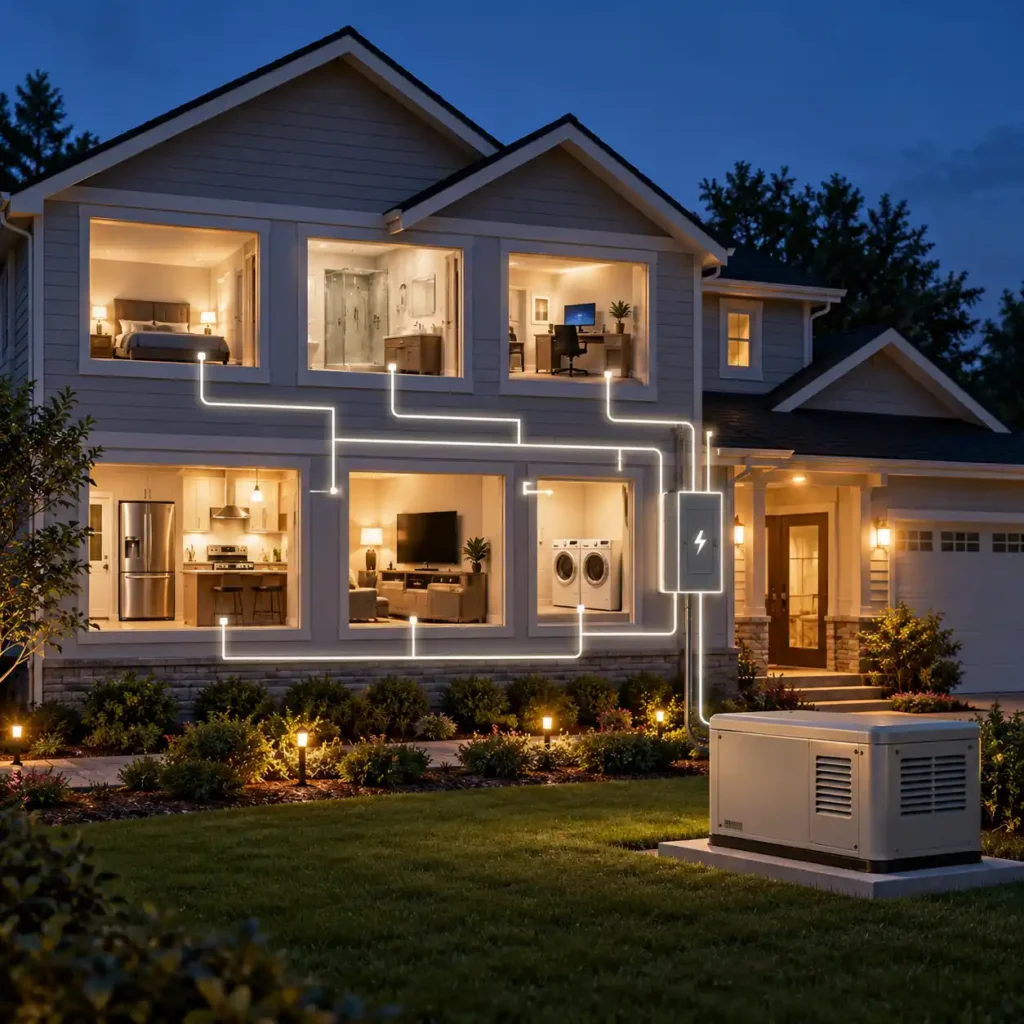
Table of Contents
Quick Answer
There is no single wattage that applies to every house.
The required backup power depends on the appliances and electrical systems you want to operate, which loads can run simultaneously, and whether any of them have significant startup demand.
A basic whole-house running-load calculation is:
Total Running Load = Σ (Running Watts × Quantity)
For example, assume the selected loads are:
- refrigerator: 200W;
- lighting and selected outlets: 400W;
- well pump: 900W;
- central AC: 3,000W.
If all four loads are operating simultaneously:
200W + 400W + 900W + 3,000W = 4,500W
For a deeper explanation of how electrical loads translate into energy use over time, see our guide to Power Consumption Formula.
The simultaneous running load is therefore approximately 4.5kW.
That is only the continuous portion of the calculation.
If the well pump or air conditioner has a higher starting requirement, the backup system may also need additional short-duration surge capability.
For example, if a 900W pump requires 2,400W while starting, its additional startup demand is:
2,400W − 900W = 1,500W
If the other loads are already operating when the pump starts, the temporary demand could reach approximately:
4,500W + 1,500W = 6,000W
This example illustrates why simply adding every starting-watt figure together can produce a misleading result. The relevant peak depends on which loads are already running and which loads start during the same event.
The calculator below is designed to make those relationships easier to evaluate.
Whole House Load Calculator
Use the calculator to build a list of the household loads you want to evaluate during a power outage.
Enter:
- Appliance or Load
- Running Watts
- Starting Watts
- Quantity
- Hours per Day
The calculator estimates:
- total running load;
- potential startup demand;
- daily energy consumption;
- the combined load represented by the selected appliances.
| Appliance or Load | Running Watts | Starting Watts | Quantity | Hours/Day |
|---|---|---|---|---|
| Refrigerator | 200W | 600W | 1 | 8 |
| Lighting | 400W | 400W | 1 | 6 |
| Well Pump | 900W | 2,400W | 1 | 2 |
| Central AC | 3,000W | 7,000W | 1 | 4 |
Your Estimated Load
Total Running Load: calculated from the running wattage and quantity entered.
Potential Starting Demand: estimated by adding the highest additional starting demand to the total running load. This simplified calculation assumes that the largest startup event occurs while the other selected loads are already running.
This is a planning estimate. Multiple motors or compressors may start at the same time, which can produce a higher short-term demand
Daily Energy Use: estimated from running wattage, quantity, and expected operating time.
The result is a planning estimate, not a guarantee of actual household demand.
For important loads, replace any generic or estimated wattage with the value provided by the manufacturer or measured under representative operating conditions.
Whole House Load Calculator
Use the calculator to build a list of the household loads you want to evaluate during a power outage.
| Appliance or Load | Running Watts | Starting Watts | Quantity | Hours/Day | |
|---|---|---|---|---|---|
Your Estimated Load
* The result is a planning estimate. For important loads, verify actual specifications on appliance labels.
How to Use the Whole House Load Calculator
The accuracy of the result depends largely on the quality of the information entered.
Step 1: Decide What You Want to Power
First determine the backup scenario you are evaluating.
A true whole-house scenario may include:
- central air conditioning;
- heating equipment;
- electric water heating;
- refrigerator and freezer;
- electric range;
- clothes dryer;
- washing machine;
- well pump;
- sump pump;
- pool equipment;
- lighting;
- computers and networking equipment;
- entertainment equipment;
- EV charging;
- other major electrical loads.
You do not necessarily need to include every device connected to every outlet.
For example, if several small phone chargers are normally connected but consume only a few watts each, they may have little effect on the overall load compared with a central AC compressor or electric water heater.
The purpose is to create a realistic operating scenario, not simply the longest possible list of electrical devices.
Step 2: Find the Running Wattage
Running watts describe the approximate electrical power required while an appliance is operating.
The preferred sources are:
- manufacturer specifications;
- the appliance nameplate;
- the owner’s manual;
- measured power consumption.
If a device lists voltage and current instead of watts, a basic calculation is:
Watts = Volts × Amps
However, this is not always an exact representation of real power for AC equipment. Motors and some electronic loads can have power-factor characteristics that make apparent power different from real power.
For significant household loads, use the manufacturer’s electrical specifications whenever they are available.
Step 3: Identify Starting Watts
Starting demand matters primarily for equipment that contains motors or compressors.
Examples include:
- refrigerators and freezers;
- central air conditioners;
- heat pumps;
- well pumps;
- sump pumps;
- pool pumps;
- furnace blowers;
- other motor-driven equipment.
If the manufacturer provides both running and starting wattage, enter those values.
If an appliance has no meaningful startup surge — for example, many resistive heating loads or basic lighting — its starting value may be the same as its running value for a simplified calculation.
Do not assume that a generic “2×” or “3×” multiplier is accurate for every motor. Starting characteristics vary considerably by equipment design.
Step 4: Enter Quantity
If several identical appliances or loads may operate simultaneously, enter the appropriate quantity.
For example, if three devices each require 150W:
150W × 3 = 450W
Their combined running contribution is approximately 450W.
For motor loads, however, quantity alone does not tell you the peak startup requirement. You also need to consider whether those units can start at the same time.
Step 5: Enter Expected Operating Time
Hours per day are used to estimate energy consumption, not instantaneous power demand.
The basic relationship is:
Energy (Wh) = Power (W) × Time (hours)
A 1,500W appliance operating for two hours would therefore use approximately:
1,500W × 2 hours = 3,000Wh
or:
3kWh
For appliances that cycle on and off, such as refrigerators and air conditioners, the entered operating time should represent the expected equivalent operating time rather than automatically assuming the appliance draws its rated running wattage continuously for the entire period.
Running Watts vs. Starting Watts
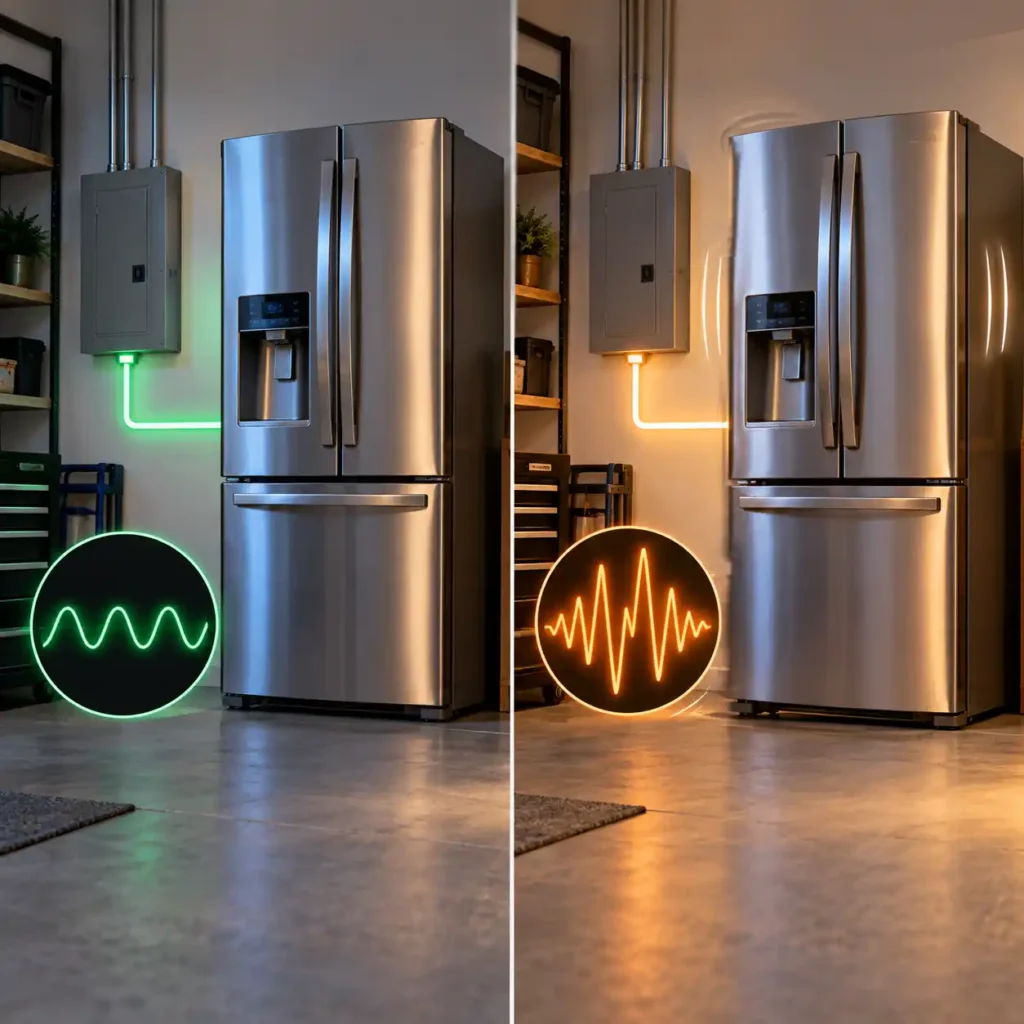
One of the most important distinctions in backup-power planning is the difference between running watts and starting watts.
Running Watts
Running watts represent the power required by the loads that are operating normally.
| Load | Running Watts |
|---|---|
| Refrigerator | 200W |
| Lighting | 400W |
| Well Pump | 900W |
| Central AC | 3,000W |
| Total | 4,500W |
The home therefore has an estimated simultaneous running load of 4.5kW under this scenario.
Starting Watts
Starting watts are different because some equipment requires a temporary increase in power when a motor or compressor starts. The additional starting demand can be estimated by subtracting running watts from starting watts. For individual appliances, you can use our Appliance Wattage Calculator to estimate running watts, starting watts, and energy use before adding them to a whole-house load estimate.
Suppose the well pump in the example above requires:
- 900W running
- 2,400W starting
The additional startup requirement is:
2,400W − 900W = 1,500W
The 2,400W figure should not simply be added on top of the entire 4,500W running load as though the pump’s 900W operating requirement did not already exist.
Instead, if the pump starts while the other selected loads are already operating, the temporary demand would be approximately:
4,500W + 1,500W = 6,000W
This distinction between starting watts and additional starting watts is important when interpreting generator and inverter specifications.
Why You Should Not Automatically Add Every Startup Surge
Suppose a home has:
- refrigerator;
- well pump;
- sump pump;
- central AC.
Each may have a significant startup demand.
It would be overly conservative to assume that all four motors necessarily start at exactly the same moment unless the specific system or operating scenario makes that possible.
A more useful planning approach is to identify:
- the loads expected to operate simultaneously;
- the largest relevant startup event;
- whether multiple loads can realistically start together;
- the continuous and surge ratings of the backup equipment.
Current backup-power calculators commonly use this scenario-based approach rather than simply summing every possible motor surge.
How to Calculate a Whole-House Load
Once the load list is complete, calculate the household demand in layers rather than reducing everything to one number.
1. Calculate the Simultaneous Running Load
Add the running watts of the loads that may operate together:
Running Load = Σ (Running Watts × Quantity)
For example:
- refrigerator: 200W;
- lighting: 400W;
- well pump: 900W;
- central AC: 3,000W.
Running Load = 4,500W
2. Identify the Relevant Startup Event
Next, determine which selected load could create the largest additional startup requirement.
If the well pump starts at 2,400W but normally runs at 900W:
Additional Startup Demand = 2,400W − 900W = 1,500W
The resulting scenario becomes:
4,500W + 1,500W = 6,000W
This does not mean that 6,000W will be consumed continuously. It represents a higher temporary demand under the stated startup scenario.
3. Evaluate the Backup Equipment Separately
The calculated household load is not automatically the same thing as the size of the generator, inverter, or battery system you should purchase.
The backup equipment has its own specifications, including:
- continuous/rated output;
- surge or peak output;
- voltage;
- output configuration;
- operating limitations;
- installation requirements.
For example, a power station may have enough stored battery energy but an inverter that cannot deliver the required surge. Conversely, a generator may have sufficient peak output but insufficient continuous capacity for the selected loads.
The load calculation therefore establishes the electrical demand that the backup system needs to handle. Equipment selection comes afterward.
Why Simultaneous Loads Matter

A home’s maximum theoretical connected load can be much higher than the load that normally occurs at one time.
Consider a house with:
- 3,000W central AC;
- 4,500W electric water heater;
- 5,000W electric range;
- 5,000W clothes dryer;
- 900W well pump;
- 600W general household loads.
Simply adding everything produces:
19,000W
But that does not prove the house continuously requires 19kW during an outage.
The dryer may not be operating while the range is in use. The water heater may cycle. The well pump may run only intermittently. The AC compressor may cycle according to indoor temperature.
This is why a useful whole house load calculator should model the loads you actually expect to operate rather than treating every nameplate rating as a simultaneous continuous demand.
Whole-House Backup vs. Essential-Load Backup
This distinction becomes even more important when planning for an outage.
A whole-house backup scenario attempts to preserve normal household operation, potentially including major loads such as HVAC, electric water heating, cooking equipment, and laundry.
An essential-load scenario prioritizes selected systems such as:
- refrigeration;
- lighting;
- communications;
- heating or cooling;
- sump or well pumps;
- medical equipment;
- selected outlets.
Reducing the number of simultaneous high-power loads can dramatically change the required backup output.
Neither approach is universally correct. The appropriate scenario depends on the home’s equipment, the expected outage conditions, and which loads need to remain operational.
Power Demand vs. Energy Consumption
Watts and watt-hours should not be treated as interchangeable.
Watts (W) describe power demand at a given point in time.
Watt-hours (Wh) describe energy used over a period of time.
For example, a 2,000W appliance operating for three hours would consume approximately:
2,000W × 3 hours = 6,000Wh
or:
6kWh
This distinction is critical for battery backup.
A battery system needs enough output power to operate the household loads and enough stored energy to keep them operating for the required duration.
For example, a battery could have enough stored energy in Wh for several hours but still fail to operate a large HVAC compressor if its inverter cannot supply the required starting demand.
Conversely, an inverter may be powerful enough to operate the selected loads but the battery may not contain enough usable energy for a long outage.
The whole-house load calculation therefore answers one part of the backup-power question:
How much electrical power might the selected household loads require?
The next question is how long that load must be supported and how much usable battery energy or fuel capacity is required.
How to Read the Whole House Load Calculator Results
The calculator provides three primary figures: total running load, potential peak starting load, and estimated daily energy use.
Each number answers a different planning question.
Total Running Load
Total running load represents the combined power required by the loads entered into the calculator while they are operating normally.
For example, if the selected loads require:
- Refrigerator: 200W
- Lighting: 400W
- Well pump: 900W
- Central AC: 3,000W
the combined running load is:
200W + 400W + 900W + 3,000W = 4,500W
That is a 4.5kW running load under this particular scenario.
This does not mean the home continuously consumes 4.5kW. Some appliances cycle on and off, while others may not operate at the same time.
For backup-power planning, the important question is therefore not simply how much equipment exists in the home, but which loads need to operate simultaneously during an outage.
Potential Peak Starting Load
Some electrical loads require additional power when their motors start.
Refrigerators, well pumps, sump pumps, air conditioners, furnaces, and other motor-driven equipment can have a higher starting demand than their normal running wattage.
The calculator therefore considers the largest additional starting demand among the selected loads rather than automatically adding every starting-watt figure together.
This provides a more useful planning estimate for situations in which one major motor starts while the other selected loads are already operating.
The result should still be treated as an estimate. Actual startup behavior depends on the equipment, motor characteristics, controls, operating conditions, and the power source.
Why Simultaneous Loads Matter

A house may contain many electrical appliances without all of them operating at the same moment.
During an outage, however, several important loads may overlap.
For example, a refrigerator may be running while lighting is on and a well pump starts. If the central air conditioner also starts at that moment, the electrical system must be capable of handling the resulting demand.
This is why simply adding every appliance’s maximum wattage can produce an unrealistic result.
A more practical planning approach is to identify:
- the loads that must operate continuously or routinely;
- the loads that may operate at the same time;
- motor-driven loads with significant starting demand;
- loads that can be delayed, switched off, or managed during an outage.
Load management can therefore change the amount of backup capacity required without changing the electrical equipment installed in the home.
Use Actual Appliance Wattage Whenever Possible
Generic wattage values are useful when creating an initial estimate, but they should not replace the manufacturer’s specifications when those specifications are available.
Check the appliance:
- nameplate;
- owner’s manual;
- manufacturer specifications;
- measured operating power, where practical.
If you need help determining actual electrical consumption from wattage and operating time, see our guide on How to Calculate Power Consumption.
Pay particular attention to equipment with motors or compressors.
A refrigerator, well pump, central air conditioner, or other motor-driven appliance may have substantially different running and starting characteristics from a generic example.
For a serious backup-power installation, replace estimated values in the calculator with the actual specifications for the equipment you intend to operate.
Whole House Load vs. Essential Loads
A whole-house load calculation does not necessarily mean that every electrical device in the home must operate simultaneously during an outage.
There is an important distinction between:
Whole-house planning
The calculation considers a broad selection of household loads that could potentially operate during an outage.
Essential-load planning
The calculation focuses on the appliances and circuits that are actually necessary during the outage.
For example, a homeowner may decide that refrigeration, lighting, internet equipment, a well pump, and heating or cooling are priorities, while an electric dryer, EV charger, or other high-demand appliance can remain off.
For example, a homeowner may decide that refrigeration, lighting, internet equipment, a well pump, and heating or cooling are priorities, while an electric dryer, EV charger, or other high-demand appliance can remain off. FEMA’s power outage guidance recommends prioritizing the appliances and devices you need during an outage because a generator may not be able to power all appliances at one time.
This distinction can significantly change the required backup-power capacity. If the backup system uses a battery rather than a generator, the next step is to determine how much stored energy is required. Our Battery Capacity Calculator can help estimate battery size in watt-hours and amp-hours.
Account for Load Management

Load management can reduce simultaneous demand by preventing selected high-power appliances from operating at the same time.
For example, a backup-power system may prioritize essential loads while temporarily preventing a lower-priority appliance from operating when a large motor load starts.
This can be particularly relevant when a home has several high-demand systems, such as:
- central air conditioning;
- electric water heating;
- well or sump pumps;
- electric ranges;
- clothes dryers;
- EV charging.
The objective is not necessarily to power every load simultaneously. Instead, the goal may be to maintain the loads that matter most while controlling or scheduling larger secondary loads.
Do Not Size Backup Power From Square Footage Alone
Home size can provide context, but square footage does not determine the home’s actual electrical demand by itself.
Two homes with the same floor area can have very different electrical loads.
One may use:
- gas heating;
- a gas water heater;
- a gas range;
- a smaller air-conditioning system.
Another home of the same size may have:
- electric resistance heating;
- an electric water heater;
- an electric range;
- multiple HVAC systems;
- an EV charger;
- a well pump.
The second home can therefore require substantially more backup capacity.
For this reason, a load-based calculation is more informative than choosing generator or backup capacity solely from the home’s square footage.
Current whole-house sizing tools similarly emphasize the actual outage load rather than treating home size as the primary sizing variable.
Common Whole House Load Calculation Mistakes
Adding Every Starting Watt Together
One of the most common mistakes is adding the starting wattage of every motor-driven appliance to the total running load.
This can dramatically overstate a realistic peak if those appliances do not start simultaneously.
A better planning approach is to identify the largest additional startup demand and consider which loads are realistically operating at the same time.
Using the Adapter Rating as Continuous Consumption
The electrical rating printed on a power supply or appliance does not necessarily represent the amount of power the equipment continuously consumes.
Where possible, use the appliance’s documented operating power or a representative measurement.
Forgetting 240V Loads
Some major household loads operate on 240V rather than standard 120V circuits.
Examples can include certain:
- central air-conditioning systems;
- electric water heaters;
- electric dryers;
- ranges;
- well pumps;
- EV chargers.
When evaluating a whole-house backup system, verify that the selected power source is compatible with the voltage and connection requirements of the loads you intend to operate.
Assuming the Calculator Is an Electrical Code Calculation
An online calculator is useful for backup-power planning, but it should not automatically be treated as a code-compliant residential load calculation.
Professional electrical load calculations may involve service characteristics, demand factors, circuit requirements, equipment ratings, and applicable local requirements.
Some current calculators explicitly distinguish planning estimates from professional or code-based electrical calculations.
How to Improve the Accuracy of Your Estimate

For a more useful result, work through the calculator in several passes.
First, create the initial load list.
Enter the appliances and electrical systems you expect to use during an outage.
Next, replace generic values.
Use manufacturer specifications or measured values whenever available.
Then, review simultaneous operation.
Ask which loads can realistically operate at the same time.
Finally, examine the largest startup event.
Identify equipment with substantial motor-starting demand and determine whether your backup system can accommodate that event while other selected loads are operating.
This process produces a more defensible planning estimate than simply entering every appliance in the house and adding all of its maximum ratings.
When You Need a Professional Load Calculation
The Whole House Load Calculator is intended for preliminary backup-power planning.
A qualified electrician should evaluate the installation when you are selecting or installing equipment that connects to the home’s electrical system, particularly for a permanent standby generator, transfer equipment, service changes, or other significant electrical modifications.
A professional can evaluate the actual electrical installation, applicable requirements, transfer equipment, conductors, load-management strategy, and equipment compatibility.
The calculator can help you understand the scale of the load you are trying to support, but it should not be treated as a substitute for an electrical design or required professional load calculation.
Once you know the loads you need to support, you can compare Best Whole House Backup Power Systems that are designed for broader home backup applications.
Quick Takeaway
The most useful whole-house backup-power estimate is based on the loads you actually expect to operate, not simply the size of the home.
Use the calculator to:
- identify the total running load;
- identify the largest additional starting demand;
- estimate daily energy consumption;
- distinguish essential loads from non-essential loads;
- evaluate which appliances may operate simultaneously;
- replace generic wattage values with actual equipment specifications.
The resulting figure is a planning estimate. Before purchasing or installing a permanent backup-power system, verify the actual electrical requirements and installation requirements for your home and equipment.