
Choosing a portable power station starts with two different questions:
- How much power do your devices need at the same time?
- How much energy do they need over the time you want to run them?
Those questions are related, but they are not the same.
A power station’s continuous output, measured in watts (W), determines whether it can operate your devices at the same time. Its battery capacity, measured in watt-hours (Wh), determines how long it can keep those devices running before the battery needs to be recharged.
Our Power Station Size Calculator estimates both requirements from your devices, running time, quantity, system efficiency, reserve, and startup demand.
For loads with motors or compressors, such as refrigerators and pumps, the calculator also helps distinguish normal running power from temporary startup demand.

Table of Contents
Quick Answer
The right power station size depends on both power output and battery capacity.
You need enough continuous watts (W) to run your devices at the same time, enough surge or startup power to handle temporary increases from motors and compressors, and enough watt-hours (Wh) to supply the required energy for the time you need.
The basic energy calculation is:
Energy Required (Wh) = Device Power (W) × Runtime (hours)
For multiple devices:
Total Energy (Wh) = Σ [Running Watts × Quantity × Hours of Use]
The required battery capacity must then account for system losses and the amount of reserve you want to keep.
For example, if your devices consume a combined 300W and you need to operate them for 8 hours:
300W × 8h = 2,400Wh
That does not mean you should automatically buy a 2,400Wh power station. Some of the station’s rated capacity is lost during power conversion, and you may not want to discharge the battery to its absolute limit.
At the same time, the station must have enough continuous output to handle the 300W load. If one of the devices is a refrigerator, pump, or other motor-driven appliance, its startup demand must also be checked separately.
This is why sizing a power station requires three numbers, not one:
- Continuous output (W)
- Startup or surge capability (W)
- Battery capacity (Wh)
Power Station Size Calculator
Use the calculator to estimate the minimum power station specifications needed for your planned load.
Calculator Inputs
The calculator accepts:
- Device or Appliance
- Running Watts (W)
- Starting Watts (W), if applicable
- Quantity
- Hours of Use
- Number of Days
- Inverter/System Efficiency
- Battery Reserve
Calculator Results
The calculator returns:
Total Running Load
The combined running power of the selected devices.
Estimated Peak Starting Demand
The estimated short-term power requirement when the largest additional startup demand occurs while the other selected loads are already running.
Daily Energy Use
The estimated watt-hours consumed during the selected daily operating period.
Required Energy Capacity
The estimated battery capacity needed after accounting for system losses and the selected reserve.
Recommended Power Station Size
A practical capacity target that can be compared with real power station specifications.
What the Calculator Tells You
A power station has two primary specifications that shoppers often confuse:
Power output tells you what the station can run.
Battery capacity tells you how long it can run it.
For example, consider two hypothetical power stations:
- 1,000Wh / 500W
- 1,000Wh / 1,800W
Both have approximately the same stored energy, but they do not have the same ability to operate high-power appliances.
The 500W model may be adequate for:
- phones;
- laptops;
- lights;
- routers;
- small electronics.
The 1,800W model can handle substantially higher instantaneous loads, assuming the appliance’s startup requirements are also within the station’s surge capability.
Now reverse the comparison:
- 2,000Wh / 500W
- 1,000Wh / 1,800W
The first station stores more energy but may still be unable to power a 1,200W appliance because its inverter output is too low.
The second can power the appliance but has less stored energy and may therefore run out sooner.
This is the central principle behind the Power Station Size Calculator:
You must match both the station’s output rating and its battery capacity to your actual load.
Watts vs. Watt-Hours: Why You Need Both
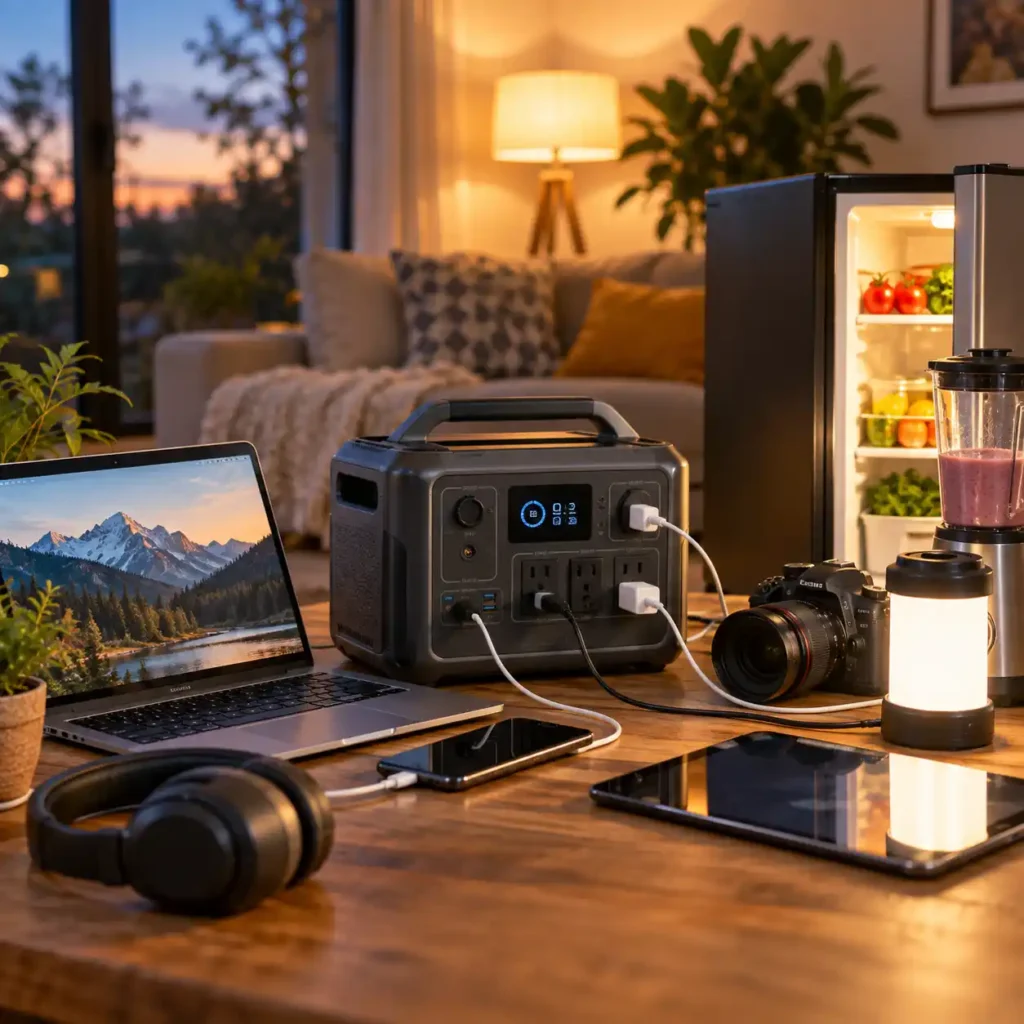
The distinction between watts and watt-hours is fundamental to power station sizing.
Watts (W)
Watts measure power at a given moment.
If a laptop draws 60W while operating, its instantaneous power requirement is approximately 60W.
If you run:
- laptop — 60W
- monitor — 40W
- LED light — 10W
the combined running load is:
60W + 40W + 10W = 110W
Your power station therefore needs a continuous output rating above this combined load.
Watt-Hours (Wh)
Watt-hours measure energy used over time.
A 100W device running for 5 hours consumes:
100W × 5h = 500Wh
A 50W device running for 10 hours also consumes:
50W × 10h = 500Wh
The power requirement is different, but the energy consumption is the same.
That is why a power station can be described using both:
W = how much power it can deliver
Wh = how much energy it stores
You need both values to size a station correctly.
How the Power Station Size Calculator Works
The calculator follows a sequence rather than applying one arbitrary multiplier to the total wattage.
Step 1: Calculate Your Running Load
Start by making a realistic list of what you actually need to power.
For a short power outage, for example, you might choose:
- refrigerator;
- Wi-Fi router;
- LED lights;
- phone chargers;
- laptop.
You do not necessarily need to include every electrical appliance in the house.
This is one of the biggest advantages of using a dedicated power station sizing calculator: you can calculate the system around your actual priority loads rather than buying based on a generic capacity recommendation.
This approach is consistent with the U.S. Department of Energy’s guidance to identify critical loads and determine how much power is needed to keep essential systems operating during an outage.
Suppose your simultaneous running loads are:
- Refrigerator: 150W
- Wi-Fi router: 15W
- LED lights: 40W
- Laptop: 60W
- Phone chargers: 20W
The total running load is:
150W + 15W + 40W + 60W + 20W = 285W
Your power station therefore needs a continuous AC output comfortably above 285W.
However, this is only the first part of the calculation.
If the refrigerator has a compressor startup surge, the station also needs sufficient surge capability to start it.
Step 2: Calculate Daily Energy Use
Once you know the running load, determine how long each device will actually operate.
The basic formula is:
Energy (Wh) = Power (W) × Time (hours)
For multiple devices:
Daily Energy Use = Σ (Running Watts × Quantity × Hours/Day)
Consider this example:
- Laptop: 60W × 5h = 300Wh
- Router: 15W × 10h = 150Wh
- LED lighting: 40W × 6h = 240Wh
- Phone charging: 20W × 2h = 40Wh
Total:
300Wh + 150Wh + 240Wh + 40Wh = 730Wh/day
The station therefore needs to deliver approximately 730Wh of usable energy for this load profile before accounting for conversion losses and reserve.
This is different from simply multiplying the maximum simultaneous load by 24 hours.
A device that is rated at 1,000W does not necessarily consume 1,000W continuously throughout the day.
That distinction becomes particularly important for refrigerators, pumps, heating equipment, and other cycling or intermittent loads.
Step 3: Account for Inverter and System Losses
The energy stored in a power station’s battery does not all reach an AC appliance.
When the station supplies AC power, the battery’s DC energy passes through an inverter. The conversion process consumes some energy.
There can also be losses associated with:
- internal electronics;
- DC conversion;
- wiring;
- battery management;
- operating conditions.
Therefore, the usable energy available to your appliances can be lower than the headline Wh rating printed on the power station.
A simplified planning formula is:
Required Rated Capacity = Required Load Energy ÷ System Efficiency
For example, if your appliances require 800Wh and you use an assumed overall efficiency of 90%:
800Wh ÷ 0.90 = 889Wh
This means a station rated around 900Wh would be the mathematical minimum under that assumption, before adding any additional planning reserve.
The actual efficiency of a power station depends on the model, load, output type, battery condition, temperature, and operating mode. For that reason, the calculator should treat efficiency as a planning assumption, not a universal constant.
Step 4: Add a Practical Capacity Reserve
Sizing exactly to the calculated minimum can leave very little margin.
Real-world energy consumption may be higher than expected because:
- appliance wattage varies;
- refrigerators cycle differently;
- temperatures change;
- batteries age;
- inverter efficiency varies with load;
- additional devices may be connected;
- the outage may last longer than expected.
A reserve therefore provides practical headroom.
A 20% planning reserve means adding 20% to the calculated capacity requirement; it does not mean keeping exactly 20% of the battery unused.
For example, if your calculated requirement after efficiency losses is 900Wh, a 20% planning reserve would produce:
900Wh × 1.20 = 1,080Wh
You could therefore look for a power station around the 1,000–1,200Wh class, depending on the manufacturer’s usable-capacity specifications.
The important point is that a reserve should be applied deliberately.
It should not be stacked repeatedly on top of other conservative assumptions, because doing so can unnecessarily inflate the recommended capacity.
Step 5: Check Startup and Surge Power
Battery capacity alone does not determine whether a power station can start an appliance.
Motors and compressors can require a temporary increase in power when they start.
Common examples include:
- refrigerators;
- freezers;
- sump pumps;
- well pumps;
- compressors;
- some power tools;
- certain air conditioners.
For an appliance with known running and starting ratings:
Additional Starting Demand = Starting Watts − Running Watts
For example:
Refrigerator
- Running: 150W
- Starting: 600W
Additional startup demand:
600W − 150W = 450W
If the other selected loads are already consuming 200W, the estimated peak demand during that startup event would be:
200W + 600W = 800W
The station therefore needs enough surge capability to handle approximately 800W under this simplified scenario.
This is different from adding the 600W starting figure on top of the refrigerator’s 150W running demand as though they were separate loads.
The starting rating is the total temporary demand of that appliance, not an additional permanent load.
For individual appliances, our Appliance Wattage Calculator can be used to estimate running watts, starting watts, and energy use before adding the device to a power station sizing calculation.
How Many Watt-Hours Do You Need?
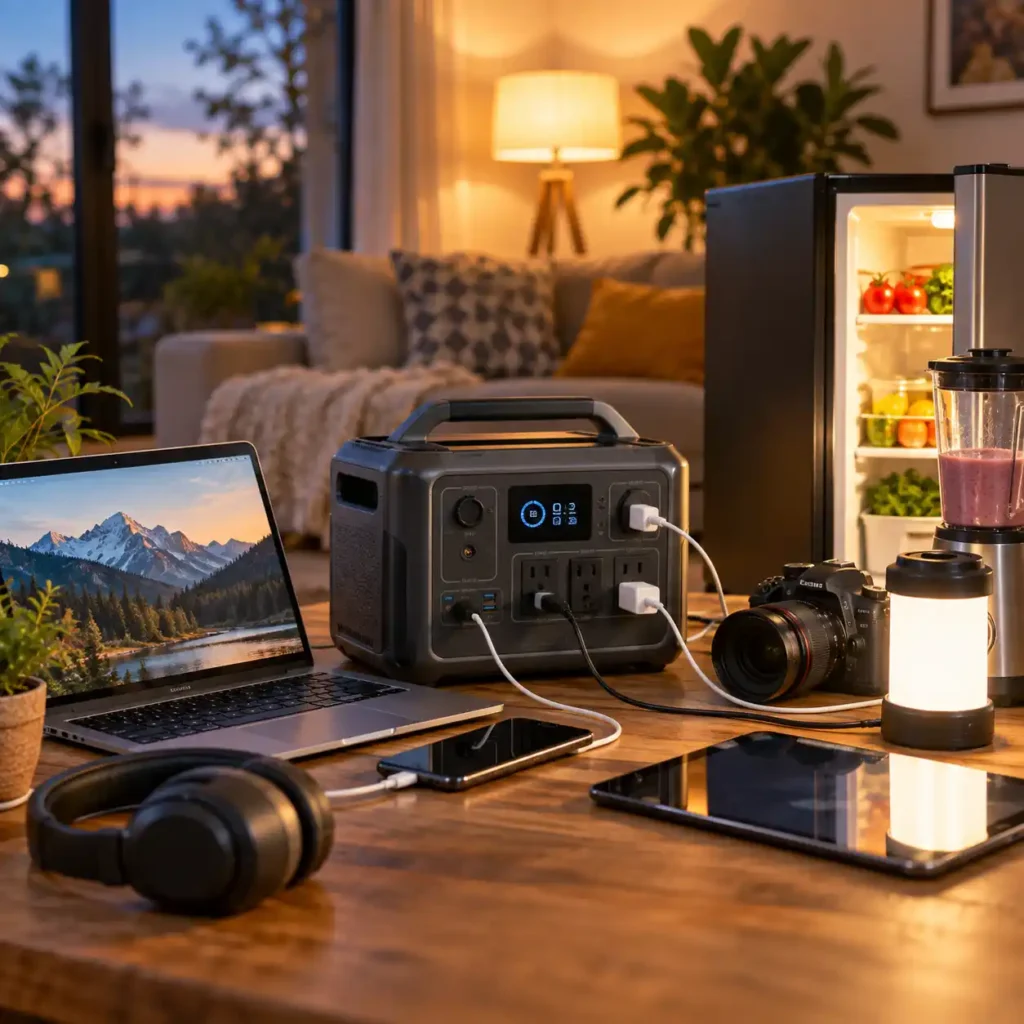
Once you know how much energy your devices use each day, the next question is how many days you want the power station to support them before recharging.
The basic calculation is:
Required Energy = Daily Energy Use × Number of Days
For example, if your selected devices consume 730Wh per day and you want enough stored energy for two days:
730Wh × 2 = 1,460Wh
This is the energy requirement before accounting for system losses and your selected reserve.
If the calculator uses a 90% system-efficiency assumption, the corresponding rated capacity would be:
1,460Wh ÷ 0.90 = 1,622Wh
If you then apply a 20% planning reserve:
1,622Wh × 1.20 = 1,946Wh
If you plan to recharge the power station with solar during an extended outage, use our Solar Charging Time Calculator to estimate how long replenishment may take.
The result suggests a power station in the 2,000Wh class subject to the manufacturer’s published usable capacity and output specifications.
This illustrates why two people can need very different power station sizes even when they use the same devices.
A person who needs 730Wh for one day has a very different capacity requirement from someone who needs the same load for three days.
How Many Watts Does Your Power Station Need?
Battery capacity is only half of the sizing decision.
You also need to check the power station’s continuous AC output.
Add the running watts of all devices that may operate simultaneously:
Continuous Load = Σ (Running Watts × Quantity)
For example:
- Refrigerator: 150W
- Laptop: 60W
- Router: 15W
- LED lighting: 40W
- Phone chargers: 20W
Total:
150W + 60W + 15W + 40W + 20W = 285W
A power station rated for only 200W continuous output would be too small for this load, even if its battery contained enough watt-hours for the required runtime.
A station with a continuous output comfortably above the calculated load provides more practical operating headroom.
The important distinction is:
Wh determines how long the station can supply energy.
W determines how much power the station can deliver at one time.
A power station must satisfy both requirements.
Power Station Size Examples
The following examples illustrate how the same power station can be suitable for one application but inadequate for another.
Example 1: Laptop, Router, and Lighting
Suppose you need:
- Laptop: 60W for 5 hours
- Router: 15W for 10 hours
- LED lighting: 40W for 6 hours
Energy use:
60W × 5h = 300Wh
15W × 10h = 150Wh
40W × 6h = 240Wh
Total:
690Wh/day
The simultaneous running load is:
60W + 15W + 40W = 115W
This means the power station needs enough capacity for approximately 690Wh of daily energy, after accounting for efficiency and reserve, while its continuous output needs to exceed the 115W simultaneous load.
This load profile can typically be handled by a compact power station, provided its continuous output and usable capacity meet the calculated requirements.
Example 2: Refrigerator and Essential Electronics
Now consider a backup setup with:
- Refrigerator: 150W
- Router: 15W
- LED lighting: 40W
- Laptop: 60W
The simultaneous running load is:
150W + 15W + 40W + 60W = 265W
But the refrigerator may require significantly more power when its compressor starts.
If its documented starting demand is 600W, the station must be able to accommodate that startup event while the other selected loads are operating.
The energy requirement also depends on how long the refrigerator compressor actually runs during the day.
A refrigerator rated at 150W does not necessarily consume:
150W × 24 hours = 3,600Wh/day
because its compressor normally cycles rather than running continuously.
For this type of load, measured energy consumption or a realistic duty-cycle estimate can produce a better capacity estimate than simply multiplying the nameplate running watts by 24 hours.
This is one reason refrigerator backup deserves its own Refrigerator Runtime Calculator when the appliance is the primary load.
Example 3: Higher-Power Appliances
Consider a different setup:
- Microwave: 1,200W
- Laptop: 60W
- Router: 15W
- Lighting: 40W
The simultaneous load is:
1,200W + 60W + 15W + 40W = 1,315W
A 1,000W power station would not be suitable for this combination, regardless of whether it had a large battery.
A station with a continuous output above the calculated load would be required.
However, the microwave may only operate for a few minutes.
This creates an important distinction:
A high-wattage appliance can have a major effect on the required inverter output without consuming a large amount of total energy.
For example, a 1,200W microwave operating for 10 minutes consumes approximately:
1,200W × 0.167h ≈ 200Wh
So the appliance has a high power requirement but a relatively modest energy requirement when used briefly.
What Size Power Station Do You Need for Common Uses?
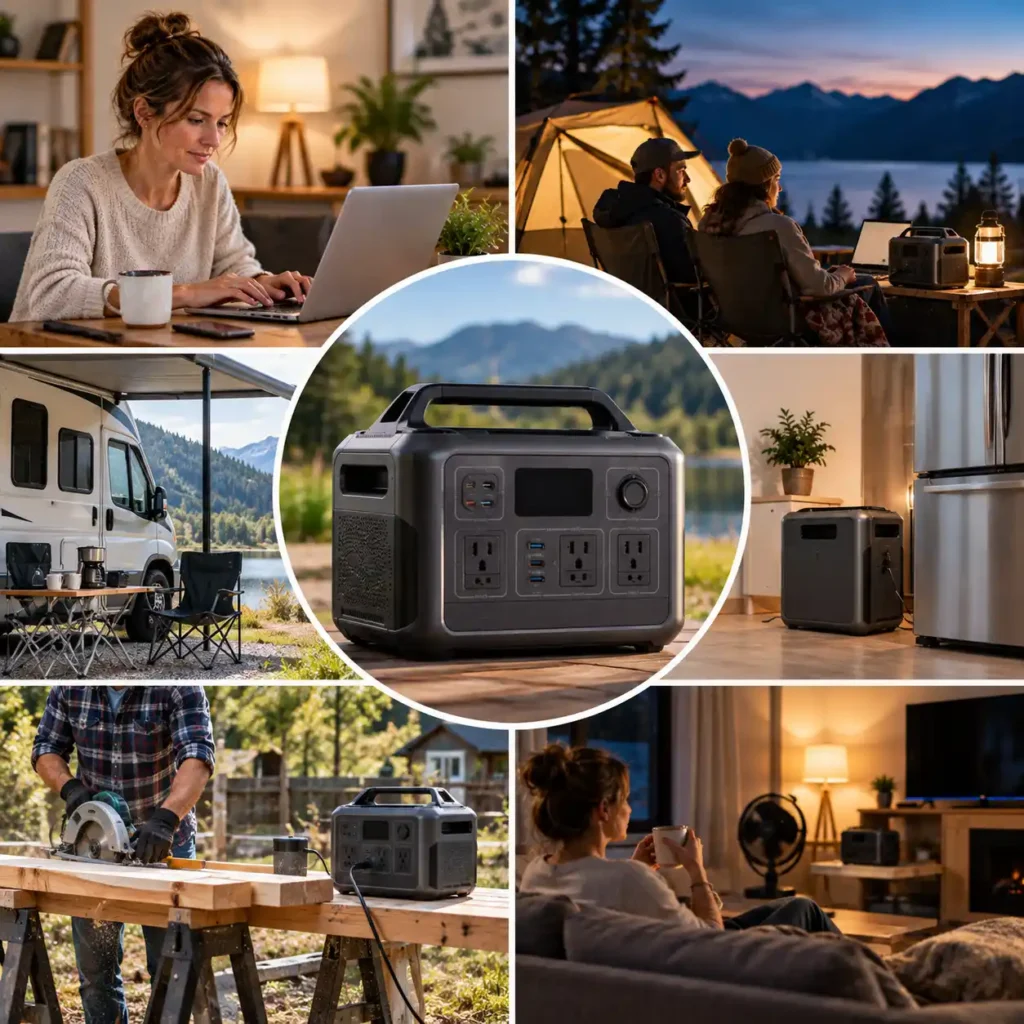
There is no single power station size that is correct for every user.
The required capacity depends on the actual devices, operating time, and number of days between recharges.
| Use Case | Typical Loads | Approx. Capacity Range | Output Consideration | Important Factor |
|---|---|---|---|---|
| Phones, lights, small electronics | Phones, LED lights, small USB devices | 200–500Wh | 300W+ | Low energy demand |
| Camping and remote work | Laptop, lights, phones, router | 500–1,000Wh | 500W+ | Daily energy use |
| CPAP and essential electronics | CPAP, phones, lights, router | 500–1,000Wh | 300–500W+ | Actual CPAP consumption |
| Refrigerator and essentials | Refrigerator, router, lights, electronics | 1,000–2,000Wh+ | 1,000W+ | Compressor startup and duty cycle |
| Higher-power appliances | Microwave, coffee maker, power tools | 1,000Wh+ | 1,500–2,000W+ | Continuous and surge output |
These ranges are only starting points. Actual requirements can vary substantially depending on appliance wattage, operating time, battery capacity, efficiency, and whether the devices are used simultaneously.
For an exact estimate, use the Power Station Size Calculator with your actual loads rather than choosing a capacity from a generic size chart.
Power Station Capacity vs. Usable Capacity
The number printed on a power station is its rated battery capacity, but that does not necessarily mean every watt-hour will be available to your AC appliances.
For example, a station may be advertised as having 1,000Wh of battery capacity.
The energy actually available at the connected load can be lower because of:
- inverter losses;
- internal conversion losses;
- battery management limits;
- operating temperature;
- discharge characteristics;
- the manufacturer’s battery-management strategy;
- the output type being used.
This is why the calculator uses an efficiency assumption rather than treating the rated Wh number as perfectly usable energy.
When comparing real power stations, check how the manufacturer defines the published capacity and whether the specification refers to nominal battery capacity or usable output energy.
Do not automatically apply the same loss factor twice.
If a manufacturer’s documentation already provides a tested usable-energy figure for the relevant output path, that information may be more useful than applying a generic efficiency assumption.
Why Appliance Wattage Estimates Can Be Wrong
The wattage printed on an appliance is not always the same as the power it consumes continuously.
Depending on the device, the published value may represent:
- rated power;
- maximum power;
- nominal operating power;
- charger output;
- motor power;
- or another specification.
Actual consumption can change with operating conditions.
For example, a refrigerator may consume very little while its compressor is off and substantially more while the compressor is operating.
A laptop may draw less than its maximum charger rating when the battery is already charged.
A television can consume different amounts depending on brightness and operating mode.
For the most accurate sizing, use measured consumption whenever practical.
A plug-in power meter can be useful for AC appliances because it measures actual electrical consumption rather than relying entirely on the device’s maximum rating.
For appliance-level estimates, the Appliance Wattage Calculator can help estimate running watts, starting watts, and energy use before entering the load into the power station calculator.
How to Make Your Power Station Last Longer
If your calculated capacity is close to the available power station sizes, reducing energy consumption can sometimes be more practical than buying a much larger unit.
Several strategies can extend runtime.
Reduce unnecessary loads
Turn off devices that are not essential during the outage.
A router, refrigerator, medical device, lighting, and communication equipment may have a higher priority than entertainment devices or other nonessential loads.
Avoid unnecessary standby consumption
Chargers and electronics can continue to consume electricity even when the connected device is not actively being used.
Disconnect loads that do not need to remain powered.
Use efficient lighting
LED lighting generally requires much less power than older incandescent lighting.
Use DC or USB outputs when appropriate
Some portable power stations can power USB or DC devices without using the AC inverter.
Avoiding unnecessary DC-to-AC-to-DC conversion can reduce conversion losses for compatible devices.
The exact benefit depends on the power station and the device, so the manufacturer’s specifications remain the best source for actual efficiency.
Reduce simultaneous high-power loads
If a microwave, coffee maker, hair dryer, or other high-wattage appliance is only needed occasionally, avoid running it at the same time as another large load when practical.
This can reduce the required instantaneous output rating.
When a Power Station Is Too Small
A power station can be too small in several different ways.
The battery capacity is too low
The station may successfully operate your devices but run out of energy before the required runtime is complete.
The continuous output is too low
The battery may contain enough energy, but the inverter cannot deliver enough power to operate the connected devices simultaneously.
The surge rating is too low
The station may handle the normal running load but shut down when a motor or compressor starts.
The usable capacity is lower than expected
The advertised Wh rating may not translate directly into the energy available to your appliances.
This is why choosing a power station based only on its Wh rating can lead to an incorrect purchase decision.
Common Power Station Sizing Mistakes
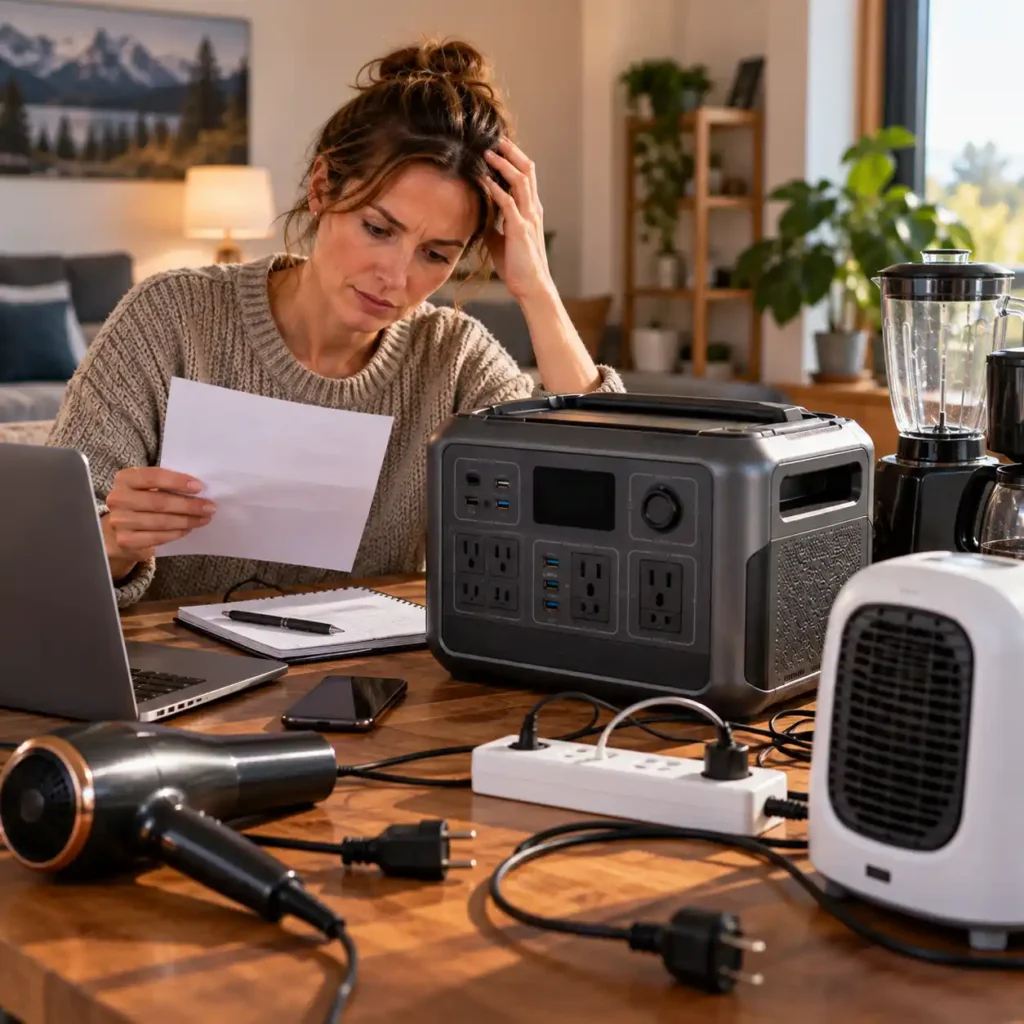
Choosing a power station by Wh alone
A large battery does not guarantee a sufficiently powerful inverter.
Always check Wh and W together.
Choosing by continuous watts alone
The opposite mistake is buying a powerful inverter with too little battery capacity.
A station may run a 1,500W appliance perfectly but exhaust its battery quickly.
Adding all starting watts together
Startup demand should not automatically be calculated by adding every appliance’s starting-watt rating.
The important question is which loads are operating when the largest startup event occurs.
For a simplified planning estimate:
Estimated Peak Starting Demand = Total Running Load + Highest Additional Starting Demand
where:
Additional Starting Demand = Starting Watts − Running Watts
This approach avoids double-counting an appliance’s normal running power.
Assuming every appliance runs at its rated wattage continuously
This can substantially overestimate energy use for cycling loads such as refrigerators.
Ignoring runtime
A 500W load running for one hour uses:
500Wh
The same load running for eight hours uses:
4,000Wh
Runtime is therefore just as important as wattage when determining battery capacity.
Buying exactly the calculated minimum
Real-world conditions are variable.
A modest planning reserve can provide useful headroom for estimation errors, changing loads, temperature, battery aging, and longer-than-expected outages.
Double-counting efficiency and reserve
If the calculation already accounts for usable capacity or manufacturer-provided losses, do not automatically subtract the same losses again.
The goal is a realistic estimate, not the largest possible number.
Power Station Size Calculator vs. Battery Capacity Calculator
These calculators are related, but they answer different questions.
A Power Station Size Calculator asks:
What combination of battery capacity and output should I look for to operate my specific devices?
It combines:
- running watts;
- simultaneous loads;
- runtime;
- startup demand;
- system efficiency;
- reserve;
- and number of days.
A Battery Capacity Calculator focuses more directly on determining the required battery energy capacity and converting between electrical capacity units such as watt-hours and amp-hours.
For example, if you already know that a system needs 1,500Wh, a Battery Capacity Calculator can help you determine the corresponding battery requirements for a specified voltage.
If you do not yet know what size portable power station you need, the Power Station Size Calculator is the more appropriate starting point.
Frequently Asked Questions
What size power station do I need?
The right power station size depends on three numbers: continuous output in watts, surge output in watts, and battery capacity in watt-hours. First calculate the devices you need to run at the same time, then calculate how much energy they will use over your required runtime. The power station should meet the resulting wattage, startup demand, and Wh requirements.
How many watts do I need in a portable power station?
Add the running watts of all devices you expect to use simultaneously. The power station’s continuous output should be higher than this combined load. You also need enough surge output for appliances with motors or compressors, such as refrigerators, pumps, and some power tools.
How many watt-hours do I need in a power station?
Your required watt-hours depend on how much energy your devices consume and how long you need to run them. Calculate the daily energy use of your loads, multiply it by the number of days, then account for system losses and a practical reserve. A higher Wh rating generally provides longer runtime, but it does not increase the station’s maximum power output.
Is a 500Wh power station enough?
A 500Wh power station can be suitable for relatively low-power loads such as phones, LED lights, small electronics, and some laptops. Whether it is enough depends on the actual wattage of your devices, how many you use at once, and how long you need them to run. A 500Wh battery may be inadequate for high-power appliances or extended backup periods.
Is a 1,000Wh power station enough?
A 1,000Wh power station can be enough for many camping, remote-work, and short-duration backup situations, but there is no universal answer. The usable energy is lower than the nominal battery rating after conversion losses, and the required output in watts must also match your devices.
Is a 2,000Wh power station enough for home backup?
A 2,000Wh power station can provide useful backup for essential loads such as a refrigerator, router, lights, phones, and other low-power electronics. However, the actual runtime depends on the average load, inverter efficiency, reserve, and refrigerator duty cycle. Larger loads or multi-day outages may require substantially more capacity.
Can a portable power station run a refrigerator?
Yes, provided the power station has enough continuous output, startup or surge capability, and usable battery capacity. Refrigerator compressors can require substantially more power when starting than while running, so checking only the refrigerator’s running wattage can lead to an undersized power station.
How long will a 1,000Wh power station last?
Runtime depends on the average load rather than the battery rating alone. As a basic planning method, divide the usable battery capacity by the average power draw in watts. In practice, inverter losses, battery reserve, operating conditions, and changing appliance loads reduce the runtime compared with a simple nominal Wh ÷ W calculation.
How long will a 2,000Wh power station last?
A 2,000Wh power station can provide very different runtimes depending on the load. For example, a relatively small continuous load may run for many hours, while a 1,000W appliance can consume the available energy much faster. Use the station’s usable capacity and the average load—not just the advertised 2,000Wh rating—to estimate runtime.
What can a 1,000W power station run?
A 1,000W power station can run devices whose combined continuous demand stays within its inverter output rating, subject to startup requirements. It may handle laptops, lights, routers, televisions, and some kitchen appliances, but a device rated near or above 1,000W may leave little or no headroom for other loads.
What is the difference between watts and watt-hours on a power station?
Watts measure how much power the station can deliver at a given moment, while watt-hours measure how much energy its battery stores. For example, a 100W load running for five hours consumes approximately 500Wh before accounting for system losses. You need enough watts to run your devices and enough watt-hours to run them for the required time.
Do I need to consider surge watts when sizing a power station?
Yes. Surge capability is important for appliances that draw extra power when starting, particularly refrigerators, freezers, pumps, compressors, and some power tools. The required peak output should account for the largest startup event while the other selected loads are still operating.
Can a portable power station run a whole house?
A portable power station can support selected essential household loads, but it should not automatically be treated as a whole-house backup system. The required capacity and output depend on the appliances you want to run simultaneously. For a complete household load assessment, use our Whole House Load Calculator. Running an entire home—including high-demand electric heating, central air conditioning, electric water heating, or other large loads—usually requires a much larger permanently installed backup system rather than a typical portable power station.
Final Takeaway
The right Power Station Size Calculator result is not a single number.
A properly sized portable power station must meet three separate requirements:
1. Continuous output (W)
Enough inverter power to operate the devices you need simultaneously.
2. Startup or surge capability (W)
Enough temporary output to start motors, compressors, and other loads with higher startup demand.
3. Battery capacity (Wh)
Enough stored energy to operate the selected loads for the required amount of time.
The basic sizing process is:
Running Watts → Daily Wh → Efficiency Losses → Reserve → Required Capacity
while startup-capable appliances require a separate:
Running Watts → Additional Starting Demand → Estimated Peak Starting Demand
The best way to avoid overbuying or undersizing is to calculate your actual loads rather than choosing a power station from a generic capacity recommendation.
Use the Power Station Size Calculator to estimate the watts and watt-hours your specific setup requires, then compare that result with the manufacturer’s continuous output, surge rating, and published battery capacity before choosing a model.