
The Power Consumption Formula is the mathematical foundation used to determine how much electrical power a device requires and how much energy it consumes over a specific period. It is the standard calculation behind electricity usage estimates, battery runtime projections, portable power station sizing, generator planning, solar energy calculations, and utility cost estimates.
Rather than relying on assumptions, the formula converts measurable electrical values—such as voltage, current, power, and operating time—into objective energy calculations. Understanding these relationships makes it easier to compare appliances, estimate electricity demand, interpret calculator results, and verify whether a power system is appropriately sized for the intended load.
This reference explains the core power consumption formulas, defines every variable and measurement unit, clarifies when each equation should be used, and documents the calculations performed by our Power Consumption Calculator. It is intended as a technical reference for interpreting results accurately rather than a step-by-step beginner’s tutorial.
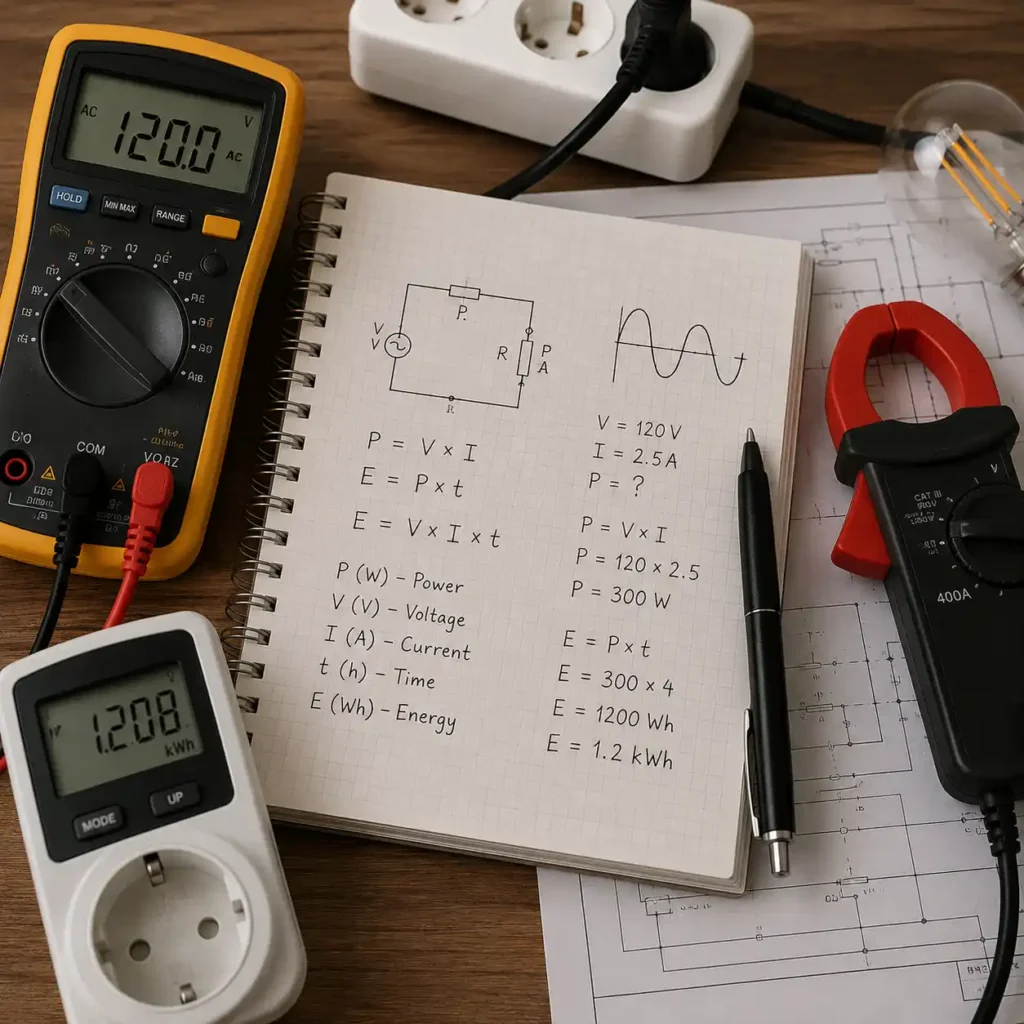
Table of Contents
Quick Answer
The power consumption formula calculates the amount of electrical power a device uses based on measurable electrical values. For most DC circuits and resistive AC loads, electrical power is calculated by multiplying voltage by current:
Power (W) = Voltage (V) × Current (A)
To determine energy consumption over time, multiply the device’s power by its operating duration:
Energy (Wh) = Power (W) × Time (h)
These equations are the industry-standard foundation for estimating electricity usage, battery runtime, generator sizing, portable power station capacity, solar energy production, and operating costs. Our Power Consumption Calculator applies these formulas automatically, allowing you to calculate accurate power and energy requirements without performing manual calculations.
What Is the Power Consumption Formula?
The power consumption formula is a mathematical equation used to calculate the electrical power required by a device or the amount of electrical energy it consumes during operation. It establishes the relationship between fundamental electrical quantities—including voltage, current, power, and time—to produce measurable, repeatable results.
In electrical engineering, these formulas provide a standardized method for evaluating energy demand across residential, commercial, and industrial applications. They are widely used when designing electrical systems, estimating electricity costs, sizing generators, selecting portable power stations, calculating battery runtime, and planning solar energy installations.
Although several power consumption equations exist, each serves a different purpose depending on the available measurements and the type of calculation being performed. Some formulas determine instantaneous electrical power, while others calculate total energy consumption over a specified operating period. Selecting the appropriate equation is essential for obtaining accurate results.
The sections below document the most commonly used power consumption formulas, explain when each should be applied, and describe the variables used in every calculation.
Power Consumption Formula Reference
The following equations represent the most widely used formulas for calculating electrical power and energy consumption. Each equation is designed for a specific calculation scenario and should be selected according to the electrical values available.
| Formula | Purpose | Typical Application |
|---|---|---|
| P = V × I | Calculates electrical power from voltage and current. | DC circuits, resistive AC loads, appliance power calculations. |
| P = I² × R | Calculates power using current and electrical resistance. | Circuit analysis when current and resistance are known. |
| P = V² ÷ R | Calculates power using voltage and resistance. | Electrical heating elements, resistive loads, circuit design. |
| E = P × t | Calculates energy consumption over time. | Electricity usage, battery runtime estimates, utility cost calculations. |
| E = V × I × t | Calculates energy directly from voltage, current, and operating time. | Electrical engineering calculations and energy analysis. |
Each equation produces a different electrical value and should not be used interchangeably. If you’re applying these calculations to portable battery equipment, our Best Portable Power Stations for Home Backup (2026) guide explains how power output and battery capacity affect real-world backup performance.
Power (W) describes the rate at which electricity is consumed at a given moment, whereas Energy (Wh or kWh) represents the total amount of electricity consumed over a period of time. Understanding this distinction is essential for interpreting calculation results correctly and selecting the appropriate formula for a specific application.
For additional information about how electricity, watts, watt-hours, and kilowatt-hours are defined and measured, see the official guidance published by the U.S. Energy Information Administration (EIA), the U.S. government’s primary source for national energy information.
Formula Variables Explained
The following variables are used throughout the power consumption formulas presented in this guide. Understanding what each symbol represents is essential for performing accurate electrical calculations and interpreting calculator results correctly.
| Symbol | Meaning | Unit | Description |
|---|---|---|---|
| P | Power | Watts (W) | The rate at which electrical energy is consumed or produced. |
| V | Voltage | Volts (V) | The electrical potential difference that drives current through a circuit. |
| I | Current | Amperes (A) | The flow of electric charge through a conductor. |
| R | Resistance | Ohms (Ω) | The opposition to the flow of electrical current. |
| E | Energy | Watt-hours (Wh) or Kilowatt-hours (kWh) | The total amount of electricity consumed over a period of time. |
| t | Time | Hours (h) | The duration for which electrical power is used. |
Each variable represents a measurable electrical quantity with internationally recognized SI units. Maintaining consistent units throughout a calculation is essential for obtaining accurate results. For example, power should be expressed in watts (W), voltage in volts (V), current in amperes (A), and time in hours (h) when calculating energy consumption in watt-hours (Wh).
How to Use the Power Consumption Formula
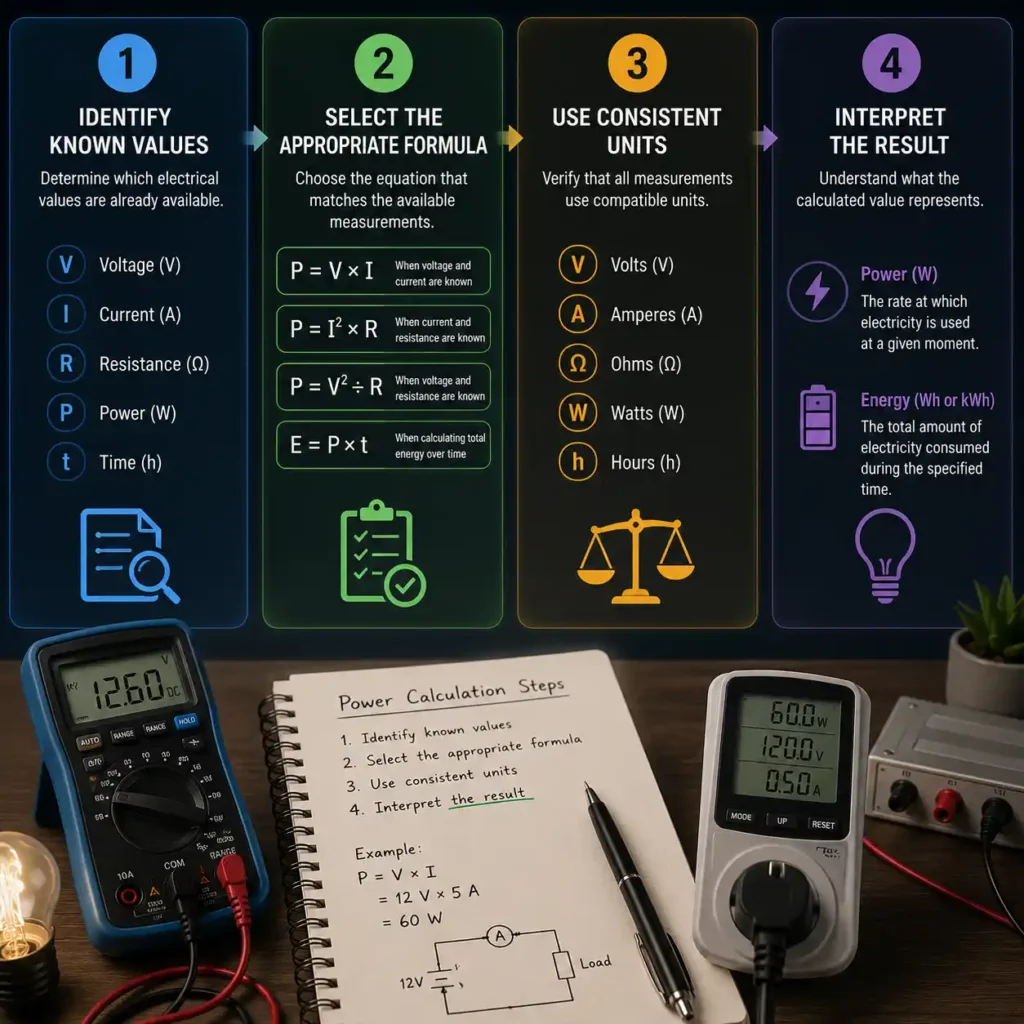
Using the power consumption formula requires identifying the electrical values available and selecting the equation that matches those measurements. Depending on the information provided, you may calculate electrical power, estimate total energy consumption, or determine electricity usage over a specific operating period.
In most everyday situations, the calculation follows four simple steps:
1. Identify the Known Values
Determine which electrical values are already available, such as:
- Voltage (V)
- Current (A)
- Resistance (Ω)
- Power (W)
- Operating Time (h)
These values are typically listed on an appliance nameplate, power supply, battery specifications, user manual, or manufacturer documentation.
2. Select the Appropriate Formula
Choose the equation that corresponds to the available measurements.
For example:
- P = V × I when voltage and current are known.
- P = I² × R when current and resistance are known.
- P = V² ÷ R when voltage and resistance are known.
- E = P × t when calculating total energy consumption over time.
Using the correct equation ensures the calculation is both accurate and meaningful.
3. Use Consistent Units
Before performing the calculation, verify that all measurements use compatible units.
- Voltage → Volts (V)
- Current → Amperes (A)
- Resistance → Ohms (Ω)
- Power → Watts (W)
- Time → Hours (h)
If units are inconsistent—for example, minutes instead of hours or milliamps instead of amperes—they should be converted before applying the formula.
4. Interpret the Result
The calculated value represents either:
- Electrical Power (W) — the rate at which electricity is being used at a given moment.
- Energy Consumption (Wh or kWh) — the total amount of electricity consumed during the specified operating time.
Understanding the difference between these two results is essential when estimating battery runtime, sizing a generator or portable power station, calculating electricity costs, or evaluating appliance energy efficiency.
💡 Practical Tip
For everyday calculations, manual arithmetic is usually unnecessary. Our Power Consumption Calculator automatically applies the appropriate equation based on the values you enter, reducing the risk of conversion errors and producing consistent, accurate results within seconds.
Practical Power Consumption Calculation Examples
The following examples demonstrate how the most common power consumption formulas are applied in real-world situations. Each scenario uses realistic electrical values to illustrate how power and energy consumption are calculated for everyday appliances.
Example 1: Calculating Power from Voltage and Current
Suppose a portable electric heater operates at 120 volts and draws 12.5 amperes of current.
Using the standard electrical power equation:
P = V × I
Substituting the known values:
- Voltage = 120 V
- Current = 12.5 A
Calculation:
P = 120 × 12.5 = 1,500 W
The heater consumes 1,500 watts (1.5 kW) while operating.
Example 2: Calculating Energy Consumption
A portable refrigerator consumes 60 watts and runs continuously for 24 hours.
Using the energy consumption formula:
E = P × t
Known values:
- Power = 60 W
- Operating Time = 24 h
Calculation:
E = 60 × 24 = 1,440 Wh
Converting to kilowatt-hours:
1,440 Wh ÷ 1,000 = 1.44 kWh
The refrigerator consumes approximately 1.44 kWh of electricity during one day of continuous operation.
Example 3: Estimating Battery Runtime
A portable power station has a usable battery capacity of 1,024 Wh.
A laptop continuously consumes 80 W.
Estimated runtime:
Runtime = Battery Capacity ÷ Power Consumption
Calculation:
1,024 Wh ÷ 80 W = 12.8 hours
Under ideal conditions, the battery could power the laptop for approximately 12.8 hours. Actual runtime will typically be lower because of inverter losses, battery efficiency, temperature, and load variations. For a practical comparison of battery capacities around this range, see our Best 1000Wh Portable Power Stations (2026) guide, which compares portable power stations based on capacity, output, charging performance, and real-world usability.
Example 4: Estimating Daily Electricity Cost
An appliance uses 500 watts and operates for 5 hours each day.
Daily energy consumption:
500 × 5 = 2,500 Wh
Converted to kilowatt-hours:
2.5 kWh
If electricity costs $0.18 per kWh, the estimated daily operating cost is:
2.5 × 0.18 = $0.45 per day
These examples demonstrate how the same group of formulas can be used to calculate electrical power, estimate energy consumption, predict battery runtime, and approximate operating costs. Although the calculations are straightforward, manually converting units and selecting the correct equation can introduce errors. The Power Consumption Calculator performs these calculations automatically, ensuring consistent units and accurate results across a wide range of electrical applications.
Common Applications of the Power Consumption Formula
Although the underlying equations remain the same, the power consumption formula is used across a wide range of residential, commercial, and off-grid applications. Understanding where these calculations are applied helps users interpret results more effectively and select the appropriate equipment for their specific energy requirements.
| Application | How the Formula Is Used | Typical Goal |
|---|---|---|
| Portable Power Stations | Estimate battery runtime for connected devices. | Select the correct battery capacity. |
| Solar Power Systems | Calculate daily energy production and expected electrical output. | Size solar panels appropriately. |
| Home Backup Power | Determine the total electrical load during a power outage. | Select an appropriately sized backup system. |
| Generators | Calculate running and starting power requirements. | Choose a generator with sufficient capacity. |
| Household Appliances | Estimate electricity usage for individual devices. | Reduce energy consumption and operating costs. |
| Battery Systems | Estimate expected runtime based on battery capacity and electrical load. | Predict backup duration. |
| Electricity Bills | Estimate daily or monthly energy consumption. | Forecast electricity costs more accurately. |
| RV & Camping | Calculate off-grid power requirements for portable equipment. | Plan reliable mobile power systems. |
The same electrical principles apply in each of these situations. Whether you are estimating appliance energy usage, selecting a generator, sizing a portable power station, planning a solar installation, or calculating battery runtime, the power consumption formula provides a consistent and reliable method for evaluating electrical demand and making informed energy decisions. If you’re using these calculations to choose a fuel-powered backup solution, our Best Portable Generators (2026) guide compares generator options for different power requirements and backup scenarios.
For more detailed guidance on choosing the right battery-powered solution for your household, explore our Best Home Battery Backup Systems (2026) guide, which compares residential battery systems designed to provide reliable backup power during outages.
Common Power Consumption Calculation Mistakes

Even simple electrical calculations can produce incorrect results if the wrong formula, units, or measurements are used. The following mistakes are among the most common when estimating power consumption and energy usage.
| Common Mistake | Why It Happens | Correct Approach |
|---|---|---|
| Confusing power with energy | Watts (W) and watt-hours (Wh) are often treated as the same measurement. | Remember that watts measure power, while watt-hours and kilowatt-hours measure energy consumed over time. |
| Using inconsistent units | Mixing minutes with hours or milliamps with amperes leads to incorrect calculations. | Convert all values to compatible SI units before performing any calculation. |
| Selecting the wrong formula | Different formulas apply depending on which electrical values are known. | Choose the equation that matches the available measurements, such as voltage and current or power and time. |
| Ignoring efficiency losses | Real electrical systems are not 100% efficient. | Consider inverter efficiency, battery losses, and conversion losses when estimating real-world performance. |
| Rounding values too early | Early rounding can accumulate noticeable calculation errors. | Keep full precision during calculations and round only the final result. |
Avoiding these common mistakes improves calculation accuracy and helps ensure that battery runtime estimates, electricity cost projections, generator sizing, and portable power station calculations reflect realistic operating conditions. When using our Power Consumption Calculator, these issues are minimized because the calculator automatically applies the appropriate formulas and maintains consistent units throughout the calculation process.
Frequently Asked Questions About the Power Consumption Formula
The following questions address some of the most common topics people search for when learning how to calculate electrical power, estimate energy consumption, compare appliance efficiency, and understand electricity usage. These answers complement the information provided above and clarify practical scenarios that are not covered in the main sections of this guide.
Does higher wattage always mean higher electricity consumption?
Not necessarily. A higher-wattage appliance uses more electrical power while operating, but total energy consumption also depends on how long the appliance runs. For example, a 2,000-watt space heater used for 30 minutes may consume less electricity than a 100-watt light bulb left on continuously for an entire day. Both power rating and operating time determine total energy usage.
Can two appliances with the same wattage consume different amounts of electricity?
Yes. Two appliances with the same power rating can consume different amounts of energy if they operate for different lengths of time or follow different duty cycles. For example, two 1,000-watt appliances will have different daily energy consumption if one runs for one hour and the other operates for four hours.
Why is actual power consumption sometimes lower than the rated power?
Many electrical devices do not operate at their maximum rated power continuously. Refrigerators, air conditioners, heat pumps, and similar appliances cycle on and off automatically. Variable-speed motors and electronic controls also adjust power draw based on demand, causing actual energy consumption to differ from the maximum rated value.
Can standby power increase my electricity bill?
Yes. Many electronic devices continue consuming small amounts of electricity even when switched off. Televisions, gaming consoles, routers, chargers, and smart home devices often draw standby power 24 hours a day. Although each device uses only a small amount of electricity, the combined annual energy consumption can become noticeable.
Which household appliances usually consume the most electricity?
Heating and cooling equipment generally account for the largest share of household electricity consumption. Electric water heaters, space heaters, central air conditioners, electric ovens, clothes dryers, and EV chargers are typically among the highest energy-consuming appliances because they combine high power ratings with extended operating times.
Does voltage affect power consumption?
Yes. Voltage is one of the variables used to calculate electrical power. According to the formula P = V × I, changing the voltage while maintaining the same current changes the calculated power. However, many modern appliances automatically regulate their internal electrical characteristics, so actual power consumption depends on the appliance design rather than voltage alone.
Is a power consumption calculator more accurate than manual calculations?
A calculator is not inherently more accurate than the underlying formulas, but it significantly reduces the chance of human error. By automatically selecting the correct equation, converting units, and performing calculations consistently, a power consumption calculator provides reliable results when accurate input values are supplied.
What information do I need before calculating power consumption?
In most cases, you need the appliance’s power rating or its voltage and current. To estimate total energy consumption, you also need the operating time. These values are usually available on the appliance specification label, in the owner’s manual, or in the manufacturer’s technical documentation.
Can the power consumption formula be used for batteries, generators, and solar power systems?
Yes. The same electrical formulas are widely used when estimating battery runtime, sizing portable power stations, selecting generators, planning solar energy systems, and calculating electrical loads. Although the applications differ, the underlying relationships between power, energy, voltage, current, and operating time remain the same.
Why is understanding power consumption important?
Understanding power consumption helps you estimate electricity costs, compare appliance efficiency, reduce unnecessary energy usage, select appropriately sized backup power equipment, and make informed purchasing decisions. It also makes it easier to interpret electrical specifications and evaluate the results produced by energy calculators.
Final Thoughts
The power consumption formula provides a standardized method for calculating electrical power, estimating energy usage, and understanding how electricity is consumed by appliances and electrical systems. Whether you are evaluating household devices, estimating battery runtime, sizing a portable power station, selecting a generator, or planning a solar energy system, these calculations form the basis of informed energy decisions.
By understanding the relationship between voltage, current, power, energy, and operating time, you can interpret electrical specifications more accurately, compare equipment objectively, and estimate electricity consumption with greater confidence. If you’re using these calculations to plan residential energy storage, our Best Home Battery Backup Systems (2026) guide compares home battery systems designed to provide reliable backup power during outages.
For faster and more convenient calculations, use our Power Consumption Calculator, which automatically applies the appropriate formulas, performs unit conversions, and generates accurate results without manual calculations.
To continue learning about electrical power calculations, explore our related guides covering battery runtime, generator sizing, solar energy calculations, appliance wattage, and portable power systems.