
Whether you’re choosing a portable power station, sizing a backup generator, planning an off-grid solar system, or preparing your home for the next power outage, one question comes before every decision: how much electricity do you actually need?
Knowing your power consumption is the foundation of every reliable backup power system. Without accurate calculations, it’s easy to buy equipment that’s too small to run your essential appliances—or spend hundreds of dollars more than necessary on capacity you’ll never use. A simple mistake in estimating electrical load can lead to overloaded inverters, shortened battery runtime, unexpected generator shutdowns, or critical devices losing power when you need them most.
The good news is that calculating power consumption isn’t as complicated as it might seem. Once you understand a few basic electrical concepts—such as watts, watt-hours, kilowatt-hours, and appliance running power—you can accurately estimate the energy requirements of almost any device, from refrigerators and CPAP machines to RV equipment and whole-home backup systems.
In this guide, you’ll learn how to calculate power consumption step by step using simple formulas, practical examples, and real-world scenarios. You’ll also find a free Power Consumption Calculator, appliance wattage references, and expert tips to help you estimate electrical loads with confidence.
By the end of this guide, you’ll know how to calculate the power requirements of individual appliances, estimate total household energy usage, choose the right battery or generator capacity, avoid the most common sizing mistakes, and confidently plan a backup power system that matches your actual needs.

Table of Contents
Quick Answer
Calculating power consumption is simple. Multiply an appliance’s power rating (watts) by the number of hours it operates.
Formula:
Energy (Wh) = Power (W) × Time (hours)
To convert the result into kilowatt-hours:
kWh = Wh ÷ 1,000
For example, a 100 W television running for 5 hours consumes:
100 × 5 = 500 Wh = 0.5 kWh
Knowing this simple calculation allows you to estimate electricity usage, size backup power systems correctly, compare appliance energy consumption, calculate battery runtime, and avoid costly sizing mistakes.
Why Calculating Power Consumption Matters
At first glance, calculating power consumption may seem unnecessary. However, knowing exactly how much electricity your appliances use is one of the most important steps when choosing any backup power solution.
Whether you’re selecting a portable power station, backup generator, solar panel system, or home battery, every decision depends on having an accurate estimate of your energy requirements. Without it, you’re simply guessing. If you’re specifically planning to use a battery-powered system for residential emergency backup, our Best Portable Power Stations for Home Backup (2026) guide compares the leading options for keeping essential household devices running during outages.
A proper power consumption calculation helps you:
- Choose the right size portable power station or generator.
- Estimate battery runtime for essential appliances during a power outage.
- Size a solar power system more accurately.
- Avoid overloading inverters, batteries, and generators.
- Reduce unnecessary costs by purchasing equipment that matches your actual needs.
- Plan emergency backup power with greater confidence.
Even a small error in your calculations can have real consequences. Underestimating your electrical load may leave critical appliances without power, while overestimating it often results in spending far more than necessary on oversized equipment.
Fortunately, calculating power consumption isn’t complicated. Once you understand a few basic concepts, you can accurately estimate the energy needs of almost any appliance, room, RV, or even an entire home.
What Is Power Consumption?
Power consumption refers to the rate at which an appliance, device, or system uses electrical power while operating. It’s one of the most fundamental concepts in electricity and the starting point for almost every backup power calculation. Whether you’re choosing a portable power station, sizing a backup generator, installing solar panels, or estimating your home’s energy needs, understanding power consumption allows you to make informed decisions instead of relying on rough estimates.
Every electrical device consumes power whenever it’s running. This power is measured in watts (W), which indicate the rate at which electricity is being used at a specific moment. A small LED bulb may consume only 8–12 watts, while a refrigerator typically operates between 100 and 800 watts, depending on its size and compressor cycle. High-demand appliances such as electric kettles, microwave ovens, hair dryers, and space heaters often require 1,000 to 2,000 watts or more, making them some of the largest power consumers in a typical household.
However, power consumption isn’t just about how many watts an appliance uses. It’s about understanding the electrical demand of everything you plan to power—individually and collectively. For example, a single appliance with a modest wattage may not present a challenge on its own, but running multiple devices simultaneously can quickly exceed the capacity of a battery, inverter, generator, or portable power station. This is why accurately calculating power consumption is essential before investing in any backup power solution.
Understanding power consumption also helps you answer practical questions that many homeowners, RV owners, campers, and emergency preparedness enthusiasts face every day. Can your portable power station run a refrigerator overnight? How many solar panels do you need to recharge a battery in one day? Will your generator handle both a sump pump and a microwave at the same time? How long can a home battery keep your essential appliances running during a blackout? Every one of these questions begins with the same calculation: how much power your equipment actually consumes.
Another common misconception is assuming that an appliance always uses the number of watts printed on its label. In reality, actual power consumption often varies depending on how the device operates. Refrigerators cycle on and off throughout the day, air conditioners adjust compressor speed based on temperature, and many modern electronics automatically reduce power usage when they’re idle. As a result, understanding the rated wattage is only the first step. Estimating real-world energy usage requires considering operating time, duty cycles, and startup demands—topics we’ll cover later in this guide.
Learning how power consumption works provides benefits far beyond choosing the right backup equipment. It allows you to identify energy-hungry appliances, estimate electricity costs more accurately, improve the efficiency of an off-grid solar system, and prepare for emergencies with greater confidence. Instead of guessing whether your equipment can handle the load, you’ll be able to make decisions based on real electrical requirements and reliable calculations.
Before learning how to calculate power consumption, it’s important to understand another concept that often causes confusion: the difference between power and energy. Although these terms are frequently used interchangeably, they describe two different aspects of electricity—and knowing the distinction is essential for accurate calculations throughout this guide.
Power vs. Energy: Understanding the Difference

If you’ve ever compared portable power stations, generators, solar batteries, or household electricity bills, you’ve probably seen terms like watts (W), watt-hours (Wh), and kilowatt-hours (kWh). Although they’re often used together, they don’t mean the same thing. In fact, confusing power with energy is one of the most common reasons people choose the wrong backup power equipment or miscalculate how long a battery will last.
The easiest way to understand the difference is to think of power as the rate at which electricity is being used, while energy is the total amount of electricity consumed over time.
Power answers the question:
“How much electricity is this appliance using right now?”
Energy answers a different question:
“How much electricity has this appliance used after running for a certain amount of time?”
Although these concepts are closely related, they serve different purposes when planning or sizing a backup power system.
For example, imagine a space heater rated at 1,500 watts. The 1,500 W tells you how much electrical power the heater requires while it’s operating. However, that number alone doesn’t tell you how much energy it will consume. If the heater runs for one hour, it uses 1,500 watt-hours (Wh) of energy. If it runs for three hours, it consumes 4,500 Wh, or 4.5 kWh.
This distinction becomes especially important when comparing appliances with batteries.
Suppose you’re looking at a portable power station with a battery capacity of 1,024 Wh. Many first-time buyers mistakenly compare that number directly with an appliance rated at 1,000 W, assuming the values represent the same measurement. They don’t.
The appliance’s wattage describes its instantaneous power demand, while the battery’s watt-hour rating describes its stored energy capacity. One tells you how much power is needed to operate the appliance; the other tells you how much energy is available before the battery is depleted. To estimate runtime accurately, you need both numbers.
The same principle applies when choosing a backup generator. Generator specifications are primarily based on power output, because the generator must be capable of supplying enough watts to operate all connected appliances simultaneously. Battery systems, on the other hand, are typically evaluated by both continuous power output and stored energy capacity, since they must deliver enough power while also storing enough energy to run your devices for the desired amount of time.
Understanding the difference between power and energy also helps explain why two appliances with the same wattage don’t necessarily consume the same amount of electricity over a day. A microwave oven may draw 1,200 watts, but it usually operates for only a few minutes each day. A refrigerator, by comparison, has a much lower running wattage but cycles on and off continuously over 24 hours. As a result, the refrigerator often consumes significantly more total energy despite having a lower instantaneous power demand.
A simple analogy makes this relationship even easier to understand.
Imagine filling a bucket with water. The flow rate from the faucet represents power—how quickly water is flowing at any given moment. The water collected in the bucket represents energy—the total amount accumulated over time. A fast-flowing faucet fills the bucket more quickly, but the final amount of water depends on both the flow rate and how long the faucet remains open.
Electricity works in exactly the same way.
Power determines how fast energy is being used, while time determines how much energy is ultimately consumed.
This single concept forms the foundation of every electrical calculation you’ll make throughout this guide. Whether you’re estimating battery runtime, selecting a generator, sizing a solar system, or comparing electricity costs, understanding the relationship between power, time, and energy allows you to make accurate calculations instead of relying on estimates.
Now that the difference between power and energy is clear, the next step is understanding the three units you’ll encounter in almost every calculation: watts (W), watt-hours (Wh), and kilowatt-hours (kWh). These measurements are closely connected, but each serves a different purpose when calculating electrical consumption.
Watts vs. Watt-Hours vs. Kilowatt-Hours

Once you understand the difference between power and energy, the next step is learning the three units you’ll encounter in almost every electrical calculation: watts (W), watt-hours (Wh), and kilowatt-hours (kWh).
Although these measurements are closely related, they describe different aspects of electricity. Knowing when each unit is used will help you read appliance specifications correctly, compare backup power equipment, estimate battery runtime, and better understand your electricity bill.
Watts (W): Instantaneous Power
A watt is a unit of power. It measures the rate at which electricity is being used at a specific moment.
Whenever you look at the specification label on an appliance, the wattage tells you how much power that device requires while it’s operating. For example:
- LED light bulb — 10 W
- Laptop charger — 65 W
- Television — 120 W
- Refrigerator (running) — 150–250 W
- Microwave oven — 1,200 W
- Electric kettle — 1,500 W
These numbers describe the appliance’s instantaneous electrical demand, not how much electricity it will consume over an entire day.
This distinction is important because two appliances can have the same wattage but use very different amounts of energy depending on how long they operate.
For example, a 1,500-watt electric kettle may run for only five minutes, while a 150-watt refrigerator cycles throughout the entire day. Even though the refrigerator has a much lower power rating, it often consumes more total electricity over 24 hours.
In other words, watts tell you how much power is needed right now—not how much electricity will ultimately be consumed.
Watt-Hours (Wh): Stored or Consumed Energy
A watt-hour (Wh) measures energy, not power.
It represents the amount of electricity consumed when a one-watt device operates for one hour.
Because watt-hours include both power and time, they’re widely used to describe battery capacity.
For example:
- Portable Power Station A — 512 Wh
- Portable Power Station B — 1,024 Wh
- Home Battery System — 10,240 Wh
Unlike watts, which describe demand at a single moment, watt-hours tell you how much electrical energy is available or has been used over time.
Suppose your laptop consumes 60 watts while charging.
If it remains connected for two hours, the total energy consumption is:
60 W × 2 hours = 120 Wh
This value represents the amount of energy drawn from the battery or the electrical grid during that period.
As battery capacity increases, the watt-hour value also increases, allowing devices to operate for longer before recharging becomes necessary.
Kilowatt-Hours (kWh): Household Energy Consumption
While watt-hours are commonly used for batteries and portable power stations, kilowatt-hours (kWh) are the standard unit used by utility companies to measure household electricity consumption.
One kilowatt equals 1,000 watts.
Therefore:
1 kWh = 1,000 Wh
If a 1,000-watt space heater runs continuously for one hour, it consumes 1 kWh of electricity.
If the same heater runs for five hours, it consumes 5 kWh.
This is the unit you’ll see on every residential electricity bill because it provides a convenient way to measure larger amounts of energy over days, weeks, and months.
For example, if your electricity provider charges $0.18 per kWh, and an appliance consumes 10 kWh, the operating cost would be approximately $1.80.
Understanding kilowatt-hours makes it much easier to estimate operating costs, compare appliance efficiency, and predict how much energy your household uses during normal daily activities.
How These Three Units Work Together
Although watts, watt-hours, and kilowatt-hours describe different things, they’re all part of the same calculation.
Think of them as answering three different questions:
| Unit | What It Measures | Typical Use |
|---|---|---|
| Watts (W) | Instantaneous power demand | Appliance specifications, generator output, inverter capacity |
| Watt-hours (Wh) | Energy stored or consumed | Battery capacity, portable power stations |
| Kilowatt-hours (kWh) | Large-scale energy consumption | Home electricity bills, daily and monthly energy usage |
How to Calculate Power Consumption

Calculating power consumption is much easier than it might seem. Whether you’re estimating the runtime of a portable power station, sizing a generator, planning a solar system, or simply trying to understand your electricity bill, the same basic principle applies:
Energy consumption depends on two factors:
- How much power an appliance uses (watts)
- How long it operates (hours)
By combining these two values, you can accurately estimate how much electricity an appliance consumes over any period of time.
The formula is straightforward:
Energy (Wh) = Power (W) × Time (hours)
For example, imagine you have a television rated at 100 watts.
If it runs for 5 hours, the calculation looks like this:
100 W × 5 h = 500 Wh
That means the television consumes 500 watt-hours of electrical energy.
If you want the result in kilowatt-hours, simply divide by 1,000:
500 Wh ÷ 1,000 = 0.5 kWh
This is the same unit used by utility companies when measuring household electricity usage.
The same method works for virtually every electrical device, including:
- Refrigerators
- Laptop computers
- CPAP machines
- Televisions
- Fans
- Coffee makers
- Portable heaters
- Microwave ovens
- Power tools
- Portable air conditioners
As long as you know an appliance’s wattage and approximately how long it operates, you can estimate its energy consumption with a high degree of accuracy.
However, there is one important detail to keep in mind.
The wattage printed on an appliance is often its rated power, not its actual average power consumption. Some appliances—such as refrigerators, air conditioners, heat pumps, and washing machines—cycle on and off throughout the day rather than operating continuously. Others may draw significantly more electricity for a few seconds when they first start.
Because of this, the calculated value is usually an estimate, not an exact measurement. For the most accurate results, it’s best to measure real-world power consumption using a plug-in power meter.
Even with that limitation, the formula above provides an excellent estimate for most everyday calculations and serves as the foundation for sizing batteries, generators, solar panels, and backup power systems.
The examples below show how these formulas apply to common household appliances and real backup power planning scenarios.
Real-World Power Consumption Calculation Examples
Understanding the formula is one thing—using it in real-life situations is another. The following examples demonstrate how to calculate the energy consumption of common household appliances using their power rating and operating time.
These calculations can help you estimate electricity costs, determine battery runtime, choose the right portable power station, or size a backup generator more accurately.
Example 1: Television
Suppose you have a television with a power rating of 100 watts that you watch for 5 hours each day.
Calculation:
100 W × 5 h = 500 Wh
Convert to kilowatt-hours:
500 Wh ÷ 1,000 = 0.5 kWh
Daily energy consumption: 500 Wh (0.5 kWh)
Example 2: Laptop
A laptop charger typically draws around 65 watts while charging.
If the laptop is plugged in for 8 hours, the calculation is:
65 W × 8 h = 520 Wh
Convert to kilowatt-hours:
520 Wh ÷ 1,000 = 0.52 kWh
Daily energy consumption: 520 Wh (0.52 kWh)
Example 3: Refrigerator
A refrigerator is different because the compressor doesn’t run continuously. Although the appliance may be rated at 180 watts, it cycles on and off throughout the day.
Assume the compressor operates for a total of 8 hours over a 24-hour period.
Calculation:
180 W × 8 h = 1,440 Wh
Convert to kilowatt-hours:
1,440 Wh ÷ 1,000 = 1.44 kWh
Estimated daily energy consumption: 1.44 kWh
Actual consumption varies depending on room temperature, thermostat settings, door openings, and appliance efficiency.
Example 4: Electric Space Heater
Portable electric heaters are among the highest-power household appliances.
If a 1,500-watt heater runs for 3 hours, the calculation is:
1,500 W × 3 h = 4,500 Wh
Convert to kilowatt-hours:
4,500 Wh ÷ 1,000 = 4.5 kWh
Energy consumed: 4.5 kWh
This example illustrates why space heaters can noticeably increase household electricity costs during colder months.
Example 5: Portable Power Station Runtime
Power consumption calculations are also useful for estimating battery runtime.
Suppose you have a portable power station with a battery capacity of 1,024 Wh, and you connect a 200-watt appliance.
Ignoring inverter losses for simplicity:
Runtime = 1,024 Wh ÷ 200 W = 5.12 hours
In practice, inverter efficiency and battery management reduce the available energy slightly, so the actual runtime would typically be around 4.5–5 hours.
These examples demonstrate that the same calculation works for almost any electrical device. Once you know the appliance’s wattage and its operating time, estimating energy consumption becomes straightforward.
Accurate calculations depend on using the correct power rating. Next, we’ll look at the most reliable places to find an appliance’s wattage—and what to do if it isn’t listed.
Where to Find an Appliance's Power Rating
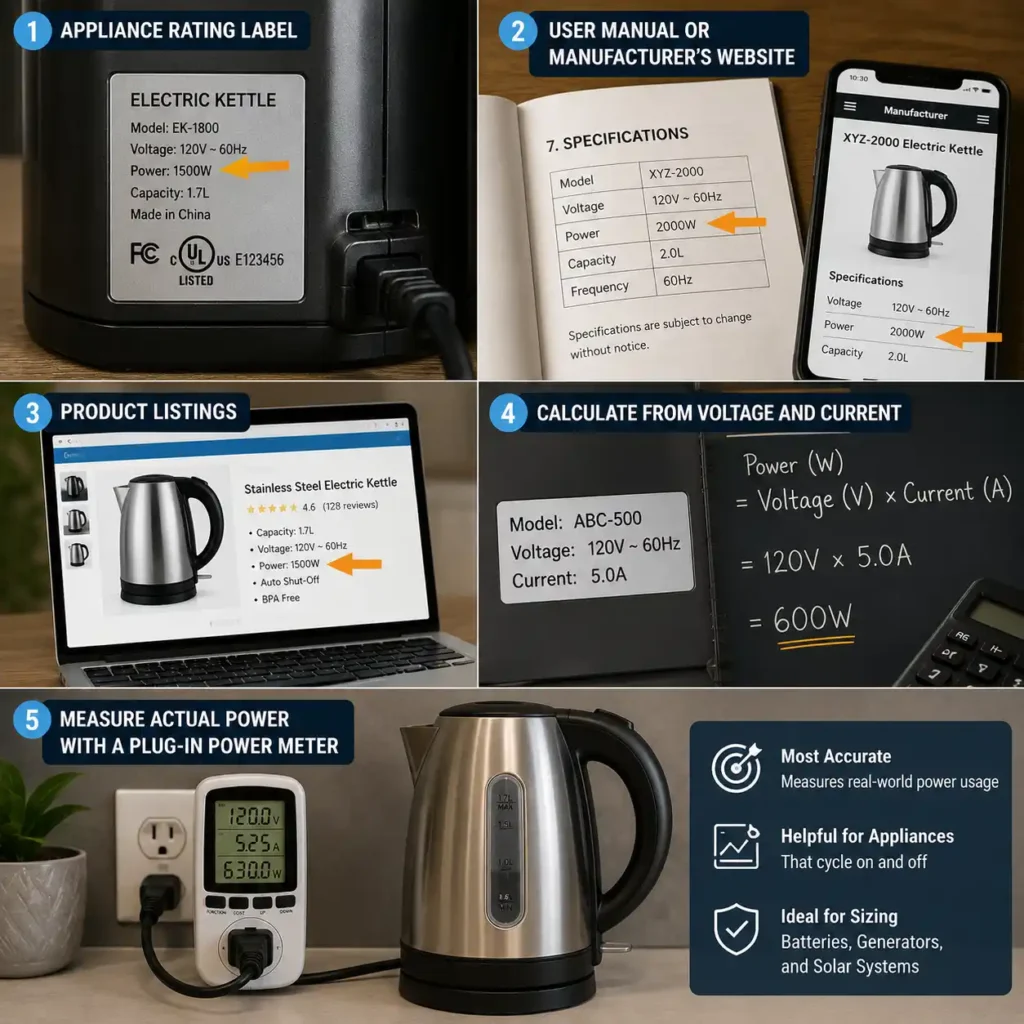
Before you can calculate power consumption, you need to know how much electricity an appliance actually uses. Fortunately, most electrical devices include this information somewhere on the product itself or in the manufacturer’s documentation.
Depending on the appliance, you can usually find the power rating in one of the following places.
1. Appliance Rating Label
The easiest and most reliable source is the rating label attached to the appliance.
It’s commonly located:
- On the back or bottom of the appliance
- Inside a refrigerator or freezer door
- Near the power cord
- On the underside of kitchen appliances
- On the manufacturer’s identification plate
The label typically includes electrical specifications such as:
- Voltage (V)
- Current (A)
- Frequency (Hz)
- Power (W)
Some labels display the wattage directly, making calculations simple.
For example:
Power: 1,200 W
In this case, you can immediately use 1,200 watts in your calculations.
2. User Manual or Manufacturer’s Website
If the rating label is difficult to read or inaccessible, check the appliance’s user manual or the manufacturer’s official website.
Most manufacturers publish detailed technical specifications, including:
- Rated power consumption
- Operating voltage
- Maximum power draw
- Standby power consumption
- Energy efficiency information
These specifications are often more detailed than what’s printed on the appliance itself.
For additional information about appliance energy efficiency and federal efficiency standards, see the U.S. Department of Energy’s Appliance and Equipment Standards Program
3. Product Listings
If you no longer have the manual, online product listings can also be helpful.
Retailers frequently publish complete technical specifications for household appliances, including power consumption, dimensions, and energy ratings.
However, whenever possible, verify the information against the manufacturer’s specifications rather than relying solely on third-party listings.
4. Calculate Wattage from Voltage and Current
Sometimes the appliance label doesn’t list watts directly. Instead, it may show only voltage (V) and current (A).
For many household appliances, you can estimate the power using the following formula:
Power (W) = Voltage (V) × Current (A)
For example, if the label shows:
- Voltage: 120 V
- Current: 5 A
The estimated power consumption is:
120 × 5 = 600 W
This calculation works well for many common appliances operating under normal conditions. However, the actual power consumption may vary depending on efficiency, power factor, and operating load, especially for devices with electric motors or electronic power supplies.
5. Measure Actual Power with a Plug-In Power Meter
For the most accurate results, use a plug-in power meter.
Instead of relying on the rated wattage, a power meter measures the electricity an appliance actually consumes during normal operation.
This is particularly useful for appliances whose power usage changes over time, such as:
- Refrigerators
- Freezers
- Air conditioners
- Dehumidifiers
- Washing machines
- Dishwashers
- Computers
- Televisions
Because these appliances cycle on and off or operate at different power levels, their real-world energy consumption is often lower—or sometimes higher—than the rated wattage printed on the label.
If you’re sizing a portable power station, home battery, or backup generator, measuring actual power consumption provides the most accurate data and helps prevent costly oversizing or undersizing of your system.
Once you’ve identified an appliance’s power rating, you’re ready to calculate its energy consumption using the formulas below.
Typical Household Appliance Wattage
If you don’t have access to an appliance’s rating label or specifications, the table below provides typical running wattages for many common household devices. These values are approximate and may vary depending on the model, size, efficiency, and operating conditions.
| Appliance | Typical Running Power |
|---|---|
| LED Light Bulb | 8–12 W |
| Laptop | 45–100 W |
| Desktop Computer | 200–500 W |
| Television (LED) | 60–150 W |
| Wi-Fi Router | 8–20 W |
| Refrigerator | 100–250 W |
| Freezer | 150–300 W |
| Microwave Oven | 800–1,200 W |
| Coffee Maker | 800–1,200 W |
| Electric Kettle | 1,200–1,500 W |
| Toaster | 800–1,500 W |
| Hair Dryer | 1,200–1,800 W |
| Vacuum Cleaner | 600–1,400 W |
| Space Heater | 1,500 W |
| Window Air Conditioner | 500–1,500 W |
| Portable Air Conditioner | 900–2,000 W |
| CPAP Machine | 30–90 W |
Note: These are typical running wattages. Appliances with electric motors or compressors—such as refrigerators, freezers, air conditioners, and pumps—may require significantly higher startup (surge) power for a few seconds when they first turn on.
For the most accurate calculations, always use the power rating shown on your specific appliance whenever possible. Actual power consumption varies by model, age, efficiency, operating mode, and environmental conditions, so the values above should be used as general reference points rather than exact specifications.
Power Consumption Formulas You Should Know
Although most power consumption calculations rely on just one basic equation, there are several formulas that become useful in different situations. Whether you’re estimating battery runtime, calculating electricity costs, or converting between electrical units, these formulas cover nearly every calculation you’ll encounter.
Fortunately, they’re all based on the same relationship between power, energy, and time.
1. Calculate Energy Consumption
This is the most commonly used formula in this guide.
Energy (Wh) = Power (W) × Time (hours)
Use this formula whenever you know an appliance’s wattage and how long it operates.
Example:
- Appliance power: 150 W
- Operating time: 4 hours
150 W × 4 h = 600 Wh
2. Convert Watt-Hours to Kilowatt-Hours
Electric utility companies measure electricity in kilowatt-hours (kWh) rather than watt-hours.
To convert:
kWh = Wh ÷ 1,000
Example:
2,500 Wh ÷ 1,000 = 2.5 kWh
3. Convert Kilowatt-Hours to Watt-Hours
Sometimes battery capacity is given in Wh, while energy usage is listed in kWh.
To convert back:
Wh = kWh × 1,000
Example:
1.8 kWh × 1,000 = 1,800 Wh
4. Calculate Power from Voltage and Current
Some appliance labels don’t list wattage directly. Instead, they provide voltage and current.
In that case, use:
Power (W) = Voltage (V) × Current (A)
Example:
- Voltage: 120 V
- Current: 8 A
120 × 8 = 960 W
This formula is commonly used for household appliances, power supplies, and electrical equipment.
5. Estimate Battery Runtime
When choosing a portable power station or home battery, you’ll often want to know how long it can power a device.
A simple estimate is:
Runtime (hours) = Battery Capacity (Wh) ÷ Appliance Power (W)
Example:
- Battery capacity: 1,024 Wh
- Appliance: 200 W
1,024 ÷ 200 = 5.12 hours
Keep in mind that inverter losses and battery efficiency typically reduce the actual runtime slightly.
6. Estimate Electricity Cost
Once you know how much energy an appliance consumes, estimating operating costs is straightforward.
Cost = Energy (kWh) × Electricity Rate
Example:
- Energy used: 3 kWh
- Electricity price: $0.18 per kWh
3 × $0.18 = $0.54
This simple calculation helps compare appliances, estimate monthly energy expenses, and evaluate the long-term operating costs of household equipment.
Formula Reference Table
| Formula | Purpose |
|---|---|
| Energy (Wh) = Power (W) × Time (h) | Calculate energy consumption |
| kWh = Wh ÷ 1,000 | Convert watt-hours to kilowatt-hours |
| Wh = kWh × 1,000 | Convert kilowatt-hours to watt-hours |
| Power (W) = Voltage (V) × Current (A) | Calculate wattage from voltage and current |
| Runtime (h) = Battery Capacity (Wh) ÷ Power (W) | Estimate battery runtime |
| Cost = kWh × Electricity Rate | Estimate electricity costs |
These six formulas cover the vast majority of everyday power calculations. Whether you’re comparing appliances, sizing a backup power system, estimating battery runtime, or calculating electricity costs, mastering these equations will allow you to make informed decisions with confidence.
Even with the right formulas, small calculation errors can lead to incorrect battery sizing, unexpected shutdowns, or inaccurate energy estimates. Let’s look at the mistakes to avoid.
Common Mistakes When Calculating Power Consumption

Even though calculating power consumption is relatively straightforward, small mistakes can lead to incorrect battery runtime estimates, undersized generators, higher electricity costs, or unexpected equipment shutdowns.
Understanding the following pitfalls will help you make more accurate calculations and choose the right backup power solution.
1. Confusing Watts with Watt-Hours
One of the most common mistakes is treating watts (W) and watt-hours (Wh) as if they measure the same thing.
They don’t.
- Watts (W) measure power—how much electricity an appliance uses at a specific moment.
- Watt-hours (Wh) measure energy—how much electricity is consumed or stored over time.
For example, a 1,000 Wh portable power station does not provide 1,000 watts continuously. Instead, it stores 1,000 watt-hours of energy. The actual power it can deliver depends on its inverter’s continuous output rating.
Always compare watts to watts and watt-hours to watt-hours when evaluating appliances and battery systems.
2. Ignoring Operating Time
Energy consumption depends on both power and operating time.
A high-wattage appliance used for only a few minutes may consume less electricity than a lower-wattage appliance that runs continuously throughout the day.
For example:
- A 1,500 W electric kettle operating for five minutes typically uses far less energy than
- A 150 W refrigerator cycling on and off over 24 hours.
Never estimate energy consumption using wattage alone.
3. Assuming the Rated Wattage Is Always the Actual Wattage
The power rating printed on an appliance represents its rated or maximum operating power under specific conditions.
Many appliances rarely operate at that level continuously.
Examples include:
- Refrigerators
- Freezers
- Air conditioners
- Heat pumps
- Washing machines
- Dishwashers
These appliances cycle on and off or adjust their power consumption depending on temperature, load, or operating mode.
For the most accurate calculations, measure real-world consumption with a plug-in power meter whenever possible.
4. Forgetting Startup (Surge) Power
Many appliances require a brief surge of electricity when starting.
Devices with electric motors or compressors often draw two to seven times their normal running wattage for a fraction of a second.
Common examples include:
- Refrigerators
- Freezers
- Air conditioners
- Sump pumps
- Air compressors
- Circular saws
If you’re sizing a generator, inverter, or portable power station, make sure it can handle both the continuous running power and the temporary startup surge.
Ignoring surge power is one of the most common reasons backup power systems fail to start certain appliances.
5. Ignoring Inverter and Battery Losses
Battery capacity doesn’t translate into usable energy with 100% efficiency.
When a portable power station converts stored DC electricity into household AC power, a small portion of the energy is lost as heat inside the inverter.
Most modern portable power stations operate with an inverter efficiency of approximately 85% to 95%, depending on the load and design.
For this reason, a battery rated at 1,000 Wh typically provides 850–950 Wh of usable AC energy under normal operating conditions.
Using the full battery capacity in runtime calculations often results in optimistic estimates.
6. Forgetting That Power Consumption Changes
Not all appliances consume a constant amount of electricity.
Modern devices frequently adjust their power draw automatically.
For example:
- Variable-speed HVAC systems change compressor speed.
- Gaming computers consume far more power under heavy workloads than when idle.
- Televisions use different amounts of electricity depending on screen brightness and picture settings.
- Laptop chargers draw less power as the battery approaches a full charge.
Because real-world power consumption changes throughout the day, any calculation based on a single wattage value should be considered an estimate unless actual measurements are available.
The Bottom Line
Most calculation errors come from misunderstanding how electrical power and energy work rather than from using the wrong formula.
If you:
- distinguish watts from watt-hours,
- account for operating time,
- consider startup surges,
- include inverter losses, and
- remember that actual power consumption can vary,
your estimates will be much closer to real-world performance.
These principles are especially important when selecting a portable power station, sizing a backup generator, planning a home battery system, or estimating household electricity costs.
Mastering these fundamentals will also make it much easier to compare backup power solutions, estimate runtime accurately, and avoid costly sizing mistakes before purchasing equipment.
Below, you’ll find answers to some of the most frequently asked questions about power consumption calculations, electrical units, and appliance energy usage.
Frequently Asked Questions
How do I calculate the power consumption of an appliance?
To calculate power consumption, multiply the appliance’s power rating (in watts) by the number of hours it operates.
Formula:
Energy (Wh) = Power (W) × Time (hours)
For example, if a 100-watt television runs for 5 hours, it consumes 500 Wh (0.5 kWh) of electricity.
How do you convert watts into kilowatt-hours (kWh)?
Watts measure power, while kilowatt-hours measure energy consumed over time.
To convert power usage into kilowatt-hours, use this formula:
kWh = (Watts × Hours) ÷ 1,000
For example:
- Appliance power: 1,500 W
- Operating time: 2 hours
1,500 × 2 ÷ 1,000 = 3 kWh
What is the difference between watts, watt-hours, and kilowatt-hours?
These units measure different aspects of electricity.
- Watts (W) measure instantaneous power.
- Watt-hours (Wh) measure energy stored or consumed.
- Kilowatt-hours (kWh) measure larger amounts of energy and are used by utility companies for electricity billing.
Understanding these differences is essential when calculating energy usage or comparing portable power stations and home backup systems.
How can I estimate my electricity bill from appliance wattage?
First, calculate the appliance’s energy consumption in kilowatt-hours (kWh).
Then multiply that value by your electricity rate.
Formula:
Electricity Cost = Energy (kWh) × Electricity Rate
For example, if an appliance consumes 4 kWh and your utility charges $0.18 per kWh, the operating cost is:
4 × $0.18 = $0.72
How do I know how many watts my appliance uses?
The easiest way is to check the appliance’s rating label.
You can also find the power rating in:
- The user manual
- The manufacturer’s website
- Product specification pages
- A plug-in power meter
If only voltage and current are listed, estimate the wattage using:
Power (W) = Voltage (V) × Current (A)
Why is my actual electricity usage different from my calculations?
Power consumption calculations are estimates.
Actual energy use can vary because of:
- Compressor cycling
- Variable-speed motors
- Standby power consumption
- Startup (surge) power
- Inverter efficiency
- Battery losses
- Changes in operating conditions
For the most accurate measurements, use a plug-in power meter.
Can I calculate power consumption without a power meter?
Yes.
If you know the appliance’s wattage and operating time, you can estimate energy consumption using:
Energy (Wh) = Power (W) × Time (hours)
While this method provides a good estimate, a power meter measures actual real-world electricity usage and is more accurate for appliances with changing power demands.
Which household appliances use the most electricity?
Some of the highest energy-consuming household appliances include:
- Electric water heaters
- HVAC systems
- Central air conditioners
- Electric clothes dryers
- Space heaters
- Electric ovens
- Pool pumps
- Refrigerators and freezers
- Electric vehicle chargers
These appliances either have high wattage, long operating times, or both.
How accurate are online power consumption calculators?
Most online calculators provide reliable estimates if you enter accurate appliance wattage and operating time.
However, they usually assume constant power consumption and don’t account for:
- Startup surges
- Variable-speed compressors
- Inverter losses
- Battery efficiency
- Real-world operating cycles
For precision, combine calculator estimates with measurements from a plug-in power meter.
How much electricity does a typical home use per day?
Daily household electricity consumption varies depending on the size of the home, climate, number of occupants, and the appliances used.
In the United States, the average home typically uses around 25–35 kWh of electricity per day, though actual usage can be significantly lower or higher depending on lifestyle and seasonal heating or cooling demands.
Understanding your household’s daily energy consumption can help you size a portable power station, home battery system, or backup generator more accurately.
Final Thoughts
Understanding how to calculate power consumption makes it easier to estimate electricity usage, reduce energy costs, and choose the right backup power solution.
Once you understand the relationship between power (watts), energy (watt-hours and kilowatt-hours), and operating time, estimating electricity usage becomes straightforward. Whether you’re calculating the cost of running a household appliance, sizing a portable power station, selecting a backup generator, or planning a home battery system, the same fundamental principles apply.
Remember that every calculation starts with accurate information. Check the appliance’s power rating whenever possible, account for actual operating time, and keep in mind that some devices consume varying amounts of electricity depending on their workload. If you need the most precise results, a plug-in power meter is one of the best investments you can make.
Our Power Consumption Calculator simplifies the entire process by performing the calculations automatically. Simply enter your appliance’s wattage and operating time to estimate energy usage in both watt-hours (Wh) and kilowatt-hours (kWh), making it easier to compare appliances, estimate electricity costs, and determine battery runtime.
As you continue learning about backup power and energy management, you’ll also benefit from understanding related topics such as battery capacity, inverter sizing, generator selection, solar panel output, and whole-home backup systems. Together, these concepts provide the knowledge needed to make informed decisions, avoid costly mistakes, and build a reliable power solution for your specific needs.
Whether you’re preparing for emergencies, reducing electricity bills, or simply trying to understand how your appliances consume energy, knowing how to calculate power consumption is the foundation of smarter energy planning.