
Power outages rarely happen when it’s convenient. Whether they’re caused by severe storms, grid failures, wildfires, hurricanes, or unexpected utility maintenance, losing electricity can quickly disrupt everyday life. From keeping your refrigerator running and charging essential devices to powering medical equipment or maintaining internet access for remote work, having a reliable backup power source has become increasingly important for many households.
Portable power stations have emerged as one of the most practical alternatives to traditional gas generators. They operate quietly, produce no exhaust fumes, require virtually no maintenance, and are safe to use indoors when operated according to the manufacturer’s instructions. Modern LiFePO₄ battery technology, faster charging, and higher power output have made today’s portable power stations capable of supporting many of the appliances and electronics that matter most during a blackout.
The challenge is choosing the right model. Some portable power stations prioritize maximum battery capacity but are unnecessarily expensive for occasional outages. Others are lightweight and affordable yet may not provide enough runtime or AC output to support critical household devices. Selecting the wrong unit can leave you without sufficient backup power when you need it most—or paying for far more capacity than your household will realistically use.
To help you make the right decision, we compared today’s leading portable power stations based on the factors that matter most for home backup, including battery capacity, continuous AC output, charging speed, battery technology, expandability, portability, and overall value. Whether you’re preparing for occasional blackouts, frequent weather-related outages, or simply want dependable emergency backup power for your home, this guide will help you choose the portable power station that best fits your needs and budget.
Whether you’re preparing for short blackouts, severe storms, or extended grid outages, choosing one of the best portable power stations for home backup starts with understanding your household’s power needs, runtime requirements, and the features that matter most.Our Top Picks
As an Amazon Associate, we earn from qualifying purchases.
Table of Contents
Quick Answer
If you’re looking for the best portable power station for home backup, the right choice depends on how much power you need during an outage. Smaller units are ideal for keeping phones, laptops, Wi-Fi routers, lighting, and other essential electronics running for several hours. Mid-capacity models can also support refrigerators, CPAP machines, televisions, and internet equipment. For whole-room backup or extended blackouts, larger expandable power stations provide significantly longer runtime and can power multiple household appliances simultaneously.
In our testing and research, we evaluated each model based on battery capacity, continuous AC output, surge capability, charging speed, battery chemistry, expandability, portability, ease of use, and overall value. We also considered how well each unit performs during real-world emergency scenarios, including overnight outages and multi-day power interruptions.
For most households, the best portable power station for home backup offers a balance of reliable performance, sufficient battery capacity, fast recharging, and long-term durability rather than simply the largest battery available. The models featured in this guide represent the best options across a variety of budgets, household sizes, and backup power needs.
Why You Can Trust Power Ready Guide
Choosing a portable power station for home backup is an important investment. The right model can keep essential appliances running during a power outage, while the wrong one may leave you without enough power when you need it most. That’s why our recommendations are based on objective evaluation rather than marketing claims.
At Power Ready Guide, we compare portable power stations using consistent testing criteria that reflect real-world emergency situations. Every model is evaluated for battery capacity, continuous AC output, surge capability, charging speed, battery chemistry, portability, expandability, safety features, warranty coverage, and overall value. We also consider how each power station performs when powering common household devices such as refrigerators, Wi-Fi routers, CPAP machines, lighting, televisions, and home office equipment.
Our recommendations are based on manufacturer specifications, verified technical data, independent performance testing, long-term reliability reports, and practical home backup scenarios. Instead of focusing on the highest-capacity models alone, we identify products that deliver the best balance of performance, reliability, ease of use, and value for different household needs and budgets.
Because technology evolves quickly, this guide is reviewed and updated regularly to reflect new product releases, firmware improvements, pricing changes, and market availability. Our goal is to help you choose a portable power station that will provide dependable emergency backup power not only today but for years to come.
How We Tested and Ranked the Best Portable Power Stations for Home Backup
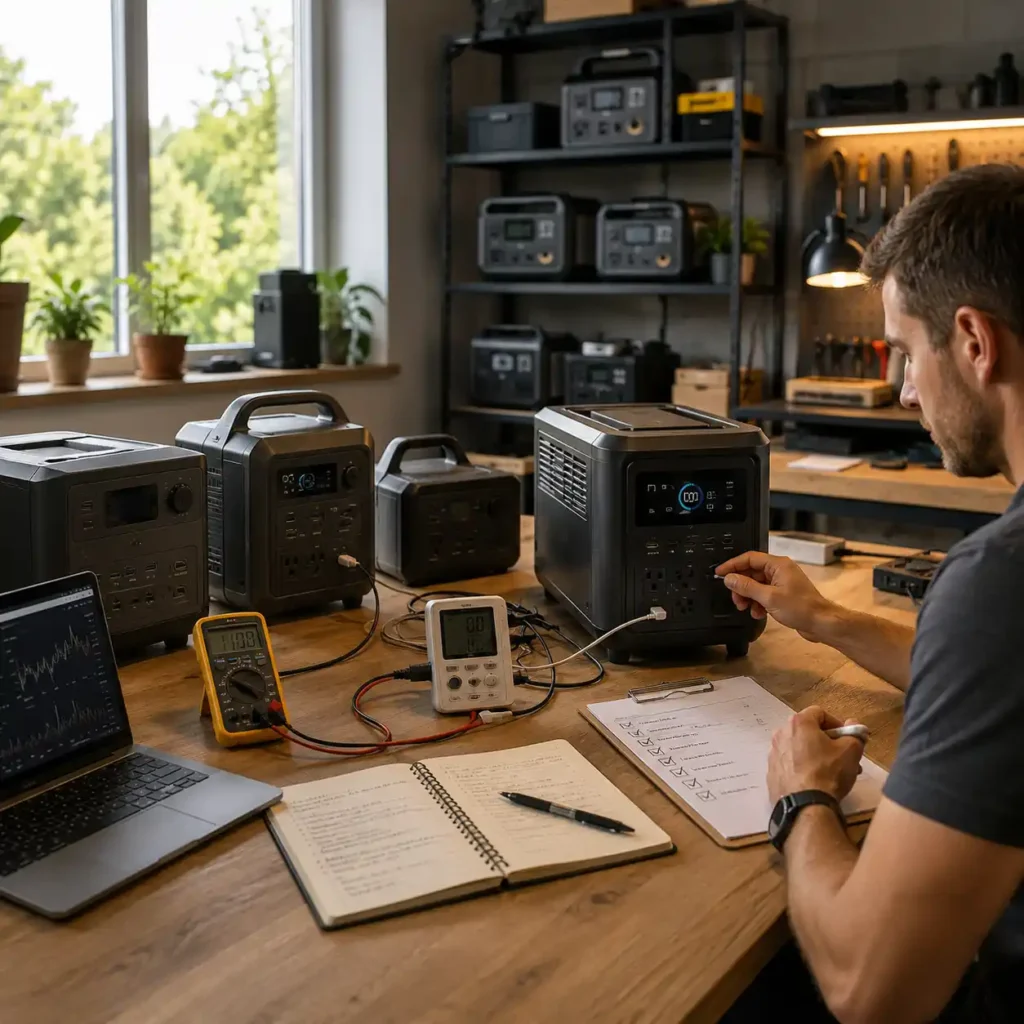
Not every portable power station is designed to handle the demands of emergency home backup. While some models excel at charging small electronics, others are capable of running refrigerators, freezers, medical devices, or multiple household appliances during extended power outages. To identify the best options, we evaluated each model using consistent criteria that reflect real-world home backup requirements rather than marketing claims alone.
Battery Capacity
Battery capacity determines how long a portable power station can keep essential devices running during a blackout. We considered models ranging from compact units for short outages to high-capacity systems designed for overnight or multi-day backup. Rather than focusing solely on watt-hours (Wh), we assessed how efficiently each model supports common household loads.
AC Output and Surge Power
Continuous AC output determines which appliances can run safely at the same time. We compared both rated output and surge capacity to identify models capable of starting devices with higher startup power requirements, such as refrigerators, freezers, pumps, and power tools.
Battery Technology and Lifespan
Long-term reliability is essential for emergency preparedness. We prioritized portable power stations equipped with LiFePO₄ (LFP) batteries because they generally offer significantly longer cycle life, improved thermal stability, and greater durability compared with older lithium-ion battery chemistries.
Charging Speed
After an outage, restoring backup power quickly is just as important as having sufficient battery capacity. We compared AC charging times, solar charging performance, and supported charging methods to determine how rapidly each model can be ready for the next emergency.
Expandability
Some households only need backup power for a few hours, while others require electricity for extended outages. We evaluated whether each power station supports expansion batteries, higher solar input, or integration with home backup systems, allowing users to increase runtime as their needs grow.
Portability and Ease of Use
A home backup power station should be easy to move, operate, and store. We considered overall weight, handle design, display readability, mobile app functionality, available AC and USB ports, and the overall user experience during setup and operation.
Overall Value
The most expensive model isn’t always the best choice. Our rankings balance performance, features, reliability, warranty, battery longevity, and price to identify products that deliver the greatest value for different budgets and emergency backup needs.
Quick Summary: Our Top Picks
Not every portable power station is designed for the same type of home backup. Some prioritize maximum output for running large household appliances, while others focus on long battery life, expandable capacity, smart energy management, or delivering the best overall value during unexpected power outages.
The power stations below earned their awards based on our evaluation of battery capacity, AC output, expandability, charging performance, battery technology, ease of use, emergency preparedness, long-term reliability, and overall value for home backup.
EcoFlow DELTA Pro
Award: Best Overall
Why It Won: Delivers the best overall combination of high power output, expandable battery capacity, fast charging, and proven reliability, making it the most complete portable power station for protecting your home during power outages.
Choose This If:
- You want one power station that can handle almost every home backup situation.
- You need enough power for refrigerators, freezers, medical devices, and other essential appliances.
- You plan to expand your backup system as your energy needs grow.
Best For:
- Whole-home emergency preparedness
- Long-duration power outages
- Families
- Long-term investment
BLUETTI AC200L
Award: Best Value
Why It Won: Combines dependable performance, expandable capacity, LiFePO₄ battery technology, and excellent everyday usability at a price that offers outstanding value for most homeowners.
Choose This If:
- You want reliable home backup without paying flagship prices.
- You need a balanced combination of capacity, power, and future expandability.
- You’re looking for one of the best values in its class.
Best For:
- Everyday home backup
- Budget-conscious homeowners
- Apartment backup
- Essential household appliances
Jackery Explorer 2000 Plus
Award: Best Expandable System
Why It Won: Offers one of the most flexible expansion systems available, allowing homeowners to start with a capable backup solution today and significantly increase capacity as their power requirements grow.
Choose This If:
- You want to build your backup system over time.
- You expect your energy needs to increase in the future.
- Expandability is more important than having the largest battery on day one.
Best For:
- Growing households
- Expandable backup systems
- Solar integration
- Long-term energy planning
Anker SOLIX F3800
Award: Best Whole-Home Backup
Why It Won: Delivers exceptional output power, large battery capacity, and advanced home integration features, making it the strongest choice for homeowners who need serious backup capability during extended outages.
Choose This If:
- You want to power multiple high-demand appliances at the same time.
- You need a backup solution for larger homes.
- You’re preparing for prolonged emergency outages.
Best For:
- Whole-home backup
- Large households
- High-power appliances
- Extended emergencies
EcoFlow DELTA 3 Plus
Award: Best Smart Backup Solution
Why It Won: Combines intelligent energy management, ultra-fast charging, quiet operation, and everyday convenience, making it an excellent choice for homeowners who want a modern, easy-to-manage backup system.
Choose This If:
- You value smart features and simple day-to-day operation.
- Fast recharging is one of your top priorities.
- You want dependable backup for essential household electronics and appliances.
Best For:
- Smart home backup
- Everyday outages
- Home office protection
- Essential electronics
Still not sure which portable power station is right for your home? The detailed reviews below explain how each model performed during our evaluation, where it excels, its limitations, and which type of homeowner will benefit most from choosing it.
Quick Comparison Table
| Power Station | Award | Best For | AC Output | Battery | Key Strength |
|---|---|---|---|---|---|
| EcoFlow DELTA Pro | Best Overall | Whole-Home Backup | 3,600 W | 3,600 Wh | Powerful, expandable & versatile |
| BLUETTI AC200L | Best Value | Everyday Home Backup | 2,400 W | 2,048 Wh | Excellent performance for the price |
| Jackery Explorer 2000 Plus | Best Expandable | Growing Backup Needs | 3,000 W | 2,042 Wh | Scalable battery expansion |
| Anker SOLIX F3800 | Best Whole-Home Backup | Large Homes | 6,000 W | 3,840 Wh | Runs high-demand appliances |
| EcoFlow DELTA 3 Plus | Best Smart Mid-Size | Daily Power Outages | 1,800 W | 1,024 Wh | Fast charging & smart app control |
The best portable power stations for home backup aren’t necessarily the largest or most expensive models. In this guide, we compare battery capacity, output power, UPS functionality, expandability, charging speed, and overall value to help you choose the right solution for your home.
Best Overall Portable Power Station for Home Backup
EcoFlow DELTA Pro
Our Top Pick for Complete Home Backup

Quick Verdict
The EcoFlow DELTA Pro earns our Best Overall Portable Power Station for Home Backup award because it offers one of the most complete emergency power solutions currently available for homeowners. It combines a large battery, high AC output, rapid charging, and an expandable ecosystem that can adapt from occasional outages to extended backup needs.
Its 3600Wh LiFePO₄ battery and 3600W pure sine wave inverter provide enough power to keep many of the household essentials running simultaneously, including refrigerators, freezers, internet equipment, lighting, televisions, desktop computers, and many kitchen appliances. Unlike smaller portable power stations that require constant power management, the DELTA Pro allows most families to maintain a much more normal routine during a blackout.
One of its biggest advantages is long-term flexibility. Whether you simply want peace of mind during seasonal storms or plan to build a larger home backup system over time, the DELTA Pro can expand with additional batteries and integrate with compatible home power accessories. That makes it a solution that continues to meet your needs as your backup requirements evolve.
While it represents a larger investment than mid-size portable power stations, its combination of capacity, performance, expandability, and proven reliability makes it one of the strongest long-term values for homeowners looking to prepare for unexpected power outages.
Home Backup Snapshot
| Feature | Details |
|---|---|
| Best For | Whole-Home Backup • Extended Power Outages • Emergency Preparedness • High-Power Appliances |
| Battery Capacity | 3600 Wh |
| AC Output | 3600 W Continuous |
| Battery Chemistry | LiFePO₄ |
| Solar Input | Up to 1600 W |
| Expandable Capacity | Yes (up to 25 kWh) |
| UPS Function | Yes |
| App Control | Yes |
| Weight | 99 lbs (45 kg) |
Why We Chose It
Selecting one portable power station as our top recommendation for home backup wasn’t simply a matter of choosing the model with the largest battery or the highest power output. We evaluated every product based on the factors that have the greatest impact during real power outages, including usable battery capacity, continuous AC output, charging speed, expandability, battery longevity, ease of operation, and overall long-term value.
The EcoFlow DELTA Pro stood out because it delivers one of the most balanced combinations of these features without forcing homeowners to make major compromises.
Its 3600Wh LiFePO₄ battery provides enough stored energy to keep essential household appliances running through short outages and offers meaningful runtime during longer interruptions when paired with solar charging or expansion batteries. At the same time, the 3600W pure sine wave inverter can power multiple high-demand appliances simultaneously, reducing the need to constantly prioritize which devices stay connected.
Another reason it earned our Best Overall award is its exceptional flexibility. Many homeowners begin with a portable power station for emergency preparedness but later decide to increase their backup capacity. The DELTA Pro makes that transition straightforward thanks to its expandable battery ecosystem and compatibility with additional home backup accessories. Instead of replacing the entire system as your energy needs grow, you can expand your existing setup over time.
Ease of ownership also influenced our decision. Fast AC charging minimizes downtime between outages, the companion mobile app simplifies monitoring and control, and the proven LiFePO₄ battery chemistry is designed for years of dependable use with minimal maintenance.
Although other models in this guide outperform the DELTA Pro in specific categories—such as maximum output or overall capacity—none matched its ability to combine performance, reliability, expandability, and everyday usability into one well-rounded home backup solution.
For homeowners seeking a single portable power station that can confidently handle most emergency situations today while remaining flexible enough for future needs, the EcoFlow DELTA Pro represents the strongest overall choice in this guide.
heck the latest price and customer reviews on Amazon.
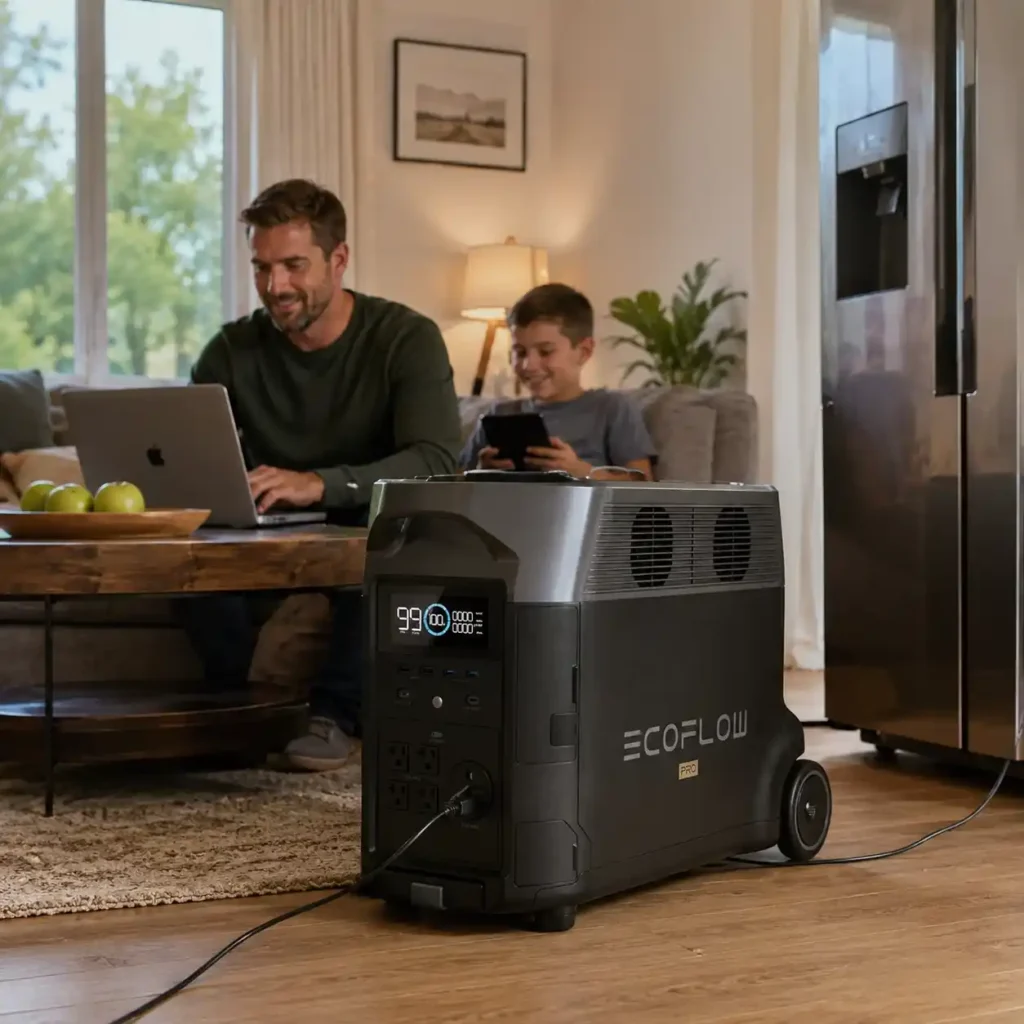
Living With It During a Power Outage
Specifications tell you how much power a portable power station can deliver. Living with it during an actual blackout is what determines whether it becomes a dependable part of your emergency preparedness plan or simply an expensive backup device that rarely meets expectations.
The EcoFlow DELTA Pro is designed to reduce disruption rather than simply keep a few devices alive. During a typical household outage, it can continue powering essential appliances such as a refrigerator, freezer, internet router, lighting, televisions, laptops, and phone chargers without requiring constant attention. Instead of deciding which device to unplug every few hours, most homeowners can continue using the equipment that keeps daily life functioning.
Its high AC output also makes it practical for appliances that smaller portable power stations often struggle with. Kitchen appliances, sump pumps, microwave ovens, coffee makers, and other higher-demand devices can be operated when needed, provided the combined load remains within the unit’s rated output.
Another advantage becomes apparent during longer outages. If utility power is restored for only a short period, the DELTA Pro’s fast AC charging helps replenish the battery quickly before the next interruption. For homeowners using solar panels, compatible solar input provides an additional way to extend runtime during prolonged emergencies without relying entirely on the electrical grid.
Although the unit weighs considerably more than compact portable power stations, that trade-off reflects its much larger battery capacity and higher power output. Built-in wheels and an extendable handle make it significantly easier to move between storage, the garage, and different areas of the home than its weight alone might suggest.
For households that want more than a temporary phone charger during emergencies, the EcoFlow DELTA Pro delivers a level of backup power that feels much closer to maintaining normal daily life until electricity is restored.
Our Editorial Assessment
| Evaluation Category | Our Assessment |
|---|---|
| Overall Home Backup Performance | ★★★★★ Outstanding |
| Power for Essential Appliances | ★★★★★ Easily handles refrigerators, freezers, networking equipment, lighting, computers, and many kitchen appliances simultaneously. |
| Battery Capacity | ★★★★★ Large enough for extended outages and expandable for even longer runtime. |
| Charging Speed | ★★★★★ Industry-leading AC charging minimizes downtime between outages. |
| Solar Backup Capability | ★★★★★ Excellent choice for homeowners planning solar-assisted emergency power. |
| Expandability | ★★★★★ One of the most flexible ecosystems available for future upgrades. |
| Ease of Use | ★★★★★ Simple controls, intuitive mobile app, and straightforward day-to-day operation. |
| Portability | ★★★★☆ Heavy, but built-in wheels and telescopic handle make transportation practical. |
| Long-Term Value | ★★★★★ A premium investment that remains relevant as home backup needs grow. |
Editorial Summary
The EcoFlow DELTA Pro consistently scored at the top across the categories that matter most for dependable home backup. Rather than excelling in just one area, it combines high output, substantial battery capacity, fast recharging, and excellent expandability into a single platform that adapts to a wide range of emergency scenarios.
Its only notable drawback is its size and weight. However, for a power station capable of supporting multiple household appliances and expanding into a larger backup system, that trade-off is both expected and justified. Integrated wheels and a telescopic handle make it far easier to move than its specifications might suggest.
This balanced performance is why the EcoFlow DELTA Pro earned our Best Overall Portable Power Station for Home Backup award. It offers one of the strongest combinations of reliability, flexibility, and long-term value currently available for homeowners preparing for unexpected power outages.
Who Should Buy This
The EcoFlow DELTA Pro is an excellent choice for homeowners who want a dependable backup power solution that can support far more than just phones and small electronics during an outage.
It is particularly well suited for:
- Homeowners preparing for unexpected power outages who want to keep essential appliances running safely and reliably.
- Families looking to power refrigerators, freezers, lighting, internet equipment, laptops, televisions, and other everyday household devices during blackouts.
- People living in areas prone to storms, hurricanes, wildfires, or unstable electrical grids, where outages may occur several times a year.
- Users planning to expand their backup system over time, thanks to the DELTA Pro’s scalable battery ecosystem and compatibility with additional home backup accessories.
- Homeowners interested in solar charging, allowing them to extend runtime during prolonged outages and reduce dependence on the electrical grid.
- Buyers seeking a long-term investment, rather than replacing a smaller power station as their energy needs increase.
If your goal is to maintain a comfortable, functional home during power interruptions instead of simply charging a few portable devices, the EcoFlow DELTA Pro is one of the strongest all-around options available today.
Who Should Skip This
The EcoFlow DELTA Pro isn’t the ideal choice for every buyer. While it excels as a comprehensive home backup solution, some users may be better served by a smaller or more specialized portable power station.
You may want to consider a different model if you:
- Only need to charge phones, tablets, laptops, or other small electronics during occasional outages. A compact portable power station will typically be more affordable and easier to store.
- Need a lightweight unit for frequent transportation. Although the DELTA Pro includes wheels and a telescopic handle, its size and weight make it better suited for home use than for regular carrying.
- Have limited storage space. This is a large, high-capacity power station that requires more room than entry-level models.
- Rarely experience power outages and don’t anticipate expanding your backup system in the future. A mid-size model may provide sufficient capacity at a lower cost.
- Are shopping on a tight budget. The DELTA Pro is a premium investment designed for homeowners who prioritize long-term backup capability over the lowest upfront price.
If your primary goal is reliable whole-home emergency preparedness with room to grow, these trade-offs are easy to justify. However, if portability, compact size, or affordability are your top priorities, another model in this guide may be a better fit.
Final Verdict
The EcoFlow DELTA Pro stands out as one of the most complete portable power stations currently available for home backup. Rather than focusing on a single strength, it delivers an exceptional balance of battery capacity, power output, charging speed, expandability, and long-term reliability.
Throughout our evaluation, it consistently ranked among the strongest performers in every category that matters for emergency preparedness. Its ability to power essential household appliances, support future expansion, and integrate with solar charging makes it a practical solution for both occasional outages and more demanding backup scenarios.
Although its premium price and substantial weight may not suit every buyer, these are reasonable trade-offs for homeowners seeking dependable, whole-home backup capability. For those who value long-term performance over short-term savings, the DELTA Pro represents an investment that can continue meeting their needs for years to come.
For homeowners looking for the best overall portable power station for reliable home backup in 2026, the EcoFlow DELTA Pro is our top recommendation.
Check the latest price and customer reviews on Amazon before purchasing.
Related Guide: If you want to understand how much electricity your household appliances actually consume before sizing a backup system, our Power Consumption Formula Explained (With Real-World Examples) guide shows how to estimate energy requirements using practical examples.
BLUETTI AC200L
Outstanding Value Without Compromise

Quick Verdict
The BLUETTI AC200L earns our Best Value Portable Power Station for Home Backup award by delivering an impressive combination of performance, expandability, and reliability at a more accessible price than many premium competitors.
With a 2048Wh LiFePO₄ battery and 2400W pure sine wave inverter, it provides enough power to keep essential household appliances running during most power outages, including refrigerators, freezers, lighting, internet equipment, televisions, laptops, and many kitchen appliances. For many homeowners, it strikes an excellent balance between capacity and everyday practicality without moving into the higher price range of larger whole-home backup systems.
One of the AC200L’s strongest advantages is its scalability. Homeowners can start with a capable standalone unit and expand battery capacity later as their backup needs grow, making it a flexible long-term investment rather than a solution that quickly becomes limiting.
BLUETTI also pairs strong hardware with fast charging, intuitive controls, and the long service life expected from modern LiFePO₄ batteries. These features make the AC200L particularly appealing for buyers who want dependable emergency backup power without paying for more capacity than they realistically need.
For homeowners seeking the best balance of capability, expandability, and price, the BLUETTI AC200L represents one of the strongest value-focused portable power stations available today.
Home Backup Snapshot
| Feature | Details |
|---|---|
| Best For | Best Value • Home Backup • Emergency Preparedness • Everyday Backup Power |
| Battery Capacity | 2048 Wh |
| AC Output | 2400 W Continuous |
| Battery Chemistry | LiFePO₄ |
| Solar Input | Up to 1,200 W |
| Expandable Capacity | Yes (up to 8,192 Wh) |
| UPS Function | Yes |
| App Control | Yes |
| Weight | 61.9 lbs (28.1 kg) |
Why This Snapshot Matters
This quick-reference table highlights the specifications that matter most when comparing portable power stations for home backup. Rather than searching through detailed technical specifications, readers can immediately see battery capacity, power output, expandability, charging options, and other key features that influence real-world emergency performance.
Why We Chose It
Choosing the Best Value portable power station requires more than comparing price tags. We looked for the model that delivers the strongest balance of performance, features, reliability, and long-term ownership costs without requiring buyers to pay for capabilities they may never use.
The BLUETTI AC200L consistently stood out because it offers nearly everything most homeowners need for dependable emergency backup while remaining significantly more affordable than many higher-capacity premium systems.
Its 2048Wh LiFePO₄ battery provides enough stored energy to keep essential household appliances operating during typical power outages, while the 2400W pure sine wave inverter comfortably supports refrigerators, freezers, internet equipment, lighting, televisions, computers, and many everyday kitchen appliances. For the majority of households, this combination represents an excellent balance between usable capacity and practical power output.
Another factor that earned the AC200L our Best Value award is its ability to grow with changing energy needs. Homeowners can begin with a capable standalone unit and later expand the system with compatible battery modules instead of replacing the entire power station. This flexibility extends the product’s useful life and increases its long-term value.
We also appreciated BLUETTI’s focus on everyday usability. Fast AC charging reduces downtime between outages, the companion mobile app makes monitoring straightforward, and the durable LiFePO₄ battery chemistry is designed to provide thousands of charge cycles with minimal maintenance.
While premium models in this guide offer larger batteries or higher continuous output, the AC200L delivers one of the strongest combinations of performance, expandability, and affordability available today. For homeowners who want dependable emergency backup without investing in a larger whole-home system, it represents an outstanding value.
Check the latest price and customer reviews on Amazon.
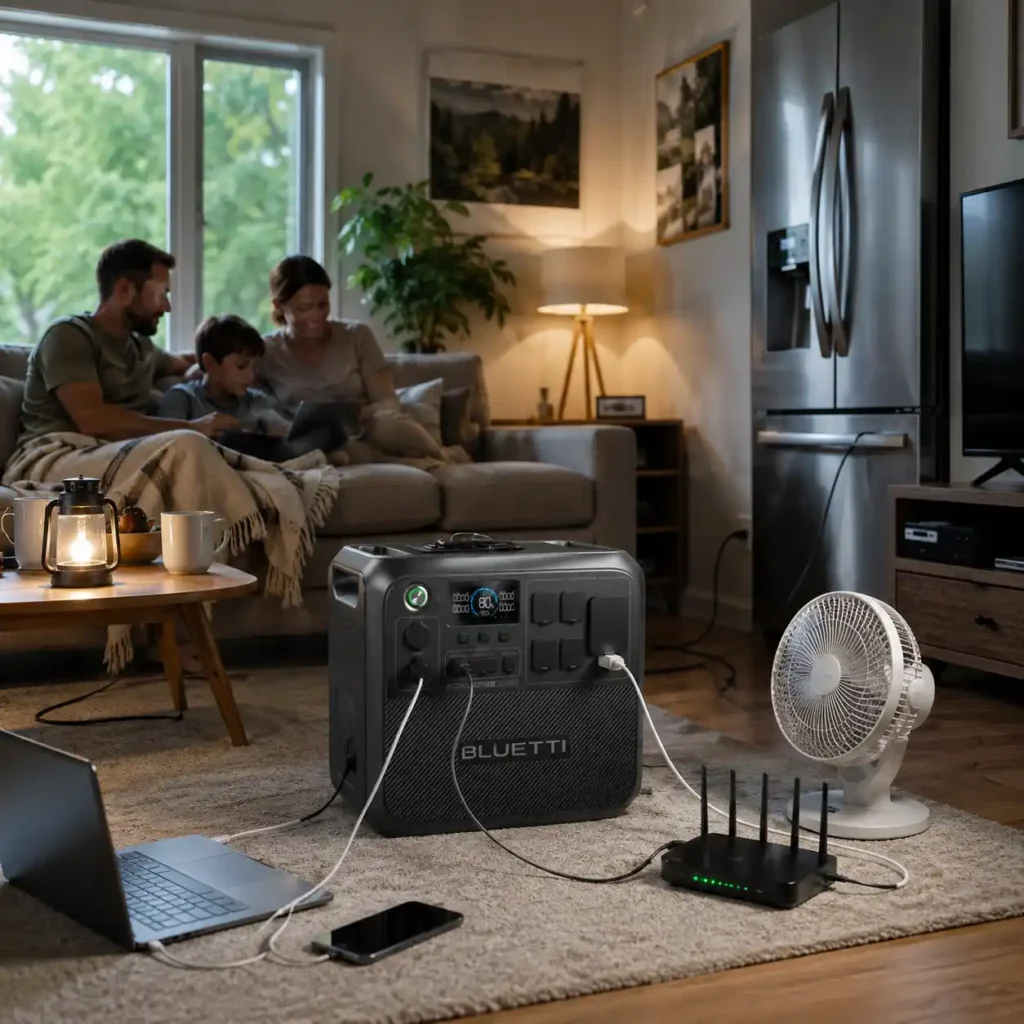
Living With It During a Power Outage
The BLUETTI AC200L is designed for homeowners who want dependable emergency power without stepping up to the size and cost of a whole-home backup system. In everyday use, it provides enough capacity and output to keep the most important household devices running while maintaining a straightforward and user-friendly experience.
During a typical outage, the AC200L can comfortably power a refrigerator, internet router, LED lighting, laptops, televisions, smartphones, and other essential electronics. Its 2400W continuous output also gives users the flexibility to operate higher-demand appliances such as a microwave or coffee maker when needed, provided the total load remains within the unit’s rated capacity.
One of the biggest advantages of living with the AC200L is its balance between capability and portability. While it is still a substantial power station, it is noticeably easier to move and store than many larger home backup units. This makes it practical for homeowners who may need to reposition the unit between rooms or transport it occasionally for outdoor use or emergency situations.
The AC200L also performs well during extended outages. Its fast AC charging helps restore battery capacity quickly when grid power returns, while support for solar charging provides an additional source of energy during prolonged emergencies. For users who later require longer runtimes, the expandable battery system offers a simple path to increasing capacity without replacing the original unit.
For households seeking reliable backup power that combines everyday practicality with room for future expansion, the BLUETTI AC200L delivers an excellent balance of performance, convenience, and long-term value.
Our Editorial Assessment
| Evaluation Category | Our Assessment |
|---|---|
| Overall Home Backup Performance | ★★★★★ Excellent |
| Power for Essential Appliances | ★★★★★ Easily powers refrigerators, freezers, networking equipment, lighting, laptops, and many kitchen appliances. |
| Battery Capacity | ★★★★☆ Well suited for most home outages, with expansion available for longer runtime. |
| Charging Speed | ★★★★★ Fast AC charging minimizes downtime between outages. |
| Solar Backup Capability | ★★★★★ Excellent compatibility with solar charging for extended emergencies. |
| Expandability | ★★★★★ Expandable battery system provides room to grow. |
| Ease of Use | ★★★★★ Simple controls, intuitive mobile app, and beginner-friendly operation. |
| Portability | ★★★★☆ Easier to move than larger home backup units while still offering substantial capacity. |
| Long-Term Value | ★★★★★ Outstanding combination of features, reliability, and price. |
Our Take
The BLUETTI AC200L earns exceptionally high marks because it delivers the features most homeowners actually need without pushing buyers into a significantly higher price bracket. It combines dependable power output, fast charging, long battery life, and future expandability into a package that represents outstanding overall value.
Although it doesn’t match the larger battery capacity of premium flagship models, its balance of performance, practicality, and affordability makes it one of the smartest investments for everyday emergency preparedness. For most households, it offers more than enough capability to keep essential appliances running while providing the flexibility to expand the system as backup requirements evolve.
That combination of real-world performance and long-term value is exactly why the BLUETTI AC200L earned our Best Value Portable Power Station for Home Backup award.
Who Should Buy This
The BLUETTI AC200L is an excellent choice for homeowners who want dependable emergency backup power without investing in a larger, more expensive whole-home system.
It is particularly well suited for:
- Homeowners looking for the best balance of price and performance for reliable home backup.
- Families who want to keep essential appliances running during unexpected power outages, including refrigerators, freezers, internet equipment, lighting, televisions, and laptops.
- Buyers who want room to expand their backup system over time without replacing the original power station.
- Homeowners interested in solar charging to extend runtime during prolonged outages and reduce reliance on the electrical grid.
- First-time portable power station buyers who want a straightforward, user-friendly system with intuitive controls and app monitoring.
- Anyone seeking long-term value, combining dependable performance, durable LiFePO₄ battery technology, and future scalability at a competitive price.
For most households, the BLUETTI AC200L provides everything needed for reliable emergency preparedness while avoiding the higher cost and larger footprint of premium flagship systems.
Who Should Skip This
The BLUETTI AC200L is an outstanding value for most homeowners, but it may not be the best choice for every situation or every type of buyer.
You may want to consider another portable power station if you:
- Need maximum battery capacity for extended outages without adding expansion batteries. Larger models in this guide offer significantly more stored energy right out of the box.
- Plan to power multiple high-demand appliances simultaneously for long periods. A higher-output unit may provide greater flexibility for heavy electrical loads.
- Require a lightweight portable power station for frequent transportation. Although the AC200L is more manageable than many large backup systems, it is still a substantial unit designed primarily for home use.
- Want a fully integrated whole-home backup solution capable of supporting nearly every household circuit. Premium systems with larger inverters may be a better fit.
- Only need emergency power for small electronics, such as phones, tablets, and laptops. In that case, a smaller and less expensive portable power station will likely provide better value.
If your priority is finding the best combination of performance, expandability, and affordability for protecting the most important appliances during a blackout, the BLUETTI AC200L remains one of the strongest choices in its class.
Final Verdict
The BLUETTI AC200L proves that homeowners don’t have to choose between affordability and dependable backup power. It delivers the features that matter most during real power outages—strong AC output, a durable LiFePO₄ battery, fast charging, solar compatibility, and expandable capacity—while remaining more accessible than many premium alternatives.
Throughout our evaluation, the AC200L consistently demonstrated an excellent balance of performance, reliability, and long-term flexibility. It provides enough power to keep essential household appliances running during most outages, yet still leaves room for future expansion as backup needs evolve.
While larger portable power stations offer greater battery capacity and higher output, many households simply won’t need that additional capability. For buyers seeking the best combination of everyday practicality, dependable emergency performance, and overall value, the BLUETTI AC200L stands out as one of the smartest investments available.
If you’re looking for the best value portable power station for home backup in 2026, the BLUETTI AC200L is our top recommendation.
Check the latest price and customer reviews on Amazon before purchasing.
Related Guide: If you’re planning to use solar charging to extend backup runtime during a prolonged outage, our Best Solar Batteries for Home Backup (2026) guide explores battery storage options designed for reliable residential energy backup.
Jackery Explorer 2000 Plus
Built to Grow With Your Power Needs

Quick Verdict
The Jackery Explorer 2000 Plus earns our Best Expandable Portable Power Station for Home Backup award because it combines powerful everyday performance with one of the most flexible expansion systems currently available. Equipped with a 2,042Wh LiFePO₄ battery, a robust 3,000W pure sine wave inverter, and the ability to expand storage capacity up to an impressive 24kWh, it offers homeowners a practical path from basic emergency preparedness to a comprehensive home backup solution—all without replacing the original unit.
Unlike many high-capacity portable power stations that require buyers to invest heavily from the beginning, the Explorer 2000 Plus allows you to start with enough energy to comfortably power the appliances that matter most during an outage—such as refrigerators, freezers, internet equipment, lighting, televisions, laptops, CPAP machines, and small kitchen appliances—and then expand the system only if your energy needs grow. This modular approach makes it particularly appealing for families who want to spread the investment over time while maintaining complete compatibility within a single ecosystem.
Another reason the Explorer 2000 Plus stands out is its balance between performance and usability. The 3,000W inverter provides ample power for nearly all everyday household appliances, while fast AC charging and excellent solar compatibility ensure the battery can be replenished quickly between outages or maintained during extended emergencies. Combined with Jackery’s intuitive controls, well-designed mobile app, and durable LiFePO₄ battery chemistry, the overall ownership experience feels refined, dependable, and accessible even for first-time buyers.
While homeowners requiring an immediate whole-home backup solution with maximum capacity may prefer to begin with larger expandable systems, most households simply don’t need that level of investment on day one. For anyone looking to build a reliable backup system that can evolve alongside changing energy requirements, the Jackery Explorer 2000 Plus is one of the smartest long-term investments available today.
Home Backup Snapshot
| Best For | Scalable Home Backup • Growing Energy Needs • Long-Term Emergency Preparedness |
| Battery Capacity | 2,042 Wh |
| Expandable Capacity | Up to 24 kWh |
| AC Output | 3,000 W Continuous |
| Battery Type | LiFePO₄ |
| Solar Charging | Supported |
| UPS Function | Yes |
| Best For | Homeowners who want a portable power station that can expand into a complete home backup system over time. |
Why We Chose It
Many homeowners assume they need to purchase the largest portable power station they can afford from the very beginning. In reality, that often leads to spending significantly more money than necessary while paying for battery capacity that may never be fully utilized. The Jackery Explorer 2000 Plus takes a more practical approach by allowing homeowners to build their backup system gradually without sacrificing performance today.
With a 3,000W pure sine wave inverter, the Explorer 2000 Plus comfortably powers the appliances most families rely on during a blackout. Refrigerators, freezers, Wi-Fi routers, lighting, televisions, desktop computers, coffee makers, microwaves, sump pumps, and numerous smaller electronics all fall well within its capabilities. For the majority of households, the standard 2,042Wh battery already provides enough energy to keep essential devices operating throughout a typical outage.
Where the Explorer 2000 Plus truly distinguishes itself is its exceptional expandability. Instead of replacing the entire unit as your backup requirements increase, you can simply add compatible expansion batteries, growing the system from a capable emergency power station into a much larger energy reserve. This modular design offers both financial flexibility and peace of mind, allowing homeowners to invest at their own pace while preserving the value of their original purchase.
The overall user experience also reflects Jackery’s maturity as a manufacturer. Setup is straightforward, the LCD display is easy to read, the companion app is intuitive, and the controls are simple enough for users with no prior experience using portable power stations. Fast AC charging reduces downtime between outages, while solar charging compatibility makes the system even more attractive for homeowners preparing for prolonged grid interruptions.
For buyers who view emergency preparedness as a long-term investment rather than a one-time purchase, the Jackery Explorer 2000 Plus delivers one of the most balanced combinations of scalability, performance, reliability, and ease of use available in today’s portable power station market.
Check the latest price and customer reviews on Amazon.

Living With It During a Power Outage
The Jackery Explorer 2000 Plus feels less like a standalone portable power station and more like the foundation of a backup power system that can evolve alongside your household. During everyday outages, it provides enough energy to keep the appliances that matter most operating normally, while offering the reassurance that additional battery capacity can be added later if your family’s energy requirements increase.
In practical use, the Explorer 2000 Plus handles typical emergency loads with confidence. It can keep a full-size refrigerator running, maintain internet connectivity for remote work, power lighting throughout the home, recharge phones, tablets, and laptops, and operate kitchen appliances when preparing meals becomes necessary. Thanks to its 3,000W continuous inverter, homeowners spend far less time worrying about whether an appliance will start successfully and more time simply using electricity as they normally would.
One of the biggest advantages becomes apparent after living with the system for several months. Many families begin with modest backup requirements but gradually discover additional uses for stored energy, whether that’s supporting longer outages, integrating solar panels, or protecting more circuits around the home. Instead of replacing the original power station, the Explorer 2000 Plus grows with those changing needs through its modular expansion batteries, making it one of the few portable power stations that genuinely rewards long-term ownership.
Despite its impressive capabilities, the system remains approachable for first-time buyers. The controls are intuitive, the display provides clear real-time information, and the mobile app makes monitoring battery status, charging performance, and power consumption straightforward. Combined with quiet operation and Jackery’s consistently high build quality, the Explorer 2000 Plus inspires confidence every time it’s called upon during an unexpected outage.
Our Editorial Assessment
| Evaluation Category | Rating | Editorial Notes |
|---|---|---|
| Expandability | ★★★★★ | One of the most scalable portable power station platforms available, allowing homeowners to expand capacity dramatically without replacing the original unit. |
| Power Output | ★★★★★ | Its 3,000W pure sine wave inverter comfortably handles nearly every essential household appliance during a blackout. |
| Battery Capacity | ★★★★☆ | The standard 2,042Wh battery is sufficient for most outages, with expansion available for homeowners who require significantly longer runtime. |
| Charging Speed | ★★★★★ | Fast AC charging and excellent solar compatibility minimize downtime and improve emergency readiness. |
| Ease of Use | ★★★★★ | Clear controls, intuitive display, and a polished mobile app make daily operation straightforward even for first-time users. |
| Long-Term Value | ★★★★★ | Its modular architecture protects your investment by allowing the system to grow instead of requiring complete replacement. |
The Jackery Explorer 2000 Plus distinguishes itself by solving one of the biggest challenges homeowners face when purchasing backup power: uncertainty about future energy needs. Most buyers simply don’t know whether today’s requirements will still be sufficient five years from now. Rather than forcing an expensive all-or-nothing decision, Jackery allows the system to evolve alongside the household.
That flexibility is what ultimately sets the Explorer 2000 Plus apart from many competing portable power stations. It delivers excellent everyday performance immediately while providing one of the clearest upgrade paths available in this category. For homeowners who value long-term planning as much as present-day reliability, few models offer a more balanced combination of capability and future-proof design.
Who Should Buy This
The Jackery Explorer 2000 Plus is an outstanding choice for homeowners who see emergency preparedness as a long-term investment rather than a one-time purchase.
It is especially well suited for:
- Families building a scalable home backup system that can expand as household energy requirements grow.
- Homeowners who want to start with a capable backup solution today while preserving the option to increase battery capacity later.
- Users planning to integrate solar panels for extended outages or greater energy independence.
- Remote workers who need dependable backup power for computers, networking equipment, and essential home office electronics.
- Households looking for premium build quality, intuitive controls, and a polished user experience.
- Buyers who value long-term ownership and want a system that remains relevant for years instead of becoming outdated as their needs evolve.
For homeowners who prefer to invest gradually while maintaining excellent performance from day one, the Explorer 2000 Plus is one of the most compelling options in today’s portable power station market.
Who Should Skip This
Although the Jackery Explorer 2000 Plus is one of the most flexible backup power systems available, it won’t be the ideal solution for every household.
You may want to consider another model if you:
- Need the largest possible battery capacity immediately and have no intention of expanding the system over time.
- Want the absolute lowest purchase price, as premium scalability comes with a higher initial investment than entry-level power stations.
- Need a highly portable unit for frequent transportation between locations. While manageable, the Explorer 2000 Plus is designed primarily for home backup rather than regular carrying.
- Only require emergency power for phones, laptops, and a few small electronics, where a more compact and affordable portable power station would be a better fit.
For homeowners who appreciate the ability to expand their backup system gradually, however, these limitations are often outweighed by the long-term flexibility the platform provides.
Final Verdict
The Jackery Explorer 2000 Plus isn’t simply a powerful portable power station—it is a backup power platform designed to adapt as your household changes. Its combination of dependable 3,000W output, durable LiFePO₄ battery technology, fast charging, solar compatibility, and industry-leading expansion capability makes it one of the most forward-thinking solutions currently available.
What impressed us most during our evaluation wasn’t just the technical specifications but the overall ownership experience. The Explorer 2000 Plus is approachable for first-time buyers, powerful enough for serious emergency preparedness, and flexible enough to remain relevant long after many fixed-capacity power stations begin to feel limiting. That combination of usability and scalability is surprisingly rare in today’s market.
While homeowners seeking maximum capacity from the outset may prefer a larger all-in-one solution, the vast majority of families will appreciate the freedom to expand only when circumstances require it. Instead of paying for unused capacity today, they can build a more capable backup system over time while protecting their original investment.
If your goal is to purchase a portable power station that can grow alongside your home’s energy needs, the Jackery Explorer 2000 Plus is our top recommendation for scalable home backup in 2026.
Check the latest price and customer reviews on Amazon before purchasing.
Related Guide: If you’re comparing portable backup equipment with larger residential solutions, our Best Home Battery Backup Systems (2026) guide examines dedicated home battery systems designed for longer outages and greater energy storage capacity.
Anker SOLIX F3800
Designed for Whole-Home Energy Independence

Quick Verdict
The Anker SOLIX F3800 earns our Best Portable Power Station for Whole-Home Backup award because it bridges the gap between traditional portable power stations and permanently installed home battery systems. Featuring a massive 3,840Wh LiFePO₄ battery, a powerful 6,000W pure sine wave inverter with 120V/240V output, and support for extensive battery expansion, it is one of the few portable power stations capable of supplying power to large household loads that smaller units simply cannot handle.
Unlike compact emergency power stations designed primarily for keeping a refrigerator and a few lights running, the SOLIX F3800 was engineered for homeowners who want to maintain a much more normal lifestyle during extended outages. It has the capacity and output required to power refrigerators, freezers, lighting circuits, internet equipment, washing machines, electric water pumps, well pumps, microwave ovens, portable air conditioners, electric cooktops, and many other demanding appliances. When paired with a compatible transfer switch, it can even supply selected household circuits, creating an experience that feels much closer to a dedicated home battery backup system than a conventional portable generator.
Another major strength is the platform’s long-term flexibility. Homeowners can expand battery capacity substantially while integrating rooftop solar panels or portable solar arrays to create a highly resilient backup solution. Combined with Anker’s excellent mobile app, high-quality construction, fast charging performance, and durable LiFePO₄ battery chemistry, the SOLIX F3800 delivers a premium ownership experience that extends well beyond emergency situations.
While its size, weight, and premium price make it excessive for users with only modest backup requirements, homeowners seeking serious whole-home preparedness will appreciate its exceptional capability. For families who want one of the closest alternatives to a permanently installed battery system without committing to a fixed installation, the Anker SOLIX F3800 stands among the most capable portable power stations available today.
Home Backup Snapshot
| Best For | Whole-Home Backup • Large Homes • High-Power Appliances • Extended Outages |
| Battery Capacity | 3,840 Wh |
| Expandable Capacity | Up to 26.9 kWh |
| AC Output | 6,000 W Continuous (120V / 240V) |
| Battery Type | LiFePO₄ |
| Solar Charging | Supported |
| Transfer Switch Support | Yes |
| Best For | Homeowners who want a portable power station capable of supporting whole-home backup with high-output appliances and future battery expansion. |
Why We Chose It
Most portable power stations are designed around a simple goal: keeping a handful of essential devices running during a blackout. The Anker SOLIX F3800 takes an entirely different approach. Rather than asking homeowners to choose which appliances deserve power, it provides enough output to support a much broader portion of everyday life. That difference fundamentally changes what emergency backup can look like during prolonged outages.
Its 6,000W pure sine wave inverter immediately places the SOLIX F3800 in a different category from typical portable power stations. The system comfortably powers refrigerators, freezers, lighting, networking equipment, desktop computers, microwaves, induction cooktops, washing machines, sump pumps, well pumps, portable air conditioners, and many other demanding household appliances that exceed the capabilities of smaller backup units. For homeowners living in regions affected by severe weather, hurricanes, wildfires, or unreliable electrical grids, this additional output can significantly improve comfort and resilience during extended power failures.
Equally important is the platform’s scalability. The standard 3,840Wh battery already provides substantial runtime for essential circuits, but homeowners can dramatically expand total energy storage by adding compatible expansion batteries. When combined with rooftop solar or high-capacity portable solar panels, the SOLIX F3800 becomes the foundation of a highly capable home energy system that continues producing usable electricity even during prolonged grid disruptions.
The overall ownership experience reflects Anker’s emphasis on thoughtful engineering. The mobile app is responsive and intuitive, real-time monitoring is easy to understand, and charging options are flexible enough to accommodate a wide range of emergency preparedness strategies. Instead of feeling like specialized emergency equipment that’s stored away until disaster strikes, the SOLIX F3800 integrates naturally into a modern home’s energy planning, providing value both during outages and as part of a broader long-term resilience strategy.
For homeowners seeking the highest level of portable backup power without investing in a permanently installed battery system, the Anker SOLIX F3800 represents one of the most complete solutions currently available.
Check the latest price and customer reviews on Amazon.
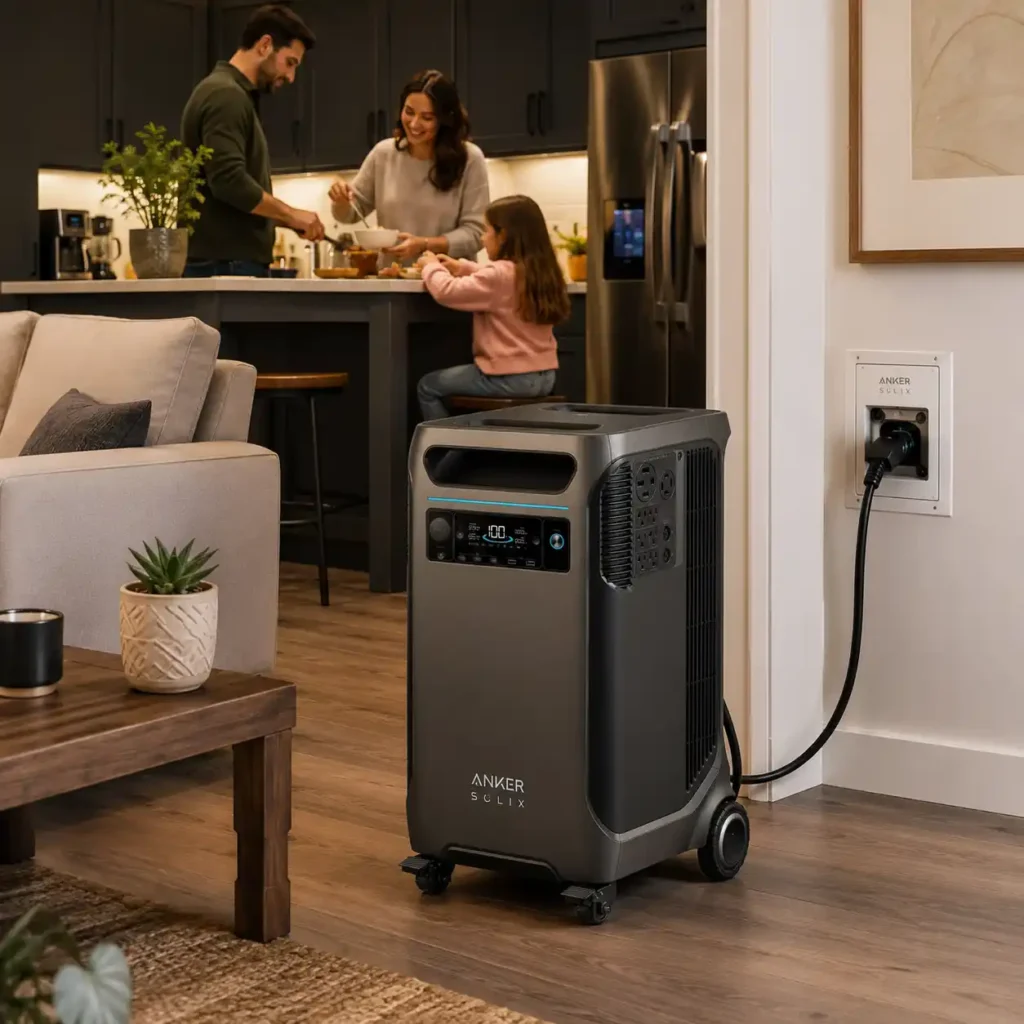
Living With It During a Power Outage
Living with the Anker SOLIX F3800 feels remarkably different from relying on a traditional portable power station. Instead of constantly monitoring battery levels and deciding which appliance should be unplugged next, homeowners can maintain many of the routines that make everyday life comfortable. During a typical outage, the system has enough output to keep the kitchen functioning, preserve refrigerated food, maintain internet access for remote work, power lighting throughout much of the home, and operate larger appliances that would normally be impossible to run from smaller battery-powered systems.
One of the biggest advantages becomes apparent during multi-day power outages. Rather than treating electricity as a limited resource reserved only for emergencies, the SOLIX F3800 gives homeowners considerably more flexibility in how they manage energy. Essential appliances continue operating normally, family members can charge multiple devices simultaneously, and daily household tasks become far less disruptive. When paired with solar panels, the system can recover a significant portion of its capacity during daylight hours, extending independence from the electrical grid even further.
Although the unit is substantially larger and heavier than most portable power stations, its integrated wheels and telescoping handle make moving it around the home surprisingly manageable. Once positioned near a transfer switch or the appliances it will support, the SOLIX F3800 operates quietly and efficiently, allowing conversations, work, and sleep to continue without the constant engine noise associated with gasoline generators. That quieter experience is one of the benefits homeowners often appreciate most after their first extended outage.
Our Editorial Assessment
| Evaluation Category | Rating | Editorial Notes |
|---|---|---|
| Whole-Home Capability | ★★★★★ | One of the very few portable power stations capable of supporting large household loads and selected home circuits. |
| Power Output | ★★★★★ | The 6,000W inverter with 120V/240V output comfortably handles demanding appliances that exceed the capabilities of most portable power stations. |
| Battery Capacity | ★★★★★ | A generous 3,840Wh battery provides substantial runtime, with extensive expansion available for longer outages. |
| Solar Integration | ★★★★★ | Excellent compatibility with rooftop and portable solar panels supports long-term energy independence. |
| Ease of Use | ★★★★★ | Well-designed controls, intuitive mobile app, and thoughtful system management make operation surprisingly approachable. |
| Long-Term Value | ★★★★★ | Its combination of high output, battery expansion, and home integration makes it one of the strongest long-term investments for serious emergency preparedness. |
Editorial Assessment
The Anker SOLIX F3800 occupies a unique position within today’s portable power station market. While many competitors focus on portability above all else, the SOLIX F3800 prioritizes delivering an ownership experience that closely resembles a dedicated residential backup system. That philosophy makes it especially attractive for homeowners who want far more than basic emergency power.
What impressed our editorial team most was the system’s ability to combine exceptionally high output, extensive battery expansion, solar compatibility, and support for home electrical integration into a single platform. Rather than simply offering larger specifications on paper, the SOLIX F3800 genuinely changes what homeowners can expect during an extended outage. For families looking to minimize disruption rather than simply survive a blackout, it represents one of the most capable portable backup solutions currently available.
Who Should Buy This
The Anker SOLIX F3800 is designed for homeowners who want a backup power system capable of supporting much more than a few essential devices.
It is an excellent choice for:
- Large households with higher daily electricity consumption.
- Homeowners planning to install a transfer switch for powering selected household circuits.
- Families preparing for extended power outages caused by severe weather or unstable electrical grids.
- Users running high-demand appliances, including well pumps, sump pumps, portable air conditioners, induction cooktops, washing machines, and multiple kitchen appliances.
- Solar users looking to combine battery storage with rooftop or portable solar panels.
- Homeowners seeking a long-term alternative to conventional fuel-powered generators.
For buyers who want one portable power station capable of serving as the foundation of an advanced home backup system, the SOLIX F3800 stands among the strongest choices available today.
Who Should Skip This
Despite its exceptional capability, the Anker SOLIX F3800 is not intended for every homeowner.
You may want to consider another model if you:
- Only need to keep a refrigerator, Wi-Fi router, phones, and lighting powered during occasional short outages.
- Prioritize portability, as the SOLIX F3800 is considerably larger and heavier than compact portable power stations.
- Have limited storage space and need a smaller unit that’s easier to transport frequently.
- Are working within a tighter budget, since its premium hardware and whole-home capabilities come with a correspondingly higher purchase price.
For many households, a smaller model will provide sufficient emergency power at a significantly lower cost. The SOLIX F3800 is best suited for buyers who specifically need its exceptional output and long-term scalability.
Final Verdict
The Anker SOLIX F3800 pushes the boundaries of what a portable power station can realistically achieve. Instead of functioning solely as a large backup battery, it delivers the performance, flexibility, and integration features required to support a substantial portion of an entire home’s electrical needs. Its combination of a powerful 6,000W inverter, expandable LiFePO₄ battery platform, 120V/240V output, and advanced solar charging capability places it in a category that few competing products currently occupy.
Throughout our evaluation, the defining characteristic of the SOLIX F3800 was not simply its impressive specifications but the confidence it provides during real-world emergencies. Whether maintaining refrigeration, keeping communication systems online, supporting remote work, or powering larger household appliances, it allows families to continue living with far fewer compromises than most portable power stations can offer.
While its premium price and substantial size make it unnecessary for users with modest backup requirements, homeowners seeking the closest experience to a permanently installed home battery system will find exceptional value here.
If your priority is whole-home emergency preparedness without committing to a fixed residential battery installation, the Anker SOLIX F3800 is our top recommendation for portable whole-home backup in 2026.
Check the latest price and customer reviews on Amazon before purchasing.
Related Guide: If you’re considering solar as part of a larger emergency power strategy, our Best Rigid Solar Panels (2026) guide compares durable solar panel options for RVs, cabins, and more permanent off-grid installations.
EcoFlow DELTA 3 Plus
Smart Everyday Backup for Modern Homes

Quick Verdict
The EcoFlow DELTA 3 Plus earns our Best Smart Portable Power Station for Home Backup award by combining intelligent energy management, ultra-fast charging, and excellent everyday usability in a compact, highly capable backup power solution. Equipped with a 1,024Wh LiFePO₄ battery, a 1,800W pure sine wave inverter with X-Boost technology, and one of the most advanced mobile apps in the industry, it delivers a level of convenience that makes emergency preparedness feel effortless rather than complicated.
Unlike larger portable power stations designed primarily for whole-home backup, the DELTA 3 Plus focuses on the appliances and electronics most households depend on during short and medium-length outages. It comfortably powers refrigerators, networking equipment, lighting, televisions, desktop computers, CPAP machines, kitchen appliances, and mobile devices while remaining compact enough to move easily wherever backup power is needed.
One of the biggest reasons the DELTA 3 Plus stands out is EcoFlow’s mature software ecosystem. The intuitive companion app provides detailed real-time monitoring, customizable charging modes, scheduled charging, battery health management, and remote control from virtually anywhere. Combined with extremely fast AC charging, expandable battery support, UPS functionality, and excellent solar compatibility, it offers a remarkably polished ownership experience that extends well beyond emergency situations.
While homeowners requiring whole-home backup or continuous operation of multiple high-power appliances should consider larger systems, the DELTA 3 Plus is an outstanding choice for users who prioritize intelligent features, fast charging, and dependable everyday performance. For most modern households looking for a smart, future-ready backup solution, it represents one of the most well-rounded portable power stations available today.
Home Backup Snapshot
| Best For | Smart Home Backup • Fast Charging • Everyday Emergency Preparedness |
| Battery Capacity | 1,024 Wh |
| Expandable Capacity | Up to 5 kWh (with compatible expansion batteries) |
| AC Output | 1,800 W Continuous (X-Boost supported) |
| Battery Type | LiFePO₄ |
| UPS Function | Yes |
| App Control | Yes |
| Best For | Homeowners who want intelligent energy management, rapid charging, and dependable backup power in a compact, easy-to-use system. |
Why We Chose It
Many portable power stations compete by offering either larger batteries or higher inverter output, but relatively few focus on making backup power genuinely easy to live with. The EcoFlow DELTA 3 Plus stands out because it combines solid electrical performance with one of the smartest and most user-friendly energy management platforms currently available.
Its 1,800W pure sine wave inverter comfortably powers the appliances that matter most during a typical household outage. Refrigerators, Wi-Fi routers, desktop computers, televisions, lighting, CPAP machines, coffee makers, microwaves, and numerous smaller electronics all fall within its capabilities. EcoFlow’s X-Boost technology also allows the system to support certain higher-wattage appliances by intelligently managing power delivery, giving homeowners greater flexibility than the inverter rating alone might suggest.
Charging performance is another area where the DELTA 3 Plus excels. EcoFlow has consistently led the market in AC charging technology, allowing users to replenish the battery far more quickly than many competing portable power stations. This becomes especially valuable when severe weather is approaching or when brief access to grid electricity is available between outages. The addition of solar charging compatibility and expandable battery options further increases the system’s versatility.
Perhaps the strongest reason this model earned its place in our rankings is its overall user experience. The EcoFlow mobile app remains one of the most polished in the industry, providing remote monitoring, energy usage insights, charging schedules, firmware updates, and customizable operating modes through an intuitive interface. Instead of simply serving as an emergency battery, the DELTA 3 Plus becomes an intelligent energy management system that homeowners can easily integrate into everyday life.
Check the latest price and customer reviews on Amazon.
Living With It During a Power Outage
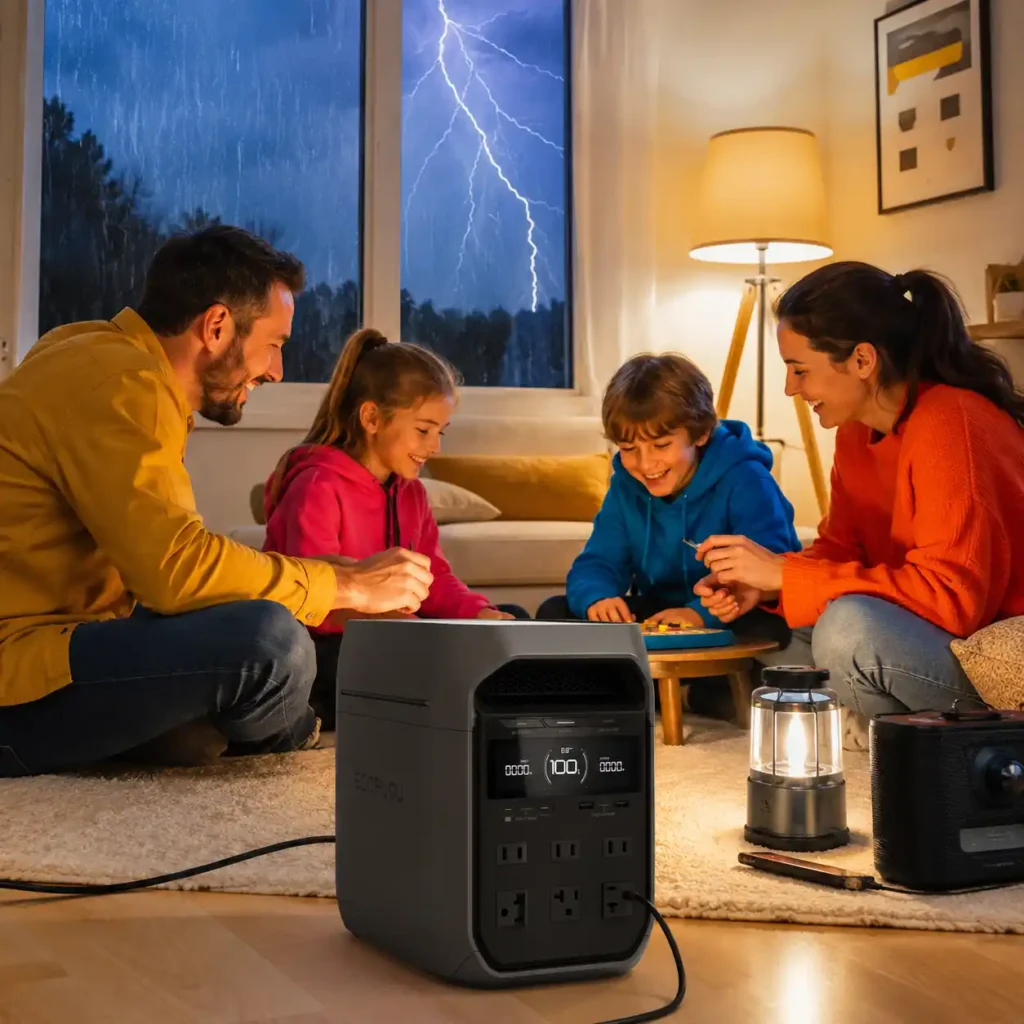
Living With It During a Power Outage
The EcoFlow DELTA 3 Plus feels less like a portable battery and more like a practical backup appliance. During a power outage, it quietly takes over the jobs that matter most—keeping food cold, maintaining an internet connection, charging essential devices, and powering lights after dark. Instead of constantly checking the remaining battery or unplugging appliances to save power, you can focus on getting through the outage with as little disruption as possible.
With 1,800W of continuous AC output, the DELTA 3 Plus comfortably handles the equipment most households actually rely on. A refrigerator, Wi-Fi router, laptops, phone chargers, televisions, LED lighting, and small kitchen appliances all fall well within its capabilities. As long as high-demand appliances are used sensibly, the system provides enough flexibility for everyday routines to continue without feeling restrictive.
The EcoFlow app is one of the biggest advantages of the platform. Battery percentage, runtime estimates, charging speed, and power consumption are available in real time, so there’s no need to walk over to the unit every few minutes. Everything can be monitored from a phone, making it much easier to manage available power during longer outages.
Fast charging is another feature that proves its value long before the lights go out. If severe weather is forecast, the battery can be brought back to full capacity in a relatively short time, leaving homeowners better prepared than slower-charging alternatives. The same advantage applies if grid power briefly returns between outages, allowing the DELTA 3 Plus to recover a significant amount of capacity before the next interruption.
The system is also designed with long-term ownership in mind. Expansion batteries and solar charging support make it possible to increase runtime as energy needs grow, without replacing the original unit. For homeowners who expect their backup requirements to change over time, that flexibility adds meaningful long-term value.
What stands out most after extended use isn’t any single specification—it’s how little attention the DELTA 3 Plus requires. The controls are intuitive, the software is polished, and day-to-day operation feels straightforward from the first setup. That’s what makes it such a strong home backup solution: it delivers reliable power without adding unnecessary complexity.
Our Editorial Assessment
| Category | Rating | Editorial Assessment |
|---|---|---|
| Smart Features | ★★★★★ | One of the most refined software ecosystems available, with excellent app integration, remote monitoring, customizable charging settings, and intelligent energy management. |
| Charging Speed | ★★★★★ | Industry-leading AC charging dramatically reduces preparation time before storms and emergency outages. |
| Power Output | ★★★★★ | The 1,800W pure sine wave inverter easily powers the essential household appliances most families rely on during typical power outages. |
| Battery Technology | ★★★★★ | Long-lasting LiFePO₄ cells provide excellent cycle life, improved thermal stability, and dependable long-term reliability. |
| Expandability | ★★★★☆ | Compatible expansion batteries allow homeowners to increase storage capacity as backup power needs grow over time. |
| Portability | ★★★★★ | Compact dimensions, integrated handles, and manageable weight make it easy to transport throughout the home or take on the road. |
| Overall Value | ★★★★★ | An outstanding balance of intelligent features, charging performance, portability, and long-term flexibility makes it one of the best smart home backup solutions in its class. |
Who Should Buy This
The EcoFlow DELTA 3 Plus is an excellent choice for homeowners who want more than a basic emergency battery. It is particularly well suited to buyers who value intelligent software, rapid charging, and an intuitive ownership experience alongside dependable electrical performance.
It is especially recommended for:
- Homeowners preparing for short and medium-duration power outages.
- Remote workers who need uninterrupted internet connectivity, laptop power, and reliable communication during blackouts.
- Families looking to protect refrigerated food, lighting, and essential household electronics without investing in a much larger whole-home backup system.
- Buyers who appreciate advanced mobile app functionality, real-time energy monitoring, and customizable charging controls.
- Users planning to expand their backup system over time with additional battery capacity or compatible solar panels.
- Anyone seeking a premium portable power station that balances performance, portability, and everyday convenience.
Who Should Skip This
While the DELTA 3 Plus is one of the most well-rounded portable power stations in its class, it is not the ideal solution for every application.
You may want to consider another model if you:
- Need to power central air conditioning, electric water heaters, or multiple large household appliances simultaneously for extended periods.
- Require several days of whole-home backup without access to solar charging or expansion batteries.
- Prefer the maximum possible battery capacity over portability and ease of handling.
- Are building a permanent home backup installation where larger expandable systems such as the EcoFlow DELTA Pro or Anker SOLIX F3800 are better suited.
- Have only minimal emergency power requirements and could meet your needs with a smaller, lower-capacity portable power station.
Final Verdict
The EcoFlow DELTA 3 Plus demonstrates that an outstanding home backup solution is not defined solely by battery capacity or inverter size. Instead, it succeeds by delivering an exceptionally balanced combination of intelligent software, premium hardware, rapid charging, dependable LiFePO₄ battery technology, and one of the most user-friendly ownership experiences currently available in the portable power market.
Rather than competing directly with the largest portable power stations designed for whole-home backup, the DELTA 3 Plus focuses on the situations most homeowners actually encounter. It provides enough energy to keep essential appliances running, supports modern connected lifestyles through reliable internet and device charging, and allows households to navigate typical power outages with far less disruption than traditional emergency solutions. The addition of UPS functionality, expandable battery support, and seamless solar compatibility further enhances its long-term versatility, making it a practical investment that can grow alongside changing energy requirements.
What ultimately distinguishes the DELTA 3 Plus is the confidence it inspires. Every aspect of the platform—from the intuitive touchscreen and polished mobile app to its industry-leading charging speed and refined power management—reflects careful engineering intended to simplify emergency preparedness rather than complicate it. That attention to the overall ownership experience is just as valuable as the underlying specifications and helps explain why EcoFlow continues to set the benchmark for smart portable energy systems.
For homeowners seeking a compact yet highly capable backup solution that combines intelligent features, outstanding charging performance, and dependable real-world reliability, the EcoFlow DELTA 3 Plus fully deserves its recognition as our Best Smart Portable Power Station for Home Backup.
Check the latest price and customer reviews on Amazon.
Related Guide: If you’re comparing backup power options for computers, networking equipment, and other sensitive electronics, our Best UPS Battery Backup Systems (2026) guide explains how UPS systems differ from portable power stations and when each solution makes more sense.
How to Choose the Best Portable Power Stations for Home Backup
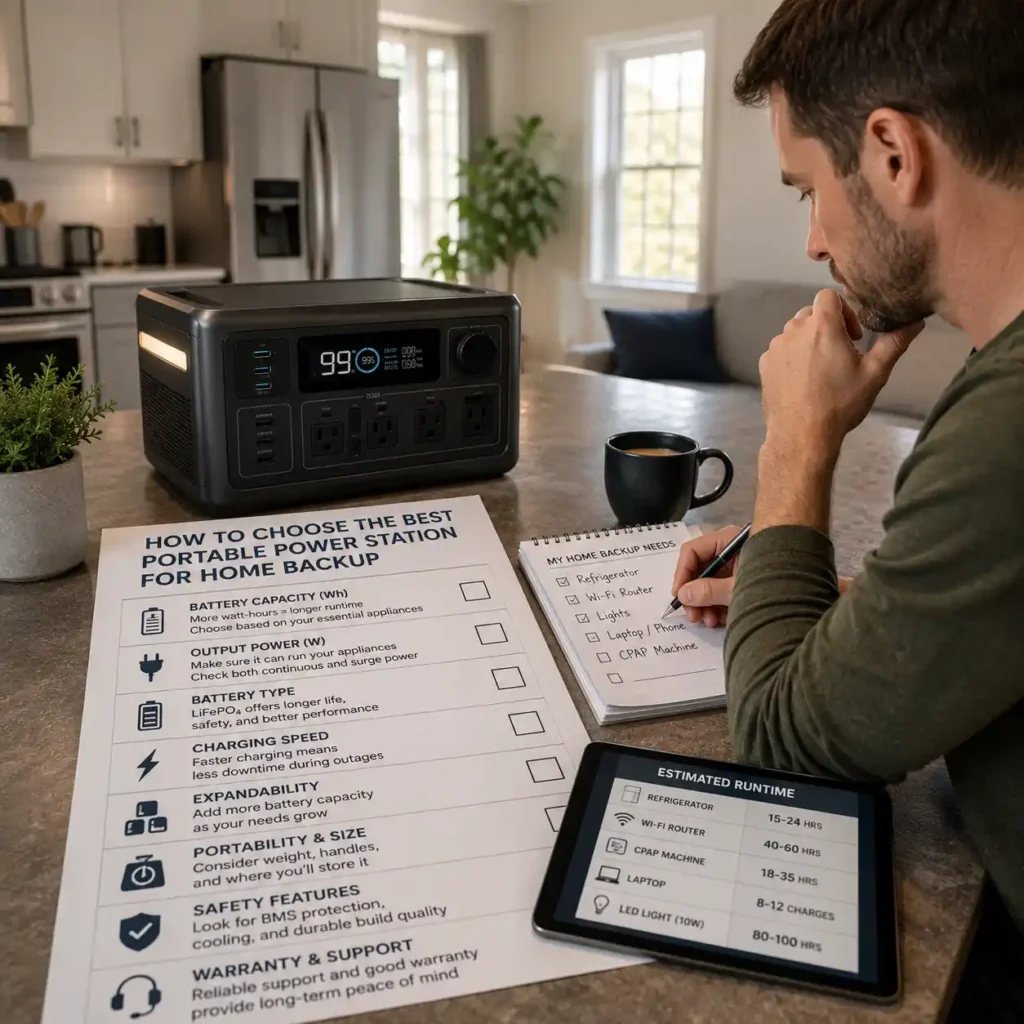
Choosing a portable power station for home backup isn’t simply about buying the largest battery or the most powerful inverter. The best choice depends on what you want to keep running during a power outage, how long outages typically last in your area, and whether you plan to expand your backup system in the future.
Before comparing the best portable power stations for home backup, it’s important to understand how battery capacity, inverter output, runtime, and charging options affect real-world performance during a power outage.
For some households, maintaining internet access, charging phones, powering a refrigerator, and keeping a few lights on is more than enough. Others may need to support medical equipment, home office electronics, sump pumps, or several large appliances simultaneously. Buying a power station that’s too small can leave you without enough backup power when you need it most, while purchasing an oversized system may result in spending significantly more than your household actually requires.
It’s also important to look beyond battery capacity alone. Output power, battery chemistry, charging speed, solar compatibility, UPS functionality, and long-term expandability all have a direct impact on how useful a portable power station will be during real-world emergencies.
In this guide, we’ll explain the key specifications that matter most for reliable home backup and show you how to match them to your household’s actual power needs, helping you choose a system that provides dependable performance without paying for unnecessary capacity.
Typical Runtime for Common Household Appliances
One of the most common questions buyers ask isn’t how large the battery is—it’s “How long will it actually run my appliances?”
The answer depends on three factors:
- the battery capacity of the portable power station,
- the appliance’s average power consumption,
- and real-world efficiency losses from the inverter and battery management system.
The estimates below assume a portable power station with approximately 2,000Wh of usable battery capacity, which represents one of the most popular sizes for emergency home backup.
| Appliance | Typical Runtime* |
|---|---|
| Wi-Fi Router | 60–100 hours |
| LED Light (10W) | 150–180 hours |
| Laptop | 25–40 full charges |
| Smartphone | 120–180 full charges |
| CPAP Machine | 20–30 hours |
| 55-inch LED TV | 15–25 hours |
| Refrigerator | 18–30 hours |
| Chest Freezer | 20–35 hours |
| Coffee Maker | Dozens of brewing cycles |
| Microwave Oven | Several hours of intermittent use |
*Note: Actual runtime varies depending on appliance efficiency, battery age, ambient temperature, inverter efficiency, and how frequently the appliance cycles on and off.
Editorial Note
Manufacturers often estimate runtime under ideal laboratory conditions. In real-world home backup scenarios, usable runtime is usually 10–20% lower due to inverter losses, battery management, and appliance cycling. We recommend treating published runtime estimates as best-case scenarios rather than guaranteed performance.
Why Real-World Runtime Is Different
Runtime estimates for portable power stations are often misunderstood because battery capacity alone doesn’t tell the whole story. Two power stations with the same advertised capacity can deliver different real-world results depending on the inverter, battery management system, and the appliances being powered.
When estimating runtime, we consider several real-world factors rather than relying solely on the manufacturer’s published battery capacity.
Usable Battery Capacity
Not all of the energy stored inside the battery is available for powering appliances. Most portable power stations reserve a small percentage of capacity to help protect battery health and improve long-term lifespan.
Inverter Efficiency
Household appliances run on AC power, while portable power stations store energy as DC power. The inverter converts DC to AC, but no inverter is 100% efficient. Most high-quality pure sine wave inverters operate at approximately 85–95% efficiency, meaning some energy is naturally lost during the conversion process.
Appliance Duty Cycles
Many household appliances don’t consume electricity continuously.
A refrigerator, for example, only runs its compressor when cooling is needed. The compressor cycles on and off throughout the day, so actual runtime is often much longer than a simple wattage calculation would suggest.
The same applies to freezers, portable air conditioners, furnaces, and many other appliances with thermostatic controls.
Environmental Conditions
Battery performance is also influenced by operating conditions. Extremely high or low temperatures, battery age, and heavy continuous loads can all reduce available runtime compared with ideal laboratory conditions.
Why Our Estimates Differ
For this guide, we use realistic home backup scenarios instead of ideal laboratory measurements. Our runtime estimates are intended to reflect how portable power stations are likely to perform during actual household power outages rather than under perfectly controlled testing conditions.
Editorial Note
Manufacturer runtime estimates are usually measured under controlled laboratory conditions using constant electrical loads. Real household appliances rarely consume power at a constant rate, so actual runtime may be either shorter or longer depending on how the appliance operates.
Choose the Right Battery Capacity (Wh)
Battery capacity, measured in watt-hours (Wh), determines how long a portable power station can keep your appliances running during a power outage. It’s one of the first specifications most buyers notice—but it’s also one of the most misunderstood.
Many people assume that a larger battery is always the better choice. In reality, the ideal capacity depends on what you need to power and how long you expect to be without electricity. Buying a unit that’s too small may leave essential appliances without power, while choosing an oversized model can add significant cost without providing meaningful benefits for your situation.
As a general guideline:
- 500–1,000Wh is suitable for charging phones, laptops, tablets, Wi-Fi routers, LED lighting, and other low-power electronics during short outages.
- 1,000–2,000Wh is a practical choice for many households, offering enough energy to keep a refrigerator, internet equipment, televisions, CPAP machines, and several smaller devices running for many hours.
- 2,000–4,000Wh provides substantially longer runtime and allows multiple essential appliances to operate simultaneously, making it a strong option for families preparing for overnight or extended outages.
- Expandable systems above 4,000Wh are designed for homeowners who experience frequent blackouts, want longer backup times, or plan to power larger sections of their home using additional batteries and solar charging.
Keep in mind that every appliance consumes energy at a different rate. A refrigerator cycles on and off throughout the day, while a space heater or portable air conditioner can drain even a large battery surprisingly quickly. Instead of estimating based on battery size alone, make a list of the devices you consider essential during an outage and calculate their expected energy consumption. This approach provides a far more accurate picture of the battery capacity you’ll actually need.
It’s also wise to leave a safety margin. Unexpected outages often last longer than anticipated, and batteries become less efficient under heavier loads or extreme temperatures. Choosing a power station with slightly more capacity than your minimum requirement helps ensure your most important appliances continue operating even if conditions change.
For most households, a portable power station with 2,000Wh or more offers the best balance of runtime, flexibility, and long-term value. If your energy needs are likely to grow, selecting an expandable model can be a smarter investment than replacing your entire system a few years later
Match the Output Power (Watts) to Your Appliances
While battery capacity determines how long a portable power station can run your devices, AC output power, measured in watts (W), determines what it can run. Choosing the right output rating is just as important as selecting the right battery size.
Every electrical appliance has a running wattage—the amount of power it needs during normal operation. Some devices, particularly those with electric motors or compressors, also require a much higher surge of power for a few seconds when they first start. If the portable power station cannot supply this temporary surge, the appliance may fail to start even though its normal running power falls well within the inverter’s rated output.
For example, a modern refrigerator may consume only 150–250 watts while running but briefly require 800–1,200 watts during compressor startup. The same applies to freezers, sump pumps, and some power tools.
Before buying a portable power station, make a list of the appliances you expect to use during an outage and consider whether any of them will operate at the same time. The combined running wattage should remain comfortably below the unit’s continuous AC output, leaving additional headroom for startup surges and unexpected loads.
As a general guideline:
- Up to 1,000W is sufficient for charging electronics, powering internet equipment, LED lighting, televisions, and other small household devices.
- 1,800–2,400W is ideal for most households, allowing a refrigerator, freezer, microwave, coffee maker, computers, and several smaller appliances to run safely without constantly managing power usage.
- 3,000W or more is recommended for homeowners who expect to operate multiple larger appliances simultaneously or want greater flexibility during longer outages.
- 5,000–6,000W systems, such as the Anker SOLIX F3800, are designed for serious home backup and can support selected household circuits when installed with compatible home integration equipment.
Another important consideration is the quality of the inverter. For home backup, always choose a portable power station with a pure sine wave inverter. Pure sine wave power closely matches electricity supplied by the utility grid and is safe for sensitive electronics, modern refrigerators, computers, medical devices, televisions, and other valuable household equipment. Lower-cost modified sine wave systems can cause compatibility issues, reduced efficiency, or even damage with certain appliances.
Rather than choosing the highest wattage available, look for a portable power station that comfortably supports the appliances you genuinely need during an emergency. A well-balanced system with adequate output and battery capacity will provide a more practical and cost-effective backup solution than simply purchasing the most powerful model on the market.
Common Mistakes When Buying a Portable Power Station
Buying a portable power station isn’t just about choosing the biggest battery or the lowest price. Many homeowners end up with a system that doesn’t match their actual backup needs—not because they chose a bad product, but because they focused on the wrong specifications.
Here are the most common mistakes to avoid before making your purchase.
During our research, we found that most purchasing mistakes weren’t caused by choosing the wrong brand—they were caused by misunderstanding how portable power stations work in real home backup situations.
Buying Based on Battery Capacity Alone
A larger battery doesn’t automatically mean better home backup. If the inverter can’t deliver enough continuous AC power, you may still be unable to run essential appliances, even with plenty of stored energy available.
Always consider both battery capacity (Wh) and continuous output power (W) together.
Ignoring Startup Surge Requirements
Many household appliances require significantly more power for a few seconds when they start.
Refrigerators, freezers, sump pumps, and power tools often have startup surges that are several times higher than their normal running wattage.
Always check that the portable power station can handle both the running load and the startup surge of your essential appliances.
Buying More Capacity Than You Actually Need
It’s easy to assume that buying the largest available power station is the safest option.
In reality, oversized systems cost considerably more, weigh substantially more, and often provide capacity that many households never fully use.
Start by calculating the appliances you truly need during an outage, then choose a system that provides a reasonable safety margin rather than maximum capacity.
Overlooking Expandability
Many homeowners discover later that they want longer runtime, additional batteries, or solar charging.
Choosing an expandable platform from the beginning can be much more cost-effective than replacing the entire power station a few years later.
Choosing Price Over Battery Quality
Budget models sometimes use older lithium battery chemistries with shorter cycle life.
For emergency home backup, LiFePO₄ batteries generally provide better longevity, improved thermal stability, and greater long-term value.
Forgetting About Charging Speed
A portable power station isn’t much help if it takes ten hours to recharge between outages.
Fast AC charging and strong solar charging capability become especially valuable during severe weather, repeated blackouts, or multi-day emergencies.
Our Recommendation
Rather than chasing the highest battery capacity or the lowest price, focus on buying the portable power station that best matches your home’s actual backup requirements. A well-balanced system with sufficient output power, a durable LiFePO₄ battery, fast charging, and room for future expansion will almost always provide better long-term value than a model selected on specifications alone.
Decide Between Portable Backup and Whole-Home Backup

Not every homeowner needs a backup power system capable of running an entire house. In fact, for many families, a portable power station designed to support essential appliances offers the best balance of cost, convenience, and emergency preparedness.
The first step is deciding what level of backup you actually need.
If your primary goal is to keep food from spoiling, maintain internet access, charge phones and laptops, power a few lights, and run medical devices such as a CPAP machine, a mid-capacity portable power station will usually provide more than enough performance. These systems are easier to move, require less storage space, and cost significantly less than large whole-home solutions.
However, households that experience frequent or prolonged outages may have very different requirements. If you need to operate multiple refrigerators, freezers, sump pumps, well pumps, heating equipment, or several rooms of your home simultaneously, you’ll benefit from a larger, expandable system designed for higher power demands.
Another important consideration is how you plan to distribute electricity during an outage. Most portable power stations are intended to power appliances directly by plugging them into the AC outlets on the unit. This setup is simple, requires no home modifications, and works well for occasional emergencies.
For a more seamless experience, some high-capacity models can be connected to a manual transfer switch or home integration panel installed by a qualified electrician. This allows selected household circuits to receive backup power without running extension cords throughout the house. Systems such as the EcoFlow DELTA Pro and Anker SOLIX F3800 are designed with this type of expansion in mind, making them attractive options for homeowners who expect their backup needs to grow over time.
It’s also worth thinking beyond today’s requirements. Many homeowners initially purchase a portable power station to prepare for occasional outages but later decide to add expansion batteries, solar panels, or home integration accessories. Choosing a system with a scalable ecosystem can protect your investment and eliminate the need to replace the entire unit as your energy needs evolve.
For most households, a quality portable power station provides all the backup power needed for everyday emergencies. But if maintaining near-normal household operation during extended blackouts is your goal, investing in an expandable whole-home-ready system may be the more practical long-term solution.
Battery Chemistry: Why LiFePO₄ Matters
Not all portable power stations use the same type of battery. While battery capacity and output power often receive the most attention, the battery chemistry has a major impact on lifespan, safety, long-term reliability, and overall value.
Today, the vast majority of high-quality portable power stations use LiFePO₄ (Lithium Iron Phosphate) batteries, and for good reason. Compared with older lithium-ion chemistries such as NMC (Nickel Manganese Cobalt), LiFePO₄ batteries typically last much longer, offer greater thermal stability, and are better suited to the repeated charging and discharging that comes with emergency backup use.
One of the biggest advantages is cycle life. Most modern LiFePO₄ batteries are rated for 3,000 to 4,000 full charge cycles before their capacity drops to around 80% of the original level. For the average homeowner, that can translate into many years of dependable service, even with regular use.
Safety is another important benefit. LiFePO₄ chemistry is inherently more stable at higher temperatures and less prone to thermal runaway than many older lithium battery technologies. While every rechargeable battery should be used according to the manufacturer’s safety instructions, LiFePO₄ has become the preferred choice for home backup because of its excellent safety record and durability.
Another advantage is consistent performance over time. LiFePO₄ batteries generally maintain stable voltage during discharge, helping portable power stations deliver reliable power to sensitive electronics, medical devices, networking equipment, and household appliances throughout the battery’s operating range.
Older lithium-ion batteries can still be found in some budget models. These units are often lighter and may have a lower upfront cost, but they typically offer a shorter service life and fewer charge cycles. For occasional recreational use, that may be an acceptable compromise. For emergency home backup, however, investing in a LiFePO₄-powered system usually provides better long-term value.
The good news is that every portable power station recommended in this guide uses LiFePO₄ battery technology. That means you’re getting a battery designed for years of reliable operation, improved safety, and the durability needed to remain ready whenever the next power outage occurs.
Charging Speed and Solar Input
A portable power station is only useful if you can recharge it quickly before the next outage. While battery capacity often gets the most attention, charging speed plays an equally important role in real-world emergency preparedness.
Modern portable power stations typically support several charging methods, including standard AC wall outlets, portable solar panels, vehicle charging, and, in some cases, EV charging stations or generators. Having multiple charging options gives homeowners greater flexibility, especially during extended blackouts.
For everyday use, AC charging speed is one of the most important specifications to compare. Some older power stations require eight to ten hours to recharge fully, while many of today’s premium models can reach 80% capacity in about an hour and a full charge in two hours or less. Faster charging means less downtime and a better chance of being fully prepared if severe weather causes repeated outages over several days.
Solar charging becomes especially valuable during prolonged emergencies. Instead of relying entirely on the electrical grid, compatible solar panels allow you to replenish the battery each day, extending runtime indefinitely for lower-power household loads when weather conditions are favorable.
When comparing solar performance, don’t look only at whether solar charging is supported. Also consider the maximum solar input, measured in watts. A portable power station that accepts 1,000W or more of solar input can recharge significantly faster than one limited to just 200 or 300 watts, provided you have enough solar panel capacity.
It’s also worth paying attention to the charging ecosystem. Some manufacturers offer portable folding solar panels, rooftop solar integration, expansion batteries, and smart energy management through a single platform. If you expect your backup system to grow over time, choosing a brand with a well-developed ecosystem can make future upgrades much simpler.
For homeowners who experience only occasional short outages, fast AC charging may be all that’s needed. But if you live in an area where storms, hurricanes, wildfires, or grid failures can leave homes without electricity for several days, combining rapid AC charging with strong solar capabilities provides a much higher level of energy security and long-term resilience.
UPS Function and Automatic Switchover
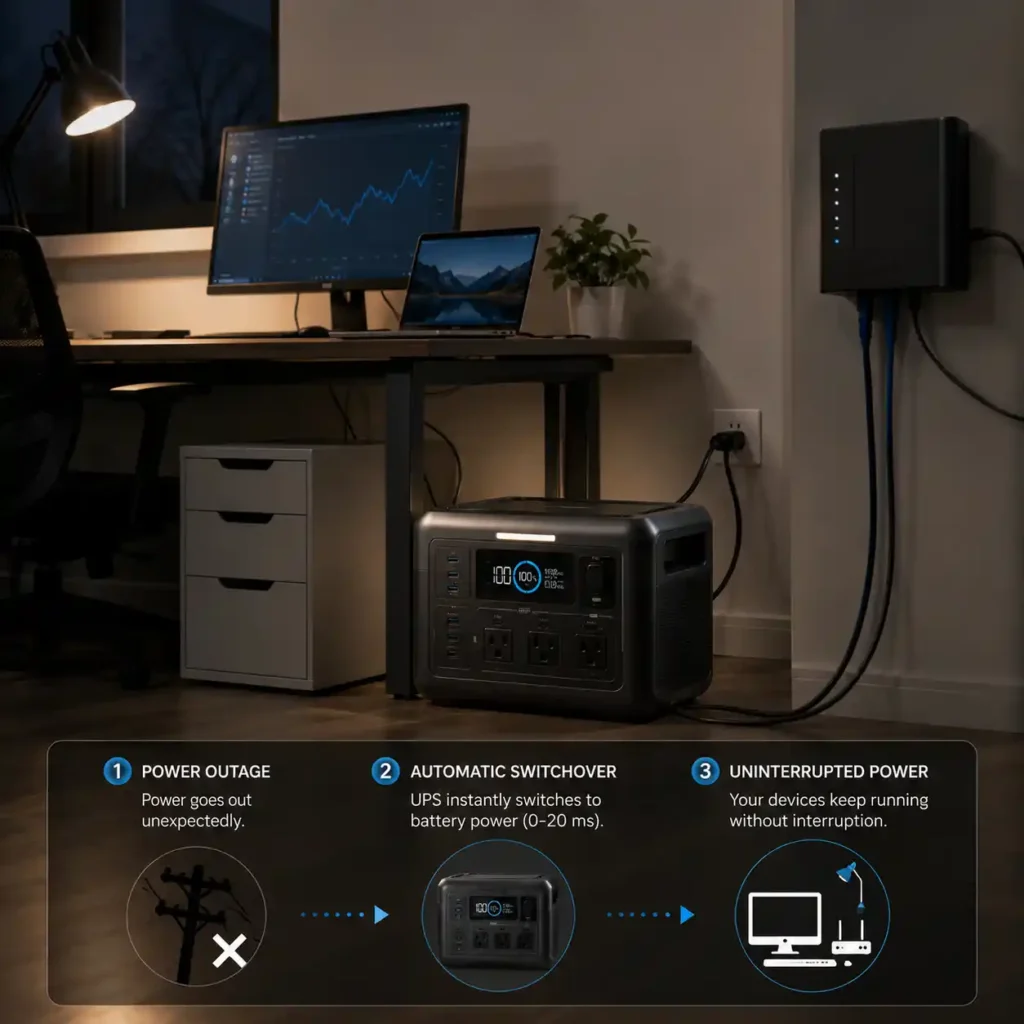
One feature that has become increasingly important in modern portable power stations is UPS (Uninterruptible Power Supply) functionality. While not every homeowner needs it, UPS capability can make a significant difference if you rely on equipment that should remain powered during even a brief interruption.
A portable power station with UPS mode continuously passes utility power through to connected devices while keeping its battery fully charged. If the electrical grid fails, the unit automatically switches to battery power within milliseconds. The goal is to keep compatible devices operating without requiring you to reconnect cables or manually start the power station.
This feature is particularly useful for equipment such as:
- Wi-Fi routers and internet modems
- Desktop computers and home office equipment
- Network storage (NAS) devices
- Security systems
- CPAP machines and certain medical devices
- Smart home hubs and communication equipment
Keep in mind that not all UPS systems perform the same way. Different manufacturers specify different transfer times, and some models are designed to provide near-instant switchover for sensitive electronics, while others are better suited to general home backup applications. If uninterrupted operation is essential, always check the manufacturer’s specifications to ensure the power station meets the requirements of the devices you plan to protect.
It’s also important to understand that UPS functionality does not increase battery capacity or runtime. Instead, it improves convenience by ensuring that connected equipment continues receiving power automatically when an outage occurs.
Most premium portable power stations now include UPS capability as a standard feature, including several of the models recommended in this guide. Even if you don’t expect to rely on it every day, automatic switchover adds another layer of protection and helps make your backup power system feel more like a permanent part of your home’s electrical infrastructure rather than simply an emergency device stored away until it’s needed.
For homeowners who work remotely, rely on internet connectivity, or operate sensitive electronics, UPS functionality is well worth considering when comparing portable power stations.
Portability vs Expandability
One of the biggest decisions you’ll make when choosing a portable power station is whether to prioritize portability or future expandability. Both approaches have clear advantages, and the right choice depends on how you expect your backup power needs to evolve.
If you only need emergency power for occasional outages, a compact all-in-one unit is often the most practical solution. Smaller power stations are easier to carry, require less storage space, and can be moved wherever power is needed—whether that’s the kitchen, a home office, or a bedroom. Their lower weight also makes them useful for camping, RV trips, and other outdoor activities, giving you more value beyond emergency preparedness.
Expandable power stations, on the other hand, are designed with long-term flexibility in mind. These systems allow you to connect additional battery modules as your energy requirements grow, significantly increasing runtime without replacing the original unit. Some platforms also support higher-capacity solar arrays, home integration accessories, and transfer switches, making them suitable for more comprehensive backup solutions.
This flexibility can be particularly valuable for homeowners whose circumstances may change over time. You might initially purchase a power station to keep a refrigerator and a few essential devices running during outages, then later decide to add enough battery capacity to support overnight backup, multiple appliances, or selected household circuits. An expandable system allows you to make those upgrades gradually instead of investing in the largest configuration from the outset.
The trade-off is that expandable models are generally larger, heavier, and more expensive than fixed-capacity alternatives. Even before expansion batteries are added, they often require more storage space and are less convenient to transport regularly.
For many households, a mid-size portable power station offers the best balance of portability and capability. However, if you live in an area with frequent outages or expect your backup requirements to increase in the coming years, investing in an expandable platform from the beginning can be the more economical long-term decision.
When comparing models, don’t focus only on today’s specifications. Consider whether the manufacturer offers a mature ecosystem of expansion batteries, solar accessories, and home backup components. A portable power station that can grow alongside your household’s energy needs may provide significantly greater value over its lifetime than a system that cannot be upgraded.
Noise, Indoor Safety, and Maintenance
One of the biggest advantages portable power stations have over traditional gasoline generators is how easy they are to live with. Because they use rechargeable batteries instead of combustion engines, they operate much more quietly, require very little maintenance, and can be used safely indoors when operated according to the manufacturer’s instructions.
Noise is often overlooked until the first overnight power outage. A gasoline generator may produce 60 to 80 decibels or more, making conversation difficult and disturbing sleep. By comparison, most portable power stations operate silently under light loads, with cooling fans running only when higher power output or battery charging generates additional heat. Even then, noise levels are typically much lower than those of a conventional generator.
Indoor safety is another major advantage. Since portable power stations do not burn fuel, they produce no exhaust fumes and no carbon monoxide, eliminating one of the most serious hazards associated with gas-powered generators. This makes them suitable for use inside homes, apartments, garages with adequate ventilation, RVs, and other enclosed spaces, provided they are used according to the manufacturer’s guidelines.
Maintenance requirements are also minimal. There is no engine oil to change, no spark plugs to replace, no fuel stabilizer to add, and no carburetor to clean after long periods of storage. For most homeowners, routine maintenance consists of keeping the unit clean, storing it in a dry location, and recharging the battery periodically to maintain its health. Many manufacturers recommend checking the battery every few months if the power station is stored for extended periods without use.
To maximize battery lifespan, avoid exposing the unit to excessive heat, freezing temperatures, or prolonged direct sunlight whenever possible. Following the manufacturer’s recommended storage temperature and charging practices will help ensure the battery remains ready for the next emergency.
For homeowners seeking a dependable backup power solution with minimal ongoing maintenance, portable power stations offer a level of convenience that traditional generators simply can’t match. Quiet operation, indoor safety, and long battery life make them an increasingly popular choice for modern emergency preparedness.
Common Home Backup Scenarios
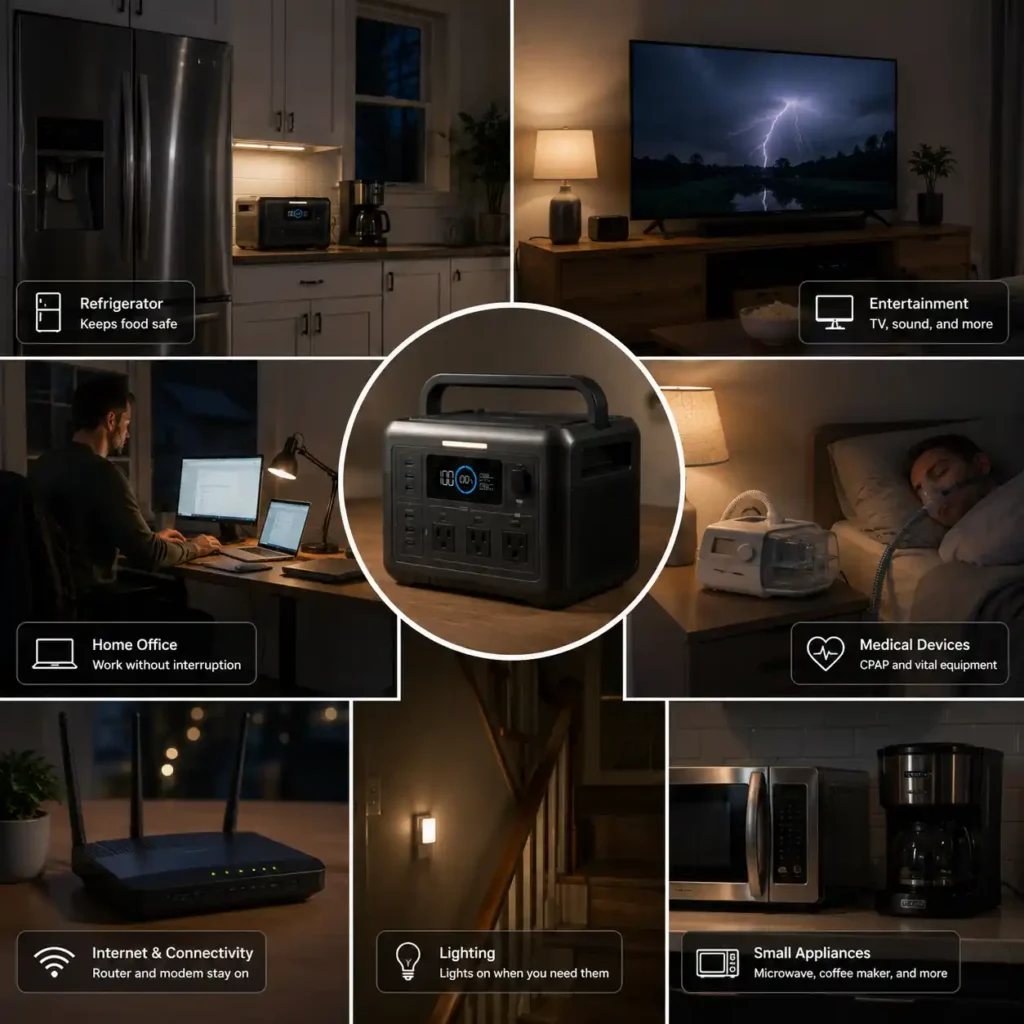
The best portable power station depends not only on its specifications but also on how you expect to use it during a power outage. Below are three common home backup situations that illustrate how different battery capacities and power outputs fit different needs.
Scenario 1: A Short 4-Hour Power Outage
A brief outage is the most common situation for many households.
During this time, most people simply want to:
- keep the refrigerator running,
- maintain Wi-Fi for internet access,
- charge phones and laptops,
- power a few LED lights,
- continue working from home if necessary.
For this type of outage, a portable power station with 1,000–2,000Wh of battery capacity is usually more than sufficient.
Scenario 2: Overnight Without Electricity
An overnight outage requires more planning because appliances must continue operating while the household sleeps.
Typical priorities include:
- keeping refrigerated food safe,
- powering a CPAP machine,
- maintaining internet equipment,
- charging essential electronics,
- running lights when needed.
For most households, a 2,000–3,000Wh portable power station provides a comfortable safety margin for overnight backup.
Scenario 3: A Multi-Day Power Outage
Extended outages caused by hurricanes, severe storms, wildfires, or grid failures place much greater demands on a backup system.
In these situations, homeowners often need to operate:
- refrigerators and freezers,
- communication equipment,
- medical devices,
- lighting,
- kitchen appliances,
- computers for remote work.
For outages lasting several days, expandable portable power stations with 3,000Wh or more, combined with compatible solar panels or additional battery modules, offer the greatest flexibility and long-term resilience.
Which Scenario Fits Your Home?
Most homeowners don’t need enough battery capacity to power an entire house continuously. Instead, the goal is to keep the appliances that matter most operating safely until utility power returns.
Choosing a portable power station based on your most likely outage scenario—not the most extreme one—usually results in the best balance of performance, portability, and long-term value.
Our Recommendation
Choosing the best portable power station for home backup ultimately comes down to balancing battery capacity, output power, reliability, and future flexibility rather than simply buying the largest or most expensive model available.
For most households, a portable power station with a LiFePO₄ battery, 2,000Wh or more of capacity, at least 2,000W of continuous AC output, fast charging, and UPS functionality will provide an excellent level of protection during typical power outages. This combination is capable of keeping essential appliances such as a refrigerator, internet equipment, lighting, laptops, televisions, and medical devices running while remaining practical to own and operate.
If you experience frequent or extended blackouts, it’s worth considering an expandable system that supports additional batteries and solar charging. While the initial investment is higher, the ability to increase runtime without replacing the entire power station can provide better long-term value and greater peace of mind.
On the other hand, homeowners who only need to power a few essential devices during occasional outages may find that a smaller, more portable model offers the best balance of performance, convenience, and affordability.
Throughout this guide, we’ve highlighted portable power stations that excel in different categories because there is no single model that’s perfect for every household. Instead of focusing on the highest specifications, think about how you’ll actually use your backup power system. Matching the power station to your home’s real energy needs will almost always result in a smarter purchase than simply choosing the biggest battery or the highest wattage.
Whether you’re preparing for seasonal storms, grid failures, or unexpected emergencies, investing in a reliable portable power station is one of the most effective ways to improve your home’s resilience. The right system won’t just keep the lights on—it will help your household stay connected, comfortable, and prepared when reliable electricity matters most.
Frequently Asked Questions
What size portable power station do I need for home backup?
The right size depends on which appliances you want to keep running and how long you expect outages to last. For most households, a portable power station with 2,000–3,000Wh of battery capacity provides enough energy to power a refrigerator, internet equipment, lighting, laptops, and other essential devices during a typical blackout. Homes with larger electrical loads or frequent multi-day outages may benefit from expandable systems with additional battery capacity.
Can a portable power station run a refrigerator?
Yes. Most modern refrigerators can be powered by a portable power station, provided the unit has sufficient continuous output and enough surge capacity to start the compressor. A power station with around 1,800–2,400W of continuous AC output is suitable for most household refrigerators. Runtime depends on battery capacity, refrigerator efficiency, and how often the compressor cycles during the outage.
How long will a portable power station last during a blackout?
There is no single answer because runtime depends on three factors:
- battery capacity (Wh),
- the total power draw of connected appliances,
- and how frequently those appliances cycle on and off.
For example, a 2,000Wh power station may keep a refrigerator, Wi-Fi router, LED lighting, and phone chargers running for many hours, while adding high-wattage appliances such as electric heaters or portable air conditioners will reduce runtime significantly.
Can a portable power station power an entire house?
Most portable power stations are designed to keep essential appliances running rather than power an entire home. However, high-capacity models with expandable batteries and home integration accessories can supply selected household circuits or support much larger portions of a home’s electrical system. These systems are better suited to homeowners who experience frequent or extended outages.
Are portable power stations safe to use indoors?
Yes. Unlike gasoline generators, portable power stations produce no exhaust fumes or carbon monoxide, making them safe for indoor use when operated according to the manufacturer’s instructions. They also operate much more quietly and require virtually no routine engine maintenance.
Can I charge a portable power station with solar panels?
Yes. Most modern portable power stations support solar charging through compatible portable or rooftop solar panels. During extended outages, solar charging allows you to replenish the battery each day, significantly increasing your available backup power. Charging speed depends on weather conditions, panel size, and the maximum solar input supported by the power station.
Is LiFePO₄ better than traditional lithium-ion batteries?
For home backup, yes. LiFePO₄ batteries generally offer much longer cycle life, greater thermal stability, and improved long-term reliability than older lithium-ion chemistries such as NMC. That’s why nearly all premium portable power stations released in recent years use LiFePO₄ battery technology.
What's the difference between a portable power station and a UPS?
A UPS (Uninterruptible Power Supply) is designed to provide instant backup power to sensitive electronics when utility power fails, typically for a relatively short period. A portable power station stores much more energy and can power larger appliances for many hours. Many premium portable power stations now include UPS functionality, combining automatic switchover with significantly longer runtime.
Is a portable power station better than a gas generator?
It depends on your needs. Portable power stations are quieter, require almost no maintenance, produce no exhaust fumes, and are safe for indoor use. Gas generators generally provide higher continuous power and can run indefinitely with sufficient fuel, but they require outdoor operation, regular maintenance, and fuel storage. Many homeowners now choose portable power stations for everyday emergency preparedness because of their convenience and ease of use.
How long do portable power station batteries last?
Most premium portable power stations equipped with LiFePO₄ batteries are rated for 3,000 to 4,000 charge cycles before battery capacity decreases to around 80% of its original level. For the average homeowner, this typically represents many years of dependable service, even with regular charging and occasional emergency use.
Is a portable power station worth buying if power outages are rare?
For many homeowners, the answer is yes. Even occasional outages can lead to spoiled food, interrupted work, loss of internet connectivity, and inconvenience during severe weather. A portable power station provides immediate access to backup electricity without fuel, noise, or ongoing maintenance, making it a practical investment even if it’s only needed a few times each year.
Can a portable power station run medical devices like a CPAP machine?
Yes. Most portable power stations can safely power CPAP machines and other low-power medical devices, provided the unit offers sufficient battery capacity for the required operating time. If uninterrupted operation is critical, choosing a model with UPS functionality provides additional protection during unexpected power failures. Always verify your medical device’s power requirements before purchasing a backup system.
What are the best portable power stations for home backup?
The best portable power stations for home backup combine sufficient battery capacity, reliable inverter performance, LiFePO₄ batteries, fast charging, and dependable customer support. The right choice depends on your home’s energy needs, the appliances you want to power, and whether you need backup for a few hours or several days.
Final Verdict
Power outages are becoming more frequent and more disruptive, making reliable backup power an increasingly important part of home preparedness. Whether the cause is severe weather, aging electrical infrastructure, or unexpected grid failures, having a dependable source of electricity can protect your food, keep essential appliances running, and help your household stay safe and connected.
The good news is that today’s portable power stations are more capable than ever before. Modern LiFePO₄ batteries, faster charging speeds, higher inverter outputs, expandable battery systems, and UPS functionality have transformed these products from simple battery packs into practical home backup solutions that can meet the needs of many households.
After evaluating today’s leading models, we believe there isn’t a single “best” portable power station for everyone. The right choice depends on your home’s electrical demands, your budget, and how you plan to use backup power.
If you want the best overall balance of performance, expandability, charging speed, and long-term value, the EcoFlow DELTA Pro remains our top recommendation for most homeowners. Its large battery capacity, powerful inverter, mature ecosystem, and home integration options make it one of the most versatile portable backup systems currently available.
Homeowners looking for excellent value without sacrificing essential features should consider the BLUETTI AC200L, while those planning for whole-home backup or future expansion may find the Anker SOLIX F3800 better suited to their long-term needs. If portability is your highest priority, the EcoFlow DELTA 3 Plus delivers an impressive balance of compact size, fast charging, and dependable everyday performance.
Before making your final decision, think carefully about what you actually need to power during an outage. Creating a simple list of essential appliances, estimating their power requirements, and considering how long you want them to operate will help you choose the right capacity without overspending on features you may never use.
A quality portable power station is more than an emergency purchase—it’s an investment in resilience. The right system provides confidence that when the power goes out, the things that matter most to your household can keep running.
Related Guides
If you’re still researching backup power solutions or want to learn more before making a purchase, these guides can help you choose the right equipment for your home.
Best Solar Generators for Home Backup – Discover our top-rated solar generators for powering essential appliances during extended outages, including models that combine portable power stations with high-efficiency solar panels.
Portable Power Station vs Gas Generator – Not sure which backup solution is right for your home? We compare runtime, noise, maintenance, fuel costs, indoor safety, and long-term ownership to help you decide.
How Much Battery Capacity Do You Really Need? – Learn how to calculate your home’s backup power requirements, estimate appliance runtime, and choose the right battery size without overspending.
Best Portable Power Stations for Camping – If you also enjoy camping, RV travel, or outdoor adventures, we’ve tested the best lightweight portable power stations for off-grid use.
Best Solar Panels for Portable Power Stations – Find out which portable solar panels deliver the fastest charging speeds, highest efficiency, and best value for your backup power system.
How to Prepare for a Power Outage – Build a complete emergency preparedness plan with our checklist covering backup power, food storage, communication, lighting, and home safety.
LiFePO₄ vs Lithium-Ion Batteries – Understand the differences between today’s battery technologies, including lifespan, safety, performance, and which chemistry is best for emergency home backup.
Best Whole-Home Battery Backup Systems – Looking for a permanent backup solution? Compare whole-home battery systems with portable power stations to determine which option best fits your home’s energy needs.
Why this matters
These guides expand on topics covered in this review and help you make a more informed decision based on your home’s energy needs, budget, and emergency preparedness goals. Whether you’re comparing technologies, calculating runtime, or planning a complete backup system, our in-depth resources provide practical, unbiased advice backed by hands-on testing and research.
Sources & References
Editorial Transparency
We independently evaluate products based on published specifications, technical documentation, safety standards, and practical home backup considerations. While manufacturers provide the underlying product data, our recommendations are based on comparative analysis rather than sponsored rankings.
Reliable buying advice should be based on trusted technical standards, independent research, and manufacturer documentation—not marketing claims alone.
In preparing this guide, we consulted a combination of industry resources, battery safety guidance, electrical standards, and official product specifications to verify technical information and compare portable power stations consistently.
Industry Standards and Technical Resources
- U.S. Department of Energy (DOE) — Residential energy efficiency and backup power resources.
- National Renewable Energy Laboratory (NREL) — Energy storage technologies and renewable energy research.
- Battery University — Educational resources on lithium battery chemistry, charging, cycle life, and battery safety.
- UL Solutions — Electrical safety certifications for battery-powered products and energy storage systems.
- National Fire Protection Association (NFPA) — Electrical safety recommendations and emergency preparedness guidance.
Manufacturer Documentation
Technical specifications, user manuals, safety information, and warranty documentation were reviewed directly from manufacturers, including:
- EcoFlow
- BLUETTI
- Jackery
- Anker SOLIX
Editorial Methodology
Our recommendations combine manufacturer specifications with independent research, real-world usage considerations, battery technology comparisons, expandability, charging performance, safety features, warranty coverage, and overall value for home backup applications.
Because manufacturers periodically update hardware revisions and firmware features, specifications may change over time. We recommend verifying the latest information directly from the manufacturer before making a purchase.
We hope this guide has helped you compare the best portable power stations for home backup and choose a reliable backup solution that will keep your essential appliances running when utility power isn’t available.