
Choosing a portable power station is less about finding the model with the biggest battery and more about matching the right specifications to the way you will actually use it.
A 2,000Wh power station may sound better than a 1,000Wh model, but that does not automatically make it the better choice. If you only need to charge phones, laptops, lights, and a camera on a weekend trip, the larger unit may add unnecessary weight and cost. On the other hand, a smaller station may fail when you need to keep a refrigerator, CPAP machine, modem, or other essential equipment running during a power outage.
The key is to evaluate capacity, continuous output, surge capability, battery chemistry, charging speed, solar input, portability, and features together.
This guide explains exactly how to do that before you buy.
Table of Contents
Quick Answer
The right portable power station is the one that can run your highest-demand devices and provide enough usable energy for the amount of time you need, without being unnecessarily large, heavy, or expensive.
Before buying, determine these seven things:
- What devices will you run?
- How many watts do they use at the same time?
- Do any devices have a high startup surge?
- How many watt-hours do you need for your required runtime?
- How will you recharge the power station?
- Do you need portability, solar charging, UPS functionality, or expandable capacity?
- How often will you use it?
The two specifications you should never confuse are:
- Watt-hours (Wh): how much energy the battery stores.
- Watts (W): how much power the inverter can deliver at one time.
A good buying decision requires both.
In short: choose the power station based on your required watts first, your required watt-hours second, and the features that support your actual use case third.
How to Choose a Portable Power Station: Start With What You Need to Power
How to choose a portable power station starts with your electrical needs, not with the power station itself. The biggest mistake buyers make is choosing a battery size before determining what they actually need to power.
Do not begin by asking:
“Should I buy a 1,000Wh or 2,000Wh power station?”
Instead ask:
“What exactly do I want this power station to do?”
A portable power station might be used for very different purposes:
- Emergency power during a blackout
- Refrigerator or freezer backup
- CPAP backup
- Home office equipment
- Internet modem and router
- Camping
- RV or van use
- Tailgating
- Outdoor events
- Photography and video equipment
- Power tools
- Charging phones and laptops
- Short-term emergency preparedness
Each scenario produces a different ideal combination of capacity, output, weight, and charging capability.
Build a simple load list
Before comparing models, write down the equipment you expect to run.
| Device | Typical Power* | Hours Needed | Estimated Energy |
|---|---|---|---|
| Smartphone charger | 5–20W | 2 | 10–40Wh |
| Laptop | 45–100W | 5 | 225–500Wh |
| Wi-Fi router | 10–20W | 8 | 80–160Wh |
| Refrigerator | 100–250W running | 8 | Varies |
| CPAP | 30–60W | 8 | 240–480Wh |
| Microwave | 900–1,500W | Short use | Varies |
*Actual consumption varies significantly by model and operating conditions. Check the appliance label, manual, or a power meter when possible.
The refrigerator is a particularly important example. Its compressor cycles on and off, so its average energy consumption is not simply its rated running wattage multiplied by every hour of the day.
That is why measured consumption is better than guessing when sizing a system for serious backup use.
For a more detailed approach to determining your electrical demand, see our How to Calculate Power Consumption guide before comparing power stations.
Capacity: How Many Watt-Hours Do You Need?
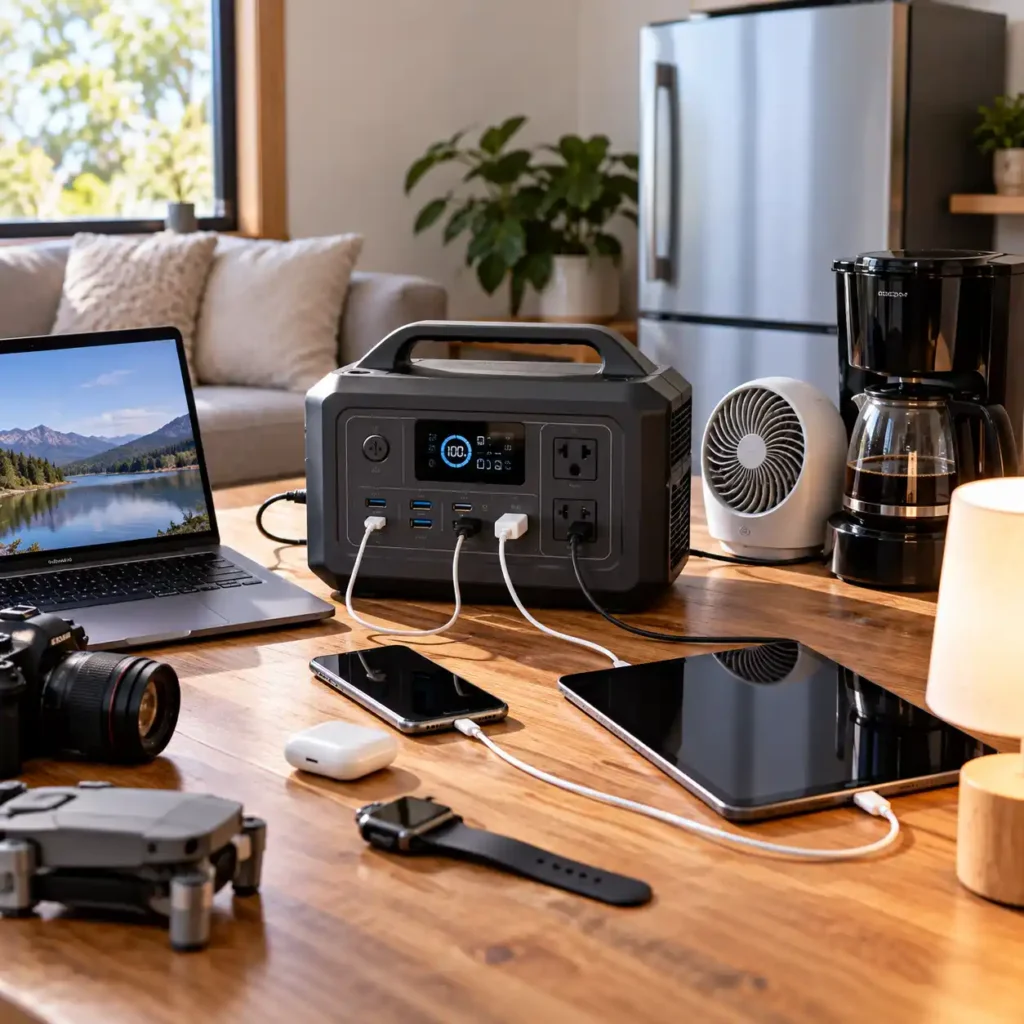
Battery capacity is measured in watt-hours (Wh).
It is the approximate amount of electrical energy stored in the battery.
Think of Wh as the size of a fuel tank.
A larger capacity generally means longer runtime, assuming the power station has enough output to run the device.
For example, in a simplified calculation:
- 1,000Wh ÷ 100W = 10 hours
- 1,000Wh ÷ 200W = 5 hours
- 1,000Wh ÷ 500W = 2 hours
Real-world runtime will be lower because energy is lost through the inverter, conversion electronics, battery management system, and other factors.
If you want to calculate your required battery capacity more precisely, use our Battery Capacity Calculator to estimate the Wh and Ah requirements for your setup.
Capacity does not tell you what the station can run
This distinction is critical.
A 2,000Wh power station does not necessarily mean it can power a 2,000W appliance.
For example, a power station could have:
- 2,000Wh battery capacity
- 1,800W continuous AC output
- 2,700W surge output
The battery has substantial stored energy, but the inverter still limits the amount of power that can be delivered at one time.
This is one of the most common purchasing mistakes in the category.
Output Wattage: What Can the Power Station Actually Run?
Output is measured in watts (W).
It tells you how much electrical power the power station can deliver simultaneously.
Suppose you want to run:
- Refrigerator: 150W
- Router: 15W
- Laptop: 70W
- LED lights: 30W
Your running load is approximately:
150 + 15 + 70 + 30 = 265W
A power station with a 300W continuous inverter might technically handle that load, but there is very little headroom.
A better target would be a unit with substantially more continuous output.
A practical rule
Add the running wattage of the devices you expect to operate simultaneously and allow some headroom rather than selecting a unit that operates continuously near its maximum rating.
This becomes especially important when motors, compressors, or heating elements are involved.
Pure Sine Wave: Does It Matter?
A pure sine wave inverter produces a smoother, more consistent form of AC power that closely resembles the electricity supplied by the grid. It is generally preferred for sensitive electronics and equipment that may respond poorly to lower-quality power.
When choosing a portable power station, check the manufacturer’s specifications to confirm whether the AC inverter provides a pure sine wave output. Do not assume that every power station with standard AC outlets uses the same inverter waveform.
Pure sine wave output can be particularly relevant for computers, medical equipment, audio equipment, and certain motor-driven appliances. While many modern devices can operate normally on different inverter types, sensitive or motor-based equipment may benefit from cleaner AC power.
If you plan to use the power station for critical electronics or medical equipment, verify the manufacturer’s compatibility guidance rather than relying on the outlet type alone.
Do Not Forget Surge Power
Some appliances require significantly more power when they start.
This is known as startup or surge power.
Common examples include:
- Refrigerators
- Freezers
- Pumps
- Fans
- Power tools
- Some air compressors
- Certain appliances with electric motors
A refrigerator may consume relatively little power once running but require a higher instantaneous load when the compressor starts.
Therefore, you need to check two specifications on the power station:
Continuous output
The amount of power it can deliver continuously.
Surge/peak output
The higher amount of power it can temporarily deliver under specified conditions.
Do not rely on a generic multiplier for every appliance. Startup requirements vary by motor, compressor, control system, and appliance design.
When the load is important, check the manufacturer’s specifications or measure the appliance with a suitable power meter.
If you need help identifying running and starting watts for individual appliances, use our Appliance Wattage Calculator before sizing your power station.
How to Choose a Portable Power Station Based on Runtime
A basic runtime estimate is:
Runtime ≈ Battery Capacity (Wh) × Efficiency ÷ Load (W)
For example, assume:
- Battery capacity: 1,000Wh
- Load: 100W
- Estimated usable efficiency: 85%
Then:
1,000 × 0.85 ÷ 100 = approximately 8.5 hours
This is only an estimate.
For illustration only, using an assumed 85% efficiency. Actual AC runtime varies by model, load, temperature, and operating conditions.
Actual runtime can vary because of:
- Inverter efficiency
- Load size
- AC versus DC output
- Battery temperature
- Battery condition
- Power management settings
- Appliance cycling
- Minimum battery reserve
- Conversion losses
Why the 85% example is useful
It prevents a common mistake: assuming that a 1,000Wh battery will always deliver exactly 1,000Wh of usable AC energy.
It will not.
The actual usable energy available at an AC outlet depends on the entire electrical conversion chain.
For a critical backup application, use conservative estimates rather than designing your system around the theoretical maximum.
LiFePO4 vs. NMC Battery Chemistry
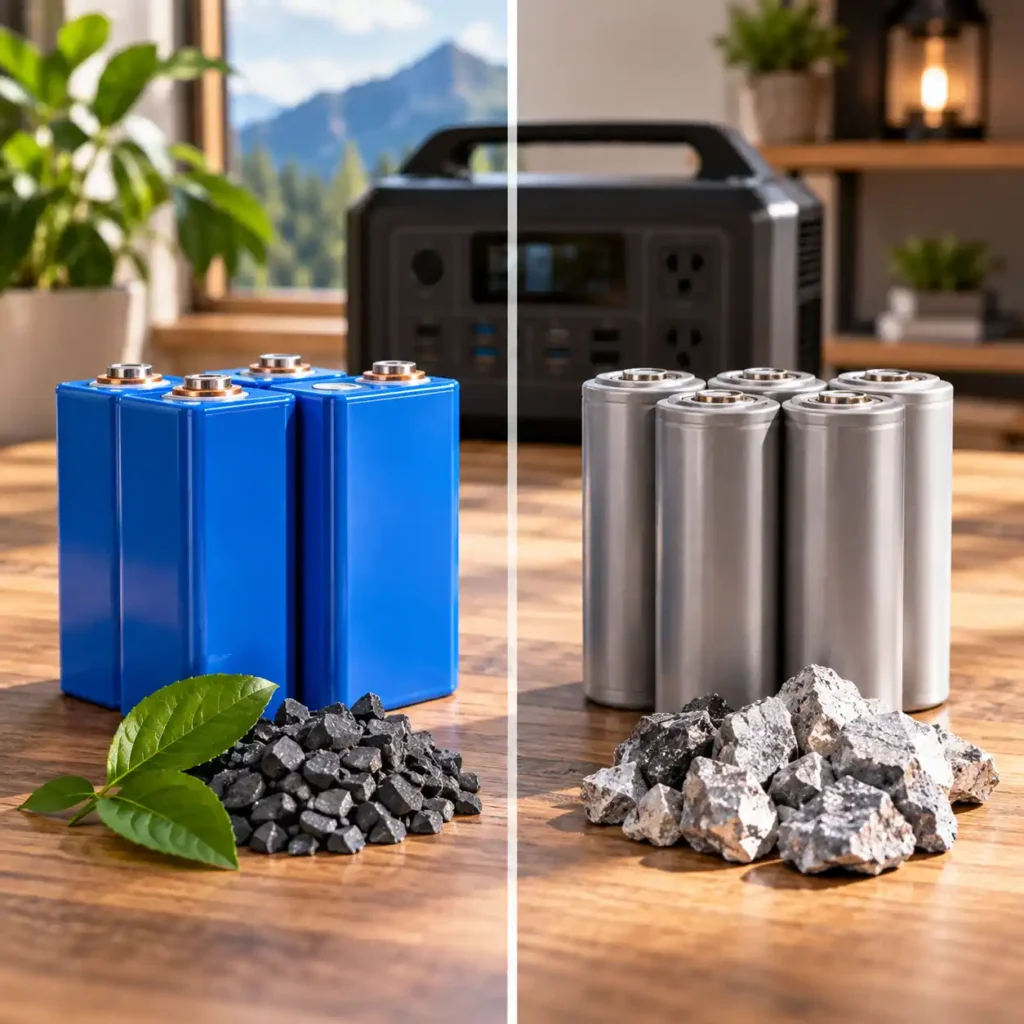
Battery chemistry affects weight, lifespan, durability, safety characteristics, and overall value.
The two chemistries you are most likely to encounter are:
- LiFePO4 (LFP)
- NMC (Nickel Manganese Cobalt)
LiFePO4
LiFePO4 has become the dominant choice in many modern portable power stations, particularly in medium- and large-capacity models.
Advantages commonly include:
- Long cycle life
- Good thermal stability
- Strong long-term durability
- Good value for frequent cycling
- Well suited to repeated charging and discharging
The trade-off is that LFP batteries tend to have lower energy density than NMC, so a comparable-capacity unit can be heavier or larger.
NMC
NMC batteries offer higher energy density and can therefore make sense when reducing size and weight is a major priority.
Their disadvantages can include shorter cycle life compared with modern LFP systems.
Which should you choose?
For most buyers who want a portable power station for regular camping, home backup, frequent cycling, or long-term emergency preparedness, LiFePO4 is generally the more attractive chemistry.
If your highest priority is minimizing weight and you expect relatively infrequent use, an NMC model can still make sense.
Do not evaluate chemistry alone. Also check the manufacturer’s cycle-life methodology, warranty, operating-temperature specifications, and battery-retention terms.
Charging Speed and Charging Methods
A power station is only useful when it can be recharged in a practical way.
Most models support some combination of:
- AC wall charging
- Solar charging
- 12V vehicle charging
- USB-C charging on some models
AC charging
For emergency preparedness, AC charging speed can be extremely important.
Imagine a storm knocks out power for 24 hours. If your power station can recharge rapidly when electricity returns, you can prepare it for the next outage much more easily.
Compare:
- AC input wattage
- Full recharge time
- Whether the advertised time applies to a specific charging mode
- Whether charging power changes near full capacity
Do not compare charging times without checking battery capacity.
A 1,000Wh station charging in one hour and a 2,000Wh station charging in two hours are delivering roughly comparable charging power, but they provide very different stored energy.
Solar Charging: What Should You Look For?
Solar charging can make a portable power station much more useful during extended outages or off-grid trips.
But “solar compatible” does not mean “charges quickly from any solar panel.”
Check:
- Maximum solar input wattage
- MPPT charge controller
- Solar input voltage range
- Maximum input current
- Connector type
- Compatible panel configurations
Why MPPT matters
MPPT — Maximum Power Point Tracking — allows the solar charging system to continuously seek an efficient operating point as sunlight conditions change.
Solar output is affected by:
- Sun angle
- Clouds
- Panel temperature
- Shade
- Panel orientation
- Season
- Cable losses
Therefore, a panel’s advertised wattage is not the same as the power station’s actual solar input throughout the day.
A common mistake
Buying a large solar panel array without checking whether the power station can accept its voltage and current.
Always match the panel configuration to the power station’s specified solar input range.
Ports and Outlets Matter More Than You Think
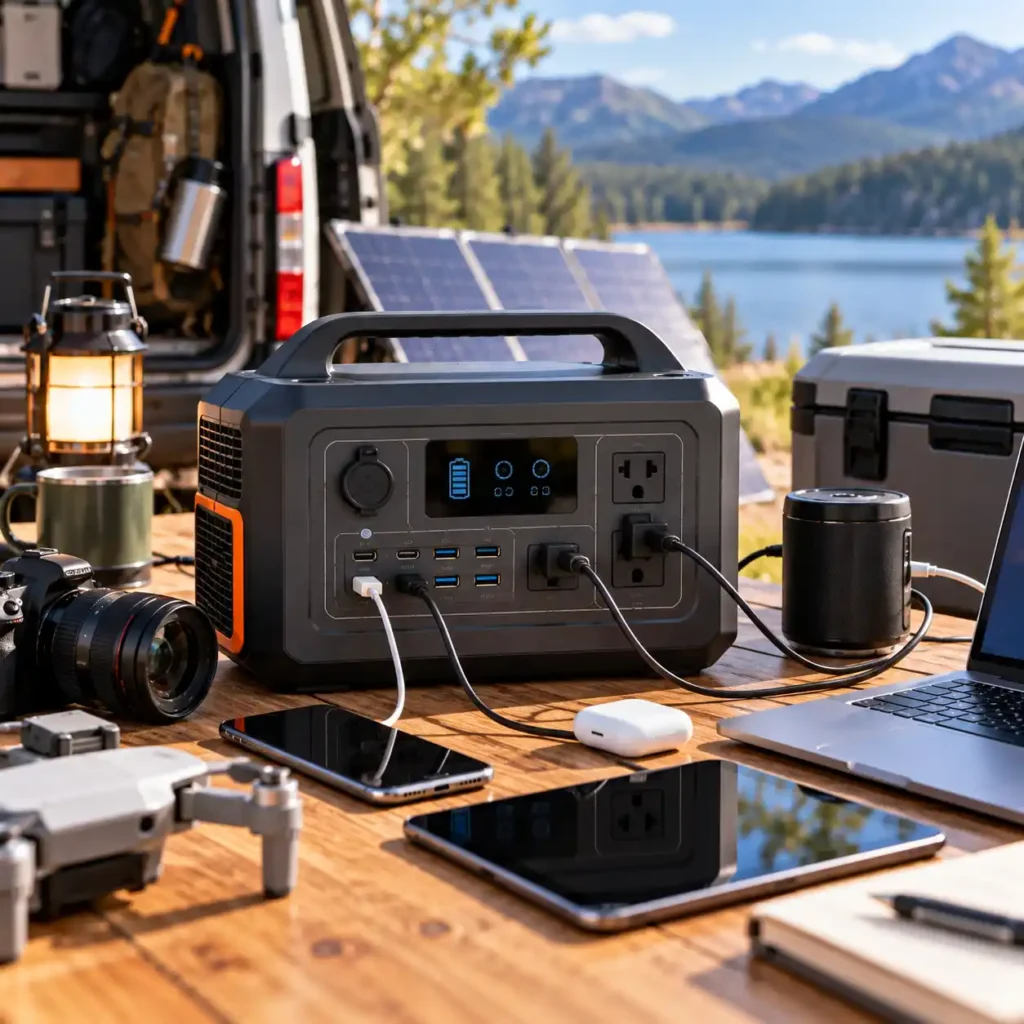
A power station can have excellent capacity and still be inconvenient if it does not have the connections you need.
Look for:
- AC outlets
- USB-C Power Delivery
- USB-A
- 12V DC outputs
- Vehicle-style 12V outlet
- Wireless charging, if useful
- Anderson or other DC connectors on specialized models
USB-C is increasingly important
For modern electronics, USB-C Power Delivery can eliminate the need for separate AC adapters.
That matters because running a laptop through an AC inverter and its power brick may consume more energy than powering it directly through a suitable DC/USB-C connection.
If your main loads are phones, tablets, laptops, cameras, and other USB-C devices, check the actual USB-C output rating, not simply whether the port is labeled USB-C.
UPS and Emergency Backup Features
If you are buying a portable power station primarily for emergencies, UPS or EPS functionality can be important.
A suitable system may allow connected equipment to continue receiving power when grid electricity fails.
This can be useful for:
- Wi-Fi routers
- Modems
- Computers
- NAS systems
- Monitors
- CPAP equipment
- Home office equipment
However, not every portable power station is a true UPS, and transfer times and operating modes vary.
If uninterrupted operation is important, check the manufacturer’s published transfer-time specification and verify that your equipment is compatible.
Do not buy based solely on a product page saying “UPS.”
Expandable Capacity: Do You Need It?
Some power stations support additional battery modules.
This can be valuable if your energy requirements may grow.
For example, you might initially need:
- Laptop
- Router
- Lights
- Phones
Later, you may want:
- Refrigerator backup
- Longer outage coverage
- Additional solar generation
- More home essential loads
An expandable system can allow you to increase stored energy without replacing the entire power station.
But remember:
Adding battery capacity does not automatically increase inverter output.
If the inverter is rated at 1,800W, adding expansion batteries does not turn it into a 3,000W inverter.
Expansion primarily increases energy storage and runtime, subject to the system’s design.
Portability: Bigger Is Not Always Better
The word “portable” can become misleading as capacity increases.
A compact 300–500Wh power station may be easy to carry with one hand.
A large 2,000–3,000Wh system can become a substantial piece of equipment.
Before buying, ask:
- Will I carry it frequently?
- Will it stay in the house?
- Does it need wheels?
- Will it go into a car?
- Am I taking it camping?
- Do I need to move it during an emergency?
- Can I comfortably lift it?
Match capacity to mobility
For frequent outdoor use, weight may matter more than gaining another several hundred watt-hours.
For home backup, capacity may matter more than portability.
There is no universally “best” size.
There is only the size that best fits the job.
Safety, Operating Conditions, and Battery Care
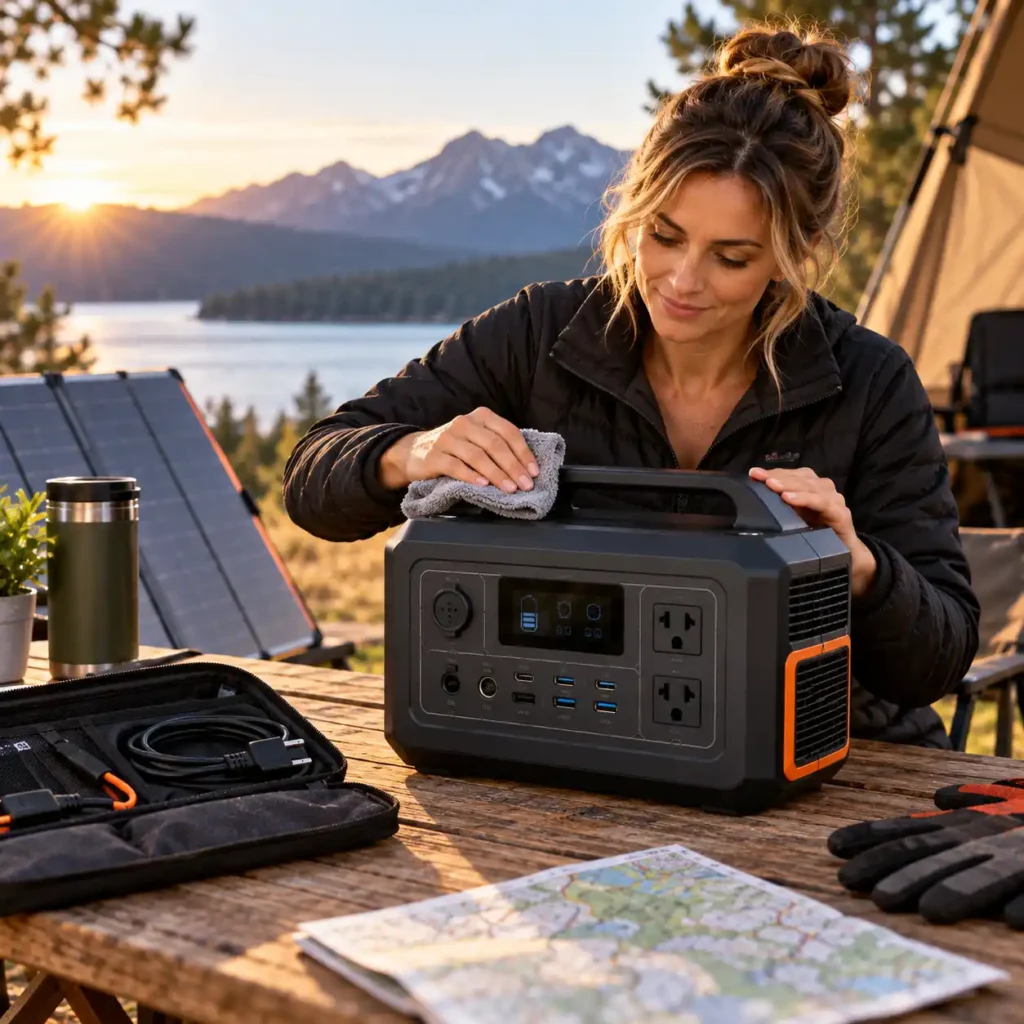
A portable power station is a high-energy electrical device. Treat it accordingly.
Before buying, check:
- Manufacturer safety information
- Operating-temperature range
- Charging-temperature limits
- Battery management system
- Overload protection
- Over-temperature protection
- Short-circuit protection
- Warranty
- Applicable safety certifications
When comparing portable power stations, it is also worth checking whether the product has been evaluated to an applicable safety standard. UL 2743 portable power pack testing provides a useful reference for understanding safety requirements for portable power sources.
Do not treat a power station like a gasoline generator
One important advantage of a battery power station is that it produces no combustion exhaust during operation.
That makes it fundamentally different from a gasoline or propane generator.
However, that does not mean every model can be used in every location or under every condition.
Always follow the manufacturer’s instructions regarding:
- Indoor use
- Charging
- Ventilation
- Moisture
- Rain
- Temperature
- Storage
- Extension cords and connected loads
Never modify the battery system or open the enclosure unless you are specifically qualified and understand the associated risks.
How Much Should You Spend?
Price should come after you determine your requirements.
Comparing power stations only by their retail price is misleading.
Instead, consider:
- Capacity
- Continuous output
- Battery chemistry
- Cycle life
- Solar input
- Charging speed
- Expandability
- Port selection
- Warranty
- Long-term usability
Cost per watt-hour
One useful comparison metric is:
Price ÷ Battery Capacity (Wh)
For example:
A $700 power station with 1,000Wh:
$700 ÷ 1,000 = $0.70/Wh
A $900 power station with 2,000Wh:
$900 ÷ 2,000 = $0.45/Wh
The second station is cheaper per stored watt-hour.
But cost per Wh should not be the only deciding factor. A cheaper Wh may come with lower output, slower charging, fewer ports, weaker warranty support, or less suitable portability.
Portable Power Station Size Guide
| Capacity | Best For | Typical Loads | Main Advantage | Main Limitation |
|---|---|---|---|---|
| Under 500Wh | Personal electronics, short trips | Phones, tablets, lights, small electronics | Light and portable | Limited runtime |
| 500–1,000Wh | Camping, home essentials | Laptops, routers, lights, small appliances | Good balance | Limited for large appliances |
| 1,000–2,000Wh | Extended camping and outage backup | Refrigerator, electronics, CPAP, small appliances | Versatile capacity | Heavier and more expensive |
| 2,000–4,000Wh | Serious home backup | Multiple essential loads | Longer runtime | Less portable |
| 4,000Wh+ | Extended backup and expandable systems | Multiple household circuits and essential loads | Large energy reserve | High cost, weight, and complexity |
These ranges should not be treated as guarantees. A 1,000Wh power station with a 1,800W inverter can be more useful for certain loads than a 1,500Wh unit with a weaker inverter.
Always evaluate Wh and W together.
Match the Power Station to the Use Case
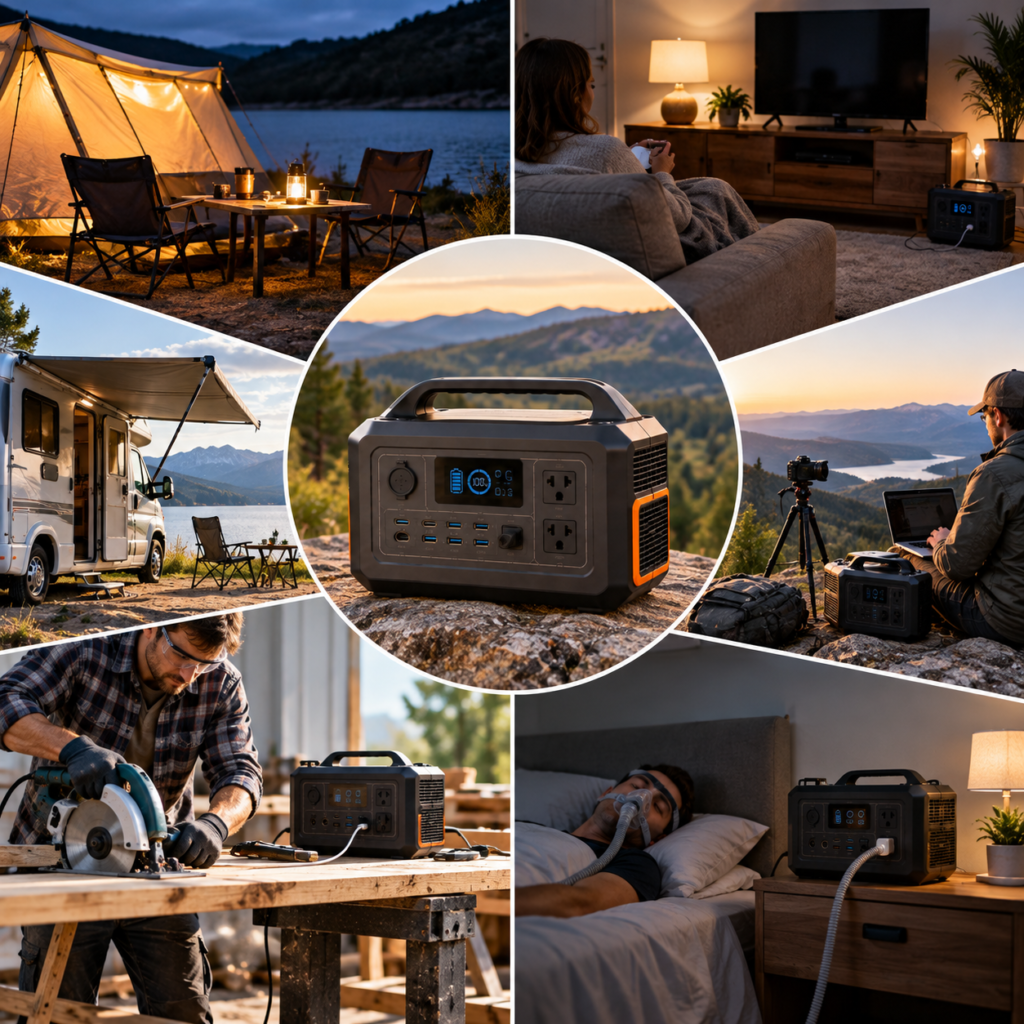
For camping
Prioritize:
- Moderate capacity
- Low weight
- USB-C output
- Efficient DC outputs
- Solar charging
- Quiet operation
- Easy carrying
If your camping loads are primarily phones, lights, cameras, laptops, and small electronics, buying an enormous home-backup unit may simply create unnecessary weight.
For home power outages
Prioritize:
- Higher capacity
- Strong continuous output
- Adequate surge capability
- Fast AC charging
- Solar input
- Expandability
- Reliable warranty support
Start with essential loads rather than attempting to power the entire house from a portable unit. For model-level recommendations, see our Best Portable Power Stations for Home Backup (2026) guide.
For refrigerator backup
Pay particular attention to:
- Continuous inverter output
- Surge capability
- Actual refrigerator energy consumption
- Required outage duration
- Solar recharge capability
A refrigerator is one of the clearest examples of why capacity alone is not enough.
For CPAP
Look for:
- Sufficient overnight runtime
- Compatible output
- Low-load efficiency
- DC/USB options where appropriate
- Manufacturer guidance for medical equipment
If a humidifier or heated tubing is used, energy consumption can be substantially higher.
For home office backup
Prioritize:
- UPS/EPS functionality if needed
- Fast transfer time
- AC output
- USB-C PD
- Enough capacity for the expected outage
- Reliable recharge capability
The objective is not necessarily to keep everything in the house running. It is to maintain the equipment that matters.
Common Buying Mistakes
1. Buying capacity before calculating the load
A larger battery is not automatically better.
2. Confusing Wh with W
Wh determines stored energy.
W determines output capability.
You need both.
3. Ignoring surge power
Motors and compressors can require substantially more power during startup.
4. Trusting advertised runtime
Theoretical calculations rarely match real-world AC runtime exactly.
5. Looking only at battery capacity
A 2,000Wh station with inadequate output can still fail to run your appliance.
6. Buying solar panels without checking input specifications
Panel voltage and current must match the power station’s solar input limits.
7. Assuming every power station works as a UPS
UPS behavior varies by model.
8. Choosing the biggest station because it seems like the safest choice
You may end up paying more for weight and capacity you never use.
9. Ignoring charging speed
A large battery that takes too long to recharge may be less useful during repeated outages.
10. Buying based only on the brand name
Brand reputation matters, but the exact model’s specifications matter more.
11. Comparing products using different testing assumptions
Cycle life, runtime, recharge time, and solar performance can be reported under different conditions.
Read the detailed specifications before comparing numbers directly.
12. Forgetting warranty support
A good battery system is a long-term purchase. Check who provides support and how warranty claims are handled in your market.
When a Portable Power Station Is Not the Right Solution
A portable power station is not automatically the best backup solution for every home.
Consider another solution if you need:
- Whole-house backup
- Long-duration backup lasting several days
- High-power HVAC operation
- Large electric water heaters
- Central air conditioning
- Electric dryers
- High-power well pumps
- Automatic whole-home transfer
For these requirements, a permanently installed battery system, standby generator, or appropriately designed hybrid backup system may be more suitable.
A portable power station is strongest when you need flexible, modular, relatively quiet backup for selected loads.
Portable Power Station Buying Checklist
Before purchasing, verify every item below from the manufacturer's detailed specifications.
Power Requirements
Battery
Charging
Features
Long-Term Value
The Simple Decision Framework
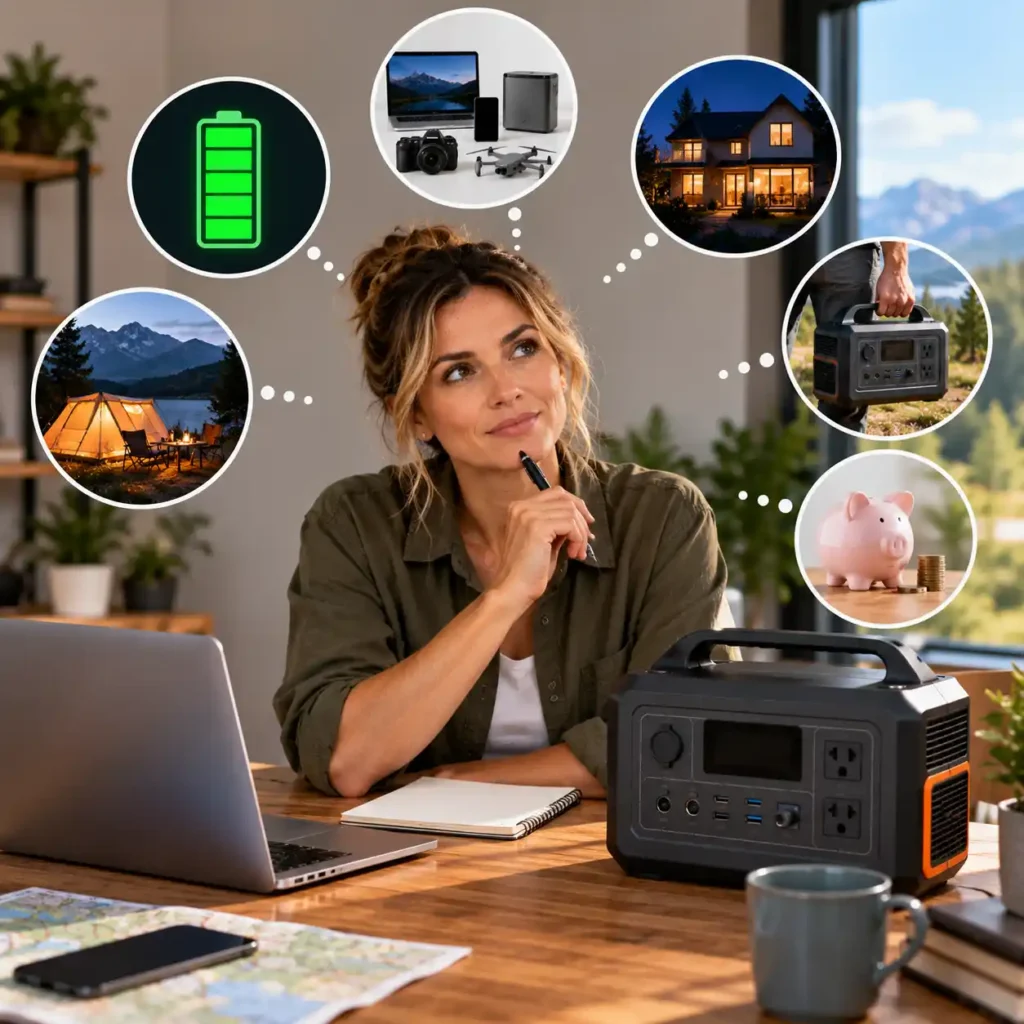
If you want a simple way to understand how to choose a portable power station, reduce the buying process to these decisions and work through them in order:
Step 1: Define the job
Camping? Emergency backup? Refrigerator? CPAP? Home office? RV?
Step 2: Calculate your simultaneous load
Add the running watts of the equipment you want to operate at the same time.
Step 3: Check surge requirements
Identify motors, compressors, pumps, and other loads that may require additional startup power.
Step 4: Calculate required energy
Estimate how many Wh you need for the desired runtime. If you want to turn these calculations into a specific sizing recommendation, use our Power Station Size Calculator before comparing individual models.
Step 5: Choose the battery chemistry
For frequent use and long-term ownership, LiFePO4 is generally the preferred starting point.
Step 6: Check recharge capability
Make sure AC and, if needed, solar charging fit your situation.
Step 7: Choose the physical size
Do not buy more weight than you can realistically move.
Step 8: Add the features you actually need
UPS, USB-C PD, expansion, solar input, additional outlets, app connectivity, and other features should support your use case—not simply make the specification sheet look impressive.
Step 9: Compare total value
Look beyond the sticker price.
Step 10: Verify the exact model
Finally, check the manufacturer’s current specifications rather than relying on a retailer’s abbreviated product description.
FAQ
What size portable power station do I need?
The right size depends on two things: how much power your devices require at the same time and how long you need to run them. Start by calculating your continuous wattage, checking startup surge requirements, and estimating your required watt-hours. A small station may be enough for phones and laptops, while refrigerator backup or longer outages usually require substantially more capacity.
How many watt-hours do I need in a portable power station?
you expect to use it, then add the results. Because AC conversion and other losses reduce usable energy, your calculated requirement should not be treated as the station’s exact rated capacity. For emergency backup, allowing additional capacity provides a useful margin.
How long will a portable power station run a refrigerator?
Runtime varies considerably because refrigerators cycle their compressors rather than drawing the same amount of power continuously. A 1,000Wh power station may provide roughly half a day of refrigerator backup in some real-world situations, but the actual result depends on the refrigerator’s efficiency, ambient temperature, compressor cycling, battery capacity, and inverter losses. Measuring the refrigerator’s actual consumption is more reliable than relying on a generic runtime claim.
Can a portable power station run a microwave?
It can, provided the power station’s inverter has sufficient continuous and surge output for the microwave. Many household microwaves draw around 900–1,500W while operating, so a low-output portable power station may not be suitable even if it has a large battery capacity. Always compare the microwave’s actual input power with the station’s continuous AC output rating.
Can a portable power station run a CPAP machine all night?
Yes, many portable power stations can run a CPAP overnight, but the required capacity depends on the machine and settings. Heated humidifiers and heated tubing can significantly increase energy consumption, so size the station according to your actual configuration rather than the CPAP’s basic wattage alone. A suitable DC connection can also be worth considering when the CPAP manufacturer supports it.
Is LiFePO4 better than NMC for a portable power station?
For many buyers, LiFePO4 is the more attractive choice because it generally offers longer cycle life and good thermal stability. NMC batteries can provide higher energy density and therefore may allow a lighter or more compact design. The better chemistry depends on whether your priority is long-term cycling, weight, size, or the specific model’s overall value. Current 2026 buying guides increasingly treat battery chemistry and cycle life as major purchasing criteria
How long does a portable power station battery last?
Battery life has two different meanings: runtime on one charge and the useful lifespan of the battery itself. Modern LiFePO4 power stations are often rated for thousands of charge cycles, but the exact rating depends on the manufacturer, test conditions, depth of discharge, and the point at which remaining capacity is measured. Calendar aging and storage conditions also affect long-term battery life.
Can you charge a portable power station with solar panels?
Yes, if the power station has a compatible solar input. Before buying panels, check the station’s maximum solar input wattage, supported voltage range, maximum current, connector type, and panel configuration requirements. A panel’s advertised wattage also does not guarantee that the station will receive that amount of power throughout the day because sunlight and panel conditions constantly change.
Can you use a portable power station indoors?
A battery power station does not produce combustion exhaust during normal operation, unlike a gasoline generator. However, indoor use and charging must still follow the manufacturer’s instructions, including requirements related to temperature, moisture, ventilation, electrical loads, and charging. Never assume that every model has identical indoor-use requirements.
Do portable power stations work as UPS systems?
Some models provide UPS or EPS functionality, but they do not all behave like dedicated uninterruptible power supplies. Transfer time, supported operating modes, connected-load limits, and compatibility can vary by model. If uninterrupted power is important for a computer, NAS, CPAP, network equipment, or other sensitive equipment, check the manufacturer’s published transfer-time and UPS specifications rather than relying only on a “UPS” label.
How many watts should a portable power station have?
Start by adding the running wattage of everything you expect to operate simultaneously. Then check the highest startup or surge requirement and choose a power station with adequate headroom above those loads. A station with a large Wh capacity can still fail to run an appliance if its inverter does not provide enough continuous or surge wattage.
Are portable power stations worth it?
A portable power station can be worth the investment when it solves a specific recurring problem, such as emergency refrigerator backup, CPAP operation, home-office continuity, camping, RV use, or off-grid power. It is less compelling if you only need occasional phone charging or expect one battery unit to power high-demand whole-house loads for several days. The value comes from matching the station’s capacity, output, recharge options, and portability to an actual use case—not simply buying the largest model available.
Final Takeaway
The best portable power station is not the one with the biggest battery, the highest advertised wattage, or the longest feature list.
It is the one that matches your actual electrical load, required runtime, charging options, portability needs, and budget.
Start with the devices you need to power. Calculate their wattage and energy requirements. Check continuous and surge output separately. Then evaluate battery chemistry, charging speed, solar input, ports, UPS functionality, expandability, weight, warranty, and long-term value.
Once you know those requirements, comparing portable power stations becomes much easier—and you are far less likely to spend money on a system that is either too small for the job or unnecessarily large.
The right power station should solve a specific power problem. Choose the requirements first, and the product second.