
Knowing how long a refrigerator can run on battery power is important when preparing for a power outage or evaluating a backup-power system.
Our Refrigerator Runtime Calculator estimates how long a battery can power a refrigerator based on its running wattage, compressor duty cycle, battery capacity, inverter efficiency, and usable battery reserve.
For the most accurate result, use the refrigerator’s actual power consumption whenever possible. Generic wattage ratings can provide a useful starting point, but real-world energy use varies with compressor cycling, temperature, door openings, appliance efficiency, and other operating conditions.
Table of Contents
Quick Answer
A refrigerator’s battery runtime can be estimated by dividing the battery’s usable energy by the refrigerator’s average power consumption:
Estimated Runtime = Usable Battery Energy ÷ Average Refrigerator Power
For a refrigerator, average power is different from rated running watts because the compressor does not normally operate continuously.
A simplified estimate is:
Average Refrigerator Power = Running Watts × Compressor Duty Cycle
For example, a refrigerator rated at 150W with an estimated 35% duty cycle would have an average compressor load of:
150W × 0.35 = 52.5W
A battery’s usable energy must then account for inverter losses and any energy reserve you do not want to consume.
This means a refrigerator rated at 150W does not necessarily require 150W continuously for every hour of a power outage.
The calculator below combines these factors to provide a more realistic runtime estimate.
Refrigerator Runtime Calculator
Estimate how long a battery can run a refrigerator based on battery capacity, running wattage, compressor duty cycle, inverter efficiency, and battery reserve.
Your Estimated Refrigerator Runtime
Use the calculator below to estimate how long your battery can run a refrigerator.
Enter the battery’s usable capacity, the refrigerator’s running wattage, the estimated compressor duty cycle, inverter efficiency, and the percentage of battery capacity you want to keep in reserve.
The result is a planning estimate, not a guarantee of actual runtime. Refrigerator power consumption changes with ambient temperature, thermostat settings, door openings, compressor cycling, appliance efficiency, battery condition, and inverter performance.
If you have measured the refrigerator’s actual energy consumption over a full day, use that data instead of relying on a generic duty-cycle assumption.
How the Refrigerator Runtime Calculator Works
The calculator uses the refrigerator’s average power demand rather than assuming that its rated running wattage remains constant throughout the entire outage.
The calculation has three main stages:
- Estimate the refrigerator’s average power consumption.
- Determine how much battery energy is actually usable.
- Divide usable battery energy by average refrigerator power.
This approach is more realistic for refrigerators because their compressors normally cycle rather than operate continuously.
Step 1 — Calculate Average Refrigerator Power
The first step is estimating the refrigerator’s average power demand.
The simplified formula is:
Average Refrigerator Power = Running Watts × Duty Cycle
Suppose a refrigerator uses 150W while its compressor is running and the compressor operates approximately 35% of the time.
The estimated average load is:
150W × 0.35 = 52.5W
This does not mean the refrigerator actually draws exactly 52.5W at every moment. It represents an average load over the calculation period.
A refrigerator may draw close to its running wattage while the compressor is operating and considerably less when the compressor is off.
Step 2 — Calculate Usable Battery Energy
The battery’s advertised capacity is not necessarily the amount of energy available to the refrigerator’s AC outlet.
Some energy is lost during DC-to-AC conversion, and you may also choose to keep part of the battery in reserve.
A simplified calculation is:
Usable Battery Energy = Battery Capacity × Inverter Efficiency × Usable Battery Percentage
For example, a 1,000Wh battery with 90% inverter efficiency and a 90% usable battery percentage provides approximately:
1,000Wh × 0.90 × 0.90 = 810Wh
of usable energy for the calculation.
Actual usable capacity depends on the battery system, inverter, discharge limits, operating conditions, and how the manufacturer defines its rated capacity.
For broader battery-sizing calculations, see our Battery Capacity Calculator.
Step 3 — Estimate Refrigerator Runtime
Once average refrigerator power and usable battery energy are known, estimated runtime can be calculated as:
Runtime = Usable Battery Energy ÷ Average Refrigerator Power
Using the previous example:
810Wh ÷ 52.5W = 15.4 hours
So the estimated runtime would be approximately 15.4 hours under those assumptions.
This example illustrates why using only:
1,000Wh ÷ 150W = 6.7 hours
would produce a substantially different result.
The second calculation assumes the refrigerator consumes 150W continuously, which does not account for compressor cycling.
Why Refrigerator Running Watts Are Not the Same as Average Power
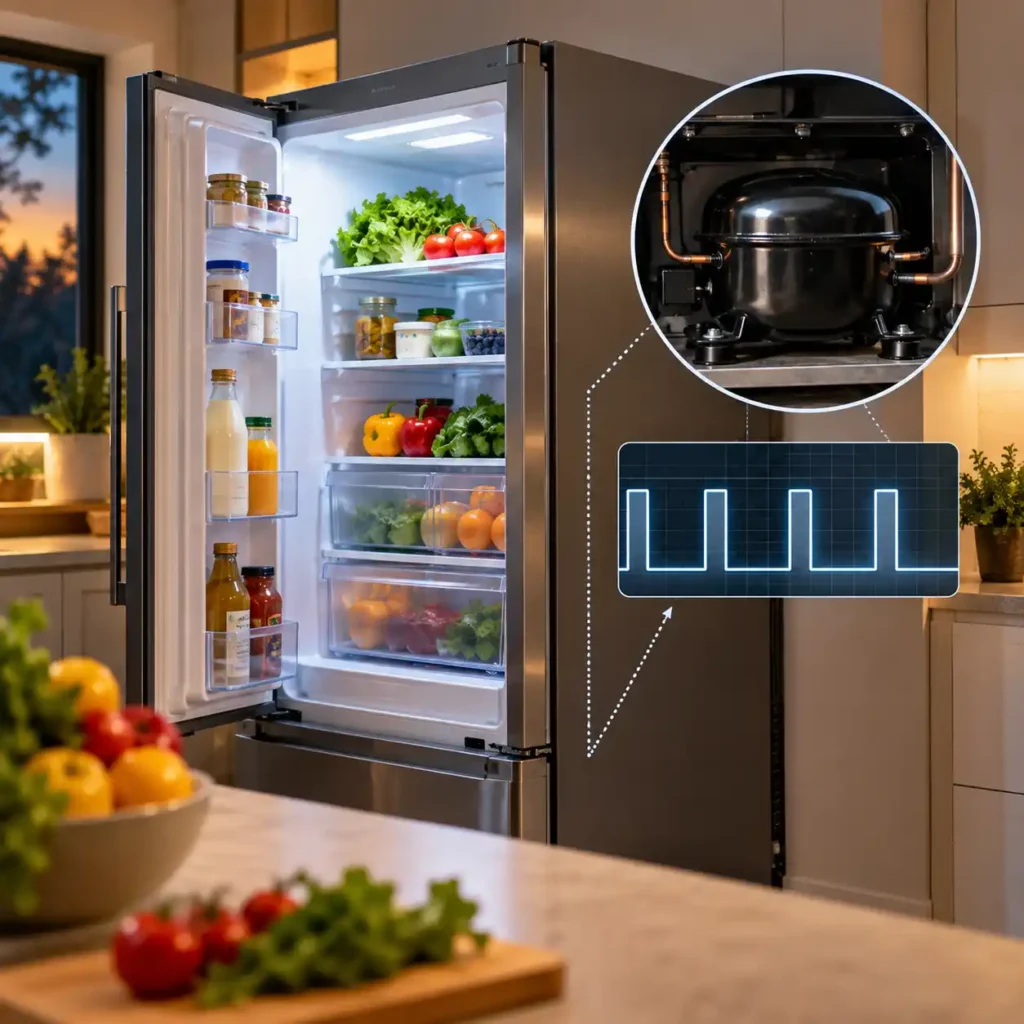
One of the most common mistakes when estimating refrigerator runtime is treating the appliance’s rated running wattage as its constant energy consumption.
A refrigerator is a cycling load.
When the compressor starts, the refrigerator can draw significantly more power than its normal running load for a short period. Once the compressor reaches its operating state, power consumption typically falls. When the compressor shuts off, the refrigerator’s instantaneous power demand can drop substantially.
The result is a changing power profile rather than a flat load.
This distinction matters because battery runtime is determined by energy consumption over time, while the refrigerator’s running and starting wattages describe instantaneous electrical demand. Understanding the difference between instantaneous power and energy consumption is also important when working with the power consumption formula.
What Is Compressor Duty Cycle?
Compressor duty cycle describes approximately how much of a given period the compressor is actively running.
For example:
- 20% duty cycle: compressor runs about 12 minutes per hour on average.
- 30% duty cycle: compressor runs about 18 minutes per hour.
- 40% duty cycle: compressor runs about 24 minutes per hour.
- 50% duty cycle: compressor runs about 30 minutes per hour.
These are simplified averages rather than guarantees.
A refrigerator’s duty cycle can change significantly depending on the surrounding temperature, thermostat setting, insulation, door openings, appliance condition, and how much cooling is required.
Why a Refrigerator Does Not Run at Full Power 24/7
If a refrigerator is rated at 150W, that rating generally describes its electrical demand under a particular operating condition. It does not necessarily mean the compressor consumes 150W continuously for 24 hours.
For example, if the compressor averages a 35% duty cycle:
150W × 35% = 52.5W average load
Over 24 hours, that simplified average would correspond to:
52.5W × 24 = 1,260Wh
or:
1.26kWh per day
This is an estimate rather than a measurement of the refrigerator’s actual daily energy consumption.
For a more accurate planning figure, a full-day measurement with a suitable plug-in power meter can be much more useful than multiplying the nameplate wattage by 24 hours.
How Duty Cycle Changes Battery Runtime
Duty cycle has a direct effect on the estimated average load.
Consider a refrigerator with a 150W running load:
| Duty Cycle | Estimated Average Load |
|---|---|
| 20% | 30W |
| 30% | 45W |
| 40% | 60W |
| 50% | 75W |
The difference becomes significant when a refrigerator needs to operate for many hours during an outage.
A lower duty cycle generally means lower average energy consumption and therefore longer estimated battery runtime. A higher duty cycle means the compressor operates for more of the time, increasing energy consumption and reducing runtime.
For this reason, using an arbitrary duty-cycle value can introduce substantial uncertainty into a refrigerator runtime calculation.
How to Find Your Refrigerator's Actual Power Consumption
The most accurate refrigerator runtime estimate starts with the appliance’s actual electrical characteristics.
Generic wattage values can be useful for preliminary planning, but the refrigerator’s real-world consumption can differ considerably from a typical rating.
Check the Refrigerator Rating Label
Look for the electrical rating label on the refrigerator.
Depending on the manufacturer and model, it may provide information such as:
- voltage;
- current;
- rated power;
- frequency;
- model number.
A wattage rating can help establish the refrigerator’s approximate operating load, but it should not automatically be treated as its average 24-hour energy consumption.
Check the Manufacturer's Specifications
The manufacturer’s documentation may provide more useful information than the basic rating label.
Some refrigerators specify estimated annual or daily energy consumption, while others provide operating specifications that can help determine the expected electrical load.
If the manufacturer provides energy-use information for the exact model, that data can be more useful for runtime planning than a generic refrigerator wattage estimate.
Use a Plug-In Power Meter
For an AC refrigerator, a suitable plug-in energy meter can provide a practical way to measure actual consumption.
Instead of looking only at instantaneous watts, measure the refrigerator over a sufficiently long period to capture multiple compressor cycles.
A 24-hour measurement can be particularly useful because it captures changes in operating conditions throughout the day.
The resulting energy measurement can then be expressed in watt-hours (Wh) or kilowatt-hours (kWh) and used to estimate battery requirements more directly.
If you first need to determine the running and starting load of an appliance, our Appliance Wattage Calculator can help with the underlying wattage calculations.
Use 24-Hour Energy Consumption When Available
If your refrigerator’s actual energy consumption is known in kWh per day, you can calculate an approximate average load without having to estimate the compressor duty cycle yourself. For a broader explanation of how appliance energy use is converted into watt-hours and kilowatt-hours, see our How to Calculate Power Consumption guide.
For example, suppose a refrigerator uses:
1.2kWh per day
Convert that to watt-hours:
1.2kWh × 1,000 = 1,200Wh/day
Then divide by 24 hours:
1,200Wh ÷ 24 = 50W average load
That 50W average load can then be used as the refrigerator’s average power input for a runtime estimate.
This method can be more representative of real-world operation because it incorporates the refrigerator’s actual cycling behavior over the measurement period.
How to Calculate Refrigerator Battery Runtime

The basic refrigerator runtime calculation compares the battery’s usable energy with the refrigerator’s estimated average power consumption.
A simplified formula is:
Estimated Runtime (hours) = Usable Battery Energy (Wh) ÷ Average Refrigerator Load (W)
Because a refrigerator does not usually run its compressor continuously, the average load can be estimated from its running wattage and compressor duty cycle:
Average Refrigerator Load = Running Watts × Duty Cycle
For example, if a refrigerator has a 150W running load and an estimated 35% duty cycle:
150W × 0.35 = 52.5W
The estimated average load is therefore approximately 52.5W.
The battery’s usable energy must also account for inverter losses and any battery reserve you plan to keep unavailable.
For example, a 1,000Wh battery with 90% inverter efficiency and a 10% reserve provides approximately:
1,000Wh × 0.90 × 0.90 = 810Wh
The estimated runtime would then be:
810Wh ÷ 52.5W ≈ 15.4 hours
This is a planning estimate rather than a guaranteed runtime. Actual refrigerator consumption can change throughout the day.
If you are comparing real-world 1,000Wh options for appliance backup, see our guide to 1000Wh portable power stations.
What Affects Refrigerator Runtime on a Battery?
Several factors can cause actual runtime to differ from a calculator estimate.
Refrigerator Efficiency
Newer, more efficient refrigerators may require less energy over a typical day than older models. Two refrigerators with similar running wattage can therefore have different daily energy consumption.
Ambient Temperature
A refrigerator may need to operate its compressor more frequently in a hot environment. Higher surrounding temperatures can increase the duty cycle and reduce battery runtime.
Door Openings
Frequent door openings allow cold air to escape and introduce warmer air into the refrigerator. The compressor may then need to run longer to restore the target temperature.
Thermostat and Temperature Settings
Lower temperature settings can increase compressor operation. The selected refrigerator and freezer temperatures therefore affect overall energy consumption.
Battery and Inverter Efficiency
The energy stored in a battery is not necessarily the same amount of energy available to the refrigerator. Inverter losses, battery reserve settings, conversion losses, and operating conditions can reduce the usable energy delivered to the appliance.
How to Get a More Accurate Refrigerator Runtime Estimate
A calculator becomes much more useful when it is based on measured refrigerator consumption rather than a generic wattage assumption.
If possible, measure the refrigerator’s energy consumption over a representative period using a suitable electricity monitor or plug-in energy meter.
A full-day measurement can be particularly useful because it captures compressor cycling throughout different operating conditions.
If you measure:
1.2 kWh over 24 hours
the refrigerator’s average power consumption is:
1,200Wh ÷ 24 = 50W
You can then use approximately 50W as the average load for a preliminary runtime calculation.
For example, a battery providing 810Wh of usable energy would theoretically provide:
810Wh ÷ 50W = 16.2 hours
This approach can be more representative than calculating average consumption from a single running-wattage reading and an assumed duty cycle.
However, one day’s measurement should still be treated as an estimate. Refrigerator energy use can change with ambient temperature, household usage, and operating conditions.
Refrigerator Runtime Example
Consider a refrigerator with the following specifications:
- Running wattage: 150W
- Estimated compressor duty cycle: 35%
- Battery capacity: 1,000Wh
- Inverter efficiency: 90%
- Battery reserve: 10%
First, calculate the average refrigerator load:
150W × 35% = 52.5W
Next, calculate the usable battery energy:
1,000Wh × 90% × 90% = 810Wh
Then calculate the estimated runtime:
810Wh ÷ 52.5W = 15.4 hours
The estimated runtime is therefore approximately 15.4 hours.
This example demonstrates why battery capacity alone is not enough to predict refrigerator runtime. The refrigerator’s actual energy consumption and compressor duty cycle have a major effect on the result.
How to Extend Refrigerator Runtime During a Power Outage

If the goal is to keep a refrigerator operating for as long as possible during an outage, reducing unnecessary energy consumption can help.
Keep the Refrigerator Door Closed
Avoid unnecessary door openings during an outage.
Keeping the refrigerator closed during an outage is important not only for reducing energy use but also for food safety. The U.S. Food and Drug Administration provides additional guidance on food safety during power outages, including recommended refrigerator temperatures and how long refrigerated food can generally remain safe without power.
Keep the Refrigerator Properly Loaded
A reasonably full refrigerator can help maintain a stable internal temperature, although air circulation should not be blocked.
Keep the Refrigerator Away From Heat
Where practical, avoid placing the refrigerator in direct sunlight or next to significant heat sources. Lower surrounding temperatures can reduce the workload on the cooling system.
Use a Battery With Appropriate Usable Capacity
A larger nominal battery does not automatically provide proportionally longer runtime. Compare usable battery energy, inverter efficiency, and reserve settings when evaluating backup options.
Consider Solar Recharging for Longer Outages
For extended outages, battery capacity alone may not be sufficient. A solar charging system can replenish energy consumed by the refrigerator and potentially extend the period for which the appliance can remain powered.
Battery Size for Refrigerator Backup
The battery capacity required for a refrigerator depends primarily on its average daily energy consumption and the number of hours or days of backup desired.
A useful preliminary relationship is:
Required Battery Capacity = Average Power × Desired Runtime ÷ System Efficiency
For example, if a refrigerator averages 50W and you want approximately 24 hours of theoretical runtime:
50W × 24 hours = 1,200Wh
The actual battery should generally have more nominal capacity than this simple figure because inverter losses, battery reserve, usable depth of discharge, and other system losses reduce the energy available to the refrigerator.
For multi-day outages, it is also important to consider how the battery will be recharged rather than simply selecting a larger battery.
For a more detailed calculation of battery capacity in watt-hours and amp-hours, use our Battery Capacity Calculator.
Refrigerator Starting Watts and Battery Backup
A refrigerator’s compressor can require a temporary increase in power when it starts.
This startup demand is different from the refrigerator’s normal running wattage.
For battery backup, the system therefore needs to satisfy two separate requirements:
- Continuous power: enough output to operate the refrigerator while the compressor is running.
- Startup power: enough temporary output to handle the compressor’s starting demand.
A battery may have sufficient energy capacity in watt-hours but still fail to operate a refrigerator if the inverter cannot handle the appliance’s startup demand.
For this reason, check the inverter’s continuous and surge output ratings when selecting a battery backup system for a refrigerator.
Common Refrigerator Runtime Calculation Mistakes
Using Running Watts as 24-Hour Consumption
A refrigerator rated at 150W does not necessarily consume 150W continuously for 24 hours.
The compressor cycles on and off, so actual average consumption may be considerably lower.
Assuming a Fixed Duty Cycle
A 30% or 40% duty cycle is only an estimate unless it is based on actual measurements.
Ambient temperature, thermostat settings, refrigerator efficiency, and usage patterns can change the duty cycle.
Ignoring Inverter Losses
Dividing battery capacity directly by refrigerator wattage can overestimate runtime because the inverter consumes some of the stored energy.
Using Battery Capacity Without Considering Usable Energy
A battery’s advertised capacity does not necessarily represent the amount of energy that can be delivered to the refrigerator under real operating conditions.
Ignoring Compressor Startup Demand
Runtime calculations focus on energy consumption, but the inverter must also be capable of handling the refrigerator’s temporary startup demand.
Treating the Calculator Result as a Guarantee
A calculator provides a planning estimate. Actual runtime can vary as refrigerator operating conditions change.
Frequently Asked Questions
How long will a 1,000Wh battery run a refrigerator?
A 1,000Wh battery can run a refrigerator for different lengths of time depending on its average power consumption, inverter efficiency, battery reserve, and operating conditions. A refrigerator averaging 50W, for example, would theoretically require about 1,200Wh over 24 hours before system losses are considered.
How long will a 500Wh battery run a refrigerator?
A 500Wh battery may run a refrigerator for several hours, but the actual runtime depends on the refrigerator’s average energy consumption and the amount of battery energy available to the AC output. Compressor startup requirements must also be checked separately.
How long will a 2,000Wh battery run a refrigerator?
A 2,000Wh battery can provide substantially longer runtime than a 1,000Wh battery, but there is no universal runtime. The best estimate comes from dividing usable battery energy by the refrigerator’s measured or estimated average power consumption.
How many watts does a refrigerator use?
A refrigerator’s running wattage varies by model, size, age, and efficiency. Many household refrigerators draw roughly 100–250W while the compressor is operating, but the average power over a full day can be considerably lower because the compressor cycles on and off.
How much electricity does a refrigerator use per day?
Daily consumption varies by refrigerator and operating conditions. A useful way to determine the actual figure is to use the appliance’s EnergyGuide annual energy estimate or measure its electricity consumption over 24 hours or longer. Current consumer-facing sources commonly report roughly 1–2 kWh per day for many household refrigerators, but actual consumption can vary substantially.
Can a portable power station run a refrigerator?
Yes. A portable power station can run many refrigerators if its inverter can handle the refrigerator’s startup demand and its battery provides enough usable energy for the required runtime. Both inverter output and battery capacity need to be considered
What size battery do I need to run a refrigerator for 24 hours?
The required battery size depends on the refrigerator’s average daily energy consumption rather than its running wattage alone. For example, a refrigerator averaging 50W would theoretically use about 1,200Wh in 24 hours before accounting for inverter losses and battery reserve.
How many starting watts does a refrigerator need?
A refrigerator can require substantially more power when its compressor starts than it uses during normal operation. The actual startup requirement varies by compressor and appliance, so the manufacturer’s specifications or a suitable measurement should be used when sizing the inverter. Current 2026 sources commonly report startup demand several times higher than running power.
Will a 1,000W inverter run a refrigerator?
It may, but the continuous wattage rating alone is not enough to determine compatibility. The inverter must also have sufficient surge capacity for compressor startup. The refrigerator’s actual starting demand should be compared with both the inverter’s continuous and peak output ratings.
How can I measure how much power my refrigerator actually uses?
A plug-in electricity meter can measure the refrigerator’s energy consumption over time. Measuring for at least 24 hours is more useful than taking a single wattage reading because the compressor cycles on and off. The refrigerator’s EnergyGuide information can also provide an annual energy estimate.
Why does my refrigerator use less power than its rated wattage?
The rated running wattage generally describes the refrigerator’s power draw while the compressor is operating. The compressor does not normally run continuously, so the refrigerator’s average power consumption over a full day can be much lower than its running wattage.
Can solar panels keep a refrigerator running during a power outage?
Yes. Solar panels can recharge the battery as the refrigerator consumes energy, potentially extending runtime during a prolonged outage. The solar array, battery capacity, charge controller, inverter efficiency, and available sunlight need to be evaluated together rather than treating solar generation as additional battery capacity.
Final Takeaway
A refrigerator runtime calculation is more accurate when it considers average energy consumption rather than running wattage alone.
The key factors are the refrigerator’s running wattage, compressor duty cycle, battery’s usable capacity, inverter efficiency, battery reserve, and compressor startup requirements.
For preliminary planning, the calculator provides a practical estimate. For a more reliable backup-power decision, use measured refrigerator energy consumption whenever possible and verify that the inverter can handle both the continuous load and compressor startup demand.
This distinction is important when choosing backup equipment because battery capacity determines how much energy is available, while inverter output determines whether the refrigerator can operate safely and reliably.