
You can connect different solar panels to a portable power station in some situations, but compatibility depends on the panels’ electrical specifications, how they are connected, and the power station’s solar input design. Two panels with different wattage ratings may be compatible in one configuration but unsuitable in another.
The key is to determine whether the panels will share a single MPPT input or connect to separate, independent MPPT inputs. This distinction affects how differences in voltage and current influence charging performance and which configurations may be permitted. In this guide, you’ll learn how to assess a specific panel combination using a practical compatibility matrix and a step-by-step decision process before connecting anything.
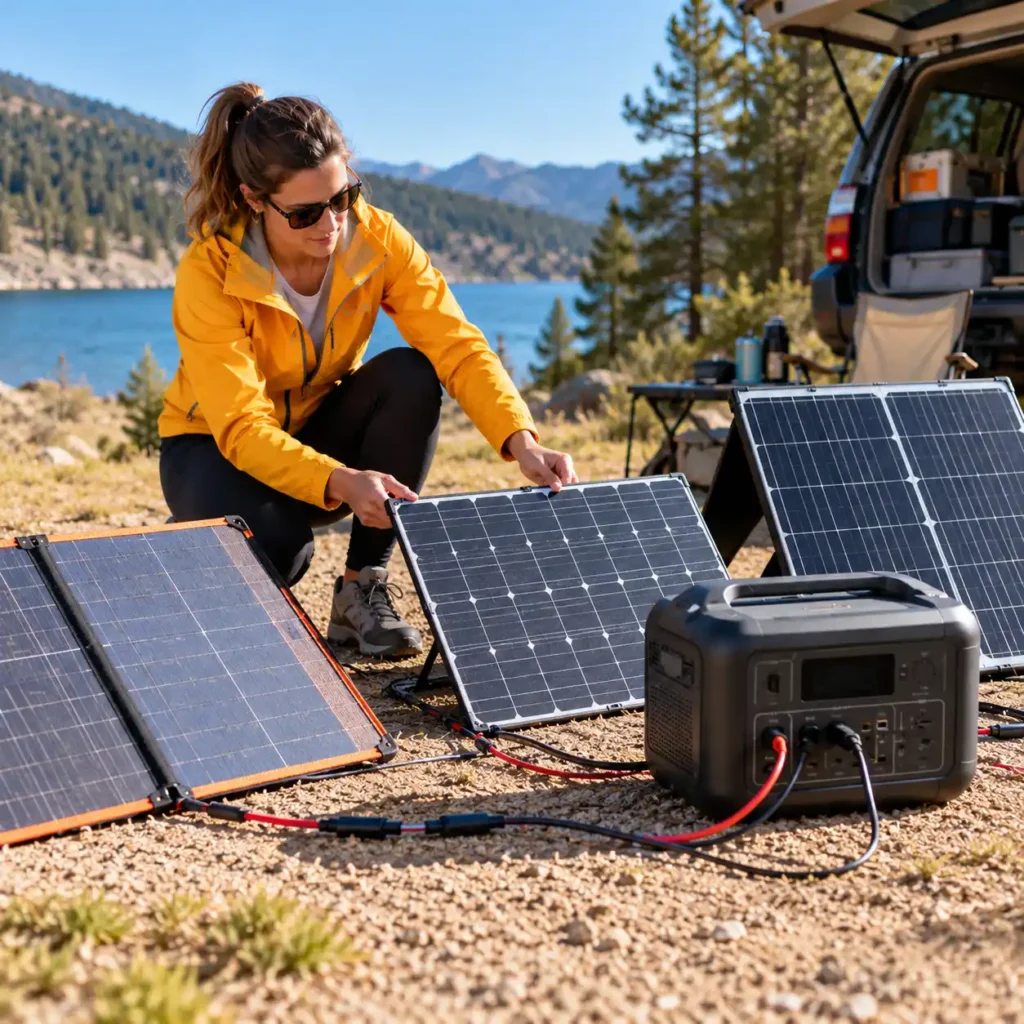
Table of Contents
Quick Answer: Can You Combine Different Solar Panels?
Yes, you can combine different solar panels with a portable power station if their electrical specifications and the station’s solar input requirements are compatible. Different wattage ratings do not automatically rule out a combination, and matching connectors alone does not guarantee compatibility.
Before connecting the panels, check their open-circuit voltage (Voc), operating voltage (Vmp), current specifications, and the station’s input limits. The wiring method also matters: series and parallel connections affect voltage and current differently.
Panels sharing one MPPT controller may experience reduced output when their electrical characteristics differ, while independent MPPT inputs can manage separate arrays more independently. Always verify the proposed configuration against the manufacturer’s documentation before connecting the panels.
What You Need to Know About Each Solar Panel
Before connecting different solar panels to a portable power station, collect the electrical specifications for every panel you plan to use. These values are usually listed on the panel’s rear label, in the manufacturer’s datasheet, or in the product manual. Do not rely on wattage alone: two panels with similar rated power can have different voltage and current characteristics that affect compatibility.
If you are still choosing panels, our Best Portable Solar Panels (2026) guide compares portable options, but you should still verify each panel’s electrical specifications against your power station before buying.
Solar Panel Specifications to Check
| Specification | What It Means | Why It Matters |
|---|---|---|
| Rated power (W) | The panel’s nominal maximum power output under standard test conditions | Helps estimate the array’s total rated power and check the station’s maximum solar input power |
| Open-circuit voltage (Voc) | The panel’s voltage when it is not connected to a load | Essential for checking the maximum permitted PV voltage, especially when panels are connected in series |
| Voltage at maximum power (Vmp) | The panel’s operating voltage near its maximum power point under specified test conditions | Helps determine whether the panel or array operates within the station’s supported MPPT voltage range |
| Current at maximum power (Imp) | The panel’s current at its maximum power point under specified test conditions | Helps assess current compatibility, particularly when panels are connected in parallel or share an input |
| Short-circuit current (Isc) | The current measured when the panel’s output terminals are shorted under specified test conditions | Needed when the manufacturer specifies a maximum allowable short-circuit current or requires an Isc-based check |
These are rated values measured under specified test conditions, not guaranteed real-world output. Actual voltage, current, and power change with sunlight, temperature, and operating conditions. Use the published specifications for compatibility checks, and follow any additional calculation or safety margin required by the power station manufacturer.
Solar Input Specifications to Find in the Power Station Manual
The power station’s manual or official specifications should identify the electrical limits of its solar charging input. Check the relevant input or port rather than relying only on a headline specification for the entire unit.
| Power Station Specification | What to Look For | Why It Matters |
|---|---|---|
| Maximum PV input voltage | The highest permitted solar-array voltage | The array’s voltage must never exceed this limit. For a series connection, add the panels’ Voc values and account for the increase in Voc at low temperatures when required by the manufacturer |
| MPPT operating voltage range | The voltage range in which the solar charge controller can track the array’s maximum power point | The array’s operating voltage must fall within the supported range under the relevant conditions |
| Maximum input current | The maximum permitted current for the relevant solar input | Helps determine whether the proposed panel arrangement is allowed, especially for parallel connections |
| Maximum solar input power (W) | The maximum rated solar power the station can accept | Helps establish whether the proposed array is within the station’s power limit; exceeding the wattage rating does not make an otherwise incompatible voltage or current configuration safe |
| Input and MPPT configuration | Whether ports share one MPPT controller or use independent MPPT inputs | Determines whether panels connected to different ports can operate independently and which combinations the manufacturer supports |
Some power stations have multiple physical solar connectors that share a controller, while others provide independent MPPT inputs. Do not assume that separate ports mean separate MPPT controllers. Confirm the design in the manual or obtain clarification from the manufacturer.
Create a Compatibility Record Before Connecting Anything
Record the specifications for each panel and the limits for the intended power station input. If any required value is missing, look for the manufacturer’s datasheet or ask the manufacturer to confirm it.
| Item | Panel A | Panel B | Power Station Limit |
|---|---|---|---|
| Rated power (W) | Record value | Record value | Maximum input power |
| Voc (V) | Record value | Record value | Maximum PV voltage |
| Vmp (V) | Record value | Record value | MPPT operating range |
| Imp (A) | Record value | Record value | Maximum input current |
| Isc (A) | Record if required | Record if required | Maximum permitted Isc, if specified |
This record provides the information needed for the next step: determining whether the panels will share one MPPT input or connect to separate, independent inputs. That distinction, along with the electrical limits above, determines which combinations may be compatible.
One MPPT Input vs. Separate MPPT Inputs
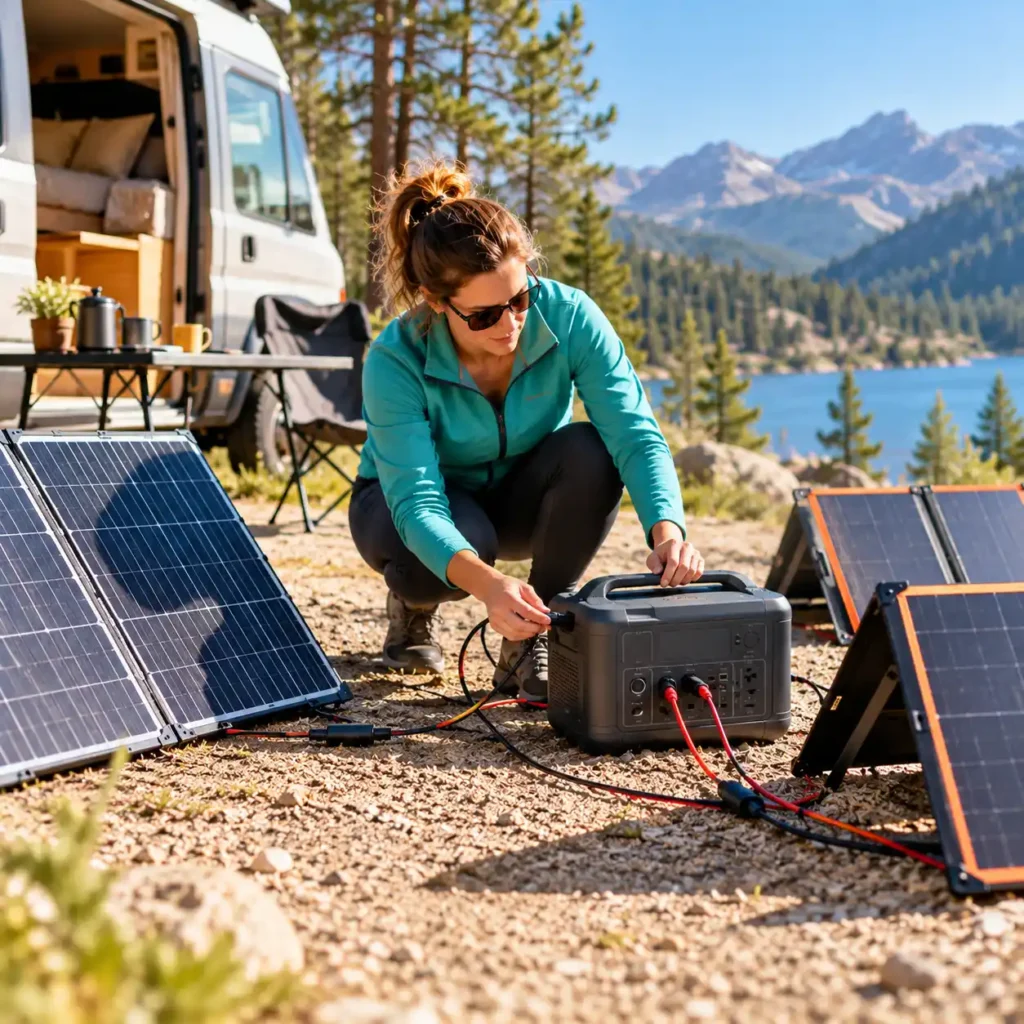
When connecting different solar panels to a portable power station, the charge controller’s configuration can matter as much as the panels’ rated wattage. Two panels may have compatible connectors and a combined wattage below the station’s maximum solar input rating, yet still perform poorly together if their electrical characteristics do not match the controller’s operating requirements.
The key question is whether the panels share a single Maximum Power Point Tracking (MPPT) controller or connect to separate, independent MPPT inputs.
When Different Panels Share One MPPT Input
An MPPT controller adjusts the electrical operating point of a solar array to extract available power. When panels with different voltage and current characteristics share one controller, the controller must find an operating point for the combined array rather than optimize each panel independently.
The effect depends on how the panels are wired:
In series, panel voltages add, while the same current flows through every panel. If panels have different current characteristics, the lower-current panel can limit the current of the string under relevant operating conditions.
In parallel, panel currents add, while the connected branches operate at a common voltage. If the panels have different operating voltages, one or both may operate away from their individual maximum-power points, reducing the power available from the combined array.
As a result, the total output may be lower than the sum of the panels’ individual rated wattages. The extent of this mismatch loss depends on the panels’ electrical characteristics, the wiring arrangement, and the controller’s behavior. Different wattage ratings alone do not establish whether a combination is compatible.
Practical implication: When panels share one MPPT input, check their voltage and current characteristics together with the station’s supported input range and wiring requirements. Do not assume that combining their rated wattages tells you how much usable charging power the array will deliver.
Why Separate, Independent MPPT Inputs Can Help
A power station with genuinely independent MPPT controllers can track the maximum power point of the solar array connected to each controller separately. This allows panels with different operating characteristics to be managed more independently than panels combined on a single shared MPPT input.
For example, imagine connecting a higher-wattage panel to one independent MPPT input and a lower-wattage panel to another. If both configurations are supported by the manufacturer, each controller can adjust its own array’s operating point instead of having to find one shared operating point for both panels.
This can reduce the performance penalty associated with mismatched panels. It does not, however, guarantee that every combination will work or that either panel will deliver its full rated output.
Each panel or array must still comply with the electrical requirements of its assigned input, including the permitted PV voltage, MPPT operating range, maximum input current, and any specified short-circuit current limit. The station’s overall solar input power limit also remains relevant.
Practical implication: Independent MPPT inputs can make it easier to use panels with different specifications, but only when the proposed arrangement is explicitly supported and all input limits are respected.
Why Two Solar Ports Do Not Necessarily Mean Two MPPT Controllers
The number of physical connectors does not reveal how a power station manages its solar inputs internally. A device may have two solar ports that share one MPPT controller, or it may provide separate inputs with independent tracking. The exact design varies by model.
This distinction matters because two panels plugged into separate ports may still share the same controller and therefore interact electrically. Conversely, panels connected to independent MPPT inputs may be tracked separately, subject to the manufacturer’s restrictions.
Check the official manual or technical documentation for statements about independent MPPT controllers, separate solar inputs, supported combinations, and port-specific limits. If the documentation does not establish whether the inputs are independent, do not assume that they are.
Also, do not use a splitter or adapter to combine panels across ports unless the manufacturer permits that configuration. A connector fitting physically is not proof of electrical compatibility.
Check Both Individual Input Limits and Total Station Limits
Even when the controller arrangement is suitable, the proposed panel combination must remain within the power station’s electrical limits. These limits can apply to each input separately and to the device as a whole.
If you are comparing power stations before choosing a model, our How to Choose a Portable Power Station guide explains which specifications to evaluate for your intended setup.
| What to check | Why it matters |
|---|---|
| Maximum PV voltage for each input | The connected array’s voltage must not exceed the input’s permitted maximum. For series-connected panels, account for the sum of their open-circuit voltages and any cold-temperature correction required by the manufacturer. |
| Supported MPPT voltage range | The array must operate within the controller’s specified tracking range under the relevant conditions. |
| Maximum input current | The proposed configuration must comply with the current limit for the relevant input. Follow any additional short-circuit current restrictions in the manual. |
| Maximum solar input power | The station may limit the total solar power it can accept, even if the panels are connected to independent controllers. |
| Per-port and combined limits | Verify whether the specifications apply to each port, each MPPT controller, or all solar inputs combined. Do not assume that every port can accept its individual maximum simultaneously. |
| Approved connection method | Confirm whether the manufacturer permits the proposed series, parallel, or separate-input arrangement. |
A panel combination can satisfy one limit and still violate another. For example, staying below the station’s total wattage rating does not make an array safe if its open-circuit voltage exceeds the permitted maximum. Likewise, independent MPPT inputs do not override the current or voltage limits of either input.
The Decision Rule
Before combining panels with different specifications, establish the controller topology first:
If the panels share one MPPT input, evaluate the combined array’s voltage and current characteristics for the intended wiring configuration, then verify every relevant input limit.
If the panels use separate, independent MPPT inputs, check each panel or array against the limits of its assigned input, as well as the station’s combined solar input limits.
If the controller arrangement is unclear, consult the official manual or contact the manufacturer before connecting the panels.
The important distinction is not simply whether the panels have different wattage ratings. It is whether the power station can manage their electrical characteristics in the proposed configuration without exceeding its specified limits. Once the controller arrangement is confirmed, you can use the panel specifications to determine which connection options are appropriate.
How Series and Parallel Connections Affect Mismatched Panels
The wiring arrangement affects how panels with different electrical characteristics perform together. Before combining mismatched panels, consider how the chosen configuration affects voltage, current, and compatibility with the power station’s MPPT input.
Series Connections: Voltage Adds
In a series connection, panel voltages add together, while the same current flows through the string. Under relevant operating conditions, a panel with lower current capability may limit the output of the series-connected array.
Check the combined open-circuit voltage (Voc), the string’s operating voltage, and the panels’ current characteristics. The combined Voc must remain within the power station’s maximum PV input voltage, including the cold-temperature increase specified by the manufacturer where applicable.
Parallel Connections: Current Adds
In a parallel connection, branch currents add together, while the panels share a common operating voltage. If their maximum-power voltages (Vmp) differ, one or both panels may operate away from their individual maximum-power points, reducing total output.
Check voltage compatibility, the station’s MPPT operating range, the permitted input current, and any applicable short-circuit current limits.
Why Panel Wattage Is Not Enough
Rated wattage alone cannot establish whether two panels are compatible. Panels with similar wattage can have different voltage and current characteristics, and panels with different wattage ratings may work together in a configuration supported by the manufacturer.
The aim is not simply to maximize combined rated wattage. The wiring arrangement must suit the panels’ electrical characteristics, the station’s input limits, and its MPPT configuration.
For a technical explanation of how mismatched electrical characteristics can reduce array output, see Sandia National Laboratories’ guide to solar panel mismatch losses.
Always confirm that the proposed configuration is permitted by the manufacturer before connecting the panels.
Compatibility Matrix: Which Panel Combinations May Work?
Different solar panels can sometimes be used together with a portable power station, but compatibility depends on more than brand or rated wattage. The panels’ voltage and current characteristics, wiring arrangement, the station’s MPPT configuration, and its electrical input limits all affect whether a combination is suitable.
Use the matrix below as a preliminary screening tool, not as confirmation that a combination is compatible. It highlights the main concern for each configuration and the specifications you need to verify before connecting the panels.
| Panel combination | Main concern | What to verify |
|---|---|---|
| Different brands, similar specifications | Similar ratings do not guarantee compatibility. | Voc, Vmp, Imp, Isc, connectors, polarity, and approved wiring. |
| 100 W + 200 W, similar Vmp | Combined wattage does not guarantee compatibility or 300 W of actual input. | Voc, Vmp, Imp, Isc, and the station’s input limits. |
| Different Vmp | Panels sharing one MPPT may operate less efficiently as a combined array. | MPPT configuration, operating voltage range, and approved wiring. |
| Different Imp | In series, current may be limited by the lower-current panel; parallel behavior depends on voltage compatibility and input limits. | Imp, Isc, array configuration, and station input limits. |
| Panels connected to separate MPPT inputs | Separate physical ports do not necessarily have independent controllers. | MPPT independence, per-input limits, and the station’s total input limit. |
| Missing specifications | Compatibility cannot be established reliably. | Obtain the datasheet or confirmation from the manufacturer before connecting. |
Important: This matrix is a preliminary screening guide. It does not replace the manuals for the exact power station and solar panels, and it does not establish that any combination is approved for use.
What Do Manufacturers Recommend?
Manufacturers take a model-specific approach to solar panel compatibility, so check their guidance before combining panels.
Jackery’s official guidance discusses the risks of mixing different panel models because differences in electrical specifications can affect charging performance. Check the guidance and documentation for your specific Jackery model before deciding whether a combination is supported.
EcoFlow’s guide to series and parallel connections explains how wiring arrangements affect array voltage and current. Use those principles alongside the input requirements for the specific power station and panels being considered.
These sources should not be treated as universal rules for every portable power station. Compatibility depends on the specific equipment, its electrical limits, the wiring arrangement, and whether the panels share an MPPT controller or connect to genuinely independent MPPT inputs.
How to Check Compatibility Before Connecting the Panels
Before connecting different solar panels to a portable power station, verify that the proposed configuration meets the electrical requirements of both the panels and the station. Follow these steps in order. If a critical specification or input limit cannot be confirmed, treat compatibility as unverified.
Step 1: Collect the Specifications for Every Panel
Find the manufacturer’s label, datasheet, or technical manual for each panel. Record:
Rated power (W)
Open-circuit voltage (Voc)
Voltage at maximum power (Vmp)
Current at maximum power (Imp)
Short-circuit current (Isc), where relevant to the station’s input limits
Do not rely on rated wattage alone. Panels with similar power ratings can have different voltage and current characteristics.
Step 2: Check the Power Station’s Solar Input Requirements
Use the official documentation for your exact power station model to identify:
Maximum permitted PV input voltage
Supported MPPT operating voltage range
Maximum input current and any separate short-circuit current limit
Maximum solar input power
Approved connection methods and restrictions on combining panels
Determine whether these limits apply per port, per MPPT controller, or to the entire station. Do not assume that separate physical ports have independent MPPT controllers or can each accept their maximum rated input simultaneously.
Step 3: Evaluate the Wiring Arrangement and MPPT Configuration
Identify whether the panels will be connected in series, in parallel, or to separate MPPT inputs.
Series: Panel voltages add together, while the same current flows through the string. Check the combined Voc, operating voltage, and current characteristics.
Parallel: Branch currents add together, while the panels share a common operating voltage. Check voltage compatibility and the combined current.
Separate MPPT inputs: Check each panel or array against the limits of its assigned input, then verify the station’s total input limits.
Confirm whether separate inputs have genuinely independent MPPT controllers. Panels sharing one controller may experience reduced output when their electrical characteristics differ.
Step 4: Verify Voltage, Current, and Power Limits
Compare the proposed configuration with every applicable input limit.
Cold-weather voltage: Voc generally increases as solar cells get colder. For a series-connected array, account for the expected minimum temperature using the panel manufacturer’s temperature coefficient and the calculation method specified by the power station manufacturer. The resulting voltage must remain below the station’s maximum permitted PV input voltage.
MPPT operating range: Confirm that the array’s operating voltage is within the supported tracking range under relevant conditions.
Current: Verify that the proposed configuration complies with the maximum input current and any specified Isc limit.
Solar input power: Check both the applicable input rating and the station’s total solar input limit.
Passing one check does not compensate for failing another. An array can remain below the wattage limit but still exceed the maximum permitted PV voltage.
Step 5: Confirm Connectors and Manufacturer Approval
Verify connector compatibility, correct polarity, and the approved wiring method. A connector that physically fits does not establish electrical compatibility.
Compare your findings with the manuals for the exact power station and panels. If the documentation does not clearly permit the proposed combination, contact the manufacturer before connecting the equipment.
Final Pre-Connection Checklist
Before connecting the panels, confirm that:
The required electrical specifications are available for every panel.
The power station’s input limits and MPPT configuration are understood.
The proposed wiring arrangement has been evaluated.
Cold-weather Voc has been checked where applicable.
Current, MPPT voltage, solar input power, connector, and polarity requirements have been verified.
The configuration is permitted by the manufacturer.
If any essential requirement remains unresolved, do not connect the panels until the uncertainty has been resolved.
Worked Examples: Checking Two Different Solar Panels
The best way to assess a mixed solar panel setup is to compare the panels’ electrical specifications with the exact input limits of the portable power station. The examples below use illustrative specifications, not data from actual products. They demonstrate how to evaluate compatibility without assuming that rated wattage equals real-world charging power.
Example 1: Different Wattages, Similar Operating Voltages
Suppose you want to connect a 100 W panel and a 200 W panel to a portable power station. Their rated operating voltages are similar, but their current ratings differ.
Illustrative panel specifications
| Specification | Panel A | Panel B |
|---|---|---|
| Rated power | 100 W | 200 W |
| Vmp | 18 V | 18 V |
| Voc | 22 V | 22 V |
| Imp | 5.56 A | 11.11 A |
| Isc | 6.0 A | 12.0 A |
These values are illustrative and internally consistent as approximate rated power values:
P ≈ Vmp × Imp
Proposed configuration: parallel connection
For panels connected in parallel, the branch currents add while the connected panels share a common voltage.
Approximate combined rated operating current:
Imp,total = 5.56 + 11.11 = 16.67 A
Approximate combined rated power:
Ptotal ≈ 100 + 200 = 300 W
The nominal open-circuit voltage remains approximately 22 V for panels with identical rated Voc values connected in parallel, not 44 V. However, the actual array behavior depends on the panels’ electrical characteristics and operating conditions.
Illustrative power station limits
Assume the station specifies:
Maximum PV input voltage: 30 V
MPPT operating range: 12–28 V
Maximum input current: 15 A
Maximum solar input power: 300 W
Assessment
The panels have the same illustrative rated Vmp and Voc values, so their nominal voltage characteristics are similar. However, in the proposed parallel configuration, their rated operating currents add:
Imp,total = 5.56 + 11.11 = 16.67 A
This exceeds the station’s assumed maximum input current of 15 A. Although the combined nominal rated power is approximately 300 W, meeting the power limit does not override the current limit.
The station’s specified short-circuit current limit, if provided, must also be checked against the proposed array configuration. The panel and station manuals must confirm that the wiring arrangement is permitted.
Decision: Compatibility not confirmed. The proposed parallel configuration exceeds the illustrative operating-current limit. Do not connect it to this input unless the manufacturer’s documentation confirms an approved configuration.
Example 2: Different Operating Voltages in a Series Connection
Suppose you want to connect a 100 W panel and a 150 W panel in series. Their rated operating voltages differ, so the combined voltage must be checked against the power station’s input limits.
Illustrative panel specifications
| Specification | Panel A | Panel B |
|---|---|---|
| Rated power | 100 W | 150 W |
| Vmp | 18 V | 30 V |
| Voc | 22 V | 36 V |
These are illustrative values. The sum of the panels’ rated Vmp values is a nominal reference, not a guarantee of the array’s actual operating voltage.
Proposed configuration: series connection
In a series connection, panel voltages add while the same current flows through the string. The panels’ different electrical characteristics may affect the operating point and available output.
Nominal sum of open-circuit voltages:
Voc,total = 22 + 36 = 58 V
Nominal sum of rated operating voltages:
Vmp,total = 18 + 30 = 48 V
Illustrative power station limits
Assume the station specifies:
Maximum PV input voltage: 50 V
MPPT operating range: 15–45 V
Maximum input current: 10 A
Maximum solar input power: 300 W
Assessment
The nominal sum of the panels’ open-circuit voltages is 58 V, exceeding the station’s assumed maximum PV input voltage of 50 V. The nominal sum of their rated Vmp values is 48 V, above the assumed MPPT upper limit of 45 V.
Open-circuit voltage can rise at low temperatures, so a suitable cold-weather Voc calculation is also necessary when evaluating a proposed series string. However, the nominal voltage already exceeds the stated maximum, so no cold-weather adjustment is needed to identify this configuration as unsuitable for the assumed input.
Decision: Do not connect this series configuration to the illustrative input. Its nominal open-circuit voltage exceeds the specified maximum PV input voltage. A different wiring arrangement would need to be assessed independently against all relevant station and panel specifications.
What These Examples Demonstrate
| Finding | Practical meaning |
|---|---|
| Similar Vmp does not guarantee compatibility. | Current limits, short-circuit current limits, and wiring requirements still matter. |
| Different Vmp does not automatically rule out every configuration. | Compatibility depends on the proposed wiring, MPPT topology, and all applicable input limits. |
| Rated wattages can be added for a nominal total, but actual output may be lower. | Real-world power depends on operating conditions, panel mismatch, and controller behavior. |
| Meeting the power limit is not enough. | Check maximum PV voltage, MPPT operating range, input current, and any specified short-circuit current limit. |
The final rule: A panel combination is confirmed compatible only when the proposed wiring configuration meets the documented requirements of the exact solar panels and portable power station. If a critical specification is missing or an applicable limit is exceeded, do not assume the combination is safe to connect. Consult the manufacturers’ documentation or obtain confirmation of an approved configuration.
When You Should Not Connect Different Solar Panels
Do not connect different solar panels to a portable power station until their compatibility has been verified. If an electrical limit is exceeded or a critical specification is unknown, resolve the issue before proceeding.
Do not connect the panels if:
Maximum PV voltage exceeds the station’s limit or cannot be verified. Account for the cold-weather increase in open-circuit voltage (Voc) where applicable.
Current or other input limits are exceeded. The proposed configuration must comply with the station’s current limits, supported MPPT voltage range, and applicable solar input power restrictions.
The manufacturer does not permit the configuration. Do not assume that a technically plausible arrangement is approved for your specific equipment.
Polarity, connectors, or cable ratings are uncertain. Verify correct polarity, connector compatibility, and cable suitability before making a connection.
Essential specifications are missing. If you cannot establish the panels’ electrical ratings or the station’s input requirements, compatibility remains unverified.
For a practical example of manufacturer-specific requirements, consult the official EcoFlow DELTA Pro 3 user manual. It is essential to check the documentation for your exact power station model, because permitted PV voltage, current limits, and supported connection configurations vary between models.
If any critical requirement fails or remains unresolved, do not connect the panels. Obtain the missing specifications or confirmation from the manufacturer before proceeding.
Frequently Asked Questions
Can I connect solar panels from different brands to the same portable power station?
Yes, in some configurations, but different brands are not automatically compatible. Check each panel’s Voc, Vmp, Imp, and Isc where applicable, along with the power station’s input limits and approved wiring methods. If the panels share one MPPT controller, differences in their electrical characteristics may reduce charging performance. Always verify compatibility with the manufacturer’s documentation
Can I connect a 100 W and a 200 W solar panel together?
Potentially, but the combined rated power of 300 W does not guarantee compatibility. The panels’ voltage and current characteristics, the connection method, the MPPT configuration, and the power station’s limits all matter. For example, connecting panels in parallel adds their currents, which may exceed the input’s maximum current even when the combined wattage is within the station’s rating.
Is it better to connect different solar panels in series or in parallel?
Neither configuration is universally better for mismatched panels. In series, voltage adds while the same current flows through every panel, so a lower-current panel may limit the string’s output. In parallel, current adds while the panels share a common voltage, which can reduce performance when their operating voltages differ. Choose a configuration only after checking the panel specifications and the power station’s requirements.
Can I use different solar panels if my power station has two solar input ports?
Not necessarily. Two physical ports do not always mean the power station has two independent MPPT controllers. The ports may share one controller, or they may support independent tracking. Check the exact model’s manual to confirm the input design, per-port limits, and total solar input restrictions before connecting different panels.
What should I do if I cannot find the specifications needed to check compatibility?
Do not connect the panels until the missing information is confirmed. Look for the panel manufacturer’s datasheet and the official manual for your power station. Verify the maximum PV voltage, MPPT operating range, current limits, solar input power, and permitted connection method. If the documentation does not answer your question, contact the manufacturer for confirmation of the proposed configuration.
Verify Compatibility Before Connecting Different Solar Panels
You can connect different solar panels to a portable power station in some configurations, but matching wattage or compatible connectors alone does not guarantee compatibility. The result depends on the panels’ electrical characteristics, the wiring arrangement, and the station’s MPPT configuration and input limits.
Before connecting the panels, verify the proposed configuration against the official documentation for your exact power station and solar panels. If a critical specification is missing or an electrical limit cannot be confirmed, treat compatibility as unverified and contact the manufacturer before proceeding.
Related Guides
To better understand your solar setup and avoid compatibility problems, explore these related guides:
Why Is My Portable Power Station Not Charging from Solar Panels? — Learn how to troubleshoot solar charging problems, including voltage mismatches, cable issues, and input limitations.
Can You Use a Portable Power Station While It Is Charging? — Understand how simultaneous charging and power use work and what to check before relying on this setup.
Choosing compatible panels starts with the electrical specifications, not the wattage printed on the label. Verify the complete configuration before connecting your equipment.