
A reliable portable solar panel can make the difference between running out of power and staying connected wherever your adventures take you. Whether you’re camping in remote locations, traveling in an RV, preparing for emergencies, or simply looking for a renewable way to recharge a portable power station, today’s folding solar panels offer more efficiency, durability, and convenience than ever before.
However, not every portable solar panel performs the same in real-world conditions. Power output varies with sunlight, panel technology, portability, weather resistance, and compatibility with different power stations. Some models prioritize maximum charging speed, while others focus on lightweight portability or long-term durability for frequent outdoor use.
To help you choose the right option, we evaluated five of the most popular portable solar panels currently available on Amazon. Our comparison focuses on the models that consistently stand out for performance, build quality, ease of use, and overall value:
- EcoFlow 220W Bifacial Portable Solar Panel
- Jackery SolarSaga 200W
- BLUETTI PV200
- Renogy 200W Portable Solar Panel
Best for Rugged Outdoor Use
Goal Zero Nomad 200 Solar Panel
In this guide, you’ll find detailed hands-on style evaluations, an easy-to-read comparison table, practical buying advice, and clear recommendations for different use cases. Whether your priority is maximizing energy production, minimizing weight, or finding the best value for your budget, this guide will help you choose the portable solar panel that best fits your needs.
As an Amazon Associate, we earn from qualifying purchases.
Table of Contents
Quick Answer
If you’re looking for the best portable solar panel overall, the EcoFlow 220W Bifacial Portable Solar Panel is our top recommendation. Its bifacial design, excellent charging performance, durable construction, and wide compatibility make it the strongest all-around choice for camping, RV travel, and off-grid power.
If value is your priority, the BLUETTI PV200 delivers an excellent balance of performance, portability, and price. For users already invested in the Jackery ecosystem, the Jackery SolarSaga 200W offers seamless compatibility and dependable charging performance. The Renogy 200W Portable Solar Panel stands out for its versatile MC4 connectivity, while the Goal Zero Nomad 200 Solar Panel is an excellent companion for Anker SOLIX power stations thanks to its efficient design and user-friendly setup.
Our top picks for 2026 are:
- Best Overall: EcoFlow 220W Bifacial Portable Solar Panel
- Best Premium: Jackery SolarSaga 200W
- Best Value: BLUETTI PV200
- Best Versatility: Renogy 200W Portable Solar Panel
- Best for Anker Users: Anker SOLIX PS200 Portable Solar Panel
Why You Can Trust Power Ready Guide
Choosing a portable solar panel isn’t just about comparing wattage or picking the most popular brand. Real-world performance depends on a combination of factors, including charging efficiency, portability, build quality, weather resistance, compatibility, and long-term reliability. Our goal is to evaluate every product from the perspective of how people actually use it outdoors.
For this guide, we focused on five of the most popular portable solar panels currently available on Amazon. Rather than relying on marketing claims alone, we compared each model based on manufacturer specifications, product features, construction quality, compatibility with portable power stations, portability, durability, and overall value for camping, RV travel, emergency backup, and off-grid use.
Every recommendation in this guide follows the same evaluation methodology. We compare products using consistent criteria so that readers can easily understand where each model excels and where another option may be a better fit. Instead of selecting a single “winner” for everyone, we identify the best choice for different priorities, whether that’s maximum performance, premium quality, versatility, or value.
Because product availability, pricing, and specifications can change over time, we periodically review our recommendations and update this guide when meaningful changes occur. Our objective is to provide accurate, practical, and unbiased information that helps you choose the right portable solar panel with confidence.
How We Evaluated the Best Portable Solar Panels
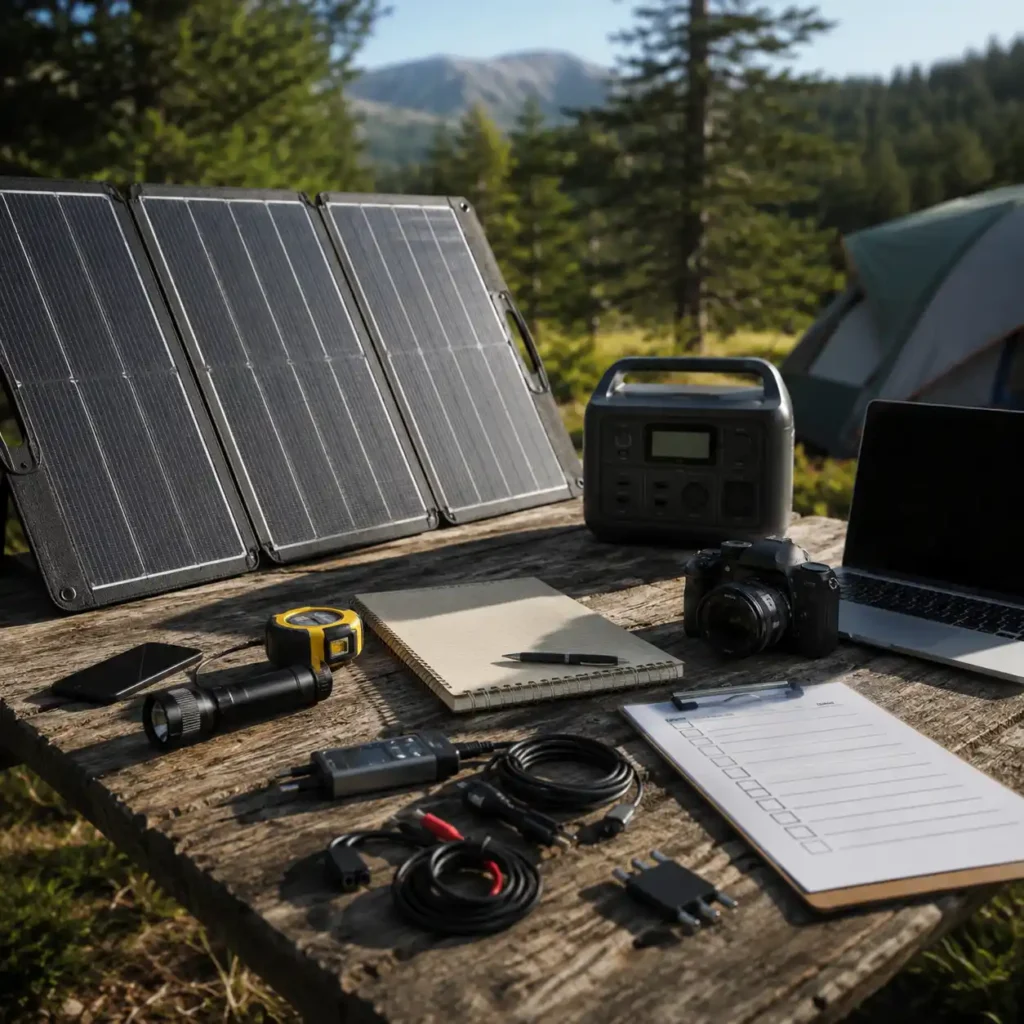
Not every portable solar panel is designed for the same type of user. Some prioritize maximum energy production, while others focus on portability, durability, or compatibility with specific portable power stations. To make our recommendations as practical as possible, we evaluated every model using the same consistent criteria.
Power Output
Rated wattage is only part of the story. We considered each panel’s advertised output alongside its intended use, helping readers understand which models are better suited for charging larger power stations or maintaining smaller devices during extended outdoor trips.
Solar Conversion Efficiency
Higher conversion efficiency allows a panel to generate more electricity from the available sunlight. We considered the manufacturer’s efficiency ratings, cell technology, and overall design to identify panels that make the most of favorable solar conditions.
Portability
A portable solar panel should be easy to carry, transport, and deploy. We evaluated folded dimensions, overall weight, carrying handles or cases, and how practical each panel is for camping, RV travel, road trips, and off-grid use.
Build Quality and Durability
Outdoor equipment must withstand regular use. We looked at frame construction, protective materials, kickstand stability, weather-resistant design, and overall build quality to determine which panels are better prepared for long-term outdoor use.
Compatibility
Compatibility is one of the most important factors when choosing a portable solar panel. We considered connector types, charging flexibility, and how easily each panel integrates with portable power stations from the same manufacturer or with compatible third-party systems.
Ease of Setup
A good portable solar panel should be ready to use within minutes. We compared kickstand design, cable organization, folding mechanisms, and overall ease of positioning the panels toward the sun for efficient charging.
Value for Money
Price alone doesn’t determine value. We evaluated what each product offers for its cost, including performance, build quality, portability, warranty, and overall user experience to identify the strongest value in every price category.
By applying the same evaluation process to every product, we were able to compare the strengths and trade-offs of each model objectively. This approach allows readers to choose the portable solar panel that best matches their power needs, travel style, and budget rather than relying on specifications alone.
Who This Guide Is For
Portable solar panels are a practical solution for anyone who needs reliable electricity away from traditional power sources. Whether you’re planning weekend camping trips or preparing for unexpected power outages, choosing the right panel depends on how and where you intend to use it.
This guide is designed for:
- Campers who want a lightweight and portable solar panel to keep phones, cameras, lights, and portable power stations charged throughout multi-day trips.
- RV owners looking for a convenient way to supplement onboard power, reduce generator use, and recharge portable power stations while parked off-grid.
- Van lifers and overlanders who need dependable renewable energy during extended travel without relying on campground hookups.
- Emergency preparedness users building a reliable backup power solution for blackouts, severe weather, or other situations where grid electricity may not be available.
- Remote workers and digital nomads who spend time outdoors and need a dependable source of power for laptops, cameras, communication devices, and portable workstations.
- Outdoor enthusiasts who enjoy hiking, fishing, photography, hunting, or other activities where portable solar charging provides additional convenience and energy independence.
You don’t need to be living completely off-grid to benefit from a portable solar panel. Even occasional campers and homeowners can reduce dependence on wall outlets while gaining a quiet, renewable way to recharge essential devices and portable power stations.
Whether your priority is maximum charging performance, portability, durability, or overall value, the recommendations in this guide are intended to help you choose the portable solar panel that best matches your needs and budget.
Quick Summary- Our Top Picks
If you’re looking for the best portable solar panel without reading every detailed review, the summary below highlights our top recommendations for different budgets, camping styles, and outdoor needs.
Our selections are based on charging performance, solar conversion efficiency, portability, durability, compatibility with portable power stations, ease of setup, and overall long-term value. Each model excels in a specific category, making it easier to choose the portable solar panel that best fits your camping, RV, emergency preparedness, or off-grid power requirements.
EcoFlow 220W Bifacial Portable Solar Panel
Award: Best Overall
Why It Won:
Combines excellent charging performance, a bifacial design that can capture additional reflected sunlight, durable construction, and broad compatibility with EcoFlow and other compatible portable power stations. It offers the best overall balance of efficiency, portability, and long-term value for most outdoor users.
Choose This If:
- You want the best all-around portable solar panel.
- You regularly go camping or travel in an RV.
- You need reliable charging performance in a wide range of outdoor conditions.
Best For:
- Car camping
- RV travel
- Off-grid adventures
- Emergency backup
Jackery SolarSaga 200W
Award: Best Premium Choice
Why It Won:
Offers excellent build quality, dependable charging performance, and seamless integration with Jackery portable power stations, making it a premium choice for users who value simplicity and reliability.
Choose This If:
- You already own a Jackery power station.
- You prefer premium build quality.
- You want an easy plug-and-play charging experience.
Best For:
- RV camping
- Weekend camping
- Family camping
- Jackery users
BLUETTI PV200
Award: Best Value
Why It Won:
Delivers an excellent combination of charging performance, portability, and affordability, making it one of the best-value portable solar panels in the 200W class.
Choose This If:
- You’re looking for the best value.
- You want dependable solar charging without overspending.
- You need a versatile panel for camping and emergency preparedness.
Best For:
- Weekend camping
- Budget-conscious buyers
- Emergency backup
- Portable power stations
Renogy 200W Portable Solar Panel
Award: Best Versatility
Why It Won:
Universal MC4 connectivity, durable construction, and broad compatibility make it one of the most flexible portable solar panels for campers, RV owners, overlanders, and off-grid users.
Choose This If:
- You own portable power stations from different brands.
- You want maximum compatibility.
- You may expand your solar setup in the future.
Best For:
- RV travel
- Overlanding
- Off-grid cabins
- DIY solar systems
Goal Zero Nomad 200 Solar Panel
Award: Best for Rugged Outdoor Use
Why It Won:
Built for demanding outdoor conditions, the Goal Zero Nomad 200 combines durable construction, dependable charging performance, and excellent portability. Its rugged design and reliable solar output make it an ideal choice for campers, overlanders, and off-grid adventurers who need equipment that performs consistently in challenging environments.
Choose This If:
- You frequently camp in remote locations.
- You need a rugged solar panel designed for outdoor use.
- You value durability and dependable charging performance over the lowest price.
Best For:
- Overlanding
- Off-grid camping
- Outdoor expeditions
- Emergency preparedness
Portable Solar Panel Comparison
Compare the best portable solar panels side by side to quickly see how they differ in rated power, solar cell technology, weight, portability, and ideal use case. This comparison table provides a fast overview of our top recommendations before you dive into the detailed reviews below.
| Model | Award | Rated Power | Solar Cell Type | Best For |
|---|---|---|---|---|
| EcoFlow 220W Bifacial Portable Solar Panel | Best Overall | 220W | Bifacial Monocrystalline | Most Campers |
| Jackery SolarSaga 200W | Best Premium Choice | 200W | Monocrystalline | Premium Users |
| BLUETTI PV200 | Best Value | 200W | Monocrystalline | Budget-Conscious Buyers |
| Renogy 200W Portable Solar Panel | Best Versatility | 200W | Monocrystalline | RV & Off-Grid Use |
| Goal Zero Nomad 200 Solar Panel | Best for Rugged Outdoor Use | 200W | Monocrystalline | Outdoor Expeditions |
The Best Portable Solar Panels Reviewed
EcoFlow 220W Bifacial Portable Solar Panel
Best Overall

Quick Verdict
The EcoFlow 220W Bifacial Portable Solar Panel earns our Best Overall award because it delivers the best combination of efficiency, portability, charging performance, and long-term value. Its high-output bifacial design captures additional reflected sunlight to improve energy production, while its rugged folding construction makes it easy to transport and deploy at campsites, RV parks, and off-grid locations.
Rated at 220W, it pairs exceptionally well with EcoFlow portable power stations but also works with many other compatible solar generators. The panel offers excellent real-world performance, durable construction, and a practical carrying case that doubles as an adjustable kickstand, making setup quick and convenient.
What ultimately sets the EcoFlow 220W Bifacial Portable Solar Panel apart is its balance. Some panels are lighter, some cost less, and others offer slightly higher efficiency under ideal conditions, but very few combine premium build quality, bifacial technology, dependable charging, and everyday usability as effectively. If you’re buying one portable solar panel to handle nearly every camping, RV, or emergency backup situation over the coming years, this is the model we’d choose first.
Camping Snapshot
| Feature | Details |
|---|---|
| Best Use | Camping • RV Travel • Overlanding • Emergency Backup |
| Rated Power | 220W |
| Solar Cell Type | Bifacial Monocrystalline |
| Weight | Approximately 20.9 lbs (9.5 kg) |
| Foldable Design | Yes |
| Weather Resistance | IP68 |
| Best For | Users looking for the best all-around portable solar panel with excellent charging performance and long-term versatility. |
Why We Chose It
Choosing the best portable solar panel isn’t simply about selecting the highest wattage. The best panel is the one that consistently delivers reliable charging performance while remaining easy to transport, quick to set up, and durable enough to withstand regular outdoor use.
That’s exactly why the EcoFlow 220W Bifacial Portable Solar Panel earned our top recommendation.
Its 220W rated output, combined with bifacial solar cells, allows it to capture additional reflected sunlight from surfaces like sand, gravel, or light-colored ground, improving energy production in favorable conditions. The folding design makes transportation simple, while the integrated carrying case doubles as an adjustable stand for fast deployment at camp.
We also placed significant value on long-term ownership. Premium materials, IP68 water and dust resistance, broad compatibility with portable power stations, and EcoFlow’s consistently high build quality make this panel a dependable investment for years of camping, RV travel, emergency backup, and off-grid adventures.
For users looking for one portable solar panel that balances efficiency, durability, portability, and everyday usability, the EcoFlow 220W Bifacial Portable Solar Panel stands out as the strongest all-around choice in this guide.
Check the latest price and customer reviews on Amazon.
Living With It at Camp
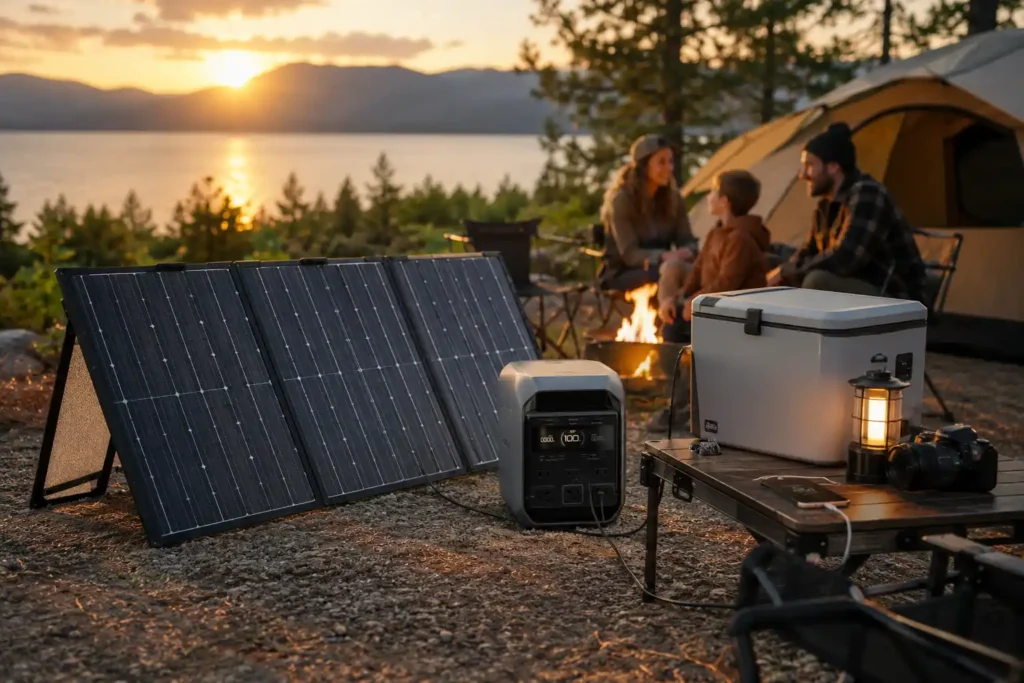
The EcoFlow 220W Bifacial Portable Solar Panel quickly becomes one of those pieces of camping gear that quietly works in the background. Instead of worrying about conserving every watt-hour, you can take advantage of available sunlight throughout the day to recharge your portable power station while enjoying your time outdoors.
Imagine arriving at your campsite in the morning and unfolding the panel beside your tent or RV. Within minutes, it’s connected to your power station and harvesting solar energy while you prepare breakfast, explore nearby trails, or relax at camp. Throughout the day, it helps replenish the energy used by portable refrigerators, lights, laptops, cameras, and other camping essentials.
Its adjustable stand makes it easy to position the panel toward the sun as conditions change, while the folding design allows it to be packed away quickly whenever it’s time to move to the next destination. Whether you’re spending a weekend at a campground or several days off-grid, the EcoFlow 220W provides dependable solar charging without adding unnecessary complexity to your camping routine.
EcoFlow 220W Bifacial Portable Solar Panel Evaluation
| Evaluation Category | Editorial Assessment |
|---|---|
| Portability | Foldable design with integrated carrying case makes transport and setup simple. |
| Charging Performance | Excellent real-world solar output with additional energy capture from bifacial technology. |
| Durability | Premium construction with IP68 weather resistance for demanding outdoor conditions. |
| Long-Term Ownership | High-quality materials and dependable performance provide excellent long-term value. |
| Overall Rating | Our top overall recommendation thanks to its outstanding balance of efficiency, portability, durability, and versatility. |
Who Should Buy This
- Campers looking for one premium portable solar panel that performs exceptionally well in almost every outdoor scenario.
- RV owners who frequently rely on solar charging.
- Overlanders building a dependable off-grid power system.
- Users who value high efficiency, rugged construction, and long-term reliability.
- Buyers planning to pair the panel with a portable power station for extended outdoor adventures.
Who Should Skip This
- Casual campers who only need to charge small USB devices.
- Backpackers who require an ultra-lightweight solar panel.
- Buyers shopping strictly for the lowest upfront price.
- Users who only expect to use solar charging occasionally.
Final Verdict
The EcoFlow 220W Bifacial Portable Solar Panel earns its place at the top of this guide because it successfully balances the qualities that matter most for real-world outdoor use. It combines excellent charging performance, premium build quality, reliable durability, and convenient portability into one well-designed package.
While some panels may cost less or weigh slightly less, very few deliver such a complete combination of efficiency, ease of use, and long-term value. Whether you’re camping for the weekend, traveling by RV, or preparing for emergency backup power, this panel consistently provides dependable solar charging in a wide variety of situations.
If you’re looking for one portable solar panel that can confidently handle almost every camping and off-grid scenario for years to come, the EcoFlow 220W Bifacial Portable Solar Panel is our Best Overall recommendation.
Check the latest price and customer reviews on Amazon.
Related Guide: If you’re planning to build a larger solar setup around your portable panel, our Best Rigid Solar Panels (2026): Tested Picks for RVs, Cabins & Off-Grid Solar Systems guide compares rigid panel options when portability is less important than higher output and permanent installation.
Jackery SolarSaga 200W
Best Premium Choice
Quick Verdict
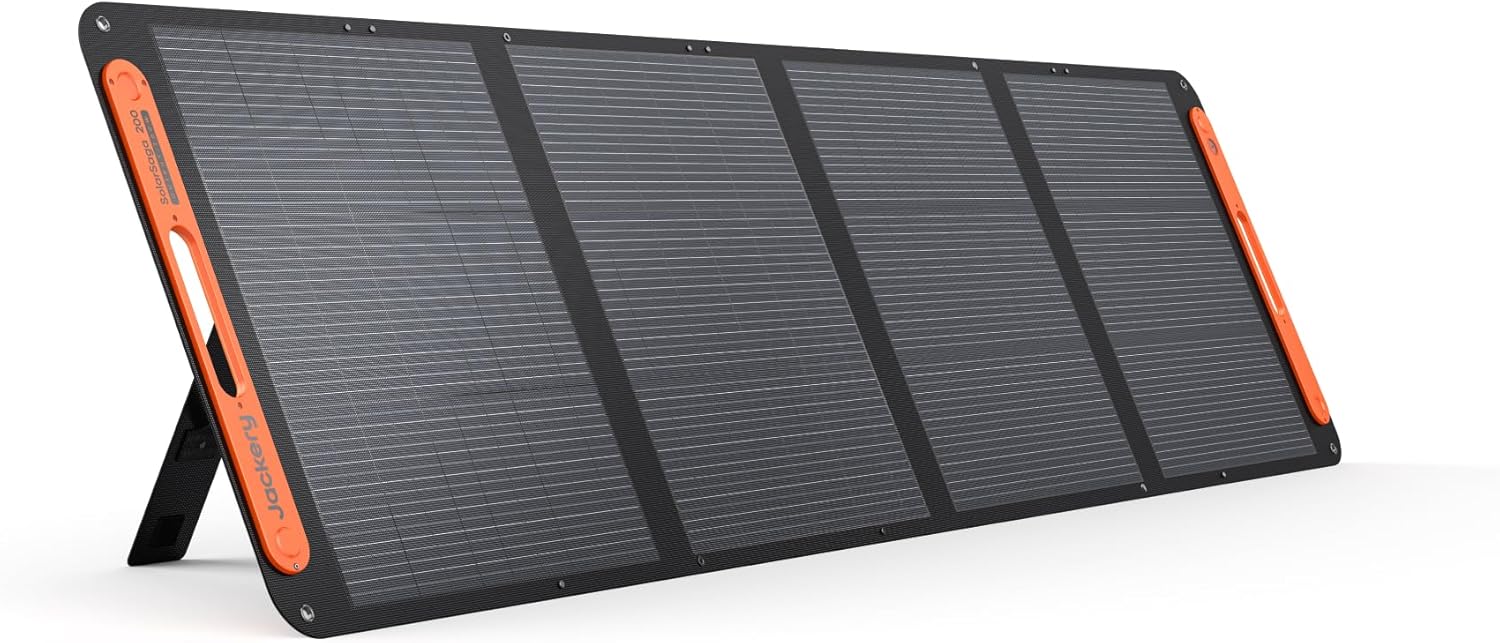
The Jackery SolarSaga 200W earns our Best Premium Choice award by combining excellent build quality, dependable charging performance, and one of the most user-friendly designs available. While it doesn’t use bifacial technology, its highly efficient monocrystalline cells, lightweight folding construction, and fast setup make it a favorite among campers, RV owners, and outdoor enthusiasts who value reliability over chasing maximum theoretical output.
With a rated output of 200W, the SolarSaga 200W provides consistent solar charging for compatible portable power stations while remaining easy to transport and deploy. Integrated kickstands, durable ETFE-laminated panels, and Jackery’s long-established reputation for quality contribute to a premium ownership experience that feels refined from the first trip.
What ultimately sets the SolarSaga 200W apart is its simplicity. It unfolds quickly, requires minimal adjustment, and delivers dependable performance across a wide range of outdoor conditions. For buyers who prioritize premium construction, proven reliability, and effortless everyday use, this is one of the finest portable solar panels currently available.
Camping Snapshot
| Feature | Details |
|---|---|
| Best Use | Camping • RV Travel • Overlanding • Emergency Backup |
| Rated Power | 200W |
| Solar Cell Type | Monocrystalline |
| Weight | Approximately 17.6 lbs (8 kg) |
| Foldable Design | Yes |
| Weather Resistance | ETFE-laminated surface for improved outdoor durability |
| Best For | Campers seeking premium quality, dependable charging, and effortless setup. |
Why We Chose It
Finding a premium portable solar panel isn’t simply about paying more—it’s about choosing a product that consistently delivers dependable performance, excellent craftsmanship, and a frustration-free experience every time you head outdoors.
That’s exactly why the Jackery SolarSaga 200W earned our Best Premium Choice award.
Its high-efficiency monocrystalline solar cells provide reliable charging in a wide range of weather conditions, while the lightweight folding design makes transportation remarkably easy. The integrated kickstands allow for quick setup, helping users position the panel toward the sun without additional accessories or complicated adjustments.
We also placed considerable emphasis on long-term ownership. Jackery has built a strong reputation for producing dependable outdoor power equipment, and the SolarSaga 200W reflects that experience through its durable construction, quality materials, and consistently polished design. Rather than focusing solely on maximum output, it delivers the kind of reliable everyday performance that many campers appreciate over years of regular use.
For buyers who want premium quality, dependable charging, and one of the easiest portable solar panels to use, the Jackery SolarSaga 200W stands out as the premium recommendation in this guide.
Check the latest price and customer reviews on Amazon.
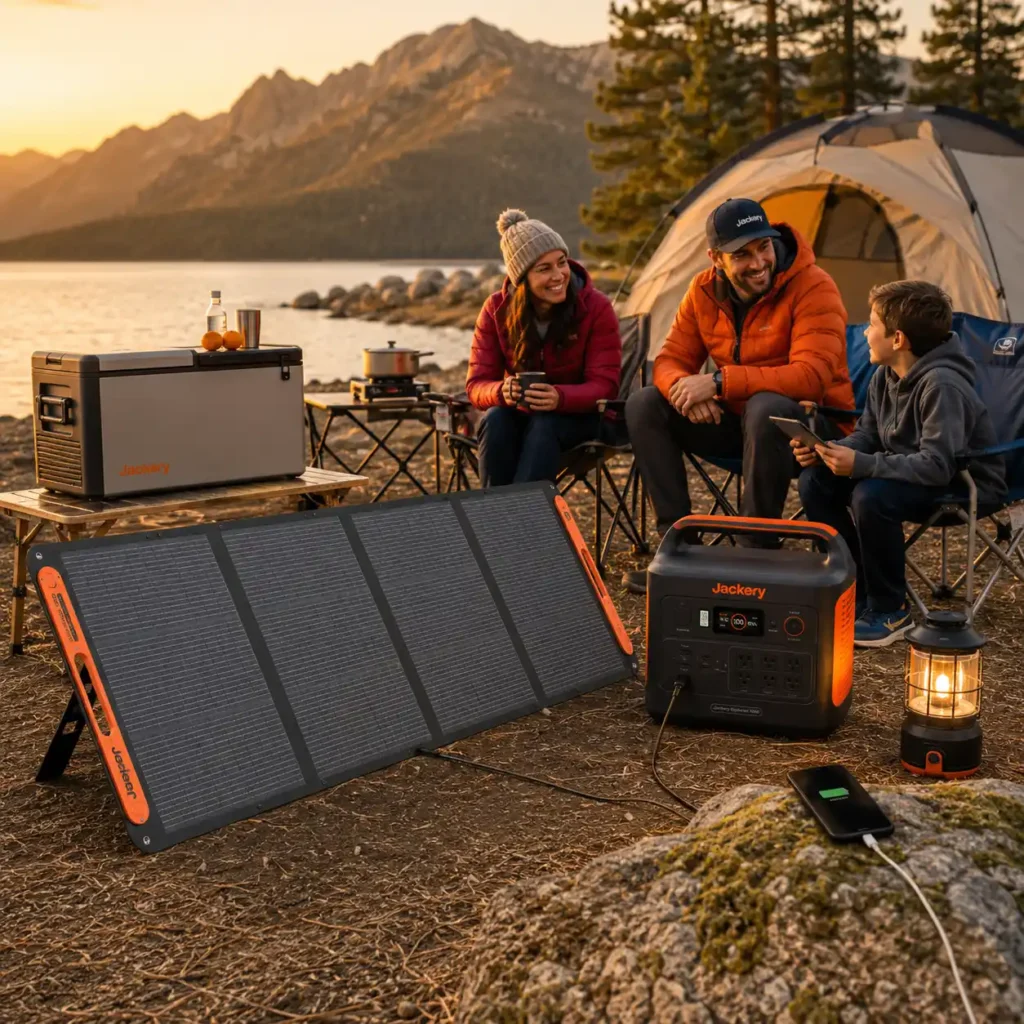
Living With It at Camp
The Jackery SolarSaga 200W is the kind of solar panel that makes off-grid charging feel simple from the moment you arrive at camp. Instead of spending time adjusting complicated equipment, you unfold the panel, position the built-in kickstands toward the sun, connect it to your portable power station, and let it begin generating clean energy while you enjoy the outdoors.
Imagine arriving at a lakeside campsite early in the afternoon. After setting up your tent, you unfold the SolarSaga 200W beside your camp kitchen and connect it to your power station. Throughout the day, it quietly replenishes the battery while your portable refrigerator keeps food cold, phones recharge, cameras prepare for the next adventure, and a laptop remains ready for remote work or trip planning.
As the sun begins to set, the stored energy powers campsite lighting, portable fans, and other essential equipment without the noise or maintenance of a fuel generator. The panel folds away just as easily when it’s time to leave, making it a practical companion for campers who appreciate equipment that works reliably without adding unnecessary complexity.
Its lightweight design is especially appreciated during frequent road trips, where quick setup and dependable charging become more valuable than chasing maximum laboratory efficiency. For many campers, that’s exactly what makes the SolarSaga 200W such an enjoyable panel to own.
Jackery SolarSaga 200W Evaluation
| Evaluation Category | Editorial Assessment |
|---|---|
| Portability | Lightweight folding design with integrated kickstands makes transportation and setup exceptionally easy. |
| Charging Performance | Reliable real-world charging with consistent output across a wide range of outdoor conditions. |
| Durability | High-quality ETFE-laminated construction designed for frequent camping and outdoor use. |
| Long-Term Ownership | Excellent craftsmanship, dependable performance, and Jackery's strong reputation support long-term value. |
| Overall Rating | Our Best Premium Choice thanks to its outstanding build quality, ease of use, and dependable charging performance. |
Who Should Buy This
- Campers who value premium build quality and dependable long-term reliability.
- RV owners looking for a lightweight and easy-to-deploy solar panel.
- Outdoor enthusiasts who prioritize quick setup and user-friendly operation.
- Buyers already using or planning to purchase a Jackery portable power station.
- Anyone seeking a premium portable solar panel with consistent real-world performance.
Who Should Skip This
- Buyers looking for the highest possible solar output for the price.
- Users who specifically want bifacial solar technology.
- Backpackers who require an ultra-lightweight charging solution.
- Budget-conscious shoppers focused primarily on minimizing upfront cost.
Final Verdict
The Jackery SolarSaga 200W earns its place as our Best Premium Choice by delivering exactly what many outdoor enthusiasts value most: dependable performance, exceptional build quality, and a user experience that remains effortless from one trip to the next.
While other panels may offer higher peak output or additional features, few match the SolarSaga’s combination of portability, premium construction, and consistently reliable charging. Whether you’re camping for the weekend, traveling by RV, or building a dependable off-grid setup, it provides the confidence that comes from using equipment designed with long-term durability in mind.
If you’re willing to invest a little more for outstanding quality and hassle-free solar charging, the Jackery SolarSaga 200W is one of the best premium portable solar panels available today.
Check the latest price and customer reviews on Amazon.
Related Guide: If your solar panel will be used primarily for mobile travel and you need a compact power source to complement it, our Best Portable Power Stations for RV (2026): Tested Picks for Reliable Off-Grid Power guide compares battery power stations designed for life on the road.
BLUETTI PV200
Best Value
Quick Verdict
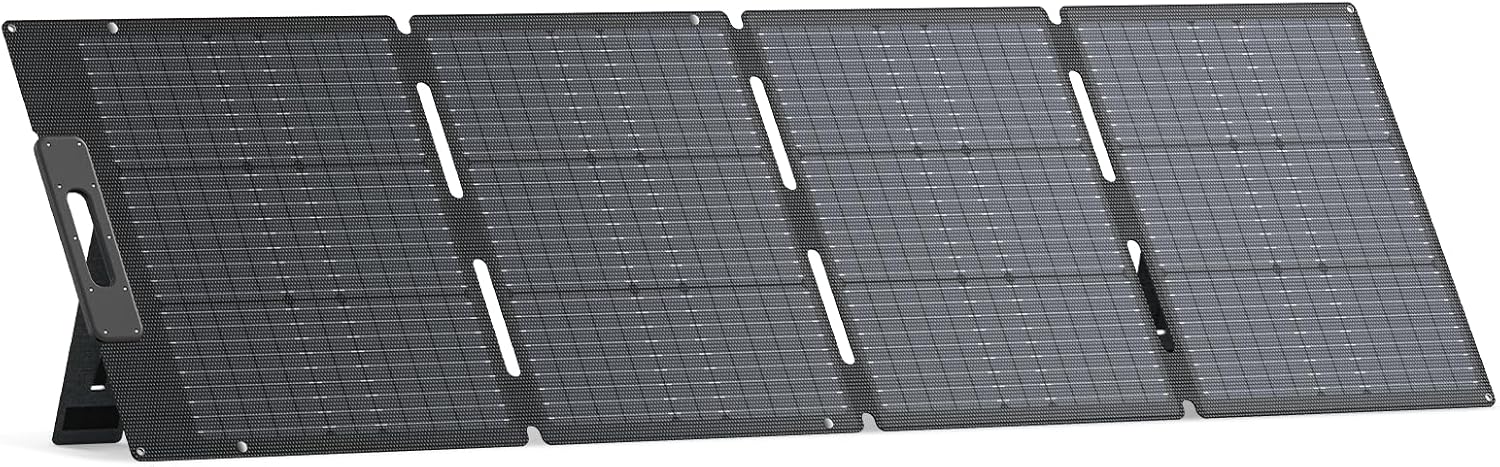
The BLUETTI PV200 earns our Best Value award by offering an excellent balance of charging performance, portability, durability, and affordability. While premium solar panels may include additional features or slightly higher efficiency, the PV200 delivers dependable real-world performance at a more accessible price, making it one of the smartest choices for campers seeking maximum value.
Its 200W monocrystalline solar cells provide consistent charging for portable power stations, while the foldable design and integrated kickstands allow for quick deployment at campsites, RV parks, and off-grid locations. Built with durable ETFE-laminated materials, the PV200 is designed to withstand regular outdoor use without adding unnecessary weight or complexity.
What makes the BLUETTI PV200 especially attractive is its overall practicality. It delivers the performance most campers actually need while remaining competitively priced, making it an excellent option for first-time buyers as well as experienced outdoor enthusiasts looking to expand their off-grid power system without overspending.
Camping Snapshot
| Feature | Details |
|---|---|
| Best Use | Camping • RV Travel • Overlanding • Emergency Backup |
| Rated Power | 200W |
| Solar Cell Type | Monocrystalline |
| Weight | Approximately 16.1 lbs (7.3 kg) |
| Foldable Design | Yes |
| Weather Resistance | ETFE-laminated surface for dependable outdoor durability |
| Best For | Campers looking for excellent charging performance and long-term value without paying premium prices. |
Why We Chose It
Finding the best value portable solar panel isn’t simply about choosing the lowest price. True value comes from balancing dependable charging performance, durable construction, portability, and long-term reliability without paying for features that many campers rarely use.
That’s exactly why the BLUETTI PV200 earned our Best Value award.
Its 200W monocrystalline solar cells deliver reliable charging for compatible portable power stations, while the foldable design makes transportation and storage straightforward. The integrated kickstands allow users to position the panel quickly toward the sun, helping maximize solar collection with minimal effort.
We also considered long-term ownership. The durable ETFE-laminated construction, solid overall build quality, and broad compatibility with BLUETTI and many other portable power stations make the PV200 a dependable investment for regular camping, RV travel, and emergency preparedness. Rather than focusing on premium extras, it concentrates on delivering the features that matter most for everyday outdoor use.
For campers who want dependable solar charging, rugged construction, and outstanding overall value, the BLUETTI PV200 stands out as one of the smartest purchases in this guide.
Check the latest price and customer reviews on Amazon.
Living With It at Camp
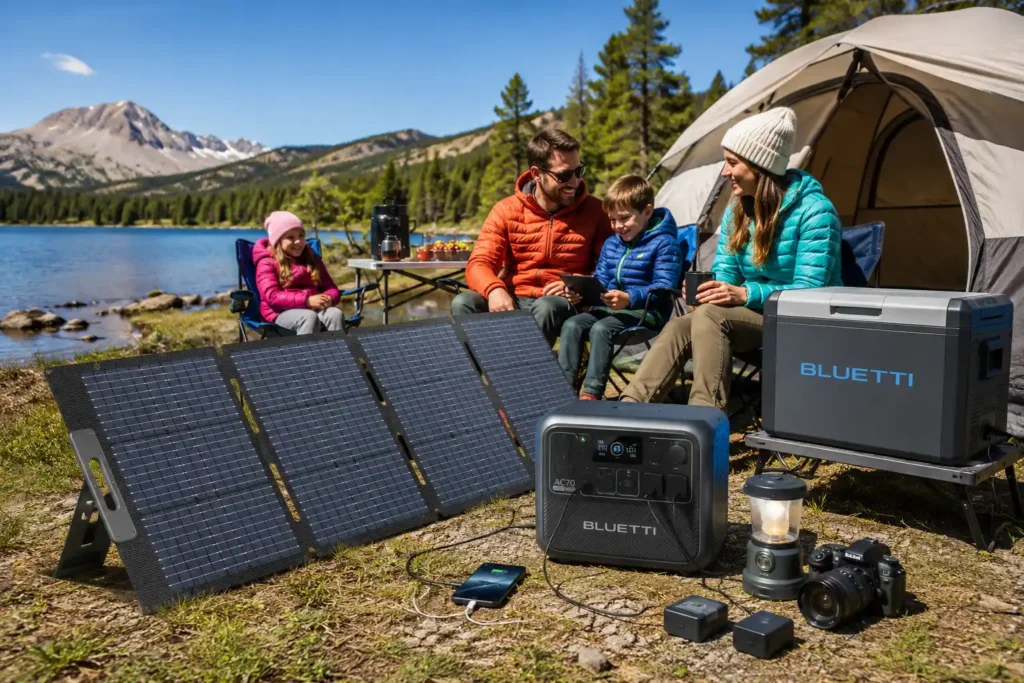
The BLUETTI PV200 is the kind of solar panel that quietly proves its value throughout an entire camping trip. Instead of worrying about stretching every watt-hour, you can simply unfold the panel, position it toward the sun, and let it continuously recharge your portable power station while you enjoy the outdoors.
Picture arriving at your campsite on a clear afternoon. After pitching the tent, you connect the PV200 to your power station and leave it collecting sunlight while you explore nearby trails or relax by the lake. Throughout the day, it helps keep your camping refrigerator running, camera batteries topped up, phones fully charged, and lighting ready for the evening.
As sunset approaches, the stored energy keeps your campsite comfortable without the noise or maintenance of a traditional generator. The lightweight folding design also makes it easy to reposition the panel during the day or pack it away quickly before heading home. It delivers exactly the kind of dependable performance that makes camping more enjoyable without requiring constant attention.
For campers looking to maximize value without sacrificing everyday usability, the BLUETTI PV200 feels like a dependable companion that simply gets the job done.
BLUETTI PV200 Evaluation
| Evaluation Category | Editorial Assessment |
|---|---|
| Portability | Foldable, lightweight design makes transportation and campsite setup quick and convenient. |
| Charging Performance | Reliable 200W output delivers consistent solar charging for portable power stations during everyday camping use. |
| Durability | ETFE-laminated construction withstands frequent outdoor use and varying weather conditions. |
| Long-Term Ownership | Excellent balance of performance, durability, and affordability provides outstanding long-term value. |
| Overall Rating | Our Best Value recommendation thanks to its dependable performance, rugged construction, and competitive price. |
Who Should Buy This
- Campers looking for the best balance of performance and affordability.
- RV owners who want dependable solar charging without paying premium prices.
- First-time buyers building their first portable solar setup.
- Outdoor enthusiasts needing reliable charging for weekend trips and longer adventures.
- Anyone seeking excellent long-term value from a portable solar panel.
Who Should Skip This
- Users specifically looking for bifacial solar technology.
- Buyers who want the lightest premium panel available.
- Campers requiring more than 200W of solar generation from a single panel.
- Professionals willing to pay significantly more for premium-brand features.
Final Verdict
The BLUETTI PV200 earns our Best Value award by delivering the features that matter most without inflating the price. It combines dependable charging performance, durable construction, practical portability, and straightforward operation into a portable solar panel that performs exceptionally well in real camping conditions.
While premium models may include additional refinements or specialized technologies, the PV200 focuses on providing reliable everyday performance at a price that represents outstanding value. Whether you’re camping for the weekend, traveling by RV, or preparing for emergency backup power, it offers a smart balance of capability and affordability.
If you’re searching for a portable solar panel that delivers excellent real-world performance without stretching your budget, the BLUETTI PV200 is one of the strongest value choices available today.
Check the latest price and customer reviews on Amazon.
Related Guide: If you’re trying to keep the cost of your complete portable solar setup under control, our Best Portable Power Stations Under $500 (2026) guide can help you compare affordable battery power options that pair well with portable solar panels.
Renogy 200W Portable Solar Panel
Best Versatility
Quick Verdict
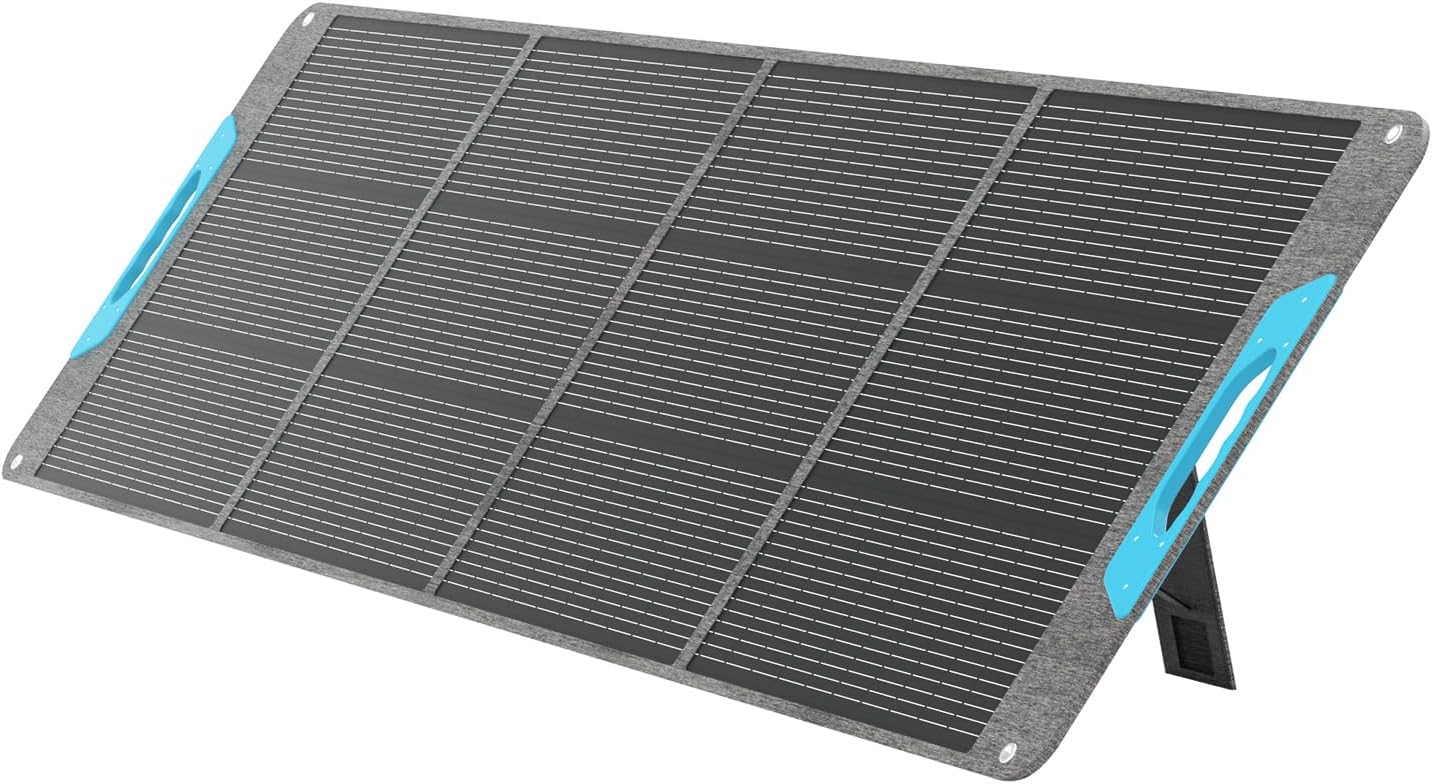
The Renogy 200W Portable Solar Panel earns our Best Versatility award because it adapts exceptionally well to a wide variety of outdoor applications. Whether you’re camping in a tent, traveling by RV, overlanding, boating, or preparing for emergency backup, it delivers dependable solar charging in a rugged, portable package designed for frequent use.
Its 200W monocrystalline solar cells provide reliable power generation, while the foldable suitcase-style design with integrated kickstands allows for fast deployment wherever sunlight is available. Broad compatibility with many portable power stations and solar generators makes it an excellent choice for users who aren’t locked into a single ecosystem.
What truly distinguishes the Renogy 200W Portable Solar Panel is its flexibility. Rather than being optimized for one specific type of user, it performs consistently well across many different outdoor scenarios. For buyers who want one solar panel capable of handling everything from weekend camping trips to extended off-grid adventures, it represents one of the most versatile options available.
Camping Snapshot
| Feature | Details |
|---|---|
| Best Use | Camping • RV Travel • Overlanding • Boating • Emergency Backup |
| Rated Power | 200W |
| Solar Cell Type | Monocrystalline |
| Weight | Approximately 17.6 lbs (8 kg) |
| Foldable Design | Yes |
| Weather Resistance | Durable ETFE surface designed for outdoor environments |
| Best For | Users seeking one portable solar panel that performs reliably across a wide range of outdoor activities. |
Why We Chose It
The most versatile portable solar panel isn’t necessarily the lightest or the most powerful. True versatility comes from delivering reliable charging performance across a broad range of outdoor environments while remaining easy to transport, simple to set up, and compatible with different portable power systems.
That’s exactly why the Renogy 200W Portable Solar Panel earned our Best Versatility award.
Its 200W monocrystalline solar cells provide dependable energy generation for camping, RV travel, overlanding, boating, and emergency preparedness. The practical foldable design with integrated kickstands allows users to deploy the panel quickly, while Renogy’s broad compatibility with many portable power stations gives owners greater flexibility when building or expanding an off-grid power system.
We also considered long-term ownership. Renogy has established a strong reputation in the solar industry, and this panel reflects that experience through durable construction, dependable performance, and a design intended for years of outdoor use. Instead of excelling in only one specific situation, it consistently performs well wherever portable solar power is needed.
For campers and outdoor enthusiasts who want one dependable solar panel capable of adapting to nearly any adventure, the Renogy 200W Portable Solar Panel stands out as the most versatile choice in this guide.
Check the latest price and customer reviews on Amazon.
Living With It at Camp
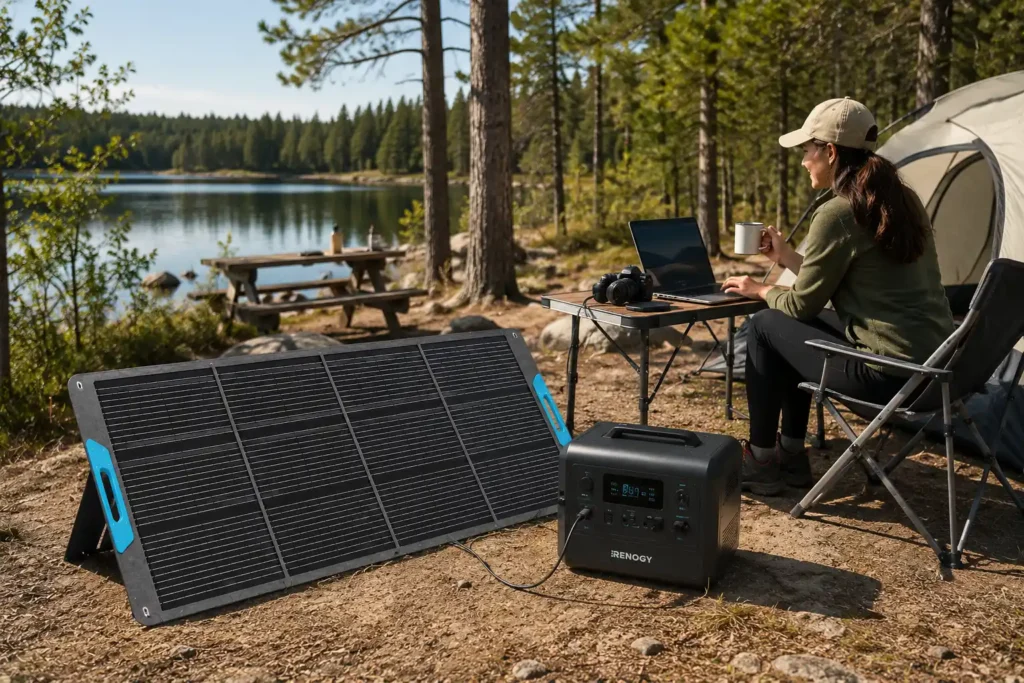
The Renogy 200W Portable Solar Panel is designed for campers who never know exactly where their next adventure will take them. Whether you’re spending the weekend at a campground, exploring remote forest roads, camping beside a mountain lake, or traveling in an RV, it adapts easily to changing conditions and different styles of outdoor travel.
Imagine arriving at camp early in the afternoon. Within minutes, the foldable panel is positioned toward the sun and connected to your portable power station. While your family enjoys hiking, fishing, or simply relaxing around camp, the panel quietly replenishes the battery that powers your portable refrigerator, lighting, laptops, cameras, and mobile devices.
As the day continues, the lightweight design makes it easy to reposition the panel for better sun exposure, helping maximize energy production without interrupting your activities. When it’s time to pack up, the entire system folds neatly into a compact package that’s simple to carry and store.
Its broad compatibility is one of its biggest advantages. Whether you already own a Renogy power station or another compatible solar generator, the Renogy 200W integrates easily into a variety of off-grid setups, making it a dependable choice for users who value flexibility as much as performance.
Renogy 200W Portable Solar Panel Evaluation
| Evaluation Category | Editorial Assessment |
|---|---|
| Portability | Foldable suitcase-style design makes transportation, storage, and campsite setup simple. |
| Charging Performance | Reliable 200W solar output delivers consistent charging across a wide range of outdoor conditions. |
| Durability | Robust ETFE construction is built for frequent camping, RV travel, and off-grid adventures. |
| Long-Term Ownership | Excellent compatibility, dependable construction, and proven reliability provide lasting value. |
| Overall Rating | Our Best Versatility recommendation thanks to its adaptability, dependable performance, and broad compatibility. |
Who Should Buy This
- Campers looking for one solar panel that adapts to many different outdoor activities.
- RV owners and overlanders who value compatibility with a wide range of portable power stations.
- Boaters and outdoor enthusiasts needing dependable portable solar charging.
- Users planning to expand their off-grid power system over time.
- Buyers who prioritize flexibility alongside reliable everyday performance.
Who Should Skip This
- Campers looking specifically for bifacial solar technology.
- Buyers focused only on the lowest purchase price.
- Backpackers requiring an ultra-lightweight solar solution.
- Users who only need occasional USB charging for small electronics.
Final Verdict
The Renogy 200W Portable Solar Panel earns our Best Versatility award because it performs confidently across a wide variety of outdoor situations. Its dependable charging performance, durable construction, and broad compatibility make it an excellent choice for campers who want one panel capable of supporting many different adventures.
Rather than being limited to a single type of camping or power station, it integrates easily into diverse off-grid setups, making it a practical long-term investment for outdoor enthusiasts. Whether you’re camping, overlanding, traveling by RV, or preparing for emergency backup, the Renogy 200W consistently delivers the flexibility and reliability that many users are looking for.
If you want one portable solar panel that can adapt to almost any outdoor lifestyle, the Renogy 200W Portable Solar Panel is our Best Versatility recommendation.
Check the latest price and customer reviews on Amazon.
Related Guide: If you’re using portable solar as part of a larger emergency preparedness system, our Best Portable Generators (2026) guide compares fuel-powered backup options that can provide additional electricity when sunlight is unavailable or solar production is limited.
Goal Zero Nomad 200 Solar Panel
Best for Rugged Outdoor Use

Quick Verdict
The Goal Zero Nomad 200 Solar Panel earns our Best for Rugged Outdoor Use award thanks to its durable construction, dependable charging performance, and field-ready design built for demanding outdoor environments. Whether you’re camping in remote locations, overlanding across rough terrain, or relying on solar power during extended off-grid adventures, the Nomad 200 is engineered to withstand challenging conditions while delivering reliable energy.
Its 200W monocrystalline solar cells provide consistent charging for compatible portable power stations, while the foldable four-panel design makes transportation and deployment surprisingly convenient. Reinforced materials, integrated hanging loops, and rugged construction reflect Goal Zero’s long history of designing equipment specifically for outdoor explorers.
What sets the Nomad 200 apart is its confidence-inspiring durability. Rather than focusing solely on maximum efficiency or the lowest weight, it prioritizes dependable performance in environments where equipment is expected to handle dust, repeated transport, changing weather, and frequent use. For campers who regularly venture far from established campgrounds, it’s one of the most capable portable solar panels available.
Camping Snapshot
| Feature | Details |
|---|---|
| Best Use | Camping • Overlanding • Off-Grid Expeditions • Emergency Backup |
| Rated Power | 200W |
| Solar Cell Type | Monocrystalline |
| Weight | Approximately 22.7 lbs (10.3 kg) |
| Foldable Design | Yes |
| Weather Resistance | Heavy-duty construction designed for demanding outdoor use |
| Best For | Outdoor enthusiasts who need dependable solar charging in rugged environments. |
Why We Chose It
The best portable solar panel for rugged outdoor use isn’t simply the one with the highest wattage—it’s the one you can depend on when conditions become unpredictable. Durability, reliable charging, and practical field usability matter just as much as raw power output.
That’s exactly why the Goal Zero Nomad 200 earned our Best for Rugged Outdoor Use award.
Its 200W monocrystalline solar cells provide dependable energy generation, while the reinforced folding design is built to handle repeated transportation, uneven terrain, and demanding outdoor conditions. Integrated hanging loops and multiple mounting options make it easy to position the panel in campsites, overlanding setups, or remote base camps where flexibility is essential.
We also placed significant emphasis on long-term ownership. Goal Zero has earned a strong reputation among outdoor adventurers for producing equipment designed specifically for real-world expeditions. The Nomad 200 reflects that philosophy through its robust construction, dependable performance, and practical design that continues performing trip after trip.
For campers, overlanders, and outdoor explorers who need a portable solar panel capable of handling tougher environments without sacrificing reliability, the Goal Zero Nomad 200 stands out as the most rugged option in this guide.
Check the latest price and customer reviews on Amazon.
Living With It at Camp
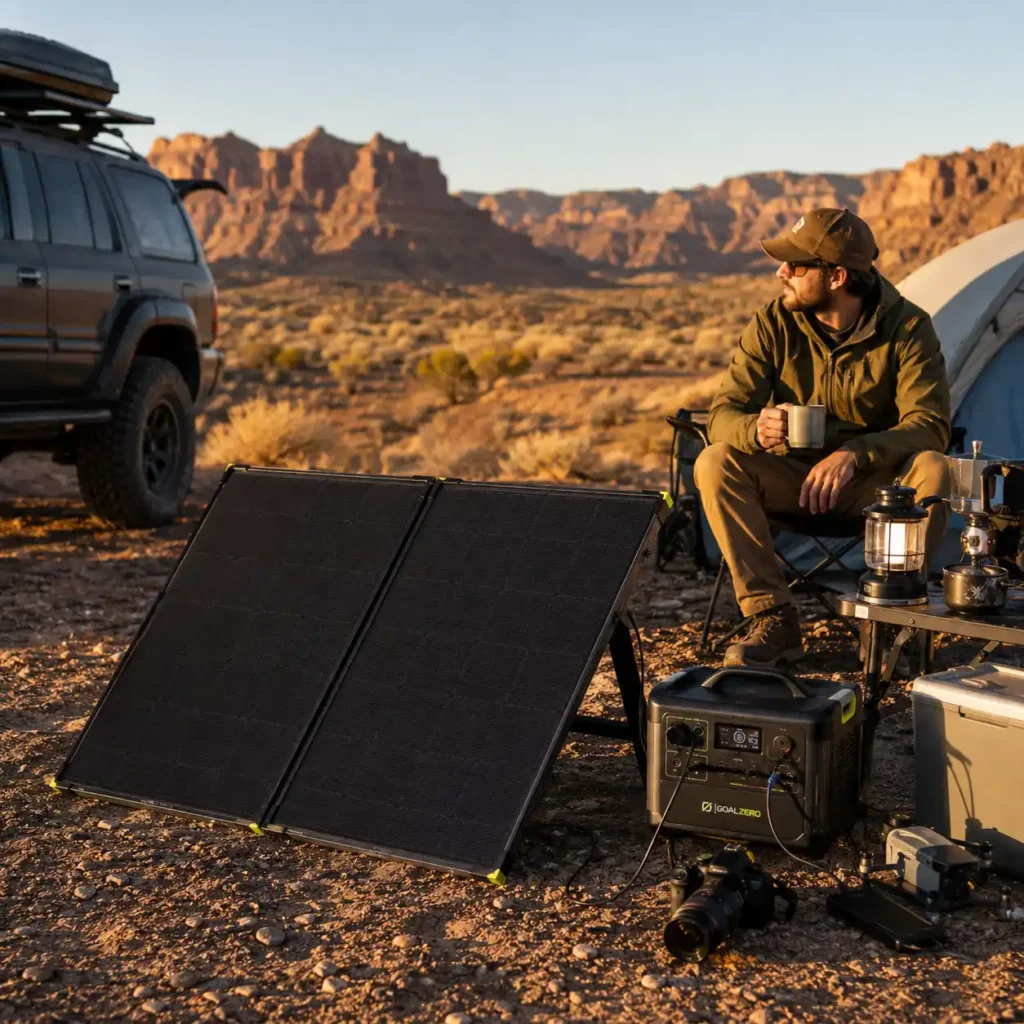
The Goal Zero Nomad 200 is built for campers who spend more time beyond established campgrounds than inside them. Whether you’re exploring remote backcountry trails, overlanding through rugged terrain, or setting up a temporary base camp far from electrical hookups, this panel is designed to provide dependable solar charging where reliability matters most.
Imagine arriving at a remote campsite just after sunrise. The Nomad 200 unfolds beside your vehicle while breakfast is cooking over a camp stove. As the morning sun climbs higher, the panel quietly recharges your portable power station, keeping your refrigerator running, navigation equipment powered, camera batteries charging, and lighting ready for another night outdoors.
Throughout the day, its rugged construction inspires confidence when moving between campsites or repositioning the panel to follow the sun. Instead of worrying about delicate equipment, you simply focus on the journey ahead. By evening, your essential devices remain fully powered, allowing you to enjoy the wilderness without sacrificing modern conveniences.
For outdoor enthusiasts who regularly venture into demanding environments, the Goal Zero Nomad 200 feels less like an accessory and more like dependable expedition equipment.
Goal Zero Nomad 200 Evaluation
| Evaluation Category | Editorial Assessment |
|---|---|
| Portability | Foldable four-panel design makes transport straightforward despite its rugged construction. |
| Charging Performance | Reliable 200W solar output delivers dependable charging during extended off-grid adventures. |
| Durability | Heavy-duty construction is engineered to withstand demanding outdoor environments and frequent travel. |
| Long-Term Ownership | Premium materials and Goal Zero's expedition-focused design provide excellent long-term reliability. |
| Overall Rating | Our Best for Rugged Outdoor Use recommendation thanks to its exceptional durability and dependable field performance. |
Who Should Buy This
- Overlanders traveling through remote or rugged terrain.
- Campers who frequently camp far from developed campgrounds.
- Outdoor photographers and content creators working off-grid.
- Adventurers looking for durable equipment built for years of heavy outdoor use.
- Buyers who prioritize reliability over minimum weight.
Who Should Skip This
- Casual campers who only take a few weekend trips each year.
- Backpackers looking for the lightest possible solar panel.
- Budget-conscious buyers seeking the lowest upfront cost.
- Users who primarily charge small USB devices.
Final Verdict
The Goal Zero Nomad 200 earns our Best for Rugged Outdoor Use award because it delivers exactly what experienced outdoor enthusiasts expect from expedition-grade equipment: dependable charging, exceptional durability, and confidence in demanding environments.
Although lighter and less expensive panels are available, few are designed with the same emphasis on long-term reliability and field-ready performance. Whether you’re overlanding across remote landscapes, camping off-grid for several days, or preparing for emergency backup, the Nomad 200 provides dependable solar power when it matters most.
If your adventures regularly take you beyond the reach of traditional campsites and electrical hookups, the Goal Zero Nomad 200 is one of the most capable and durable portable solar panels you can buy.
Check the latest price and customer reviews on Amazon.
Related Guide: If your solar setup is intended to support a larger residential backup system, our Best Whole House Backup Power Systems (2026): Expert Picks for Reliable Home Backup Power guide explores solutions designed to provide broader household protection during extended outages.
How to Choose the Best Portable Solar Panel
Choosing the best portable solar panel isn’t simply about buying the model with the highest wattage. The right panel depends on how you camp, which devices you want to charge, the portable power station you already own (or plan to buy), and the weather conditions you typically encounter.
Many first-time buyers assume that a larger solar panel will always provide a better experience. In reality, an oversized panel can add unnecessary weight, take up valuable storage space, and cost significantly more without delivering meaningful advantages for weekend camping. On the other hand, choosing a panel that’s too small may leave your power station recharging much more slowly than expected, especially during cloudy conditions or shorter winter days.
The goal is to select a portable solar panel that matches your actual power needs rather than chasing the highest advertised wattage. Whether you’re heading out for a one-night camping trip, spending several days off-grid, traveling in an RV, or building an emergency backup system for home, understanding a few key specifications will help you choose a panel that performs reliably in real-world conditions.
Unlike a portable power station, a solar panel doesn’t store energy—it only generates it. That means its performance depends not only on its own specifications but also on sunlight, panel positioning, temperature, and compatibility with your power station. Looking beyond the marketing numbers will help you make a much smarter long-term investment.
The sections below explain the most important factors to consider before buying your first—or next—portable solar panel.
One piece of advice applies to almost every buyer: don’t shop for the biggest solar panel—shop for the charging performance you actually need. The best portable solar panel is the one that keeps your power station ready without adding unnecessary weight, complexity, or expense.
Start With Your Power Needs
The first question isn’t “Which portable solar panel produces the most power?” It’s “How much energy do I actually need to generate each day?”
Different camping styles place very different demands on a portable solar panel.
Imagine arriving at the same campground as another camper.
They unfold a massive 400W solar panel that occupies much of their campsite. You set up a lightweight 200W panel that takes less than a minute to position.
By the end of the afternoon, both of you have fully recharged your portable power station because your daily energy consumption is relatively modest.
That’s why choosing the right panel size matters far more than simply choosing the largest one.
Someone who spends a single weekend charging smartphones, LED lights, and a camera has very different solar requirements than an overlander running a portable refrigerator every day or an RV owner relying on solar as their primary charging source.
For example, if your typical camping trip involves keeping a few personal devices charged and occasionally topping up a compact portable power station, a 100W portable solar panel may provide everything you need while remaining exceptionally lightweight and easy to transport.
Campers using mid-size portable power stations between 700Wh and 1000Wh often benefit from 200W solar panels, which offer an excellent balance between charging performance, portability, and setup time.
For extended off-grid adventures, RV camping, or larger power stations with capacities exceeding 1500Wh, 300W to 400W of portable solar capacity may become the better investment. The additional solar input helps recover battery capacity more quickly during limited daylight hours and reduces dependence on vehicle or grid charging.
Instead of asking how many watts you can afford, start by identifying how you actually use electricity outdoors. Matching your solar panel to your daily energy consumption almost always leads to a better long-term experience than simply buying the largest panel available.
How Much Solar Panel Wattage Do You Really Need?
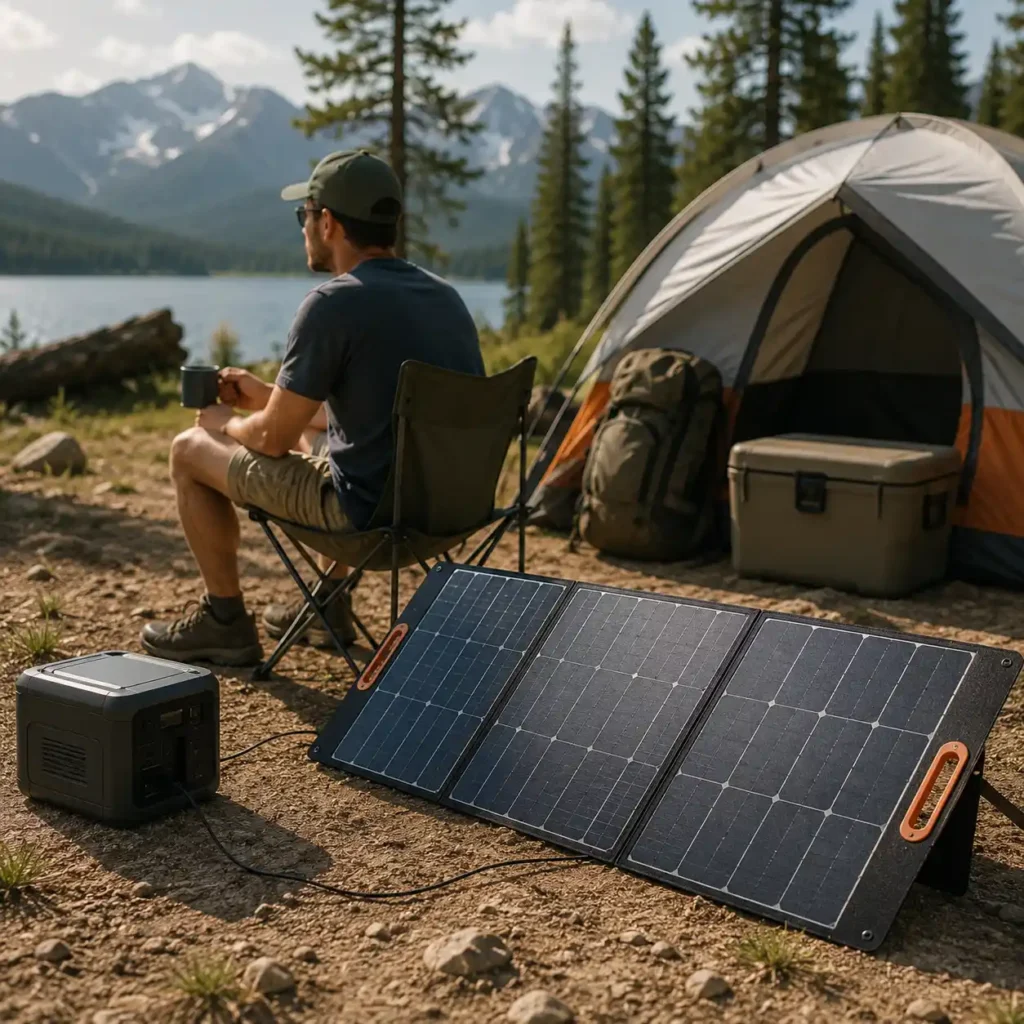
Solar panel wattage is usually the first specification buyers notice, but it’s also one of the most misunderstood.
It’s also the specification people tend to overestimate the most.
Many buyers assume they’ll eventually need the highest-wattage panel they can afford. In reality, most weekend campers use far less energy than they expect, meaning a large solar panel often delivers more generating capacity than their portable power station or daily power consumption actually requires.
A portable solar panel’s wattage represents its maximum power output under ideal laboratory conditions, known as Standard Test Conditions (STC). In the real world, however, actual output is influenced by sunlight intensity, panel angle, temperature, cloud cover, shading, and even dust on the panel surface. Because of these factors, it’s perfectly normal for a 200W panel to produce less than its advertised maximum for much of the day.
For lightweight weekend camping, a 100W portable solar panel is often sufficient to keep small portable power stations topped up while charging phones, cameras, headlamps, tablets, and other essential electronics.
If your camping setup includes a portable refrigerator, laptop, CPAP machine, portable fan, or a mid-size power station between 700Wh and 1000Wh, a 200W panel is widely considered the sweet spot. It offers noticeably faster charging while remaining portable enough for most campers to carry and deploy with ease.
Campers planning extended off-grid adventures, overlanding expeditions, RV travel, or using larger power stations with capacities of 1500Wh or more should consider 300W to 400W of portable solar capacity. Larger panels help recover more energy during shorter winter days and provide greater flexibility when weather conditions are less than ideal.
A helpful way to think about solar panel wattage is this: buy enough solar generation for your typical day—not for perfect sunshine. Choosing a panel that matches your real energy consumption usually provides better value, easier transportation, and a more enjoyable outdoor experience.
Remember that every increase in wattage comes with trade-offs. Larger solar panels are heavier, occupy more storage space, require a bigger setup area, and generally cost more. Unless your camping style genuinely demands the extra output, carrying additional solar capacity on every trip may become more of a burden than a benefit.
Monocrystalline vs. Polycrystalline Solar Panels
One of the first specifications you’ll encounter when comparing portable solar panels is the type of solar cells they use. Today, nearly every high-quality portable solar panel relies on monocrystalline technology—and for good reason.
Many first-time buyers assume all solar panels perform the same as long as the wattage is identical. In reality, the type of solar cells has a significant impact on efficiency, charging performance, and the amount of electricity the panel can generate throughout the day.
Monocrystalline solar panels are manufactured from a single, high-purity silicon crystal. This design allows them to convert a higher percentage of sunlight into usable electricity compared with older panel technologies. Higher efficiency means more power can be generated from the same surface area, making monocrystalline panels especially valuable for portable applications where space and weight are limited.
Polycrystalline panels, by comparison, are produced using multiple silicon crystals. While they are often less expensive to manufacture, they generally offer lower efficiency and require a larger surface area to produce the same amount of power. As a result, polycrystalline technology has become increasingly uncommon in modern portable solar panels designed for camping, RV travel, and emergency backup.
Another important advantage of monocrystalline panels is their better performance during less-than-ideal conditions. Although no solar panel performs at full output under heavy cloud cover or deep shade, monocrystalline cells typically maintain higher efficiency during overcast weather, cooler temperatures, and the lower sun angles often experienced in the morning, late afternoon, or winter months.
This is one reason why every solar panel recommended in this guide uses monocrystalline solar cells. They provide the best combination of charging efficiency, portability, durability, and long-term value for outdoor use.
If you’re choosing between two portable solar panels with similar specifications, the model using high-efficiency monocrystalline cells will usually deliver the better real-world performance over the lifetime of the panel.
Foldability and Portability Matter More Than You Think
A portable solar panel may produce plenty of power, but if it’s difficult to transport, slow to set up, or awkward to reposition throughout the day, you’re less likely to use it to its full potential.
This is one of the most overlooked aspects of buying a portable solar panel.
Many shoppers focus almost entirely on wattage, assuming that higher output automatically means a better product. In reality, portability often has a greater impact on everyday usability than an extra 50 or even 100 watts of rated capacity.
Think about what typically happens when you arrive at camp.
After parking your vehicle, you’re setting up a tent, organizing gear, preparing food, or simply relaxing after a long drive. A lightweight foldable solar panel that unfolds in seconds is far more likely to be positioned correctly and moved throughout the day to follow the sun. A larger, heavier panel that requires more effort to handle may end up staying in one place, reducing its overall energy production.
Modern foldable solar panels are designed specifically for mobility. Most feature integrated carrying handles, protective storage cases, adjustable kickstands, and compact folding designs that fit easily into a vehicle, RV storage compartment, or camping trailer. These features make transportation easier while also helping protect the solar cells during travel.
Weight becomes increasingly important if you frequently move between campsites, hike short distances to your setup, or simply prefer traveling with less gear. A compact 100W or 200W panel can usually be carried comfortably by one person, while larger 300W and 400W systems may require considerably more storage space and effort to reposition during the day.
It’s also worth considering how often you’ll need to adjust the panel’s angle. Portable solar panels generate the most electricity when facing direct sunlight. A lighter panel makes these small adjustments quick and effortless, helping maximize charging performance throughout the day.
Instead of asking only, “How much power does this panel produce?”, also ask “How easy will it be to carry, deploy, pack away, and reposition every time I go camping?”
The best portable solar panel isn’t simply the one with the highest output—it’s the one you’ll enjoy using on every trip.
Weather Resistance and Durability
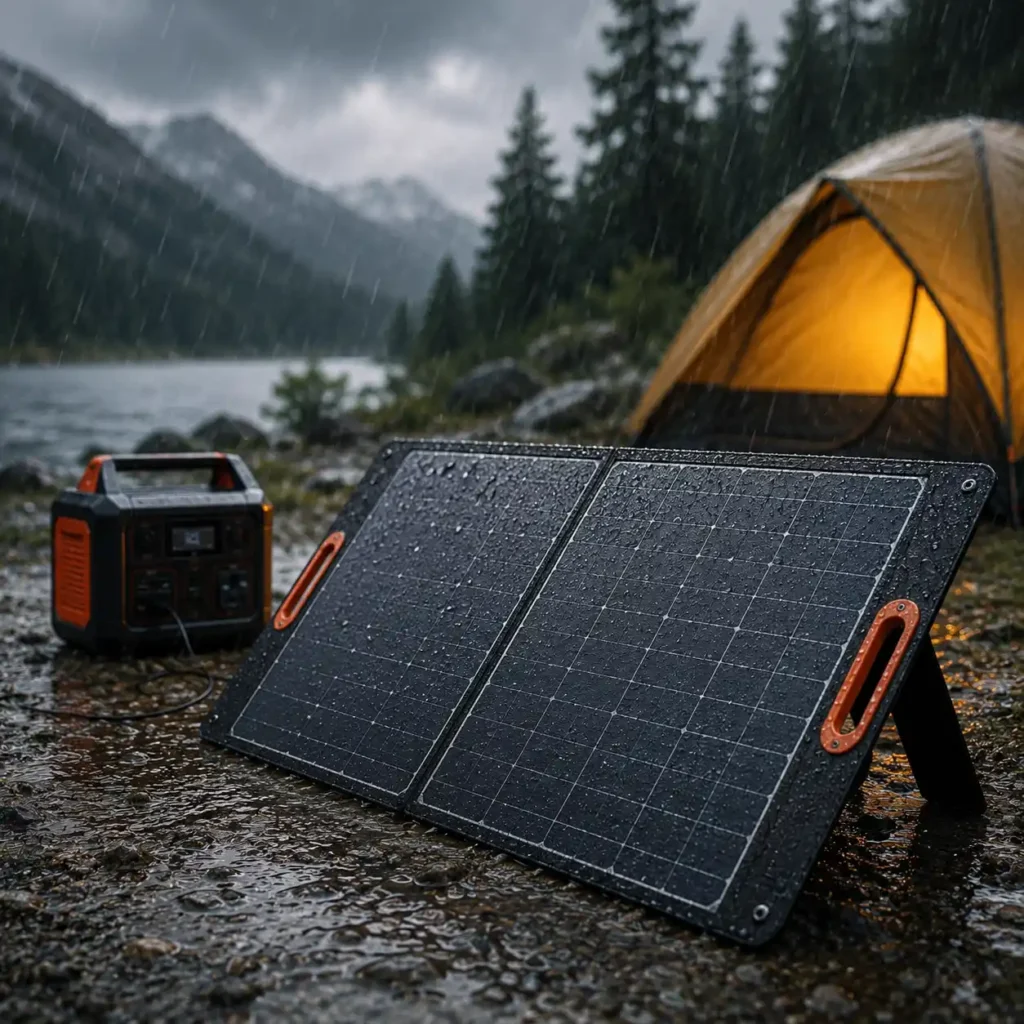
A portable solar panel is designed to be used outdoors, so durability is just as important as charging performance. Whether you’re camping in the mountains, traveling by RV, or preparing for emergency power outages, your panel should be able to withstand the conditions you’ll actually encounter—not just perfect sunny days.
Many buyers focus on wattage and efficiency while overlooking how well a panel is built. Yet long-term reliability often depends on the quality of its materials, weather protection, and overall construction.
Think about a typical camping trip.
The morning starts with clear skies, but by afternoon, a passing shower rolls through the campsite. Dust settles on the panels during a dry overlanding trip. A sudden gust of wind knocks the panel over, or it spends hours exposed to intense summer sunlight.
These situations are completely normal, and a well-built portable solar panel should be designed to handle them.
One of the first specifications to check is the IP rating, which indicates the panel’s resistance to dust and water. Many premium portable solar panels carry an IP65, IP67, or similar rating, meaning they can withstand rain, dust, and splashing water during normal outdoor use. However, it’s important to remember that water resistance does not mean waterproof. Most foldable solar panels should never be submerged or left outside during severe storms.
Build quality also extends beyond weather protection. Reinforced corners, durable stitching, heavy-duty carrying handles, strong kickstands, and scratch-resistant surfaces all contribute to a panel that performs reliably over many years of camping and travel.
Kickstands deserve special attention. A stable support system helps keep the panel properly angled toward the sun while reducing the risk of it collapsing or blowing over in light wind. Well-designed kickstands also make setup faster and allow you to adjust the panel throughout the day for improved charging performance.
If you regularly camp in challenging environments, consider how often the panel will be folded, packed, transported, and exposed to changing weather. A slightly more expensive panel built with higher-quality materials will often deliver better long-term value than a cheaper alternative that begins showing wear after only a few seasons.
Ultimately, the best portable solar panel isn’t just the one that generates the most electricity—it’s the one that continues generating reliable power after years of outdoor use.
Connector Compatibility
Even the highest-quality portable solar panel won’t perform as expected if it isn’t compatible with your portable power station. Before buying, it’s important to look beyond the panel’s wattage and make sure the electrical specifications match your power station’s charging requirements.
Compatibility is one of the most common areas of confusion for first-time buyers.
Many people assume that if two products advertise solar charging, they’ll work together without any issues. In reality, connector types, input voltage, maximum current, and supported solar input all determine whether a panel can charge your power station efficiently—or at all.
The connector is the first specification to check. Many portable solar panels use the industry-standard MC4 connectors, which have become the preferred choice because they’re weather-resistant, secure, and compatible with a wide range of portable power stations. Some manufacturers, however, include proprietary connectors or supply adapter cables designed specifically for their own products.
This is why it’s always worth checking what accessories are included in the box. Many leading brands provide multiple adapter cables, allowing a single solar panel to work with different portable power stations without purchasing additional accessories.
Voltage compatibility is equally important. Every portable power station has a maximum solar input voltage that it can safely accept. Connecting a panel that exceeds this limit may prevent charging or, in some cases, trigger the power station’s protection system. Likewise, if the panel’s operating voltage is too low, charging performance may be significantly reduced.
Maximum solar input also plays a major role. For example, connecting a 400W solar panel to a power station that accepts only 200W of solar input won’t cut charging time in half. The power station will simply limit the incoming power to its maximum supported input, meaning much of the panel’s potential output cannot be used.
When comparing products, don’t focus solely on the solar panel itself. Think of the panel and the portable power station as a complete charging system. The best results come from pairing components that are designed to work efficiently together.
Before making your purchase, verify four key specifications:
- Connector type
- Supported solar input voltage
- Maximum solar input wattage
- Included adapter cables
Spending a few minutes checking compatibility before you buy can save hours of frustration once you’re out at the campsite.
Charging Speed Depends on More Than Panel Wattage
One of the biggest misconceptions about portable solar panels is that a higher wattage rating automatically means faster charging. While panel size certainly matters, it’s only one part of the equation.
In real-world camping conditions, charging speed depends on a combination of factors working together.
Imagine two campers using identical 200W portable solar panels.
One positions the panel directly toward the sun, keeps it free of shade, and pairs it with a power station capable of accepting the panel’s full solar input.
The other places the panel flat on the ground beneath partial tree cover while using a power station that can accept only half of the available solar power.
Although both own the same solar panel, their charging performance can be dramatically different.
Sunlight is the biggest variable. Portable solar panels produce their highest output under direct sunlight, but cloud cover, tree branches, nearby buildings, dust, and even the angle of the sun can significantly reduce energy production. Seasonal changes also play an important role, with shorter winter days generally providing fewer charging hours than summer.
Panel positioning is equally important. Even small adjustments throughout the day can noticeably improve energy production. Many experienced campers reposition their panels every few hours to keep them facing the sun as closely as possible. This simple habit often generates more additional energy than upgrading to a slightly larger solar panel.
Temperature is another factor many buyers overlook. Surprisingly, solar panels don’t perform best in extreme heat. As the temperature of the solar cells increases, their efficiency gradually decreases. This means a cool, sunny spring day can sometimes produce better charging performance than an extremely hot summer afternoon.
The portable power station itself also affects charging speed. Every power station has a maximum solar input rating that limits how much energy it can accept. Even if your panel is capable of producing more electricity, charging speed will never exceed the power station’s maximum supported solar input.
Instead of judging a portable solar panel by its advertised wattage alone, think of charging speed as the result of an entire system. Panel efficiency, weather conditions, proper positioning, and power station compatibility all work together to determine how quickly your battery recharges.
The fastest portable solar setup isn’t always the one with the biggest panel—it’s the one that’s properly matched, correctly positioned, and used under the best possible conditions.
Choosing the Right Solar Panel for Your Portable Power Station
A portable solar panel and a portable power station should never be viewed as separate purchases. Together, they form a complete off-grid power system, and choosing the right combination is one of the most important decisions you’ll make.
Many buyers spend hours comparing solar panels while paying little attention to the power station they’ll be charging. In reality, even the most efficient solar panel can’t deliver its full potential if it’s paired with an incompatible or undersized battery system.
Think about your setup as a team rather than two individual products.
A compact power station designed for weekend camping doesn’t necessarily benefit from an oversized 400W solar panel. Likewise, pairing a large 2000Wh power station with a small 100W panel may result in recharge times that are far longer than expected.
The best approach is to balance solar generation with battery capacity.
For compact portable power stations in the 250Wh to 500Wh range, a 100W solar panel is often the most practical choice. It’s lightweight, easy to transport, and usually provides enough charging capacity for casual camping, hiking, and emergency use.
Power stations with capacities between 700Wh and 1000Wh pair exceptionally well with 200W portable solar panels. This combination has become one of the most popular choices for campers because it offers an excellent balance between charging speed, portability, and overall cost.
If you’re using a larger portable power station with 1500Wh to 2500Wh of battery capacity, you’ll typically benefit from 300W to 400W of portable solar input. The additional solar capacity helps replenish larger batteries more efficiently during long off-grid trips, especially when daily energy consumption is higher.
Expandable power stations deserve special consideration. Many modern systems allow you to add extra battery modules as your energy needs grow. If you expect to expand your battery capacity in the future, choosing a solar panel with greater charging potential today can help ensure your system continues to perform well without requiring another solar upgrade later.
It’s also important to think about how you actually camp.
Weekend campers who return home after two or three days often need only enough solar power to offset everyday device charging. Overlanders, RV travelers, and people living off-grid for extended periods usually rely on solar as their primary energy source, making larger, higher-output panels a much more worthwhile investment.
Rather than asking, “What’s the best portable solar panel?”, ask “What’s the best portable solar panel for my power station and the way I travel?”
Choosing both components as a complete system will almost always provide better performance, faster charging, and greater long-term value than selecting either product independently.
What Can a Portable Solar Panel Power?
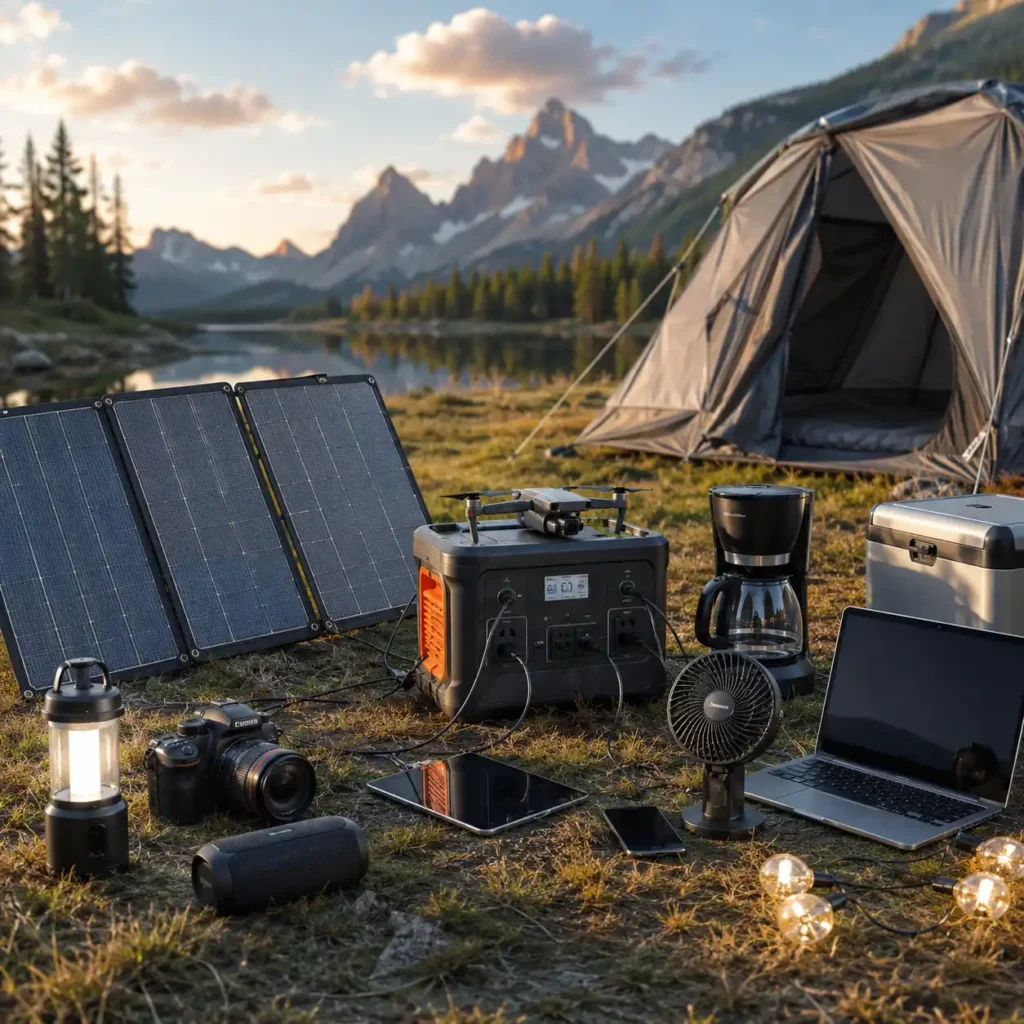
Choosing the right portable solar panel is only part of the equation. The next question most buyers ask is what they can realistically power once the panel is connected to a compatible portable power station.
In most off-grid setups, a portable solar panel does not power appliances directly. Instead, it generates electricity that recharges a portable power station, which then supplies stable AC or DC power to your devices. As a result, real-world performance depends on several factors, including panel wattage, available sunlight, battery capacity, and the power requirements of the equipment you plan to use.
Although portable solar panels are often compared by their advertised wattage, choosing the right model is really about matching solar production to your daily energy needs. A lightweight panel may be more than enough for charging phones, cameras, and other small electronics, while larger systems are better suited for powering refrigerators, remote work equipment, or emergency backup devices. Understanding how different appliances consume energy makes it much easier to build an efficient off-grid power system without paying for more solar capacity than you actually need.
Whether you’re camping, traveling in an RV, working remotely, or preparing for power outages, understanding which devices are suitable for solar charging helps you choose the right system and avoid unrealistic expectations. The examples below highlight some of the most common uses for portable solar panels, explain how different devices consume energy, and help you determine which panel size is best suited to your own off-grid adventures.
Small Everyday Devices
Portable solar panels are excellent for keeping small electronic devices charged throughout the day. Even compact 60W to 100W panels can easily generate enough energy to recharge smartphones, tablets, wireless headphones, smartwatches, cameras, GPS units, and portable battery packs under favorable sunlight conditions.
These low-power devices consume relatively little electricity, making them ideal for solar charging during camping trips, hiking adventures, or extended travel. Many users also recharge drone batteries, action cameras, and handheld gaming devices while spending time outdoors.
Many of these devices also support USB-C Power Delivery or direct USB charging, allowing them to recharge efficiently without relying on AC outlets. During sunny conditions, it’s often possible to charge smaller electronics while simultaneously replenishing the battery inside a portable power station, making better use of the available solar energy throughout the day.
Because these devices require only a small amount of energy, they are often fully recharged long before sunset, allowing the remaining solar production to be stored in your portable power station for later use.
Camping Essentials
Portable solar panels also provide enough energy to support many of the devices that make camping more comfortable. LED lanterns, USB camping lights, portable fans, electric air pumps, Bluetooth speakers, and rechargeable flashlights can all be powered efficiently using a properly sized portable power station.
For campers spending several days off-grid, solar charging significantly reduces the need to carry multiple spare batteries or search for electrical hookups. A reliable solar setup allows essential equipment to remain charged throughout the trip while providing greater energy independence in remote locations.
Instead of carefully conserving every watt-hour stored in the battery, campers can replace much of the energy they use each day with solar power. This makes extended camping trips more comfortable and sustainable while reducing dependence on campground facilities or vehicle charging.
Many campers also use solar power to operate CPAP machines overnight when paired with a sufficiently sized portable power station, making off-grid camping more practical for users with medical equipment.
Portable Refrigerators and Coolers
One of the most common reasons people invest in portable solar panels is to keep a 12V portable refrigerator running while camping or traveling. Unlike phones or lights, portable refrigerators operate continuously, making them one of the largest daily energy consumers in most outdoor setups.
Although modern compressor refrigerators are highly efficient, they still require a consistent source of electricity throughout the day and night.Compressor refrigerators are generally far more energy-efficient than thermoelectric coolers, making them the preferred choice for longer camping trips. Their actual power consumption also varies depending on outside temperature, thermostat settings, and how frequently the lid is opened. Positioning the refrigerator in the shade and allowing proper ventilation around the compressor can further reduce energy usage and improve overall efficiency.
A 200W to 400W portable solar panel paired with an appropriately sized portable power station can often generate enough energy to offset much of the refrigerator’s daily power consumption under good weather conditions.
For extended camping trips, this combination helps preserve food, drinks, and medications without relying on campground hookups or noisy fuel-powered generators.
Laptops and Remote Work Equipment
Portable solar panels have become increasingly popular among remote workers, digital nomads, photographers, and content creators who spend long periods away from traditional power sources.
With the right portable power station, solar energy can recharge laptops, camera batteries, drones, portable monitors, Wi-Fi routers, Starlink Mini systems, and other essential work equipment. Many modern laptops support USB-C Power Delivery, allowing them to recharge more efficiently than through a traditional AC adapter connected to the inverter. This reduces conversion losses, improves overall system efficiency, and leaves more stored energy available for other devices later in the day.This allows professionals to work from campsites, RVs, cabins, or remote outdoor locations while maintaining reliable access to electricity.
For users who depend on electronic equipment every day, larger 200W or 400W solar panels generally provide a better balance between charging speed and long-term energy production.
Emergency Home Devices
Portable solar panels are equally valuable during unexpected power outages. While they cannot replace a whole-home backup system, they can keep many essential household devices operating for extended periods when paired with a portable power station.
Common emergency applications include charging smartphones, powering Wi-Fi routers and internet modems, running LED lights, operating radios, keeping rechargeable medical devices powered, and maintaining communication with family and emergency services. Unlike gasoline generators, portable solar panels generate electricity silently and without fuel, making them especially useful during prolonged outages where fuel supplies may be limited or generator use is restricted. As long as sunlight is available, they provide a renewable way to recharge your portable power station day after day.
For households preparing for storms, hurricanes, or grid failures, portable solar panels provide a renewable method of replenishing battery power without requiring gasoline or diesel fuel.
What Portable Solar Panels Can't Power
Although portable solar panels are remarkably versatile, it’s important to understand their limitations. High-power household appliances typically consume electricity much faster than a portable solar panel can generate it.
Devices such as electric heaters, air conditioners, microwave ovens, induction cooktops, electric kettles, washing machines, and clothes dryers generally require significantly larger battery systems and much higher solar input than portable panels are designed to provide.
Setting realistic expectations helps you build a solar system that matches your actual energy needs. For most campers, RV owners, and emergency preparedness users, portable solar panels perform best when used to support essential electronics, lighting, refrigeration, communication equipment, and other moderate-power devices rather than large household appliances.
Rather than trying to replace an entire household electrical system, portable solar panels are designed to provide dependable renewable energy for essential electronics, refrigeration, communication devices, and other moderate-power equipment. Choosing a solar setup that matches your actual energy requirements will deliver a more reliable, efficient, and enjoyable off-grid experience while helping you avoid unnecessary cost, weight, and complexity.
Frequently Asked Questions
Are portable solar panels worth buying?
Yes, portable solar panels are a worthwhile investment if you regularly camp, travel in an RV, work remotely, or want a renewable backup power source during outages. They allow you to recharge a portable power station using sunlight, reducing dependence on electrical hookups or fuel-powered generators. While they won’t replace a residential solar system, they provide an efficient and environmentally friendly way to generate electricity almost anywhere.
Can a portable solar panel charge a portable power station directly?
Yes. Most portable solar panels are specifically designed to recharge compatible portable power stations. The panel converts sunlight into DC electricity, which is then regulated by the power station’s built-in solar charge controller before being stored in the battery. Always verify that the panel’s voltage, connector type, and maximum output are compatible with your power station.
What size portable solar panel do I need?
The ideal size depends on your daily energy consumption. A 60W to 100W panel is usually sufficient for charging phones, tablets, cameras, and other small electronics. A 200W panel is a popular all-around choice for camping and RV travel, while 300W to 400W panels are better suited for quickly recharging larger portable power stations or supporting higher daily energy use.
How long does it take to charge a portable power station with a solar panel?
Charging time depends on the panel’s wattage, available sunlight, weather conditions, and the battery capacity of the portable power station. Under ideal conditions, a 200W solar panel can recharge many mid-sized power stations within several hours, while larger batteries may require a full day of strong sunlight or multiple days with smaller panels.
Do portable solar panels work on cloudy days?
Yes, but their performance is significantly reduced. Portable solar panels continue generating electricity under cloudy skies, although power output may drop well below their rated capacity depending on cloud cover. For the best performance, position the panel in direct sunlight whenever possible and adjust its angle throughout the day.
Can portable solar panels charge devices without a portable power station?
Some portable solar panels include built-in USB-A or USB-C ports that allow smartphones, tablets, and other small electronics to be charged directly. However, most foldable panels are designed primarily to recharge a portable power station, which then supplies stable power to your devices regardless of changing sunlight conditions.
Are portable solar panels waterproof?
Many portable solar panels are designed with weather-resistant materials and carry IP65, IP67, or similar protection ratings, making them suitable for light rain or damp outdoor conditions. However, the junction box, connectors, and any connected portable power station should always be protected from standing water or prolonged exposure to heavy rain. Always follow the manufacturer’s recommended operating conditions.
Can I connect multiple portable solar panels together?
Yes, many portable power stations support connecting multiple compatible solar panels in either series or parallel, depending on the manufacturer’s specifications. Expanding your solar array increases charging speed, but you should always stay within the maximum voltage and current limits supported by your power station.
What is the difference between monocrystalline and polycrystalline portable solar panels?
Monocrystalline solar panels are generally more efficient, perform better in limited sunlight, and require less space to generate the same amount of electricity. Polycrystalline panels are typically less expensive but are becoming less common in portable applications. Today, most premium portable solar panels use high-efficiency monocrystalline cells.
Can portable solar panels power a refrigerator?
Not directly in most camping setups. Instead, the solar panel recharges a portable power station, which then supplies electricity to the refrigerator. A properly sized solar panel and battery combination can often generate enough energy to help keep a 12V portable compressor refrigerator running during multi-day camping trips under favorable weather conditions.
How can I maximize the output of a portable solar panel?
For the highest energy production, place the panel in direct sunlight, avoid even partial shading, keep the surface clean, and adjust its angle to face the sun as it moves across the sky. Repositioning the panel several times during the day can noticeably improve total daily energy production, especially during extended off-grid trips.
How long do portable solar panels last?
High-quality portable solar panels are built to provide reliable performance for many years. While actual lifespan varies by manufacturer, build quality, and usage conditions, premium monocrystalline panels typically maintain useful power output for well over a decade when properly stored, transported, and protected from unnecessary physical damage.
Final Verdict
Choosing the best portable solar panel isn’t about buying the highest advertised wattage or the most expensive model—it’s about selecting a panel that matches your power needs, travel style, and the portable power station you plan to use. The right choice should provide dependable charging performance, practical portability, durable construction, and long-term value for the way you actually camp, travel, or prepare for emergencies.
Rather than selecting a single product for every type of user, we identified the strongest portable solar panels for different priorities. Each recommendation in this guide excels in a specific category, making it easier to choose the model that best fits your own outdoor adventures.
If you want the best overall combination of charging performance, efficiency, portability, and long-term versatility, the EcoFlow 220W Bifacial Portable Solar Panel remains our top recommendation. Buyers looking for premium build quality and seamless integration with Jackery power stations will appreciate the Jackery SolarSaga 200W, while the BLUETTI PV200 stands out as the strongest value choice by combining dependable performance with an affordable price. The Renogy 200W Portable Solar Panel is the most versatile option thanks to its broad compatibility and flexible outdoor use, and the Goal Zero Nomad 200 Solar Panel is our preferred choice for campers and overlanders who prioritize rugged construction and dependable performance in demanding environments.
Your ideal solar panel also depends on how much energy you use each day. Weekend campers who primarily charge phones, cameras, lighting, and smaller portable power stations may find that a lightweight 100W panel provides all the power they need. Users running portable refrigerators, remote work equipment, or larger portable power stations will typically benefit from higher-output 200W to 400W portable solar panels that can replenish battery capacity more efficiently during extended off-grid trips.
One of the biggest mistakes buyers make isn’t choosing the wrong brand—it’s choosing the wrong panel size. Purchasing more solar capacity than you actually need adds unnecessary cost, weight, and storage requirements, while choosing too little capacity can lead to slower charging and reduced flexibility during longer adventures. Matching your solar panel to your real-world energy consumption will almost always produce better results than simply buying the largest panel available.
Modern portable solar technology has improved dramatically in recent years. High-efficiency monocrystalline solar cells, durable ETFE coatings, improved folding designs, adjustable kickstands, and better weather resistance have made today’s portable solar panels more reliable, efficient, and easier to use than ever before. Combined with modern LiFePO₄ portable power stations, they provide a quiet, renewable, and fuel-free power solution for camping, RV travel, emergency preparedness, and off-grid living.
Whether you’re keeping a portable refrigerator running, powering a remote workspace, charging photography equipment, extending an RV adventure, or preparing for unexpected power outages, a quality portable solar panel provides greater energy independence wherever sunlight is available. Instead of relying on electrical hookups or carrying extra fuel, you can generate clean renewable energy almost anywhere your adventures take you.
Ultimately, the best portable solar panel is the one that fits your equipment, your travel style, and your daily energy requirements—not simply the one with the highest wattage or the longest specification sheet. By choosing a model that matches the way you actually use power outdoors, you’ll enjoy a more reliable, efficient, and sustainable off-grid power system for years to come.
We hope this guide has helped you compare today’s leading portable solar panels with confidence and made choosing the right model a little easier. Wherever your next adventure takes you, dependable solar power means greater freedom, cleaner energy, and the confidence to stay powered almost anywhere.
Related Guides
Building an efficient portable solar power system involves more than simply choosing the right portable solar panel. Matching your solar panel with a compatible portable power station, the right accessories, and energy-efficient equipment will help you generate more usable power, reduce charging times, and stay off-grid for longer.
The guides below provide in-depth advice on selecting compatible equipment, estimating real-world energy requirements, and building a reliable solar power setup for camping, RV travel, emergency preparedness, and remote work.
Best Portable Power Stations – Compare the top portable power stations for camping, RV travel, emergency backup, and everyday off-grid use.
Best Solar Generators – Explore complete solar generator systems that combine portable power stations with compatible portable solar panels.
Portable Power Station Accessories – Discover the most useful accessories, including charging cables, adapter cables, carrying cases, extension cables, and other upgrades that improve flexibility and compatibility.
How to Choose the Right Portable Power Station – Learn how battery capacity, inverter output, charging speed, and battery chemistry affect real-world performance.
What Size Portable Solar Panel Do I Need? – Learn how to match solar panel wattage with your portable power station, daily energy consumption, and charging goals.
Portable Power Station Runtime Calculator – Estimate how long different battery capacities can power refrigerators, CPAP machines, laptops, Starlink, lights, and other essential devices.
Portable Solar Panel Charging Time Calculator – Estimate how long different solar panel sizes take to recharge portable power stations under different weather conditions and sunlight levels.
Portable Solar Panel Care and Maintenance – Understand solar panel efficiency, monocrystalline technology, weather resistance, connector compatibility, and the key factors that influence real-world charging performance.