
Choosing between MPPT vs PWM solar charge controllers affects how effectively a solar system uses the power produced by its panels. Although both technologies regulate the electricity flowing from the solar array to the battery, they handle panel voltage differently. This can influence charging performance, system compatibility, and the amount of usable solar energy.
The choice is not simply between a cheaper and a more expensive controller. PWM can be a practical option when panel and battery voltages are appropriately matched, while MPPT can offer an advantage when the system benefits from voltage conversion. However, advertised efficiency figures alone do not establish which technology is right for a particular setup.
This guide compares MPPT and PWM operating principles, energy harvest, system compatibility, performance conditions, and cost to help you determine which controller best fits your solar system.
As an Amazon Associate, I earn from qualifying purchases.

Table of Contents
Quick Answer
MPPT Solar Charge Controller — Best For: systems with higher-voltage solar panels, larger arrays, or a need to maximize usable panel output. MPPT is often the stronger choice when panel operating voltage is significantly higher than battery charging voltage because it can convert excess voltage into additional charging current. Its main limitation is the higher purchase cost, along with the need to stay within the controller’s specified PV input limits.
PWM Solar Charge Controller — Best For: smaller, budget-conscious systems with appropriately matched panel and battery voltages. PWM controllers are generally simpler and less expensive, making them a practical option when the system does not need voltage conversion. Their main limitation is that they cannot convert excess panel voltage into additional charging current, potentially leaving some available panel power unused.
The better choice depends on your panel specifications, battery requirements, and overall system design. MPPT offers greater flexibility and can improve energy harvest under suitable conditions, while PWM can provide a more economical solution for a properly matched system. Neither technology is automatically the right choice for every solar installation.
Our Evidence & Evaluation Method
We evaluate MPPT and PWM solar charge controllers using official manufacturer specifications, technical documentation, electrical performance principles, and the specific U.S. product configurations selected for this guide. Our goal is to provide a transparent, evidence-based comparison without presenting manufacturer claims or theoretical estimates as independently verified test results.
Our primary sources include official manufacturer product pages, datasheets, user manuals, and technical documentation. We also check the corresponding Amazon.com listings to confirm product names, model numbers, and configurations. Independent testing and reliable technical measurements are considered additional evidence where available. Manufacturer specifications are clearly distinguished from independently measured results.
How We Handle Performance Estimates
Solar charging performance depends on the complete system configuration, not just the controller’s advertised efficiency. Panel voltage, battery charging voltage, cell temperature, sunlight conditions, wiring losses, and controller operating limits all influence the power available for charging.
Where numerical examples are used, we identify the panel specifications and operating assumptions behind each calculation. Estimated power and charging current are not presented as guaranteed real-world results. Actual performance varies with environmental conditions, equipment configuration, conversion losses, and battery charging requirements.
We also distinguish between MPPT tracking efficiency and DC-to-DC conversion efficiency. These are different performance measurements and should not be treated as interchangeable.
The five controllers are assessed using documented specifications and technical analysis rather than claims of proprietary hands-on testing. We explain the evidence behind our comparisons and identify relevant limitations so readers can distinguish verified product capabilities from illustrative calculations and practical assessments.
Who This Guide Is For

Who Should Read This
This guide is for RV owners, off-grid system builders, and DIY solar users who need to choose between MPPT and PWM charge controllers. It is particularly useful if you are matching solar panels to a battery bank, upgrading an existing system, or deciding whether MPPT technology justifies its higher cost.
Who Should Use Another Guide
Buyers looking for specific product recommendations: See our guide to Best Solar Charge Controllers.
RV owners choosing a complete solar kit: See our guide to Best RV Solar Panel Kits.
Readers who need system-specific calculations: Use our Solar Panel Size Calculator or Solar Charging Time Calculator.
MPPT vs PWM: Key Differences at a Glance
MPPT and PWM solar charge controllers regulate the power flowing from solar panels to a battery, but they use different methods to manage panel voltage. This affects how efficiently available solar power can be used, which panel configurations each technology supports, and the overall cost of a system.
| Comparison Factor | PWM Solar Charge Controller | MPPT Solar Charge Controller |
|---|---|---|
| Operating Principle | Regulates the connection between the solar panel and battery using pulse-width modulation | Tracks the panel's maximum power point and uses DC-to-DC conversion to adjust voltage and current |
| Panel Voltage | Operates the panel closer to battery voltage | Allows the panel to operate at a higher voltage within the controller's specified limits |
| Energy Harvest | May leave some available panel power unused when panel operating voltage is higher than battery charging voltage | Can convert excess panel voltage into additional charging current, making better use of available panel power |
| Panel Configuration | Best suited to panels with operating voltage appropriately matched to the battery | Supports higher-voltage panel configurations within its maximum PV input limits |
| Performance Conditions | The difference between panel and battery voltage has a direct effect on how much panel power can be used | Potential energy-harvesting advantage depends on panel voltage, temperature, sunlight, and system configuration |
| System Design | Generally simpler and less expensive | Offers greater flexibility but requires careful checks of PV voltage, current, and power limits |
| Typical Cost | Lower purchase cost | Higher purchase cost |
The Main Difference
A PWM controller regulates the connection between the solar panel and battery, while an MPPT controller tracks the panel’s maximum power point and converts the available power to the voltage and current required for battery charging.
When panel operating voltage is significantly higher than battery charging voltage, MPPT technology can use more of the available panel power. When the panel and battery voltages are already closely matched, the difference in energy harvest may be smaller.
Quick Summary: Our Top Solar Charge Controller Picks
The five solar charge controllers below illustrate different reasons to choose MPPT or PWM technology. Rather than treating one type as universally better, we highlight the capabilities and limitations that matter for different solar system configurations.
Victron Energy SmartSolar MPPT 100/30
Award: Best for Customizable Charging Profiles and Bluetooth Monitoring
Best For: Solar system owners who want configurable battery charging and convenient wireless monitoring.
Key Reason: This 30A MPPT controller supports customizable charging settings and Bluetooth monitoring through VictronConnect, allowing users to monitor system performance and adjust supported parameters.
Main Limitation: Its 100V maximum PV open-circuit voltage limits higher-voltage array configurations.
EPEVER Tracer4215BN 40A
Award: Best for Higher-Voltage Solar Array Configurations
Best For: Off-grid system builders using higher-voltage solar arrays and requiring a 40A charge controller.
Key Reason: Its 150V maximum PV open-circuit voltage under specified low-temperature conditions provides more flexibility for series-connected panel configurations than controllers with lower voltage limits.
Main Limitation: Its larger physical footprint and more involved system configuration require additional installation planning, including cold-weather PV voltage calculations.
Renogy Rover 40A MPPT with Bluetooth
Award: Best for 40A MPPT Charging with Included Bluetooth Monitoring
Best For: Buyers who want a 40A MPPT controller with an LCD and Bluetooth monitoring included in the selected configuration.
Key Reason: It combines 40A charging capacity, automatic 12V/24V battery-system recognition, an LCD, and an included Bluetooth module.
Main Limitation: Its 100V maximum PV input voltage limits higher-voltage solar array configurations.
Renogy Wanderer Li 30A PWM
Award: Best for Budget-Conscious 12V PWM Systems
Best For: Smaller 12V solar installations where a lower-cost PWM controller is sufficient for the panel and battery configuration.
Key Reason: This 30A PWM controller provides a straightforward charging option for appropriately matched 12V solar systems without the additional cost of MPPT conversion.
Main Limitation: PWM technology, 12V-only operation, and a 25V maximum PV input voltage limit system flexibility.
Morningstar ProStar PS-30
Award: Best for Long-Term 12V/24V PWM System Reliability
Best For: Buyers prioritizing a durable PWM controller for 12V or 24V solar installations with straightforward monitoring requirements.
Key Reason: Its 30A rating, 12V/24V compatibility, and published five-year warranty make it an option for buyers who value established controller functionality and warranty coverage.
Main Limitation: It has no built-in display, and custom programming is required for battery chemistries other than lead-acid.
Solar Charge Controller Comparison Table
| Comparison Factor | MPPT | PWM |
|---|---|---|
| Operating Principle | Maximum power point tracking with DC-to-DC conversion | Pulse-width modulation |
| Energy Harvest | Can use more available panel power when voltage conversion is beneficial | May leave some panel power unused when voltages are mismatched |
| Panel Configuration | More flexible with higher-voltage arrays | Requires closer voltage matching |
| System Compatibility | Depends on controller input and battery limits | Depends on controller and panel/battery voltage matching |
| Purchase Cost | Generally higher | Generally lower |
| Best Application | Larger or higher-voltage solar arrays | Smaller, properly matched systems |
| Model | Technology | Electrical Specifications | Monitoring |
|---|---|---|---|
| Victron SmartSolar MPPT 100/30 | MPPT | 30A · 12V/24V · 100V max PV Voc · 440W / 880W | Bluetooth, VE.Direct |
| EPEVER Tracer4215BN 40A | MPPT | 40A · 12V/24V · 150V max PV Voc* · 520W / 1,040W | RS485 |
| Renogy Rover 40A MPPT with Bluetooth | MPPT | 40A · 12V/24V · 100V max PV Voc · 520W / 1,040W | LCD, Bluetooth module included |
| Renogy Wanderer Li 30A | PWM | 30A · 12V · 25V max PV input | LED indicators; optional Bluetooth |
| Morningstar ProStar PS-30 | PWM | 30A · 12V/24V · 30V / 60V max PV Voc | LED indicators; no built-in display |
* EPEVER: 150V at the specified minimum temperature; 138V at 25°C. PV power figures are shown for 12V and 24V systems, respectively, where specified by the manufacturer.
How We Evaluated Solar Charge Controllers
We compare the five selected solar charge controllers using eight criteria. Each criterion addresses a specific aspect of the controller’s documented capabilities, system compatibility, installation requirements, or practical value.
1. Charging Capability
We examine the controller’s rated battery charging current and supported battery voltage. A higher current rating can accommodate a larger charging setup, but it does not establish compatibility on its own.
2. Solar Input Utilization
We assess how each controller uses the available power from the solar array. For MPPT models, this includes maximum power point tracking and DC-to-DC conversion. For PWM models, we consider the need to match panel operating voltage to battery charging voltage. We do not assume a fixed energy-harvesting advantage under all conditions.
3. Panel and Battery Compatibility
We check maximum PV open-circuit voltage, supported battery voltages, permitted solar input current and power, and documented battery chemistry support. These limits determine which panel and battery configurations a controller can safely accommodate.
4. Charging Regulation and Battery Settings
We examine available charging stages, preset battery profiles, configurable voltage settings, and options for adjusting charging parameters. These features are particularly relevant when a system uses a specific battery chemistry or requires settings beyond standard presets.
5. Installation Requirements and Physical Design
We consider physical dimensions, cooling requirements, wiring connections, mounting provisions, and installation complexity. These factors affect how easily a controller can be integrated into an RV, cabin, or stationary off-grid system.
6. System Configuration and Expansion
We assess supported system voltages and the flexibility to configure solar panels in series or parallel. We also consider whether the controller can accommodate a larger array or future system changes without exceeding its documented electrical limits.
7. Monitoring, Warranty, and Manufacturer Support
We examine built-in displays, Bluetooth connectivity, communication interfaces, optional accessories, published warranty terms, and available manufacturer documentation. Included equipment is distinguished from optional accessories.
8. Practical Value and Application Suitability
We consider whether a controller’s documented capabilities justify its cost for the intended application. An MPPT model may offer a practical advantage in systems with a larger panel-to-battery voltage difference, while a properly matched PWM controller may be more economical for a smaller, simpler installation.
We also consider the intended application of each model, including RV solar installations, small off-grid systems, and larger battery-based configurations.
How We Interpret the Results
No single specification determines the best controller for every installation. We consider how the eight evaluation criteria apply to each model and the system requirements it is designed to meet.
Our assessments are based on documented specifications and technical analysis. Calculated estimates are not treated as independent laboratory measurements, and we do not claim hands-on testing that was not performed.
Solar Charge Controllers: Detailed Reviews
Victron Energy SmartSolar MPPT 100/30
Best for Customizable Charging Profiles and Bluetooth Monitoring

Quick Verdict
The Victron Energy SmartSolar MPPT 100/30 is a 30A MPPT solar charge controller designed for 12V and 24V battery systems. It combines maximum power point tracking with configurable battery charging settings, built-in Bluetooth, and VE.Direct connectivity, giving users control over charging parameters and access to system monitoring through VictronConnect.
This model is particularly suitable for RV owners and off-grid system builders who want more than basic solar charging regulation. Its strongest appeal is the combination of customizable charging profiles and convenient wireless monitoring, making it a practical choice for users who value control over battery charging and visibility into system performance.
Snapshot
| Specification | Victron SmartSolar MPPT 100/30 |
|---|---|
| Controller Technology | MPPT |
| Rated Charging Current | 30A |
| Battery Voltage | 12V / 24V |
| Maximum PV Open-Circuit Voltage | 100V |
| Maximum PV Power | 440W (12V) / 880W (24V) |
| Peak Conversion Efficiency | 98% |
| Monitoring | Built-in Bluetooth, VE.Direct |
| Dimensions / Weight | 130 × 186 × 70 mm (H × W × D) / 1.3 kg |
Why We Chose It
The Victron Energy SmartSolar MPPT 100/30 earns Best for Customizable Charging Profiles and Bluetooth Monitoring because it combines configurable battery charging with built-in Bluetooth connectivity and the VictronConnect app. Users can monitor system performance and adjust supported charging parameters without purchasing a separate Bluetooth module.
Compared with the EPEVER Tracer4215BN, which offers higher maximum PV input voltage, and the Renogy Rover 40A, which also includes Bluetooth monitoring, the Victron stands out for its configurable charging configuration options and integration with the VictronConnect ecosystem. This makes it a strong choice for users who prioritize charging control and convenient wireless monitoring over higher PV input capacity or a higher charging-current rating.
Check the latest price and customer reviews on Amazon.

Practical Considerations
Measuring approximately 130 × 186 × 70 mm and weighing 1.3 kg, the Victron SmartSolar MPPT 100/30 is compact enough to fit into an RV electrical compartment, utility cabinet, or off-grid battery installation. It is designed for fixed mounting rather than portable use. Victron specifies vertical installation on a non-flammable surface, with the electrical terminals facing downward and at least 10 cm of clearance above and below the unit for cooling.
In everyday use, it can remain installed near the battery and regulate solar charging without requiring users to handle the controller between charging sessions. However, placement matters: it should not be mounted directly above the battery, and the temperature difference between the controller and battery should generally remain within 5°C for accurate temperature-compensated charging. This makes proper installation and ventilation more important than portability, particularly in a confined RV compartment.
Evaluation
| Evaluation Factor | This Model | How It Compares | Buyer Implication |
|---|---|---|---|
| Charging Profile Customization | Configurable charging parameters and multiple battery presets | Offers extensive configuration options through VictronConnect | Useful for users who want greater control over battery charging settings |
| PV Voltage Flexibility | 100V maximum PV open-circuit voltage | Lower than the EPEVER Tracer4215BN's 150V limit | Suitable for compatible arrays, but less flexible for higher-voltage panel configurations |
| Monitoring and Connectivity | Built-in Bluetooth and VE.Direct | Bluetooth is included, unlike the optional Bluetooth accessory for the Renogy Wanderer Li 30A | Provides wireless monitoring without purchasing a separate Bluetooth module |
| Charging Current | 30A rated output | Lower than the 40A ratings of the EPEVER and Renogy Rover | Better suited to systems within its 30A charging capacity than installations requiring a higher rated current |
Who Should Buy This
The Victron Energy SmartSolar MPPT 100/30 is a good fit for buyers who:
- Need a 30A MPPT controller for a 12V or 24V battery system with compatible solar panel specifications.
- Want customizable battery charging profiles rather than relying only on fixed presets.
- Prefer built-in Bluetooth monitoring through VictronConnect without purchasing a separate Bluetooth module.
- Are building an RV or off-grid solar system where charging control and system monitoring matter more than a higher 40A charging rating.
Who Should Skip This
The Victron Energy SmartSolar MPPT 100/30 may not be the right choice if you:
- Need a controller with a PV input voltage limit above 100V. The EPEVER Tracer4215BN 40A supports higher-voltage solar array configurations.
Require more than 30A of charging current for your battery system. Consider the EPEVER Tracer4215BN or Renogy Rover 40A instead.
Want a lower-cost, straightforward PWM controller for a voltage-matched 12V solar setup. The Renogy Wanderer Li 30A may be a more economical option.
Final Verdict
The Victron Energy SmartSolar MPPT 100/30 is the right choice for buyers who prioritize customizable battery charging and integrated Bluetooth monitoring in a well-supported 12V or 24V solar system. Its 30A charging capacity and 100V PV voltage limit, however, make it less suitable for larger arrays or installations requiring higher charging current. Choose it when charging control and monitoring are more important than maximum PV input flexibility or a higher current rating.
Check the latest price and customer reviews on Amazon.
Related Guide: If you are comparing MPPT and PWM controllers and want to explore specific models for your solar setup, see our Best Solar Charge Controllers (2026) guide for a closer look at available options and their capabilities.
EPEVER Tracer4215BN 40A
Best for Higher-Voltage Solar Array Configurations.

Quick Verdict
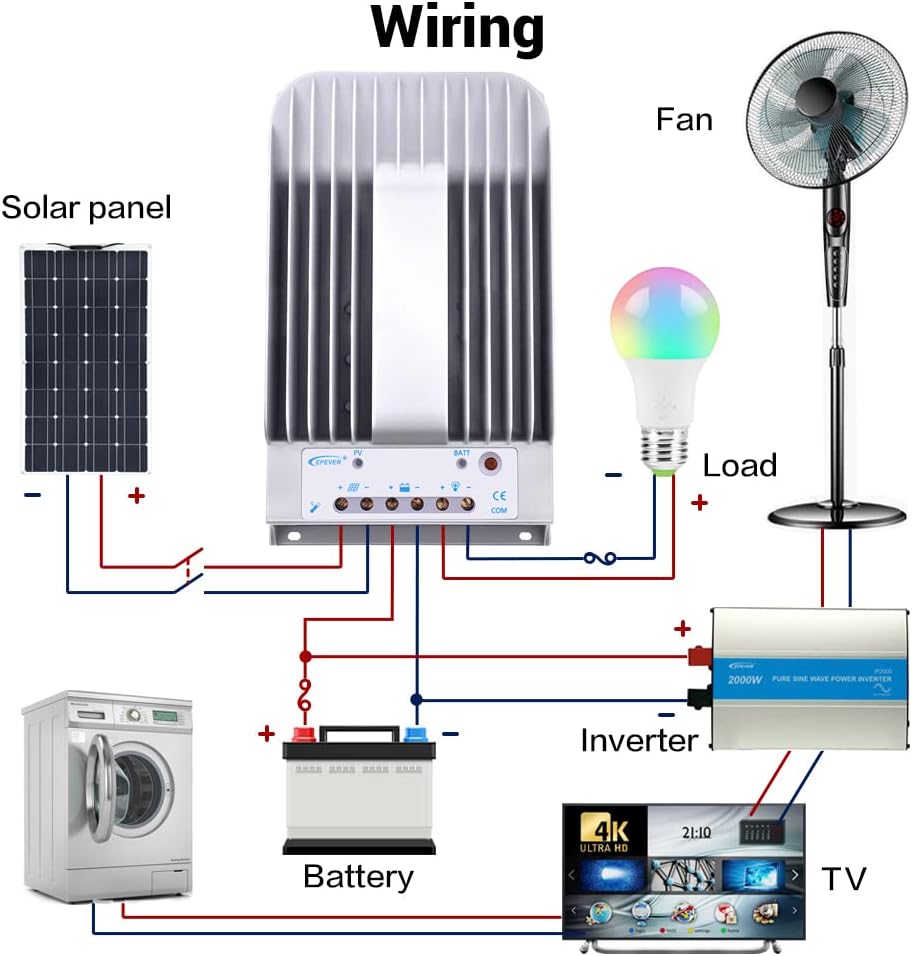
The EPEVER Tracer4215BN is a 40A MPPT solar charge controller designed for 12V and 24V battery systems, with automatic system-voltage identification. Its defining feature is support for higher-voltage solar arrays: the controller has a maximum PV open-circuit voltage rating of 150V under specified minimum-temperature conditions (138V at 25°C). It also supports solar input power up to 520W for 12V systems and 1,040W for 24V systems, making it suitable for larger off-grid installations that use series-connected panels.
This model is particularly useful for off-grid system builders who need more flexibility in solar array configuration than a lower-voltage controller can provide. Its 40A charging capacity and RS485 communication interface add to its appeal for more substantial installations. However, the higher PV voltage rating does not remove the need to calculate the array’s cold-weather open-circuit voltage and stay within the controller’s limits.
Snapshot
| Specification | EPEVER Tracer4215BN 40A |
|---|---|
| Controller Technology | MPPT |
| Rated Charging Current | 40A |
| Battery Voltage | 12V / 24V |
| Maximum PV Open-Circuit Voltage | 150V (138V at 25°C) |
| Maximum PV Power | 520W (12V) / 1,040W (24V) |
| Monitoring / Connectivity | RS485 communication |
Why We Chose It
The EPEVER Tracer4215BN 40A earns Best for Higher-Voltage Solar Array Configurations because its higher PV voltage allowance gives system builders more flexibility when connecting solar panels in series. Compared with the Victron SmartSolar 100/30 and Renogy Rover 40A, both limited to 100V maximum PV open-circuit voltage, the EPEVER supports a higher-voltage array configuration, making it particularly relevant for installations where panel string design is an important consideration.
The 40A charging capacity also places it alongside the Renogy Rover 40A in this comparison, while offering a different advantage: greater PV voltage flexibility. Unlike the PWM-based Renogy Wanderer Li and Morningstar ProStar PS-30, it uses MPPT technology to track the panels’ maximum power point and convert available solar power for battery charging. This combination makes it the strongest fit among these five models for buyers prioritizing higher-voltage array configurations.
Check the latest price and customer reviews on Amazon.
Practical Considerations
Measuring 302.5 × 182.7 × 63.5 mm and weighing approximately 2.9 kg, the EPEVER Tracer4215BN is designed for fixed installation rather than portable use. It is better suited to a dedicated RV electrical compartment, utility area, or off-grid power enclosure with enough room for wiring and airflow. EPEVER specifies at least 150 mm of clearance above and below the controller for ventilation, so it should not be squeezed into a tightly packed space.
In a typical off-grid installation, the controller can be mounted near the battery bank and connected to a series-configured solar array, helping keep longer PV cable runs at a higher voltage. Once installed, it operates as a permanent part of the charging system rather than equipment that needs to be moved between uses. The main practical limitation is its installation requirement: the IP30 enclosure is intended for protected indoor mounting, and the controller needs adequate ventilation. It should not be installed in a sealed enclosure with flooded batteries or in a confined area where battery gases can accumulate.
Evaluation
| Evaluation Factor | This Model | How It Compares | Buyer Implication |
|---|---|---|---|
| PV Array Configuration | Supports up to 150V PV open-circuit voltage under specified temperature conditions | Higher than the 100V limits of the Victron and Renogy Rover | Allows more flexibility when designing series-connected solar arrays |
| Charging Capacity | 40A rated charging current | Matches the Renogy Rover and exceeds the 30A ratings of the other three models | Suitable for systems requiring a higher charging-current rating |
| MPPT Tracking | Tracking efficiency rated at ≥99.5% by the manufacturer | Uses MPPT technology, unlike the two PWM controllers in this comparison | Helps keep the array operating near its maximum power point under suitable conditions |
| Communication | RS485 interface | Different from the built-in Bluetooth monitoring of the Victron and Renogy Rover | Better suited to installations using compatible wired monitoring equipment than buyers who prefer app-based Bluetooth access |
Who Should Buy This
The EPEVER Tracer4215BN 40A is a good fit for buyers who:
- Need an MPPT controller for a 12V or 24V off-grid solar system with a higher-voltage panel array.
Plan to connect solar panels in series and need more PV voltage flexibility than a 100V controller provides.
Require a 40A charging capacity for their battery system.
Are comfortable with fixed indoor installation and RS485-based monitoring rather than relying on built-in Bluetooth connectivity.
Who Should Skip This
The EPEVER Tracer4215BN 40A may not be the right choice if you:
- Need a compact controller for a space-constrained RV installation. The Victron SmartSolar 100/30 has a smaller physical footprint.
Prefer built-in Bluetooth monitoring and app-based configuration without additional communication equipment. Consider the Victron SmartSolar or Renogy Rover 40A.
Want a simple, lower-cost PWM controller for a voltage-matched 12V solar system. The Renogy Wanderer Li 30A may be a more economical fit.
Final Verdict
The EPEVER Tracer4215BN 40A is the strongest fit for buyers designing off-grid solar systems around higher-voltage, series-connected panel arrays. Its main advantage is greater PV input voltage flexibility than the other MPPT models in this comparison, combined with a 40A charging capacity. The trade-off is a larger installation footprint and the need for protected indoor mounting with compatible RS485 monitoring equipment. Choose it if your priority is flexible solar array configuration rather than compact size or built-in Bluetooth convenience.
Check the latest price and customer reviews on Amazon.
Related Guide: If you are planning a higher-voltage off-grid solar array with series-connected panels, see our Best Rigid Solar Panels (2026) guide to compare panel options for your system.
Renogy Rover 40A MPPT with Bluetooth
Best for 40A MPPT Charging with Included Bluetooth Monitoring.

Quick Verdict
The Renogy Rover 40A MPPT with Bluetooth is a solar charge controller designed for 12V and 24V battery systems. It combines MPPT charging technology with an LCD display and an included Bluetooth module, allowing users to monitor system performance and access charging information through a compatible mobile device.
This model is particularly suitable for RV owners and off-grid solar users who want a 40A MPPT controller with wireless monitoring included in the selected configuration. Its main appeal is the combination of charging capacity, straightforward system monitoring, and convenient access to operating information without purchasing a separate Bluetooth module.
Snapshot
| Specification | Renogy Rover 40A MPPT with Bluetooth |
|---|---|
| Controller Technology | MPPT |
| Rated Charging Current | 40A |
| Battery Voltage | 12V / 24V |
| Maximum PV Open-Circuit Voltage | 100V |
| Maximum PV Power | 520W (12V) / 1,040W (24V) |
| Monitoring | LCD, included Bluetooth module |
Why We Chose It
The Renogy Rover 40A MPPT with Bluetooth earns Best for 40A MPPT Charging with Included Bluetooth Monitoring because it combines 40A charging capacity with an LCD display and an included Bluetooth module. Users can monitor system performance wirelessly without purchasing a separate monitoring accessory.
Compared with the Victron SmartSolar 100/30, it offers a higher charging-current rating, while the EPEVER Tracer4215BN supports higher-voltage solar arrays. The Rover stands out as a practical middle ground for buyers who want 40A MPPT charging and convenient wireless monitoring without prioritizing advanced charging customization or higher PV voltage capacity.

Practical Considerations
Measuring approximately 238 × 172 × 77 mm and weighing 2 kg, the Renogy Rover 40A is designed for fixed installation in an RV electrical compartment or off-grid power enclosure. It needs adequate space for wiring and ventilation, so it may be less convenient in compact installations.
Once installed, it operates as part of the permanent solar charging system without requiring handling between uses. Its IP32 enclosure means it should be protected from direct exposure to rain and water.
Evaluation
| Evaluation Factor | This Model | How It Compares | Buyer Implication |
|---|---|---|---|
| Wireless Monitoring | Bluetooth module included | Like the Victron, unlike the EPEVER's RS485 communication | Provides app-based monitoring without purchasing a separate Bluetooth module |
| Charging Control | LCD and user-programmable charging parameters in USER mode | Offers more monitoring and adjustment options than the basic PWM models | Useful for users who want visibility into charging operation and control over supported settings |
| PV Array Flexibility | 100V maximum PV open-circuit voltage | Matches the Victron but is below the EPEVER's higher voltage limit | Suitable for compatible arrays, but less flexible for higher-voltage panel configurations |
| Charging Capacity | 40A rated charging current | Matches the EPEVER and exceeds the 30A ratings of the other three controllers | Suitable for systems requiring a 40A charging capacity |
Who Should Buy This
The Renogy Rover 40A MPPT with Bluetooth is a good fit for buyers who:
- Need a 40A MPPT controller for a 12V or 24V solar system.
Want Bluetooth monitoring included without purchasing a separate communication module.
Prefer an LCD display and app-based access to solar charging information.
Have a compatible solar array within the controller’s input limits and want a fixed installation for an RV or off-grid system.
Who Should Skip This
The Renogy Rover 40A MPPT with Bluetooth may not be the right choice if you:
- Need a controller with a PV input voltage limit above 100V for higher-voltage solar array configurations. Consider the EPEVER Tracer4215BN.
Require more than 40A of charging current for your battery system. This model is limited to its 40A rating.
Prefer a lower-cost PWM controller for a smaller, voltage-matched 12V solar setup. The Renogy Wanderer Li 30A may be a more economical option.
Final Verdict
The Renogy Rover 40A MPPT with Bluetooth is a strong choice for RV owners and off-grid users who want 40A MPPT charging with convenient wireless monitoring included in the package. Its main advantage is the combination of charging capacity, an LCD, and Bluetooth connectivity, while its 100V PV input limit restricts higher-voltage array configurations. Choose it if convenient monitoring and 40A charging meet your system requirements; consider the EPEVER Tracer4215BN if your priority is greater solar array voltage flexibility.
Check the latest price and customer reviews on Amazon.
Related Guide: If you are considering the Renogy Rover 40A and want to understand how it fits into the manufacturer’s wider solar equipment lineup, see our Renogy: Brand, Product Ecosystem & Buying Guide (2026) for an overview of its products and ecosystem.
Renogy Wanderer Li 30A PWM
Best for Budget-Conscious 12V PWM Systems

Quick Verdict
The Renogy Wanderer Li 30A is a PWM solar charge controller designed for 12V battery systems. It provides straightforward solar charging regulation in a compact, budget-oriented design, making it a practical option for smaller installations where the panel and battery voltages are appropriately matched.
This model is particularly suitable for RV owners and DIY solar users who want a basic, affordable controller for a 12V setup without paying extra for MPPT technology. Its main appeal is simplicity and lower cost, while its 12V-only operation and limited PV input flexibility make it less suitable for larger or more complex solar systems.
Snapshot
| Specification | Renogy Wanderer Li 30A |
|---|---|
| Controller Technology | PWM |
| Rated Charging Current | 30A |
| Battery Voltage | 12V |
| Maximum PV Input Voltage | 25V |
| Battery Compatibility | Sealed/AGM, Gel, Flooded, and Li (LFP) presets; default Li settings are for 12.8V LFP batteries. Li-mode charging parameters can be adjusted through the Renogy BT App with the optional BT-1 module |
| Monitoring | LED indicators; optional Bluetooth via BT-1 module |
Why We Chose It
The Renogy Wanderer Li 30A earns Best for Budget-Conscious 12V PWM Systems because it offers straightforward solar charging regulation without the added cost and complexity of MPPT technology. For smaller 12V installations with appropriately matched panel and battery voltages, it provides a practical, economical solution without requiring the additional capabilities of a more advanced controller.
Compared with the Victron SmartSolar, EPEVER Tracer4215BN, and Renogy Rover, which use MPPT technology, the Wanderer is a simpler, budget-oriented alternative. The Morningstar ProStar PS-30 offers a more established PWM option with 12V/24V compatibility and a longer published warranty, but the Renogy is better aligned with buyers who need an affordable controller specifically for a basic 12V system.
Check the latest price and customer reviews on Amazon.
Practical Considerations
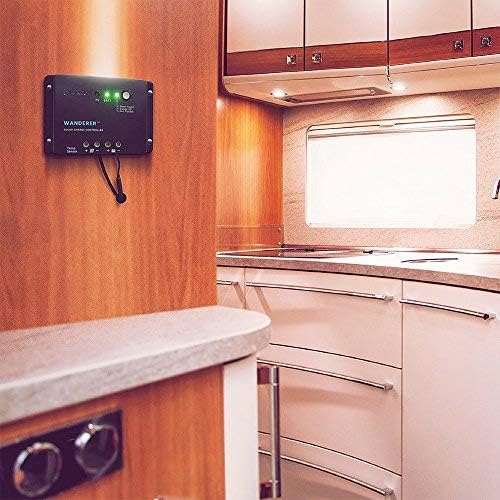
Measuring approximately 163.8 × 109.6 × 44.7 mm and weighing just 0.29 kg (0.65 lb), the Renogy Wanderer Li 30A is compact and easy to accommodate in a small RV electrical compartment or DIY solar installation. It is designed for fixed mounting rather than regular handling.
The optional BT-1 module also enables access to the Renogy BT App, which is required to adjust charging parameters in Li mode. The controller’s on-device controls allow selection of the preset battery type but do not provide the same parameter-adjustment capability.
In everyday use, it can remain installed near the battery as part of a small 12V solar charging system. It should be mounted vertically in a dry, well-ventilated location, protected from direct sunlight and excessive heat, with at least 150 mm of clearance above and below. Its IP20 enclosure is not designed for exposure to water or outdoor weather.
Evaluation
| Evaluation Factor | This Model | How It Compares | Buyer Implication |
|---|---|---|---|
| System Flexibility | Designed for 12V battery systems only | Less versatile than the 12V/24V Victron, EPEVER, Renogy Rover, and Morningstar controllers | Best suited to dedicated 12V installations rather than systems that may expand to 24V |
| Solar Power Utilization | PWM charging technology | Cannot convert excess panel voltage into additional charging current like the three MPPT models | Works best when panel operating voltage is appropriately matched to battery charging voltage |
| Monitoring Options | LED indicators; optional Bluetooth via BT-1 | Less convenient than the built-in Bluetooth monitoring on the Victron and Renogy Rover | Suitable for buyers who do not need continuous app-based monitoring |
| PV Configuration | 25V maximum PV input voltage | More restrictive than the higher-voltage input limits of the MPPT controllers | Limits the choice of panel configurations and requires careful voltage matching |
Who Should Buy This
The Renogy Wanderer Li 30A is a good fit for buyers who:
- Need a basic PWM controller for a 12V solar system with appropriately matched panel and battery voltages.
Want an affordable charging solution for a small RV, camper, or DIY off-grid installation.
Have a solar setup that does not require MPPT conversion or higher-voltage panel configurations.
Prefer straightforward charging regulation and are comfortable using LED indicators rather than a built-in display or standard Bluetooth monitoring.
Who Should Skip This
The Renogy Wanderer Li 30A may not be the right choice if you:
- Need a controller for a 24V battery system or plan to expand beyond a 12V setup. Consider the Victron SmartSolar, EPEVER Tracer4215BN, Renogy Rover, or Morningstar ProStar PS-30.
Have higher-voltage solar panels or want to connect panels in series. An MPPT controller offers greater PV input flexibility.
Want built-in Bluetooth monitoring, detailed system data, or more advanced charging control. Consider the Victron SmartSolar or Renogy Rover 40A.
Final Verdict
The Renogy Wanderer Li 30A is a sensible choice for buyers who need an affordable, straightforward controller for a small 12V solar system with properly matched panel and battery voltages. Its main advantage is simplicity and low-cost operation, but its PWM technology and limited PV input flexibility make it unsuitable for more demanding or expandable installations. Choose it for a basic 12V setup where budget matters more than higher energy harvest, advanced monitoring, or system flexibility.
Check the latest price and customer reviews on Amazon.
Related Guide: If you are planning a simple, budget-conscious solar setup for your RV, see our Best RV Solar Panel Kits (2026): Top Picks for Different RV Power Needs guide to compare complete kit options for different RV power requirements.
Morningstar ProStar PS-30 PWM
Best for Long-Term 12V/24V PWM System Reliability

Quick Verdict
The Morningstar ProStar PS-30 is a 30A PWM solar charge controller designed for 12V and 24V battery systems. It focuses on dependable charging regulation and straightforward operation rather than advanced monitoring features, making it suitable for users who need a robust controller for a conventional off-grid solar installation.
This model is particularly relevant to buyers who prioritize long-term system reliability and want a controller from an established solar charge control manufacturer. Its main appeal is its durable, practical design and five-year warranty. However, it has no built-in display, and users with battery chemistries other than lead-acid may need custom programming to configure the appropriate charging settings.
Snapshot
| Specification | Morningstar ProStar PS-30 |
|---|---|
| Controller Technology | PWM |
| Rated Charging Current | 30A |
| Battery Voltage | 12V / 24V |
| Maximum PV Open-Circuit Voltage | 30V (12V system) / 60V (24V system) |
| Monitoring | LED indicators; no built-in display |
| Warranty | 5 years |
Why We Chose It
The Morningstar ProStar PS-30 earns Best for Long-Term 12V/24V PWM System Reliability because it combines established PWM charging technology with a five-year manufacturer warranty. Its appeal is straightforward: a durable, conventional charge controller for buyers who value long-term system operation and do not need advanced monitoring features.
Compared with the Renogy Wanderer Li 30A, which is limited to 12V systems, the ProStar supports both 12V and 24V installations. Unlike the three MPPT models in this comparison, it does not offer maximum power point tracking, but its simpler PWM approach may be sufficient for appropriately matched solar panels and batteries. It is the strongest fit among these five for buyers prioritizing a long-term PWM solution over advanced monitoring or higher solar energy harvest.
Check the latest price and customer reviews on Amazon.

Practical Considerations
Measuring approximately 153 × 105 × 55 mm and weighing just 13.8 oz (0.39 kg), the Morningstar ProStar PS-30 is compact and lightweight enough to fit into an RV electrical compartment or off-grid equipment enclosure. It is designed for fixed mounting on a vertical surface rather than regular portable use.
Once installed, it can operate as part of a permanent 12V or 24V solar charging system with minimal day-to-day handling. Its IP20 enclosure requires a protected location away from direct rain and sunlight, with adequate ventilation. The lack of a built-in display also means users must rely on the LED indicators or compatible external monitoring equipment to check system information.
Evaluation
| Evaluation Factor | This Model | How It Compares | Buyer Implication |
|---|---|---|---|
| System Voltage Compatibility | Supports 12V and 24V battery systems | More versatile than the 12V-only Renogy Wanderer Li 30A | Suitable for a wider range of conventional off-grid system configurations |
| Charging Technology | PWM regulation | Unlike the Victron, EPEVER, and Renogy Rover MPPT models, it does not convert excess panel voltage into additional charging current | Best suited to systems with appropriately matched panel and battery voltages |
| Battery Configuration | Custom programming required for battery chemistries other than lead-acid | Offers less straightforward setup for non-lead-acid batteries than controllers with documented preset profiles | Buyers using lithium or other battery chemistries should verify configuration requirements before purchasing |
| Monitoring | LED indicators; no built-in display | Less detailed onboard monitoring than the Victron and Renogy Rover | Better suited to users comfortable with basic status indicators rather than detailed display or Bluetooth monitoring |
Who Should Buy This
- Need a 30A PWM controller for a 12V or 24V off-grid solar system with appropriately matched panel and battery voltages.
Prioritize long-term reliability and a five-year manufacturer warranty over advanced monitoring features.
Prefer a straightforward charging controller for a conventional solar installation without the added cost of MPPT technology.
Are comfortable using LED status indicators instead of a built-in display and can configure the controller appropriately for their battery chemistry.
Who Should Skip This
The Morningstar ProStar PS-30 may not be the right choice if you:
- Need MPPT technology to improve solar energy harvest from higher-voltage panels. Consider the Victron SmartSolar, EPEVER Tracer4215BN, or Renogy Rover 40A.
Want built-in Bluetooth monitoring or an LCD display for convenient access to detailed system information. The Victron SmartSolar or Renogy Rover may be a better fit.
Prefer ready-made charging profiles for different battery chemistries without custom programming. Check the Renogy Rover or another controller with a documented preset compatible with your battery.
Final Verdict
The Morningstar ProStar PS-30 is best suited to buyers who want a dependable PWM controller for a conventional 12V or 24V solar system. Its five-year warranty and established design are key advantages, but the lack of a built-in display and the need for custom programming with non-lead-acid batteries require consideration. Choose it if you prioritize a straightforward, long-term PWM solution over advanced monitoring or MPPT performance.
Check the latest price and customer reviews on Amazon.
Related Guide: If you are building a solar battery system and need to choose a compatible battery for your charge controller, see our Best Solar Batteries for Home Backup (2026) guide to compare battery options for backup power applications.
What Does a Solar Charge Controller Do?

A solar charge controller regulates the flow of electricity from solar panels to a battery bank. It sits between the solar array and the batteries, controlling charging voltage and current so the batteries receive power within their specified limits. Because solar panel output changes with sunlight, temperature, and operating conditions, the controller adjusts the charging process to help prevent overcharging and reduce unnecessary stress on the battery.
A charge controller also manages battery charging according to the supported charging profile. Depending on the model and battery chemistry, this may include different charging stages, voltage limits, and temperature compensation. Many controllers also provide reverse-current protection to help prevent the battery from discharging back through the solar panels when solar production stops, such as at night.
Some models include additional functions, such as load control, low-voltage load disconnect, system monitoring, and fault protection. However, these capabilities vary by controller and should be checked in the manufacturer’s specifications. A solar charge controller does not replace an inverter: the controller manages battery charging, while an inverter converts stored DC electricity into AC power for compatible household appliances.
What Is an MPPT Solar Charge Controller?
An MPPT (Maximum Power Point Tracking) solar charge controller is an advanced type of charge controller that continuously adjusts how it draws power from solar panels to capture the maximum available power. It uses an electronic tracking algorithm to identify the panel’s maximum power point (MPP) — the combination of voltage and current at which the panel produces its highest wattage under current operating conditions.
How MPPT Technology Works
Solar panels do not produce a fixed voltage and current. Their output changes with sunlight intensity, panel temperature, and other operating conditions. As a result, the maximum power point shifts throughout the day. An MPPT controller monitors the panel’s electrical output and repeatedly adjusts its operating point to follow these changes.
Once the controller identifies the available maximum power point, its built-in DC-to-DC converter transforms the incoming electricity to match the voltage required by the battery. In a typical off-grid system, this means reducing the higher solar panel voltage to the lower battery charging voltage while increasing the output current accordingly. The conversion process preserves most of the available input power, minus the controller’s own conversion losses.
Why Voltage Conversion Matters
The main advantage of this process is that the solar panels can operate at their optimal voltage even when it is higher than the battery’s charging voltage. Instead of simply reducing the panel voltage and losing the potential benefit of the difference, an MPPT controller converts much of that excess voltage into additional charging current.
For example, a solar array producing 36V at 8A delivers 288W of power. If an MPPT controller converts that power to a battery charging voltage of 14.4V, the theoretical output current would be 20A before conversion losses. The actual current would be slightly lower because no controller converts energy with 100% efficiency.
This ability to track the panel’s maximum power point and convert voltage into usable charging current makes MPPT technology particularly useful when solar array voltage is significantly higher than battery charging voltage.
What Is a PWM Solar Charge Controller?
A PWM (Pulse Width Modulation) solar charge controller regulates battery charging by rapidly switching the electrical connection between the solar panel and the battery. Unlike an MPPT controller, it does not use a DC-to-DC converter to transform excess panel voltage into additional charging current. Instead, it controls the charging process by adjusting how long the connection remains switched on.
How PWM Technology Works
When the battery needs charging, the PWM controller connects the solar panel to the battery, allowing current to flow. While the connection is on, the panel operates at a voltage close to the battery’s charging voltage, rather than maintaining its own maximum power point. This is why the panel and battery voltages need to be appropriately matched for a PWM system.
As the battery approaches its target charging voltage, the controller rapidly switches the connection on and off. It adjusts the duration of these electrical pulses to regulate the average current flowing into the battery and maintain the required charging voltage. This switching process gives the technology its name: Pulse Width Modulation.
Why Panel and Battery Voltage Matching Matters
A PWM controller does not convert the difference between panel voltage and battery voltage into additional charging current. When the panel’s maximum power point voltage is considerably higher than the battery’s charging voltage, the controller pulls the panel’s operating voltage closer to the battery voltage. As a result, some of the panel’s potential power is not used.
PWM controllers are therefore best suited to systems where the solar panel voltage is closely matched to the battery’s charging requirements. For a small solar installation with compatible equipment, this simpler approach can provide effective battery charging without the additional cost of MPPT conversion.
MPPT vs PWM: How Much More Solar Power Can MPPT Harvest?
Consider the same 100W solar panel connected to the same 12V battery, charging at 13V. The panel has a maximum power voltage (Vmp) of 18V and a maximum power current (Imp) of approximately 5.6A. These values represent a typical 100W panel operating near its rated maximum power point under Standard Test Conditions (STC).
The difference comes from how each controller handles the voltage between the panel and the battery.
| Calculation | MPPT Controller | PWM Controller |
|---|---|---|
| Panel operating voltage | 18V | 13.5V |
| Panel operating current | 5.6A | 6.0A |
| Power at panel output | 100W (rounded) | 81W |
| Assumed controller conversion efficiency | 98% | No voltage conversion |
| Power delivered to battery | 98W | 78W |
| Battery charging voltage | 13V | 13V |
| Estimated charging current | 7.54A | 6.0A |
MPPT calculation:
The controller tracks the panel’s maximum power point and converts its higher-voltage output to the battery’s charging voltage. Assuming 98% conversion efficiency:
Available battery-side power: 100W × 0.98 = 98W
Estimated charging current: 98W ÷ 13V = 7.54A
PWM calculation:
A PWM controller connects the panel directly to the battery during its switching cycle, bringing the panel’s operating voltage close to battery voltage. In the illustrative Victron example, a 13V battery and an assumed 0.5V cable and controller voltage drop result in approximately 13.5V at the panel. The panel current at this operating point is approximately 6A:
Power at panel output: 13.5V × 6A = 81W
Power delivered to the battery: 13V × 6A = 78W
Estimated charging current: 78W ÷ 13V = 6.0A
Under these assumptions, the MPPT controller delivers approximately 20W more charging power and 1.54A more charging current than the PWM controller. That represents about 25.6% more battery-side power compared with the PWM example.
These figures illustrate a specific operating scenario, not a guaranteed performance difference. The PWM result comes from the panel’s current at the lower operating voltage shown in Victron Energy’s technical comparison; it should not be treated as a universal 6A output for every 100W panel. Actual results depend on the panel’s I–V characteristics, irradiance, temperature, wiring losses, controller efficiency, and battery charging voltage. The assumed 98% MPPT conversion efficiency is also an example, not a measured result for every controller.
The key distinction is that MPPT converts excess panel voltage into additional charging current, while PWM does not. The actual advantage depends on how much higher the panel’s operating voltage is than the battery’s charging voltage.
What Affects MPPT vs PWM Performance in Real-World Conditions?

The performance difference between MPPT and PWM controllers changes with the conditions in which a solar array operates. Panel temperature, available sunlight, shading, and battery charging demand all affect how much energy can reach the battery.
Cold Weather and Solar Panel Voltage
Solar panels generally produce higher voltage in cold conditions. This can increase the difference between the panel’s operating voltage and the battery’s charging voltage, giving an MPPT controller more excess voltage to convert into charging current.
A PWM controller cannot use this voltage difference in the same way. As a result, MPPT often has a greater energy-harvesting advantage in cold weather, provided the array remains within the controller’s maximum PV voltage rating. Cold-weather open-circuit voltage must always be calculated before connecting panels in series.
Hot Weather and High Panel Temperatures
High panel temperatures reduce solar module voltage and can lower the available power. As the panel’s operating voltage moves closer to the battery’s charging voltage, the energy-harvesting advantage of MPPT may decrease.
In hot climates, a properly matched panel and battery system can therefore make PWM a more competitive option. However, actual performance still depends on the panel’s specifications and the battery’s charging voltage.
Cloudy Weather and Low Sunlight
Cloud cover reduces the amount of sunlight reaching a solar panel, which lowers its power output. Under moderate cloud cover, panel current generally decreases more than voltage, so the relative difference between MPPT and PWM may not change substantially.
In very low-light conditions, however, panel voltage can also fall. If it approaches the battery’s charging voltage, an MPPT controller may retain an advantage by operating the array at its available maximum power point. Neither controller can compensate for the solar energy lost because of insufficient sunlight.
Partial Shading
Shade from trees, roof equipment, antennas, or nearby structures can reduce panel output, sometimes significantly. The effect depends on which cells are shaded, the panel’s bypass-diode design, and how the panels are connected.
MPPT controllers can track the available power under changing conditions, but shading can create multiple peaks on a panel array’s power curve. Some tracking algorithms may settle on a local rather than the highest power point. MPPT therefore does not eliminate shading losses or guarantee that a shaded array will perform well.
Battery State of Charge
Battery state of charge affects how much charging current the battery can accept. When a battery is low, the controller can generally deliver more available solar power during the bulk charging stage. As the battery approaches full charge, it moves into later charging stages, and the controller reduces or regulates current to maintain the required voltage.
At this point, the difference between MPPT and PWM may have less practical importance because the battery cannot accept all the available solar power. If the battery is already full and there is no additional load, extra energy-harvesting capability provides little benefit.
When Is an MPPT Solar Charge Controller Better?
An MPPT solar charge controller is generally the better choice when a solar array operates at a significantly higher voltage than the battery bank, or when the system requires greater flexibility in panel configuration. Its ability to convert excess panel voltage into additional charging current can make more of the available solar power usable.
MPPT is particularly beneficial in the following situations:
Using higher-voltage solar panels: When panel operating voltage is considerably higher than battery charging voltage, MPPT can convert the difference into additional charging current instead of leaving that potential power unused.
Connecting panels in series: Series-connected panels produce higher array voltage, making MPPT a suitable option for systems designed around higher-voltage solar inputs. The array must remain within the controller’s maximum PV voltage limit.
Building a larger off-grid system: Systems with greater solar capacity can benefit from improved power utilization, particularly when the array voltage is higher than the battery voltage.
Planning future system expansion: MPPT controllers generally support more flexible solar array configurations, provided the added panels remain within the controller’s voltage, current, and power limits.
Reducing solar cable losses: Higher-voltage array configurations can transmit the same power at lower current, potentially reducing cable losses when the wiring is correctly sized.
MPPT also makes sense when the additional energy harvested is valuable enough to justify the controller’s higher purchase price. This is especially relevant for off-grid systems where available solar production directly affects battery charging and energy availability.
However, MPPT is not automatically the better investment for every installation. If the panel voltage is already closely matched to the battery, the array is relatively small, and the system has no need for higher-voltage configurations, a less expensive PWM controller may provide sufficient performance.
When Is a PWM Solar Charge Controller a Better Choice?
A PWM solar charge controller can be a practical choice for a small, cost-conscious solar system where panel voltage is appropriately matched to battery charging requirements. In this type of installation, the additional voltage-conversion capability of MPPT may provide too little benefit to justify its higher purchase price.
PWM is particularly suitable in the following situations:
Using voltage-matched solar panels: When the panel’s operating voltage is close to the battery’s charging voltage, PWM can regulate charging without a substantial loss of otherwise usable panel power.
Building a small 12V solar system: Basic RV, camping, and small off-grid installations may not require the higher-voltage array configurations supported by MPPT.
Keeping initial costs low: PWM controllers generally cost less, making them attractive when the system has modest energy requirements and every component needs to fit a limited budget.
Using a simple, established setup: For a compatible panel and battery combination, PWM offers straightforward charging regulation without the additional conversion electronics found in MPPT controllers.
Maintaining an existing PWM system: If the current controller meets the system’s charging requirements and the solar array is appropriately matched, replacing it with MPPT may not deliver enough additional energy to justify the upgrade cost.
The main consideration is compatibility. A PWM controller is not suitable for every solar panel configuration, particularly when the panel’s operating voltage is substantially higher than the battery’s charging voltage. Its lower purchase price should therefore be weighed against the potential loss of usable solar power.
When an Extra Solar Panel Can Make PWM More Economical
The lower purchase price of a PWM controller does not automatically make it the less expensive system over the long term. In some installations, additional solar panel capacity can compensate for the lower power utilization of PWM technology. Whether this approach saves money depends on the cost of the controller, additional panel capacity, mounting hardware, wiring, and available installation space.
Consider the earlier 100W panel example. Under the stated assumptions, an MPPT controller delivers approximately 98W to the battery, while the PWM configuration delivers about 78W.
To estimate how much nominal solar capacity a PWM system would need to deliver comparable power:
Required PWM array capacity: 98W ÷ 0.78 = approximately 126W.
A practical 150W array would provide approximately 117W under the same simplified assumptions.
This means a PWM system with roughly 150W of panel capacity could deliver comparable or greater charging power than the 100W MPPT example. However, this is an illustrative estimate, not a guaranteed output prediction. Actual performance depends on panel characteristics, operating conditions, battery voltage, and system losses.
The economic comparison comes down to the additional cost of the two approaches:
MPPT approach: Pay the price premium for an MPPT controller while using the original 100W panel.
PWM approach: Use a less expensive PWM controller and add the panel capacity needed to reach comparable output.
For example, if the MPPT controller costs $90 more than the PWM alternative, while the additional 50W of solar capacity and its associated installation hardware cost $60, the PWM configuration would have a $30 lower upfront cost under these assumptions.
However, the additional panel requires physical space and may increase wiring and installation complexity. The PWM controller must also support the resulting array current and power, and the additional panel must be electrically compatible with the existing array.
The practical takeaway: PWM can remain the more economical choice when adding panel capacity is inexpensive and installation space is available. MPPT is often more attractive when roof or mounting space is limited, higher-voltage panel configurations are desirable, or maximizing energy harvest from an existing array is more important than minimizing controller cost.
For a small system with appropriately matched panel and battery voltages, however, PWM can provide the charging functionality needed without paying for MPPT capabilities that the installation may not meaningfully benefit from.
MPPT vs PWM for 12V, 24V, and 48V Solar Systems
The choice between MPPT and PWM depends partly on whether the solar charge controller supports the battery bank’s nominal voltage. Both technologies can be used in different system-voltage configurations, but their suitability depends on the relationship between solar panel voltage and battery charging voltage.
12V Solar Systems
Both MPPT and PWM controllers can work well in 12V systems, provided the panel and battery specifications are compatible.
PWM can be a cost-effective option for smaller installations using panels with an operating voltage closely matched to the battery’s charging requirements. MPPT is generally more suitable when using higher-voltage panels, larger solar arrays, or series-connected modules.
For a basic 12V RV or small off-grid system, the decision often comes down to whether the additional energy harvest from MPPT justifies its higher cost.
24V Solar Systems
Both controller technologies are also available for 24V battery systems. PWM can work with appropriately matched solar panels, while MPPT offers greater flexibility when the array operates at a higher voltage than the battery bank.
A 24V system can also benefit from higher-voltage solar configurations, particularly when panels are connected in series. In these installations, MPPT can convert the higher array voltage into the charging current required by the battery.
48V Solar Systems
For 48V battery banks, MPPT is generally the more flexible choice because it supports higher-voltage solar array configurations and can convert their output to the battery’s charging requirements.
PWM can also be used in a 48V system, but the solar panel voltage must be appropriately matched to the battery’s charging voltage. This can restrict panel configuration and reduce the practical flexibility of the installation.
It is particularly important to check the controller’s supported battery voltage. A controller designed for 12V and 24V systems cannot automatically be used with a 48V battery bank, even if its PV input voltage rating appears sufficient.
Which Controller Should You Choose?
| Battery System | PWM Suitability | MPPT Suitability |
|---|---|---|
| 12V | Suitable for small systems with matched panel voltage | Better for higher-voltage panels and larger arrays |
| 24V | Suitable when panel and battery voltages are matched | More flexible for series-connected panels and higher-voltage arrays |
| 48V | Possible with appropriately matched equipment | Generally offers greater array configuration flexibility |
The important distinction is that battery voltage alone does not determine whether MPPT or PWM is better. You must also consider panel operating voltage, the controller’s supported battery voltage, and its maximum PV input limits. Always verify these specifications before selecting a controller.
How to Choose Between MPPT and PWM Solar Charge Controllers

Choosing between MPPT and PWM requires more than comparing controller prices or rated amperage. The controller must match the battery bank, solar array, and expected charging requirements. Check the following specifications before selecting a model.
Battery Voltage and Chemistry
First, confirm the nominal voltage of your battery bank: 12V, 24V, or 48V. The charge controller must explicitly support that voltage.
If you are still determining the required battery storage capacity for your system, use our Battery Capacity Calculator to convert between amp-hours (Ah) and watt-hours (Wh) and estimate the capacity needed for your energy requirements.
A controller designed for 12V and 24V systems cannot automatically be used with a 48V battery bank.
Next, check battery chemistry. Lead-acid, AGM, gel, and lithium batteries have different charging requirements. The controller must support the appropriate battery type or allow the required charging parameters to be configured.
For lithium batteries, also confirm compatibility with the battery manufacturer’s charging specifications and battery management system (BMS). Do not assume that a controller’s lithium setting supports every lithium battery.
Solar Panel Voltage and Current
Check the solar panel datasheet for four important electrical values:
Vmp (Voltage at Maximum Power): The panel voltage at which it produces its rated maximum power.
Voc (Open-Circuit Voltage): The panel voltage when no load is connected.
Imp (Current at Maximum Power): The current produced at the maximum power point.
Isc (Short-Circuit Current): The maximum current measured when the panel output is short-circuited under specified test conditions.
For PWM, panel operating voltage must be appropriately matched to battery charging voltage. For MPPT, the panel array can operate at a higher voltage, provided it meets the controller’s input requirements.
Remember that connecting panels in series increases voltage, while connecting them in parallel increases current. The final array configuration must remain within the controller’s electrical limits.
How Isc Affects Solar Charge Controller Compatibility
Isc is important when checking whether a solar array is compatible with a controller’s maximum PV short-circuit current rating. Unlike Imp, which describes the panel’s current at its maximum power point, Isc represents the current produced when the panel’s output terminals are short-circuited under specified test conditions.
Array configuration determines how Isc adds up:
Panels in series: Voltage increases, but the string current remains approximately equal to the Isc of one panel.
Strings in parallel: Current increases. Add the Isc values of the parallel strings to determine the array’s total short-circuit current.
For example, consider four identical panels, each with an Isc of 6.2A, arranged as two panels in series per string and two strings in parallel:
Series connection: 6.2A per string.
Two parallel strings: 6.2A × 2 = 12.4A array Isc.
Check the controller’s datasheet or manual to confirm that the permitted PV input short-circuit current is sufficient for the array configuration. Apply any additional design factors required by the manufacturer and applicable electrical code.
Also distinguish maximum PV short-circuit current from maximum operational PV input current. Some manufacturers specify both because they describe different limits. Do not compare either PV input rating with the controller’s battery charging current: a 30A charging rating does not mean the controller can accept any PV input current up to 30A.
Maximum PV Input Voltage
The controller’s maximum PV input voltage is a critical safety limit, particularly when panels are connected in series.
Do not check only the panel’s rated voltage under standard test conditions. Solar panel open-circuit voltage increases as temperatures fall, so the array’s cold-weather Voc must be calculated using the panel manufacturer’s temperature coefficient.
For a series-connected array:
Voc,cold = Voc,STC × [1 + βVoc × (Tmin − 25°C)] × Number of Panels in Series
Here, βVoc is the panel’s voltage temperature coefficient expressed as a decimal per degree Celsius, and Tmin is the lowest expected cell temperature used for the design calculation.
Example: Calculating Cold-Weather Voc for a Series Array
Suppose a solar array uses two identical panels connected in series. Each panel has the following specifications:
Rated open-circuit voltage (Voc): 22.5V
Voc temperature coefficient: −0.29%/°C
Lowest expected temperature: −10°C
The reference temperature under Standard Test Conditions (STC) is 25°C, so the temperature difference is:
25°C − (−10°C) = 35°C
Because the temperature coefficient is negative, the panel’s open-circuit voltage increases as the temperature falls.
Cold-weather Voc per panel:
22.5V × [1 + (0.0029 × 35)] = 24.78V
Total cold-weather Voc for two panels in series:
24.78V × 2 = 49.56V
The calculated cold-weather open-circuit voltage is therefore approximately 49.6V. A controller with a 50V maximum PV input voltage would not be a suitable choice for this configuration because the calculated voltage is already too close to its absolute limit. A controller rated for 100V would provide more voltage headroom, provided all its other PV input and battery compatibility requirements are also satisfied.
This is an illustrative calculation using assumed panel specifications. For an actual installation, use the temperature coefficient and design temperature required by the panel and controller manufacturers and applicable electrical code. Always keep calculated cold-weather Voc below the controller’s absolute maximum PV input voltage.
The resulting array voltage must remain below the controller’s maximum PV input voltage. Follow the manufacturer’s specified limits and applicable design requirements.
Maximum Charging Current and Solar Input Power
A controller’s rated charging current indicates how much current it can deliver to the battery. Its maximum PV input power indicates how much solar array capacity it can support at a specified battery-system voltage. Both values must be checked.
For an MPPT controller, a preliminary estimate of charging current can be calculated using the following formula:
Icharge ≈ (Parray × η) / Vcharge
Where:
Parrayis the total rated solar array power in watts.ηis the controller’s conversion efficiency expressed as a decimal.Vchargeis the battery’s actual charging voltage.
For example, a 400W solar array supplying a battery charging at 14.4V through a controller with 98% conversion efficiency would produce approximately 27.2A of charging current under the assumed conditions.
This is an estimate, not confirmation that a particular controller is suitable. Check the manufacturer’s maximum PV power rating, charging-current limit, permitted PV input current, and any applicable oversizing or derating requirements.
Future Expansion
If you plan to add solar panels later, choose a controller that can accommodate the intended expansion without exceeding its electrical limits.
Consider whether the additional panels will increase array voltage, current, or both. Series connections increase voltage, while parallel connections increase current, so expansion can affect different controller limits.
An MPPT controller with sufficient PV input capacity may offer greater flexibility for a growing system. However, a higher-rated controller is not automatically suitable: the battery voltage, maximum charging current, PV voltage, and permitted array power must all remain within specifications.
Planning these limits before installation can help avoid replacing the controller when the solar array grows.
Common MPPT vs PWM Buying Mistakes
Choosing between MPPT and PWM is not simply a matter of buying the more advanced controller or selecting the lowest-priced option. The wrong decision can lead to unnecessary expenses, limited system flexibility, or less usable solar power.
Choosing MPPT Because It Is Always Better
MPPT technology offers advantages when the solar array operates at a significantly higher voltage than the battery. However, that does not mean every system will benefit enough to justify the additional cost. For a small installation with appropriately matched panel and battery voltages, PWM may provide sufficient charging performance without the expense of MPPT.
Buying Based on Amperage Alone
A higher charging-current rating does not automatically make a controller suitable for a larger solar installation. Buyers sometimes compare 30A and 40A models without considering how much solar power each can support at their battery voltage. This can result in purchasing a controller that cannot accommodate the intended array, despite having an apparently sufficient amperage rating.
Assuming a Higher PV Voltage Rating Means Unlimited Flexibility
A controller with a higher maximum PV input voltage offers more options for connecting panels in series, but it does not support every possible array configuration. Buyers can overlook other electrical limits or assume that the advertised voltage rating applies under all temperatures. The result can be an incompatible or improperly configured solar array.
Paying for Features the System Does Not Need
Bluetooth monitoring, advanced communication interfaces, displays, and configurable charging profiles can be useful, but not every installation requires them. Paying extra for features that will rarely be used can increase the system cost without improving its practical value. Prioritize the functions that support your actual monitoring and battery-management requirements.
Planning Solar Expansion Without Considering the Battery System
Adding more solar panels does not automatically improve a system if the battery bank cannot accept the additional charging current or store the extra energy. Buyers sometimes plan array expansion without considering battery capacity, charging limits, and the intended energy demand. The result may be an oversized solar array that provides less practical benefit than expected.
Comparing Controller Prices Instead of Total System Cost
A lower-priced PWM controller may appear to be the economical choice, but it can be less suitable if the panel configuration creates a substantial voltage mismatch. Conversely, paying more for MPPT may not be worthwhile when the system gains little additional usable energy. Compare the total cost of a compatible installation, including the controller, wiring, accessories, and any changes needed to the solar array.
What to Prioritize Before Buying
Start with electrical compatibility between the panels, controller, and battery. Then determine whether MPPT offers a meaningful energy-harvesting advantage for your configuration. Finally, compare the features you actually need and the total cost of installing and operating the system. This approach helps avoid paying for unnecessary capabilities or choosing a controller that limits the performance of the rest of your equipment.
Frequently Asked Questions
Is an MPPT Charge Controller Worth It for a 100W Solar Panel?
It depends on the panel’s operating voltage and the battery charging voltage. If the panel produces substantially more voltage than the battery requires, an MPPT controller can recover more usable power. If the panel and battery voltages are already closely matched, the additional energy harvest may not justify the higher controller cost. Compare the expected power gain with the price difference rather than relying on panel wattage alone.
Can I Use a 24V Solar Panel with a 12V Battery?
Yes, when using a compatible MPPT charge controller that supports the panel’s input voltage and can convert it to the required 12V battery charging voltage. A conventional PWM controller is generally unsuitable for this configuration because it does not provide the same voltage conversion. Always check the panel’s actual Vmp and Voc, as well as the controller’s input limits.
Can an MPPT Charge Controller Charge a Lithium Battery?
Yes, provided the controller supports the specific lithium battery chemistry and its required charging parameters. Check the manufacturer’s recommended charging voltage, current limits, and temperature requirements. The battery’s built-in battery management system (BMS) provides additional protection, but it does not replace the need for a compatible charge controller.
Can I Replace a PWM Controller with an MPPT Controller Without Changing My Solar Panels?
In many cases, yes. Existing panels can often remain in place if their electrical specifications are compatible with the new MPPT controller. However, the replacement must support the array’s open-circuit voltage, operating current, and total power, as well as the battery’s voltage and charging requirements. Some installations may benefit from rewiring panels in series, but this is not always necessary.
Do I Need Special Solar Panels for an MPPT Charge Controller?
No. MPPT controllers can work with many types of solar panels, provided their electrical specifications fall within the controller’s permitted input range. They are particularly useful with panels whose operating voltage is higher than the battery’s charging voltage. The important factors are panel voltage, current, array configuration, and controller compatibility—not a special MPPT-specific panel design.
Final Verdict: MPPT vs PWM Solar Charge Controllers
MPPT is the better choice for systems with higher-voltage solar arrays, larger energy requirements, or plans for future expansion. Its ability to convert excess panel voltage into additional charging current can improve solar energy utilization and provide greater system flexibility.
PWM remains a practical and more affordable option for smaller installations where panel and battery voltages are appropriately matched. It can provide sufficient charging performance without the additional cost of MPPT technology.
The right choice depends on your solar array, battery requirements, and budget. Choose MPPT when its additional energy harvest and flexibility justify the investment. Choose PWM when a simpler, lower-cost controller meets your system’s actual needs.
Our Recommendation
The right solar charge controller depends on your battery system, solar array configuration, charging requirements, and budget. Based on these priorities, our selected models offer different advantages:
For customizable charging and Bluetooth monitoring: The Victron SmartSolar MPPT 100/30 offers configurable charging profiles and integrated Bluetooth monitoring for compatible 12V and 24V systems.
For higher-voltage solar arrays: The EPEVER Tracer4215BN 40A supports higher PV input voltage, making it a suitable option for compatible series-connected panel configurations.
For 40A MPPT charging with included Bluetooth: The Renogy Rover 40A MPPT with Bluetooth combines 40A charging capacity, an LCD display, and wireless monitoring.
For a budget-conscious 12V PWM system: The Renogy Wanderer Li 30A provides a simpler, lower-cost option for appropriately matched 12V solar and battery configurations.
For a 12V/24V PWM system with a five-year warranty: The Morningstar ProStar PS-30 is worth considering when long-term reliability and manufacturer warranty coverage are priorities.
Before choosing any model, verify that its battery voltage, charging profile, maximum PV voltage, permitted PV input current, and supported solar array power match your actual system. A controller’s rated charging current or technology alone does not establish compatibility.
Related Guides
Best Solar Charge Controllers (2026): Compare specific MPPT and PWM controller models and find one that matches your solar system.
Best Rigid Solar Panels (2026): Explore rigid panel options for RV, residential, and off-grid solar installations.
Best RV Solar Panel Kits (2026): Compare complete solar kits for RV owners choosing panels, controllers, and system components.
Solar Panel Size Calculator: Estimate the solar panel capacity needed to support your energy requirements.
Solar Charging Time Calculator: Estimate how long a solar panel system may take to recharge a battery under specified conditions.
Power Ready Guide Commitment
At Power Ready Guide, our goal is to help readers make informed decisions about solar and backup power equipment. We prioritize accurate technical information, clearly explained specifications, and practical recommendations based on real system requirements.
We distinguish manufacturer specifications from independent test results and calculated estimates, and we do not present unverified performance claims as proven results. Product recommendations consider compatibility, practical limitations, features, and overall value—not just advertised ratings or brand reputation.
Our commitment is to provide clear, evidence-based guidance so you can choose equipment that fits your power needs, budget, and long-term plans.