
Whether you’re building your first off-grid solar system, upgrading an RV or boat installation, or improving the efficiency of an existing solar setup, choosing the right solar charge controller is one of the most important decisions you’ll make.
A quality charge controller does far more than regulate battery charging. It protects your battery bank from overcharging and excessive discharge, maximizes the energy harvested from your solar panels, extends battery lifespan, and helps your entire solar power system operate safely and efficiently. Selecting the wrong controller, on the other hand, can reduce charging performance, waste valuable solar energy, and even shorten the life of expensive batteries.
The challenge is that the best solar charge controller isn’t necessarily the one with the highest current rating or the most advanced feature set. Some systems benefit greatly from a premium MPPT controller, while others are better served by a reliable PWM model that delivers excellent performance at a much lower cost. The right choice depends on your solar array, battery type, system voltage, energy requirements, and long-term expansion plans.
For this guide, we evaluated today’s leading solar charge controllers based on the factors that matter most in real-world solar installations: charging efficiency, controller technology (MPPT vs. PWM), battery compatibility, supported system voltages, PV input capacity, safety protections, monitoring features, build quality, ease of installation, manufacturer reputation, and overall value.
Rather than recommending one “perfect” controller for every application, we explain the strengths, limitations, and ideal use cases for each model, helping you choose the solar charge controller that best matches your solar power system and your budget.
As an Amazon Associate, we earn from qualifying purchases.
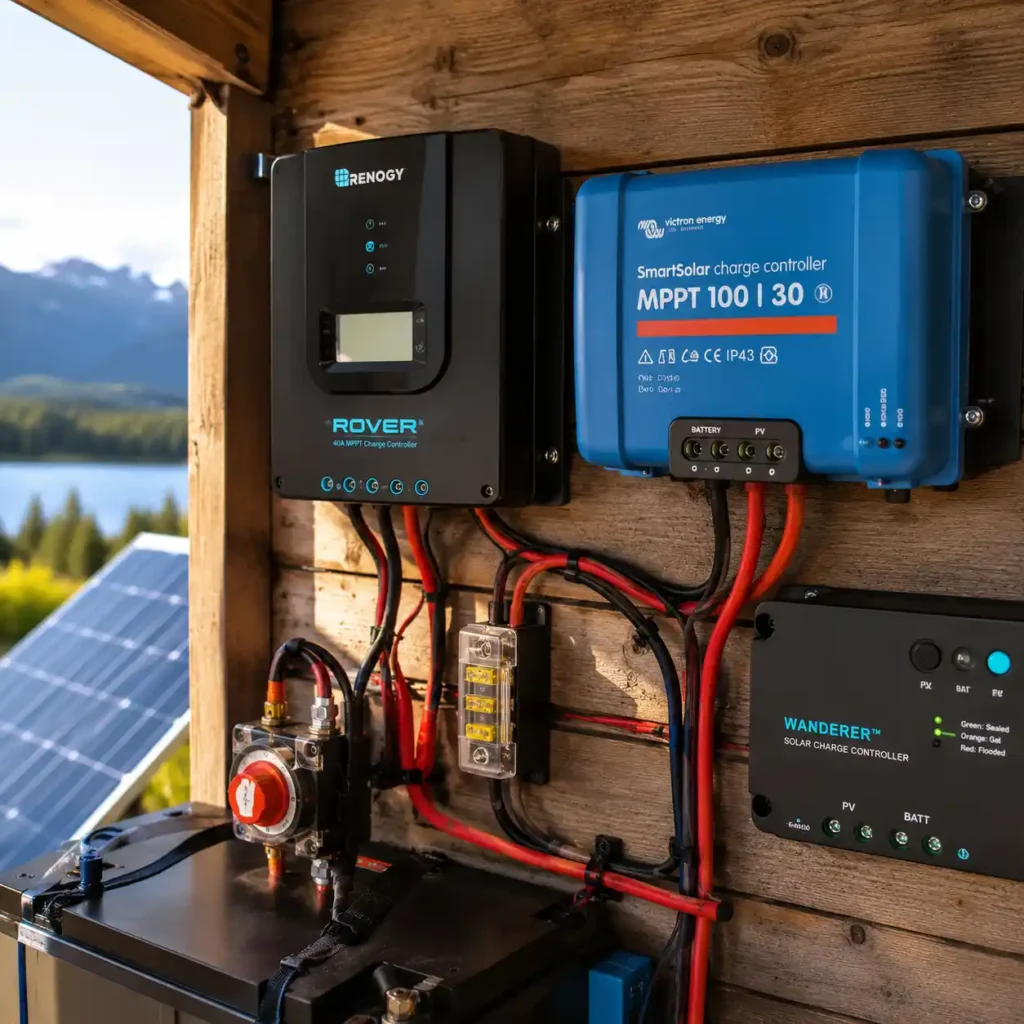
Table of Contents
Quick Answer
The best solar charge controller in 2026 is the Victron SmartSolar MPPT 100/30, thanks to its outstanding combination of charging efficiency, excellent Bluetooth monitoring, broad battery compatibility, proven reliability, and long-term value. It delivers premium MPPT performance for a wide range of off-grid, RV, marine, and backup power systems while remaining easy to configure and expand as your solar installation grows.
If your priorities are different, there are excellent alternatives. The Renogy Rover 40A MPPT offers exceptional value for money, making it an ideal choice for budget-conscious buyers who still want the advantages of MPPT technology. The EPEVER Tracer 4210AN provides dependable MPPT performance at an even lower price point for smaller systems. If you’re building a compact solar setup, the Victron SmartSolar MPPT 75/15 delivers the same premium Victron ecosystem in a controller designed for lower-power installations. For small 12V systems where maximum efficiency isn’t essential, the Renogy Wanderer 30A PWM remains one of the best PWM controllers available.
The right solar charge controller ultimately depends on your solar panel array, battery chemistry, system voltage, expected energy production, and future expansion plans. This guide compares each recommended controller in detail, explaining where it excels, its limitations, and which type of solar power system it is best suited for.
Why You Can Trust Power Ready Guide
Power Ready Guide is an independent resource dedicated to helping readers choose reliable backup power and off-grid energy equipment through in-depth research and practical evaluation.
For this guide, we assessed today’s leading solar charge controllers based on the criteria that matter most in real-world use. Instead of focusing on marketing claims alone, we compared charging technology, battery compatibility, supported system voltages, PV input capacity, efficiency, safety protections, monitoring features, installation experience, build quality, manufacturer reputation, warranty coverage, and long-term value.
We also evaluated how each controller fits different types of solar installations. A controller that’s ideal for a large off-grid cabin isn’t necessarily the best choice for a compact RV, a small boat, or a weekend camping setup. Our recommendations are designed to help you match the right controller to your specific solar power system rather than simply buying the most expensive model.
Our rankings are never based on sponsorships or paid placements. Every product is selected because it offers strong performance, dependable reliability, and excellent value within its category.
When available, we also consider manufacturer documentation, long-term user experience, installer feedback, product reliability history, and overall ecosystem support to provide recommendations that remain useful well beyond the initial purchase.
How We Evaluated the Best Solar Charge Controllers

Choosing the best solar charge controller involves much more than comparing current ratings or looking for the lowest price. A high-quality controller should maximize the energy harvested from your solar panels, protect your batteries under all charging conditions, and continue operating reliably for years in demanding environments.
To identify the best models, we evaluated every controller using the criteria that have the greatest impact on real-world performance and long-term ownership.
Charging Technology (MPPT vs. PWM)
We prioritized controllers that deliver the highest charging efficiency for their intended application. MPPT models were evaluated for their ability to maximize solar energy production under changing weather conditions, while PWM controllers were assessed based on their value, simplicity, and suitability for smaller solar systems.
Battery Compatibility
Not every controller supports every battery chemistry equally well. We evaluated compatibility with lithium (LiFePO₄), AGM, Gel, Flooded Lead-Acid, and other common battery types, along with available charging profiles and customization options.
Charging Performance and Efficiency
We compared maximum charging current, power conversion efficiency, voltage tracking capabilities, and the controller’s ability to maintain consistent charging performance throughout the day as sunlight conditions change.
Solar Input Capacity
Maximum PV input voltage, supported system voltages, and solar array capacity all influence how flexible a controller is. We favored products that allow future system expansion without requiring an immediate controller upgrade.
Monitoring and Smart Features
Modern solar systems benefit from accurate system monitoring. We considered Bluetooth connectivity, mobile apps, remote monitoring options, display quality, historical performance data, and ease of configuration.
Safety and Battery Protection
Reliable protection is essential for both batteries and connected equipment. We evaluated built-in safeguards such as overcharge protection, reverse polarity protection, over-temperature protection, overload protection, and automatic system recovery.
Installation and Ease of Use
Some controllers are designed for experienced installers, while others are much more beginner-friendly. We assessed terminal layout, wiring accessibility, documentation quality, software setup, and overall installation experience.
Build Quality and Long-Term Reliability
A charge controller often operates continuously for many years. We considered thermal management, enclosure quality, component durability, manufacturer reputation, firmware support, and long-term reliability reported by the solar community.
Overall Value
Rather than recommending only premium products, we selected controllers that deliver the strongest combination of performance, features, reliability, and price within their respective categories. This approach ensures that every recommendation represents an excellent investment for its intended use, whether you’re building a compact RV solar system or a larger off-grid installation.
Who This Guide Is For
This guide is designed for anyone planning to build, upgrade, or expand a solar power system and looking for a reliable solar charge controller that matches their specific needs.
Whether you’re assembling your first off-grid setup or replacing an outdated controller, choosing the right model can significantly improve charging efficiency, extend battery life, and make your entire solar system more reliable.
This guide is especially helpful for:
- Homeowners building or upgrading off-grid solar systems.
- RV owners looking for efficient battery charging while traveling.
- Van life enthusiasts who rely on solar power for everyday living.
- Boat owners who need dependable charging in marine environments.
- Cabin owners operating remote solar installations.
- Emergency preparedness users building backup power systems.
- DIY solar enthusiasts designing custom battery and solar configurations.
It is also useful if you’re trying to decide whether an MPPT or PWM controller is the better choice, selecting the proper controller size for your solar array, or ensuring compatibility with lithium (LiFePO₄), AGM, Gel, or flooded lead-acid batteries.
No single solar charge controller is ideal for every application. A compact RV system has different requirements than a large off-grid home, while a small portable setup may not benefit from premium MPPT technology. That’s why our recommendations cover multiple price ranges, system sizes, and installation types, helping you choose the controller that provides the best balance of performance, reliability, and long-term value for your specific solar power system.
Quick Summary: Our Top Picks
Not every solar charge controller is designed for the same type of solar power system. Some prioritize maximum charging efficiency for large off-grid installations, while others focus on affordability, compact size, Bluetooth monitoring, or compatibility with specific battery types.
The charge controllers below earned their awards based on our evaluation of charging technology, efficiency, battery compatibility, PV input capacity, monitoring features, safety protections, ease of installation, long-term reliability, and overall value.
Victron SmartSolar MPPT 100/30
Award: Best Overall
Why It Won:
Delivers an exceptional combination of industry-leading MPPT efficiency, outstanding build quality, advanced Bluetooth monitoring, and long-term reliability, making it the best all-around solar charge controller for most off-grid solar systems.
Choose This If:
- You want premium performance and reliability.
- You use LiFePO₄ or lead-acid batteries.
- You plan to expand your solar system in the future.
Best For:
- Off-grid homes
- RVs
- Van conversions
- Boats
- Medium-sized solar systems
Renogy Rover 40A MPPT
Award: Best Value
Why It Won:
Offers excellent MPPT performance, broad battery compatibility, and dependable operation at a price that makes it one of the best values for DIY solar installations.
Choose This If:
- You’re building your first solar system.
- You want MPPT efficiency without paying premium prices.
- You need reliable charging for a medium-sized setup.
Best For:
- RV solar systems
- Cabins
- Van life
- DIY installations
EPEVER Tracer 4210AN
Award: Best Budget MPPT
Why It Won:
Provides true MPPT charging technology, solid efficiency, and dependable performance at one of the lowest prices in its category.
Choose This If:
- You’re working with a limited budget.
- You still want the advantages of MPPT technology.
- You don’t need advanced wireless monitoring.
Best For:
- Budget off-grid systems
- Small cabins
- DIY solar projects
- Backup battery charging
Victron SmartSolar MPPT 75/15
Award: Best for Small Solar Systems
Why It Won:
Combines premium MPPT technology with a compact design, making it an excellent choice for smaller solar arrays where efficiency and reliability remain a priority.
Choose This If:
- You have a compact solar setup.
- You need Bluetooth monitoring.
- You want premium quality in a small controller.
Best For:
- Camper vans
- Boats
- Portable solar systems
- Small cabins
Renogy Wanderer 30A PWM
Award: Best PWM Controller
Why It Won:
Delivers dependable battery charging, simple installation, and excellent affordability for smaller solar systems where PWM technology remains a practical solution.
Choose This If:
- You have a small solar array.
- You’re looking for the most affordable option.
- Your panel voltage closely matches your battery voltage.
Best For:
- Small RV systems
- Battery maintenance
- Garden sheds
- Portable solar kits
Still not sure which solar charge controller is right for your solar power system?
The detailed reviews below explain how each model performs in real-world applications, where it excels, its limitations, and which type of solar installation will benefit most from choosing it.
Best Solar Charge Controllers Compared
| Model | Award | Technology | Charging Current | Best For |
|---|---|---|---|---|
| Victron SmartSolar MPPT 100/30 | Best Overall | MPPT | 30A | Most Off-Grid Solar Systems |
| Renogy Rover 40A MPPT | Best Value | MPPT | 40A | DIY Solar Installations |
| EPEVER Tracer 4210AN | Best Budget MPPT | MPPT | 40A | Budget Solar Systems |
| Victron SmartSolar MPPT 75/15 | Best for Small Solar Systems | MPPT | 15A | Camper Vans & Small Solar Arrays |
| Renogy Wanderer 30A PWM | Best PWM Controller | PWM | 30A | Small Solar Systems |
The Best Solar Charge Controllers Reviewed
Victron SmartSolar MPPT 100/30
Best Overall Solar Charge Controller

Quick Verdict
The Victron SmartSolar MPPT 100/30 earns our Best Overall award because it delivers the best combination of charging efficiency, reliability, intelligent monitoring, and long-term value for most off-grid solar systems. Rather than competing on charging current alone, it excels through outstanding MPPT performance, excellent build quality, seamless Bluetooth connectivity, and one of the most mature software ecosystems available for solar power management.
Designed for 12V and 24V battery systems, the controller supports up to 30A of charging current with a maximum PV open-circuit voltage of 100V, making it suitable for camper vans, RVs, cabins, boats, and residential off-grid installations. Its advanced Maximum Power Point Tracking technology continually optimizes solar harvest throughout the day, helping users capture significantly more energy than PWM controllers, especially during cloudy weather or colder temperatures.
What truly separates the SmartSolar 100/30 from many competitors is the overall ownership experience. Integrated Bluetooth allows complete monitoring and configuration through the VictronConnect app without requiring additional accessories, while Victron’s reputation for reliability and long software support makes this controller an investment that can remain part of a solar system for many years.
For users who want one solar charge controller that combines premium performance with exceptional ease of use, the Victron SmartSolar MPPT 100/30 remains our top recommendation.
Solar System Snapshot
| Feature | Details |
|---|---|
| Solar Systems | Camper Vans • RVs • Cabins • Boats • Off-Grid Homes |
| Charging Current | 30A |
| Battery Voltage | 12V / 24V (Auto) |
| Maximum PV Voltage | 100V |
| Charging Technology | MPPT |
| Monitoring | Built-in Bluetooth via VictronConnect |
| Best For | Users seeking premium performance, intelligent monitoring, and long-term reliability. |
Why We Chose It
Choosing the best solar charge controller involves far more than comparing charging current or maximum solar input. The most important factor is how efficiently the controller converts available solar energy into usable battery power while providing reliable operation over many years of daily use.
That is exactly where the Victron SmartSolar MPPT 100/30 stands out.
Its highly efficient MPPT algorithm continuously tracks the optimal operating point of connected solar panels, allowing the controller to maximize energy harvest as sunlight intensity and panel temperature change throughout the day. Compared with traditional PWM controllers, this can translate into noticeably higher charging efficiency, particularly in less-than-ideal weather conditions or during cooler seasons.
Equally important is the overall user experience. Built-in Bluetooth eliminates the need for external communication modules, allowing owners to monitor charging performance, review historical production data, update firmware, and adjust settings directly from a smartphone using the intuitive VictronConnect app.
We also considered long-term ownership. Victron Energy has established one of the strongest reputations in the off-grid solar industry for product reliability, firmware support, and compatibility across a broad ecosystem of inverters, batteries, and monitoring equipment. For users planning to expand their solar installation in the future, the SmartSolar 100/30 provides an excellent foundation that integrates naturally into larger Victron-based systems.
For anyone seeking a premium MPPT controller that combines efficiency, intelligent monitoring, and proven reliability, the Victron SmartSolar MPPT 100/30 is the strongest overall choice in this guide.
Check the latest price and customer reviews on Amazon.

Living With It
The Victron SmartSolar MPPT 100/30 is one of those components you rarely think about once it’s installed—and that’s exactly what makes it so effective. Rather than constantly checking charging status or wondering whether your batteries are receiving the maximum available solar power, the controller quietly manages the entire charging process in the background.
Imagine arriving at your off-grid cabin or camper van after several days away. As soon as the morning sun reaches the solar panels, the SmartSolar controller automatically begins tracking the maximum power point, optimizing energy production without requiring any manual adjustments. Throughout the day, you can open the VictronConnect app on your phone to see real-time charging current, battery voltage, historical energy production, and charging status from wherever you are around camp.
For travelers who spend extended periods off-grid, this visibility becomes surprisingly valuable. Instead of guessing how much energy your panels produced yesterday or whether the batteries reached full charge, you have clear data that helps you better understand your entire solar system.
The controller also adapts well to changing weather conditions. Passing clouds, cooler mornings, and fluctuating sunlight are handled automatically by the MPPT algorithm, helping your panels harvest more usable energy than a comparable PWM controller. Over weeks and months of regular use, those efficiency gains can make a noticeable difference in overall battery performance and available stored energy.
Perhaps the greatest advantage is confidence. Once installed correctly, the SmartSolar 100/30 simply becomes part of your electrical system—working quietly every day to protect your batteries and maximize the energy your solar panels produce.
Victron SmartSolar MPPT 100/30 Evaluation
| Evaluation Category | Editorial Assessment |
|---|---|
| Charging Efficiency | Excellent MPPT performance that maximizes solar energy harvest throughout the day. |
| Ease of Use | Built-in Bluetooth and the VictronConnect app make monitoring and setup exceptionally simple. |
| Reliability | Outstanding build quality backed by one of the most trusted brands in off-grid solar. |
| Expandability | Integrates seamlessly with the broader Victron ecosystem for future system upgrades. |
| Overall Rating | Our top overall recommendation thanks to its outstanding efficiency, reliability, intelligent monitoring, and long-term value. |
Who Should Buy This
- Homeowners building a reliable off-grid solar system.
- RV, camper van, and boat owners who want premium MPPT charging performance.
- Users planning to expand their solar installation over time.
- DIY installers looking for an intuitive controller with built-in Bluetooth monitoring.
- Anyone seeking long-term reliability from a trusted solar equipment manufacturer.
Who Should Skip This
- Buyers looking for the lowest possible upfront cost.
- Very small solar systems where a basic PWM controller is sufficient.
- Users who do not need Bluetooth monitoring or advanced system data.
- Installations requiring charging currents above 30A without adding additional controllers.
Final Verdict
The Victron SmartSolar MPPT 100/30 earns its Best Overall award by delivering an exceptional balance of efficiency, intelligent features, reliability, and long-term ownership value. Rather than focusing on headline specifications alone, it provides the consistent real-world performance that matters most in everyday off-grid use.
Its advanced MPPT technology helps maximize energy production, while built-in Bluetooth and the polished VictronConnect app make monitoring and configuration effortless. Combined with Victron Energy’s excellent reputation for durability and ecosystem compatibility, the SmartSolar 100/30 is a controller that many users will continue relying on for years as their solar systems grow.
If you’re looking for one solar charge controller that combines premium performance with dependable operation across a wide range of off-grid applications, the Victron SmartSolar MPPT 100/30 is our Best Overall Solar Charge Controller.
Check the latest price and customer reviews on Amazon.
Related Guide: If you’re building an off-grid solar system around a charge controller, our Best Solar Batteries for Home Backup (2026) guide can help you understand which battery technologies are best suited to storing solar energy for reliable backup power.
Renogy Rover 40A MPPT
Best Value Solar Charge Controller

Quick Verdict
The Renogy Rover 40A MPPT earns our Best Value award by delivering an impressive combination of charging efficiency, dependable performance, and advanced MPPT technology at a price that remains accessible for most DIY solar users. It offers many of the features found in premium controllers while keeping overall system costs under control, making it one of the smartest investments for budget-conscious off-grid installations.
Designed for both 12V and 24V battery systems, the Rover 40A supports up to 40A of charging current and accepts a maximum PV input voltage of 100V, providing enough flexibility for camper vans, RVs, cabins, boats, and small off-grid homes. Its intelligent MPPT charging algorithm continuously adjusts to changing sunlight conditions, helping maximize solar production while protecting battery health throughout every charging stage.
What makes the Rover 40A particularly appealing is its balance between capability and simplicity. The controller features a clear LCD display for monitoring charging status and battery information, while optional Bluetooth connectivity allows users to view system performance remotely through the Renogy DC Home app. Combined with broad battery compatibility—including AGM, Gel, Flooded, and Lithium batteries—it adapts well to a wide variety of solar installations.
For anyone looking to build a reliable off-grid solar system without paying premium-brand prices, the Renogy Rover 40A MPPT remains one of the strongest value-oriented controllers available today.
Solar System Snapshot
| Feature | Details |
|---|---|
| Solar Systems | Camper Vans • RVs • Cabins • Boats • Small Off-Grid Homes |
| Charging Current | 40A |
| Battery Voltage | 12V / 24V (Auto) |
| Maximum PV Voltage | 100V |
| Charging Technology | MPPT |
| Monitoring | LCD Display • Optional Bluetooth Module |
| Best For | DIY users seeking reliable MPPT performance at an excellent price. |
Why We Chose It
Finding the best value solar charge controller isn’t simply about choosing the lowest price. A controller that saves money upfront but sacrifices charging efficiency, reliability, or battery protection can easily cost more over its lifetime. The best value comes from balancing performance, features, and long-term dependability.
That’s exactly where the Renogy Rover 40A MPPT excels.
Its advanced MPPT charging technology helps maximize energy harvest throughout the day, allowing solar panels to operate closer to their optimum output even as sunlight intensity changes. Compared with entry-level PWM controllers, the Rover can significantly improve charging efficiency under a wide range of real-world conditions.
We also appreciate its versatility. Supporting multiple battery chemistries—including lithium, AGM, Gel, and flooded lead-acid batteries—the Rover fits nearly any modern off-grid system. Installation remains straightforward thanks to its clear LCD interface, while users wanting remote monitoring can add Renogy’s optional Bluetooth module for convenient smartphone access.
Long-term ownership is another strength. Renogy has become one of the most recognized names in consumer solar equipment, offering broad compatibility with its expanding ecosystem of panels, batteries, inverters, and accessories. For DIY builders planning future upgrades, the Rover 40A provides a dependable foundation that can grow alongside the rest of the system.
For buyers looking to maximize performance without stretching their budget, the Renogy Rover 40A MPPT offers one of the best price-to-performance ratios in this guide.
Check the latest price and customer reviews on Amazon.
Living With It
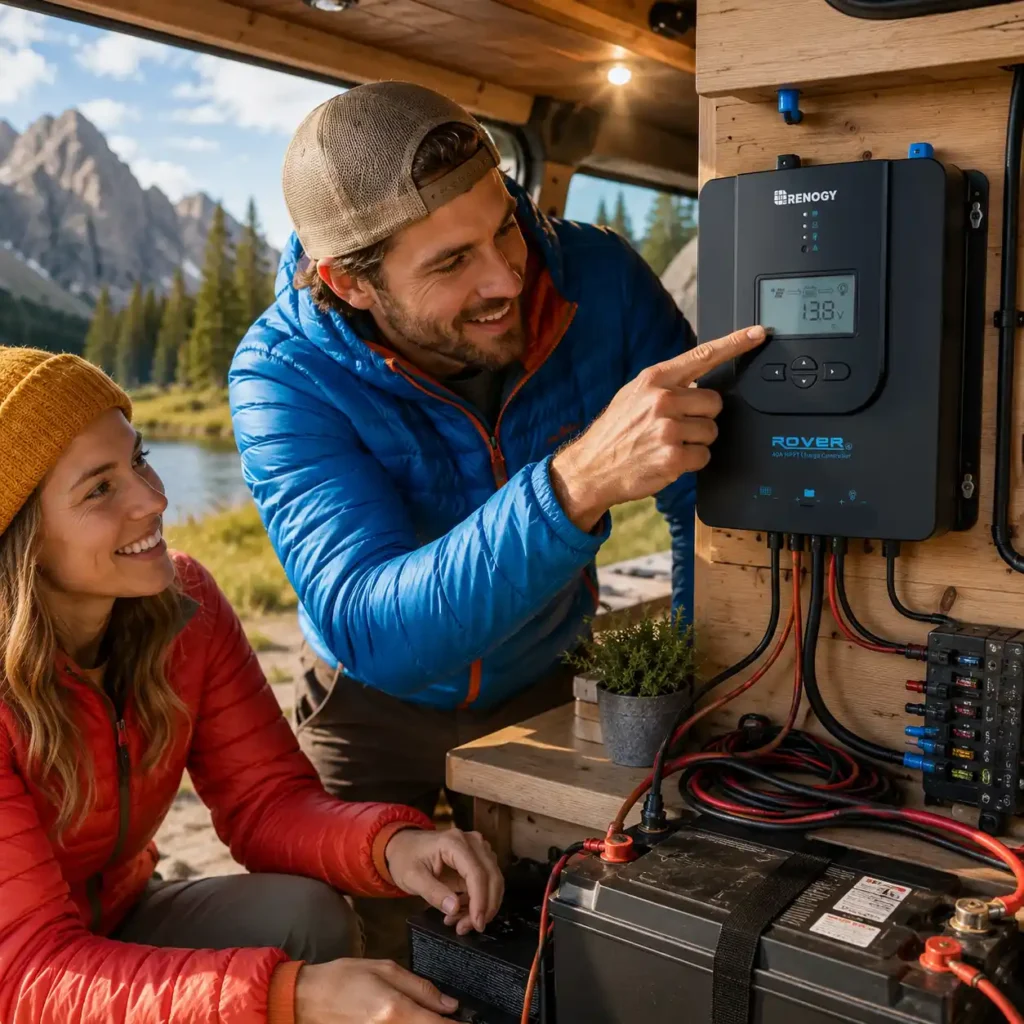
The Renogy Rover 40A MPPT is designed for campers and off-grid users who want dependable solar charging without unnecessary complexity. Once installed, it quietly manages the charging process while giving you enough information to understand how your solar system is performing throughout the day.
Imagine arriving at your campsite after a long drive. Your solar panels immediately begin replenishing the battery bank while the Rover automatically adjusts to changing sunlight conditions. Inside your camper van, the refrigerator continues running, lights stay on after sunset, and your phones, cameras, and laptops remain charged without requiring constant attention.
The built-in LCD display makes it easy to check battery voltage, charging current, and system status with a quick glance. For users who prefer additional convenience, the optional Bluetooth module allows you to monitor charging performance from your smartphone without opening electrical compartments or inspecting the controller directly.
Over longer trips, the Rover’s efficient MPPT charging becomes increasingly valuable. Every sunny morning helps recover battery capacity more quickly, while cloudy periods are handled intelligently as the controller continuously searches for the panels’ maximum power point. The result is a more efficient charging process that helps extend battery runtime during multi-day off-grid adventures.
For many DIY solar owners, that’s exactly what makes the Renogy Rover so appealing. It combines dependable everyday performance with practical monitoring features and enough flexibility to support a growing solar system for years to come.
Renogy Rover 40A MPPT Evaluation
| Evaluation Category | Editorial Assessment |
|---|---|
| Charging Efficiency | Highly efficient MPPT charging that consistently improves solar energy harvest over PWM controllers. |
| Ease of Use | The LCD display is straightforward, while optional Bluetooth adds convenient remote monitoring. |
| Reliability | Solid construction and dependable charging performance make it a trusted choice for everyday off-grid use. |
| Value | Outstanding balance of features, performance, and affordability for DIY solar installations. |
| Overall Rating | Our Best Value recommendation thanks to its excellent price-to-performance ratio and dependable long-term operation. |
Who Should Buy This
- DIY users building their first off-grid solar system.
- Camper van, RV, and boat owners seeking reliable MPPT charging at a reasonable price.
- Users who want compatibility with AGM, Gel, Flooded, and Lithium batteries.
- Solar enthusiasts planning to expand their systems over time.
- Buyers looking for premium performance without paying a premium price.
Who Should Skip This
- Users who want built-in Bluetooth without purchasing an additional module.
- Large solar installations requiring charging currents above 40A.
- Buyers seeking premium ecosystem integration comparable to higher-end systems.
- Very small solar setups where an inexpensive PWM controller is sufficient.
Final Verdict
The Renogy Rover 40A MPPT earns its Best Value award by delivering the features most off-grid users actually need at a price that remains accessible for a wide range of budgets. Its efficient MPPT charging, broad battery compatibility, dependable performance, and optional remote monitoring make it one of the strongest mid-range solar charge controllers available today.
While premium models may offer more advanced connectivity or ecosystem integration, the Rover focuses on what matters most: maximizing solar energy, protecting your batteries, and providing reliable day-to-day operation. That combination makes it an excellent choice for camper vans, RVs, cabins, boats, and many residential off-grid systems.
If you’re looking for a solar charge controller that offers exceptional performance without the premium price tag, the Renogy Rover 40A MPPT is our Best Value Solar Charge Controller.
Check the latest price and customer reviews on Amazon.
Related Guide: If you’re planning to expand your solar array and need to understand which panel types work best for different installations, our Best Portable Solar Panels (2026) guide compares practical solar panel options for camping, RVs, and off-grid power systems.
EPEVER Tracer 4210AN
Best Budget MPPT Solar Charge Controller

Quick Verdict
The EPEVER Tracer 4210AN earns our Best Budget MPPT award by offering genuine MPPT charging performance at one of the most affordable price points in its class. While it lacks some of the premium conveniences found on higher-end controllers, it delivers efficient solar charging, dependable battery protection, and proven reliability that have made it a popular choice among DIY solar enthusiasts for years.
Supporting both 12V and 24V battery systems, the controller provides up to 40A of charging current with a maximum PV open-circuit voltage of 100V, making it well suited for camper vans, cabins, boats, small RVs, and residential off-grid systems. Its advanced MPPT algorithm continuously tracks the optimal operating point of connected solar panels, helping improve charging efficiency over traditional PWM controllers in a wide range of weather conditions.
Although the Tracer 4210AN focuses on value rather than premium features, it remains highly capable. The controller supports multiple battery types, includes comprehensive electronic protection functions, and can be expanded with optional remote displays and communication modules for users who want additional monitoring capabilities.
For buyers who want the efficiency advantages of MPPT technology without stretching their budget, the EPEVER Tracer 4210AN continues to be one of the strongest value-focused controllers available.
Solar System Snapshot
| Feature | Details |
|---|---|
| Solar Systems | Camper Vans • Cabins • Boats • Small RVs • Off-Grid Homes |
| Charging Current | 40A |
| Battery Voltage | 12V / 24V (Auto) |
| Maximum PV Voltage | 100V |
| Charging Technology | MPPT |
| Monitoring | Optional Remote Meter and Communication Modules |
| Best For | Budget-conscious buyers seeking reliable MPPT charging without premium pricing. |
Why We Chose It
Finding an affordable solar charge controller often means choosing between price and performance. Many entry-level controllers use PWM technology, which can leave valuable solar energy unused under changing weather conditions. The EPEVER Tracer 4210AN stands out because it delivers true MPPT charging while remaining one of the most competitively priced controllers in its category.
Its intelligent MPPT tracking continuously adjusts to changing sunlight conditions, allowing connected solar panels to operate closer to their maximum power point throughout the day. The result is higher charging efficiency, faster battery recovery, and better overall solar utilization compared with similarly priced PWM alternatives.
We also value the controller’s reputation for long-term reliability. The Tracer series has been used successfully in thousands of off-grid installations worldwide, earning a strong reputation among DIY builders who prioritize dependable performance over luxury features. Multiple electronic protection functions—including overcharging, reverse polarity, overheating, and short-circuit protection—help safeguard both the controller and the connected battery system.
While it doesn’t include built-in Bluetooth or a premium smartphone app, the Tracer 4210AN supports optional remote displays and communication accessories for users who want expanded monitoring capabilities later. For buyers whose priority is maximizing solar charging performance while keeping costs under control, the EPEVER Tracer 4210AN offers one of the best price-to-performance ratios available in today’s MPPT controller market.
Check the latest price and customer reviews on Amazon.
Living With It
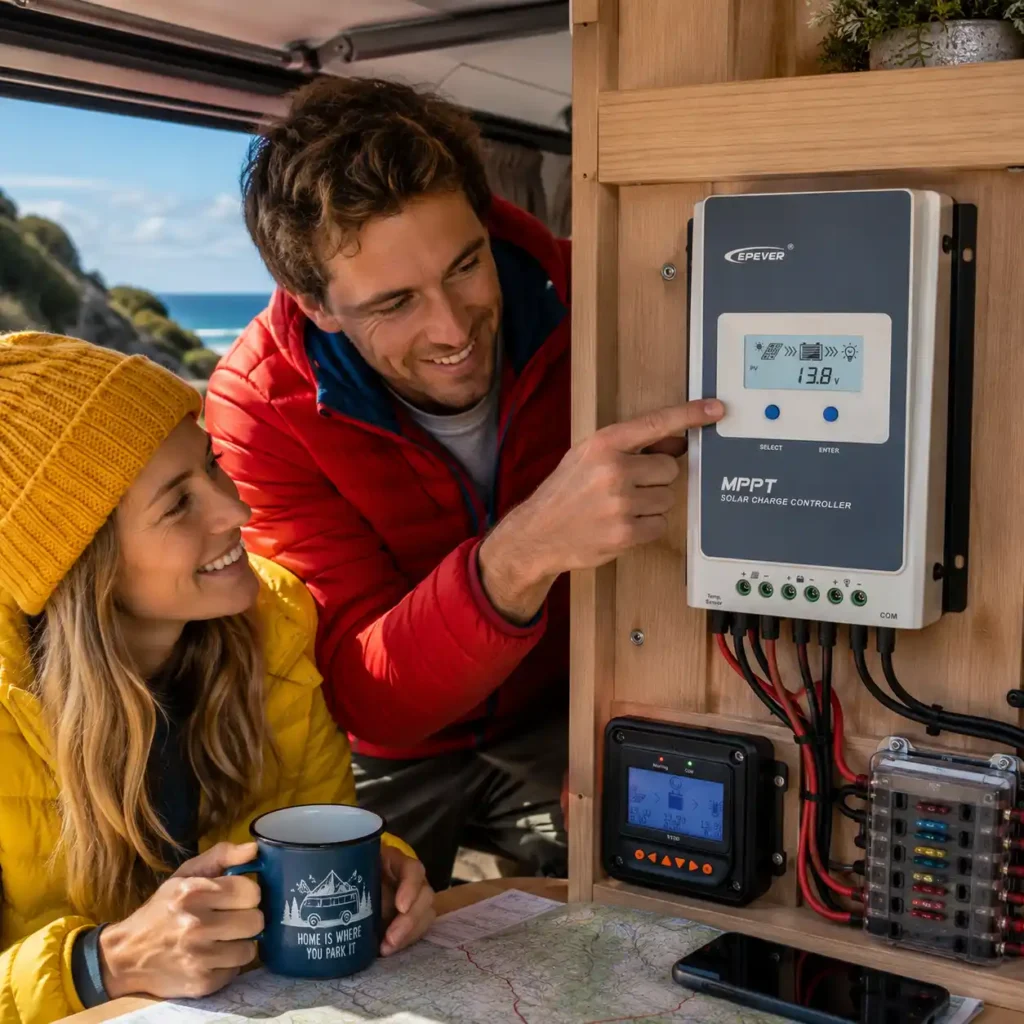
The EPEVER Tracer 4210AN proves that you don’t need a premium-priced controller to enjoy dependable off-grid solar power. Once installed, it quietly manages battery charging day after day, giving you the confidence that your solar system is making the most of every hour of available sunlight.
Imagine spending several days at an off-grid cabin or campsite without access to shore power. Each morning, your solar panels begin charging the battery bank as soon as the sun rises, while the Tracer automatically tracks the panels’ maximum power point to capture as much energy as possible. Throughout the day, your refrigerator, lighting, water pump, and mobile devices continue operating without requiring constant attention or manual adjustments.
Although the controller focuses on performance rather than luxury features, it provides clear operating information through compatible remote displays, allowing you to monitor charging status and battery performance whenever needed. Many users appreciate this straightforward approach, especially when reliability matters more than smartphone connectivity.
The controller also performs well under changing weather conditions. Passing clouds, varying panel temperatures, and fluctuating solar intensity are handled automatically by the MPPT algorithm, helping recover more energy than a comparable PWM controller would typically produce. During longer off-grid stays, those daily efficiency gains gradually translate into longer battery runtime and greater overall energy independence.
For DIY builders, the Tracer 4210AN offers another important advantage: confidence. It has earned a strong reputation through years of successful installations around the world, making it a controller that many users install once and rarely think about again—exactly the kind of dependable performance most off-grid systems need.
EPEVER Tracer 4210AN Evaluation
| Evaluation Category | Editorial Assessment |
|---|---|
| Charging Efficiency | True MPPT charging delivers excellent solar energy utilization for its price range. |
| Ease of Use | Simple operation with optional remote monitoring for users who want additional system information. |
| Reliability | Well-proven design with strong protection features and an excellent long-term reliability record. |
| Value | One of the best price-to-performance ratios among budget-friendly MPPT controllers. |
| Overall Rating | Our Best Budget MPPT recommendation thanks to its dependable performance, efficient charging, and outstanding affordability. |
Who Should Buy This
- Budget-conscious buyers who want true MPPT charging.
- DIY solar enthusiasts building their first off-grid system.
- Camper van, cabin, boat, and RV owners looking for reliable battery charging.
- Users who prioritize long-term reliability over premium smart features.
- Buyers seeking strong performance without paying for unnecessary extras.
Who Should Skip This
- Users who want built-in Bluetooth or Wi-Fi monitoring.
- Buyers looking for a premium mobile app experience.
- Large solar systems requiring charging currents above 40A.
- Users who prefer an integrated ecosystem with advanced smart accessories.
Final Verdict
The EPEVER Tracer 4210AN earns its Best Budget MPPT award by delivering exactly what many off-grid users need most: dependable MPPT charging, reliable battery protection, and proven long-term performance at an affordable price.
While it doesn’t offer the premium connectivity or polished software found on more expensive controllers, it excels where it matters most—efficiently converting solar energy into usable battery power while protecting your investment for years of everyday operation. Its strong reputation among DIY solar builders and off-grid enthusiasts is well deserved.
If your goal is to maximize charging efficiency without stretching your budget, the EPEVER Tracer 4210AN is one of the smartest MPPT solar charge controllers you can buy.
The included MT50 Remote Meter, RTS temperature sensor, and RS485 communication cable add exceptional value by providing expanded monitoring, more accurate temperature-compensated charging, and PC connectivity without requiring additional purchases. This complete accessory package is rarely included with budget-friendly MPPT controllers.
Check the latest price and customer reviews on Amazon.
Related Guide: If you’re deciding between different solar charging technologies, our Best Solar Chargers (2026) guide compares portable charging solutions for outdoor use, emergency preparedness, and situations where access to conventional electricity is limited.
Victron SmartSolar MPPT 75/15
Best Compact MPPT Controller

Quick Verdict
The Victron SmartSolar MPPT 75/15 earns our Best Compact Smart MPPT Solar Charge Controller award by combining premium MPPT charging performance, built-in Bluetooth connectivity, and Victron Energy’s renowned engineering quality in one of the most compact controllers available. Designed for smaller off-grid solar systems, it delivers highly efficient battery charging while providing convenient wireless monitoring through the VictronConnect app.
Supporting both 12V and 24V battery systems, the SmartSolar MPPT 75/15 delivers up to 15A of charging current and accepts a maximum 75V PV open-circuit voltage, making it an excellent choice for camper vans, boats, cabins, tiny homes, and other compact solar installations. Its advanced MPPT algorithm continuously tracks the maximum power point of connected solar panels, allowing the controller to harvest significantly more solar energy than comparable PWM controllers, especially during cool mornings, partial cloud cover, and rapidly changing weather conditions.
Unlike many compact charge controllers, the SmartSolar MPPT 75/15 includes integrated Bluetooth as standard equipment. Using the free VictronConnect mobile app, users can monitor charging performance, battery status, historical data, and update firmware directly from a smartphone without purchasing additional accessories. Combined with the VE.Direct communication port, the controller also offers seamless integration into larger Victron Energy systems as your off-grid installation grows.
For users seeking premium charging efficiency, intelligent monitoring, and long-term reliability in a compact package, the Victron SmartSolar MPPT 75/15 stands out as one of the best small MPPT solar charge controllers available today.
Solar System Snapshot
| Feature | Details |
|---|---|
| Solar Systems | Camper Vans • Boats • Cabins • Tiny Homes • Small RVs |
| Charging Current | 15A |
| Battery Voltage | 12V / 24V (Auto) |
| Maximum PV Voltage | 75V |
| Charging Technology | MPPT |
| Monitoring | Built-in Bluetooth • VictronConnect App • VE.Direct |
| Best For | Compact off-grid solar systems requiring premium MPPT charging with built-in wireless monitoring. |
Why We Chose It
Compact solar systems deserve the same charging efficiency and battery protection as larger installations, but many small charge controllers sacrifice advanced monitoring features to keep costs down. The Victron SmartSolar MPPT 75/15 takes a different approach by combining industry-leading MPPT charging technology with built-in Bluetooth connectivity, giving users premium functionality without increasing installation complexity.
Its intelligent MPPT algorithm continuously adjusts to changing sunlight conditions, enabling connected solar panels to operate close to their maximum power point throughout the day. Compared with traditional PWM controllers, this results in faster battery charging, higher energy harvest, and better overall solar performance—particularly during cold weather, partial shading, and fluctuating solar irradiance.
One of the controller’s biggest advantages is its integrated Bluetooth communication. Using the free VictronConnect app, owners can monitor charging status in real time, review historical performance, configure charging parameters, and install firmware updates directly from a smartphone or tablet. This eliminates the need for additional Bluetooth accessories while making system management simple and intuitive.
Beyond its smart features, the SmartSolar MPPT 75/15 reflects Victron Energy’s long-standing reputation for reliability. It incorporates comprehensive electronic protections against overheating, reverse polarity, battery overcharging, and short circuits, while the VE.Direct communication interface allows seamless expansion into larger Victron Energy ecosystems if your solar installation grows in the future.
For users building compact off-grid solar systems who want premium efficiency, wireless monitoring, and proven long-term durability, the Victron SmartSolar MPPT 75/15 is one of the strongest compact MPPT solar charge controllers on the market today.
Check the latest price and customer reviews on Amazon.

Living With It
The Victron SmartSolar MPPT 75/15 is designed for people who want a compact solar charging system that is both efficient and easy to monitor. Whether you’re traveling in a camper van, spending weekends at an off-grid cabin, or maintaining a small solar-powered boat, the controller quietly manages battery charging while giving you instant access to system data through your smartphone.
Imagine parking your camper beside a mountain lake for a long weekend. As the morning sun reaches your rooftop solar panel, the SmartSolar MPPT 75/15 immediately begins optimizing power production. Throughout the day, it keeps your battery charged while running LED lighting, a portable refrigerator, USB chargers, ventilation fans, and other everyday essentials that make off-grid living comfortable.
One of the controller’s greatest advantages is its built-in Bluetooth connectivity. Instead of opening electrical compartments or installing additional monitoring hardware, you simply launch the VictronConnect app to view charging current, battery voltage, historical performance, and charging stage in real time. Firmware updates and system configuration can also be completed wirelessly, making routine maintenance simple even for first-time solar users.
During changing weather conditions, the SmartSolar’s advanced MPPT algorithm continuously adjusts the operating point of the solar panels to capture more usable energy than a comparable PWM controller. Those daily efficiency gains help keep batteries healthier, extend available runtime, and make better use of every hour of sunlight.
For owners of compact solar systems, the SmartSolar MPPT 75/15 delivers an ideal balance of premium charging performance, intelligent wireless monitoring, and the long-term reliability that has made Victron Energy one of the most trusted names in off-grid solar power.
Victron SmartSolar MPPT 75/15 Evaluation
| Evaluation Category | Editorial Assessment |
|---|---|
| Charging Efficiency | Excellent MPPT performance maximizes energy harvest from compact solar arrays. |
| Ease of Use | Built-in Bluetooth and the VictronConnect app make monitoring and setup exceptionally simple. |
| Reliability | Premium Victron engineering with comprehensive electronic protection ensures dependable long-term operation. |
| Smart Features | Integrated Bluetooth, wireless firmware updates, and VE.Direct connectivity provide outstanding system flexibility. |
| Overall Rating | Our Best Compact Smart MPPT Solar Charge Controller recommendation thanks to its efficient charging, intelligent monitoring, and proven reliability. |
Who Should Buy This
- Camper van owners who want efficient charging with convenient smartphone monitoring.
- Boat owners seeking a compact and dependable MPPT charge controller.
- Cabin and tiny home owners running small off-grid solar systems.
- DIY solar builders looking for premium Victron quality without moving to larger controllers.
- Buyers who value built-in Bluetooth, easy configuration, and long-term reliability.
Who Should Skip This
- Large off-grid systems requiring more than 15A of charging current.
- Users planning to connect high-voltage or high-wattage solar arrays.
- Installations that require multiple charging outputs.
- Buyers looking for a lower-cost PWM controller for very small budgets.
Final Verdict
The Victron SmartSolar MPPT 75/15 earns its Best Compact Smart MPPT Solar Charge Controller award by combining premium MPPT charging performance, built-in Bluetooth monitoring, and exceptional long-term reliability in a compact, easy-to-install package.
Unlike many compact controllers that require additional accessories for wireless monitoring, the SmartSolar 75/15 includes integrated Bluetooth as standard. Combined with the VictronConnect app, it allows users to monitor system performance, adjust charging settings, review historical data, and install firmware updates directly from a smartphone, making everyday system management remarkably simple.
If you’re building a compact off-grid solar system and want premium charging efficiency, intelligent wireless monitoring, and the proven quality of Victron Energy, the SmartSolar MPPT 75/15 is one of the best compact MPPT solar charge controllers you can buy.
Check the latest price and customer reviews on Amazon.
Related Guide: If you’re building a smaller off-grid system where portability and installation flexibility matter, our Best Flexible Solar Panels (2026) guide explores lightweight panel options for RVs, boats, vans, and other mobile solar applications.
Renogy Wanderer Li 30A PWM
Best PWM Solar Charge Controller

Quick Verdict
The Renogy Wanderer Li 30A PWM earns our Best PWM Solar Charge Controller award by offering dependable battery charging, broad battery compatibility, and user-friendly operation at an affordable price. While it doesn’t deliver the higher energy harvest of MPPT technology, it remains an excellent choice for smaller solar systems where simplicity, reliability, and cost-effectiveness are the top priorities.
Designed for 12V battery systems, the Wanderer Li supports up to 30A of charging current and is compatible with sealed, gel, flooded, and lithium batteries, making it a versatile controller for camper vans, travel trailers, boats, sheds, cabins, and other small off-grid installations. Its PWM charging algorithm provides stable multi-stage battery charging that helps maintain battery health while protecting against common electrical faults.
Unlike many basic PWM controllers, the Wanderer Li includes an integrated LCD display for monitoring charging status, battery information, and system settings directly on the controller. It also supports an optional Renogy BT-1 Bluetooth Module, allowing users to monitor and configure their solar system remotely through the Renogy DC Home smartphone app.
For users building budget-friendly solar systems where affordability, ease of installation, and dependable everyday performance matter more than maximum charging efficiency, the Renogy Wanderer Li 30A PWM remains one of the best PWM solar charge controllers available today.
Solar System Snapshot
| Feature | Details |
|---|---|
| Solar Systems | Camper Vans • Boats • Cabins • RVs • Small Off-Grid Systems |
| Charging Current | 30A |
| Battery Voltage | 12V |
| Charging Technology | PWM |
| Battery Compatibility | Sealed • Gel • Flooded • Lithium |
| Monitoring | LCD Display • Optional BT-1 Bluetooth Module • Renogy DC Home App |
| Best For | Affordable 12V solar systems that prioritize reliable PWM charging and broad battery compatibility. |
Why We Chose It
Not every solar installation requires an MPPT charge controller. For smaller 12V systems with modest solar arrays, a well-designed PWM controller can provide reliable battery charging while significantly reducing overall system cost. The Renogy Wanderer Li 30A PWM stands out by delivering dependable everyday performance, wide battery compatibility, and one of the best user experiences in the PWM category.
Its intelligent multi-stage PWM charging helps maintain healthy battery charging cycles while supporting a wide range of battery chemistries, including sealed lead-acid, gel, flooded, and lithium batteries. This flexibility makes it an excellent option for users upgrading existing systems or switching to lithium batteries without replacing their charge controller.
Another advantage is the controller’s straightforward operation. The integrated LCD display provides clear access to charging status, battery information, and system settings directly from the unit, while optional Bluetooth connectivity through Renogy’s BT-1 Bluetooth Module allows remote monitoring and configuration using the Renogy DC Home mobile app.
The Wanderer Li also incorporates comprehensive electronic protection features, including safeguards against reverse polarity, battery overcharging, over-discharge, overload, short circuits, and overheating. These protections help improve battery longevity while giving users confidence during everyday operation.
For first-time solar builders and budget-conscious buyers who want dependable charging, simple installation, and excellent compatibility with modern battery technologies, the Renogy Wanderer Li 30A PWM remains one of the strongest value-oriented PWM solar charge controllers on the market.
Check the latest price and customer reviews on Amazon.

Living With It
The Renogy Wanderer Li 30A PWM is built for users who want a dependable solar charging system without unnecessary complexity. Whether you’re powering a weekend camper, a fishing boat, a small cabin, or a utility trailer, the controller quietly manages battery charging while requiring very little day-to-day attention.
Imagine arriving at your favorite lakeside campsite with a compact camper van equipped with a single solar panel and a lithium battery. As sunlight reaches the panel, the Wanderer Li immediately begins regulating the charging process, keeping your battery topped up while powering LED lighting, USB chargers, a portable refrigerator, fans, and other everyday essentials. Throughout the day, the controller automatically adjusts the charging stages to help maximize battery life without requiring manual intervention.
Its built-in LCD display makes checking system status quick and straightforward. Battery voltage, charging current, and operating information are always available at a glance, giving users confidence that their solar system is working properly. For those who want additional convenience, the optional Renogy BT-1 Bluetooth Module allows wireless monitoring through the Renogy DC Home mobile app, making it easy to review charging performance directly from a smartphone.
Although PWM technology cannot match the energy harvest of an MPPT controller, the Wanderer Li performs exceptionally well in smaller 12V solar systems where panel voltage closely matches battery voltage. For many camper vans, boats, sheds, and cabins using modest solar arrays, the difference in charging efficiency is often outweighed by the controller’s affordability, simplicity, and proven reliability.
For users looking for an easy-to-install solar charge controller that delivers dependable battery protection, broad battery compatibility, and excellent value, the Renogy Wanderer Li 30A PWM remains one of the most trusted PWM controllers available today.
Renogy Wanderer Li 30A PWM Evaluation
| Evaluation Category | Editorial Assessment |
|---|---|
| Charging Performance | Reliable multi-stage PWM charging delivers dependable battery maintenance for small 12V solar systems. |
| Ease of Use | Simple installation, intuitive LCD display, and optional Bluetooth monitoring make everyday operation straightforward. |
| Reliability | Comprehensive electronic protection and Renogy's proven design provide dependable long-term performance. |
| Value | Outstanding affordability and broad battery compatibility make it one of the strongest PWM controllers in its class. |
| Overall Rating | Our Best PWM Solar Charge Controller recommendation thanks to its dependable charging, ease of use, and excellent value. |
Who Should Buy This
- Budget-conscious buyers building a small 12V solar system.
- Camper van, trailer, boat, and cabin owners using modest solar arrays.
- First-time DIY solar builders looking for an easy-to-install controller.
- Users running sealed, gel, flooded, or lithium batteries.
- Buyers who value simplicity, reliability, and affordability over maximum charging efficiency.
Who Should Skip This
- Users who want the higher energy harvest of MPPT technology.
- Solar systems using higher-voltage PV arrays.
- Installations larger than 30A charging capacity.
- Buyers looking for built-in Bluetooth monitoring without purchasing an optional accessory.
Final Verdict
The Renogy Wanderer Li 30A PWM earns its Best PWM Solar Charge Controller award by delivering reliable battery charging, broad battery compatibility, and outstanding value for compact 12V solar systems.
While PWM technology cannot match the efficiency of MPPT controllers, the Wanderer Li offers stable multi-stage charging, comprehensive electronic protection, and user-friendly operation that make it an excellent solution for smaller off-grid installations. Its integrated LCD display, optional Bluetooth connectivity, and support for modern lithium batteries further strengthen its appeal for both first-time and experienced solar users.
If you’re building a budget-friendly 12V solar system and want a dependable, easy-to-use controller from a trusted manufacturer, the Renogy Wanderer Li 30A PWM is one of the best PWM solar charge controllers you can buy.
Check the latest price and customer reviews on Amazon.
Related Guide: Before choosing the right charge controller for your system, our How to Calculate Power Consumption (Complete Guide + Free Calculator) guide can help you estimate your actual electrical loads and understand how much solar and battery capacity your setup may require.
How to Choose the Best Solar Charge Controller
Choosing the best solar charge controller isn’t simply about buying the model with the highest amperage or the most advanced features. The right controller depends on your solar panel output, battery type, system voltage, and how you plan to use your solar power system.
Many buyers assume that purchasing the largest MPPT controller automatically guarantees better performance. In reality, an oversized controller may cost considerably more without providing any real advantage for a smaller solar installation. On the other hand, choosing a controller that’s too small can limit your system’s performance, reduce charging efficiency, and even prevent future expansion.
The goal is to select a charge controller that matches your solar array and battery bank—not simply the one with the highest specifications. Whether you’re building a compact camper van system, powering an RV, maintaining a boat battery, or installing a complete off-grid solar setup, understanding a few key specifications will help you choose a controller that delivers reliable, efficient charging for years to come.
The sections below explain the most important factors to consider before buying your first—or next—solar charge controller.
One piece of advice applies to almost every solar installation: don’t shop for the biggest charge controller—shop for the solar system you actually plan to build. A properly matched controller will quietly maximize charging performance, protect your batteries, and provide dependable operation without adding unnecessary cost or complexity.
Start With Your Solar System
The first question isn’t, “Which solar charge controller is the most powerful?” It’s “What kind of solar system are you building?”
Different solar installations place very different demands on a charge controller, and choosing the right model starts with understanding your own setup rather than comparing specifications alone.
Imagine two RV owners shopping for a new charge controller.
One is installing a single 200W solar panel to keep a lithium battery charged during weekend trips. The other is building a 1,000W rooftop solar array with multiple batteries for extended off-grid camping.
Although both systems perform the same basic function, their charging requirements are completely different. A controller that’s ideal for the smaller system would quickly become a bottleneck for the larger installation, while a high-capacity MPPT controller designed for a large solar array would add unnecessary cost to the smaller setup without improving performance.
That’s why choosing the right controller is far more important than simply choosing the largest one.
A small camper van or travel trailer with one or two solar panels often requires only a compact controller that provides reliable battery charging while remaining simple to install. Larger RVs, cabins, boats, and off-grid homes typically benefit from higher-capacity MPPT controllers that can handle greater solar input, support larger battery banks, and leave room for future expansion.
It’s also worth thinking beyond your current installation. Many solar systems grow over time as additional panels or batteries are added. Choosing a controller with a reasonable safety margin can make future upgrades much easier without requiring you to replace the entire charging system.
Instead of asking how many amps the controller can handle, start by identifying the solar system you actually plan to build. Matching the controller to your solar array, battery bank, and future plans will almost always result in better performance, lower long-term costs, and a more reliable solar installation.
MPPT vs PWM: Which Technology Is Right for You?

One of the first decisions you’ll make when choosing a solar charge controller is whether to buy an MPPT (Maximum Power Point Tracking) or PWM (Pulse Width Modulation) model.
While both types perform the same essential task—regulating the flow of energy from your solar panels to your batteries—they do so in very different ways. Understanding these differences is one of the best ways to avoid buying the wrong controller for your solar system.
For many first-time buyers, the choice can seem confusing. MPPT controllers typically cost more, while PWM models are often marketed as a budget-friendly alternative. However, the better option isn’t determined by price alone. It depends on the size of your solar array, the type of battery you’re using, and how much charging efficiency matters in your application.
| Feature | MPPT | PWM |
|---|---|---|
| Charging efficiency | Higher | Lower |
| Best for | Medium and large solar systems | Small solar systems |
| Initial cost | Higher | Lower |
| Lithium battery compatibility | Excellent | Good for smaller systems |
| Future expansion | Excellent | Limited |
What Is an MPPT Solar Charge Controller?
MPPT controllers continuously monitor the voltage and current produced by your solar panels, automatically adjusting their operating point to harvest the maximum available power.
Instead of sending panel voltage directly to the battery, an MPPT controller converts excess voltage into additional charging current. This allows your solar panels to operate at their most efficient voltage while delivering more usable energy to the battery bank.
In real-world conditions, MPPT controllers can harvest significantly more energy than PWM models, particularly during cold weather, cloudy conditions, or when solar panel voltage is substantially higher than battery voltage. The efficiency advantage becomes even more noticeable whenever your solar panels operate well above your battery’s charging voltage.
They’re also the preferred choice for larger solar arrays, higher-voltage panel configurations, and lithium battery systems where maximizing charging efficiency is a priority.
What Is a PWM Solar Charge Controller?
PWM controllers use a much simpler charging method. Their straightforward design makes them easy to install, reliable, and generally more affordable than MPPT controllers.
Rather than converting excess panel voltage into additional charging current, a PWM controller gradually reduces the charging current as the battery approaches full charge, effectively matching the solar panel voltage to the battery voltage.
Because they don’t optimize power conversion, PWM controllers are less efficient whenever the solar panel voltage is significantly higher than the battery voltage.
However, they remain a practical solution for smaller solar systems where efficiency gains are relatively modest and keeping costs low is more important than maximizing every watt of available solar energy.
When Should You Choose MPPT?
An MPPT controller is usually the better investment if you:
- plan to install solar arrays above approximately 200W;
- use LiFePO₄ batteries;
- expect to camp or live off-grid year-round;
- want the highest possible charging efficiency;
- plan to expand your solar system in the future;
- use higher-voltage solar panel configurations.
Although MPPT controllers typically cost more upfront, the additional energy they recover often offsets the higher purchase price over the lifetime of the system.
When Is PWM Still a Good Choice?
PWM controllers continue to make sense for many smaller installations.
They’re often a good choice if you:
- have a single small solar panel;
- maintain a battery during storage;
- operate a modest 12V system with limited power demands;
- want an inexpensive controller for occasional use;
- don’t expect to expand your solar array later.
For these applications, a quality PWM controller can provide dependable battery charging without the additional cost of MPPT technology.
Which One Should You Choose?
For most RV owners, van builders, cabin owners, and off-grid users, an MPPT solar charge controller is the better long-term investment. Higher charging efficiency, better performance in changing weather conditions, and greater flexibility for future system expansion make it the preferred choice for modern solar installations.
PWM controllers still have their place, particularly in small, budget-friendly systems where simplicity and affordability matter more than extracting every possible watt from the solar panels.
As a general rule, if you’re investing in a solar system that you expect to use for many years, it’s usually worth choosing an MPPT controller from the beginning. It not only improves charging performance today but also gives you more flexibility as your solar system grows in the future.
What Size Solar Charge Controller Do You Need?

Choosing the correct size solar charge controller is just as important as selecting the right charging technology. Even the most advanced MPPT controller won’t deliver its full potential if it’s undersized for your solar array, while an oversized controller may simply increase your project cost without providing any immediate benefit.
The key specification to understand is charging current, measured in amps (A). Your charge controller must safely handle the maximum current your solar panels can produce while remaining compatible with your battery bank and system voltage.
As a general guideline, smaller solar systems with panels up to 200W often require a 15A–20A controller. Systems in the 200W–500W range typically work best with 20A–40A models, while larger installations above 500W usually benefit from 40A or higher MPPT controllers, depending on the total solar capacity and battery voltage.
Remember that battery voltage also affects controller sizing. A 400W solar array connected to a 12V battery requires more charging current than the same array connected to a 24V battery. For this reason, manufacturers always specify both the maximum charging current and the supported battery voltages for each controller.
It’s also smart to think about future expansion. If you expect to add more solar panels later, choosing a controller with a reasonable safety margin can save money and simplify upgrades by eliminating the need to replace the controller as your system grows.
Rather than choosing the largest controller available, select one that’s properly matched to your current solar array while allowing modest room for future growth. A correctly sized controller will maximize charging efficiency, protect your batteries, and provide reliable performance for years to come.
| Solar Array Size | Typical Battery System | Recommended Charging Current |
|---|---|---|
| Up to 200W | 12V | 15A–20A |
| 200W–500W | 12V / 24V | 20A–40A |
| 500W–800W | 24V | 40A–60A |
| 800W+ | 24V / 48V | 60A+ (depending on system voltage and total solar array size) |
Battery Compatibility
Your solar charge controller must be compatible with the type of battery you’re using. While most modern controllers support multiple battery chemistries, not every model offers the same charging profiles or level of flexibility.
Today’s solar systems commonly use four battery types: LiFePO₄ (Lithium Iron Phosphate), AGM, Gel, and Flooded lead-acid batteries. Each chemistry requires slightly different charging voltages and charging stages to maximize battery life and performance.
LiFePO₄ batteries have become the preferred choice for many modern RVs, camper vans, boats, and off-grid systems because they offer longer cycle life, faster charging, lower weight, and greater usable capacity. Most premium MPPT controllers include dedicated lithium charging profiles or allow users to configure custom charging parameters for optimal performance.
AGM and Gel batteries remain popular because they’re maintenance-free and generally less expensive than lithium batteries. However, they require different charging voltages than LiFePO₄ batteries, making it important to verify that your controller supports the battery chemistry you plan to use.
Flooded lead-acid batteries are still widely used in larger off-grid systems and older solar installations. They require periodic maintenance and often benefit from equalization charging, a feature that not every charge controller supports.
Before purchasing a controller, always check the manufacturer’s specifications to confirm compatibility with your battery type. If you expect to upgrade from lead-acid to lithium batteries in the future, choosing a controller that supports both chemistries can help protect your investment and simplify future system upgrades.
PV Input Voltage Matters
When comparing solar charge controllers, many buyers focus almost entirely on charging current while overlooking another equally important specification: maximum PV input voltage.
This value determines the highest open-circuit voltage (Voc) your controller can safely accept from the connected solar panels. If your solar array exceeds the controller’s maximum PV voltage rating, the controller may shut down, trigger protective functions, or even suffer permanent damage in severe cases.
This becomes especially important when connecting multiple solar panels in series. Each panel adds voltage to the array, meaning a system that works perfectly with a single panel may exceed the controller’s limits after additional panels are installed.
For example, a controller rated for 100V PV input can safely support a much wider range of panel configurations than a controller limited to 50V or 75V. That’s one reason why higher-quality MPPT controllers often offer greater flexibility for future system expansion.
Before purchasing a solar charge controller, compare the controller’s maximum PV input voltage with the combined open-circuit voltage (Voc) of your solar panels. It’s also wise to leave a safety margin, as panel voltage can increase during cold weather and under certain environmental conditions.
Choosing a controller with an appropriate PV voltage rating not only improves system reliability but also gives you greater flexibility if you decide to expand your solar array in the future.
Monitoring Features: Do You Really Need Bluetooth?
One feature that has become increasingly common on modern solar charge controllers is built-in monitoring. While basic controllers simply manage battery charging, many MPPT models now allow you to monitor system performance, adjust charging settings, and review historical data using a smartphone or computer.
For many users, Bluetooth monitoring is more than just a convenience. It provides real-time information about battery voltage, charging current, solar power production, and charging history without requiring access to the controller itself. This can be especially useful when the controller is installed inside a storage compartment, electrical cabinet, or other hard-to-reach location.
Controllers such as the Victron SmartSolar series include built-in Bluetooth, allowing users to connect directly through the VictronConnect app. Other manufacturers may require an optional Bluetooth module or external display for remote monitoring.
However, not every solar installation requires advanced monitoring features. If your system consists of a single solar panel maintaining a battery for occasional weekend trips, a simple controller without wireless connectivity may be perfectly adequate. On the other hand, larger RV, boat, or off-grid systems often benefit from the additional visibility that Bluetooth or remote monitoring provides.
When comparing solar charge controllers, consider how often you’ll want to monitor your system and whether remote access is likely to improve your overall experience. While Bluetooth isn’t essential for every installation, it can make system management significantly easier, particularly as your solar setup becomes more complex.
Installation and Expandability
Choosing a solar charge controller isn’t only about meeting your current power needs. It’s also worth considering how easily the controller can be installed today and whether it will allow your solar system to grow in the future.
Most modern charge controllers are designed for straightforward installation, but there are important differences between models. Before purchasing, check the controller’s wiring terminals, supported cable sizes, and available communication ports. A well-designed controller can simplify installation while making future maintenance much easier.
Expandability is another factor that’s often overlooked. Many people begin with a single solar panel and one battery, only to add more panels, larger battery banks, or additional monitoring equipment later. Selecting a controller that provides sufficient charging capacity and supports future accessories can help avoid replacing the entire unit as your system evolves.
Some premium controllers also integrate with broader solar ecosystems, allowing them to communicate with inverters, battery monitors, and other energy management devices. While these features aren’t necessary for every installation, they can provide valuable flexibility for larger RV, marine, cabin, or residential off-grid systems.
If you expect your solar setup to remain small, a simple standalone controller may be all you need. However, if you think your system is likely to expand over time, investing in a controller that supports future upgrades can be a smart long-term decision.
Features You Can Ignore
Shopping for a solar charge controller can quickly become overwhelming. Product listings often highlight long lists of features, making it seem as though every additional function is essential. In reality, many buyers end up paying for capabilities they’ll rarely—or never—use.
For most RV owners, camper van travelers, boat owners, and small off-grid systems, the fundamentals matter far more than an extensive feature list. Reliable MPPT charging, compatibility with your battery type, appropriate charging current, and solid build quality will have a much greater impact on everyday performance than extra convenience features.
For example, premium communication options, advanced networking capabilities, or highly specialized programming functions may be valuable for large residential solar installations, but they’re often unnecessary for smaller mobile or recreational systems. Similarly, choosing a controller solely because it offers the highest charging current rarely makes sense if your solar array doesn’t require that capacity.
Instead of comparing products by the number of advertised features, focus on the specifications that directly affect your system’s performance and reliability. A well-matched controller with the right charging technology and battery support will almost always provide better long-term value than a more expensive model packed with features you never use.
When in doubt, prioritize performance over marketing. A controller that efficiently charges your batteries every day is far more valuable than one offering dozens of functions that add complexity without improving the overall performance of your solar system.
Common Buying Mistakes

Buying the right solar charge controller isn’t just about choosing a trusted brand or the latest technology. Many disappointing purchases happen because buyers overlook a few basic specifications that have a major impact on system performance.
One of the most common mistakes is choosing a controller based solely on its charging current. While amperage is important, it isn’t the only specification that matters. Battery compatibility, maximum PV input voltage, and charging technology all play equally important roles in selecting the right controller.
Another frequent mistake is purchasing a PWM controller for a larger solar array simply because it’s less expensive. Although PWM controllers work well for small systems, they can significantly reduce energy harvest when paired with higher-voltage solar panels or larger installations where an MPPT controller would be much more efficient.
Many buyers also fail to consider future expansion. A controller that perfectly matches today’s system may become a limitation after adding more solar panels or upgrading to a larger battery bank. Choosing a model with a reasonable capacity margin can help avoid replacing the controller as the system grows.
Finally, don’t assume that every controller supports every battery chemistry. Before buying, always verify compatibility with your specific battery type, whether it’s LiFePO₄, AGM, Gel, or Flooded lead-acid. Selecting the correct charging profile is essential for maximizing battery performance and lifespan.
Taking a few extra minutes to compare these key specifications before making a purchase can help you avoid costly mistakes and ensure that your solar charge controller continues to perform reliably for years to come.
Quick Buyer Checklist
Before buying a solar charge controller, make sure you can answer “yes” to each of these questions:
- I know whether I need an MPPT or PWM controller.
- The controller supports my battery chemistry (LiFePO₄, AGM, Gel, or Flooded).
- Its charging current is sufficient for my solar array.
- The maximum PV input voltage exceeds my panel voltage.
- It matches my system voltage (12V, 24V, or 48V).
- I have room for future solar panel expansion.
- The monitoring features meet my needs (Bluetooth, display, or remote monitoring).
- The controller is from a manufacturer with a proven reliability record.
Matching the Right Controller to Your Solar System
The best solar charge controller isn’t necessarily the most powerful or the most expensive—it’s the one that matches your solar system and the way you plan to use it. Choosing a controller that fits your current setup while allowing for reasonable future expansion will provide the best balance of performance, reliability, and value.
For small systems, such as a single solar panel used to maintain a battery in a camper van, travel trailer, or boat, a compact PWM or entry-level MPPT controller is often sufficient. These installations typically prioritize simplicity, affordability, and dependable battery maintenance over maximum charging efficiency.
Medium-sized systems with multiple solar panels generally benefit from an MPPT controller. The improved charging efficiency helps recover more energy throughout the day, especially in changing weather conditions, making MPPT the preferred choice for most RVs, camper vans, and small off-grid cabins.
Larger off-grid installations with higher solar capacity and expanded battery banks require controllers capable of handling greater charging currents and higher PV input voltages. In these systems, choosing a high-quality MPPT controller provides the flexibility and performance needed to support future expansion while maximizing the energy harvested from the solar array.
Before making your final decision, consider not only the size of your current system but also how you expect it to evolve over the next few years. Selecting a controller that supports your long-term plans can reduce upgrade costs and help ensure your solar power system continues to meet your needs as it grows.
Our Expert Buying Tips
After reviewing dozens of solar charge controllers across a wide range of off-grid applications, one recommendation consistently stands out: buy the controller that fits your system—not the one with the biggest specifications.
Start by calculating the size of your solar array, confirming your battery type, and checking the maximum PV input voltage your system requires. These three factors will narrow your options far more effectively than comparing long lists of features or marketing claims.
If your budget allows, an MPPT controller is usually the best long-term investment. The higher charging efficiency, improved performance in changing weather conditions, and greater flexibility for future expansion often justify the higher initial cost, particularly for RVs, camper vans, cabins, and residential off-grid systems.
However, don’t assume that every installation requires the most advanced controller available. Smaller systems used for battery maintenance or occasional camping trips can perform perfectly well with a quality PWM controller that matches the system’s requirements.
Finally, choose a controller from a manufacturer with a proven reputation for reliability, clear documentation, and long-term product support. A dependable charge controller is one of the most important components in any solar power system, protecting both your batteries and your investment for years to come.
Real-World Solar Charge Controller Examples
Choosing the right solar charge controller becomes much easier when you can relate technical specifications to real-world solar systems. While charging current, battery compatibility, and PV input voltage are important, many buyers still wonder one simple question: “What size controller do I actually need for my setup?”
The examples below illustrate how different types of solar installations typically pair with different charge controllers. These aren’t strict design rules—every system should be sized according to its specific solar panels, battery bank, and energy requirements—but they provide a practical starting point for planning your installation.
Whether you’re maintaining a single battery in a camper van or building a larger off-grid solar system for a cabin or home, these examples show how controller size, charging technology, and intended use all work together.
Example 1: Weekend Camper Van
Imagine you own a compact camper van with a single 200W solar panel and one 12V LiFePO₄ battery. Your daily power needs include LED lighting, USB charging, a portable refrigerator, a roof vent fan, and occasional laptop charging during weekend trips.
For a system like this, a 15A–20A MPPT solar charge controller is typically an excellent choice. It provides enough charging capacity to maximize the output of a 200W solar panel while leaving a modest safety margin for efficient operation. Choosing an MPPT controller also improves charging performance during cloudy weather and cooler mornings, helping recover more energy throughout the day than a comparable PWM model.
If you plan to add another solar panel in the future, it may be worth selecting a slightly larger controller now rather than replacing it later. Otherwise, a compact MPPT controller offers an efficient, reliable, and cost-effective solution for this type of camper van installation.
Example 2: Family RV
A family RV often places much greater demands on a solar charging system. It’s common to see two or more solar panels, a larger battery bank, and electrical loads such as a compressor refrigerator, water pump, lighting, device chargers, a television, and occasional use of a small inverter.
In this situation, a 30A–40A MPPT charge controller is generally the better choice. The higher charging capacity allows the controller to handle a larger solar array efficiently while maintaining fast battery charging throughout the day. MPPT technology also helps recover additional energy during changing weather conditions, which becomes increasingly valuable when multiple appliances rely on stored battery power.
If the RV is likely to receive additional solar panels later, selecting a controller with extra capacity can simplify future upgrades without replacing the charging system.
Example 3: Off-Grid Cabin
An off-grid cabin typically relies on solar power every day, making the charge controller one of the most important components in the entire electrical system. Unlike weekend camping setups, these systems often support larger battery banks and higher daily energy consumption.
Imagine a cabin equipped with a 24V battery bank, multiple solar panels, LED lighting, a refrigerator, water pump, internet equipment, and other essential appliances. In this type of installation, a 40A–60A MPPT solar charge controller is usually the most appropriate choice.
The higher charging capacity allows the controller to efficiently manage larger solar arrays while maximizing energy harvest throughout the day. This becomes especially valuable during winter months or extended periods of cloudy weather, when every additional watt of available solar energy helps maintain battery charge.
If you’re planning an off-grid cabin that may expand over time, choosing a controller with sufficient charging capacity and a generous PV input voltage rating can make future upgrades much easier. Investing in the right controller from the beginning often reduces long-term costs while improving the overall reliability of the solar power system.
Example 4: Boat or Marine System
Marine solar systems present unique challenges. Salt air, vibration, limited installation space, and changing weather conditions all place additional demands on electrical equipment, making reliability just as important as charging performance.
A typical boat may use solar power to keep house batteries charged while running navigation equipment, cabin lighting, communication devices, refrigerators, and other onboard electronics. Depending on the size of the solar array, a 20A–40A MPPT controller is often the preferred solution, providing efficient battery charging while maximizing the energy available from limited deck space.
For many boat owners, built-in Bluetooth monitoring is also a valuable feature. Being able to check battery voltage, charging status, and solar production from a smartphone makes it easier to monitor the system without accessing the electrical compartment.
When selecting a controller for marine use, look for a model with durable construction, comprehensive electronic protection, and a strong reputation for long-term reliability. A dependable controller helps protect your batteries while ensuring your onboard electrical system continues operating safely throughout every voyage.
Common Solar Power Systems That Use a Charge Controller

Not every solar power system has the same charging requirements. The ideal charge controller depends not only on the size of the solar array but also on how the system is used and the equipment it needs to support.
Some installations simply maintain a single battery between trips, while others provide continuous power for refrigerators, lighting, water pumps, communication equipment, and other essential devices. Understanding the typical requirements of different applications makes it much easier to choose a controller that delivers reliable performance without paying for unnecessary capacity.
The examples below highlight some of the most common solar power systems where selecting the right charge controller can improve charging efficiency, protect battery life, and simplify future system expansion.
Camper Vans
Camper vans are one of the most common applications for solar charge controllers. Most systems use one or two rooftop solar panels to keep a house battery charged while powering LED lights, portable refrigerators, roof fans, USB chargers, and small electronic devices.
For many camper van owners, an MPPT controller offers the best balance of efficiency and long-term value. It helps maximize energy production during changing weather conditions while making the most of limited roof space. Built-in Bluetooth monitoring is also a popular feature, allowing users to check charging performance directly from a smartphone without opening electrical compartments.
Choosing a controller with enough capacity for future solar panel upgrades is often worthwhile, especially if longer off-grid trips are planned.
RVs and Travel Trailers
RVs and travel trailers often require larger and more flexible solar charging systems than compact camper vans. With greater roof space available for solar panels and higher daily energy consumption, these systems typically rely on larger battery banks to power refrigerators, lighting, water pumps, entertainment systems, and a wide range of personal electronics.
For most RV installations, an MPPT solar charge controller is the preferred choice. Its higher charging efficiency helps maximize energy production throughout the day, particularly when weather conditions change or rooftop space limits the size of the solar array. Many RV owners also appreciate Bluetooth monitoring, which allows them to check battery status and solar production without entering storage compartments or electrical bays.
When selecting a controller for an RV, it’s worth considering not only your current solar array but also future upgrades. Many RV owners gradually add more solar panels or increase battery capacity over time, making a controller with additional charging headroom a practical long-term investment.
Boats and Marine Systems
Solar charge controllers play an important role in marine electrical systems, where reliable battery charging is essential for navigation equipment, communication devices, lighting, refrigeration, and other onboard electronics.
Marine environments create additional challenges, including vibration, humidity, and exposure to salt air. Choosing a high-quality controller with proven reliability and comprehensive protection features helps ensure dependable operation under demanding conditions.
MPPT controllers are particularly well suited for boats because they maximize energy harvest from limited deck space, allowing solar panels to produce more usable power throughout the day. Many modern marine installations also benefit from Bluetooth monitoring, giving owners convenient access to charging information while onboard.
Off-Grid Cabins
Off-grid cabins depend on consistent battery charging to provide reliable electricity throughout the year. These systems often include larger solar arrays, higher-capacity battery banks, and essential household loads such as refrigerators, water pumps, lighting, internet equipment, and small appliances.
For most cabin installations, a high-quality MPPT controller delivers the best combination of efficiency, battery protection, and long-term reliability. As solar systems expand, features such as higher PV input voltage limits and compatibility with larger battery banks become increasingly important.
Selecting a controller with room for future growth allows cabin owners to expand their solar capacity without replacing one of the most critical components of the system.
Tiny Homes and Backup Power Systems
Tiny homes and residential backup power systems often share many of the same requirements as larger off-grid installations, although their energy consumption varies considerably depending on the appliances being used.
A properly sized MPPT controller helps maximize the available solar energy while maintaining healthy battery charging throughout changing weather conditions. For homeowners using LiFePO₄ batteries, selecting a controller with dedicated lithium charging profiles can further improve battery performance and lifespan.
Whether the goal is full-time off-grid living or maintaining backup power during utility outages, choosing a controller that matches both the solar array and battery bank helps create a reliable system capable of supporting future energy needs.
MPPT vs. PWM Solar Charge Controllers: Which Is Better?
If you’ve been comparing solar charge controllers, you’ve probably noticed that almost every model falls into one of two categories: MPPT or PWM. While we’ve already explained how each technology works, the question many buyers still ask is simple: Which one should you actually choose?
The answer depends less on which technology is “better” and more on how you plan to use your solar power system. Both types regulate battery charging effectively, but they are designed for different applications, budgets, and performance expectations.
MPPT controllers are the preferred choice for most modern solar installations. By continuously tracking the maximum power point of your solar panels, they convert available solar energy into usable charging current more efficiently than PWM controllers. This higher efficiency becomes particularly valuable in larger solar arrays, during cloudy weather, and whenever panel voltage is significantly higher than battery voltage.
PWM controllers, on the other hand, remain a practical solution for smaller and less demanding systems. If you’re maintaining a single battery with one solar panel or building a simple weekend camping setup, a quality PWM controller can provide reliable charging at a much lower initial cost.
For most RV owners, camper van builders, boat owners, and off-grid cabin users, an MPPT controller is usually the better long-term investment. The higher energy harvest, greater flexibility, and compatibility with future system expansion often outweigh the additional upfront cost.
However, if your solar system is small, your energy requirements are modest, and your budget is limited, a well-built PWM controller can still be an excellent choice. The most important goal isn’t selecting the most advanced technology—it’s selecting the controller that best matches your solar array, battery bank, and long-term plans.
Frequently Asked Questions
Do I need a solar charge controller for every solar panel?
Not always. If you’re charging a battery from a solar panel, a charge controller is almost always required to prevent overcharging and protect battery life. The main exception is very small trickle chargers that include a built-in regulator or are specifically designed for battery maintenance. For most RV, camper van, boat, and off-grid solar systems, a dedicated charge controller is an essential component
How do I know what size solar charge controller I need?
Start by determining your solar array’s total wattage, battery voltage, and the maximum charging current your panels can produce. The controller must safely handle both the charging current and the maximum PV input voltage while allowing some room for future expansion. Choosing the correct size helps maximize charging efficiency and protects both the controller and your batteries.
Is an MPPT controller always better than PWM?
Not necessarily. MPPT controllers offer higher charging efficiency and are the preferred choice for medium and large solar systems. However, a quality PWM controller can still be an excellent option for small systems with modest power requirements, particularly when keeping costs low is a priority. The best choice depends on your solar array, battery type, and future expansion plans.
Can I use a 24V solar panel with a 12V battery?
Yes—but only if you’re using a compatible MPPT charge controller. An MPPT controller converts the higher panel voltage into the correct charging voltage for the battery while maintaining high efficiency. A PWM controller generally requires the solar panel voltage to closely match the battery voltage and is not suitable for most higher-voltage panel configurations.
Can I connect more solar panels than my charge controller is rated for?
Only within the manufacturer’s specifications. Exceeding the controller’s maximum PV input voltage can damage the unit, while exceeding its charging current rating may reduce performance or trigger protective functions. Always check both limits before expanding your solar array.
Will a larger charge controller charge my batteries faster?
Not by itself. A larger controller only delivers the power that your solar panels can actually produce. If your solar array generates 20A, installing a 60A controller won’t increase charging speed. Larger controllers are mainly beneficial when supporting larger solar arrays or allowing room for future expansion
Can one charge controller charge multiple batteries?
Yes. A properly sized controller can charge multiple batteries connected together as a single battery bank, provided they have the same voltage, chemistry, age, and similar capacity. Mixing different battery types or significantly different battery ages is generally not recommended because it can lead to uneven charging and reduced battery life.
How long does a solar charge controller typically last?
A high-quality solar charge controller can often operate reliably for 10 years or more, depending on installation quality, operating temperatures, and environmental conditions. Choosing a reputable manufacturer and installing the controller according to the manufacturer’s recommendations can significantly extend its service life
Can I leave a solar charge controller connected all the time?
Yes. Solar charge controllers are designed for continuous operation. They automatically adjust the charging process as the battery reaches full capacity and help prevent overcharging. Leaving the controller connected permanently is standard practice for most off-grid solar systems.
Is Bluetooth monitoring worth paying extra for?
For many users, yes. Bluetooth monitoring makes it easy to view battery voltage, charging current, solar production, and historical performance from a smartphone without accessing the controller directly. While it’s not essential for every installation, it’s a feature many RV owners, camper van travelers, boat owners, and off-grid users appreciate for its convenience and system visibility.
Can a solar charge controller drain my battery?
Under normal operating conditions, a solar charge controller consumes only a very small amount of power to monitor and manage the charging process. This standby power draw is minimal and is not enough to significantly discharge a healthy battery. However, if a battery remains disconnected from solar panels for an extended period, the controller’s own power consumption may slowly reduce the battery charge over time. Most modern controllers are designed to minimize standby power usage, making this a minor concern for properly maintained solar systems.
Can I use one solar charge controller for multiple solar panels?
Yes. A single solar charge controller can manage multiple solar panels, provided the combined voltage and current of the solar array remain within the controller’s maximum specifications. Solar panels may be connected in series, parallel, or a combination of both, depending on the controller’s PV input voltage limit and the overall system design. Before adding additional panels, always verify that both the maximum PV input voltage and maximum charging current stay within the manufacturer’s recommended limits
Final Verdict
Choosing the best solar charge controller isn’t about buying the model with the highest charging current or the longest feature list—it’s about selecting the controller that best matches your solar panels, battery bank, and the way you actually use your solar power system.
A compact camper van with a single rooftop panel has very different charging requirements than an off-grid cabin running multiple appliances every day. Likewise, a boat owner maintaining onboard batteries doesn’t need the same controller as someone building a large residential solar installation. That’s why there isn’t one perfect charge controller for every situation.
This is exactly why we selected category winners instead of recommending a single controller for everyone.
If you’re looking for the best overall balance of charging efficiency, intelligent monitoring, reliability, and long-term value, the Victron SmartSolar MPPT 100/30 remains our top recommendation. Its industry-leading MPPT performance, built-in Bluetooth connectivity, polished VictronConnect app, and outstanding reputation for durability make it an excellent choice for most RVs, camper vans, boats, cabins, and off-grid solar systems.
Buyers who want outstanding MPPT performance while keeping costs under control should take a close look at the EPEVER Tracer 4210AN. It delivers true MPPT charging, dependable battery protection, and one of the best price-to-performance ratios available, making it an excellent option for DIY solar builders and budget-conscious buyers.
For smaller solar installations, the Victron SmartSolar MPPT 75/15 stands out as an ideal solution. It combines premium MPPT charging with built-in Bluetooth monitoring in a compact package that’s perfectly suited to camper vans, boats, tiny homes, and other modest off-grid systems where every watt of available solar energy matters.
For users planning to expand their solar systems over time, the Renogy Rover 40A MPPT is an excellent choice. Its higher charging capacity, dependable MPPT performance, and integrated Bluetooth monitoring make it well suited for growing RV, cabin, and off-grid solar installations. It offers the flexibility to support additional solar panels and larger battery banks without sacrificing everyday reliability.
If your priority is an affordable controller for a simple 12V solar setup, the Renogy Wanderer Li 30A PWM remains one of the strongest PWM options available. While it doesn’t deliver the efficiency gains of MPPT technology, it provides reliable battery charging, straightforward installation, and excellent value for smaller systems where advanced features aren’t essential.
One of the biggest mistakes we see isn’t choosing the wrong brand—it’s choosing the wrong controller for the solar system. Many buyers focus only on charging current while overlooking battery compatibility, maximum PV input voltage, or future expansion plans. Others purchase far more capacity than they’ll ever use, increasing costs without improving real-world performance.
Before making your final decision, think about how much solar power your panels actually produce, what type of batteries you’re using, and whether you expect your system to grow over the next few years. Spending a few extra minutes evaluating these factors will almost always lead to a better purchase than simply choosing the controller with the highest specifications.
The good news is that today’s solar charge controllers are more capable than ever before. Modern MPPT technology delivers significantly higher charging efficiency than earlier generations, while features such as built-in Bluetooth, smartphone monitoring, intelligent multi-stage charging, and dedicated LiFePO₄ battery support have made solar systems easier to manage and more reliable than ever.
Whether your goal is keeping your RV batteries fully charged during long road trips, maintaining reliable power aboard a boat, supporting an off-grid cabin, or building your first camper van solar system, the right charge controller quietly becomes one of the most valuable components in your entire installation. It protects your batteries, maximizes the energy harvested from your solar panels, and helps ensure your system performs reliably every day.
At the end of the day, the best solar charge controller isn’t the one with the most impressive specifications—it’s the one that’s properly matched to your solar array, battery bank, and long-term energy needs.
Choose a controller that fits your solar system—not just your budget—and you’ll build a more efficient, more reliable, and more expandable off-grid power system that will continue serving you for many years to come.
We hope this guide has helped you better understand the differences between today’s leading solar charge controllers and made it easier to identify the right model for your specific application. Whether you’re upgrading an existing system or building a new one from scratch, choosing the right controller is one of the smartest investments you can make in the long-term performance of your solar power system.
Related Guides
Building a reliable solar power system involves much more than simply choosing the right solar charge controller. Matching your controller with compatible solar panels, batteries, inverters, and other system components will help maximize charging efficiency, improve battery life, and create a more dependable off-grid power system.
The guides below provide practical advice on selecting compatible equipment, comparing different solar technologies, and designing a solar system that fits your energy needs—whether you’re powering a camper van, RV, boat, cabin, or a complete off-grid home.
- Best Portable Solar Panels – Compare the best portable solar panels for RVs, camper vans, camping, and off-grid charging.
- Best LiFePO₄ Batteries – Learn how to choose the right lithium battery for your solar power system.
- Best Power Inverters – Compare pure sine wave inverters for RVs, cabins, backup power, and off-grid living.
- MPPT vs. PWM Solar Charge Controllers – Understand the key differences between MPPT and PWM technology and learn which one is best for your solar installation.
- How to Size a Solar Charge Controller – Learn how to calculate the correct controller size based on your solar panel wattage, battery voltage, and charging current.
- How to Calculate Solar Panel Wattage – A step-by-step guide to estimating your daily energy production and selecting the right solar array.
- How to Build an Off-Grid Solar System – A complete beginner’s guide to planning and assembling a reliable off-grid solar power system.
- Solar Panel Series vs. Parallel Wiring – Learn when to wire solar panels in series, parallel, or a combination of both for maximum system performance.