
Whether you’re building a new solar energy system, upgrading an existing installation, or preparing your home for power outages, choosing the right solar battery is one of the most important decisions you’ll make. A quality battery allows you to store excess solar energy during the day and use it when electricity prices are higher, the sun isn’t shining, or the utility grid goes down.
The challenge is that the best solar battery isn’t necessarily the one with the largest capacity or the highest price. Some batteries are designed for homeowners looking for dependable whole-home backup, while others prioritize modular expansion, smart energy management, or long-term value. Choosing the wrong battery can result in unnecessary expense, limited system flexibility, or storage capacity that doesn’t match your actual energy needs.
For this guide, we evaluated today’s leading solar batteries based on the factors that matter most in real residential energy storage systems: usable battery capacity, battery chemistry, scalability, safety certifications, smart monitoring features, installation flexibility, long-term reliability, warranty coverage, and overall value.
Rather than recommending one “perfect” solar battery for every home, we explain the strengths, limitations, and ideal use cases for each model, helping you choose the battery that best matches your solar system, backup requirements, and long-term energy goals.
As an Amazon Associate, we earn from qualifying purchases.
Table of Contents
Quick Answer
The best solar battery for home backup in 2026 is the ECO-WORTHY Cubix100 48V 100Ah LiFePO₄, thanks to its exceptional balance of usable storage capacity, premium LiFePO₄ battery technology, intelligent monitoring, proven reliability, and outstanding overall value. Its 5.12 kWh capacity, modular server rack design, Bluetooth connectivity, and long cycle life make it an excellent choice for homeowners building a dependable residential solar energy storage system.
Unlike complete home battery backup systems, the products in this guide are standalone battery modules designed to work with compatible inverters and residential solar energy systems. Their primary role is energy storage, allowing homeowners to build or expand a customized backup solution rather than purchasing an all-in-one power platform.
If your priorities are different, there are excellent alternatives. The Hysincere Power HX48100H is our top recommendation for homeowners who prefer a clean cabinet-style installation, while the VATRER POWER 48V 100Ah Wall-Mounted Battery is ideal for maximizing floor space with a sleek wall-mounted design. Buyers looking for the best overall value should consider the HumsiENK 48V 100Ah Server Rack Battery, while homeowners who prioritize advanced safety and intelligent system management will appreciate the VPauexii 48V 100Ah Server Rack Battery with Auto Fire Suppression, featuring built-in WiFi and Bluetooth connectivity, a Smart BMS, and an integrated automatic fire suppression system.
The right solar battery ultimately depends on your home’s energy consumption, backup power expectations, installation preferences, available space, and future expansion plans. This guide compares each recommended battery in detail, explaining where every model excels, where it may have limitations, and which type of homeowner will benefit most from choosing it.
Why You Can Trust Power Ready Guide
At Power Ready Guide, we specialize exclusively in backup power, residential energy storage, solar power systems, and emergency preparedness. Our recommendations are based on in-depth product research, manufacturer specifications, technical analysis, feature comparisons, long-term reliability, independent testing data where available, and real-world ownership feedback.
For this guide, every solar battery was evaluated using the same objective criteria to ensure fair and consistent comparisons, including:
- Battery chemistry and expected service life
- Usable energy capacity
- Battery management system (BMS) features
- Safety certifications and protection systems
- Installation type and expandability
- Smart monitoring and connectivity
- Compatibility with residential solar energy storage systems
- Manufacturer reputation and warranty
- Overall value for money
We don’t recommend the most expensive battery or simply the one with the largest capacity. Instead, we recommend the models that provide the best balance of reliability, safety, long-term performance, and value for different home backup scenarios.
Our goal is to help homeowners make informed purchasing decisions by explaining not only which solar batteries perform well, but also why they perform well, who they’re best suited for, and where each model fits within today’s residential energy storage market.
How We Evaluated the Best Solar Batteries for Home Backup

Researching and comparing residential solar battery systems using consistent evaluation criteria for home energy storage and backup power.
Every solar battery in this guide was evaluated using the same research framework to ensure fair, consistent, and objective comparisons. Rather than focusing on a single specification, we assessed how each model performs as a complete home energy storage solution, balancing capacity, safety, reliability, expandability, and long-term value.
A larger battery isn’t automatically the best choice for every homeowner. Factors such as battery chemistry, installation type, smart monitoring, system compatibility, warranty coverage, and future expansion can have just as much impact on long-term satisfaction as total energy capacity. Our evaluation reflects the real-world trade-offs homeowners face when selecting a battery for residential solar systems.
Each recommendation was assessed using the following criteria:
- Battery chemistry, with preference given to LiFePO₄ technology for its longer lifespan, improved thermal stability, and enhanced safety.
- Usable storage capacity, evaluating how much energy is available for everyday consumption and backup during grid outages.
- Battery management system (BMS), including built-in protection features, cell balancing, and intelligent system monitoring.
- Installation flexibility, comparing server rack, cabinet, and wall-mounted designs for different residential applications.
- Expandability, including support for adding additional battery modules as household energy requirements grow.
- Connectivity and smart features, such as Bluetooth, mobile app support, CAN communication, RS485 compatibility, and real-time system monitoring where available.
- Build quality and long-term reliability, based on manufacturer specifications, warranty coverage, engineering design, and overall product reputation.
- Overall value for money, comparing performance, features, reliability, and long-term ownership costs rather than simply recommending the highest-capacity or most expensive battery.
We also considered different homeowner needs because the ideal battery for a small solar backup system may be very different from the best choice for whole-home backup or a larger off-grid installation.
Our goal isn’t to recommend the largest battery on the market. It’s to help homeowners choose the solar battery that best matches their energy consumption, backup expectations, available installation space, and future expansion plans, ensuring a smarter long-term investment rather than simply purchasing the biggest system available.
Who This Guide Is For
Choosing a solar battery isn’t simply about buying the largest energy storage system available. The right battery depends on your home’s electricity consumption, the appliances you want to keep running during outages, your solar system configuration, available installation space, and whether you plan to expand your energy storage in the future.
This guide is designed for homeowners who want to make a confident buying decision based on practical energy needs rather than marketing claims or oversized specifications.
It’s especially helpful for:
- Homeowners installing a new solar energy system who want to add reliable battery storage for greater energy independence.
- Families preparing for power outages and looking for dependable backup power to keep essential appliances operating during grid failures.
- Homeowners upgrading an existing solar system with additional battery capacity to increase self-consumption and reduce reliance on utility power.
- Off-grid property owners who require dependable long-term energy storage for cabins, workshops, vacation homes, or remote residences.
- Buyers comparing today’s residential battery technologies, including server rack, cabinet, and wall-mounted LiFePO₄ battery systems before making a long-term investment.
- Homeowners planning future expansion, who want a battery system that can grow alongside increasing household energy demands.
Whether your priority is whole-home backup, maximizing solar self-consumption, long battery lifespan, smart monitoring, installation flexibility, or the best overall value, this guide will help you choose the solar battery that best matches your home’s energy requirements, backup expectations, and long-term goals.
Quick Summary. Our Top Picks
Not every solar battery is designed for the same type of home energy storage system. Some prioritize maximum storage capacity for whole-home backup, while others focus on installation flexibility, smart monitoring, scalability, or delivering the best overall value for residential solar systems.
The solar batteries below earned their awards based on our evaluation of battery chemistry, usable storage capacity, safety features, installation options, smart connectivity, expandability, long-term reliability, and overall value for home backup power.
ECO-WORTHY Cubix100 48V 100Ah LiFePO₄
Award: Best Overall
Why It Won
Delivers the best overall combination of storage capacity, premium LiFePO₄ battery technology, Bluetooth monitoring, modular expandability, and long-term reliability, making it the most versatile choice for residential solar energy storage.
Choose This If
- You want one battery that performs exceptionally well in most home backup scenarios.
- You’re building a new residential solar energy storage system.
- You value scalability, smart monitoring, and dependable long-term performance.
Best For
- Whole-home backup
- Residential solar systems
- Energy independence
- Long-term expansion
Hysincere Power HX48100H 48V 100Ah
Award: Best Cabinet Battery
Why It Won
Offers a dedicated cabinet-style design that combines dependable LiFePO₄ performance, clean installation, and reliable residential energy storage in a self-contained enclosure.
Choose This If
- You prefer a cabinet-style battery system.
- You want a clean, professional installation.
- You expect reliable daily solar energy storage.
Best For
- Residential backup systems
- Cabinet installations
- Daily energy storage
- Homeowners upgrading existing solar systems
VATRER POWER 48V 100Ah Wall-Mounted Battery
Award: Best Wall-Mounted Battery
Why It Won
Combines high-capacity LiFePO₄ energy storage with a slim wall-mounted design, making it ideal for homeowners who want to maximize usable floor space without sacrificing backup performance.
Choose This If
- You want to save valuable floor space.
- Your utility room has limited installation space.
- You prefer a modern wall-mounted battery system.
Best For
- Wall-mounted installations
- Compact utility rooms
- Residential solar storage
- Modern home energy systems
HumsiENK 48V 100Ah LiFePO₄ Server Rack Battery
Award: Best Value
Why It Won
Delivers excellent value by combining Grade A LiFePO₄ cells, Bluetooth monitoring, active balancing, and a scalable server rack design at a competitive price.
Choose This If
- You’re looking for the strongest overall value.
- You want premium battery features without paying premium prices.
- You plan to expand your battery bank over time.
Best For
- Value-focused homeowners
- Server rack systems
- Modular battery expansion
- Residential backup power
VPauexii 48V 100Ah LiFePO₄ Server Rack Battery with Auto Fire Suppression
Award: Best Smart Battery
Why It Won
Combines intelligent WiFi and Bluetooth monitoring, a Smart BMS, and an integrated automatic fire suppression system, delivering one of the most advanced safety and monitoring feature sets in this guide.
Choose This If
- You want advanced battery safety features.
- You value WiFi and Bluetooth remote monitoring.
- Smart energy management is a top priority.
Best For
- Smart home energy systems
- Advanced battery monitoring
- Safety-focused homeowners
- Expandable residential solar installations
Best Solar Batteries for Home Backup Compared
| Model | Battery Type | Capacity | Installation | Best For |
|---|---|---|---|---|
| ECO-WORTHY Cubix100 48V 100Ah | LiFePO₄ | 5.12 kWh | Server Rack | Best Overall |
| Hysincere Power HX48100H | LiFePO₄ | 5.12 kWh | Cabinet | Best Cabinet Battery |
| VATRER POWER 48V 100Ah | LiFePO₄ | 5.12 kWh | Wall-Mounted | Best Wall-Mounted Battery |
| HumsiENK 48V 100Ah | LiFePO₄ | 5.12 kWh | 3U Server Rack | Best Value |
| VPauexii 48V 100Ah | LiFePO₄ | 5.12 kWh | 3U Server Rack | Best Smart Battery |
The Best Solar Batteries for Home Backup Reviewed
ECO-WORTHY Cubix100 48V 100Ah LiFePO₄
Best Overall Solar Battery for Home Backup

Quick Verdict
The ECO-WORTHY Cubix100 48V 100Ah LiFePO₄ earns our Best Overall award because it delivers the strongest balance of storage capacity, safety, expandability, smart monitoring, and long-term value for residential solar energy storage. Its 5.12 kWh LiFePO₄ battery, server rack design, Bluetooth connectivity, and support for scalable home energy systems make it a dependable choice for homeowners who want reliable backup power without paying premium prices.
Unlike many batteries that focus on a single advantage, the Cubix100 performs well across every category that matters. It offers ample energy storage for everyday solar self-consumption and emergency backup, integrates easily into modern residential solar systems, and provides the flexibility to expand as household energy requirements grow.
What ultimately sets the Cubix100 apart is its ability to balance performance with practicality. It combines proven LiFePO₄ battery technology, intelligent battery management, and a modular server rack design into a solution that suits both first-time solar buyers and homeowners building larger backup systems. If you’re looking for one battery that delivers outstanding overall value while remaining ready for future expansion, this is the model we’d recommend first.
Home Backup Snapshot
| Battery Type | LiFePO₄ |
|---|---|
| Nominal Capacity | 48V 100Ah (5.12 kWh) |
| Installation Type | Server Rack |
| Connectivity | Bluetooth |
| Expandability | Yes |
| Best For | Homeowners seeking a balanced, expandable solar battery for whole-home backup and residential energy storage. |
Best Solar Batteries for Home Backup Compared
Choosing the best solar battery for home backup isn’t simply about buying the largest battery bank. The ideal solution combines dependable energy storage, long service life, modern safety features, installation flexibility, and the ability to grow alongside your home’s energy needs.
That’s exactly why the ECO-WORTHY Cubix100 earned our top recommendation.
Its 5.12 kWh LiFePO₄ battery provides enough storage capacity for many residential backup applications while maintaining the long cycle life and thermal stability that have made lithium iron phosphate the preferred chemistry for modern home energy storage systems. The integrated Bluetooth monitoring allows homeowners to track battery status in real time, while the server rack design makes installation straightforward and future expansion significantly easier.
We also placed considerable emphasis on long-term ownership. The Cubix100 supports modular system growth, making it suitable for homeowners who may begin with a single battery and gradually increase storage capacity as their solar installation expands. Combined with its modern battery management system and competitive overall value, it offers an ownership experience that extends well beyond its initial installation.
For homeowners looking for a reliable, scalable, and well-rounded energy storage solution, the ECO-WORTHY Cubix100 stands out as the strongest overall choice in this guide.
Check the latest price and customer reviews on Amazon.

Living With It
The ECO-WORTHY Cubix100 is designed for homeowners who want dependable energy storage without constantly thinking about battery management. Once installed, it quietly becomes part of your home’s electrical system, automatically storing excess solar energy during the day and providing backup power whenever it’s needed.
Imagine a typical summer afternoon. Your solar panels are producing more electricity than your household is consuming, and instead of sending that surplus energy back to the grid, the Cubix100 stores it for later use. As evening arrives and solar production drops, the battery seamlessly supplies stored energy to your home, reducing reliance on utility electricity and helping lower energy costs.
The same reliability becomes even more valuable during a power outage. Essential household circuits continue operating while the battery delivers stable power to critical appliances, allowing daily routines to continue with minimal interruption. Real-time Bluetooth monitoring also makes it easy to check battery status, system performance, and remaining capacity directly from your smartphone without visiting the equipment room.
Its modular server rack design offers another practical advantage. Homeowners can begin with a single battery and expand the system later as electricity consumption increases, making the Cubix100 a solution that grows alongside changing household energy needs rather than one that quickly becomes outdated.
ECO-WORTHY Cubix100 Evaluation
| Evaluation Category | Editorial Assessment |
|---|---|
| Energy Storage | Excellent balance of usable capacity for everyday solar energy storage and dependable home backup. |
| Installation Flexibility | Standard server rack design simplifies installation and allows future system expansion. |
| Smart Features | Bluetooth monitoring provides convenient real-time access to battery status and performance. |
| Long-Term Ownership | LiFePO₄ chemistry, modular scalability, and dependable build quality deliver excellent long-term value. |
| Overall Rating | Our top overall recommendation for homeowners seeking reliable, scalable residential energy storage. |
Who Should Buy This
- Homeowners installing a new residential solar energy storage system.
- Families looking for dependable whole-home or essential circuit backup during outages.
- Buyers planning to expand battery capacity over time.
- Homeowners who value Bluetooth monitoring and modern battery management features.
- Anyone seeking the best balance of performance, reliability, scalability, and overall value.
Who Should Skip This
- Homeowners needing only a very small backup battery for a few essential devices.
- Buyers with limited installation space who specifically require a wall-mounted battery.
- Users looking for a fully integrated all-in-one energy storage cabinet rather than a modular server rack system.
- Homeowners without plans to install or use a compatible residential solar system.
Final Verdict
The ECO-WORTHY Cubix100 48V 100Ah LiFePO₄ earns its place as our Best Overall Solar Battery for Home Backup because it delivers an exceptional balance of performance, safety, expandability, and long-term value. Rather than focusing on a single standout specification, it performs consistently well across every category that matters most for residential energy storage.
Its combination of reliable LiFePO₄ battery technology, Bluetooth monitoring, modular server rack design, and scalable architecture makes it suitable for both first-time solar battery buyers and homeowners planning to expand their systems in the future.
If you’re looking for one solar battery that offers dependable backup power today while providing the flexibility to grow with your home’s energy needs tomorrow, the ECO-WORTHY Cubix100 is the strongest overall recommendation in this guide.
Check the latest price and customer reviews on Amazon.
Related Guide: If you’re building a complete residential solar backup system, our Best Solar Charge Controllers (2026) guide explains how charge controllers help regulate solar energy before it reaches your battery storage system.
Hysincere Power HX48100H 48V 100Ah
Best Cabinet Battery for Home Backup

Quick Verdict
The Hysincere Power HX48100H 48V 100Ah earns our Best Cabinet Battery award because it combines dependable LiFePO₄ battery technology with a clean, cabinet-style design that simplifies installation and integrates neatly into residential energy storage systems. For homeowners who prefer an organized, enclosed solution rather than an open server rack configuration, it delivers an excellent balance of performance, safety, and long-term reliability.
Its 5.12 kWh storage capacity provides enough energy for essential home backup applications while remaining suitable for scalable solar installations. The cabinet enclosure also offers a more finished appearance, making it an attractive option for utility rooms, garages, or dedicated energy storage spaces where aesthetics matter alongside functionality.
What ultimately distinguishes the HX48100H is its straightforward ownership experience. Instead of requiring homeowners to assemble multiple rack components, it provides a ready-to-install cabinet solution that supports future battery expansion while maintaining a clean, professional installation. For buyers seeking dependable home backup with minimal installation complexity, this is one of the strongest cabinet-style batteries available.
Home Backup Snapshot
| Battery Type | LiFePO₄ |
|---|---|
| Nominal Capacity | 48V 100Ah (5.12 kWh) |
| Installation Type | Cabinet |
| Connectivity | Smart BMS |
| Expandability | Yes |
| Best For | Homeowners who prefer a cabinet-style battery system with clean installation and reliable residential backup power. |
Why We Chose It
Choosing a cabinet-style solar battery isn’t simply about appearance. The best solution should also provide dependable energy storage, long service life, straightforward installation, and room for future expansion as household energy requirements evolve.
That’s exactly where the Hysincere Power HX48100H stands out.
Its 48V 100Ah LiFePO₄ battery offers the durability, safety, and long cycle life expected from modern lithium iron phosphate technology while packaging the entire system inside a professional cabinet enclosure. This design helps simplify installation, keeps components well organized, and provides additional protection for residential environments.
We also appreciated its flexibility for growing solar systems. Homeowners can begin with a single cabinet battery and expand storage capacity later as backup requirements increase. Combined with intelligent battery management and dependable day-to-day operation, the HX48100H delivers a reassuring ownership experience for families investing in long-term residential energy storage.
For homeowners who value a tidy installation, reliable performance, and scalable home backup power, the Hysincere Power HX48100H is our top recommendation among cabinet-style solar batteries.
Check the latest price and customer reviews on Amazon.
Living With It
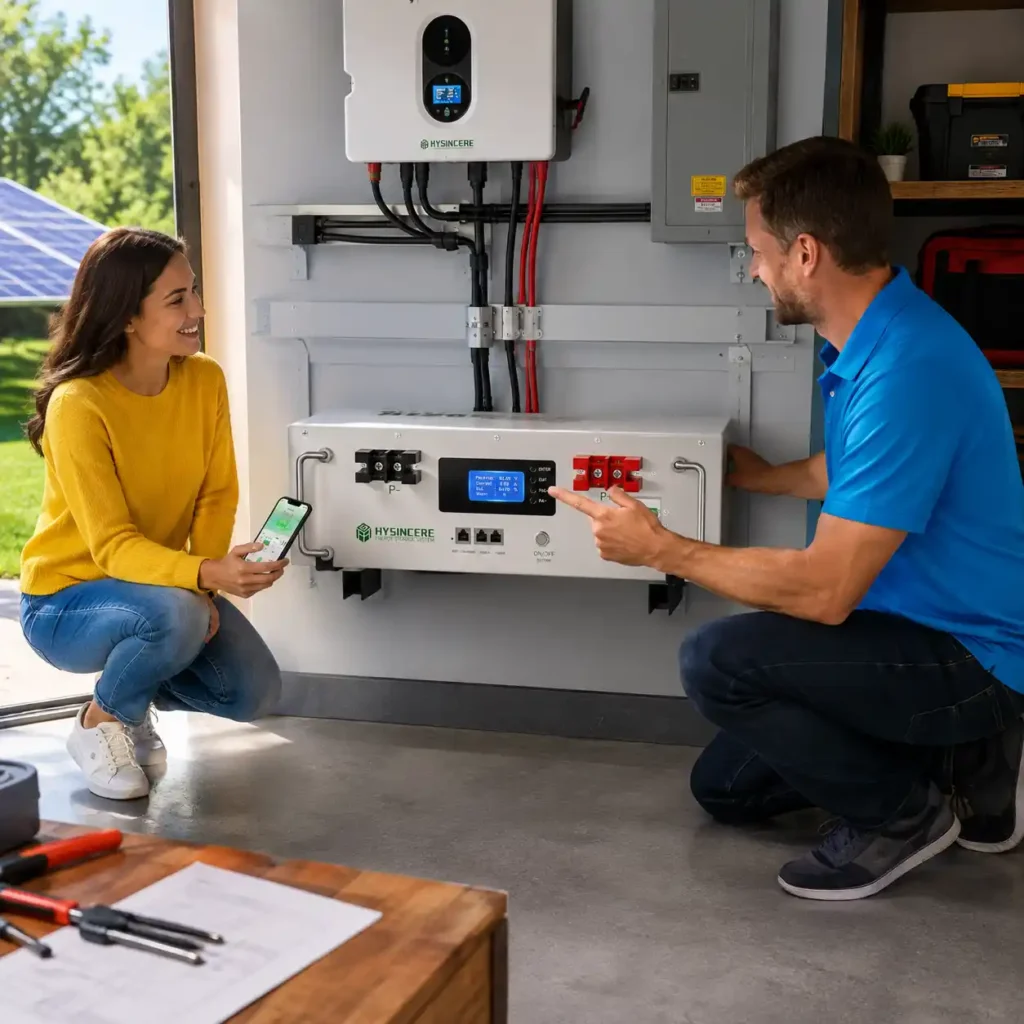
The Hysincere Power HX48100H is built for homeowners who want a residential battery system that feels permanent rather than pieced together. Once installed, its enclosed cabinet design blends naturally into a garage, utility room, or dedicated energy space, providing a clean appearance while quietly storing solar energy in the background.
On a typical day, surplus electricity generated by your rooftop solar panels is stored automatically instead of being exported to the grid. As household demand increases during the evening, the battery supplies stored energy to reduce utility consumption and improve solar self-consumption without requiring constant attention from the homeowner.
Its value becomes even more apparent during an unexpected outage. Essential household circuits remain powered while the cabinet enclosure protects the battery components and keeps the installation organized. Homeowners who prefer equipment that looks professionally installed often appreciate this approach, especially when the energy system is visible rather than hidden away.
Another practical advantage is future scalability. As electricity consumption grows or additional solar panels are installed, the system can be expanded without replacing the original battery, allowing homeowners to increase storage capacity over time while maintaining a consistent installation.
Hysincere Power HX48100H Evaluation
| Evaluation Category | Editorial Assessment |
|---|---|
| Energy Storage | Reliable 5.12 kWh LiFePO₄ capacity for residential solar energy storage and essential home backup. |
| Installation Flexibility | Cabinet enclosure provides a clean, organized installation suitable for garages and utility rooms. |
| Smart Features | Integrated Smart BMS delivers dependable battery protection and efficient system management. |
| Long-Term Ownership | Expandable design and durable LiFePO₄ chemistry make it a dependable long-term investment. |
| Overall Rating | Our top recommendation for homeowners seeking a cabinet-style solar battery with reliable performance and clean installation. |
Who Should Buy This
- Homeowners who prefer a cabinet-style battery system instead of a server rack installation.
- Families looking for dependable residential backup power during outages.
- Buyers who value a clean, professional-looking installation.
- Homeowners planning to expand their solar energy storage over time.
- Anyone seeking reliable LiFePO₄ performance with straightforward ownership.
Who Should Skip This
- Buyers specifically looking for a wall-mounted battery.
- Homeowners with very limited installation space.
- Users who prefer the flexibility of a modular server rack system.
- Anyone needing only a small backup battery for a few essential devices.
Final Verdict
The Hysincere Power HX48100H 48V 100Ah stands out as our Best Cabinet Battery because it combines dependable LiFePO₄ performance with an enclosed, professional-looking design that simplifies installation and everyday ownership. It delivers the storage capacity, reliability, and expandability most homeowners expect from a modern residential battery while presenting a cleaner alternative to traditional server rack systems.
Although it isn’t the most compact or the most feature-rich battery in this guide, it excels where many homeowners place the greatest value: dependable operation, organized installation, and long-term scalability. For buyers who want a cabinet-style battery that integrates naturally into a residential solar energy storage system, the Hysincere Power HX48100H is an excellent choice.
Check the latest price and customer reviews on Amazon.
Related Guide: If you’re comparing battery storage with other ways to keep your home powered during an outage, our Best Portable Power Stations for Home Backup (2026) guide covers flexible battery-powered solutions for essential household loads.
Best Wall-Mounted Battery for Home Backup
VATRER POWER 48V 100Ah LiFePO₄ Wall-Mounted Battery

Quick Verdict
The VATRER POWER 48V 100Ah Wall-Mounted LiFePO₄ Battery earns our Best Wall-Mounted Battery award by combining premium Grade A lithium cells, dependable LiFePO₄ chemistry, and a space-saving wall-mounted design built specifically for residential energy storage. With 5.12 kWh of usable capacity, an integrated 100A Battery Management System (BMS), and a built-in LED monitor, it delivers reliable backup power while keeping installation clean and organized.
Unlike floor-standing cabinet systems or server rack batteries, the VATRER POWER battery mounts directly to the wall, making it an excellent choice for homeowners who want to maximize usable space in garages, utility rooms, or dedicated energy storage areas. Its durable construction, long cycle life, and scalable design make it equally suitable for everyday solar self-consumption and whole-home backup during utility outages.
What ultimately sets this battery apart is its combination of premium battery components and practical installation. The use of Grade A cells, support for more than 6,000 charge cycles, and an expected 10-year service life provide the confidence homeowners expect when investing in a long-term residential energy storage solution.
Home Backup Snapshot
| Battery Type | LiFePO₄ (Grade A Cells) |
|---|---|
| Nominal Capacity | 48V 100Ah (5.12 kWh) |
| Installation Type | Wall-Mounted |
| Connectivity | 100A Smart BMS with LED Monitor |
| Expandability | Yes |
| Best For | Homeowners seeking a premium wall-mounted battery with long lifespan, Grade A cells, and dependable whole-home backup performance. |
Why We Chose It
Selecting the best wall-mounted solar battery requires more than comparing storage capacity alone. Homeowners also need long-term reliability, safe battery chemistry, efficient battery management, and an installation that integrates neatly into a residential energy system.
The VATRER POWER 48V 100Ah stands out by combining all of these qualities in one well-balanced package.
Its Grade A LiFePO₄ cells provide excellent thermal stability, dependable performance, and an impressive lifespan of more than 6,000 deep charge cycles, making it a strong long-term investment for residential backup power. The integrated 100A Smart BMS continuously monitors charging and discharging conditions while protecting the battery from overcharging, over-discharging, overheating, and short circuits.
We also value its practical wall-mounted design. By keeping the battery off the floor, homeowners gain a cleaner installation while preserving valuable utility room or garage space. Combined with its LED status monitor, scalable architecture, and compatibility with off-grid and residential solar energy storage systems, the VATRER POWER battery offers one of the most complete wall-mounted solutions in this guide.
Check the latest price and customer reviews on Amazon.

Living With It
The VATRER POWER 48V 100Ah Wall-Mounted Battery is designed for homeowners who want dependable backup power without sacrificing valuable floor space. Once installed, it becomes a seamless part of a residential solar energy system, quietly storing excess daytime solar production while remaining neatly mounted on the wall for easy access and monitoring.
During normal operation, the battery automatically stores surplus energy generated by rooftop solar panels. As electricity demand increases in the evening, the stored energy helps power essential household circuits, reducing dependence on the utility grid and increasing solar self-consumption.
The battery truly proves its value during a power outage. Refrigerators, lighting, internet equipment, security systems, and other priority loads continue operating while the integrated 100A Smart BMS constantly monitors battery performance and provides protection against overcharging, over-discharging, overheating, and short circuits. The built-in LED monitor allows homeowners to quickly check battery status without opening an app or additional monitoring software.
Its wall-mounted installation also makes future expansion easier. Whether you’re building a new solar energy storage system or upgrading an existing one, the battery offers a clean, organized appearance while leaving valuable floor space available for other equipment.
VATRER POWER 48V 100Ah Evaluation
| Evaluation Category | Editorial Assessment |
|---|---|
| Battery Performance | Grade A LiFePO₄ cells deliver dependable performance, excellent thermal stability, and more than 6,000 deep charge cycles. |
| Installation | Wall-mounted design saves valuable floor space while creating a clean, professional-looking residential installation. |
| Smart Features | Integrated 100A Smart BMS and LED monitor provide continuous battery protection and easy status monitoring. |
| Long-Term Ownership | Designed for a service life of up to 10 years with low-maintenance LiFePO₄ chemistry and scalable energy storage. |
| Overall Rating | Our top recommendation for homeowners seeking a premium wall-mounted solar battery with excellent reliability, long lifespan, and space-saving installation. |
Who Should Buy This
- Homeowners looking for a premium wall-mounted residential battery.
- Solar system owners who want to maximize usable garage or utility room space.
- Families seeking reliable whole-home backup during utility outages.
- Buyers who value Grade A LiFePO₄ cells, long cycle life, and integrated battery protection.
- Homeowners planning to expand their residential energy storage system over time.
Who Should Skip This
- Buyers specifically looking for a server rack battery configuration.
- Homeowners who prefer a cabinet-style energy storage solution.
- Users needing only a small portable battery for occasional emergency use.
- Installations where wall mounting is not practical.
Final Verdict
The VATRER POWER 48V 100Ah LiFePO₄ Wall-Mounted Battery earns our Best Wall-Mounted Battery award by delivering an outstanding combination of premium battery technology, efficient use of space, and long-term reliability. Its Grade A lithium iron phosphate cells, 5.12 kWh capacity, integrated 100A Smart BMS, and LED monitor provide the performance and confidence homeowners expect from a modern residential energy storage system.
While every battery in this guide serves a different purpose, the VATRER POWER model stands out for homeowners who want a clean, space-efficient installation without compromising performance or longevity. For residential solar systems where reliable backup power, durable battery chemistry, and organized installation are top priorities, it is one of the strongest wall-mounted solutions available today.
Check the latest price and customer reviews on Amazon.
Related Guide: If you’re planning to add solar generation to your residential backup system, our Best Solar Panels for Home Battery Backup (2026) guide can help you choose panels based on output, compatibility, and their role in recharging home battery storage.
HumsiENK 48V 100Ah LiFePO₄ Server Rack Battery
Best Value Solar Battery for Home Backup

Quick Verdict
The HumsiENK 48V 100Ah LiFePO₄ Server Rack Battery earns our Best Value Solar Battery award by offering an impressive combination of modern features, dependable LiFePO₄ technology, and competitive pricing. Delivering 5.12 kWh of energy storage, built-in Bluetooth monitoring, active cell balancing, and a robust 100A Battery Management System (BMS), it provides many of the capabilities found in premium residential batteries while remaining an affordable option for homeowners building a reliable backup power system.
Designed in a standard 3U server rack format, the battery integrates easily into residential solar energy storage systems and supports future expansion as household energy requirements grow. The inclusion of Grade A lithium iron phosphate cells and intelligent battery management helps maximize efficiency, battery lifespan, and day-to-day reliability.
What makes the HumsiENK battery particularly attractive is its value proposition. Rather than sacrificing important features to reach a lower price point, it delivers the performance, expandability, and smart monitoring capabilities most homeowners need for dependable whole-home backup and off-grid energy storage.
Home Backup Snapshot
| Battery Type | LiFePO₄ (Grade A Cells) |
|---|---|
| Nominal Capacity | 48V 100Ah (5.12 kWh) |
| Installation Type | 3U Server Rack |
| Connectivity | Bluetooth, Active Balancing, 100A Smart BMS |
| Expandability | Yes |
| Best For | Homeowners seeking maximum value, smart monitoring, and scalable residential energy storage at an affordable price. |
Why We Chose It
Finding the best value solar battery isn’t simply about choosing the lowest-priced model. A true value purchase should combine dependable battery chemistry, intelligent battery management, long-term reliability, and expansion capability without compromising the essential features homeowners expect from a residential energy storage system.
That’s exactly where the HumsiENK 48V 100Ah Server Rack Battery excels.
Its 5.12 kWh LiFePO₄ battery delivers dependable backup power for essential household loads while incorporating Grade A lithium cells, active balancing technology, and Bluetooth connectivity—features often found on considerably more expensive residential batteries. The integrated 100A Smart BMS continuously protects the battery while helping maintain balanced cell performance throughout thousands of charging cycles.
We also appreciate its standardized 3U server rack design, which simplifies installation and future system expansion. Homeowners can begin with a single battery and gradually increase storage capacity as energy demands grow, making it an excellent long-term investment. For buyers who want premium functionality without paying premium prices, the HumsiENK 48V 100Ah represents one of the strongest values in this guide.
Check the latest price and customer reviews on Amazon.
Living With It
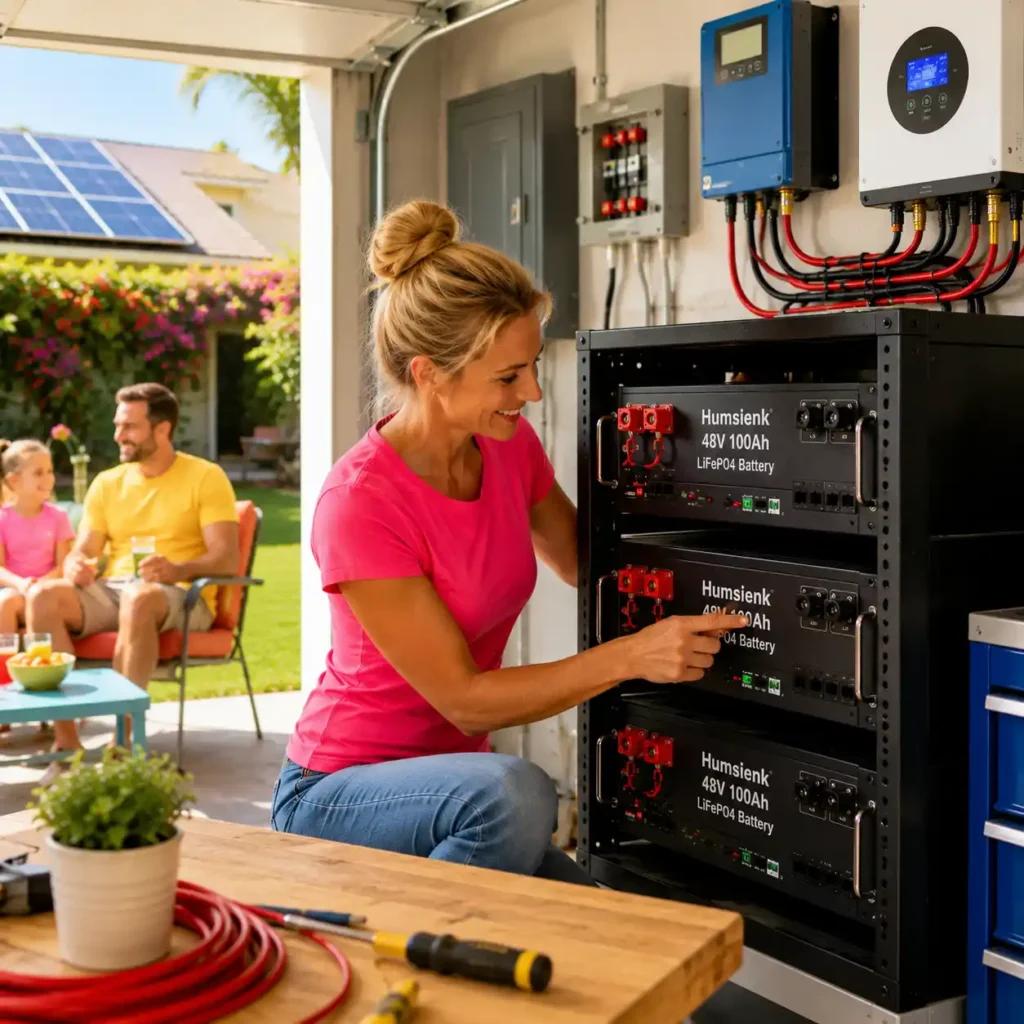
The HumsiENK 48V 100Ah Server Rack Battery is designed for homeowners who want dependable home backup without overspending on features they may never use. Once installed, it integrates seamlessly into a residential solar energy storage system, quietly storing excess solar production during the day and supplying clean, stable power whenever it’s needed.
In everyday operation, the battery automatically charges from surplus solar energy and helps power household loads after sunset, reducing grid dependence and improving overall solar self-consumption. Its Bluetooth connectivity allows homeowners to check battery status, capacity, and operating conditions directly from a smartphone, making routine monitoring quick and convenient without additional hardware.
The battery becomes especially valuable during power outages. Essential appliances such as refrigerators, lighting, internet equipment, security systems, and communication devices continue operating while the 100A Smart BMS and active cell balancing help maintain safe, efficient performance throughout the discharge cycle. These intelligent management features contribute to longer battery life and more consistent performance over thousands of charging cycles.
Because the battery follows a standard 3U server rack format, expanding storage capacity is straightforward. Homeowners can begin with a single module and gradually add additional batteries as energy requirements increase, making the system both affordable today and scalable for the future.
HumsiENK 48V 100Ah Evaluation
| Evaluation Category | Editorial Assessment |
|---|---|
| Battery Performance | Grade A LiFePO₄ cells and active balancing deliver dependable performance, long service life, and stable energy output. |
| Installation | Standard 3U server rack design allows clean installation and simple expansion for growing home energy storage systems. |
| Smart Features | Bluetooth monitoring and a 100A Smart BMS provide convenient system management and comprehensive battery protection. |
| Long-Term Ownership | Expandable architecture, intelligent battery management, and durable LiFePO₄ chemistry provide outstanding long-term value. |
| Overall Rating | Our Best Value recommendation thanks to its excellent balance of features, scalability, reliability, and affordability. |
Who Should Buy This
- Homeowners looking for the best balance between price and performance.
- Buyers building a scalable residential solar energy storage system.
- Users who want Bluetooth monitoring without paying premium prices.
- Families seeking reliable whole-home backup for essential household circuits.
- Anyone planning to expand battery capacity over time using a modular server rack system.
Who Should Skip This
- Homeowners who specifically prefer a wall-mounted battery.
- Buyers looking for a fully enclosed cabinet-style installation.
- Users needing only a small emergency battery for occasional backup.
- Installations where a server rack configuration isn’t practical.
Final Verdict
The HumsiENK 48V 100Ah LiFePO₄ Server Rack Battery successfully combines the features homeowners actually need with an attractive price point. Its Grade A LiFePO₄ cells, Bluetooth monitoring, active balancing, 100A Smart BMS, and modular 3U server rack design create a dependable residential energy storage solution that delivers premium functionality without the premium cost.
While some batteries in this guide offer specialized installation formats or additional premium features, few match the HumsiENK battery’s overall value proposition. For homeowners seeking reliable home backup, straightforward scalability, and modern battery management at a competitive price, the HumsiENK 48V 100Ah is one of the smartest investments available.
Check the latest price and customer reviews on Amazon.
Related Guide: If you want to understand how much electricity your home actually consumes before sizing a battery bank, our Power Consumption Formula Explained (With Real-World Examples) guide provides practical examples for estimating electrical loads.
VPauexii 48V 100Ah LiFePO₄ Server Rack Battery with Auto Fire Suppression
Best Smart Battery for Home Backup

Quick Verdict
The VPauexii 48V 100Ah LiFePO₄ Server Rack Battery earns our Best Smart Battery award by combining advanced safety features, intelligent wireless monitoring, and dependable LiFePO₄ energy storage into one scalable residential backup solution. With 5.12 kWh of storage capacity, WiFi and Bluetooth connectivity, a built-in 100A Smart Battery Management System (BMS), and an integrated automatic fire suppression system, it delivers one of the most complete feature sets in this guide.
Unlike conventional server rack batteries that focus primarily on energy storage, this model emphasizes both performance and system protection. Homeowners can monitor battery status remotely through a mobile app while benefiting from continuous battery protection and an additional layer of safety provided by the integrated fire suppression system. This combination makes it particularly attractive for residential installations where long-term reliability and peace of mind are top priorities.
What ultimately distinguishes this battery is its balance of intelligent features and advanced safety technology. For homeowners looking beyond basic energy storage and investing in a smarter, more secure residential backup system, it stands out as one of the most innovative options available.
Home Backup Snapshot
| Battery Type | LiFePO₄ |
|---|---|
| Nominal Capacity | 48V 100Ah (5.12 kWh) |
| Installation Type | 3U Server Rack |
| Connectivity | WiFi, Bluetooth, 100A Smart BMS |
| Safety Features | Integrated Auto Fire Suppression System |
| Expandability | Yes |
| Best For | Homeowners seeking advanced safety, smart wireless monitoring, and scalable residential backup power. |
Why We Chose It
While battery capacity and cycle life remain important, modern homeowners increasingly expect residential energy storage systems to deliver more than basic backup power. Advanced monitoring, built-in safety features, and long-term reliability have become equally important when choosing a solar battery for home backup.
The VPauexii distinguishes itself by combining these capabilities into a single residential energy storage solution. Its 5.12 kWh LiFePO₄ battery, 100A Smart BMS, and support for both WiFi and Bluetooth monitoring allow homeowners to easily monitor battery performance and operating status from virtually anywhere.
What truly sets this model apart is its integrated automatic fire suppression system—a feature rarely found in batteries within this price category. Combined with more than 6,000 deep charge cycles, a modular 3U rack-mounted design, and straightforward system expansion, it offers an outstanding balance of intelligent features, safety, and long-term value.
For homeowners who prioritize modern monitoring capabilities, enhanced protection, and dependable residential energy storage, this battery earns our recommendation as the Best Smart Battery in this guide.
Check the latest price and customer reviews on Amazon.
Living With It
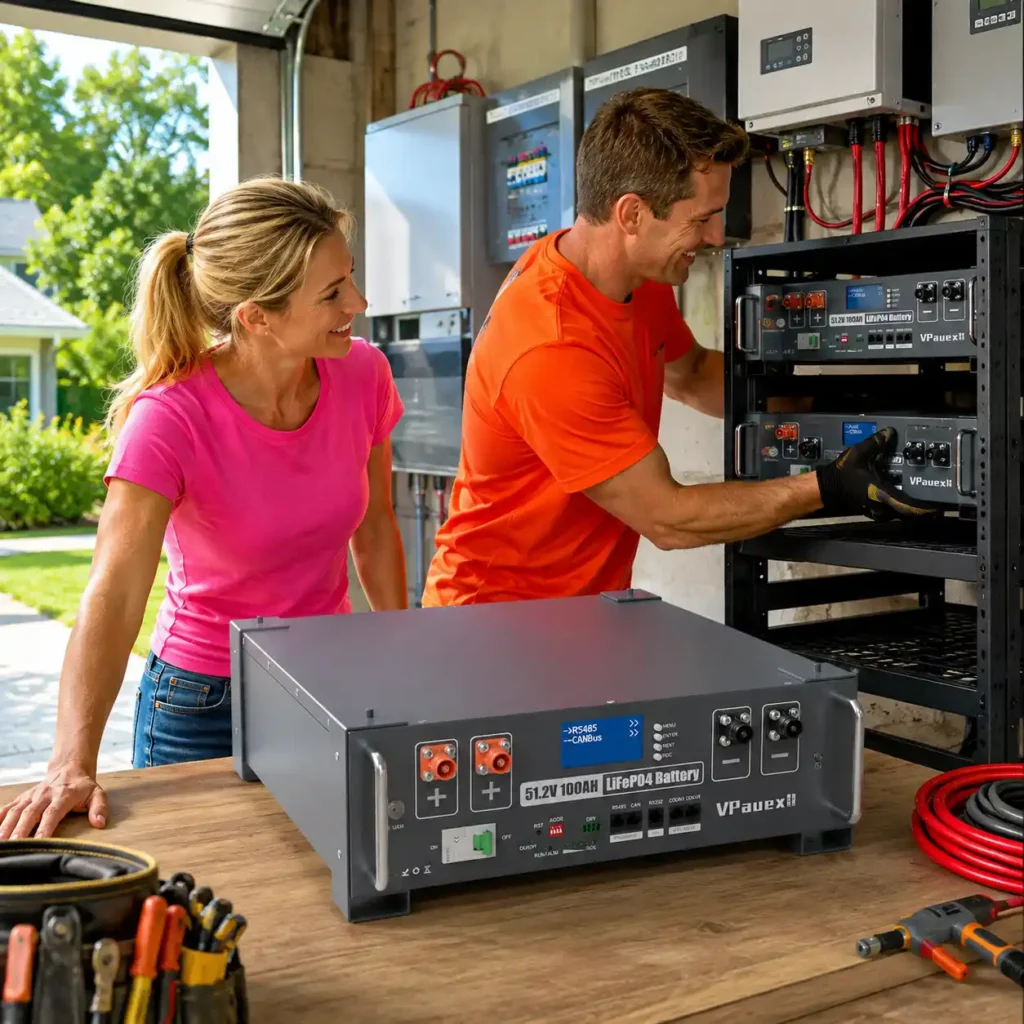
The VPauexii 48V 100Ah LiFePO₄ Server Rack Battery with Auto Fire Suppression is designed for homeowners who want more than basic energy storage. Once installed, it becomes the intelligent core of a residential backup system, quietly storing surplus solar energy while providing continuous monitoring and enhanced safety features that inspire confidence during everyday operation.
Throughout a typical day, the battery automatically stores excess electricity generated by rooftop solar panels. As household energy demand increases during the evening, the stored energy powers essential appliances while reducing reliance on the electrical grid. Using the built-in WiFi and Bluetooth connectivity, homeowners can monitor battery status, charging activity, remaining capacity, and system health directly from a smartphone without additional monitoring hardware.
During a utility outage, the battery supplies dependable backup power to priority household circuits, including refrigerators, lighting, networking equipment, security systems, and other essential devices. The integrated 100A Smart BMS continuously manages charging and discharging conditions, while the built-in automatic fire suppression system provides an additional layer of protection rarely found in residential batteries within this category.
Its modular 3U server rack design also simplifies future expansion. Homeowners can begin with a single battery and easily increase storage capacity as their solar installation or household energy requirements continue to grow.
VPauexii 48V 100Ah Evaluation
| Evaluation Category | Editorial Assessment |
|---|---|
| Battery Performance | Reliable 5.12 kWh LiFePO₄ battery delivers stable residential backup power with more than 6,000 deep charge cycles. |
| Safety Features | Integrated automatic fire suppression system and 100A Smart BMS provide an additional level of protection for residential energy storage. |
| Smart Features | Built-in WiFi and Bluetooth connectivity allow convenient remote monitoring through a smartphone app. |
| Expandability | Standard 3U server rack design supports modular system expansion as household energy needs increase. |
| Overall Rating | Our Best Smart Battery recommendation thanks to its advanced safety technology, intelligent monitoring, and dependable long-term performance. |
Who Should Buy This
- Homeowners looking for advanced battery safety features.
- Solar system owners who want WiFi and Bluetooth monitoring.
- Families building a scalable whole-home backup system.
- Buyers who value intelligent battery management and remote monitoring.
- Homeowners seeking a premium server rack battery with enhanced protection.
Who Should Skip This
- Buyers looking for the lowest-cost residential battery.
- Homeowners who prefer a wall-mounted installation.
- Users needing only occasional emergency backup for a few small devices.
- Installations where advanced smart monitoring features are unnecessary.
Final Verdict
The VPauexii 48V 100Ah LiFePO₄ Server Rack Battery with Auto Fire Suppression earns our Best Smart Battery award by combining intelligent monitoring, dependable LiFePO₄ performance, and one of the strongest safety feature sets in this guide. Its WiFi and Bluetooth connectivity, integrated 100A Smart BMS, automatic fire suppression system, and scalable 3U server rack design make it an outstanding solution for homeowners seeking modern residential energy storage with enhanced peace of mind.
While every battery in this guide excels in a specific category, the VPauexii model distinguishes itself by prioritizing both convenience and safety without compromising long-term reliability. For homeowners who want real-time system monitoring, advanced protection, and dependable whole-home backup, it represents one of the most feature-rich server rack batteries currently available.
Check the latest price and customer reviews on Amazon.
Related Guide: If you’re comparing different residential energy storage configurations, our Best Power Inverters for Home Backup (2026) guide explains how inverter capacity, output, and compatibility affect the performance of a battery-based backup system.
How to Choose the Best Solar Battery for Home Backup
Choosing the best solar battery for home backup isn’t simply about buying the battery with the largest storage capacity or the longest cycle life. The right choice depends on your home’s energy consumption, the appliances you want to keep running during outages, your solar system configuration, available installation space, and your long-term energy goals.
Many homeowners assume that purchasing the largest battery automatically provides the best backup solution. In reality, an oversized battery system can significantly increase installation costs while providing storage capacity that may rarely be used. On the other hand, selecting a battery that’s too small could leave essential appliances without power during extended outages.
The goal is to choose a battery that matches your household’s actual energy requirements rather than paying for capacity you’ll seldom need. Whether you’re installing your first residential solar energy storage system, expanding an existing setup, or building a whole-home backup solution, understanding a few key factors will help you make a smarter long-term investment.
The sections below explain the most important considerations before choosing a solar battery for home backup.
One principle applies to almost every homeowner: don’t shop for the biggest battery—shop for the backup system that fits the way your home actually uses electricity. The right battery should quietly provide dependable energy when you need it most while delivering long-term reliability, scalability, and excellent overall value.
Start With Your Home Energy Needs
The first question isn’t “Which solar battery has the highest capacity?” It’s “How does your home actually use electricity?”
Every household has different backup power requirements. Some homeowners simply want to keep essential appliances running during occasional outages, while others expect their battery system to support an entire home for hours—or even days—when the grid goes down.
Imagine two neighboring homes during a power outage.
One family needs enough backup power for a refrigerator, internet router, lighting, and a few essential outlets. The other wants to operate air conditioning, kitchen appliances, well pumps, and multiple household circuits without interruption.
Both homes need reliable backup power, but they require very different battery systems.
That’s why choosing the right battery size matters far more than simply choosing the largest one available.
Homeowners looking for basic emergency backup may find that a single 5.12 kWh battery provides sufficient storage for their most important household loads. Larger homes, whole-home backup systems, or properties with higher daily electricity consumption often benefit from installing multiple batteries that can operate together as a scalable energy storage system.
Instead of asking how much battery capacity you can afford, start by understanding how much energy your home actually needs during an outage. Matching your battery system to your household’s real energy consumption almost always leads to a more efficient, cost-effective, and future-proof investment than simply buying the largest battery available.
How Much Battery Capacity Do You Really Need?
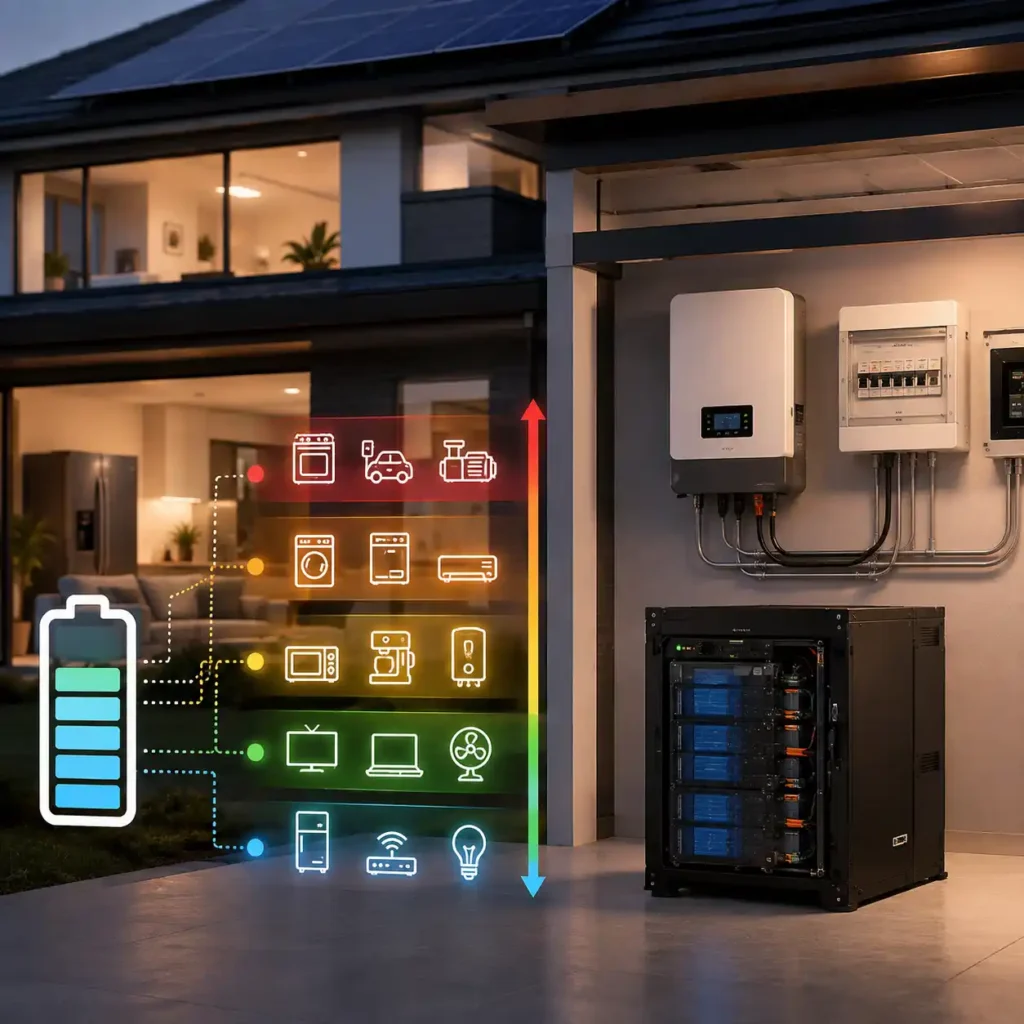
Home battery system installed in a residential utility room supplying backup power during a grid outage.
Battery capacity is usually the first specification homeowners compare, but it’s also one of the most misunderstood.
It’s also the specification buyers tend to overestimate the most.
Many homeowners assume they need the largest battery system available to protect their home during an outage. In reality, purchasing far more storage capacity than your household actually uses can significantly increase costs without delivering meaningful everyday benefits.
Solar battery capacity is typically measured in kilowatt-hours (kWh). Simply put, a higher kWh rating means the battery can store more electricity and power your home for a longer period before it needs to be recharged. However, more capacity isn’t automatically better if your backup requirements don’t justify it.
For homeowners who only want to keep essential appliances running during occasional outages, a 5–10 kWh battery system is often sufficient. This amount of storage can typically support refrigerators, lighting, internet equipment, communication devices, and other priority household loads for many hours, depending on energy consumption.
Families looking for longer backup durations or partial whole-home coverage often benefit from systems providing 10–20 kWh of usable storage. These larger battery banks can support additional household circuits while providing greater flexibility during extended outages.
Homes with high electricity consumption, large HVAC systems, electric water heaters, or complete whole-home backup goals may require 20 kWh or more, often achieved by installing multiple batteries that operate together as a scalable energy storage system.
A helpful way to think about battery capacity is this: buy enough storage for your typical backup needs—not your most extreme outage. Choosing a battery system that reflects your home’s real energy usage usually results in a more cost-effective installation while still providing dependable backup power when you need it most.
Remember that every additional kilowatt-hour increases equipment costs, installation complexity, and overall system size. Unless your household genuinely requires that extra capacity, investing in more storage than you’ll realistically use may provide little practical benefit over the lifetime of the system.
Choose the Right Installation Type
Battery performance is only one part of choosing the right home backup system. The way a battery is installed can have just as much impact on convenience, available space, future expansion, and long-term ownership.
Many homeowners focus almost entirely on battery capacity while overlooking installation type. In reality, selecting the right form factor can make your energy storage system easier to install, simpler to expand, and better suited to your home’s available space.
Today’s residential solar batteries are generally available in three main installation styles: server rack, wall-mounted, and cabinet systems. Each offers distinct advantages depending on your home’s layout and long-term energy goals.
Server rack batteries are the most flexible option for homeowners planning to expand their storage capacity over time. Their modular design allows additional batteries to be added as energy requirements grow, making them a popular choice for scalable residential solar systems and whole-home backup installations.
Wall-mounted batteries are ideal when installation space is limited. By mounting directly to the wall, they free up valuable floor space while providing a clean, modern appearance that works well in garages, utility rooms, and dedicated energy storage areas.
Cabinet-style batteries combine the battery and protective enclosure into a single integrated unit. This design offers a tidy, professional installation and simplifies system organization, making it an excellent option for homeowners who prefer an all-in-one residential backup solution.
Rather than asking which installation type is best, consider which one best matches your available space, future expansion plans, and installation preferences. The right battery should not only provide dependable backup power but also integrate naturally into your home’s energy system for many years to come.
Why LiFePO₄ Battery Technology Is Worth It
Not all solar batteries use the same battery chemistry, and that difference can have a significant impact on long-term performance, safety, and overall value. Today, LiFePO₄ (Lithium Iron Phosphate) has become the preferred technology for residential energy storage because it offers an outstanding combination of durability, thermal stability, and long service life.
For most homeowners, a solar battery is a long-term investment rather than a product they expect to replace after only a few years.
It’s a system designed to provide reliable backup power during outages, increase solar self-consumption, and reduce dependence on the electrical grid for many years. Choosing a battery built around proven, long-lasting chemistry simply makes better financial and practical sense.
Compared with older lithium battery chemistries, LiFePO₄ batteries are engineered to withstand thousands of charge and discharge cycles while maintaining a high percentage of their original capacity. This extended lifespan makes them particularly well suited for residential solar systems that charge and discharge on a daily basis.
LiFePO₄ technology is also widely recognized for its excellent thermal stability and enhanced safety characteristics. While every battery should be installed and operated according to the manufacturer’s recommendations, lithium iron phosphate chemistry is considered one of the safest options available for modern home energy storage systems.
Another important advantage is long-term reliability. Homeowners investing in solar energy want confidence that their battery will continue delivering dependable performance year after year. LiFePO₄ batteries are designed to provide that reliability while requiring very little ongoing maintenance.
For these reasons, every battery recommended in this guide uses LiFePO₄ battery technology. Although systems built around this chemistry may sometimes require a higher initial investment, their longer service life, improved safety, and excellent long-term value make them the smartest choice for most residential backup applications.
Smart Monitoring and Battery Management Systems

A solar battery does much more than simply store electricity. Modern residential energy storage systems are designed to monitor battery health, optimize charging and discharging, and protect the system from conditions that could shorten its lifespan. That’s why the Battery Management System (BMS) is one of the most important features to evaluate before buying a home backup battery.
Many homeowners focus on battery capacity while paying little attention to how the battery is managed. In practice, an advanced BMS can have a significant impact on long-term reliability, efficiency, and overall system safety.
A Smart BMS continuously monitors key operating parameters such as voltage, current, temperature, and state of charge. It automatically protects the battery from overcharging, over-discharging, overheating, excessive current, and short circuits, helping maximize both safety and service life.
Many modern residential batteries also include Bluetooth or WiFi connectivity, allowing homeowners to monitor battery performance through a smartphone app. Instead of checking the battery manually, users can view charging status, remaining capacity, operating conditions, and system alerts from virtually anywhere within the supported connection range—or remotely for systems that support internet-based monitoring.
Some batteries go even further by incorporating features such as active cell balancing, which helps maintain consistent voltage across individual battery cells. By reducing imbalances during charging and discharging, active balancing can improve efficiency and contribute to more stable long-term performance.
While advanced monitoring features may not directly increase battery capacity, they can make ownership significantly easier. The ability to track system performance, identify potential issues early, and monitor energy usage provides greater confidence that the battery will continue operating reliably when backup power is needed most.
For this reason, every battery recommended in this guide includes an intelligent Battery Management System, while several of our top picks also offer advanced connectivity features such as Bluetooth, WiFi, or both, giving homeowners greater visibility into the performance of their residential energy storage system.
Expandability and Future-Proofing
One of the biggest advantages of modern residential solar batteries is their ability to grow alongside your energy needs. Instead of investing in a large and expensive battery bank from the beginning, many homeowners can start with a single battery and expand their system later by adding compatible battery modules.
This flexibility makes it much easier to balance today’s budget with tomorrow’s energy goals.
Imagine installing your first solar battery after adding rooftop solar panels. At first, your primary goal may simply be to keep essential appliances running during power outages. A few years later, your household may purchase an electric vehicle, install a heat pump, or simply decide to increase energy independence by storing more solar power.
Without an expandable battery system, meeting those new energy demands could require replacing the entire installation.
Modular battery systems eliminate that problem. Many server rack batteries allow additional units to be connected in parallel, increasing total storage capacity while using the same overall system architecture. This approach simplifies future upgrades and often reduces the long-term cost of expanding a residential energy storage system.
Expandability is especially valuable for homeowners who are installing solar for the first time. Rather than guessing how much storage they’ll eventually need, they can begin with a practical system that meets current requirements and increase capacity only if their energy consumption changes.
That doesn’t mean every homeowner needs a large expandable battery bank. If your electricity usage is predictable and your backup requirements are unlikely to change, a single battery may provide everything you need for many years.
The key is to think beyond today’s installation. Choosing a battery that supports future expansion gives your home energy storage system the flexibility to adapt as your household, electricity consumption, and backup power expectations continue to evolve.
Safety Features That Matter
Safety should be one of the first considerations when choosing a solar battery for home backup. While battery capacity and performance often receive the most attention, built-in protection systems play an equally important role in ensuring reliable long-term operation.
Modern residential batteries are designed with multiple layers of protection that continuously monitor operating conditions and automatically respond if something falls outside safe limits. These features help protect both the battery itself and the home’s electrical system.
One of the most important components is the Battery Management System (BMS). A quality BMS continuously monitors voltage, current, temperature, and charging conditions while protecting the battery against overcharging, over-discharging, overheating, overcurrent, and short circuits. These safeguards help maximize battery life while reducing the risk of system failure.
Some premium batteries also include active cell balancing, which keeps individual battery cells operating at similar voltage levels. This improves charging efficiency, enhances long-term performance, and helps maintain consistent battery health over thousands of charge and discharge cycles.
Advanced residential batteries may also offer additional safety technologies beyond the standard BMS. For example, some models feature an integrated automatic fire suppression system, providing an extra layer of protection in the unlikely event of a serious internal battery fault. While this feature is not yet common across the industry, it demonstrates how modern battery manufacturers continue to improve residential energy storage safety.
When comparing solar batteries, it’s also worth looking for products that comply with recognized safety standards and certifications where applicable. These certifications indicate that the battery has been evaluated against established safety and performance requirements for residential energy storage applications.
Ultimately, the safest battery isn’t necessarily the one with the longest specification sheet. It’s the one that combines proven LiFePO₄ chemistry, a reliable Smart BMS, intelligent battery protection, and high manufacturing quality to deliver dependable performance throughout years of daily operation.
Common Buying Mistakes

Almost every homeowner investing in solar energy wants a battery system that will provide reliable backup power for many years. Yet many disappointing purchases aren’t caused by poor-quality products—they happen because the battery doesn’t match the home’s actual energy requirements.
One of the most common mistakes is buying far more battery capacity than the household realistically needs. While a larger battery can provide longer backup times, it also increases equipment costs and installation expenses. Many homeowners discover that much of their purchased storage capacity remains unused during normal operation.
The opposite mistake is choosing a battery that’s too small. A system sized only for today’s electricity usage may quickly become insufficient if the household adds new appliances, installs an electric vehicle charger, or expands its solar array. Planning for reasonable future growth often results in a better long-term investment.
Another frequent oversight is focusing only on battery capacity while ignoring installation type. A server rack battery, wall-mounted battery, and cabinet system can all provide similar energy storage, but each offers different advantages for available space, maintenance, and future expansion. Selecting the wrong installation style can make upgrades more difficult later.
Some buyers also pay little attention to the battery’s Battery Management System (BMS) or available monitoring features. Smart monitoring, Bluetooth or WiFi connectivity, and intelligent battery protection don’t increase storage capacity, but they can significantly improve long-term reliability, simplify system management, and help identify potential issues before they become serious problems.
Finally, many homeowners compare batteries using only headline specifications such as capacity and cycle life. While those numbers are important, factors such as battery chemistry, safety features, expandability, warranty support, build quality, and manufacturer reputation deserve equal consideration. The best solar battery isn’t simply the one with the highest specifications—it’s the one that fits your home’s energy needs while providing dependable performance for years to come.
Quick Buyer Checklist
Before purchasing a solar battery for home backup, take a moment to confirm that your system meets these essential requirements:
- You’ve estimated your home’s actual backup energy needs rather than choosing the largest battery available.
- The battery uses LiFePO₄ chemistry for long-term reliability and safety.
- Its usable capacity matches the appliances you plan to power during an outage.
- The installation type (server rack, cabinet, or wall-mounted) fits your available space.
- The battery includes a reliable Smart Battery Management System (BMS).
- It supports future expansion if your household’s energy needs increase.
- The battery is compatible with your inverter and residential solar system.
- The warranty, manufacturer reputation, and long-term support meet your expectations.
Matching the Right Battery to Your Home
There isn’t a single solar battery that’s perfect for every household. The best choice depends on your daily electricity consumption, the appliances you want to keep running during outages, your available installation space, and your long-term energy goals.
If your primary objective is to maintain power for essential household loads—such as a refrigerator, internet router, lighting, and communication devices—a single 5.12 kWh battery may provide all the backup capacity you need during most power outages. This type of system is often an excellent starting point for homeowners installing residential battery storage for the first time.
Homeowners with larger families or higher daily electricity consumption may benefit from multiple batteries connected in parallel. Expanding storage capacity allows additional household circuits to remain operational for longer periods while providing greater flexibility during extended outages or periods of reduced solar generation.
Installation preferences also play an important role. Server rack batteries are well suited for homeowners who value modular expansion and expect their energy storage system to grow over time. Wall-mounted batteries are an excellent solution for homes where maximizing floor space is a priority, while cabinet-style batteries offer a clean, self-contained installation that integrates neatly into utility rooms and dedicated equipment spaces.
Your preferred level of system monitoring may also influence your decision. Some homeowners simply want dependable automatic backup power, while others appreciate advanced features such as Bluetooth or WiFi monitoring, smartphone apps, active cell balancing, and detailed real-time system information.
Ultimately, the best solar battery isn’t necessarily the one with the largest storage capacity or the longest list of features. It’s the battery that fits naturally into your home’s energy system, provides reliable backup when you need it, and offers the flexibility to support your household for many years to come.
Our Expert Buying Tips
After comparing today’s leading solar batteries for home backup, one recommendation stands out above all others: buy for the way your home uses energy today while leaving room for tomorrow’s needs.
That single decision influences almost every aspect of your investment—from the amount you’ll spend and the available backup runtime to how easily your energy storage system can expand in the future.
It’s tempting to assume that the largest battery is always the best choice, but that’s rarely the case. A properly sized battery that matches your household’s actual electricity consumption will often deliver a better ownership experience than an oversized system that costs significantly more while providing storage capacity you’ll rarely use.
Whenever possible, choose a battery built around LiFePO₄ battery technology. Its long cycle life, excellent thermal stability, low maintenance requirements, and proven long-term reliability make it one of the smartest investments for residential solar energy storage.
If there’s a possibility that your household’s energy needs will grow—whether through an electric vehicle, additional solar panels, or increased electricity consumption—consider selecting a battery that supports modular expansion. The ability to add storage capacity later provides valuable flexibility without requiring you to replace your original investment.
Smart monitoring features are also worth considering. Batteries equipped with Bluetooth or WiFi connectivity, together with a reliable Smart BMS, make it easier to monitor system performance, track battery health, and quickly identify potential issues before they affect backup power availability.
Finally, remember that the best solar battery isn’t the one with the longest specification sheet. It’s the one that integrates naturally with your home’s energy system, delivers dependable backup power when the grid goes down, and continues providing reliable performance year after year.
The right battery should quietly protect your home in the background, allowing you to focus on everyday life rather than worrying about the next power outage.
What Can a 5.12 kWh Solar Battery Power?
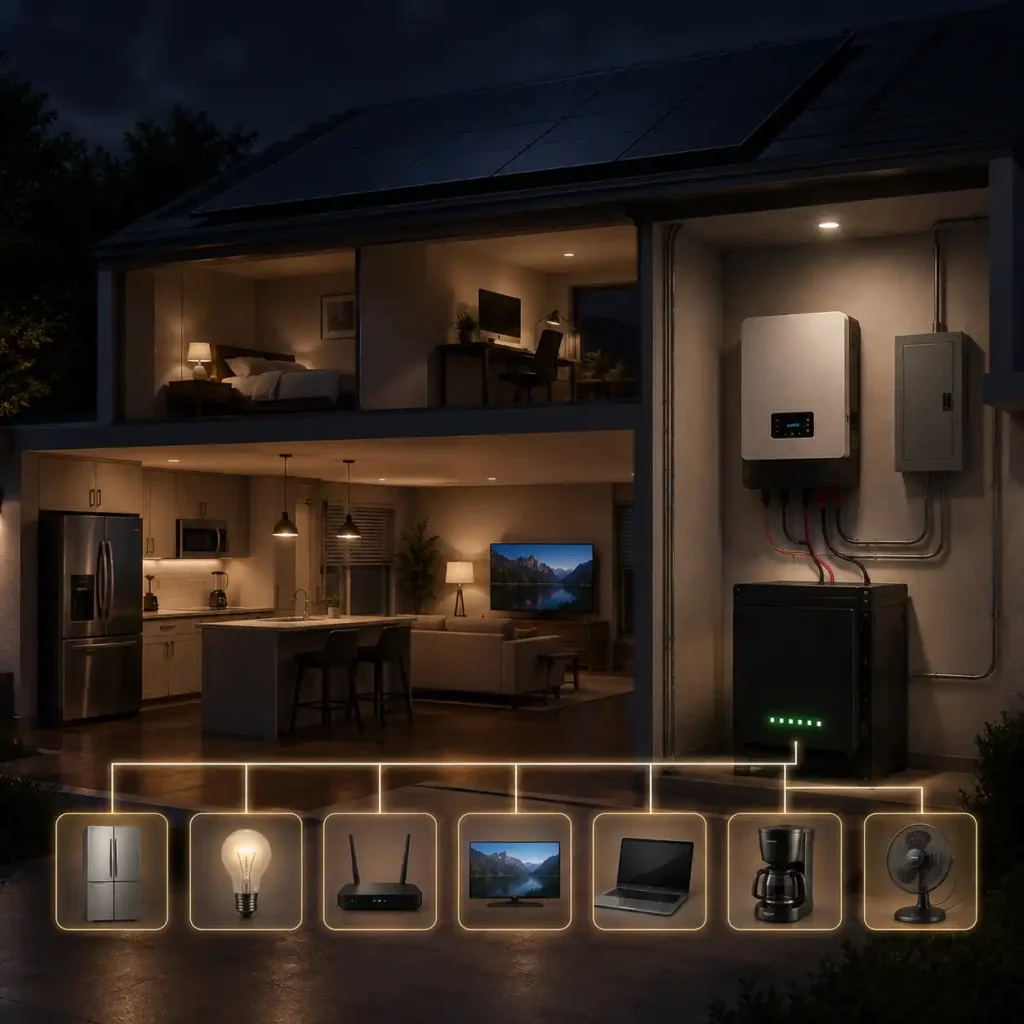
A 5.12 kWh LiFePO₄ solar battery has become one of the most popular capacities for residential energy storage because it offers an excellent balance between backup runtime, installation cost, and future expandability. For many homeowners, it’s large enough to keep essential household loads running during typical power outages while remaining easy to integrate into both new and existing solar systems.
Exactly how long a battery will last depends on two factors: how much usable energy the battery provides and how much electricity your home consumes during an outage. A battery powering only a refrigerator, internet equipment, lighting, and a few electronics will last considerably longer than one supporting high-power appliances such as central air conditioning, electric water heaters, or electric ovens.
Rather than trying to power an entire home at once, many homeowners choose to connect their solar battery to essential backup circuits. This approach extends runtime, improves overall efficiency, and ensures that the appliances most critical to everyday life continue operating when grid power is unavailable.
The examples below illustrate the types of household equipment that a typical 5.12 kWh residential battery can support. Actual runtime will vary depending on appliance power consumption, inverter efficiency, battery depth of discharge, and the number of devices operating simultaneously.
Typical Appliances a 5.12 kWh Battery Can Support
One of the biggest questions homeowners ask before investing in a solar battery is, “What will it actually power during an outage?” The answer depends on the battery’s usable capacity, inverter size, and how many appliances are operating at the same time.
A 5.12 kWh LiFePO₄ battery is typically designed to support essential household loads rather than every electrical device in the home simultaneously. When paired with a properly sized hybrid inverter, it can provide dependable backup power for many of the appliances families rely on most during short- and medium-duration outages.
Typical backup loads include refrigerators, freezers, LED lighting, Wi-Fi routers, televisions, laptops, mobile device chargers, security systems, and small kitchen appliances. Medical equipment such as CPAP machines can also often be supported, depending on overall system configuration and total power demand.
High-power appliances—including central air conditioners, electric water heaters, electric ranges, clothes dryers, and whole-home HVAC systems—consume electricity much more quickly. Running these devices continuously generally requires a larger battery bank or multiple batteries connected together to increase total storage capacity.
The table below provides general examples of the types of household equipment a 5.12 kWh battery can support. Actual runtime will vary depending on appliance efficiency, inverter performance, battery settings, and how many devices are operating simultaneously.
| Appliance | Typical Power | Estimated Runtime* | Priority Level | Recommended for Backup |
|---|---|---|---|---|
| Refrigerator | 100–200 W | 20–40 hours | Essential | ✔ Yes |
| LED Lighting (Whole Home) | 50–150 W | 30–70 hours | Essential | ✔ Yes |
| Wi-Fi Router & Modem | 15–30 W | 120+ hours | Essential | ✔ Yes |
| Television | 80–150 W | 25–50 hours | Medium | ✔ Yes |
| Laptop | 40–80 W | 60–100 hours | Medium | ✔ Yes |
| CPAP Machine | 30–60 W | 70–120 hours | Essential | ✔ Yes |
| Chest Freezer | 100–200 W | 20–40 hours | Essential | ✔ Yes |
| Microwave Oven | 1000–1500 W | Short-term use only | Occasional | ✔ Yes |
| Coffee Maker | 800–1200 W | Short-term use only | Occasional | ✔ Yes |
| Central Air Conditioner | 2000–5000 W | Very limited | High Load | Depends on system size |
*Estimated runtime values are approximate and assume a fully charged 5.12 kWh battery. Actual performance varies depending on inverter efficiency, battery settings, appliance cycling, and total household power consumption.
Quick Runtime Tips
Even a well-sized solar battery will perform better when energy is used strategically during an outage. A few simple habits can significantly extend your available backup runtime:
- Prioritize essential circuits such as refrigerators, lighting, internet equipment, and communication devices.
- Avoid operating multiple high-power appliances at the same time unless your battery system is specifically designed for whole-home backup.
- Take advantage of daytime solar production whenever possible to recharge the battery and reduce energy consumption from stored power.
- Monitor your battery’s state of charge using the built-in app or Battery Management System (BMS) to avoid unexpected depletion.
- If you expect your household’s electricity needs to grow, choose an expandable battery system that allows additional storage capacity to be added later.
Factors That Affect Backup Runtime
The examples above provide a general idea of what a 5.12 kWh solar battery can support, but actual backup time will vary from one home to another. Two households using the same battery may experience very different runtimes depending on how electricity is consumed during an outage.
One of the biggest factors is the total power demand of the connected appliances. A refrigerator, Wi-Fi router, LED lighting, and a few mobile device chargers require relatively little energy and allow the battery to operate for much longer. Adding high-power loads such as electric ovens, space heaters, air conditioners, or water heaters can reduce available runtime significantly.
Another important consideration is how many appliances operate at the same time. Even efficient household devices consume more energy when several are running simultaneously. Prioritizing only essential circuits helps extend backup duration and makes more efficient use of the stored energy.
Battery settings and usable capacity also influence runtime. Most modern LiFePO₄ batteries are configured to maintain a reserve capacity that helps protect long-term battery health. As a result, the full nominal battery capacity may not always be available for everyday use.
The efficiency of the inverter plays a role as well. Every time stored DC energy is converted into AC electricity for household appliances, a small amount of energy is lost during the conversion process. High-quality hybrid inverters minimize these losses, improving the overall efficiency of the backup system.
Finally, solar production during daylight hours can greatly extend battery runtime. When solar panels continue generating electricity while the grid is unavailable, they can recharge the battery and directly power household loads, allowing the backup system to operate much longer than the battery alone.
Understanding these factors helps homeowners develop realistic expectations and design a backup system that matches both their daily electricity usage and their emergency power requirements.
How Many Batteries Do You Need for Whole-Home Backup?
The answer depends on what you expect your backup system to power. Some homeowners only want to keep essential appliances running during occasional outages, while others want enough stored energy to operate nearly the entire house for extended periods without grid power.
For many homes, one 5.12 kWh battery provides an excellent starting point. It can supply power to priority circuits such as refrigerators, freezers, internet equipment, LED lighting, security systems, televisions, and device chargers while maintaining a relatively affordable installation cost.
If your goal is longer backup runtime or supporting additional household circuits, installing two batteries can significantly increase available energy storage. A larger battery bank allows more appliances to operate simultaneously while extending backup duration during prolonged outages or periods of limited solar production.
Homes with high daily electricity consumption, multiple occupants, large HVAC systems, well pumps, or electric vehicle charging often require three or more batteries working together. Modular battery systems make this possible by allowing compatible batteries to operate in parallel, creating a scalable energy storage solution that can grow alongside the household’s energy needs.
It’s also important to consider how your backup system will be used. Some homeowners prioritize emergency preparedness, while others want to maximize solar self-consumption by storing excess daytime production for use during the evening. These different goals often influence the amount of storage capacity that makes the most sense.
Rather than choosing the largest battery bank available, begin by identifying your essential household loads and estimating how long you want them to remain operational during a power outage. A properly sized system typically delivers better overall value than one that is significantly larger than your actual requirements.
For homeowners who expect their electricity usage to increase in the future, choosing an expandable battery system provides additional flexibility. Starting with one battery and adding more capacity later is often the most practical and cost-effective approach to building a reliable whole-home backup system.
Our Recommendation
For most homeowners, the best approach is to start with a battery system that matches your current energy needs while allowing room for future expansion. This strategy provides dependable backup power today without requiring a larger investment than necessary.
If your goal is to keep essential household appliances running during power outages, a single 5.12 kWh LiFePO₄ battery is often an excellent starting point. It provides enough stored energy for priority loads such as refrigerators, lighting, internet equipment, televisions, and other everyday essentials while remaining one of the most cost-effective residential backup solutions.
Homeowners seeking longer backup duration or greater energy independence should consider installing multiple batteries. Expanding storage capacity not only increases runtime but also allows additional household circuits to remain operational during extended outages. Choosing a modular battery system from the beginning makes future upgrades much simpler and often more affordable.
We also recommend prioritizing LiFePO₄ battery technology, a high-quality Battery Management System (BMS), and reliable smart monitoring features. These technologies contribute to longer battery life, improved safety, easier system management, and greater confidence that your backup power system will perform when it’s needed most.
Finally, don’t choose a battery based solely on its specifications. Consider how well it fits your home’s energy consumption, installation space, backup expectations, and future plans. A thoughtfully selected battery system will provide far greater long-term value than simply purchasing the largest or most expensive option available.
Frequently Asked Questions
What size solar battery do I need for home backup?
The right battery size depends on your household’s energy consumption and the appliances you want to keep running during a power outage. For many homes, a single 5.12 kWh LiFePO₄ battery provides enough backup power for essential loads such as refrigerators, lighting, internet equipment, televisions, and device charging. Larger homes or whole-home backup systems often require multiple batteries connected together to increase storage capacity and runtime.
Can a 5.12 kWh battery run an entire house?
Usually not. A 5.12 kWh battery is designed to support essential household circuits rather than every electrical appliance simultaneously. Most homeowners use batteries to power priority loads while avoiding high-demand appliances such as central air conditioning or electric water heaters unless multiple batteries are installed.
How long will a solar battery last during a power outage?
Backup time depends on battery capacity and household electricity usage. A 5.12 kWh battery may power essential appliances for many hours, while homes with higher energy consumption will require additional storage capacity. Solar panels can also extend runtime by recharging the battery during daylight hours.
Is LiFePO₄ better than other lithium battery types?
Yes. LiFePO₄ (Lithium Iron Phosphate) batteries are widely considered the best choice for residential energy storage because they offer long cycle life, excellent thermal stability, improved safety, and minimal maintenance. They are specifically designed for years of daily charging and discharging.
Can I add more batteries later?
In many cases, yes. Most modern server rack battery systems support parallel expansion, allowing homeowners to increase storage capacity as energy needs grow. Choosing an expandable battery from the beginning makes future upgrades much easier and more cost-effective.
Should I choose a server rack, wall-mounted, or cabinet battery?
The best installation type depends on your available space and future plans. Server rack batteries offer the greatest flexibility for expansion, wall-mounted batteries save floor space, and cabinet batteries provide a clean all-in-one installation with an integrated enclosure.
Do solar batteries work during a grid outage?
Yes, but only if the battery system is paired with a compatible hybrid inverter or backup inverter designed for off-grid operation during outages. Without backup capability, most grid-tied solar systems automatically shut down for safety reasons.
How many years does a LiFePO₄ solar battery last?
Most LiFePO₄ batteries are rated for 6,000 or more charge cycles, which typically translates to well over ten years of residential use, depending on operating conditions and charging habits.
Are solar batteries worth the investment?
For many homeowners, yes. Solar batteries provide backup power during outages, increase energy independence, improve solar self-consumption, and help reduce reliance on the electrical grid. Their value depends on local electricity prices, outage frequency, and individual energy goals.
What is the best solar battery for home backup in 2026?
Based on our evaluation, the ECO-WORTHY Cubix100 48V 100Ah LiFePO₄ is the best overall solar battery for home backup in 2026. It offers an excellent combination of 5.12 kWh storage capacity, LiFePO₄ battery technology, Bluetooth monitoring, modular expandability, and long-term value for residential solar energy storage systems.
Final Verdict
Choosing the best solar battery for home backup isn’t about buying the largest battery or the one with the longest list of specifications. It’s about selecting the right balance of storage capacity, battery technology, installation type, smart features, safety, and future expandability for the way your home actually uses electricity.
Some homeowners simply want reliable backup power for essential appliances during occasional outages, while others are building complete residential energy storage systems designed to maximize solar self-consumption and provide whole-home backup. Every household has different energy priorities, which is exactly why we selected winners for different installation styles and use cases rather than recommending one battery for everyone.
If you’re looking for the best overall combination of performance, reliability, expandability, and long-term value, the ECO-WORTHY Cubix100 48V 100Ah LiFePO₄ remains our top recommendation. Its modular server rack design, dependable LiFePO₄ battery technology, Bluetooth monitoring, and scalable architecture make it an excellent choice for the majority of residential solar installations.
Homeowners who prefer a fully enclosed battery system should consider the Hysincere Power HX48100H, while those wanting to maximize installation space will appreciate the VATRER POWER 48V 100Ah Wall-Mounted Battery. Buyers focused on maximizing value will find the HumsiENK 48V 100Ah Server Rack Battery particularly appealing thanks to its premium features and competitive pricing. For homeowners seeking advanced monitoring capabilities and enhanced protection, the VPauexii 48V 100Ah Server Rack Battery with Auto Fire Suppression offers one of the most comprehensive combinations of intelligent battery management and built-in safety features in this guide.
One of the biggest mistakes homeowners make isn’t choosing the wrong brand—it’s choosing the wrong battery size. Many invest in far more storage capacity than they’ll realistically use, while others underestimate future electricity needs and quickly outgrow their first battery system.
Before making your decision, think carefully about the appliances you want to power during an outage, how long you expect your backup system to operate, the amount of available installation space, and whether your household’s energy requirements are likely to increase over time. Spending a little time evaluating these factors will almost always lead to a smarter investment than simply buying the largest battery available.
The good news is that today’s residential solar batteries are more capable than ever before. Modern LiFePO₄ battery technology, intelligent Battery Management Systems, wireless monitoring, modular expansion, and improved safety features have transformed home energy storage into a practical and dependable solution for homeowners seeking greater energy independence.
Whether your goal is protecting essential household appliances during blackouts, storing excess solar energy for evening use, lowering your reliance on the electrical grid, or building a scalable whole-home backup system, the right solar battery quietly works in the background—delivering reliable power exactly when you need it.
At the end of the day, the best solar battery isn’t the one with the biggest capacity or the most impressive specifications. It’s the one that fits your home’s energy needs, integrates seamlessly with your solar system, and continues providing dependable backup power for many years to come.
Choose a battery that matches your home—not just your budget—and you’ll enjoy greater energy security, increased independence, and the confidence that your home will remain powered when it matters most.
We hope this guide has helped you compare today’s leading residential solar batteries with confidence and made selecting the right home backup battery a little easier. Whatever your energy goals may be, investing in the right battery today can provide years of reliable backup power, improved solar efficiency, and greater peace of mind.
Related Guides
Choosing the right solar battery is only one part of building a dependable home backup power system. To get the best performance from your investment, it’s equally important to select compatible inverters, solar panels, backup equipment, and properly size your energy storage system for your household’s electricity needs.
The guides below will help you compare essential components, estimate backup requirements, and build a reliable residential solar energy system that delivers dependable power during outages while maximizing long-term value.
- Best Hybrid Solar Inverters – Compare the top hybrid inverters for residential solar energy storage and whole-home backup systems.
- Best Solar Panels for Home Backup – Learn how to choose efficient solar panels that pair perfectly with residential battery storage.
- Best Home Backup Generators – Compare battery backup systems and generators to determine the best solution for your home.
- Best Transfer Switches for Home Backup – Discover the safest and most reliable ways to connect backup power to your home’s electrical system.
- How Many Solar Batteries Do I Need? – Learn how to calculate the right battery capacity based on your household’s electricity consumption and backup goals.
- Whole-Home Backup vs Essential Loads – Understand the differences between powering your entire home and protecting only your most important circuits.
- Solar Battery Runtime Calculator – Estimate how long different battery capacities can power refrigerators, lighting, internet equipment, freezers, medical devices, and other essential household appliances during a power outage.
- LiFePO₄ vs Other Solar Battery Technologies – Compare battery chemistries, lifespan, safety, performance, and long-term value before investing in residential energy storage.