
Choosing the right solar array starts with understanding how much electricity you need to produce and how much solar energy your location can realistically provide. A system that is too small may fail to offset your electricity use or recharge a backup battery adequately. A system that is significantly oversized can increase equipment, installation, and roof-space requirements without providing proportional value.
Our Solar Panel Size Calculator helps estimate the solar array capacity and number of panels needed based on your electricity consumption, peak sun hours, panel wattage, and expected system losses.
For backup-power applications, the calculation can also be used as a planning starting point for determining how much solar generation is needed to recharge a battery after an outage or daily discharge.
The result is a planning estimate, not a final photovoltaic system design. Actual solar production depends on location, roof orientation and tilt, shading, temperature, equipment characteristics, wiring, inverter efficiency, soiling, and other site-specific factors. NREL’s PVWatts model incorporates many of these variables when estimating photovoltaic production.

Table of Contents
Quick Answer
To estimate the solar panel system size you need, start with your actual electricity consumption. If you need help determining your household’s energy use, our guide explains how to calculate your daily electricity consumption before sizing a solar array.
Required Solar Array Size (kW) = Daily Energy Use (kWh) ÷ (Peak Sun Hours × System Efficiency)
Once you know the required array size, calculate the number of panels:
Number of Panels = Required System Size (kW) × 1,000 ÷ Panel Wattage (W)
Always round the result up to the next whole panel.
For example, if a home uses 30 kWh per day, receives 5 peak sun hours, and you assume an 80% system efficiency, the estimated solar array is:
30 ÷ (5 × 0.80) = 7.5 kW
With 400W panels:
7,500W ÷ 400W = 18.75
You would therefore need 19 panels, producing a total installed DC capacity of 7.6 kW.
This is the basic calculation used by many current solar sizing calculators.
Solar Panel Size Calculator
Estimate the solar array size and number of panels needed for household energy use or battery recharge.
Your Estimated Solar System Size
Use the calculator to estimate the solar array capacity and number of panels required for your electricity needs.
Enter the following information:
- Average electricity consumption
- Energy-use period: daily, monthly, or annual
- Peak sun hours per day
- Solar panel wattage
- System efficiency or loss factor
- Optional target energy offset
- Optional battery energy requirement
- Optional usable roof area
The calculator should return:
- Required solar system size in kW
- Number of solar panels
- Installed DC capacity
- Estimated daily solar production
- Estimated monthly or annual production
- Optional roof-space requirement
- Optional solar capacity required for battery charging
For a simple planning calculation, daily electricity consumption, peak sun hours, system efficiency, and panel wattage are the four most important inputs.
More advanced solar models can account for location, tilt, azimuth, shading, system losses, inverter characteristics, and weather data. NREL’s PVWatts Calculator is designed for more detailed photovoltaic production estimates and can model systems at specific locations.
Required Solar Array Size = Daily Energy Use ÷ (Peak Sun Hours × System Efficiency)
What Does a Solar Panel Size Calculator Calculate?
A Solar Panel Size Calculator answers a practical question:
How large does my solar array need to be to produce the amount of electricity I want?
The calculation begins with energy consumption rather than the number of panels.
That distinction is important.
A 400W solar panel does not continuously produce 400W throughout the day. Its 400W rating represents its nominal DC output under specified test conditions. Actual energy production changes with solar irradiance, temperature, orientation, shading, system losses, and other conditions.
The purpose of the calculator is therefore to convert:
Energy demand → solar generation requirement → system size → panel count
For example:
30 kWh/day → 7.5 kW solar array → 19 × 400W panels
The final number of panels is always rounded up because a practical installation cannot use a fraction of a panel.
How Solar Panel Sizing Works

Solar panel sizing is fundamentally an energy-production calculation.
You need to compare:
- How much electricity you consume.
- How many equivalent peak-sun hours your location receives.
- How much energy the solar system loses before electricity reaches the usable output.
- How much power each individual panel can produce.
The simplified relationship is:
Daily Solar Production = Solar Array Size × Peak Sun Hours × System Efficiency
Rearranging the equation gives:
Solar Array Size = Daily Energy Requirement ÷ (Peak Sun Hours × System Efficiency)
This approach is useful for preliminary planning because it accounts for the fact that a solar array does not operate at its nameplate output continuously.
Actual photovoltaic energy yield is affected by heat, dirt, shading, wiring, inverter conversion, module mismatch, system availability, and other factors. The U.S. Department of Energy specifically identifies heat, dirt, and shade as factors that influence actual PV energy yield.
Solar Panel Size Formula
The primary formula is:
Required Solar System Size (kW) = Daily Energy Use (kWh) ÷ (Peak Sun Hours × System Efficiency)
Where:
- Daily Energy Use = average electricity consumption in kWh per day
- Peak Sun Hours = equivalent hours of solar production per day
- System Efficiency = usable system output after expected losses, expressed as a decimal
For example:
- Daily energy use = 24 kWh
- Peak sun hours = 5
- System efficiency = 80% = 0.80
- For a simple planning estimate, an 80% performance factor can be used as an illustrative assumption. Actual system losses vary by site, equipment, shading, temperature, soiling, wiring, inverter configuration, and other conditions.
- NREL’s PVWatts model uses a detailed loss model rather than one universal efficiency percentage.
The calculation is:
24 ÷ (5 × 0.80) = 6 kW
The estimated solar array therefore needs approximately 6 kW of DC capacity.
Calculating the Number of Panels
Once the required system size is known:
Panels Required = Required System Size × 1,000 ÷ Panel Wattage
For 6 kW using 400W panels:
6,000 ÷ 400 = 15 panels
So the system would require approximately 15 × 400W panels.
How Many Solar Panels Do You Need?
The number of panels depends on three main factors:
- how much electricity you use;
- how much usable sunlight your location receives;
- the wattage of the panels you choose.
A higher-wattage panel can reduce the number of panels required for the same total system capacity.
For example, a 6 kW array could theoretically use:
- 15 × 400W panels = 6.0 kW
- 14 × 440W panels = 6.16 kW
- 13 × 480W panels = 6.24 kW
The panel count changes, but the required system capacity remains approximately the same.
This is why panel wattage and system size should not be confused.
A larger individual panel does not automatically mean that your home requires less solar capacity. It simply means you can reach the required capacity with fewer modules.
Solar Panel Size Example

Consider a home that consumes:
900 kWh per month
Convert monthly consumption to daily consumption:
900 ÷ 30 = 30 kWh/day
Assume:
- Peak sun hours = 5 hours/day
- System efficiency = 80%
- Panel wattage = 400W
Calculate the required system size:
30 ÷ (5 × 0.80) = 7.5 kW
Now calculate the panel count:
7,500 ÷ 400 = 18.75
Round up:
19 panels
Actual installed capacity:
19 × 400W = 7,600W
So the planning estimate is:
19 × 400W panels = 7.6 kW DC array
This produces a preliminary 7.6 kW DC array under the stated assumptions.
How to Calculate Solar Panel Size Step by Step
Step 1 — Determine Your Electricity Consumption
Start with your actual electricity use. Your utility bill may show monthly or annual energy consumption in kWh, so convert that figure into an average daily usage before sizing your solar array.
If you want to understand how electrical loads are converted into energy requirements, see Power Consumption Formula Explained.
Your utility bill may show:
- monthly kWh;
- annual kWh;
- daily average consumption.
Using a 12-month average is generally preferable because electricity use can vary substantially between seasons.
If your bill shows 12,000 kWh per year:
12,000 ÷ 365 = 32.88 kWh/day
Use approximately 32.9 kWh/day as the planning value.
Step 2 — Determine Your Peak Sun Hours
Peak sun hours are not the same thing as daylight hours.
One peak sun hour represents the equivalent of one hour of solar irradiance at approximately 1,000 W/m².
A location can have 12 hours of daylight but only several equivalent peak sun hours.
Your actual solar resource depends on geographic location, season, weather, orientation, tilt, and other conditions.
For more location-specific modeling, tools such as NREL PVWatts use solar-resource and weather data to estimate PV production.
Step 3 — Account for System Losses
No rooftop solar system converts all available sunlight into usable electricity.
Losses can occur through:
- inverter conversion;
- wiring;
- shading;
- soiling;
- temperature;
- module mismatch;
- connections;
- system availability;
- other equipment and operating conditions.
PVWatts uses a detailed loss model rather than treating all losses as one simple universal percentage. Its published documentation lists multiple loss categories and a default total system-loss assumption of approximately 14% in its model.
For a simple calculator, however, using an overall performance factor can make the calculation easier to understand.
Step 4 — Calculate Required Solar Capacity
Use:
System Size = Daily kWh ÷ (Peak Sun Hours × Efficiency)
For:
- 30 kWh/day
- 5 peak sun hours
- 80% efficiency
The result is:
7.5 kW
Step 5 — Divide by Panel Wattage
Once you know the required solar array size, divide the total system wattage by the wattage of one panel to determine how many panels you need.
With 400W panels:
7,500 ÷ 400 = 18.75
Because you cannot install a fraction of a panel, always round the result up:
19 panels
This would give you a total installed capacity of:
19 × 400W = 7,600W, or 7.6 kW
Panel wattage affects the number of physical panels required, so compare the rated output, dimensions, efficiency, and installation characteristics before choosing a specific model. For one common panel type used in permanent installations, see our guide to Best Rigid Solar Panels.
Step 6 — Check the Actual Installed Capacity
Nineteen 400W panels produce:
19 × 400 = 7,600W
Therefore:
Installed capacity = 7.6 kW DC
The actual system will not necessarily produce 7.6 kW at any particular moment. The installed DC capacity is a nameplate rating, while actual production varies with environmental and system conditions.
Step 7 — Check Roof Space and Site Conditions
The final question is not only whether the calculated number of panels fits the energy requirement.
You also need to determine whether the roof can physically accommodate them.
Check:
- usable roof area;
- roof orientation;
- roof pitch;
- shading;
- vents and chimneys;
- setbacks;
- structural limitations;
- panel dimensions;
- access requirements.
DOE guidance for PV procurement similarly identifies available rooftop space, weather, energy demand, PV production, topology, and existing renewable resources as factors that can affect system sizing.
Peak Sun Hours Explained
Peak sun hours are one of the most important inputs in a Solar Panel Size Calculator.
They represent solar energy expressed as equivalent full-sun hours rather than simply counting the hours between sunrise and sunset.
For example, five peak sun hours does not mean that the sun is visible for only five hours.
It means the day’s available solar energy is approximately equivalent to five hours at a reference irradiance of 1,000 W/m².
This distinction matters because using daylight hours instead of peak sun hours can produce a significant sizing error.
Peak sun hours also vary by location and season.
For preliminary planning, a generalized value can be useful. For a serious site-specific estimate, use a location-based solar resource model instead.
NREL’s PVWatts Calculator allows users to enter a location and model photovoltaic energy production using location-specific solar and weather data.
How System Losses Affect Solar Panel Size
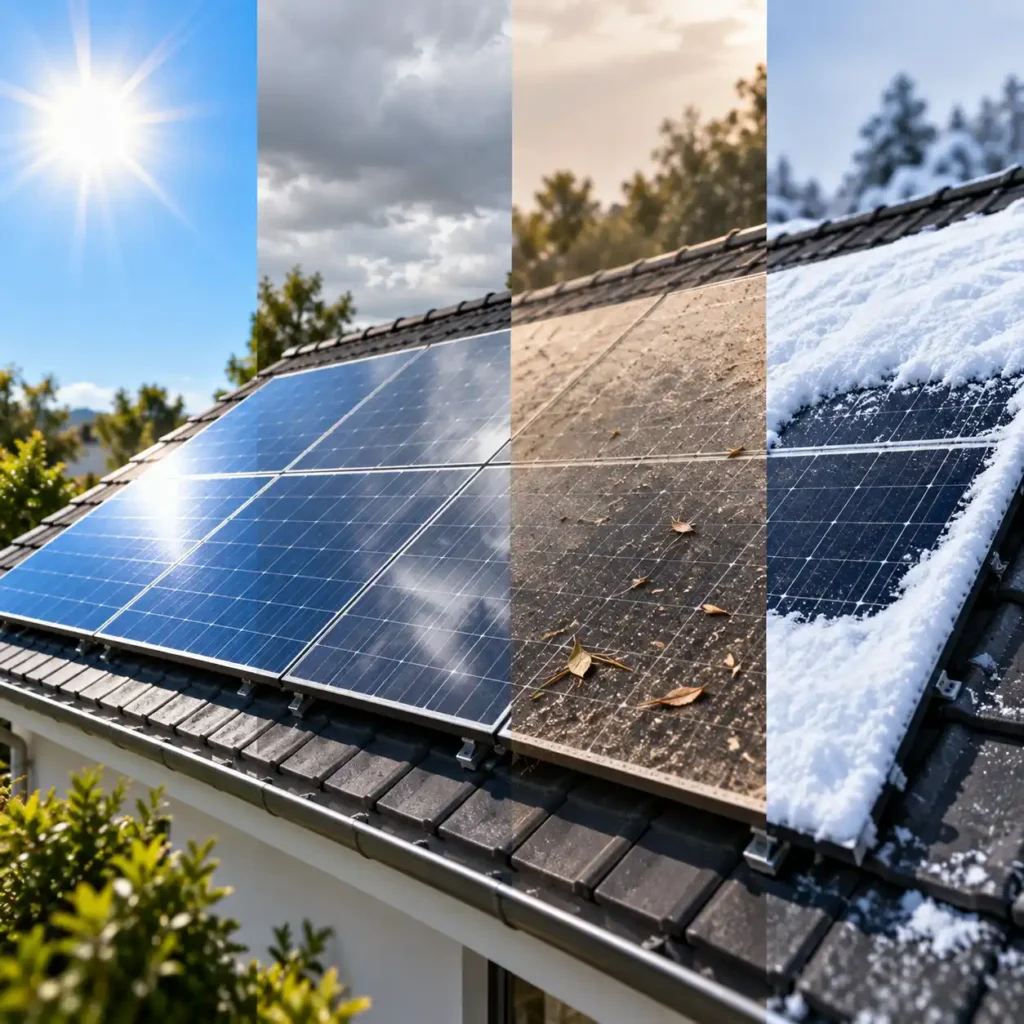
System losses directly affect the required array size.
Suppose a home needs 30 kWh/day and receives 5 peak sun hours.
With 100% theoretical efficiency:
30 ÷ 5 = 6 kW
But real systems experience losses.
At 80% efficiency:
30 ÷ (5 × 0.80) = 7.5 kW
The difference is substantial:
6 kW theoretical system vs. 7.5 kW planning system
Ignoring losses can therefore lead to an undersized array.
At the same time, it is important not to treat one generic efficiency percentage as a guarantee. Actual losses vary with system design and site conditions.
NREL’s PVWatts documentation illustrates this by modeling separate loss categories such as soiling, shading, mismatch, wiring, connections, degradation, availability, and inverter effects.
Solar Panel Wattage and Panel Count
Solar panels are available in different power ratings.
For example, a system requiring approximately 8 kW could use:
| Panel Wattage | Panels for ~8 kW | Installed Capacity |
|---|---|---|
| 400W | 20 | 8.0 kW |
| 420W | 20 | 8.4 kW |
| 440W | 19 | 8.36 kW |
| 480W | 17 | 8.16 kW |
The calculator should always round the number of panels upward.
For example, if the mathematical result is 18.2 panels, you cannot install 18.2 panels.
You need at least 19 panels, subject to the final system design.
How Much Roof Space Do Solar Panels Need?
Panel count is only half of the physical sizing problem.
You also need enough usable roof area.
A modern residential panel may occupy roughly 18–25 square feet depending on its physical dimensions, but actual installation requirements can be higher because panels cannot simply be placed edge-to-edge across a roof.
Roof-space requirements depend on:
- panel dimensions;
- roof geometry;
- setbacks;
- vents;
- chimneys;
- roof access;
- mounting configuration;
- local installation requirements.
For example, 20 panels that each occupy approximately 21 square feet would have a basic module footprint of:
20 × 21 = 420 square feet
That does not mean that exactly 420 square feet of roof is sufficient for the complete installation.
The usable roof area must account for the actual layout and required clearances.
This is one reason a calculator should present roof area as a planning estimate, not a final installation drawing.
Solar Panel Size for Battery Charging
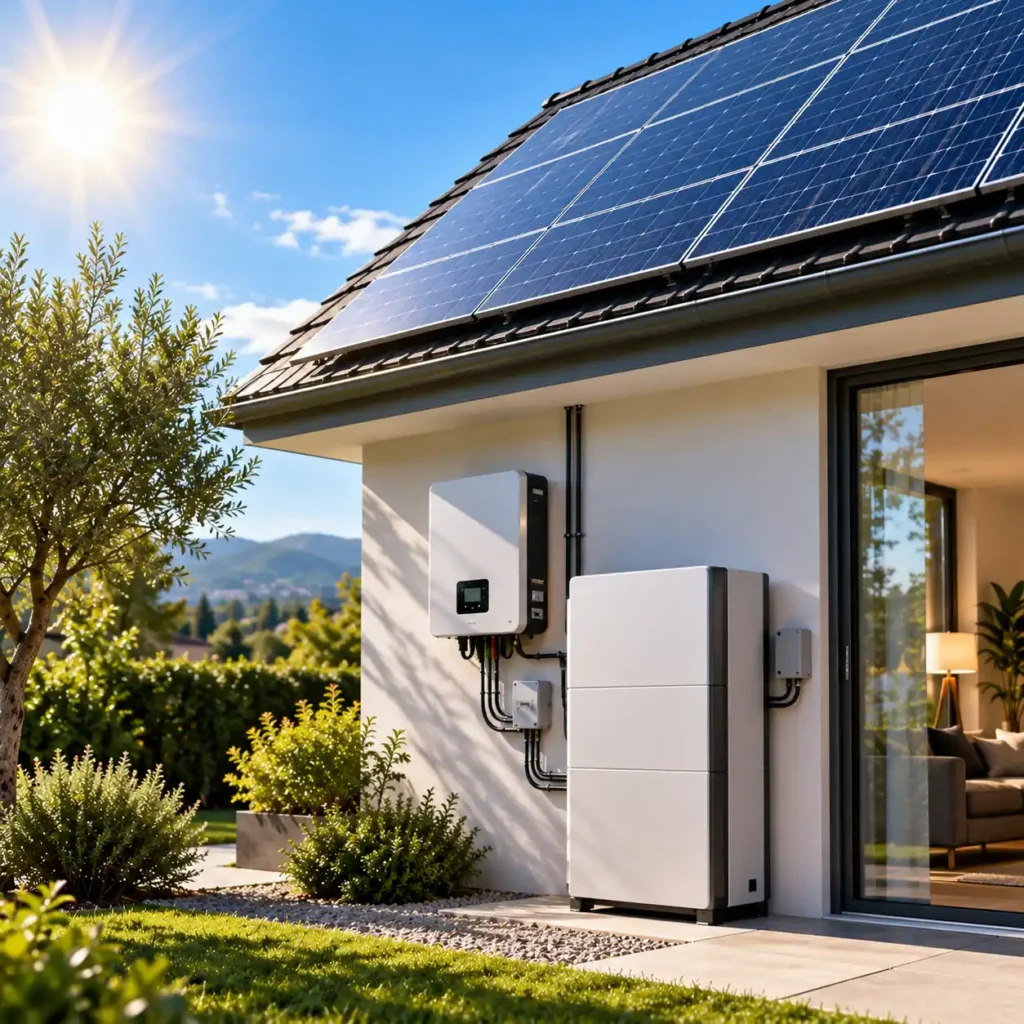
This is particularly important for a backup-power system.
Sizing solar panels to cover household electricity consumption is not exactly the same as sizing solar panels to recharge a battery.
If you have a battery bank, you need to consider:
usable battery capacity;
depth of discharge;
battery charging losses;
inverter/charger losses;
solar system losses;
how quickly you need the battery recharged;
how much solar energy is available during the recharge period.
If you are still determining how much battery storage you need, our Battery Capacity Calculator can help estimate the required battery size in Ah and Wh before you calculate the solar array needed for recharging.
For example, suppose you have a battery with:
10 kWh usable energy
and you want to replace 10 kWh of energy after a discharge.
If the combined charging and solar-system efficiency is approximately 80%, the solar array needs to produce more than 10 kWh:
10 ÷ 0.80 = 12.5 kWh
If you have 5 peak sun hours:
12.5 ÷ 5 = 2.5 kW
A planning estimate would therefore require approximately 2.5 kW of solar capacity to replace 10 kWh of battery energy under those assumptions.
The actual requirement can be higher depending on the battery, inverter, temperature, shading, charging limits, and weather.
Important Distinction
Solar panel sizing for household energy offset asks:
How large must my PV system be to produce the electricity I consume?
Solar panel sizing for battery charging asks:
How large must my PV system be to replace the energy removed from the battery within the available solar window?
These can produce very different answers.
Solar Panel Size vs. Battery Size
Solar panels and batteries perform different jobs.
The solar array generates energy.
The battery stores energy.
A larger solar array does not automatically mean you need a larger battery.
Likewise, a larger battery does not automatically require a larger solar array unless you expect the solar system to recharge that battery within a specific timeframe.
Consider a backup system with:
- 20 kWh daily household consumption;
- 10 kWh battery;
- 5 peak sun hours;
- 80% overall planning efficiency.
The solar array needed to support household energy production and the solar capacity needed to recharge a 10 kWh battery are separate calculations.
This distinction is particularly important for a website category focused on Battery Runtime, because battery runtime depends primarily on stored usable energy and load demand, while solar array sizing determines how quickly that stored energy can be replenished.
Solar Panel Size for Backup Power
For backup power, solar sizing should be approached as a system-level problem.
A useful sequence is:
Step 1: Determine the loads you need during an outage.
Step 2: Estimate daily energy consumption in kWh.
Step 3: Determine the required battery capacity.
Step 4: Determine how much battery energy needs to be replaced each day.
Step 5: Determine the available peak sun hours.
Step 6: Account for solar and charging losses.
Step 7: Calculate the solar array capacity.
For example:
- Backup energy requirement = 12 kWh/day
- Peak sun hours = 5
- Overall planning efficiency = 80%
Then:
12 ÷ (5 × 0.80) = 3 kW
A planning estimate would therefore be approximately 3 kW of solar capacity.
With 400W panels:
3,000 ÷ 400 = 7.5
Round up:
8 × 400W panels = 3.2 kW
The additional capacity created by rounding up provides a small amount of additional array capacity, although actual production still depends on site conditions.
Solar and battery storage can handle part or all of an outage, but some systems may also need a generator for longer periods of low solar production. In that case, use our Generator Size Calculator to estimate the generator capacity needed for additional backup power.
How Shading and Roof Orientation Affect Sizing
A basic calculator cannot fully understand your roof.
Two homes with identical electricity consumption can require different solar arrays because their roofs receive different amounts of usable sunlight.
Important factors include:
Roof Orientation
The direction a roof faces affects how much solar energy its panels receive over the day.
Roof Tilt
Panel angle influences solar exposure and seasonal production.
Shading
Trees, neighboring buildings, chimneys, roof structures, and other obstructions can reduce production.
Temperature
Solar module output changes with operating temperature.
Soiling
Dust, dirt, pollen, and other material on the panel surface can reduce energy production.
Wiring and Inverter Losses
Energy is lost as electricity passes through system components.
These factors are why a simple Solar Panel Size Calculator should be viewed as a preliminary sizing tool rather than a substitute for a site-specific PV model.
NREL’s PVWatts model explicitly includes system-loss categories and location-specific modeling, while DOE research identifies heat, dirt, shade, and other external factors as contributors to actual PV energy yield.
Common Solar Panel Sizing Mistakes

Using Daylight Hours Instead of Peak Sun Hours
Ten hours of daylight does not equal ten peak sun hours.
Use the appropriate solar-resource value for your location.
Ignoring System Losses
Using theoretical 100% efficiency can significantly underestimate the required array size.
Sizing Only for Today’s Electricity Use
If you expect your electricity consumption to increase, include those future loads before finalizing the system size. For example, adding an EV, heat pump, electric water heater, pool equipment, or additional air conditioning can significantly increase daily energy demand.
A system sized only around current consumption may not provide enough solar generation for your future needs.
Using One Generic Sun-Hour Value for Every Location
Solar resources vary substantially by geography and season.
Confusing Panel Wattage With System Size
A 400W panel is one module rated at 400W.
An 8 kW solar array contains multiple panels whose combined nominal capacity is approximately 8 kW.
Forgetting to Round Up
A result of 18.4 panels means you need at least 19 panels.
Ignoring Roof Space
The mathematically correct number of panels still has to fit on the available roof.
Treating the Calculator Result as a Final Design
A calculator does not automatically account for every structural, electrical, permitting, shading, or interconnection requirement.
Sizing Solar Without Considering the Battery
For backup systems, solar generation and battery storage should be evaluated together.
A battery may provide several hours of runtime, but if the solar array cannot replenish the energy consumed, the system may not recover adequately during a prolonged outage.
When a Solar Panel Size Calculator Is Not Enough
A calculator is useful for preliminary planning, comparison, and understanding the approximate system size.
It is not a substitute for a complete site-specific design.
A more detailed assessment becomes especially important when the project involves:
- substantial roof shading;
- multiple roof orientations;
- unusual roof geometry;
- large battery systems;
- whole-home backup;
- high electricity consumption;
- electric heating;
- heat pumps;
- EV charging;
- complicated inverter configurations;
- limited roof area;
- off-grid operation;
- generator integration;
- local interconnection requirements.
For these situations, a more detailed PV production model can provide a better estimate.
NREL’s PVWatts Calculator estimates PV energy production using location and system parameters, while more advanced modeling tools can incorporate additional design and performance variables.
What to Check Before Buying Solar Panels

Once the Solar Panel Size Calculator gives you a preliminary system size, do not immediately choose a panel based only on its wattage.
Check:
- panel wattage;
- physical panel dimensions;
- efficiency rating;
- temperature characteristics;
- manufacturer specifications;
- inverter compatibility;
- voltage and current limits;
- available roof area;
- roof orientation;
- shading;
- mounting requirements;
- local electrical requirements;
- battery compatibility, if applicable;
- warranty and degradation specifications.
For battery-backed systems, also check the inverter’s maximum PV input and charging limitations.
A solar array can be physically large enough to produce the required energy but still be incompatible with the selected inverter or charge controller.
Frequently Asked Questions
How many solar panels do I need for my home?
The number of solar panels depends on your electricity consumption, peak sun hours, system losses, and panel wattage. As a starting point, calculate the required solar array size first, then divide it by the wattage of one panel. A typical residential system may require around 15–25 modern panels, but the exact number can vary significantly by location and energy use.
How do I calculate what size solar panel system I need?
Divide your daily electricity consumption by your average peak sun hours and the expected system efficiency. For example, 30 kWh per day with 5 peak sun hours and 80% efficiency requires approximately 7.5 kW of solar capacity. You can then divide the required wattage by the wattage of your chosen panels to determine the panel count.
How many 400W solar panels do I need?
The number of 400W panels depends on the required system size. For an 8 kW solar array, you would need 20 × 400W panels. For a 7.5 kW requirement, the calculation gives 18.75 panels, so you would need 19 panels, providing 7.6 kW of installed DC capacity.
How many solar panels do I need for 1,000 kWh per month?
The answer depends heavily on your location and solar resource. You first need to convert 1,000 kWh per month into an average daily requirement of about 33.3 kWh. The required panel count then depends on peak sun hours, system losses, and panel wattage. Current solar-sizing guides emphasize that the same 1,000 kWh monthly consumption can require substantially different system sizes in different climates.
What are peak sun hours for solar panels?
Peak sun hours represent the equivalent number of hours per day when solar irradiance averages 1,000 W/m². They are not the same as daylight hours. A location may have many hours of daylight but only several equivalent peak sun hours available for solar production. Using the correct local peak sun-hour value is important when sizing a PV system
How much efficiency should I assume when sizing a solar system?
A simplified calculator can use an overall system-efficiency or performance-ratio assumption to account for real-world losses. However, there is no single efficiency value that applies to every installation. Inverter losses, temperature, wiring, soiling, shading, mismatch, and other factors can affect actual production. More detailed calculators model these losses separately.
How much roof space do I need for solar panels?
Roof space depends on the number and physical dimensions of the panels, plus setbacks, access areas, vents, chimneys, shading, and other obstructions. The nominal panel footprint is therefore smaller than the total roof area required for an actual installation. A calculator can provide a preliminary estimate, but only a roof layout or site survey can determine usable installation area accurately.
How many solar panels do I need to charge a 10 kWh battery?
It depends on how much energy you need to put back into the battery, the available peak sun hours, and charging and system losses. For example, if 10 kWh must be replenished and the overall planning efficiency is 80%, approximately 12.5 kWh of solar energy would be required. With 5 peak sun hours, that corresponds to approximately 2.5 kW of solar capacity, or about 7 × 400W panels after rounding up.
Can I use a Solar Panel Size Calculator for an off-grid system?
Yes, but only as a preliminary sizing tool. Off-grid systems require additional consideration of battery capacity, depth of discharge, inverter efficiency, seasonal solar production, backup generation, charging limits, and periods of low solar availability. The basic array calculation can be used as a starting point, but an off-grid system requires more detailed design.
Should I size solar panels based on monthly or annual electricity usage?
Annual electricity consumption is generally more useful for an initial whole-year sizing estimate because it captures seasonal differences in energy use. Monthly consumption can also be useful, particularly when you want to examine seasonal production or size a system around a specific operating period. Current solar calculators commonly use annual kWh or monthly kWh as the primary consumption input.
Does a larger solar panel mean I need fewer solar panels?
Yes, but only in terms of panel count, not necessarily total solar capacity. For example, an 8 kW system requires 20 × 400W panels, but only 17 × 480W panels would provide approximately 8.16 kW. The required system capacity is determined by energy demand and solar conditions; higher-wattage panels simply reach that capacity with fewer modules.
Can a Solar Panel Size Calculator tell me exactly how much electricity my panels will produce?
No. A calculator provides a planning estimate rather than a guaranteed production figure. Actual output depends on location, orientation, tilt, shading, temperature, soiling, inverter performance, wiring, equipment characteristics, and seasonal weather. More detailed PV models can incorporate location-specific solar and weather data, but even those are estimates rather than guarantees
Is a Solar Panel Size Calculator accurate enough to choose a final system?
It is useful for preliminary system sizing, comparing panel configurations, and understanding approximately how much solar capacity you may need. It should not replace a site-specific design. Before purchasing equipment, verify the result against roof orientation, shading, usable roof area, inverter limits, electrical requirements, battery requirements, and local installation rules. Current 2026 calculator guidance similarly describes online sizing results as planning estimates rather than final installation designs.
Solar Panel Size Calculator — Final Takeaway
The most reliable way to estimate solar panel requirements is to start with energy demand, not the panel itself.
Determine how much electricity you need, convert that demand into a daily or annual energy requirement, identify the available peak sun hours, account for realistic system losses, and then calculate the required solar array capacity.
The basic formula is:
Required Solar Array Size = Daily Energy Use ÷ (Peak Sun Hours × System Efficiency)
Then calculate the panel count:
Number of Panels = Required Array Size × 1,000 ÷ Panel Wattage
Always round the panel count upward and verify that the resulting array fits the available roof area.
For backup-power systems, go one step further. Solar generation and battery storage should be evaluated together because the solar array determines how quickly the battery can be replenished after energy is consumed.
A Solar Panel Size Calculator is therefore an excellent starting point for planning a solar system, comparing panel configurations, estimating battery-recharge capability, and understanding the approximate scale of a PV array.
For a final installation decision, however, the calculated result should be checked against actual solar-resource data, roof orientation and shading, equipment specifications, inverter limits, battery requirements, electrical design, and applicable installation requirements. NREL and the U.S. Department of Energy both emphasize the importance of system-specific modeling and real-world performance factors when estimating PV energy production.