
Choosing the best portable solar panel for a power station is not simply a matter of matching wattage. A panel may have sufficient rated power but still be incompatible with a station because of its operating voltage, current, or connector requirements. This makes comparing the best portable solar panels for power stations more complicated than comparing their advertised wattage alone.
This guide evaluates five portable solar panels across 100W, 200W, and 400W categories, examining their electrical specifications, connection requirements, portability, and practical limitations. Rather than treating higher wattage as an automatic advantage, we focus on whether each panel is a suitable match for a particular type of solar input. Our compatibility-first approach helps you identify what to check before buying and avoid choosing a panel your power station cannot use effectively.
As an Amazon Associate, I earn from qualifying purchases.
Table of Contents
Quick Answer
If you need a smaller 100W option for a lower-power solar setup, consider the Anker SOLIX PS100 Bifacial (Best 100W Panel for Lower-Power Solar Setups). For a 200W panel with lower operating voltage and higher current, the BougeRV New 200W N-Type Foldable (Best 200W Panel for Lower-Voltage, Higher-Current Inputs) is worth considering. Its 18V Vmp and 11.2A Imp make it important to check your power station’s accepted PV voltage and current before buying.
For a 400W setup, the right choice depends on the input requirements and preferred panel design. The Anker SOLIX PS400 Bifacial (Best 400W Panel for 48V-Rated Solar Inputs) is a candidate for stations that support its 48V rated output. The Renogy REGO 400W Portable Solar Panel (Best 400W Suitcase Panel with Integrated Kickstands) is worth considering if you prefer a suitcase-style design with integrated supports, while the Renogy RSP400SB-US 400W Solar Blanket (Best Lightweight 400W Blanket-Style Panel) offers a lighter blanket-style format. Check the exact Amazon listing and current availability for both Renogy models before purchasing.
Before choosing any panel, compare its open-circuit voltage (Voc), operating voltage, current, and connector requirements with your power station’s solar input specifications. A higher wattage rating does not guarantee compatibility or faster charging.
Our Evidence & Evaluation Method
Our assessment is based on documented product specifications, manufacturer technical documentation, official warranty information, and Amazon US product listings for the specific models reviewed. We use these sources to verify product details and identify compatibility requirements that buyers should check before connecting a panel to a portable power station.
| Information Reviewed | What We Verified | Primary Source |
|---|---|---|
| Electrical Specifications | Voc, Vmp, Isc, Imp, and rated solar output, where published | Manufacturer specifications and technical documentation |
| Product Dimensions & Weight | Folded dimensions, deployed dimensions, weight, and panel format | Manufacturer product documentation |
| Connectors & Included Cables | Documented connector types, cable configurations, and included accessories | Manufacturer documentation and exact Amazon US listings |
| Construction & Protection | Panel design, stated weather-resistance ratings, and documented operating conditions | Manufacturer product documentation |
| Warranty & Support | Published warranty periods and available support information | Official manufacturer warranty and support documentation |
| Power Station Input Requirements | Accepted PV voltage and current ranges, maximum solar input, and relevant connection requirements | Manufacturer documentation for the power station, where available |
We distinguish manufacturer-rated specifications from calculated estimates and technical compatibility analysis. We do not present theoretical output as independently measured performance.
Product versions also matter. Specifications, connectors, cables, and included accessories can differ between regional versions or model revisions, so we identify the specific US models reviewed wherever the available documentation allows.
Research Limitations
We did not conduct independent laboratory tests or outdoor performance measurements. Our assessment therefore does not establish independently measured conversion efficiency, real-world power output, or comparative charging speed. Actual performance depends on environmental conditions and the power station’s own input limitations.
Our goal is to provide a transparent, documentation-based comparison and help readers understand which product details and power station requirements they should verify before purchasing.
Who This Guide Is For
Who Should Read This
This guide is for buyers who want to pair a portable solar panel with a power station and need to understand voltage, current, connector, and wattage compatibility before purchasing. It is especially useful if you already own a power station and want to expand or replace its solar charging setup.
Who Should Use Another Guide
If you are choosing a power station rather than a solar panel, start with our guide to the Best Portable Power Stations. If you want a broader comparison of portable solar panels for camping, RV trips, or general outdoor use, see our Best Portable Solar Panels (2026) guide.
Quick Summary
Anker SOLIX PS100 Bifacial
- Award: Best 100W Panel for Lower-Power Solar Setups
Best For: Buyers who need a compact 100W solar option for a compatible portable power station.
Key Reason: A 100W bifacial portable solar panel designed to provide solar charging without stepping up to a larger panel.
Main Limitation: Its 100W rated output is lower than the other panels in this comparison. Check the exact listing version, solar input compatibility, and included cables before buying.
BougeRV New 200W N-Type Foldable
- Award: Best 200W Panel for Lower-Voltage, Higher-Current Inputs
Best For: Buyers whose power stations support an 18V operating-voltage panel with a higher current input.
Key Reason: A foldable 200W N-type solar panel that provides a higher-wattage option in a relatively low-voltage configuration.
Main Limitation: Its 11.2A rated operating current and 12.22A short-circuit current may exceed the limits of some power station solar inputs.
Anker SOLIX PS400 Bifacial
- Award: Best 400W Panel for 48V-Rated Solar Inputs
Best For: Owners of power stations with solar inputs compatible with a 48V-rated, 400W panel.
Key Reason: A 400W bifacial portable solar panel designed for higher-capacity solar charging setups.
Main Limitation: Its 48V rated voltage and 8.33A rated current require careful compatibility checks. It is not suitable for every portable power station.
Renogy REGO 400W Portable Solar Panel
- Award: Best 400W Suitcase Panel with Integrated Kickstands
Best For: Buyers who prefer a foldable suitcase-style 400W panel with integrated support legs.
Key Reason: A portable suitcase-format solar panel designed to provide a structured, freestanding deployment option.
Main Limitation: Its weight and deployed size require consideration when transporting and positioning it. Confirm the exact specifications and model designation associated with the Amazon listing before purchase.
Renogy RSP400SB-US 400W Portable Solar Panel Blanket
- Award: Best Lightweight 400W Blanket-Style Panel
Best For: Buyers who prioritize a lighter 400W blanket-style design over a rigid suitcase format.
Key Reason: A 16.09 lb, foldable 400W solar blanket designed to provide a high rated output in a flexible panel format.
Main Limitation: Its blanket-style design requires a suitable surface for deployment rather than offering freestanding support. The MC4 connection also requires a compatible cable or adapter for the power station.
Portable Solar Panel Comparison
| Model | Rated Solar Output | Weight | Best For |
|---|---|---|---|
| Anker SOLIX PS100 Bifacial | 100W | 6.2 lb | Lower-power solar setups |
| BougeRV New 200W N-Type Foldable | 200W | 13.8 lb | Lower-voltage, higher-current inputs |
| Anker SOLIX PS400 Bifacial | 400W | 21.9 lb | Compatible 48V-rated solar inputs |
| RENOGY REGO 400W Portable Solar Panel | 400W | 30.2 lb | Suitcase-style deployment with integrated kickstands |
| Renogy RSP400SB-US 400W Portable Solar Panel Blanket | 400W | 16.09 lb | Lightweight blanket-style design |
How We Evaluated
We compared the five portable solar panels using criteria that reflect how buyers select a panel for a specific portable power station. Electrical compatibility carries particular weight: a panel’s rated wattage alone does not determine whether a power station can accept its output.
Our evaluation focuses on the following criteria:
1. Electrical Compatibility
We compared each panel’s open-circuit voltage (Voc), operating voltage (Vmp), operating current (Imp), and short-circuit current (Isc), where specifications were available. These values help determine whether a panel’s electrical characteristics fall within a power station’s accepted solar input range.
2. Rated Solar Output
We considered each panel’s rated wattage in relation to the intended charging setup. A higher wattage rating does not guarantee that a power station will accept the panel’s full rated output. The station’s maximum solar input and electrical limits remain essential parts of the comparison.
3. Charging Potential
We considered how panel output and electrical characteristics may translate into useful solar charging under suitable conditions. Actual energy production varies with sunlight intensity, panel angle, shading, temperature, and the power station’s input limits. We therefore treat rated wattage as a specification, not a guaranteed real-world result.
4. Connector and Adapter Compatibility
We examined documented panel connections, included cables, and any stated adapter requirements. A panel may meet a power station’s electrical requirements but still need a compatible cable or adapter. Connector compatibility and electrical compatibility are treated as separate considerations.
5. Portability and Deployment
We compared verified product weights, folded and deployed dimensions, and overall panel formats. These factors help distinguish compact foldable panels from larger suitcase-style and blanket-style designs, each of which offers a different balance of transport convenience and setup requirements.
6. Construction and Weather Protection
We considered documented construction features, protective ratings, and stated operating conditions. These details help buyers understand the conditions each panel is designed to handle without assuming that all portable panels provide equivalent weather protection.
7. Setup and Practical Usability
We considered documented deployment features such as integrated kickstands, folding configurations, and positioning requirements. These characteristics can affect how easily a panel can be set up and adjusted at a campsite, RV site, or home.
8. Warranty and Manufacturer Support
We considered published warranty terms and available manufacturer support information. Warranty coverage is relevant to long-term ownership, particularly for equipment that may be transported frequently and used outdoors.
9. Use-Case Fit and Overall Value
Finally, we considered how each panel’s specifications, compatibility requirements, portability, and documented features align with its intended use. A 100W panel may be a more practical choice for a lower-power setup, while a 400W model may better suit a power station designed to accept higher solar input. We do not treat the highest rated wattage as an automatic indicator of the best choice.
Our Evaluation Approach
We applied these criteria to compare the five selected models and identify their respective strengths, limitations, and intended use cases. Our assessment relies on manufacturer specifications, product documentation, and technical compatibility analysis rather than independent laboratory or outdoor testing. When discussing charging performance, we distinguish manufacturer-rated output from practical performance considerations and clearly identified estimates.
Solar Panel Connectors and Power Station Inputs
Portable solar panels and power stations do not always use the same connector type. An adapter cable may be required to connect them, but a matching connector does not automatically mean that the panel is electrically compatible with the power station.
| Panel Connector | Power Station Input | What to Check |
|---|---|---|
| MC4 | XT60 / XT60i | Confirm that the specific MC4-to-XT60 or MC4-to-XT60i cable is compatible with the power station and meets its cable and electrical requirements. |
| MC4 | DC8020 | Verify that the power station manufacturer specifies or supports a suitable MC4-to-DC8020 cable for the exact model. |
| Proprietary panel connector | Matching proprietary input | Confirm compatibility with the exact power station model and its specified connection requirements. |
| Different connector types | Supported PV input | Check adapter compatibility, connector polarity, cable ratings, and the power station's electrical input limits. |
Important: An adapter can resolve a physical connector mismatch, but it cannot make an electrically incompatible panel suitable for a power station. Before connecting a panel, compare its Voc, Vmp, Isc, and Imp with the power station’s published solar input specifications. Also verify connector polarity, cable ratings, and any manufacturer-specific connection requirements. Do not assume that an MC4-to-XT60, MC4-to-XT60i, or MC4-to-DC8020 cable is suitable for every power station that uses that input connector.
Example Solar Panel and Power Station Compatibility Checks
The following examples show how to compare a panel’s electrical specifications with a power station’s published solar input limits. They are specification-based compatibility checks, not manufacturer-certified endorsements of every possible cable configuration.
1. Anker SOLIX PS100 Bifacial (100W) → Anker SOLIX C1000
The PS100 has a Vmp of 21.6V and an Imp of 4.63A, with a published Voc of 25.9V and Isc of 4.86A. These values fall within the C1000’s 11–32V solar input range, which supports up to 10A. The panel’s rated output is also below the station’s maximum solar input capacity.
Before connecting them, confirm that the cable and connector configuration is suitable for the exact C1000 version.
2. BougeRV New 200W N-Type Foldable → EcoFlow DELTA 2 Max
The BougeRV panel is rated at 200W, with a Vmp of 18V, Imp of 11.2A, Voc of 21V, and Isc of 12.22A. The DELTA 2 Max supports 11–60V, up to 15A, and up to 500W per solar input. The panel’s published electrical specifications fall within these limits.
A suitable connection cable is still required. Verify its connectors, polarity, and electrical ratings before use.
3. Renogy RSP400SB-US 400W Portable Solar Panel Blanket → EcoFlow DELTA 2 Max
The Renogy blanket has a Vmp of 33.6V, Imp of 11.9A, Voc of 39.2V, and Isc of 13.1A. Its 400W rated output is below the DELTA 2 Max’s 500W single-port limit, while its published voltage and current values fall within the station’s stated input limits.
Check the panel’s cable configuration and allow for the increase in open-circuit voltage that can occur at low temperatures before connecting it.
Important: These examples compare published electrical specifications; they do not replace the connection instructions for either product. Always check the exact power station manual, cable compatibility, connector polarity, and operating conditions. A panel that passes an electrical specification check may still require a separately sourced cable or adapter.
Product Reviews
Anker SOLIX PS100 Bifacial
Best 100W Panel for Lower-Power Solar Setups

Quick Verdict
The Anker SOLIX PS100 Bifacial Portable Solar Panel, 100W, for Camping, Home is a foldable 100W solar panel for power station owners who need a compact, lower-output charging option rather than a larger panel designed for high-capacity solar setups. Its defining feature is the bifacial design, which captures sunlight from both sides of the panel. Anker states that this can provide up to 10% more power in suitable locations with reflective surfaces, such as sand, snow, or concrete.
We selected it as Best 100W Panel for Lower-Power Solar Setups because it fills a specific role in this comparison: providing a portable solar option for users whose charging needs do not justify a 200W or 400W panel. Its 100W rating also sets a clear boundary on its intended use. It is best considered by buyers whose power stations support the panel’s electrical output and who value a smaller solar setup over maximum charging capacity.
Snapshot
| Specification | Details |
|---|---|
| Rated Solar Output | 100W |
| PV Output (Vmp / Imp) | 21.6V / 4.63A |
| Panel Design | Bifacial, foldable |
| Solar Cell Technology | N-type |
| Weight | 6.2 lb |
| Folded Dimensions | 20.1 × 23.6 × 2.5 in |
| Unfolded Dimensions | 40.6 × 23.6 × 0.7 in |
| Included Cables | Two 8.2 ft MC4 extension cables and one 1.6 ft XT60i charging cable. cable |
| Warranty | 5 years |
Why We Chose It
The Anker SOLIX PS100 Bifacial Portable Solar Panel, 100W, for Camping, Home stands out from the other models in our selection through its bifacial construction. While the BougeRV 200W and three 400W panels prioritize higher rated output, the PS100 offers a different feature: the ability to collect reflected light through its rear surface.
Anker claims that the bifacial design can provide up to 10% additional power under suitable conditions. The actual benefit depends on the installation surface, reflected light, and panel positioning. This feature gives the PS100 a distinct advantage within the lower-output category, although it does not replace the higher charging capacity offered by the larger panels.
We selected it for buyers who value bifacial technology in a 100W panel, rather than those who need to maximize solar input.
Check the latest price and customer reviews on Amazon.

Practical Considerations
When unfolded, the Anker SOLIX PS100 Bifacial Portable Solar Panel, 100W, for Camping, Home measures 40.6 × 23.6 inches, giving it a relatively manageable footprint for a campsite, RV parking area, or backyard. Its integrated stand allows you to position the panel toward the sun rather than laying it flat, while the foldable construction makes storage between trips more convenient. At 6.2 lb, it is also easier to carry from a vehicle to a suitable sunlit spot than the larger 200W and 400W panels in this comparison.
In everyday use, the PS100 makes the most sense for topping up a compatible portable power station during outdoor activities or adding modest solar input at home. Its bifacial surface may benefit from reflected light when placed above a bright surface, although the actual gain depends on the surroundings and sunlight conditions. The main limitation is its 100W rated output: it is not designed for buyers who need substantial solar generation or want to take full advantage of a power station with a high-capacity PV input. Compatibility with the station’s voltage, current, and connector requirements must also be confirmed before use.
Evaluation
| Evaluation Factor | This Model | How It Compares | Buyer Implication |
|---|---|---|---|
| Solar Output | 100W | Lowest rated output among the five models | Suits modest solar charging needs rather than high-demand setups |
| Electrical Compatibility | 21.6V / 4.63A | Different input profile from the 200W and 400W alternatives | Verify your power station's accepted voltage and current limits |
| Bifacial Design | Captures light from both sides | A distinguishing feature in this selection | Reflected light may provide additional output in suitable conditions |
| Portability | Foldable design; 6.2 lb | Lighter and more compact than the larger-output alternatives | Easier to carry and store when portability matters more than maximum wattage |
Who Should Buy This
- Buyers who need a compact 100W solar panel for a compatible portable power station rather than a higher-output charging setup.
- Campers and RV users who prioritize a foldable panel that is relatively easy to carry and store.
- Power station owners whose solar input supports the panel’s 21.6V / 4.63A output.
- Users who can position the panel above reflective surfaces to potentially benefit from its bifacial design.
Who Should Skip This
- Buyers who need more than 100W of rated solar output to replenish a power station with substantial daily energy demands.
- Owners of power stations whose PV input voltage or current limits are incompatible with the panel’s electrical output.
- Users who need a larger solar panel for higher-output charging and would benefit more from one of the 200W or 400W models in this guide.
Final Verdict
The Anker SOLIX PS100 Bifacial Portable Solar Panel, 100W, for Camping, Home is a good fit for buyers who prioritize portability and need only modest solar charging capacity. Its main advantage is the lightweight bifacial design; its main limitation is the 100W output, which may be insufficient for power stations with higher daily charging demands.
Check the latest price and customer reviews on Amazon.
Related Guide: Not sure whether a 100W panel provides enough solar capacity for your setup? Use our Solar Panel Size Calculator to estimate the solar panel wattage your setup requires.
BougeRV New 200W N-Type Foldable
Best 200W Panel for Lower-Voltage, Higher-Current Inputs
Quick Verdict
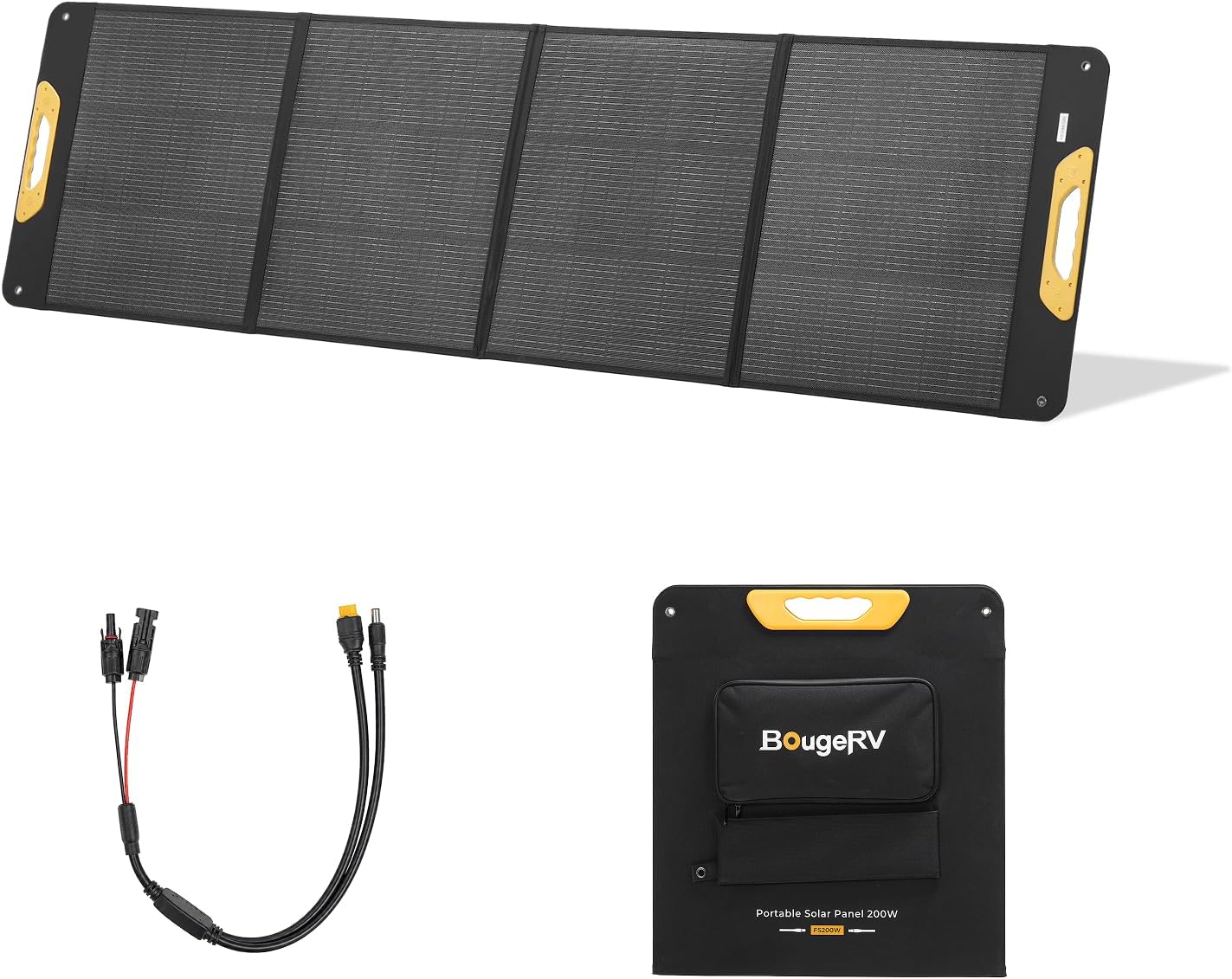
The BougeRV 200W Portable Solar Panel is a foldable solar panel designed for portable power station owners who need more solar input than a 100W panel can provide but do not want to carry a 400W setup. Its defining characteristic is its lower-voltage, higher-current electrical profile, making it particularly relevant to buyers whose power stations support this type of solar input.
We selected it as Best 200W Panel for Lower-Voltage, Higher-Current Inputs because it occupies a distinct position among our five choices. It is not a universal match for every power station: the receiving unit must support the panel’s voltage and current specifications, as well as its connection requirements. Buyers should verify these limits before choosing this model.
Snapshot
| Specification | Details |
|---|---|
| Rated Solar Output | 200W |
| Operating Voltage / Current (Vmp / Imp) | 18V / 11.2A |
| Weight | 13.8 lb |
| Folded Dimensions | 23.6 × 22.9 × 1.8 in |
| Unfolded Dimensions | 87.8 × 22.9 × 1.18 in |
| Included Cable | 1 × 1.6-ft solar charging cable |
Why We Chose It
The BougeRV 200W Portable Solar Panel earns Best 200W Panel for Lower-Voltage, Higher-Current Inputs because it offers a middle ground between the 100W Anker SOLIX PS100 and the three 400W models in our selection. It provides twice the PS100’s rated output without moving into the larger-output category represented by the Anker SOLIX PS400 and two Renogy panels.
Its lower-voltage, higher-current profile also distinguishes it from the other models. This makes it a relevant option for power stations specifically designed to accept that electrical configuration, rather than a general-purpose choice based on wattage alone.
We chose it for buyers whose power stations support its input requirements and who want a 200W foldable panel without stepping up to a 400W setup.
Check the latest price and customer reviews on Amazon.

Practical Considerations
When unfolded, the BougeRV 200W Portable Solar Panel measures 87.8 × 22.9 inches, so it needs a fairly long, unobstructed surface for deployment. Its 13.8 lb weight makes it manageable to carry between a vehicle and a campsite, while the folded dimensions of 23.6 × 22.9 × 1.8 inches make storage considerably easier. This format is suited to users who can set aside a clear area for the panel rather than those who need a rigid panel permanently mounted in place.
At an RV site or campsite, the panel can serve as a portable daytime charging option for a compatible power station. Users can reposition it as the sun moves to maintain favorable exposure, provided the cable reaches the station without creating a trip hazard. Its lower-voltage, higher-current profile also makes checking the power station’s solar input specifications particularly important before setup.
Evaluation
| Evaluation Factor | This Model | How It Compares | Buyer Implication |
|---|---|---|---|
| Solar Output | 200W rated output | Twice the rated wattage of the Anker PS100, below the three 400W models | Offers a middle ground for buyers who need more than a 100W panel |
| Electrical Compatibility | 18V / 11.2A operating output | Lower operating voltage than the 400W alternatives, with higher current than the Anker PS400 and RENOGY REGO | Suitable only for power stations that support this voltage and current combination |
| Deployment Footprint | 87.8 × 22.9 in unfolded | Its long, narrow layout differs from the more compact or suitcase-style alternatives | Requires sufficient unobstructed ground space when deployed |
| Portability | 13.8 lb; foldable design | Lighter than all three 400W panels, but heavier than the Anker PS100 | A manageable option to transport when a 200W output is preferred over a smaller panel |
Who Should Buy This
- Power station owners whose solar input supports an 18V operating voltage and 11.2A operating current.
- RV and camping users who need a 200W panel for daytime solar charging without moving to a 400W setup.
- Buyers who want more rated solar output than a 100W panel offers but still need a foldable, transportable design.
- Users with enough unobstructed outdoor space to deploy a panel measuring 87.8 inches in length.
Who Should Skip This
- Owners of power stations that cannot accept the panel’s 18V operating voltage or 11.2A current.
- Buyers who need higher solar input capacity and would benefit more from one of the 400W panels in this guide.
- Campers with limited deployment space who may find the panel’s nearly 7.3-foot unfolded length impractical.
Final Verdict
Check the latest price and customer reviews on Amazon.
Related Guide: If your power station does not recognize a solar panel or charge as expected, see our guide to Why Is My Portable Power Station Not Charging from Solar Panels?. It explains how to check voltage and current compatibility, connectors, and solar input limits before assuming that your panel or power station is faulty.
Anker SOLIX PS400 Bifacial
Best 400W Panel for 48V Vmp-Rated Solar Inputs

Quick Verdict
The Anker SOLIX PS400 Bifacial Portable Solar Panel is a foldable 400W solar panel designed for portable power station owners who need higher solar input for RV use, camping, or home backup.
We selected it as Best 400W Panel for 48V-Rated Solar Inputs for buyers whose power stations support its electrical configuration and who want a high-output bifacial panel in a portable format.
Snapshot
| Specification | Details |
|---|---|
| Rated Solar Output | 400W |
| PV Output (Vmp / Imp) | 48V / 8.33A |
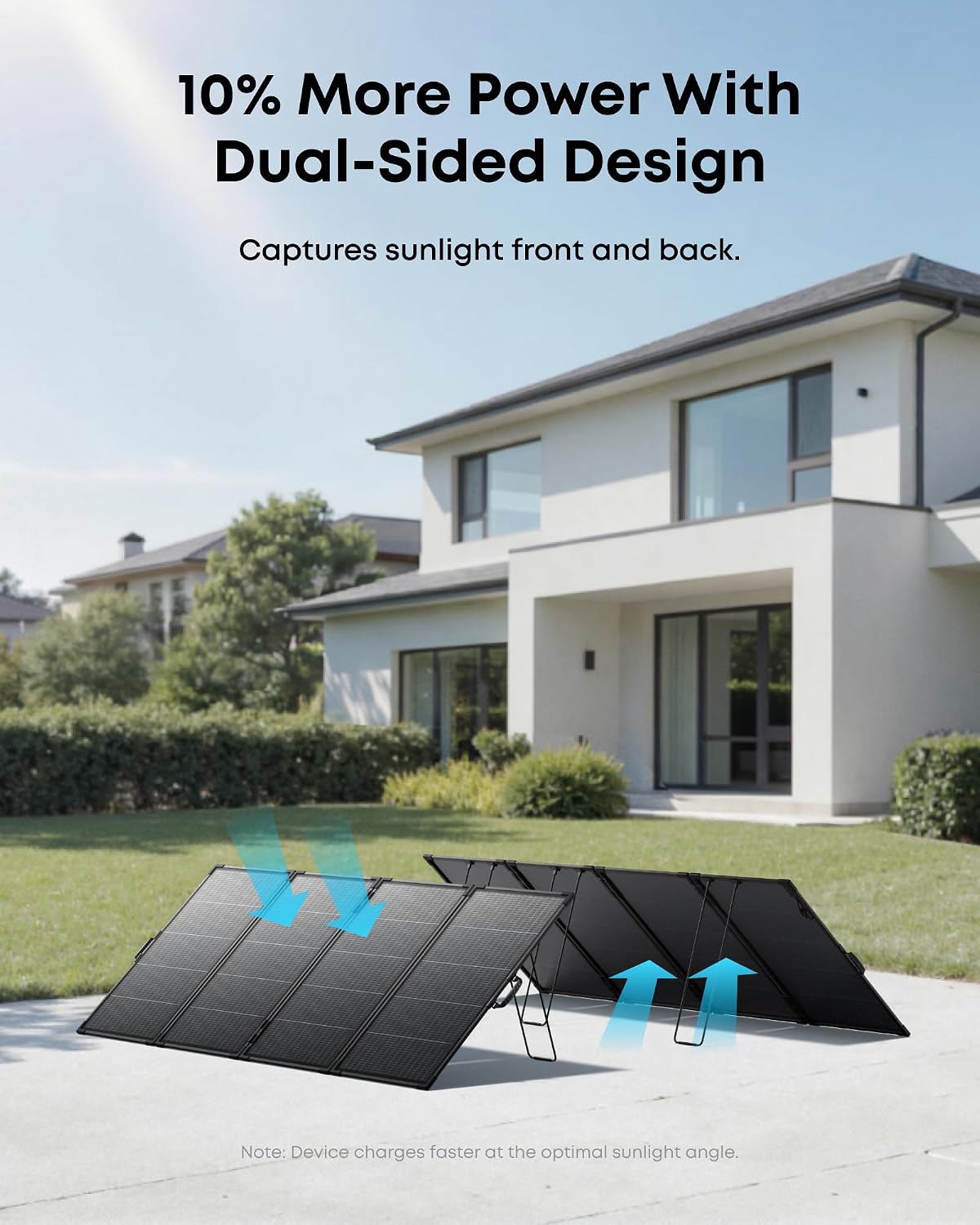
| Solar Cell Technology | N-Type, bifacial |
| Weight | 21.9 lb |
| Folded Dimensions | 22.3 × 38.7 × 3.2 in |
| Unfolded Dimensions | 90.2 × 38.7 × 0.7 in |
| Included Cables | 2 × 8.2-ft solar charging cables; 1 × 1.6-ft XT60i solar charging cable |
| Warranty | 5 years |
Why We Chose It
The Anker SOLIX PS400 Bifacial earns Best 400W Panel for 48V-Rated Solar Inputs because it combines a 400W rated output with a 48V electrical profile. This distinguishes it from the BougeRV 200W panel and the smaller Anker PS100, while giving it a different compatibility profile from the two Renogy 400W models.
We chose it for power station owners whose equipment supports this 48V-rated input configuration and who want a bifacial panel in a foldable format. Its award is based on this specific compatibility niche, not on a claim that it is universally better than the other 400W options.
Check the latest price and customer reviews on Amazon.
Practical Considerations
When unfolded, the Anker SOLIX PS400 Bifacial measures 90.2 × 38.7 inches, so it needs a fairly large, unobstructed area for deployment. Folded dimensions are 22.3 × 38.7 × 3.2 inches, making it easier to store in an RV or vehicle cargo area, while its 21.9 lb weight is manageable for occasional transport.
It is suited to RV trips, extended camping, or backup charging where a 400W panel can be positioned in direct sunlight. The main practical limitation is its large unfolded footprint: it may be difficult to position at crowded campsites or in areas with limited sun exposure.
Evaluation
| Evaluation Factor | This Model | How It Compares | Buyer Implication |
|---|---|---|---|
| Solar Output | 400W rated output | Higher than the 100W and 200W options; matches the two Renogy 400W panels | Suitable for buyers who need higher solar generation capacity |
| Electrical Compatibility | 48V / 8.33A Vmp / Imp output | Different electrical profile from the other four panels | Confirm that the power station supports this voltage and current before buying |
| Portability | 21.9 lb; foldable design | Lighter than the RENOGY REGO 400W, but heavier than the Renogy RSP400SB-US blanket. | Offers a balance between 400W output and transportability |
| Panel Design | N-type bifacial cells | Adds rear-side generation capability not shared by all models in this comparison | May provide additional output when reflective light reaches the rear surface |
Who Should Buy This
Power station owners whose solar input supports the panel’s 48V Vmp and 8.33A Imp specifications.
RV users and campers who need a foldable solar panel rated at 400W.
Buyers interested in a 400W bifacial panel.
Users with enough open space to position the panel for direct sunlight and, where suitable reflective surfaces are available, additional light on its rear side.
Who Should Skip This
- Owners of power stations that do not support the panel’s voltage and current requirements.
- Buyers who need a compact panel for limited campsite or balcony space.
- Users who prioritize the lightest possible 400W option; the Renogy RSP400SB-US blanket weighs less at 16.09 lb.
Final Verdict
The Anker SOLIX PS400 Bifacial is the strongest fit for buyers who need 400W of solar input and whose power station is compatible with its 48V-rated output. Its bifacial design adds potential value in suitable conditions, but the large deployment area and specific electrical requirements make compatibility and available space essential buying considerations. Choose it when those conditions are met; otherwise, one of the other 400W panels may be a more practical match.
Check the latest price and customer reviews on Amazon.
Renogy REGO 400W
Best 400W Suitcase Panel with Integrated Kickstands

Quick Verdict
The Renogy REGO 400W Portable Solar Panel is a 400W foldable suitcase-style panel designed for portable power station owners who need higher solar output and a stable, freestanding setup. Its integrated kickstands make positioning the panel toward the sun more convenient without requiring a separate support structure.
We selected it as Best 400W Suitcase Panel with Integrated Kickstands for buyers who prioritize straightforward deployment and adjustable positioning. However, this model has a specific manufacturer-stated power station voltage requirement that buyers must verify before purchasing.
Snapshot
| Specification | Details |
|---|---|
| Rated Solar Output | 400W |
| Operating Voltage / Current (Vmp / Imp) | 40V / 10A |
| Weight | 30.2 lb |
| Folded Dimensions | 27.9 × 33.7 × 3.2 in |
| Unfolded Dimensions | 111.8 × 33.7 × 0.8 in |
| Panel Output Connector | MC4 |
Important Voltage Compatibility Requirement
The Renogy REGO 400W has a 40V operating voltage (Vmp) and a 47.2V open-circuit voltage (Voc). Renogy specifies that the portable power station’s DC input voltage rating must exceed 48V. This is a separate manufacturer requirement and should not be confused with the panel’s Vmp rating.
Before purchasing, check the exact power station manual and confirm that its supported PV operating range, maximum input voltage, and current limits are compatible with this panel.
Why We Chose It
The Renogy REGO 400W earns Best 400W Suitcase Panel with Integrated Kickstands because its built-in support legs provide freestanding placement and adjustable positioning without requiring a separate stand. This distinguishes its suitcase-style design from the Anker SOLIX PS400 Bifacial and the Renogy RSP400SB-US blanket-style panel, which use different deployment formats.
We chose it for buyers who prefer an integrated support system and adjustable panel positioning as part of the panel itself, rather than a separate mounting solution.
Check the latest price and customer reviews on Amazon.

Practical Considerations
With unfolded dimensions of 111.8 × 33.7 inches, the Renogy REGO 400W requires a long, unobstructed area for placement. Its folded size of 27.9 × 33.7 × 3.2 inches makes storage more manageable, although its 30.2 lb weight makes frequent carrying less convenient.
The integrated kickstands are particularly useful at RV stops and established campsites, where the panel can remain in one position during several hours of charging. They allow users to adjust the panel’s angle toward the sun without setting up a separate support. However, the large deployed footprint makes this design less practical for crowded campsites or confined outdoor spaces.
Evaluation
| Evaluation Factor | This Model | How It Compares | Buyer Implication |
|---|---|---|---|
| Solar Output | 400W rated output | Matches the Anker PS400 Bifacial and Renogy RSP400SB-US; exceeds the PS100 and BougeRV 200W | Suitable for buyers who need higher solar generation capacity |
| Electrical Compatibility | 40V Vmp / 10A Imp; 47.2V Voc | Renogy specifies a power station DC input voltage rating above 48V | Check the manufacturer's voltage requirement and the station's PV voltage and current limits before connecting |
| Deployment | Integrated kickstands | Offers built-in support, unlike the blanket-style Renogy panel | Easier to position without a separate stand |
| Portability | 30.2 lb; suitcase-style folding design | Heaviest of the five selected panels | Better suited to stationary setups than frequent carrying |
Who Should Buy This
- Power station owners whose equipment meets Renogy’s stated DC input voltage requirement of more than 48V and supports the panel’s electrical specifications.
- RV users and campers who need 400W of rated solar output.
- Buyers who prefer integrated kickstands for freestanding placement and adjustable positioning.
- Users who can leave the panel set up in a relatively spacious, sunny location.
Who Should Skip This
- Owners of power stations that do not meet Renogy’s stated DC input voltage requirement or whose PV input limits are incompatible with the panel.
- Buyers who need a lightweight panel for frequent carrying; the Anker PS400 Bifacial or Renogy RSP400SB-US blanket is lighter.
- Users with limited deployment space who cannot accommodate the panel’s large unfolded dimensions.
Final Verdict
The Renogy REGO 400W is the right choice for buyers who value easy, freestanding panel positioning and need 400W of solar output. Its integrated kickstands simplify setup, but the 30.2 lb weight makes it less suitable for frequent transport. Choose it for a relatively stationary RV or campsite setup where convenient positioning matters more than carrying weight.
Check the latest price and customer reviews on Amazon.
Related Guide: If you’re planning a solar setup for your RV, see our guide to Best RV Solar Panel Kits (2026): Top Picks for Different RV Power Needs. It helps you compare RV solar solutions and choose a setup that matches your power requirements.
Renogy RSP400SB-US 400W
Best Lightweight 400W Blanket-Style Panel
Quick Verdict
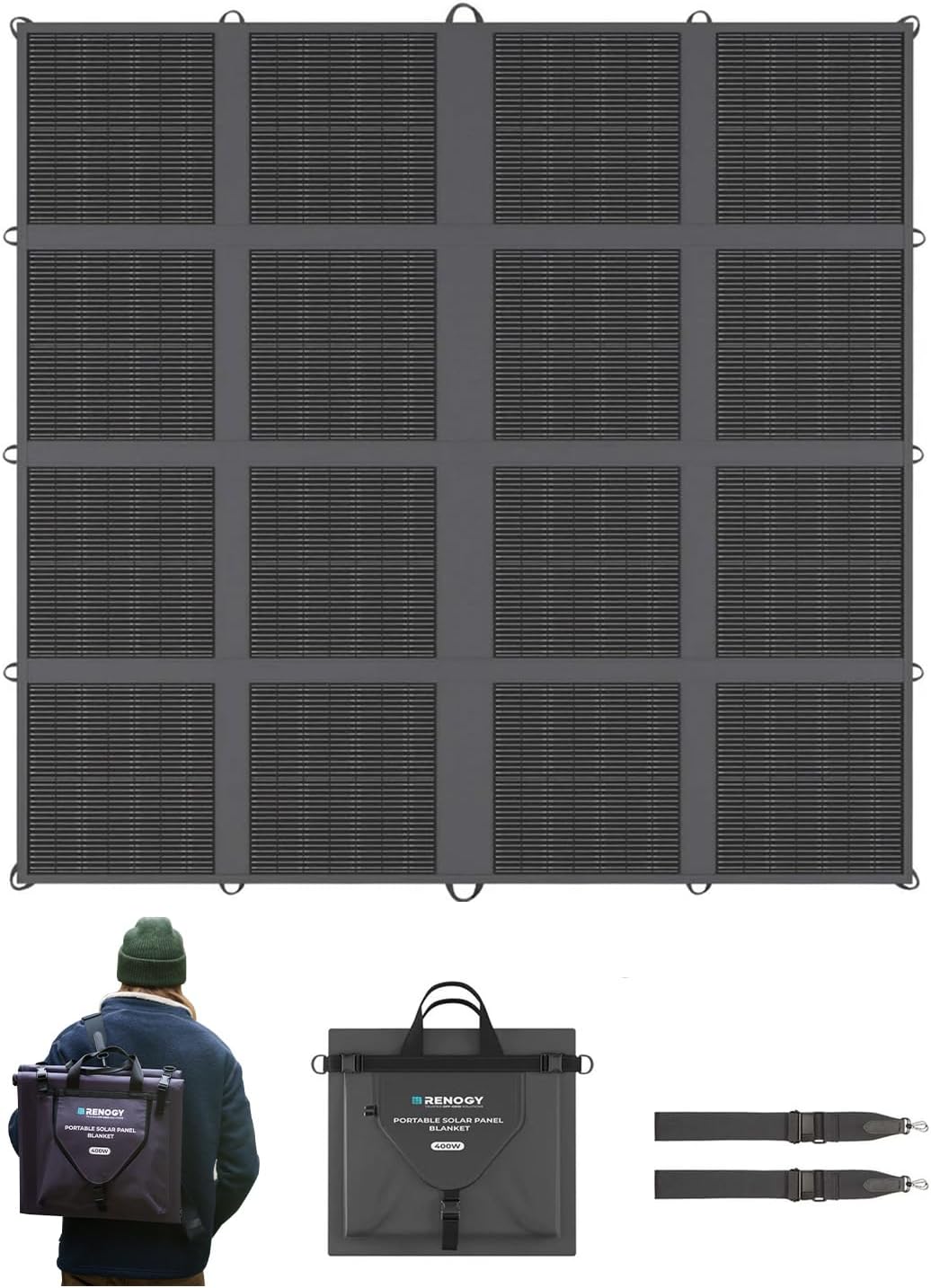
The Renogy RSP400SB-US 400W Portable Solar Panel Blanket is a foldable, blanket-style solar panel designed for portable power station owners who need 400W of rated solar output in a flexible format. Its 16-fold design makes it suitable for mobile setups where compact storage and the ability to lay out the panel on a suitable surface matter more than freestanding convenience.
We selected it as Best Lightweight 400W Blanket-Style Panel for buyers who want a high-output solar option without the weight of a traditional suitcase-style panel. It is a practical choice provided the power station supports its electrical input requirements and there is enough space to deploy it.
Snapshot
| Specification | Details |
|---|---|
| Rated Solar Output | 400W |
| Operating Voltage / Current (Vmp / Imp) | 33.6V / 11.9A |
| Weight | 16.09 lb |
| Folded Dimensions | 16.54 × 15.83 × 4.13 in |
| Unfolded Dimensions | 64.96 × 62.99 × 1.50 in |
| Panel Connection | MC4 |
Why We Chose It
The Renogy RSP400SB-US earns Best Lightweight 400W Blanket-Style Panel because it delivers the same rated 400W output as the other three 400W models while weighing just 16.09 lb. It is lighter than both the Anker SOLIX PS400 Bifacial and the Renogy REGO 400W, while its 16-fold blanket construction offers a different storage and transport format from rigid foldable panels.
We chose it for buyers who prioritize lower carrying weight when comparing 400W options. Unlike the freestanding REGO suitcase panel, the RSP400SB-US must be laid out on a suitable surface, making its format better suited to setups where portability matters more than integrated support.
Check the latest price and customer reviews on Amazon.

Practical Considerations
When unfolded, the Renogy RSP400SB-US measures 64.96 × 62.99 inches, requiring a broad, relatively flat surface for deployment. Its 16-fold design reduces the packed size to 16.54 × 15.83 × 4.13 inches, while the 16.09 lb weight makes it easier to carry and store than the other 400W panels in this comparison.
It is well suited to camping, RV stops, and mobile off-grid setups where reducing transport weight matters. The main practical limitation is that the blanket needs a suitable surface for deployment and does not have integrated kickstands, so positioning it toward the sun requires more manual adjustment.
Evaluation
| Evaluation Factor | This Model | How It Compares | Buyer Implication |
|---|---|---|---|
| Solar Output | 400W rated output | Matches the Anker PS400 Bifacial and RENOGY REGO 400W; exceeds the PS100 and BougeRV 200W | Suitable for buyers who need higher solar generation capacity |
| Electrical Compatibility | 33.6V / 11.9A operating profile | Different from the Anker PS400 and RENOGY REGO 400W profiles | Check the power station’s supported voltage and current before buying |
| Portability | 16.09 lb; 16-fold blanket design | Lightest of the three 400W panels in this comparison. | Easier to carry and store than the other 400W options |
| Deployment | Requires a flat surface; no integrated kickstands | Less self-supporting than the RENOGY REGO 400W suitcase panel | Best for buyers who can lay out and manually position the panel at their campsite |
Who Should Buy This
- Power station owners whose solar input supports the panel’s 33.6V / 11.9A operating profile.
- Campers and RV users who need 400W of rated solar output but want to minimize carrying weight.
- Buyers who prioritize compact folded storage and a lightweight blanket-style design.
- Users who have a suitable flat surface for deploying and positioning the panel.
Who Should Skip This
- Owners of power stations that do not support the panel’s voltage and current requirements.
- Buyers who need a freestanding panel with integrated kickstands; the Renogy REGO 400W is a better fit.
- Users who need a rigid, self-supporting panel for frequent setup on uneven ground.
Final Verdict
The Renogy RSP400SB-US is the better choice for buyers who want 400W of solar output without carrying the weight of a traditional suitcase panel. Its 16.09 lb weight and compact folded format make transport easier, but the blanket design requires a suitable surface and manual positioning. Choose it for mobile setups where low carrying weight matters more than freestanding convenience.
Check the latest price and customer reviews on Amazon.
How to Choose the Best Portable Solar Panels for Power Stations
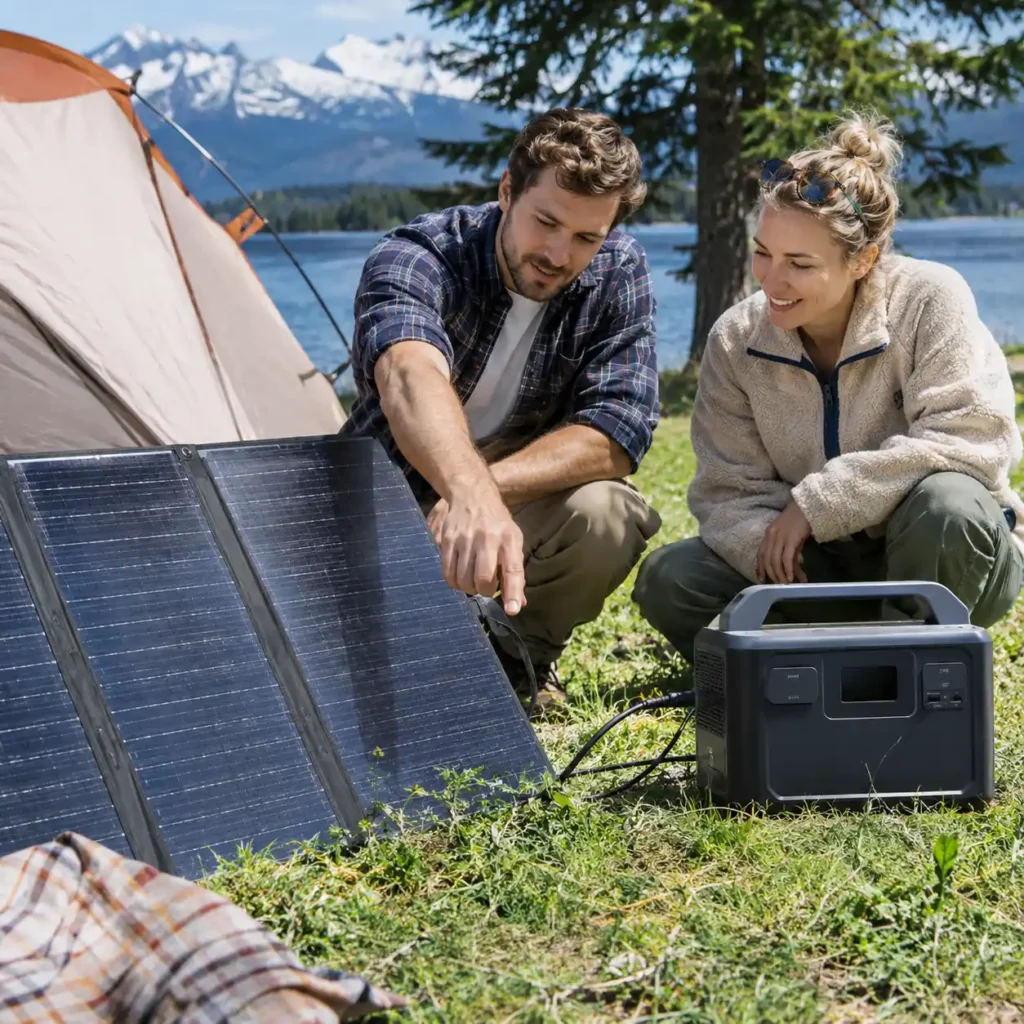
Before buying a portable solar panel, check the solar input specifications of your power station against the electrical specifications of the panel. Rated wattage alone does not establish compatibility. A panel may offer enough power but still fall outside the station’s accepted voltage or current range.
Use the following checks to determine whether a panel can work safely and effectively with your setup.
Maximum Solar Input Voltage
Maximum solar input voltage is one of the most important specifications to check. It defines the highest voltage the power station can accept through its solar charging input.
Find the maximum PV input voltage in your power station’s manual, then compare it with the panel’s open-circuit voltage (Voc). If you plan to connect multiple panels in series, their Voc values add together.
Never exceed the power station’s maximum permitted solar input voltage. Too much voltage can damage the solar charging circuitry. Also check the station’s minimum operating voltage: a panel that cannot reach that threshold may not start charging.
Maximum Input Current
Current, measured in amps (A), determines how much electrical current the power station can accept from a solar panel or array.
Compare the panel’s operating current (Imp) and short-circuit current (Isc) with the limits specified in the power station manual. These values serve different purposes: Imp describes current at the panel’s maximum power point, while Isc represents current when the panel’s output terminals are shorted.
When connecting panels in parallel, their currents add together. The combined current must remain within the power station’s permitted input limits. Check both the maximum operating input current and any separately stated maximum short-circuit current.
Maximum Solar Wattage
Every portable power station has a maximum rated solar input, expressed in watts (W). This determines how much solar power its charging system can accept.
For example, a power station rated for 500W of maximum solar input cannot use more than its supported charging capacity, even if the connected panels have a higher combined wattage. Depending on the model and manufacturer-approved configuration, excess available panel power may simply be limited by the charge controller rather than increasing charging speed.
However, a higher-wattage array is not automatically compatible. Its voltage and current must still remain within the station’s limits. Check the maximum permitted panel configuration in the manual before connecting additional panels.
Voc vs. Vmp: Understanding the Difference
Solar panels have two important voltage specifications, and confusing them can lead to compatibility problems.
| Specification | Meaning | Why It Matters |
|---|---|---|
| Voc (Open-Circuit Voltage) | Voltage measured when the panel is not connected to a load | Must remain below the power station’s maximum PV input voltage |
| Vmp (Voltage at Maximum Power) | Voltage at which the panel produces its rated maximum power under specified test conditions | Must fall within the power station’s supported operating or MPPT voltage range |
Both values matter, but they serve different purposes. Voc determines whether the panel or array stays below the station’s maximum voltage limit, while Vmp helps establish whether the station can operate the panel within its usable charging range.
To understand how the charge controller affects solar panel operation, see our guide to MPPT vs. PWM solar charge controllers and the differences between these two technologies.
A panel can have a suitable Vmp but an excessively high Voc. Conversely, a safe Voc does not guarantee that its operating voltage is high enough for the station to charge.
| Panel (Rated Output) | Voc | Vmp | Isc | Imp |
|---|---|---|---|---|
| Anker SOLIX PS100 Bifacial (100W) | 25.9V* | 21.6V | 4.86A* | 4.63A |
| BougeRV New 200W N-Type Foldable (200W) | 21V ±5% | 18V ±5% | 12.22A ±5% | 11.2A ±5% |
| Anker SOLIX PS400 Bifacial (400W) | 57.6V* | 48V | 8.75A* | 8.33A |
| RENOGY REGO 400W (400W) | 47.2V | 40V | 11A | 10A |
| Renogy RSP400SB-US (400W) | 39.2V | 33.6V | 13.1A | 11.9A |
Anker Voc and Isc values are listed in an Anker-branded technical sheet; confirm them against the current documentation for the exact US product version before publication.
How to read these specifications: Voc is the panel’s open-circuit voltage, while Vmp is its operating voltage at maximum power. Isc is the short-circuit current, and Imp is the operating current at maximum power. Compare the panel’s Voc and Isc with the power station’s maximum permitted PV input limits, and make sure its Vmp falls within the station’s supported operating range. Always account for the increase in Voc at low temperatures.
Series vs. Parallel Connections
If you plan to connect more than one solar panel, the wiring configuration changes the electrical characteristics of the array.
Panels are connected positive to negative. Their voltages add together, while current remains approximately the same as that of one panel.
Example: two panels with 20V Voc each produce 40V combined Voc.
Parallel connection
Panels are connected positive to positive and negative to negative. Voltage remains approximately the same, while current adds together.
Example: two panels with 5A Imp each produce 10A combined Imp.
The correct configuration depends on the power station’s voltage and current limits. Series wiring can exceed the maximum input voltage, while parallel wiring can exceed the permitted current.
Do not assume that every power station supports both configurations. Follow the manufacturer’s instructions for the exact model, including any restrictions on mixing panel wattages or electrical characteristics.
If you are considering combining panels with different wattages or electrical specifications, read our guide to connecting different solar panels to a portable power station before choosing a configuration.
Connector and Adapter Compatibility
Even when the electrical specifications match, the panel still needs a compatible connection to the power station.
Portable solar panels commonly use MC4 connectors, while power stations may have XT60, XT60i, DC8020, or other proprietary or model-specific inputs. An adapter cable may be required to connect the two.
Before purchasing, check:
- Connector type: Confirm that the panel cable and power station input can be connected using an approved cable or adapter.
- Polarity: Verify positive and negative connections. A connector that physically fits does not necessarily guarantee correct polarity.
- Cable compatibility: Make sure the cable is rated for the system’s voltage and current.
- Manufacturer requirements: Check whether the power station requires a specific solar charging cable or adapter.
Never rely on connector shape alone to establish electrical compatibility. The cable, polarity, and electrical ratings must all be suitable for the equipment.
| Panel | Panel Output Connector | Included Cables |
|---|---|---|
| Anker SOLIX PS100 Bifacial | Not clearly identified in the available product documentation | 2 × 8.2-ft solar charging cables; 1 × 1.6-ft XT60i cable |
| BougeRV New 200W N-Type Foldable | Confirm exact connector type | 1 × 1.6-ft solar charging cable; connector details need confirmation |
| Anker SOLIX PS400 Bifacial | Not clearly identified in the available product documentation | 2 × 8.2-ft solar charging cables; 1 × 1.6-ft XT60i cable |
| RENOGY REGO 400W | MC4 | Confirm exact cable package for the Amazon listing |
| Renogy RSP400SB-US | MC4 connection | Confirm exact cable package for the US Amazon listing |
Important: Included cables and panel output connectors are not interchangeable specifications. A cable may have one connector on the panel side and another on the power station side. Before purchasing, check both ends of the cable, connector polarity, cable ratings, and compatibility with your exact power station model. An adapter can resolve a connector mismatch, but it cannot correct incompatible voltage or current specifications.
Cold-Weather Voltage Considerations
Solar panel voltage increases as cell temperature decreases. This means a panel’s open-circuit voltage (Voc) can be higher on a cold, sunny morning than its rated value under standard test conditions.
This matters particularly when connecting multiple panels in series. Their combined Voc may exceed the power station’s maximum solar input voltage in cold conditions, even if the setup appears to be within the limit in warmer weather.
Before connecting an array, check the panel manufacturer’s Voc temperature coefficient and calculate the expected voltage at the lowest temperature relevant to your location. Leave a safety margin rather than designing the system right at the power station’s maximum voltage limit.
Important: Never use the panel’s standard-condition Voc as the only voltage check for a series-connected array. Cold-weather voltage must also remain within the power station’s permitted input range.
Compatibility checklist before buying
| What to Check | Where to Find It | What Must Match |
|---|---|---|
| Maximum PV voltage | Power station manual | Cold-adjusted array Voc must stay below the limit |
| Operating voltage range | Power station manual | Panel Vmp must fall within the supported charging range |
| Maximum input current | Power station manual | Array Imp must respect the specified limit |
| Maximum short-circuit current | Power station manual | Array Isc must not exceed the stated limit |
| Maximum solar wattage | Power station manual | Connected panel configuration must be permitted |
| Connectors and polarity | Both product manuals | Correct cable, adapter, and polarity |
| Series/parallel support | Power station manual | Configuration must be explicitly supported |
Bottom line: Match the complete electrical profile, not just the wattage. Check voltage, current, solar input capacity, connectors, and cold-weather voltage before connecting a portable solar panel to your power station.
Solar Panel Wattage: 100W vs. 200W vs. 400W
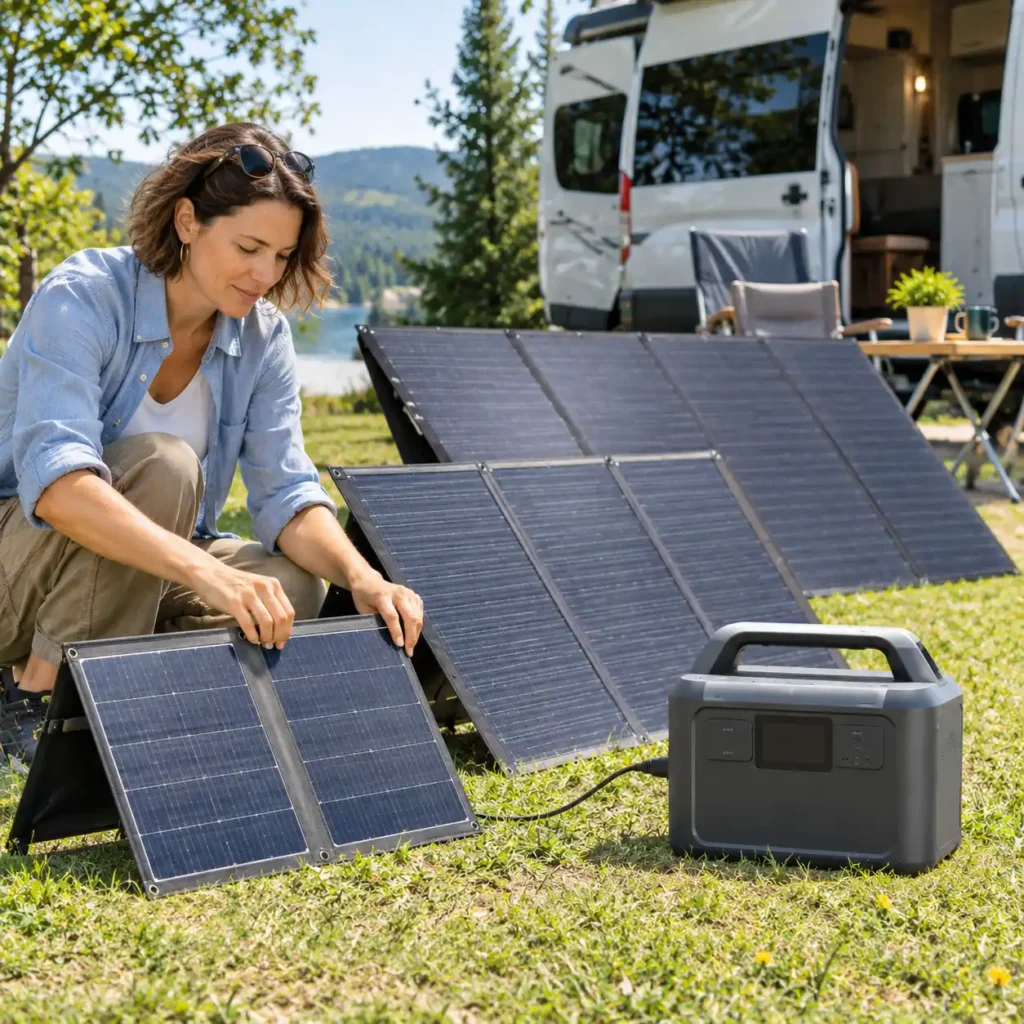
Choosing between a 100W, 200W, and 400W portable solar panel depends on how much solar power your power station can accept, how quickly you want to recharge it, and how much energy you typically use.
If you are still estimating the solar capacity your setup requires, use our Solar Panel Size Calculator to determine how much panel output you may need.
A higher-wattage panel can provide more charging power in suitable sunlight, but it is not automatically the best choice. If your power station has a limited solar input, a larger panel may not deliver a meaningful charging advantage. Its voltage and current must also fall within the station’s supported input range.
When Is a 100W Solar Panel Enough?
A 100W panel is a practical option for smaller portable power stations, occasional outdoor use, and buyers who prioritize portability over charging speed.
It can help maintain a power station’s charge during camping trips or provide supplemental energy for smaller everyday loads. However, its limited rated output means charging a larger battery can take considerable time, particularly when sunlight is inconsistent.
A 100W panel makes sense when:
- Your power station has a relatively low maximum solar input.
- You mainly need supplemental charging rather than rapid recharging.
- You prioritize a lightweight panel that is easy to carry and deploy.
- Your daily energy consumption is modest.
For example, the Anker SOLIX PS100 Bifacial has a rated output of 100W and a published PV output of 21.6V / 4.63A. It is designed for buyers who value a compact solar setup rather than maximum charging capacity.
When Should You Choose a 200W Solar Panel?
A 200W panel offers a middle ground between portability and charging potential. It can provide more solar input than a 100W panel without requiring the larger deployment area and carrying weight often associated with 400W models.
This category is worth considering if you use your power station regularly for camping, road trips, or moderate off-grid power needs. It can also be a sensible match for stations whose solar input specifications support this level of output.
However, two panels with the same rated wattage can have different electrical profiles. For example, the BougeRV New 200W N-Type Foldable Portable Solar Panel has a published operating voltage of 18V and operating current of 11.2A. A power station must support these characteristics, not simply accept 200W of solar input.
A 200W panel makes sense when:
- Your power station supports approximately 200W of solar input.
- You want a balance between charging potential and portability.
- Your energy needs are higher than occasional maintenance charging.
- You have enough space to deploy a larger panel but do not need a full 400W setup.
When Is a 400W Solar Panel Worth It?
A 400W panel is intended for power station owners who need substantially more solar charging capacity and whose equipment can accept it.
This output level is particularly relevant for larger power stations, extended camping trips, RV setups, and situations where faster solar replenishment is important. A 400W-rated panel can provide considerably more charging potential than a 100W or 200W model under comparable conditions.
The trade-off is that 400W panels generally require more deployment space. Depending on their construction, they may also be heavier, bulkier, or less convenient to reposition.
More importantly, the power station must support the panel’s electrical specifications. The three 400W panels in this guide illustrate why wattage alone is not enough:
| Panel | Rated Output | Published Operating Voltage | Published Operating Current |
|---|---|---|---|
| Anker SOLIX PS400 Bifacial | 400W | 48V | 8.33A |
| RENOGY REGO 400W | 400W | 40V | 10A |
| Renogy RSP400SB-US | 400W | 33.6V | 11.9A |
Although all three panels have the same rated output, their operating voltage and current differ. A power station compatible with one 400W panel is not necessarily compatible with the other two.
A 400W panel makes sense when:
- Your power station supports the panel’s voltage and current requirements.
- Its maximum solar input is high enough to make use of the additional capacity.
- You need more substantial daily solar replenishment.
- You have sufficient space for deployment and repositioning.
Match Panel Wattage to the Power Station's Solar Input
The power station’s maximum solar input wattage is a useful starting point when selecting a panel. It tells you how much rated solar power the charging system is designed to accept, although voltage and current limits must also be checked.
Consider these simplified examples:
| Power Station's Maximum Solar Input | Panel to Consider | What to Expect |
|---|---|---|
| 100W | 100W | A close match for the station's rated input capacity |
| 200W | 200W | More charging potential if voltage and current are compatible |
| 400W | 400W | A suitable output class if the complete electrical profile matches |
| 300W | 400W | Input may be limited to 300W, provided the panel is electrically compatible and the manufacturer permits the configuration |
The last example is particularly important. A 400W panel connected to a station with a 300W maximum solar input will not automatically charge the battery at 400W. The station’s charging system may limit the accepted power, but this does not eliminate the need to verify voltage, operating current, short-circuit current, and manufacturer-approved configurations.
Remember: Rated Wattage Is Not Actual Charging Power
The wattage printed on a solar panel represents its rated output under standardized test conditions. Actual output changes with sunlight intensity, panel temperature, orientation, shading, and other environmental factors.
A 200W panel, for example, should not be expected to deliver 200W continuously throughout the day. Under less favorable conditions, its output can be substantially lower.
This is why a larger panel can be useful: additional rated capacity may help compensate for less-than-ideal sunlight. However, it cannot overcome an incompatible solar input or guarantee a particular charging time.
If you want to estimate how long a panel will take to recharge your battery, use our Solar Charging Time Calculator: Calculate How Long It Takes to Charge a Battery.
Practical Recommendation
- Choose 100W if portability and occasional supplemental charging matter more than speed.
- Choose 200W if you want a balanced option for regular outdoor use and moderate charging needs.
- Choose 400W if you have a power station with sufficient solar input capacity and need greater solar replenishment.
The best choice is not necessarily the panel with the highest wattage. It is the panel that your power station can safely accept and that provides enough charging capacity for your actual energy needs.
What Solar Charging Performance Can You Expect?
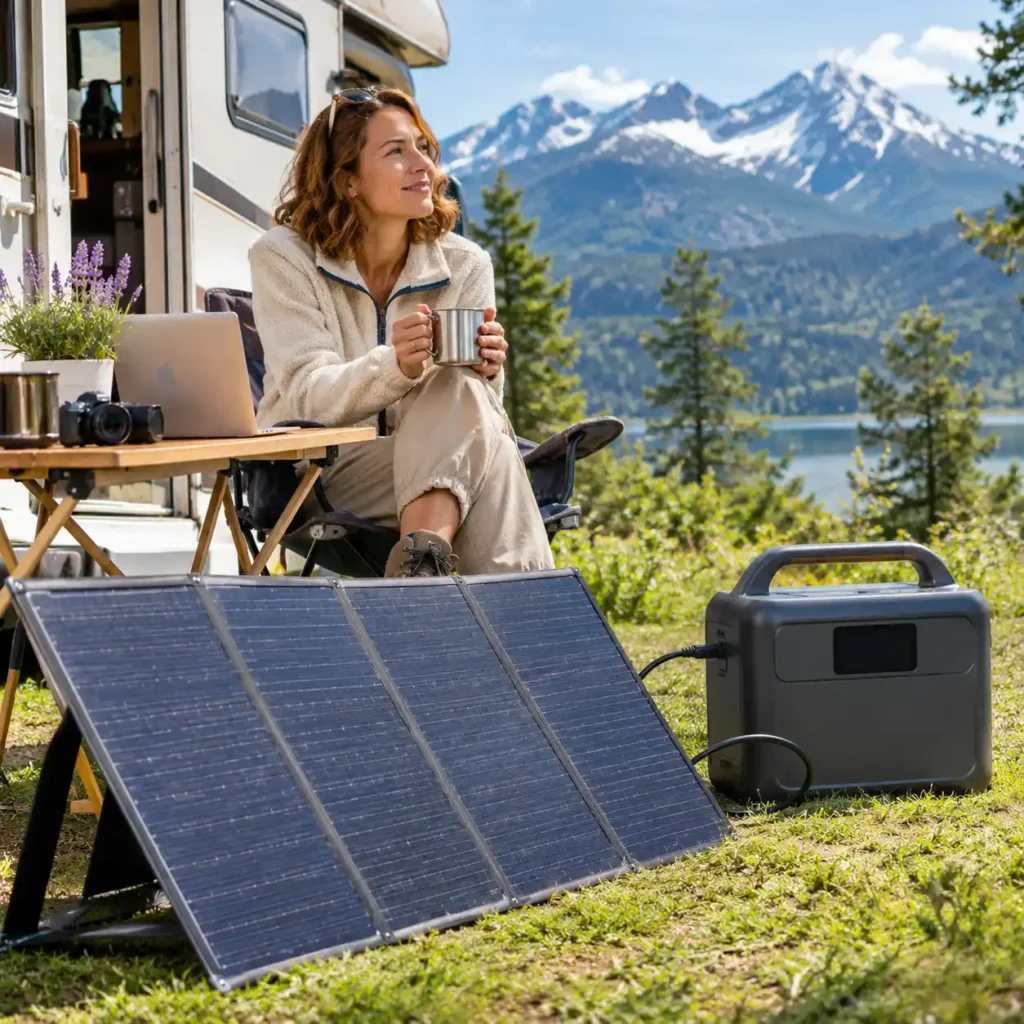
A portable solar panel’s rated wattage tells you its maximum power output under standardized test conditions. It does not tell you how much power the panel will produce throughout the day or how quickly it will recharge your power station.
Actual solar charging performance depends on sunlight intensity, panel temperature, orientation, shading, and the power station’s own input limits. Understanding these factors helps set realistic expectations before choosing a panel.
Rated Output vs. Actual Output
A panel rated at 100W, 200W, or 400W is tested under Standard Test Conditions (STC), which provide a consistent reference for comparing solar panels. These conditions include a solar irradiance of 1,000 W/m² and a cell temperature of 25°C.
Outdoor conditions rarely match these laboratory conditions exactly. As a result, actual output is usually lower than the panel’s rated wattage and can fluctuate throughout the day.
For example:
- A 100W panel does not necessarily deliver 100W whenever it is outdoors.
- A 200W panel may produce substantially less than 200W under weak sunlight or unfavorable positioning.
- A 400W panel can deliver more power, but only when sunlight and the connected power station’s input specifications allow it.
The power station may also limit the amount of electricity it accepts. If a panel can produce 350W but the station supports only 300W of solar input, the charging system cannot use the full available output.
Performance in Peak Sunlight
Solar panels generally produce their highest output when sunlight is strong, the panel is positioned toward the sun, and there is little or no shading.
However, even under bright conditions, actual output may differ from the rated figure. High panel temperatures can reduce conversion efficiency, while cable losses, dust, and the power station’s charging limits can further affect the power delivered.
The term peak sun hours is also important. It does not mean the number of daylight hours. It represents the equivalent number of hours during which solar irradiance averages 1,000 W/m².
For example, a location receiving five peak sun hours does not necessarily provide five hours of uninterrupted full-rated panel output. It means the day’s total solar energy is equivalent to five hours at that reference irradiance.
What Happens in Partial Shade?
Partial shading can reduce solar panel output significantly, sometimes more than buyers expect.
When a tree branch, vehicle, tent, or other object covers part of a panel, the effect depends on the panel’s cell layout, internal wiring, and bypass diode configuration. In some designs, shading one section can reduce the output of a larger portion of the panel.
This is particularly important with portable panels because their position can change as the sun moves or nearby objects cast shadows.
To reduce shading-related losses:
- Position the panel in an area with an unobstructed view of the sun.
- Keep nearby trees, vehicles, tents, and other objects from casting shadows across the cells.
- Reposition the panel when shadows move during the day.
- Check the manufacturer’s guidance on bypass diodes and panel configuration.
A higher-wattage panel does not eliminate shading losses. Keeping the active solar surface exposed to direct sunlight is often more useful than simply choosing a larger panel.
Why Panel Orientation Matters
The angle and direction of a solar panel affect how much sunlight reaches its surface. A panel positioned directly toward the sun generally captures more energy than one lying flat or facing away from it.
For portable solar panels, practical positioning involves three considerations:
Direction: Point the panel toward the sun’s current position. The ideal direction changes throughout the day and depends on your location.
Tilt angle: Adjust the panel so sunlight strikes its surface as directly as practical. Some foldable panels include integrated kickstands that make repositioning easier.
Season and time of day: The sun follows a different path across the sky depending on the season and latitude. A setup that performs well in summer may need a different tilt angle in winter.
Portable panels make it easier to adjust orientation than permanently installed panels, but frequent repositioning may be necessary to maintain good exposure.
Realistic Solar Charging Estimates
A practical way to estimate daily solar energy production is to multiply the panel’s rated wattage by the number of peak sun hours and an estimated system efficiency factor.
Daily Solar Energy = Panel Wattage × Peak Sun Hours × System Efficiency
For planning purposes, this example uses a 75% system efficiency factor. This is an illustrative estimate, not a guaranteed performance figure. Actual results depend on weather, temperature, panel orientation, shading, wiring, and the power station’s charging system.
The following examples assume four peak sun hours per day:
| Panel Rated Output | Peak Sun Hours | Estimated Daily Energy |
|---|---|---|
| 100W | 4 | 300Wh |
| 200W | 4 | 600Wh |
| 400W | 4 | 1,200Wh |
These figures help explain the practical difference between panel sizes. Under the same assumed conditions, a 200W panel can produce approximately twice the daily energy of a 100W panel, while a 400W panel can produce approximately four times as much.
However, the power station must be able to accept the available solar input. If its maximum solar charging capacity is lower than the panel’s potential output, actual energy delivered to the battery may be limited.
Estimating battery recharge time
To estimate how long solar charging may take, divide the amount of energy the battery needs by the average solar charging power actually accepted by the power station.
Charging Time (hours) = Energy Needed (Wh) ÷ Average Accepted Solar Power (W)
For example, replenishing 500Wh at an average accepted charging rate of 100W would take approximately 5 hours under these assumed conditions.
Actual charging may take longer because solar output fluctuates throughout the day. The power station may also reduce its charging rate as the battery approaches full capacity.
For a more specific estimate based on your battery capacity and panel output, use our Solar Charging Time Calculator.
What to Remember
Rated wattage is a starting point, not a promise of actual performance. Strong sunlight, correct orientation, and an unobstructed panel surface help improve output, while temperature, shading, and power station input limits can reduce the energy delivered.
When comparing 100W, 200W, and 400W panels, consider both their potential daily energy production and the amount of power your station can actually accept. This gives you a more realistic basis for choosing a panel than rated wattage alone.
Common Buying Mistakes
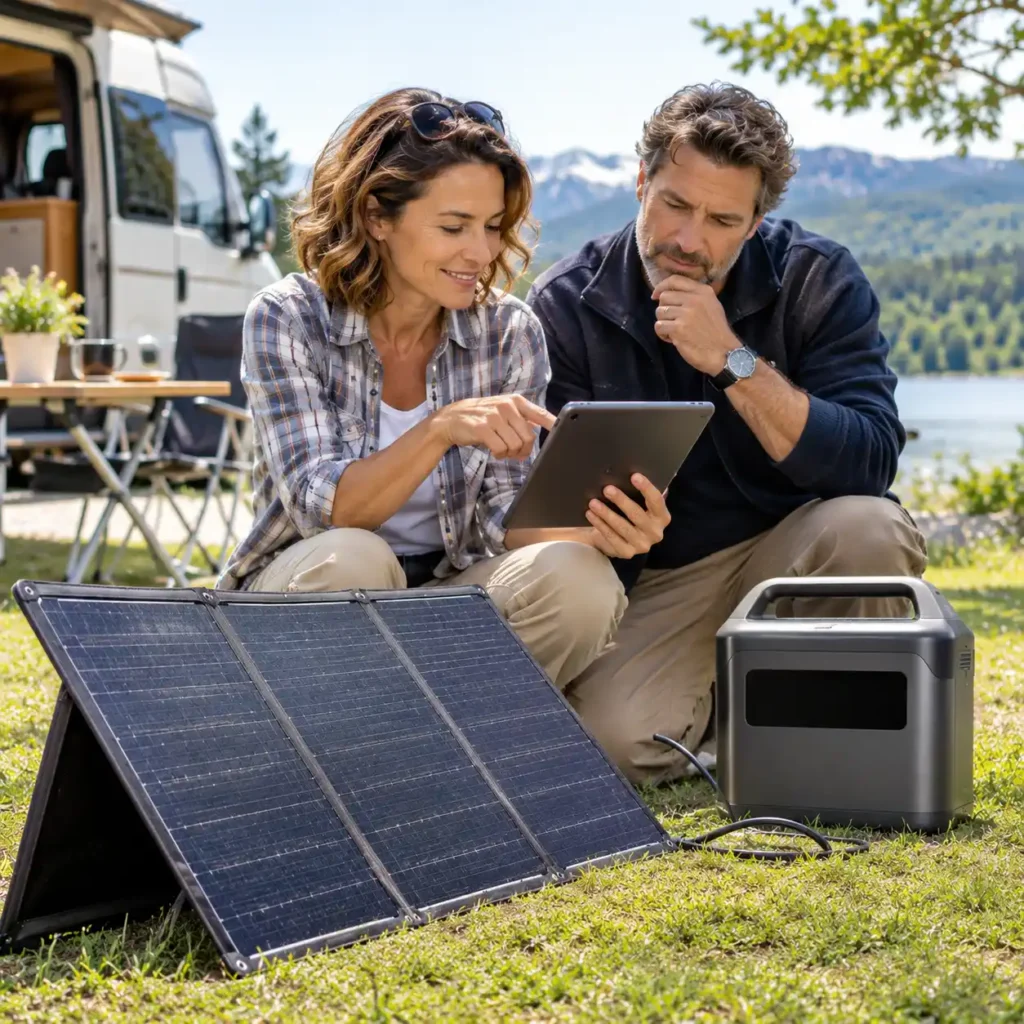
Choosing a portable solar panel for a power station involves more than comparing wattage or advertised efficiency. Buyers can easily overlook electrical limitations, underestimate real-world performance, or choose a panel that is inconvenient for their intended setup.
Here are five common mistakes to avoid before purchasing.
Choosing a Panel by Wattage Instead of Compatibility
A 400W panel may appear to be a better investment than a 200W model, but higher rated output does not automatically mean better compatibility or faster charging.
Even panels with the same rated wattage can have different operating voltages and currents. A power station compatible with one 400W panel may not support another.
Better approach: Compare the panel’s complete electrical specifications with your power station’s solar input limits. Choose wattage only after confirming compatibility.
Assuming an Adapter Solves Every Compatibility Problem
An adapter can resolve a connector mismatch, but it cannot make an electrically incompatible solar panel suitable for a power station.
A cable that physically connects two devices does not guarantee correct polarity, adequate current rating, or acceptable voltage. Some power stations also require manufacturer-specific charging cables or adapters.
Better approach: Verify connector type, polarity, cable ratings, and manufacturer requirements before purchasing an adapter. Never assume that a matching connector guarantees compatibility.
Assuming More Panels Always Mean Faster Charging
Connecting additional solar panels does not automatically double the charging power available to a power station.
The result depends on the electrical characteristics of the panels, whether they are connected in series or parallel, and the station’s maximum input limits. An incorrectly configured array may exceed permitted voltage or current, while a station with limited solar input may be unable to use the additional available power.
Better approach: Check the power station’s approved panel configurations and calculate the combined voltage and current before connecting multiple panels.
Planning Around Ideal Solar Conditions
A panel’s advertised wattage is not a reliable prediction of its everyday output. Buyers who estimate charging time using rated wattage alone may underestimate how long recharging will take.
Cloud cover, partial shade, panel temperature, orientation, and seasonal changes can all affect solar production. A setup that performs well during clear summer weather may deliver considerably less energy under less favorable conditions.
Better approach: Use realistic daily energy estimates rather than assuming continuous full-rated output. Allow additional charging time when planning around variable weather or higher energy consumption.
Ignoring Portability and Deployment Space
A higher-output panel may look attractive on paper but become inconvenient to transport, unfold, position, and store.
This matters particularly for RV owners and campers with limited storage space or frequently changing locations. A large suitcase-style panel may offer convenient freestanding deployment but require more storage room. A blanket-style panel may be lighter but need a suitable surface and more careful positioning.
Better approach: Consider weight, folded dimensions, deployment area, support design, and storage requirements alongside electrical specifications.
Buying Priorities: What to Check Before You Order
Before choosing a portable solar panel, verify these five points:
Electrical compatibility: Check Voc, Vmp, Isc, and Imp against the power station’s published solar input limits.
Solar input capacity: Choose a panel configuration that stays within the station’s maximum accepted solar input.
Charging expectations: Account for sunlight conditions, shading, orientation, and your daily energy requirements.
Portability and deployment: Check panel weight, folded dimensions, deployment area, and support design.
Connection requirements: Confirm compatible cables, adapters, connector polarity, and manufacturer-specific instructions.
The best portable solar panel is not necessarily the largest or most powerful model. It is the one that works within your power station’s limits, provides sufficient charging capacity for your needs, and remains practical for your intended setup.
Frequently Asked Questions
Can You Use a Power Station While It Is Charging from Solar Panels?
Yes, if the power station supports pass-through charging, which allows it to charge and supply power to connected devices simultaneously.
However, this does not mean the battery will always gain charge while you use the station. If connected devices consume more power than the solar panel supplies, the battery will continue to discharge, although potentially more slowly.
Check the manufacturer’s specifications to confirm pass-through charging support for your exact model. For more details on simultaneous charging and power output, see our guide to using a portable power station while it is charging.
Can You Leave a Portable Solar Panel Outside in the Rain?
It depends on the panel’s weather-resistance rating and the manufacturer’s instructions. Some portable solar panels are designed to withstand outdoor exposure, while others offer limited protection against moisture.
Pay particular attention to the protection ratings of the panel surface, junction box, connectors, and cable connections. A weather-resistant panel does not automatically mean every connection is waterproof.
Before leaving a panel outdoors, check its IP rating and follow the manufacturer’s guidance for rain exposure and storage.
Do Portable Solar Panels Need a Separate Charge Controller?
Usually, no. Most portable power stations have a built-in MPPT solar charge controller that regulates the incoming solar power and manages battery charging.
However, some models require a separate solar adapter or MPPT module. For example, DJI Power 1000 requires a dedicated Solar Panel Adapter Module for solar charging.
Check your power station’s manual before purchasing additional equipment. Do not assume that every model has the same charging architecture.
Can You Leave a Solar Panel Connected When the Power Station Is Fully Charged?
This depends on the power station’s charging management system and manufacturer instructions. Many modern power stations automatically regulate or stop battery charging when the selected charge limit is reached.
However, charging behavior and battery-protection settings vary by model. Check whether your station supports automatic charging cutoff and whether the manufacturer permits leaving the solar input connected when the battery is full.
For extended periods without use, follow the manufacturer’s recommendations for disconnecting and storing the equipment.
Can You Connect a Solar Panel Directly to a Power Station Battery?
No. A portable solar panel should be connected through the power station’s designated solar charging input, using the specified cable or compatible adapter.
The station’s charging electronics regulate the incoming power and manage the battery charging process. Connecting a panel directly to battery terminals bypasses these controls and can create unsafe electrical conditions.
Always use the designated solar input and follow the connection instructions in the power station manual.
Final Verdict
The best portable solar panel for a power station is not necessarily the one with the highest wattage. It is the one that matches your station’s electrical limits, provides sufficient charging capacity, and fits your portability needs. Among the five models reviewed, the right choice depends on your power station’s solar input specifications and how you plan to use it.
Our Recommendation
If portability is your priority: Choose the Anker SOLIX PS100 Bifacial for a lightweight 100W setup.
If you want a balance of output and portability: Choose the BougeRV New 200W N-Type Foldable Portable Solar Panel.
If you need 400W output with a 48V-rated operating profile: Choose the Anker SOLIX PS400 Bifacial Portable Solar Panel.
If you prefer a freestanding suitcase design: Choose the Renogy REGO 400W Portable Solar Panel with integrated kickstands.
If low carrying weight matters most in a 400W panel: Choose the Renogy RSP400SB-US 400W Portable Solar Panel Blanket.
Before ordering, confirm that the panel’s voltage, current, and connector requirements are compatible with your power station.
Related Guides
If you want to refine your solar setup or explore the next step, these guides can help:
Solar Panel Size Calculator: Calculate How Many Solar Panels You Need — if you want to estimate how much solar capacity your setup requires.
Solar Charging Time Calculator: Calculate How Long It Takes to Charge a Battery — if you want to estimate how long a portable solar panel may take to recharge your power station.
Can You Connect Different Solar Panels to a Portable Power Station?— if you want to understand how to combine solar panels and what electrical limitations to consider.
Why Is My Portable Power Station Not Charging from Solar Panels? — if your power station does not recognize or accept solar input.
MPPT vs PWM Solar Charge Controllers: Which Is Better for Your System?— if you want to understand how different charge controller technologies affect solar charging.
Power Ready Guide Commitment
At Power Ready Guide, our goal is not to tell you to spend the most. It is to help you understand what you are actually getting for your money.
We compare portable solar panels based on the factors that matter to real buying decisions—electrical compatibility, rated output, charging potential, portability, construction, and overall value. We make the trade-offs clear so you can see not only which panel stands out, but why another option may make more sense for your power station and your needs.
Our commitment is simple: help you spend your budget with confidence, not simply spend the entire budget.