
Owning an RV gives you the freedom to explore beyond crowded campgrounds, travel at your own pace, and enjoy the comfort of home almost anywhere. But whether you’re spending a weekend at a full-hookup RV park or boondocking miles away from the nearest electrical connection, reliable power quickly becomes one of the most important parts of your setup.
A modern RV depends on reliable electricity for far more than basic lighting. Keeping food fresh, charging phones and laptops, powering essential electronics, and maintaining everyday comfort all require a dependable source of energy. While your RV’s built-in batteries can handle basic 12V systems, they often aren’t designed to provide enough AC power for extended off-grid camping or today’s growing electrical demands.
That’s where a portable power station for RV becomes a valuable investment. Unlike noisy gas generators, today’s lithium power stations deliver clean, silent energy with virtually no maintenance. Many models also support fast AC charging, solar charging, and expandable battery systems, making them an excellent solution for RV owners who want greater energy independence without carrying fuel or disturbing neighboring campers.
The challenge is that not every portable power station is well suited for RV travel. Some models prioritize portability over runtime, while others offer impressive battery capacity but become difficult to transport or don’t provide the right combination of AC output, charging options, and expandability that RV owners often need. Choosing the wrong model can leave you with insufficient power for essential appliances—or paying for features you’ll rarely use.
To help you make the right decision, we carefully evaluated some of the most compelling portable power stations currently available for RV use. Rather than simply comparing battery capacity or price, we considered the factors that matter most in real-world RV travel, including usable battery capacity, continuous AC output, charging speed, solar compatibility, portability, expandability, long-term value, and overall ownership experience.
No matter how you travel, choosing the right portable power station means balancing battery capacity, inverter performance, charging flexibility, portability, and long-term value. This guide will help you compare today’s leading models and confidently choose the best solution for your RV and camping style.
As an Amazon Associate, we earn from qualifying purchases.
Table of Contents
Quick Answer
If you’re looking for the best portable power station for RV living, the EcoFlow DELTA 3 Max is our top recommendation. Its combination of 2048Wh battery capacity, powerful AC output, ultra-fast charging, expandable battery options, and reliable LiFePO₄ technology makes it an excellent all-around choice for everything from weekend RV trips to extended boondocking adventures.
That said, there isn’t a single portable power station that’s perfect for every RV owner.
If you primarily take short weekend trips and value portability, the DJI Power 1000 offers an excellent balance of performance and compact design. RV travelers looking for maximum battery capacity at a competitive price should consider the OUPES Mega 2, while the VTOMAN FlashSpeed 1500 stands out with its fast charging and versatile everyday performance. For RV owners planning to build a larger off-grid solar system, the Pecron E1500LFP offers an expandable platform that can grow alongside your power needs.
The best portable power station ultimately depends on how you travel. Weekend campers, full-time RVers, and off-grid enthusiasts all have different energy requirements, and choosing the right model means balancing battery capacity, AC output, charging flexibility, portability, and future expandability.
That’s why we compared five of today’s most promising portable power stations for RV use, evaluating them across the criteria that matter most in real-world RV travel—not just on paper specifications. The detailed reviews below will help you determine which model offers the best combination of performance, features, and long-term value for your specific RV lifestyle.
Why You Can Trust Power Ready Guide
Choosing a portable power station for an RV isn’t just about buying the biggest battery or the most expensive model. The right choice depends on how you travel, how much power you actually use, and which features will provide real value over years of RV ownership.
At Power Ready Guide, our goal is to help readers make informed purchasing decisions based on practical performance rather than marketing claims. Every product featured in this guide was selected after carefully reviewing its published specifications, real-world capabilities, manufacturer reputation, customer feedback, long-term value, and suitability for RV travel.
Our recommendations are based on a consistent editorial evaluation process rather than manufacturer marketing. Every product is assessed using the same criteria, allowing us to compare models fairly and recommend the best option for different RV travel styles, budgets, and off-grid power needs.
We also recognize that RV owners have very different power requirements. A couple spending weekends at established campgrounds doesn’t need the same power solution as someone living full-time in a motorhome or spending days boondocking on public land. That’s why our recommendations are based on real-world use cases, helping you choose the right portable power station for your travel style instead of simply recommending the largest or most expensive unit.
Because technology evolves quickly, we also prioritize models that remain competitive in today’s market through modern battery chemistry, efficient charging systems, expandable energy storage, and strong long-term ownership value. Our recommendations are updated as new products become available and existing models improve, ensuring this guide remains relevant for RV owners looking for dependable portable power solutions in 2026.
How We Chose the Best Portable Power Stations for RV

Who This Guide Is For
Not every portable power station is designed with RV travel in mind. While many models perform well for camping or emergency home backup, RV owners typically demand more power, longer runtimes, greater flexibility, and the ability to support a wider range of appliances.
To identify the strongest options, we evaluated each model using the criteria that have the greatest impact on everyday RV use rather than focusing on battery capacity alone.
Battery Capacity
Battery capacity determines how long your portable power station can keep essential devices running before it needs to be recharged. For RV owners, this affects everything from powering a portable refrigerator overnight to charging laptops, running Starlink, or operating small kitchen appliances during extended off-grid stays.
We prioritized models that provide enough usable energy for realistic RV scenarios, not just impressive specifications on paper.
AC Output and Surge Performance
Many RV appliances require significantly more power than smartphones or camping lights. Coffee makers, microwaves, induction cooktops, electric kettles, and power tools all place higher demands on a portable power station.
That’s why we considered both continuous AC output and surge capacity, ensuring the recommended models can handle everyday RV equipment safely and reliably.
Charging Speed
A large battery is only useful if you can recharge it efficiently.
We evaluated how quickly each power station can recharge from a standard wall outlet, as well as its support for solar charging and vehicle charging. Fast recharge times are especially valuable for RV travelers who frequently move between campgrounds or have limited opportunities to replenish battery power.
Solar Compatibility
Many RV owners eventually add portable or roof-mounted solar panels to increase energy independence.
For that reason, we favored power stations with efficient MPPT solar controllers, generous solar input limits, and compatibility with a wide range of solar panel configurations. Expandable solar capability becomes particularly important for extended boondocking or full-time RV living.
Portability
Even powerful portable power stations need to be practical to move.
Weight, carrying handles, overall dimensions, and ease of loading into an RV all influence day-to-day usability. We considered how portable each model is without sacrificing the battery capacity needed for real-world RV travel.
Expandability and Long-Term Value
Many RV owners start with a single portable power station and later expand their electrical system.
Models that support additional battery packs, larger solar arrays, or future system upgrades offer greater long-term value than products with fixed capabilities. We also considered battery chemistry, expected lifespan, warranty coverage, manufacturer support, and overall reliability to identify products that remain worthwhile investments for years of RV adventures.
Rather than searching for a single “perfect” portable power station, our goal was to recommend the best solution for different types of RV owners—from occasional weekend travelers to full-time RVers who rely on dependable off-grid power every day.
This guide is designed for RV owners who want a reliable, quiet, and portable source of electricity without relying solely on campground hookups or noisy gas generators.
Whether you own a travel trailer, fifth wheel, camper van, Class B, Class C, or Class A motorhome, a portable power station can provide convenient backup power for everyday essentials while giving you greater flexibility to camp wherever your adventures take you.
This guide is especially useful if you:
- Enjoy boondocking or dry camping and need dependable off-grid power for several days.
- Take weekend RV trips and want an easy-to-use portable power solution without installing a permanent electrical system.
- Work remotely from your RV and need reliable power for laptops, monitors, Starlink, cameras, or other electronic equipment.
- Want to reduce generator use by switching to a quieter, maintenance-free lithium battery system.
- Plan to add solar panels and build a more energy-independent RV setup over time.
- Need emergency backup power for unexpected outages while traveling or at home.
However, it’s also important to understand what portable power stations cannot do.
Most portable power stations—even high-capacity models—are not intended to run a large rooftop RV air conditioner continuously for many hours without additional battery expansion or a substantial solar charging system. If your primary goal is operating high-demand appliances around the clock, you’ll likely need a larger integrated RV electrical system or a dedicated whole-home backup solution.
For the vast majority of RV owners, though, today’s portable power stations provide more than enough energy to power refrigerators, lighting, laptops, communication equipment, televisions, kitchen appliances, CPAP machines, battery chargers, and many other essentials that make life on the road more comfortable.
Whether you’re planning occasional weekend escapes or embracing full-time RV living, the recommendations in this guide are intended to help you choose a power station that matches your travel style, energy needs, and long-term plans, rather than simply recommending the biggest battery available.
Quick Summary of the Best Portable Power Stations for RV
If you don’t have time to read the full guide, this quick summary highlights the best portable power stations for RV owners across different travel styles, power needs, and budgets. Every recommendation below excels in a specific situation, whether you’re planning extended off-grid camping, taking weekend RV trips, or looking for the best overall value.
There isn’t one perfect portable power station for every RV owner. The right choice depends on your RV size, the appliances you want to power, how long you stay off-grid, your charging options, and whether you plan to expand your battery capacity in the future. Use this shortlist to narrow your options, then read the detailed reviews to find the model that best fits your RV adventures.
EcoFlow DELTA 3 Max
Award: Best Overall
Why It Won
Delivered the best overall balance of battery capacity, fast charging, expandability, inverter performance, and everyday usability, making it our top recommendation for most RV owners.
Choose This If:
- You frequently travel in your RV throughout the year.
- You want a reliable all-around portable power station.
- You value premium features, fast charging, and future expandability.
Best For:
- Full-time RV living
- Weekend RV trips
- Boondocking
- Family RV travel
- Off-grid camping
DJI Power 1000
Award: Best for Weekend RV Trips
Why It Won
Combines excellent portability, quiet operation, and dependable power output, making it ideal for shorter RV adventures without carrying unnecessary weight.
Choose This If:
- You mainly take weekend RV trips.
- You want a compact and easy-to-carry power station.
- You don’t need an oversized battery.
Best For:
- Weekend camping
- Small RVs
- Camper vans
- Short off-grid stays
OUPES Mega 2
Award: Best Value
Why It Won
Offers outstanding battery capacity and performance for the price, making it one of the strongest value options for RV owners.
Choose This If:
- You want maximum capacity without overspending.
- You need reliable power for multiple appliances.
- You prefer the best value over premium branding.
Best For:
- Budget-conscious RV owners
- Family camping
- Boondocking
- Longer camping trips
VTOMAN FlashSpeed 1500
Award: Best Fast Charging
Why It Won
Features exceptionally fast AC charging, making it an excellent choice for RV travelers who frequently move between campgrounds and recharge whenever shore power is available.
Choose This If:
- You relocate frequently during RV trips.
- Fast recharge time is a priority.
- You often have access to campground hookups.
Best For:
- Road trips
- Campgrounds
- RV parks
- Frequent travelers
Pecron E1500LFP
Award: Best Expandable Solar System
Why It Won
Provides flexible battery expansion and strong solar charging capability, making it the best choice for building a long-term off-grid RV power system.
Choose This If:
- You plan to camp off-grid for extended periods.
- Solar charging is an important part of your setup.
- You want to expand your battery system over time.
Best For:
- Solar-powered RVs
- Long-term boondocking
- Remote camping
- Off-grid living
Still not sure which portable power station for RV is right for your setup?
The detailed reviews below explain where each model excels, who should buy it, its biggest strengths and limitations, and which type of RV owner will get the best long-term value from each recommendation.
Best Portable Power Stations for RV Compared
Choosing the right portable power station for your RV isn’t just about buying the largest battery. Battery capacity, AC output, charging speed, portability, expandability, and overall value all play an important role depending on how you travel.
The comparison table below provides a side-by-side overview of our top portable power station recommendations for RV owners. Use it to quickly compare the key specifications before exploring the detailed reviews of each model later in this guide.
| Model | Award | Capacity | AC Output | Weight |
|---|---|---|---|---|
| EcoFlow DELTA 3 Max | Best Overall for RV Living | 2048 Wh | 2400 W | ≈51.5 lbs |
| DJI Power 1000 | Best for Weekend RV Trips | 1024 Wh | 2200 W | ≈32.6 lbs |
| OUPES Mega 2 | Best Value Large-Capacity | 2048 Wh | 2500 W | ≈53.4 lbs |
| VTOMAN FlashSpeed 1500 | Best Fast-Charging | 1548 Wh | 1500 W | ≈41.9 lbs |
| Pecron E1500LFP | Best Expandable Solar System | 1536 Wh | 2200 W | ≈39.7 lbs |
Note: Specifications may vary slightly depending on the selected configuration or manufacturer updates. Always verify the latest specifications before purchasing.
Best Overall Portable Power Station for RV Living
EcoFlow DELTA 3 Max
Quick Verdict
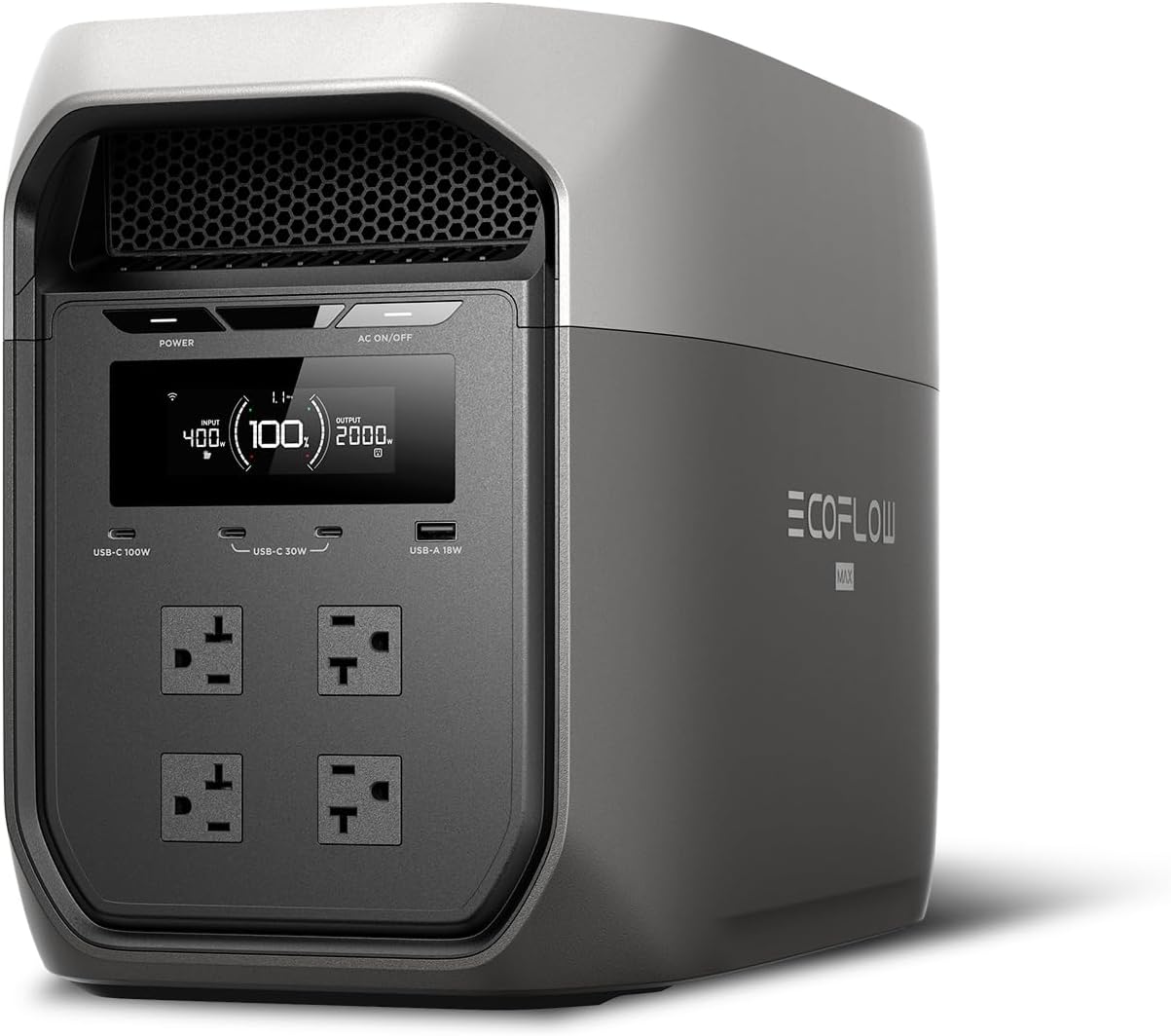
The EcoFlow DELTA 3 Max earns our Best Overall Portable Power Station for RV Living award because it delivers the strongest overall balance of power, battery capacity, charging speed, portability, and long-term flexibility among the models we evaluated.
Rather than excelling in only one category, the DELTA 3 Max performs consistently well across nearly every aspect that matters to RV owners. Its 2048Wh LiFePO₄ battery, 2400W continuous AC output, and rapid AC charging provide enough energy to comfortably power everyday essentials like RV refrigerators, Starlink, laptops, lighting, coffee makers, televisions, and CPAP machines, while still offering enough overhead for occasional higher-demand appliances.
Equally important, EcoFlow’s expandable battery ecosystem allows the DELTA 3 Max to grow alongside your electrical needs. Whether you currently take occasional weekend trips or plan to spend extended periods boondocking, the system can be expanded without replacing the original power station.
While it carries a higher upfront price than entry-level alternatives, its combination of real-world usability, premium build quality, fast charging, and future expandability makes it one of the strongest long-term investments available for RV owners seeking dependable portable power.
RV Snapshot
| Feature | Details |
|---|---|
| Best For | Travel Trailers • Fifth Wheels • Class B Vans • Class C Motorhomes • Weekend & Full-Time RV Living |
| Battery Capacity | 2048 Wh |
| AC Output | 2400 W Continuous |
| Battery Chemistry | LiFePO₄ |
| Solar Input | Up to 1000 W |
| Expandable Capacity | Yes |
| UPS Function | Yes |
| App Control | Yes |
| Weight | 51.5 lbs (23.4 kg) |
Why We Chose It
Choosing one portable power station to recommend for the widest range of RV owners is surprisingly difficult. Many larger models offer impressive battery capacity but sacrifice portability, while lighter units are easier to transport yet struggle to support the appliances that make modern RV travel comfortable.
The EcoFlow DELTA 3 Max stands out because it avoids those compromises better than almost any other model in its class.
During our evaluation, we looked beyond battery capacity alone. We considered how each power station fits into everyday RV life, including charging performance, usable AC output, portability, expandability, battery longevity, and overall ownership value. The DELTA 3 Max consistently ranked near the top across every category rather than dominating only one.
Its 2048Wh battery comfortably supports the daily electrical demands of most RV travelers without moving into the size and weight typically associated with much larger power stations. At the same time, its 2400W inverter provides enough continuous power for many of the appliances RV owners use every day, including portable refrigerators, induction cooktops, coffee makers, Starlink systems, laptops, televisions, and other essential electronics.
Long-term flexibility also played an important role in our recommendation. EcoFlow’s expandable battery ecosystem allows owners to increase runtime as their energy needs grow, making the DELTA 3 Max a system that can evolve over years of travel instead of becoming obsolete after a few seasons.
For RV owners looking for one portable power station that delivers dependable performance across a wide variety of travel styles, the EcoFlow DELTA 3 Max represents one of the most balanced choices currently available.
Check the latest price and customer reviews on Amazon.

Living With It on the Road
The biggest difference between an average portable power station and a great one isn’t something you’ll find on a specification sheet. It’s the confidence that comes from knowing your essential equipment will simply work whenever you need it. That’s exactly the experience the EcoFlow DELTA 3 Max delivers.
Whether you’re setting up at a full-hookup RV resort, parking beside a remote mountain lake, or spending several days boondocking on public land, the DELTA 3 Max quickly adapts to the way you travel. Its 2048Wh LiFePO₄ battery provides enough usable energy to power many of the appliances that make modern RV life comfortable without constantly forcing you to think about battery levels or ration electricity.
A typical day might begin with coffee brewing while phones and laptops finish charging overnight. Throughout the afternoon, the power station quietly keeps a portable refrigerator running, supports Starlink for work or entertainment, recharges cameras and drones after exploring, and powers small kitchen appliances whenever they’re needed. By evening, there’s still enough reserve capacity for campsite lighting, television, CPAP machines, or other essential equipment without creating the feeling that every watt has to be carefully managed.
What makes the DELTA 3 Max especially enjoyable to own is its versatility. Fast AC charging allows the battery to recover quickly whenever shore power is available, while strong solar input helps extend your stay in remote locations. As your travel style evolves, EcoFlow’s expandable battery ecosystem also provides the flexibility to increase capacity without replacing the entire unit.
Perhaps the greatest compliment you can give any portable power station is that you eventually stop thinking about it altogether. The DELTA 3 Max quietly becomes part of your RV lifestyle, delivering dependable power across a wide variety of travel situations while allowing you to focus on the places you’re visiting rather than the equipment you’re carrying.
Our Editorial Assessment
| Evaluation Category | Editorial Assessment |
|---|---|
| RV Friendliness | Excellent balance of capacity, output, and portability for most RV travel styles. |
| Power Performance | Comfortably powers refrigerators, Starlink, coffee makers, laptops, CPAP machines, televisions, and many other everyday RV appliances. |
| Charging Speed | Among the fastest AC recharge times available in this capacity class, minimizing downtime between destinations. |
| Solar Integration | Supports high solar input for extended off-grid camping and long boondocking stays. |
| Build Quality | Premium construction with a durable LiFePO₄ battery designed for years of regular use. |
| Long-Term Value | One of the best long-term investments thanks to its expandable battery ecosystem and versatile performance. |
Who Should Buy This
- RV owners looking for one portable power station that performs well across a wide range of travel styles.
- Couples and families taking regular weekend or multi-day RV trips.
- Boondockers who want reliable solar-compatible power without committing to a permanently installed battery system.
- Remote workers who depend on laptops, Starlink, and other electronics while traveling.
- Travelers planning to expand their off-grid electrical setup over time.
Who Should Skip This
- Campers who only need to charge phones or a few small USB devices.
- Buyers looking for the lowest possible upfront price.
- Backpackers or tent campers who prioritize minimum weight over battery capacity.
- RV owners who already have a large built-in lithium battery bank capable of covering all daily energy needs.
Final Verdict
The EcoFlow DELTA 3 Max earns its place at the top of this guide because it delivers something surprisingly rare: a portable power station with very few meaningful compromises.
It combines generous battery capacity, strong AC output, exceptionally fast charging, excellent solar compatibility, and future expandability into a package that remains practical for everyday RV travel. Rather than excelling in only one area, it performs consistently well across nearly every category that matters to modern RV owners.
If you’re investing in a single portable power station to support everything from weekend escapes to extended off-grid adventures, the EcoFlow DELTA 3 Max is the model we’d recommend first. It offers the best overall balance of performance, flexibility, and long-term value in this guide.
Check the latest price and customer reviews on Amazon.
Related Guide: If you’re looking for a portable power solution that can handle more than typical RV appliances, our Best Whole House Backup Power Systems (2026) guide explores larger backup systems designed to provide reliable power for homes during extended outages.
DJI Power 1000
Best Portable Power Station for Weekend RV Trips
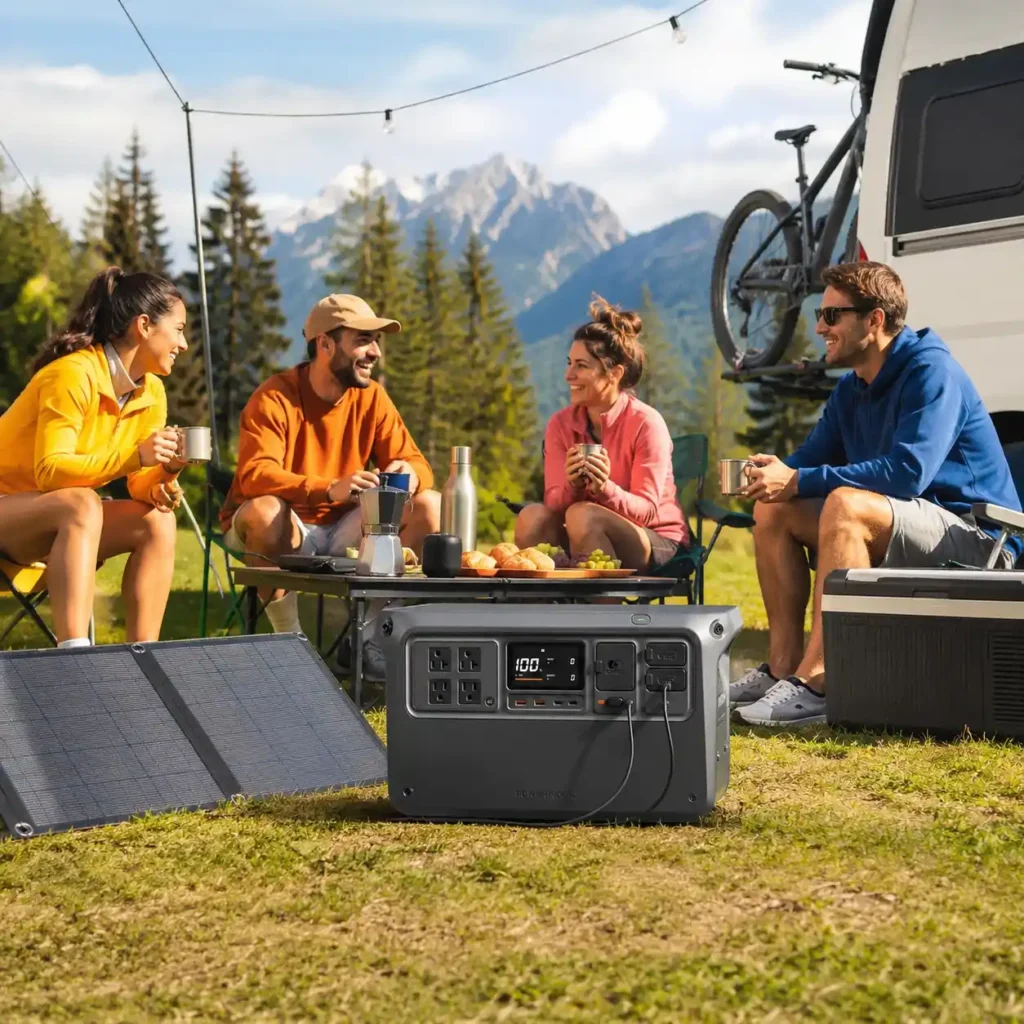
DJI Power 1000 portable power station beside a camper van at a scenic lakeside campsite powering essential RV equipment.

Quick Verdict
The DJI Power 1000 earns our Best Portable Power Station for Weekend RV Trips award because it delivers one of the best combinations of portability, premium build quality, fast charging, and everyday usability available in the 1kWh class. Featuring a 1,024Wh LiFePO₄ battery, a powerful 2,200W pure sine wave inverter, and exceptionally fast AC recharging, it provides more than enough power for the appliances most RV travelers actually use while remaining compact enough to transport comfortably between destinations.
Unlike larger power stations designed primarily for extended off-grid living, the DJI Power 1000 focuses on the needs of campers who spend weekends exploring campgrounds, state parks, national parks, and dispersed campsites. It easily powers portable refrigerators, electric coolers, CPAP machines, induction cooktops, coffee makers, laptops, televisions, routers, cameras, drones, and multiple USB devices without requiring the extra weight and bulk of a 2kWh system. For couples, solo travelers, camper van owners, and small travel trailer users, its capacity strikes an excellent balance between runtime and portability.
One of the biggest advantages of the DJI Power 1000 is how quickly it returns to full capacity. Fast AC charging allows travelers to recharge during a lunch stop, at an RV park with shore power, or before heading to the next campsite, minimizing downtime between adventures. Combined with its quiet operation, intuitive companion app, high-quality construction, and durable LiFePO₄ battery chemistry, the unit feels more like a premium piece of travel equipment than simply another portable battery.
While RV owners planning week-long boondocking trips with high daily power consumption may benefit from a larger expandable system, most weekend travelers simply don’t need that level of capacity. For short and medium-length RV adventures where portability, convenience, and dependable performance matter most, the DJI Power 1000 is one of the strongest all-around choices currently available.
RV Snapshot
| Feature | Details |
|---|---|
| RV Style | Weekend RV Trips • Camper Vans • Small Travel Trailers • Road Trips |
| Battery Capacity | 1,024 Wh |
| AC Output | 2,200 W |
| Battery Type | LiFePO₄ |
| Weight | 32.6 lbs (14.8 kg) |
| Solar Charging | Supported |
| App Control | Yes |
| Best For | RV owners looking for a premium portable power station that combines portability, fast charging, and dependable performance for weekend adventures. |
Why We Chose It
Many RV owners automatically assume they need the biggest portable power station available, but that’s rarely true for weekend travel. Most camper van owners and travel trailer users are looking for a reliable power source that can comfortably run everyday essentials, recharge quickly between destinations, and remain easy to lift in and out of the vehicle. The DJI Power 1000 was designed with exactly that balance in mind.
Its 2,200W continuous AC output is capable of powering nearly every appliance commonly used during RV trips, including portable refrigerators, electric coolers, coffee makers, induction cooktops, microwaves, CPAP machines, televisions, laptops, battery chargers, and multiple mobile devices at the same time. Meanwhile, the 1,024Wh LiFePO₄ battery provides enough usable energy for most two- or three-day adventures without adding the significant weight associated with larger 2kWh models.
Another reason the DJI Power 1000 stands out is its overall user experience. The enclosure feels exceptionally solid, the interface is intuitive, the companion app is easy to navigate, and one of the fastest AC recharge systems in this category helps minimize downtime between trips. Whether you’re moving between campgrounds every day or simply topping up before heading off-grid, quick charging becomes a genuine convenience rather than just another specification on the box.
For RV owners who prioritize portability, premium engineering, and dependable everyday performance over maximum battery capacity, the DJI Power 1000 represents one of the most refined portable power stations currently available. It delivers the features most travelers actually use while avoiding the extra cost, weight, and bulk that many weekend campers simply don’t need.
Check the latest price and customer reviews on Amazon.
Living With It on the Road
The DJI Power 1000 is the kind of portable power station that quickly becomes part of your normal camping routine. At just under 33 pounds, it’s significantly easier to lift into a camper van, SUV, or travel trailer than many larger 2kWh power stations, making setup and transportation much less of a chore. The integrated handles are comfortable to grip, and the compact footprint allows it to fit neatly under a dinette seat, in a storage compartment, or behind the driver’s seat in many Class B camper vans.
During typical weekend RV trips, the Power 1000 easily handles the devices most travelers rely on every day. It can keep a portable refrigerator running overnight, brew morning coffee, recharge phones, tablets, cameras, drones, and laptops, and still have enough capacity left for evening lighting or entertainment. Its 2,200W pure sine wave inverter also provides enough headroom for higher-startup appliances without constantly forcing users to think about power limits.
One feature that stands out in everyday use is the remarkably fast AC recharge. Instead of waiting most of the day for the battery to refill, you can recover a large portion of the capacity while stopping for lunch, spending a few hours at an RV campground with shore power, or preparing for the next leg of your journey. For travelers who frequently move between destinations, this dramatically reduces downtime and makes energy management much less stressful.
Noise levels are also impressive. Under moderate loads, the cooling system remains relatively quiet, making the unit well suited for camper vans and smaller RV interiors where loud fan noise can quickly become annoying. Combined with DJI’s intuitive companion app, responsive controls, and premium build quality, the Power 1000 feels polished and refined throughout everyday use.
While it isn’t intended to replace a large expandable home backup system or support week-long boondocking with heavy electrical loads, it excels at exactly what it was designed for: providing reliable, portable power for comfortable weekend RV travel without unnecessary size or weight.
Editorial Assessment
| Category | Rating | Editorial Notes |
|---|---|---|
| Portability | ★★★★★ | Compact size and moderate weight make transportation easy for camper vans and travel trailers. |
| Power Output | ★★★★★ | 2,200W inverter comfortably runs nearly all common RV appliances. |
| Battery Capacity | ★★★★☆ | Excellent for weekend travel, though extended off-grid stays may require additional capacity. |
| Charging Speed | ★★★★★ | Among the fastest AC recharge performance available in this capacity class. |
| Ease of Use | ★★★★★ | User-friendly controls, intuitive app, and premium overall design. |
| Value for Money | ★★★★☆ | Premium pricing is justified by excellent engineering and overall user experience. |
Who Should Buy This
- RV owners who primarily take weekend camping trips.
- Camper van travelers who value portability.
- Couples and solo travelers with moderate daily power needs.
- Users who want extremely fast AC recharging.
- Travelers looking for premium build quality and an excellent mobile app.
- Anyone wanting reliable portable power without carrying a much heavier 2kWh power station.
Who Should Skip This
- Full-time RVers who regularly spend a week or longer boondocking.
- Users needing to power high-demand appliances for extended periods every day.
- Buyers who require expandable battery capacity from the start.
- Anyone looking for the lowest purchase price rather than premium features.
Final Verdict
The DJI Power 1000 isn’t designed to be the largest portable power station available—it’s designed to be one of the easiest to live with. Its combination of excellent portability, premium construction, exceptionally fast charging, quiet operation, and dependable 2,200W output makes it an outstanding companion for weekend RV adventures.
For camper van owners, couples traveling in small travel trailers, and RV enthusiasts who typically spend a few days off-grid before moving to the next destination, the DJI Power 1000 delivers exactly the right balance of performance, convenience, and reliability. While larger power stations remain the better choice for extended off-grid living, few models in the 1kWh class provide such a refined overall ownership experience.
If your priority is a premium portable power station that is easy to carry, quick to recharge, and capable of powering nearly everything you need during weekend RV trips, the DJI Power 1000 is one of the strongest recommendations in this guide.
Check the latest price and customer reviews on Amazon.
Related Guide: If you’re comparing different battery capacities to find the right balance between portability and runtime, our Best 1000Wh Portable Power Stations (2026) guide focuses on power stations around the 1kWh class and explains where this capacity makes the most sense.
OUPES Mega 2
Best Value Large-Capacity Portable Power Station for RV
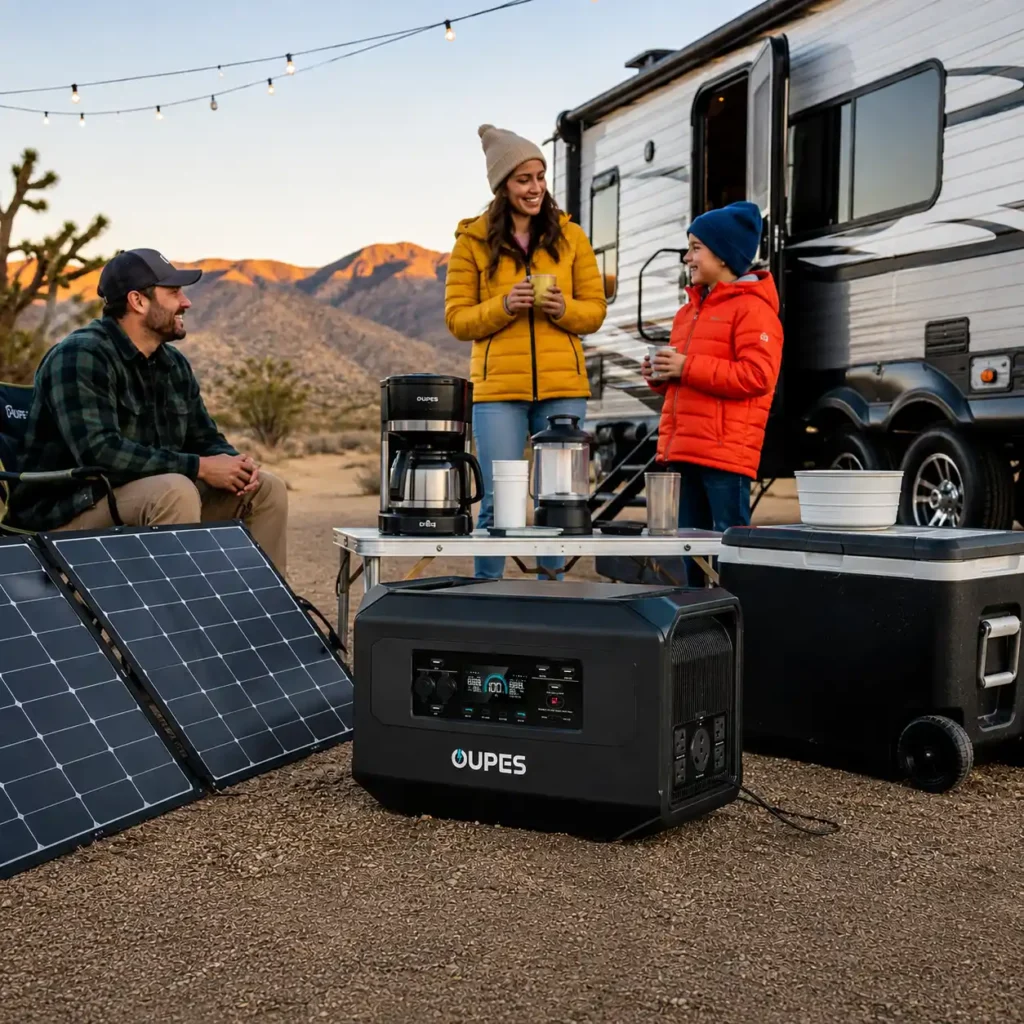
OUPES Mega 2 portable power station positioned beside a travel trailer at an off-grid campsite with solar panels connected and essential RV appliances running.

Quick Verdict
The OUPES Mega 2 earns our Best Value Large-Capacity Portable Power Station for RV award because it delivers the kind of battery capacity and power output typically found in far more expensive portable power stations while maintaining an exceptionally competitive price. Equipped with a 2,048Wh LiFePO₄ battery, a 2,500W pure sine wave inverter, and expandable energy storage, it provides enough power to comfortably support extended RV camping, boondocking, and off-grid adventures without requiring a premium-level investment.
For RV owners who spend several days away from hookups, battery capacity becomes just as important as inverter power. The OUPES Mega 2 offers enough stored energy to operate portable refrigerators, CPAP machines, coffee makers, microwaves, induction cooktops, televisions, laptops, Starlink systems, lighting, fans, and multiple electronic devices throughout the day while still maintaining a healthy reserve for overnight use. Combined with its strong continuous AC output, the Mega 2 easily supports the electrical demands of most camper vans, travel trailers, fifth wheels, and motorhomes.
Another area where the OUPES Mega 2 stands out is overall value. Many competing power stations with similar battery capacity, inverter performance, and LiFePO₄ battery technology cost substantially more. The Mega 2 delivers many of the features RV owners actually need—including solar charging capability, expandable battery options, multiple AC outlets, USB connectivity, and dependable everyday performance—without pushing buyers into the highest price category.
Although premium brands may offer slightly more refined mobile apps or additional software features, the OUPES Mega 2 focuses on what matters most: delivering large-capacity portable power at an affordable price. For RV owners seeking maximum watt-hours per dollar without sacrificing reliability or modern battery technology, it represents one of the strongest value propositions currently available.
RV Snapshot
| Feature | Details |
|---|---|
| RV Style | Boondocking • Extended RV Camping • Travel Trailers • Fifth Wheels • Motorhomes |
| Battery Capacity | 2,048 Wh |
| AC Output | 2,500 W |
| Battery Type | LiFePO₄ |
| Weight | ≈53.4 lbs (24.2 kg) |
| Solar Charging | Supported |
| App Control | Yes |
| Best For | RV owners looking for maximum battery capacity, expandable power, and excellent overall value for extended off-grid camping. |
Why We Chose It
Finding a portable power station that combines high battery capacity, strong inverter performance, LiFePO₄ battery technology, and expandable energy storage at a reasonable price is surprisingly difficult. The OUPES Mega 2 successfully delivers all of these features while remaining considerably more affordable than many premium competitors with similar specifications.
Its 2,500W pure sine wave inverter comfortably powers nearly every appliance commonly used inside an RV, including portable refrigerators, microwaves, induction cooktops, coffee makers, CPAP machines, televisions, laptops, battery chargers, and Starlink internet systems. Meanwhile, the 2,048Wh battery provides enough usable energy for extended weekends, multi-day camping trips, and longer boondocking adventures before recharging becomes necessary.
The Mega 2 also offers the flexibility many RV owners eventually need. Solar charging support allows users to harvest renewable energy while camping off-grid, and battery expansion options provide a practical upgrade path for travelers whose power requirements grow over time. Instead of replacing the entire system, users can increase available capacity as their camping style evolves.
For RV owners focused on maximizing value rather than paying extra for premium branding, the OUPES Mega 2 delivers one of the most compelling combinations of performance, runtime, expandability, and affordability currently available in the large-capacity portable power station market.
Check the latest price and customer reviews on Amazon.
Living With It on the Road
The OUPES Mega 2 is built for RV owners who regularly spend several days away from electrical hookups and need dependable power without constantly worrying about battery levels. Its 2,048Wh battery provides enough energy for the daily essentials of comfortable RV living, allowing you to focus on enjoying the trip rather than carefully rationing every watt.
In real-world use, the Mega 2 comfortably powers a portable refrigerator around the clock while also supporting laptops, phones, tablets, Starlink internet, LED lighting, CPAP machines, fans, coffee makers, televisions, and kitchen appliances throughout the day. The 2,500W pure sine wave inverter easily handles the startup requirements of most common RV appliances, giving users the flexibility to run multiple devices without constantly monitoring the display.
Although the Mega 2 is larger and heavier than compact power stations designed for weekend travel, the additional weight reflects its substantially greater battery capacity. For RV owners who typically transport their power station from the tow vehicle to the campsite once and leave it in place for the duration of the trip, portability becomes far less important than having enough stored energy to remain comfortable off-grid.
Solar charging adds another level of independence. When paired with compatible solar panels, the Mega 2 can recover much of its daily energy usage during sunny weather, helping extend off-grid stays without relying solely on campground hookups or generators. The expandable battery option also makes it possible to increase total capacity later, allowing the system to grow alongside changing camping needs instead of requiring a complete replacement.
For travelers who prioritize long runtime, dependable everyday performance, and maximum battery capacity for the money, the OUPES Mega 2 delivers an ownership experience that feels remarkably capable for its price class.
Editorial Assessment
| Category | Rating | Editorial Notes |
|---|---|---|
| Value for Money | ★★★★★ | One of the strongest price-to-capacity ratios in the large portable power station category. |
| Power Output | ★★★★★ | 2,500W inverter easily supports nearly all everyday RV appliances. |
| Battery Capacity | ★★★★★ | 2,048Wh provides excellent runtime for extended camping and multi-day boondocking. |
| Expandability | ★★★★★ | Expandable battery options allow users to increase capacity as power needs grow. |
| Solar Readiness | ★★★★☆ | Works well with portable solar panels for longer off-grid adventures. |
| Portability | ★★★★☆ | Heavier than compact models but appropriate for its battery size and intended use. |
Who Should Buy This
- RV owners who frequently camp off-grid for several days.
- Travelers looking for maximum battery capacity without paying premium-brand prices.
- Boondockers who want to power refrigerators, coffee makers, Starlink, laptops, CPAP machines, and kitchen appliances.
- Users planning to expand their battery capacity in the future.
- Anyone seeking an excellent balance of performance, runtime, and affordability.
Who Should Skip This
- Weekend campers who only need a lightweight power station for basic electronics.
- Travelers who frequently carry their power station long distances.
- Users with minimal power requirements who can save money with a smaller battery.
- Buyers looking for the lightest portable power station available.
Final Verdict
The OUPES Mega 2 stands out by delivering the features that matter most to RV owners: a large 2,048Wh LiFePO₄ battery, a powerful 2,500W pure sine wave inverter, expandable capacity, and dependable off-grid performance—all at a price that undercuts many similarly equipped competitors.
Rather than competing on premium branding or advanced software features, the Mega 2 focuses on delivering outstanding real-world value. It provides enough energy to comfortably support extended RV trips, multi-day boondocking adventures, and everyday campsite living without requiring the higher investment associated with many flagship models.
For RV owners who want the most battery capacity and capability for their budget, the OUPES Mega 2 is one of the best value large-capacity portable power stations available today.
Check the latest price and customer reviews on Amazon.
Related Guide: If you’re planning to recharge your RV power station from the sun, our Best Solar Chargers (2026) guide compares solar charging options that can help extend off-grid runtime and reduce dependence on campground hookups.
VTOMAN FlashSpeed 1500
Best Fast-Charging Portable Power Station for RV.
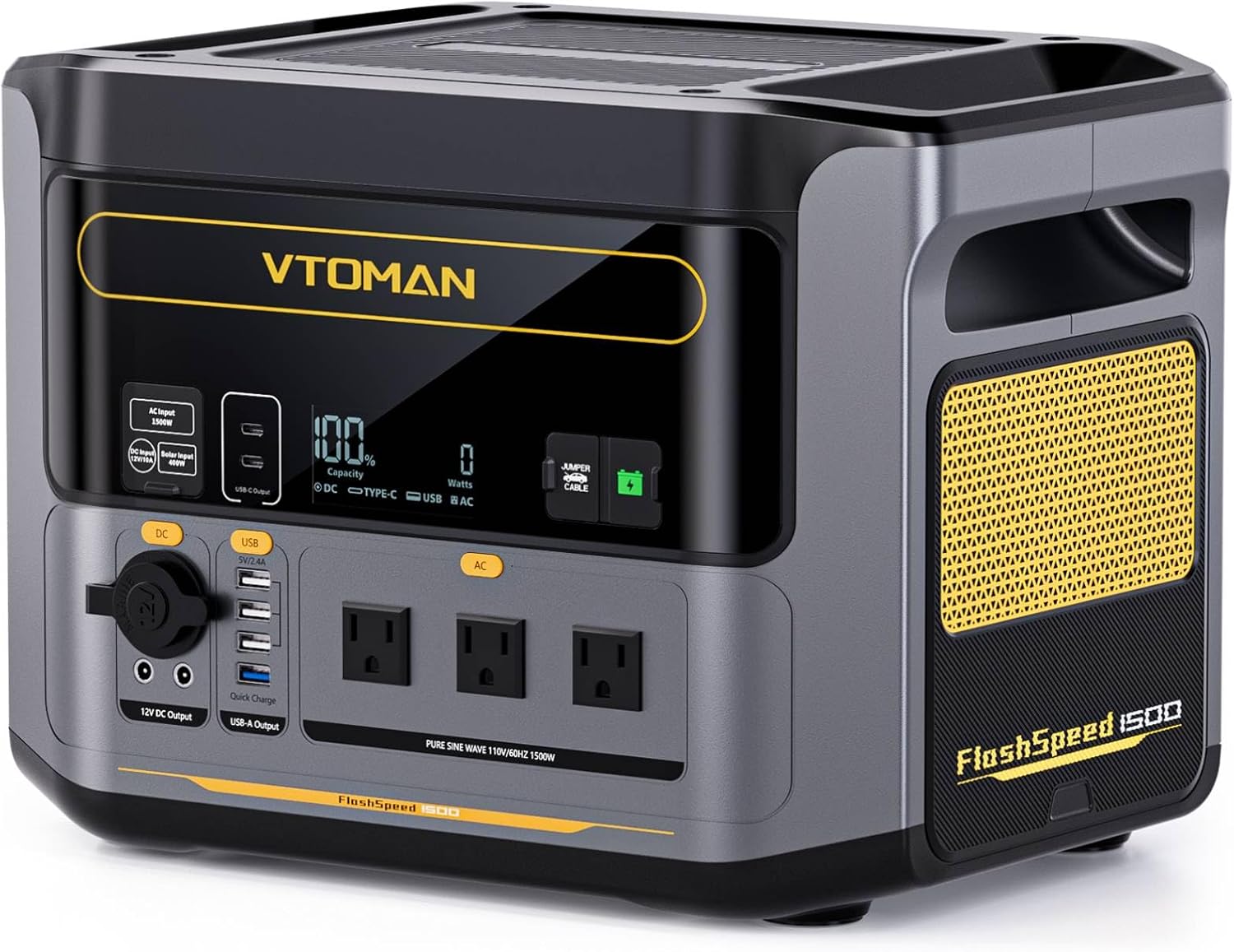
VTOMAN FlashSpeed 1500 portable power station powering essential RV appliances at a campsite while connected to portable solar panels.
Quick Verdict
The VTOMAN FlashSpeed 1500 earns our Best Fast-Charging Portable Power Station for RV award by combining rapid AC charging, dependable power output, and practical battery capacity in a package designed for travelers who are constantly on the move. Rather than maximizing battery size alone, VTOMAN focuses on minimizing downtime, allowing RV owners to recharge quickly between destinations and spend more time enjoying their trips instead of waiting for their power station to refill.
With a 1,548Wh LiFePO₄ battery and a 1,500W pure sine wave inverter, the FlashSpeed 1500 provides enough power for the vast majority of everyday RV essentials. It comfortably operates portable refrigerators, coffee makers, televisions, CPAP machines, Starlink systems, laptops, cameras, lighting, fans, and multiple personal devices while maintaining stable output for sensitive electronics. For most weekend campers and travelers moving between campgrounds every few days, this capacity offers an excellent balance between runtime and portability.
Where this model truly separates itself from much of the competition is its exceptionally fast AC recharge capability. Instead of spending many hours waiting for the battery to recover after a day of camping, users can recharge a significant portion of the battery during a lunch stop, while visiting an RV park with shore power, or before heading out on the next leg of the journey. This faster turnaround makes energy management considerably easier, especially for travelers who frequently relocate rather than staying in one campsite for extended periods.
The FlashSpeed 1500 also supports solar charging and expandable battery options, giving owners greater flexibility as their camping style evolves. While it doesn’t offer the massive battery capacity of larger premium models, it delivers an outstanding combination of charging speed, dependable performance, and everyday practicality at a competitive price.
For RV travelers who value convenience, mobility, and the ability to get back to full power quickly, the VTOMAN FlashSpeed 1500 stands out as one of the most well-rounded fast-charging portable power stations currently available.
RV Snapshot
| Feature | Details |
|---|---|
| RV Style | Weekend RV Trips • Camper Vans • Travel Trailers • Frequent Travelers |
| Battery Capacity | 1,548 Wh |
| AC Output | 1,500 W |
| Battery Type | LiFePO₄ |
| Weight | ≈41.9 lbs (19 kg) |
| Solar Charging | Supported |
| App Control | No |
| Best For | RV owners who prioritize ultra-fast recharging, reliable everyday power, and excellent portability. |
Why We Chose It
The VTOMAN FlashSpeed 1500 was selected because it solves one of the biggest frustrations of RV travel: waiting for a portable power station to recharge. While many units in this class offer similar battery capacities, few can recover as quickly from a low battery, making the FlashSpeed 1500 especially attractive for travelers who move frequently between campsites.
Its 1,548Wh LiFePO₄ battery provides ample energy for everyday RV living, while the 1,500W pure sine wave inverter easily handles the appliances most campers rely on, including portable refrigerators, coffee makers, televisions, CPAP machines, laptops, Starlink terminals, and small kitchen appliances. The battery capacity strikes an effective balance between runtime and portability, making the unit easier to transport than many larger 2kWh systems.
Beyond fast AC charging, the FlashSpeed 1500 offers additional flexibility through solar charging compatibility and expandable battery support. This allows users to extend both runtime and off-grid capability over time without replacing the entire system. For RV owners looking for a dependable, easy-to-manage power station that spends less time charging and more time powering their adventures, the VTOMAN FlashSpeed 1500 earns its place as our top fast-charging recommendation.
Check the latest price and customer reviews on Amazon.

Living With It on the Road
Not every RV traveler spends a week in one campground. Many people move every day or two, exploring different destinations, national parks, and scenic routes along the way. That’s exactly the kind of travel the VTOMAN FlashSpeed 1500 feels built for.
Instead of planning your schedule around long recharge times, you simply plug the unit into shore power whenever the opportunity arises. By the time you’ve finished lunch at an RV park, restocked supplies, or prepared for the next day’s drive, the battery has often recovered enough to keep your journey moving without interruption. Over several trips, that convenience becomes one of the biggest reasons to appreciate this power station.
Its 1,548Wh LiFePO₄ battery comfortably supports the equipment many RV owners rely on every day. A portable refrigerator stays cold throughout the drive, Starlink keeps you connected, laptops remain ready for work, and cameras, drones, and phones recharge whenever needed. Small kitchen appliances like coffee makers or electric kettles are equally easy to power, making everyday life on the road feel far more comfortable without relying on a noisy gas generator.
Another advantage becomes apparent after spending time with the FlashSpeed 1500. The controls are straightforward, the display is easy to read, and the overall design never feels complicated. It behaves like equipment that’s ready whenever you need it, rather than something that constantly requires planning or attention.
For travelers who regularly move between campgrounds instead of staying in one place for extended periods, this balance of fast charging, practical battery capacity, and dependable everyday performance makes the VTOMAN FlashSpeed 1500 an exceptionally easy power station to live with. It quietly fits into your travel routine, allowing you to focus on the road ahead instead of the next charging opportunity.
Editorial Assessment
| Category | Rating | Editorial Notes |
|---|---|---|
| Charging Speed | ★★★★★ | Among the fastest AC recharging portable power stations available for RV travel. |
| Everyday Performance | ★★★★★ | Easily powers the appliances most RV owners rely on during daily camping. |
| Battery Capacity | ★★★★☆ | 1,548Wh offers an excellent balance between runtime and portability. |
| Expandability | ★★★★☆ | Expandable battery support adds flexibility for future off-grid needs. |
| Solar Compatibility | ★★★★☆ | Works well with portable solar panels for extended camping trips. |
| Portability | ★★★★★ | More manageable than larger 2kWh-class models while still providing substantial power. |
Who Should Buy This
- RV travelers who frequently move between campsites.
- Campers who want one of the fastest AC charging portable power stations available.
- Weekend adventurers looking for an excellent balance of capacity and portability.
- Users powering refrigerators, Starlink, CPAP machines, laptops, lighting, and small appliances.
- Buyers seeking dependable LiFePO₄ battery technology without paying flagship prices.
Who Should Skip This
- Full-time RV owners who regularly require more than 2,000Wh of battery capacity.
- Campers running high-power appliances for extended periods without recharging.
- Users who prioritize maximum runtime over fast recharge capability.
- Travelers building large expandable off-grid power systems.
Final Verdict
The VTOMAN FlashSpeed 1500 earns our Best Fast-Charging Portable Power Station for RV award because it focuses on what many RV travelers value most: spending less time waiting for a battery to recharge and more time enjoying the journey. Its combination of fast AC charging, a 1,548Wh LiFePO₄ battery, and a 1,500W pure sine wave inverter makes it a dependable power solution for campers who frequently move between destinations.
Rather than competing solely on battery capacity, the FlashSpeed 1500 delivers an excellent balance of performance, portability, and convenience. It provides enough energy to comfortably run the appliances most RV owners use every day—including portable refrigerators, CPAP machines, Starlink systems, laptops, lighting, coffee makers, and other camping essentials—without the added bulk of many larger power stations.
Another strength is its flexibility. Support for solar charging and expandable battery options means the system can adapt as your camping style evolves, whether you’re taking weekend road trips today or planning longer off-grid adventures in the future. That versatility gives the FlashSpeed 1500 a longer useful lifespan than many fixed-capacity competitors.
While travelers who spend a week or more completely off-grid may benefit from a larger 2,000Wh+ model, many RV owners simply don’t need that extra capacity. For frequent travelers, weekend campers, and anyone who values quick turnaround between trips, the FlashSpeed 1500 offers one of the best combinations of charging speed, everyday usability, and overall value in its class.
If minimizing downtime is just as important to you as dependable power, the VTOMAN FlashSpeed 1500 is an easy recommendation and one of the most practical portable power stations currently available for modern RV travel.
Check the latest price and customer reviews on Amazon.
Related Guide: If you want to add more solar capacity to your RV power setup, our Best Solar Charge Controllers (2026) guide explains how charge controllers regulate energy between solar panels and battery storage for reliable off-grid charging.
Pecron E1500LFP
Best Expandable Solar Power System for RV
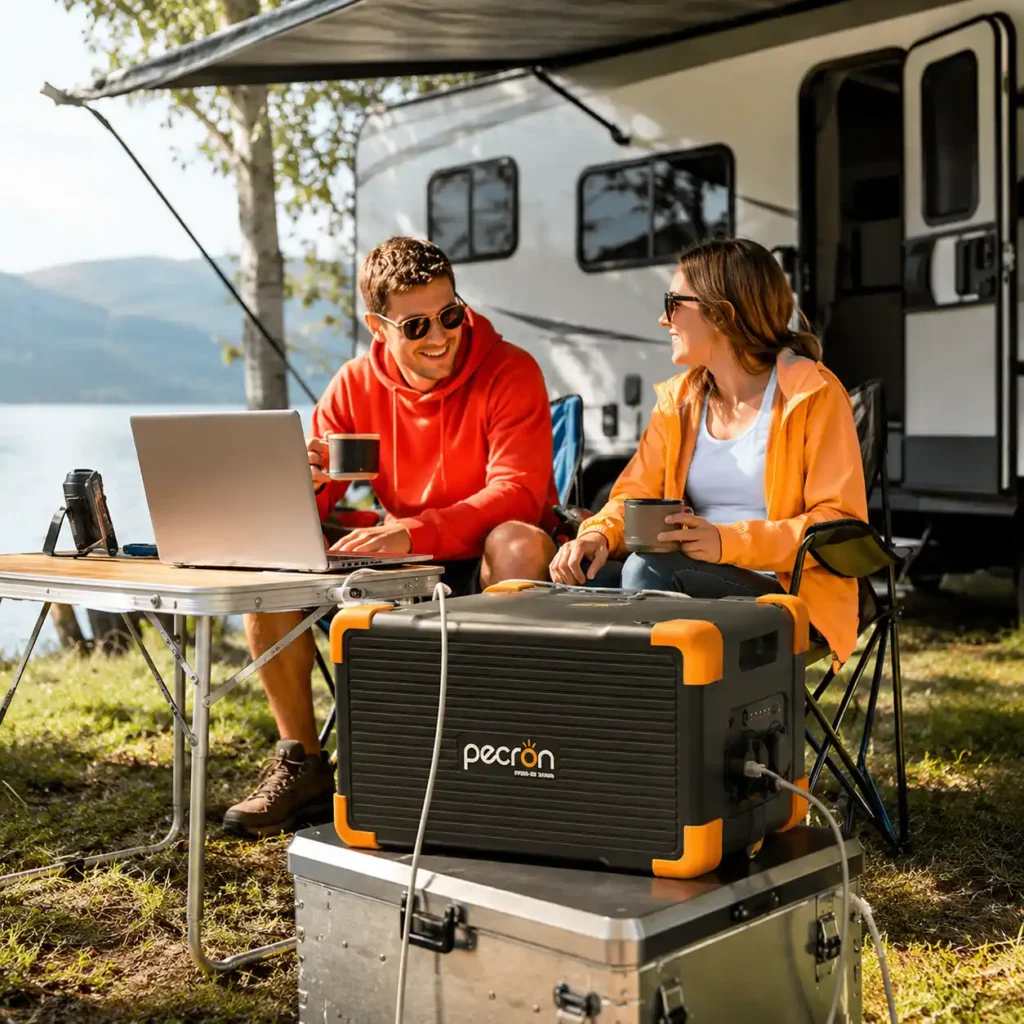
Pecron E1500LFP portable power station powering an RV campsite with portable solar panels during an extended off-grid adventure.

Quick Verdict
The Pecron E1500LFP earns our Best Expandable Solar Power System for RV award by offering one of the most flexible upgrade paths for RV owners who plan to spend more time off-grid. Rather than focusing solely on high output or ultra-fast charging, Pecron designed this system around long-term scalability, allowing users to expand both battery capacity and solar capability as their camping needs evolve.
At its core, the E1500LFP features a 1,536Wh LiFePO₄ battery paired with a 2,000W pure sine wave inverter, providing reliable power for the appliances most RV travelers rely on every day. It comfortably supports portable refrigerators, Starlink internet, CPAP machines, laptops, televisions, coffee makers, induction cooktops, lighting, cameras, and multiple mobile devices while delivering clean, stable electricity for sensitive electronics.
Where the E1500LFP truly distinguishes itself is its solar-first philosophy. Travelers who enjoy boondocking or extended stays away from electrical hookups can gradually build a larger off-grid energy system instead of replacing their power station as their needs grow. The expandable battery ecosystem and strong solar charging capability make it especially attractive for campers who see portable power as a long-term investment rather than a single purchase.
Although some competitors emphasize premium mobile apps or the fastest AC charging speeds, Pecron focuses on dependable hardware, straightforward operation, and excellent expandability. That approach makes it particularly appealing to RV owners who prioritize energy independence over smart features and who expect to spend increasing amounts of time camping off-grid in the future.
For travelers planning to build a reliable solar-powered RV setup that can grow year after year, the Pecron E1500LFP offers one of the most versatile and future-ready solutions currently available.
RV Snapshot
| Feature | Details |
|---|---|
| RV Style | Boondocking • Solar Camping • Extended Off-Grid RV Living |
| Battery Capacity | 1,536 Wh |
| AC Output | 2,000 W |
| Battery Type | LiFePO₄ |
| Weight | ≈41 lbs (18.5 kg) |
| Solar Charging | High-capacity solar input supported |
| App Control | No |
| Best For | RV owners building an expandable solar-powered camping system for extended off-grid adventures. |
Why We Chose It
Many portable power stations perform well right out of the box, but relatively few continue to grow alongside their owners. The Pecron E1500LFP stands out because it was designed with long-term flexibility in mind, making it an excellent choice for RV travelers who expect their off-grid adventures to become longer, more frequent, and increasingly dependent on solar power.
Its 1,536Wh LiFePO₄ battery and 2,000W pure sine wave inverter provide enough power for the vast majority of everyday RV appliances while maintaining the reliability expected from a modern portable power station. Whether powering a portable refrigerator, Starlink terminal, CPAP machine, laptops, televisions, coffee makers, induction cooktops, or charging multiple mobile devices simultaneously, the E1500LFP delivers clean, stable electricity throughout the day.
What truly earned the Pecron E1500LFP its place in our ranking is its expandable ecosystem and excellent solar capability. Many RV owners begin with occasional weekend trips but gradually move toward extended boondocking, remote work, or full-time RV travel. As those adventures become longer, so do their energy requirements. Instead of replacing your original power station with a larger model, the Pecron platform allows you to expand your energy system over time, creating a solution that grows with your lifestyle rather than becoming obsolete after a few seasons.
This approach makes the E1500LFP particularly attractive for campers investing in portable solar panels and building a reliable off-grid setup. On sunny days, its strong solar charging capability allows you to replenish the battery while continuing to power essential appliances, reducing dependence on campground hookups and helping you stay comfortably off-grid for longer periods.
Although the E1500LFP doesn’t offer every premium software feature or the fastest AC charging found on some flagship competitors, those trade-offs are easy to overlook considering its overall value. Pecron focuses on dependable hardware, long battery life, expandable capacity, and practical real-world performance instead of unnecessary complexity.
For RV travelers who view portable power as a long-term investment rather than a one-time purchase, the Pecron E1500LFP delivers one of the most flexible and future-ready solar power systems available today. Its combination of reliable LiFePO₄ technology, expandable battery options, and excellent solar integration makes it an outstanding choice for anyone planning to spend more time exploring beyond the reach of traditional campground power.
Check the latest price and customer reviews on Amazon.
Living With It on the Road
The Pecron E1500LFP is the kind of power station that becomes more valuable the longer you own it. While many portable power stations are designed primarily for occasional weekend camping, the Pecron feels built for RV travelers whose adventures gradually become longer, more independent, and increasingly powered by solar energy.
During a typical camping trip, the E1500LFP easily handles the essentials that make life on the road comfortable. It can keep a portable refrigerator running around the clock while simultaneously powering Starlink internet, charging laptops, cameras, drones, and phones, and supplying clean electricity for CPAP machines, LED lighting, televisions, or small kitchen appliances. The 2,000W pure sine wave inverter provides enough continuous power for most everyday RV tasks without requiring constant attention to energy management.
What really changes the ownership experience is its expandable design. Instead of treating the power station as a fixed-capacity device, you can gradually build a larger off-grid energy system as your travel style evolves. Weekend campers often discover that they enjoy longer stays in remote locations, and the Pecron platform allows your portable power setup to grow without replacing the unit you already own.
Solar charging also becomes a natural part of everyday use. Connect portable solar panels after arriving at camp, and the battery can continue replenishing throughout the day while supporting your essential devices. That flexibility helps reduce generator use, minimizes dependence on campground hookups, and provides greater confidence when camping in remote locations for several consecutive days.
Although it isn’t the lightest portable power station in its class, the E1500LFP remains practical for RV owners because it is typically loaded once, positioned in a convenient storage compartment or near the RV entrance, and used as the central power hub throughout the trip. Once in place, its straightforward controls and clearly organized output ports make everyday operation simple, even for users new to portable power systems.
For RV travelers who value long-term flexibility over short-term convenience, the Pecron E1500LFP delivers an ownership experience that feels dependable, expandable, and exceptionally well suited to years of off-grid camping adventures.
Editorial Assessment
| Category | Editorial Assessment |
|---|---|
| RV Performance | Excellent for extended camping, solar-powered RV setups, and multi-day off-grid adventures. |
| Ease of Use | Simple controls and intuitive operation make it easy for both beginners and experienced RV owners. |
| Solar Capability | One of the strongest expandable solar platforms in this price class, making it ideal for long-term energy independence. |
| Expandability | Outstanding battery expansion options allow the system to grow alongside your future camping needs. |
| Overall Value | An excellent long-term investment for RV travelers who prioritize flexibility, solar charging, and future-proof performance over premium smart features. |
Who Should Buy This
- RV owners building an expandable solar-powered camping system.
- Boondockers planning longer off-grid adventures.
- Travelers who want a portable power station that can grow with future energy needs.
- Users powering refrigerators, Starlink, CPAP machines, laptops, lighting, and everyday RV appliances.
- Buyers looking for dependable LiFePO₄ battery technology with excellent long-term value.
Who Should Skip This
- Weekend campers who rarely camp without electrical hookups.
- Travelers who prioritize ultra-fast AC charging over system expandability.
- Users who want advanced smart app features and wireless connectivity.
- RV owners who need maximum power immediately instead of gradually expanding their energy system
Final Verdict
The Pecron E1500LFP earns our Best Expandable Solar Power System for RV award because it takes a different approach from many portable power stations on the market. Rather than focusing solely on today’s power needs, it is designed for RV owners whose camping style is likely to evolve over time. As weekend trips become week-long adventures and portable solar panels become part of your regular setup, the E1500LFP is built to grow with you instead of becoming a system you’ll eventually outgrow.
Its 1,536Wh LiFePO₄ battery, 2,000W pure sine wave inverter, dependable output, and excellent solar charging performance provide more than enough capability for everyday RV living. From keeping a refrigerator cold and powering Starlink for remote work to charging laptops, cameras, medical devices, and kitchen appliances, it delivers the reliable performance most RV travelers depend on every day. More importantly, its expandable battery ecosystem allows you to increase your available energy without replacing the original unit, making it one of the most future-ready investments in this category.
The E1500LFP isn’t trying to impress buyers with flashy software or the fastest charging specifications on the market. Instead, it focuses on durability, dependable performance, long battery life, and practical flexibility—qualities that become increasingly valuable after months or even years of regular camping. That’s exactly why it stands out in a crowded market where many competitors emphasize short-term convenience over long-term ownership.
If your goal is simply to power a few devices for occasional weekend trips, there are lighter and less expensive alternatives. But if you’re building a reliable off-grid RV power system that can expand alongside your adventures, few portable power stations offer the same combination of scalability, solar compatibility, and long-term value.
For RV travelers who see portable power as an investment rather than a disposable gadget, the Pecron E1500LFP is one of the smartest and most future-proof choices available today. It delivers dependable performance now while providing the flexibility to support many years of comfortable, self-sufficient camping wherever the road takes you.
Check the latest price and customer reviews on Amazon.
Related Guide: If you’re building an RV power system around portable equipment and need practical accessories for charging, connections, and everyday use, our Essential Portable Power Station Accessories (2026): Complete Buyer’s Guide guide covers the equipment that can make a portable setup easier to use on the road.
How to Choose the Best Portable Power Station for RV
Choosing the best portable power station for your RV isn’t simply about buying the largest battery or the most expensive model. The right choice depends on how you travel, which appliances you plan to power, whether you camp with electrical hookups, and how long you typically stay off-grid.
For some RV owners, a portable power station serves as a convenient backup for charging phones, laptops, and small electronics during overnight stops. For others, it becomes an essential part of an off-grid electrical system, powering refrigerators, Starlink, CPAP machines, coffee makers, induction cooktops, and other everyday appliances while boondocking far from campground hookups.
Many buyers assume that a larger battery automatically provides a better experience. In reality, oversized power stations are heavier, more expensive, and often provide far more capacity than occasional RV travelers actually need. At the same time, choosing a system that’s too small may leave you searching for power long before your trip is over.
The goal is to select a portable power station that matches the way you actually travel. Whether you’re planning weekend RV getaways, extended cross-country adventures, or full-time RV living, understanding a few key specifications will help you choose a model that delivers dependable performance without paying for features you’ll rarely use.
The sections below explain the most important factors to consider before investing in a portable power station for your RV.
Start With Your RV Travel Style
Before comparing battery capacity or inverter wattage, think about how you actually use your RV. The best portable power station isn’t necessarily the largest or the most expensive—it’s the one that matches your travel style and daily energy needs.
For occasional weekend camping with access to campground hookups, a compact power station with around 1,000Wh of capacity is often enough. It can keep your phones, tablets, laptops, cameras, lights, and small electronics charged while also providing backup power for short outages or overnight stops.
If you regularly spend several days boondocking, your energy demands increase significantly. Running a portable refrigerator, Starlink internet, CPAP machine, fans, televisions, and charging multiple devices throughout the day requires a larger battery and a more powerful inverter. In this situation, portable power stations in the 1,500Wh to 2,000Wh range usually provide the best balance between runtime, portability, and cost.
For full-time RV living or extended off-grid travel, battery capacity becomes even more important. Longer stays without electrical hookups often mean relying on solar charging while powering essential appliances every day. Choosing an expandable power station allows you to increase your available energy over time instead of replacing your entire system as your needs grow.
It’s also worth thinking about how often you’ll move your power station. If you’re constantly loading and unloading it between your vehicle, campsite, and home, weight and portability become major considerations. On the other hand, if the unit will remain inside your RV for most trips, a heavier model with greater capacity may be the more practical long-term investment.
By identifying your travel style first, you’ll narrow your options quickly and avoid paying for battery capacity or features you may never actually use. The goal isn’t to buy the biggest portable power station available—it’s to choose one that fits the way you travel today while leaving enough flexibility for future adventures.
How Much Battery Capacity Do You Really Need?

Battery capacity is one of the first specifications most buyers notice, but it’s also one of the easiest to misunderstand. A larger battery doesn’t automatically mean a better portable power station—it simply means you have more stored energy available before the unit needs to be recharged.
Capacity is measured in watt-hours (Wh). In simple terms, watt-hours tell you how much electricity a power station can store. The higher the number, the longer it can run your devices, assuming the power consumption remains the same.
For example, a 1,000Wh portable power station is generally suitable for charging phones, laptops, cameras, drones, and running LED lights or a portable cooler during short trips. Moving up to the 1,500–2,000Wh range gives you enough capacity to power many of the appliances RV owners rely on every day, including portable refrigerators, Starlink systems, CPAP machines, televisions, coffee makers, and small kitchen appliances.
If you spend several days boondocking or work remotely from your RV, battery capacity becomes even more important. Every appliance you use throughout the day draws energy from the battery, and those demands quickly add up. Choosing a power station that’s too small may force you to recharge more often than expected or limit which appliances you can use simultaneously.
However, bigger isn’t always better. Higher-capacity power stations are heavier, take up more storage space, and typically cost significantly more. Many RV travelers discover that a mid-sized unit combined with portable solar panels provides a more practical and cost-effective solution than carrying the largest battery available.
If you expect your energy needs to grow over time, consider an expandable power station. Instead of paying for maximum capacity upfront, you can add extra battery modules later as your camping style evolves, making your investment more flexible and future-proof.
As a general guideline, 1,500Wh to 2,000Wh remains the sweet spot for most RV owners, offering an excellent balance of runtime, portability, price, and everyday usability.
Understanding AC Output and Surge Power
While battery capacity determines how long a portable power station can run your devices, AC output determines what it can run. Understanding the difference is essential when choosing a power station for RV travel.
Continuous AC output, measured in watts (W), indicates how much power the station can deliver steadily while operating. Every appliance has its own power requirement, and your portable power station must be capable of supplying that amount continuously. If the appliance requires more power than the inverter can provide, it simply won’t operate.
For most RV owners, a portable power station with 2,000W of continuous AC output offers an excellent balance between versatility and portability. This power level is sufficient for running portable refrigerators, Starlink terminals, CPAP machines, televisions, coffee makers, microwaves, induction cooktops, electric kettles, and many other everyday appliances commonly used while camping.
You’ll also notice another specification called surge power or peak power. Some appliances, particularly those with electric motors or compressors, require a brief burst of additional electricity when they first start. During this startup period, the power demand may temporarily exceed the appliance’s normal operating wattage. A power station with adequate surge capacity can handle these short spikes without shutting down.
It’s equally important to consider combined power usage. Even if each appliance individually falls within the inverter’s limits, running several high-power devices at the same time can exceed the available output. For example, operating an induction cooktop while simultaneously using an electric kettle and microwave may overload the inverter, even though each appliance works perfectly on its own.
For most RV travelers, choosing a portable power station with a 2,000W pure sine wave inverter provides enough flexibility for nearly all everyday camping scenarios while leaving additional headroom for future appliances.
Rather than chasing the highest wattage available, focus on matching the inverter’s continuous output to the appliances you actually plan to use. In many cases, this approach results in a lighter, more affordable, and more efficient portable power solution.
Solar Charging Matters More Than You Think
One of the biggest advantages of a portable power station over a traditional gas generator is the ability to recharge using solar energy. For RV owners who enjoy boondocking or extended stays away from electrical hookups, solar charging can significantly increase independence and reduce the need to rely on noisy generators or frequent campground visits.
Modern portable power stations are designed to work with portable solar panels, allowing you to replenish the battery throughout the day while continuing to power your essential devices. On sunny days, this creates a continuous cycle of energy production and consumption, helping you stay off-grid much longer than battery capacity alone would allow.
However, charging performance depends on several factors. The size of your solar array, available sunlight, weather conditions, panel orientation, and the power station’s maximum solar input all affect how quickly the battery recharges. Even the most efficient solar panels cannot reach their full output if they’re shaded by trees or positioned at the wrong angle.
When comparing portable power stations, pay close attention to the maximum solar input rating, which is measured in watts. This specification determines how much solar power the unit can accept at one time. For example, a power station that supports 500W of solar input will recharge much faster than one limited to 200W, provided you have enough solar panels connected.
It’s also worth considering how flexible the charging system is. Some models allow multiple solar panels to be connected in series or parallel, making it easier to expand your solar setup as your energy needs grow. This flexibility is especially valuable for full-time RV travelers who spend extended periods away from shore power.
For most RV owners, pairing a portable power station with 200W to 400W of portable solar panels provides an excellent balance between charging speed, portability, and ease of setup. Travelers who spend weeks off-grid or rely heavily on high-power appliances may benefit from even larger solar arrays if their power station supports higher solar input.
Rather than viewing solar charging as an optional accessory, many experienced RV owners consider it an essential part of an off-grid power system. A well-matched combination of battery capacity and solar input can dramatically extend your camping time while reducing operating costs and increasing overall energy independence.
Battery Chemistry: Why LiFePO₄ Is the Better Choice

Not all portable power stations use the same type of battery, and the battery chemistry inside the unit has a major impact on its lifespan, safety, performance, and overall value. While older portable power stations often relied on traditional lithium-ion batteries, most premium models designed for RV travel now use LiFePO₄ (Lithium Iron Phosphate) technology.
For most RV owners, LiFePO₄ is the better long-term investment.
The biggest advantage is cycle life. Every rechargeable battery gradually loses capacity over time, and manufacturers measure this using charge cycles. One cycle represents using the equivalent of 100% of the battery’s capacity, whether that’s from a single full discharge or several smaller charging sessions.
Traditional lithium-ion batteries typically maintain good performance for several hundred to around one thousand charge cycles before noticeable capacity loss occurs. In comparison, many modern LiFePO₄ batteries are designed to deliver 3,000 to 4,000 charge cycles, with some premium models rated even higher before their capacity declines to around 80% of the original value.
For RV owners who camp frequently, work remotely, or live full-time on the road, this difference can translate into many additional years of dependable service.
Safety is another important advantage.
LiFePO₄ batteries are known for their excellent thermal stability. They are less prone to overheating under heavy loads and are generally more resistant to thermal runaway than many older lithium-ion chemistries. While every portable power station should still be operated according to the manufacturer’s recommendations, LiFePO₄ technology provides an additional level of confidence when using high-power appliances inside an RV.
Another benefit is consistent performance during everyday use.
LiFePO₄ batteries maintain a stable voltage throughout most of the discharge cycle, allowing connected appliances to receive reliable power until the battery approaches a low state of charge. They also tolerate frequent charging and discharging exceptionally well, making them ideal for travelers who recharge every day using solar panels or campground electricity.
This durability is particularly valuable for boondocking. During extended off-grid trips, your portable power station may be charged by solar energy during the day and partially discharged every evening. Repeating this cycle hundreds of times each year places significant demands on the battery, making long cycle life one of the most important characteristics to consider.
There are a few trade-offs.
LiFePO₄ batteries are generally heavier than some traditional lithium-ion batteries with the same energy capacity. As a result, portable power stations using LiFePO₄ technology often weigh more than older models. However, improvements in battery design have reduced this difference considerably, and many RV owners find that the longer lifespan and improved durability easily outweigh the additional weight.
Price can also be slightly higher, particularly for larger-capacity models. However, evaluating the purchase based only on the initial price can be misleading. Because LiFePO₄ batteries last significantly longer, the overall cost of ownership is often lower over the lifetime of the product. Instead of replacing a power station after several years of heavy use, many owners continue using the same unit for much longer.
When shopping for a portable power station, choosing a model equipped with LiFePO₄ batteries is one of the easiest ways to future-proof your investment. Combined with a quality inverter, fast charging, and sufficient solar input, this battery technology provides the durability and reliability that most RV travelers expect from a modern off-grid power system.
Consider Weight and Portability
Battery capacity is important, but so is the ability to move your portable power station comfortably. One of the most common mistakes RV buyers make is choosing the largest battery they can afford without considering how often they’ll actually need to lift, carry, or reposition it.
A 1,000Wh power station may weigh around 25–35 pounds (11–16 kg), making it relatively easy for most people to carry with one or two hands. However, once battery capacity increases to 2,000Wh or more, weight often climbs to 50–70 pounds (23–32 kg). Larger expandable models can weigh considerably more, especially after additional battery packs are connected.
This isn’t necessarily a problem—but it should match how you travel.
If your power station will remain in a fixed location inside the RV for most of the trip, a heavier model may be perfectly acceptable. Many RV owners install their power station near the electrical cabinet, under a dinette seat, or in an exterior storage compartment, where it only needs to be moved occasionally.
On the other hand, some travelers regularly take their power station outside to power cooking equipment, charge e-bikes, run tools around the campsite, or recharge using portable solar panels positioned away from the RV. In these situations, weight quickly becomes an everyday convenience issue rather than just a number listed in the specifications.
Design features can make a significant difference.
Many larger portable power stations now include built-in wheels and a telescoping handle, allowing them to roll like a suitcase instead of being carried. While these features add a small amount of weight, they dramatically improve mobility for heavier units and reduce physical strain during setup.
Equally important is the placement of the carrying handles. Well-balanced dual side handles make two-person lifting much easier, while centrally positioned folding handles improve one-handed carrying on smaller models. A compact, thoughtfully designed power station often feels much lighter than another unit with the same published weight simply because it’s easier to grip and control.
You should also think about where the power station will be stored while traveling.
Measure the available space inside your RV before purchasing. Pay attention not only to the overall dimensions but also to ventilation requirements. Portable power stations generate heat during charging and while operating high-power appliances, so they should have adequate airflow and should never be tightly enclosed without sufficient ventilation.
If you’re planning to move the power station frequently between your RV, home, garage, and outdoor activities, portability becomes even more valuable. A slightly smaller model that’s easy to transport is often used far more often than a larger station that’s difficult to lift.
Ultimately, the best portable power station isn’t simply the one with the largest battery—it’s the one you’ll actually enjoy using. Choosing a model with the right balance of capacity, weight, dimensions, and portability will make everyday RV travel more comfortable and ensure your investment fits naturally into your camping routine rather than becoming another heavy piece of equipment to work around.
Expandability: Planning for Future Power Needs
When choosing a portable power station, it’s easy to focus only on your current energy needs. However, many RV owners discover that their power requirements change over time. New appliances, longer camping trips, remote work, electric bikes, Starlink internet, or additional family members can all increase daily electricity consumption.
This is where battery expandability becomes one of the most valuable features to consider.
An expandable power station allows you to increase battery capacity by connecting one or more compatible expansion batteries. Instead of replacing your entire system when your energy needs grow, you simply add extra storage while continuing to use the same inverter, charging system, and output ports.
For occasional weekend campers, a fixed-capacity power station is often more than sufficient. If your typical trip lasts one or two nights and you mainly power lights, phones, a portable refrigerator, and a few small appliances, you’ll probably never need additional battery capacity.
The situation is different for travelers who spend extended periods off-grid.
Boondockers, digital nomads, and full-time RV owners often rely on their portable power station every day. As travel habits evolve, many people add solar panels, portable air conditioners, electric cooking appliances, Starlink systems, or medical equipment such as CPAP machines. Each new device increases daily energy consumption, making extra battery capacity increasingly valuable.
An expandable system also provides greater flexibility.
Instead of carrying the maximum battery capacity on every trip, you can configure your setup based on your destination. For a short weekend getaway, the main power station alone may be enough. For a week of boondocking in a remote location, you can connect one or two expansion batteries to significantly increase available energy without purchasing an entirely new unit.
Another advantage is investment protection.
Portable power stations represent a significant purchase, and many premium models are designed to remain in service for years. Choosing an expandable platform gives you the opportunity to upgrade gradually as your needs change instead of replacing the entire system simply because you’ve outgrown its battery capacity.
That said, expandability isn’t necessary for everyone.
Expansion batteries add cost, weight, and require additional storage space inside your RV. If your energy usage is predictable and comfortably fits within the capacity of a fixed-size power station, paying extra for future expansion may provide little practical benefit.
When evaluating expandable models, it’s worth looking beyond the maximum battery capacity. Consider how many expansion batteries the system supports, whether installation is straightforward, how much additional space each battery requires, and whether the manufacturer is likely to continue supporting the platform in the future. A well-designed ecosystem can remain useful for many years as your camping style evolves.
Ultimately, the best choice depends on how you expect your RV lifestyle to develop. If you anticipate spending more time off-grid, investing in larger solar arrays, or adding higher-power appliances in the coming years, an expandable power station offers valuable flexibility and helps protect your investment over the long term.
Output Ports and Everyday Convenience

Battery capacity and inverter power often receive the most attention, but the number and variety of output ports can have an equally significant impact on everyday usability. A portable power station may have an impressive battery and a powerful inverter, yet still feel inconvenient if it lacks the connections you rely on most during your travels.
Before comparing specifications, take a moment to think about everything you regularly charge or power while camping. Smartphones, tablets, laptops, cameras, drones, portable refrigerators, Starlink terminals, CPAP machines, LED lighting, electric coolers, fans, and kitchen appliances all require different types of connections. The more closely a power station matches your equipment, the more convenient it will be to use.
For most RV travelers, AC household outlets remain the most important output. These standard outlets power appliances such as coffee makers, induction cooktops, microwaves, televisions, portable heaters, and many household chargers. Having four AC outlets instead of two may seem like a small difference, but it can eliminate the need for extension cords or power strips when multiple appliances are in use.
USB connectivity has also become increasingly important.
Modern portable power stations should ideally include several USB-A ports for smaller accessories and at least one or two USB-C Power Delivery (PD) ports capable of delivering high power. Many newer laptops, tablets, cameras, and even portable monitors can now be charged directly through USB-C, eliminating the need to carry bulky AC adapters. High-power USB-C ports also charge devices faster while reducing energy losses associated with converting battery power to AC and back again.
Another useful feature for RV owners is a regulated 12V DC car socket. This outlet allows compatible devices such as portable refrigerators, air compressors, tire inflators, camping lights, and other automotive accessories to operate efficiently without requiring an inverter. Because these appliances use DC power directly, they often consume less energy than when powered through AC adapters.
Some manufacturers also include additional DC5521 outputs, aviation-style connectors, or Anderson ports for specialized camping equipment, amateur radio systems, portable pumps, and other accessories. While many casual campers may never use these connectors, experienced RV travelers often appreciate having them available for future expansion.
Convenience isn’t just about the number of ports—it’s also about their placement.
Well-designed power stations group similar outputs together, clearly label each connection, and position ports where cables won’t interfere with cooling vents or carrying handles. Front-facing outputs are generally easier to access inside an RV than ports scattered across multiple sides of the unit.
The display is another feature that’s easy to underestimate until you begin using the power station regularly.
A bright, easy-to-read screen should clearly show the remaining battery percentage, estimated runtime, input power, output power, charging status, and any active warnings or error messages. More advanced displays also provide information about individual charging sources, battery health, and operating modes, allowing you to monitor energy consumption at a glance.
Some premium models go a step further by offering smartphone app connectivity through Wi-Fi or Bluetooth. These apps allow you to monitor battery status remotely, enable or disable output ports, adjust charging speeds, update firmware, and receive notifications without needing to access the power station directly. While app control isn’t essential for every RV owner, it can be particularly useful when the unit is installed in a storage compartment or another less accessible location.
Ultimately, the best collection of output ports is the one that fits your own camping style. Rather than choosing a model with the highest number of connections, look for a power station that supports the devices you use most often. A thoughtful combination of AC outlets, USB-C Power Delivery, USB-A ports, and regulated 12V outputs will make everyday RV living noticeably more convenient and reduce the need for extra adapters and extension cords.
Warranty, Customer Support, and Long-Term Value
A portable power station is a significant investment, and unlike many camping accessories, it’s a product you’ll likely rely on for years. That’s why it’s important to evaluate not only the technical specifications but also the company’s reputation, warranty coverage, and long-term customer support.
A generous warranty often reflects the manufacturer’s confidence in its product. While warranty terms vary by brand, many leading manufacturers now offer three to five years of coverage, with some premium models providing even longer protection. Although a longer warranty doesn’t automatically guarantee better quality, it does provide additional peace of mind, particularly when purchasing a higher-capacity power station.
Customer support becomes especially important if you ever experience technical issues, shipping damage, firmware problems, or questions about expansion batteries and solar compatibility. A company with responsive support, clear documentation, and readily available replacement parts can save considerable time and frustration compared to brands with limited after-sales service.
Software support is another factor that has become increasingly relevant.
Many modern portable power stations include Wi-Fi or Bluetooth connectivity and receive firmware updates that improve charging performance, battery management, inverter efficiency, or compatibility with new accessories. Manufacturers that actively maintain their products through software updates often provide a better ownership experience over the long term.
It’s also worth considering the manufacturer’s product ecosystem.
Companies that offer compatible solar panels, expansion batteries, protective cases, vehicle charging accessories, and replacement cables make it much easier to expand or maintain your system in the future. Buying into a well-supported ecosystem often provides greater flexibility than choosing a standalone product with no upgrade path.
Availability is another practical consideration. If you’re traveling extensively across North America, being able to obtain replacement cables, service, or warranty support without lengthy delays can make a significant difference. Established manufacturers typically have broader distribution networks and better access to spare parts than smaller or lesser-known brands.
While it’s tempting to choose the least expensive option, the initial purchase price tells only part of the story. A power station with a longer lifespan, reliable customer support, regular firmware updates, and strong warranty coverage often delivers better value over time than a cheaper model that may need to be replaced sooner or offers limited service if something goes wrong.
Before making your final decision, take a few minutes to research the manufacturer’s reputation. Reading independent reviews, browsing user experiences, and checking how the company handles warranty claims can provide valuable insights that specifications alone cannot reveal.
Ultimately, the best portable power station is more than a collection of impressive numbers. It’s a product backed by a company that continues to support its customers long after the initial purchase. Choosing a trusted manufacturer can give you greater confidence that your investment will continue to perform reliably throughout years of RV travel.
Common Mistakes to Avoid When Choosing a Portable Power Station for RV
Even experienced RV owners can choose the wrong portable power station if they focus only on specifications or price. Avoiding a few common mistakes can save money, improve your off-grid experience, and help you choose a system that will continue meeting your needs for years.
Buying Based Only on Battery Capacity
A larger battery isn’t always the better choice. While extra capacity increases runtime, it also adds weight, cost, and storage requirements. Choose a battery size that matches your actual daily energy consumption rather than automatically buying the largest model available.
Ignoring Continuous AC Output
Many buyers pay close attention to watt-hours but overlook inverter power. A power station with plenty of battery capacity may still be unable to run your coffee maker, microwave, induction cooktop, or other appliances if its continuous AC output is too low.
Underestimating Daily Power Usage
It’s easy to underestimate how much electricity you’ll use during a typical camping day. Refrigerators, Starlink systems, CPAP machines, laptops, lighting, and kitchen appliances all consume energy. Estimating your daily power requirements before purchasing helps prevent disappointing runtime.
Overlooking Solar Charging Capability
If you plan to spend time boondocking, solar charging can dramatically extend your battery runtime. Choosing a model with limited solar input today may restrict your ability to build a more capable off-grid power system later.
Buying a Unit That’s Too Heavy
Higher-capacity power stations often weigh more than 50 pounds (23 kg). If you’ll frequently move the unit between your RV, campsite, vehicle, and home, portability should be just as important as battery capacity.
Not Thinking About Future Expansion
Your energy needs may grow over time as you add new appliances, work remotely, or spend longer periods off-grid. Choosing an expandable system today can save you from replacing your entire power station in just a few years.
By avoiding these common mistakes, you’ll be much more likely to choose a portable power station that delivers the right balance of performance, portability, and long-term value for your RV adventures.
Before You Buy: Quick Checklist
Before you click the Buy Now button, take a moment to confirm that the portable power station you’ve chosen truly matches your RV lifestyle and power requirements.
Use this quick checklist before making your final decision:
✔ Estimate your average daily energy consumption.
✔ List every appliance you plan to power while camping.
✔ Make sure the continuous AC output can handle your highest-demand appliance.
✔ Choose LiFePO₄ battery technology for longer lifespan and better long-term value.
✔ Check the maximum solar input if you plan to camp off-grid.
✔ Consider the unit’s weight if you’ll carry it frequently.
✔ Decide whether expandable battery capacity may be useful in the future.
✔ Compare warranty coverage and customer support before purchasing.
If you can confidently check every item on this list, you’re much more likely to choose a portable power station that will meet your needs for years of RV travel.
Portable Power Station Runtime Examples

How Long Can a Portable Power Station Run Common RV Appliances?
One of the most common questions RV owners ask is, “How long will this power station actually run my equipment?” While battery capacity is measured in watt-hours (Wh), most people think in terms of everyday appliances rather than electrical specifications.
The answer depends on two main factors: the battery capacity of the portable power station and the amount of electricity the appliance consumes. A larger battery stores more energy, while high-power appliances drain that energy more quickly.
For example, a smartphone may require only a few watt-hours to recharge, allowing a portable power station to recharge it dozens of times. A portable refrigerator, on the other hand, runs continuously throughout the day and consumes far more energy. Kitchen appliances such as coffee makers, electric kettles, and microwaves draw even higher power, but they are usually used for only a few minutes at a time.
It’s also important to remember that real-world runtime is never exactly the same as the battery’s published capacity.
Every portable power station loses a small amount of energy during the conversion process from the battery’s DC power to household AC power. Additional factors such as ambient temperature, battery age, inverter efficiency, and the operating pattern of the appliance all influence the final runtime. As a result, the actual usable energy is typically somewhat lower than the advertised battery capacity.
Fortunately, many RV appliances don’t operate continuously. Portable refrigerators cycle their compressors on and off, CPAP machines use different amounts of power depending on their settings, and laptops or Starlink systems rarely draw their maximum rated power throughout the day. Because of this, real-world runtimes are often longer than simple calculations based on maximum power consumption might suggest.
The following examples provide realistic estimates for some of the devices most commonly used by RV travelers. While actual results will vary depending on your equipment and usage habits, these examples offer a practical way to compare different battery capacities and choose the portable power station that best matches your camping style.
Typical Runtime Examples by Battery Capacity
| Appliance | Power | Approximate Runtime |
|---|---|---|
| Portable Refrigerator | 45–60 W | 1000Wh: 16–20 hrs 1500Wh: 25–30 hrs 2000Wh: 33–40 hrs |
| CPAP Machine | 30–60 W | 1000Wh: 15–28 hrs 1500Wh: 23–42 hrs 2000Wh: 30–56 hrs |
| Starlink | 50–75 W | 1000Wh: 12–17 hrs 1500Wh: 18–26 hrs 2000Wh: 24–35 hrs |
| Laptop | 50–70 W | 1000Wh: 12–17 hrs 1500Wh: 18–26 hrs 2000Wh: 24–35 hrs |
| Smartphone | 10–20 Wh | 1000Wh: 50–70 charges 1500Wh: 75–105 charges 2000Wh: 100–140 charges |
| LED Lights | 10 W | 1000Wh: 85–90 hrs 1500Wh: 125–135 hrs 2000Wh: 170–180 hrs |
| Electric Fan | 35–50 W | 1000Wh: 17–24 hrs 1500Wh: 26–36 hrs 2000Wh: 34–48 hrs |
| Coffee Maker | 800–1000 W | 1000Wh: 50–60 min 1500Wh: 75–90 min 2000Wh: 100–120 min |
| Microwave | 900–1200 W | 1000Wh: 40–50 min 1500Wh: 60–75 min 2000Wh: 80–100 min |
| Camera Charger | 8–15 W | 1000Wh: 60–90 charges 1500Wh: 90–135 charges 2000Wh: 120–180 charges |
What Affects Real-World Runtime?
The runtime estimates in the table above provide a useful starting point, but actual performance will vary depending on how you use your portable power station. Even two RV owners with the same model may see different runtimes under similar conditions.
One of the biggest factors is inverter efficiency. Portable power stations store energy as DC (direct current), but most household appliances require AC (alternating current). During this conversion process, a small amount of energy is lost as heat. As a result, the usable energy available to your appliances is typically around 85–90% of the battery’s rated capacity.
The type of appliance also makes a significant difference.
Some devices, such as LED lights or phone chargers, draw a relatively constant amount of power. Others operate in cycles. Portable refrigerators switch their compressors on and off throughout the day, while CPAP machines may consume different amounts of power depending on pressure settings, humidifier use, and ambient temperature. This means their average energy consumption is often much lower than their maximum power rating.
Environmental conditions also affect battery performance.
Very low temperatures can temporarily reduce the available capacity of lithium batteries, while extremely hot environments may decrease efficiency and cause the cooling fans to operate more frequently. Although modern LiFePO₄ batteries perform well across a wide range of conditions, moderate temperatures generally provide the best overall performance.
Battery age is another consideration.
Like all rechargeable batteries, portable power stations gradually lose capacity over time. Thanks to the long cycle life of LiFePO₄ technology, this decline is usually slow, but a battery that has been used for several years may not provide the same runtime as it did when new.
Charging habits can also influence your experience. If you’re using solar panels during the day, the battery may be replenished while your appliances are running, effectively extending runtime. Likewise, using energy-efficient appliances can significantly reduce overall power consumption and allow you to stay off-grid for much longer.
For these reasons, it’s best to view runtime estimates as practical guidelines rather than exact predictions. The most accurate way to estimate your own runtime is to calculate the combined energy consumption of the devices you use most often and compare that figure with the usable capacity of your portable power station.
By understanding the factors that influence real-world performance, you’ll be able to choose a battery capacity that matches your travel style and avoid both unnecessary overspending and unexpected power shortages during your RV adventures.
Frequently Asked Questions (FAQ)
Final Verdict
What size portable power station do I need for an RV?
Choose your battery capacity based on your daily energy consumption rather than the size of your RV. For charging phones, laptops, lights, and small electronics, a 500–1000Wh model is usually sufficient. If you plan to power a portable refrigerator, CPAP machine, Starlink, or several devices simultaneously, a 1000–2000Wh portable power station is a much better choice. Full-time RVers and frequent boondockers often benefit from expandable systems with 2000Wh or more.
Can a portable power station run an RV air conditioner?
Yes—but only some models. Most rooftop RV air conditioners require a high startup surge and continuous power output that smaller power stations cannot provide. A high-capacity unit with at least 2000–3000W continuous output and sufficient surge capacity may run certain RV air conditioners for a limited period. Always check both the starting and running wattage of your specific AC unit before purchasing. Always check the manufacturer’s recommended storage and operating temperatures, as these limits can vary between brands and battery systems.
Can I charge a portable power station while using it?
Yes. Most modern portable power stations support pass-through charging, allowing you to recharge the battery while simultaneously powering connected devices. This feature is particularly useful when charging from solar panels during the day while continuing to run your RV essentials. Check the manufacturer’s specifications, as performance may vary between models
Can I charge a portable power station with solar panels?
Absolutely. Most RV-friendly portable power stations include an MPPT solar charge controller and support charging from compatible portable or rooftop solar panels. Solar charging allows you to extend your off-grid camping time without relying on campground hookups or fuel-powered generators. Charging speed depends on solar panel wattage, weather conditions, and available sunlight.
How long does a portable power station battery last?
Lorem ipsum dolor sit amet, consectetur adipiscing elit. Ut elit tellus, luctus nec ullamcorper mattis, pulvinar dapibus leoBattery lifespan depends primarily on battery chemistry. Modern LiFePO₄ batteries typically provide around 3,000–4,000 charge cycles before capacity gradually declines, which can translate into many years of regular use. Traditional lithium-ion batteries generally have a shorter service life..
Is a portable power station better than an RV generator?
It depends on how you travel. Portable power stations are quiet, emission-free, require virtually no maintenance, and are safe to use inside an RV. Traditional generators produce much higher power for extended periods but are noisy, require fuel, regular maintenance, and outdoor operation. Many RV owners now use a portable power station for everyday camping and reserve a generator only for heavy-duty power needs.
Are portable power stations safe to use inside an RV?
Yes. Unlike gasoline generators, portable power stations produce no carbon monoxide or exhaust fumes, making them safe for indoor use when operated according to the manufacturer’s instructions. They should still be kept dry, protected from extreme temperatures, and used with adequate ventilation around the cooling system.
Can a portable power station stay plugged in all the time?
Most modern LiFePO₄ power stations include an advanced Battery Management System (BMS) that protects against overcharging. While many manufacturers allow continuous AC connection, it’s still good practice to follow the recommended charging guidelines in the user manual to maximize long-term battery health.
What appliances should I avoid running on a portable power station?
Avoid appliances whose continuous or startup power exceeds the unit’s inverter rating. High-demand devices such as large electric heaters, full-size air conditioners, electric water heaters, or residential ovens may quickly drain the battery or exceed the inverter’s limits. Always compare the appliance’s wattage with the power station’s continuous and surge ratings before use.
Is a LiFePO₄ battery worth the extra cost?
For most RV owners, yes. LiFePO₄ batteries offer a significantly longer lifespan, improved safety, faster charging, lighter maintenance requirements, and better long-term value than conventional lithium-ion batteries. Although the initial purchase price is often higher, the lower cost per charge cycle makes them a worthwhile investment for frequent RV travelers and off-grid campers.
Can I charge my RV batteries with a portable power station?
Yes, in many cases you can charge your RV batteries using a portable power station, provided you use a compatible battery charger or your RV’s built-in converter. This can be especially useful when camping off-grid or during a power outage, allowing you to replenish your RV’s house batteries without starting a noisy generator.
However, the charging speed depends on several factors, including the capacity of your power station, the size and chemistry of your RV batteries, and the charger being used. While a portable power station can be an excellent backup charging solution, it isn’t always the most efficient way to recharge large battery banks frequently.
If you regularly rely on battery charging during extended boondocking trips, consider choosing a power station that supports fast AC charging, high solar input, or expandable battery capacity to maximize available energy.
Can I leave a portable power station in my RV during winter?
It depends on the storage conditions. Most modern portable power stations, especially those using LiFePO₄ batteries, tolerate cold temperatures better than older lithium-ion models. However, extremely low temperatures can temporarily reduce battery performance, and charging a lithium battery below the manufacturer’s recommended temperature range may cause permanent damage.
If your RV will remain in freezing conditions for an extended period, it’s generally best to store the power station indoors in a dry, temperature-controlled environment. Before long-term storage, charge the battery to the level recommended by the manufacturer—typically around 40–60%—and recharge it every few months if necessary.
Following the manufacturer’s storage guidelines will help maximize battery lifespan and ensure your power station is ready for your next RV adventure.
Choosing the best portable power station for your RV isn’t about buying the biggest or most expensive model—it’s about selecting a power solution that matches the way you actually travel. The right combination of battery capacity, inverter output, charging speed, and portability will provide reliable power without adding unnecessary cost or weight.
Throughout this guide, we evaluated each portable power station using the factors that matter most in real-world RV camping. Battery capacity, continuous inverter output, battery chemistry, charging performance, portability, available output ports, expandability, and overall value were all carefully considered to help you make a confident buying decision.
If you’re a weekend camper
A compact portable power station in the 500–1000Wh range is often the best choice. These models are lightweight, easy to transport, and provide more than enough power for charging phones, laptops, cameras, lights, and other everyday camping essentials. If your trips usually last one or two nights, there’s little reason to invest in a much larger unit.
If you regularly camp off-grid
For frequent boondocking or longer adventures, a 1000–2000Wh portable power station offers the best balance of runtime, versatility, and portability. It can comfortably power portable refrigerators, CPAP machines, Starlink internet, laptops, cooking appliances, and multiple electronic devices throughout the day while remaining easy to move around your campsite.
If you’re a full-time RVer
Full-time RV travelers should consider a high-capacity or expandable LiFePO₄ power station with fast AC and solar charging. Although these systems require a higher initial investment, they provide greater energy independence, longer battery life, and the flexibility to support demanding power needs for years of daily use.
What matters most when choosing a portable power station?
While battery capacity is often the first specification buyers compare, it shouldn’t be the only one. The best portable power station is the one that combines several important features into a reliable, well-balanced package.
Before making your final decision, look for:
- LiFePO₄ battery chemistry for long service life
- Pure sine wave inverter for safely powering sensitive electronics
- Sufficient continuous and surge power for your appliances
- Fast AC charging to minimize downtime
- MPPT solar charging compatibility for off-grid camping
- A variety of AC, USB-C, USB-A, and 12V output ports
- Expandable battery options if your future energy needs may grow
- A strong manufacturer reputation and dependable warranty support
Choosing the right combination of these features will have a much greater impact on your long-term satisfaction than focusing on battery capacity alone.
Ultimately, a portable power station is about more than electricity. It gives you the freedom to camp farther from hookups, enjoy quiet evenings without the noise of a fuel generator, work remotely from virtually anywhere, and keep essential devices running when you need them most.
Whether you’re planning weekend escapes, extended road trips, or full-time RV living, investing in the right portable power station is an investment in comfort, flexibility, and peace of mind. By choosing a model that matches your travel style and energy needs, you’ll have a dependable source of power that’s ready for every adventure ahead.
Related Guides
Building a reliable RV power system involves more than simply choosing the right portable power station. Selecting compatible solar panels, refrigerators, lighting, cooking equipment, and other essential camping gear ensures greater comfort, longer off-grid adventures, and more efficient energy management.
The guides below will help you compare related products, estimate your power requirements, and build a complete portable power setup for weekend camping, full-time RV travel, boondocking, and emergency backup situations.
- Best Portable Solar Panels for RV – Compare the most efficient portable solar panels for faster off-grid charging and maximum energy independence.
- Best Portable Camping Refrigerators – Find the best 12V compressor refrigerators for RV travel, camping, and overlanding.
- Best Camping Coffee Makers – Discover portable coffee makers that are perfect for RV living and outdoor adventures.
- Best Camping Lanterns – Compare reliable LED lanterns for campsites, emergencies, and nighttime outdoor activities.
- Best Camping Fans – Stay cool during summer camping with the best portable battery-powered fans.
- Best Camping Heaters – Explore safe and efficient portable heaters for cold-weather RV camping.
- What Size Portable Power Station Do I Need? – Learn how to calculate the right battery capacity based on your appliances and daily energy usage.
- Portable Power Station Runtime Calculator – Estimate how long different battery capacities can power refrigerators, CPAP machines, Starlink, laptops, lights, and other essential RV devices.
- Portable Power Station vs Generator – Compare the pros, cons, operating costs, and best use cases for both power solutions.
- How to Charge a Portable Power Station Faster – Learn practical tips for maximizing AC, car, and solar charging performance.