
Whether you’re preparing for storm-related outages, looking for reliable backup power for your home, planning RV trips, or searching for a quieter generator for camping and outdoor use, choosing the right portable generator can make a significant difference in both convenience and safety.
The challenge is that the best portable generators aren’t simply the models with the highest peak wattage. Some generators are designed for ultra-quiet operation and sensitive electronics, while others prioritize dual-fuel flexibility, RV compatibility, longer runtimes, or the ability to power multiple household appliances during an emergency.
For this guide, we evaluated five of the most popular and widely available portable generators on Amazon: the Westinghouse iGen4500DFc, Honda EU2200i, Champion 4250-Watt Dual Fuel RV Ready Portable Open Frame Inverter Generator with Quiet Technology, DuroMax XP13000EH, and WEN 56235i. These models represent different power classes and use cases, allowing us to compare the options that matter most for real-world buyers.
Our evaluation focuses on running and peak wattage, inverter technology, fuel flexibility, noise levels, portability, RV readiness, safety features, overall value, and long-term reliability. Rather than recommending one generator for every situation, this guide explains the strengths, limitations, and ideal use cases for each model so you can choose the right portable generator for your specific needs and budget.
As an Amazon Associate, we earn from qualifying purchases.

Table of Contents
Quick Answer
The best portable generator in 2026 is the Westinghouse iGen4500DFc, thanks to its excellent all-around balance of performance, flexibility, and value for both home backup and recreational use.
If your needs are more specific:
- Quiet camping power → Honda EU2200i
- RV travel → Champion 200914
- Serious home backup → DuroMax XP13000EH
- Budget pick → WEN 56235i
For most homeowners and RV users, we’d choose the Westinghouse iGen4500DFc because it combines:
- Dual-fuel operation (gasoline and propane)
- Quiet inverter technology
- Remote electric start
- RV-ready 30A outlet
- CO safety shutdown
- Parallel capability for future expansion
It’s powerful enough to run a refrigerator, freezer, lights, Wi-Fi equipment, television, and other essential household devices during an outage, while remaining portable enough for RV travel, camping trips, and outdoor use.
The detailed comparisons below explain exactly which portable generator is best for your specific situation, budget, and power requirements.
Why You Can Trust Power Ready Guide
At Power Ready Guide, we focus exclusively on backup power, portable generators, inverter generators, solar solutions, and emergency preparedness. Our recommendations are based on detailed product research, manufacturer specifications, long-term ownership feedback, independent testing data where available, and real-world use cases rather than marketing claims alone.
For this guide, we evaluated every portable generator using the same criteria so that each model could be compared fairly and consistently.
Our research framework included running and peak wattage, inverter vs. conventional generator performance, fuel flexibility, noise levels under real operating loads, portability, RV compatibility, runtime and fuel efficiency, safety features such as CO shutdown systems, build quality, brand reliability, and overall value for money.
We also considered how these generators perform in different real-world scenarios, including home backup during power outages, RV camping and travel, tent camping and outdoor recreation, tailgating, and emergency preparedness for storms and extended blackouts.
A generator that is perfect for camping is rarely the best choice for running a refrigerator, sump pump, and multiple household appliances during a prolonged outage. Likewise, a high-output home backup generator may be unnecessarily heavy, noisy, and expensive for occasional recreational use.
Our goal is not to recommend the most expensive portable generator on the market. Instead, we identify the models that deliver the best combination of performance, reliability, usability, and long-term value for specific types of users and power needs.
That’s why this guide includes quiet inverter generators, dual-fuel RV-ready models, a high-output home backup option, and a budget-friendly inverter pick, giving you a practical comparison across the most important portable generator categories available in 2026.
How We Evaluated the Best Portable Generators

Every portable generator in this guide was evaluated using the same research framework to ensure fair, consistent, and objective comparisons. Instead of focusing on a single specification such as peak wattage, we assessed how each generator performs as a complete power solution for home backup, RV travel, camping, and emergency preparedness.
A generator with the highest advertised output is not automatically the best choice. For many buyers, factors such as noise levels, fuel flexibility, inverter power quality, portability, runtime, and ease of use are just as important as maximum power.
Each recommendation was evaluated using the following criteria:
- Running and peak wattage for realistic appliance and tool operation.
- Inverter power quality, including suitability for sensitive electronics such as laptops, routers, televisions, and battery chargers.
- Fuel flexibility, with additional value given to dual-fuel models that can run on both gasoline and propane.
- Noise performance under light, medium, and higher electrical loads.
- Portability, including weight, wheel kits, carrying handles, and overall ease of transport and storage.
- RV compatibility, including the availability of a 30A RV outlet and the ability to handle typical RV electrical loads.
- Runtime and fuel efficiency based on manufacturer specifications and real-world usage expectations.
- Safety features such as low-oil shutdown, overload protection, and carbon monoxide (CO) detection systems.
- Build quality and long-term reliability, including brand reputation, warranty support, and long-term ownership feedback.
- Overall value for money, balancing performance, features, reliability, and price rather than simply recommending the most expensive generator.
We also considered several common real-world scenarios because the ideal portable generator depends heavily on how it will be used:
- Home backup during outages – refrigerators, freezers, lighting, internet equipment, sump pumps, and essential appliances.
- RV camping – air conditioners, microwaves, battery charging, and campground-friendly noise levels.
- Tent camping and outdoor recreation – portability, quiet operation, and fuel efficiency.
- Emergency preparedness – reliability during extended power outages and the ability to operate with limited fuel availability.
Our goal is not to identify the most powerful portable generator on the market. It is to help you choose the generator that best matches your power requirements, portability needs, fuel preferences, noise expectations, and budget, while avoiding the common mistake of paying for capacity or features you are unlikely to use.
Who This Guide Is For
Buying a portable generator isn’t just about choosing the highest wattage number on the box. The right generator depends on how you plan to use it, which devices you need to power, how long outages typically last, and whether portability or runtime is the higher priority.
This guide is designed for people who want to make a confident buying decision based on real-world power needs rather than marketing claims.
It’s especially useful for:
- Homeowners who need reliable backup power for refrigerators, freezers, lights, internet equipment, sump pumps, and other essential appliances during power outages.
- RV owners looking for a generator that can run air conditioners, microwaves, battery chargers, and other RV electrical loads while remaining campground-friendly.
- Campers and outdoor enthusiasts who want quiet, fuel-efficient power for lighting, cooking equipment, portable refrigerators, charging stations, and electronics.
- Families preparing for storms, hurricanes, wildfires, or grid outages who need dependable emergency power that can be stored and started quickly when needed.
- Budget-conscious buyers who want clean inverter power for sensitive electronics without paying premium-brand prices.
- Users comparing inverter generators, dual-fuel generators, and high-output portable generators before investing in a long-term backup power solution.
This guide may not be the best fit if you are looking for:
- A permanently installed whole-house standby generator with automatic transfer switching.
- A large battery-based home backup system designed for silent whole-home operation.
- A detailed off-grid solar power system design with solar arrays, charge controllers, and battery bank sizing.
Whether your priority is quiet operation, dual-fuel flexibility, RV compatibility, extended runtime, serious home backup capability, or the best value for the money, the comparisons below will help you choose the portable generator that best matches your specific needs, budget, and expected power demands.
Quick Summary: Our Top Picks
Not every portable generator is designed for the same type of user. Some prioritize quiet operation and lightweight portability for camping, while others focus on dual-fuel flexibility, RV compatibility, or enough power to support essential household appliances during an outage.
The models below earned their awards based on our evaluation of power output, noise performance, fuel flexibility, portability, ease of use, safety features, RV compatibility, and overall value. Each generator serves a different purpose, making it easier to choose the right option for your specific power needs.
Westinghouse iGen4500DFc
Award: Best Overall Portable Generator
Why It Won:
Combines strong power output, quiet inverter technology, dual-fuel flexibility, remote electric start, and RV-ready capability in a versatile package that works well for both home backup and recreational use.
Choose This If:
You want one generator that can handle both home backup and RV travel.
You prefer quieter inverter operation over a conventional open-frame generator.
You want the flexibility to use gasoline or propane.
You need enough output for multiple essential appliances and RV equipment.
Best For:
Home backup
RV travel
Camping
Emergency preparedness
Honda EU2200i
Award: Best Quiet Generator
Why It Won:
Offers exceptionally quiet inverter operation, excellent fuel efficiency, lightweight portability, and a strong reputation for dependable performance, making it an outstanding choice for camping and sensitive electronics.
Choose This If:
Low noise is your highest priority.
You frequently camp or travel where quiet operation matters.
You need reliable power for laptops, chargers, small appliances, or other sensitive electronics.
You want a compact generator that is easy to carry and store.
Best For:
Camping
Tailgating
Sensitive electronics
Portable outdoor power
Champion Power Equipment 200914
Award: Best for RVs
Why It Won:
Combines dual-fuel flexibility, 4,250 watts of peak output, inverter technology, and RV-oriented functionality, making it a practical choice for travel trailers and campers that need more power than a compact inverter generator can provide.
Choose This If:
You regularly travel with an RV or travel trailer.
You need additional power for RV appliances and equipment.
You want the flexibility to use gasoline or propane.
You need more output than a compact 2,000W-class inverter generator provides.
Best For:
RV camping
Travel trailers
Campground power
Weekend trips
DuroMax XP13000EH
Award: Best for Home Backup
Why It Won:
Delivers substantially more power than the other generators in this guide, making it the strongest choice for homeowners who need to support multiple high-demand appliances during extended power outages.
Choose This If:
Your primary goal is serious home backup power.
You need to support refrigerators, freezers, sump pumps, or other high-demand appliances.
You want dual-fuel capability for greater emergency fuel flexibility.
You need substantially more output than a compact inverter generator can provide.
Best For:
Extended outages
High-demand appliances
Emergency home backup
Larger household power needs
WEN 56235i
Award: Best Budget Inverter Generator
Why It Won:
Provides clean inverter power, lightweight portability, quiet operation, and strong overall value for buyers who need an affordable generator for camping, electronics, and light-duty emergency backup.
Choose This If:
You have a limited budget.
You primarily need power for electronics, lights, chargers, and small appliances.
You want a lightweight generator that is easy to transport and store.
You prefer inverter technology without paying for premium-brand pricing.
Best For:
Budget-conscious buyers
Camping
Light emergency backup
Charging electronics
Still not sure which portable generator is right for your needs? The detailed reviews below explain where each model excels, its limitations, and which type of user will benefit most from choosing it.
Best Portable Generators Compared
| Model | Award | Peak Watts | Fuel Type | Best For |
|---|---|---|---|---|
| Westinghouse iGen4500DFc | Best Overall | 5,000W | Gasoline / Propane | Home backup & RVs |
| Honda EU2200i | Best Quiet Generator | 2,200W | Gasoline | Camping & electronics |
| Champion Power Equipment 200914 | Best for RVs | 4,250W | Gasoline / Propane | RVs & travel trailers |
| DuroMax XP13000EH | Best for Home Backup | 13,000W | Gasoline / Propane | Extended outages |
| WEN 56235i | Best Budget Inverter | 2,350W | Gasoline | Camping & light backup |
The Westinghouse iGen4500DFc offers the most balanced combination of power, quiet inverter operation, dual-fuel flexibility, and RV-ready convenience for users who want one versatile generator for both recreational and emergency use. The Honda EU2200i is the strongest choice for buyers who prioritize exceptionally quiet operation, portability, fuel efficiency, and reliable power for camping and sensitive electronics, while the DuroMax XP13000EH is better suited to higher-demand home backup applications.
For RV owners and travel trailer users, the Champion Power Equipment 200914 combines dual-fuel flexibility, inverter technology, and substantial power output in an RV-oriented configuration. The WEN 56235i remains an excellent value choice for buyers who need an affordable, lightweight inverter generator for camping, electronics, and light-duty emergency backup.
The detailed reviews below explain where each generator performs best, its limitations, and which type of buyer is most likely to benefit from choosing it.
The Best Portable Generators Reviewed
Westinghouse iGen4500DFc
Best Overall Portable Generator

Quick Verdict
The Westinghouse iGen4500DFc earns our Best Overall Portable Generator award because it delivers one of the strongest combinations of quiet inverter performance, dual-fuel flexibility, portability, and everyday usability in this guide. Instead of focusing on a single advantage, it balances the features that matter most for home backup, RV travel, camping, and emergency preparedness.
What makes this generator particularly versatile is its ability to bridge the gap between compact recreational generators and larger emergency backup units. With 3,700 running watts and up to 4,500 peak watts on gasoline, it provides enough capacity for many essential household loads while remaining substantially more portable and quieter than a conventional open-frame generator. On propane, it produces up to 3,330 running watts and 4,050 peak watts.
The dual-fuel capability is a major advantage for emergency preparedness. Users can operate the generator on gasoline or propane, providing additional flexibility when fuel availability changes during storms or extended outages. Features such as remote electric start, RV-ready 30A connectivity, carbon monoxide protection, and parallel capability further increase its usefulness for both home and recreational applications.
It isn’t the most powerful model in this guide—that distinction belongs to the DuroMax XP13000EH—and buyers who need to operate large 240V appliances or multiple high-demand circuits simultaneously should consider a higher-output generator instead. However, for homeowners and RV users who want one generator that combines quiet inverter operation, dual-fuel flexibility, useful emergency backup capacity, and RV compatibility, the Westinghouse iGen4500DFc offers an excellent overall balance.
Snapshot
| Running Watts | 3,700W |
|---|---|
| Peak Watts | 4,500W |
| Fuel Type | Gasoline / Propane |
| Weight | About 100 lb |
| RV-Ready | Yes |
| Best Use Case | Home backup, RVs, camping, emergency power |
Why We Chose It
We selected the Westinghouse iGen4500DFc as our Best Overall Portable Generator because it addresses a common need: finding one generator that can serve both recreational and emergency backup purposes without making major compromises in portability, convenience, or fuel flexibility.
Many portable generators are optimized for a single purpose. Compact inverter models are often quiet and easy to transport but may lack the output needed for meaningful home backup, while larger conventional generators provide more power at the expense of increased noise, weight, and portability. The iGen4500DFc occupies a useful middle ground between these categories.
Several features contributed to its top ranking:
- Dual-fuel operation allows the generator to run on gasoline or propane, giving users greater flexibility when choosing or storing emergency fuel.
- Inverter technology provides stable electrical output suitable for many modern electronics and household devices.
- Remote electric start makes startup more convenient during bad weather, nighttime outages, or other situations where manual starting is less desirable.
- The RV-ready 30A outlet allows direct connection to many compatible travel trailers and motorhomes.
- Carbon monoxide protection provides an additional safety feature by monitoring CO levels and shutting the generator down when potentially dangerous conditions are detected.
- Parallel capability provides an upgrade path for users who may eventually need additional generating capacity.
In practical terms, the iGen4500DFc offers enough output for many essential household loads while remaining more manageable than a large open-frame generator. Its wheels and telescoping handle also make it easier to move between a garage, driveway, campsite, or RV setup.
We also value its versatility for owners who expect to use a generator for more than emergencies. The combination of dual-fuel operation, inverter technology, electric start, RV-ready connectivity, and a relatively compact enclosed design makes it suitable for camping trips, RV travel, outdoor use, and periodic backup-power testing.
For buyers who want one portable generator that can support essential home loads, provide useful RV power, and remain practical for recreational use, the Westinghouse iGen4500DFc delivers a particularly well-rounded combination of performance, convenience, safety, and flexibility.
Check the latest price and customer reviews on Amazon.

Living With It at Camp
The Westinghouse iGen4500DFc is designed to provide a more manageable experience than a conventional open-frame generator, particularly when it is used for camping or RV travel. Its enclosed inverter design helps reduce noise compared with traditional open-frame models, which can make a noticeable difference when operating near a campsite or residential property.
For RV travel, the built-in 30A RV outlet is one of the most useful features. It allows compatible travel trailers and motorhomes to connect directly to the generator without relying on additional adapters. With its available output, the generator can support common RV loads such as battery charging, lighting, televisions, kitchen appliances, and other equipment, although the actual combination of appliances depends on their individual power requirements and startup demands.
The remote electric start also adds convenience during regular use. Instead of relying exclusively on a recoil starter, users can start the generator remotely when conditions make access less convenient, such as during rain, cold weather, or nighttime outages.
Fuel flexibility provides another practical advantage. Users can choose between gasoline and propane depending on availability and storage requirements. Propane can also be useful for owners who already keep propane cylinders for other outdoor equipment.
In a typical campsite or RV setup, this generator can support:
- RV battery charging
- Interior and exterior lighting
- Microwave ovens
- Coffee makers and other small kitchen appliances
- Laptops, tablets, and phones
- Portable refrigerators or coolers
- Televisions and streaming devices
- Fans and other moderate-power accessories
At around 100 lb, the iGen4500DFc is considerably heavier than compact generators such as the Honda EU2200i. Most users will therefore want to rely on its wheels and handle for transportation rather than carry it over long distances.
For buyers who want a generator that can transition between RV travel, camping, and emergency home backup, the iGen4500DFc offers a practical combination of capacity and versatility without moving into the much larger class of high-output home backup generators.
Evaluation
| Power Output | Very Good |
|---|---|
| Noise Level | Excellent |
| Portability | Very Good |
| Fuel Flexibility | Excellent |
| RV Compatibility | Excellent |
| Home Backup Capability | Very Good |
| Value for Money | Excellent |
The Westinghouse iGen4500DFc scores strongly across the categories that have the greatest impact on everyday ownership. It does not lead the field in raw power output, but it combines several desirable characteristics that are rarely found together in one portable generator.
Its strongest advantages are the combination of inverter technology, dual-fuel operation, RV-ready connectivity, and convenient electric starting. This makes it particularly well suited to buyers who expect to use the same generator for both recreational travel and emergency preparedness.
The generator’s output also provides a useful middle ground. It offers substantially more capacity than compact 2,000W-class inverter generators while remaining easier to transport and quieter than many conventional open-frame generators in higher power classes.
Who Should Buy This
The Westinghouse iGen4500DFc is an excellent choice for:
- Homeowners who need backup power for refrigerators, freezers, lights, internet equipment, and other essential appliances.
- RV owners who want a generator with a built-in 30A RV outlet and enough capacity for common RV electrical loads.
- Campers looking for quieter inverter operation than a conventional open-frame generator.
- Families preparing for storms, hurricanes, or extended power outages who want the flexibility of gasoline or propane operation.
- Buyers who want one versatile generator instead of maintaining separate units for camping and emergency backup.
Who Should Skip This
This generator may not be the best choice for:
- Users who need to operate large 240V appliances such as central air conditioners, electric water heaters, or well pumps.
- Anyone looking for an ultra-lightweight carry-in generator for tent camping or frequent manual lifting.
- Buyers with very small power requirements who only need to charge electronics and run a few lights.
- Users planning to provide whole-house backup through a 240V transfer switch without first confirming electrical compatibility and generator capacity.
Final Verdict
The Westinghouse iGen4500DFc earns our Best Overall Portable Generator award because it delivers an unusually well-balanced combination of inverter performance, dual-fuel flexibility, useful power output, RV compatibility, and everyday convenience.
With up to 4,500 peak watts and 3,700 running watts on gasoline, it provides considerably more capacity than compact recreational generators while remaining more practical for travel and camping than many larger conventional units. Propane operation adds another layer of fuel flexibility, while remote electric start and the RV-ready 30A outlet improve day-to-day convenience.
It is not the right choice for buyers who need very high continuous output or whole-house 240V backup power. For homeowners and RV users seeking one dependable generator that can handle essential backup loads, RV travel, camping, and emergency preparedness, however, the iGen4500DFc offers one of the strongest combinations of performance, convenience, safety, and flexibility in its class.
Check the latest price and customer reviews on Amazon.
Related Guide: If you’re comparing a portable generator with a battery-based backup solution for your home, our Best Portable Power Stations for Home Backup guide compares portable power stations for keeping essential appliances and devices running during outages.
Honda EU2200i
Best Quiet Generator
Quick Verdict
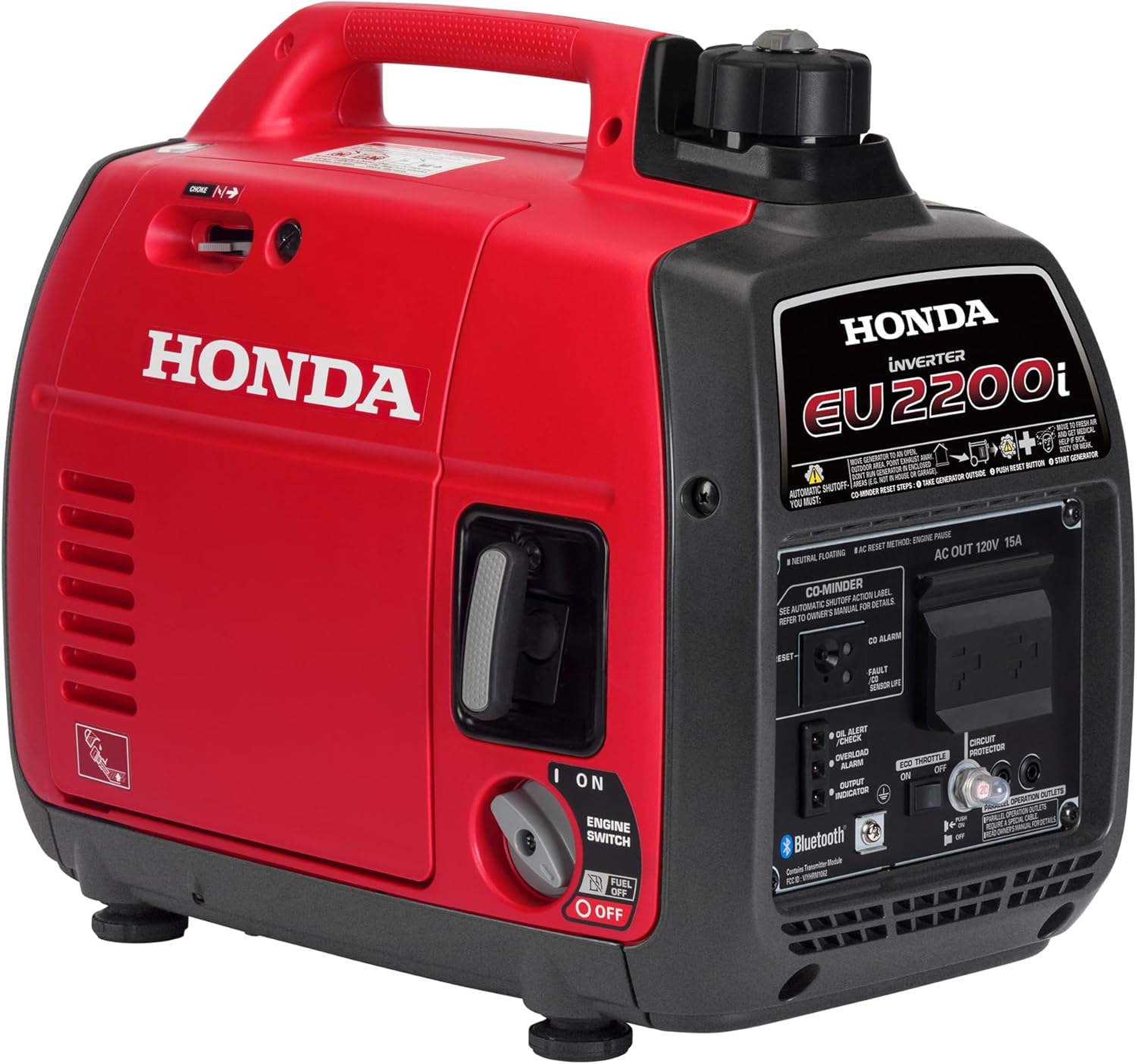
The Honda EU2200i earns our Best Quiet Generator award because it combines exceptionally quiet inverter operation, compact portability, excellent fuel efficiency, and dependable everyday performance in a lightweight package. While it does not provide the output of larger generators in this guide, its combination of low noise, manageable size, and clean inverter power makes it especially well suited to camping, tailgating, and portable electronics.
With 2,200 watts of maximum output and 1,800 watts of rated output, the EU2200i provides enough capacity for many common recreational and emergency applications. It can support devices such as refrigerators, microwaves, fans, televisions, computers, and other moderate-power equipment, although multiple high-demand appliances cannot necessarily be operated simultaneously.
Quiet operation is one of its defining advantages. Honda rates the EU2200i at approximately 48 dB(A) at 1/4 load and 57 dB(A) at rated load, allowing it to operate considerably more discreetly than many larger conventional generators. The enclosed inverter design and Eco Throttle system also help reduce unnecessary engine operation when the electrical load is lower.
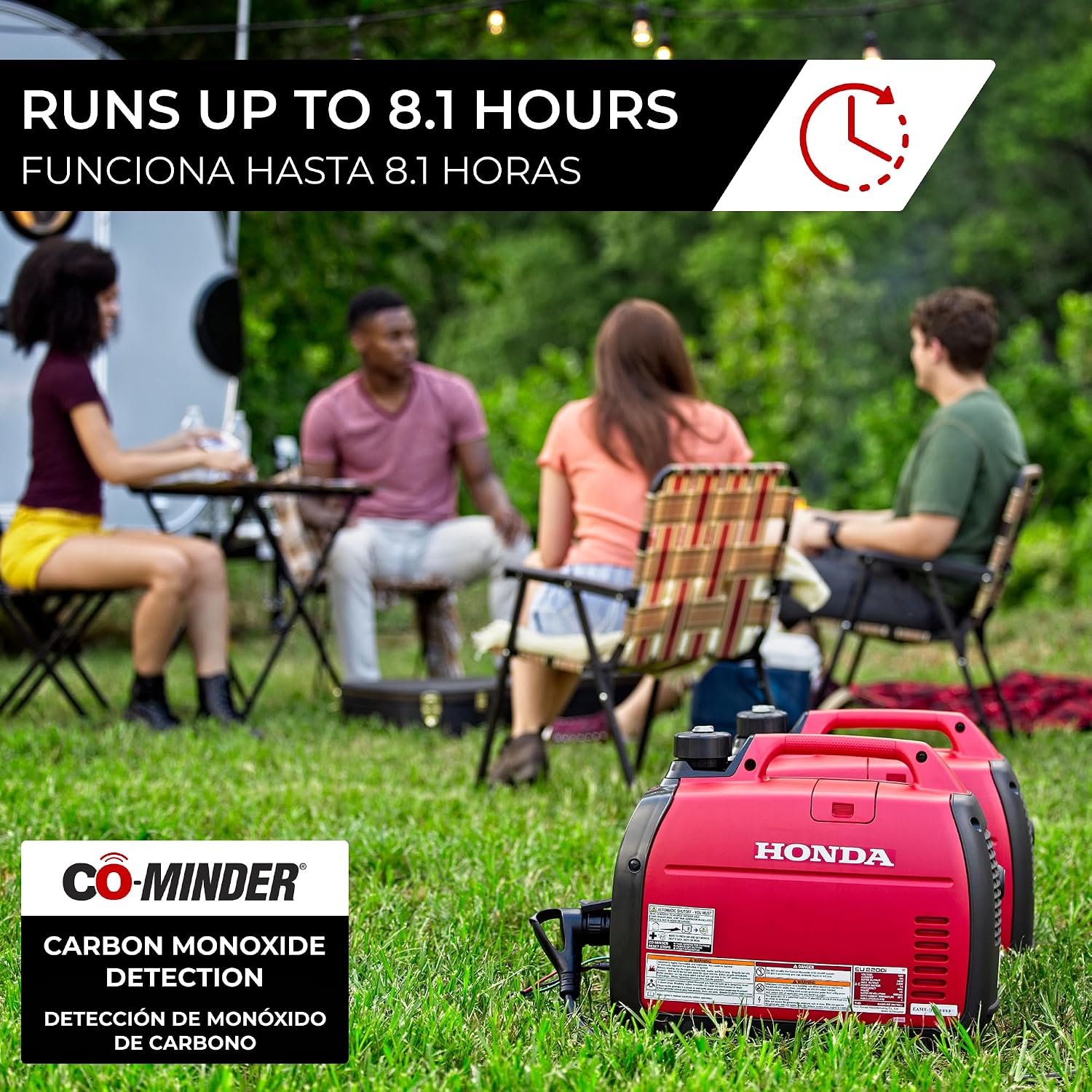
Its compact design is another major strength. At approximately 47.4 lb, the EU2200i is substantially easier to move and store than the larger generators in this guide. The 0.95-gallon fuel tank provides up to 8.1 hours of runtime at 1/4 load, making it practical for extended camping days or moderate backup needs without requiring frequent refueling.
The EU2200i is not the right choice for buyers who need to power several high-demand household appliances simultaneously, and it lacks the dual-fuel flexibility of the Westinghouse and Champion models in this guide. However, for users who place quiet operation, portability, fuel efficiency, and dependable inverter power above maximum wattage, the Honda EU2200i remains one of the strongest choices in its class.
Snapshot
| Running Watts | 1,800W |
|---|---|
| Peak Watts | 2,200W |
| Fuel Type | Gasoline |
| Weight | 47.4 lb |
| Noise Level | 48–57 dB(A) |
| Best Use Case | Camping, tailgating, electronics, light backup |
Why We Chose It
We selected the Honda EU2200i as our Best Quiet Generator because it focuses on the qualities that matter most when a generator needs to operate close to people. Instead of maximizing raw wattage, Honda has built the EU2200i around quiet operation, compact dimensions, fuel efficiency, and dependable inverter performance.
Several features contributed to its ranking:
- Quiet inverter operation keeps noise levels relatively low, with Honda rating the generator at 48 dB(A) at 1/4 load and 57 dB(A) at rated load.
- 2,200 watts of maximum output gives it more capacity than the older 2,000W-class portable generators while maintaining a compact form factor.
- 1,800 watts of rated output provides practical continuous power for common camping equipment, electronics, and selected household essentials.
- Eco Throttle technology automatically adjusts engine speed according to the electrical load, helping reduce fuel consumption and unnecessary noise.
- Inverter technology provides stable 120V power suitable for computers, chargers, televisions, and other sensitive electronic equipment.
- Parallel capability allows compatible Honda generators to be connected when additional power is required.
- Compact construction and approximately 47.4 lb dry weight make the EU2200i substantially easier to transport than larger generators designed primarily for home backup.
The EU2200i is particularly compelling for buyers who spend significant time outdoors. A generator that is easy to move, relatively quiet, and economical to operate is much easier to integrate into a campsite or tailgating setup than a larger high-output unit.
Its size also makes it practical for users who have limited storage space. It can be transported in a vehicle, stored in an RV, or kept ready for occasional emergency use without requiring the dedicated storage area that larger generators often need.
Another advantage is its ability to support a surprisingly broad range of moderate-power equipment. Honda lists applications including refrigerators or freezers, microwave ovens, portable fans, televisions, coffee makers, computers, garage door openers, and other common devices, while noting that not all loads can be powered simultaneously.
For buyers who value quiet operation and portability more than maximum output, the Honda EU2200i represents a highly practical balance. It is particularly well suited to campers, RV users with modest electrical requirements, tailgaters, and homeowners who want a compact generator for essential electronics and lighter emergency loads.
Check the latest price and customer reviews on Amazon.
Living With It at Camp
The Honda EU2200i is particularly well suited to campers who want reliable electricity without adding a large, heavy generator to their gear. Its compact design and relatively low weight make it much easier to transport than the larger generators in this guide, while its inverter technology keeps operation quiet enough for many campsites and outdoor settings.
Imagine arriving at a campsite where keeping noise under control matters just as much as having access to electricity. The EU2200i can be positioned near the edge of the campsite and used to recharge phones, laptops, camera batteries, lights, and other essential electronics without the constant noise associated with larger conventional generators.
Its 48–57 dB(A) noise rating is one of the generator’s biggest practical advantages. At lighter loads, the engine can operate quietly enough that normal conversations and campsite activities remain comfortable. As electrical demand increases, the noise level rises, but it remains relatively restrained for a gasoline generator of this size.
Fuel efficiency is another reason the EU2200i works well for extended recreational use. Honda’s Eco Throttle system automatically adjusts engine speed according to the electrical load, reducing unnecessary fuel consumption when the generator is not operating near its maximum capacity. The 0.95-gallon fuel tank can provide up to approximately 8.1 hours of runtime at 1/4 load, although actual runtime varies depending on the connected equipment and operating conditions.
In a typical camping setup, the EU2200i can support:
- Smartphones, tablets, and other small electronics
- Laptops and computer equipment
- LED lighting
- Television and streaming equipment
- Portable fans
- Camera and drone battery chargers
- Coffee makers and other moderate-power appliances
- A refrigerator or freezer, depending on its startup and running requirements
The generator’s 1,800W rated output is enough for many everyday recreational loads, but users need to pay attention to startup requirements when operating appliances with electric motors or compressors. A refrigerator, for example, may require substantially more power for a brief period when its compressor starts.
At approximately 47.4 lb, the EU2200i is much easier to carry than the larger Westinghouse, Champion, and DuroMax generators in this guide. That makes a meaningful difference for tent campers, tailgaters, and anyone who regularly moves equipment between a vehicle and campsite.
For users who need additional capacity, Honda’s parallel capability provides an upgrade path by allowing compatible Honda inverter generators to be connected. This can be useful when power requirements increase without immediately moving to a substantially larger generator.
Overall, the EU2200i is best suited to users who value quiet operation, portability, fuel efficiency, and dependable inverter power more than maximum wattage. Its compact design makes it particularly easy to integrate into camping and recreational setups where space, weight, and noise are important considerations.
Evaluation
| Power Output | Good |
|---|---|
| Noise Level | Excellent |
| Portability | Excellent |
| Fuel Efficiency | Excellent |
| RV Compatibility | Limited |
| Home Backup Capability | Good |
| Value for Money | Very Good |
The Honda EU2200i performs particularly well in the categories that matter most for portable recreational power. Its biggest strengths are its low noise level, compact size, fuel efficiency, and stable inverter output.
It does not compete with the larger generators in this guide when it comes to raw power. However, that is not the purpose of the EU2200i. Its value comes from providing dependable electricity in situations where carrying a 4,000W or 13,000W generator would add unnecessary weight, storage requirements, and noise.
Its excellent portability and quiet operation make it especially attractive for camping and outdoor recreation, while the inverter system provides clean power for many sensitive electronic devices. The ability to connect compatible generators in parallel also gives users some flexibility if their power requirements increase later.
The main limitation is output capacity. Users who need to operate multiple high-demand appliances, large RV air conditioners, or substantial household loads should choose a larger generator instead.
Who Should Buy This
The Honda EU2200i is an excellent choice for:
- Campers who prioritize quiet operation and want to minimize generator noise at the campsite.
- Tailgaters and outdoor enthusiasts who need a compact source of portable electricity.
- Users who regularly power laptops, cameras, chargers, televisions, and other sensitive electronics.
- Buyers who value excellent portability and want a generator that is relatively easy to carry and store.
- Users who need dependable power for moderate electrical loads rather than high-demand household appliances.
- Buyers who may want to expand their available power later using compatible Honda parallel-capable generators.
Who Should Skip This
The Honda EU2200i may not be the best choice for:
- Homeowners who need to power multiple high-demand appliances during extended outages.
- RV owners who need substantial capacity for large air conditioners and several onboard appliances simultaneously.
- Users who require dual-fuel operation for greater emergency fuel flexibility.
- Buyers who need enough output for large 240V appliances or whole-house backup.
- Anyone who regularly operates equipment with very high startup or continuous power requirements.
Final Verdict
The Honda EU2200i earns our Best Quiet Generator award because it focuses on the qualities that make a portable generator genuinely convenient for everyday recreational use. Its quiet inverter operation, compact dimensions, excellent fuel efficiency, and manageable 47.4 lb weight make it one of the easiest generators in this guide to transport, store, and use around a campsite.
With 2,200W of maximum output and 1,800W of rated output, it provides enough capacity for many common camping and light emergency applications while maintaining the portability that makes this class of generator so useful. Its inverter technology is also well suited to modern electronics, while Eco Throttle helps reduce fuel consumption when electrical demand is lower.
The EU2200i is not designed to replace a high-output home backup generator. Buyers who need to run multiple major appliances, large RV air conditioners, or other demanding loads should consider one of the larger models in this guide. For campers, tailgaters, and users who place quiet operation, portability, fuel efficiency, and dependable inverter power above maximum output, however, the Honda EU2200i remains an excellent choice.
Check the latest price and customer reviews on Amazon.
Related Guide: If you’re choosing a compact generator specifically for outdoor use, our Best Portable Power Stations for Camping guide compares battery-powered alternatives for quiet, fuel-free camping power.
Champion Power Equipment 200914
Best for RVs

Quick Verdict
The Champion Power Equipment 200914 earns our Best for RVs award because it combines the power RV owners need with the convenience of inverter technology and dual-fuel operation. With 4,250 watts of peak output and 3,400 watts of rated output, it provides substantially more capacity than compact 2,000W-class generators, making it a better fit for travel trailers and motorhomes with higher electrical demands.
Its 30A RV-ready outlet is one of the most important features for recreational users. Instead of building a complicated connection setup, compatible RVs can connect directly to the generator through the dedicated TT-30R outlet. The generator also supports gasoline and propane, giving RV owners more flexibility when planning fuel for longer trips or emergency situations.
Champion’s Quiet Technology and inverter design help this open-frame generator run quieter and more fuel-efficiently than older, conventional open-frame models. The unit is not as compact or lightweight as the Honda EU2200i, but its additional power makes that trade-off worthwhile for RV users who need to operate larger appliances.
The 200914 is particularly useful when an RV trip revolves around equipment with meaningful startup demands. An air conditioner, microwave, refrigerator, battery charger, and other onboard systems can quickly exceed the capacity of a small generator. The Champion provides a larger operating margin while still maintaining a portable design that can be moved around a campsite or stored for travel.
For RV owners who want dual-fuel flexibility, inverter-quality power, dedicated RV connectivity, and enough output for demanding campground loads, the Champion Power Equipment 200914 is one of the strongest choices in this guide.
Snapshot
| Running Watts | 3,400W |
|---|---|
| Peak Watts | 4,250W |
| Fuel Type | Gasoline / Propane |
| Weight | About 97 lb |
| RV-Ready | Yes |
| Best Use Case | RVs, travel trailers, camping, backup power |
Why We Chose It
We selected the Champion Power Equipment 200914 as our Best for RVs because its design addresses a specific problem that compact portable generators often cannot solve: providing enough power for an RV without stepping all the way up to a large, heavy home-backup generator.
For RV owners, generator capacity is only one part of the equation. Connection type, startup power, fuel flexibility, portability, and the ability to operate multiple onboard systems all affect how useful a generator will be once you leave the campground electrical hookup behind.
The 200914 brings several RV-friendly features together:
- 4,250 watts of peak output and 3,400 watts of rated output provide substantially more capacity than small recreational generators.
- A dedicated 30A RV-ready outlet simplifies connection to compatible travel trailers and motorhomes.
- Dual-fuel operation allows users to choose gasoline or propane depending on availability and trip requirements.
- Inverter technology provides clean electricity suitable for many modern RV electronics and appliances.
- Quiet Technology helps reduce operating noise compared with conventional open-frame generators.
- Remote electric start adds convenience when the generator is positioned outside the RV and needs to be started without repeated manual access.
- The generator includes wheels and a folding handle to make transportation more manageable despite its larger size.
The power capacity is especially relevant for RV air conditioning. Air conditioners can have significant startup demands, and a generator that looks adequate based only on running wattage may still struggle when the compressor starts. The Champion’s additional peak capacity provides more headroom for these short-duration surges.
At the same time, the generator remains more versatile than an RV-only power source. It can also be useful for camping equipment, outdoor events, emergency backup, and other situations where a 30A-capable portable generator is valuable.
We also considered the practical advantage of dual-fuel operation for RV travel. Gasoline may be convenient in many situations, while propane can provide an alternative fuel source that is useful for campers who already carry propane for cooking or other RV equipment.
The main trade-off is size. At roughly 97 lb, the Champion is significantly heavier than compact generators such as the Honda EU2200i. It is therefore better suited to RV owners who can transport the generator using its wheels and handle rather than users who expect to carry it long distances by hand.
For travel trailers, motorhomes, and campers who need more power than a compact inverter generator can provide without moving to a much larger home-backup unit, the Champion 200914 strikes a particularly useful balance between output, RV compatibility, fuel flexibility, and portability.
Check the latest price and customer reviews on Amazon.

Living With It at Camp
The Champion Power Equipment 200914 makes the most sense when an RV needs more electrical capacity than a compact recreational generator can comfortably provide. Its dedicated 30A RV-ready connection means the generator can become the primary power source for a compatible travel trailer or motorhome when campground hookups are unavailable.
Consider a summer RV trip where you arrive at a remote campsite with no electrical hookup. The refrigerator is already running, the battery charger is replenishing the house batteries, and the interior needs lighting. Then the afternoon heat arrives and the RV air conditioner becomes the most important load.
This is where the Champion’s higher output becomes valuable. With 3,400W of rated power and 4,250W of peak power, it provides considerably more capacity than a small 2,000W-class inverter generator, giving compatible RV systems more room to handle appliances with higher startup demands.
The 30A RV-ready outlet also simplifies the setup. Rather than building a separate connection system for individual appliances, compatible RVs can connect directly to the generator through the dedicated outlet. This makes the 200914 particularly convenient for travel trailers and motorhomes designed around a 30A electrical service.
During a typical RV trip, the generator can support equipment such as:
- RV air conditioners
- Refrigerators and freezers
- Microwave ovens
- Coffee makers
- Battery chargers
- Interior and exterior lighting
- Televisions and entertainment systems
- Laptops and other electronics
The generator’s dual-fuel capability becomes particularly useful on longer trips. Gasoline can provide convenient high-output operation when readily available, while propane offers an alternative fuel source for RV owners who already carry propane cylinders for cooking or other equipment.
Its inverter design is another important advantage. Although the Champion is larger and heavier than the Honda EU2200i, it still provides inverter-generated electricity — a step up from the less controlled output of older, non-inverter open-frame generators. This makes it better suited to modern RV electrical systems and sensitive electronic equipment.
Noise is still a consideration. The 200914 uses Champion’s Quiet Technology to reduce operating noise compared with conventional open-frame generators, but buyers should not expect the same low-noise experience as a compact enclosed inverter generator such as the Honda EU2200i. The larger engine and higher power capacity naturally make it more noticeable when operating close to the campsite.
Portability is also a matter of perspective. At roughly 97 lb, this is not a generator most people will want to carry any significant distance. Its wheels and folding handle make movement around an RV campsite much more practical, but the generator is best transported by vehicle and positioned before connecting the RV.
For RV owners, that trade-off makes sense. The Champion 200914 is designed less around minimal weight and more around providing usable 30A RV power with enough capacity for demanding appliances, while retaining the flexibility of dual-fuel operation.
Evaluation
| Power Output | Very Good |
|---|---|
| Noise Level | Very Good |
| Portability | Good |
| Fuel Flexibility | Excellent |
| RV Compatibility | Excellent |
| Home Backup Capability | Good |
| Value for Money | Very Good |
The Champion Power Equipment 200914 performs strongest in the categories that matter most to RV owners. Its combination of 4,250W peak output, 3,400W rated output, dedicated 30A RV connection, inverter technology, and dual-fuel capability gives it a clear advantage over smaller recreational generators when electrical demands increase.
Its RV compatibility is the defining strength. The dedicated 30A outlet eliminates much of the complexity that can come with adapting a general-purpose generator to an RV, while the additional output provides useful headroom for appliances with substantial startup demands.
Fuel flexibility is another major advantage. Having gasoline and propane available as operating options can be especially valuable during extended travel or emergency situations when one fuel source may be easier to obtain than the other.
The main compromise is portability. At approximately 97 lb, the Champion is considerably heavier than the Honda EU2200i and is better suited to vehicle-based travel than situations where the generator needs to be carried long distances.
Overall, the 200914 earns its position by prioritizing the requirements of RV owners who need meaningful electrical capacity without moving to a much larger home-backup generator.
Who Should Buy This
The Champion Power Equipment 200914 is an excellent choice for:
- RV owners who regularly travel without campground electrical hookups.
- Travel trailer users who need a generator with a dedicated 30A RV-ready outlet.
- Campers who need enough capacity to operate an RV air conditioner and other moderate-power appliances.
- Buyers who want the flexibility of gasoline and propane operation.
- RV owners who prefer the quieter, inverter-equipped design of the 200914 over a conventional (non-inverter) open-frame generator.
- Users who want more power than a compact 2,000W-class generator can provide without stepping up to a much larger home-backup model.
Who Should Skip This
The Champion 200914 may not be the best choice for:
- Backpackers or campers who need a lightweight generator that can be carried by hand.
- Users whose primary requirement is extremely quiet operation.
- Buyers who only need to charge phones, laptops, cameras, and other low-power electronics.
- Homeowners who need substantial whole-house backup capacity.
- Users who require 240V output for large household appliances.
Final Verdict
The Champion Power Equipment 200914 earns our Best for RVs award because it is purposefully suited to the electrical demands of travel trailers and motorhomes. Its combination of 4,250W peak output, 3,400W rated output, 30A RV-ready connectivity, inverter technology, and dual-fuel operation gives RV owners a practical way to maintain power away from campground hookups.
Its greatest advantage is the balance between capacity and portability. Smaller generators are easier to carry and quieter, but they may not provide enough headroom for an RV air conditioner and other appliances operating together. Larger home-backup generators provide considerably more power but add unnecessary size and complexity for many recreational users.
The Champion 200914 sits between those extremes. It is heavy enough that transport requires planning, but its wheels and folding handle make campsite positioning manageable. Its dual-fuel capability also gives RV owners additional flexibility when planning longer trips or preparing for unexpected power interruptions.
If your priority is reliable RV power, 30A connectivity, enough output for demanding onboard appliances, and the flexibility to run on gasoline or propane, the Champion Power Equipment 200914 is our Best for RVs recommendation.
Check the latest price and customer reviews on Amazon.
Related Guide: If you’re choosing a generator specifically for RV travel, our Best Portable Power Stations for RV guide compares battery-powered alternatives that provide quiet, fuel-free backup power for life on the road.
DuroMax XP13000EH
Best for Home Backup

Quick Verdict
The DuroMax XP13000EH earns our Best for Home Backup award because it delivers substantially more power than the other generators in this guide, making it the strongest choice for homeowners who need to support multiple high-demand appliances during an extended outage.
On gasoline, the XP13000EH produces 13,000 watts of peak power and 10,500 watts of running power. When operating on propane, it provides up to 12,350 peak watts and 9,975 running watts. That level of output places it firmly in a different class from compact recreational generators such as the Honda EU2200i.
The generator is designed around serious backup applications rather than lightweight recreational use. Its 120/240V output, 50A connection, electric start, dual-fuel capability, and Home Backup Ready configuration make it suitable for supporting substantial household electrical loads when connected and installed correctly.
The XP13000EH is particularly useful for homeowners who want to keep several essential systems operating at the same time. Refrigerators, freezers, sump pumps, lighting, internet equipment, kitchen appliances, and appropriately sized HVAC equipment can place significant demands on a backup generator, especially when motors and compressors create temporary startup surges.
Its dual-fuel capability adds another layer of resilience. Gasoline provides the highest rated output, while propane gives homeowners an alternative fuel source that can be useful during prolonged emergencies or when gasoline availability becomes limited.
This generator is considerably larger and heavier than the other models in this guide. At approximately 248 lb product weight, it is not intended to be carried around a campsite or loaded casually into a vehicle. Instead, it is best viewed as a high-capacity portable backup generator that remains movable because of its wheel and handle kit while being positioned primarily around a home or dedicated storage area.
For homeowners who prioritize high power output, 120/240V capability, dual-fuel flexibility, and the ability to support substantial household loads during extended outages, the DuroMax XP13000EH is our strongest home-backup recommendation.
Snapshot
| Running Watts | 10,500W |
|---|---|
| Peak Watts | 13,000W |
| Fuel Type | Gasoline / Propane |
| Weight | About 248 lb |
| Voltage | 120/240V |
| Best Use Case | Home backup, extended outages, high-demand appliances |
Why We Chose It
We selected the DuroMax XP13000EH as our Best for Home Backup because its primary advantage is straightforward: it provides the highest power capacity among the five generators in this guide.
The difference becomes especially important during a prolonged outage. A compact generator can keep phones charged and refrigerators running, but homeowners with larger electrical requirements may need substantially more capacity to operate several essential systems simultaneously.
The XP13000EH is built around that higher-demand scenario.
Its key advantages include:
- 10,500W of running power and 13,000W peak power on gasoline, providing substantial capacity for emergency household loads.
- 9,975W running power and 12,350W peak power on propane, allowing homeowners to maintain significant output while using an alternative fuel source.
- 120/240V operation, which expands its compatibility with household electrical systems and higher-demand equipment.
- A 50A outlet that can be used as part of an appropriate home backup connection.
- Electric start and remote start for easier operation when the generator is positioned outside the home.
- CO sensor shutdown and automatic low-oil shutdown for additional operational protection.
- All-metal construction and 100% copper windings, supporting the generator’s heavy-duty positioning.
- Home Backup Ready and RV Ready configurations, giving it broader utility beyond emergency household use.
Another reason it stands out is the combination of output and fuel flexibility. During a short outage, gasoline may be the simplest choice. During a longer emergency, having propane as an alternative can make fuel planning easier, particularly for households that already store propane for other equipment.
The generator also offers substantial runtime potential. DuroMax rates it for up to 17 hours at 25% load on gasoline and 8 hours at 50% load, while propane provides up to 13 hours at 25% load and 6 hours at 50% load. Actual runtime depends on electrical demand and operating conditions.
Its large fuel tank, rated at 8.3 gallons of gasoline capacity, further supports longer operating periods without frequent refueling. This matters more for emergency backup than it does for occasional camping because a generator may need to operate for many hours each day during a prolonged grid outage.
There are obvious trade-offs. The XP13000EH is significantly heavier and louder than the smaller inverter generators in this guide, with a listed operating volume of approximately 74 dB. It also requires considerably more storage space and is better suited to a prepared home backup setup than spontaneous recreational use.
For the homeowner who needs serious portable generation capacity rather than a compact recreational power source, however, those trade-offs are directly related to what the generator is designed to accomplish. The XP13000EH prioritizes power, household compatibility, fuel flexibility, and long-duration backup capability above lightweight portability.
Check the latest price and customer reviews on Amazon.

Living With It at Home
The DuroMax XP13000EH is designed for a very different kind of backup scenario than the smaller generators in this guide. Its value becomes most apparent when a power outage lasts for many hours or days and a household needs to maintain several essential systems rather than simply keep a few small devices charged.
Imagine a summer storm knocks out grid power in the evening. The refrigerator and freezer need to remain cold, the sump pump must be ready to operate, internet equipment needs to stay online, and the household still needs lighting and basic kitchen appliances. In a larger home, these loads can quickly add up, particularly when motors and compressors create temporary startup demands.
This is where the XP13000EH’s high output becomes important. With 10,500W of running power and up to 13,000W of peak power on gasoline, it provides substantially more capacity than the other generators in this guide. The generator can also operate on propane, producing up to 9,975W running and 12,350W peak, giving homeowners an alternative when gasoline is unavailable or when propane is easier to store.
The 120/240V capability is another major advantage for home backup. It expands the range of equipment the generator can support and makes it better suited to properly configured residential backup systems than smaller 120V recreational generators.
A typical emergency setup might prioritize:
- Refrigerators and freezers
- Sump pumps
- Well pumps, where compatible with available generator capacity
- Internet routers and modems
- Lighting
- Televisions and communication equipment
- Kitchen appliances
- Portable air conditioners or appropriately sized HVAC equipment
- Battery chargers and other essential electronics
The key is not to treat the generator’s 13,000W peak rating as unlimited household capacity. Large appliances should be prioritized according to their running and startup requirements, and homeowners should avoid exceeding the generator’s rated output. Loads can also be managed by turning nonessential equipment off when higher-demand appliances need to operate.
For households using a transfer switch or other permanent connection equipment, professional installation is essential. A portable generator should never be connected directly to a home’s electrical wiring through an improvised connection, and the generator must always be operated outdoors in a location where exhaust gases cannot enter the building.
Fuel planning becomes more important with a generator of this size. The XP13000EH’s large gasoline tank can support extended operation, while propane provides another fuel option for longer emergencies. Actual runtime depends heavily on electrical load, so homeowners should plan around their expected energy consumption rather than assume the generator will operate continuously at maximum output.
There is also a practical trade-off that every buyer should understand: this is a large portable generator. At approximately 248 lb, it is not something most users will casually move around. Its wheels and handles make repositioning possible, but the generator should ideally be stored in an appropriate location where it can be moved into its operating position without unnecessary lifting.
Noise is another consideration. With an operating noise level of approximately 74 dB, the XP13000EH is considerably more noticeable than compact inverter generators such as the Honda EU2200i. That is a reasonable trade-off for the substantially greater power capacity, but homeowners should consider generator placement, local noise rules, and distance from occupied areas before operating it.
For households where the priority is maintaining multiple essential electrical loads during serious or extended outages, the XP13000EH offers the capacity and electrical flexibility that smaller recreational generators simply cannot match.
Evaluation
| Power Output | Excellent |
|---|---|
| Noise Level | Good |
| Portability | Limited |
| Fuel Flexibility | Excellent |
| RV Compatibility | Very Good |
| Home Backup Capability | Excellent |
| Value for Money | Very Good |
The DuroMax XP13000EH clearly leads this group in raw generating capacity and home-backup capability. Its 120/240V output, high continuous wattage, substantial peak capacity, and dual-fuel operation make it much better suited to demanding residential applications than compact portable generators.
Its greatest limitation is portability. At roughly 248 lb, this is a generator that needs to be positioned thoughtfully and moved using its wheels rather than carried. The higher operating noise is another unavoidable consequence of its larger engine and output class.
For homeowners, however, those compromises are balanced by the ability to support substantially larger electrical loads. The generator is particularly compelling for households that need to keep several essential systems operating during an extended outage and have a suitable location and connection strategy for a high-output portable generator.
Who Should Buy This
The DuroMax XP13000EH is an excellent choice for:
- Homeowners preparing for extended power outages.
- Households that need to support multiple essential appliances at the same time.
- Users who need 120/240V capability for compatible residential equipment.
- Buyers who want the flexibility of gasoline and propane during emergencies.
- Homeowners with refrigerators, freezers, sump pumps, well pumps, or other substantial electrical loads.
- Users who are prepared to dedicate appropriate outdoor storage and operating space to a large portable generator.
Who Should Skip This
The DuroMax XP13000EH may not be the best choice for:
- Campers looking for a lightweight recreational generator.
- Buyers whose primary requirement is extremely quiet operation.
- Users who only need enough electricity for phones, laptops, lights, and small electronics.
- Households with very limited storage or generator operating space.
- Buyers who do not need the additional capacity of a high-output 120/240V generator.
- Anyone planning to connect a generator to household wiring without an appropriately installed transfer switch or other approved connection equipment.
Final Verdict
The DuroMax XP13000EH earns our Best for Home Backup award because it is built around the demands of serious residential power outages rather than lightweight recreational use. With up to 13,000W of peak output and 10,500W of running power on gasoline, it provides substantially more capacity than the other generators in this guide.
Its 120/240V capability, 50A connection, dual-fuel operation, electric start, and high continuous output make it a strong option for households that need to keep multiple essential systems operating when grid electricity is unavailable. Propane operation adds useful fuel flexibility, while the large fuel tank supports longer operating periods when demand is managed appropriately.
The trade-offs are significant. This is a large, heavy generator that is considerably louder and less convenient to transport than compact inverter models. It also requires careful planning around placement, ventilation, fuel storage, electrical connections, and household load management.
For a homeowner who needs a compact generator for occasional camping, this capacity would be unnecessary. But for households preparing for serious or extended outages and needing substantial portable generating capacity, the XP13000EH offers the strongest combination of output, electrical flexibility, and emergency fuel options in this guide.
Check the latest price and customer reviews on Amazon.
Related Guide: If you’re planning a broader home backup strategy and want to compare generator power with battery-based alternatives, our Best Home Battery Backup Systems guide explores larger battery systems designed for residential backup.
WEN 56235i
Best Budget Inverter Generator

Quick Verdict
The WEN 56235i earns our Best Budget Inverter Generator award because it provides a practical combination of inverter power, portability, quiet operation, and affordability for buyers who do not need the higher output of the larger generators in this guide.
With 2,350 watts of peak output and 1,900 watts of rated output, the WEN 56235i sits comfortably in the compact inverter-generator category. Its output is well suited to everyday recreational loads such as lights, chargers, laptops, small appliances, and selected emergency devices, while its compact design makes transportation and storage considerably easier than with larger generators.
The inverter design is particularly useful for users who regularly power modern electronics. Stable electrical output makes the generator suitable for laptops, phones, televisions, chargers, and other sensitive equipment, while its compact enclosed configuration helps keep operating noise lower than many traditional open-frame generators.
The main reason to choose the WEN over a more expensive premium model is value. Buyers who need a generator for occasional camping, tailgating, electronics, or light emergency backup may not benefit enough from additional power or premium features to justify spending substantially more.
At the same time, the WEN 56235i has clear limitations. It uses gasoline only, provides considerably less power than the Westinghouse, Champion, and DuroMax models in this guide, and is not designed for high-demand household backup or large RV air-conditioning loads.
For buyers who want affordable inverter power, compact portability, and enough capacity for everyday recreational and light emergency applications, the WEN 56235i offers one of the strongest value propositions in this guide.
Snapshot
| Running Watts | 1,900W |
|---|---|
| Peak Watts | 2,350W |
| Fuel Type | Gasoline |
| Weight | About 39 lb |
| Inverter Technology | Yes |
| Best Use Case | Camping, electronics, light emergency backup |
Why We Chose It
We selected the WEN 56235i as our Best Budget Inverter Generator because it focuses on providing the essential features most buyers need without adding the size, output, or cost associated with larger portable generators.
For many recreational users, a generator does not need to power an entire RV or several major household appliances. The actual requirement may be much simpler: keep phones and laptops charged, run campsite lighting, power a television, operate a small appliance, or provide a limited source of electricity during a short outage.
In those situations, paying for a much larger generator can mean carrying additional weight and spending more money without receiving a meaningful benefit.
The WEN 56235i addresses this type of use with a compact inverter design and 1,900 watts of rated output. Its 2,350-watt peak capacity also provides additional short-term headroom for equipment with modest startup demands.
Several characteristics contributed to its position in this guide:
- Inverter technology provides stable power for many sensitive electronic devices.
- 2,350 watts of peak output gives the generator more capacity than basic 2,000W-class units.
- 1,900 watts of rated output is sufficient for many common camping and light-duty backup loads.
- Compact construction and approximately 39 lb weight make transportation considerably easier than with the larger generators in this guide.
- Enclosed construction helps keep the generator more suitable for recreational environments than a traditional open-frame design.
- Gasoline operation keeps the fuel system straightforward for users who do not need dual-fuel flexibility.
Portability is one of the WEN’s strongest practical advantages. A generator weighing around 39 lb is much easier to move between a vehicle and campsite than a 100 lb-plus model. That makes a meaningful difference for users who may only need a generator occasionally and do not want to dedicate substantial storage space to emergency equipment.
Its smaller size also makes it easier to store between trips. For apartment dwellers, occasional campers, tailgaters, and homeowners with limited storage space, a compact generator can be more practical than a much larger unit even when the larger generator offers significantly more power.
The WEN 56235i is also a sensible choice when the electrical load is predictable. If your typical use consists of charging electronics, powering lights, running a small refrigerator, or maintaining communication equipment during a short outage, its available capacity may be sufficient without requiring the additional expense of a high-output generator.
The trade-off is that the WEN cannot provide the same level of household backup capability as the DuroMax XP13000EH or the broader versatility of a dual-fuel model such as the Westinghouse iGen4500DFc. Buyers should therefore determine their actual running and startup requirements before choosing a compact generator.
For users who want simple, portable, and affordable inverter power rather than maximum output, the WEN 56235i delivers the core functionality needed for many everyday recreational and light emergency applications without unnecessary expense.
Check the latest price and customer reviews on Amazon.

Living With It at Camp
The WEN 56235i is best suited to situations where portable electricity needs to be useful without becoming another major piece of camping equipment. Its compact size and relatively low weight make it easy to transport in a vehicle, position at a campsite, and store between trips.
Imagine a weekend camping trip where the electrical requirements are fairly modest. Instead of bringing a large generator capable of powering an entire RV, you need enough electricity for phones, laptops, LED lights, a small refrigerator, and a few other essentials. The WEN 56235i is designed around this type of practical, lower-demand setup.
Its 1,900W rated output and 2,350W peak capacity provide enough power for many common recreational loads, although users still need to account for the startup requirements of appliances with motors or compressors. A refrigerator, for example, may briefly require substantially more power when its compressor starts.
The inverter design makes the generator particularly useful for modern electronics. It provides stable electrical output for equipment such as:
- Smartphones and tablets
- Laptops and computer equipment
- Cameras and battery chargers
- LED lighting
- Televisions
- Portable fans
- Small refrigerators or coolers
- Other moderate-power camping equipment
The generator’s compact form also changes how easy it is to incorporate into a trip. At approximately 39 lb, it can be moved without the same logistical planning required by the 100 lb-plus generators in this guide. For campers who travel frequently or have limited vehicle storage, that difference can be more important than having several thousand additional watts available.
The WEN is also a practical option for short-term emergency situations. During a brief outage, it can provide electricity for essential electronics, lighting, communication equipment, and selected small appliances without requiring the storage space associated with a large home-backup generator.
There are limits to this approach. The WEN 56235i is a gasoline-only generator, so buyers who want propane as an alternative fuel source should consider one of the dual-fuel models in this guide. Its output is also not intended for large household loads, central air-conditioning systems, or substantial RV electrical demands.
For recreational use, however, its smaller size can be an advantage rather than a compromise. If your typical trips involve moderate electrical loads and your priority is carrying only the equipment you actually need, a compact inverter generator can be a much more practical solution than a larger high-output unit.
The result is a generator that fits naturally into weekend camping, tailgating, outdoor recreation, and light emergency backup without requiring buyers to pay for power capacity they are unlikely to use.
Evaluation
| Power Output | Good |
|---|---|
| Noise Level | Very Good |
| Portability | Excellent |
| Fuel Flexibility | Limited |
| RV Compatibility | Limited |
| Home Backup Capability | Good |
| Value for Money | Excellent |
The WEN 56235i performs best when evaluated against the needs of budget-conscious recreational users rather than against much larger emergency generators. Its strongest advantages are its compact design, manageable weight, inverter technology, and relatively accessible price.
Its excellent portability is particularly important. A 39 lb generator is substantially easier to transport and store than the larger models in this guide, making it a practical option for campers who do not want their power equipment to dominate their vehicle or campsite setup.
The trade-off is lower power capacity and limited fuel flexibility. Unlike the Westinghouse and Champion models, the WEN cannot switch between gasoline and propane, and its smaller output limits the number of high-demand appliances it can support.
For buyers whose electrical needs are modest, however, these limitations may not matter. The WEN provides the core benefits of an inverter generator without requiring a premium budget, making its overall value particularly strong for occasional and light-duty use.
Who Should Buy This
The WEN 56235i is an excellent choice for:
- Budget-conscious campers who need dependable portable electricity without premium pricing.
- Users who primarily charge electronics, lights, cameras, and other moderate-power equipment.
- Tailgaters and outdoor enthusiasts who value compact size and easy transportation.
- Homeowners looking for a small generator for short outages and essential electronics.
- Buyers with limited storage space who prefer a lightweight inverter generator.
- Users who do not need dual-fuel operation or high-output household backup.
Who Should Skip This
The WEN 56235i may not be the best choice for:
- Homeowners who need to operate multiple high-demand appliances during extended outages.
- RV owners who need substantial power for air conditioners and multiple onboard appliances.
- Buyers who specifically want gasoline and propane fuel flexibility.
- Users who require 240V output or whole-house backup capability.
- Anyone who expects to power large heating, cooling, or other high-wattage appliances.
Final Verdict
The WEN 56235i earns our Best Budget Inverter Generator award because it delivers the essential advantages of portable inverter power without requiring buyers to move into a higher price or power class than they actually need.
Its 1,900W rated output, 2,350W peak capacity, compact design, and approximately 39 lb weight make it particularly well suited to camping, tailgating, electronics, and light emergency backup. The inverter design also makes it a practical choice for modern electronic equipment where stable power is important.
It does not offer the fuel flexibility of the dual-fuel generators in this guide, and its lower output makes it unsuitable for serious home backup or demanding RV applications. Buyers with those requirements should choose a larger generator with greater capacity and, where appropriate, 120/240V capability.
For users who simply want an affordable, portable inverter generator for moderate electrical loads, however, the WEN 56235i offers an excellent balance of portability, functionality, and value.
Check the latest price and customer reviews on Amazon.
Related Guide:: If you want a fuel-free alternative that fits the same budget-friendly approach, our Best Portable Power Stations Under $500 (2026) guide compares affordable battery-powered options for camping and light emergency backup
How to Choose the Best Portable Generator
Choosing the best portable generator isn’t simply about buying the model with the highest wattage or the largest fuel tank. The right choice depends on what you need to power, how long you expect to run it, where you plan to use it, and how much portability matters in your particular situation.
Many buyers assume that more power automatically means a better generator. In reality, an oversized generator can consume more fuel, weigh significantly more, take up valuable storage space, and cost considerably more than necessary. On the other hand, choosing a generator that is too small can leave you unable to start or run the appliances you actually need during an outage or outdoor trip.
The goal is to find a generator that matches your real-world power requirements rather than simply choosing the largest model available. A compact inverter generator may be ideal for camping and sensitive electronics, while a larger dual-fuel generator may be a much better choice for emergency home backup or demanding RV applications.
The sections below explain the most important factors to consider before buying your first—or next—portable generator, including power output, fuel type, inverter technology, runtime, noise, portability, RV compatibility, and practical home-backup capability.
One piece of advice applies to almost every buyer: don’t shop for the biggest generator—shop for the loads you actually need to run. The best portable generator should provide enough power with an appropriate safety margin while remaining practical to transport, operate, refuel, and store.
Start With How You Plan to Use the Generator
The first question isn’t “Which portable generator is the most powerful?” It’s “What do I actually need this generator to do?”
Different use cases place very different demands on a portable generator.
Imagine two buyers preparing for the same summer weekend.
One is heading to a campground with a small refrigerator, lights, phones, and a few electronic devices. The other is preparing for a possible extended power outage and wants to keep a refrigerator, freezer, sump pump, and several household circuits operating.
Both buyers need reliable portable power—but buying the same generator would make little sense.
The camping setup prioritizes low noise, portability, fuel efficiency, and clean inverter power. The home-backup setup requires substantially more continuous and starting power, along with enough fuel flexibility and runtime to handle demanding appliances for longer periods.
That difference is why the best portable generator depends heavily on the job it needs to perform.
For camping, tailgating, or powering smaller electronics, a compact inverter generator such as the Honda EU2200i can provide an excellent balance of quiet operation, portability, and dependable power. Its smaller footprint makes it much easier to transport than a large open-frame generator.
For RV owners who need substantially more output, the Champion 4250-Watt Dual Fuel Open Frame Inverter Generator provides a more practical combination of power, inverter technology, dual-fuel capability, and RV-ready functionality. It is designed for situations where a compact 2,000-watt-class generator simply doesn’t provide enough capacity.
Homeowners preparing for more demanding outages may need an entirely different class of generator. The DuroMax XP13000EH, with its substantially higher output, is designed for users who need to operate multiple high-demand household appliances rather than simply charge electronics or run a few lights.
Between these extremes, the Westinghouse iGen4500DFc offers a versatile middle ground for buyers who want one generator that can serve both home-backup and RV needs. Its inverter design and dual-fuel capability make it particularly appealing when flexibility matters as much as raw output.
For buyers who want a lightweight and affordable inverter generator for basic backup, camping, and everyday portable power, the WEN 56235i represents a different approach: prioritize portability and value rather than maximum output.
Instead of asking how much generator you can afford, start by identifying what you actually need to power. A generator that closely matches your typical loads will usually be easier to transport, more economical to operate, and more useful in the situations where you actually depend on it.
The most important decision is therefore not the brand or the headline wattage. It is understanding your use case first—and then choosing a generator with enough capacity to handle those requirements reliably.
Understand Running Watts vs. Starting Watts
One of the most important specifications to check before buying a portable generator is the difference between running watts and starting watts. A generator may appear powerful enough based on its headline wattage, yet still struggle to start an appliance with a high initial power demand.
Running watts represent the amount of electricity the generator can continuously provide while equipment is operating normally. This is the number that determines whether the generator can sustain your appliances over time.
Starting watts, sometimes called peak or surge watts, represent the additional power available for a short period when certain appliances start. Motors and compressors can require substantially more electricity during startup than they consume once they are running.
Common examples include:
- Refrigerators and freezers
- Sump pumps
- Well pumps
- Air conditioners
- Power tools
- Some RV appliances
For example, a refrigerator may require relatively little power once the compressor is running but draw considerably more when that compressor starts. If the generator does not have enough starting capacity, the appliance may fail to start or the generator’s overload protection may activate.
This is why comparing generators based only on their peak wattage can lead to a poor buying decision. A generator advertised with a high peak figure may still be unsuitable if its continuous running-watt capacity is too low for the equipment you actually need to operate.
Why Choose an Inverter Generator?
Inverter generators are particularly attractive for camping, RV travel, tailgating, and situations where noise and portability matter.
Because the engine can adjust its operating speed according to the electrical load, many inverter generators can operate more quietly and efficiently when demand is relatively low. Their compact designs also tend to make them easier to transport than large conventional open-frame units.
Another important advantage is the quality of the electrical output. A modern inverter generator can provide stable power that is well suited to electronics such as laptops, televisions, chargers, and other sensitive equipment.
The Honda EU2200i and WEN 56235i are compact examples where portability and quiet operation are major priorities. The Westinghouse iGen4500DFc and Champion 4250-Watt Dual Fuel Open Frame Inverter Generator take the inverter concept into a higher-output category, providing substantially more power while retaining the benefits of inverter technology.
When Does a Conventional Generator Make More Sense?
Traditional open-frame generators still have an important place in the portable-generator market.
Their larger frames and engines can accommodate higher power output, making them particularly useful when the priority is running demanding household equipment rather than minimizing size or noise.
For example, someone preparing for a prolonged outage may care more about powering a refrigerator, freezer, sump pump, or other high-demand appliances than about carrying the generator to a campsite.
This is where the DuroMax XP13000EH becomes particularly relevant. Its high output is designed around serious home-backup requirements rather than lightweight recreational use.
The trade-off is that larger conventional-style generators are generally heavier and louder than compact inverter models. They also tend to consume more fuel when operating under comparable conditions, particularly when the load is relatively light.
The important point is that inverter technology is not automatically better for every buyer. It is usually the more attractive solution when quiet operation, portability, fuel efficiency, and clean power are important. A larger traditional generator can make more sense when maximum output and extended high-demand operation are the primary priorities.
When comparing generators, therefore, don’t ask only whether a model is an inverter. Ask whether its underlying design matches the environment in which you will actually use it.
Consider Runtime and Fuel Efficiency
A portable generator is only useful during an outage or trip if it can keep running for as long as you need it. That makes runtime and fuel efficiency just as important as the generator’s maximum power output.
A common mistake is to compare generators based only on fuel-tank size. A larger tank does not necessarily mean longer runtime. Actual operating time depends on the engine, fuel type, electrical load, operating mode, and how efficiently the generator converts fuel into usable electricity.
A generator running close to its maximum capacity will consume substantially more fuel than the same model powering a lighter load. This is particularly important during extended outages, when fuel availability becomes part of the overall backup-power strategy.
For occasional camping or short-term emergency use, a generator with a moderate fuel tank may provide more than enough runtime. For extended outages, however, the ability to operate efficiently at lower loads can make a significant difference in how frequently you need to refuel.
Think About Runtime at Your Actual Load
Manufacturers often publish runtime figures based on a specific fuel tank size and a relatively light load. These numbers are useful for comparison, but they should not be interpreted as the amount of time the generator will operate while powering your entire household or an RV air conditioner.
Consider two different situations.
A generator powering a refrigerator, router, several lights, and a few small electronics may operate for many hours because the average load remains relatively low.
The same generator running a large air conditioner, microwave, refrigerator, and other high-demand appliances simultaneously will consume fuel much faster.
This is why runtime should always be considered together with your expected electrical load.
If you are comparing models for home backup, look beyond the advertised “up to” runtime and consider how much fuel the generator is likely to consume at the load you actually expect to maintain.
Gasoline vs. Propane Runtime
Fuel choice also affects operating time and usable power.
Gasoline is widely available and generally allows portable generators to achieve their highest rated output. Propane can be attractive for emergency preparedness because it can be stored for longer periods under appropriate conditions and provides an alternative fuel source when gasoline supplies are limited.
However, propane operation typically produces somewhat less power than gasoline, so buyers should check the manufacturer’s specifications for both fuel types rather than assuming identical performance.
For dual-fuel generators such as the Westinghouse iGen4500DFc, Champion 4250-Watt Dual Fuel Open Frame Inverter Generator, and DuroMax XP13000EH, the ability to switch fuels can be particularly valuable during prolonged outages.
It gives you more flexibility in managing your available fuel supply rather than forcing you to rely on a single source.
Why Inverter Generators Can Save Fuel
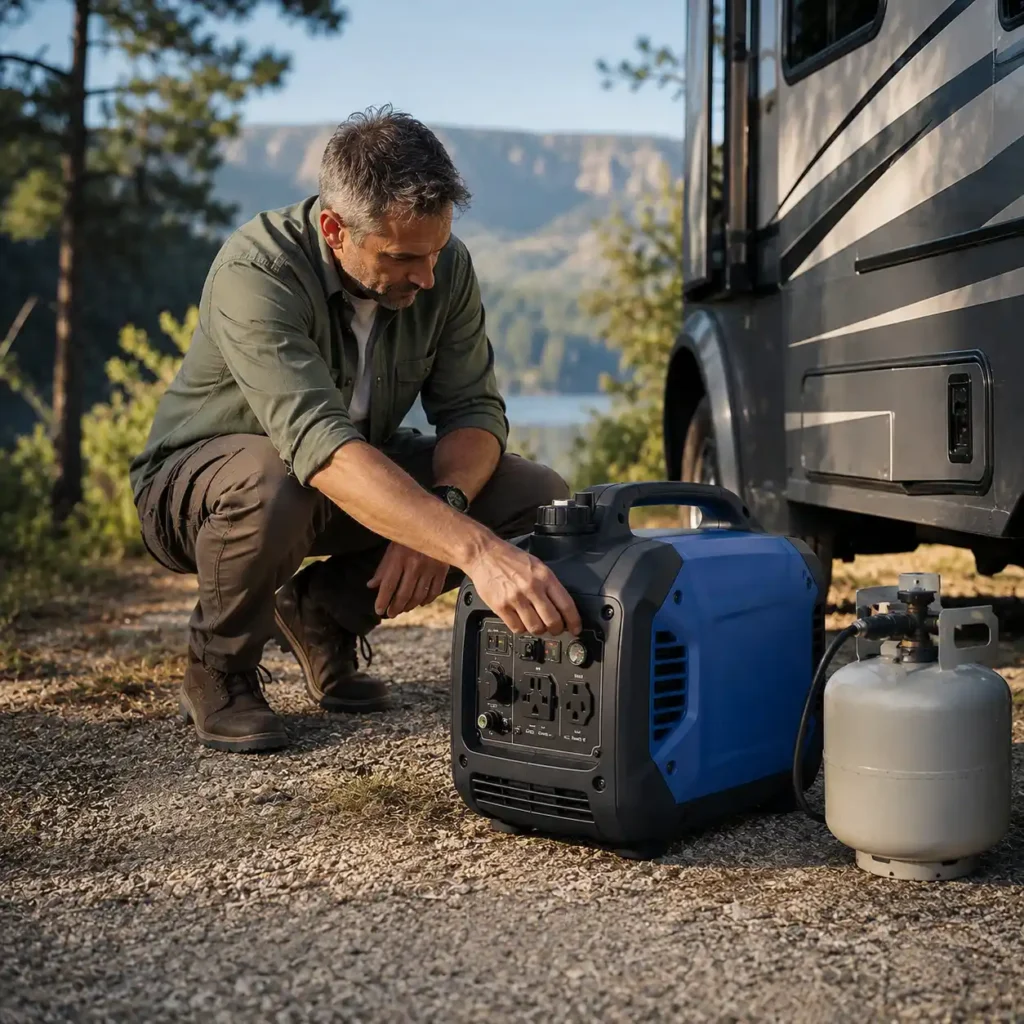
Inverter technology can also influence fuel consumption.
When electrical demand is low, many inverter generators can reduce engine speed rather than continuously operating at full speed. This can lower fuel consumption and noise during lighter loads.
That advantage is particularly relevant for camping and overnight use, when you may only need to power a refrigerator, lights, chargers, or other relatively small loads.
For buyers who expect to operate a generator for many hours at a time, fuel efficiency can ultimately matter more than a small difference in peak wattage. A generator that uses fuel efficiently can reduce operating costs and make extended backup power considerably easier to manage.
The practical takeaway is simple: choose runtime based on your expected load, not the size of the fuel tank alone. A well-matched generator that operates efficiently can provide more useful backup time while reducing both fuel consumption and the frequency of refueling.
Consider Noise Level
Noise is easy to overlook when comparing portable generators online, but it can become one of the most noticeable differences once the generator is actually running.
A generator that sounds acceptable in an open outdoor area may feel completely different when it is operating beside an RV, near a campsite, or outside a home during a nighttime power outage. For many buyers, especially campers and RV owners, noise can be just as important as raw power.
Generator noise is typically measured in decibels (dB or dB(A)). Because the decibel scale is logarithmic, relatively small numerical differences can represent noticeable changes in perceived sound. However, published noise ratings should always be interpreted carefully because manufacturers may measure sound at different distances, loads, and operating conditions.
This is one reason it is better to compare noise figures within the same category rather than assuming that a generator with a slightly lower advertised number will always sound dramatically quieter in every situation.
Why Inverter Generators Are Usually Quieter
Inverter generators have an important advantage when noise matters: many can automatically reduce engine speed when electrical demand is low.
Instead of running continuously at a high engine speed, the generator can adjust its output to match the load. When you are only charging phones, running LED lights, or keeping a small refrigerator operating, this can significantly reduce both engine noise and fuel consumption.
That makes compact inverter generators particularly attractive for camping and other environments where people are physically close to the generator.
The Honda EU2200i is a strong example of this approach, prioritizing quiet operation alongside portability. The WEN 56235i follows a similar philosophy for buyers looking for a more budget-friendly compact inverter generator.
The higher-output Westinghouse iGen4500DFc and Champion 4250-Watt Dual Fuel Open Frame Inverter Generator also use inverter technology, giving buyers substantially more power without automatically moving into the noise profile associated with many traditional open-frame generators.
When Noise Matters Most
The importance of generator noise depends heavily on where and when you plan to use the machine.
For camping and RV travel, noise can affect both your own comfort and the experience of people nearby. Campgrounds may also have specific operating-hour or noise restrictions, so a quieter generator can provide greater practical flexibility.
For home emergency backup, noise becomes particularly noticeable when a generator operates for many hours or overnight. A quieter model can be easier to live with when it is positioned outside a home and running continuously during an extended outage.
For construction, workshop, or other high-demand applications, maximum output may matter more than minimizing noise. In these situations, accepting a louder generator can be a reasonable trade-off for substantially greater power capacity.
This is where the DuroMax XP13000EH occupies a very different position from the compact models in our lineup. Its purpose is primarily high-output home backup, so buyers choosing it should prioritize its power capability and fuel flexibility rather than expecting the quiet operation of a small inverter generator.
Don't Compare Noise Ratings in Isolation
A published noise rating is useful, but it should never be the only factor determining your purchase.
Actual sound levels can change depending on:
- Electrical load
- Distance from the generator
- Engine speed
- Fuel type
- Generator placement
- Surrounding structures
- Ground surface
- Operating mode
A generator operating at a light load may be considerably quieter than the same generator working near its maximum capacity.
Placement also matters. Keeping adequate distance between the generator and occupied areas can make a substantial difference in perceived noise, while walls and other structures may reflect or amplify sound.
The practical rule is straightforward: if you plan to camp, travel in an RV, or operate the generator near living spaces, give noise performance serious consideration. If your primary requirement is powering demanding household loads during a prolonged outage, it may be reasonable to accept additional noise in exchange for the substantially higher output you need.
The best generator is therefore not necessarily the quietest one. It is the model whose noise level is appropriate for the environment in which you expect to use it.
Check Portability and Generator Weight
Portability can mean very different things depending on the generator you choose.
A compact inverter generator may be easy for one person to lift into a vehicle, while a high-output emergency generator may require wheels, handles, and two people to move safely. Choosing between them therefore involves more than simply looking at the generator’s weight.
For camping, tailgating, and frequent travel, weight and physical size can become daily considerations. A generator that is technically portable but difficult to lift may quickly become inconvenient if you need to load and unload it regularly.
By contrast, a generator intended primarily for home backup may spend most of its life in one storage location. In that situation, higher weight may be an acceptable trade-off for substantially greater power output and longer operating capability.
Match Generator Size to How Often You Move It
The Honda EU2200i and WEN 56235i are designed around portability. Their relatively compact form factors make them practical for camping, tailgating, road trips, and situations where the generator needs to be moved frequently.
The Westinghouse iGen4500DFc and Champion 4250-Watt Dual Fuel Open Frame Inverter Generator occupy a larger middle ground. They provide considerably more output than compact 2,000-watt-class generators, but their additional size and weight make them better suited to RV travel, home backup, or situations where the generator does not need to be carried long distances by hand.
The DuroMax XP13000EH is in an entirely different category. At roughly 248 pounds, it is not a generator you would choose because it is easy to carry. Its portability comes primarily from features such as wheels and handles that allow it to be positioned around a property when necessary.
This distinction is important: portable does not always mean lightweight. A large generator can still be considered portable if it is designed to be moved using wheels and handles rather than permanently installed.
Think About Storage as Well as Transportation
Weight isn’t the only portability consideration.
Before buying a generator, think about where you will store it when it isn’t running. Larger models require considerably more floor space and may be difficult to move through narrow doors, garages, or storage areas.
You should also consider how the generator will reach its operating location. If you plan to use it for home backup, determine whether you can safely move it from storage to an appropriate outdoor operating position. If you are buying for RV travel, make sure the generator can be loaded into your vehicle or trailer without creating an impractical lifting requirement.
For frequent camping trips, a smaller generator may be worth choosing even if it provides less power simply because it is easier to transport and deploy. For emergency home backup, however, accepting additional weight can make sense when the extra capacity allows you to operate appliances that smaller generators cannot support.
The best approach is to think about how often you will physically move the generator, not simply whether the product is technically classified as portable.
A generator that matches your transportation and storage capabilities will be much easier to use consistently—and that practical advantage can matter just as much as another few hundred watts of advertised output.
Check RV Compatibility
If you plan to use a portable generator with an RV or travel trailer, power output is only part of the equation. The generator also needs to work with your RV’s electrical system, including its outlet configuration, available wattage, and the appliances you expect to run.
An RV air conditioner is often the deciding factor. Unlike phones, lighting, and small electronics, an air conditioner can create a substantial starting load and continue drawing significant power while operating. A generator that is perfectly adequate for basic camping may therefore be unable to start or continuously run an RV air conditioner.
This is why RV buyers should evaluate running watts, starting watts, outlet configuration, and RV-ready connectivity together rather than choosing a generator based on wattage alone.
What Does “RV-Ready” Actually Mean?
An RV-ready generator typically includes a dedicated connection designed to work with common RV electrical systems. This can make connecting the generator considerably simpler than relying on adapters or improvised cable configurations.
However, “RV-ready” does not automatically mean that every RV appliance can be powered.
Before choosing a generator, identify the electrical requirements of your RV and determine which appliances you expect to operate simultaneously. An RV with a small air conditioner, refrigerator, lights, and basic electronics may have very different requirements from a larger motorhome with multiple high-demand appliances.
The Champion 4250-Watt Dual Fuel Open Frame Inverter Generator is particularly well suited to RV users because it combines inverter technology, dual-fuel operation, and RV-ready functionality with substantially more output than compact portable generators.
The Westinghouse iGen4500DFc is another strong option for RV travel, particularly for buyers who want a higher-output inverter generator with dual-fuel flexibility while still maintaining a relatively portable design.
Don't Forget Starting Power
RV air conditioners and other motor-driven appliances can require significantly more power when they start than they consume once they are running.
This makes starting watts especially important for RV applications.
A generator may have enough continuous output to run an air conditioner after startup but still fail when the compressor initially engages. If you plan to operate an RV air conditioner, check both the generator’s running and peak output specifications and compare them with the appliance’s actual requirements.
It is also worth considering what else will be running at the same time. A refrigerator, microwave, coffee maker, battery charger, and air conditioner can quickly create a much larger combined load than any one appliance suggests.
For this reason, RV owners should avoid sizing a generator around the air conditioner alone. Leave enough capacity for the other essential equipment you expect to use simultaneously.
Which of Our Generators Makes Sense for RV Use?
The five models in our guide are not equally suited to RV travel.
The Champion 4250-Watt Dual Fuel Open Frame Inverter Generator is our strongest choice specifically for RV applications because its output and RV-ready design provide a practical combination for travel trailers and motorhomes.
The Westinghouse iGen4500DFc is also highly versatile, particularly for RV owners who want to combine recreational use with emergency home backup.
The Honda EU2200i can be useful for smaller RV setups and lower-demand equipment, but its lower output means buyers need to be more selective about which appliances operate simultaneously.
The WEN 56235i is similarly better suited to lighter RV loads rather than demanding air-conditioning setups.
The DuroMax XP13000EH provides more than enough output for many RV applications, but its substantial size and weight make it a much less practical choice when portability is a major priority.
The key is to match the generator to the actual electrical system and appliances in your RV, rather than assuming that a higher wattage rating automatically makes one model the better RV generator.
Home Backup Capability

A portable generator can be an effective home backup solution, but not every model is designed to support the same household loads. The right choice depends on which appliances you consider essential and whether you want to power a few critical devices or several high-demand appliances at the same time.
During a short outage, many households only need to keep a refrigerator, freezer, lights, Wi-Fi equipment, and a few essential electronics running. A smaller portable generator may be sufficient for this type of emergency backup.
Longer outages create different requirements. If you also want to operate a sump pump, well pump, microwave, portable air conditioner, or other high-demand equipment, the generator needs considerably more continuous and starting capacity.
This is why homeowners should define their essential loads before choosing a generator. Trying to power every appliance in the house can quickly turn a portable generator into an unnecessarily large, expensive, and fuel-intensive system.
Match the Generator to Your Essential Loads
A practical home-backup setup usually starts with the appliances that would cause the greatest disruption if they lost power.
For many households, these include:
- Refrigerator and freezer
- Sump pump
- Wi-Fi router and modem
- Essential lighting
- Television or communication equipment
- Medical or other essential electronics
- Microwave or other occasionally used appliances
Once these loads are identified, add their running wattage and account for the highest starting demand among motor-driven appliances.
The WEN 56235i and Honda EU2200i are better suited to lighter emergency loads where portability is more important than running several large appliances simultaneously.
The Westinghouse iGen4500DFc provides a useful middle ground for homeowners who want substantially more capacity while retaining inverter technology and dual-fuel flexibility. It can also serve RV users, making it a versatile option for buyers who want one generator for multiple purposes.
The Champion 4250-Watt Dual Fuel Open Frame Inverter Generator is particularly useful when a home backup setup requires more power than a compact 2,000-watt-class generator can provide. Its additional capacity also makes it well suited to RV applications.
At the other end of the range, the DuroMax XP13000EH is designed for substantially heavier household loads. Its high output makes it appropriate for situations where multiple demanding appliances need to operate during an extended outage.
Portable Backup Is Not the Same as Whole-House Backup
It is important to distinguish between portable home backup and a permanently installed whole-house backup system.
A portable generator normally powers selected appliances or circuits through an appropriate connection and operating setup. It is not automatically capable of supplying every circuit in a home simply because its peak wattage appears high.
The number and type of appliances you can operate simultaneously will always depend on the generator’s continuous output, starting capacity, electrical configuration, and the way the generator is connected to the home.
For homeowners who need to support only essential loads, a properly sized portable generator can be a practical and cost-effective solution. Those who expect to operate an entire home—including multiple large HVAC systems, electric water heaters, ovens, or other high-demand equipment—may need a substantially different backup-power system.
The important takeaway is simple: choose a portable generator around the essential loads you actually need during an outage, rather than trying to reproduce normal household electricity consumption. This usually results in a more manageable generator, lower fuel consumption, and a backup system that is easier to operate when you need it most.
Common Portable Generator Buying Mistakes
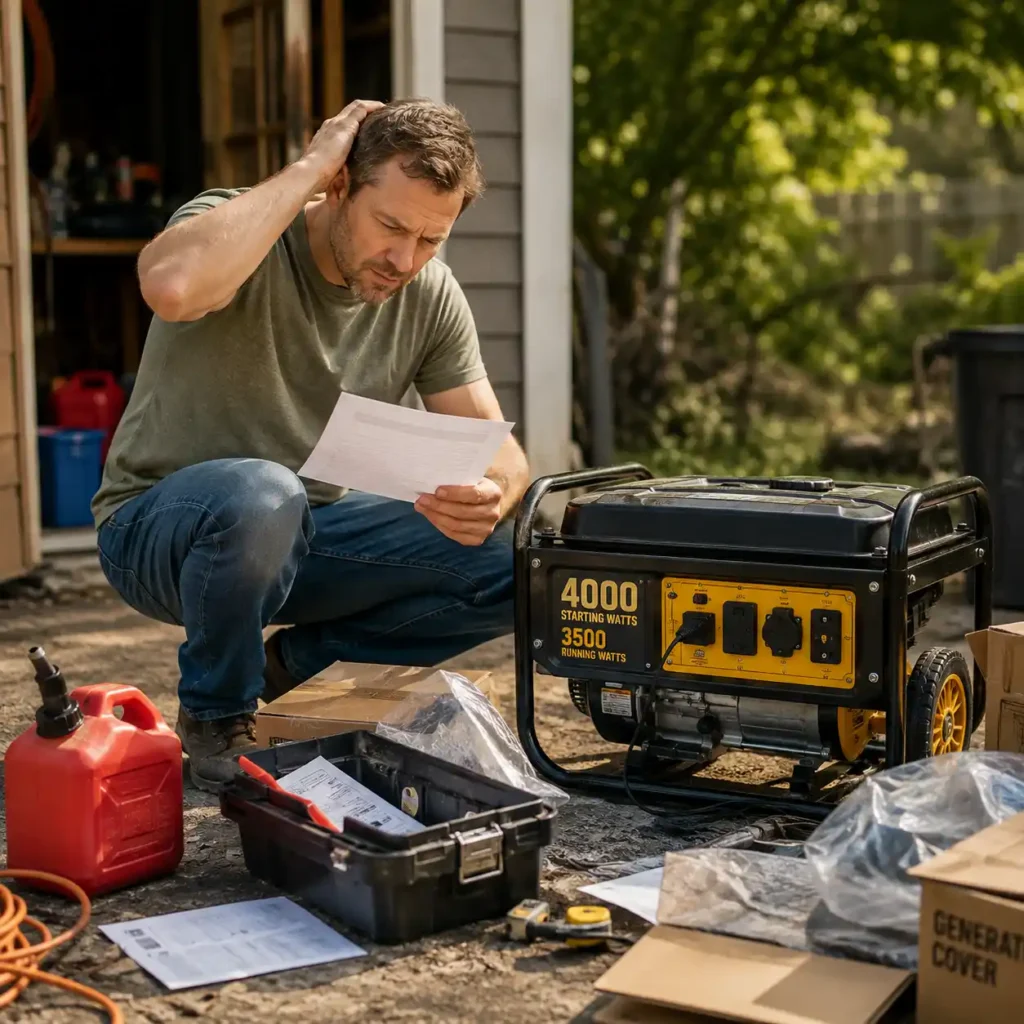
Most portable generator problems come from choosing a generator that does not match the way it will actually be used. A few common mistakes can lead to higher fuel costs, insufficient power, or a generator that is difficult to operate when you need it most.
Choosing by peak watts alone. A high starting-watt figure does not mean the generator can continuously support the same load. Always compare running watts with the appliances you expect to power.
Ignoring startup demands. Refrigerators, pumps, air conditioners, and other motor-driven appliances can require substantially more power when they start. A generator must have enough starting capacity for these temporary surges.
Buying more generator than you need. An oversized model usually costs more, takes up more space, and may consume more fuel than necessary. Extra capacity is useful, but there is little benefit in paying for output you will rarely use.
Underestimating portability. A generator that is easy to move on paper may become impractical if you need to lift it into an RV or vehicle regularly. Consider weight, wheels, handles, and storage space before buying.
Forgetting about fuel flexibility. If the generator is intended for emergency preparedness, relying on a single fuel source may limit your options during a prolonged outage. Dual-fuel capability can provide useful flexibility, particularly for home backup.
The best way to avoid these mistakes is to start with your actual appliances, expected load, and intended use. Choose the generator around your real requirements, then leave a reasonable margin for startup demands and future needs.
Quick Buyer Checklist
Before choosing a portable generator, make sure the model you’re considering matches your actual power needs and how you plan to use it.
A good portable generator should answer yes to most of these questions:
- Can it handle the combined running watts of the appliances you need to power?
- Does it have enough starting watts for refrigerators, pumps, air conditioners, and other motor-driven equipment?
- Is the fuel type practical for your situation, and would dual-fuel flexibility be useful?
- Is the generator’s noise level appropriate for camping, RV use, or residential backup?
- Can you realistically move and store it where you plan to use it?
- If you need RV power, does it have the appropriate RV-ready connection and capacity?
- If you’re preparing for outages, does it provide enough runtime and fuel flexibility for your expected use?
- If you’ll power sensitive electronics, is inverter technology appropriate for your equipment?
If you’re unsure between two models, choose the one that provides enough capacity with a reasonable margin, rather than automatically selecting the largest generator.
The goal is not maximum output. It is a generator that can reliably handle your essential loads while remaining practical to operate, transport, and maintain.
Matching a Portable Generator to Your Needs
There isn’t a single portable generator that is ideal for every buyer. The best choice depends on the appliances you need to power, where you plan to use the generator, and how much portability matters.
For camping, tailgating, and light portable use, a compact inverter generator such as the Honda EU2200i or WEN 56235i makes the most sense. These models prioritize portability, lower noise, and efficient operation rather than maximum output.
For RV travel and versatile backup, the Westinghouse iGen4500DFc offers a useful balance of output, inverter technology, and dual-fuel flexibility. It is a practical choice for buyers who want one generator that can serve both recreational and emergency purposes.
For higher-demand RV use and moderate home backup, the Champion 4250-Watt Dual Fuel Open Frame Inverter Generator provides more capacity while retaining inverter technology and dual-fuel capability.
For demanding home emergency backup, the DuroMax XP13000EH belongs to a different class. Its substantially higher output is better suited to households that need to operate several high-demand appliances during an outage.
The key is to choose according to the job, not the headline wattage. A smaller generator can be the better investment when portability and quiet operation matter, while a larger model becomes worthwhile when your essential loads require substantially more continuous and starting power.
Our Expert Buying Tips
After evaluating portable generators for different outdoor and emergency applications, one principle stands out: buy for your most common use case, while leaving enough capacity for realistic future needs.
For camping and frequent travel, prioritize portability, low noise, and fuel efficiency over maximum output. A compact inverter generator is usually more practical than carrying a large generator that you rarely need at full capacity.
For home backup, focus first on your essential appliances and their starting requirements. A generator with reasonable wattage headroom is a better choice than one that operates continuously near its maximum output.
If you expect to use the generator in different situations, dual-fuel capability can add useful flexibility. Gasoline can provide maximum output, while propane gives you another fuel option during longer outages or when gasoline availability is limited.
Finally, don’t overlook the practical details: make sure you have a safe outdoor operating location, adequate ventilation, appropriate fuel storage, and a realistic way to move and store the generator.
The best portable generator is not the biggest or most powerful model. It is the one that provides the power you actually need while remaining practical enough that you will be comfortable using it whenever an outage, trip, or other situation requires backup electricity.
Frequently Asked Questions
What size portable generator do I need?
The right generator size depends on the appliances you want to run at the same time. Add their running watts, then account for the largest starting-watt demand from a motor-driven appliance such as a refrigerator, pump, or air conditioner. Choose a generator with enough capacity to handle both requirements without operating continuously at its limit.
How many watts does a portable generator need to run a house?
There is no single wattage that works for every home. A portable generator powering essential loads such as a refrigerator, freezer, lights, router, and sump pump may require several thousand watts, while powering many additional high-demand appliances requires substantially more capacity. The correct size depends on which household loads you consider essential and which appliances need to operate simultaneously.
Can a 2,000-watt generator run a refrigerator?
Yes, a 2,000-watt-class generator can typically run a refrigerator, provided its starting surge is within the generator’s capacity and other connected loads remain limited. Because refrigerator compressors require additional power when starting, you should check both the generator’s running and starting watt ratings before relying on it for backup.
Can a portable generator run an RV air conditioner?
It depends on the air conditioner’s running and starting requirements. A 2,000-watt generator is generally too small for many RV air conditioners, while 3,000–4,000 watts or more may be appropriate for some single-AC RV setups. Always compare the generator’s output with the specific air conditioner’s startup demand rather than relying only on the RV’s amp rating.
What size generator do I need for a 30-amp RV?
Many 30-amp RVs with a single rooftop air conditioner fall into the roughly 3,000–4,000-watt generator range, but the exact requirement depends on the air conditioner and other appliances you plan to operate simultaneously. A generator must have enough starting capacity for the largest motor load as well as sufficient running watts for the combined load.
Is an inverter generator better than a conventional generator?
Neither type is universally better. Inverter generators are usually preferable for camping, RV travel, and sensitive electronics because they tend to be quieter, more fuel-efficient at lighter loads, and provide stable electrical output. Conventional generators can make more sense when maximum power and lower upfront cost are more important than portability and noise.
Is a dual-fuel portable generator worth it?
For emergency preparedness, RV travel, and extended outages, dual-fuel capability can be valuable because it allows you to use either gasoline or propane. Gasoline generally provides the generator’s highest output, while propane gives you another fuel option when gasoline availability or long-term storage is a concern.
How long can a portable generator run continuously?
Runtime depends on the generator, fuel capacity, fuel type, electrical load, and manufacturer operating requirements. A generator powering a light load can run considerably longer between refueling stops than the same model operating near maximum capacity. For extended outages, follow the manufacturer’s instructions for refueling, cooling, oil checks, and maximum operating intervals rather than assuming the advertised tank runtime applies to every load.
How much fuel does a portable generator use?
Fuel consumption varies significantly with generator size, fuel type, engine efficiency, and electrical load. A generator typically consumes more fuel as the connected load increases, so an oversized generator operating inefficiently at a light load may not provide the best fuel economy for smaller backup requirements.
Can a portable generator power a whole house?
Some high-output portable generators can support a substantial number of household circuits, but they do not automatically power an entire home simply because they have a high wattage rating. The generator must have sufficient output, the home must have an appropriate connection method such as a properly installed transfer switch or inlet, and the connected circuits must remain within the generator’s capacity.
Can I connect a portable generator directly to my house?
A portable generator should not be connected to a home’s electrical system through an improvised connection. If you want to power household circuits, use an appropriate generator inlet and transfer-switch setup installed according to local electrical requirements. This prevents dangerous backfeeding into the utility system and provides a safer way to distribute generator power.
How far should a portable generator be from the house?
Portable generators should be operated outdoors and positioned well away from the house, doors, windows, and other openings to reduce carbon monoxide exposure. Follow the generator manufacturer’s placement instructions and current local safety guidance rather than operating the unit in a garage, enclosed patio, or other partially enclosed space
Are portable generators safe for sensitive electronics?
Inverter generators are generally a good choice for sensitive electronics because their inverter systems produce stable electrical output. However, you should still follow the requirements of the specific equipment you plan to connect and verify the generator’s electrical specifications before use.
Final Verdict
The best portable generator is not necessarily the model with the highest wattage or the largest fuel tank. The right choice depends on what you need to power, how often you will move the generator, which fuel options you prefer, and whether your priority is camping, RV travel, or emergency home backup.
For most buyers looking for a versatile portable generator, the Westinghouse iGen4500DFc remains our Best Overall recommendation. It offers a strong balance of inverter technology, useful power output, dual-fuel flexibility, portability, and versatility for both recreational use and emergency backup.
For camping, tailgating, and lightweight portable power, the Honda EU2200i is our preferred choice. Its compact design, quiet inverter operation, and dependable performance make it particularly well suited to buyers who prioritize portability and low noise over maximum output.
For buyers who want an affordable compact inverter generator, the WEN 56235i provides a practical alternative. It is best suited to lighter loads and users who want a portable generator without paying for substantially more capacity than they need.
For RV travel and higher-demand portable power, the Champion 4250–stands out for its combination of output, inverter technology, dual-fuel capability, and RV-ready functionality. It offers substantially more capacity than compact 2,000-watt-class generators while remaining more practical for travel than the largest home-backup models.
For demanding home emergency backup, the DuroMax XP13000EH is the strongest choice in our lineup. Its substantially higher output makes it appropriate for households that need to operate multiple high-demand appliances during an outage. The trade-off is its considerable size and weight, which make it much less practical for frequent transport or recreational use.
Ultimately, choosing the right portable generator means matching the generator to your actual electrical loads and intended use rather than simply buying the most powerful model available. A properly sized generator should provide enough running and starting capacity, reasonable fuel flexibility, and enough practical portability for the environment in which you plan to use it.
Based on our evaluation, these five generators cover the most important camping, RV, portable, and emergency home-backup use cases without forcing every buyer into the same solution. The best generator for you is the one that provides the power you genuinely need while remaining practical to operate, transport, refuel, and store.
Our Recommendation
This guide reflects our current evaluation of the portable generator market as of August 2026. We revisit this article regularly to account for new models, discontinued products, and meaningful changes to manufacturer specifications.
We do not list fixed prices because portable generator pricing can change frequently. Instead, readers can check the current product price and availability before making a purchase.
Our recommendations are based on manufacturer specifications, generator capabilities, practical use cases, and real-world user feedback. We do not select a model simply because it offers the highest output or the most features.
If a generator in our lineup is replaced by a better option or no longer represents a strong choice for its intended use, we update the guide accordingly.
Have a portable generator question this guide didn’t answer, or a model you’d like us to evaluate? Contact us or leave a comment, and we’ll take a look.
Related Guides
Choosing the right portable generator is only one part of building a reliable backup power setup. Depending on your needs, you may also need a portable power station, solar charging system, or a larger whole-home backup solution.
The guides below cover the next steps:
Best Portable Power Stations (2026) — Compare battery-powered systems for camping, RV travel, emergency backup, and longer-duration portable power.
Best Whole House Backup Power Systems (2026) — Explore larger backup solutions designed to keep essential household circuits and major appliances running during extended outages.
Best Solar Generators (2026) — Compare battery-based power systems with solar charging for portable, emergency, and off-grid applications.
Best Solar Charge Controllers (2026) — Learn how charge controllers work and how to choose the right system for managing solar power safely and efficiently.
How to Prepare Your Home for a Power Outage — Build a practical backup-power plan by identifying essential appliances, calculating your power requirements, and preparing for extended outages.