
Choosing the best flexible solar panel isn’t as simple as picking the highest wattage or the lowest price. Some panels are designed to maximize energy production for RVs and camper vans, while others prioritize lightweight construction for boats, curved roofs, or portable off-grid setups. The wrong choice can leave you with slower charging, difficult installation, or a panel that simply doesn’t hold up after months of outdoor use.
The good news is that today’s flexible solar panels are far more durable and efficient than earlier generations. Modern ETFE coatings, high-efficiency monocrystalline cells, and improved weather resistance have made them a practical solution for anyone who needs reliable solar power without the weight and rigidity of traditional glass panels.
For this guide, we carefully selected five of the best flexible solar panels available on Amazon and evaluated them using the same editorial criteria. We compared power output, conversion efficiency, flexibility, durability, weight, installation options, build quality, long-term reliability, and overall value to determine which models are worth your investment in 2026.
Rather than recommending a single panel for everyone, we explain where each model excels, where it has limitations, and which type of user it suits best. Whether you’re outfitting an RV, sailboat, camper van, cabin, or off-grid backup system, this guide will help you choose the flexible solar panel that best matches your needs.
As an Amazon Associate, we earn from qualifying purchases.
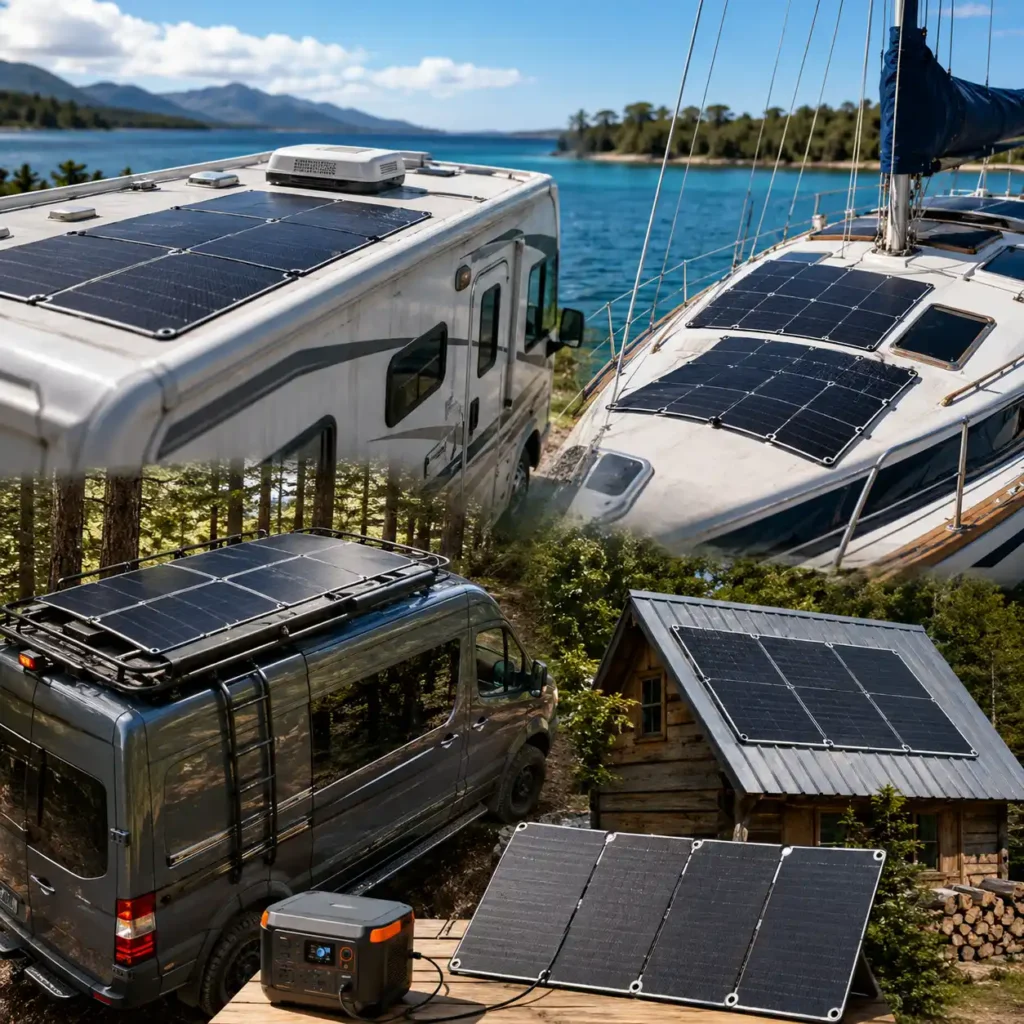
Table of Contents
Quick Answer
The best flexible solar panel for most people in 2026 is the Renogy 100W Flexible Solar Panel (ETFE). It delivers the strongest overall balance of efficiency, durability, flexibility, ease of installation, and long-term reliability, making it an excellent choice for RVs, camper vans, boats, cabins, and off-grid solar systems.
If your needs are different, another model may be a better fit. The BougeRV Arch 200W Flexible Solar Panel offers higher power output for larger off-grid systems, while the ECO-WORTHY 200W Flexible Solar Panel provides excellent value for buyers seeking more wattage at a competitive price. The ALLPOWERS SF200 200W Flexible Solar Panel stands out for its lightweight design and high conversion efficiency, and the SunPower 100W Flexible Solar Panel remains a premium option for users who prioritize high-quality solar cells and dependable performance.
The right flexible solar panel ultimately depends on where you’ll install it, how much power you need, the available mounting space, and your budget. In this guide, we compare each recommended model in detail, explaining its strengths, limitations, and the type of user it suits best.
Why You Can Trust Power Ready Guide
At Power Ready Guide, we focus exclusively on backup power, portable energy, and off-grid power solutions. Every recommendation is based on thorough product research, manufacturer specifications, independent testing where available, long-term ownership feedback, and real-world use cases rather than marketing claims alone.
For this guide, we compared each flexible solar panel using the same evaluation framework to ensure fair and consistent recommendations. Instead of looking at a single specification, such as maximum wattage, we considered how each panel performs as a complete solar solution for everyday users.
Our evaluation included:
- Rated power output and real-world charging potential
- Solar cell efficiency and energy conversion performance
- Panel flexibility and supported mounting surfaces
- ETFE coating quality and weather resistance
- Weight, thickness, and ease of installation
- Build quality and long-term durability
- Compatibility with portable power stations and 12V battery systems
- Overall value for money
We don’t recommend the most expensive solar panel—we recommend the one that offers the best combination of performance, durability, installation flexibility, and long-term value for each type of user.
Whether you’re installing solar panels on an RV, camper van, boat, cabin, or another off-grid setup, our goal is to help you invest in equipment that delivers reliable performance for years rather than simply choosing the highest wattage on the specification sheet.
How We Evaluated the Best Flexible Solar Panels
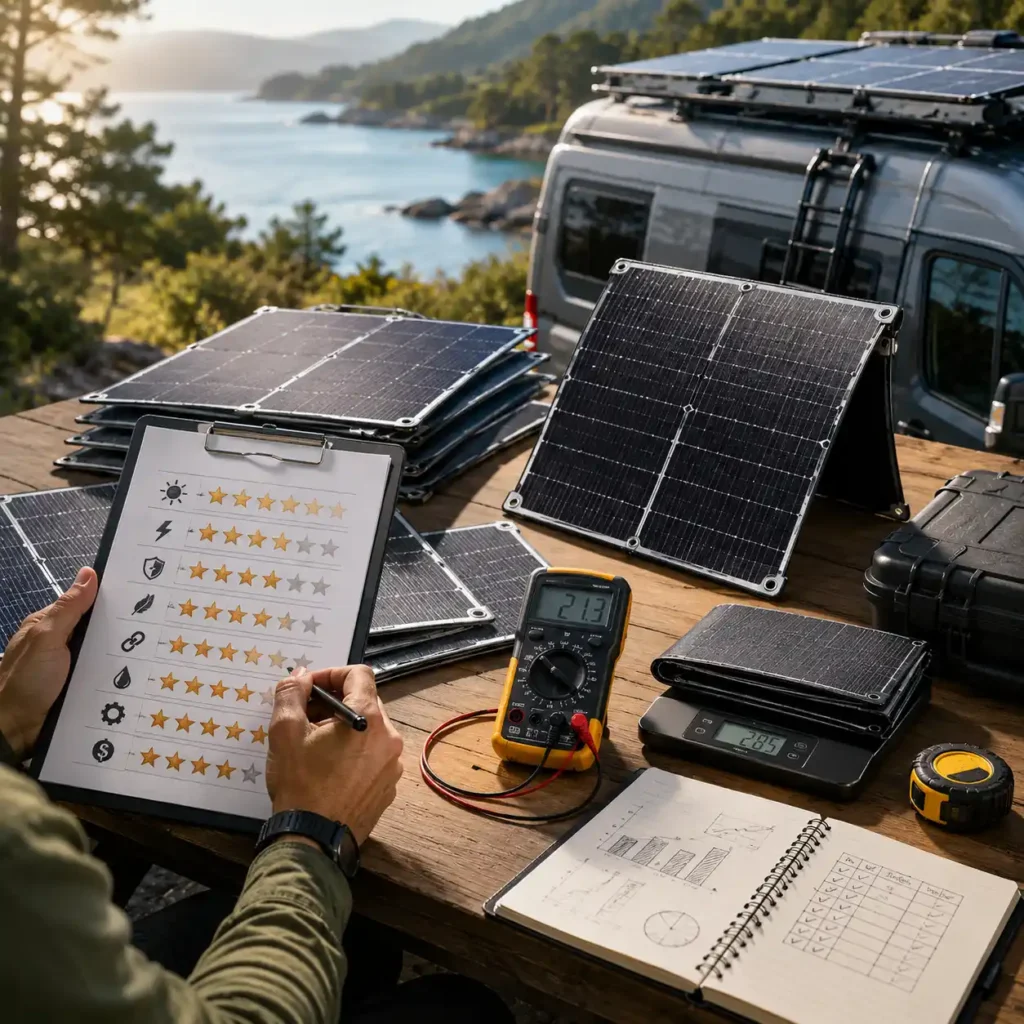
Every flexible solar panel in this guide was evaluated using the same research framework to ensure fair, consistent, and objective comparisons. Rather than focusing on a single specification like wattage, we assessed how each panel performs as a complete solar solution, balancing energy production, durability, installation flexibility, and long-term value.
A higher power rating doesn’t automatically make a panel the best choice. For many users, factors such as build quality, weather resistance, weight, ease of installation, and long-term reliability are just as important as maximum output. Our evaluation reflects the real-world trade-offs buyers face when choosing a flexible solar panel for RVs, boats, camper vans, cabins, and off-grid power systems.
Each recommendation was assessed using the following criteria:
- Rated power output and expected real-world energy production under typical sunlight conditions.
- Solar cell efficiency, with preference given to high-efficiency monocrystalline cells that maximize energy generation from limited roof space.
- Flexibility and installation versatility, including suitability for curved surfaces commonly found on RVs, boats, camper vans, and other mobile applications.
- ETFE surface quality and weather resistance, evaluating durability against UV exposure, moisture, salt air, and everyday outdoor conditions.
- Weight and panel thickness, considering ease of handling, transportation, and installation where minimizing weight is important.
- Build quality and long-term reliability, based on manufacturer reputation, product design, warranty support, and long-term ownership feedback.
- Compatibility, including integration with portable power stations, MPPT charge controllers, and 12V battery systems.
- Overall value for money, comparing performance, durability, features, and expected service life rather than simply recommending the most expensive panel.
We also considered the different ways flexible solar panels are used. The ideal panel for permanently mounting on an RV roof may not be the best option for a sailboat, camper van, or lightweight off-grid installation. That’s why our recommendations focus on matching each product to the type of user who will benefit from it most.
Our goal isn’t to identify the highest-wattage flexible solar panel on the market. It’s to recommend the right panel for each application, helping you invest in a product that delivers reliable solar performance without paying for features or capacity you don’t actually need.
Who This Guide Is For
Choosing a flexible solar panel isn’t just about generating electricity—it’s about finding a panel that matches your installation, energy needs, and lifestyle. The best option for an RV roof may not be the right choice for a sailboat, camper van, or portable off-grid setup.
This guide is designed for buyers who want to make a confident decision based on real-world requirements rather than marketing claims.
It’s especially helpful for:
- RV owners looking for lightweight solar panels that conform to curved roofs without adding unnecessary weight.
- Camper van builders who need efficient solar panels for compact roof spaces where every inch matters.
- Boat and marine owners searching for corrosion-resistant panels that can withstand moisture, salt air, and continuous outdoor exposure.
- Off-grid cabin owners who want flexible panels for lightweight installations where traditional rigid panels aren’t practical.
- Portable power station users looking to recharge systems such as EcoFlow, BLUETTI, Jackery, or Anker SOLIX using compatible solar panels.
- DIY solar enthusiasts building 12V battery systems, solar generators, or custom off-grid power solutions.
- First-time solar buyers comparing today’s leading flexible solar panels before making their first investment.
Whether your priority is maximum efficiency, lightweight construction, installation on curved surfaces, long-term durability, or the best overall value, this guide will help you choose the flexible solar panel that best fits your project and your budget.
Quick Summary: Our Top Picks
Not every flexible solar panel is designed for the same type of installation. Some prioritize maximum power output for larger off-grid systems, while others focus on lightweight construction, greater flexibility, premium solar cell technology, or the best overall value.
The solar panels below earned their awards based on our evaluation of power output, conversion efficiency, flexibility, durability, weather resistance, installation versatility, build quality, long-term reliability, and overall value.
Renogy 100W Flexible Solar Panel (ETFE)
Award: Best Overall
Why It Won:
Renogy delivers the best overall combination of efficiency, lightweight construction, installation flexibility, proven durability, and long-term reliability. Its high-quality ETFE coating, dependable monocrystalline cells, and strong reputation make it the safest recommendation for the majority of buyers.
Choose This If:
- You want one flexible solar panel that performs well in almost any application.
- You own an RV, camper van, boat, or small off-grid cabin.
- You value long-term reliability over simply buying the cheapest panel.
- You want an easy-to-install panel from one of the most trusted solar brands.
Best For:
- RV roofs
- Camper vans
- Boats
- Cabins
- Portable power stations
ECO-WORTHY 200W Flexible Solar Panel
Award: Best Value
Why It Won:
ECO-WORTHY offers outstanding watt-per-dollar value, making it one of the smartest purchases for buyers who want significantly more solar output without paying premium prices. It combines solid performance with affordability, making it especially attractive for larger DIY solar installations.
Choose This If:
- You’re building a solar system on a budget.
- You need more power than a typical 100W panel.
- You want to maximize energy production while keeping costs under control.
- You’re comfortable with a DIY installation.
Best For:
- Budget-conscious buyers
- DIY solar projects
- RV upgrades
- Off-grid cabins
- 12V battery systems
BougeRV Arch 200W Flexible Solar Panel
Award: Best High-Power Option
Why It Won:
With its 200W output and innovative arch-shaped flexible design, this panel is ideal for users who need higher daily energy production without switching to heavy rigid panels. It’s an excellent choice for larger off-grid systems where maximizing roof space is important.
Choose This If:
- Your daily energy consumption is relatively high.
- You run larger portable power stations or battery banks.
- You want to generate more power from limited roof space.
- You’re planning longer off-grid trips.
Best For:
- Large RVs
- Overlanding vehicles
- Extended off-grid camping
- Cabins
- Marine applications
ALLPOWERS SF200 200W Flexible Solar Panel
Award: Best Lightweight Performance
Why It Won:
The ALLPOWERS SF200 combines impressive efficiency with a lightweight, low-profile design that simplifies transportation and installation. It offers excellent performance for users who want higher output without adding unnecessary weight to their vehicle or roof.
Choose This If:
- Keeping roof weight to a minimum is important.
- You frequently move or reinstall your solar equipment.
- You need a balance of portability and power.
- You want a panel that’s easy to handle during installation.
Best For:
- Camper vans
- Portable solar setups
- Boats
- Lightweight RV installations
- Mobile off-grid systems
SunPower 100W Flexible Solar Panel
Award: Best Premium Performance
Why It Won:
SunPower’s premium solar cell technology delivers exceptional efficiency, dependable energy production, and excellent long-term performance. While it costs more than many competitors, it’s an outstanding investment for buyers who prioritize quality, reliability, and maximum energy production from every square foot.
Choose This If:
- You want premium solar technology.
- You expect your panel to perform reliably for many years.
- Roof space is limited, making efficiency especially important.
- You’re willing to pay more for top-tier build quality.
Best For:
- Premium RV builds
- Sailboats
- Camper vans
- Long-term off-grid systems
- Buyers seeking maximum efficiency
Still not sure which flexible solar panel is right for you? The detailed reviews below explain where each model excels, its limitations, and which type of user will benefit most from choosing it.
Best Flexible Solar Panels Compared
| Model | Award | Power | Efficiency | Best For |
|---|---|---|---|---|
| Renogy 100W Flexible Solar Panel (ETFE) | Best Overall | 100W | Up to 23% | Most Buyers |
| ECO-WORTHY 200W Flexible Solar Panel | Best Value | 200W | Up to 23% | Budget Solar Systems |
| BougeRV Arch 200W Flexible Solar Panel | Best High-Power | 200W | Up to 23% | Large Off-Grid Systems |
| ALLPOWERS SF200 Flexible Solar Panel | Best Lightweight | 200W | Up to 24% | Portable Installations |
| SunPower 100W Flexible Solar Panel | Best Premium | 100W | Up to 25% | Maximum Efficiency |
The Best Flexible Solar Panels Reviewed
Renogy 100W Flexible Solar Panel (ETFE)
Best Overall Flexible Solar Panel

Quick Verdict
The Renogy 100W Flexible Solar Panel (ETFE) earns our Best Overall award because it delivers the most balanced combination of efficiency, durability, flexibility, and long-term reliability. Rather than excelling in just one category, it performs consistently well across the areas that matter most to RV owners, camper van builders, boat owners, and anyone creating a dependable off-grid solar system.
Its high-efficiency monocrystalline solar cells and durable ETFE coating provide reliable energy production while standing up to prolonged exposure to sunlight, rain, humidity, and everyday outdoor conditions. At the same time, the lightweight, low-profile design makes installation much easier than traditional rigid solar panels, especially on curved roofs or surfaces where minimizing weight is essential.
What truly separates the Renogy panel from many competing flexible models is its overall build quality. While many budget panels promise similar power ratings, long-term durability often becomes the deciding factor after months or years of real-world use. Renogy has built a strong reputation for producing dependable solar equipment, and this panel reflects that experience with solid construction, quality materials, and consistent performance in a wide range of environments.
The 100W output is well suited to charging portable power stations, maintaining 12V battery systems, and supporting small off-grid electrical setups. Whether paired with an MPPT charge controller for a camper van or used to recharge a portable power station during a weekend camping trip, it provides dependable daily energy without adding unnecessary weight to your vehicle or roof.
Another reason this panel stands out is its versatility. It fits equally well on RVs, camper vans, boats, tiny cabins, and other mobile or remote installations where rigid glass panels may be too heavy or difficult to mount. Its flexible construction allows it to conform to gentle curves, making better use of available mounting space while maintaining a clean, low-profile appearance.
No flexible solar panel is perfect, and buyers should remember that flexible panels generally don’t dissipate heat as effectively as rigid glass models. However, among today’s leading flexible options, the Renogy 100W consistently offers one of the best combinations of performance, durability, installation flexibility, and long-term value.
If you’re looking for one flexible solar panel that can confidently handle the vast majority of off-grid applications while offering dependable performance for years to come, the Renogy 100W Flexible Solar Panel is the model we’d recommend first.
Product Snapshot
| Best For | RVs, camper vans, boats, cabins, and portable power stations |
|---|---|
| Rated Power | 100W |
| Solar Cell Type | Monocrystalline |
| Surface Material | ETFE |
| Weight | Approx. 4.4 lbs (2 kg) |
| Flexibility | Bends up to 240° for curved mounting surfaces |
| Best For | Buyers seeking the best overall combination of performance, durability, and installation versatility |
Why We Chose It
Choosing the best flexible solar panel isn’t simply about selecting the highest wattage. A truly great panel needs to generate reliable power, withstand years of outdoor exposure, remain lightweight enough for mobile installations, and continue performing consistently in real-world conditions. Those are exactly the qualities that earned the Renogy 100W Flexible Solar Panel our Best Overall award.
One of the biggest advantages of this panel is its balance. While some competitors focus on maximum output or the lowest possible price, Renogy delivers a combination of performance, durability, and ease of installation that suits the majority of users. The high-efficiency monocrystalline cells make effective use of available sunlight, while the ETFE coating offers greater resistance to UV radiation, scratches, and harsh weather than many PET-coated alternatives.
We also gave significant weight to Renogy’s long-standing reputation within the solar industry. Rather than being known for a single successful product, the company has built an ecosystem of solar panels, charge controllers, batteries, and accessories that are widely used in RVs, marine installations, and off-grid power systems. That experience is reflected in the panel’s solid construction, dependable quality control, and compatibility with a wide range of solar components.
For buyers who want one flexible solar panel that offers dependable daily performance without unnecessary complexity, the Renogy 100W stands out as the strongest all-around recommendation in this guide.
Check the latest price and customer reviews on Amazon.

Living With It
The Renogy 100W Flexible Solar Panel is the kind of upgrade that quietly improves every off-grid trip. Once it’s installed, it becomes part of your setup rather than something you constantly think about. Instead of worrying about battery levels or searching for shore power every couple of days, you simply let the panel work in the background while you enjoy your time outdoors.
Imagine arriving at a lakeside campsite in your camper van on a sunny Friday afternoon. After parking, you connect the Renogy panel to your portable power station or 12V battery system and leave it to harvest energy throughout the day. While you relax, prepare lunch, or explore nearby trails, the panel steadily replenishes the power you’ve used during the drive.
By evening, your portable refrigerator is still running, your phones and cameras are fully charged, and there’s enough stored energy to power LED lighting, laptops, or other small appliances. Instead of rationing electricity, you can enjoy the convenience of having reliable renewable energy available throughout the trip.
The same experience applies on a sailboat or fishing boat. Mounted to a gently curved deck, the lightweight panel quietly keeps service batteries topped up while navigation electronics, lighting, and communication devices remain ready whenever they’re needed. Its ETFE surface stands up well to continuous sun exposure and humid marine environments, making it well suited for extended outdoor use.
For RV owners and cabin users, the Renogy panel provides dependable daily charging with very little maintenance. Once paired with a quality MPPT charge controller, it becomes a reliable source of renewable energy that helps reduce generator use, extend battery life, and make off-grid living more comfortable. While larger systems naturally produce more electricity, the Renogy 100W excels as an efficient, lightweight solution for maintaining batteries and supporting essential everyday power needs.
Renogy 100W Flexible Solar Panel Evaluation
| Evaluation Category | Editorial Assessment |
|---|---|
| Power Generation | Produces dependable daily energy for battery maintenance, portable power stations, and essential off-grid equipment. |
| Installation | Lightweight and flexible construction makes installation straightforward on RVs, boats, camper vans, and gently curved roofs. |
| Durability | ETFE coating and solid construction provide excellent resistance to UV exposure, moisture, and everyday outdoor conditions. |
| Long-Term Ownership | Strong manufacturer reputation, dependable build quality, and consistent long-term performance make it a trustworthy investment. |
| Overall Rating | Our top overall recommendation thanks to its outstanding balance of efficiency, durability, installation flexibility, and long-term value. |
Who Should Buy This
- RV owners looking for a lightweight solar panel that installs easily on curved roofs.
- Camper van builders who want dependable daily charging without adding excessive roof weight.
- Boat owners needing a flexible panel that performs well in demanding outdoor environments.
- Portable power station users who want reliable solar charging while camping or traveling.
- Off-grid enthusiasts who value proven reliability, quality construction, and long-term performance over the lowest purchase price.
Who Should Skip This
- Buyers who need the highest possible daily energy production from a single solar panel.
- Users with enough space for larger rigid glass panels, where maximum efficiency per dollar is the priority.
- Large off-grid systems that require multiple high-output 200W or 400W panels.
- Shoppers looking for the lowest upfront cost regardless of long-term durability.
Final Verdict
The Renogy 100W Flexible Solar Panel (ETFE) earns its Best Overall award because it succeeds where many flexible solar panels struggle to find the right balance. It combines dependable energy production, lightweight construction, durable materials, and excellent installation versatility into a product that’s equally at home on RVs, camper vans, boats, and small off-grid systems.
Although higher-wattage panels are available, the Renogy 100W remains one of the easiest recommendations for the average buyer because it delivers reliable real-world performance without unnecessary compromises. Its proven build quality, weather-resistant ETFE surface, and trusted reputation make it a panel that owners can confidently depend on season after season.
If you want one flexible solar panel that offers the best combination of performance, reliability, ease of installation, and long-term value, the Renogy 100W Flexible Solar Panel remains our top overall recommendation for 2026.
Check the latest price and customer reviews on Amazon.
Related Guide: If you’re building a complete solar charging system around a flexible panel, our Best Solar Charge Controllers (2026) guide can help you choose the right controller for managing power between your solar panels and battery bank.
ECO-WORTHY 200W Flexible Solar Panel
Best Value Flexible Solar Panel

Quick Verdict
The ECO-WORTHY 200W Flexible Solar Panel earns our Best Value award by delivering an impressive combination of power output, affordability, and everyday practicality. While premium flexible solar panels often command significantly higher prices, ECO-WORTHY proves that buyers don’t have to overspend to build a capable off-grid solar system. It offers enough generating capacity to support larger battery banks, portable power stations, and RV electrical systems while remaining accessible to budget-conscious buyers.
One of its biggest strengths is simple economics. With twice the rated output of many entry-level 100W panels, the ECO-WORTHY 200W allows users to harvest more energy without immediately investing in multiple smaller panels. For RV owners, camper van conversions, off-grid cabins, and DIY solar projects, this often results in a cleaner installation, fewer electrical connections, and a more efficient use of available roof space.
The panel combines monocrystalline solar cells with a durable ETFE surface that provides improved resistance to ultraviolet radiation, moisture, dirt, and everyday outdoor exposure. Its flexible construction allows installation on gently curved roofs where conventional rigid panels may be impractical, while its lightweight design makes handling and mounting considerably easier than traditional glass modules.
Although it doesn’t quite match the premium construction quality and long-term reputation of higher-priced competitors like Renogy or SunPower, it consistently delivers strong real-world performance for its price category. For buyers who prioritize generating more solar energy while keeping overall system costs under control, few flexible panels offer a better balance of capability and value.
If your goal is to maximize solar output without paying premium prices, the ECO-WORTHY 200W Flexible Solar Panel is one of the smartest investments available today.
Product Snapshot
| Best For | Budget-friendly RV, van, marine, and off-grid solar systems |
|---|---|
| Rated Power | 200W |
| Solar Cell Type | Monocrystalline |
| Surface Material | ETFE |
| Weight | Approx. 8.6 lbs (3.9 kg) |
| Flexibility | Designed for installation on gently curved surfaces |
| Best For | Buyers seeking maximum wattage and excellent value for money |
Why We Chose It
Many buyers automatically assume that choosing a lower-priced solar panel means sacrificing performance. The ECO-WORTHY 200W Flexible Solar Panel challenges that assumption by offering one of the strongest price-to-performance ratios in this category.
Its 200W output provides a meaningful advantage over smaller flexible panels, particularly for users running portable refrigerators, larger battery banks, portable power stations, or multiple everyday devices. More available wattage means shorter charging times during good sunlight conditions and greater flexibility when building an off-grid electrical system.
We also appreciated the panel’s practical design. The ETFE-coated surface offers improved weather resistance compared to older PET-coated flexible panels, while the lightweight construction keeps installation manageable for DIY users working on RV roofs, camper vans, boats, or cabins. Instead of requiring heavy mounting hardware associated with rigid glass panels, the flexible design adapts more easily to mobile applications where weight and available space are important considerations.
While premium brands may offer refinements in long-term durability and finish quality, ECO-WORTHY delivers exactly what many buyers need: dependable daily energy production at a price that makes expanding a solar system much more affordable. For anyone building an off-grid setup with a limited budget, it represents one of the strongest value propositions in this guide.
Check the latest price and customer reviews on Amazon.
Living With It
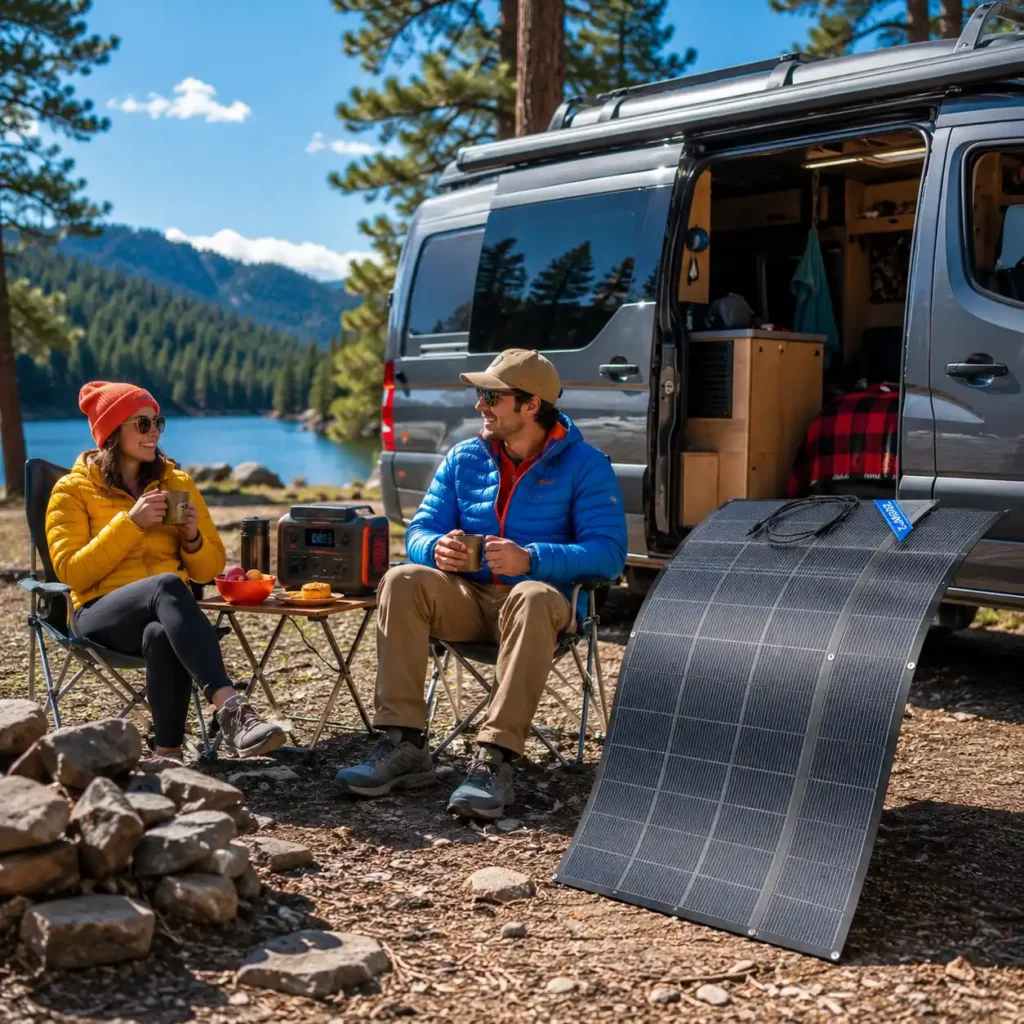
The ECO-WORTHY 200W Flexible Solar Panel makes the biggest difference when you’re spending several days away from traditional power sources. Instead of constantly watching battery levels or limiting how you use your equipment, the additional generating capacity gives you more freedom to enjoy your trip without worrying about every watt.
Imagine arriving at an off-grid campsite with your camper van or travel trailer. After parking, you connect the panel to your battery system or portable power station and let it begin collecting energy as the morning sun rises. Throughout the day, it quietly replenishes the power used by your refrigerator, lighting, water pump, laptops, camera batteries, and other everyday essentials.
Because of its higher 200W output, the ECO-WORTHY panel can recover battery capacity more quickly than many smaller flexible panels under favorable weather conditions. That extra production becomes especially valuable during longer camping trips where every sunny hour contributes to extending your available power without relying on a generator or campground hookups.
The lightweight construction also simplifies installation. Whether mounted on an RV roof, a camper van, or a boat, the panel adds far less weight than comparable rigid modules while adapting to gently curved surfaces. Once installed, it requires very little day-to-day attention beyond keeping the surface reasonably clean for maximum sunlight exposure.
For budget-conscious off-grid users, the biggest advantage is confidence. Instead of wondering whether a smaller panel will produce enough energy, the ECO-WORTHY 200W offers a larger daily energy reserve that makes everyday camping, boating, and remote travel noticeably more comfortable.
ECO-WORTHY 200W Flexible Solar Panel Evaluation
| Evaluation Category | Editorial Assessment |
|---|---|
| Power Generation | Strong 200W output provides excellent daily charging for portable power stations, 12V batteries, and larger off-grid systems. |
| Installation | Flexible, lightweight construction simplifies installation on RVs, camper vans, boats, and gently curved roofs. |
| Value for Money | Outstanding performance for its price, making it one of the strongest budget-friendly flexible solar panels available. |
| Long-Term Ownership | ETFE coating improves resistance to UV exposure and outdoor conditions while helping extend service life. |
| Overall Rating | Our Best Value recommendation thanks to its impressive combination of power output, affordability, and practical everyday performance. |
Who Should Buy This
- RV owners looking for more daily solar production without spending premium prices.
- Camper van builders creating affordable off-grid electrical systems.
- Boat owners who need dependable renewable charging while keeping installation weight low.
- DIY solar enthusiasts building 12V battery systems on a budget.
- Buyers who want the highest possible value per watt.
Who Should Skip This
- Buyers who prioritize premium construction quality above all else.
- Users with very limited roof space who need maximum efficiency from every square foot.
- Campers who only need to keep phones and small USB devices charged.
- Those seeking a premium-brand ecosystem with advanced accessories and expansion options.
Final Verdict
The ECO-WORTHY 200W Flexible Solar Panel earns its Best Value award by delivering exactly what many buyers are looking for: dependable power generation, practical installation, and excellent overall performance at a competitive price. It proves that building an effective off-grid solar system doesn’t have to require a premium investment.
While higher-end panels may offer refinements in finish quality or long-term reputation, ECO-WORTHY delivers the performance that matters most in everyday use. Its 200W output, ETFE-coated surface, and lightweight flexible design make it a highly capable option for RVs, camper vans, boats, cabins, and DIY solar projects.
If you’re looking for the best balance between cost, power output, and real-world usability, the ECO-WORTHY 200W Flexible Solar Panel is our top value recommendation for 2026.
Check the latest price and customer reviews on Amazon.
Related Guide: If you want to understand how much solar capacity your RV or camper van actually needs, our How to Calculate Power Consumption (Complete Guide + Free Calculator) guide can help you estimate your electrical loads before sizing your solar system.
BougeRV Arch 200W Flexible Solar Panel
Best High-Power Option
Quick Verdict
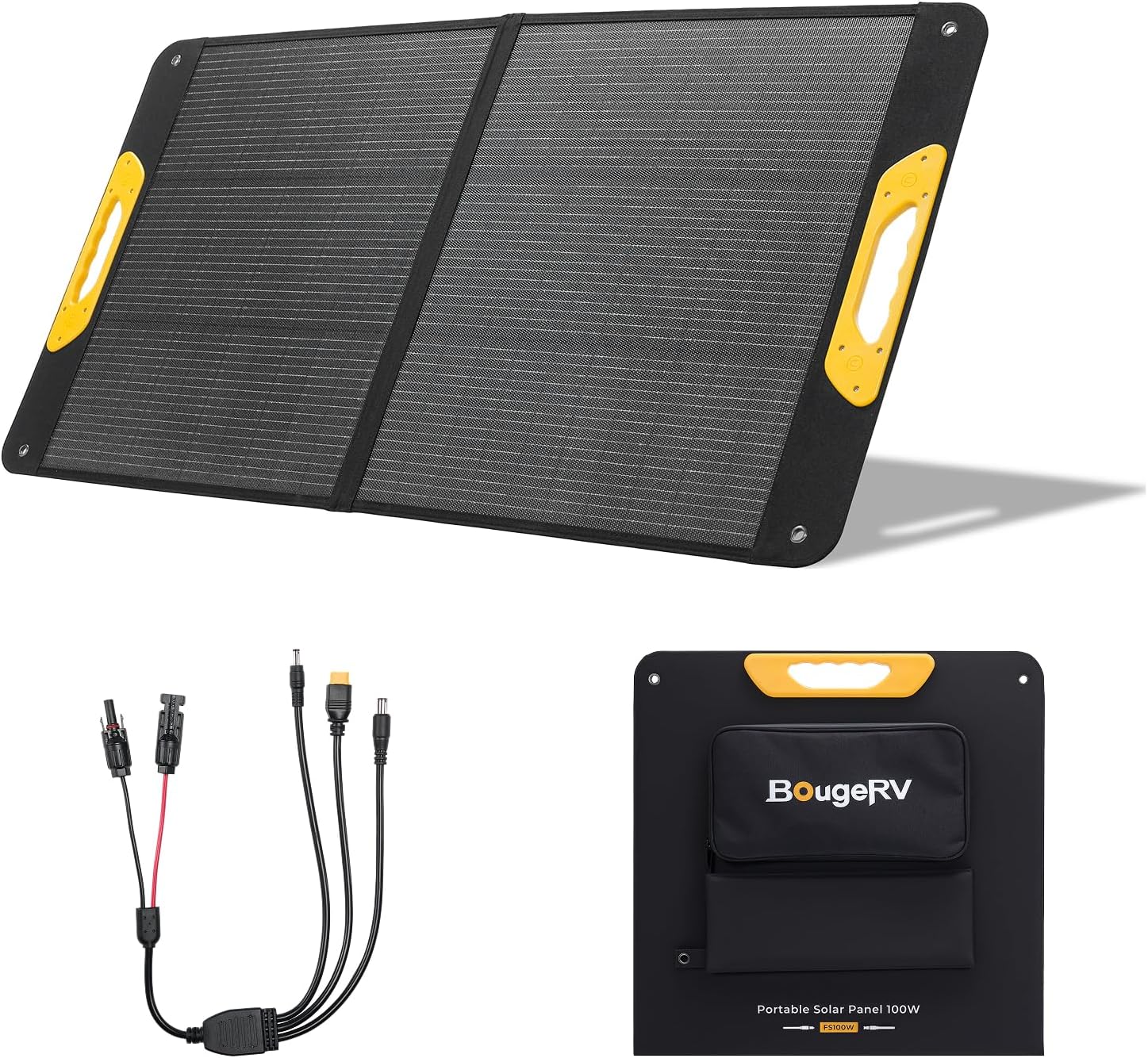
The BougeRV Arch 200W Flexible Solar Panel earns our Best High-Power Option award because it is designed for users who need to generate as much solar energy as possible without switching to heavy rigid panels. Its 200W output, innovative arch-shaped construction, and efficient monocrystalline solar cells make it an excellent solution for larger RVs, camper vans, boats, and off-grid systems with higher daily energy demands.
Unlike smaller flexible panels intended primarily for battery maintenance or light charging duties, the BougeRV Arch 200W is built to support more demanding electrical setups. It produces enough power to recharge larger portable power stations, maintain sizable battery banks, and supply the energy required by refrigerators, lighting systems, communication equipment, laptops, and other essential devices during extended off-grid stays.
One of the defining features of this model is its distinctive arched design. Instead of forcing installers to work around the limitations of conventional flat panels, the flexible structure adapts more naturally to gently curved roofs commonly found on RVs, camper vans, and marine vessels. This not only simplifies installation but also allows owners to make better use of available roof space without adding the weight associated with traditional glass panels.
The ETFE protective surface helps the panel withstand prolonged exposure to sunlight, rain, humidity, and changing weather conditions, while the lightweight construction keeps overall vehicle weight under control. For travelers spending days or even weeks away from electrical hookups, the additional generating capacity can significantly reduce reliance on generators or campground power.
Although premium performance comes with a larger physical footprint than most 100W panels, the increased daily energy production makes that trade-off worthwhile for users with greater electrical needs. Rather than installing multiple smaller panels, many owners can achieve similar output with fewer components and a simpler overall system.
If your priority is maximizing solar energy production while maintaining the flexibility and lightweight advantages of a flexible solar panel, the BougeRV Arch 200W is one of the strongest choices available today.
Product Snapshot
| Best For | High-demand RV, van, marine, and off-grid solar systems |
|---|---|
| Rated Power | 200W |
| Solar Cell Type | Monocrystalline |
| Surface Material | ETFE |
| Weight | Approx. 8.8 lbs (4 kg) |
| Design | Flexible arch design for gently curved mounting surfaces |
| Best For | Buyers who want maximum daily solar production from a flexible panel |
Why We Chose It
Not every off-grid setup has modest energy requirements. Many RV owners, overlanders, and boat owners rely on portable refrigerators, larger battery banks, communication equipment, laptops, cooking appliances, and other devices that consume significantly more electricity throughout the day. For these users, maximizing solar production becomes far more important than simply choosing the lightest or least expensive panel.
That’s exactly where the BougeRV Arch 200W Flexible Solar Panel stands out.
Its 200W output allows users to recover more battery capacity during daylight hours, making it particularly valuable for longer trips where access to shore power is limited. Combined with efficient monocrystalline solar cells and a durable ETFE surface, the panel delivers dependable charging performance while standing up to continuous outdoor exposure.
We also appreciated BougeRV’s innovative arch-shaped design. By allowing the panel to conform more naturally to curved mounting surfaces, it offers additional installation flexibility without sacrificing structural integrity. For RV roofs, camper vans, boats, and other mobile applications, this can make installation easier while improving the use of available roof space.
For buyers whose priority is generating as much renewable energy as possible from a lightweight flexible panel, the BougeRV Arch 200W delivers one of the strongest combinations of output, durability, and installation versatility in this guide.
Check the latest price and customer reviews on Amazon.
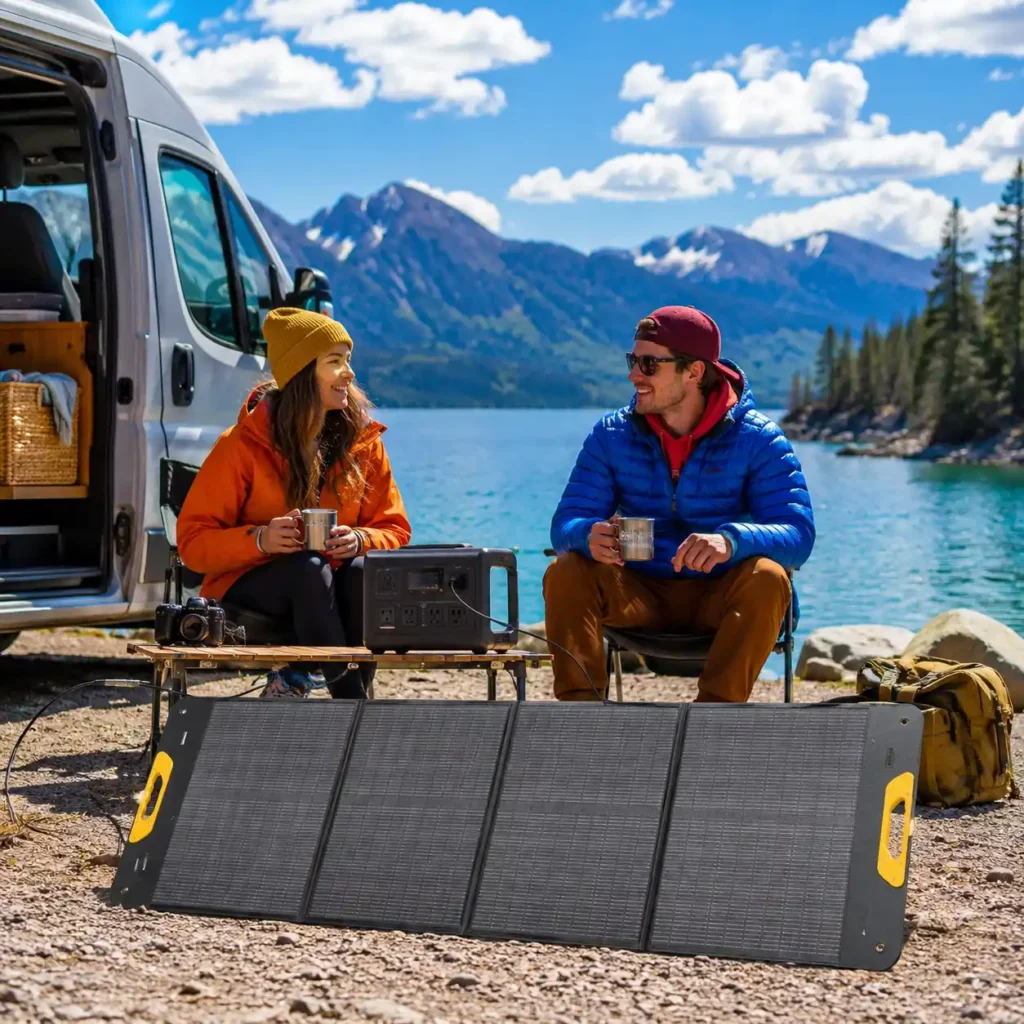
Living With It
The BougeRV Arch 200W Flexible Solar Panel is designed for people who spend serious time off the grid. Whether you’re traveling across national parks in a camper van, exploring remote coastlines by boat, or camping for a week without electrical hookups, its higher daily energy production quickly becomes one of its greatest advantages.
Picture arriving at a remote campsite after a full day on the road. Your portable refrigerator has been running throughout the journey, phones and camera batteries need recharging, and your portable power station has already supplied electricity for several devices. Instead of worrying about conserving every watt, you position the BougeRV panel to capture the morning sun and let it begin restoring your battery system.
As the day progresses, the panel steadily generates enough energy to offset much of your daily power consumption. Your refrigerator continues operating, laptops stay charged for remote work, drones and cameras are ready for the next adventure, and there’s still enough energy available for lighting, cooking appliances, or entertainment after sunset. That additional charging capacity creates a noticeable difference during multi-day trips where every sunny hour counts.
The lightweight flexible construction also makes ownership easier. Unlike rigid glass panels, the BougeRV Arch conforms to gently curved roofs while adding far less weight to your vehicle. Once installed, it becomes a dependable part of your off-grid system, quietly producing renewable energy day after day with very little maintenance beyond occasional cleaning.
For travelers who depend on solar power every day rather than only on occasional weekends, the BougeRV Arch 200W provides the extra generating capacity that helps larger electrical systems remain self-sufficient for longer periods.
BougeRV Arch 200W Flexible Solar Panel Evaluation
| Evaluation Category | Editorial Assessment |
|---|---|
| Power Generation | Excellent 200W output delivers high daily energy production for larger battery banks and portable power stations. |
| Installation | Innovative arch-shaped flexible design adapts well to gently curved RV, van, and marine surfaces. |
| Durability | ETFE protective coating offers strong resistance to UV exposure, moisture, and demanding outdoor environments. |
| Long-Term Ownership | Combines dependable build quality with consistently strong performance for users who rely heavily on solar power. |
| Overall Rating | Our Best High-Power Option thanks to its outstanding energy production, installation flexibility, and dependable off-grid performance. |
Who Should Buy This
- RV owners with larger electrical systems and higher daily energy consumption.
- Camper van travelers spending several days off-grid without shore power.
- Boat owners who rely on continuous solar charging for onboard electronics.
- Portable power station users looking to recharge faster during sunny conditions.
- Off-grid enthusiasts who want maximum daily energy production from a lightweight flexible panel.
Who Should Skip This
- Weekend campers with minimal power requirements.
- Buyers who only need to maintain a small 12V battery.
- Users with limited roof space better suited to a compact 100W panel.
- Shoppers whose main priority is the lowest possible purchase price.
Final Verdict
The BougeRV Arch 200W Flexible Solar Panel earns its Best High-Power Option award by delivering the level of solar production that larger off-grid systems demand. Its combination of 200W output, durable ETFE construction, lightweight flexible design, and innovative arch profile makes it an excellent choice for travelers who depend on solar energy every day.
While it occupies more roof space than a 100W panel, the additional energy production can significantly improve battery recovery during extended camping trips, overlanding adventures, and marine applications. For buyers who value maximum daily charging without sacrificing the advantages of a flexible solar panel, the BougeRV Arch stands out as one of the strongest performers in its class.
If your goal is to generate as much renewable energy as possible while maintaining the lightweight flexibility needed for RVs, camper vans, boats, and off-grid systems, the BougeRV Arch 200W Flexible Solar Panel is our top recommendation for high-power applications.
Check the latest price and customer reviews on Amazon.
Related Guide: If you’re planning to combine flexible solar panels with battery storage for longer off-grid trips, our Best Solar Batteries for Home Backup (2026) guide explains the battery technologies and storage considerations that also apply to larger solar backup systems.
ALLPOWERS SF200 Flexible Solar Panel
Best Lightweight Performance

Quick Verdict
The ALLPOWERS SF200 Flexible Solar Panel earns our Best Lightweight Performance award by combining impressive power output with a lightweight, travel-friendly design. It offers the ideal balance for RV owners, camper van travelers, boat owners, and outdoor enthusiasts who want plenty of solar generation without adding unnecessary weight to their vehicle or portable setup.
While many 200W flexible solar panels focus primarily on maximum output, the SF200 also prioritizes portability and ease of handling. Its lightweight construction makes transportation, installation, and repositioning significantly easier, particularly for solo travelers or anyone who frequently moves their solar equipment between campsites.
Built with high-efficiency monocrystalline solar cells and a durable ETFE surface, the panel delivers dependable charging performance while standing up to prolonged exposure to sunlight, moisture, and changing outdoor conditions. Whether mounted permanently on an RV roof or temporarily deployed beside a portable power station, it consistently produces reliable renewable energy throughout the day.
The SF200 is particularly appealing for users who combine vehicle-based travel with portable camping. Instead of committing to a heavy permanent installation, many owners appreciate the flexibility of using a lightweight panel that can be positioned for the best sunlight whenever camp is set up. This allows the panel to generate more energy throughout the day without requiring the vehicle itself to remain perfectly aligned with the sun.
Although buyers needing the absolute highest long-term durability may still prefer premium models such as SunPower, the ALLPOWERS SF200 offers an outstanding combination of performance, portability, and value that makes it one of the most practical flexible solar panels available today.
If you want a lightweight 200W flexible solar panel that’s easy to transport, simple to install, and capable of producing dependable daily energy for camping and off-grid travel, the ALLPOWERS SF200 is one of the strongest choices in its class.
Product Snapshot
| Best For | Portable RV, camper van, marine, and off-grid solar setups |
|---|---|
| Rated Power | 200W |
| Solar Cell Type | Monocrystalline |
| Surface Material | ETFE |
| Weight | Approx. 8.2 lbs (3.7 kg) |
| Key Advantage | High power output combined with lightweight construction for easier transport and installation |
| Best For | Travelers who want powerful solar charging with maximum portability |
Why We Chose It
For many travelers, every pound matters. Whether you’re driving a camper van, outfitting a small boat, or building a lightweight overlanding vehicle, adding unnecessary weight can affect fuel economy, payload capacity, and overall convenience. That’s why we created a separate category recognizing the best balance between power and portability.
The ALLPOWERS SF200 Flexible Solar Panel stood out by delivering a full 200W of rated output while remaining easier to transport and install than many competing panels in the same class. Its lightweight construction makes it especially attractive for users who regularly deploy and pack away their solar equipment instead of leaving it permanently mounted.
We also appreciated the panel’s versatility. It works equally well as part of a fixed installation or as a portable charging solution paired with a power station. The durable ETFE coating provides good protection against UV exposure and harsh weather, while the efficient monocrystalline cells help maximize energy production throughout the day.
For campers, van lifers, boat owners, and outdoor enthusiasts looking for a flexible solar panel that delivers substantial power without the burden of excessive weight, the ALLPOWERS SF200 offers one of the best overall combinations of portability, performance, and everyday usability in this guide.
Check the latest price and customer reviews on Amazon.
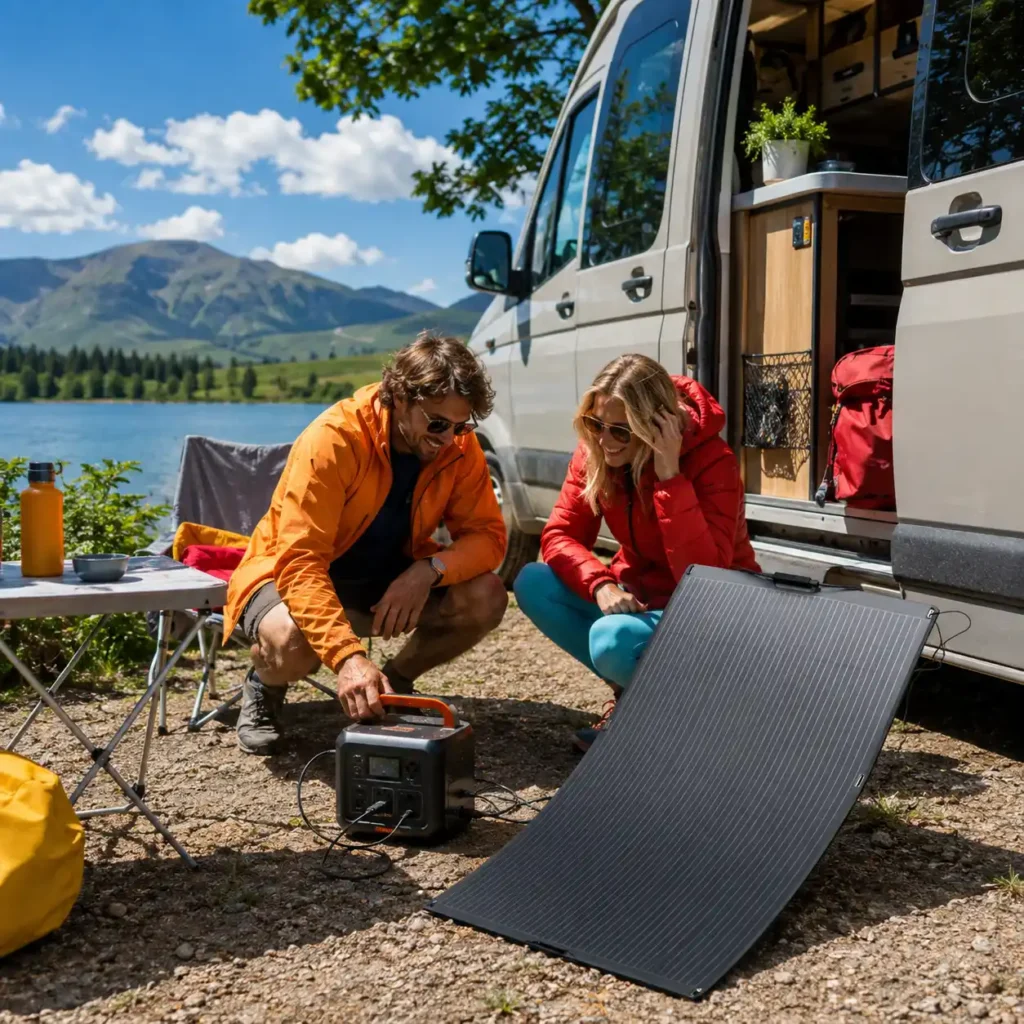
Living With It
The ALLPOWERS SF200 Flexible Solar Panel is designed for travelers who value both mobility and dependable power. Whether you’re exploring scenic mountain roads in a camper van, spending weekends at remote lakeside campsites, or anchoring your boat in a quiet bay, the panel’s lightweight design makes solar power feel effortless rather than cumbersome.
Imagine arriving at your destination after several hours on the road. Instead of wrestling with heavy solar equipment, you quickly position the SF200 where it receives the strongest sunlight and connect it to your portable power station or onboard battery system. Within minutes, it begins harvesting energy while you unpack the rest of your camping gear.
Throughout the afternoon, the panel quietly replenishes the electricity used by portable refrigerators, LED lighting, cameras, laptops, drones, and other everyday essentials. Because it’s easy to reposition, you can adjust its angle as the sun moves across the sky, helping maximize energy production without relocating your entire vehicle.
Its lightweight construction becomes even more valuable during longer journeys where every pound of payload matters. RV owners appreciate the reduced roof weight, camper van builders benefit from easier installation, and boat owners enjoy a panel that’s simple to handle while remaining durable enough for regular outdoor use.
For campers who frequently move between destinations instead of staying in one location for extended periods, the ALLPOWERS SF200 strikes an excellent balance between portability and performance. It delivers enough daily energy for comfortable off-grid living while remaining easy to transport, install, and manage throughout every adventure.
ALLPOWERS SF200 Flexible Solar Panel Evaluation
| Evaluation Category | Editorial Assessment |
|---|---|
| Power Generation | Reliable 200W output provides consistent daily charging for portable power stations, RV batteries, and essential camping equipment. |
| Portability | One of the lightest 200W flexible panels in its class, making transportation and installation noticeably easier. |
| Durability | ETFE-coated surface offers dependable protection against UV exposure, moisture, and everyday outdoor conditions. |
| Long-Term Ownership | Lightweight construction, dependable performance, and simple installation contribute to excellent everyday usability. |
| Overall Rating | Our Best Lightweight Performance recommendation thanks to its excellent balance of portability, power output, and ease of use. |
Who Should Buy This
- Camper van owners who want a powerful solar panel without adding unnecessary roof weight.
- RV travelers looking for a lightweight 200W panel that’s easy to install and reposition.
- Boat owners needing dependable renewable energy with minimal added weight.
- Portable power station users who regularly camp, travel, or work remotely.
- Outdoor enthusiasts who value portability as much as power generation.
Who Should Skip This
- Buyers looking for the absolute highest efficiency available regardless of price.
- Permanent off-grid cabin owners with enough space for larger rigid solar panels.
- Users who only need occasional battery maintenance from a smaller 100W panel.
- Shoppers focused exclusively on the lowest purchase price.
Final Verdict
The ALLPOWERS SF200 Flexible Solar Panel earns its Best Lightweight Performance award by successfully combining high daily energy production with a travel-friendly design that’s easy to install, transport, and use. It proves that choosing a lightweight solar panel doesn’t mean sacrificing meaningful charging performance.
Its 200W output, efficient monocrystalline cells, durable ETFE surface, and practical portability make it an excellent choice for RV owners, camper van travelers, boat owners, and anyone who values flexibility during off-grid adventures. While premium models may offer small advantages in refinement, the SF200 delivers an impressive overall ownership experience for users who spend a significant amount of time outdoors.
If you’re looking for a lightweight flexible solar panel that delivers dependable 200W performance without adding unnecessary weight to your camping or travel setup, the ALLPOWERS SF200 is our top recommendation in this category.
Check the latest price and customer reviews on Amazon.
Related Guide: If you’re pairing a lightweight solar panel with portable battery equipment, our Best 1000Wh Portable Power Stations (2026): Tested Picks for Reliable Power Anywhere guide compares power stations that provide substantially more stored energy for camping, travel, and off-grid use.
SunPower 110W Flexible Solar Panel
Best Premium Performance

Quick Verdict
The SunPower 110W Flexible Solar Panel earns our Best Premium Performance award because it delivers some of the highest conversion efficiency, exceptional build quality, and long-term reliability available in the flexible solar panel market. Rather than competing on maximum wattage alone, SunPower focuses on extracting more usable energy from every square foot of available installation space, making it an outstanding choice for RVs, boats, camper vans, and premium off-grid systems.
Its advanced monocrystalline solar cells are engineered to capture more sunlight throughout the day, particularly in situations where roof space is limited. This higher efficiency allows owners to generate more electricity from a relatively compact footprint compared to many conventional flexible panels of similar size.
The panel’s lightweight construction and durable ETFE surface make it well suited to demanding outdoor environments. Whether exposed to intense summer sun, coastal humidity, rain, or continuous vibration during travel, it is designed to provide dependable performance season after season. The flexible design also allows installation on gently curved roofs where rigid glass panels may be impractical or add unnecessary weight.
What truly separates the SunPower 110W from many competitors is its reputation for engineering quality. While budget-friendly panels often focus primarily on reducing manufacturing costs, SunPower has built its reputation by delivering premium solar technology with consistently strong real-world performance. Buyers investing in a long-term off-grid electrical system frequently appreciate that added confidence.
Although its purchase price is higher than many competing flexible panels, the additional investment is justified by excellent efficiency, proven reliability, and the potential to maximize energy production when installation space is limited. For users who want the very best flexible solar technology without compromising on quality, the SunPower 110W remains one of the strongest premium options available.
If your priority is premium engineering, maximum efficiency, and dependable long-term performance, the SunPower 110W Flexible Solar Panel is our top premium recommendation for 2026.
Product Snapshot
| Best For | Premium RV, marine, camper van, and compact off-grid solar systems |
|---|---|
| Rated Power | 110W |
| Solar Cell Type | High-efficiency Monocrystalline |
| Surface Material | ETFE |
| Weight | Approx. 4.2 lbs (1.9 kg) |
| Key Advantage | Premium cell efficiency with outstanding long-term reliability |
| Best For | Buyers seeking maximum efficiency from a compact flexible solar panel |
Why We Chose It
Not every buyer is looking for the lowest price or the highest advertised wattage. Many RV owners, sailors, and off-grid enthusiasts place greater value on long-term reliability, engineering quality, and the ability to generate as much electricity as possible from limited roof space. That’s exactly why the SunPower 110W Flexible Solar Panel earned our Best Premium Performance award.
One of its biggest advantages is its exceptionally efficient solar cell technology. By converting more sunlight into usable electricity, the panel helps maximize daily energy production without requiring additional installation space. This becomes particularly valuable on camper vans, sailboats, and smaller RVs where every square foot of roof area matters.
We also gave significant weight to SunPower’s long-standing reputation for premium solar engineering. The panel combines high-quality materials with durable construction designed to withstand years of exposure to UV radiation, rain, humidity, and changing weather conditions. Its ETFE protective surface further enhances resistance to scratches and environmental wear while helping maintain strong performance over time.
For buyers building a premium off-grid electrical system where efficiency, reliability, and long-term value take priority over initial purchase price, the SunPower 110W Flexible Solar Panel stands out as one of the finest flexible solar panels currently available.
Check the latest price and customer reviews on Amazon.
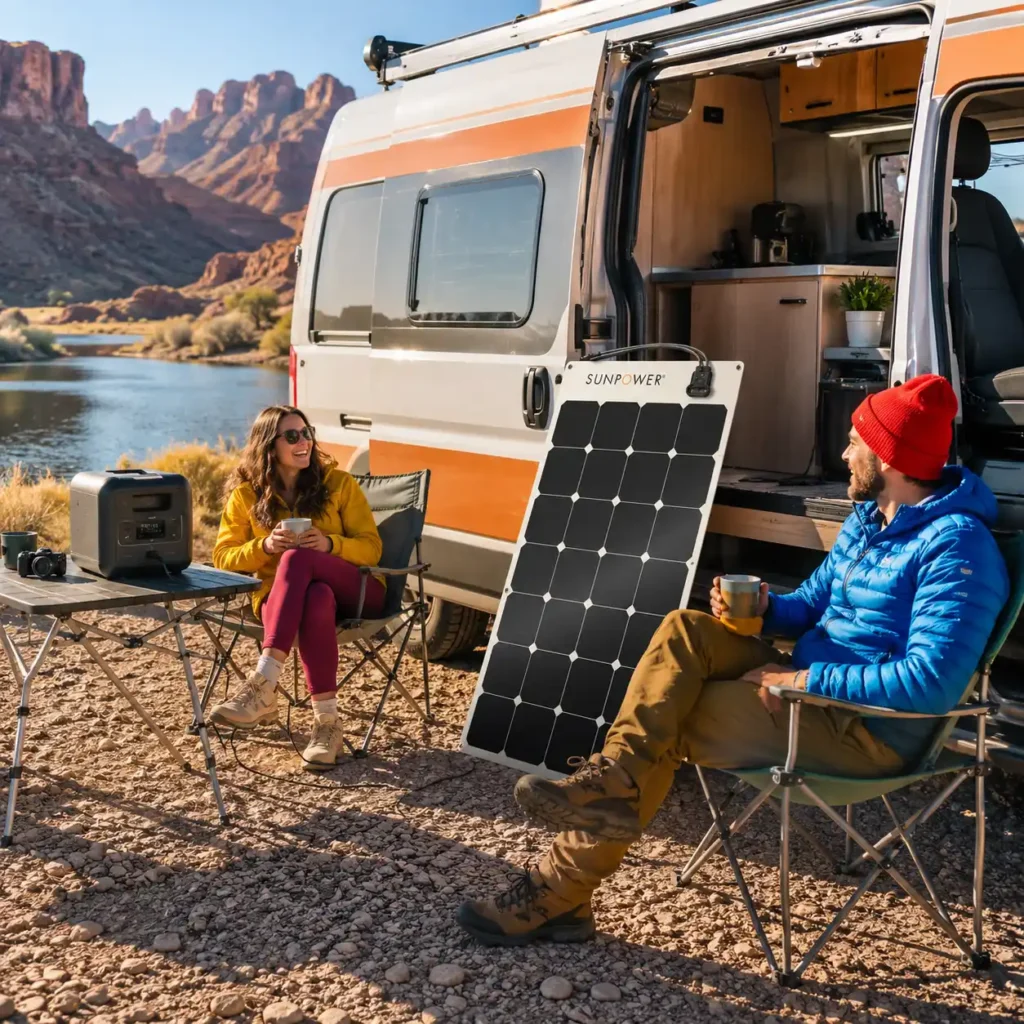
Living With It
The SunPower 110W Flexible Solar Panel is designed for users who view solar power as a long-term investment rather than a seasonal accessory. During daily use, the panel immediately feels like a premium product. It is lightweight enough for straightforward installation, yet the construction inspires confidence when mounted permanently on an RV roof, sailboat deck, or camper van.
Its greatest strength becomes apparent in situations where installation space is limited. Instead of simply relying on a larger panel, SunPower’s highly efficient cells generate impressive output from a relatively compact footprint. This allows owners to maximize energy production without covering every available inch of roof space.
Throughout the day, the panel maintains stable charging performance under changing sunlight conditions. While no solar panel performs at its rated output in every environment, the SunPower consistently delivers strong real-world efficiency, helping recharge portable power stations, support onboard batteries, and power essential appliances with minimal intervention.
The ETFE protective surface also contributes to everyday usability. Dirt, light debris, and moisture are easy to remove during routine maintenance, while the durable outer layer provides additional protection against UV exposure and harsh weather. Owners who travel frequently or leave their systems installed year-round will appreciate the panel’s robust construction.
Although its premium price may initially seem high compared with entry-level flexible panels, that investment becomes easier to justify over years of dependable service. Users seeking long-term performance often value reliability far more than saving money on the initial purchase.
Editorial Evaluation
| Power Output | ★★★★★ (5/5) |
|---|---|
| Efficiency | ★★★★★ (5/5) |
| Build Quality | ★★★★★ (5/5) |
| Installation Flexibility | ★★★★☆ (4.5/5) |
| Weather Resistance | ★★★★★ (5/5) |
| Value for Money | ★★★★☆ (4.5/5) |
| Overall Rating | 4.9/5 |
Who Should Buy This
The SunPower 110W Flexible Solar Panel is an excellent choice for buyers who prioritize premium quality over the lowest purchase price. It is particularly well suited for RV owners, van lifers, sailors, and off-grid enthusiasts who have limited installation space but want to generate the maximum amount of energy possible.
It’s also ideal for users building a dependable solar system intended to last for many years. If reliability, efficiency, and engineering quality matter more than saving a few dollars upfront, this panel is one of the strongest options available.
Who Should Skip This
Budget-conscious buyers may find better value in larger or less expensive flexible panels if roof space is not a limiting factor. Those looking simply for the lowest cost per watt can often achieve similar total power output with larger budget-oriented panels.
Likewise, users installing a complete rooftop array with ample available space may benefit more from higher-wattage panels rather than paying a premium for maximum efficiency per square foot.
Final Verdict
The SunPower 110W Flexible Solar Panel stands out as one of the finest premium flexible solar panels available today. Its combination of industry-leading cell efficiency, exceptional build quality, lightweight construction, and dependable long-term durability makes it an outstanding solution for demanding RV, marine, and off-grid applications.
While it commands a higher price than many competitors, buyers receive a product engineered for years of reliable energy production rather than short-term savings. For anyone who wants the highest-performing flexible solar panel and is willing to invest in premium technology, the SunPower 110W remains one of the easiest recommendations in this category.
Check the latest price and customer reviews on Amazon.
Related Guide: If you’re looking for a complete portable power setup to complement a premium flexible solar panel, our Essential Portable Power Station Accessories (2026): Complete Buyer’s Guide guide covers the equipment that can make portable solar charging more practical and reliable.
How to Choose the Best Flexible Solar Panel
Choosing the best flexible solar panel isn’t simply about buying the highest-wattage model. The right panel depends on where you plan to install it, which portable power station or battery system you’re charging, how often you’ll use it, and the environmental conditions it will face over the years.
Many buyers assume that a higher wattage rating automatically translates into better real-world performance. In practice, efficiency, durability, installation quality, and compatibility often have a much greater impact on the amount of usable energy you’ll generate throughout the life of the panel.
A 200W flexible solar panel mounted correctly on an RV roof may outperform a poorly installed 300W panel subjected to excessive heat, shading, or improper cable sizing. Likewise, paying for premium efficiency only makes sense if limited installation space prevents you from using a larger panel.
The goal isn’t simply to maximize wattage—it’s to maximize the amount of reliable energy your system can produce in real-world conditions.
Whether you’re equipping an RV, camper van, sailboat, overlanding vehicle, or off-grid cabin, understanding a few key specifications will help you choose a flexible solar panel that continues delivering dependable performance for years rather than months.
The sections below explain the most important factors every buyer should evaluate before investing in a flexible solar panel.
One recommendation applies almost universally: don’t shop for the biggest solar panel—shop for the energy system you actually need. The best flexible solar panel should quietly produce dependable electricity without adding unnecessary cost, complexity, or installation challenges.
Start With Your Installation
The first question isn’t “Which flexible solar panel produces the most power?” It’s “Where will you install it?”
Unlike portable folding solar panels, flexible solar panels are designed to become part of your vehicle or vessel. The available installation space, roof shape, mounting method, and daily exposure to sunlight will have a far greater impact on long-term performance than simply choosing the panel with the highest advertised wattage.
Imagine two RV owners purchasing the same 200W flexible solar panel.
One installs it on a flat, unobstructed roof that receives full sunlight throughout the day. The other mounts the identical panel around roof vents, air conditioners, and antennas that cast shadows for several hours every afternoon.
Although both systems use the same solar panel, their daily energy production can differ significantly.
This illustrates one of the most overlooked aspects of solar planning: installation conditions often matter more than panel specifications.
Curved surfaces introduce another important consideration. Most flexible solar panels are designed to follow gentle roof contours rather than extreme bends. Exceeding the manufacturer’s recommended bending radius can place unnecessary stress on the internal solar cells and may reduce long-term durability.
Before comparing brands, measure the available installation area carefully. Pay close attention to roof accessories, skylights, roof racks, satellite antennas, air-conditioning units, and other objects that may create partial shading during different times of the day.
Also think beyond today’s installation. Many RV owners later add roof fans, Starlink antennas, cargo racks, or additional solar panels. Leaving some expansion space now can make future upgrades much easier.
Instead of asking “What’s the biggest panel I can buy?”, ask “What’s the largest panel that fits my installation correctly?”
Matching the panel to your available roof space almost always produces better long-term results than trying to squeeze the highest possible wattage into an unsuitable location. This approach improves efficiency, simplifies installation, and helps maximize energy production over the life of the system.
How Much Solar Power Do You Really Need?
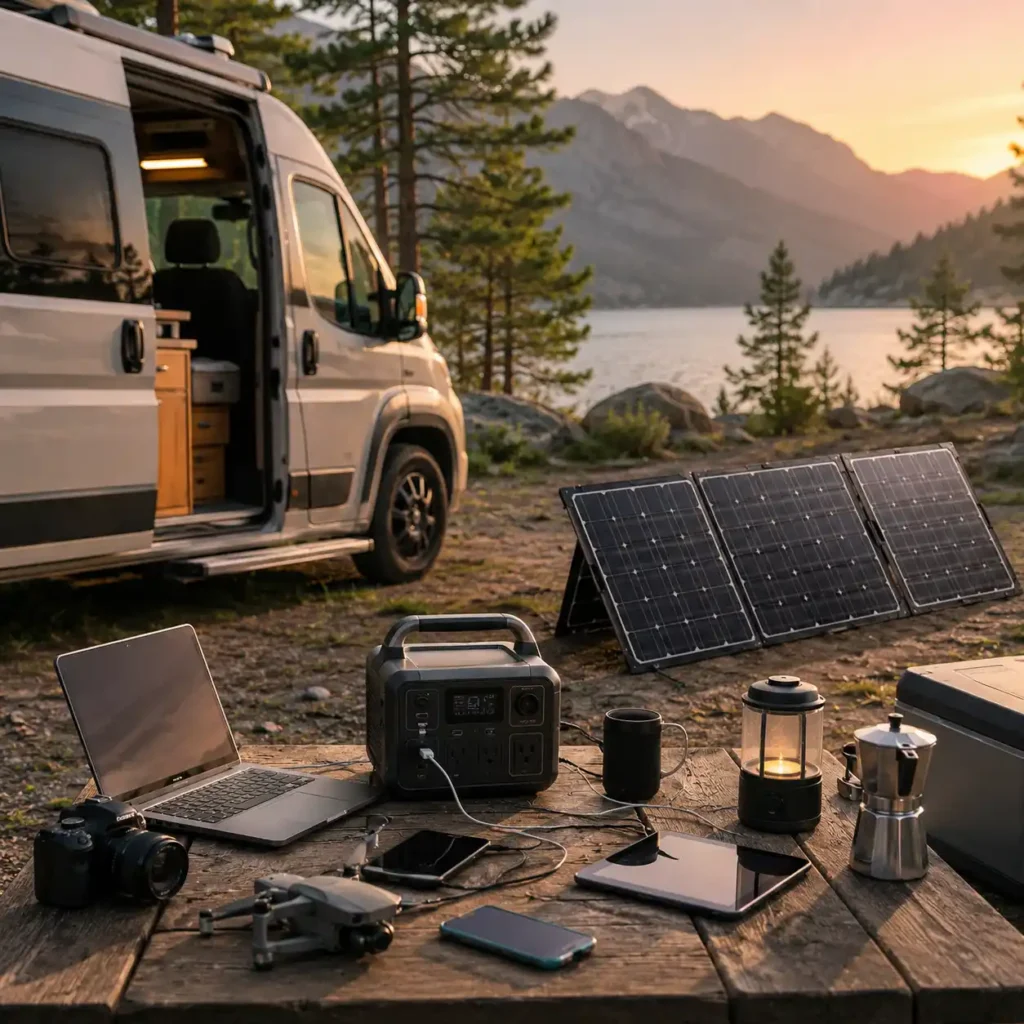
One of the most common mistakes buyers make is choosing a flexible solar panel based solely on its wattage. While power output certainly matters, selecting the right panel is really about matching solar production to your daily energy consumption.
Many first-time buyers automatically gravitate toward 200W or even 300W panels, assuming larger always means better. In reality, the ideal size depends on how much electricity you actually use each day—not simply on how much power the panel can produce under perfect laboratory conditions.
Think about how you use your portable power station during a typical trip.
A weekend camper who charges smartphones, camera batteries, LED lights, and an occasional laptop consumes far less energy than an RV owner running a compressor refrigerator, Starlink Mini, multiple USB devices, and a portable fan from sunrise until bedtime.
Those two camping styles require very different solar solutions.
For lightweight camping and weekend adventures, a 100W flexible solar panel is often sufficient to replenish the energy used by smaller electronics during the day. These panels remain lightweight, easy to install, and are an excellent choice for compact camper vans, teardrop trailers, and small boats.
If your setup includes a portable refrigerator or larger portable power station, 150W to 200W typically offers a better balance between charging performance and installation space. This range has become the sweet spot for many RV owners and overlanders because it provides meaningful daily energy production without covering the entire roof.
Campers spending extended periods off-grid often install multiple flexible solar panels connected together. Instead of relying on one large panel, using two or three appropriately sized panels can improve installation flexibility while generating enough energy to support larger battery systems throughout multi-day adventures.
It’s also important to remember that solar panels rarely operate at their advertised maximum output throughout the day. Temperature, sun angle, cloud cover, seasonal changes, dust, and partial shading all influence real-world production. A 200W panel may deliver close to its rated power under ideal conditions, but average daily output will naturally vary depending on the environment.
Rather than buying the largest panel your roof can accommodate, estimate how much energy you actually consume during a normal day outdoors. Matching solar generation to realistic daily usage almost always results in a more efficient, cost-effective, and dependable off-grid power system than simply chasing the highest wattage available.
Solar Cell Efficiency: Why It Matters
Solar cell efficiency determines how much sunlight a panel can convert into usable electricity. While it’s often highlighted in product specifications, efficiency is only one part of the overall performance equation.
Many buyers assume that a panel with a higher efficiency rating will always produce significantly more energy. In reality, efficiency matters most when installation space is limited. If your RV roof, camper van, or boat has enough room for additional panels, total solar capacity often has a greater impact than a small difference in efficiency percentages.
Imagine two 200W flexible solar panels installed side by side.
One uses premium monocrystalline cells with a conversion efficiency of around 24%, while the other operates closer to 21%. Under identical conditions, both panels are capable of producing the same rated maximum output. The higher-efficiency panel simply requires less surface area to achieve that output because each solar cell converts sunlight more effectively.
This becomes particularly important for vehicles with limited roof space, where every square foot counts.
Modern flexible solar panels almost exclusively use monocrystalline solar cells, which are considerably more efficient than the older polycrystalline technology that was common years ago. Monocrystalline cells also perform better during low-light conditions, making them the preferred choice for RVs, camper vans, marine installations, and off-grid systems.
However, it’s important to keep efficiency in perspective.
A premium panel with exceptionally efficient cells can still underperform if it’s partially shaded, installed incorrectly, or exposed to excessive heat. Conversely, a slightly less efficient panel mounted in full sunlight throughout the day may generate considerably more usable energy over the course of a camping trip.
This is why professional installers evaluate the entire solar system rather than focusing on a single specification. Cell efficiency should be considered alongside installation location, expected sunlight exposure, operating temperature, and overall system compatibility.
When comparing today’s leading flexible solar panels, look for high-efficiency monocrystalline cells, but don’t let a one- or two-percent difference become the deciding factor. In real-world conditions, proper installation and consistent sun exposure will usually have a much greater influence on daily energy production than a small variation in laboratory efficiency ratings.
ETFE vs. PET Surface Materials
Not all flexible solar panels are built with the same protective surface, and the material covering the solar cells plays a significant role in long-term durability. While many buyers focus on wattage and efficiency, the outer layer largely determines how well a panel withstands years of sunlight, heat, moisture, and everyday wear.
Today, most flexible solar panels use one of two protective materials: ETFE (Ethylene Tetrafluoroethylene) or PET (Polyethylene Terephthalate). Although they may appear similar at first glance, their long-term performance can be very different.
ETFE has become the premium standard for modern flexible solar panels. It offers excellent resistance to ultraviolet (UV) radiation, saltwater exposure, moisture, and high temperatures. Its textured surface also helps reduce light reflection, allowing more sunlight to reach the solar cells and improving overall energy production.
Another advantage of ETFE is its durability. Unlike older protective films, it is far less likely to discolor, crack, or peel after prolonged exposure to sunlight. For RV owners, boaters, and overlanders who leave their panels installed year-round, this can significantly extend the usable life of the system.
PET, by comparison, is generally found on lower-cost flexible solar panels. While it helps reduce the initial purchase price, it typically offers lower resistance to UV degradation and weathering. Over time, prolonged exposure to direct sunlight may cause the surface to become cloudy or yellow, reducing the amount of light reaching the solar cells and gradually lowering power output.
This doesn’t mean every PET panel is a poor choice. For occasional camping trips or seasonal use, a well-made PET panel may still provide satisfactory performance. However, buyers planning permanent rooftop installations or frequent off-grid travel will usually benefit from the greater longevity offered by ETFE.
Surface material also affects routine maintenance. ETFE’s smooth, non-stick finish makes it easier to remove dust, pollen, bird droppings, and salt residue with simple cleaning, helping the panel maintain consistent performance over time.
When comparing today’s leading flexible solar panels, you’ll notice that nearly all premium models—including every recommendation in this guide—use ETFE construction. Although these panels often cost slightly more upfront, the improved durability, better weather resistance, and longer service life typically make them the better long-term investment.
Ultimately, the protective surface isn’t just another specification on a product page. It’s one of the key factors determining how well a flexible solar panel performs after years of real-world exposure to the elements. Choosing ETFE today can help ensure your solar investment continues generating reliable power long after less durable alternatives begin to show signs of aging.
Flexible vs. Rigid Solar Panels
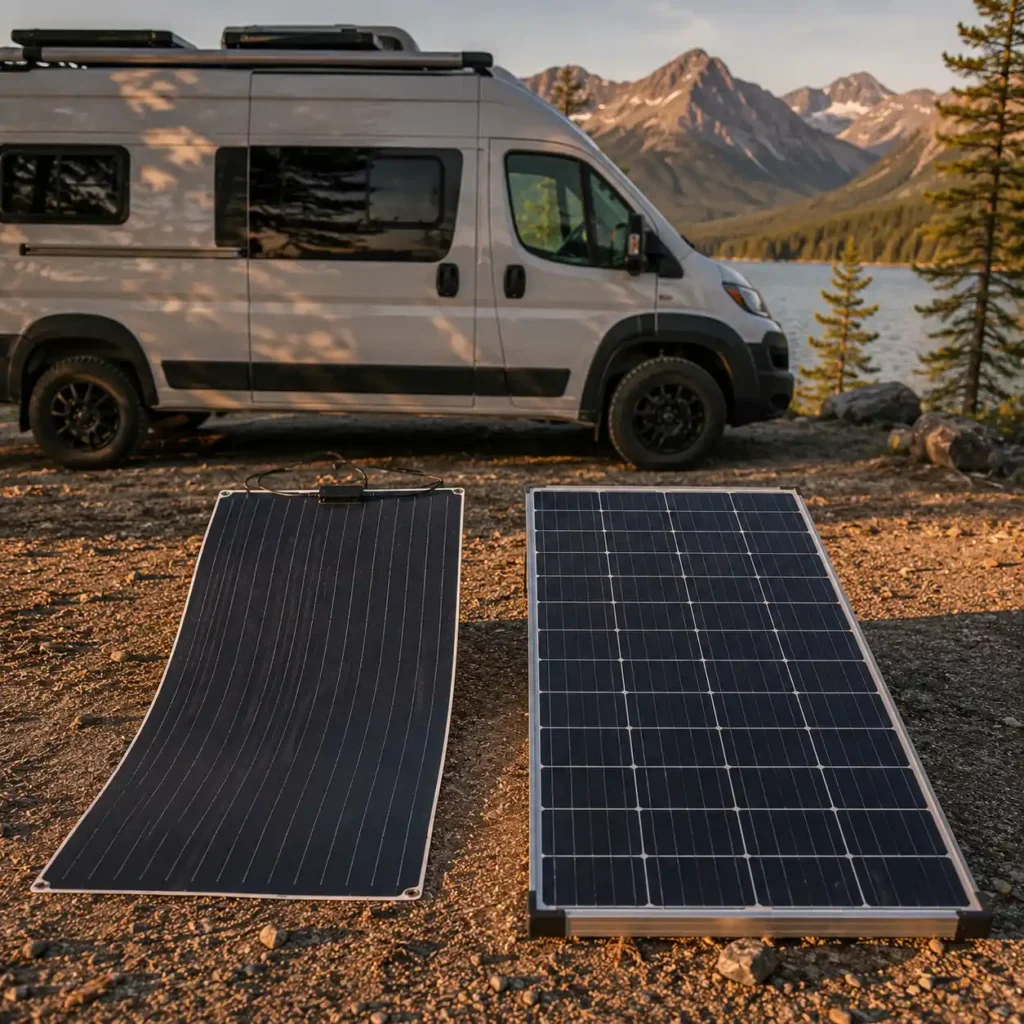
One of the biggest questions buyers face isn’t which flexible solar panel to choose—it’s whether a flexible solar panel is the right choice at all.
Both flexible and rigid solar panels convert sunlight into electricity using monocrystalline solar cells, but they’re designed for very different applications. Understanding the strengths and limitations of each technology will help you choose the solution that best matches your vehicle, travel style, and long-term expectations.
Flexible solar panels excel where weight, installation versatility, and low-profile mounting are priorities. Their lightweight construction makes them especially popular for RVs, camper vans, boats, overlanding vehicles, and curved surfaces where traditional framed panels may be impractical or impossible to install.
Rigid solar panels, on the other hand, are built around an aluminum frame with tempered glass protecting the solar cells. This construction provides excellent structural strength and superior heat dissipation, making rigid panels the preferred option for permanent residential systems and large off-grid installations.
Weight alone can be a deciding factor.
A typical 200W flexible solar panel often weighs less than half as much as a comparable rigid panel. For vehicles with limited roof load capacity—or for boats where every kilogram affects stability—this reduction in weight can be a significant advantage.
Installation is another major difference.
Flexible panels can often be bonded directly to the roof using high-strength adhesives or marine-grade sealants, eliminating the need for mounting brackets and minimizing the number of roof penetrations. This creates a clean, aerodynamic appearance while reducing wind resistance during travel.
Rigid panels generally require brackets, rails, or roof racks that elevate the panel above the mounting surface. Although this installation is more complex, the air gap beneath the panel improves ventilation and helps reduce operating temperatures.
Temperature management plays an important role in long-term performance.
Like all photovoltaic modules, solar panels become less efficient as temperatures rise. Because rigid panels are elevated above the roof, air circulates underneath them, allowing excess heat to dissipate more effectively. Flexible panels mounted directly against a roof typically retain more heat, which can slightly reduce energy production during hot summer days.
Durability is another important consideration.
Modern ETFE flexible solar panels are far more durable than earlier generations, but rigid panels generally remain the better choice for maximum service life. Their tempered glass construction provides superior resistance to impacts, abrasion, heavy snow loads, and prolonged environmental exposure.
That doesn’t mean flexible panels are fragile. High-quality models are designed to withstand rain, salt spray, vibration, and the normal movement associated with vehicles and boats. However, they benefit from careful installation and regular inspection to ensure years of reliable operation.
Ultimately, neither technology is universally better.
If your priority is maximum efficiency, long-term durability, and permanent rooftop performance, rigid solar panels remain the benchmark.
If you need low weight, minimal wind resistance, simple installation, or the ability to mount panels on curved surfaces, flexible solar panels offer clear advantages that rigid panels simply cannot match.
The best choice depends less on the panel itself and more on where—and how—you plan to use it. Buyers who understand their installation requirements first are far more likely to choose a solar solution they’ll be satisfied with for many years to come.
Weather Resistance and Long-Term Durability
Flexible solar panels spend their entire service life exposed to the elements. Unlike many portable electronics, they must withstand years of sunlight, rain, wind, changing temperatures, road vibrations, and, in marine environments, constant exposure to salt spray. That’s why durability is just as important as power output when choosing the right panel.
Many buyers focus on wattage and efficiency because those specifications are easy to compare. Long-term reliability, however, is what determines whether a solar panel continues producing dependable power five or even ten years after installation.
The quality of materials plays a major role in that longevity.
Premium flexible solar panels typically combine high-efficiency monocrystalline solar cells, an ETFE protective surface, corrosion-resistant electrical connections, and weather-sealed junction boxes. Together, these components help protect the panel from ultraviolet radiation, moisture, dust, and everyday environmental wear.
Water resistance is another specification worth understanding.
Most quality flexible solar panels carry an IP67 or IP68 rating for the junction box and electrical connectors. These ratings indicate that critical electrical components are well protected against dust and water ingress under defined testing conditions. However, an IP rating should not be interpreted as permission to permanently submerge the entire panel underwater or operate it outside the manufacturer’s intended use.
Marine applications place even greater demands on durability.
Boats and yachts expose solar panels to saltwater, high humidity, constant vibration, and strong UV radiation reflected from the water’s surface. For these installations, choosing a panel specifically designed with corrosion-resistant materials and marine-grade construction can significantly improve long-term reliability.
Temperature is another factor that affects both performance and lifespan.
Flexible solar panels routinely operate in environments where roof temperatures exceed 140°F (60°C) during summer. High-quality panels are engineered to tolerate these conditions, but prolonged exposure to excessive heat can gradually reduce the efficiency of any photovoltaic module over time. Proper installation, including following the manufacturer’s recommendations for ventilation and mounting, helps minimize thermal stress and supports longer service life.
Regular maintenance also contributes to consistent performance.
Fortunately, flexible solar panels require very little routine care. Periodically removing dust, pollen, bird droppings, leaves, and salt residue allows more sunlight to reach the solar cells and helps maintain peak energy production. During routine cleaning, it’s also a good idea to inspect cables, connectors, and mounting points for signs of wear or damage, especially after long trips or severe weather.
While no solar panel lasts forever, today’s premium flexible solar panels are significantly more durable than early generations introduced years ago. Advances in materials, manufacturing techniques, and protective coatings have improved resistance to cracking, delamination, and UV degradation, making modern flexible panels a reliable solution for long-term RV, marine, and off-grid installations.
When evaluating different models, don’t focus solely on the warranty period. Look for high-quality construction, proven materials, and a manufacturer with a strong reputation for reliability. In the long run, these factors usually have a greater impact on real-world ownership than a slightly higher advertised wattage or a marginal difference in efficiency.
Compatibility With Portable Power Stations and Battery Systems
Even the highest-quality flexible solar panel won’t perform as expected if it’s incompatible with the battery system you’re trying to charge. Before choosing a panel, it’s essential to verify that its electrical specifications match the requirements of your portable power station, solar generator, or battery bank.
Many buyers focus on panel wattage while overlooking voltage, current, and connector compatibility. These specifications are just as important because they determine whether your solar panel can safely and efficiently deliver power to your system.
Start by checking the maximum solar input supported by your power station or charge controller.
Every portable power station has limits for solar input voltage (V), current (A), and maximum charging power (W). Exceeding any of these limits can prevent the system from charging correctly or trigger built-in protection features that reduce charging performance.
For example, connecting a 200W flexible solar panel to a portable power station that accepts only 100W of solar input won’t damage the unit in most cases, but you’ll never utilize the panel’s full generating capacity. The charging system will simply limit the incoming power.
Connector type is equally important.
Most modern flexible solar panels use MC4 connectors, which have become the industry standard for residential, RV, and portable solar systems. MC4 connectors provide secure, weather-resistant connections and allow panels to integrate easily with charge controllers and many portable power stations.
However, not every power station includes a native MC4 input. Some manufacturers use proprietary charging ports and supply adapter cables in the box. Before purchasing a panel, confirm which connectors your power station requires and whether compatible adapters are included or available separately.
System expansion is another factor worth considering.
Many campers begin with a single solar panel but later decide to increase charging capacity by adding another panel. If future expansion is part of your long-term plan, verify that both your solar charge controller and portable power station support additional solar input before making your initial purchase.
Cable length also deserves attention.
A high-quality flexible solar panel can only perform well if it’s installed with appropriately sized cables that minimize voltage drop. For rooftop installations on RVs and boats, selecting the correct cable gauge becomes increasingly important as cable runs become longer.
Finally, remember that compatibility isn’t limited to electrical specifications alone.
Your mounting system, roof dimensions, battery capacity, inverter size, and expected daily energy consumption should all work together as part of a balanced solar power system. A properly matched setup will almost always outperform a collection of premium components that weren’t designed to operate efficiently together.
The best flexible solar panel is not simply the one with the highest wattage or efficiency rating—it’s the one that integrates seamlessly with your entire off-grid power system, delivering reliable charging whenever you need it most.
Weight, Flexibility, and Ease of Installation
One of the biggest advantages of flexible solar panels is right in their name—their ability to adapt to installations where traditional rigid panels simply aren’t practical.
For many RV owners, van lifers, sailors, and overlanders, reducing weight is just as important as generating electricity. Every additional pound affects fuel efficiency, roof load capacity, handling, and available cargo space. Choosing lightweight solar equipment can make a noticeable difference, especially on smaller vehicles.
This is where flexible solar panels have a clear advantage.
Most flexible models weigh 50–80% less than comparable rigid solar panels. Depending on wattage and construction, a 200W flexible panel often weighs only a few kilograms, making it significantly easier to transport, position, and install without assistance.
The reduced weight also simplifies roof installations.
Unlike framed solar panels that typically require aluminum brackets, mounting rails, and multiple roof penetrations, many flexible solar panels can be secured using high-strength structural adhesives or marine-grade sealants. This creates a clean, low-profile installation while reducing the number of holes drilled into the roof—an important consideration for preventing future water leaks.
Their flexibility provides another important advantage.
While flexible solar panels are not designed to wrap around sharp curves, they can usually conform to gently curved surfaces found on many camper vans, motorhomes, boats, and cabin roofs. This allows owners to utilize installation areas that would otherwise remain unused with conventional rigid panels.
However, flexibility should never be confused with unlimited bending.
Every manufacturer specifies a maximum bending radius or allowable curvature. Exceeding these limits can place excessive stress on the solar cells, increasing the risk of microscopic cracks that may reduce efficiency over time. During installation, the panel should naturally follow the roof’s contour rather than being forced into shape.
Ease of installation extends beyond mounting alone.
Most modern flexible solar panels arrive with pre-installed MC4 connectors and clearly labeled cables, allowing straightforward integration with compatible charge controllers and portable power stations. Even so, proper cable routing, waterproof roof glands, and secure strain relief remain essential for a professional, long-lasting installation.
Maintenance is equally simple.
Because flexible solar panels have no bulky aluminum frame, they tend to accumulate less debris around the edges and are generally easy to clean with fresh water and a soft cloth. Regular cleaning helps maximize sunlight exposure and supports consistent energy production throughout the year.
That said, lightweight construction also comes with certain trade-offs.
Flexible panels rely on the roof beneath them for structural support, making correct installation especially important. A poorly bonded panel or one installed on an uneven surface may experience unnecessary stress during travel or in strong winds. Following the manufacturer’s installation guidelines is essential to achieving the expected lifespan and performance.
For buyers seeking a sleek appearance, minimal added weight, and straightforward installation, flexible solar panels offer advantages that rigid panels cannot easily match. When installed correctly, they become an almost seamless part of the vehicle or vessel while quietly generating clean energy wherever your adventures take you.
Common Buying Mistakes
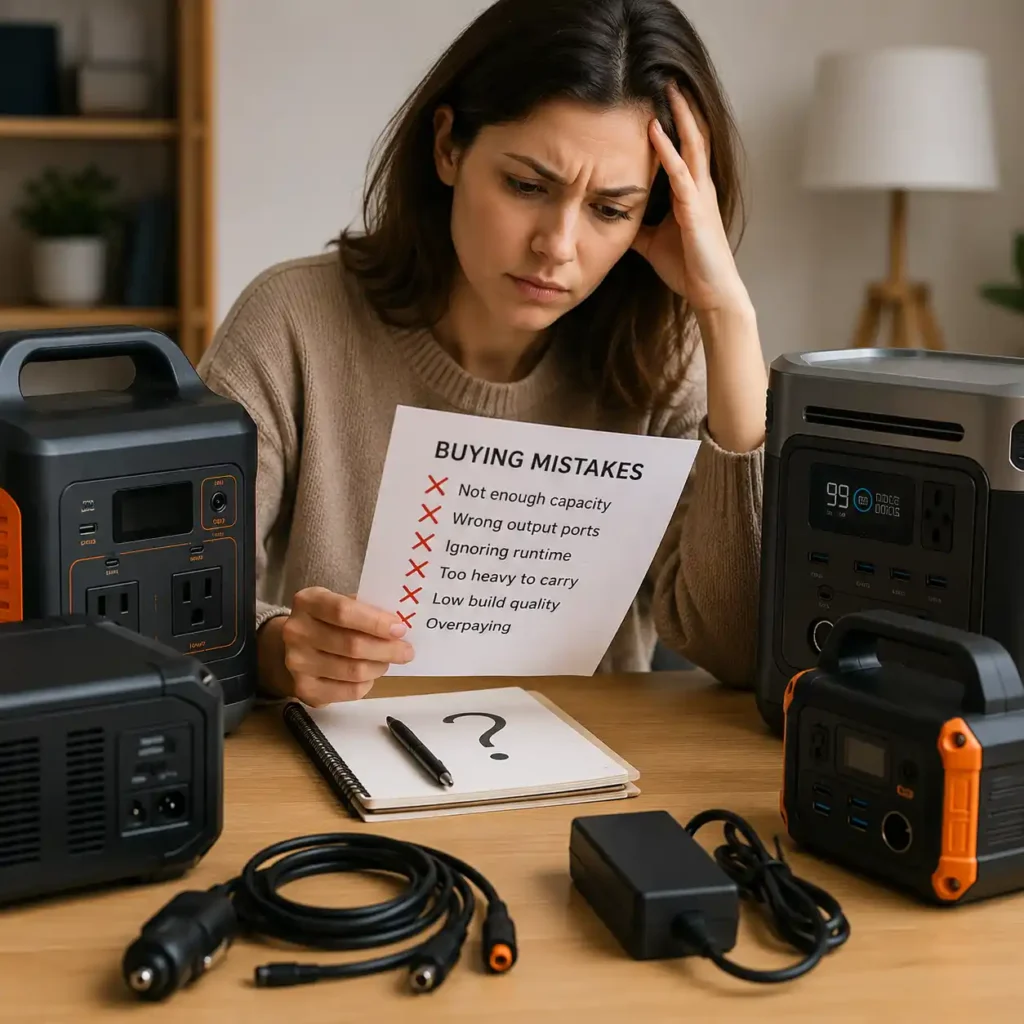
Buying a flexible solar panel may seem straightforward, but many disappointing experiences can be traced back to a handful of common purchasing mistakes rather than poor-quality products.
The good news is that most of these mistakes are entirely avoidable with a little planning.
Buying More Wattage Than You Can Actually Use
One of the most frequent mistakes is assuming that a larger solar panel is always the better investment.
In reality, your charging performance is limited by the capabilities of your portable power station or solar charge controller. Installing a 300W panel on a system that accepts only 200W of solar input won’t increase charging speed. Instead, part of the panel’s potential output simply goes unused.
Always size your solar panel to match the specifications of the equipment you’re charging rather than chasing the highest wattage available.
Ignoring Available Installation Space
Many buyers purchase a panel before carefully measuring their roof.
Roof vents, skylights, air conditioners, antennas, roof racks, and other accessories often reduce the usable installation area far more than expected. Even a panel that’s only a few inches too large can require major compromises during installation—or may not fit at all.
Measuring first almost always saves time, money, and frustration.
Underestimating the Impact of Shade
Even partial shading can noticeably reduce solar production.
A roof vent, satellite antenna, tree branch, or kayak mounted on a roof rack may cast shadows across only a small portion of the panel, yet still lower overall power generation throughout the day.
Before selecting a mounting location, consider how sunlight moves across your roof from morning until evening rather than evaluating conditions at a single point in time.
Choosing Price Over Long-Term Quality
Budget-friendly panels can be appealing, especially for first-time buyers.
However, lower prices sometimes come with compromises in materials, protective coatings, connector quality, or manufacturing consistency. These differences may not be obvious immediately after installation but can become apparent after several seasons of exposure to UV radiation, heat, rain, and vibration.
Investing in a well-built panel from a reputable manufacturer often provides better long-term value than replacing a cheaper panel after only a few years.
Overlooking Battery and Power Station Compatibility
Not every solar panel works equally well with every charging system.
Before purchasing, verify the panel’s operating voltage, current, maximum power output, and connector type. Ensuring compatibility with your portable power station or solar charge controller helps avoid unnecessary adapters, charging limitations, or installation problems.
A few minutes spent reviewing technical specifications can prevent hours of troubleshooting later.
Assuming Flexible Panels Can Bend Without Limits
The word flexible sometimes creates unrealistic expectations.
Flexible solar panels are engineered to follow gentle curves—not sharp bends or irregular surfaces. Forcing a panel beyond the manufacturer’s recommended bending radius can stress the internal solar cells and shorten its service life.
The panel should naturally conform to the mounting surface rather than being bent into position during installation.
Forgetting About Future Expansion
Your energy needs may change over time.
Many users begin by charging phones, lights, and a portable power station but later add a compressor refrigerator, Starlink Mini, electric cooler, or additional camping equipment. Planning for future expansion when designing your solar system makes upgrades much simpler and often less expensive.
Leaving room for an additional panel—or choosing equipment that supports higher solar input—can significantly extend the usefulness of your system.
Most buying mistakes aren’t caused by choosing the wrong brand. They’re the result of selecting equipment that doesn’t match how the system will actually be used.
By focusing on installation conditions, compatibility, realistic energy needs, and long-term durability instead of marketing claims alone, you’ll be far more likely to choose a flexible solar panel that delivers dependable performance for many years of outdoor adventures.
Our Expert Buying Tips
After evaluating today’s leading flexible solar panels and comparing their real-world performance, one recommendation stands out above all others: buy the panel that matches your installation—not simply the one with the highest wattage.
That single decision influences nearly everything else, from installation complexity and charging performance to long-term reliability and overall value.
It’s easy to assume that more watts automatically translate into a better solar system. In reality, a properly sized panel installed in full sunlight will almost always outperform an oversized panel that’s partially shaded or poorly positioned.
Whenever possible, choose a model built with high-efficiency monocrystalline solar cells and an ETFE protective surface. This combination has become the benchmark for premium flexible solar panels because it delivers an excellent balance of efficiency, weather resistance, and long-term durability.
If you’re planning a permanent installation on an RV, camper van, or boat, pay close attention to roof layout before selecting a panel. Measuring available space, identifying potential sources of shade, and planning cable routing in advance can prevent costly installation mistakes and maximize daily energy production.
It’s also worth thinking beyond your current setup.
Many buyers initially install a single flexible solar panel to keep a portable power station charged during weekend trips. Over time, however, their energy needs often grow as they add compressor refrigerators, Starlink Mini, electric coolers, additional lighting, or larger battery systems. Choosing equipment that allows future expansion can save both money and effort in the years ahead.
Don’t overlook the importance of compatibility.
Before purchasing any solar panel, verify that its operating voltage, current, and maximum power output fall within the specifications supported by your portable power station or MPPT charge controller. A well-matched system will charge more efficiently and deliver a far better ownership experience than components that require adapters or operate below their full potential.
Finally, remember that solar panels generate electricity only when sunlight is available.
The best off-grid systems combine efficient solar panels with sufficient battery storage, allowing excess daytime energy to be used after sunset or during cloudy weather. Thinking of your solar panel and battery as one integrated energy system—not as separate products—will help you build a setup that’s more reliable, more efficient, and better suited to your adventures.
At the end of the day, the best flexible solar panel isn’t necessarily the one with the highest efficiency rating or the most impressive specifications. It’s the one that fits your installation, works seamlessly with your power system, and continues producing dependable energy season after season.
A carefully planned solar setup should fade into the background, quietly keeping your batteries charged while you focus on what matters most—whether that’s exploring remote trails, cruising along the coast, spending weekends at your favorite campground, or enjoying the freedom of life off the grid.
Flexible Solar Panel Performance in Real-World Conditions
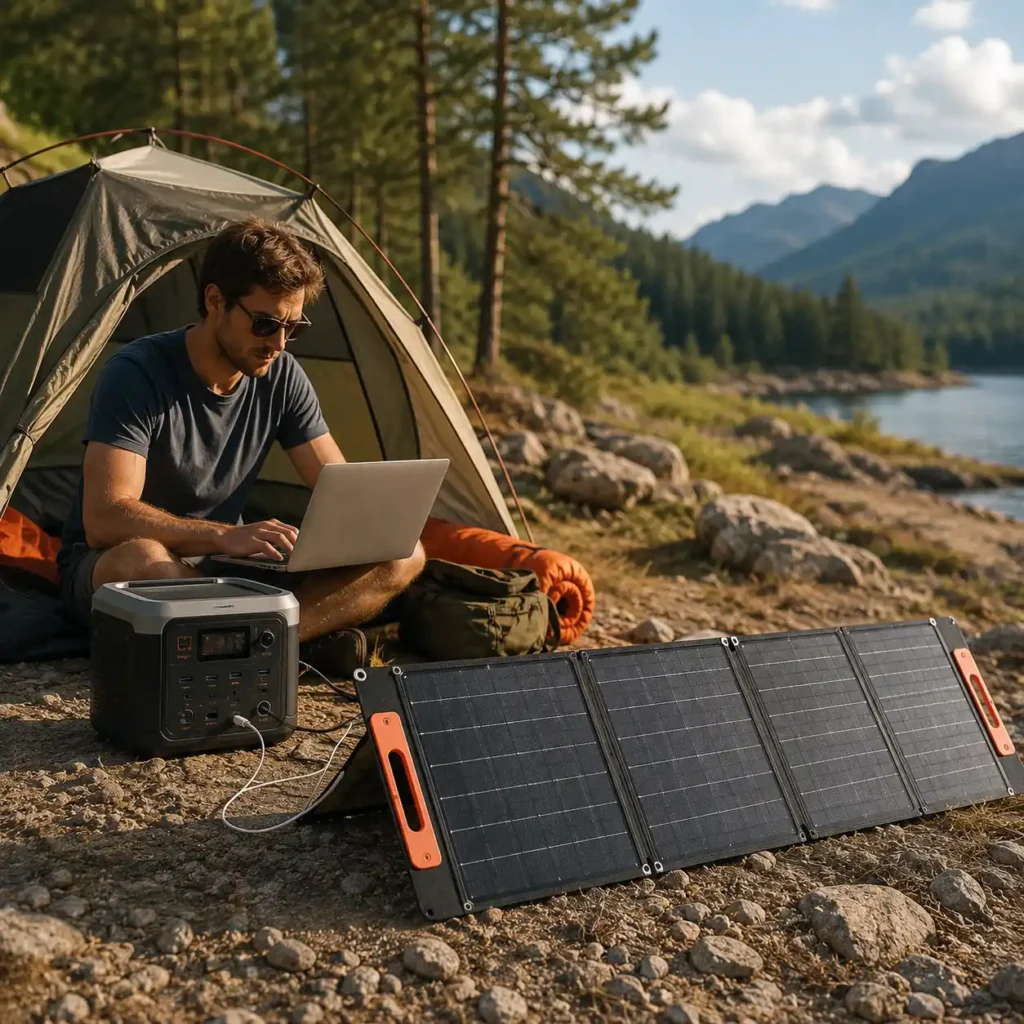
Manufacturer specifications provide a useful starting point when comparing flexible solar panels, but they don’t always reflect what you’ll experience during everyday use. Laboratory testing is performed under Standard Test Conditions (STC)—ideal circumstances that rarely occur outside controlled environments.
In the real world, solar performance is influenced by dozens of variables, including sunlight intensity, panel orientation, roof temperature, cloud cover, seasonal changes, geographic location, and even small amounts of shade.
This explains why two campers using the same 200W flexible solar panel can generate very different amounts of electricity during the same day.
One may park in an open field under clear summer skies, while another spends the afternoon beneath scattered tree cover at a shaded campsite. Although both systems are identical, their energy production can differ dramatically.
Understanding these real-world factors helps set realistic expectations and allows you to design a solar system that performs reliably under the conditions you actually encounter—not just under laboratory testing.
The following sections explain the variables that have the greatest impact on flexible solar panel performance and show how small changes in installation or environmental conditions can significantly improve daily energy production.
Why Rated Wattage Doesn't Tell the Whole Story
One of the biggest misconceptions surrounding solar panels is that a 200W panel continuously produces 200 watts of power whenever the sun is shining.
In reality, a panel reaches its rated output only under carefully controlled laboratory conditions that include a solar irradiance of 1,000 watts per square meter, a cell temperature of 25°C (77°F), and sunlight striking the panel at an optimal angle.
These conditions are useful for comparing products, but they rarely exist throughout an entire day outdoors.
As the sun moves across the sky, its angle changes continuously. Morning and evening sunlight reaches the panel at a lower angle than midday sun, naturally reducing power production. Passing clouds, airborne dust, humidity, seasonal variations, and higher operating temperatures all influence how much electricity a panel actually generates.
For this reason, experienced RV owners and off-grid travelers think less about maximum instantaneous output and more about total daily energy production.
A high-quality 200W flexible solar panel installed in full sunlight may generate enough energy over the course of the day to recharge a portable power station, operate a compressor refrigerator, and keep phones, laptops, and other electronics running without difficulty.
The exact amount of energy will vary from one location to another, but understanding that solar production changes throughout the day leads to far more realistic expectations than focusing solely on the number printed on the product label.
When comparing flexible solar panels, don’t ask, “How many watts can this panel produce?”
Instead, ask, “How much usable energy is this panel likely to generate during a typical day where I’ll actually be using it?”
That simple shift in perspective often leads to better purchasing decisions and a more satisfying off-grid experience.
How Weather and Temperature Affect Solar Output
Sunlight is only one part of the equation. Weather conditions and operating temperature have a significant influence on how much electricity a flexible solar panel produces throughout the day.
Many first-time buyers expect a solar panel to perform the same way whenever the sun is visible. In reality, solar production changes continuously as environmental conditions change.
Clear, sunny days naturally provide the highest energy output, especially when the sun is high in the sky and the panel receives direct sunlight for several hours. Even under these ideal conditions, however, panel temperature gradually increases throughout the day—and that’s where many people are surprised.
Solar panels actually become less efficient as they get hotter.
While sunlight generates electricity, it also heats the photovoltaic cells. As cell temperature rises above the standard laboratory testing conditions, electrical efficiency gradually declines. This doesn’t mean the panel stops working, but it does mean that extremely hot summer afternoons may produce slightly less power than many buyers expect.
Flexible solar panels are particularly affected because they’re commonly mounted directly against the roof of an RV, camper van, or boat. Without the air gap found beneath rigid solar panels, less airflow is available to carry heat away from the solar cells.
Fortunately, this reduction in efficiency is a normal characteristic of photovoltaic technology rather than a design flaw.
Cloud cover also affects daily energy production, although not always in the way people expect.
Thin or scattered clouds still allow a considerable amount of sunlight to reach the solar cells, enabling the panel to continue generating useful electricity. Heavy overcast conditions, however, significantly reduce solar irradiance and can lower energy production for extended periods.
Seasonal changes should also be taken into account.
During summer, longer daylight hours generally allow flexible solar panels to generate considerably more energy over the course of the day. In winter, shorter days and a lower sun angle naturally reduce daily production, even when skies remain perfectly clear.
Geographic location adds another variable.
Campers traveling through sunny regions such as the American Southwest will usually experience much higher daily solar yields than those camping in heavily forested areas or regions with frequent cloud cover. Latitude, local climate, and seasonal weather patterns all influence how much usable energy a solar panel can generate.
Rather than expecting identical performance every day, it’s better to think of solar power as a resource that naturally changes with the environment.
High-quality flexible solar panels continue producing electricity across a wide range of weather conditions, but understanding how sunlight, temperature, clouds, and the seasons affect output will help you plan your energy usage more effectively and avoid unrealistic expectations during extended off-grid adventures
The Importance of Panel Angle and Shade
Even the most efficient flexible solar panel can’t generate its full potential if it’s installed in the wrong location or spends part of the day in the shade. In real-world use, panel positioning often has a greater impact on daily energy production than small differences in efficiency or wattage.
Many buyers compare solar panels by looking at technical specifications alone. Experienced RV owners and off-grid travelers know that where a panel is installed is often just as important as which panel is installed.
The angle at which sunlight reaches the solar cells directly affects how much energy the panel can generate.
When sunlight strikes the surface at a near-perpendicular angle, more solar energy is absorbed and converted into electricity. As the angle becomes shallower during the early morning and late afternoon, less sunlight reaches the cells, reducing power output even under clear skies.
Unlike portable folding solar panels that can be repositioned throughout the day, permanently mounted flexible solar panels remain fixed to the roof. This means their performance depends largely on the orientation of the vehicle or boat and the amount of unobstructed sunlight available at the campsite.
Shade has an even greater impact.
Many people assume that only large shadows significantly reduce solar production. In reality, even partial shading can noticeably decrease the output of an entire panel. A roof vent, air-conditioning unit, antenna, roof rack, or nearby tree branch may block sunlight from only a small section of the panel, yet still reduce overall energy generation.
This is particularly important for RVs and camper vans, where rooftop equipment often creates moving shadows as the sun changes position throughout the day.
When choosing an installation location, it’s worth observing your roof during different times of the day rather than relying on a single snapshot. A panel that receives full sunlight at noon may spend several hours in partial shade during the morning or late afternoon.
Parking location also makes a measurable difference.
Camping beneath mature trees provides welcome shade for your living space but may significantly reduce solar charging. Conversely, parking in an open area maximizes solar production while increasing interior temperatures during hot weather. Finding the right balance between comfort and energy generation is often part of everyday off-grid camping.
If your setup allows some flexibility, simple adjustments can improve performance.
Whenever practical, park with the roof receiving the longest possible period of direct sunlight. Keep the panel surface clean, avoid placing rooftop cargo where it casts shadows, and consider future roof accessories before selecting a permanent mounting location.
Ultimately, maximizing solar production isn’t just about buying a better panel. It’s about giving your existing panel the best possible conditions to perform. A thoughtfully positioned 200W flexible solar panel exposed to full sunlight throughout the day will often generate more usable energy than a larger panel that’s partially shaded for several hours.
Understanding how sunlight, panel orientation, and shading work together allows you to get the most from your investment—without spending another dollar on additional solar capacity.
How Much Energy Can a Flexible Solar Panel Generate Per Day?
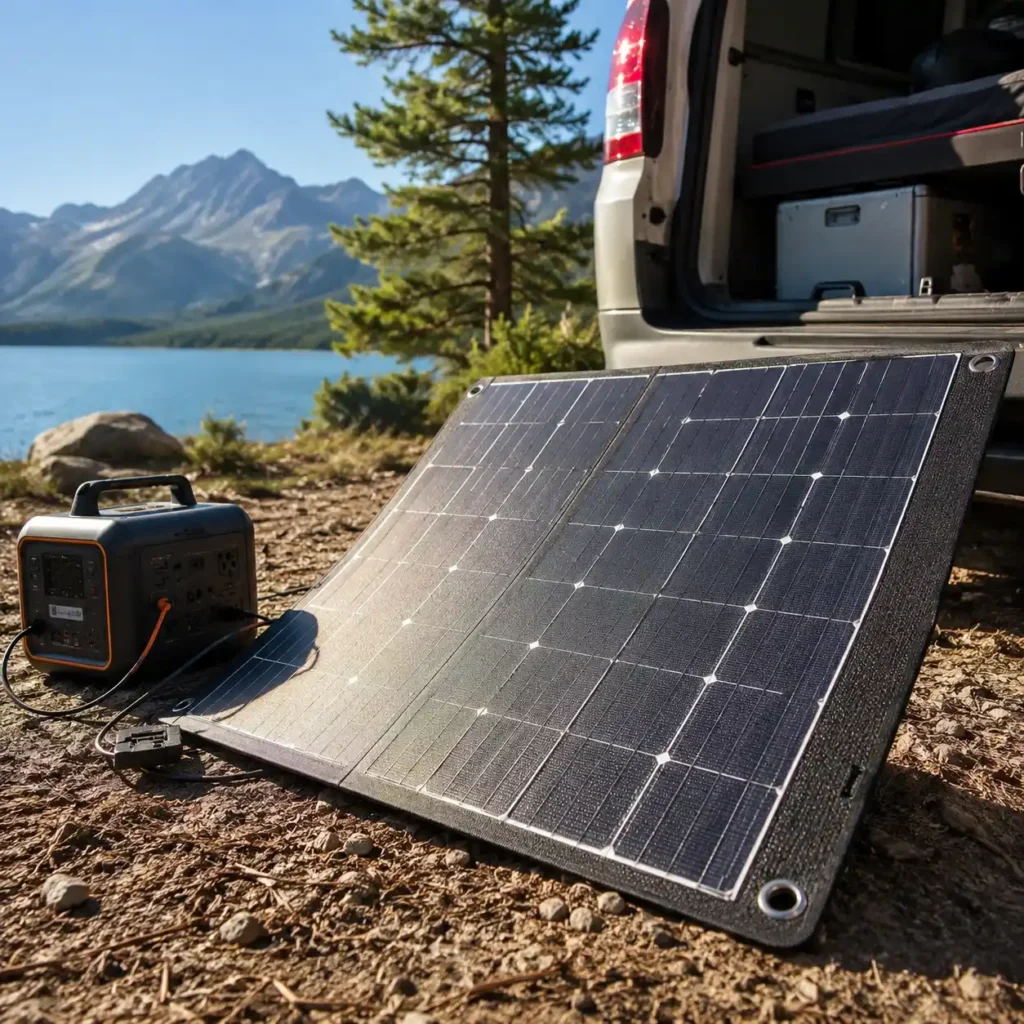
One of the most common questions buyers ask is, “How much electricity will this panel actually produce in a day?”
Unfortunately, there isn’t a single answer.
Daily energy production depends on several factors working together, including panel wattage, available sunlight, geographic location, season, weather conditions, operating temperature, and installation quality. Because these variables change from day to day, solar panels don’t produce a fixed amount of energy.
Instead, they generate electricity whenever sufficient sunlight is available.
As a general guideline, a well-positioned flexible solar panel operating under favorable conditions can often produce several times its rated wattage in watt-hours over the course of a full day. This energy is typically enough to recharge portable power stations, operate compressor refrigerators, power LED lighting, charge laptops and smartphones, and run many of the small appliances commonly used while camping or traveling.
Rather than focusing on a single number, it’s more useful to think in terms of energy production over an entire day instead of peak power output at one particular moment.
For example, a 200W flexible solar panel rarely operates at exactly 200 watts continuously. Output naturally rises during the morning, peaks around midday under ideal conditions, and gradually decreases as the sun moves lower in the sky. Passing clouds, nearby shade, or high operating temperatures may temporarily reduce production even further.
This gradual curve is completely normal and reflects how every solar panel behaves outdoors.
Another important consideration is energy consumption.
If your daily electricity use is relatively modest—charging phones, cameras, laptops, lights, and a portable power station—a single high-quality flexible solar panel may provide all the energy you need during sunny weather.
However, users running larger appliances such as compressor refrigerators, Starlink Mini, electric coolers, CPAP machines, or multiple battery-powered devices may require additional solar capacity or larger battery storage to remain energy independent for extended periods.
The most reliable way to size a solar system is to compare your expected daily energy consumption with the realistic energy production your panels can achieve under the conditions where you’ll actually be camping or traveling.
Building in a reasonable safety margin is also a smart idea.
Weather is unpredictable, campsites aren’t always perfectly positioned, and consecutive cloudy days are inevitable. Designing your system with a little extra solar capacity—or additional battery storage—helps maintain reliable power even when conditions are less than ideal.
Ultimately, the goal isn’t to maximize the number printed on a product specification sheet. It’s to generate enough usable energy each day to comfortably support your lifestyle, allowing you to spend more time enjoying your trip and less time worrying about your battery level.
Tips to Maximize Flexible Solar Panel Performance
Even the highest-rated flexible solar panel won’t perform at its best without proper installation and everyday care. Fortunately, maximizing solar output doesn’t usually require expensive upgrades. A few simple habits can noticeably improve charging efficiency and help your system generate more usable energy throughout the year.
Park Where Your Panels Receive the Most Sunlight
Choosing the right parking spot is one of the easiest ways to improve solar performance.
Whenever possible, position your RV, camper van, or boat where the roof receives the longest period of direct sunlight. While shaded campsites are often more comfortable during hot weather, they can significantly reduce daily energy production.
If you regularly camp in wooded areas, consider balancing interior comfort with solar exposure by selecting locations that provide shade during the hottest part of the afternoon while still allowing several hours of unobstructed morning or midday sun.
Keep the Panel Surface Clean
Dust, pollen, bird droppings, tree sap, salt spray, and road grime gradually accumulate on solar panels and reduce the amount of sunlight reaching the photovoltaic cells.
Fortunately, cleaning is simple.
A soft microfiber cloth, clean water, and a mild soap solution are usually all that’s needed to remove dirt without damaging the ETFE surface. Avoid abrasive brushes, harsh chemicals, or pressure washers, as these may shorten the lifespan of protective coatings.
Even light cleaning performed regularly can help maintain consistent energy production.
Minimize Shade Whenever Possible
Small shadows can have a surprisingly large impact on solar output.
Before installing your panel, check for potential sources of shade such as roof vents, air conditioners, antennas, roof racks, cargo boxes, or kayak carriers. During everyday use, avoid placing equipment on the roof where it may cast shadows across the panel.
If you’re setting up camp for several days, it’s also worth observing how nearby trees affect sunlight throughout the day rather than judging the location based only on your arrival time.
Monitor Cable Connections
Reliable electrical connections are just as important as efficient solar cells.
Periodically inspect MC4 connectors and extension cables for signs of dirt, corrosion, loose fittings, or physical damage. A poor electrical connection can reduce charging efficiency and, in some cases, prevent the power station or charge controller from operating correctly.
Keeping connectors clean, dry, and securely attached helps ensure consistent power delivery.
Avoid Unnecessary Heat Buildup
While flexible solar panels are designed to operate in hot environments, excessive heat naturally reduces efficiency.
Whenever practical, avoid mounting panels directly above components that generate significant heat, such as engine compartments or poorly ventilated equipment housings. If your installation allows for even a small amount of airflow beneath portions of the panel, it may help improve cooling during long periods of direct sunlight.
Although temperature losses cannot be eliminated entirely, thoughtful installation can reduce their impact.
Regularly Inspect the Installation
Outdoor equipment is constantly exposed to vibration, UV radiation, moisture, and changing temperatures.
At the beginning of each camping season—or before any extended trip—inspect the mounting system, adhesive, fasteners, cable routing, and connectors. Look for signs of lifting edges, damaged insulation, or excessive wear.
Catching small issues early is far easier and less expensive than repairing a failed installation later.
Match Your Energy Use to Available Sunlight
Solar energy production changes throughout the day, and planning your power usage accordingly can improve the overall efficiency of your system.
Whenever possible, charge high-demand devices such as portable power stations, laptops, or e-bike batteries during daylight hours, when your panels are actively generating electricity. This reduces the amount of energy drawn from battery storage and leaves more reserve power available after sunset.
It’s a simple habit that can noticeably improve the performance of an off-grid electrical system without adding more solar capacity.
Think of Your System as a Whole
A flexible solar panel is only one component of a complete off-grid power system.
Its performance depends not only on the quality of the panel itself but also on battery capacity, charge controller efficiency, cable quality, installation practices, and your daily energy consumption. Optimizing each part of the system typically delivers better results than focusing on any single specification.
In many cases, a well-designed 200W solar setup will outperform a poorly planned 300W system simply because every component works together more efficiently.
With thoughtful installation, regular maintenance, and realistic expectations, a high-quality flexible solar panel can provide reliable, low-maintenance power for many years. The goal isn’t to achieve perfect laboratory conditions—it’s to consistently generate enough clean energy to keep your adventures running smoothly, wherever the road or water takes you.
Flexible Solar Panels vs. Rigid Solar Panels
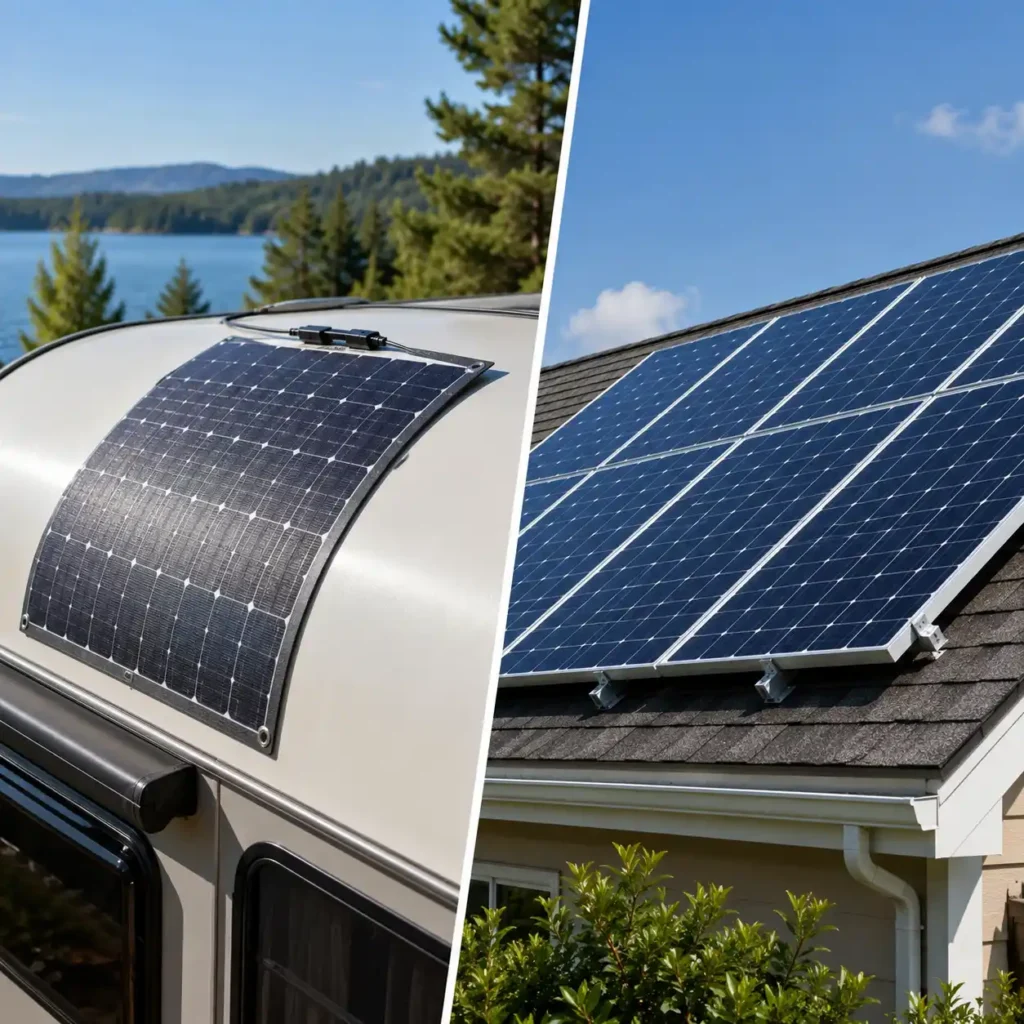
One of the biggest decisions buyers face isn’t choosing between different flexible solar panels—it’s deciding whether a flexible panel is the right choice at all.
Both flexible and rigid solar panels convert sunlight into electricity using the same basic photovoltaic technology, but they’re designed for different applications. Neither option is universally better. The right choice depends on your installation, available space, weight limitations, and how you plan to use your solar system.
Understanding the strengths and limitations of each design will help you invest in a solution that delivers the best long-term value.
When Flexible Solar Panels Are the Better Choice
Flexible solar panels are designed for installations where traditional rigid panels would be difficult, impractical, or unnecessarily heavy.
Their lightweight construction makes them particularly attractive for RVs, camper vans, boats, pop-up campers, teardrop trailers, overlanding vehicles, and other applications where every kilogram matters.
Because they can conform to gentle curves, flexible panels also work well on rounded roofs that cannot easily accommodate rigid aluminum-framed modules.
Another major advantage is their low profile.
Unlike rigid panels mounted several inches above the roof, flexible solar panels sit close to the mounting surface. This streamlined design reduces wind resistance, minimizes visual impact, and lowers the overall height of the vehicle—an important consideration for garages, ferries, and low-clearance roads.
Installation can also be simpler.
Many flexible panels can be bonded directly to the roof using high-strength adhesives or specialized mounting systems, eliminating the need for large aluminum brackets or extensive roof penetrations. For owners who want a clean, factory-like appearance, this can be a significant advantage.
Flexible panels are also easier to transport and store before installation due to their lighter weight and slimmer profile.
For travelers who prioritize portability, simplicity, and reduced weight, flexible solar panels often provide the most practical solution.
When Rigid Solar Panels Make More Sense
Despite the growing popularity of flexible models, rigid solar panels remain the preferred option for many permanent solar installations.
Their aluminum frames create an air gap beneath the panel, allowing natural airflow to remove excess heat more effectively. Since photovoltaic cells operate more efficiently at lower temperatures, rigid panels often maintain slightly better performance during prolonged exposure to hot summer sun.
Rigid panels are also generally more resistant to physical impacts.
The tempered glass front and reinforced frame provide excellent protection against hail, falling branches, accidental impacts, and years of outdoor exposure. For stationary installations on homes, cabins, workshops, or off-grid properties, this added durability is often a major advantage.
Another benefit is long-term stability.
Because rigid panels are mounted on dedicated brackets, they can often be tilted toward the sun, increasing seasonal energy production compared with permanently flat-mounted flexible panels.
For installations where weight, roof shape, and overall height are not limiting factors, rigid solar panels typically offer the highest long-term efficiency and service life.
Which Type Is Right for You?
Rather than asking which technology is better, it’s more useful to ask which one best fits your specific application.
Choose a flexible solar panel if you:
- Need a lightweight solution for an RV, camper van, boat, or overlanding vehicle.
- Have a curved or irregular roof.
- Want a low-profile installation with minimal wind resistance.
- Need to minimize overall vehicle weight.
- Prefer a clean, streamlined appearance.
Choose a rigid solar panel if you:
- Have sufficient roof space and mounting options.
- Want maximum long-term durability.
- Plan to install a permanent off-grid or residential solar system.
- Can accommodate additional weight and panel height.
- Want the option to optimize panel angle for improved seasonal performance.
For many RV owners and outdoor enthusiasts, flexible solar panels strike an excellent balance between portability, convenience, and reliable energy production. For homeowners or permanent off-grid installations, rigid panels often remain the better long-term investment.
The best solar panel isn’t determined by its construction alone. It’s the one that fits your installation, matches your energy needs, and performs reliably in the environment where you’ll use it most.
Frequently Asked Questions (FAQ)
Are flexible solar panels worth buying?
Yes—provided they’re used for the right application.
Flexible solar panels are an excellent choice for RVs, camper vans, boats, trailers, and other installations where low weight, a slim profile, or a gently curved mounting surface makes traditional rigid panels impractical. They’re also easier to transport and often simpler to install.
However, if your roof is flat, weight isn’t a concern, and maximum efficiency and service life are your priorities, rigid solar panels generally offer better long-term value.
The best option depends on your installation rather than the technology itself.
How long do flexible solar panels last?
The lifespan varies depending on the manufacturer, construction quality, installation method, and environmental conditions.
Premium flexible solar panels built with ETFE protective coatings and high-quality monocrystalline cells typically last considerably longer than entry-level models made with lower-grade materials.
Regular cleaning, avoiding excessive heat buildup, and proper installation all help maximize service life.
Are flexible solar panels waterproof?
Most quality flexible solar panels are designed to withstand rain, snow, and normal outdoor exposure.
Many models carry an IP67 or IP68 rating, indicating strong resistance to water and dust. However, waterproof does not mean they should be permanently submerged unless the manufacturer specifically states that such use is permitted.
Always check the product specifications before installation on marine applications.
Can flexible solar panels be mounted directly onto an RV roof?
Yes.
One of the biggest advantages of flexible solar panels is that many can be bonded directly to the roof using high-strength adhesive systems or specialized mounting tape.
Before installation, the mounting surface should be clean, dry, and compatible with the adhesive recommended by the panel manufacturer.
Proper installation is essential for both performance and long-term durability.
Do flexible solar panels need an air gap?
Not necessarily—but an air gap can improve performance.
Unlike rigid solar panels, flexible panels are often installed flush against the mounting surface. While this creates a sleek appearance, it also reduces airflow underneath the panel, allowing operating temperatures to rise.
Whenever installation design allows additional ventilation, cooler operating temperatures may help improve efficiency during hot weather.
Can flexible solar panels be walked on?
Generally, no.
Although flexible panels can bend slightly, they are not designed to support the weight of a person. Walking directly on the panel may damage the solar cells, protective layers, or electrical connections.
If roof access is necessary, step around the panels whenever possible.
Do flexible solar panels work on cloudy days?
Yes.
Flexible solar panels continue producing electricity under cloudy conditions, although output is lower than on bright, sunny days.
Thin cloud cover still allows a significant amount of sunlight to reach the photovoltaic cells, while heavy overcast conditions reduce energy production more substantially.
For this reason, battery capacity remains an important part of any off-grid power system.
Can I connect multiple flexible solar panels together?
Yes.
Many solar panels can be connected in series or parallel to increase system capacity.
Before expanding your system, verify that the combined voltage and current remain within the limits supported by your portable power station, MPPT charge controller, or battery charging system.
Following the manufacturer’s wiring recommendations helps ensure safe and efficient operation.
Are flexible solar panels compatible with portable power stations?
In most cases, yes.
Most modern portable power stations support charging from solar panels using MC4 connectors or compatible adapter cables.
Before purchasing, check the maximum solar input, operating voltage range, and current limits specified by the power station manufacturer to ensure full compatibility.
What size flexible solar panel do I need?
The ideal panel size depends on your daily energy consumption rather than the size of your vehicle.
For occasional camping and charging small electronics, a lower-wattage panel may be sufficient.
If you regularly power a portable refrigerator, Starlink Mini, CPAP machine, laptop, or other energy-intensive devices, you’ll likely benefit from larger solar capacity or multiple panels working together.
Estimating your daily energy usage before shopping is the most reliable way to choose the right panel.
What's the difference between flexible and foldable solar panels?
Although the names sound similar, they’re designed for different purposes.
Flexible solar panels are intended for permanent or semi-permanent installation on RVs, boats, trailers, and other surfaces where they remain mounted during normal use.
Foldable solar panels, on the other hand, are portable charging solutions that can be unfolded at a campsite, positioned toward the sun for maximum efficiency, and packed away after use.
If your goal is maximum portability, a foldable solar panel is often the better choice. If you want a permanently installed solar system, a flexible panel is usually the more practical option.
Are flexible solar panels as efficient as rigid solar panels?
Modern flexible solar panels have improved significantly in recent years, but rigid panels generally remain slightly more efficient and often have a longer service life.
The primary reason isn’t the solar cells themselves—many premium flexible panels use the same high-efficiency monocrystalline cells found in rigid models. Instead, differences in cooling, construction, and mounting methods typically give rigid panels a modest advantage in long-term performance.
For many RVs, camper vans, and boats, however, the benefits of lower weight and easier installation outweigh the small difference in efficiency.
Can Flexible Solar Panels Charge a 12V Battery Directly?
Yes, but not safely on their own.
In most cases, a flexible solar panel should be connected to a solar charge controller before charging a 12V battery. The charge controller regulates voltage and current, helping prevent overcharging and protecting the battery from potential damage.
Modern MPPT charge controllers are generally the preferred option because they maximize the amount of energy harvested from the solar panel, especially when sunlight conditions change throughout the day.
Some portable power stations already include an integrated MPPT controller, allowing the solar panel to connect directly without additional equipment.
If you’re building a traditional 12V battery system, however, a dedicated charge controller is considered an essential component.
Can Flexible Solar Panels Be Used on Boats?
Absolutely.
Flexible solar panels are particularly popular for sailboats, fishing boats, yachts, and other marine applications because they’re lightweight, corrosion-resistant, and can conform to gently curved deck surfaces where rigid panels may be difficult to install.
Their low-profile design also minimizes wind resistance and reduces the risk of snagging ropes or interfering with onboard equipment.
When installing solar panels in a marine environment, choose models specifically designed for outdoor use with durable ETFE coatings, waterproof junction boxes, and high-quality MC4 connectors. Regularly inspect electrical connections for signs of corrosion caused by saltwater exposure, and rinse the panel occasionally with fresh water to remove salt deposits.
With proper installation and maintenance, flexible solar panels can provide dependable renewable energy for onboard lighting, navigation electronics, refrigeration, communication equipment, and battery charging.
Do Flexible Solar Panels Lose Efficiency Over Time?
Yes—but this is true of all solar panels.
Over many years of normal use, photovoltaic cells gradually experience a small reduction in power output. This natural process, known as solar panel degradation, occurs as materials age after prolonged exposure to sunlight, heat, moisture, and environmental stress.
The rate of degradation depends largely on manufacturing quality.
Premium flexible solar panels built with high-quality monocrystalline cells, ETFE protective coatings, and robust encapsulation materials typically maintain their performance far better than inexpensive models made with lower-grade components.
Environmental conditions also play an important role. Continuous exposure to extreme heat, saltwater, heavy vibration, or improper installation can accelerate wear and reduce long-term performance.
Fortunately, degradation is gradual rather than sudden. A well-made flexible solar panel won’t stop working after a few years—it will simply produce slightly less electricity over time. With proper care, regular cleaning, and correct installation, a quality panel can continue generating useful power for many years of camping, boating, and off-grid travel.
Final Verdict
Choosing the best flexible solar panel isn’t about finding the highest wattage or the lowest price—it’s about selecting a panel that matches your installation, your daily energy needs, and the way you travel or live off the grid. The best panel is the one that delivers reliable power where you need it most while fitting seamlessly into your RV, camper van, boat, or off-grid setup.
Different users have different priorities. Weekend campers often need a lightweight panel to keep portable power stations and everyday electronics charged, while full-time RV owners, van lifers, and overlanders typically require larger solar systems capable of supporting refrigerators, lighting, communication equipment, and higher daily energy demands. Boat owners, meanwhile, often prioritize low weight, corrosion resistance, and the ability to conform to gently curved mounting surfaces.
That’s why we selected category winners for different applications while also identifying the model that offers the best overall balance for most buyers.
If you’re looking for the best all-around choice, the Renogy 100W Flexible Solar Panel (ETFE) remains our top recommendation. Its excellent combination of efficiency, durability, lightweight construction, installation flexibility, and proven long-term reliability makes it the safest choice for the majority of RV owners, camper van builders, boat owners, and off-grid users.
For buyers who want the strongest value for money, the ECO-WORTHY 200W Flexible Solar Panel stands out by delivering impressive power output and dependable everyday performance at a highly competitive price, making it an excellent option for budget-conscious DIY solar projects and larger off-grid systems.
If portability is your highest priority, the ALLPOWERS SF200 Flexible Solar Panel offers an outstanding balance of lightweight construction, dependable 200W performance, and easy handling. It’s an excellent choice for campers, van lifers, and travelers who regularly transport, reposition, or temporarily deploy their solar equipment.
Users with higher daily energy demands should consider the BougeRV Arch 200W Flexible Solar Panel. Its innovative flexible arch design, strong charging performance, and efficient use of roof space make it an excellent solution for larger RVs, boats, and extended off-grid adventures where dependable daily energy production is essential.
For buyers seeking premium engineering and maximum efficiency, the SunPower 110W Flexible Solar Panel remains our premium recommendation. Its high-efficiency solar cells, outstanding build quality, and long-term reliability make it an excellent investment for installations where every square foot of roof space matters.
One of the biggest mistakes we see isn’t choosing the wrong brand—it’s choosing the wrong panel for the installation. Too many buyers focus entirely on wattage while overlooking roof space, shading, compatibility with their battery or portable power station, and their actual daily energy requirements.
Before making your purchase, take a few minutes to evaluate how much electricity you typically use, where the panel will be installed, and whether your system may need to expand in the future. Careful planning almost always leads to better long-term performance than simply buying the highest-wattage panel available.
The good news is that today’s flexible solar panels are more capable than ever before. Improvements in monocrystalline solar cell technology, durable ETFE coatings, manufacturing quality, and conversion efficiency have made modern flexible panels significantly more reliable than earlier generations.
Whether you’re charging a portable power station, supporting an RV electrical system, maintaining onboard batteries on a boat, or building a dependable off-grid solar setup, a well-chosen flexible solar panel can provide years of clean, quiet, and reliable energy with very little maintenance.
Ultimately, the best flexible solar panel isn’t the one with the most impressive specifications on paper—it’s the one that fits your installation, integrates seamlessly with your power system, and consistently delivers dependable real-world performance. Choose the panel that matches your needs rather than simply your budget, and you’ll have a renewable energy solution that continues to serve you reliably for many adventures to come.
We hope this guide has helped you better understand the strengths, limitations, and real-world performance of today’s leading flexible solar panels. Wherever your next journey takes you, the right solar panel can help you travel farther, stay powered longer, and enjoy off-grid living with greater confidence.
Related Guides
Building an efficient off-grid power system involves more than simply choosing the right flexible solar panel. Matching your solar array with a compatible portable power station, battery capacity, charging accessories, and energy-efficient equipment will help you get the most from every watt of sunshine.
The guides below provide practical advice on selecting compatible products, estimating energy consumption, and building a dependable off-grid power system for RV travel, van life, boating, camping, and emergency backup power.
- Best Portable Power Stations – Compare today’s leading portable power stations for camping, RV travel, home backup, and off-grid living.
- Best Portable Solar Panels – Discover the top foldable solar panels for portable power stations and mobile off-grid charging.
- Best Solar Generators – Explore complete solar-powered backup systems for camping, RVs, and emergency preparedness.
- Best RV Batteries – Learn how to choose the right battery for reliable off-grid power and extended travel.
- How to Choose the Right Solar Panel – Understand the key factors that affect solar panel performance, efficiency, and long-term value.
- How Many Solar Panels Do I Need? – Calculate the right solar array size based on your daily energy consumption.
- Portable Power Station Runtime Calculator – Estimate how long different battery capacities can power refrigerators, CPAP machines, laptops, lights, Starlink, and other common devices.
- Solar Panel Charging Time Calculator – Estimate how long different solar panel sizes take to recharge portable power stations under real-world conditions.