
Choosing the right generator size starts with understanding how much power your home actually needs during an outage. A generator that is too small may overload when several appliances operate at the same time or when a motor-driven appliance starts. A generator that is much larger than necessary can increase purchase, installation, and operating costs without providing a meaningful benefit.
Our Generator Size Calculator helps estimate the generator capacity required from the loads you plan to operate simultaneously. The calculation considers running watts, starting requirements, and a practical capacity margin so you can identify an appropriate generator size before comparing specific models.
For final standby-generator selection and installation, the calculated result should be checked against the generator’s fuel-specific ratings, transfer equipment, electrical requirements, and the home’s actual load calculation.
Table of Contents
Quick Answer
To estimate the generator size you need, add the running watts of the loads you expect to operate at the same time, then account for the largest additional starting surge from a motor-driven appliance. Add an appropriate capacity margin and compare the result with the generator’s rated and starting output.
For permanent whole-home installations, use this calculation as a planning estimate and verify the final generator size against the home’s electrical system, fuel-specific ratings, transfer equipment, and applicable installation requirements.
Generator Size Calculator
Use the calculator below to estimate the generator capacity needed for your planned loads.
Enter the following information for each appliance or electrical load:
- Appliance or equipment name
- Quantity
- Running watts
- Starting watts, when applicable
- Which loads may operate at the same time
For appliances with motors or compressors, use the manufacturer’s starting-watt specification whenever it is available. If the equipment does not have a separate starting requirement, its starting watts can generally be treated as equal to its running watts for planning purposes.
Basic sizing approach:
Simplified generator sizing estimate = Total running watts + largest additional starting load.
This is a planning method, not a substitute for a complete electrical load calculation.
The calculation should reflect the loads that may actually operate simultaneously, rather than simply adding the starting wattage of every appliance.
Quick Example
Suppose you want to run these loads during an outage:
- Refrigerator: 700W running, 2,200W total starting
- Sump pump: 800W running, 2,000W total starting
- Lights and electronics: 500W running
- Microwave: 1,000W running
The total running load is:
700 + 800 + 500 + 1,000 = 3,000W
The refrigerator has a 1,500W additional starting requirement:
2,200W − 700W = 1,500W
The sump pump has a 1,200W additional starting requirement:
2,000W − 800W = 1,200W
If the refrigerator produces the largest additional startup demand and the motor-driven loads do not start simultaneously, the estimated peak requirement becomes:
3,000W + 1,500W = 4,500W
This means a generator should not be selected solely because its running rating is 3,000W. It must also have sufficient starting capability to handle the largest expected startup event.
If multiple motor-driven loads can start at the same time, their additional starting requirements may need to be considered together. In that situation, the required generator capacity could be higher than 4,500W.
This is the basic principle behind our Generator Size Calculator.
How Generator Sizing Works
Generator sizing is fundamentally a load calculation.
The goal is to determine two different requirements:
- How much power the generator must provide continuously.
- How much additional power it must temporarily provide when a motor, compressor, pump, or other high-starting-load equipment turns on.
These requirements are commonly described as running watts and starting watts.
A generator’s running rating tells you how much power it can continuously supply. Its starting or surge rating describes the higher power level the generator can support temporarily when equipment starts.
The generator therefore needs to satisfy both requirements.
Running Watts
Running watts are the electrical power an appliance or device consumes during normal operation.
For example, if a refrigerator uses 700W while its compressor is running, 700W is its running load for sizing purposes.
To determine the total running load, add the running watts of all loads that may operate at the same time:
Total running watts = Load 1 + Load 2 + Load 3 + …
For example:
| Load | Running Watts |
|---|---|
| Refrigerator | 700W |
| Sump pump | 800W |
| Lighting | 300W |
| Internet equipment | 100W |
| Microwave | 1,000W |
| Total | 2,900W |
The 2,900W figure represents the continuous load in this example. However, it does not tell us whether a 3,000W generator will actually be sufficient. The next question is what happens when one of the motor-driven appliances starts.
Starting Watts and Startup Surge
Starting watts are the additional power required by certain appliances when they start.
Motors and compressors can briefly draw substantially more power than they use during normal operation. Common examples include:
- refrigerators and freezers;
- sump pumps;
- well pumps;
- furnace or HVAC blower motors;
- central air-conditioning compressors;
- heat pumps;
- compressors;
- some power tools.
A refrigerator might consume several hundred watts while running but require considerably more power when its compressor starts.
This is why simply adding the running wattage of every appliance can produce an undersized generator recommendation.
The important distinction is that starting watts should not automatically be added for every appliance at the same time.
Instead, generator sizing should consider the most demanding realistic startup event: the loads that are already operating plus the additional starting requirement of the motor that starts at that moment. This approach is used by several current generator-sizing calculators and avoids artificially inflating the result by assuming every motor starts simultaneously.
The Difference Between Starting Watts and Additional Starting Watts
This distinction is particularly important when using a Generator Size Calculator.
Suppose a refrigerator has:
- Running watts: 700W
- Starting watts: 2,200W
Its total starting load is 2,200W.
But its additional starting requirement is:
2,200W − 700W = 1,500W
When calculating the combined generator load, you should not add 2,200W on top of the refrigerator’s existing 700W running load. The 700W is already included in the running total.
Instead, the startup event adds only the difference:
Additional starting load = Starting watts − Running watts
This prevents double-counting and produces a more realistic sizing calculation.
What Size Generator Do You Need?

The generator size you need depends on what you want to power at the same time, not simply on the size of your house.
A 2,000-square-foot home does not automatically require the same generator capacity as another 2,000-square-foot home. The electrical loads may be very different, which is why understanding how to calculate power consumption is an important first step before sizing a generator.
One home may have:
- a gas furnace;
- refrigerator;
- freezer;
- sump pump;
- gas water heater;
- limited lighting;
- internet equipment.
Another home of the same size may have:
- electric water heating;
- electric cooking;
- central air conditioning;
- heat pump;
- well pump;
- multiple large appliances.
The second home can require substantially more generator capacity.
This is why appliance-level load planning is more useful than choosing a generator based only on square footage.
Essential Loads vs. Whole-Home Backup
There are two fundamentally different approaches.
Essential-load backup means selecting the appliances and circuits that matter most during an outage. This might include refrigeration, heating, internet equipment, lighting, sump pumps, medical equipment, or selected kitchen appliances.
Whole-home backup aims to keep most or all of the home’s electrical system operational, including larger loads such as central air conditioning, electric water heating, ranges, dryers, and other high-demand equipment. For homeowners considering broader whole-home backup, understanding the role of the electrical system and backup equipment is equally important. See our guide to whole-home backup power systems for a closer look at this approach.
A generator sized for essential loads can be considerably smaller than one intended to support a broad whole-home load profile.
For this reason, the first step in using a Generator Size Calculator should be deciding which loads actually need backup power.
Which Appliances Should You Include?
Start with the equipment you consider essential during an outage.
For many homes, the initial list may include:
- Refrigerator
- Freezer
- Furnace or heating system
- Sump pump
- Well pump
- Internet router and modem
- Essential lighting
- Television or small electronics
- Microwave
- Garage door opener
- Medical equipment, where applicable
Then add larger loads only if you expect the generator to operate them during the outage.
Air conditioning, heat pumps, electric water heaters, electric ranges, clothes dryers, and other high-demand appliances can significantly change the required generator capacity.
Do not assume that every appliance will run continuously. Instead, identify which loads may realistically operate together and pay particular attention to equipment with substantial startup requirements.
How to Calculate Generator Size Step by Step
A reliable generator-sizing calculation can be completed in several steps.
Step 1 — Make a List of the Loads You Want to Power
Start by listing every appliance, device, or electrical system you expect to use during an outage.
Do not begin with the generator size.
Begin with the loads.
This prevents a common mistake: choosing a generator first and then trying to make the home’s electrical requirements fit its capacity.
Step 2 — Find the Actual Running Watts
Look for the appliance’s nameplate, specification sheet, owner’s manual, or manufacturer’s technical documentation.
Use actual values whenever possible rather than relying on generic wattage charts.
This is especially important for:
- air conditioners;
- heat pumps;
- well pumps;
- sump pumps;
- refrigerators;
- freezers;
- compressors;
- other motor-driven equipment.
Typical wattage values are useful for an initial estimate, but the actual equipment specifications are more reliable for final sizing. Current calculator guidance likewise recommends replacing example values with nameplate or manufacturer data before selecting equipment
Step 3 — Identify Starting Requirements
Next, determine whether each load has a higher startup requirement.
For motor-driven equipment, look for terms such as:
- Starting Watts
- Surge Watts
- Locked-Rotor Amps
- LRA
- Starting Current
If the manufacturer provides both running and starting wattage, use those values.
If only electrical current is provided, the calculation may require additional interpretation based on voltage, phase, and power factor. For major HVAC or pump loads, manufacturer or installer data is preferable to guessing.
Step 4 — Add the Running Loads That May Operate Together
Add the running watts of all loads that you expect to operate simultaneously.
For example:
700W refrigerator + 800W sump pump + 500W lighting/electronics + 1,000W microwave = 3,000W
Your continuous running requirement is therefore 3,000W.
Do not add appliances that you know will remain disconnected or that cannot realistically operate during the same period.
Step 5 — Find the Largest Additional Starting Load
Now compare the startup requirements.
If the refrigerator requires 1,500W more than its normal running load and the sump pump requires 1,200W more, the refrigerator represents the larger additional startup demand.
The calculation becomes:
3,000W running load + 1,500W largest additional startup load = 4,500W
This is a more useful planning figure than adding the full starting wattage of every motor together.
However, if multiple motors can genuinely start at the same time, that simultaneous-start scenario must also be considered. A calculator should not assume staggered starts when the electrical system or operating sequence can produce overlapping startup events. Current sizing tools explicitly account for this distinction.
Step 6 — Add Practical Capacity Headroom
Do not select a generator that matches the calculated load exactly unless the equipment’s specifications and operating conditions support that choice.
Some capacity headroom can provide room for load variation and reduce the likelihood that normal fluctuations push the generator to its limit.
For example, if the calculated running requirement is 4,500W, a 20% planning margin would produce:
4,500W × 1.20 = 5,400W
This does not mean that 20% is a universal code requirement or that every installation should use exactly 20%.
The appropriate margin depends on the generator, load profile, fuel, operating conditions, load-management strategy, and installation requirements. Several current calculators use a configurable 20% planning margin, but the value should be treated as a sizing assumption rather than a universal rule.
Step 7 — Round Up to an Available Generator Size
Generators are sold in specific capacity classes rather than every possible wattage.
If your calculation produces a requirement of 5,400W, you may need to move to the next suitable generator size rather than looking for a generator rated at exactly 5,400W.
When comparing models, check both:
- rated/running watts;
- starting/surge watts.
A generator with a sufficiently high surge rating but an inadequate continuous rating is not an appropriate choice. Conversely, a generator with enough running capacity may still struggle if its starting capability cannot handle a large motor load.
Once you know the required capacity, you can compare available generator types and models based on the way you plan to use the system, including standby generators.
Generator Size Example for a Typical Home
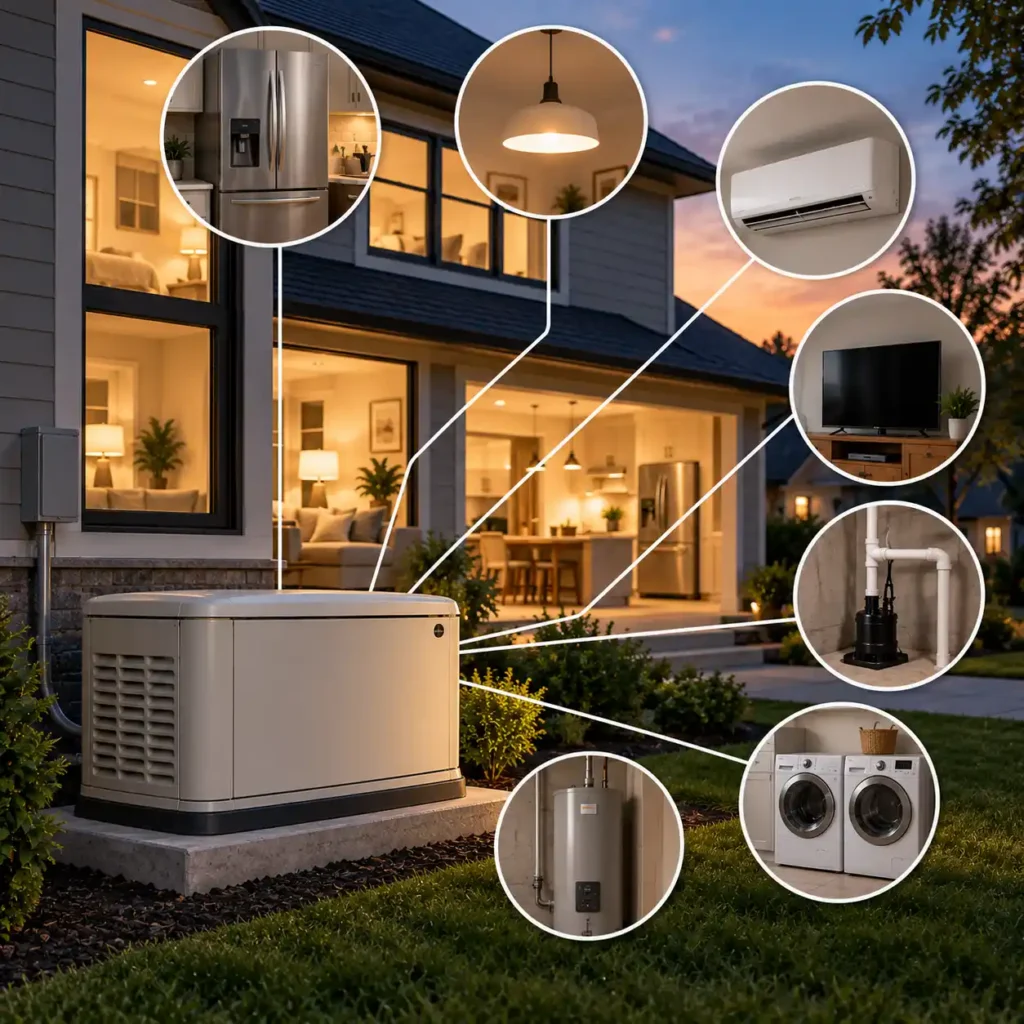
Consider a home where the homeowner wants to maintain essential electrical service during a power outage.
The planned loads are:
- Refrigerator: 700W running / 2,200W starting
- Sump pump: 800W running / 2,000W starting
- Furnace blower: 600W running / 1,800W starting
- Lighting and outlets: 500W running
- Internet equipment: 100W running
- Microwave: 1,000W running
The combined running load is:
700 + 800 + 600 + 500 + 100 + 1,000 = 3,700W
Now calculate the additional startup requirement:
Refrigerator: 2,200 − 700 = 1,500W
Sump pump: 2,000 − 800 = 1,200W
Furnace blower: 1,800 − 600 = 1,200W
The largest additional startup requirement is therefore 1,500W.
The estimated simultaneous peak becomes:
3,700W + 1,500W = 5,200W
With a 20% planning margin:
5,200W × 1.20 = 6,240W
This example suggests looking above the 6kW range, while also checking the generator’s actual running and starting ratings and whether the selected fuel changes its available output.
It is an illustration of the calculation method, not a recommendation to purchase a specific generator.
Generator Size by Home and Load Type
There is no single generator size that is correct for every home. The capacity you need depends on the electrical loads you want to operate, how those loads behave during startup, and whether you want to power essential circuits or most of the home.
A small home with gas appliances may require less generator capacity than a larger home with electric heating, central air conditioning, an electric water heater, or a well pump.
For that reason, the most reliable approach is to calculate the actual electrical loads rather than choose a generator based only on square footage.
What Can a 5,000-Watt Generator Run?
A generator in the 5,000W class can be suitable for a carefully selected group of essential household loads, depending on their running and starting requirements.
For example, it may be possible to operate a refrigerator, lighting, internet equipment, a sump pump, and selected small appliances if their combined demand remains within the generator’s ratings.
However, adding a large air conditioner, electric water heater, or other high-demand appliance can change the calculation substantially.
The generator’s starting-watt capability also matters. A model rated at 5,000W running power may have a higher surge rating, but that additional capacity must still be sufficient for the largest startup event.
What Can a 10,000-Watt Generator Run?
A 10,000W generator provides substantially more capacity for essential loads and selected larger appliances.
Depending on the home’s electrical configuration, this capacity may support combinations such as:
- Refrigerator and freezer
- Lighting and household electronics
- Sump or well pump
- Furnace blower
- Microwave
- Selected kitchen appliances
- Some air-conditioning loads
The actual combination still depends on running watts, starting requirements, voltage, and which loads can operate simultaneously.
A 10,000W generator should therefore not be described as automatically capable of powering an entire home. Whole-home capability depends on the home’s calculated load and the generator’s continuous and surge ratings.
What Can a 15,000-Watt Generator Run?
A generator around 15,000W provides more flexibility for larger homes and more demanding backup configurations.
It may support a broader combination of household loads and can make it easier to operate several essential systems at the same time.
However, high-demand equipment can still exceed the available capacity.
Central air conditioning, electric ranges, electric water heaters, heat pumps, EV chargers, and large pumps should be evaluated individually rather than assumed to fit simply because the generator has a higher wattage rating.
High-Starting-Load Appliances That Can Change Generator Sizing
Some appliances have a disproportionate effect on generator sizing because their startup demand can be much higher than their normal running consumption.
Central Air Conditioners and Heat Pumps
Air-conditioning compressors and heat pumps can create one of the largest startup challenges in a residential backup system.
The important values are not simply the appliance’s advertised operating wattage. Where available, check the equipment’s electrical specifications for starting characteristics such as locked-rotor amperage (LRA) or other manufacturer-provided startup information.
A generator may have enough continuous capacity to operate an air conditioner but still struggle with compressor startup if its surge capability is insufficient.
For larger HVAC systems, professional load assessment and generator compatibility should be considered before selecting a model.
Well Pumps and Sump Pumps
Pumps are another common source of startup demand.
A sump pump may consume relatively modest power while running but require considerably more current when its motor starts. Well pumps can create an even more significant demand depending on motor size and system configuration.
When using a Generator Size Calculator, include the pump’s running requirement and its actual starting requirement whenever those specifications are available.
Refrigerators and Freezers
Refrigerators and freezers usually have modest running loads, but their compressors cycle on and off.
This means two factors matter:
- The compressor’s starting demand.
- Whether the compressor starts while other loads are already operating.
A generator does not need to supply the refrigerator’s startup requirement continuously. It needs enough available capacity to handle the startup event while supporting the loads that are already running.
Generator Fuel and Rated Output

Fuel type can affect generator performance and should be considered when interpreting a sizing result.
Portable and standby generators may be designed to operate on gasoline, propane, natural gas, or multiple fuel types. Some models have different power ratings depending on the fuel being used.
This means a generator that appears large enough based on one rating may not provide the same output on another fuel.
When comparing models, check the manufacturer’s specifications for the rated and starting output on the fuel you actually intend to use.
If fuel flexibility is important, our guide to dual fuel generators covers the advantages and trade-offs of gasoline and propane operation in more detail.
Whole-Home Generator Sizing
Whole-home backup requires a different approach from selecting a generator for a limited group of essential circuits.
The objective is not simply to add the appliances you consider important. You also need to consider the home’s electrical service, large fixed loads, transfer equipment, and the possibility that multiple systems will operate simultaneously.
Why Whole-Home Sizing Is More Complicated
A whole-home system may need to account for loads such as:
- Central air conditioning
- Heat pumps
- Electric water heaters
- Electric ranges
- Clothes dryers
- Well pumps
- Pool equipment
- EV chargers
- Refrigeration
- General lighting and receptacle loads
Some of these loads may be managed automatically so they do not operate simultaneously.
This is where load management can change the required generator capacity. A properly designed system may prioritize essential loads and temporarily disconnect lower-priority equipment when generator capacity is limited.
For homeowners comparing complete backup systems rather than generators alone, our guide to whole-house backup power systems provides a broader look at the equipment and system configurations involved.
When a Professional Load Calculation Is Necessary
A calculator is useful for planning and estimating, but it should not replace a professional electrical assessment when the installation involves a permanent standby generator or complex loads.
Professional evaluation becomes particularly important when the home includes:
- Large central HVAC systems
- Multiple heat pumps
- Electric heating
- Large pumps
- Electric water heating
- EV charging
- Multiple high-demand appliances
- Three-phase or unusual electrical configurations
The final generator selection should account for the actual electrical system, generator specifications, transfer equipment, local requirements, and installation conditions.
Generator Size Calculator vs. Square-Footage Estimates
Square-footage rules can provide a rough starting point, but they are not a substitute for calculating electrical demand.
Two homes with the same floor area can have dramatically different backup-power requirements.
A 2,000-square-foot home with gas heating, gas cooking, and limited electrical loads may require far less generator capacity than a 2,000-square-foot home with electric heating, a heat pump, an electric water heater, and central air conditioning.
For this reason, use square footage only as a broad reference.
A Generator Size Calculator based on actual electrical loads provides a much more useful estimate because it connects generator capacity to the equipment you actually intend to operate.
Common Generator Sizing Mistakes
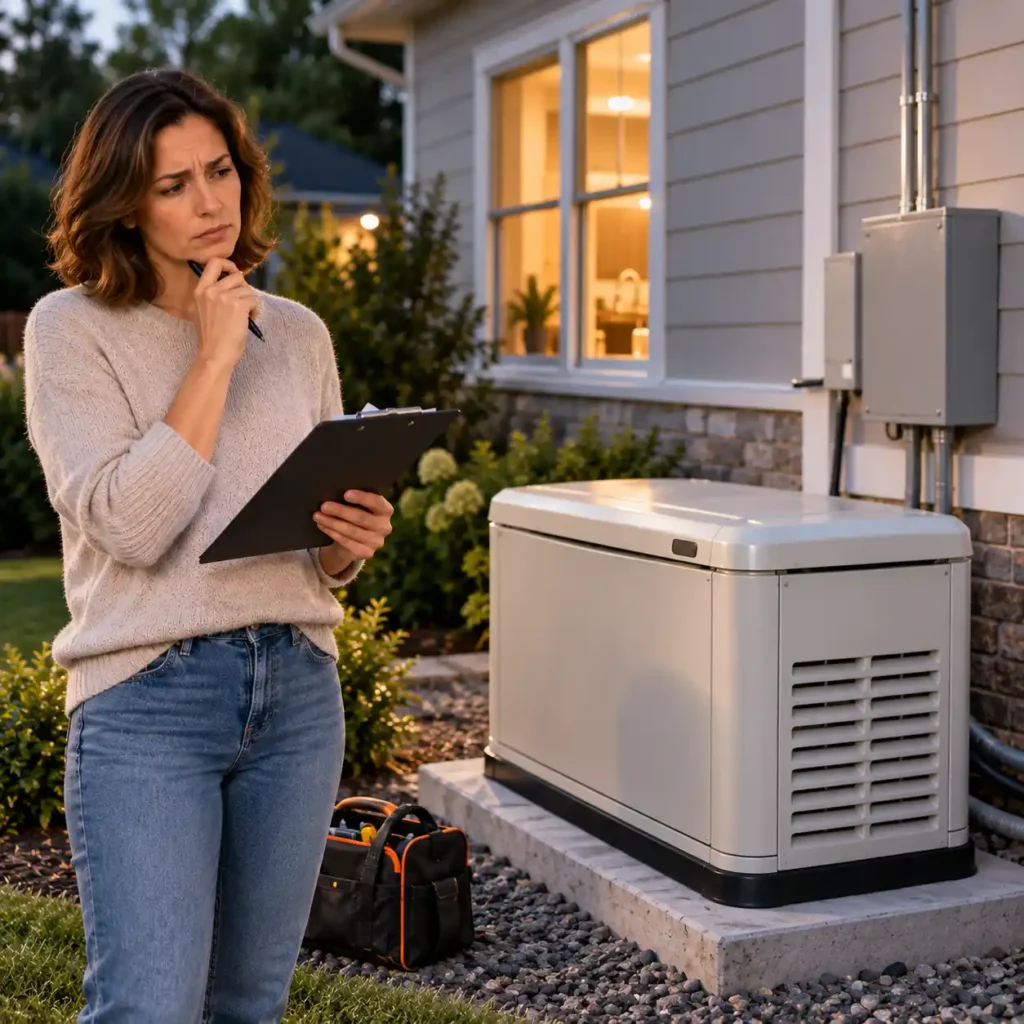
Even a well-designed calculation can produce a poor recommendation if the input assumptions are wrong.
Adding Every Appliance's Starting Watts Together
One of the most common mistakes is adding the full starting wattage of every motor-driven appliance to the total running load.
This can significantly overstate the required capacity.
Instead, identify which loads may operate simultaneously and determine the largest realistic additional startup requirement.
Sizing Only From Running Watts
The opposite mistake is ignoring startup demand entirely.
A generator may have enough continuous capacity for the calculated running load but still fail to start a large compressor or motor.
Both continuous and starting capability need to be checked.
Using Generic Wattage Values for Major Loads
Generic appliance wattage charts are useful for preliminary planning, but major electrical loads should be based on actual specifications whenever possible.
This is especially important for HVAC systems, pumps, compressors, and other motor-driven equipment.
For a broader explanation of appliance loads and electrical demand, see our guide to calculating power consumption.
Choosing a Generator Before Calculating the Load
Starting with a generator model and then trying to determine what it can power can lead to an undersized or unnecessarily expensive system.
Calculate the load first.
Then compare generators against the resulting requirements.
Ignoring Fuel-Specific Ratings
Some generators provide different output ratings depending on fuel.
Always use the rating that corresponds to the fuel you expect to use rather than assuming the highest advertised wattage applies in every operating condition.
How Much Generator Capacity Should You Leave as a Margin?
A small amount of additional capacity can provide useful headroom for normal load variation and unexpected simultaneous demand.
However, there is no universal percentage that applies to every generator installation.
A 20% planning margin is sometimes used in generator-sizing calculators as a practical estimate. The appropriate margin depends on the generator, load profile, operating conditions, and installation design. For example:
5,000W calculated requirement × 1.20 = 6,000W
This should be understood as a planning assumption rather than a mandatory electrical requirement.
The appropriate capacity depends on the generator’s ratings, load characteristics, fuel, installation, and whether load management is being used.
The goal is to avoid operating at the generator’s practical limit under normal conditions while also avoiding excessive oversizing.
What to Check Before Buying a Generator
Once the required capacity has been calculated, the generator itself still needs to pass several checks.
Look at:
- Rated/running wattage
- Starting/surge wattage
- Fuel-specific output
- Voltage and phase
- Transfer-switch compatibility
- Load-management capability
- Fuel availability
- Installation requirements
- Noise and operating environment
- Maintenance requirements
- Warranty and service support
For portable applications, you can compare the calculated requirement with our guide to portable generators.
For permanently installed home backup, compare the result against the specifications of standby generators and the required transfer equipment.
The generator’s wattage is therefore only one part of the purchase decision.
Frequently Asked Questions (FAQ)
Once the required capacity has been calculated, the generator itself still needs to pass several checks.
Look at:
- Rated/running wattage
- Starting/surge wattage
- Fuel-specific output
- Voltage and phase
- Transfer-switch compatibility
- Load-management capability
- Fuel availability
- Installation requirements
- Noise and operating environment
- Maintenance requirements
- Warranty and service support
For portable applications, you can compare the calculated requirement with our guide to portable generators.
For permanently installed home backup, compare the result against the specifications of standby generators and the required transfer equipment.
The generator’s wattage is therefore only one part of the purchase decision.
How do I calculate what size generator I need?
Add the running watts of the appliances and systems you want to operate at the same time, then account for the largest additional starting surge from a motor-driven load. Compare the resulting requirement with the generator’s rated and starting wattage.
How many watts do I need to run my house during a power outage?
The required capacity depends on which loads you want to operate. Essential backup may require only a few thousand watts, while broader whole-home backup with central air conditioning, electric water heating, pumps, and other high-demand equipment can require considerably more.
What is the difference between running watts and starting watts?
Running watts are the power an appliance uses during normal operation. Starting watts are the temporary additional power required by certain motor-driven appliances when they start. Both values can affect generator sizing.
How do I calculate starting watts for a generator?
Identify the appliance with the largest startup requirement and determine how much additional power it needs above its normal running consumption. For example, if a refrigerator uses 700W while running and requires 2,200W to start, its additional starting demand is 1,500W.
Do I add all starting watts together when sizing a generator?
Not usually. A basic sizing calculation should consider the running watts of the loads operating simultaneously plus the largest realistic additional starting surge. Adding every appliance’s full starting wattage can significantly overstate the generator capacity required
What size generator do I need to run a refrigerator, sump pump, and lights?
The answer depends on the actual running and starting requirements of the specific refrigerator and pump. Add the running watts of all three loads and then account for the largest applicable startup surge. Using nameplate or manufacturer specifications produces a more reliable result than generic wattage estimates.
Is a 5,000-watt generator enough for a house?
A 5,000W generator can be suitable for selected essential loads, such as refrigeration, lighting, internet equipment, and some smaller appliances. It may not be sufficient for a broad whole-home load that includes central air conditioning, electric heating, or other high-demand equipment.
How much generator power do I need for central air conditioning?
Central air conditioning can substantially increase generator requirements because compressor startup may create a large temporary demand. Use the air conditioner’s actual electrical specifications and consider what other loads will be operating when the compressor starts.
Can a generator run a well pump and air conditioner at the same time?
Potentially, but the generator must have enough continuous capacity for both loads and enough starting capability to handle the relevant motor startup event. The actual requirements depend on the specific pump, air conditioner, and generator.
Should I add a safety margin when sizing a generator?
Some planning approaches include additional capacity to provide headroom above the calculated load. A margin can be useful, but it should be treated as a planning assumption rather than a universal electrical-code requirement. The appropriate amount depends on the generator, load profile, installation, and operating conditions.
Can I use a generator size calculator instead of an electrician?
A calculator is useful for preliminary planning and comparing generator capacity. However, a permanent standby or whole-home installation may require a professional electrical load calculation that considers the home’s wiring, transfer equipment, fuel system, local requirements, and actual equipment specifications. For a broader look at complete backup configurations, see our guide to whole-home backup power systems.
How do I know if I need a portable or standby generator?
Start with the backup goal rather than the generator type. If you need selected essential loads and portability, a portable generator may be appropriate. If you want automatic, permanently installed backup for a broader portion of the home’s electrical system, a standby generator may be the better configuration.
Generator Size Calculator — Final Takeaway
The most reliable way to size a generator is to start with the electrical loads rather than the generator itself.
Calculate the running watts of the appliances and systems you want to operate, identify the largest realistic starting requirement, and determine which loads may operate simultaneously. Then allow appropriate headroom and verify the generator’s continuous and surge ratings, fuel-specific output, and electrical configuration.
A Generator Size Calculator provides a practical starting point for estimating the capacity you need, but the result should be treated as a planning estimate rather than an instruction to purchase a specific generator.
For permanent whole-home installations, especially those involving large HVAC systems, pumps, electric heating, or other high-demand loads, the final sizing decision should be verified against the home’s electrical system, manufacturer specifications, and applicable installation requirements.