
Choosing the best standby generators for home backup has become more complicated than simply selecting the highest-wattage model. Today’s whole-home standby systems combine automatic backup power, permanently installed equipment, advanced monitoring, and flexible fuel options, giving homeowners more ways to protect their homes during utility outages.
The real challenge is finding a generator that matches your home’s electrical demands rather than paying for capacity you may never use. A smaller standby generator can provide dependable power for essential household circuits, while higher-output systems can support a much larger portion of the home, including demanding appliances and larger electrical loads. The right choice depends on your power requirements, fuel availability, transfer-switch configuration, installation needs, and how much of your home you want to keep operating during an outage.
For this guide, we evaluated five current standby generator options designed for residential backup power: Generac Guardian 26kW, KOHLER RCA 20,000-Watt, Generac 24kW, Generac 14kW, and Generac 18kW. Rather than ranking these systems by generator size alone, we compared the factors that matter most for home backup, including power output, fuel flexibility, automatic transfer capability, monitoring features, installation considerations, expected use, and overall value for different household requirements.
Whether you’re preparing for increasingly frequent power outages, replacing an aging backup system, building a new whole-home backup setup, or simply want automatic protection when the grid goes down, this guide will help you identify the best standby generators for home backup based on your home’s actual needs—not just the biggest number on the specification sheet.
As an Amazon Associate, I earn from qualifying purchases.

Table of Contents
Quick Answer
The best standby generators for home backup provide automatic whole-home or partial-home power without requiring you to manually start a generator when the utility grid fails. Unlike portable generators, standby systems remain permanently installed, connect to the home through an automatic transfer switch, and can start within seconds of detecting an outage.
For most homeowners, the right choice depends less on maximum wattage and more on how much of the home you want to keep running simultaneously. A 14kW standby generator can make sense for households focused on essential circuits and moderate loads, while 18kW to 20kW systems offer more capacity for larger homes and heavier electrical demand. Higher-output 24kW and 26kW models are better suited to homeowners who want greater whole-home coverage and more flexibility when several appliances operate at the same time.
Our five picks cover different approaches to residential standby power. The Generac Guardian 26kW stands out for homeowners who want high output combined with an included transfer switch and Wi-Fi monitoring. The KOHLER RCA 20,000-Watt offers strong air-cooled performance and PowerBoost technology, but its transfer switch must be purchased separately. The Generac 24kW provides another high-capacity whole-home option with a 200-amp automatic transfer switch and cellular capability.
For smaller or more moderate household requirements, the Generac 14kW offers automatic whole-home backup with a 200-amp transfer switch and cellular connectivity, while the Generac 18kW provides a useful middle ground with weather-activated operation and built-in connectivity. All five use natural gas or propane, giving homeowners more flexibility than gasoline-powered portable generators.
The key is to size the generator around your actual electrical loads, transfer-switch configuration, fuel availability, and installation requirements. A larger generator is not automatically the better choice if your home’s electrical service and expected loads do not require the additional capacity.
Why You Can Trust Power Ready Guide
At Power Ready Guide, we focus exclusively on backup power, portable energy, and off-grid power solutions. Our recommendations are based on manufacturer documentation, verified product specifications, configuration-specific product data, safety information, and practical residential use cases.
For standby generators, we use a consistent evaluation framework because these systems involve more than generator wattage. We consider power output, fuel options, automatic transfer capability, monitoring and connectivity, electrical integration, operating characteristics, maintenance requirements, and suitability for different household needs.
We also pay close attention to what is actually included with each product. A standby generator sold with an automatic transfer switch represents a different purchasing proposition from a generator that requires the switch to be purchased separately. The same applies to connectivity features, fuel configuration, and other equipment needed for a complete installation.
Our goal is not to identify the largest or most expensive generator and call it the best. Instead, we compare each system according to the type of homeowner and backup scenario it is best equipped to serve, helping you choose a standby generator that fits your home’s electrical requirements and long-term backup strategy.
How We Evaluated the Best Standby Generators for Home Backup
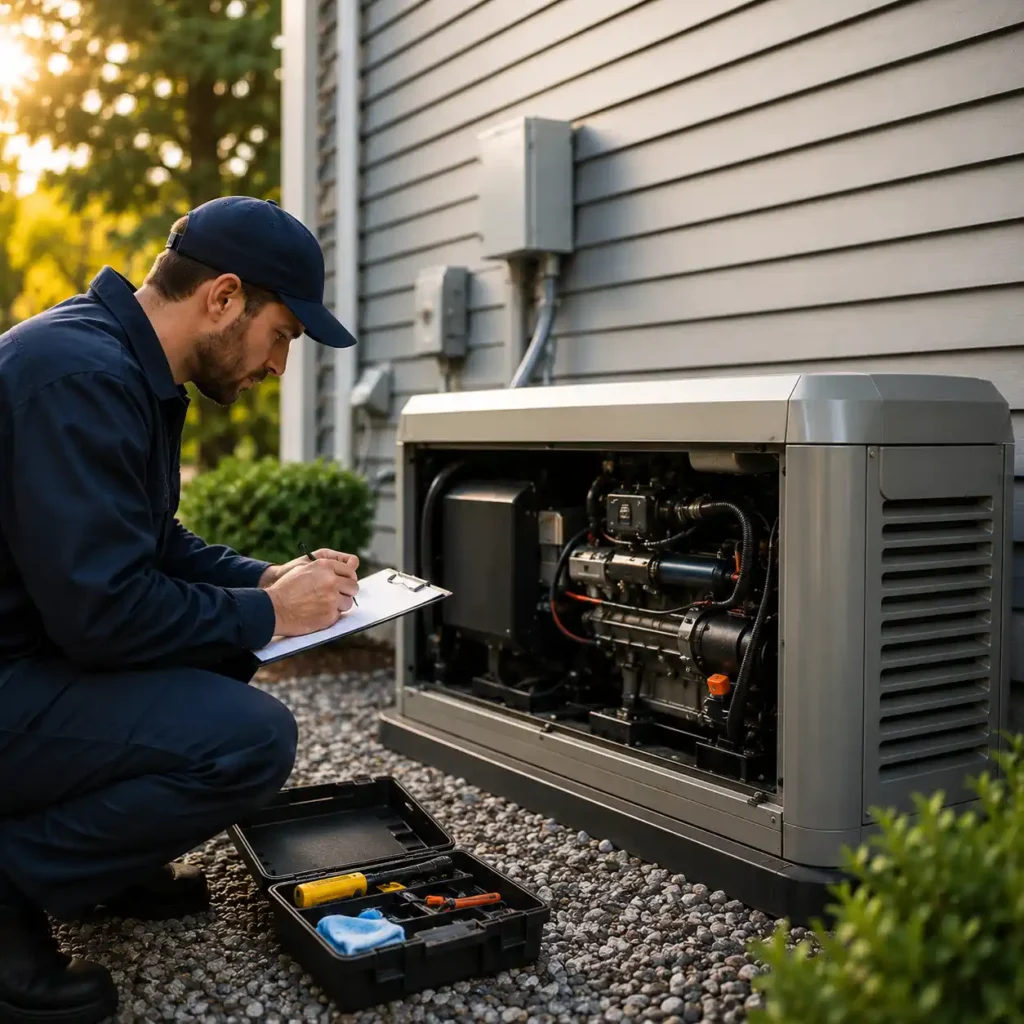
Every standby generator in this guide was researched and assessed using the same editorial framework with emphasis on the factors that directly affect residential backup performance and ownership.
Power output was one of the primary considerations. We looked at generator capacity in relation to the type and number of household loads a system can reasonably support, rather than treating higher wattage as an automatic advantage.
Fuel flexibility was also important. All five selected generators support natural gas or propane, but fuel configuration, availability, and the way a homeowner plans to use the generator can influence which option makes the most sense.
We also evaluated automatic transfer capability and included equipment. A standby generator is part of a larger electrical system, so we considered whether an automatic transfer switch is included with the listed configuration and how that affects the overall setup.
Monitoring and connectivity were considered because modern standby generators increasingly provide remote status information through Wi-Fi or cellular connections. These features can make it easier to monitor generator operation without being physically beside the unit.
Finally, we considered installation requirements, operating characteristics, maintenance, household use cases, and overall value. The goal was to distinguish between generators that look similar on a specification sheet but serve different homeowners particularly well.
This approach allows us to evaluate each generator on its practical role in a home backup system—not simply on its advertised wattage or feature count.
Who This Guide Is For
This guide is designed for homeowners who want automatic backup power without relying on a portable generator during an outage. A permanently installed standby generator can provide a more convenient backup solution for homes where keeping essential electrical systems running is a priority.
It is particularly useful for homeowners who experience frequent or extended utility outages, live in areas affected by severe weather, or simply want a backup system that can operate automatically when grid power fails. Because standby generators remain installed outside the home, they are also a practical choice for people who do not want to store, move, or manually connect a portable generator.
The guide is also intended for homeowners comparing different levels of whole-home coverage. A 14kW system may be appropriate for more moderate electrical requirements, while 18kW, 20kW, 24kW, and 26kW options provide progressively greater capacity for homes with higher simultaneous loads.
Finally, this guide can help homeowners who are comparing Generac and KOHLER standby generators, evaluating automatic transfer-switch configurations, or deciding whether features such as Wi-Fi or cellular monitoring justify choosing one system over another.
Quick Summary: Our Top Picks
Not every standby generator is designed for the same type of home or backup strategy. Some prioritize maximum whole-home capacity, while others focus on power management, automatic transfer capability, connectivity, or providing a practical balance between capacity and cost.
The standby generators below earned their awards based on our assessment of power output, fuel flexibility, automatic transfer capability, monitoring features, included equipment, installation considerations, operating characteristics, and overall long-term value for residential backup power.
Generac Guardian 26kW Home Generator
Award: Best Overall
Why It Won:
The Generac Guardian 26kW offers the strongest overall combination of high power output, automatic home backup capability, fuel flexibility, an included transfer switch, and Wi-Fi monitoring. Its substantial capacity makes it a strong choice for homeowners who want to keep a large portion of their home’s electrical system operating during an outage.
Choose This If:
- You want high-capacity automatic backup for a larger home or heavier electrical loads.
- You want a standby generator with both natural gas and propane capability.
- You prefer a configuration that includes the automatic transfer switch.
- You value built-in Wi-Fi monitoring for easier system management.
Best For:
- Whole-home backup
- Larger electrical loads
- Larger homes
- Homeowners wanting high generator capacity
- Buyers who want an included transfer switch and Wi-Fi monitoring
KOHLER RCA 20,000-Watt Air-Cooled Whole House Generator
Award: Best for Power Management
Why It Won:
The KOHLER RCA combines substantial standby capacity with PowerBoost technology designed to help manage demanding electrical loads. It is particularly interesting for homeowners who want strong performance from an air-cooled system, although the specific configuration reviewed here requires a separate transfer switch.
Choose This If:
- Your home has demanding electrical loads that can benefit from power management.
- You specifically value KOHLER PowerBoost technology.
- You want a 20kW-class standby generator for residential backup.
- You are comfortable purchasing the transfer switch separately.
Best For:
- Homes with demanding electrical loads
- Homeowners who value PowerBoost technology
- Natural gas or propane backup
- Air-cooled standby applications
- Buyers comfortable purchasing the transfer switch separately
Generac 24kW Whole Home Generator
Award: Best High-Capacity Bundle
Why It Won:
The Generac 24kW provides a strong combination of high output, automatic transfer capability, and cellular connectivity. With a 200-amp automatic transfer switch included in this configuration, it is well suited to homeowners looking for a substantial whole-home backup package rather than assembling the major components separately.
Choose This If:
- You need high-capacity backup for substantial household electrical loads.
- You want a 24kW-class standby generator with automatic operation.
- You prefer a package that includes a 200-amp automatic transfer switch.
- You want cellular connectivity for remote monitoring and system awareness.
Best For:
- Larger homes
- High electrical demand
- Whole-home backup
- Buyers wanting a bundled automatic transfer switch
- Homeowners who value cellular connectivity
Generac 14kW Whole Home Generator
Award: Best for Moderate Backup Loads
Why It Won:
The Generac 14kW offers automatic whole-home backup functionality while staying at the lower end of the capacity range represented in this guide. Its 200-amp automatic transfer switch and cellular capability make it a practical option for homeowners whose expected electrical loads do not require a larger 18kW, 20kW, 24kW, or 26kW system.
Choose This If:
- Your home has moderate electrical loads that do not require a larger generator.
- You want automatic standby operation without moving to a higher-capacity system.
- You want a configuration that includes a 200-amp automatic transfer switch.
- You value built-in cellular connectivity for remote monitoring.
Best For:
- Moderate household electrical loads
- Essential home backup
- Smaller or moderately loaded homes
- Homeowners who want automatic operation
- Buyers looking for a lower-capacity standby option
Generac 18kW Whole Home Generator
Award: Best Mid-Range Option
Why It Won:
The Generac 18kW occupies a useful middle position between moderate-capacity and higher-output standby generators. Natural gas or propane operation, weather-activated backup, and built-in connectivity give it a practical feature set for homeowners who want more capacity than a 14kW system without necessarily moving to a 20kW-plus generator.
Choose This If:
- You need more capacity than a 14kW standby generator provides.
- Your household loads fall between moderate and high electrical demand.
- You want natural gas or propane fuel flexibility.
- You value built-in cellular and Wi-Fi/Bluetooth connectivity.
Best For:
- Mid-sized household loads
- Homes needing more capacity than 14kW
- Natural gas or propane backup
- Automatic home backup
- Buyers who value cellular connectivity
Still deciding which standby generator is right for your home? The detailed reviews below explain where each model excels, who it is best suited for, what equipment is included with the specific configuration, and where its limitations matter, helping you choose the best standby generator for home backup for your specific requirements.
Best Standby Generators for Home Backup Compared
The table below provides a side-by-side comparison of the five standby generators featured in this guide. While all of them are designed for residential backup power, they differ in power output, fuel options, transfer-switch configuration, monitoring capabilities, and intended use. Comparing these key specifications can help you quickly narrow down the generator that best fits your home’s backup requirements before reading the detailed reviews.
| Standby Generator | Power Output | Fuel | Transfer Switch | Monitoring |
|---|---|---|---|---|
| Generac Guardian 26kW | 26kW | Natural Gas / Propane | Included | Wi-Fi |
| KOHLER RCA 20,000-Watt | 20kW | Natural Gas / Propane | Not Included | Remote Monitoring |
| Generac 24kW Whole Home | 24kW | Natural Gas / Propane | 200A Included | Cellular |
| Generac 14kW Whole Home | 14kW | Natural Gas / Propane | 200A Included | Cellular |
| Generac 18kW Whole Home | 18kW | Natural Gas / Propane | Not Included | Cellular |
While comparing specifications is an important first step, choosing a standby generator ultimately depends on more than power output alone. The transfer-switch configuration, fuel availability, monitoring capabilities, installation requirements, and the amount of electrical load you expect to run simultaneously can make a significant difference. In the detailed reviews below, we’ll explain the strengths, limitations, and ideal use case for each generator to help you choose the right standby system for your home.
The Best Standby Generators for Home Backup Reviewed
Generac Guardian 26kW Home Generator
Best Overall Standby Generator for Home Backup

Quick Verdict
The Generac Guardian 26kW Home Generator earns our Best Overall recommendation because it combines high standby power, automatic whole-home backup capability, flexible fuel operation, an included 200-amp transfer switch, and built-in Wi-Fi monitoring in one complete package.
With 26,000 watts of LP output and 22,500 watts on natural gas, the Guardian is positioned for homeowners who want substantial electrical capacity rather than a generator limited to a smaller group of essential circuits. Its 999cc G-Force engine and 230 LRA starting capability are designed to handle demanding household loads, while Generac’s True Power technology keeps total harmonic distortion below 5%, making the system suitable for sensitive electronics and modern appliances.
The included 200-amp whole-house transfer switch is particularly important because this specific configuration is designed as a more complete backup package rather than a generator that leaves the homeowner to source the transfer equipment separately. When properly installed, the automatic transfer system detects a utility outage, starts the generator, and transfers the home’s electrical load to generator power.
What makes the Guardian especially compelling for long-term ownership is the combination of automatic operation and remote visibility. Mobile Link Wi-Fi monitoring allows homeowners to check generator status and maintenance information remotely, while Quiet-Test mode reduces engine speed during routine exercise cycles to limit noise and fuel consumption. The aluminum enclosure is designed for outdoor installation, and Generac backs the system with a 5-year limited warranty.
For homeowners who want a powerful permanently installed generator capable of supporting a substantial portion of the home during an outage—and prefer having the transfer switch included—the Generac Guardian 26kW is the strongest all-around choice in this guide.
Product Snapshot
| Specification | Generac Guardian 26kW |
|---|---|
| Model | 7291 / G007291 |
| Power Output | 26,000W LP / 22,500W Natural Gas |
| Fuel | Natural Gas or Liquid Propane |
| Transfer Switch | 200A Whole House Switch Included |
| Monitoring | Wi-Fi / Mobile Link |
| Engine | Generac G-Force 1000, 999cc |
| Enclosure | Aluminum |
| Warranty | 5-Year Limited |
Why We Chose It
Choosing the best standby generator for home backup requires looking beyond the headline wattage. A generator has to work as part of a permanent electrical system, and the details surrounding transfer equipment, fuel, starting performance, monitoring, and maintenance can be just as important as its rated output.
The Guardian 26kW stands out because it brings those pieces together particularly well. Its 26kW LP rating and 22.5kW natural-gas rating provide substantial capacity for homes with significant electrical demand, while the generator’s 230 LRA starting capability is designed to help with large motor-driven loads. That makes the system more appropriate for homeowners who do not want to micromanage which appliances can operate during an outage.
The 200-amp whole-house transfer-switch configuration is another major reason this model takes the top position. Instead of evaluating the generator separately from the equipment needed to connect it to the home’s electrical system, buyers of this configuration are getting a package built around whole-house automatic transfer. That distinction becomes important when comparing it with generator-only configurations elsewhere in this guide.
We also value the fact that the Guardian is designed for ownership between outages, not just for the moment an outage occurs. Mobile Link provides remote status and maintenance information, while the Evolution controller provides local system information. Quiet-Test mode exercises the generator at a lower engine speed, and the aluminum enclosure is intended to withstand outdoor conditions.
The result is a standby system that makes sense for homeowners who prioritize capacity, automation, integrated equipment, and remote monitoring over minimizing the initial size of the generator.
Check the latest price and customer reviews on Amazon.

Living With It
A 26kW standby generator changes the experience of a power outage because the homeowner does not have to build an emergency power routine around a portable machine. Once the system has been professionally installed and configured, the generator remains in place and is ready to respond automatically when utility power disappears.
Imagine a summer storm taking down the local grid while your home’s air conditioning, refrigerator, internet equipment, lighting, and other major electrical loads are operating. Instead of moving a generator into position, connecting extension cords, and deciding which appliances must be switched off, the Guardian is designed to detect the outage and work with its automatic transfer switch to restore generator power to the home’s electrical system.
The high output also gives this model a different character from smaller standby generators. 26kW on propane provides considerable headroom for simultaneous household loads, while the natural-gas rating remains a substantial 22.5kW. That does not mean every home should automatically choose a 26kW generator—the electrical service, load profile, and installation design still determine the appropriate size—but it gives the Guardian considerable flexibility for demanding homes.
Remote monitoring adds another layer of convenience. With Mobile Link, homeowners can check operating status and maintenance information without standing next to the generator. For a system whose main purpose is to remain ready for an event that may happen months after its last outage, that visibility is genuinely useful.
The trade-off is straightforward: this is a substantial permanently installed system, not a compact backup appliance. It requires professional installation, appropriate fuel connections, electrical integration, and adequate outdoor space. But for homeowners who are comfortable making that commitment, the Guardian delivers the kind of set-it-up-and-be-ready experience that defines the standby-generator category.
Generac Guardian 26kW Evaluation
| Evaluation Category | Editorial Assessment |
|---|---|
| Overall Value | Excellent combination of high output, included whole-house transfer equipment, monitoring, and long-term standby functionality. |
| Power Performance | 26kW on LP and 22.5kW on natural gas provide substantial capacity for demanding residential loads. |
| Automatic Backup | The included 200A whole-house transfer switch supports automatic utility-to-generator power transfer when properly installed. |
| Monitoring & Convenience | Mobile Link Wi-Fi monitoring, Evolution controls, and Quiet-Test mode make ongoing ownership easier to manage. |
| Overall Rating | Our Best Overall recommendation for homeowners seeking high-capacity automatic whole-home backup. |
Who Should Buy This
- Homeowners who want high-capacity automatic whole-home backup rather than a portable generator.
- Households with substantial simultaneous electrical loads, including large appliances and HVAC equipment.
- Buyers who want a 200-amp whole-house transfer switch included with the generator configuration.
- Homeowners who value remote generator monitoring through Wi-Fi and Mobile Link.
- Buyers looking for a long-term standby system with natural-gas or propane operation and a 5-year limited warranty.
Who Should Skip This
- Homeowners whose electrical requirements can be comfortably covered by a substantially smaller standby generator.
- Buyers looking for a portable backup solution they can move between locations.
- Anyone unwilling to undertake the professional installation and fuel/electrical work required for a permanently installed standby system.
- Buyers primarily focused on minimizing the initial equipment cost rather than maximizing whole-home capacity.
- Households without an appropriate natural-gas or propane installation option.
Final Verdict
The Generac Guardian 26kW earns our Best Overall award because it brings together the elements that matter most in a high-capacity home standby system: substantial output, automatic whole-house transfer, dual-fuel capability, remote monitoring, and a durable outdoor enclosure.
Its 26kW LP capacity gives it a clear advantage for demanding homes, while the 22.5kW natural-gas rating remains strong enough for substantial residential loads. The included 200-amp transfer switch also makes this particular configuration more complete than generator-only alternatives.
It is not the right choice simply because it is the largest generator in this guide. Homeowners should still size a standby system around actual electrical demand and installation requirements. But when the goal is a powerful, automated system with enough capacity to support a large portion of the home, the Guardian 26kW makes a compelling case.
If you want one permanently installed standby generator that combines high power, automatic whole-home backup, flexible fuel, integrated transfer equipment, and remote monitoring, the Generac Guardian 26kW is our Best Overall recommendation.
Check the latest price and customer reviews on Amazon.
Related Guide: If you are comparing the electrical equipment required to connect a backup generator to your home’s electrical system, our Best Transfer Switches for Generators (2026) guide explains the different transfer-switch options and what to consider before installation.
KOHLER RCA 20,000-Watt Air-Cooled Whole House Generator
Best for Power Management

Quick Verdict
The KOHLER RCA 20,000-Watt Air-Cooled Whole House Generator earns our Best for Power Management recommendation because its strongest advantage is not simply the 20kW output—it is the way KOHLER combines substantial standby capacity with PowerBoost technology for demanding startup loads.
The 20RCA-QS206 delivers 20,000 watts on liquid propane and 18,000 watts on natural gas, giving homeowners a meaningful amount of capacity for central air conditioning, major appliances, electronics, and other household loads. Its KOHLER Command PRO 999cc V-twin engine is built specifically for this generator platform, while advanced voltage and frequency regulation are designed to provide stable power for household electronics.
The feature that makes this model particularly interesting is PowerBoost technology. Rather than evaluating the generator only by its continuous wattage, PowerBoost is designed to help start large loads such as a central air conditioner without causing the other connected appliances and electronics to lose power. That makes the RCA especially attractive for homes where motor-driven equipment creates significant startup demand.
The generator also automatically restores power in approximately 10 seconds when paired with the appropriate transfer equipment, and OnCue Plus remote monitoring provides access to generator status from a smartphone, tablet, or computer. The corrosion-resistant aluminum enclosure and 70 dB operating rating further reinforce its suitability as a permanently installed residential system.
One important consideration is the configuration itself: the 20RCA-QS206 listed here does not include a transfer switch. The transfer equipment therefore needs to be selected and purchased separately as part of the installation.
For homeowners who care about handling demanding electrical loads intelligently and want the additional flexibility of PowerBoost, the KOHLER RCA 20,000-Watt is one of the most compelling choices in this guide.
Product Snapshot
| Specification | KOHLER RCA 20,000-Watt |
|---|---|
| Model | 20RCA-QS206 |
| Power Output | 20,000W LP / 18,000W Natural Gas |
| Fuel | Natural Gas or Liquid Propane |
| Transfer Switch | Not Included |
| Load Management | PowerBoost Technology |
| Monitoring | OnCue Plus Remote Monitoring |
| Engine | KOHLER Command PRO CH1000, 999cc V-Twin |
| Operating Noise | 70 dB |
| Enclosure | Corrosion-Proof Aluminum |
| Warranty | 5-Year / 2,000-Hour Limited |
Why We Chose It
The KOHLER RCA takes a different approach to residential standby performance than a simple wattage comparison suggests. A 20kW generator has enough continuous capacity to support substantial household demand, but real homes do not consume electricity in perfectly predictable increments. Air conditioners, pumps, compressors, and other motor-driven equipment can create short but significant starting demands.
That is where PowerBoost becomes particularly relevant. KOHLER specifically designed the system to help start large loads, including central air conditioners, without dropping power to other connected appliances and electronics. For a homeowner with a central HVAC system or other equipment with substantial starting requirements, that can be more meaningful than simply moving to a generator with a higher headline wattage.
Fuel flexibility adds another practical advantage. The RCA produces 20kW on propane and 18kW on natural gas, and the system can be switched between those fuel sources in the field. This gives homeowners an additional layer of flexibility when planning long-duration backup power around the fuel infrastructure already available at the property.
We also like the balance between automatic operation and remote visibility. When properly integrated with a compatible transfer switch, the generator is designed to restore power in approximately 10 seconds, while OnCue Plus provides remote status information through connected devices. That combination means the homeowner can treat the generator as a permanent part of the home’s electrical infrastructure rather than a piece of emergency equipment that requires constant attention.
The important limitation is the transfer-switch configuration. The specific 20RCA-QS206 listing does not include additional equipment, and its specifications show no transfer-switch amperage. Buyers therefore need to account for a compatible transfer switch and professional installation when calculating the complete project cost.
That distinction keeps the RCA from being our easiest all-in-one package recommendation, but it does not diminish its strengths as a generator. Its combination of PowerBoost, dual-fuel capability, substantial output, remote monitoring, and a corrosion-resistant aluminum enclosure makes it particularly well suited to homes where load behavior matters as much as raw generator capacity.
Check the latest price and customer reviews on Amazon
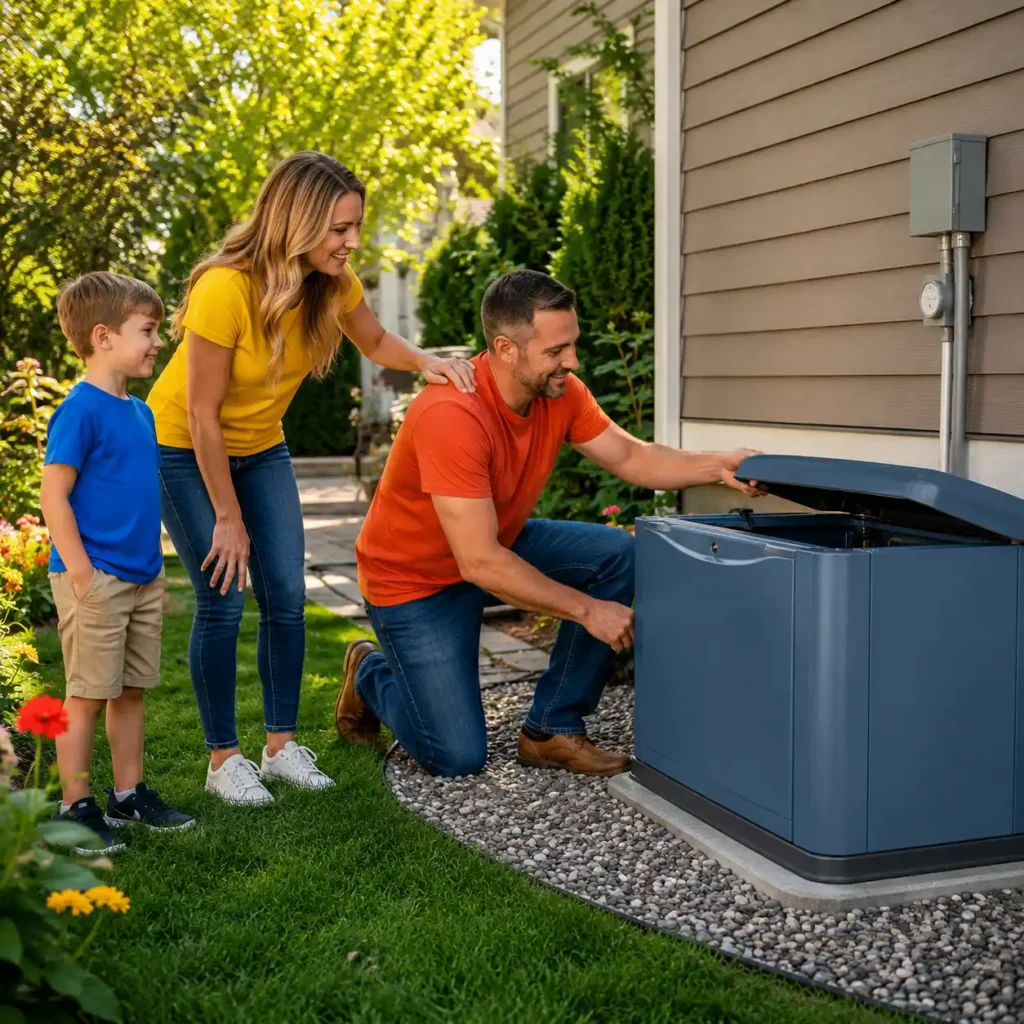
Living With It
The real advantage of the KOHLER RCA becomes easier to understand in a home where several demanding systems may need to operate at the same time.
Consider a hot summer afternoon when the utility power fails. The central air conditioner needs a strong startup, the refrigerator is already running, the internet equipment remains active, and several household electronics are connected. Instead of treating each appliance as an isolated load, the generator has to cope with the combined electrical demand and the momentary surge created when larger equipment starts.
The RCA’s PowerBoost technology is designed specifically for this type of situation. KOHLER states that it can provide the power needed to start large loads such as central air conditioning without dropping power to other major appliances and electronics.
Once the generator is operating, the 20kW propane or 18kW natural-gas output provides substantial continuous capacity for residential loads. The exact amount of equipment a home can run simultaneously still depends on the home’s electrical design and load profile, so the generator should be correctly sized rather than chosen solely by house size. But for a household with meaningful HVAC and appliance demand, this capacity provides a useful amount of headroom.
There is also a convenience factor that becomes noticeable over longer ownership. OnCue Plus allows homeowners to check generator status remotely, while the built-in controller provides local system information. Instead of discovering a problem only when the next outage occurs, remote monitoring can make it easier to keep track of the system between emergencies.
The physical design is equally suited to permanent installation. The corrosion-proof aluminum enclosure measures 47 inches long by 26.2 inches wide, and KOHLER describes the unit as capable of installation as close as 18 inches from the home when local requirements and installation conditions allow. Its listed operating volume is 70 dB, putting it in the range of a substantial outdoor mechanical appliance rather than a silent backup system.
The main thing owners need to plan for is the transfer equipment. Because this particular configuration does not include a transfer switch, the generator itself is only one component of the finished backup system. That makes the RCA particularly suitable for buyers who are planning the electrical installation carefully rather than looking for the simplest pre-bundled package.
KOHLER RCA 20,000-Watt Evaluation
| Evaluation Category | Editorial Assessment |
|---|---|
| Overall Value | Strong combination of 20kW LP output, dual-fuel capability, PowerBoost technology, remote monitoring, and durable outdoor construction. |
| Power Management | PowerBoost is designed to help start large loads such as central air conditioning without interrupting power to other connected loads. |
| Automatic Backup | Designed to restore power in approximately 10 seconds when paired with compatible transfer equipment and properly installed. |
| Monitoring & Convenience | OnCue Plus remote monitoring and the integrated controller provide useful visibility into generator operation and status. |
| Overall Rating | Our Best for Power Management recommendation for homeowners with demanding electrical loads and a carefully planned installation. |
Who Should Buy This
- Homeowners with central air conditioning or other demanding motor-driven loads.
- Buyers who value PowerBoost technology for managing substantial startup demands.
- Households looking for a dual-fuel standby generator with natural gas or propane capability.
- Homeowners who want remote generator monitoring through OnCue Plus.
- Buyers planning a permanent installation and willing to purchase a compatible transfer switch separately.
Who Should Skip This
- Buyers who specifically want a generator package with the transfer switch already included.
- Homeowners whose electrical requirements can be comfortably handled by a smaller standby generator.
- Buyers looking for a portable backup solution rather than permanently installed equipment.
- Anyone who does not have access to a suitable natural-gas or propane supply.
- Homeowners unwilling to account for the additional equipment and installation required to complete the standby system.
Final Verdict
The KOHLER RCA 20,000-Watt Air-Cooled Whole House Generator stands out because it approaches standby power from the perspective of real electrical load management rather than wattage alone.
Its PowerBoost technology, 20kW propane output, 18kW natural-gas output, automatic outage response, and OnCue Plus remote monitoring give it a strong feature set for demanding residential applications. The corrosion-proof aluminum enclosure and 5-year/2,000-hour limited warranty also make it well suited to long-term outdoor installation.
The transfer-switch issue is the principal consideration. The specific 20RCA-QS206 configuration does not include a transfer switch, so buyers need to factor compatible transfer equipment and professional installation into the complete system.
That limitation aside, this is an excellent choice for homeowners who want a substantial standby generator and have electrical loads where starting performance matters. If PowerBoost and intelligent handling of demanding loads are more important to you than buying the simplest bundled package, the KOHLER RCA 20,000-Watt is our Best for Power Management pick.
Check the latest price and customer reviews on Amazon
Related Guide: If you want to determine how much electrical capacity your home actually needs before choosing a standby generator, our How to Calculate Power Consumption (Complete Guide + Free Calculator) guide explains how to identify household loads and estimate your total power requirements.
Generac 24kW Whole Home Generator
Best High-Capacity Bundle

Quick Verdict
The Generac 24kW Whole Home Generator earns our Best High-Capacity Bundle recommendation because it combines substantial standby capacity with a 200-amp automatic transfer switch and built-in cellular connectivity in the configuration featured here. It is designed for homeowners who want a powerful permanent backup system without having to assemble the core generator and transfer equipment separately.
The Model 7326 produces 24kW on liquid propane and 22.5kW on natural gas, giving it enough capacity for homes with significant electrical demand. Its 997cc G-Force engine, automatic voltage regulation, and True Power technology are designed to provide stable power while supporting demanding residential loads.
What makes this particular configuration especially practical is the included 200-amp service-rated automatic transfer switch. The switch is matched to the generator system and is designed to automatically transfer the home from utility power to generator power when an outage occurs. For homeowners planning whole-home backup, having this equipment included can simplify the purchasing decision and reduce the need to source a compatible transfer switch separately.
The connectivity package is another strong point. Mobile Link cellular connectivity is standard, with Wi-Fi and Bluetooth capabilities also supported, allowing homeowners to check generator status, maintenance information, and readiness remotely. Generac also includes Smart Exercise technology and a sound-attenuated enclosure, while the system carries a 5-year limited warranty.
For homeowners who want a high-output standby generator with the major transfer equipment already included and prefer remote visibility into the system, the Generac 24kW is one of the most complete options in this guide.
Product Snapshot
| Specification | Generac 24kW Whole Home |
|---|---|
| Model | 7326 / G007326 |
| Power Output | 24,000W LP / 22,500W Natural Gas |
| Fuel | Natural Gas or Liquid Propane |
| Transfer Switch | 200A Automatic Transfer Switch Included |
| Monitoring | Mobile Link Cellular / Wi-Fi / Bluetooth |
| Engine | Generac G-Force 1000 Series, 997cc |
| Voltage | 240V, Single Phase |
| Enclosure | Sound-Attenuated Aluminum |
| Warranty | 5-Year Limited |
Why We Chose It
A high-capacity standby generator becomes considerably more useful when the equipment surrounding it is treated as part of the same system. That is the main reason the Generac 24kW occupies this position in our ranking.
The Model 7326 provides 24kW of LP output and 22.5kW on natural gas, placing it firmly in the high-capacity category without moving all the way to the 26kW model above it. For a homeowner whose electrical requirements are substantial but who does not necessarily need the additional capacity of the largest option in this guide, that makes the 24kW configuration a particularly logical middle ground.
The 200-amp automatic transfer switch is arguably the most important practical advantage of this particular configuration. Generac’s specifications identify Model 7326 as one of the 24kW configurations available with a 200-amp service-rated transfer switch. That means the homeowner can evaluate the generator as a more complete backup-power package rather than treating the transfer equipment as a separate purchase.
We also give this model credit for its approach to remote monitoring. Mobile Link cellular connectivity is standard on this generation of Generac air-cooled standby systems, and the platform can provide operating status, maintenance alerts, and generator-readiness information remotely. Wi-Fi and Bluetooth capabilities add additional connectivity options.
Power quality is another consideration for a permanently installed home system. Generac’s True Power technology is designed to provide less than 5% total harmonic distortion, while solid-state voltage regulation is specified at ±1%. Those features are particularly relevant in homes filled with modern electronics, variable-speed HVAC equipment, and other electronically controlled appliances.
Taken together, these features make the 24kW configuration more than simply another large generator. Its real strength is the combination of capacity, integrated transfer equipment, and connected monitoring, which is why we consider it the strongest high-capacity bundled option in this group.
Check the latest price and customer reviews on Amazon.

Living With It
The appeal of the Generac 24kW is most obvious when an outage becomes a household-wide problem rather than an isolated inconvenience.
Picture a winter storm that interrupts utility service while the home is occupied normally. Heating equipment is running, the refrigerator and freezer remain active, lights are on, computers and networking equipment are connected, and several other appliances are drawing power. The homeowner does not want to create an emergency checklist every time the electricity disappears.
A properly installed standby system is designed to handle that transition automatically. The 200-amp transfer switch separates the home’s electrical system from utility power and transfers the appropriate load to generator power when the generator is ready. This is fundamentally different from the manual setup required by a portable generator.
The 24kW output also gives the system meaningful headroom. On propane, the generator is rated for 24,000 watts, while natural-gas operation provides 22,500 watts. Actual household coverage depends on the home’s electrical loads, service configuration, and installation design, so those numbers should not be interpreted as a guarantee that every appliance can operate simultaneously. They do, however, place this model comfortably among the higher-capacity residential standby options.
Another advantage becomes apparent when the outage is over. The generator is not something that needs to be physically moved back into storage or manually disconnected. It remains installed and periodically exercises itself to maintain readiness. With Mobile Link, homeowners can also check the system remotely, which is useful when the property is unattended or when an outage occurs while nobody is at home.
The physical footprint is substantial, at roughly 46.4 inches long by 26.3 inches wide and 30.7 inches high, with a listed weight of approximately 461 pounds. This is equipment intended for a permanent outdoor installation, so adequate space, fuel supply, electrical integration, and compliance with local installation requirements all need to be considered before purchase.
For the right home, that permanence is exactly the advantage. Once professionally installed, the 24kW system is designed to remain ready in the background until the next interruption occurs.
Generac 24kW Whole Home Evaluation
| Evaluation Category | Editorial Assessment |
|---|---|
| Overall Value | Strong high-capacity package combining substantial output, a 200A automatic transfer switch, and connected monitoring. |
| Power Performance | 24kW on LP and 22.5kW on natural gas provide substantial capacity for demanding residential loads. |
| System Integration | The included 200A automatic transfer switch makes this configuration a more complete whole-home backup package. |
| Monitoring & Convenience | Mobile Link cellular connectivity with Wi-Fi and Bluetooth capabilities provides useful remote visibility and maintenance information. |
| Overall Rating | Our Best High-Capacity Bundle recommendation for homeowners seeking substantial automatic backup with integrated transfer equipment. |
Who Should Buy This
- Homeowners who want high-capacity automatic whole-home backup.
- Buyers who prefer a generator configuration with a 200-amp automatic transfer switch included.
- Households with substantial simultaneous electrical loads.
- Homeowners who want cellular-based remote monitoring without relying exclusively on a local connection.
- Buyers choosing between natural gas and propane for a permanently installed backup system.
Who Should Skip This
- Homeowners whose actual electrical requirements are comfortably below the 24kW capacity class.
- Buyers looking for a portable generator that can be moved between properties.
- Homeowners who do not need a 200-amp whole-home backup configuration.
- Buyers who want the smallest possible standby system or are primarily focused on minimizing installation requirements.
- Properties where the required fuel, electrical service, or installation space is not available.
Final Verdict
The Generac 24kW Whole Home Generator earns its Best High-Capacity Bundle award by combining three things that are particularly valuable in a permanent home backup system: substantial power, integrated transfer equipment, and remote connectivity.
With 24kW on propane and 22.5kW on natural gas, it provides considerable electrical capacity, while the included 200-amp automatic transfer switch makes the configuration more complete than a generator-only purchase. Mobile Link cellular connectivity adds another practical advantage by allowing homeowners to monitor generator readiness and maintenance remotely.
The 24kW model is not automatically the right choice for every home. Generator sizing should be based on the home’s actual electrical demand and installation requirements rather than simply selecting the largest capacity available. But for homeowners who need substantial backup power and want the major transfer equipment included, this configuration offers a particularly well-balanced solution.
If your priority is a powerful, permanently installed standby system with a 200-amp transfer switch and connected monitoring already integrated into the package, the Generac 24kW Whole Home Generator is our Best High-Capacity Bundle recommendation.
Check the latest price and customer reviews on Amazon.
Related Guide: If you’re comparing different technologies for whole-home backup, our Best Home Battery Backup Systems (2026) guide explores battery-based alternatives and can help you evaluate whether a standby generator or home battery system better fits your backup power needs.
Generac 14kW Whole Home Generator
Best for Moderate Backup Loads
Quick Verdict
The Generac 14kW Whole Home Generator is a practical choice for homeowners who want automatic standby power without moving into the higher-capacity 18kW, 20kW, 24kW, or 26kW class. This Model 7323 configuration combines 14,000 watts of standby power, natural gas or liquid propane operation, a 200A automatic transfer switch, and built-in cellular connectivity with Wi-Fi and Bluetooth capabilities. That combination gives it the core features expected from a modern permanently installed home backup system while keeping its capacity below the larger generators in this guide.
Its lower output is not a weakness for every home. For households with a well-defined electrical load profile, 14kW can provide enough capacity for essential systems and commonly used appliances while keeping the generator smaller than the high-output alternatives in this guide. The 200A automatic transfer switch is included with this configuration, so homeowners do not have to source the major switching component separately as they would with generator-only configurations. The system can operate automatically when utility power fails, making it a more convenient solution than a portable generator that must be moved, connected, and started manually.
The main consideration is whether 14kW is enough for your home’s actual simultaneous electrical demand. This model makes the most sense for moderate household loads rather than homes that routinely run several high-demand systems at the same time. For homeowners whose load calculation fits within its capacity, however, the combination of automatic operation, dual-fuel capability, included transfer equipment, and connected monitoring makes the Generac 14kW a strong lower-capacity standby option.
Product Snapshot
| Specification | Generac 14kW Whole Home Generator |
|---|---|
| Model | 7323 / G0073230 |
| Power Output | 14,000W LP / 14,000W Natural Gas |
| Fuel | Natural Gas or Liquid Propane |
| Transfer Switch | 200A Automatic Transfer Switch Included |
| Monitoring | Cellular / Wi-Fi / Bluetooth |
| Engine | Generac G-Force 800 Series, 817cc |
| Voltage | 240V, Single Phase |
| Operating Noise | 65 dB at Normal Load |
| Enclosure | Aluminum |
| Warranty | 5-Year Limited |
Why We Chose It
The 14kW model earned its place in this guide because it approaches standby power from a different angle than the larger generators above it. Instead of competing directly with the 24kW and 26kW models on maximum output, it targets homeowners whose electrical requirements can be covered with a more moderate-capacity system.
The 200A automatic transfer switch is included with this configuration, which simplifies the major equipment list for a whole-home installation. The generator also produces 14kW on both natural gas and propane, giving homeowners flexibility when choosing the available fuel source.
Another advantage is the connected monitoring system. Built-in cellular connectivity works with Generac’s Mobile Link platform, while Wi-Fi and Bluetooth capabilities provide additional connectivity options. This is useful for a permanently installed generator because homeowners can check system information without needing to be beside the equipment.
For homeowners whose load calculation points toward a 14kW requirement, this combination makes the Generac 7323 a particularly sensible lower-capacity standby option.
Safety Note: Generac issued a 2025 safety action affecting certain Next Generation home standby generators, including model G0073230. The action concerns a potential fuel-system issue that could result in a fuel leak. Before purchasing or installing this model, verify the generator’s serial number and current safety-action status with Generac. If your unit is affected, follow Generac’s instructions for inspection and repair by an authorized service provider.
Check the latest price and customer reviews on Amazon.

Living With It
The practical strength of a 14kW standby generator becomes clearer during a typical utility outage. Once the grid fails, the automatic transfer system is designed to move the home’s electrical supply to generator power without requiring the homeowner to wheel equipment outside, connect cables, or manually start an engine.
For a household with moderate electrical demand, 14kW can support a useful collection of everyday loads. Refrigeration, lighting, communications equipment, heating or cooling equipment, and other essential circuits can remain available, provided the home’s actual load calculation and electrical configuration are appropriate for the generator’s capacity.
Fuel flexibility is another advantage. Because the Model 7323 can operate on natural gas or liquid propane, homeowners can work with the fuel source that best fits the property and local installation conditions. The generator’s 817cc G-Force 800 Series engine and 65 dB normal operating noise place it firmly in the residential standby category rather than the heavier-duty, higher-output segment represented by the larger models in this guide.
The built-in cellular connection is particularly useful for a system that may sit untouched for months between outages. Mobile Link allows homeowners to monitor generator status remotely, while the system can also provide diagnostic and maintenance information.
The important limitation is capacity. A 14kW generator should not be selected simply because the advertised phrase “whole home” sounds sufficient. Homes with multiple large HVAC systems, EV charging, pool equipment, electric heating, or other substantial simultaneous loads may require a larger generator. A professional load calculation remains the right way to determine whether 14kW is adequate.
Evaluation
| Evaluation Category | Editorial Assessment |
|---|---|
| Overall Value | A practical standby package for homeowners whose electrical requirements fit within a 14kW capacity, with a 200A automatic transfer switch included. |
| Power Performance | 14kW on both natural gas and liquid propane provides useful capacity for moderate residential backup loads. |
| System Integration | The included 200A automatic transfer switch makes this configuration a more complete whole-home backup package. |
| Monitoring & Convenience | Built-in cellular connectivity with Wi-Fi and Bluetooth capabilities provides remote access to generator status and maintenance information. |
| Overall Rating | Our Best for Moderate Backup Loads recommendation for homeowners who need automatic standby power without the capacity of a larger 18kW-or-higher system. |
Who Should Buy This
- Homeowners with moderate electrical loads that can be adequately covered by a 14kW generator
- Households looking for automatic standby power rather than a manually operated portable generator
- Buyers who want a 200A automatic transfer switch included with the generator configuration
- Homeowners who have access to natural gas or liquid propane
- Buyers who value cellular, Wi-Fi, and Bluetooth connectivity for remote generator monitoring
- Homeowners who want a lower-capacity alternative to the 18kW-and-higher generators in this guide
Who Should Skip This
- Homeowners whose load calculation shows that 14kW is insufficient
- Homes with several large HVAC systems or other substantial simultaneous electrical loads
- Households with high-demand equipment such as EV chargers, electric heating, or large pool systems that may operate during an outage
- Buyers specifically looking for the maximum whole-home capacity available from this group
- Homeowners who prefer a portable system rather than a permanently installed standby generator
Final Verdict
The Generac 14kW Whole Home Generator is a strong choice for homeowners who need dependable automatic backup power but do not require the higher capacity offered by the larger generators in this guide. Its combination of 14kW output, natural gas or liquid propane operation, an included 200A automatic transfer switch, and built-in cellular connectivity gives it the essential features of a modern standby system while keeping the overall capacity at a more moderate level.
What makes this model particularly appealing is that it does not try to win on maximum output. Instead, it is designed for homeowners whose actual electrical requirements fit comfortably within a 14kW system. The included transfer switch makes the configuration more complete, while cellular, Wi-Fi, and Bluetooth connectivity add useful convenience for monitoring a permanently installed generator between outages.
The main limitation is also straightforward: 14kW will not be enough for every home. Properties with several large HVAC systems, electric heating, EV charging, pool equipment, or other substantial simultaneous loads may be better served by an 18kW or larger generator. A professional load calculation should therefore determine whether this capacity is appropriate before purchase.
For homeowners with moderate backup requirements, however, the Generac 14kW offers a sensible balance of automatic operation, fuel flexibility, integrated transfer equipment, connected monitoring, and appropriately sized power capacity. That combination is why we selected it as our Best for Moderate Backup Loads among the standby generators reviewed here.
Check the latest price and customer reviews on Amazon.
Related Guide: If you’re still deciding what type of backup system is right for your home, our Best Whole House Backup Power Systems (2026) guide compares complete home backup solutions and can help you determine which approach best matches your power requirements.
Generac 18kW Whole Home Generator
Best Mid-Range Option

Quick Verdict
The Generac 18kW Whole Home Generator is a strong middle-ground option for homeowners who need more capacity than a 14kW standby generator can provide but do not necessarily need to move up to a 20kW, 24kW, or 26kW system. This Model 7259 combines 18,000 watts of LP output, 17,000 watts on natural gas, dual-fuel capability, and built-in cellular connectivity with Wi-Fi and Bluetooth capabilities in a permanently installed air-cooled standby platform.
What makes this configuration different from several other generators in this guide is that the transfer switch is not included. That means the generator can make sense for homeowners who want to select the transfer equipment separately or already have an electrician planning the home’s electrical integration. It also means the purchase should be evaluated as part of a complete installation rather than by comparing the generator’s sticker price alone. Current distributor specifications identify Model 7259 as an 18kW, 80A, 240V single-phase generator with no transfer switch.
The 18kW capacity gives this model a useful position between moderate and high-output standby systems. For a home with a carefully calculated electrical load, it can provide substantially more headroom than a 14kW unit while avoiding the additional generator capacity of the larger models. The built-in cellular connection and Wi-Fi/Bluetooth capabilities also make remote monitoring a practical part of the ownership experience.
Product Snapshot
| Specification | Generac 18kW Whole Home Generator |
|---|---|
| Model | 7259 / G0072590 |
| Power Output | 18,000W LP / 17,000W Natural Gas |
| Fuel | Natural Gas or Liquid Propane |
| Transfer Switch | Not Included |
| Monitoring | Cellular / Wi-Fi / Bluetooth |
| Engine | Generac G-Force Series, 817cc |
| Voltage | 240V, Single Phase |
| Rated Output | 80A at 240V |
| Enclosure | Weather-Protective, Sound-Attenuated Enclosure |
| Warranty | 5-Year Limited |
Why We Chose It
The Generac 18kW earns its place in this guide because it occupies a useful point between the lower-capacity 14kW model and the substantially larger 20kW-plus generators. For many homes, that extra capacity can provide valuable headroom when several household loads need to operate at the same time, without automatically stepping up to the largest generator in the lineup.
This model is also interesting from an installation perspective. Unlike the Generac 14kW and 24kW configurations reviewed above, Model 7259 does not include a transfer switch. That is an important distinction, but it can also give homeowners and installers more flexibility when selecting the appropriate automatic transfer equipment for the home’s electrical service. The published product specifications specifically identify the 7259 as a generator without a transfer switch.
Connectivity is another reason we included it. The Next Generation 18kW platform includes cellular connectivity as standard, along with Wi-Fi and Bluetooth capabilities, allowing homeowners to use connected monitoring rather than relying solely on physical inspections of the generator. Generac’s current product documentation also identifies Model 7259 as part of its Next Generation cellular standby range.
The result is a generator that makes sense for homeowners who already understand that a standby system is more than the generator enclosure itself. If the electrical installation is being planned with a professional and the homeowner wants to choose the transfer equipment separately, the 7259 can be a particularly flexible way to build an 18kW backup system.
Check the latest price and customer reviews on Amazon.

Living With It
The appeal of an 18kW standby generator becomes apparent when a home sits somewhere between moderate and high electrical demand. A 14kW system may be sufficient for essential circuits in many properties, but adding more capacity can provide additional headroom for households where several appliances or larger electrical loads may operate simultaneously.
During an outage, the generator itself is designed to provide automatic backup when paired with a compatible transfer-switch system. Because the 7259 is sold without a transfer switch, however, the homeowner needs to treat the generator and electrical switching equipment as two parts of the same installation. The correct transfer equipment and configuration should be determined by a qualified electrician based on the home’s service and load requirements.
Fuel flexibility also makes the 18kW model practical for permanent residential installation. It can use either natural gas or liquid propane, depending on the installation and available fuel supply. The current Next Generation specification sheet rates the model at 18kW on LP and 17kW on natural gas, so the fuel choice does have a measurable effect on available output.
The built-in cellular connection is especially useful between outages. A standby generator can remain unused for long periods, so being able to monitor its status remotely is more convenient than discovering a problem only when the grid goes down. The 7259 supports cellular connectivity as well as Wi-Fi and Bluetooth, providing several ways to stay connected to the system.
There is one ownership consideration worth emphasizing: the advertised generator price does not represent the complete installed system. Because the transfer switch is not part of this particular configuration, buyers should account for the cost of the appropriate switch, installation, electrical work, fuel connection, permits, and other site-specific requirements before comparing the total cost with bundled standby packages.
Evaluation
| Evaluation Category | Editorial Assessment |
|---|---|
| Overall Value | A well-positioned 18kW standby generator offering more capacity than the 14kW option while allowing the transfer-switch configuration to be selected separately. |
| Power Performance | 18kW on liquid propane and 17kW on natural gas provide useful headroom for moderate-to-higher residential electrical loads. |
| System Integration | The generator does not include a transfer switch, so the appropriate automatic transfer equipment must be selected and installed separately. |
| Monitoring & Convenience | Built-in cellular connectivity with Wi-Fi and Bluetooth capabilities provides convenient remote monitoring between and during utility outages. |
| Overall Rating | Our Best Mid-Range Option recommendation for homeowners seeking 18kW standby capacity and connected monitoring without requiring a bundled transfer-switch configuration. |
Who Should Buy This
- Homeowners who need more capacity than a 14kW generator provides
- Households with moderate-to-higher electrical demand that do not necessarily require a 20kW-plus system
- Buyers who want 18kW LP / 17kW natural gas standby capacity
- Homeowners who want built-in cellular, Wi-Fi, and Bluetooth connectivity
- Buyers whose electrician will select and install the appropriate automatic transfer switch separately
- Homeowners who want more flexibility in configuring the complete standby system rather than purchasing a bundled generator-and-switch package
Who Should Skip This
- Buyers who specifically want a transfer switch included with the generator
- Homeowners who prefer an all-in-one standby package with the major electrical components bundled together
- Properties whose calculated electrical demand requires 20kW, 24kW, or 26kW of generator capacity
- Buyers who are comparing generators based only on the advertised purchase price without accounting for the separately purchased transfer equipment
- Homeowners who do not have access to a suitable natural gas or propane installation
Final Verdict
The Generac 18kW Whole Home Generator is the most natural middle-ground choice in this group. It provides a meaningful step up from the 14kW model while remaining below the 20kW, 24kW, and 26kW systems, making it attractive for homeowners whose electrical requirements fall somewhere in between. Its 18kW LP / 17kW natural gas output and dual-fuel capability give it enough capacity for a broad range of residential backup scenarios without automatically moving to a larger generator.
Its biggest distinction is not the generator itself but the way the system is purchased. Model 7259 does not include a transfer switch, so the homeowner must plan for compatible automatic transfer equipment separately. That makes the 7259 less convenient than the bundled 14kW and 24kW configurations in this guide, but it can also make sense when the electrical installation is being designed around the home’s specific service and load requirements.
The built-in cellular connectivity, together with Wi-Fi and Bluetooth capabilities, adds another layer of convenience to a permanently installed system. For homeowners who want remote visibility into generator status and prefer an 18kW capacity rather than stepping up to a much larger unit, this combination is compelling.
For those reasons, we selected the Generac 18kW as our Best Mid-Range Option. It is not the most complete bundle in the ranking, nor is it the highest-output generator, but it offers a sensible balance of capacity, fuel flexibility, connectivity, and configuration flexibility for homeowners whose electrical needs sit between the smaller and larger standby options.
Check the latest price and customer reviews on Amazon.
Related Guide: If you’re comparing standby power with other generator formats, our Best Inverter Generators (2026) guide can help you evaluate portable inverter-based alternatives for camping, RV use, and home backup.
How to Choose the Best Standby Generator for Home Backup
Choosing the best standby generator for home backup requires looking beyond the generator’s advertised wattage. A standby system is a permanent part of a home’s electrical infrastructure, so the right choice depends on your actual electrical loads, transfer-switch configuration, fuel supply, installation site, and how much of the home you want to keep powered during an outage.
A 26kW generator may be unnecessary for a smaller home with moderate electrical demand, while a 14kW model may not provide enough capacity for a property with multiple HVAC systems, electric heating, pool equipment, or other large loads.
The goal is not to install the largest generator available. It is to install a system that provides enough capacity for the loads you consider essential, starts those loads reliably, integrates correctly with the home’s electrical service, and remains practical to own between outages.
The following factors should be considered before choosing a standby generator.
Start With Your Home’s Electrical Load
The first question should be “What do I need to keep running during an outage?”, not “How many kilowatts should I buy?”
A typical home may have dozens of electrical devices, but they do not all need to operate simultaneously during an emergency. Refrigerators, freezers, lighting, internet equipment, security systems, sump pumps, furnaces, and selected HVAC equipment may be priorities, while less important loads can remain disconnected.
The challenge is that electrical appliances have different power requirements.
Some devices consume relatively little electricity once operating, while motors and compressors can require substantially more power when they start. Air conditioners, well pumps, sump pumps, refrigerators, and similar equipment can therefore influence generator sizing disproportionately.
This is why a simple comparison of running watts is not always enough.
A professional electrician can perform a load calculation that considers both the home’s electrical demand and the way major loads start and operate. This is especially important when a standby generator is intended to support a large portion of the home rather than only a limited group of essential circuits.
Before comparing generator models, make a practical list of the systems you want available during an outage.
Think about:
- Refrigerators and freezers
- Heating and cooling equipment
- Lighting
- Internet and networking equipment
- Security systems
- Sump or well pumps
- Garage doors
- Kitchen appliances
- Medical or other essential equipment
- Water heaters
- Pool equipment
- EV charging
- Electric heating
Once you understand which loads matter most, generator capacity becomes much easier to evaluate.
The best standby generator is therefore the one that matches the home’s actual electrical requirements rather than simply having the highest number on the specification sheet.
How Much Generator Capacity Do You Need?
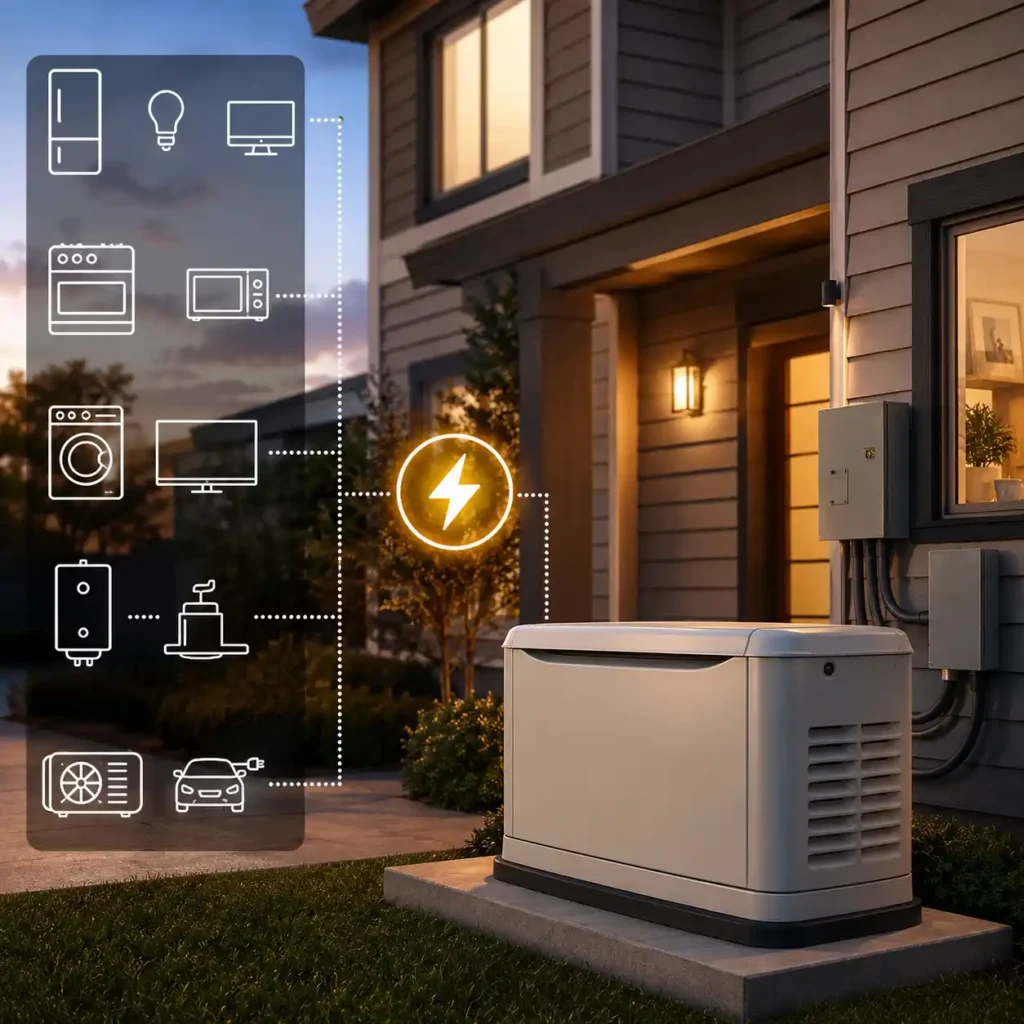
Standby generators commonly fall into several practical capacity ranges, but these should be treated as starting points rather than universal sizing rules.
A 14kW generator can be a sensible option for homes with moderate electrical demand where the load calculation confirms that essential systems and selected household loads can operate within the available capacity.
Moving into the 18kW to 20kW range provides additional headroom for households with greater simultaneous demand. This can be useful when a home has larger HVAC equipment, several appliances, or other loads that make a smaller generator less practical.
Generators in the 24kW to 26kW range are better suited to homeowners seeking substantial whole-home capacity and greater flexibility during an outage.
However, more capacity also means a larger permanently installed system and potentially greater installation and operating costs.
The important distinction is between generator capacity and whole-home coverage.
A generator marketed for whole-house backup does not mean that every home can operate every electrical device simultaneously without limits. The generator must still be correctly sized for the home’s service, electrical loads, transfer equipment, and installation configuration.
For that reason, avoid choosing a standby generator based solely on the square footage of the house.
A 2,500-square-foot home with electric heating and multiple large HVAC systems can have very different electrical requirements from a larger home using natural gas heating and relatively efficient appliances.
The most reliable approach is to determine the actual electrical load first and then select generator capacity.
Automatic Transfer Switch: Why It Matters
The transfer switch is one of the most important components of a standby generator system because it controls how the home’s electrical supply moves between utility power and generator power.
When the utility supply fails, an automatic transfer switch detects the loss of power and transfers the home’s electrical system to the generator according to the installed configuration. When utility power returns, the system reverses the process.
This is what separates a properly integrated standby generator from a portable generator that must be manually connected and started.
The transfer switch also deserves attention when comparing prices.
Some standby generator configurations include the transfer switch, while others sell the generator itself without one. These are not equivalent purchasing propositions.
For example, the Generac Guardian 26kW, Generac 24kW, and Generac 14kW configurations reviewed in this guide include a 200A automatic transfer switch, while the KOHLER RCA 20,000-Watt configuration and Generac 18kW Model 7259 do not.
That difference can materially affect the final installed cost.
It also means buyers should never compare generator prices without checking exactly what equipment is included in the specific configuration being purchased.
The correct transfer-switch arrangement should be determined by the home’s electrical service and installation requirements. Because this equipment involves the home’s electrical distribution system, installation should be handled by a qualified professional.
Natural Gas vs. Liquid Propane
Fuel availability is another major consideration when selecting a standby generator.
The five generators in this guide are designed to operate using natural gas or liquid propane, giving homeowners flexibility depending on the property’s existing infrastructure and local fuel availability.
Natural gas can be convenient for homes already connected to a suitable gas supply. Because fuel is delivered through the utility network, homeowners do not have to maintain a large on-site propane supply.
Liquid propane provides a different advantage. Properly stored propane can remain available for extended periods, making it attractive for homeowners who want an independent fuel supply rather than relying entirely on the natural-gas network.
However, fuel choice can affect generator output.
Several of the models reviewed in this guide have different rated outputs depending on whether they operate on propane or natural gas. The Generac Guardian 26kW, for example, is rated at 26kW on LP and 22.5kW on natural gas, while the Generac 24kW is rated at 24kW on LP and 22.5kW on natural gas.
That difference should be considered when sizing the system.
The best fuel is ultimately the one that provides a practical combination of availability, installation compatibility, expected runtime, and generator performance for your property.
Installation Location and Outdoor Requirements
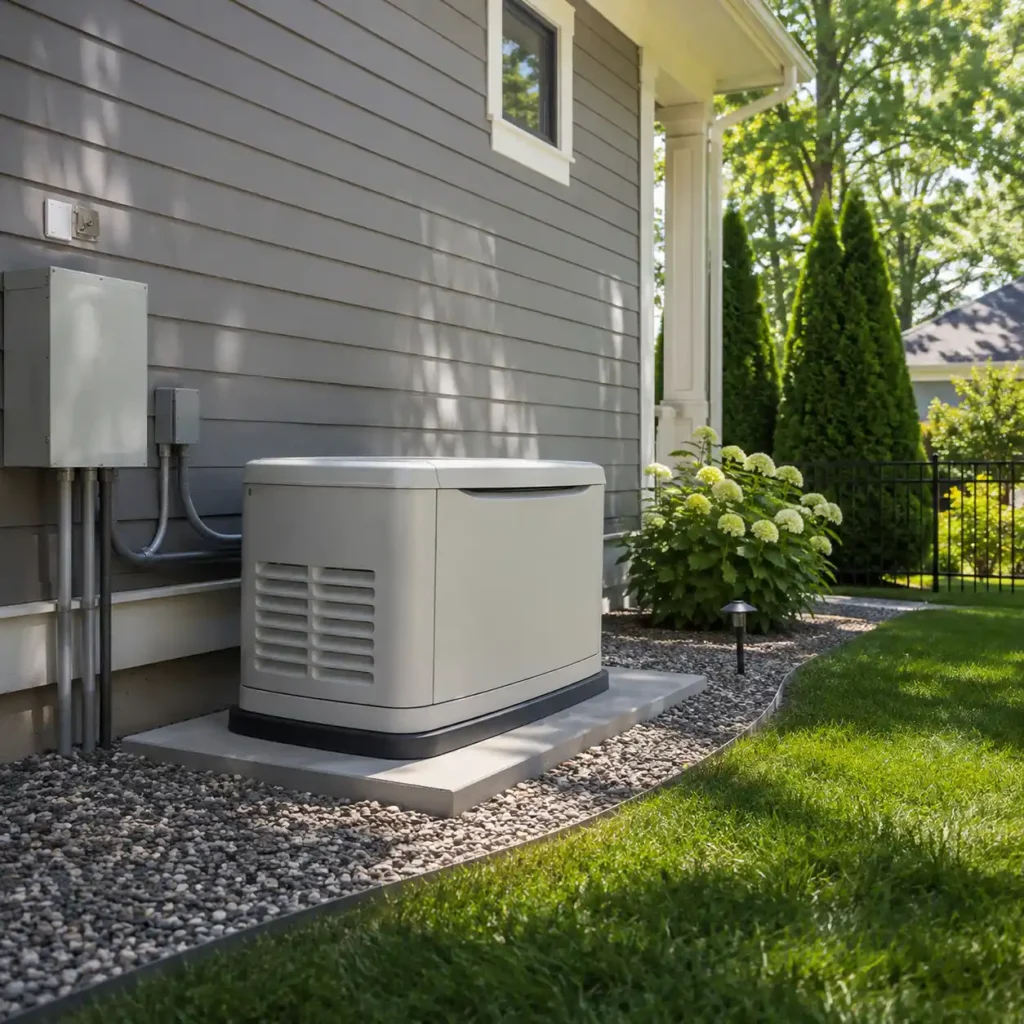
A standby generator may remain outside for years, so installation location should be considered before purchasing the equipment.
The generator needs an appropriate outdoor location with adequate clearance and ventilation according to the manufacturer’s installation requirements and applicable local codes.
Avoid treating the generator as simply another outdoor appliance that can be placed wherever there is convenient space.
The installation also needs to accommodate:
- Fuel connections
- Electrical conduit
- Transfer equipment
- Service access
- Exhaust requirements
- Local clearance requirements
- A suitable supporting surface
The surrounding environment matters as well.
A generator installed in a location exposed to excessive water, accumulated debris, flooding, or difficult service access may create unnecessary ownership problems even if the generator itself is well built.
Before purchasing, identify the proposed installation area and have the installer confirm that the location is appropriate for the selected model.
Planning the site before ordering the generator can prevent expensive changes later.
Monitoring and Connectivity
Modern standby generators increasingly include connected monitoring, and this feature can be particularly useful for equipment that may remain inactive for long periods.
Unlike a portable generator that is often used directly during an outage, a standby generator may sit outside for weeks or months while waiting for the next utility interruption.
Remote monitoring allows homeowners to check system status without physically inspecting the generator.
Depending on the model, connectivity may include Wi-Fi, cellular communication, Bluetooth, or a combination of these technologies.
The practical advantage is simple: if the generator reports a warning, maintenance requirement, or operating issue while the homeowner is away, there is a better chance of identifying the problem before the next outage occurs.
Connectivity should not be the primary reason to choose a generator, but it can significantly improve ownership convenience.
For a permanently installed system whose main purpose is readiness, knowing that the generator is ready before an outage occurs is valuable.
Maintenance and Long-Term Ownership
A standby generator is designed to remain ready between outages, but readiness requires maintenance.
Routine maintenance requirements vary by manufacturer and model, but homeowners should expect periodic inspections, oil and filter service, battery checks, exercise cycles, and other manufacturer-specified maintenance.
This is another reason connected monitoring can be useful.
The generator may spend most of its life doing nothing more dramatic than periodic self-testing. That does not mean it can be ignored.
A neglected generator can become a liability precisely when it is needed most.
Before purchasing, consider not only the initial price but also:
- Scheduled maintenance
- Service availability
- Replacement parts
- Battery replacement
- Fuel-system requirements
- Warranty coverage
- Professional servicing costs
A slightly less expensive generator that is difficult to service locally may ultimately be less attractive than a model with stronger service support and straightforward maintenance.
Common Buying Mistakes When Choosing a Standby Generator

A standby generator represents a considerably larger commitment than a portable backup generator. Installation, fuel connections, transfer equipment, permits, and electrical work can all affect the final investment.
Many purchasing mistakes happen because buyers focus too heavily on the generator itself rather than the complete backup system.
Choosing the Largest Generator Available
More capacity sounds attractive, but maximum wattage is not automatically the best choice.
Installing a generator substantially larger than the home’s calculated requirements can increase equipment, installation, and operating costs without providing meaningful additional value.
The right question is not how much power the generator can produce.
It is how much power the home actually needs during an outage.
Assuming “Whole House” Means Unlimited Power
The phrase whole-house backup can create unrealistic expectations.
A standby generator can provide power to the home’s electrical system, but the generator still has a finite output rating.
If the home attempts to operate multiple high-demand loads simultaneously, the available generator capacity can become the limiting factor.
Large HVAC systems, electric water heaters, pool pumps, EV chargers, electric ranges, and other substantial loads should therefore be included in the sizing process.
Comparing Generator Prices Without Checking the Package
Two generators with similar wattage can have very different total costs depending on what is included.
One package may include a 200A automatic transfer switch, while another may include only the generator.
This is particularly important when comparing the products in this guide.
The Generac 24kW configuration reviewed here includes a 200A automatic transfer switch, while the Generac 18kW Model 7259 is a generator-only configuration.
The advertised product price therefore should never be treated as the final installed system price.
Ignoring Starting Loads
Motors and compressors can require substantially more power during startup than they consume once operating.
This is particularly relevant for:
- Central air conditioners
- Heat pumps
- Well pumps
- Sump pumps
- Refrigerators
- Freezers
- Large ventilation equipment
A generator that appears adequate based only on running wattage may not be the best match for a home with several demanding motor-driven loads.
Load calculation and starting characteristics should therefore be considered together.
Forgetting Fuel Availability
A standby generator cannot provide backup power if its fuel supply cannot support operation.
Before selecting a natural-gas or propane configuration, confirm that the property has an appropriate fuel source and that the planned installation can support the generator’s requirements.
Fuel infrastructure should be evaluated as part of the installation—not after the generator has already been purchased.
Treating Installation as a DIY Project
Unlike many portable generators, permanently installed standby systems are integrated with the home’s electrical and fuel infrastructure.
The transfer switch, electrical service, grounding, fuel connection, clearances, and local code requirements all need to be handled correctly.
Attempting to improvise these connections can create serious safety and equipment risks.
A qualified installer should determine the appropriate configuration for the home.
Forgetting About Service and Maintenance
The generator may be the most visible component of the system, but long-term reliability depends on everything around it.
Before buying, consider whether qualified service is available in your area and how routine maintenance will be handled.
A standby generator is an investment in readiness, and readiness depends on maintaining the system before an outage occurs.
Our Expert Buying Tips
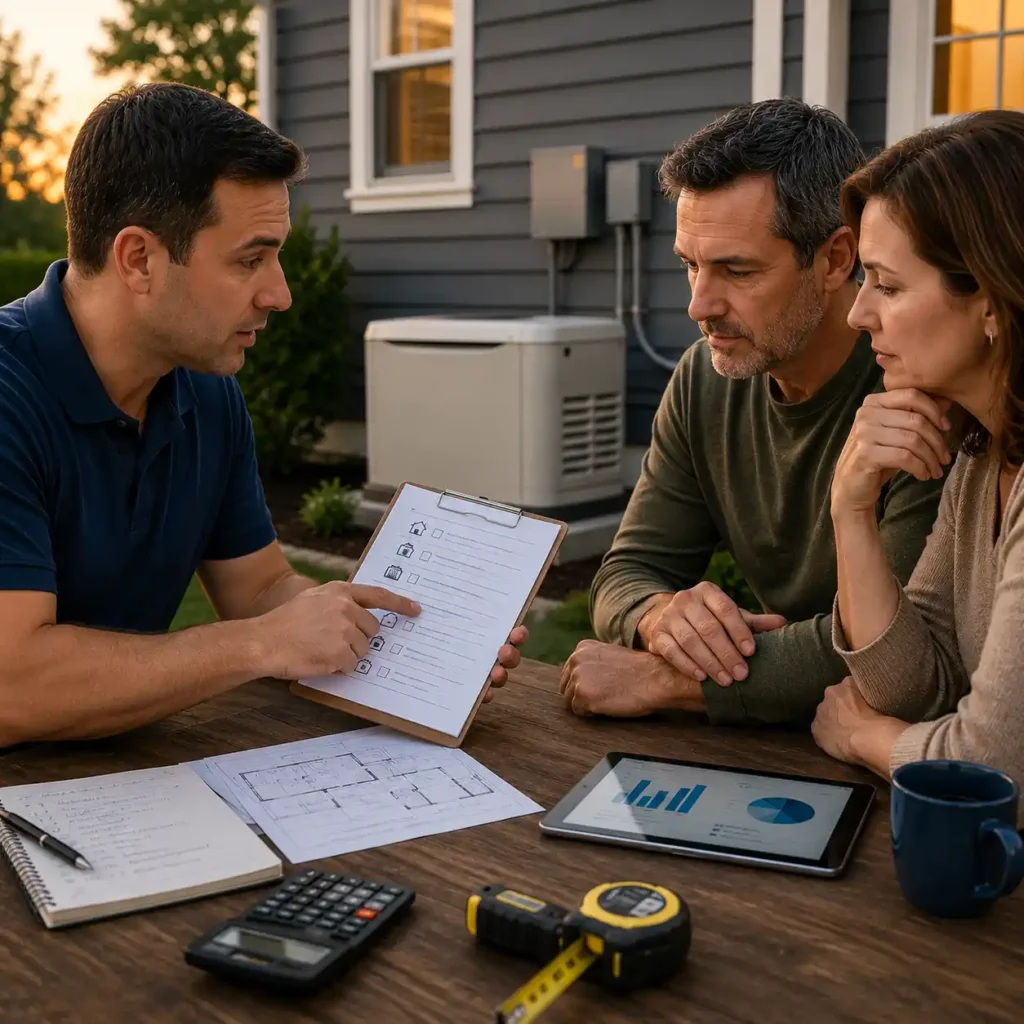
After comparing standby generators across different capacity levels and configurations, our strongest recommendation is to start with the home’s electrical requirements and work backward to the generator.
Do not begin by deciding that you need 26kW simply because it sounds safer.
Start by identifying the loads that matter most during an outage. Then determine which loads may operate simultaneously, which have substantial starting requirements, and which can remain disconnected.
Next, look carefully at the transfer equipment.
A generator with an included automatic transfer switch may offer a simpler purchasing path, while a generator-only configuration can provide more flexibility for an installer designing the electrical system around a particular property.
Fuel should be evaluated just as carefully.
Natural gas may be the most convenient option for a property with an appropriate utility connection, while propane can provide greater independence from the natural-gas network. The generator’s rated output on each fuel should also be considered.
We also recommend treating monitoring as a practical ownership feature rather than a luxury.
A standby generator’s primary job is to be ready when you need it, often after sitting unused for months. Remote status information can make that readiness easier to verify and can help identify maintenance issues before an outage.
Finally, calculate the complete installed cost, not simply the Amazon purchase price.
As a planning benchmark, the generator itself is only one part of the total project cost. Whole-home standby installations can reach well into the five-figure range once the generator, transfer equipment, fuel work, electrical work, permits, site preparation, and labor are included. Actual costs vary significantly by home and location, so a local installation quote is more useful than comparing generator prices alone.
The best standby generator is therefore not necessarily the cheapest generator or the largest generator.
It is the system that provides the right amount of capacity, integrates correctly with the home, uses a practical fuel source, and remains dependable throughout the years between outages.
Standby Generator Performance in Real-World Conditions
Manufacturer specifications provide an important starting point when comparing standby generators, but the number printed on the enclosure does not tell the entire story.
A standby generator operates as part of a complete residential electrical system. Actual performance depends on the loads connected to it, starting demands, fuel supply, ambient conditions, installation quality, and transfer equipment.
Real-world performance is therefore less about achieving a theoretical maximum and more about maintaining stable, dependable power when the utility supply is unavailable.
Why Rated Wattage Doesn't Tell the Whole Story
A generator rated at 20kW does not mean that every household load can be started simultaneously without consideration.
Rated output describes the generator’s available electrical capacity under specified operating conditions. The actual experience inside a home depends on what loads are operating and how those loads behave.
A refrigerator may require relatively modest power once running but draw a higher starting current.
An air conditioner can present an even more substantial starting demand.
This is why two homes with identical generators can have very different experiences during an outage.
One may operate comfortably because its largest loads are managed within the generator’s capacity.
Another may experience limitations because several large motors, heating systems, or other high-demand appliances attempt to operate simultaneously.
The practical objective is therefore not simply to maximize running watts. It is to ensure that the generator can handle the home’s realistic load profile.
How Fuel Choice Affects Real-World Output
Fuel selection can influence generator performance and rated capacity.
Several standby generators produce slightly different output depending on whether they operate on natural gas or liquid propane. This is particularly important when a homeowner is selecting a generator close to the calculated electrical requirement.
For example, a generator that provides greater output on propane may have less available capacity when connected to natural gas.
That difference may not matter for a lightly loaded home, but it can become important when operating close to the generator’s rated limit.
Fuel availability also affects long-term resilience.
Natural gas provides continuous utility-fed fuel where the infrastructure is available, while propane gives homeowners an on-site fuel reserve.
Neither is universally superior. The right choice depends on the property and the homeowner’s backup strategy.
The Importance of Load Management During an Outage
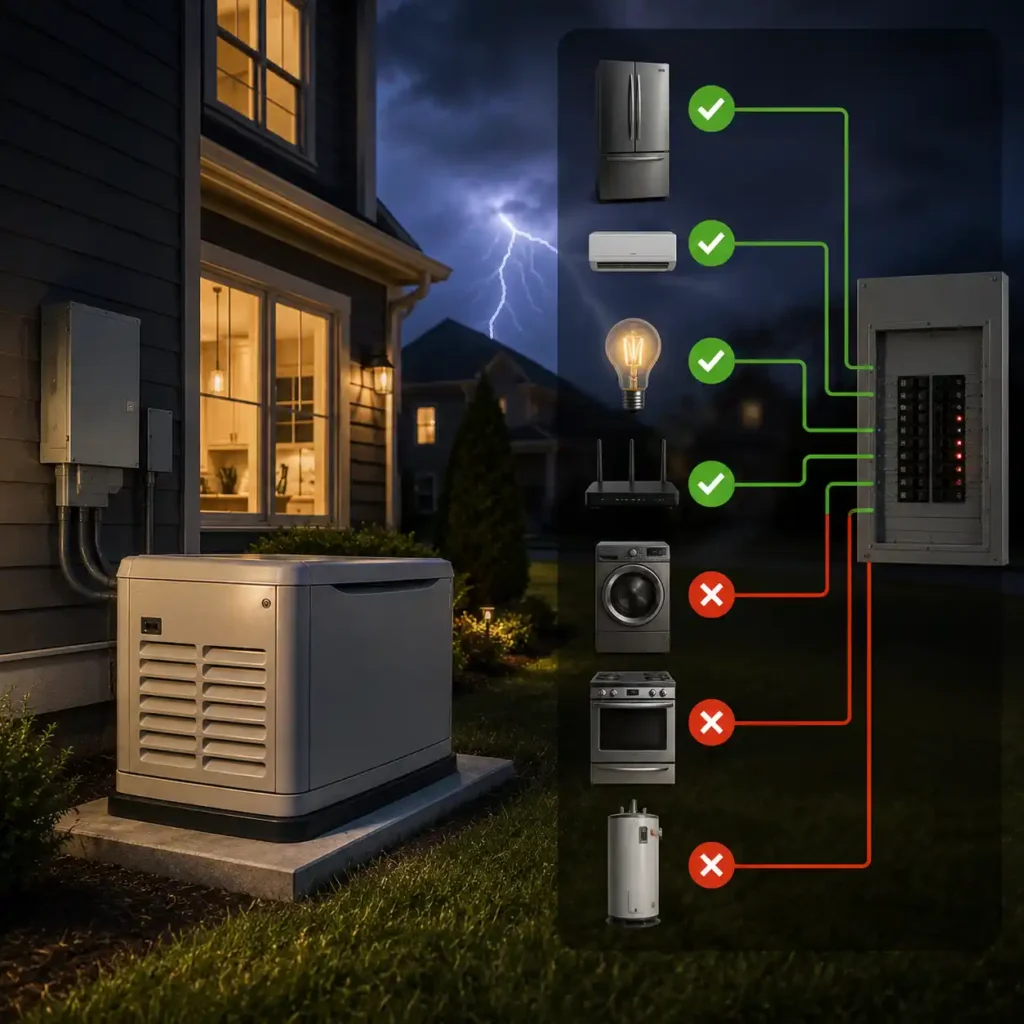
A standby generator works best when the electrical system is designed around its available capacity.
During an outage, homeowners may want to use many of the same appliances they use under normal conditions. However, certain combinations of high-demand loads may exceed the generator’s output.
This is particularly relevant for homes with:
- Multiple air-conditioning systems
- Electric heating
- Large water heaters
- Pool pumps
- Well pumps
- EV chargers
- Electric ranges
- Other high-power equipment
A properly sized system may support these loads individually or under a managed sequence, but homeowners should not assume that every major appliance can operate simultaneously simply because the generator provides whole-home backup.
Good generator sizing reduces the need for manual intervention, but electrical load management remains an important part of system design.
Weather, Temperature, and Operating Environment
Standby generators are designed for outdoor operation, but environmental conditions still matter.
High ambient temperatures can affect engine and electrical-system performance, while extreme cold can create additional starting and maintenance considerations.
The installation environment also influences long-term ownership.
Generators exposed to excessive moisture, flooding, debris, or difficult service access may require more attention than units installed in an appropriate location with proper drainage and clearances.
Weather resistance should therefore be considered together with installation quality.
A well-designed installation protects the generator while still allowing the equipment to meet its ventilation, exhaust, and service requirements.
How Much Fuel Does a Standby Generator Use?
Fuel consumption varies considerably depending on generator size, fuel type, electrical load, and operating conditions.
A generator operating at a light load does not necessarily consume fuel at the same rate as one operating near its rated capacity.
This is why homeowners should be cautious about treating a single published fuel-consumption figure as a guaranteed runtime.
For propane systems, available runtime also depends on the size of the propane storage system.
For natural-gas installations, runtime is tied to the availability and capacity of the gas supply.
The practical takeaway is straightforward: fuel planning should be based on expected electrical load and outage duration rather than generator wattage alone.
What Happens During a Long Power Outage?
Standby generators are particularly valuable during extended outages because they are designed for automatic, sustained backup operation when properly installed and maintained.
However, a long outage changes the ownership equation.
The generator may operate for many hours or even repeatedly over an extended period, increasing fuel consumption and maintenance demands.
Homeowners should therefore think about extended-outage preparedness before an emergency occurs.
That includes knowing:
- Which fuel source the generator uses
- How the fuel supply is maintained
- When maintenance is required
- How the generator communicates warnings
- Who will service the system
- Which household loads should receive priority
A standby generator provides automation, but reliable long-duration backup still depends on appropriate system planning.
Standby Generators vs. Other Backup Power Options

A standby generator is only one way to prepare a home for utility outages.
Portable generators, inverter generators, portable power stations, and home battery systems all solve different backup-power problems.
Understanding these differences is important because the most expensive or powerful option is not automatically the best solution for every household.
Standby Generator vs. Portable Generator
The biggest difference is automation.
A standby generator remains permanently installed and can automatically respond to a utility outage when paired with the appropriate transfer equipment.
A portable generator generally requires the homeowner to store it, move it into position, connect it correctly, and start it when an outage occurs.
Portable generators also typically rely on gasoline or propane stored separately, while standby systems are commonly connected to natural gas or a dedicated propane supply.
For frequent or extended outages, the convenience of a standby generator can justify the additional installation cost.
For occasional emergencies, camping, temporary backup, or buyers who need a lower initial investment, a portable generator may make more sense.
Standby Generator vs. Inverter Generator
Inverter generators are generally designed around portability and cleaner electrical output rather than permanent whole-home integration.
They can be quieter and more efficient at partial loads than conventional portable generators, making them attractive for camping, RV use, and smaller backup applications.
A standby generator serves a different purpose.
It is designed to become part of the home’s electrical infrastructure and remain ready for automatic operation.
If your priority is portable power for selected devices, an inverter generator may be the better solution.
If your priority is automatic residential backup without manual setup during an outage, a standby generator is usually the more appropriate category.
Standby Generator vs. Portable Power Station
Portable power stations offer a fundamentally different backup experience.
They store electricity in a battery rather than producing it continuously with an internal-combustion engine.
That means silent operation, no fuel combustion during use, and easy indoor use for many models within their specified operating limits.
The limitation is stored energy.
A portable power station eventually needs to be recharged, while a fuel-powered standby generator can continue operating as long as its fuel supply remains available and the system is maintained appropriately.
Portable power stations are therefore excellent for electronics, networking equipment, refrigeration, lighting, and selected appliances, but they are not direct replacements for a permanently installed whole-home standby generator in every application.
Standby Generator vs. Home Battery Backup
Home battery systems store electrical energy for later use and can provide extremely quiet backup power.
When combined with solar, they may also contribute to energy independence and daily energy management.
Their main limitation during a prolonged grid outage is energy storage capacity and recharge availability.
A standby generator, by contrast, converts fuel into electricity continuously while operating.
This makes generators particularly attractive for extended outages where maintaining power for a long period is more important than silent operation.
Battery systems may be preferable for homeowners prioritizing quiet operation, solar integration, and reduced reliance on fuel.
Standby generators remain compelling where long-duration backup and automatic operation are the primary objectives.
Frequently Asked Questions (FAQ)
What size standby generator do I need for a 2,000-square-foot house?
A 2,000-square-foot house does not automatically require a specific generator size. The correct capacity depends on the home’s electrical loads rather than square footage alone.
For many homes of this size, a 14kW to 22kW standby generator can be a reasonable starting range when the system is properly sized. A home with gas heating, moderate HVAC demand, and relatively efficient appliances may need less capacity than a similar-sized house with electric heating, multiple air-conditioning systems, or other high-demand equipment.
The most reliable approach is to calculate the home’s actual electrical load before choosing a generator.
What size standby generator do I need for a 3,000-square-foot house?
A 3,000-square-foot house may require substantially more capacity than a smaller home, but square footage alone still isn’t enough to determine the correct generator size.
Homes in this range are often candidates for 18kW to 26kW residential standby generators, particularly when homeowners want broad whole-home coverage. However, the required capacity can be lower or higher depending on HVAC systems, electric heating, water heating, cooking appliances, pumps, and other major loads.
A professional load calculation is the best way to determine whether a particular generator can handle the home’s expected demand.
Is 22kW enough to run a whole house?
For many homes, a 22kW standby generator can provide substantial whole-home backup, but it does not guarantee that every electrical load can operate simultaneously.
The answer depends on the home’s total electrical demand and, especially, the starting requirements of large motors and compressors.
Homes with central air conditioning, well pumps, electric water heating, EV charging, or multiple large HVAC systems may require load management or additional generator capacity.
The important question is whether 22kW provides sufficient capacity for the home’s calculated load—not simply whether the house is considered “whole house.
Is 24kW enough for a whole-house generator?
A 24kW standby generator provides considerable capacity for a residential backup system and can be appropriate for homes with higher electrical demand.
However, “24kW” does not mean the generator can operate every major electrical appliance simultaneously without limits. Large HVAC compressors, electric heating, pool equipment, EV chargers, and other high-demand loads can significantly affect the required capacity.
A 24kW system should therefore be selected based on an actual load calculation and the specific configuration of the home’s electrical system.
Can a 14kW generator run central air conditioning?
Central air-conditioning compressors can require considerably more power when starting than they consume while running. This starting demand needs to be considered alongside the home’s other simultaneous electrical loads.
For some homes, 14kW can be sufficient with appropriate load management. For others, a larger generator will be necessary.
Can a 20kW generator run central air conditioning?
A 20kW standby generator can run central air conditioning in many homes, but the exact answer depends on the HVAC system and the rest of the electrical load.
The size of the air-conditioning compressor, its starting characteristics, and other appliances operating at the same time all matter.
If the home has multiple HVAC systems, electric heating, or several large motor loads, a 20kW generator may require load management or additional capacity.
Can a standby generator run 24 hours a day?
Yes. A properly installed standby generator can operate continuously during an extended utility outage, provided its fuel supply, operating conditions, and maintenance requirements are properly managed.
For a natural-gas system, the practical runtime can extend for days or longer when the gas supply remains available. Propane systems are ultimately limited by the amount of fuel stored in the tank.
The important limitation is not a simple “24-hour maximum.” Long outages require attention to fuel availability, engine condition, oil and filter service intervals, and the manufacturer’s operating requirements.
How long will a standby generator run on natural gas?
A natural-gas standby generator can continue operating for the duration of an outage as long as the gas supply remains available and the generator receives the maintenance required by the manufacturer.
Unlike propane, natural gas does not depend on the capacity of an on-site storage tank. However, the generator still has operating and maintenance requirements that become increasingly important during a prolonged outage.
For this reason, “unlimited runtime” should be understood as continuous fuel availability rather than maintenance-free operation.
How long will a standby generator run on propane?
A propane standby generator can operate for extended periods, but its runtime ultimately depends on the size of the propane tank, the generator’s fuel consumption, and the electrical load.
Higher electrical demand generally increases fuel consumption, reducing the number of hours available from a fixed tank.
For homeowners in areas prone to hurricanes, winter storms, or other multi-day outages, propane storage capacity should therefore be considered when designing the backup system rather than treated as an afterthought.
Does a standby generator automatically turn on when the power goes out?
Yes. Automatic operation is one of the main advantages of a permanently installed standby generator.
When the system detects a utility outage, the automatic transfer equipment initiates the transfer from utility power to generator power. Once utility service returns, the system transfers the home back to utility power and the generator shuts down.
This allows a properly installed standby system to operate without the homeowner having to move the generator, connect extension cords, or manually start the engine
Does a whole-house generator power everything in the house?
Not necessarily.
A whole-house standby installation is designed to make the home’s electrical system available to generator power, but the generator itself still has a finite output capacity.
If the home’s simultaneous electrical demand exceeds that capacity, the system may require load management to prevent several high-demand appliances from operating at the same time.
This is why “whole house” describes the electrical integration of the system, not unlimited electrical capacity.
Do I need a 200-amp transfer switch for a whole-house generator?
Not every home requires exactly the same transfer-switch configuration.
A 200A automatic transfer switch can be appropriate for homes with a 200A electrical service and a generator installation designed to provide whole-house backup. However, the correct transfer equipment depends on the home’s electrical service, panel configuration, generator, and installation design.
It is important to check whether the transfer switch is included with the generator because some configurations include it while others sell the generator separately.
What happens if the generator is too small for my house?
If the generator is undersized for the home’s electrical demand, the system may not be able to support all connected loads simultaneously.
Large motors and compressors can be particularly problematic because their starting demand can temporarily exceed what the generator can comfortably provide.
Depending on the system design, this can result in load shedding, tripped protection, or certain appliances being unavailable during an outage.
Choosing a generator based on an actual load calculation is therefore much safer than estimating capacity from house size alone.
Is it better to get a 14kW or 22kW standby generator?
The better choice depends on the home’s electrical requirements.
A 14kW generator can be an efficient choice when the household has moderate electrical demand and the load calculation confirms that the capacity is sufficient.
A 22kW generator provides substantially more headroom and may be preferable for homes with larger HVAC systems or greater simultaneous electrical demand.
Buying the larger generator simply because it offers more power isn’t necessarily better if the additional capacity isn’t needed.
Are standby generators louder than portable generators?
Standby generators produce engine noise while operating, but modern residential models are designed specifically for outdoor home installation.
Noise varies by model, load, enclosure design, and installation location. Generac, for example, reports average sound levels around 65–67 dB for its home standby models, depending on the model.
The generator’s location also matters. A unit positioned close to bedrooms, neighboring properties, or outdoor living areas may be more noticeable than one installed farther away where local requirements permit.
Final Verdict
The best standby generators for home backup are not necessarily the largest or most expensive models. The right choice depends on the electrical demands of the home, the level of automation required, the available fuel source, the transfer-switch configuration, and the total cost of creating a properly integrated backup system.
For homeowners who want the strongest overall combination of capacity, automatic transfer capability, monitoring, and complete-system convenience, the Generac Guardian 26kW remains our Best Overall choice from this lineup.
The KOHLER RCA 20,000-Watt is particularly compelling for homeowners who place greater emphasis on load management and PowerBoost technology, especially where substantial motor-driven loads make starting performance an important consideration.
For buyers seeking a high-capacity package with the major transfer equipment already included, the Generac 24kW Whole Home Generator offers an attractive combination of substantial output, a 200A automatic transfer switch, and connected monitoring.
The Generac 14kW Whole Home Generator makes more sense for homeowners whose electrical requirements are moderate and whose load calculation confirms that 14kW is sufficient. It avoids paying for capacity the home may not actually need while still providing automatic standby operation and an included transfer switch.
Finally, the Generac 18kW Whole Home Generator occupies a useful middle position. Its 18kW LP / 17kW natural-gas capacity provides additional headroom over a 14kW system, while the generator-only configuration gives installers more flexibility to select the appropriate transfer equipment separately.
The most important lesson from comparing these systems is simple: size the generator around the home, not the other way around.
Before purchasing, determine which appliances and electrical systems must remain operational during an outage, identify the largest starting loads, confirm the fuel supply, verify whether a transfer switch is included, and calculate the complete installed cost.
A properly sized standby generator should not require constant attention during an outage. Once professionally installed and maintained, it should simply do its job: automatically provide dependable backup electricity when the utility grid cannot.
That is ultimately what makes a standby generator different from other backup-power solutions. It is not merely a generator sitting outside the house. It is a permanent part of the home’s emergency power strategy, designed to provide convenience, continuity, and confidence when normal utility service disappears.
Related Guides
Choosing a standby generator is only one part of building a reliable home backup-power strategy. The generator must be correctly sized, integrated with the home’s electrical system, and evaluated alongside other technologies that may provide better value for particular households.
Explore these related Power Ready Guide resources:
- Best Transfer Switches for Generators (2026) – Learn how transfer switches work and what to consider when selecting the equipment that connects a generator to your home’s electrical system.
- How to Calculate Power Consumption (Complete Guide + Free Calculator) – Calculate household electrical loads before deciding how much generator capacity you actually need.
- Best Home Battery Backup Systems (2026) – Compare battery-based backup solutions for homeowners who want quiet operation, energy storage, and potential solar integration.
- Best Whole House Backup Power Systems (2026) – Compare complete home backup approaches when a generator is only one of several possible solutions.
- Best Portable Generators (2026) – Explore portable alternatives for homeowners who need emergency backup without permanently installing a standby system.
- Best Inverter Generators (2026) – Compare quieter, portable inverter-based generators for camping, RVs, and smaller-scale home backup.