
A battery runtime calculator estimates how long a battery can power a device or group of devices before its usable energy is depleted. The basic calculation is straightforward: divide available battery energy in watt-hours (Wh) by the power consumed by the load in watts (W).
For a quick theoretical estimate:
Runtime (hours) = Battery Capacity (Wh) ÷ Load (W)
However, real battery systems rarely deliver every watt-hour printed on the label. Battery chemistry, usable depth of discharge, inverter efficiency, battery age, temperature, standby consumption, and changing appliance loads can all reduce actual runtime.
For a more realistic estimate:
Runtime (hours) ≈ Usable Battery Energy (Wh) ÷ Average Load (W)
This guide explains how battery runtime is calculated, how to convert Ah to Wh, why real-world runtime differs from theoretical results, and how to estimate backup time for portable power stations, battery banks, RV systems, UPS units, and home backup batteries.
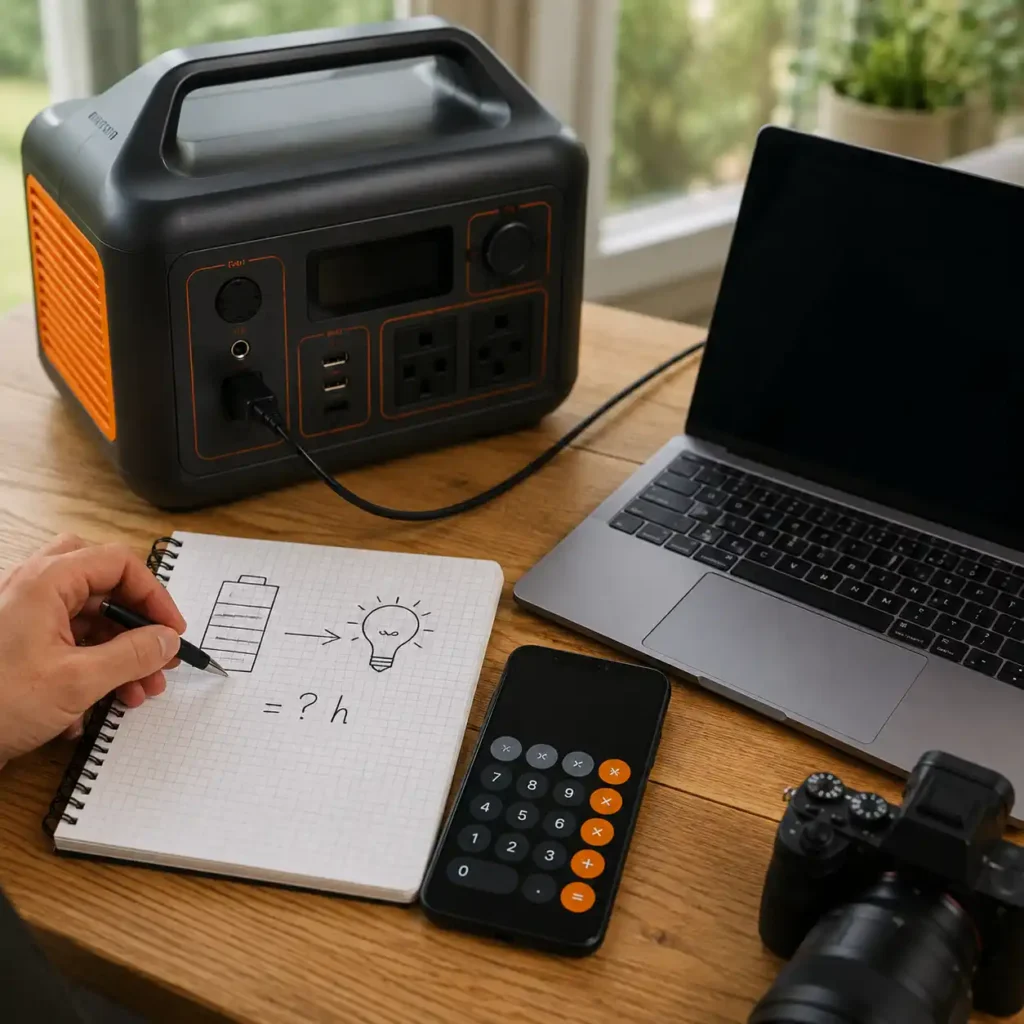
Table of Contents
Quick Answer
The simplest way to calculate battery runtime is to divide the battery’s available energy in watt-hours by the power consumed by the load:
Runtime (hours) = Battery Capacity (Wh) ÷ Load (W)
For example, a 1,000Wh battery powering a continuous 100W load has a theoretical runtime of:
1,000 Wh ÷ 100 W = 10 hours
That is an ideal calculation. Actual runtime will usually be lower when the battery powers AC equipment through an inverter or when only part of the rated battery capacity is usable.
For a more realistic estimate:
Runtime (hours) ≈ (Battery Wh × Usable Capacity × Efficiency) ÷ Load W
For example, if a 1,000Wh battery provides 90% usable capacity and the system operates at 90% efficiency:
1,000 × 0.90 × 0.90 ÷ 100 = 8.1 hours
The calculator on this page is designed to help translate battery capacity and electrical load into a practical runtime estimate rather than relying on the battery’s headline capacity alone.
Battery Runtime Formula
Battery runtime is fundamentally an energy calculation.
A battery stores energy, while an appliance consumes energy at a particular rate. Watt-hours measure the amount of stored electrical energy, while watts measure the rate at which that energy is being consumed.
The basic battery runtime formula is:
Runtime (hours) = Battery Capacity (Wh) ÷ Load (W)
Where:
- Runtime = estimated operating time in hours
- Battery Capacity = stored energy in watt-hours
- Load = average electrical power consumed by the device or devices in watts
The real-world battery runtime formula
For practical battery planning, the calculation should account for the portion of the battery that can actually be delivered to the load.
Runtime (hours) ≈ (Battery Capacity Wh × Usable Capacity × System Efficiency) ÷ Average Load W
For systems using an AC inverter, system efficiency includes the energy lost during DC-to-AC conversion.
A battery rated at 1,000Wh therefore does not necessarily provide 1,000Wh of usable AC energy to an appliance.
This distinction is one of the most important concepts when interpreting battery runtime estimates.
How the Battery Runtime Calculator Works

Our Battery Runtime Calculator uses the relationship between stored energy and electrical load to estimate operating time.
The calculation can begin with either:
- Battery capacity in Wh
- Battery capacity in Ah plus voltage
If the battery is specified in amp-hours, its nominal energy is calculated first:
Battery Energy (Wh) = Battery Capacity (Ah) × Voltage (V)
The calculator can then apply practical adjustments such as usable capacity and conversion efficiency before determining the estimated runtime.
Basic calculation
If you know the battery capacity in watt-hours:
Runtime = Wh ÷ W
Example:
- Battery = 1,024Wh
- Load = 100W
1,024 ÷ 100 = 10.24 hours
Adjusted calculation
If the usable capacity is 90% and system efficiency is 90%:
1,024 × 0.90 × 0.90 = 829.44Wh
Then:
829.44 ÷ 100 = 8.29 hours
The theoretical result is therefore 10.24 hours, while the adjusted estimate is approximately 8.3 hours.
The difference illustrates why battery specifications should not be interpreted as guaranteed runtime.
Wh vs Ah: Understanding Battery Capacity
One of the most common sources of confusion in battery calculations is the difference between amp-hours (Ah) and watt-hours (Wh).
They describe different characteristics of a battery.
Amp-hours describe electrical charge capacity.
Watt-hours describe stored electrical energy.
For runtime calculations, watt-hours are usually more useful because they can be directly compared with a load measured in watts.
Converting Ah to Wh
Use:
Wh = Ah × V
For example, a 12V 100Ah battery has a nominal energy capacity of:
100 Ah × 12 V = 1,200 Wh
A 24V 100Ah battery has:
100 Ah × 24 V = 2,400 Wh
Although both batteries are rated at 100Ah, the 24V battery stores approximately twice as much nominal energy.
This is why comparing batteries based only on amp-hours can be misleading.
Converting Wh to Ah
If you know watt-hours and voltage:
Ah = Wh ÷ V
For example:
1,000 Wh ÷ 12 V = 83.3 Ah
These conversions use nominal voltage. Actual battery voltage varies during operation, so the result is an energy estimate rather than a direct measurement of runtime.
How to Calculate Battery Runtime Step by Step
A reliable runtime estimate begins with four pieces of information:
- Battery capacity
- Battery voltage, if capacity is given in Ah
- Average load
- Usable capacity and system efficiency
1. Find the battery capacity
Check the battery label or manufacturer specifications.
The capacity may be expressed as:
- Wh
- kWh
- Ah
- mAh
Portable power stations commonly advertise capacity in Wh, while standalone batteries and battery banks frequently use Ah.
2. Convert Ah to Wh if necessary
If the battery is rated in amp-hours:
Wh = Ah × V
For example:
100Ah × 12.8V = 1,280Wh
Use the manufacturer’s stated nominal voltage where available rather than assuming every “12V” battery has exactly the same nominal voltage.
3. Determine the load
Find the appliance’s running power in watts.
Use actual measured consumption when possible.
A device rated at 100W does not necessarily consume exactly 100W continuously. Some appliances cycle on and off, while others change their power consumption according to operating conditions.
4. Account for usable battery capacity
A battery’s rated capacity is not always equivalent to the amount of energy you should plan to deliver.
Usable capacity may be affected by:
- Battery chemistry
- Manufacturer limits
- Depth of discharge
- Battery management system settings
- Reserve capacity
- Battery condition
5. Account for conversion losses
If the appliance runs from AC through an inverter, some battery energy is lost during conversion.
A practical estimate can therefore use:
Runtime ≈ (Battery Wh × Usable Capacity × Inverter Efficiency) ÷ Load W
6. Interpret the result as an estimate
The result should be treated as a planning estimate rather than a guaranteed runtime.
Actual runtime can change as the battery temperature, state of charge, age, load, and operating conditions change.
Real-World Battery Runtime: Why the Simple Formula Is Optimistic
The simple Wh ÷ W calculation is useful because it establishes a theoretical baseline.
However, it assumes that the battery can deliver all of its rated energy to the load with no losses.
Real systems do not operate that way.
Energy can be lost through:
- Inverter conversion
- DC-to-DC conversion
- Wiring and connections
- Battery internal resistance
- Battery management electronics
- Cooling systems
- Inverter idle consumption
- Battery protection limits
For this reason, a runtime estimate based solely on nameplate Wh can be noticeably more optimistic than actual operating time.
A useful way to think about the calculation
Instead of asking:
How many watt-hours does the battery have?
ask:
How many watt-hours can actually reach my device?
That is the energy value that matters for runtime.
Battery Runtime by Battery Type
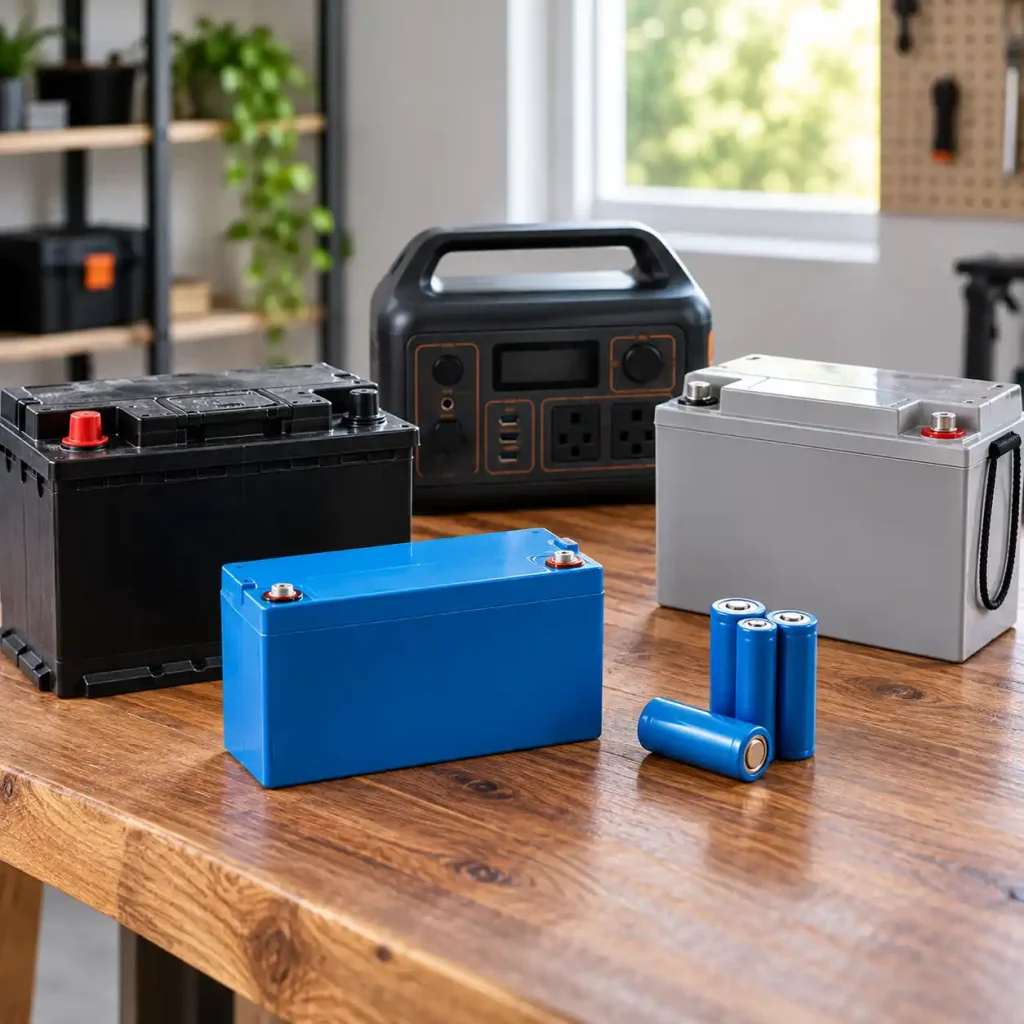
Battery chemistry affects how much of the rated capacity can practically be used and how performance changes under different loads and environmental conditions.
LiFePO₄ batteries
Lithium iron phosphate batteries are widely used in modern portable power stations, RV systems, and residential energy storage.
They can generally support deeper discharge than traditional lead-acid batteries, but the exact usable range depends on the manufacturer’s specifications and battery management system.
For runtime calculations, use the manufacturer’s stated usable capacity or recommended depth of discharge whenever available.
Lithium-ion batteries
Lithium-ion systems are common in consumer electronics, portable batteries, and some backup applications.
Runtime depends on the particular cell chemistry, battery management system, operating temperature, and manufacturer-defined usable capacity.
Lead-acid batteries
Lead-acid batteries require more conservative planning.
Using a large portion of the nominal capacity can reduce service life, and available capacity can also decline as discharge rate increases.
For lead-acid systems, the rated Ah figure should therefore not automatically be interpreted as fully usable energy.
Why chemistry matters
Two batteries with identical nominal watt-hour ratings can produce different practical runtimes because the amount of usable energy and system losses may differ.
Always use manufacturer specifications when they are available.
Battery Runtime by Load
The battery capacity alone does not determine runtime.
The load is equally important.
A 1,000Wh battery powering a 50W device will last much longer than the same battery powering a 500W appliance.
The relationship is approximately linear for a steady load:
Double the load → approximately half the runtime
Half the load → approximately twice the runtime
For example, ignoring losses:
- 1,000Wh ÷ 50W = 20 hours
- 1,000Wh ÷ 100W = 10 hours
- 1,000Wh ÷ 200W = 5 hours
- 1,000Wh ÷ 500W = 2 hours
- 1,000Wh ÷ 1,000W = 1 hour
These are theoretical values before efficiency and other real-world adjustments.
Practical Battery Runtime Examples
Example 1: 500Wh Battery With a 50W Load
A 500Wh battery powers a device consuming 50W.
Runtime = 500 ÷ 50 = 10 hours
The theoretical runtime is approximately 10 hours.
If the system delivers only 90% of its rated energy to the load:
500 × 0.90 ÷ 50 = 9 hours
The adjusted estimate is approximately 9 hours.
Example 2: 1,000Wh Battery With a 100W Load
A portable power station has a rated capacity of 1,000Wh and powers a 100W device.
1,000 ÷ 100 = 10 hours
With 90% usable energy and 90% conversion efficiency:
1,000 × 0.90 × 0.90 ÷ 100 = 8.1 hours
The realistic planning estimate is therefore approximately 8.1 hours, assuming the efficiency assumptions accurately represent the system.
Example 3: 1,024Wh Battery Running a Refrigerator
Refrigerators require special consideration because their compressors cycle rather than consuming their maximum running power continuously.
Suppose the refrigerator averages 80W over its operating cycle.
The theoretical runtime is:
1,024 ÷ 80 = 12.8 hours
At 90% usable energy and 90% system efficiency:
1,024 × 0.90 × 0.90 ÷ 80 = 10.37 hours
The estimate is approximately 10.4 hours.
The refrigerator’s actual runtime may differ because the compressor duty cycle, ambient temperature, food load, door openings, and startup behavior affect energy consumption.
For appliances with changing power demand, measured average consumption is more useful than simply reading the highest wattage printed on the appliance.
Example 4: 2,000Wh Battery With a 500W Load
A 2,000Wh battery powers a steady 500W load.
Ideal runtime:
2,000 ÷ 500 = 4 hours
At 90% usable capacity and 90% system efficiency:
2,000 × 0.90 × 0.90 ÷ 500 = 3.24 hours
The adjusted planning estimate is approximately 3 hours 15 minutes.
Calculating Runtime for Multiple Devices
When several devices operate simultaneously, their power consumption must be combined.
For steady loads:
Total Load = Device 1 W + Device 2 W + Device 3 W + …
For example:
- Router: 15W
- Laptop: 60W
- LED lights: 20W
- Television: 80W
Total load:
15 + 60 + 20 + 80 = 175W
A 1,000Wh battery would theoretically provide:
1,000 ÷ 175 = 5.71 hours
With 90% usable capacity and 90% system efficiency:
1,000 × 0.90 × 0.90 ÷ 175 = 4.63 hours
The estimated runtime becomes approximately 4 hours 38 minutes.
What if the devices do not run continuously?
Do not simply add their maximum rated wattages if the devices operate at different times.
Instead, estimate energy consumption over the relevant period:
Energy Used (Wh) = Average Power (W) × Operating Time (h)
This approach is especially useful for:
- Refrigerators
- Freezers
- Water pumps
- Heating equipment
- Air conditioners
- Cycling appliances
AC vs DC Battery Runtime
The output path matters when calculating battery runtime.
Direct DC loads
A device connected directly to a battery may avoid the DC-to-AC conversion performed by an inverter.
This can reduce conversion losses.
However, other losses can still occur through:
- DC-to-DC converters
- Wiring
- Connectors
- Device electronics
AC loads
When a battery powers an AC appliance through an inverter, the inverter converts DC energy into AC electricity.
That conversion is not perfectly efficient.
The calculation therefore needs to account for inverter losses.
For example, if a battery supplies 500Wh of usable energy and the inverter operates at 90% efficiency:
500 × 0.90 = 450Wh
Approximately 450Wh reaches the AC load before considering other system-specific losses.
This is why AC runtime can differ from a simple battery-capacity calculation.
How Inverter Efficiency Affects Runtime
Inverter efficiency is particularly important when a battery powers household AC appliances.
A simplified calculation is:
Runtime = Battery Wh × Usable Capacity × Inverter Efficiency ÷ Load W
Consider a 1,000Wh battery powering a 200W appliance.
At 95% efficiency:
1,000 × 0.95 ÷ 200 = 4.75 hours
At 85% efficiency:
1,000 × 0.85 ÷ 200 = 4.25 hours
The difference is approximately 30 minutes.
The inverter’s own standby or idle consumption can become even more significant when powering small loads for long periods.
When exact runtime matters, use measured system consumption or manufacturer runtime data whenever available.
Other Factors That Affect Battery Runtime
The mathematical formula gives us the foundation, but several real-world factors can change the result.
Battery temperature
Battery performance changes with temperature.
Cold conditions can reduce available capacity and may also affect charging and battery-management behavior. High temperatures can accelerate battery degradation.
For outdoor, RV, camping, and emergency applications, environmental conditions should therefore be considered when planning runtime.
Battery age and state of health
A new battery and an older battery with the same nameplate capacity may not deliver the same amount of energy.
Capacity gradually declines as batteries age and accumulate charge-discharge cycles.
Load variation
A device that constantly consumes 100W is easy to model.
A refrigerator that alternates between low consumption and compressor operation is more difficult.
For variable loads, average energy consumption over time is usually more meaningful than maximum wattage.
Peukert’s Law and Lead-Acid Runtime
For lead-acid batteries, runtime can also be affected by the Peukert effect. This describes how a battery’s usable capacity decreases as the discharge rate increases. In practical terms, a lead-acid battery may deliver less energy under a heavy load than its rated Ah capacity suggests.
This effect is particularly relevant to flooded, AGM, and other lead-acid batteries because their capacity ratings are measured at a specified discharge rate, commonly a 20-hour rate. Drawing substantially more current than that reference rate can reduce the amount of usable capacity available before the battery reaches its discharge limit.
For this reason, a simple calculation such as runtime = battery capacity ÷ load can be somewhat optimistic when a lead-acid battery is subjected to a relatively heavy load. The higher the discharge rate, the greater the potential difference between the theoretical runtime and the runtime observed in practice.
Lithium batteries are much less affected by Peukert’s effect, so the simple energy-based runtime calculation is generally a better approximation for lithium systems, although inverter losses, temperature, battery age, and other operating conditions can still affect actual runtim
Startup surge
Motors and compressors can draw substantially more power when starting than while running.
Startup surge usually affects whether the inverter can start the appliance successfully rather than directly determining the entire runtime.
A battery system can therefore have enough energy for an appliance but still fail to operate it if the inverter cannot handle its starting demand.
Inverter idle consumption
An inverter can consume power even when the connected appliance is drawing very little.
This becomes particularly relevant with small loads and long runtimes.
An inverter can consume power even when the connected appliance is drawing very little.
This becomes particularly relevant with small loads and long runtimes.
For small loads, inverter idle consumption can materially reduce runtime because the inverter draws power even when the connected appliance uses very little energy.
For example, if an inverter consumes 20W at idle and a connected device uses 30W, the battery is effectively supplying about 50W before accounting for additional conversion losses. On a 1,000Wh battery, that difference can materially reduce the expected runtime compared with calculating the runtime from the appliance’s 30W load alone.
Battery management system
Modern lithium batteries use battery management systems to monitor and protect the cells.
The BMS can limit output or disconnect the battery when operating conditions exceed defined safety thresholds.
Common Battery Runtime Calculation Mistakes

| Common Mistake | Why It Happens | Correct Approach |
|---|---|---|
| Dividing Ah directly by watts | Ah and W measure different quantities | Convert Ah to Wh using voltage first. |
| Assuming 100% of rated Wh is usable | Nameplate capacity is treated as delivered energy | Account for usable capacity and system losses. |
| Ignoring inverter efficiency | The calculation assumes perfect DC-to-AC conversion | Include inverter efficiency for AC loads. |
| Using peak appliance wattage as continuous consumption | Startup or maximum ratings are mistaken for average demand | Use measured or average running watts when appropriate. |
| Ignoring cycling loads | Refrigerators and pumps are treated as constant loads | Use average consumption or duty cycle. |
| Forgetting standby consumption | Small loads are assumed to be the only energy demand | Include inverter and system overhead. |
| Ignoring temperature | Laboratory or rated conditions are assumed to match field conditions | Consider the operating environment. |
| Treating runtime as guaranteed | The formula produces a single exact number | Treat the result as an estimate and use manufacturer data when available. |
Battery Runtime Reference Chart
The following theoretical values illustrate how runtime changes as load increases. They assume the full rated battery capacity is available and therefore do not include efficiency or usable-capacity adjustments.
| Battery Capacity | 50W Load | 100W Load | 200W Load | 500W Load |
|---|---|---|---|---|
| 500Wh | 10 h | 5 h | 2.5 h | 1 h |
| 1,000Wh | 20 h | 10 h | 5 h | 2 h |
| 1,024Wh | 20.5 h | 10.2 h | 5.1 h | 2.0 h |
| 1,500Wh | 30 h | 15 h | 7.5 h | 3 h |
| 2,000Wh | 40 h | 20 h | 10 h | 4 h |
These values are useful as a first-pass estimate. Actual runtime can be shorter because usable battery energy and conversion efficiency are less than 100% in many systems.
For a more accurate estimate, enter the actual battery capacity, load, and system assumptions into the Battery Runtime Calculator.
How Much Battery Capacity Do You Need for a Specific Runtime?
If you know how much power your devices consume and how long you want them to run, you can calculate the approximate battery capacity required for your backup system.
The basic calculation is:
Required Battery Capacity (Wh) ≈ (Load (W) × Desired Runtime (hours)) ÷ (Usable Capacity × System Efficiency)
For example, suppose your backup load averages 100W and you want to run it for 8 hours. If you assume 90% usable battery capacity and 90% system efficiency:
Required Battery Capacity ≈ (100W × 8h) ÷ (0.90 × 0.90)
Required Battery Capacity ≈ 988Wh
In this example, a battery with approximately 1,000Wh of rated capacity would be a reasonable starting point, although actual runtime can vary depending on the battery chemistry, inverter efficiency, temperature, battery age, and the actual load.
When choosing a battery for a specific backup duration, it is generally better to allow some additional capacity rather than sizing the system exactly to the theoretical minimum. This provides a margin for changing loads and real-world losses that may not be fully captured by the calculation.
Frequently Asked Questions About Battery Runtime
How do you calculate battery runtime?
Battery runtime can be estimated by dividing the battery’s usable energy by the total power consumption of the connected load. For a battery rated in watt-hours, a practical formula is: Runtime (hours) = Usable Wh ÷ Load W. Usable capacity should account for factors such as depth of discharge and inverter efficiency when powering AC devices
How long will a 100Ah battery run an appliance?
It depends on the battery voltage, appliance load, battery chemistry, usable depth of discharge, and whether an inverter is required. For example, a 12V 100Ah battery has a nominal capacity of 1,200Wh before accounting for usable capacity and conversion losses. A 100W load would therefore require roughly 1,200Wh for 12 hours under ideal conditions, with actual runtime being lower after losses and battery limitations.
How long will a 1,000Wh power station run?
A 1,000Wh power station does not necessarily provide 10 hours at a 100W load because some stored energy is lost during conversion and some capacity may be reserved by the battery management system. As a basic estimate, divide usable watt-hours by the average load in watts. A 100W load could therefore run for roughly 8–9 hours with 80–90% usable AC energy, depending on the power station.
How long will a 500Wh battery run a 100W device?
Under ideal conditions, 500Wh divided by 100W equals 5 hours. In actual use, runtime will normally be shorter when the device uses AC power because inverter losses and the power station’s internal consumption reduce the energy available to the appliance. The exact result depends on the system’s usable capacity and efficiency.
How long will a 1,000Wh power station run a refrigerator?
A typical household refrigerator can run for roughly 10–18 hours from a 1,000Wh-class power station, but the actual runtime varies substantially. Refrigerators cycle on and off, so their average power consumption can be much lower than their running wattage. Ambient temperature, door openings, refrigerator efficiency, inverter losses, and compressor startup requirements also affect the result
Can a power station run a refrigerator overnight?
Yes, a sufficiently sized power station can run a refrigerator overnight, but capacity alone is not enough to determine whether the setup will work. You need to check both average energy consumption and startup surge requirements. A refrigerator may have a relatively modest average draw while briefly requiring substantially more power when its compressor starts.
Why doesn't my battery provide its full rated watt-hours?
The advertised battery capacity is generally a nominal figure rather than the exact amount of AC energy available to your appliances. Usable energy can be reduced by the battery’s discharge limits, inverter conversion losses, internal electronics, and other system overhead. This is why dividing the nameplate Wh rating directly by appliance wattage can overestimate real-world runtime.
How does inverter efficiency affect battery runtime?
Inverter efficiency determines how much of the battery’s stored DC energy reaches an AC appliance. If an inverter operates at 90% efficiency, approximately 10% of the energy used for conversion is lost rather than delivered to the load. The inverter can also consume some power while operating with a small or intermittent load, further reducing runtime.
Is battery runtime based on running watts or peak watts?
For estimating ongoing runtime, average or running power consumption is generally more useful than a short startup surge. However, peak power still matters when determining whether the inverter can start an appliance such as a refrigerator, pump, or compressor. In other words, running watts help estimate energy consumption, while surge watts help determine whether the system can handle startup
How do you convert amp-hours (Ah) to watt-hours (Wh)?
Multiply amp-hours by nominal battery voltage: Wh = Ah × V. For example, a 12V 100Ah battery has a nominal capacity of 1,200Wh. This conversion is essential because appliance loads are normally expressed in watts, while many batteries are rated in amp-hours.
How can I make my battery backup last longer?
The most effective approach is to reduce the average load and prioritize essential devices. Turn off unnecessary equipment, avoid running high-power appliances simultaneously, use DC outputs when appropriate to reduce conversion losses, and account for the standby consumption of the inverter. For appliances that cycle, such as refrigerators, use realistic average consumption rather than assuming the maximum running wattage continues continuously.
Final Thoughts
A battery runtime calculator provides a practical way to translate battery capacity into an estimated operating time.
The basic relationship is simple:
Runtime = Battery Energy ÷ Load
But accurate battery planning requires more than dividing the battery’s advertised watt-hours by an appliance’s rated watts.
Usable capacity, inverter efficiency, battery chemistry, temperature, battery age, cycling loads, startup requirements, and system overhead can all influence the final result.
For a quick theoretical estimate, start with:
Runtime (hours) = Battery Wh ÷ Load W
For practical planning, use:
Runtime (hours) ≈ (Battery Wh × Usable Capacity × System Efficiency) ÷ Average Load W
When exact runtime matters, use manufacturer specifications or measured power consumption whenever available.
Understanding these calculations also makes it easier to compare portable power stations, size battery banks, estimate appliance backup time, and determine whether a particular battery system can meet your requirements.
If you are planning a portable backup system, our Best 1000Wh Portable Power Stations (2026) guide can help compare systems around the 1,000Wh capacity class. For broader residential applications, see our Best Home Battery Backup Systems (2026) guide.