
Finding the best 1000Wh portable power stations isn’t as simple as comparing battery capacity or choosing the lowest price. While most models in this category offer around 1000 watt-hours of energy, their real-world performance can vary dramatically in charging speed, AC output, portability, battery lifespan, and overall value.
A 1000Wh portable power station has become the sweet spot for many buyers. It offers enough capacity to power portable refrigerators, CPAP machines, laptops, power tools, cameras, coffee makers, and other everyday essentials, while remaining compact enough for camping trips, RV travel, tailgating, emergency home backup, and off-grid adventures.
The challenge is that today’s market is filled with excellent options that appear very similar on paper. Some prioritize ultra-fast charging, others focus on lightweight portability, while premium models offer expandable battery systems or higher inverter output. Choosing the wrong one can mean paying for features you’ll never use—or discovering too late that your power station can’t handle the devices you rely on most.
To help you make the right decision, we compared the best 1000Wh portable power stations available today based on the factors that matter most in real-world use, including battery technology, continuous AC output, charging speed, portability, expandability, build quality, and overall value. Whether you’re looking for a dependable backup power source at home, reliable electricity for camping, or a versatile solution for everyday emergencies, this guide will help you find the best 1000Wh portable power station for your needs.
As an Amazon Associate, Power Ready Guide earns from qualifying purchases.
Table of Contents
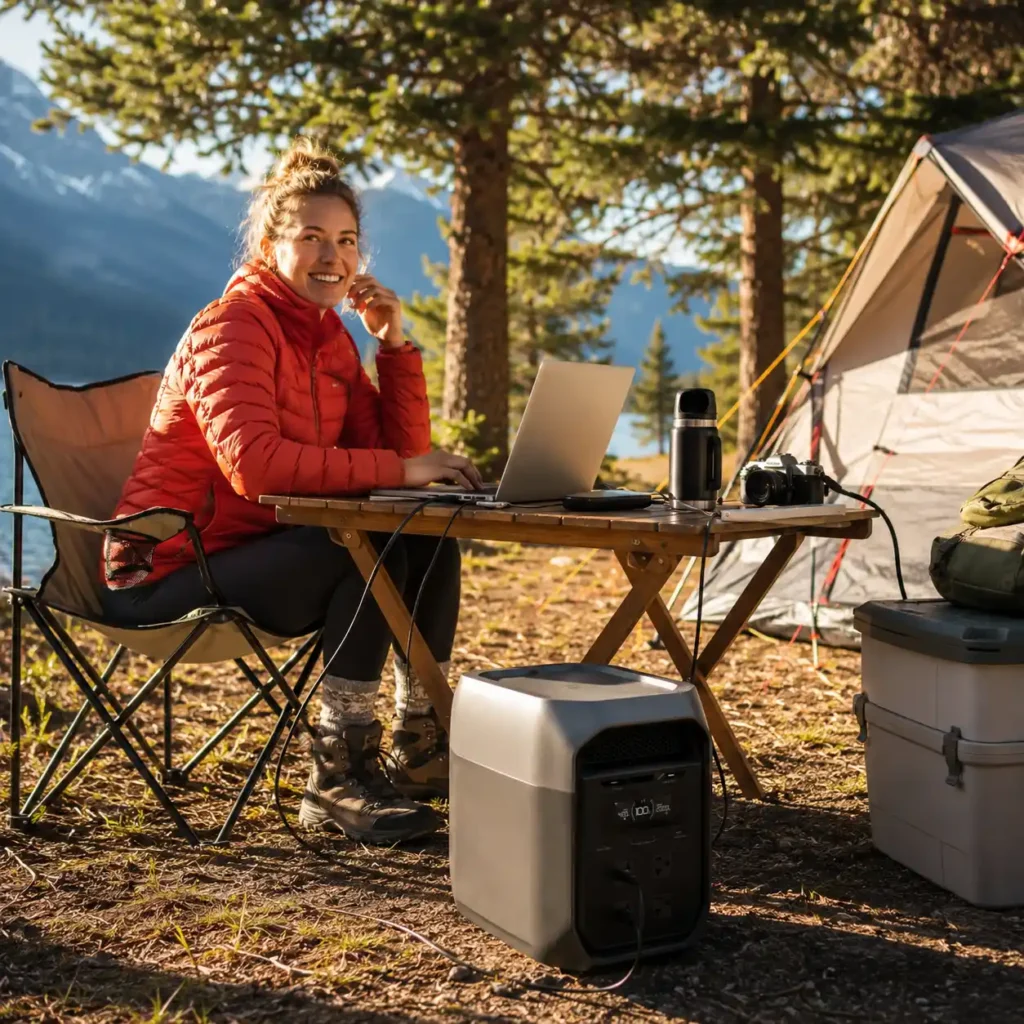
Quick Answer
If you’re looking for the best 1000Wh portable power station, the EcoFlow DELTA 3 is our top recommendation. It delivers one of the best combinations of battery capacity, 1800W continuous AC output, ultra-fast charging, long-lasting LiFePO₄ battery technology, and expandability, making it the most well-rounded choice for home backup, camping, RV travel, and everyday emergency preparedness.
That said, the best 1000Wh portable power station depends on how you plan to use it. The Jackery Explorer 1000 v2 stands out as the best value thanks to its lightweight design and dependable everyday performance. If charging speed is your top priority, the Anker SOLIX C1000 is one of the fastest-recharging models in its class. Buyers who want a compact, modern design with excellent portability should consider the BLUETTI Elite 100 V2, while the DJI Power 1000 is an outstanding choice for creators, drone pilots, and anyone already invested in the DJI ecosystem.
No single 1000Wh portable power station is perfect for every user. The right model depends on the appliances you want to run, how often you’ll use it, whether portability or fast charging matters more, and if you plan to expand your power system in the future. That’s why we compared five of today’s leading 1000Wh portable power stations to help you choose the model that offers the best balance of performance, features, and long-term value for your specific needs.
Why You Can Trust Power Ready Guide
Choosing the best 1000Wh portable power station requires more than comparing battery capacity or reading customer reviews. Models in this category often look similar on paper, but differences in inverter performance, charging speed, battery technology, portability, expandability, and overall usability can have a significant impact on real-world ownership.
At Power Ready Guide, we evaluate portable power stations using the same criteria experienced buyers consider before investing in a backup power solution. Rather than relying on marketing claims or a single specification, we compare the features that matter most in everyday use, including usable battery capacity, continuous AC output, charging performance, battery chemistry, portability, build quality, available output ports, expandability, smart features, warranty coverage, and long-term value.
For this guide, we selected five of the strongest 1000Wh portable power stations currently available on Amazon. Each model represents a different strength within this highly competitive category. Some deliver the fastest charging, others focus on lightweight portability, while others provide exceptional overall performance or seamless integration with a broader power ecosystem.
Our goal isn’t to recommend the most expensive product or the one with the longest list of features. Our goal is to help you choose the best 1000Wh portable power station for your specific needs, whether you’re preparing for power outages, building an emergency backup system, traveling in an RV, camping off-grid, or simply looking for a reliable source of portable electricity.
Every recommendation in this guide is based on detailed specification analysis, manufacturer documentation, feature comparisons, and practical usage scenarios. We focus on helping readers understand how each power station performs in real life, so you can make an informed purchase with confidence.
How We Evaluated the Best 1000Wh Portable Power Stations
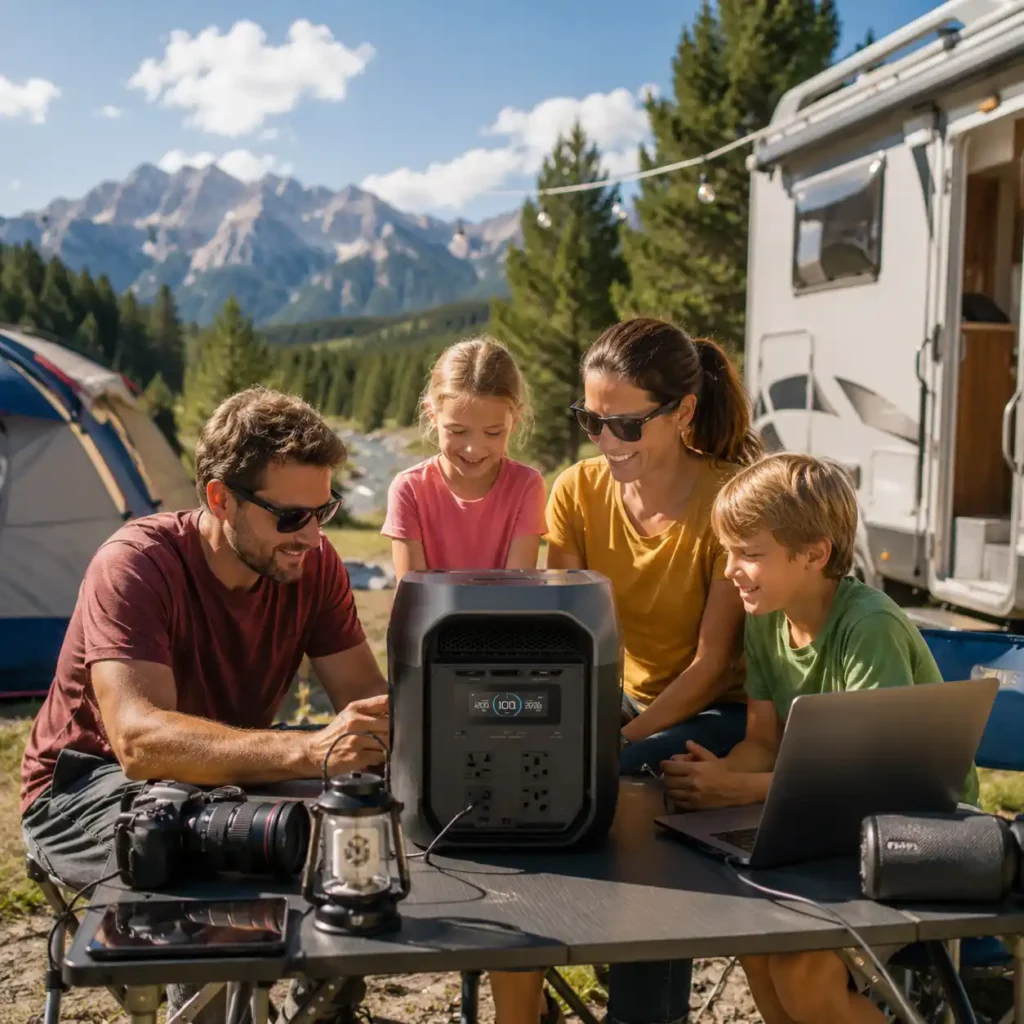
Choosing the best 1000Wh portable power station involves far more than comparing battery capacity. Although every model in this guide falls into the 1000Wh class, they differ significantly in charging speed, inverter performance, battery lifespan, portability, expandability, and overall user experience.
For this guide, we evaluated every 1000Wh portable power station using the criteria that have the greatest impact on real-world performance. Battery chemistry, usable capacity, continuous AC output, surge capability, charging speed, solar compatibility, portability, output port selection, app functionality, build quality, warranty coverage, and overall value all played an important role in our assessment.
We also considered how each model performs across different use cases. A power station that’s ideal for emergency home backup may not be the best choice for frequent camping trips, while a lightweight model designed for portability may not offer the expandability or high output that some users need. Rather than searching for a single “perfect” product, we identified the strengths that make each model the right choice for a specific type of buyer.
Our recommendations are based on manufacturer specifications, official product documentation, feature comparisons, and practical usage scenarios that reflect how people actually use portable power stations. Instead of relying on marketing claims, we evaluate how those specifications translate into everyday performance—whether you’re powering essential appliances during an outage, running equipment at a campsite, supporting an RV, or preparing for emergency situations.
By focusing on real-world usability instead of headline specifications alone, we aim to help you choose the best 1000Wh portable power station with confidence and select the model that best matches your power needs, budget, and long-term expectations
Who This Guide Is For
This guide is designed for anyone looking for the best 1000Wh portable power station to provide reliable electricity at home, outdoors, or on the road. A power station in the 1000Wh class offers one of the best balances between battery capacity, portability, and versatility, making it an excellent choice for a wide range of users.
This guide is especially helpful if you are:
- Homeowners looking for dependable backup power during outages for essentials like Wi-Fi routers, lights, laptops, CPAP machines, and small household appliances.
- Campers and outdoor enthusiasts who need reliable portable power for refrigerators, coffee makers, lighting, cameras, drones, and other camping equipment.
- RV owners and van lifers searching for a versatile power station that is easy to transport while providing enough capacity for everyday off-grid living.
- Remote workers and digital nomads who need dependable electricity for laptops, monitors, networking equipment, and mobile workstations.
- Content creators and photographers who regularly charge cameras, drones, batteries, lighting equipment, and other electronics in the field.
- Homeowners preparing for emergencies who want a quiet, maintenance-free alternative to a gas generator for powering essential devices during unexpected power outages.
- First-time buyers who want to invest in a versatile 1000Wh portable power station that can handle a wide variety of everyday situations without being unnecessarily large or expensive.
This guide may not be the best fit if you’re looking for a compact battery pack for charging only phones and small USB devices, or if you need a high-capacity power station above 2000Wh to run large household appliances for extended periods. Those use cases are better served by dedicated guides covering smaller portable batteries and larger whole-home backup solutions.
Quick Summary: Our Top Picks
Not every 1000Wh portable power station is built for the same type of user. Some prioritize ultra-fast charging, others focus on portability, while some deliver the best balance of performance, expandability, and long-term value.
The models below earned their awards based on our evaluation of battery capacity, inverter performance, charging speed, battery technology, portability, expandability, build quality, smart features, and overall value.
Award: Best Overall
Why It Won
The EcoFlow DELTA 3 delivers the best overall combination of power, charging speed, portability, expandability, and everyday usability. Its 1800W pure sine wave inverter, ultra-fast AC charging, LiFePO₄ battery, and expandable ecosystem make it the most versatile 1000Wh portable power station in this guide.
Choose This If
- You want the best all-around performer.
- Fast recharging is a priority.
- You need one power station for home, travel, and emergencies.
Best For
- Home backup
- Camping
- RV travel
- Emergency preparedness
Award: Best Value
Why It Won
The Jackery Explorer 1000 v2 offers an excellent balance of price, portability, efficiency, and dependable everyday performance. It’s one of the easiest 1000Wh portable power stations to own and an outstanding value for most buyers.
Choose This If
- You’re buying your first portable power station.
- You want excellent value for money.
- You mainly power small and medium appliances.
Best For
- Weekend camping
- First-time buyers
- Road trips
- Everyday backup
Award: Best Fast Charging
Why It Won
The Anker SOLIX C1000 features one of the fastest AC recharge times in the 1000Wh category while delivering premium build quality, reliable performance, and an excellent companion app.
Choose This If
- You frequently travel on short notice.
- You want to recharge as quickly as possible.
- Smart app control is important to you.
Best For
- Frequent travelers
- Camping
- Road trips
- Emergency backup
Award: Best Compact Design
Why It Won
The BLUETTI Elite 100 V2 combines strong performance with a compact, travel-friendly design. It’s an excellent choice for buyers who want modern features without carrying unnecessary weight.
Choose This If
- Portability is your top priority.
- You travel frequently.
- You want a compact yet capable power station.
Best For
- Camping
- Outdoor recreation
- RV travel
- Weekend trips
Award: Best for DJI Users
Why It Won
The DJI Power 1000 is purpose-built for creators and drone pilots, offering fast charging for compatible DJI batteries, powerful AC output, and seamless integration with the DJI ecosystem.
Choose This If
- You own DJI drones or cameras.
- You regularly create content outdoors.
- Fast battery turnaround is important.
Best For
- Drone pilots
- Photographers
- Videographers
- Mobile production
Best 1000Wh Portable Power Stations Compared
Choosing the best 1000Wh portable power station involves more than simply comparing battery capacity. While every model in this guide offers around 1,000Wh of stored energy, they differ in inverter power, charging speed, portability, battery technology, expandability, and overall value.
The comparison table below provides a side-by-side overview of our top picks. Use it to quickly compare the most important specifications before exploring the detailed reviews of each model later in this guide.
| Model | Award | Capacity | AC Output | Weight |
|---|---|---|---|---|
| EcoFlow DELTA 3 | Best Overall | 1024Wh | 1800W | 27.6 lbs |
| Anker SOLIX C1000 | Best Fast Charging | 1056Wh | 1800W | 28.4 lbs |
| Jackery Explorer 1000 v2 | Best Value | 1070Wh | 1500W | 23.8 lbs |
| BLUETTI Elite 100 V2 | Best Compact Design | 1024Wh | 1800W | 25.4 lbs |
| DJI Power 1000 | Best for DJI Users | 1024Wh | 2200W | 28.7 lbs |
Note: Specifications may vary slightly following manufacturer updates or regional product versions. Always verify the latest specifications and included accessories before purchasing.
Detailed Reviews of the Best 1000Wh Portable Power Stations
The following reviews take a closer look at each of our top picks. We evaluated every 1000Wh portable power station based on real-world usability, battery technology, charging performance, inverter capability, portability, expandability, and overall value.
Rather than focusing only on specifications, these reviews explain who each model is best suited for, where it excels, and any limitations you should consider before buying.
EcoFlow DELTA 3
Best Overall Portable Power Station for RV living
Quick Verdict
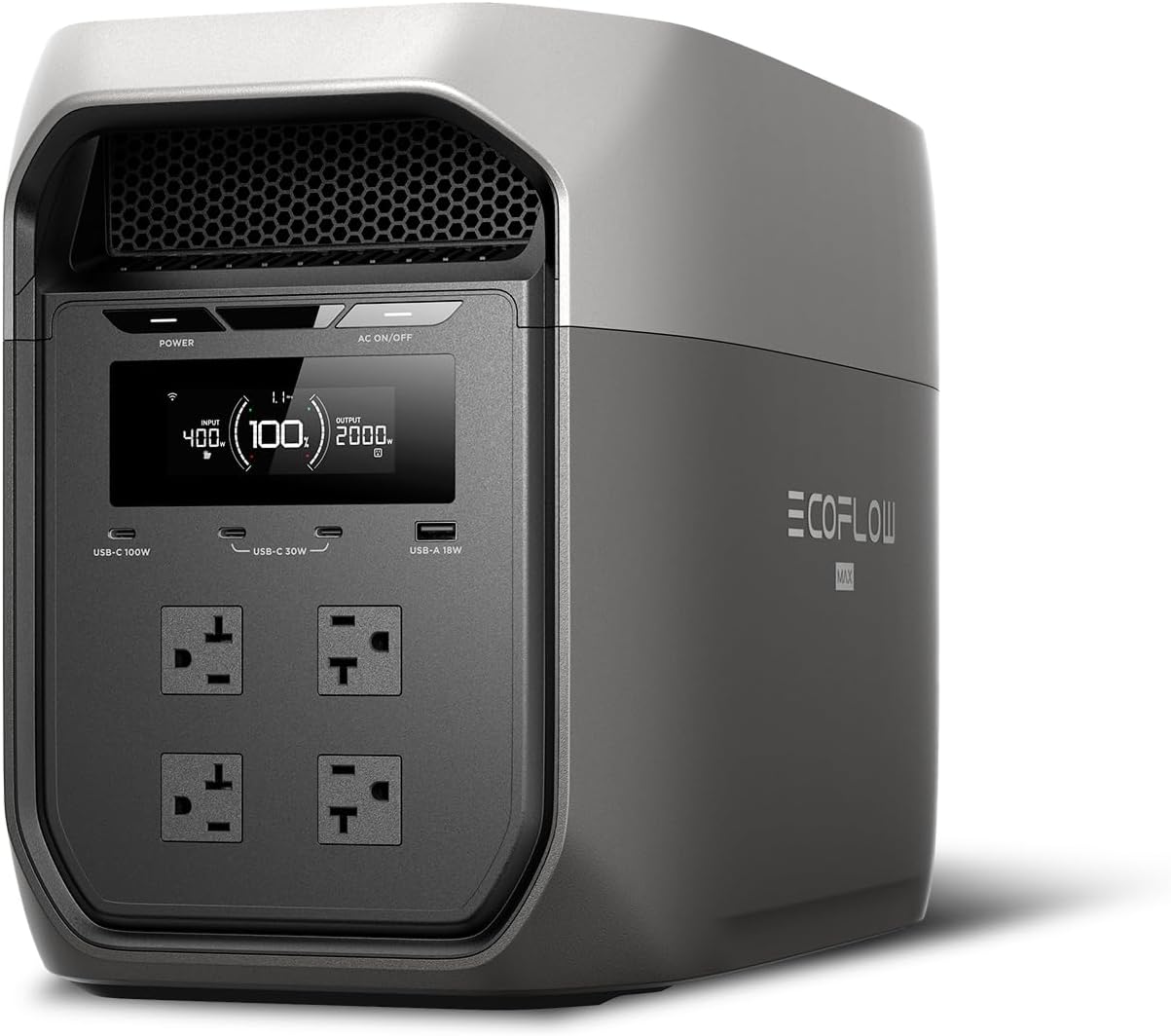
The EcoFlow DELTA 3 earns our Best Overall award because it delivers the strongest overall combination of performance, charging speed, portability, and long-term flexibility among the 1000Wh portable power stations we evaluated.
Rather than leading in just one category, the DELTA 3 performs consistently well across nearly every criterion that matters to most buyers. Its 1024Wh LiFePO₄ battery, powerful 1800W pure sine wave inverter, ultra-fast AC charging, and expandable battery ecosystem make it equally well suited for home backup, camping, RV travel, emergency preparedness, and everyday portable power.
Another reason the DELTA 3 stands out is its ability to grow with your needs. Whether you’re purchasing your first portable power station or upgrading from an older model, EcoFlow’s expansion battery options allow you to increase runtime without replacing the entire unit. Combined with excellent build quality, intuitive app control, and one of the fastest recharge speeds in its class, it offers exceptional long-term value.
Although it isn’t the least expensive option in this guide, its balanced performance, premium feature set, and outstanding versatility make it the 1000Wh portable power station we’d recommend to the widest range of users.
Product Snapshot
| Feature | Details |
|---|---|
| Best For | Home Backup • Camping • RV Travel • Emergency Preparedness |
| Battery Capacity | 1024Wh |
| AC Output | 1800W Continuous |
| Battery Chemistry | LiFePO₄ |
| Solar Input | Up to 500W |
| Expandable Capacity | Yes |
| UPS Function | Yes |
| App Control | Yes |
| Weight | 27.6 lbs (12.5 kg) |
Why We Chose It
Selecting a single 1000Wh portable power station to recommend for the widest range of users is more challenging than it might seem. Some models excel in charging speed but sacrifice expandability, while others offer higher inverter output at the cost of increased weight or a less refined user experience.
The EcoFlow DELTA 3 distinguishes itself by avoiding most of these compromises.
During our evaluation, we looked beyond battery capacity and output power alone. We assessed how each power station performs in everyday situations, including charging speed, inverter capability, portability, battery longevity, software experience, expandability, and overall ownership value. Across all of these categories, the DELTA 3 consistently ranked among the strongest performers.
Its 1800W pure sine wave inverter comfortably powers many of the appliances people use every day, including refrigerators, coffee makers, laptops, televisions, routers, CPAP machines, power tools, and kitchen appliances. At the same time, the 1024Wh LiFePO₄ battery provides enough stored energy for weekend camping trips, emergency outages, remote work, or outdoor recreation without making the unit excessively heavy.
Charging performance is another major advantage. EcoFlow has built a reputation for extremely fast AC charging, and the DELTA 3 continues that tradition. Instead of waiting most of the day to recharge after a camping trip or power outage, users can return the battery to a high state of charge in a fraction of the time required by many competing models. This significantly improves convenience, particularly for people who travel frequently or rely on their power station as emergency backup.
Long-term flexibility also influenced our recommendation. Unlike many portable power stations that remain fixed at their original capacity, the DELTA 3 supports EcoFlow’s expandable battery ecosystem. That means buyers can start with a compact, portable unit today and increase available runtime later without replacing the entire system.
Perhaps most importantly, the DELTA 3 doesn’t force buyers into a single use case. It performs equally well at home during outages, at the campground, inside an RV, on road trips, or as portable power for outdoor events. That versatility ultimately earned it our Best Overall award.
Check the latest price and customer reviews on Amazon.

Living With It at Camp
The EcoFlow DELTA 3 quickly becomes one of those pieces of camping gear you stop thinking about because it simply works. Instead of watching the battery percentage throughout the day or deciding which device should be plugged in next, you settle into camp knowing your essential equipment will continue running while you focus on enjoying the outdoors.
One of the first things you’ll notice after a few camping trips with the DELTA 3 is how quickly it becomes part of your routine. After pitching the tent, you place the DELTA 3 beside your camp kitchen, connect a portable refrigerator, and begin charging phones, camera batteries, and a drone while setting up the rest of camp. As evening arrives, LED lights illuminate the campsite, dinner is prepared using a small electric appliance, and everyone tops up their devices before bed without taking turns at the outlets.
The next morning feels just as effortless. Coffee is brewing, the refrigerator has kept food cold overnight, laptops and cameras are fully charged, and there’s still enough battery remaining for another full day of hiking, fishing, or relaxing around camp. Rather than constantly managing your available power, the DELTA 3 quietly handles the background work, allowing electricity to become something you rarely think about.
Its versatility extends well beyond traditional camping. During road trips, it keeps cameras, drones, and portable refrigerators running between destinations. At outdoor events, it provides reliable power for lighting, speakers, and mobile workstations. At home, the same unit can step in during unexpected outages to keep essential electronics operating until the power returns.
Fast AC charging makes ownership even more convenient. Whether you spend a night at a campground with electrical hookups or recharge at home before your next adventure, the DELTA 3 can be ready again remarkably quickly. For people who camp regularly, that means less waiting and more time actually using the power station where it matters.
EcoFlow DELTA 3 Evaluation
| Evaluation Category | Editorial Assessment |
|---|---|
| Portability | Light enough to carry around camp while still providing meaningful battery capacity for multi-day trips. |
| Power Performance | Comfortably powers portable refrigerators, CPAP machines, coffee makers, laptops, cameras, Starlink, and other common camping equipment. |
| Charging Speed | Among the fastest AC recharge times in the 1000Wh category, making frequent camping trips far more convenient. |
| Long-Term Ownership | LiFePO₄ battery, expandable ecosystem, polished mobile app, and excellent manufacturer support provide outstanding long-term value. |
| Overall Rating | Our top overall recommendation thanks to its exceptional balance of performance, portability, reliability, and everyday usability. |
Who Should Buy This
- Campers looking for one portable power station that performs exceptionally well in almost every outdoor scenario.
- Families taking regular weekend or multi-day camping trips.
- RV owners needing dependable portable power between destinations.
- Remote workers relying on laptops, Starlink, cameras, and other electronics while traveling.
- Buyers planning to expand their portable power setup over time.
- Anyone wanting one power station that works equally well at home and outdoors.
Who Should Skip This
- Campers who only charge phones, headlamps, and a few USB devices.
- Backpackers looking for the lightest possible battery solution.
- Buyers shopping strictly for the lowest upfront price.
- Users who expect to use a portable power station only once or twice a year for occasional emergencies.
Final Verdict
The EcoFlow DELTA 3 earns its place at the top of this guide because it succeeds where many competitors force compromises. It delivers enough battery capacity for real camping, enough inverter power for demanding appliances, recharge speeds that suit modern travel, and an ownership experience that remains satisfying long after the first trip.
While some competitors outperform it in individual categories, none combine performance, portability, charging speed, software experience, and future expandability as effectively as the DELTA 3. It’s equally comfortable powering a campsite, supporting remote work on the road, providing backup electricity at home, or accompanying an RV adventure.
If you’re looking for one 1000Wh portable power station that can confidently handle almost every situation today while continuing to meet your needs for years to come, the EcoFlow DELTA 3 is our Best Overall recommendation.
Check the latest price and customer reviews on Amazon.
Related Guide: If you’re planning to use a portable power station primarily for outdoor adventures, our Best Portable Power Stations for Camping (2026) guide can help you compare models based on battery capacity, portability, charging options, and the practical demands of camping.
DJI Power 1000
Best Portable Power Station for Weekend RV Trips

Quick Verdict
The DJI Power 1000 earns our Best Portable Power Station for Weekend RV Trips award because it delivers one of the strongest combinations of portability, premium engineering, fast charging, and everyday usability in the 1000Wh portable power station category.
Powered by a 1024Wh LiFePO₄ battery and a 2200W pure sine wave inverter, it provides more than enough energy for the appliances most RV travelers actually use without carrying the additional size and weight of a much larger power station. Whether you’re powering a portable refrigerator, brewing morning coffee, charging laptops, cameras, drones, or keeping Starlink online, the Power 1000 handles everyday camping tasks with confidence while remaining easy to transport between campsites.
What truly sets the DJI Power 1000 apart is its refined ownership experience. From the premium build quality and intuitive companion app to its exceptionally fast AC charging, nearly every aspect of the system feels thoughtfully engineered. Instead of spending hours waiting for the battery to recharge before your next adventure, you can recover most of its capacity during a lunch stop, at an RV park with shore power, or before heading out for the weekend.
While travelers planning extended off-grid expeditions may eventually benefit from a larger expandable power system, most RV owners simply don’t require that level of capacity. For weekend escapes, road trips, camper vans, and small travel trailers, the DJI Power 1000 offers one of the most balanced and enjoyable ownership experiences available today.
RV Snapshot
| Feature | Details |
|---|---|
| RV Style | Weekend RV Trips • Camper Vans • Small Travel Trailers • Road Trips |
| Battery Capacity | 1024Wh |
| AC Output | 2200W Continuous |
| Battery Type | LiFePO₄ |
| Weight | 32.6 lbs (14.8 kg) |
| Solar Charging | Supported |
| App Control | Yes |
| Best For | Weekend RV travelers seeking premium portability and dependable everyday performance. |
Why We Chose It
Choosing the best portable power station for weekend RV trips isn’t simply about selecting the model with the largest battery. Most RV travelers spend two or three days exploring campgrounds, state parks, scenic overlooks, and national parks before returning home or moving on to the next destination. For that style of travel, portability, convenience, and fast charging often matter more than carrying the heaviest power station available.
The DJI Power 1000 was clearly designed with this type of traveler in mind.
Its 2200W pure sine wave inverter comfortably powers nearly every appliance commonly found on weekend RV adventures, including portable refrigerators, coffee makers, induction cooktops, CPAP machines, televisions, laptops, Starlink systems, cameras, battery chargers, and multiple mobile devices simultaneously. Meanwhile, the 1024Wh LiFePO₄ battery provides enough usable energy for most two- or three-day trips without introducing the bulk normally associated with larger 2kWh systems.
Another reason the DJI Power 1000 earned this award is the overall quality of the ownership experience. The enclosure feels exceptionally solid, the interface is intuitive, and the companion app makes monitoring battery status and adjusting settings remarkably simple. Combined with one of the fastest AC recharge systems in this category, the entire experience feels polished from the moment you begin using it.
Rather than trying to be the largest portable power station available, DJI focused on creating one that travelers genuinely enjoy bringing along. The result is a premium portable power station that’s easy to carry, quick to recharge, simple to operate, and exceptionally well suited for the way most people actually travel.
For RV owners who prioritize convenience, portability, premium engineering, and dependable everyday performance over maximum battery capacity, the DJI Power 1000 represents one of the most refined choices currently available in the 1000Wh portable power station category.
Check the latest price and customer reviews on Amazon.

Living With It on the Road
The DJI Power 1000 fits naturally into the rhythm of weekend RV travel. Instead of thinking about battery levels or deciding which appliance should take priority, you simply connect the essentials and enjoy your destination. Whether it’s keeping a portable refrigerator running, charging cameras and drones after a day of exploring, or brewing coffee the next morning, the power station quietly takes care of the background work.
What stands out after a few weekends isn’t just the available power—it’s how little attention the unit demands. Once everything is connected, it operates quietly and reliably, allowing you to focus on the trip itself rather than managing your power supply.
One of the biggest advantages becomes obvious between destinations. Thanks to its exceptionally fast AC charging, the DJI Power 1000 can recover a large portion of its battery during a lunch stop, an afternoon at an RV park with shore power, or before leaving home for your next adventure. For travelers who frequently move between campsites, this dramatically reduces downtime and removes much of the stress associated with managing portable power.
Its premium construction also contributes to the ownership experience. The sturdy enclosure, responsive controls, quiet cooling system, and intuitive companion app all make the unit feel refined in daily use. Rather than feeling like a piece of emergency equipment, the DJI Power 1000 feels like high-quality travel gear built to accompany every weekend adventure.
Editorial Assessment
| Category | Rating | Editorial Notes |
|---|---|---|
| Portability | ★★★★★ | Compact size and comfortable carrying handles make it ideal for camper vans, SUVs, and small travel trailers. |
| Power Output | ★★★★★ | The 2200W inverter easily powers nearly every appliance commonly used during weekend RV trips. |
| Battery Capacity | ★★★★☆ | Excellent for weekend adventures, though longer off-grid stays may benefit from a larger battery system. |
| Charging Speed | ★★★★★ | One of the fastest AC recharge systems in the 1000Wh category, minimizing downtime between trips. |
| Ease of Use | ★★★★★ | Premium build quality, intuitive controls, and an excellent mobile app create a polished user experience. |
| Value for Money | ★★★★☆ | Higher price than some competitors, but justified by engineering quality, performance, and everyday usability. |
Who Should Buy This
- RV owners who primarily take weekend camping trips.
- Camper van travelers who value portability and premium engineering.
- Couples and solo travelers with moderate daily power requirements.
- Remote workers using laptops, Starlink, cameras, and mobile devices while traveling.
- Travelers who appreciate exceptionally fast AC charging.
- Buyers looking for a premium portable power station that is easy to transport and simple to use.
Who Should Skip This
- Full-time RVers spending a week or longer boondocking without access to shore power.
- Users who need to power large appliances for extended periods every day.
- Buyers who require expandable battery capacity from the start.
- Anyone shopping primarily for the lowest possible purchase price.
Final Verdict
The DJI Power 1000 wasn’t designed to be the largest portable power station in its class—it was designed to be one of the easiest to own. That philosophy is reflected in every part of the user experience, from its premium construction and intuitive controls to its exceptionally fast charging and dependable everyday performance.
Its combination of a 1024Wh LiFePO₄ battery, a 2200W pure sine wave inverter, quiet operation, and excellent portability makes it an outstanding companion for weekend RV adventures. Whether you’re exploring national parks, traveling in a camper van, spending a few nights at a lakeside campground, or taking a spontaneous road trip, it delivers the right amount of power without the unnecessary size and weight of a much larger system.
While travelers planning extended off-grid expeditions may eventually benefit from a higher-capacity expandable power station, few models in the 1000Wh portable power station category provide such a refined balance of portability, charging speed, build quality, and overall ownership experience.
If your priority is a premium portable power station that’s easy to carry, quick to recharge, and capable of powering nearly everything you need during weekend RV trips, the DJI Power 1000 is one of the strongest recommendations in this guide.
Check the latest price and customer reviews on Amazon.
Related Guide: If you’re choosing portable power specifically for RV travel, our Best Portable Power Stations for RV (2026) guide compares the features that matter most on the road, including usable capacity, inverter output, portability, and charging flexibility.
Jackery Explorer 1000 v2
Best Value Portable Power Station

Quick Verdict
The Jackery Explorer 1000 v2 earns our Best Value Portable Power Station award because it delivers an impressive combination of performance, portability, and reliability at a price that makes premium portable power more accessible to a wider range of buyers.
Equipped with a 1070Wh LiFePO₄ battery and a 1500W pure sine wave inverter, the Explorer 1000 v2 comfortably powers the appliances most people rely on during camping trips, RV travel, emergency outages, and outdoor activities. It easily handles portable refrigerators, coffee makers, laptops, televisions, CPAP machines, routers, lighting, and multiple USB-powered devices while remaining compact enough for frequent transport.
Jackery has also refined nearly every aspect of this second-generation model. Compared with earlier versions, the Explorer 1000 v2 offers a lighter design, faster charging, improved battery chemistry, and a more modern user experience without sacrificing the simplicity that has made Jackery one of the most trusted names in portable power.
While it doesn’t offer the highest inverter output or the most advanced expansion ecosystem in this guide, it delivers outstanding everyday performance at a highly competitive price. For buyers looking to maximize value without compromising quality, the Jackery Explorer 1000 v2 stands out as one of the smartest purchases in the 1000Wh portable power station category.
Product Snapshot
| Feature | Details |
|---|---|
| Best For | Camping • Weekend RV Trips • Home Backup • Outdoor Recreation |
| Battery Capacity | 1070Wh |
| AC Output | 1500W Continuous |
| Battery Type | LiFePO₄ |
| Solar Charging | Supported |
| App Control | Yes |
| Weight | Approximately 23.8 lbs (10.8 kg) |
| Best Value | Excellent balance of performance, portability, and affordability. |
Why We Chose It
Finding genuine value isn’t simply about choosing the least expensive portable power station. A lower purchase price means very little if performance, battery longevity, or reliability fall short after a few trips. Instead, we looked for the model that delivers the greatest overall return on investment for the widest range of users.
The Jackery Explorer 1000 v2 consistently stood out throughout our evaluation.
Its 1070Wh LiFePO₄ battery provides enough usable capacity for most weekend camping trips, road adventures, emergency home backup, and outdoor recreation without pushing the unit into the heavier weight class occupied by many larger power stations. At the same time, its 1500W pure sine wave inverter comfortably powers the appliances most buyers actually use, including portable refrigerators, electric coolers, coffee makers, televisions, routers, laptops, CPAP machines, and battery chargers.
Portability played an equally important role in our assessment. Weighing noticeably less than many competing models in this category, the Explorer 1000 v2 is easy to move between the garage, vehicle, campsite, backyard, or RV. That convenience makes a meaningful difference for people who use their portable power station regularly rather than leaving it stored between emergencies.
Another reason this model earned our Best Value award is Jackery’s long-standing reputation for dependable products and user-friendly design. The controls are intuitive, the display is easy to read, and the overall ownership experience remains refreshingly straightforward. Buyers don’t need to spend time learning complicated settings before putting the power station to work.
Perhaps most importantly, the Explorer 1000 v2 avoids unnecessary compromises. Rather than chasing maximum specifications in one category, it delivers balanced performance across battery capacity, portability, charging speed, build quality, and ease of use. That combination makes it one of the safest recommendations for first-time buyers as well as experienced outdoor enthusiasts looking for dependable portable power without overspending.
Check the latest price and customer reviews on Amazon.

Living With It at Camp
The Jackery Explorer 1000 v2 is the kind of portable power station that quietly earns your trust over time. It doesn’t rely on one headline feature or an unusually high specification to stand out. Instead, it delivers the dependable, straightforward performance that makes every camping trip a little easier and a lot more comfortable.
Arrive at camp, set up your tent, and the Explorer 1000 v2 is ready to get to work. It keeps a portable refrigerator running, charges phones, cameras, and drones after the drive, and powers the small appliances that make camp life more enjoyable. Everything simply works without the noise, fuel, or maintenance associated with a traditional gas generator.
As the day unfolds, the power station continues to support your routine without demanding much attention. A laptop can handle a few hours of remote work while you enjoy the scenery. An electric kettle prepares coffee, a portable fan keeps the tent comfortable on warm afternoons, and cameras and other devices recharge between adventures. Rather than thinking about power management, you can focus on spending time outdoors.
When evening arrives, the Explorer 1000 v2 quietly keeps everything running in the background. Campsite lighting creates a comfortable atmosphere, essential devices recharge overnight, and there’s still enough power remaining for the next morning’s coffee before heading home or continuing your trip.
One of the biggest conveniences comes after the adventure is over. Thanks to its fast AC charging capability, the battery can be recharged quickly at home and prepared for the next outing without spending the entire day connected to a wall outlet. For campers who head outdoors regularly, that means less waiting and more time enjoying the equipment they’ve invested in.
Perhaps what makes the Explorer 1000 v2 so appealing is its simplicity. The display is easy to understand, the controls are intuitive, and there is very little learning curve. Even first-time portable power station owners can begin using it confidently within minutes. That ease of ownership is one of the reasons Jackery has earned such a loyal following among campers, road trippers, and outdoor enthusiasts.
Editorial Assessment
| Category | Rating | Editorial Notes |
|---|---|---|
| Portability | ★★★★★ | One of the lightest portable power stations in its class, making transportation between home, vehicle, and campsite effortless. |
| Power Performance | ★★★★☆ | The 1500W pure sine wave inverter comfortably powers the vast majority of camping and everyday household appliances. |
| Battery Capacity | ★★★★★ | 1070Wh provides an excellent balance between usable runtime and manageable size for most outdoor adventures. |
| Charging Speed | ★★★★★ | Fast AC recharging minimizes downtime and makes frequent weekend trips much more convenient. |
| Ease of Use | ★★★★★ | Simple controls, a clear display, and an intuitive mobile app make everyday operation exceptionally easy. |
| Value for Money | ★★★★★ | Outstanding overall value by combining dependable performance, trusted reliability, and an accessible purchase price. |
Who Should Buy This
- First-time portable power station buyers looking for dependable performance without unnecessary complexity.
- Families who regularly enjoy weekend camping trips and outdoor adventures.
- RV travelers wanting a lightweight and reliable portable power solution.
- Homeowners preparing for occasional power outages while staying within a sensible budget.
- Outdoor enthusiasts who need dependable power for cameras, drones, laptops, and other electronic equipment.
- Buyers looking for the strongest balance of price, reliability, portability, and everyday usability.
Who Should Skip This
- Users who regularly power high-demand appliances above 1500W.
- Full-time off-grid campers requiring several days of continuous runtime.
- Buyers looking for expandable battery capacity from the beginning.
- Users who need the most powerful inverter available in the 1000Wh category regardless of price.
Final Verdict
The Jackery Explorer 1000 v2 proves that exceptional value isn’t about being the least expensive option—it’s about delivering the features most people actually need in a package that’s dependable, easy to own, and built to last.
Its combination of a 1070Wh LiFePO₄ battery, a 1500W pure sine wave inverter, lightweight construction, fast charging, and Jackery’s well-earned reputation for reliability makes it one of the most approachable portable power stations available today. Rather than overwhelming buyers with unnecessary complexity, it focuses on delivering consistent everyday performance whether you’re camping with family, traveling in an RV, preparing for emergency outages, or simply enjoying time outdoors.
While larger and more powerful models certainly have their place, many buyers will discover that the Explorer 1000 v2 provides everything they realistically need while remaining easier to transport and significantly more affordable. That balance is precisely why it earned our Best Value Portable Power Station award.
If you’re looking for a portable power station that combines trusted reliability, practical performance, excellent portability, and outstanding long-term value, the Jackery Explorer 1000 v2 is one of the smartest investments you can make in the 1000Wh portable power station category.
Check the latest price and customer reviews on Amazon.
Related Guide: If keeping the purchase price under control is one of your main priorities, our Best Portable Power Stations Under $500 (2026) guide can help you compare more affordable models without overlooking battery capacity, output, and everyday usability.
BLUETTI Elite 100 V2
Best Lightweight Portable Power Station
Quick Verdict
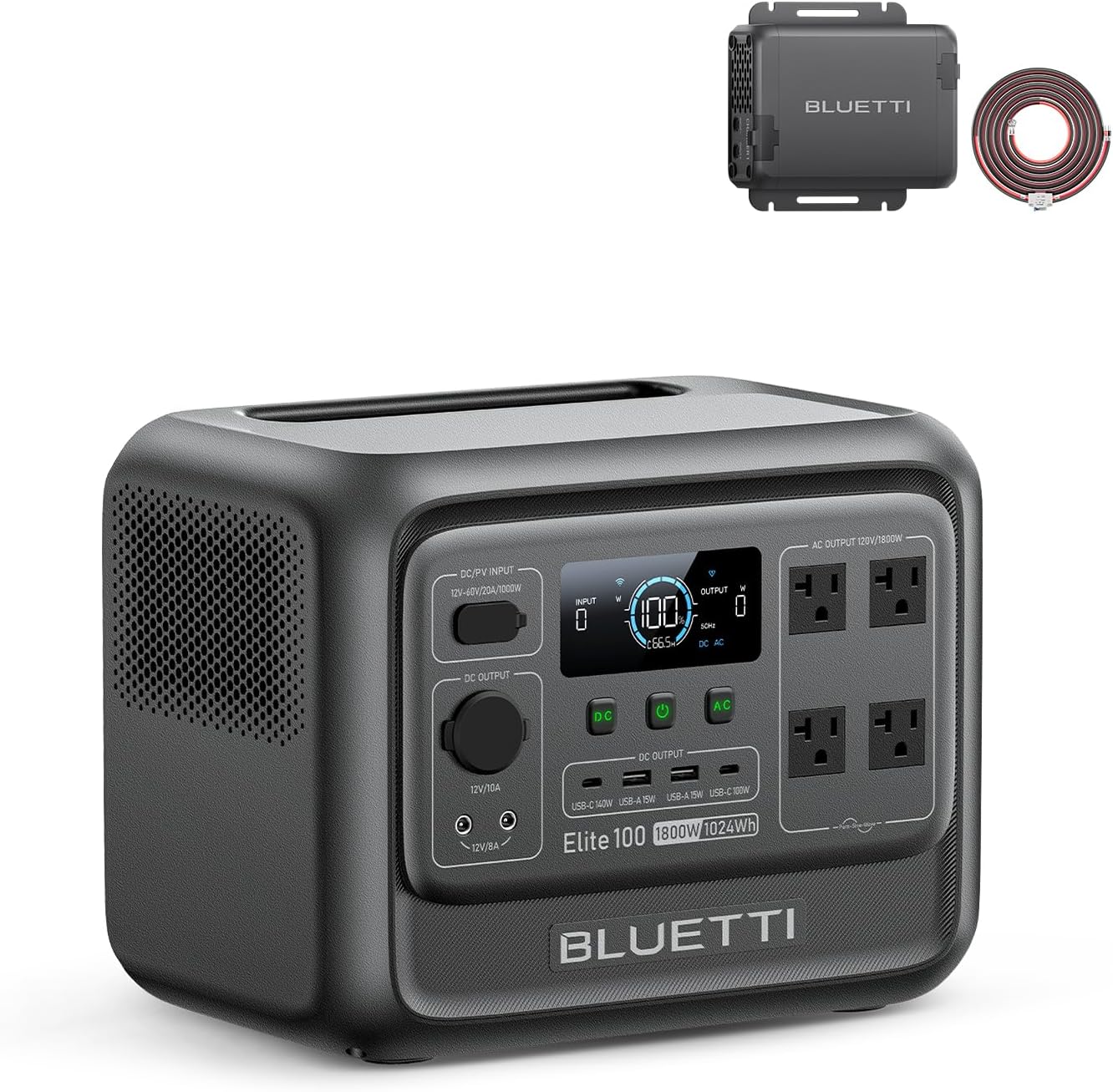
Few portable power stations in the 1000Wh class place as much emphasis on portability as the BLUETTI Elite 100 V2. That focus is exactly why it earned our Best Lightweight Portable Power Station award.
Built around a 1024Wh LiFePO₄ battery and a 1800W pure sine wave inverter, the Elite 100 V2 delivers enough power for the vast majority of camping equipment, RV appliances, emergency backup devices, and outdoor electronics while remaining noticeably easier to carry than many competing models. Whether you’re loading gear into the trunk of your car, carrying equipment across a campground, or moving the unit around your home during a power outage, its lightweight design quickly becomes one of its biggest advantages.
Unlike larger portable power stations that often require two hands and careful planning every time they’re moved, the BLUETTI Elite 100 V2 feels designed for people who frequently transport their equipment. It comfortably powers portable refrigerators, electric coolers, CPAP machines, coffee makers, televisions, laptops, routers, battery chargers, cameras, drones, and multiple USB-powered devices without forcing users to sacrifice portability for performance.
Beyond its manageable weight, the Elite 100 V2 also delivers the premium features expected from a modern portable power station. Fast AC charging minimizes downtime between adventures, solar charging support offers additional flexibility for off-grid travel, and the intuitive BLUETTI mobile app makes monitoring battery status and adjusting settings simple for both new and experienced users.
While buyers planning to run multiple high-demand appliances continuously may eventually benefit from a larger expandable system, many outdoor enthusiasts, travelers, and homeowners simply want dependable portable power that doesn’t feel cumbersome to move. For anyone who values mobility as much as battery capacity, the BLUETTI Elite 100 V2 offers one of the best-balanced ownership experiences currently available.
Product Snapshot
| Feature | Details |
|---|---|
| Best For | Camping • Road Trips • RV Travel • Emergency Backup • Outdoor Recreation |
| Battery Capacity | 1024Wh |
| AC Output | 1800W Continuous |
| Battery Type | LiFePO₄ |
| Solar Charging | Supported |
| App Control | Yes |
| Weight | One of the lightest models in the 1000Wh class |
| Best For | Buyers looking for maximum portability without giving up everyday performance. |
Why We Chose It
Weight is one of the most overlooked factors when shopping for a portable power station. On paper, a difference of ten or fifteen pounds between two models may not seem significant. In everyday use, however, that difference becomes surprisingly important. Whether you’re lifting the unit into the back of an SUV, carrying it across a campground, moving it around an RV, or relocating it from room to room during a home power outage, every pound matters.
The BLUETTI Elite 100 V2 stood out because it delivers the level of performance most buyers expect from a 1000Wh portable power station while remaining noticeably easier to transport than many competing models.
Its 1800W pure sine wave inverter provides enough continuous power to operate nearly every appliance commonly used during camping trips, RV travel, and emergency situations. Portable refrigerators, electric coolers, induction cooktops, coffee makers, CPAP machines, televisions, laptops, Starlink systems, battery chargers, and numerous USB-powered devices all fall comfortably within its capabilities. Meanwhile, the 1024Wh LiFePO₄ battery offers sufficient energy storage for overnight camping, weekend adventures, and short-term emergency backup without pushing the unit into a heavier weight class.
Portability alone would not have been enough to earn this award. The Elite 100 V2 also impressed us with its overall refinement. Fast AC charging allows the battery to recover quickly between trips, solar charging support provides additional flexibility for extended outdoor adventures, and the BLUETTI mobile app offers straightforward monitoring and system control. Together, these features create a polished ownership experience that extends well beyond raw specifications.
Perhaps most importantly, the Elite 100 V2 demonstrates that choosing a lightweight power station no longer requires major compromises. Buyers still receive dependable battery chemistry, strong inverter performance, modern charging options, and the build quality expected from a premium manufacturer. Instead of sacrificing capability to reduce weight, BLUETTI has managed to balance both exceptionally well.
For campers, road trippers, RV owners, photographers, outdoor content creators, and homeowners who frequently move their equipment from place to place, the BLUETTI Elite 100 V2 represents one of the most practical and portable solutions currently available in the 1000Wh portable power station category.
Check the latest price and customer reviews on Amazon.
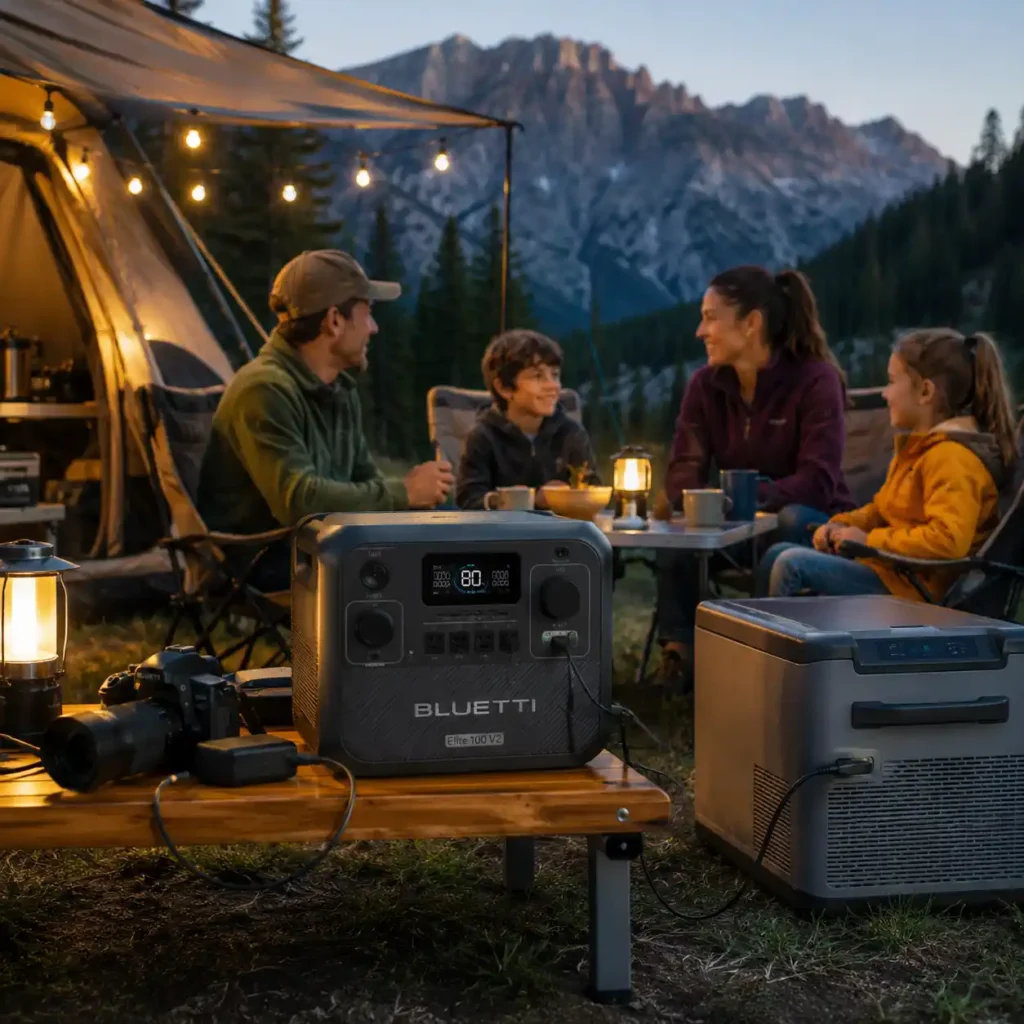
Living With It on the Go
The BLUETTI Elite 100 V2 immediately feels different from many other portable power stations the first time you pick it up. While most units in the 1000Wh category remind you that you’re carrying a substantial battery every time you move them, the Elite 100 V2 feels surprisingly manageable. That difference may seem minor on paper, but after a weekend of loading, unloading, and repositioning equipment around a campsite or RV, it becomes one of the features you’ll appreciate the most.
Imagine arriving at a national park after several hours on the road. Instead of debating whether it’s worth carrying the power station from the vehicle to the picnic table, you simply grab the Elite 100 V2 and walk it over with the rest of your camping gear. Within minutes, it’s keeping a portable refrigerator cold while phones, smartwatches, camera batteries, and a drone recharge after the journey. There’s no complicated setup and no concern about fuel, exhaust fumes, or excessive noise—just dependable electricity exactly where you need it.
Throughout the afternoon, the power station quietly supports everything happening around camp. A laptop powers through a few hours of photo editing while overlooking the lake. An electric kettle prepares coffee before an afternoon hike. A portable fan keeps the tent comfortable during warm weather, and camera batteries recharge between excursions so they’re ready to capture the evening sunset. The Elite 100 V2 delivers enough output to handle these everyday tasks without making you constantly think about which appliance can be plugged in next.
As daylight fades, the campsite becomes even more inviting. LED string lights create a warm atmosphere for dinner, portable speakers provide background music, and everyone charges their phones before the next day’s adventure. Throughout the evening, the power station operates quietly in the background, allowing conversations and the sounds of nature to remain uninterrupted. Its compact footprint also makes it easy to position beside a table or inside a camper van without occupying valuable living space.
Frequent travelers will especially appreciate how easy the Elite 100 V2 is to transport from one destination to the next. Whether you’re moving between campgrounds, exploring scenic overlooks during a road trip, or simply carrying it from your garage to the backyard for an outdoor gathering, the reduced weight makes every move noticeably easier. It becomes a piece of equipment that you bring because it’s convenient—not because you feel obligated after making the investment.
Fast AC charging further enhances the experience. After returning home from a weekend adventure, the battery can quickly recharge and be ready for the next trip without spending the entire day connected to an outlet. For active campers, RV owners, photographers, and outdoor enthusiasts who spend as much time traveling as they do at home, that convenience makes the Elite 100 V2 feel exceptionally well suited to everyday life.
Editorial Assessment
| Category | Rating | Editorial Notes |
|---|---|---|
| Portability | ★★★★★ | One of the lightest full-featured portable power stations in the 1000Wh category, making transportation effortless. |
| Power Output | ★★★★★ | The 1800W inverter comfortably powers nearly all appliances typically used during camping, RV travel, and emergency backup. |
| Battery Capacity | ★★★★☆ | 1024Wh provides excellent runtime for weekend adventures and short-term backup while maintaining a lightweight design. |
| Charging Speed | ★★★★★ | Fast AC charging minimizes downtime and keeps the unit ready for frequent travel. |
| Ease of Use | ★★★★★ | Simple controls, an intuitive mobile app, and a clear display make daily operation straightforward for both beginners and experienced users. |
| Value for Money | ★★★★☆ | Premium features, excellent portability, and dependable performance justify its position among the best lightweight models available. |
Who Should Buy This
- Campers who frequently carry their portable power station between the vehicle and the campsite.
- Road trip enthusiasts looking for dependable portable power without unnecessary weight.
- Camper van owners with limited storage space who value compact equipment.
- Photographers, drone pilots, and outdoor content creators who regularly recharge cameras, batteries, laptops, and editing equipment.
- Homeowners who want an emergency backup solution that can easily be moved from room to room during a power outage.
- Buyers who believe portability is just as important as battery capacity.
Who Should Skip This
- Users planning to operate multiple high-wattage appliances simultaneously for long periods.
- Full-time off-grid campers requiring several days of continuous runtime without recharging.
- Buyers specifically looking for expandable battery systems with significantly larger energy storage.
- Users whose primary priority is maximum battery capacity regardless of size or weight.
Final Verdict
The BLUETTI Elite 100 V2 demonstrates that a lightweight portable power station no longer requires meaningful compromises. Instead of sacrificing output, battery quality, or modern features to reduce weight, BLUETTI has created a remarkably balanced system that delivers dependable everyday performance while remaining exceptionally easy to transport.
Its combination of a 1024Wh LiFePO₄ battery, a 1800W pure sine wave inverter, fast AC charging, solar compatibility, intuitive app control, and highly portable design makes it one of the most versatile portable power stations in this guide. Whether you’re spending weekends at the campground, traveling in a camper van, working remotely from scenic locations, or preparing your home for unexpected outages, the Elite 100 V2 provides reliable power without becoming a burden to carry.
Many buyers focus almost exclusively on battery capacity when comparing portable power stations. In reality, a unit that’s easier to move often gets used more frequently and becomes a far more valuable part of everyday life. That practical advantage is exactly what sets the Elite 100 V2 apart from many heavier competitors.
If you’re searching for a portable power station that combines impressive performance with genuine everyday portability, the BLUETTI Elite 100 V2 is one of the finest lightweight options currently available in the 1000Wh portable power station category.
Check the latest price and customer reviews on Amazon.
Related Guide: If you’re considering a portable power station primarily as emergency backup for your home, our Best Portable Power Stations for Home Backup (2026) guide explains which features and power capabilities matter most when keeping essential household devices running during an outage.
Anker SOLIX C1000
Best Fast-Charging Portable Power Station

Quick Verdict
The Anker SOLIX C1000 earns our Best Fast-Charging Portable Power Station award because it combines impressive power output, dependable LiFePO₄ battery technology, and one of the fastest AC charging systems available in the 1000Wh portable power station category.
Powered by a 1056Wh LiFePO₄ battery and a 1800W pure sine wave inverter, the SOLIX C1000 is designed for users who don’t want to spend hours waiting for their portable power station to recharge before the next adventure. Whether you’re preparing for a weekend camping trip, heading out in an RV, responding to an unexpected power outage, or packing for a day of outdoor photography, the ability to recharge quickly can make just as much difference as battery capacity itself.
The SOLIX C1000 comfortably powers portable refrigerators, electric coolers, induction cooktops, coffee makers, CPAP machines, laptops, routers, televisions, Starlink systems, cameras, drones, and numerous USB-powered devices simultaneously. Its strong inverter performance provides enough headroom for the appliances most people rely on every day while maintaining the compact footprint expected from a portable unit in this capacity class.
What truly distinguishes the Anker SOLIX C1000 is how efficiently it fits into an active lifestyle. Instead of planning an entire day around charging your power station, you can restore most of its battery during a short stop at home, an RV park, or anywhere AC power is available. That flexibility becomes particularly valuable for travelers who move between destinations frequently or homeowners who want their emergency backup system ready again as quickly as possible after an outage.
Combined with Anker’s reputation for reliable electronics, an intuitive mobile app, modern battery management, and excellent overall build quality, the SOLIX C1000 offers one of the most polished ownership experiences in this guide. For buyers who value convenience, fast turnaround, and dependable everyday performance, it represents one of the strongest choices currently available.
Product Snapshot
| Feature | Details |
|---|---|
| Best For | Camping • RV Travel • Home Backup • Road Trips • Emergency Preparedness |
| Battery Capacity | 1056Wh |
| AC Output | 1800W Continuous |
| Battery Type | LiFePO₄ |
| Solar Charging | Supported |
| App Control | Yes |
| Charging Speed | Ultra-fast AC charging |
| Best For | Users who want to spend less time charging and more time using their portable power station. |
Why We Chose It
Fast charging has become one of the defining features of modern portable power stations, but not every manufacturer delivers the same real-world experience. Many models advertise quick charging speeds, yet still require long waiting periods before they’re ready for another trip or capable of serving as emergency backup again. During our evaluation, the Anker SOLIX C1000 consistently distinguished itself by making rapid charging a genuine everyday advantage rather than simply another specification on a product page.
Its 1056Wh LiFePO₄ battery offers an excellent balance between usable energy storage and portability, providing enough capacity for weekend camping trips, RV travel, emergency home backup, and outdoor recreation. Paired with a 1800W pure sine wave inverter, it comfortably powers the appliances most buyers use on a regular basis, including portable refrigerators, coffee makers, electric coolers, televisions, routers, CPAP machines, laptops, battery chargers, Starlink equipment, and multiple USB devices at the same time.
Where the SOLIX C1000 truly separates itself from many competitors is the way its charging performance fits naturally into everyday life. Instead of leaving the power station connected overnight before every trip, users can recover a substantial amount of battery capacity during a short break at home, while preparing the RV, or after arriving at a campground with shore power. That flexibility reduces downtime, simplifies trip planning, and ensures the unit is ready whenever the next adventure begins.
Beyond charging performance, the SOLIX C1000 also impressed us with its overall refinement. The enclosure feels solid and durable, the LCD display is bright and easy to read, the controls are intuitive, and the Anker mobile app provides convenient remote monitoring and system management. Everything about the user experience reflects the attention to detail that has helped Anker build a strong reputation for dependable consumer electronics.
Another factor that influenced our decision was balance. The SOLIX C1000 doesn’t focus exclusively on charging speed while neglecting other areas. It combines modern LiFePO₄ battery chemistry, dependable inverter performance, solar charging capability, premium construction, and intuitive operation into a package that feels equally at home powering a campsite, supporting an RV, or serving as a reliable emergency backup solution.
For buyers who want a portable power station that’s always ready for the next trip, the next outage, or the next outdoor adventure with minimal waiting, the Anker SOLIX C1000 stands out as one of the most complete and convenient options in the 1000Wh portable power station category.
Check the latest price and customer reviews on Amazon.
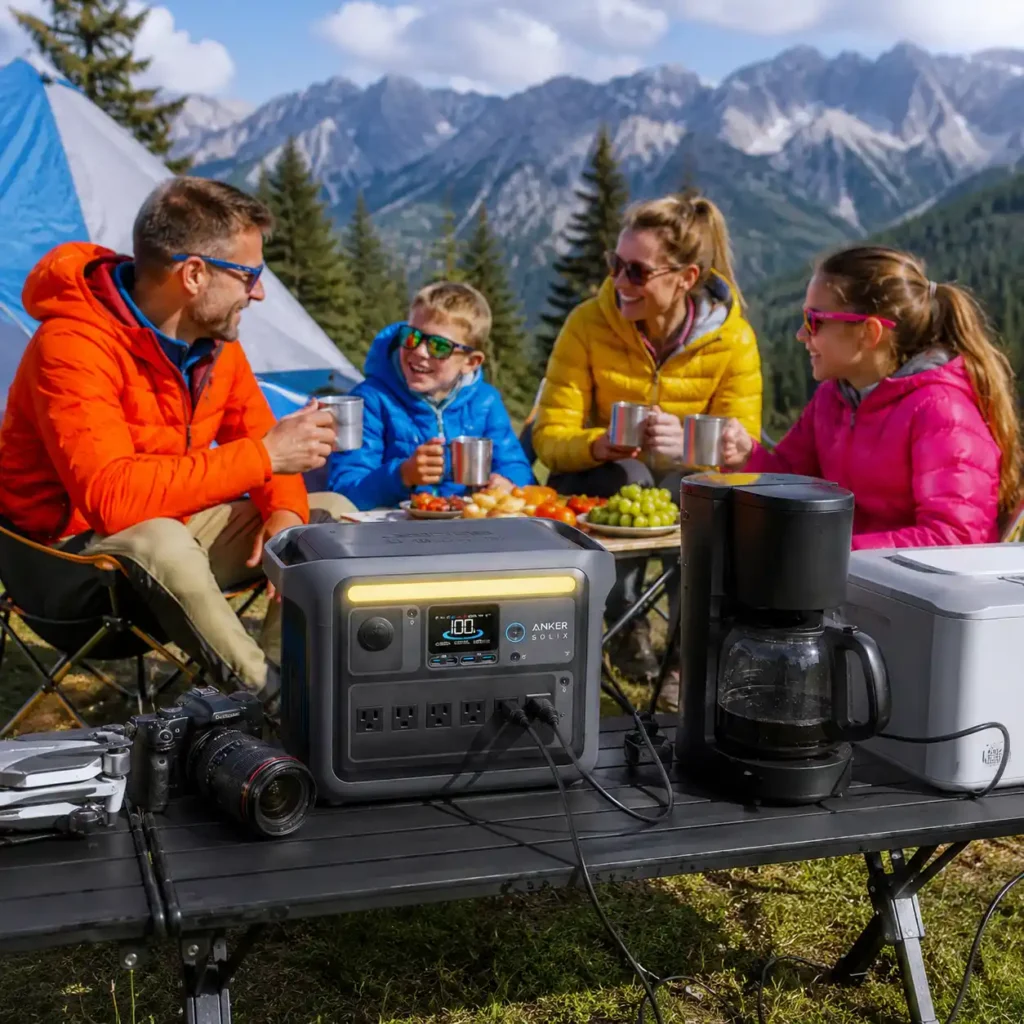
Living With It Every Weekend
The Anker SOLIX C1000 feels like it was designed for people who are constantly on the move. Rather than being a portable power station that spends most of its life sitting on a garage shelf, it encourages regular use because it’s always ready for the next trip. Its biggest advantage isn’t simply how much power it stores—it’s how quickly it returns to full capacity between adventures.
Imagine arriving home on Sunday evening after spending the weekend camping with family. The refrigerator in the camper stayed cold, everyone’s phones remained charged, a laptop was used for editing photos, coffee was made every morning, and several camera batteries were recharged throughout the trip. With many portable power stations, the next step would be leaving the battery plugged in overnight or even into the following day before it would be fully prepared for another outing.
The SOLIX C1000 changes that routine completely.
After unloading your camping equipment, you simply connect the power station to a household outlet. While you’re unpacking the vehicle, cleaning camping gear, or preparing for the workweek, the battery is already recovering a substantial portion of its capacity. By the time everything else is put away, the power station is well on its way to being ready for the next adventure. That seemingly small convenience becomes surprisingly valuable over months and years of ownership.
This rapid turnaround is especially beneficial for families who travel frequently. Perhaps one weekend you’re camping in the mountains, and the next you’re spending time at the beach. Between trips, there may only be a day or two at home. Instead of worrying whether the battery has had enough time to recharge, you can focus on planning your next destination, knowing your portable power station will be ready when you are.
The same advantage extends beyond recreational travel. During severe weather or unexpected utility outages, homeowners often recharge their portable power station as soon as electricity returns, preparing for the possibility of another interruption. Faster charging means the backup system spends less time unavailable and more time ready to protect essential devices if another outage occurs.
Throughout daily use, the SOLIX C1000 also demonstrates the attention to detail that Anker has become known for. The display is bright and easy to read in both daylight and evening conditions, the controls respond quickly, and the companion mobile app provides clear information about battery level, charging status, input and output power, and system settings. Everything feels polished, intuitive, and thoughtfully designed.
Another quality that becomes apparent over time is its versatility. One weekend the SOLIX C1000 might power a campsite, the following week it may support an outdoor family gathering in the backyard, and later it could provide emergency electricity for your refrigerator and internet router during a storm. Instead of serving one specific purpose, it naturally adapts to many different situations throughout the year.
For active families, RV travelers, road trip enthusiasts, photographers, remote workers, and homeowners who value preparedness, the Anker SOLIX C1000 quickly becomes far more than emergency equipment. It becomes an everyday tool that’s always ready for whatever comes next.
Editorial Assessment
| Category | Rating | Editorial Notes |
|---|---|---|
| Charging Speed | ★★★★★ | One of the fastest AC charging systems available in the 1000Wh category, significantly reducing downtime between trips. |
| Power Performance | ★★★★★ | The 1800W pure sine wave inverter easily handles most camping, RV, home backup, and outdoor appliances. |
| Battery Capacity | ★★★★☆ | 1056Wh provides an excellent balance between runtime and portability for everyday users. |
| Portability | ★★★★☆ | Compact enough for regular transportation while remaining sturdy and well-built. |
| Ease of Use | ★★★★★ | An intuitive interface, responsive controls, and a polished mobile app make daily operation exceptionally straightforward. |
| Value for Money | ★★★★★ | Premium charging performance, dependable hardware, and refined software create outstanding long-term value. |
Who Should Buy This
- Campers who head outdoors almost every weekend and want their power station ready again as quickly as possible.
- RV owners who frequently travel between campgrounds and appreciate minimal charging downtime.
- Homeowners preparing for emergency outages who want their backup power restored quickly after electricity returns.
- Remote workers who depend on reliable portable electricity while traveling.
- Outdoor photographers, drone pilots, and content creators who regularly recharge multiple batteries between shooting sessions.
- Buyers looking for one of the most refined and user-friendly ownership experiences in the 1000Wh portable power station category.
Who Should Skip This
- Buyers whose highest priority is maximum battery capacity rather than charging speed.
- Users planning to build a large expandable off-grid energy system.
- People who rarely move or recharge their portable power station and therefore won’t benefit as much from ultra-fast charging.
- Buyers focused primarily on achieving the lowest possible purchase price instead of premium convenience features.
Final Verdict
The Anker SOLIX C1000 proves that convenience can be just as important as raw specifications. While battery capacity and inverter output remain essential considerations, the ability to recharge quickly transforms the ownership experience in ways that many buyers don’t fully appreciate until they begin using their portable power station regularly.
Its combination of a 1056Wh LiFePO₄ battery, a 1800W pure sine wave inverter, ultra-fast AC charging, solar compatibility, intuitive app control, and premium construction creates a power station that’s equally capable at the campsite, inside an RV, during emergency outages, or as part of everyday outdoor life. Rather than excelling in only one area, it delivers a thoughtfully balanced package that feels refined from the moment it’s unboxed.
What ultimately earned the SOLIX C1000 our Best Fast-Charging Portable Power Station award wasn’t simply its impressive charging specifications—it was the practical advantage those speeds provide in real life. Less time connected to a wall outlet means more time ready for your next road trip, weekend camping adventure, family vacation, or unexpected emergency.
If your ideal portable power station is one that’s dependable, easy to live with, and always prepared for the next opportunity to get outdoors, the Anker SOLIX C1000 stands among the strongest choices available in today’s 1000Wh portable power station market.
Check the latest price and customer reviews on Amazon.
Related Guide: If you want to build a more complete charging setup around your portable power station, our Best Solar Chargers (2026) guide can help you compare solar charging options for extending your available power during camping, travel, and off-grid use.
How to Choose the Best 1000Wh Portable Power Station
Start With Your Camping Style
Choosing the best 1000Wh portable power station involves much more than comparing battery capacity. While a 1000Wh battery offers an excellent balance between portability and runtime, factors such as inverter output, charging speed, battery chemistry, solar compatibility, weight, expandability, and long-term reliability ultimately determine how useful the power station will be in real-world situations.
A quality 1000Wh portable power station can comfortably support weekend camping trips, RV travel, outdoor events, remote work, emergency home backup, and many everyday off-grid activities. Rather than focusing on the highest specifications, it’s more important to choose a model that matches your actual power requirements, charging preferences, and budget.
Buying a unit that’s significantly larger than you need often means paying more for extra capacity while carrying unnecessary weight. On the other hand, choosing a model that’s too small can leave you without enough power to run essential equipment such as a portable refrigerator, CPAP machine, laptop, or other devices when you need them most.
The following buying guide explains the most important factors to consider before purchasing a 1000Wh portable power station and will help you confidently choose the best model for your needs and budget.
Before comparing battery capacities, charging speeds, or inverter ratings, ask yourself one simple question:
How do you actually camp?
The answer is far more important than any specification you’ll find on a product page.
Someone who spends a single night at a campground with electrical hookups has completely different power requirements than a family spending an entire weekend off-grid. Likewise, an overlander crossing remote terrain for several days will prioritize battery capacity very differently from someone who simply wants to keep phones charged and brew coffee on Saturday morning.
For minimalist campers, compact power stations are often the smartest investment. If your typical trip involves charging smartphones, powering LED lanterns, keeping a camera battery topped up, and perhaps running a small fan overnight, carrying a large 2000Wh battery offers very little real benefit. A lightweight unit is easier to transport, quicker to recharge, and leaves more room in your vehicle for the gear that actually improves your camping experience.
Weekend campers often occupy the middle ground. Once portable refrigerators, laptops, portable fans, CPAP machines, coffee makers, and multiple electronic devices become part of your campsite, battery requirements naturally increase. This is exactly why portable power stations in the 700Wh to 1000Wh range have become the sweet spot for so many outdoor enthusiasts. They provide enough energy to support modern camping comforts while remaining manageable for one person to carry.
Larger families, RV owners, and campers who regularly spend several days away from electrical hookups usually benefit from even greater capacity. In these situations, a 1000Wh to 2000Wh system—or an expandable battery ecosystem—offers the flexibility to power several appliances simultaneously while extending runtime between charging opportunities.
Ultimately, your camping style should determine the size of your power station—not the other way around.
The best purchase isn’t necessarily the largest model you can afford. It’s the one that naturally fits the trips you take most often.
How Much Battery Capacity Do You Really Need?

Battery capacity is usually the first specification buyers notice—and one of the easiest to misunderstand.
When comparing portable power stations, you’ll see capacities listed in watt-hours (Wh). In simple terms, watt-hours measure how much energy the battery can store. The higher the number, the longer the power station can supply electricity before it needs to be recharged.
However, bigger doesn’t automatically mean better.
Many campers assume they need the largest battery they can afford, only to discover they rarely use more than half of its capacity. Carrying an oversized power station means dealing with extra weight, sacrificing valuable cargo space, and spending significantly more money without gaining meaningful real-world benefits.
Instead of asking, “What’s the biggest battery available?” ask yourself a much more useful question:
“How much energy do I actually use during a typical camping trip?”
For campers who mainly charge smartphones, cameras, rechargeable lanterns, GPS devices, tablets, and other small electronics, a 300Wh to 500Wh portable power station is often more than sufficient. These compact models are lightweight, easy to transport, and can comfortably support overnight or weekend camping without becoming a burden to carry.
Once your camping setup includes equipment that runs continuously—such as a portable refrigerator, CPAP machine, laptop, portable fan, or Starlink Mini—battery requirements increase considerably. This is where 700Wh to 1000Wh portable power stations truly shine. They provide enough energy to support modern camping comforts while remaining portable enough for regular use, which is why this capacity range has become the sweet spot for many outdoor enthusiasts.
Campers planning longer off-grid adventures, family camping trips, or RV travel should consider 1500Wh to 2000Wh systems or larger. The additional capacity allows several appliances to operate simultaneously for extended periods while reducing the need to recharge every day. Larger batteries also provide greater peace of mind when weather conditions limit solar charging opportunities or when campground hookups aren’t available.
It’s also worth thinking beyond a single appliance.
A portable refrigerator may consume relatively modest power on its own, but once you add lighting, camera chargers, drone batteries, laptops, smartphones, portable speakers, and the occasional use of an electric kettle or coffee maker, total daily energy consumption can increase surprisingly quickly. Looking at your entire camping setup rather than individual devices provides a much more realistic estimate of the battery capacity you’ll actually need.
Another consideration is how your camping habits might evolve over time. Many people begin with simple overnight trips but gradually add more electrical equipment as they become more comfortable camping. Portable refrigerators replace coolers. Drones become part of every adventure. Remote work extends weekends into full weeks outdoors. Buying a power station with a little room to grow can often provide better long-term value than choosing the smallest model that meets today’s requirements.
At the same time, it’s rarely worth purchasing capacity you’ll only use once every few years. A power station should support your typical adventures, not the most extreme trip you might eventually take.
If your power needs increase significantly in the future, many modern ecosystems now offer expandable battery options, allowing you to increase storage capacity without replacing the entire unit.
For most campers, the best portable power station isn’t the one with the biggest battery—it’s the one that delivers the right balance of runtime, portability, convenience, and long-term value.
Understanding AC Output vs. Surge Power
One of the most common mistakes first-time buyers make is focusing almost entirely on battery capacity while overlooking another specification that’s just as important—AC output.
Battery capacity determines how long your portable power station can supply electricity.
AC output determines what it can actually power.
Understanding the difference between these two specifications is essential because a large battery doesn’t necessarily mean you’ll be able to run every appliance you bring camping. A power station may have enough stored energy to operate for many hours, but if its inverter can’t deliver sufficient output, certain devices simply won’t start.
Continuous AC Output
Continuous AC output, measured in watts (W), refers to the amount of power a portable power station can deliver continuously while operating normally.
This is the specification you should compare with the rated power consumption of the appliances you plan to use.
For example:
- Smartphones and tablets typically require less than 30W.
- Laptops usually consume between 40W and 100W while charging.
- Portable compressor refrigerators often operate between 45W and 60W.
- CPAP machines generally require 30W to 60W.
- Portable fans commonly draw 20W to 50W.
- Electric kettles and coffee makers may require anywhere from 700W to over 1,200W.
If your coffee maker requires 900W, your portable power station should comfortably support more than 900W of continuous output. Likewise, if you expect to run a refrigerator, charge two laptops, and power campsite lighting at the same time, you’ll need enough inverter capacity to handle the combined load rather than each appliance individually.
Thinking about your total power requirements—not just individual devices—helps prevent unexpected shutdowns when several appliances are running simultaneously.
What Is Surge Power?
Some appliances require significantly more electricity for a brief moment when they first start.
This temporary increase is known as surge power, starting power, or peak power.
After startup, these appliances quickly settle into a much lower operating wattage.
You’ll encounter surge loads most commonly with equipment that contains electric motors or compressors, including:
- Portable refrigerators
- Small water pumps
- Air compressors
- Certain power tools
- Some household appliances
For example, a camping refrigerator that normally operates at around 50W may briefly require several times that amount for a fraction of a second when the compressor starts. If your portable power station cannot supply that short burst of additional power, the refrigerator may fail to start even though its normal operating consumption is relatively low.
Modern premium portable power stations are specifically designed to accommodate these brief startup demands, allowing motor-driven appliances to operate reliably without constantly triggering overload protection.
Why Continuous Output Matters More
Many manufacturers prominently advertise impressive peak or surge wattage because larger numbers naturally attract attention.
In practice, however, continuous AC output is almost always the more important specification.
Camping equipment typically runs for minutes or hours—not fractions of a second. Once an appliance has started, it relies entirely on the inverter’s continuous output capability. That’s why two portable power stations with similar surge ratings can perform very differently in everyday use if one provides significantly higher sustained power.
When comparing models, it’s worth paying far more attention to continuous output than headline peak numbers.
Buy for the Appliances You Actually Use
The goal isn’t to own the most powerful inverter available.
It’s to own one that’s appropriately matched to your camping equipment.
If your typical trips involve charging electronics, powering a portable refrigerator, running campsite lighting, and occasionally making coffee, an 1800W inverter will comfortably handle almost everything you’ll realistically need.
On the other hand, if your camping style includes induction cooktops, electric grills, microwave ovens, or several high-power appliances operating simultaneously, stepping up to a larger power station with higher continuous output becomes a worthwhile investment.
Like battery capacity, inverter power should reflect your real camping habits—not the most demanding setup you might use once every few years.
The best portable power station isn’t the one with the highest advertised wattage. It’s the one that quietly powers everything you rely on, day after day, without making you think about electrical limits while you’re enjoying the outdoors.
Battery Chemistry: Why LiFePO₄ Is Worth It
Not all portable power stations are built around the same battery technology, and while battery chemistry may not be the first specification buyers compare, it has one of the biggest impacts on long-term ownership.
Today, LiFePO₄ (Lithium Iron Phosphate) has become the benchmark for premium portable power stations, replacing the older lithium-ion chemistries that dominated the market only a few years ago.
The reason is simple: LiFePO₄ batteries are designed to last longer, operate more safely, and maintain their performance over thousands of charging cycles.
For campers, that translates into a power station you can rely on season after season without worrying about rapid battery degradation.
A Longer Service Life
Every rechargeable battery slowly loses capacity over time.
The difference lies in how quickly that happens.
Traditional lithium-ion batteries generally begin to show noticeable wear after several hundred charging cycles. While they can still provide years of service for occasional users, frequent campers may see battery performance decline much sooner than expected.
LiFePO₄ technology changes that equation.
Most modern LiFePO₄ portable power stations are rated for thousands of charge and discharge cycles before the battery capacity falls to around 80% of its original level. For many users, that’s enough for well over a decade of normal camping, road trips, home backup, and everyday use.
Instead of thinking about replacing your power station every few years, you’re investing in equipment that’s designed to remain dependable for the long haul.
Better Safety for Outdoor Use
Camping often exposes equipment to conditions that are far less predictable than those found inside the home.
Warm summer afternoons, cold mountain mornings, dusty campsites, and frequent transportation all place additional demands on portable electronics.
LiFePO₄ batteries are well known for their excellent thermal stability, making them one of the safest battery chemistries currently used in portable power stations.
While no battery should ever be exposed to conditions outside the manufacturer’s recommended operating limits, LiFePO₄ cells are naturally more resistant to overheating and thermal runaway than many older lithium battery technologies. This improved stability is one of the reasons why nearly every major manufacturer has adopted LiFePO₄ for its newest generation of premium portable power stations.
For equipment that’s frequently transported in vehicles, used around families, or stored for emergency backup, that added peace of mind is an important advantage.
Consistent Performance Over Time
Battery longevity isn’t just about how many years a power station lasts.
It’s also about how well it performs throughout those years.
A high-quality LiFePO₄ battery retains its capacity remarkably well, meaning the runtime you enjoy during your first camping season should remain largely consistent even after hundreds of recharge cycles.
Whether you’re keeping a portable refrigerator running through a long weekend, powering a CPAP machine overnight, or charging camera equipment during repeated outdoor adventures, consistent battery performance helps eliminate unpleasant surprises as the years go by.
Why Every Model in This Guide Uses LiFePO₄
When evaluating today’s leading portable power stations, one trend became impossible to ignore.
Every model we ultimately recommended is built around LiFePO₄ battery technology.
That’s not a coincidence.
While older lithium-ion batteries can still perform well for light or occasional use, LiFePO₄ offers a combination of durability, safety, efficiency, and long-term value that’s difficult to match.
Although these batteries sometimes increase the initial purchase price, the additional investment is often recovered through a significantly longer service life and a lower likelihood of needing to replace the power station prematurely.
For most campers, paying slightly more today for equipment that will continue performing reliably for many years is a decision that makes excellent financial sense.
Our Recommendation
If you’re comparing two otherwise similar portable power stations, battery chemistry should never be an afterthought.
Whenever possible, choose a model built around LiFePO₄ technology.
The longer lifespan, improved durability, greater thermal stability, and excellent long-term reliability make it one of the most worthwhile upgrades available in today’s portable power station market.
Camping equipment is expected to accompany you on countless adventures. Choosing a power station with a battery that’s designed to do exactly that is one of the smartest decisions you can make.
Solar Charging Capabilities

One of the biggest advantages of a portable power station is the ability to generate electricity almost anywhere. With a compatible solar panel, you can recharge your battery far from the electrical grid, making longer camping trips more comfortable and significantly reducing your dependence on campground hookups or vehicle charging.
For many outdoor enthusiasts, solar charging is what transforms a portable power station from a convenient battery into a true off-grid power solution.
That said, not every camper needs to place solar charging at the top of their priority list.
Weekend Campers May Not Need Solar
If most of your adventures last one or two nights, a fully charged portable power station will often provide all the electricity you need before you return home.
Charging phones, running LED lights, powering a portable refrigerator, and making coffee each morning usually consumes only a portion of the battery capacity available in today’s mid-size power stations.
In these situations, solar compatibility is a welcome bonus rather than an essential feature.
Many campers don’t even unpack their solar panels during shorter trips because their battery comfortably lasts the entire weekend.
Longer Off-Grid Trips Tell a Different Story
Solar charging becomes much more valuable once you’re spending several days away from civilization.
Overlanding expeditions, dispersed camping, boondocking, RV travel, and extended stays in national parks often provide few—or no—opportunities to recharge from household electricity.
Instead of treating your portable power station as a fixed energy supply, solar panels allow you to replenish a portion of the battery every day, extending your runtime almost indefinitely under favorable weather conditions.
Even replacing part of the energy consumed each day can dramatically increase how long you can remain off-grid without sacrificing comfort.
For campers who regularly travel to remote locations, solar charging quickly becomes one of the most valuable features a portable power station can offer.
Not All Solar Charging Is Equal
It’s easy to assume that every portable power station offering solar charging performs similarly.
In reality, there are significant differences between models.
Some power stations accept relatively modest solar input, making recharge times considerably longer. Others support much higher solar input, allowing them to recover battery capacity far more quickly under the same sunlight conditions.
When comparing models, pay attention to specifications such as:
- Maximum solar input (W)
- Supported input voltage range
- Maximum charging current
- Solar connector type
- Estimated recharge time under ideal conditions
These figures provide a much clearer picture of real-world charging performance than simply seeing the words “solar compatible” on a product page.
Real-World Solar Performance
It’s also important to set realistic expectations.
Solar panels rarely produce their advertised maximum output for an entire day.
Cloud cover, seasonal sunlight, panel orientation, surrounding trees, high temperatures, dust, and even the angle of the morning or afternoon sun all influence charging efficiency.
A 400W solar panel doesn’t continuously deliver 400 watts throughout the day. Under excellent conditions it may briefly approach its rated output, but average production is often considerably lower.
Experienced campers understand this and view solar charging as a way to extend battery life, rather than instantly refill a depleted power station.
Planning with realistic expectations leads to a much more satisfying off-grid experience.
Choosing the Right Solar Setup
Your ideal solar system should reflect the way you travel.
Campers who move to a new location every day often prioritize lightweight, foldable panels that are easy to deploy and pack away.
RV owners and overlanders who spend several days in one campsite may prefer larger solar arrays capable of producing significantly more energy throughout the day.
There’s no universal solution.
The best solar setup is the one that balances portability, charging performance, available vehicle space, and your daily energy consumption.
Our Recommendation
If your camping trips usually last only a weekend, don’t feel pressured to buy solar panels immediately.
A quality portable power station with sufficient battery capacity may already provide everything you need.
However, if you’re planning extended off-grid adventures—or simply want the freedom to stay outdoors longer without searching for electrical hookups—choosing a power station with strong solar charging capabilities is one of the smartest investments you can make.
Solar won’t eliminate the need to manage your energy wisely, but it dramatically increases your independence. And for many campers, that’s exactly what portable power is all about: the freedom to explore farther, stay longer, and enjoy the outdoors without constantly worrying about the next place to plug in.
Charging Speed Matters More Than Most Campers Think

When shopping for a portable power station, it’s natural to focus on battery capacity, inverter power, and the number of available outlets. Charging speed, however, is often overlooked—even though it’s one of the features you’ll appreciate most after months or years of ownership.
After all, battery capacity determines how long you can use your portable power station.
Charging speed determines how quickly you’re ready to use it again.
The difference may not seem important when reading a specification sheet, but it becomes immediately obvious in everyday camping.
Faster Charging Means Less Waiting
Imagine returning home on Sunday evening after a weekend camping trip.
Your portable refrigerator has been running all weekend, you’ve charged phones, cameras, laptops, and perhaps even brewed coffee every morning. The battery is nearly empty.
With some portable power stations, recharging to full capacity may take most of the night—or even longer.
With today’s fastest models, the battery can recover a substantial amount of energy in little more than an hour, allowing you to unpack your camping gear while the power station prepares itself for the next adventure.
The difference isn’t just measured in hours.
It’s measured in convenience.
The less time your power station spends charging, the more time it’s available whenever you need it.
Ideal for Frequent Campers
Fast charging is particularly valuable for people who camp regularly.
Perhaps you head into the mountains almost every weekend during the summer. Maybe you alternate between family camping trips, beach weekends, and road trips throughout the season.
In these situations, you don’t want to spend several days thinking about whether your power station has finished charging.
You simply plug it in after returning home and know it’ll be ready well before your next departure.
That convenience quickly becomes one of the most appreciated aspects of owning a modern portable power station.
It Matters During Road Trips Too
Charging speed isn’t only useful at home.
Many campers recharge their power stations whenever an opportunity presents itself—during lunch stops, at RV parks, while visiting friends, or at campsites with electrical hookups.
These charging windows are often relatively short.
A portable power station capable of accepting high AC input can recover a meaningful amount of battery capacity during a brief stop, giving you considerably more flexibility as your journey continues.
Instead of planning your day around charging, charging naturally fits into your existing travel schedule.
Faster Doesn’t Mean You Should Ignore Everything Else
While fast AC charging is undoubtedly a valuable feature, it shouldn’t become the only factor driving your purchasing decision.
The best portable power station combines several characteristics:
- Reliable battery technology
- Sufficient battery capacity
- Strong continuous AC output
- Effective solar charging
- Long battery lifespan
- Practical portability
- Fast, convenient recharging
Looking at charging speed in isolation rarely leads to the best buying decision.
Instead, consider how it complements the rest of the system.
Real-World Convenience Is Hard to Overstate
One of the reasons fast charging consistently ranks so highly among experienced users is that it improves nearly every aspect of ownership.
There’s less planning before a trip.
Less waiting after returning home.
Less concern if an unexpected camping opportunity appears at the last minute.
And during emergency home backup, the advantages are equally clear. Once grid power returns, a fast-charging portable power station can restore its battery much sooner, ensuring it’s prepared if another outage occurs.
It’s one of those features that may not seem essential when you’re comparing specification sheets—but once you’ve lived with it, it’s surprisingly difficult to give up.
Our Recommendation
If you’re choosing between two otherwise similar portable power stations, don’t underestimate the value of faster charging.
The ability to recharge quickly won’t extend your runtime while you’re camping, but it will make the entire ownership experience noticeably more convenient.
For occasional campers, moderate charging speeds are usually perfectly adequate.
For frequent travelers, RV owners, overlanders, and anyone who uses their portable power station regularly, fast AC charging is a feature you’ll appreciate every single time you plug it in.
Sometimes the best camping equipment isn’t the gear that performs the most dramatically in the field—it’s the equipment that quietly makes every trip easier before you even leave home.
Portability: Weight vs. Capacity
As battery capacity increases, so does one unavoidable trade-off: weight.
It’s easy to compare portable power stations by their watt-hours and inverter output, but the moment you lift one into your vehicle, another specification suddenly becomes just as important. A larger battery may deliver longer runtimes, but it also takes up more space and requires considerably more effort to transport.
For campers, portability isn’t just about convenience—it’s part of the overall camping experience.
Every Pound Matters
Think about everything you already bring on a typical camping trip.
Tents, sleeping bags, folding chairs, coolers, cooking equipment, clothing, food, water, and recreational gear all compete for limited cargo space. Adding a heavy portable power station can quickly become noticeable, especially if you camp with a smaller SUV, crossover, or sedan.
It’s also worth remembering that you rarely move a power station just once.
You’ll lift it into your vehicle at home, carry it to the campsite, reposition it throughout your stay, and load it back into the car when it’s time to head home.
Choosing a model that’s comfortable to handle makes each of those moments significantly easier.
Compact Models for Lightweight Adventures
For solo campers, couples, and weekend adventurers, compact portable power stations weighing less than 20 pounds (9 kg) often provide the ideal balance between portability and performance.
These units are easy to carry with one hand, fit neatly into almost any vehicle, and can be moved around camp without much effort. They’re an excellent choice for campers whose primary needs include charging electronics, powering lights, running a small fan, or keeping a few essential devices operating throughout the weekend.
Their lighter weight also makes them particularly appealing for people who frequently change campsites or enjoy spontaneous overnight trips.
The Sweet Spot for Most Campers
Once portable refrigerators, laptops, CPAP machines, and other larger devices become part of your camping setup, moving to a mid-size power station usually makes sense.
Models weighing between 20 and 40 pounds (9–18 kg) strike an excellent balance between runtime and portability.
This category includes many of today’s most popular 1000Wh portable power stations because they provide enough energy for modern camping comforts while remaining manageable for one person to carry.
For many outdoor enthusiasts, this is where practicality and performance come together most naturally.
When Bigger Is the Better Choice
High-capacity portable power stations weighing more than 40 pounds (18 kg) are designed for situations where extended runtime matters more than easy transportation.
Family camping, RV travel, overlanding, and multi-day off-grid adventures often justify the additional weight because the larger battery significantly reduces the need for frequent recharging.
If your power station typically stays in one location after being unloaded, carrying a few extra pounds may be a worthwhile compromise in exchange for substantially longer runtimes.
The key is making sure that extra capacity genuinely supports the way you camp.
Think Beyond Battery Capacity
One of the easiest mistakes buyers make is asking:
“How much battery do I want?”
A better question is:
“How much weight am I want to bring on every camping trip?”
That simple shift in perspective often leads to a much better purchasing decision.
A power station that comfortably fits your vehicle, is easy to carry, and provides enough energy for your typical adventures will usually deliver a more satisfying ownership experience than the largest model you can afford.
After all, the best portable power station is the one you enjoy bringing with you—not the one that stays in the garage because it’s simply too heavy to bother loading into the car.
Our Recommendation
Unless you regularly need several days of uninterrupted power, avoid buying more battery than you realistically require.
For most campers, a well-balanced portable power station in the 700Wh to 1000Wh range offers the ideal combination of runtime, portability, and everyday usability.
The goal isn’t to own the heaviest battery on the market.
It’s to own a power station that’s powerful enough for your adventures while remaining light enough that you’ll happily take it on every one of them.
Expandable Battery Systems
One of the most significant innovations in portable power stations over the past few years hasn’t been larger batteries or faster charging speeds—it’s the introduction of expandable battery systems.
Instead of forcing buyers to choose between a compact portable power station and a large, high-capacity model, many manufacturers now offer modular ecosystems that allow additional battery packs to be connected whenever more storage is needed.
For many campers, this flexibility changes the way they think about buying a portable power station.
Start Small, Expand Later
One of the biggest challenges when shopping for a portable power station is trying to predict your future power needs.
Perhaps you’re just beginning to explore camping and currently spend only an occasional weekend outdoors. A compact 1000Wh power station may seem like the perfect fit today.
But what happens a year from now?
You might purchase a portable refrigerator, begin working remotely from campsites, upgrade to an RV, or start planning week-long overlanding adventures. Suddenly, the battery capacity that once felt generous no longer seems quite enough.
With an expandable system, you don’t have to replace your original investment.
Instead, you simply add compatible expansion batteries as your needs evolve.
That flexibility can significantly extend the useful life of your portable power station while reducing long-term costs.
A Smarter Long-Term Investment
Expandable battery systems also make financial sense for many buyers.
Purchasing the largest available power station immediately isn’t always the best use of your budget, especially if you’ll rarely use its full capacity.
By starting with a smaller system, you invest only in the battery capacity you actually need today. If your camping style changes in the future, expanding the system is usually far less expensive than replacing the entire power station with a completely new model.
This modular approach allows your equipment to grow alongside your adventures.
Greater Flexibility for Different Trips
Expandable batteries aren’t useful only because they increase total capacity.
They also allow you to tailor your power setup to each individual trip.
For a quick weekend getaway, your base unit may provide more than enough energy while remaining relatively lightweight and easy to transport.
When planning a longer off-grid expedition or family camping vacation, adding one or two expansion batteries provides dramatically longer runtimes without requiring you to purchase a separate high-capacity power station.
The result is a system that’s far more adaptable than a fixed-capacity solution.
Not Everyone Needs Expansion
While expandable ecosystems offer clear advantages, they aren’t essential for every camper.
If your camping routine is consistent throughout the year, your power requirements are predictable, and you don’t anticipate adding significantly more equipment, a fixed-capacity portable power station may be the simpler and more economical choice.
Many weekend campers will enjoy years of reliable service without ever feeling the need to increase their battery capacity.
There’s no reason to pay for expandability if you’re confident your energy requirements are unlikely to change.
Which Campers Benefit Most?
Expandable battery systems are particularly valuable for:
- RV owners whose electricity needs vary from trip to trip.
- Families planning longer camping vacations.
- Overlanders spending multiple days away from electrical hookups.
- Remote workers who occasionally work from campsites.
- Buyers who want a future-proof investment without purchasing excessive battery capacity today.
In each of these situations, the ability to increase energy storage over time provides both convenience and financial flexibility.
Our Recommendation
If you’re deciding between two otherwise similar portable power stations, consider not only what you need today, but what you might need two or three years from now.
Your camping style is likely to evolve.
Your equipment will probably expand.
And your electricity requirements may grow alongside them.
Choosing a portable power station with an expandable battery ecosystem gives you the freedom to adapt without starting over.
That doesn’t mean expansion is the right choice for everyone. But for campers who see portable power as a long-term investment rather than a single purchase, it’s one of the most valuable features available in today’s market.
The best portable power station isn’t just capable of supporting your next adventure—it’s capable of growing with every adventure that follows.
Essential Output Ports
Battery capacity and inverter power often receive most of the attention when comparing portable power stations, but the available output ports play an equally important role in everyday usability.
After all, even the largest battery isn’t particularly useful if you can’t conveniently connect the devices you actually bring camping.
A well-designed portable power station should allow you to power multiple devices simultaneously without constantly searching for adapters or unplugging one appliance to use another.
Start by Thinking About What You Actually Use
Before comparing port configurations, make a list of the equipment you normally take camping.
For many people, that includes:
- Smartphones
- Tablets
- Cameras
- Laptops
- Portable refrigerators
- LED lanterns
- Electric coolers
- Fans
- CPAP machines
- Drones
- Coffee makers
Each of these devices may require a different type of connection.
Choosing a power station with the right mix of outputs makes daily use much simpler than relying on external adapters.
AC Outlets Are Still the Most Important
For most campers, standard AC outlets remain the primary reason for buying a portable power station.
They allow you to operate household appliances exactly as you would at home, including:
- Portable refrigerators
- Coffee makers
- Electric kettles
- Small induction cooktops
- CPAP machines
- Laptop chargers
- Battery chargers for cameras and power tools
While the number of AC outlets varies between models, two to four outlets are sufficient for most camping setups.
More important than the quantity is ensuring the inverter provides enough continuous power to operate the appliances you intend to use at the same time.
USB-C Has Become Essential
A few years ago, USB-A ports dominated portable power stations.
Today, the situation has changed dramatically.
Many modern laptops, smartphones, tablets, cameras, drones, headphones, and portable monitors now charge via USB-C Power Delivery (PD).
High-power USB-C ports can often eliminate the need to carry bulky laptop power adapters altogether, reducing both weight and cable clutter inside your camping gear.
If you’re buying a portable power station in 2026, at least one high-wattage USB-C PD port should be considered a necessity rather than a luxury.
USB-A Still Has Its Place
Although USB-C is becoming the new standard, USB-A ports remain useful for many accessories.
Camping lights, Bluetooth speakers, action cameras, GPS devices, rechargeable flashlights, and countless other gadgets still rely on USB-A cables.
Having two or more USB-A ports available allows these smaller devices to charge without occupying your faster USB-C connections.
A good mix of both standards offers the greatest flexibility.
Don’t Forget 12V DC Outputs
Many camping accessories continue to operate on 12-volt DC power.
These include:
- Portable refrigerators
- Air pumps
- Tire inflators
- Camping fans
- LED lighting systems
- Certain communication equipment
If you already own 12V camping accessories, verify that the power station includes a regulated 12V car socket capable of supporting your equipment.
For some campers, this outlet may be used just as frequently as the AC outlets.
More Ports Aren’t Always Better
It’s tempting to assume that the power station with the greatest number of ports is automatically the better choice.
In reality, quality matters far more than quantity.
A practical selection of well-placed, clearly labeled ports is generally more valuable than an excessive collection of rarely used connectors.
The best designs make it easy to plug in multiple devices simultaneously without cables interfering with one another or blocking adjacent outlets.
Thoughtful layout contributes just as much to usability as the number of available connections.
Our Recommendation
Don’t choose a portable power station simply because it offers the highest number of ports.
Instead, choose one that matches the devices you actually bring camping.
For most outdoor enthusiasts, the ideal combination includes:
- Multiple AC outlets
- At least one high-power USB-C PD port
- Several USB-A ports
- A regulated 12V car socket
This configuration comfortably supports the vast majority of modern camping equipment while leaving room for future devices as your gear evolves.
The best portable power station isn’t the one with the longest specification sheet—it’s the one that lets every essential device plug in easily, charge efficiently, and stay powered throughout your adventure.
Features You Can Ignore
When shopping for a portable power station, it’s easy to become distracted by long specification sheets filled with impressive-sounding features.
Manufacturers naturally want to differentiate their products, and marketing materials often highlight every available function—even those that have little impact on real-world camping.
While many premium features are genuinely useful, others receive far more attention than they deserve.
Understanding which specifications truly matter—and which can safely be treated as secondary considerations—will help you make a smarter purchasing decision and avoid paying for features you’ll rarely, if ever, use.
Wireless Phone Charging
Wireless charging pads have become increasingly common on portable power stations.
At first glance, they seem convenient. Simply place your smartphone on top of the unit, and charging begins automatically.
In practice, however, many campers use protective phone cases, move around camp frequently, or keep their phones in pockets rather than resting on top of the power station.
A standard USB-C cable usually charges faster, wastes less energy, and works regardless of where the power station is positioned.
Wireless charging is certainly a pleasant bonus—but it should never influence your buying decision.
Decorative LED Lighting
Some portable power stations include built-in LED light bars, ambient lighting effects, or even colorful accent LEDs designed to give the unit a more modern appearance.
Although these features may look attractive in product photos, they’re rarely used during actual camping trips.
Most campers already carry dedicated headlamps, lanterns, or rechargeable camping lights that provide better illumination while consuming very little power.
Integrated lighting is convenient during emergencies, but it’s far from a deciding factor when comparing otherwise similar models.
Smartphone Apps
Many modern portable power stations now include Wi-Fi or Bluetooth connectivity through companion smartphone apps.
These apps typically allow you to:
- Monitor battery percentage
- View input and output power
- Change charging settings
- Update firmware
- Enable or disable certain ports remotely
While these functions are genuinely useful, they aren’t essential for everyone.
Most campers spend only a few minutes interacting with their power station each day, and nearly every important function remains fully accessible through the controls on the unit itself.
A well-designed app is certainly a welcome addition—but poor app support shouldn’t automatically eliminate an otherwise excellent portable power station from consideration.
Fancy Display Animations
High-resolution color displays, animated graphics, and elaborate user interfaces have become increasingly popular.
They certainly make a product feel more modern.
However, from a practical standpoint, the information that actually matters is surprisingly simple:
- Remaining battery percentage
- Input power
- Output power
- Estimated runtime
- Charging status
- Warning notifications
A clear, easy-to-read display is far more valuable than one filled with animations and visual effects.
When you’re checking your power station in bright sunlight or during a late-night camping trip, clarity always wins.
Marketing Buzzwords
It’s also worth approaching marketing terminology with a healthy degree of skepticism.
Phrases such as:
- “Revolutionary technology”
- “Next-generation intelligence”
- “Ultra-smart energy management”
- “AI-powered battery optimization”
often sound impressive but may offer little practical benefit to the average camper.
Instead of focusing on promotional language, pay attention to measurable specifications:
- Battery capacity
- Continuous AC output
- Battery chemistry
- Charging speed
- Solar input
- Weight
- Warranty
- Real-world reliability
Objective specifications tell you far more about how a power station will perform than any advertising slogan.
Focus on What Actually Improves Camping
The best portable power station isn’t necessarily the one with the longest feature list.
It’s the one that quietly performs its job every day without demanding your attention.
Reliable battery performance.
Enough power for your essential devices.
Fast charging.
Long battery life.
Easy portability.
These are the features that genuinely improve your camping experience.
Everything else should be viewed as a bonus rather than a necessity.
Our Recommendation
Don’t let flashy features distract you from the fundamentals.
A portable power station with excellent battery technology, dependable performance, practical charging options, and the right capacity for your needs will almost always provide greater long-term satisfaction than one packed with gimmicks.
When comparing models, ask yourself a simple question:
Will this feature actually improve my camping experience, or does it simply make the specification sheet look more impressive?
More often than not, the answer will help you identify the better product.
The smartest buying decisions are rarely based on the longest list of features—they’re based on choosing the features that genuinely matter.
Common Buying Mistakes

Buying a portable power station is a significant investment, and with so many models available, it’s surprisingly easy to focus on the wrong specifications.
Many first-time buyers either purchase more power than they’ll ever use or discover too late that their new power station can’t run the equipment they actually brought camping.
Fortunately, most of these mistakes are entirely avoidable.
Understanding the most common pitfalls will help you choose a portable power station that fits your camping style, budget, and long-term needs from the very beginning.
Buying More Capacity Than You Actually Need
One of the most common assumptions is that bigger automatically means better.
While a larger battery certainly provides longer runtimes, it also comes with higher costs, increased weight, and reduced portability.
For many weekend campers, a massive 2000Wh or 3000Wh power station offers little practical benefit. Most short camping trips simply don’t consume that much electricity.
Instead of paying for unused battery capacity, focus on matching your purchase to your typical energy consumption.
A well-sized power station is often more enjoyable to own than the largest model available.
Ignoring Continuous AC Output
Battery capacity tells you how long a device can run.
It does not tell you whether the power station can run it at all.
Many buyers pay close attention to watt-hours while overlooking the inverter’s continuous AC output.
As a result, they may purchase a power station with plenty of stored energy but insufficient power to operate appliances like coffee makers, induction cooktops, electric kettles, or power tools.
Always compare your appliances’ power requirements with the portable power station’s continuous AC output—not just its battery capacity.
Forgetting About Weight
Specifications look very different on a product page than they do when you’re lifting a power station into your vehicle.
A battery weighing more than 50 pounds (23 kg) may seem manageable in theory, but after several camping trips, repeatedly loading and unloading that weight becomes much less appealing.
Before choosing a larger model, ask yourself a practical question:
Can I comfortably carry this by myself every time I go camping?
If the answer is uncertain, a slightly smaller model may provide a much better overall ownership experience.
Assuming Every Model Charges Quickly
Charging performance varies far more than many buyers realize.
Two portable power stations with nearly identical battery capacities may have dramatically different recharge times.
Some models can recover most of their battery in little more than an hour, while others require several hours connected to AC power.
If you camp frequently or often prepare for last-minute trips, charging speed deserves far more attention than many first-time buyers give it.
Overlooking Solar Compatibility
Not every camper needs solar panels.
However, buyers who expect to spend several days off-grid should verify that their chosen power station supports sufficient solar input.
A model with limited solar charging capability may perform perfectly during weekend trips but become frustrating during extended adventures where sunlight is the primary energy source.
Thinking about future camping plans—not just your next trip—can prevent disappointment later.
Choosing Based Only on Price
Budget is always an important consideration, but the least expensive portable power station isn’t necessarily the best value.
A slightly higher upfront investment may provide:
- Longer battery lifespan
- Faster charging
- Better build quality
- More reliable customer support
- A stronger warranty
- Improved long-term performance
When viewed over many years of ownership, these advantages often outweigh a modest difference in purchase price.
Buying for “What If” Scenarios
Many shoppers imagine every possible future situation.
“What if I buy an RV?”
“What if I need to power my entire campsite?”
“What if I eventually purchase an electric cooler, drone, projector, and induction cooktop?”
Planning ahead is sensible.
Buying exclusively for hypothetical situations often isn’t.
Choose a portable power station that meets your current needs while allowing reasonable room for growth—not one designed around unlikely possibilities that may never happen.
Our Recommendation
The best buying decisions begin with an honest assessment of how you actually camp.
Consider:
- How long your trips usually last.
- Which devices you genuinely use.
- How much weight you’re willing to carry.
- Whether you’ll regularly camp off-grid.
- How often you’ll use your power station throughout the year.
Answering these questions will do far more to guide your purchase than comparing dozens of marketing specifications.
The right portable power station isn’t the one with the biggest battery or the highest price tag.
It’s the one that fits naturally into your camping routine, performs reliably every time you need it, and continues to meet your needs long after the excitement of unboxing has passed.
Matching a Power Station to Your Camping Style
The best portable power station isn’t necessarily the one with the largest battery, the highest inverter output, or the fastest charging speed.
It’s the one that fits the way you camp.
A solo backpacker spending one night at a campsite has very different power requirements than a family of four camping for a week with a portable refrigerator, laptops, and multiple electronic devices.
Understanding your own camping style is often the simplest way to narrow down the hundreds of available models and avoid paying for features you’ll never use.
Weekend Campers
If your typical camping trips last one or two nights, your energy needs are probably lower than you think.
Most weekend campers primarily use their portable power station for:
- Charging smartphones
- Powering LED lanterns
- Running a small fan
- Charging cameras or drones
- Keeping a portable refrigerator running overnight
- Occasionally powering a coffee maker or laptop
For this type of camping, a 700Wh to 1000Wh portable power station is usually the ideal choice.
It offers enough capacity to stay comfortable throughout the weekend while remaining compact, lightweight, and easy to transport.
Unless you regularly use high-power appliances, larger batteries often add unnecessary weight without providing meaningful benefits.
Family Camping
Family camping naturally increases electricity consumption.
Multiple phones, tablets, cameras, portable speakers, lighting, and coolers all compete for the same battery.
Children may also bring gaming devices or other electronics that require daily charging.
In these situations, additional battery capacity provides valuable peace of mind.
A power station around 1000Wh or larger allows the whole family to enjoy modern conveniences without constantly worrying about battery levels.
If your family frequently camps for several days at a time, choosing a model with expandable battery support can also provide useful flexibility for future trips.
RV Camping and Overlanding
For RV owners and overlanders, portable power often becomes an essential part of everyday life rather than an occasional convenience.
Longer trips, remote destinations, and extended periods away from electrical hookups place much greater demands on your power system.
These campers frequently operate:
- Portable refrigerators
- Starlink systems
- Laptops
- Camera equipment
- CPAP machines
- Fans
- Cooking appliances
- Communication equipment
Higher-capacity power stations combined with fast AC charging and strong solar input are usually the most practical solution.
For many RV travelers, portability becomes slightly less important than battery capacity and charging flexibility, since the power station typically remains inside the vehicle after arriving at camp.
Remote Workers and Digital Nomads
More people than ever are combining work with outdoor travel.
Whether you’re answering emails from a national park, editing photographs at a lakeside campsite, or joining video meetings from your camper van, reliable electricity becomes essential.
For remote work, look for a portable power station that offers:
- Pure sine wave AC output
- High-power USB-C Power Delivery ports
- Fast AC recharging
- Quiet operation
- Reliable battery technology
- Sufficient capacity for a full workday
Dependability is often more important than maximum battery size.
A power station that consistently powers your laptop, internet connection, and essential electronics allows you to work confidently from almost anywhere.
Emergency Backup Users Who Also Camp
Many buyers don’t purchase a portable power station exclusively for camping.
Instead, they want one product that can serve multiple purposes throughout the year.
When not traveling, the same power station can provide emergency electricity during power outages, keeping phones charged, powering lights, running medical devices, or preserving food in a refrigerator for a limited time.
If this sounds like you, prioritize models that combine excellent camping performance with strong home backup capabilities.
A portable power station that serves double duty often represents the best overall value.
Our Recommendation
Don’t shop for the “best” portable power station in absolute terms.
Shop for the one that’s best for the way you camp.
A thoughtfully chosen 1000Wh model that perfectly matches your adventures will almost always provide greater satisfaction than a much larger unit that’s heavier, more expensive, and filled with capacity you’ll rarely use.
By focusing on your actual camping habits instead of hypothetical scenarios, you’ll end up with equipment that’s easier to carry, simpler to use, and far more enjoyable to own.
The best portable power station is the one that supports your adventures—not one that encourages you to redesign them around its capabilities.
Our Expert Buying Tips
After reviewing dozens of portable power stations, comparing specifications, analyzing real-world performance, and evaluating how these products are actually used during camping trips, one conclusion becomes clear:
The best portable power station isn’t defined by a single specification.
It’s the result of choosing the right balance of battery capacity, power output, charging performance, portability, and long-term reliability for your specific needs.
If you’re still unsure which model to choose, these practical recommendations will help simplify your decision.
Buy for the Way You Camp Today
It’s tempting to shop for every possible future scenario.
Many buyers imagine needing to power an entire campsite, prepare elaborate meals with electric appliances, or spend weeks off-grid—even if their current camping trips last only a weekend.
While it’s sensible to leave room for future growth, buying far beyond your actual needs usually results in unnecessary expense and extra weight.
Choose a portable power station that comfortably supports the camping trips you take most often.
If your adventures evolve over time, many modern systems now offer expandable battery options that allow your setup to grow with you.
Prioritize Quality Over Maximum Specifications
The specification sheet rarely tells the whole story.
Two portable power stations may appear almost identical on paper, yet deliver very different ownership experiences.
Look beyond headline numbers and consider factors such as:
- Overall build quality
- Battery chemistry
- Manufacturer reputation
- Warranty coverage
- Charging speed
- Software support
- Customer service
- Long-term reliability
A dependable power station that performs consistently year after year is almost always a better investment than a model that simply advertises slightly higher specifications.
Don’t Underestimate Convenience
Some of the features that have the greatest impact on everyday use aren’t the ones that dominate marketing campaigns.
Fast charging means less waiting before your next trip.
Comfortable carrying handles make transportation easier.
A bright, easy-to-read display simplifies battery management.
Well-organized ports reduce cable clutter around camp.
These details may seem minor individually, but together they significantly improve the overall ownership experience.
The best products are often the ones that quietly make life easier every time you use them.
Think Beyond Camping
For many people, a portable power station becomes one of the most versatile pieces of equipment they own.
When you’re not camping, the same unit can serve as:
- Emergency backup power during outages
- A portable energy source for road trips
- Power for outdoor events and picnics
- Electricity for DIY projects
- Backup power while working remotely
- A convenient charging station in the garage or backyard
Choosing a model that performs well in multiple situations often delivers much greater long-term value than purchasing equipment designed for a single purpose.
Our Final Advice
If we could offer only one piece of advice to first-time buyers, it would be this:
Avoid chasing the biggest numbers. Instead, focus on the best overall balance.
For the vast majority of campers, a modern portable power station offering approximately 1000Wh of battery capacity, LiFePO₄ battery technology, pure sine wave AC output, fast charging, and solar compatibility represents the ideal combination of portability, performance, and long-term value.
That’s exactly why the models featured in this guide earned their recommendations.
Each one delivers dependable performance in the areas that genuinely matter—not just impressive specifications on a product page.
At the end of the day, the best portable power station isn’t the one with the largest battery or the longest list of features.
It’s the one that gives you the confidence to travel farther, stay longer, and enjoy every camping trip knowing your essential devices will have reliable power whenever you need it.
Portable Power Station Runtime Examples

One of the first questions most campers ask after choosing a battery capacity is surprisingly simple:
“How long will it actually power my equipment?”
That’s where runtime estimates become far more useful than watt-hour specifications alone.
While battery capacity allows you to compare different portable power stations, it doesn’t immediately tell you how long your refrigerator will stay cold, how many times you can recharge your phone, or whether your laptop will last through an entire weekend.
Translating battery capacity into real-world camping scenarios makes choosing the right portable power station much easier.
The examples below are based on a 1000Wh portable power station, which has become one of the most popular battery sizes for camping. It offers an excellent balance of runtime, portability, and versatility, making it suitable for everything from weekend camping trips to overlanding adventures and remote work outdoors.
Keep in mind that these figures are estimates rather than guarantees.
Actual runtime depends on several factors, including inverter efficiency, battery temperature, the age of the battery, and how individual appliances consume electricity. Devices that cycle on and off—such as portable refrigerators—often run much longer than simple wattage calculations might suggest, while high-power appliances can drain a battery surprisingly quickly.
Instead of looking only at a single appliance, it’s more helpful to think about the combination of equipment you normally use throughout a camping trip.
A family running a portable refrigerator, charging several smartphones, using LED lights after sunset, and brewing coffee in the morning will consume energy very differently from a solo camper whose primary needs are a laptop, camera batteries, and a small fan.
Understanding these differences makes it much easier to choose a power station that matches your camping style without paying for battery capacity you’ll rarely use.
The following runtime estimates are intended as practical planning guidelines. They illustrate how a typical 1000Wh portable power station performs with many of the devices campers use every day, helping you better estimate your own energy requirements before heading off-grid.
Common Camping Devices You Can Power
One of the biggest advantages of a portable power station is its versatility.
Modern units do far more than simply recharge smartphones. They can power everything from portable refrigerators and CPAP machines to laptops, coffee makers, drones, Starlink systems, and countless other camping essentials.
Understanding how much electricity your equipment actually consumes is one of the easiest ways to choose the right battery capacity. Rather than selecting a portable power station based solely on its advertised watt-hours, it’s far more practical to think about the devices you normally use during a typical camping trip.
The sections below highlight some of the most common camping appliances, explain how they use electricity, and discuss the type of portable power station that’s typically best suited for each one.
Portable Camping Refrigerators
For many campers, a portable compressor refrigerator is the single most valuable appliance at camp.
Unlike traditional coolers that rely on melting ice, compressor refrigerators maintain a consistent temperature for several days while eliminating the need to buy ice or worry about food spoiling during longer trips.
Once you’ve camped with a quality portable refrigerator, it’s difficult to imagine going back to a cooler filled with melting ice.
Although these refrigerators operate throughout the day, they don’t run continuously.
Instead, the compressor cycles on and off as needed to maintain the desired temperature. As a result, their average power consumption is often much lower than many first-time buyers expect.
Under typical camping conditions, a quality 700Wh to 1000Wh portable power station is usually sufficient to keep a compressor refrigerator running throughout a weekend. Larger battery capacities provide additional peace of mind for extended off-grid adventures or extremely hot weather, when the compressor must work harder to maintain cooling.
Several factors influence refrigerator runtime, including:
- Ambient temperature
- How frequently the lid is opened
- Thermostat settings
- The amount of food stored inside
- Overall battery efficiency
Because compressor refrigerators cycle automatically, actual runtime often exceeds what simple wattage calculations would suggest.
For most campers, a portable refrigerator represents one of the best reasons to invest in a portable power station. Fresh food, cold drinks, and reliable temperature control significantly improve both comfort and convenience, especially during multi-day camping trips.
Our Recommendation
If a portable refrigerator is one of the primary devices you plan to power, don’t choose your power station based solely on the refrigerator’s rated wattage.
Instead, consider how long you’ll be camping between opportunities to recharge.
For weekend camping, a 700Wh to 1000Wh portable power station is typically an excellent match.
For longer off-grid adventures, combining a larger battery with compatible solar panels offers the greatest flexibility and helps keep your refrigerator running day after day without relying on campground electricity.
CPAP Machines
For campers who rely on a CPAP machine, access to dependable electricity isn’t simply a matter of convenience—it’s an essential part of getting a safe and restful night’s sleep.
Fortunately, modern portable power stations make off-grid camping much more practical for CPAP users by providing quiet, reliable power without the noise, fumes, or maintenance associated with traditional generators.
Most CPAP machines consume relatively little electricity compared to high-power camping appliances. Depending on the pressure settings, humidifier use, heated tubing, and the specific model, average power consumption typically falls between 30W and 60W during operation.
Because of this modest power requirement, even a mid-sized portable power station can often operate a CPAP machine for an entire night, with many 1000Wh models capable of supporting multiple nights of use before requiring a recharge.
It’s important to remember, however, that not every CPAP setup consumes the same amount of energy.
Several factors can significantly affect runtime, including:
- Pressure settings
- Heated humidifier use
- Heated tubing
- Ambient temperature
- Whether the machine operates from AC or DC power
Many CPAP manufacturers also offer optional DC power cables that allow the machine to draw power directly from the battery. This avoids the energy losses associated with converting DC battery power into household AC electricity and can noticeably extend runtime during longer camping trips.
If your CPAP model supports direct DC input, it’s worth considering this option when planning extended off-grid adventures.
For campers who depend on CPAP therapy every night, choosing a portable power station with sufficient battery capacity provides valuable peace of mind. It ensures consistent overnight operation even if weather conditions reduce solar charging or unexpected delays keep you away from electrical hookups longer than planned.
Our Recommendation
If powering a CPAP machine is one of your primary reasons for purchasing a portable power station, prioritize reliability over maximum capacity.
Look for a model with:
- LiFePO₄ battery technology
- Pure sine wave AC output
- Sufficient battery capacity for at least one full night’s operation
- Multiple charging options, including AC and solar
- A clear battery display that allows you to monitor remaining capacity easily
For most campers, a 700Wh to 1000Wh portable power station provides an excellent balance between portability and overnight runtime. If you’re planning multi-day trips without access to shore power, pairing your power station with compatible solar panels can help ensure dependable operation throughout your adventure.
Laptops and Remote Work Equipment
Camping no longer means completely disconnecting from the outside world.
Many campers now work remotely from national parks, campgrounds, and overlanding destinations, while others simply want to edit photos, stream movies, plan routes, or stay connected with family during longer trips.
A portable power station makes all of this possible without relying on campground electrical hookups.
Most modern laptops consume between 40W and 70W during normal use, although actual power consumption varies depending on the model and workload. Tasks such as web browsing or writing documents require far less energy than video editing, gaming, or rendering large files.
A 1000Wh portable power station can typically recharge a laptop 12 to 18 times, making it more than capable of supporting several days of remote work for most users. This allows campers to stay productive while enjoying the freedom of working from virtually anywhere.
For digital nomads and remote professionals, a portable power station often powers more than just a laptop.
Common equipment includes:
- Smartphones
- Tablets
- Portable monitors
- Camera battery chargers
- External SSDs
- Wi-Fi hotspots
- Starlink Mini
- USB-powered accessories
Although each device uses relatively little electricity on its own, their combined energy consumption throughout the day can become significant. Choosing a portable power station with sufficient battery capacity helps ensure your entire workspace remains powered from morning until evening.
Fast charging capabilities are equally important.
Many modern portable power stations include high-power USB-C Power Delivery ports capable of charging laptops directly, eliminating the need for bulky AC adapters. Charging through USB-C is often more efficient and keeps your workspace simpler by reducing the number of cables you need to carry.
If your laptop supports USB-C Power Delivery, it’s worth selecting a power station that offers at least one high-output USB-C port.
Quiet operation is another advantage that’s easy to overlook.
Unlike gas generators, portable power stations produce virtually no noise during normal operation. This creates a more pleasant working environment and allows you to take video calls, join online meetings, or concentrate on your work without the constant background sound of an engine.
Our Recommendation
If you regularly work while camping, choose a portable power station that prioritizes reliable daily performance rather than maximum battery capacity.
Look for features such as:
- High-power USB-C Power Delivery ports
- Pure sine wave AC outlets
- Fast AC recharging
- LiFePO₄ battery technology
- A clear display showing real-time input, output, and remaining battery capacity
For most remote workers, a 700Wh to 1000Wh portable power station provides enough energy to power a laptop, charge multiple mobile devices, and support a full day of work while remaining compact enough for easy transport. If your setup includes power-hungry equipment such as portable monitors, Starlink, or camera gear, stepping up to a larger capacity model may provide additional flexibility for extended off-grid stays.
Smartphones, Tablets, Cameras, and Drones
Not every camping device requires a large amount of electricity.
In fact, the equipment most campers use every day—smartphones, tablets, cameras, drone batteries, GPS devices, and smartwatches—typically consumes only a small fraction of a portable power station’s total battery capacity.
Although each individual device uses relatively little energy, keeping them all charged throughout a multi-day camping trip can quickly become one of the most common reasons for bringing a portable power station.
A modern 1000Wh portable power station can typically provide:
- 60–80 full smartphone charges
- 40–55 camera battery charges
- 10–20 drone battery charges
These figures make even mid-sized power stations more than capable of supporting photography trips, overlanding adventures, and extended camping weekends where multiple electronic devices are used every day.
For photographers and content creators, reliable battery power often means more than simply keeping devices charged.
Mirrorless cameras, action cameras, drones, wireless microphones, portable LED lights, and external storage devices all require regular charging, especially after long days spent capturing photos and video.
Instead of carrying several separate power banks, many campers find it much more convenient to recharge all of their equipment from a single portable power station.
Modern power stations are particularly well suited for this role because they typically include a wide variety of charging options.
Depending on the model, you may have access to:
- USB-A ports
- High-speed USB-C Power Delivery ports
- DC outputs
- AC household outlets
- Wireless charging pads on selected models
This flexibility allows multiple devices to recharge simultaneously, making it easy for an entire family or group of campers to keep their electronics powered without taking turns.
Drone pilots should remember that drone batteries generally consume much more energy than smartphone batteries.
While a phone may require only 10–20Wh for a full recharge, a single drone battery can require 35–80Wh, depending on the model. As a result, spending an afternoon capturing aerial footage can use considerably more energy than many first-time drone owners expect.
Fortunately, even after charging several phones, cameras, and drone batteries, a quality 1000Wh portable power station usually has ample capacity remaining for other camping essentials, such as lighting, laptops, or a portable refrigerator.
Our Recommendation
If your camping trips revolve around photography, videography, or content creation, prioritize a portable power station with a generous selection of charging ports rather than focusing solely on battery capacity.
Look for features such as:
- Multiple USB-C Power Delivery ports
- Several USB-A ports
- Fast charging support
- The ability to charge multiple devices simultaneously
- A clear display showing remaining battery capacity
For most campers carrying personal electronics, a 700Wh to 1000Wh portable power station offers an excellent balance between portability and charging capability. It provides enough energy to keep cameras, drones, smartphones, tablets, and other everyday devices powered throughout a weekend without adding unnecessary weight to your camping gear.
Coffee Makers, Electric Kettles, and Small Kitchen Appliances
For many campers, the day doesn’t truly begin until the first cup of coffee.
Whether you prefer a drip coffee maker, a capsule machine, or an electric kettle for pour-over brewing, a portable power station makes it possible to enjoy many of the comforts of home even when you’re miles from the nearest electrical hookup.
Unlike refrigerators or LED lights, however, kitchen appliances consume a large amount of power over a short period of time.
Most portable coffee makers require between 700W and 1000W, while electric kettles often draw 800W to 1500W, depending on the model. Although these appliances typically operate for only a few minutes, they place a significant demand on the inverter while they’re running.
For this reason, battery capacity isn’t the only specification that matters.
Your portable power station must also provide enough continuous AC output to handle the appliance safely.
A 1000Wh battery may store plenty of energy, but if the inverter can only deliver 600W of continuous output, it won’t be able to operate a 900W coffee maker regardless of the available battery capacity.
Fortunately, all of the portable power stations recommended in this guide offer sufficient AC output to run common camping kitchen appliances, making them practical choices for preparing breakfast, boiling water, or heating small meals.
Because coffee makers and kettles operate for relatively short periods, they consume much less total energy than many people expect.
Even after brewing several cups of coffee in the morning, a 1000Wh portable power station still has plenty of capacity available for running a portable refrigerator, charging electronics, or powering lights throughout the rest of the day.
Other kitchen appliances commonly used while camping include:
- Electric kettles
- Toasters
- Sandwich makers
- Small rice cookers
- Portable induction cooktops
- Compact blenders
These appliances can make camping more comfortable, but they also increase your peak power requirements. Before purchasing any power station, compare the appliance’s rated wattage with the unit’s continuous AC output to ensure compatibility.
If you frequently cook at your campsite, choosing a model with 1800W or higher continuous AC output provides greater flexibility and allows you to operate a wider variety of kitchen equipment without limitations.
Our Recommendation
If preparing hot meals and drinks is an important part of your camping experience, prioritize continuous AC output just as much as battery capacity.
Look for a portable power station that offers:
- Pure sine wave AC power
- Sufficient continuous output for your highest-demand appliance
- Fast AC recharging between trips
- LiFePO₄ battery technology for long-term durability
For most campers, a 1000Wh portable power station with an inverter rated at 1800W or more provides an excellent balance of portability and cooking capability. It can comfortably power common coffee makers, kettles, and other small kitchen appliances while still leaving enough stored energy for your essential camping electronics throughout the day.
LED Lighting, Fans, and Small Electronics
Not every device at your campsite requires a large amount of electricity.
In fact, some of the equipment you’ll use most frequently—LED lights, portable fans, Bluetooth speakers, GPS units, smartwatches, and USB-powered accessories—consumes very little energy. These low-power devices may seem insignificant on their own, but together they play a major role in making your campsite more comfortable and enjoyable.
Because their power consumption is relatively low, even a modest portable power station can keep them running for surprisingly long periods.
For example, a typical 1000Wh portable power station can power:
- LED camp lights for approximately 60–150 hours
- A portable fan for around 20–40 hours
This makes these devices ideal companions for multi-day camping trips, particularly when conserving battery capacity for higher-priority equipment such as refrigerators or CPAP machines.
LED lighting is one of the most efficient uses of stored battery power.
Modern LED lanterns and string lights provide bright, reliable illumination while consuming only a few watts of electricity. Whether you’re preparing dinner after sunset, reading inside your tent, or creating a comfortable atmosphere around the campsite, quality LED lighting offers excellent runtime with minimal impact on your battery.
Portable fans are another popular camping accessory, especially during warm-weather trips.
Although they consume more electricity than LED lights, their power requirements remain relatively modest compared to appliances such as refrigerators or coffee makers. A portable fan can significantly improve comfort during hot nights by increasing airflow inside a tent or camper, helping you sleep more comfortably without rapidly draining your power station.
Many campers also rely on a growing collection of small USB-powered electronics, including:
- Bluetooth speakers
- GPS devices
- Smartwatches
- Headlamps
- Rechargeable lanterns
- Electric lighters
- Portable air pumps
- Insect repellent devices
Individually, these accessories require very little energy. Even when several are charged throughout the day, they typically account for only a small percentage of a portable power station’s available capacity.
This is one reason modern portable power stations are so well suited to camping.
With multiple USB-A and USB-C ports, they allow several low-power devices to charge simultaneously without requiring separate wall adapters or multiple power banks.
Our Recommendation
If your camping setup mainly includes lighting, fans, and small electronic devices, you probably don’t need the largest portable power station available.
Instead, focus on features that improve everyday convenience, including:
- Multiple USB-A and USB-C charging ports
- Efficient battery management
- A clear display showing remaining battery capacity
- Compact size for easy transportation
- LiFePO₄ battery technology for long-term reliability
For most campers, a 700Wh to 1000Wh portable power station provides far more than enough energy to keep essential lighting, fans, and everyday electronics running throughout an entire weekend while still leaving plenty of battery capacity available for larger appliances when needed.
Starlink Mini and Internet Connectivity
Reliable internet access has become increasingly important for many campers.
Whether you’re working remotely, navigating unfamiliar routes, staying in touch with family, uploading photos, or streaming entertainment after a day outdoors, having a dependable connection can make camping more convenient and, in some situations, much safer.
Portable satellite internet systems such as the Starlink Mini have made it possible to stay connected almost anywhere with a clear view of the sky.
Unlike traditional mobile hotspots, which depend on cellular coverage, satellite internet allows campers to access high-speed internet even in many remote locations where mobile service is weak or unavailable.
Of course, this convenience comes with additional power requirements.
A Starlink Mini typically consumes around 25W to 40W, depending on network activity and environmental conditions. While this is considerably lower than many household appliances, it represents a continuous electrical load that can become significant during extended periods of use.
A 1000Wh portable power station can generally operate a Starlink Mini for approximately 20 to 30 hours, making it a practical solution for weekend camping, overlanding, and remote work away from traditional power sources.
If you plan to work online throughout the day, remember that the internet terminal is only part of your overall energy consumption.
A typical remote workspace may also include:
- A laptop
- A smartphone
- Camera battery chargers
- A portable monitor
- LED lighting for evening work
- USB-powered accessories
When these devices are combined, choosing a power station with sufficient battery capacity becomes even more important.
Fortunately, many modern portable power stations include multiple AC outlets and high-power USB-C ports, allowing your entire mobile office to operate from a single power source.
For longer off-grid stays, pairing your portable power station with compatible solar panels provides even greater flexibility.
Solar charging can replenish the battery during daylight hours while Starlink and other equipment remain in use, helping to extend your time away from electrical hookups.
This combination has become especially popular among digital nomads, overlanders, RV travelers, and photographers who spend extended periods in remote locations.
Our Recommendation
If reliable internet access is an important part of your camping experience, choose a portable power station that offers enough battery capacity to support your entire workspace, not just your Starlink terminal.
Look for features such as:
- LiFePO₄ battery technology
- Fast AC recharging
- Strong solar charging capability
- Multiple AC outlets
- High-power USB-C Power Delivery ports
- A clear display showing real-time power consumption
For occasional weekend use, a 1000Wh portable power station is usually sufficient to power a Starlink Mini alongside your everyday electronics.
If you’re planning to work remotely for several days without access to grid power, consider a larger-capacity model or an expandable battery system paired with solar panels. This combination provides greater energy independence and allows you to stay connected for much longer between recharging opportunities.
Frequently Asked Questions
Is a 1000Wh portable power station enough for home backup?
For most households, a 1000Wh portable power station is an excellent solution for short-term emergency backup. While it won’t power an entire home or large HVAC systems, it can keep essential devices running during a blackout, including Wi-Fi routers, LED lights, laptops, smartphones, CPAP machines, televisions, and many small kitchen appliances.
The exact runtime depends on how much electricity your devices consume. Many homeowners find that a 1000Wh model provides the ideal balance between portability, affordability, and practical emergency preparedness. If your goal is to power large appliances or maintain backup power for multiple days, a larger 2000Wh or expandable system may be a better choice.
How long will a 1000Wh portable power station run a refrigerator?
The answer depends on the refrigerator’s power consumption and how often its compressor cycles on and off. Most modern portable refrigerators use relatively little electricity and can often run for many hours on a fully charged 1000Wh power station.
Household refrigerators generally consume more power, but because the compressor doesn’t run continuously, runtime is often much longer than many buyers expect.
Rather than focusing only on battery capacity, it’s important to consider the refrigerator’s average daily energy consumption when estimating real-world runtime.
Can a 1000Wh portable power station run a microwave?
Yes—but only if the power station’s continuous AC output is high enough.
Many microwave ovens require between 800W and 1500W during operation. A 1000Wh battery provides the energy, but the inverter must also be capable of supplying the required wattage.
Fortunately, several models in this guide feature 1800W or higher continuous AC output, making them suitable for most standard microwave ovens.
Can a 1000Wh portable power station power a CPAP machine overnight?
Yes. For most users, a 1000Wh portable power station can operate a CPAP machine for an entire night and, in many cases, for multiple nights before needing to be recharged.
Actual runtime depends on the CPAP model, pressure settings, heated humidifier use, heated tubing, and whether the machine operates from AC or DC power.
If your CPAP supports direct DC input, using the manufacturer’s DC cable can improve efficiency and extend battery runtime.
How long does it take to recharge a 1000Wh portable power station?
Recharge time varies significantly between manufacturers.
Some premium models can recharge from a wall outlet in about one hour, while others require three to six hours. Solar charging time depends on panel size, available sunlight, and the maximum solar input supported by the power station.
If fast turnaround between trips or emergencies is important, recharge speed should be one of your top buying considerations.
Can I charge a 1000Wh portable power station with solar panels?
Yes. Most modern 1000Wh portable power stations support solar charging through built-in MPPT charge controllers.
Charging speed depends on the size of the solar array, weather conditions, and the station’s maximum solar input rating. Under good sunlight, solar panels can significantly extend your off-grid runtime and reduce your dependence on grid electricity.
Is LiFePO₄ better than traditional lithium-ion batteries?
For most buyers, yes.
LiFePO₄ (Lithium Iron Phosphate) batteries typically offer a much longer cycle life, improved thermal stability, and greater long-term durability than older lithium-ion chemistries.
Although they can be slightly heavier, their longer lifespan and increased safety have made LiFePO₄ the preferred battery technology in most premium portable power stations available today.
Why doesn't a 1000Wh power station deliver a full 1000Wh of usable energy?
The capacity printed on the specification sheet represents the battery’s stored energy, not the exact amount that reaches your appliances.
Some energy is naturally lost through inverter conversion, battery management systems, and built-in safety reserves that protect battery health. As a result, the usable energy available for AC-powered devices is typically lower than the advertised battery capacity.
Should I buy a 1000Wh or a 2000Wh portable power station?
That depends on how you plan to use it.
A 1000Wh portable power station is ideal for weekend camping, RV travel, remote work, emergency preparedness, and powering everyday household essentials during short outages. It offers an excellent balance of capacity, portability, and price.
If you expect to run multiple large appliances for extended periods or need backup power for several days, a 2000Wh model or an expandable battery system may be a better long-term investment.
Which 1000Wh portable power station is the best overall?
Based on our evaluation, the EcoFlow DELTA 3 earns our Best Overall award because it delivers the strongest combination of performance, charging speed, inverter power, battery technology, portability, and expandability.
That said, the best choice ultimately depends on your priorities. Buyers focused on maximum value may prefer the Jackery Explorer 1000 v2, those who want the fastest charging should consider the Anker SOLIX C1000, while the BLUETTI Elite 100 V2 stands out for portability and the DJI Power 1000 is an excellent option for users already invested in the DJI ecosystem.
Final Verdict
Choosing the best 1000Wh portable power station ultimately comes down to how you plan to use it. While every model in this guide offers approximately the same battery capacity, differences in inverter performance, charging speed, portability, battery chemistry, expandability, and overall user experience can have a much greater impact on long-term satisfaction than capacity alone.
After comparing today’s leading models, the EcoFlow DELTA 3 earns our Best Overall recommendation. Its combination of a powerful 1800W pure sine wave inverter, ultra-fast AC charging, durable LiFePO₄ battery, expandable ecosystem, and polished mobile app makes it the most versatile choice for the widest range of users. Whether you’re preparing for power outages, traveling in an RV, camping off-grid, or simply looking for dependable portable electricity at home, the DELTA 3 offers an excellent balance of performance, flexibility, and long-term value.
That doesn’t mean it’s the right choice for everyone.
If keeping costs under control is your highest priority, the Jackery Explorer 1000 v2 delivers outstanding everyday performance at an attractive price point. Buyers who value the fastest possible recharge times should look closely at the Anker SOLIX C1000, while those seeking a lighter, travel-friendly design will appreciate the BLUETTI Elite 100 V2. For photographers, filmmakers, and drone pilots already invested in the DJI ecosystem, the DJI Power 1000 offers unique advantages that few competitors can match.
Rather than focusing on a single specification, think about how you’ll use your power station over the next several years. Consider the appliances you plan to run, how often you’ll transport the unit, whether you’ll rely on solar charging, and if your future power needs are likely to grow. Choosing a model that fits your real-world usage will almost always provide greater satisfaction than simply buying the largest battery or the lowest-priced option.
A quality 1000Wh portable power station represents one of the smartest investments for reliable portable electricity. It provides enough energy for emergency home backup, outdoor recreation, remote work, RV travel, and countless everyday situations while remaining compact enough to transport with ease. For many buyers, it offers the ideal balance between capacity, portability, and value.
We hope this guide has helped you identify the 1000Wh portable power station that best matches your needs, budget, and lifestyle, so you can invest with confidence and enjoy dependable power wherever life takes you.
Related Guides
Looking to learn more about portable power stations and backup power solutions? Explore our in-depth buying guides to compare different battery capacities, discover the best models for specific use cases, and choose the right portable power station for your needs.
Best 500Wh Portable Power Stations
Need something lighter and easier to carry? Our guide to the best 500Wh portable power stations compares compact models designed for day trips, camping, photography, and emergency backup for essential electronics.
Best 2000Wh Portable Power Stations
If you need to power larger appliances or prepare for extended power outages, explore our recommendations for the best 2000Wh portable power stations. These models offer significantly longer runtimes and higher inverter output for demanding applications.
Best Portable Power Stations for Camping
Planning your next outdoor adventure? Discover the best portable power stations for camping, including lightweight models for tent camping, overlanding, and RV travel.
Portable Power Station vs Generator
Not sure whether you should buy a battery power station or a traditional generator? This guide explains the key differences in runtime, noise, maintenance, fuel requirements, operating costs, and ideal use cases.
How to Choose the Right Portable Power Station
Choosing the right portable power station isn’t just about battery capacity. Learn how to compare inverter output, battery chemistry, charging speed, solar compatibility, expandability, and other features that matter before making your purchase.
Best Solar Panels for Portable Power Stations
Maximize your off-grid independence by pairing your power station with compatible solar panels. This guide explains how to choose the right panel size, understand charging performance, and get the fastest possible solar recharge.
Best Portable Power Stations for Home Backup
Looking for reliable emergency power during outages? Compare the best portable power stations for home backup based on runtime, inverter capacity, expandability, and overall value for residential use.