
Knowing how long a battery can run a CPAP machine is important when preparing for a power outage, camping trip, RV travel, or any situation where reliable grid power may not be available.
Our CPAP Runtime Calculator estimates how long a battery can power your CPAP based on battery capacity, average CPAP power consumption, hours of use per night, and the efficiency of the power connection.
For the most accurate estimate, use the actual power consumption of your specific CPAP setup whenever possible. CPAP power demand can vary with the machine model, prescribed pressure, humidification, heated tubing, and connection method.
A battery’s advertised watt-hour capacity also does not necessarily equal the amount of energy that reaches the CPAP. When the machine is powered through an AC inverter, conversion losses reduce usable energy. A compatible DC connection can follow a more efficient power path.
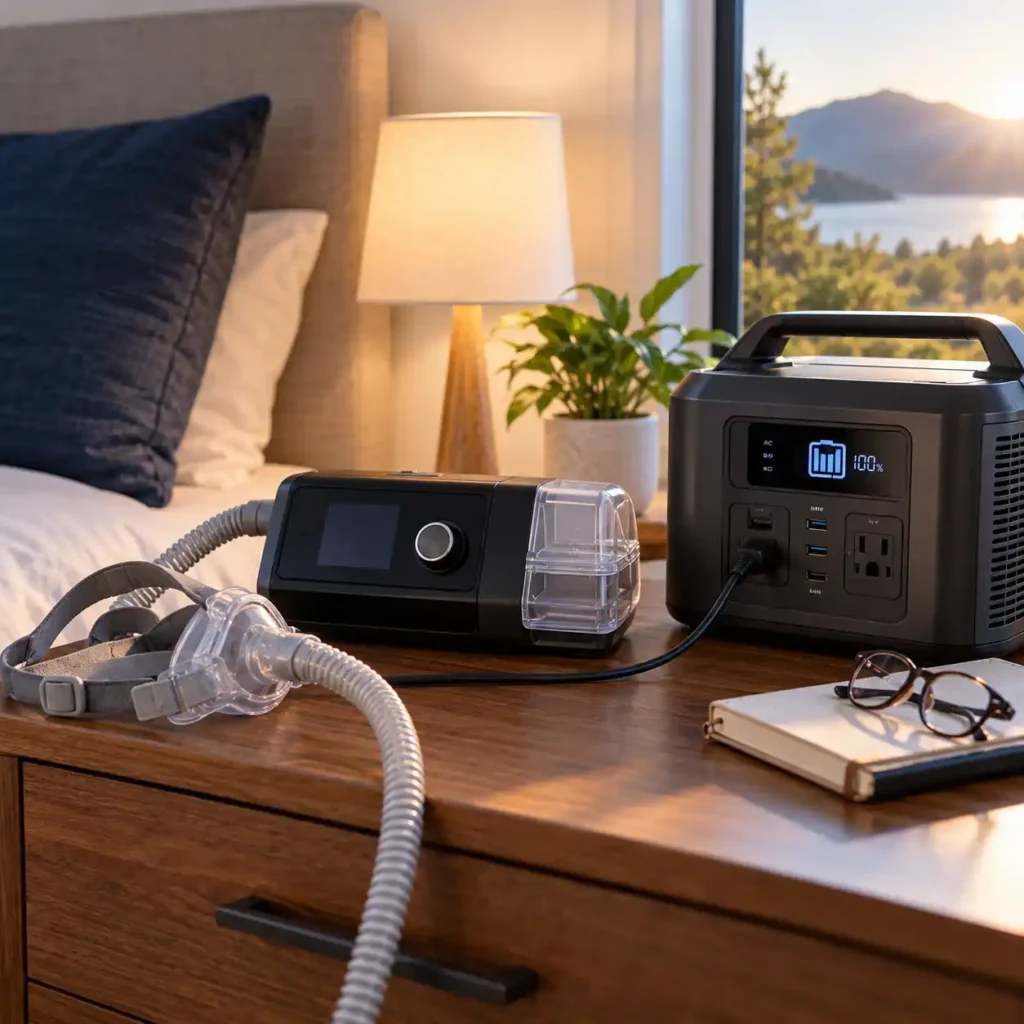
Table of Contents
Quick Answer
A CPAP battery runtime estimate can be calculated by comparing the battery’s usable energy with the CPAP’s average power consumption:
Estimated Runtime = Usable Battery Energy ÷ Average CPAP Power
If the battery’s advertised capacity is given in watt-hours and the power connection has conversion losses, a simplified calculation is:
Estimated Runtime = Battery Capacity × Efficiency ÷ Average CPAP Power
For example, a 500Wh battery powering a CPAP that averages 25W through a connection operating at 85% efficiency would provide approximately:
500Wh × 0.85 ÷ 25W = 17 hours
If you use the CPAP for 8 hours per night:
17 hours ÷ 8 hours = 2.1 nights
This is a planning estimate rather than a guarantee. Actual runtime can be shorter or longer depending on the CPAP model, pressure settings, humidifier, heated tubing, battery condition, temperature, and power-conversion losses.
For a reliable backup plan, use the CPAP’s actual average power consumption whenever that information is available.
CPAP Runtime Calculator
Estimate how long a battery can power your CPAP and approximately how many nights of therapy it can provide. Enter your battery capacity, average CPAP power consumption, nightly usage, connection efficiency, and battery reserve.
Your Estimated CPAP Runtime
The estimate is based on the battery capacity, average CPAP power consumption, hours of use per night, power connection efficiency, and battery reserve entered above. Actual runtime can vary with CPAP model, prescribed pressure, humidification, heated tubing, power-conversion losses, battery condition, temperature, and other operating conditions.
Important: This calculator provides a backup-power planning estimate. It does not determine whether CPAP therapy settings should be changed. Follow your CPAP manufacturer's instructions and your clinician's recommendations for prescribed therapy settings.
Use the calculator to estimate how long your battery can power your CPAP and approximately how many nights of therapy it can provide.
Enter:
- Battery Capacity (Wh)
- Average CPAP Power (W)
- Hours of Use per Night
- Power Connection Efficiency (%)
- Battery Reserve (%)
The calculator uses these inputs to estimate how much energy is available from the battery and how long it can power the CPAP. For a deeper explanation of battery capacity in watt-hours, see our Battery Capacity Calculator.
- total CPAP runtime in hours;
- estimated runtime in nights;
- energy required per night;
- usable battery energy;
- remaining runtime after a full night of therapy.
The result is intended for backup-power planning. It does not determine whether changing CPAP therapy settings is appropriate for you.
For prescribed pressure, humidification, heated tubing, and other therapy settings, follow your equipment manufacturer’s instructions and your clinician’s recommendations.
How the CPAP Runtime Calculator Works
The calculator uses the relationship between stored battery energy and the CPAP’s average electrical demand.
There are four main steps:
- Determine the battery’s available energy.
- Estimate the CPAP’s average power consumption.
- Account for energy lost during power conversion.
- Compare the available energy with the number of hours the CPAP will operate.
This approach is more useful than simply dividing a battery’s advertised watt-hours by a CPAP’s power-supply rating.
Step 1 — Determine Battery Capacity
Battery capacity is commonly expressed in watt-hours (Wh).
For example:
- 100Wh battery = 100 watt-hours of rated energy
- 300Wh battery = 300 watt-hours
- 500Wh battery = 500 watt-hours
- 1,000Wh battery = 1,000 watt-hours
A higher Wh rating generally means that a battery stores more energy, but the full rated capacity may not be available at the CPAP’s output.
The actual energy delivered to the device depends on the battery system, discharge limits, conversion efficiency, and connection method.
This is why the calculator includes an efficiency factor rather than assuming that 100% of the advertised battery capacity reaches the CPAP.
Step 2 — Determine Average CPAP Power
The next input is the CPAP’s average power consumption in watts.
This is different from the maximum power rating of the machine’s power supply.
For example, the ResMed AirSense 11 user guide lists a 65W power supply, along with typical and peak power consumption figures. The power-supply rating therefore should not automatically be treated as the machine’s continuous overnight energy consumption.
Whenever possible, use the manufacturer’s specifications for your exact CPAP model or measure the device’s actual consumption.
Average power is especially important because CPAP energy use can change during the night depending on operating conditions and whether electrically heated comfort features are being used.
Step 3 — Account for Power-Conversion Efficiency
The way the CPAP is connected to the battery can affect runtime.
With a portable power station, the battery stores DC energy. If the CPAP is connected to a standard AC outlet, the power station’s inverter converts battery DC into AC power. The CPAP’s power adapter then converts that AC power back to the DC voltage required by the machine.
That conversion process consumes some energy.
A compatible DC power connection can avoid the battery’s AC inverter stage and may therefore provide longer runtime from the same battery capacity. Current CPAP runtime calculators commonly distinguish between DC-direct and AC-inverter connections for this reason.
The exact efficiency depends on the battery, adapter, cable, CPAP model, and operating conditions. Therefore, the calculator should use an appropriate efficiency assumption rather than treating all power connections as identical.
Step 4 — Convert Runtime Into Nights
Knowing runtime in hours is useful, but CPAP users usually need to know something more practical:
How many nights will the battery last?
The calculation is straightforward:
Estimated Nights = Estimated Runtime ÷ Hours of CPAP Use per Night
For example, if the calculator estimates 20 hours of total runtime and you normally use your CPAP for 8 hours each night:
20 ÷ 8 = 2.5 nights
This does not mean that the battery will necessarily provide exactly two and a half complete nights under all conditions. It is an estimate based on the selected power consumption and efficiency assumptions.
For emergency planning, it is generally better to maintain some battery reserve rather than planning to drain the battery completely.
What CPAP Power Consumption Means
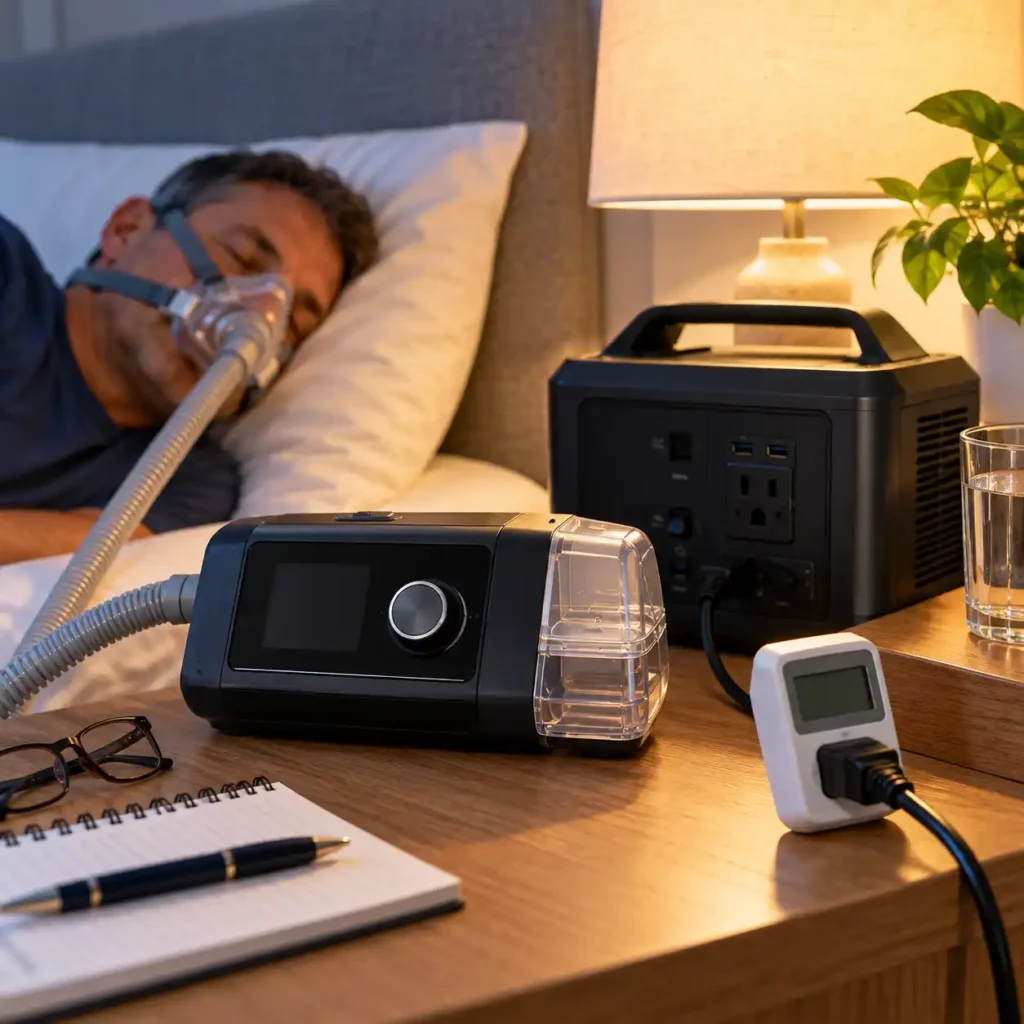
CPAP power consumption is not necessarily a single fixed number.
A machine may have several different electrical figures in its documentation, including:
- power-supply rating;
- typical power consumption;
- peak power consumption;
- input voltage;
- input current.
These figures serve different purposes.
The power-supply rating describes the capability of the supplied adapter. It does not automatically mean that the CPAP consumes that amount continuously throughout the night.
For battery-runtime calculations, average power consumption is usually the most useful value because runtime depends on total energy used over time.
For a broader explanation of how electrical power and energy consumption are calculated, see our power consumption formula guide.
For example, a CPAP averaging 20W for 8 hours uses approximately:
20W × 8 hours = 160Wh
A CPAP averaging 40W for the same 8-hour period uses:
40W × 8 hours = 320Wh
The second setup therefore requires approximately twice as much energy for the same duration.
This is why knowing the actual average load can be more useful than relying only on the wattage printed on the power adapter.
How CPAP Settings Affect Battery Runtime
Several operating conditions can change how much energy a CPAP system requires.
Humidifier
A heated humidifier can substantially increase electrical demand because it must heat water during therapy.
This makes humidification one of the most important variables when estimating CPAP battery runtime. Current CPAP runtime tools commonly separate calculations for humidifier-off and heated-humidifier configurations because the difference can materially change the required battery capacity.
If your normal therapy setup includes heated humidification, calculate runtime using power consumption that reflects that configuration.
Do not assume that a runtime estimate based on the CPAP blower alone will apply unchanged when the heated humidifier is operating.
If conserving battery energy during an outage is important, follow the CPAP manufacturer’s instructions and your clinician’s recommendations before changing any therapy or comfort settings.
Heated Tubing
Heated tubing can also increase energy consumption because the system must supply power to maintain the selected tube temperature.
The effect varies by device and settings, so a generic wattage value should not be treated as universal.
If you normally use heated tubing, the best runtime estimate is based on measurements or manufacturer information for the complete configuration rather than the CPAP motor alone.
Pressure and Operating Conditions
CPAP power consumption can also vary with operating conditions.
The machine has to generate airflow at the prescribed pressure, and actual demand can change as therapy conditions change.
Mask leak, pressure requirements, and the machine’s operating mode can therefore affect real-world energy use.
For this reason, a published wattage figure should be treated as an input for planning rather than a guarantee of overnight consumption.
Most importantly, do not change prescribed therapy settings simply to obtain a longer battery runtime. If you need to operate your CPAP from backup power, keep your prescribed therapy settings unless your clinician or equipment provider advises otherwise.
How CPAP Power Connection Affects Battery Runtime
The same battery can provide different CPAP runtimes depending on how the machine is connected.
AC Connection
With an AC connection, the typical power path is:
Battery DC → AC inverter → CPAP power adapter → CPAP
Each conversion stage introduces some energy loss.
This is convenient because most portable power stations provide standard AC outlets, but it may not be the most efficient way to power a compatible CPAP.
DC Connection
With a compatible DC connection, the power path can be more direct:
Battery DC → compatible DC cable or converter → CPAP
By avoiding the battery’s AC inverter stage, a DC setup can reduce conversion losses.
However, the cable or converter must be compatible with the specific CPAP model and required voltage. A generic DC cable should not be assumed to be safe or compatible simply because its connector fits.
Manufacturer documentation should be used to verify the correct power requirements and compatible accessories.
The practical advantage of DC power is therefore not that it magically increases the battery’s capacity. Instead, it can reduce the amount of stored energy lost during conversion.
How to Calculate CPAP Battery Runtime
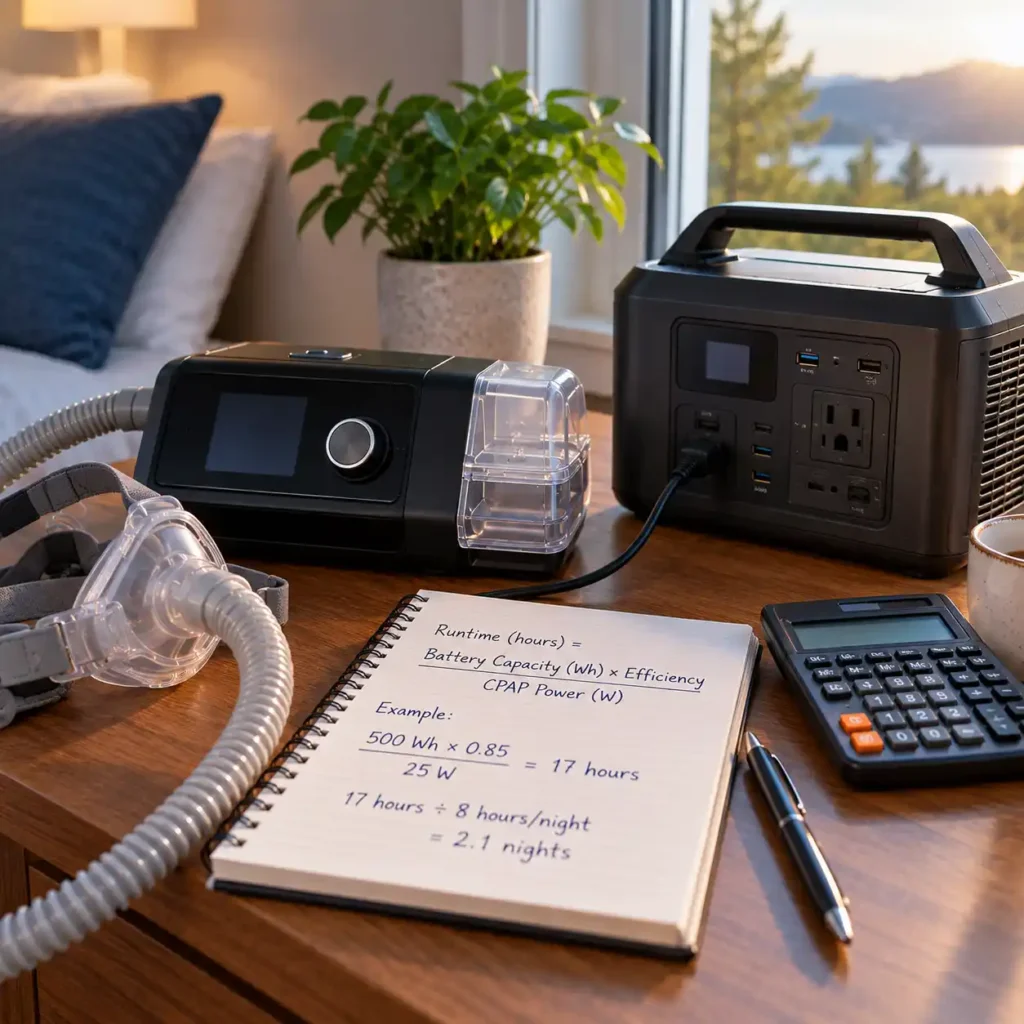
The basic calculation is:
Runtime (hours) = Battery Capacity (Wh) × Efficiency ÷ Average CPAP Power (W)
Suppose you have:
- Battery capacity: 500Wh
- Average CPAP power: 25W
- Connection efficiency: 85%
First calculate usable energy:
500Wh × 0.85 = 425Wh
Then divide usable energy by average CPAP power:
425Wh ÷ 25W = 17 hours
If the CPAP operates for 8 hours per night:
17 ÷ 8 = 2.1 nights
This means the theoretical estimate is approximately 17 hours, or about 2.1 eight-hour nights.
In practical planning, however, it is better not to treat the final percentage of battery capacity as guaranteed runtime. Battery condition, temperature, conversion losses, and variation in CPAP power consumption can all affect the actual result.
For this reason, a battery selected for emergency CPAP use should provide reasonable margin rather than being sized exactly to the theoretical minimum.
How Many Watt-Hours Does a CPAP Need for One Night?
A simple way to estimate the energy required for one night is:
Energy Required per Night (Wh) = Average CPAP Power (W) × Hours of Use
For an 8-hour night:
| Average CPAP Power | Energy for 8 Hours |
|---|---|
| 10W | 80Wh |
| 15W | 120Wh |
| 20W | 160Wh |
| 25W | 200Wh |
| 30W | 240Wh |
| 40W | 320Wh |
| 50W | 400Wh |
These figures represent the CPAP’s energy requirement before accounting for the efficiency of the battery-to-CPAP power path.
For example, a CPAP averaging 25W requires approximately 200Wh for eight hours:
25W × 8 hours = 200Wh
If the battery system delivers only 85% of its rated capacity to the CPAP through the selected connection, the nominal battery capacity needed would be higher than 200Wh.
This is why the distinction between energy required by the CPAP and battery capacity required to deliver that energy matters when sizing backup power.
How to Find Your CPAP's Actual Power Consumption
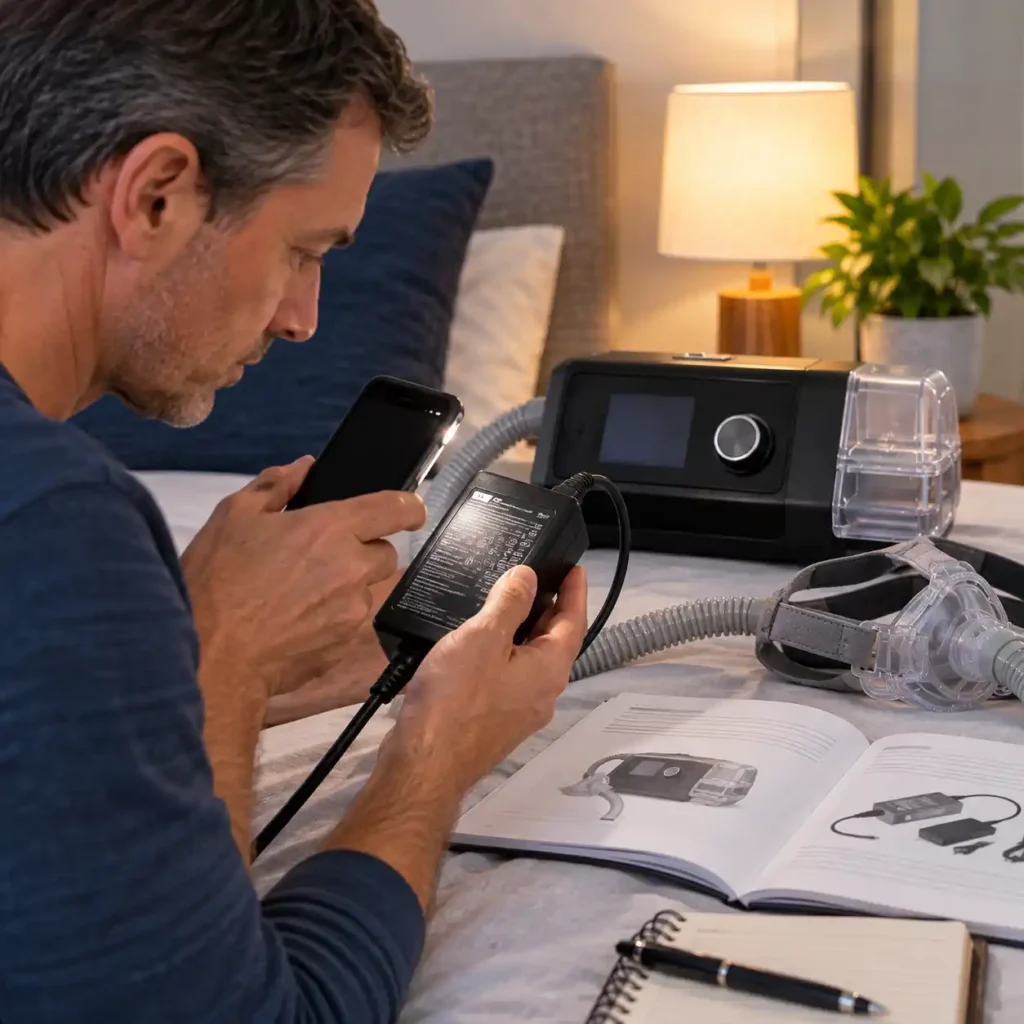
The most reliable runtime estimate starts with information specific to your CPAP rather than a generic wattage assumption.
Check the Manufacturer’s Documentation
Start with the user guide or technical specifications for your exact CPAP model.
Look for terms such as:
- typical power consumption;
- power consumption;
- input power;
- rated power;
- peak power;
- power supply specifications.
Be careful not to automatically use the power-supply wattage as the CPAP’s average operating load.
For example, ResMed’s AirSense 11 documentation distinguishes its 65W power supply from its stated typical and peak power consumption figures.
Check Your Complete Therapy Configuration
The power consumption figure should match the setup you actually use.
If your normal configuration includes:
- heated humidification;
- heated tubing;
- a specific pressure setting;
- other electrically powered accessories;
use information that reflects that configuration whenever possible.
A runtime estimate based on a bare CPAP unit may overstate the runtime of a setup that includes electrically heated comfort features.
Measure Actual Energy Consumption
A suitable plug-in power meter can provide a more useful real-world measurement for an AC-powered CPAP setup.
Instead of relying on a brief instantaneous wattage reading, measure consumption over a sufficiently long period to capture normal operation.
A longer measurement period can reveal how much energy the complete setup actually uses during typical therapy.
Once you know the energy consumed over a known period, you can calculate average power:
Average Power (W) = Energy Used (Wh) ÷ Time (hours)
For example, if the complete CPAP setup consumes 200Wh during 8 hours:
200Wh ÷ 8 hours = 25W average power
That 25W figure can then be used as the average power input for a more realistic battery-runtime calculation.
The result will still be an estimate because future nights may involve different pressure requirements, temperature, mask leak, humidifier operation, or other conditions.
CPAP Runtime Example
Consider a CPAP setup with:
- Battery capacity: 500Wh
- Average CPAP power: 25W
- Use per night: 8 hours
- Connection efficiency: 85%
First calculate usable battery energy:
500Wh × 0.85 = 425Wh
Then calculate runtime:
425Wh ÷ 25W = 17 hours
Now convert the runtime into nights:
17 hours ÷ 8 hours = 2.1 nights
The estimated runtime is therefore approximately 17 hours, equivalent to about 2.1 eight-hour nights under the selected assumptions.
This example demonstrates why battery capacity alone does not determine CPAP runtime.
Two users with the same 500Wh battery can get substantially different results if one CPAP setup averages 15W while another averages 40W.
The power connection can also affect the result. If the same battery is used through a less efficient AC power path, less of the stored energy reaches the CPAP.
For real-world backup planning, use the closest available power-consumption figure for your exact machine and configuration rather than relying solely on a generic CPAP wattage estimate.
What Affects CPAP Battery Runtime?
The runtime shown by a CPAP battery calculator is an estimate because several variables can change how much energy the complete therapy setup consumes.
The most important factors include the CPAP’s actual average power, humidification, heated tubing, connection method, battery efficiency, and the number of hours the machine operates each night.
Humidification and Heated Tubing
Heated humidification and heated tubing can increase the electrical load of a CPAP system.
If you normally use these features, a runtime estimate based only on the blower’s power consumption may be too optimistic.
For backup-power planning, use a power-consumption figure that reflects your normal therapy configuration whenever possible.
If conserving battery energy becomes necessary during an outage, do not change prescribed therapy settings without appropriate guidance from your clinician or equipment provider.
Hours of Use Per Night
The number of hours the CPAP operates directly affects how much energy is consumed each night.
For example, a CPAP averaging 25W would use approximately:
25W × 6 hours = 150Wh
With 8 hours of use:
25W × 8 hours = 200Wh
With 10 hours of use:
25W × 10 hours = 250Wh
The same battery can therefore provide a different number of nights depending on how long the CPAP operates each night.
Battery Capacity
Battery capacity determines how much stored energy is available, but the advertised Wh rating should not automatically be treated as fully usable energy.
Conversion losses and the battery reserve reduce the energy available to the CPAP.
For example, two batteries may have different nominal capacities but provide less difference in practical runtime than their labels suggest if one system has a less efficient power path.
For backup planning, compare usable energy rather than looking only at the nominal Wh rating.
Battery Reserve
A battery reserve is the portion of the battery capacity you intentionally do not use.
For example, if a 500Wh battery has a 10% reserve and the system operates at 85% connection efficiency, the simplified usable-energy calculation is:
500Wh × 90% × 85% = 382.5Wh
A reserve reduces the calculated runtime, but it can provide additional margin for unexpected conditions and prevent the calculation from assuming complete battery depletion.
The appropriate reserve depends on the battery system and your backup-power strategy.
Temperature and Battery Condition
Battery performance can vary with operating conditions.
Temperature, battery age, charging history, and the battery management system can affect the amount of energy that is practically available.
A runtime estimate based on a new battery at moderate temperature should therefore not be interpreted as a guaranteed result for every operating condition.
How to Get a More Accurate CPAP Runtime Estimate
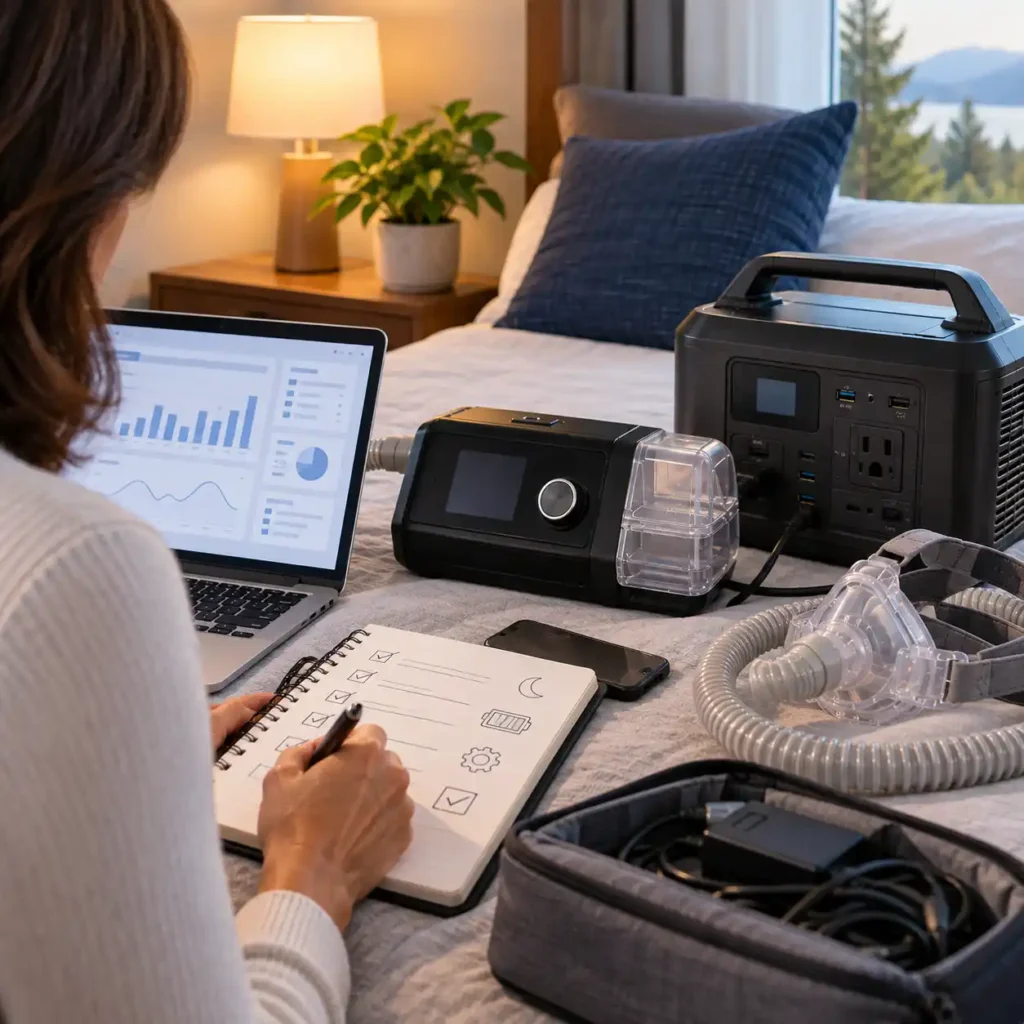
The most useful CPAP runtime estimate combines manufacturer specifications with measurements from the actual equipment.
Start with the exact CPAP model and the configuration you expect to use during a power outage.
Then identify the machine’s average power consumption rather than automatically using the maximum rating of its power adapter.
If possible, measure the complete AC-powered setup over a representative therapy period.
Use Actual Energy Consumption When Available
If you know how many watt-hours the CPAP consumes during a typical night, you can calculate the average power directly.
For example, suppose the complete setup uses 200Wh over 8 hours:
200Wh ÷ 8 hours = 25W average power
You can then use approximately 25W as the average load in the runtime calculation.
This can be more useful than relying on a generic CPAP wattage estimate because the measurement reflects the particular machine and configuration being used.
Measure the Complete Setup
If the CPAP normally operates with a humidifier or heated tubing, include those components in the measurement.
Measuring only the CPAP blower while excluding electrically powered accessories can underestimate the energy required during actual therapy.
Likewise, if you normally use an AC adapter with a portable power station, the measurement should reflect the relevant power path when possible.
Test the Backup System Before an Outage
A practical test can reveal differences between the theoretical calculation and the actual system.
Connect the CPAP to the intended backup battery using the configuration you expect to use during an outage.
Then observe the battery’s energy consumption during normal operation.
A test can help identify:
- actual overnight energy use;
- the effect of humidification;
- the effect of heated tubing;
- conversion losses;
- battery reserve behavior;
- unexpected power draw from connected equipment.
A real-world test is particularly useful when reliable overnight backup is important.
How to Extend CPAP Battery Runtime
If the goal is to maximize the number of therapy hours available from a battery during an outage, focus on reducing unnecessary energy losses rather than changing prescribed therapy.
Use an Efficient Power Connection
If your CPAP manufacturer supports a compatible DC power solution, a direct DC connection may reduce conversion losses compared with powering the machine through an AC inverter.
The correct cable, converter, and voltage must be verified for the specific CPAP model.
Do not use a DC cable solely because the connector appears to fit. Electrical compatibility matters.
Avoid Unnecessary AC Conversion
When a suitable DC connection is available, avoiding an unnecessary AC conversion stage can improve overall system efficiency.
The benefit depends on the specific CPAP, battery, adapter, and converter.
A DC connection does not increase the battery’s stored energy. It can simply reduce the amount of energy lost between the battery and the CPAP.
Reduce Unnecessary Electrical Loads
If the backup system is powering additional devices, those loads consume energy that would otherwise remain available for the CPAP.
For the longest possible CPAP runtime, avoid connecting unnecessary equipment to the same battery during an extended outage.
Keep the Battery Properly Charged
Before an expected outage, make sure the backup battery is adequately charged according to the manufacturer’s instructions.
For recurring backup use, follow the battery manufacturer’s storage and charging recommendations.
A runtime calculation assumes a particular starting state of charge. A battery that begins the outage partially charged will naturally provide less runtime than the same battery starting at full charge.
How Much Battery Capacity Do You Need for CPAP Backup?
The required battery capacity depends on the CPAP’s average power consumption, the number of hours of therapy per night, the number of nights required, and the efficiency of the power connection.
A useful preliminary calculation is:
Required Battery Capacity = CPAP Power × Hours per Night × Number of Nights ÷ Overall Efficiency
For example, suppose a CPAP averages 25W and is used for 8 hours per night for three nights.
First calculate the CPAP’s energy requirement:
25W × 8 hours × 3 nights = 600Wh
If the overall power-path efficiency is 85%:
600Wh ÷ 0.85 ≈ 706Wh
A battery with approximately 706Wh of nominal capacity would therefore be the theoretical minimum under these assumptions before adding any additional planning margin or reserve.
In practice, selecting a battery exactly at the calculated minimum leaves little room for variation.
Actual energy consumption can differ from the assumed average, and the usable capacity of a battery can change with operating conditions.
For that reason, a practical backup system should provide some additional capacity rather than relying on a calculation that assumes perfect conditions.
CPAP Battery Runtime Example: Different Power Levels
The effect of CPAP power consumption becomes clear when comparing otherwise identical setups.
Assume:
- Battery capacity: 500Wh
- Connection efficiency: 85%
- Battery reserve: 10%
- Use per night: 8 hours
The usable battery energy is:
500Wh × 90% × 85% = 382.5Wh
The resulting runtime changes with average CPAP power.
| Average CPAP Power | Estimated Runtime | Approx. 8-Hour Nights |
|---|---|---|
| 10W | 38.3 hours | 4.8 nights |
| 15W | 25.5 hours | 3.2 nights |
| 20W | 19.1 hours | 2.4 nights |
| 25W | 15.3 hours | 1.9 nights |
| 30W | 12.8 hours | 1.6 nights |
| 40W | 9.6 hours | 1.2 nights |
These are simplified estimates using the same battery and efficiency assumptions for every row.
The table demonstrates why the actual CPAP power consumption is such an important input. A relatively small difference in average wattage can produce a substantial difference in overnight runtime.
Common CPAP Runtime Calculation Mistakes
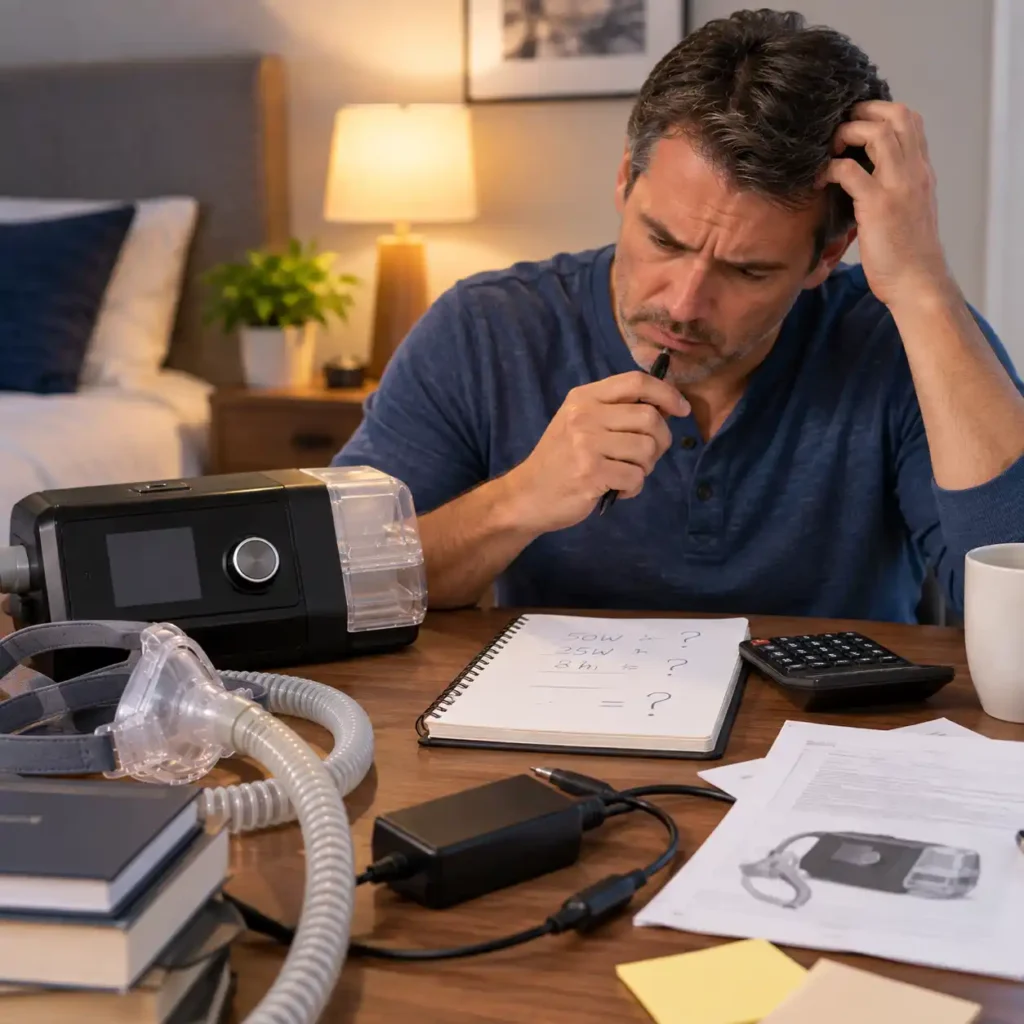
Using the Power Adapter Rating as Average Consumption
A CPAP power adapter’s wattage rating describes the adapter’s capability and should not automatically be interpreted as the machine’s average overnight consumption.
Whenever possible, use manufacturer specifications for actual consumption or measure the complete setup.
Ignoring Humidifier and Heated Tubing
A calculation based only on the CPAP blower can underestimate energy use if heated humidification or heated tubing is normally enabled.
The runtime estimate should reflect the configuration you actually intend to use.
Dividing Battery Capacity by CPAP Watts Without Accounting for Efficiency
A calculation such as:
500Wh ÷ 25W = 20 hours
assumes that the entire 500Wh reaches the CPAP.
Real systems have conversion losses, so actual runtime can be lower.
Treating Nominal Battery Capacity as Fully Usable
The battery’s advertised Wh capacity does not necessarily equal the energy available at the CPAP output.
Reserve settings, conversion efficiency, discharge limits, and operating conditions can reduce usable energy.
Using a Generic CPAP Wattage
Different CPAP machines and configurations can have different power requirements.
A generic value can be useful for an initial estimate, but it should be replaced with model-specific information when available.
Assuming Every DC Cable Is Compatible
A physically matching connector does not guarantee electrical compatibility.
Voltage, polarity, current requirements, connector specifications, and the manufacturer’s approved power solutions all matter.
Planning to Use Every Last Watt-Hour
A theoretical calculation can produce a runtime that looks sufficient on paper but leaves no margin for real-world variation.
For emergency backup, it is safer to plan with reasonable capacity margin rather than assuming the battery will deliver its entire nominal capacity exactly as calculated.
Frequently Asked Questions
How many watt-hours does a CPAP need for one night?
The energy required depends on the CPAP’s average power consumption and the number of hours it operates. For example, a CPAP averaging 25W for 8 hours requires approximately 200Wh at the device before accounting for power-conversion losses.
A CPAP with lower average power may require considerably less, while a setup using heated humidification or heated tubing can require substantially more energy.
How long will a 500Wh battery run a CPAP?
The runtime depends on the CPAP’s average power, connection efficiency, and battery reserve.
For example, with 500Wh of nominal capacity, 85% connection efficiency, and a 10% reserve, the simplified usable energy is:
500Wh × 0.90 × 0.85 = 382.5Wh
At an average CPAP load of 25W, that would provide approximately 15.3 hours, or about 1.9 eight-hour nights.
Actual runtime will vary with the CPAP model and configuration.
How long will a 1,000Wh battery run a CPAP?
A 1,000Wh battery can provide substantially more runtime than a 500Wh battery under identical conditions.
Using 25W average CPAP power, 85% connection efficiency, and a 10% battery reserve:
1,000Wh × 0.90 × 0.85 ÷ 25W = 30.6 hours
That corresponds to approximately 3.8 eight-hour nights nder the simplified assumptions. If you are comparing battery systems around this capacity, see our guide to Best 1000Wh Portable Power Stations.
This is a planning estimate rather than a guaranteed runtime.
What size battery do I need to run a CPAP for 8 hours?
There is no single battery size that works for every CPAP.
As a starting point, multiply the CPAP’s average power by 8 hours and then account for connection losses and any battery reserve.
For example:
25W × 8 hours = 200Wh
Because some stored energy is lost between the battery and CPAP, the battery’s nominal capacity generally needs to be higher than 200Wh.
The required capacity can be much higher when heated humidification or heated tubing is used.
Does a CPAP use more battery power with the humidifier on?
Yes. A heated humidifier adds electrical demand because energy is required to heat water.
The increase varies by CPAP model and humidifier settings, so the most accurate approach is to measure the complete setup or use manufacturer-specific power-consumption information.
Because humidification can materially increase energy consumption, it can have a significant effect on the number of hours or nights a battery can provide.
Does heated tubing reduce CPAP battery runtime?
Yes. Heated tubing adds another electrical load to the CPAP system.
If the goal is to estimate realistic battery runtime, include heated tubing in the measurement or power estimate whenever it will be used during backup operation.
The effect varies by equipment and temperature setting, so a generic wattage figure should not be treated as universal.
Is it better to run a CPAP from DC or AC power?
A compatible DC connection can be more energy-efficient because it may avoid the additional DC-to-AC-to-DC conversion involved when a CPAP is powered through an AC inverter.
However, the actual efficiency depends on the battery, converter, CPAP power supply, and connection method.
Use a DC solution only when it is electrically compatible with the specific CPAP and supported by the equipment manufacturer.
How can I find out how many watts my CPAP actually uses?
Start with the manufacturer’s documentation and the power-supply specifications for your exact CPAP model.
For a more useful runtime estimate, measure the complete setup over a representative period with a suitable power meter when possible.
If you normally use a humidifier or heated tubing, include those components in the measurement because they can materially change total energy consumption.
Can a portable power station run a CPAP all night?
A portable power station can run a CPAP overnight if its usable energy capacity is sufficient and its output is electrically compatible with the CPAP. When preparing backup power for a CPAP during an outage, it is important to confirm that the specific device can safely operate from the selected battery or generator. The FDA guidance on medical devices during power outages recommends checking the device instructions or contacting the manufacturer to determine whether battery or generator power is appropriate.
The important specifications are not just the battery’s advertised Wh rating. You should also consider connection efficiency, battery reserve, the CPAP’s actual average power consumption, and whether the humidifier or heated tubing will be operating.
For an overnight backup plan, calculate the energy required for the complete setup rather than relying on the power station’s nominal capacity alone. For shorter power interruptions, UPS battery backup systems can also be an alternative to consider.
How many nights can a CPAP battery last?
The number of nights depends on battery capacity, average CPAP power, hours of use per night, connection efficiency, and battery reserve.
For example, if a battery provides 382.5Wh of usable energy and the CPAP requires 200Wh per eight-hour night, the theoretical result is:
382.5Wh ÷ 200Wh = 1.9 nights
Higher CPAP power consumption reduces the number of nights, while lower consumption increases it.
Does CPAP pressure affect battery runtime?
CPAP power consumption can vary with operating conditions, including the pressure delivered by the machine.
However, the effect is specific to the CPAP model and operating configuration, so a generic wattage adjustment should not be assumed.
For battery planning, use measured average consumption or manufacturer-specific information for your particular machine whenever possible.
How much battery capacity do I need for several nights of CPAP use?
First calculate the energy required for one night, then multiply it by the number of nights.
For example, a CPAP averaging 25W for 8 hours requires approximately 200Wh per night at the device.
For three nights:
200Wh × 3 = 600Wh
You then need to account for connection losses and any battery reserve. This means the required nominal battery capacity will be higher than 600Wh.
For multi-night backup, it is also worth considering how the battery will be recharged rather than simply increasing battery size.
How accurate is a CPAP battery runtime calculator?
A calculator provides a planning estimate, not a guaranteed runtime.
Accuracy improves when the calculation uses the CPAP’s actual average energy consumption, realistic connection efficiency, usable battery capacity, and the number of hours the machine will operate.
Actual results can still differ because of battery condition, temperature, power-conversion losses, CPAP configuration, and changes in energy consumption during operation. Current CPAP runtime calculators also emphasize that model-specific settings and connection methods can materially change the result.
Final Takeaway
A CPAP Runtime Calculator is most useful when it estimates battery runtime from the variables that actually determine energy consumption.
The key inputs are:
- battery capacity in watt-hours;
- average CPAP power consumption;
- hours of use per night;
- power-connection efficiency;
- battery reserve.
For a more realistic result, use power-consumption information for your specific CPAP and include the accessories that will actually operate during therapy, particularly heated humidification and heated tubing.
The connection method also matters. A compatible DC power solution may reduce conversion losses compared with an AC inverter, while an AC connection can offer greater convenience and compatibility with standard portable power stations.
For emergency planning, do not rely solely on the theoretical maximum runtime. Test the intended backup setup when possible, allow reasonable capacity margin, and follow the CPAP manufacturer’s instructions for approved power sources and accessories.
The goal of the calculation is simple: determine whether the available battery can provide enough energy for the required therapy hours and, when necessary, enough additional capacity to remain useful through a longer outage.