
A dual fuel generator gives you more flexibility when reliable backup power matters. By running on either gasoline or propane, these generators let you choose the fuel that best fits your situation, whether you are preparing for a power outage, backing up essential appliances at home, supporting an RV, or using a generator for outdoor and emergency power.
The best dual fuel generator is not necessarily the model with the highest peak wattage. Fuel efficiency, running power, outlet configuration, portability, starting options, noise level, inverter technology, and compatibility with your intended backup setup can all affect which generator makes the most sense. A high-output conventional generator may be a better choice for demanding home loads, while a quieter inverter model may be more practical for RV use or sensitive electronics.
For this guide, we selected five dual fuel generators that represent different power levels and use cases. Our picks include high-output portable generators for home backup, as well as more compact inverter models designed for quieter operation and greater versatility. Each model is evaluated using its specific product listing and verified specifications so you can compare actual capabilities rather than relying on wattage alone.
As an Amazon Associate, I earn from qualifying purchases.

Table of Contents
Quick Answer
The best dual fuel generator for most people in 2026 is the Westinghouse WGen7500DFc. It offers a strong balance of power, fuel flexibility, starting convenience, outlet options, and overall practicality for home backup and emergency use. With 7,500 running watts on gasoline and 6,750 running watts on propane, it provides enough capacity for many essential household loads without moving into the size and weight of the highest-output models.
If you need substantially more power for demanding home backup, the DuroMax XP13000EH is the strongest choice in this lineup. Its 13,000 peak watts and 10,500 running watts on gasoline make it the most powerful generator in our selection, while its 120/240V output and 50A connection provide the flexibility needed for larger backup loads.
For buyers who want an inverter generator, the WEN DF680iX stands out for its combination of dual-fuel operation, inverter technology, 240V capability, RV-ready outlet, and quieter operation. The Westinghouse iGen5000DFc EFI is another strong inverter option, particularly for users who value electronic fuel injection, lower weight, and a compact design.
The WEN DF1100X sits between the highest-output and more compact options. With up to 11,000 peak watts on gasoline and 8,300 running watts, it offers substantial backup capacity while retaining the straightforward design and functionality of a conventional portable generator.
The right dual fuel generator ultimately depends on how much power you need, which fuel you plan to use, whether you need 120V or 120/240V operation, how important portability and noise are, and whether inverter technology or EFI provides meaningful advantages for your setup. In this guide, we compare all five models using their specific Amazon listings and verified specifications to help you choose the generator that best matches your backup power needs in 2026.
Why You Can Trust Power Ready Guide
At Power Ready Guide, we focus exclusively on backup power, portable energy, and off-grid power solutions. Every recommendation is based on thorough product research, manufacturer specifications, verified product data, fuel performance information, safety features, and real-world use cases rather than marketing claims alone.
Every dual fuel generator in this guide was evaluated using the same research framework, with emphasis on power output, fuel flexibility, runtime, safety, portability, and suitability for different backup scenarios.
For this guide, we compared each dual fuel generator using the same evaluation framework to ensure fair and consistent recommendations. Instead of looking at peak wattage alone, we considered how each generator performs as a complete backup power solution, including its usable running power, fuel options, outlet configuration, starting system, portability, noise characteristics, and suitability for different applications.
Our evaluation included:
- Rated and peak power output on both gasoline and propane
- Fuel flexibility, tank capacity, and expected runtime
- Engine size, starting system, and overall generator design
- 120V and 120/240V output capabilities and available receptacles
- Inverter technology and power quality where applicable
- CO detection and automatic shutdown features
- Portability, weight, wheels, and overall ease of handling
- Noise level and suitability for residential, RV, and outdoor use
- Build quality, manufacturer reputation, warranty support, and long-term reliability
- Compatibility with transfer switches, RV connections, and home backup applications
- Overall value for money based on performance, features, and intended use
We don’t recommend the generator with the highest advertised wattage—we recommend the model that offers the best combination of usable power, fuel flexibility, reliability, features, and value for each type of user.
Whether you need backup power during a residential outage, a generator for an RV, or a portable power source for demanding off-grid applications, our goal is to help you choose equipment that matches your actual electrical requirements rather than simply buying the biggest generator available.
Each generator in this guide is tied to a specific Amazon listing and model, allowing us to evaluate the actual product rather than combining specifications from different versions or listings.
How We Evaluated the Best Dual Fuel Generators

Every dual fuel generator in this guide was evaluated using the same research framework to ensure fair, consistent, and objective comparisons. Rather than focusing on a single specification such as maximum wattage, we assessed how each generator performs as a complete backup power solution, balancing usable output, fuel flexibility, convenience, portability, and long-term value.
A higher peak power rating doesn’t automatically make a generator the best choice. For many users, running wattage, fuel consumption, outlet configuration, starting options, noise level, and ease of transportation are just as important. Our evaluation reflects the real-world trade-offs buyers face when choosing a dual fuel generator for home backup, RV use, emergency preparedness, or off-grid power.
Each recommendation was assessed using the following criteria:
- Rated and peak power output, including the difference between running and starting watts and, where applicable, the generator’s output on both gasoline and propane.
- Fuel flexibility and runtime, considering dual-fuel capability, fuel tank capacity, and how practical each fuel source is for extended backup use.
- Engine and starting system, including engine displacement, electric start, remote start, recoil backup, and overall operating convenience.
- Output and receptacle configuration, including 120V and 120/240V capability, 30A and 50A connections, RV-ready outlets, and suitability for different backup applications.
- Power quality and inverter technology, giving appropriate consideration to inverter models where cleaner electrical output, lower distortion, and quieter operation can be important.
- Safety features, including CO detection and automatic shutdown systems designed to help protect users during generator operation.
- Portability and physical design, considering weight, wheels, handles, and how practical each generator is to move, position, and store.
- Noise and operating characteristics, particularly for residential properties, camping, RV use, and other situations where generator noise can affect usability.
- Build quality and long-term reliability, based on manufacturer reputation, product design, warranty support, and available ownership feedback.
- Overall value for money, comparing power capacity, features, fuel flexibility, construction, and intended use rather than simply selecting the cheapest or most powerful generator.
We also considered the different ways dual fuel generators are used. A generator intended primarily for whole-home backup has different requirements from one used with an RV or for portable off-grid power. A high-output conventional generator may provide the capacity needed for demanding household loads, while an inverter generator can offer advantages where quieter operation, portability, or power quality matters.
Our goal isn’t to identify the generator with the highest advertised wattage. It’s to recommend the right generator for each application, helping you choose a model that provides appropriate power, practical fuel flexibility, and dependable performance without paying for capacity or features you don’t actually need.
Who This Guide Is For
Choosing a dual fuel generator isn’t just about buying the highest-wattage model—it’s about finding a generator that matches your power requirements, fuel preferences, installation needs, and intended use. The best option for whole-home backup may not be the right choice for an RV, camping setup, or portable off-grid application.
This guide is designed for buyers who want to make a confident decision based on practical requirements rather than marketing claims.
It’s especially helpful for:
- Homeowners looking for dependable backup power during outages and wanting the flexibility to run a generator on either gasoline or propane.
- RV owners who need a portable generator with sufficient output and RV-ready connections for extended travel or off-grid camping.
- Emergency preparedness buyers who want a reliable backup power source and the ability to store propane for longer-term emergency use.
- Off-grid users who need substantial portable power for cabins, remote properties, tools, appliances, or other electrical loads.
- DIY and backup power enthusiasts comparing conventional and inverter dual fuel generators for custom power setups.
- Buyers with demanding electrical loads who need higher running wattage for refrigerators, pumps, heating equipment, air conditioning, or multiple household appliances.
- First-time generator buyers comparing leading dual fuel models before making their first investment.
Whether your priority is maximum output, fuel flexibility, quieter inverter operation, portability, RV compatibility, or the best overall value, this guide will help you choose the dual fuel generator that best fits your power needs and budget.
Quick Summary: Our Top Picks
Not every dual fuel generator is designed for the same type of backup power. Some prioritize high output for demanding household loads, while others focus on inverter technology, quieter operation, portability, RV compatibility, or fuel efficiency.
The generators below earned their awards based on our evaluation of power output, fuel flexibility, outlet configuration, starting systems, inverter technology where applicable, portability, safety features, build quality, long-term reliability, and overall value.
Westinghouse WGen7500DFc
Award: Best Overall
Why It Won:
The Westinghouse WGen7500DFc offers the strongest overall balance of usable power, dual-fuel flexibility, convenient starting, practical outlet configuration, and dependable conventional-generator performance. Its 7,500 running watts on gasoline and 6,750 running watts on propane provide substantial capacity for residential backup without moving into the largest and heaviest generator class.
Choose This If:
You want a powerful all-around generator for home backup.
You need the flexibility to run on gasoline or propane.
You want electric and remote starting for easier operation.
You need 120/240V capability for a broader range of household loads.
You prefer a proven conventional generator design.
Best For:
Home backup
Emergency preparedness
Essential household appliances
RV and outdoor power
Buyers seeking the best overall balance
DuroMax XP13000EH
Award: Best High-Power Option
Why It Won:
The DuroMax XP13000EH is the most powerful model in our selection, delivering up to 13,000 peak watts and 10,500 running watts on gasoline. Its high output, 120/240V operation, and 50A connection make it the strongest choice for buyers who need substantial portable power for demanding home backup applications.
Choose This If:
You need the highest output among our five picks.
You want to support multiple high-demand household loads.
You need 120/240V power for larger backup applications.
You want a generator with a 50A connection.
Maximum portable power is more important than compact size.
Best For:
High-demand home backup
Large households
Emergency power
Workshops and heavy-duty loads
Buyers who need maximum output
WEN DF1100X
Award: Best Value High-Output Generator
Why It Won:
The WEN DF1100X provides substantial backup capacity without moving all the way into the highest-output class. With up to 11,000 peak watts and 8,300 running watts on gasoline, it offers a strong combination of power, dual-fuel capability, practical features, and value for buyers who need more capacity than a mid-size generator provides.
Choose This If:
You need high output but don’t require the maximum capacity of the DuroMax.
You want both gasoline and propane operation.
You need 120/240V capability for home backup.
You want a conventional generator with electric starting.
Value is an important part of your purchasing decision.
Best For:
Home backup
Emergency preparedness
Larger appliances
DIY backup power systems
Value-focused buyers
WEN DF680iX
Award: Best Dual Fuel Inverter Generator
Why It Won:
The WEN DF680iX stands apart from the conventional generators in this lineup by combining dual-fuel capability with inverter technology. It offers up to 5,100 rated watts on gasoline, 4,500 rated watts on propane, 240V capability, an RV-ready TT-30R outlet, and a quieter operating profile, making it particularly versatile for users who value power quality and portability.
Choose This If:
You specifically want an inverter generator.
You need a quieter option for RV or outdoor use.
You want both gasoline and propane capability.
You need 240V output in a more compact generator.
RV compatibility and power quality are important to you.
Best For:
RVs
Camping
Portable power
Sensitive electronics
Buyers seeking inverter technology
Westinghouse iGen5000DFc EFI
Award: Best Compact EFI Inverter Generator
Why It Won:
The Westinghouse iGen5000DFc EFI combines dual-fuel operation, inverter technology, and electronic fuel injection in a substantially more compact package. With 3,900 running watts on gasoline and 3,500 running watts on propane, it is better suited to users who value portability, efficient operation, and lower-output backup power rather than maximum capacity.
Choose This If:
You want a compact dual fuel inverter generator.
Portability is more important than maximum output.
You value electronic fuel injection.
You need a generator for an RV, camping, or smaller backup setup.
You want inverter technology and lower power capacity in a portable design.
Best For:
RVs
Camping
Portable backup power
Smaller electrical loads
Buyers prioritizing portability and EFI
Still not sure which dual fuel generator is right for you? The detailed reviews below explain where each model excels, its limitations, and which type of user will benefit most from choosing it.
Best Dual Fuel Generators Compared
| Model | Award | Gasoline Output | Propane Output | Best For |
|---|---|---|---|---|
| Westinghouse WGen7500DFc | Best Overall | 9,500 peak / 7,500 running W | 8,550 peak / 6,750 running W | Home Backup |
| DuroMax XP13000EH | Best High-Power Option | 13,000 peak / 10,500 running W | 12,350 peak / 9,975 running W | High-Demand Backup |
| WEN DF1100X | Best Value High-Output | 11,000 peak / 8,300 running W | 9,500 peak / 7,500 running W | Home Backup |
| WEN DF680iX | Best Dual Fuel Inverter | 6,800 peak / 5,100 rated W | 6,000 peak / 4,500 rated W | RVs & Portable Power |
| Westinghouse iGen5000DFc EFI | Best Compact EFI Inverter | 5,000 peak / 3,900 running W | 4,500 peak / 3,500 running W | Portable Backup |
The Best Dual Fuel Generators Reviewed
Westinghouse WGen7500DFc
Best Overall Dual Fuel Generator

Quick Verdict
The Westinghouse WGen7500DFc earns our Best Overall award because it strikes a particularly useful balance between substantial backup capacity and practical everyday operation. It is not the largest generator in this guide, nor is it designed to compete with compact inverter models. Instead, it occupies the middle ground that makes sense for many homeowners who want enough power for serious outage backup without stepping up to the size and capacity of a heavy-duty 13,000-watt class generator.
On gasoline, the WGen7500DFc produces 9,500 peak watts and 7,500 running watts. When propane is used, output is 8,550 peak watts and 6,750 running watts. That difference matters when planning a backup system: gasoline provides the generator’s highest available output, while propane gives you an alternative fuel source with slightly lower power capacity.
The generator is built around a 420cc 4-stroke OHV engine with a cast-iron sleeve, giving it the type of conventional, heavy-duty design expected from a home-backup generator in this power class. A 6.6-gallon gasoline tank provides up to 11 hours of runtime at 25% load, while Westinghouse rates propane runtime at up to 8 hours at 25% load when using a 20-pound propane tank.
Where the WGen7500DFc becomes especially practical for home use is its control and connection setup. It combines push-button electric starting with a wireless remote key fob and emergency recoil starting, while its 120/240V L14-30R transfer-switch-ready outlet allows it to be integrated into a properly installed home backup system. Two GFCI 120V duplex outlets and two USB ports provide additional options for individual loads and smaller devices.
The dual-fuel capability also adds useful flexibility during an extended outage. The WGen7500DFc can operate on gasoline or propane, and the manufacturer states that the fuel source can be switched without shutting the unit off. That can be valuable when one fuel supply becomes less convenient to access than the other.
There are trade-offs. At 202.1 pounds dry, this is not a generator you casually lift into a vehicle, and its 72 dBA operating level is typical of a large conventional portable generator rather than a quiet inverter model. It also has total harmonic distortion of up to 23%, so buyers whose primary concern is sensitive electronics may have better options elsewhere in this guide.
If you want a substantial dual fuel generator primarily for home backup, with 120/240V capability, remote and electric starting, and enough running power for a wide range of essential household loads, the Westinghouse WGen7500DFc is our strongest all-around choice.
Product Snapshot
| Specification | Details |
|---|---|
| Best For | Home backup and demanding portable power |
| Gasoline Output | 9,500 peak / 7,500 running watts |
| Propane Output | 8,550 peak / 6,750 running watts |
| Engine | 420cc 4-stroke OHV |
| Fuel Tank | 6.6 gallons (25 L) |
| Starting System | Electric, remote, and recoil |
| Voltage | 120/240V |
| Transfer Switch Ready | Yes |
| CO Sensor | Yes, with automatic shutdown |
| Dry Weight | 202.1 lb. (91.2 kg) |
| Noise Level | 72 dBA |
| Residential Warranty | 3 years limited |
Why We Chose It
The reason the Westinghouse WGen7500DFc takes the Best Overall position is not a single headline specification. Its advantage is how many important requirements it satisfies at the same time.
For home backup, running wattage is more meaningful than the largest number printed in a product title. With 7,500 running watts on gasoline and 6,750 on propane, the WGen7500DFc has enough continuous capacity to support a substantial collection of essential household loads, provided the total demand and starting surges remain within the generator’s limits. Its 120/240V output also makes it more suitable for residential backup applications than a generator limited to 120V operation.
We also value the way Westinghouse has approached starting and fuel management. The push-button electric starter is convenient for routine use, the remote key fob adds another layer of convenience, and recoil starting provides a manual backup. For a generator that may sit unused for months between outages, having multiple starting methods is a practical advantage rather than simply a feature-list item.
Its fuel flexibility is equally important. Gasoline gives the WGen7500DFc its highest rated output and up to 11 hours of runtime at 25% load from the 6.6-gallon tank. Propane provides a second fuel option and can be useful for emergency preparedness because propane can be stored specifically for backup-power use. The generator’s ability to switch between the two fuels without shutting down adds another layer of operational flexibility.
The connection panel is another reason this model works particularly well as a home-backup generator. The L14-30R receptacle is transfer-switch ready, while the two GFCI 120V household outlets provide conventional plug-in connections. The built-in VFT display also provides voltage, frequency, and lifetime-hour information, giving the owner useful operating and maintenance information without requiring additional equipment.
The WGen7500DFc is therefore less about being the most specialized generator in the group and more about being a dependable middle-ground solution: powerful enough for serious backup, flexible enough to run on two fuels, and equipped with the connections and starting options that make a portable generator easier to integrate into a home emergency-power plan.
Check the latest price and customer reviews on Amazon.

Living With It
A generator in this class makes the most sense when it becomes part of a household’s emergency plan before an outage occurs. The WGen7500DFc is large enough that you will want a dedicated storage location, a clear operating area outdoors, and a plan for connecting it safely when utility power goes down.
Imagine a summer storm knocks out electricity in the evening. The refrigerator and freezer need to stay cold, the sump pump needs to remain available, and several rooms still need basic lighting. Instead of trying to power individual appliances one at a time with extension cords, a properly installed transfer switch can make the WGen7500DFc part of a more organized backup system.
The electric start is particularly useful in that situation. Rather than repeatedly pulling a recoil starter on a large conventional generator, you can start the unit with the push button or remote key fob. If the battery or electric starting system is unavailable, the recoil starter provides another option.
Fuel choice can become equally important during a prolonged outage. You may begin with gasoline because it provides the generator’s highest output, then use propane when you want to conserve your stored gasoline supply. Because the WGen7500DFc supports both fuels, the backup strategy does not depend entirely on one fuel source.
The generator’s physical size is the trade-off for that capability. At more than 200 pounds dry, moving it is a two-person-or-equipment job rather than a casual lift. Its never-flat wheels and foam-grip handle make positioning easier on suitable surfaces, but this remains a substantial piece of equipment.
That is why we see the WGen7500DFc primarily as a home-backup generator that happens to be portable, rather than as a generator designed to be carried frequently. Once positioned in an appropriate outdoor location, connected correctly, and maintained, its combination of power and dual-fuel flexibility makes much more sense.
Westinghouse WGen7500DFc Evaluation
| Evaluation Category | Editorial Assessment |
|---|---|
| Power Output | Strong continuous capacity, with 7,500 running watts on gasoline and 6,750 running watts on propane. |
| Fuel Flexibility | Gasoline and propane operation provides useful flexibility for routine and extended backup use. |
| Home Integration | 120/240V output and a transfer-switch-ready L14-30R connection make it well suited to properly installed home backup systems. |
| Starting & Controls | Electric, remote, and recoil starting plus a VFT display provide strong operational convenience. |
| Safety | CO sensor with automatic shutdown, GFCI outlets, overload protection, and automatic low-oil shutdown add important protection features. |
| Overall Rating | Our Best Overall choice for buyers seeking a powerful, practical dual fuel generator primarily for home backup. |
Who Should Buy This
- Homeowners who want substantial portable backup power during utility outages.
- Buyers who need both gasoline and propane operation for greater fuel flexibility.
- Users who want 120/240V output and a transfer-switch-ready connection for home backup.
- Emergency-preparedness buyers who prefer a conventional generator with multiple starting methods.
- Households that need more continuous power than compact inverter generators typically provide.
- Buyers who value practical features such as remote starting, GFCI outlets, CO shutdown, and a built-in digital display.
Who Should Skip This
- Buyers who need a lightweight generator that can be transported frequently.
- RV users specifically looking for an RV-ready generator with a TT-30R outlet.
- Users who prioritize very quiet operation and would be better served by an inverter generator.
- Buyers primarily concerned with very low harmonic distortion for sensitive electronic equipment.
- Households that need the highest available output from this group and are willing to accept a larger, heavier generator.
Final Verdict
The Westinghouse WGen7500DFc earns our Best Overall award because it gets the fundamentals right without trying to be everything at once. Its 7,500 running watts on gasoline, 6,750 running watts on propane, 120/240V output, dual-fuel capability, and transfer-switch-ready connection give it a strong foundation for residential backup power.
It is undeniably a large portable generator, and its 202.1-pound dry weight means portability should be understood as wheeled mobility, not easy lifting. The 72 dBA operating level and conventional-generator design also make it less appropriate for buyers whose priority is quiet RV or camping operation.
But for the homeowner who wants a serious backup generator without stepping all the way up to the largest model in our selection, the WGen7500DFc makes a compelling case. It combines strong usable output with two fuel options, convenient starting, home-ready connections, and a useful set of safety and monitoring features.
If your priority is dependable home backup with a strong balance of power, fuel flexibility, convenience, and value, the Westinghouse WGen7500DFc is our Best Overall dual fuel generator for 2026.
Check the latest price and customer reviews on Amazon.
system, our guide to transfer switches for generators explains the available options and what to consider for a safe, properly installed backup-power setup.
DuroMax XP13000EH
Best High-Power Dual Fuel Generator

Quick Verdict
The DuroMax XP13000EH earns our Best High-Power award because it delivers the highest overall power capacity in this lineup, making it the strongest choice for homeowners who need a portable generator capable of handling substantial electrical demand during a prolonged outage. With 13,000 peak watts and 10,500 running watts on gasoline, it provides considerably more continuous power than most conventional portable generators, giving demanding household loads more operating headroom.
Its dual-fuel capability makes the XP13000EH even more practical for emergency preparedness. On propane, it produces up to 12,350 peak watts and 9,975 running watts, so switching away from gasoline does not mean dropping into the lower-capacity range associated with many smaller dual-fuel generators. Having two fuel options also gives homeowners greater flexibility when planning for extended outages, particularly when one fuel source is easier to store or obtain than the other.
What truly separates the DuroMax from the other models in this guide is the amount of power available for simultaneous household loads. A refrigerator, freezer, lighting circuits, internet equipment, pumps, kitchen appliances, and other electrical systems can quickly add up during an outage. The XP13000EH is designed for situations where simply powering a few essential devices is not enough and where additional capacity can make it easier to manage several demanding loads at the same time.
The 500cc OHV engine and 120/240V electrical configuration reinforce that high-output positioning. The generator also includes a 50-amp connection, which makes it particularly relevant for properly configured home backup installations where higher-capacity electrical service is required. Transfer-switch readiness further supports its role as a serious emergency-power solution rather than a generator intended primarily for occasional recreational use.
The XP13000EH is also well suited to homeowners who want substantial portable capacity without moving directly to a permanently installed standby generator. It can provide a significant amount of power when needed while retaining the flexibility to be stored and deployed as a portable backup system. Electric start adds convenience when the generator needs to be brought online during an outage, while CO Alert, GFCI protection, and surge protection provide important safety features for emergency operation.
Of course, that level of output comes with trade-offs. The XP13000EH is a substantial generator designed around power capacity rather than compactness or easy everyday portability. It is also likely to be more generator than necessary for households whose backup requirements are limited to a refrigerator, a few lights, networking equipment, and other essential low-demand devices. Buyers should therefore size the generator according to their actual running loads and startup requirements rather than choosing the highest wattage simply because it is available.
For households with significant electrical demand, however, the additional capacity can be a meaningful advantage. The combination of 10,500 running watts on gasoline, nearly 10,000 running watts on propane, 120/240V output, and a 50-amp connection gives the DuroMax XP13000EH a clear position at the high-capacity end of the portable dual-fuel generator market.
If you need a dual fuel generator with enough capacity to handle demanding household loads and want substantial power headroom during an outage, the DuroMax XP13000EH is the model we’d recommend first.
Product Snapshot
| Specification | Details |
|---|---|
| Best For | High-demand home backup and whole-home emergency power |
| Gasoline Output | 13,000 peak / 10,500 running watts |
| Propane Output | 12,350 peak / 9,975 running watts |
| Engine | 500cc OHV |
| Voltage | 120/240V |
| 50A Connection | Yes |
| Starting System | Electric start |
| Transfer Switch Ready | Yes |
| Gasoline Runtime | Up to 8.5 hours at 50% load |
| Propane Runtime | Up to 6.5 hours at 50% load |
| Safety | CO Alert, GFCI, and surge protection |
Why We Chose It
The XP13000EH earns its place because of one defining characteristic: substantial usable output. With 10,500 running watts available on gasoline, it sits well above the capacity of most conventional portable generators and gives homeowners considerably more room to manage simultaneous electrical loads.
That extra capacity matters during an outage. A refrigerator or freezer may need to run alongside lighting, a sump pump, HVAC equipment, kitchen appliances, or other household circuits. Instead of choosing which larger loads to leave disconnected, a higher-output generator gives the system more operating headroom.
The dual-fuel design adds another layer of practicality. Gasoline provides the higher output, while propane offers an alternative fuel source that can be useful when homeowners want to keep multiple fuel options available for emergency preparedness.
The XP13000EH is also designed around serious electrical connections, including 120/240V output and a 50-amp connection. For a properly installed backup setup, that makes it a particularly relevant choice for homes with higher electrical demand.
Check the latest price and customer reviews on Amazon.

Living With It
The XP13000EH is the kind of generator that makes sense when power capacity matters more than compactness. Its 500cc engine and high-output electrical system are designed around demanding loads rather than lightweight portability, so this is better viewed as a dedicated emergency-power machine than something you casually move around for recreational use.
Its biggest advantage becomes apparent when several appliances need to operate at once. The 10,500-watt gasoline running capacity provides substantially more headroom than smaller portable generators, while the 120/240V configuration allows it to serve applications that require both voltage levels.
Fuel choice is another practical consideration. Running on gasoline gives the generator its maximum output, while propane provides a second fuel option when that is more convenient or better suited to the homeowner’s emergency-fuel strategy.
At 50% load, the rated gasoline runtime is up to 8.5 hours, with propane providing up to 6.5 hours under the same load condition. These figures illustrate the trade-off of a high-output generator: substantial power is available, but sustained heavy loads naturally consume fuel quickly.
DuroMax XP13000EH Evaluation
| Evaluation Category | Editorial Assessment |
|---|---|
| Power Output | Exceptional portable-generator capacity, with 10,500 running watts on gasoline and 9,975 running watts on propane. |
| Fuel Flexibility | Dual-fuel operation allows homeowners to choose between gasoline and propane while retaining substantial output on either fuel. |
| Home Integration | 120/240V capability and a 50A connection make it particularly suitable for properly configured high-demand home backup systems. |
| Starting & Controls | Electric start simplifies operation, while the generator is designed around straightforward emergency-power use. |
| Safety | CO Alert, GFCI protection, and surge protection provide important layers of operational safety. |
| Overall Rating | Our Best High-Power choice for buyers who need more portable backup capacity for demanding household loads. |
Who Should Buy This
The DuroMax XP13000EH is a strong fit for homeowners who expect their backup generator to handle multiple substantial electrical loads at the same time.
It makes particular sense if you:
- Need more than 10,000 running watts from a portable generator.
- Want 120/240V capability for a properly installed home backup connection.
- Prefer having both gasoline and propane available as fuel options.
- Have several high-demand appliances that may need to operate during an outage.
- Want a high-output alternative to a permanently installed standby generator.
Who Should Skip This
The XP13000EH is probably excessive if your backup requirements are limited to a refrigerator, lights, internet equipment, and a few smaller appliances.
Its high output comes with a larger, more substantial generator platform, so buyers who prioritize easy portability, quiet operation, or compact storage may be better served by a smaller inverter generator.
It is also not the best choice simply because the wattage number is higher. Generator sizing should be based on your actual running loads and startup requirements rather than maximum available output alone.
Final Verdict
The DuroMax XP13000EH stands out because it approaches portable generator backup from the high-capacity end of the spectrum. With 10,500 running watts on gasoline and nearly 10,000 running watts on propane, it provides considerably more electrical headroom than the typical portable generator.
Its 120/240V configuration and 50-amp connection further reinforce its role as a serious home-backup option. For households with demanding loads, that combination can be more valuable than a lighter or quieter generator with substantially less capacity.
For buyers who prioritize maximum portable power and need substantial backup capacity, the DuroMax XP13000EH is our Best High-Power Dual Fuel Generator.
Check the latest price and customer reviews on Amazon.
Related Guide: If you are planning a backup setup capable of supporting major household loads, our guide to whole house backup power systems explains how generators, transfer equipment, and other backup technologies fit together in a complete home-power strategy.
WEN DF1100X
Best Value High-Output Dual Fuel Generator

Quick Verdict
The WEN DF1100X earns our Best Value High-Output award because it combines substantial backup capacity with the practical features most homeowners actually need, without moving all the way into the highest-output class represented by the DuroMax XP13000EH. With 11,000 peak watts and 8,300 running watts on gasoline, it provides enough continuous capacity for demanding household applications while maintaining a more straightforward, practical positioning for buyers who want serious backup power without paying primarily for maximum available output.
Its dual-fuel capability adds considerable versatility. On propane, the DF1100X produces up to 9,500 surge watts and 7,500 running watts, giving homeowners a useful alternative to gasoline while retaining enough continuous capacity for many essential household loads. Being able to choose between gasoline and propane can be particularly valuable during extended outages, when fuel availability, storage, and convenience can change from one situation to another.
One of the strongest aspects of this model is the way WEN has equipped it for different types of electrical demand. The generator provides both 120V and 240V output and includes a 120V/240V 50A NEMA L14-50R receptacle, as well as a 120V L5-30R twist-lock outlet that is transfer-switch ready. That combination gives the DF1100X considerably more flexibility than a basic portable generator designed primarily around standard household receptacles.
The 457cc 4-stroke OHV engine is appropriately matched to the generator’s high-output design, while the 6.6-gallon gasoline tank provides up to 8.5 hours of runtime at half load. For homeowners preparing for outages, this creates a useful balance between available power and practical operating duration. The generator can supply substantial electrical loads without requiring the fuel capacity of some larger machines.
WEN also includes several features that make the DF1100X easier to operate in a real emergency. Electric start eliminates the need to rely on manual recoil starting every time the generator is needed, while the included wheel and handle kit makes moving the generator more manageable. The 47-inch LPG connection hose is also included, so the propane capability does not depend on purchasing a separate basic connection hose before the generator can be used with an LPG tank.
Safety is another important part of the package. The WEN Watchdog CO shutdown sensor is designed to automatically turn the generator off if dangerous levels of carbon monoxide are detected. Four 120V GFCI receptacles provide additional protection for connected equipment, while the generator’s overall outlet configuration gives users several ways to distribute loads depending on the installation.
The DF1100X is not the smallest or quietest option in this guide, and its high-output open-frame design makes it better suited to stationary emergency use than casual camping or situations where portability and low noise are the primary priorities. Buyers should also remember that its maximum 11,000-watt figure represents surge capacity rather than continuous output; the more important figure for sustained household operation is 8,300 running watts on gasoline or 7,500 on propane.
That distinction makes the DF1100X particularly attractive for buyers who have calculated their electrical requirements and found that they need more capacity than a mid-range generator can provide, but do not necessarily need the extreme output of a 13,000-watt-class machine. It offers a substantial amount of power, a genuine dual-fuel configuration, useful 120/240V connectivity, and a practical collection of included equipment.
If you want a high-output dual fuel generator that combines substantial home-backup capacity, flexible connections, convenient electric starting, and strong practical value, the WEN DF1100X is the model we’d recommend first
Product Snapshot
| Specification | Details |
|---|---|
| Best For | High-output home backup and demanding portable power |
| Gasoline Output | 11,000 peak / 8,300 running watts |
| Propane Output | 9,500 peak / 7,500 running watts |
| Engine | 457cc 4-stroke OHV |
| Fuel Tank | 6.6 gallons |
| Starting System | Electric start |
| Voltage | 120V/240V |
| 50A Connection | Yes, NEMA L14-50R |
| Transfer-Switch Ready | Yes, NEMA L5-30R |
| CO Protection | WEN Watchdog automatic shutdown sensor |
| Gasoline Runtime | Up to 8.5 hours at half load |
| Warranty | 2 years |
Why We Chose It
The WEN DF1100X occupies an interesting position in this lineup. It does not attempt to win by offering the absolute highest output, nor does it compete primarily on compactness or inverter technology. Instead, it focuses on providing a substantial amount of conventional generator capacity while keeping the feature set practical for homeowners who want a flexible emergency-power solution.
The 8,300 running watts available on gasoline are particularly important. For generator shopping, peak wattage can attract attention, but continuous wattage determines how much electrical demand the generator can actually sustain. With more than 8,000 running watts available on gasoline, the DF1100X has enough capacity to move beyond basic emergency essentials and support a broader selection of household loads.
Propane operation remains substantial as well. The generator delivers 7,500 running watts on LPG, meaning the alternative fuel is not simply a low-output backup mode. This makes the dual-fuel design more useful in practice because homeowners can choose their fuel source without giving up the majority of the generator’s operating capacity.
The electrical panel is another reason we selected the DF1100X. WEN equips the generator with four 120V GFCI 5-20R receptacles, a 120V L5-30R twist-lock receptacle, and a 120V/240V 50A NEMA L14-50R receptacle. That gives the generator a broader range of connection options than many basic portable models and makes it better suited to a properly configured home backup installation.
The included equipment also strengthens its value proposition. WEN supplies a wheel and handle kit, a 47-inch LPG connection hose, and a bottle of oil, reducing the number of basic accessories required before putting the generator into service. The electric-start system is particularly useful for emergency deployment, when convenience matters more than the novelty of manual starting.
Finally, the DF1100X includes WEN’s Watchdog CO shutdown sensor. This does not eliminate the need for correct outdoor placement and safe generator operation, but it provides an additional automated safeguard by shutting down the generator when dangerous carbon monoxide levels are detected.
Check the latest price and customer reviews on Amazon.
Living With It
The DF1100X is designed for buyers who are thinking about a generator as a serious piece of emergency equipment rather than an occasional recreational accessory. Its 11,000-watt peak capacity and 8,300-watt gasoline running output give it enough headroom for substantial household demand, while the 6.6-gallon fuel tank keeps the overall configuration familiar to anyone accustomed to conventional portable generators.
In day-to-day ownership, the dual-fuel system is likely to be one of its most useful characteristics. Gasoline provides the higher output, while propane gives homeowners another way to keep the generator operating when LPG is more convenient or when they prefer to maintain multiple fuel sources for emergency preparedness. WEN specifies 9,500 peak watts and 7,500 running watts on propane, so the alternative fuel remains capable of supporting meaningful electrical loads.
The control and connection layout also make the generator adaptable to different situations. Standard 120V GFCI outlets can handle individual household or job-site equipment, while the L5-30R and L14-50R connections expand the range of potential applications. The 120V/240V capability is especially relevant for homeowners planning a properly configured backup connection rather than simply running extension cords to a handful of appliances.
The gasoline runtime is rated at up to 8.5 hours at half load. That figure is important to interpret correctly: actual runtime changes with electrical demand, so a generator operating under heavier loads will consume fuel more quickly. Nevertheless, the specification gives the DF1100X a useful operating window for planned emergency use.
The included wheel and handle kit is another practical touch. A generator of this output is not something most owners will want to carry, so having a built-in means of moving it around the property is important. The included LPG hose similarly makes the dual-fuel capability more immediately useful.
Overall, the DF1100X feels most at home in a prepared home-backup setup where the generator can be stored safely, positioned outdoors when needed, and connected to the household through an appropriate electrical configuration. It is less compelling for buyers whose primary concern is quiet operation or compact transport, but for high-output emergency use, its combination of capacity and equipment makes a strong practical case.
WEN DF1100X Evaluation
| Evaluation Category | Editorial Assessment |
|---|---|
| Power Output | Strong high-output capacity, with 8,300 running watts on gasoline and 7,500 running watts on propane. |
| Fuel Flexibility | Gasoline and propane operation provide useful flexibility while maintaining substantial output on either fuel. |
| Home Integration | 120V/240V capability, a 50A NEMA L14-50R connection, and a transfer-switch-ready L5-30R outlet make it well suited to properly configured backup installations. |
| Starting & Controls | Electric start simplifies operation, while the multiple outlet configurations provide flexibility for different electrical loads. |
| Safety | WEN Watchdog CO shutdown protection and four 120V GFCI receptacles provide important additional safeguards. |
| Overall Rating | Our Best Value High-Output choice for buyers who want substantial dual-fuel backup capacity without stepping up to the highest-output model in the lineup. |
Who Should Buy This
The WEN DF1100X is a particularly good fit for homeowners who want serious backup capacity without automatically moving to the largest generator in the category.
It makes sense if you:
- Need more than 8,000 running watts of gasoline capacity.
- Want substantial power available on both gasoline and propane.
- Need 120V/240V output for a properly configured home backup system.
- Want both a 50A connection and a transfer-switch-ready 30A twist-lock outlet.
- Prefer electric start for easier emergency operation.
- Want a generator that includes a wheel and handle kit and LPG hose.
- Value a strong combination of output and practical features rather than maximum wattage alone.
Who Should Skip This
The DF1100X may be more generator than necessary for buyers whose emergency loads are limited to a refrigerator, lighting, internet equipment, and a few other essential devices.
It is also not the most appropriate choice if quiet operation is your highest priority. The conventional open-frame configuration is better suited to outdoor emergency use than noise-sensitive environments such as campsites, where an inverter generator may be a better fit.
Buyers who need the maximum possible portable output may also want to move up to the DuroMax XP13000EH. Conversely, anyone who has not yet calculated their actual electrical requirements should do that before choosing an 11,000-watt-class generator; additional capacity is useful only when the household can actually make use of it.
Final Verdict
The WEN DF1100X succeeds by offering a particularly practical combination of high output, dual-fuel flexibility, useful electrical connections, and included equipment. Its 11,000 peak and 8,300 running watts on gasoline put it firmly into the high-output category, while its 9,500 peak and 7,500 running watts on propane preserve a meaningful level of capacity when using the alternative fuel.
Its 120V/240V configuration and 50A NEMA L14-50R receptacle make it especially relevant to homeowners planning more substantial backup-power installations, while the transfer-switch-ready L5-30R provides another connection option for appropriately configured systems. The electric-start system, wheel and handle kit, included LPG hose, GFCI outlets, and WEN Watchdog CO shutdown sensor round out the package.
The result is a generator that does not need to be the most powerful model available to be highly useful. For many homeowners, the combination of 8,300 running watts on gasoline and 7,500 on propane provides a more than adequate amount of headroom for substantial emergency loads without paying specifically for the extra capacity of a 13,000-watt-class machine.
There are reasonable trade-offs. The DF1100X is a substantial conventional portable generator rather than a compact inverter model, and its strongest use case is home backup rather than quiet recreational power. Buyers should also remember that the advertised peak output is not the same as continuous capacity and should size the generator around their actual running and startup loads.
If you’re looking for a high-output dual fuel generator that delivers substantial home-backup capacity, flexible 120V/240V connections, and a strong feature set at a practical level of output, the WEN DF1100X is the model we’d choose for value.
Check the latest price and customer reviews on Amazon.
Related Guide: If you’re deciding how much generator capacity your home actually needs, our guide to calculating power consumption can help you estimate running loads, account for startup demand, and choose a generator size based on your real electrical requirements.
WEN DF680iX
Best Dual Fuel Inverter Generator

Quick Verdict
The WEN DF680iX earns our Best Dual Fuel Inverter Generator award because it combines clean inverter power, dual-fuel flexibility, quiet operation, and practical RV-ready connectivity in a package that is considerably more versatile than a conventional open-frame generator. With 6,800 surge watts and 5,100 rated watts on gasoline, it provides enough capacity for a wide range of home backup, RV, camping, and mobile power applications without sacrificing the advantages that make inverter generators attractive.
One of its biggest strengths is the quality of its electrical output. The DF680iX uses inverter technology and is designed to produce a pure-sine-wave-like output with total harmonic distortion below 0.3% at no load and below 1.2% at full load. That makes it particularly well suited to sensitive electronics such as laptops, monitors, phones, tablets, and other modern devices that can be less tolerant of unstable generator power.
The generator also offers meaningful dual-fuel flexibility. On gasoline, its 224cc engine produces up to 6,800 surge watts and 5,100 rated watts, while propane operation provides up to 6,000 surge watts and 4,500 rated watts. Rather than treating propane as a secondary feature with very limited capacity, the DF680iX maintains a useful level of output on both fuels, giving owners more flexibility when planning for camping trips or extended power outages.
Noise is another area where this model separates itself from the larger conventional generators in our lineup. WEN rates the DF680iX at just 64 dBA at quarter load, making it considerably more appropriate for environments where generator noise matters. That can be particularly valuable for RV owners, campers, hunters, tailgaters, and homeowners who want backup power without the more intrusive operating character of a large open-frame generator.
Its connectivity is equally versatile. The DF680iX includes a 120V/240V L14-30R receptacle, two 120V receptacles, a TT-30R RV outlet, a 12V DC outlet, and two USB ports. The bonded-neutral 240V configuration also supports low-power Level 2 charging for battery and hybrid electric vehicles, giving this generator an unusual additional use case beyond conventional backup power.
WEN has also paid attention to everyday usability. Electric start provides convenient startup, while the recoil starter serves as a backup. Built-in wheels and a telescoping handle make the generator easier to move, and the fuel-shutoff system uses the remaining fuel in the carburetor before shutdown to help reduce stagnant-fuel buildup. Eco Mode can also adjust engine operation according to the connected electrical load, helping avoid unnecessary fuel consumption.
There are, of course, limits to what a 6,800-watt inverter generator can provide. Its continuous gasoline output of 5,100 watts is substantially lower than the capacity offered by the high-output open-frame models in this guide, so it is not the right choice for households trying to operate numerous major appliances simultaneously. Buyers who need maximum whole-home capacity should look toward a larger conventional generator instead.
If you want the flexibility of dual-fuel operation together with quiet inverter performance, clean power, RV-ready connectivity, and convenient portability, the WEN DF680iX is one of the most well-rounded choices in its class.
Product Snapshot
| Specification | Details |
|---|---|
| Best For | RV travel, camping, sensitive electronics, and moderate home backup |
| Gasoline Output | 6,800 peak / 5,100 running watts |
| Propane Output | 6,000 peak / 4,500 running watts |
| Engine | 224cc dual-fuel engine |
| Fuel Tank | 2.9 gallons |
| Starting System | Electric start with recoil backup |
| Voltage | 120V/240V |
| RV Connection | TT-30R |
| Inverter | Yes, low-THD clean power |
| Noise Level | 64 dBA at 25% load |
| CO Protection | WEN Watchdog automatic shutdown sensor |
| Warranty | 3 years limited |
Why We Chose It
The WEN DF680iX fills an important gap in this guide because not every dual fuel generator needs to be built around maximum output. For many buyers, the more important combination is clean electricity, manageable noise, reasonable portability, and enough capacity to support everyday equipment during an outage or while traveling.
Its inverter design is particularly valuable for modern electronics. The manufacturer specifies total harmonic distortion below 0.3% at no load and below 1.2% at full load, which is substantially cleaner than the electrical output typically associated with conventional generators. That makes the DF680iX a particularly attractive option for users who expect to power computers, monitors, phones, tablets, and similar electronics directly from their generator.
We also appreciated the generator’s unusually broad connection options. The TT-30R receptacle makes it naturally suited to RV use, while the L14-30R provides 120V/240V connectivity for other applications. Standard 120V outlets, USB ports, and a 12V DC receptacle add further flexibility without requiring a collection of adapters for every small device.
Fuel flexibility is another strong point. The DF680iX produces 5,100 rated watts on gasoline and 4,500 rated watts on propane, so both fuel sources remain useful for real-world operation. Its 2.9-gallon tank keeps the overall generator relatively compact, while the manufacturer rates it for up to 6.1 hours of half-load runtime on gasoline and up to 9 hours at half load when using a 20-pound LPG tank.
Finally, the combination of electric start, built-in wheels, telescoping handle, fuel shutoff, and Eco Mode gives the DF680iX a level of everyday convenience that suits mobile users particularly well. It is not simply a quieter generator; it is a more versatile design intended to move between different roles, from RV power and camping to emergency backup and even low-power EV charging.
Check the latest price and customer reviews on Amazon.

Living With It
The WEN DF680iX makes the most sense when a generator needs to fit into your lifestyle rather than simply sit outside the house waiting for an emergency. Its combination of wheels, telescoping handle, quiet inverter operation, and RV-ready connectivity makes it especially easy to imagine as part of a camping or travel setup.
Picture arriving at an RV campsite after a long day on the road. You connect the TT-30R outlet to your RV and start the generator without the loud, intrusive operating character associated with many large conventional machines. Inside the RV, the generator can provide power for essential appliances, lighting, electronics, and other equipment while its inverter system supplies cleaner electricity for sensitive devices.
The same flexibility works well outside an RV. At a remote campsite, the DF680iX can support a portable refrigerator, lighting, laptops, phones, camera batteries, and other everyday equipment while remaining relatively unobtrusive. Its 64 dBA rating at quarter load makes it much better suited to shared outdoor environments than many high-output open-frame generators.
The dual-fuel system becomes particularly useful during longer trips or emergency situations. Gasoline provides the higher output, while propane gives you another way to keep the generator running without relying exclusively on stored gasoline. The fuel-shutoff function also adds a practical ownership benefit by allowing the generator to consume remaining fuel from the carburetor before shutting down, helping reduce the problems associated with stagnant fuel.
For homeowners, the DF680iX can also serve as a flexible emergency generator for essential circuits and electronics. Its 5,100-watt gasoline running capacity is not intended to compete with the largest whole-home generators, but it provides considerably more capacity than small recreational inverter generators while retaining the quieter, cleaner characteristics that make inverter technology attractive.
That combination is what makes the DF680iX particularly appealing. You can use it for an RV trip one weekend, portable backup power during an outage the next, and general off-grid electrical needs whenever required. It is a genuinely multi-purpose generator rather than a model designed around only one application.
WEN DF680iX Evaluation
| Evaluation Category | Editorial Assessment |
|---|---|
| Power Output | Strong mid-range capacity, with 5,100 running watts on gasoline and 4,500 running watts on propane. |
| Fuel Flexibility | Gasoline and propane operation provide useful flexibility for travel, camping, and emergency backup. |
| Power Quality | Inverter technology and low THD make it particularly well suited to sensitive electronics and modern equipment. |
| Portability & RV Use | Built-in wheels, telescoping handle, and TT-30R RV connectivity make it highly practical for mobile applications. |
| Overall Rating | Our Best Dual Fuel Inverter Generator for buyers who prioritize clean power, quiet operation, flexibility, and RV-ready performance. |
Who Should Buy This
- RV owners who want a dual fuel generator with a dedicated TT-30R connection.
- Campers and travelers who value quieter operation and easier portability.
- Homeowners who need moderate backup power for essential circuits and electronics.
- Users who regularly power laptops, monitors, phones, and other sensitive electronics.
- Buyers who want gasoline and propane flexibility without moving to a large open-frame generator.
- Electric vehicle owners who could benefit from the generator’s low-power Level 2 charging capability.
Who Should Skip This
- Homeowners who need enough continuous output to run numerous major appliances simultaneously.
- Buyers whose priority is maximum whole-home backup capacity.
- Users who do not need inverter-quality power or RV-oriented connectivity.
- Shoppers looking for the smallest and lightest generator possible.
- Buyers who plan to power very high-demand loads continuously during extended outages.
Final Verdict
The WEN DF680iX earns its Best Dual Fuel Inverter Generator award by bringing together several advantages that are difficult to find in one portable generator. Its inverter technology provides clean power for sensitive electronics, while the dual-fuel engine gives users the flexibility to operate on either gasoline or propane.
Its RV-ready design is another major advantage. The TT-30R connection, 120V/240V L14-30R receptacle, standard 120V outlets, USB ports, and 12V DC connection give the DF680iX enough versatility to move comfortably between RV travel, camping, emergency backup, and general portable power applications.
The generator also strikes a useful balance between output and usability. With 5,100 running watts on gasoline, it has substantially more capacity than a small recreational inverter generator, while its 64 dBA rating at quarter load, wheels, telescoping handle, electric start, and fuel-shutoff system keep it practical for mobile use.
It is not the right generator for buyers who need maximum household capacity. Larger models in this guide offer considerably more continuous power and are better suited to homes with several high-demand electrical loads. The DF680iX instead makes its strongest case for buyers who want quality, flexibility, and versatility rather than sheer wattage.
If you’re looking for a dual fuel generator that combines clean inverter power, quiet operation, RV-ready connectivity, and enough capacity for both travel and essential home backup, the WEN DF680iX is our top inverter-generator recommendation for 2026.
Check the latest price and customer reviews on Amazon.
Related Guide: If you’re specifically interested in the advantages of inverter technology, our Best Inverter Generators (2026) guide compares models designed for quieter operation, cleaner power, camping, RV travel, and home backup.
Westinghouse iGen5000DFc EFI
Best Compact EFI Inverter Generator

Quick Verdict
The Westinghouse iGen5000DFc EFI earns our Best Compact EFI Inverter Generator award because it combines fuel-injected engine technology, inverter power, dual-fuel flexibility, and a relatively compact design in a generator built for buyers who do not need the massive output of a high-capacity open-frame model. With 5,000 peak watts and 3,900 running watts on gasoline, it provides a useful level of power for essential home backup, RVs, camping, and other applications where portability and efficiency matter as much as raw output.
One of its biggest advantages is the combination of electronic fuel injection (EFI) and inverter technology. EFI can simplify starting and help the engine meter fuel more precisely than a traditional carbureted system, while the inverter design provides stable power for modern electronics. The generator produces up to 3,900 running watts on gasoline and 3,500 running watts on propane, giving users meaningful capacity on either fuel without moving into the much larger physical size associated with high-output conventional generators.
The iGen5000DFc EFI is also particularly attractive for mobile applications. Its 120V configuration includes a dedicated 30A RV receptacle, making it a natural fit for campers and travel trailers, while the compact inverter design is easier to integrate into a portable setup than a large open-frame generator. An extendable handle and carry handles further support its role as a generator that can be moved and deployed when needed.
Another practical strength is its focus on efficient operation. The generator includes an Eco Mode that automatically adjusts engine RPM according to the current electrical load, helping reduce unnecessary fuel consumption and operating noise when demand is lower. The LED data center also provides useful information such as remaining runtime, power output, fuel level, voltage, and lifetime operating hours, giving users a clearer picture of the generator’s status while it is running.
The dual-fuel configuration adds another layer of preparedness. Gasoline provides the higher output, while propane offers an alternative fuel source for situations where homeowners or RV users prefer LPG. The ability to choose between fuels can be particularly useful during extended outages or longer off-grid trips, when having more than one fuel option provides additional flexibility.
Safety has also been built into the design. The CO Sensor continuously monitors for dangerous carbon monoxide accumulation and automatically shuts down the engine if increasing CO levels are detected. The generator also includes circuit breakers to protect connected equipment from electrical overload, while the floating-neutral configuration is designed around its 120V electrical system.
The main limitation is straightforward: this is not a high-output whole-home generator. Its 3,900 running watts on gasoline and 3,500 running watts on propane are better suited to essential circuits, RV loads, smaller household systems, and portable applications than to simultaneously powering numerous major appliances. Buyers who need substantially more continuous capacity should consider one of the larger generators in this guide.
If you want a compact dual fuel inverter generator with EFI, RV-ready connectivity, efficient operation, and enough capacity for essential backup and mobile power, the Westinghouse iGen5000DFc EFI is one of the most versatile choices in its class.
Product Snapshot
| Specification | Details |
|---|---|
| Best For | RV travel, camping, essential home backup, and portable power |
| Gasoline Output | 5,000 peak / 3,900 running watts |
| Propane Output | 4,500 peak / 3,500 running watts |
| Engine | 224cc fuel-injected engine |
| Fuel Tank | 3.4 gallons (12.8 L) |
| Starting System | Electric, remote, and recoil |
| Voltage | 120V |
| RV Connection | 120V 30A TT-30R |
| Inverter | Yes, ≤3% THD |
| CO Protection | CO Sensor with automatic shutdown |
| Fuel Efficiency | Eco Mode adjusts engine speed to match electrical load |
| Weight | Approx. 111 lb. (50.3 kg) |
Why We Chose It
The Westinghouse iGen5000DFc EFI stands out because it approaches dual-fuel backup power from a different direction than the larger generators in this guide. Instead of maximizing wattage, it focuses on creating a more compact and efficient package for buyers who need useful backup capacity without stepping up to a large open-frame machine.
The 3,900 running watts available on gasoline provide enough continuous capacity for many essential loads while remaining manageable for RV and mobile applications. Propane operation delivers 3,500 running watts, so the alternative fuel remains genuinely useful rather than being limited to light-duty operation.
EFI is another reason this generator deserves attention. Fuel injection gives the engine a more modern fuel-delivery system than a conventional carbureted generator, while the inverter architecture is designed to provide stable electricity with THD of 3% or less. For users running modern electronics alongside essential appliances, this combination is a meaningful advantage.
We also appreciated the generator’s RV-oriented configuration. The dedicated 120V 30A RV receptacle makes it particularly useful for travel trailers and similar setups, while the 120V duplex receptacles provide additional connection options for individual appliances and equipment. The LED data center adds useful operational information without requiring owners to estimate fuel level or generator status themselves.
The result is a generator that makes sense for buyers who value portability, efficiency, clean inverter power, and fuel flexibility more than maximum output. It is particularly compelling for RV owners, campers, and homeowners building an essential-load backup strategy where a 10,000-watt-class generator would simply be unnecessary.
Check the latest price and customer reviews on Amazon.

Living With It
The Westinghouse iGen5000DFc EFI is easiest to appreciate when you need backup power that can move between different roles. It is compact enough to make sense for RV travel and camping, yet powerful enough to provide meaningful emergency electricity for essential household equipment when the grid goes down.
Imagine arriving at an RV campsite and connecting the generator through its 30A TT-30R receptacle. The dedicated RV connection makes the setup straightforward, while the inverter system provides stable power for the electronics and appliances inside the trailer. During periods of lower demand, Eco Mode reduces engine speed rather than running the engine harder than necessary.
The same flexibility works well during an outage at home. Instead of trying to power an entire house, you can concentrate on essential loads such as a refrigerator, freezer, lighting, communication equipment, and selected smaller appliances. With 3,900 running watts available on gasoline, the generator offers enough capacity for a carefully managed essential-load setup without requiring the physical footprint of a much larger machine.
The dual-fuel capability is particularly useful when preparing for longer disruptions. Gasoline provides the generator’s higher output, while propane offers another fuel option that can be kept available for emergency use. Having both options means you are not completely dependent on a single fuel source when conditions change.
The LED data center also makes ownership more convenient. Instead of relying only on the sound of the engine or manually checking the tank, you can monitor remaining runtime, fuel level, voltage, power output, and accumulated operating hours from the generator’s display.
For RV owners and campers, the combination of inverter power, EFI, Eco Mode, dual-fuel operation, and manageable size makes the iGen5000DFc EFI particularly versatile. It is not designed to replace a large whole-home generator, but that is precisely the point: for users whose requirements are moderate, it provides a more practical level of capacity without unnecessary bulk.
Westinghouse iGen5000DFc EFI Evaluation
| Evaluation Category | Editorial Assessment |
|---|---|
| Power Output | Strong compact-generator capacity, with 3,900 running watts on gasoline and 3,500 running watts on propane. |
| Fuel Flexibility | Gasoline and propane operation provide useful flexibility for both mobile and emergency backup applications. |
| Power Quality | Inverter technology with ≤3% THD makes it well suited to electronics and modern household equipment. |
| Portability & RV Use | Compact inverter design, carry handles, extendable handle, and a dedicated 30A RV receptacle make it highly practical for mobile use. |
| Overall Rating | Our Best Compact EFI Inverter Generator for buyers who want efficient, flexible backup power without the size of a high-output open-frame generator. |
Who Should Buy This
- RV owners who want a dual fuel generator with a dedicated 30A RV connection.
- Campers looking for inverter-quality power in a more manageable package.
- Homeowners who need backup power for essential loads rather than the entire house.
- Buyers who value EFI and Eco Mode for more efficient generator operation.
- Users who want gasoline and propane flexibility without moving to a large open-frame generator.
- Anyone who needs a generator that can serve both mobile and emergency backup roles.
Who Should Skip This
- Homeowners who need to operate several major household appliances simultaneously.
- Buyers looking for maximum whole-home backup capacity.
- Users who specifically require 240V output for high-demand equipment.
- Buyers who prioritize the highest possible running wattage over portability and efficiency.
- Those looking for a dedicated large-capacity generator for extensive emergency loads.
Final Verdict
The Westinghouse iGen5000DFc EFI earns its Best Compact EFI Inverter Generator award by offering a particularly useful combination of modern engine technology, inverter power, dual-fuel capability, and practical portability. Its 3,900 running watts on gasoline and 3,500 running watts on propane provide meaningful capacity for essential backup and mobile applications without the bulk of the larger generators in this guide.
The combination of EFI and inverter technology is what gives this model its distinctive character. Fuel injection brings a more modern approach to engine management, while the inverter system provides stable 120V power for electronics and everyday equipment. Eco Mode further improves its suitability for variable loads by allowing engine speed to respond to actual demand.
Its 30A RV receptacle, electric and remote starting, LED data center, CO Sensor, and dual-fuel operation make it a versatile generator rather than a model designed around one narrow application. For RV travel and camping, those features are particularly useful, while homeowners can use the generator as part of an essential-load emergency backup strategy.
The limitation is its 120V-only configuration and relatively modest continuous output compared with the high-capacity generators elsewhere in this guide. It is therefore not the model we’d choose for extensive whole-home backup or numerous high-demand 240V appliances.
If you’re looking for a compact dual fuel inverter generator that adds EFI, efficient operation, RV-ready connectivity, and dependable power to a highly versatile package, the Westinghouse iGen5000DFc EFI is our top compact recommendation for 2026.
Check the latest price and customer reviews on Amazon.
Related Guide: If you need a generator primarily for RV travel and want to compare it with other portable power options, our Best Portable Power Stations for RV (2026) guide can help you evaluate battery-based alternatives for mobile backup power
How to Choose the Best Dual Fuel Generator

Choosing the best dual fuel generator isn’t simply about buying the model with the highest wattage. The right generator depends on how much power you actually need, which appliances you plan to run, how you intend to connect the generator, which fuel is most practical for your situation, and how frequently you expect to use it.
Many buyers assume that a larger generator automatically provides a better backup solution. In practice, excessive capacity can mean paying for equipment you rarely use, while choosing too little capacity can leave you constantly managing which appliances can operate at the same time.
A generator that comfortably handles your normal running loads with additional capacity for startup demands will usually provide a much better ownership experience than one selected simply because it has the largest number on the specification sheet.
Dual fuel generators introduce another important consideration because gasoline and propane do not always provide identical output. Gasoline will typically deliver the higher wattage, while propane offers advantages in fuel storage and convenience. Understanding those differences before buying helps you choose a generator that remains useful regardless of which fuel you ultimately use.
The goal isn’t simply to maximize generator size—it’s to find the right balance between power capacity, fuel flexibility, portability, convenience, and long-term practicality.
Whether you’re preparing for a home power outage, equipping an RV, supporting a workshop, or keeping emergency equipment available, understanding a few key specifications will help you choose a dual fuel generator that matches your actual requirements.
The sections below explain the most important factors every buyer should evaluate before investing in a dual fuel generator.
One recommendation applies almost universally: don’t shop for the biggest generator—shop for the generator that matches your actual electrical loads. The best dual fuel generator should provide enough capacity for your essential equipment without adding unnecessary cost, fuel consumption, or physical bulk.
How Much Generator Power Do You Really Need?
One of the most common mistakes buyers make is choosing a dual fuel generator based solely on its peak wattage. While starting or surge wattage is important, the more important figure for everyday operation is the generator’s running wattage.
Running watts represent the amount of electrical power the generator can continuously provide. Peak watts, meanwhile, describe the additional temporary capacity available when appliances with motors or compressors require extra power during startup.
Think about a typical home during a power outage.
A refrigerator may need to operate continuously, while lights, internet equipment, a television, a sump pump, or other appliances may also be running. If several devices start at approximately the same time, their combined startup requirements can temporarily exceed their normal operating consumption.
This is why generator sizing should begin with your actual electrical loads rather than the advertised peak number.
A smaller household that only needs refrigeration, lighting, communications equipment, and a few essential appliances may have very different requirements from a larger home trying to operate HVAC equipment, pumps, kitchen appliances, and multiple circuits simultaneously.
The same principle applies to RVs and mobile applications.
An RV owner running a refrigerator, air conditioner, microwave, battery charger, lighting, and entertainment equipment may require considerably more capacity than someone using a generator only for small electronics and battery charging.
Once you know your expected running load, leave some additional capacity for startup demands and unexpected loads. Operating a generator close to its maximum continuous output for long periods leaves less room for appliances that cycle on and off or temporarily require additional power.
Rather than asking “How many watts can this generator produce?”, ask “How many watts will my equipment actually require at the same time?”
That simple change in perspective makes generator selection much more accurate and helps prevent both undersizing and unnecessary overcapacity.
Gasoline vs. Propane: Which Fuel Is Better?
The main advantage of a dual fuel generator is flexibility. Instead of being limited to a single fuel source, you can choose between gasoline and propane depending on availability, storage requirements, operating conditions, and the type of backup situation you are preparing for.
Gasoline generally provides the higher power output of the two fuels. For buyers who need maximum generator capacity, gasoline is usually the preferred option when the generator is rated to produce more watts on gasoline than propane.
Gasoline is also widely available and familiar to most generator owners. During normal conditions, it can be convenient for short-term use, particularly when the generator is being used for equipment, home maintenance, or temporary backup.
However, gasoline has a relatively limited storage life compared with propane. Long-term storage requires appropriate fuel management, and gasoline may require stabilizer and periodic rotation to remain suitable for emergency use.
Propane offers a different set of advantages.
A properly stored propane cylinder can remain available for much longer periods without the same type of fuel degradation associated with gasoline. This makes propane particularly attractive for emergency preparedness, where fuel may need to sit unused for months before it is required.
Propane can also be convenient for households that already use LPG for grills, outdoor equipment, or other appliances.
The trade-off is that propane usually produces slightly less power than gasoline when used with the same dual fuel generator. Runtime also depends heavily on cylinder size and electrical load.
Neither fuel is universally better.
Gasoline is often the better choice when maximum output is the priority, while propane can be especially attractive for long-term storage and emergency preparedness.
The real advantage of a dual fuel generator is that you don’t have to make the decision permanently. Having access to both fuels allows you to adapt to changing circumstances and fuel availability.
Conventional vs. Inverter Dual Fuel Generators

Another important decision is whether you need a conventional dual fuel generator or an inverter generator with dual-fuel capability.
Traditional open-frame generators are generally designed around high output and straightforward electrical generation. They are particularly useful for home backup, construction equipment, workshops, and other applications where substantial wattage matters more than compactness or quiet operation.
Inverter generators take a different approach.
Instead of supplying electricity directly from the alternator in the same way as a conventional generator, an inverter system converts and electronically regulates the generated power before supplying it to connected equipment. This allows inverter generators to provide cleaner, more stable electrical output.
That distinction can matter when powering sensitive electronics.
Laptops, monitors, communications equipment, televisions, and other modern electronics may benefit from the cleaner electrical characteristics of an inverter generator.
Inverter generators can also operate more efficiently under lighter loads because many models automatically reduce engine speed when less power is required. This can reduce fuel consumption and operating noise compared with running a conventional generator at a fixed engine speed.
The trade-off is usually capacity.
The largest portable generators are typically conventional open-frame models because their design is optimized around high electrical output rather than compactness and quiet operation.
Inverter generators are often more attractive for camping, RV travel, electronics, and moderate home backup where portability and power quality are important.
When choosing between the two, think about the equipment you plan to power rather than assuming one technology is universally superior.
If maximum household capacity is the priority, a conventional dual fuel generator may be the better choice.
If cleaner power, quieter operation, and portability are more important, a dual fuel inverter generator may provide the better overall experience.
Transfer Switch and Home Integration
If your primary reason for purchasing a dual fuel generator is home backup, electrical integration deserves careful consideration before you buy.
A portable generator can power individual appliances through appropriate outdoor-rated extension cords, but connecting it to selected household circuits requires a properly designed electrical system.
A transfer switch or other approved transfer equipment allows the generator to supply designated circuits while preventing unsafe backfeeding into the utility grid.
Generator output also matters here.
Models offering 120/240V capability are particularly relevant to home backup systems because some household equipment and electrical circuits require 240V power. However, simply having a 120/240V generator does not automatically mean every household appliance can be powered safely or that the generator can support the entire electrical panel.
The generator’s available running wattage, outlet configuration, connection type, and the home’s electrical system all need to be compatible.
This is also where generator sizing becomes particularly important.
A generator may have enough peak wattage to start a demanding appliance but insufficient running capacity to support that appliance alongside several other household loads. Understanding your actual electrical requirements before installation helps prevent overload conditions and unnecessary fuel consumption.
Home integration should therefore be planned as part of the generator purchase rather than treated as an afterthought.
If you intend to use a dual fuel generator as a serious home backup system, consult a qualified electrician for the appropriate connection method and equipment for your property.
Fuel Storage and Emergency Preparedness
One of the biggest reasons buyers choose dual fuel generators is the ability to maintain more than one fuel source for an emergency.
Fuel availability can change quickly during a widespread power outage. Gas stations may experience long lines, fuel supplies may become limited, and traveling to obtain gasoline may become difficult.
Having propane available provides another option.
Propane cylinders can be stored for extended periods when handled correctly, making them particularly useful as part of a preparedness strategy. Gasoline, meanwhile, can provide higher generator output when maximum performance is required.
The most practical approach is not necessarily choosing one fuel and ignoring the other.
Instead, consider maintaining a reasonable supply of both fuels based on your expected generator usage, storage capabilities, local regulations, and the manufacturer’s requirements.
Fuel should always be stored in appropriate approved containers and in accordance with local safety regulations. Never store gasoline or propane indoors or in an area where fuel vapors could accumulate.
It is also worth planning for the duration of a potential outage.
A generator that consumes fuel rapidly under heavy loads may require significantly more fuel than a smaller unit running only essential appliances. Reducing unnecessary electrical demand can therefore extend your available fuel supply.
The benefit of dual fuel technology is flexibility—but that flexibility becomes most useful when fuel storage is planned before an emergency occurs.
Noise, Portability, and Daily Convenience
Generator size affects more than electrical output. It also influences noise, weight, storage, transportation, and how easy the machine is to deploy when you actually need it.
Large conventional generators are generally heavier and more substantial because they contain larger engines, alternators, fuel systems, and frames designed to support higher electrical output.
For home backup, this may be a reasonable trade-off.
A generator that remains stored safely beside a garage or shed and is moved only during an outage does not need to be as portable as a unit carried to an RV campsite every weekend.
For camping and RV travel, however, weight and operating noise become much more important.
An inverter generator with wheels and a compact frame can be considerably easier to integrate into a mobile setup. Lower operating noise is also valuable when the generator is being used near campsites, neighbors, or recreational areas.
Think about how often you will physically move the generator.
If the answer is rarely, prioritizing output may make more sense.
If you expect to transport it frequently, a smaller and more manageable model may provide a better overall ownership experience even if it produces fewer watts.
The best generator is the one whose physical characteristics fit the way you actually intend to use it.
Safety Features and Proper Operation
Safety should never be treated as an optional generator feature.
Modern dual fuel generators may include carbon monoxide sensors, automatic shutdown systems, GFCI protection, overload protection, low-oil shutdown, and other safeguards designed to reduce operational risks.
A CO sensor can provide an important additional layer of protection by detecting dangerous carbon monoxide levels and shutting down the generator when appropriate.
However, no built-in safety system replaces correct generator placement.
Portable fuel-powered generators must be operated outdoors and away from doors, windows, and ventilation openings so that exhaust gases cannot enter occupied spaces. They should never be operated inside a home, garage, basement, enclosed porch, or other enclosed or partially enclosed area.
Fuel handling also requires care.
Allow the generator to cool before refueling when required by the manufacturer’s instructions, keep ignition sources away from fuel, and follow the specific procedures provided for switching between gasoline and propane.
Before purchasing, review the manufacturer’s operating instructions and make sure the generator’s safety features match your intended use.
A high-output generator is only a reliable backup solution when it can be operated safely and correctly.
Dual Fuel Generator Performance in Real-World Conditions

Manufacturer specifications provide an essential starting point when comparing dual fuel generators, but they don’t tell the entire story of what you’ll experience during an actual power outage, camping trip, or extended period of off-grid use.
Real-world generator performance is influenced by electrical load, fuel type, ambient temperature, altitude, maintenance, fuel quality, and how the generator is operated.
This explains why two owners using the same generator can experience different runtimes and operating characteristics.
One may run the generator at a light load for several hours to power a refrigerator and essential electronics. Another may operate close to the generator’s rated capacity while simultaneously powering several high-demand appliances.
The generator itself is the same, but the operating conditions are completely different.
Understanding these variables helps you establish realistic expectations and allows you to use a dual fuel generator more efficiently.
Why Rated Wattage Doesn't Tell the Whole Story
One of the biggest misconceptions surrounding generators is that a model advertised at 10,000 or 13,000 watts will continuously produce that amount of power regardless of what is connected to it.
In reality, generator specifications normally distinguish between peak or starting watts and running watts.
Starting watts provide temporary additional capacity for appliances with motors and compressors. Refrigerators, freezers, pumps, air conditioners, and similar equipment can require significantly more power when their motors start than they consume once operating.
Running watts represent the continuous electrical capacity available after those startup demands have passed.
This distinction becomes especially important when calculating a household’s total load.
A generator may successfully start a refrigerator and an air-conditioning system individually, for example, but attempting to start both simultaneously can create a much larger temporary demand.
This is why experienced generator users consider both running loads and startup requirements rather than focusing on one headline wattage figure.
When comparing dual fuel generators, ask “How much continuous power does this model provide on the fuel I expect to use?”
That question is often more useful than simply comparing peak wattage numbers.
How Fuel Choice Affects Generator Performance
Gasoline and propane do not produce identical results.
Most dual fuel generators provide their highest rated output on gasoline, while propane produces somewhat lower peak and running wattage. The exact difference depends on the generator model.
This means your generator’s capacity should be evaluated using the fuel you are most likely to rely on during an outage.
If your household requires the maximum available running capacity, gasoline may be the better operating choice.
If long-term fuel storage and convenience are more important, propane may be preferable even though the available output is lower.
Fuel choice can also affect runtime.
A generator operating at a particular electrical load consumes fuel according to its engine design and operating conditions. A higher electrical load generally results in greater fuel consumption regardless of whether gasoline or propane is being used.
For this reason, runtime specifications should always be interpreted alongside the stated load condition.
A generator that runs for many hours at a light load will naturally consume fuel much more quickly when operating near its rated capacity.
The best dual fuel strategy therefore depends on both how much power you need and how long you expect to need it.
How Weather and Temperature Affect Generator Performance
Generators operate in a wide range of environmental conditions, but temperature and altitude can influence engine performance and fuel consumption.
Cold temperatures can make starting more difficult, particularly when equipment has been stored without regular maintenance. Hot weather can increase operating temperatures and place additional thermal demands on the engine.
High ambient temperatures may also affect generator output and engine performance depending on the specific model and operating conditions.
Altitude introduces another variable.
As elevation increases, air density decreases. Internal-combustion engines receive less oxygen, which can reduce available engine power. Manufacturers may provide specific guidance or derating information for operation at higher elevations.
Weather can also influence how you use the generator.
During a winter outage, heating equipment may create substantial electrical demand. During summer, air conditioning and cooling equipment can become the largest loads in the home.
This is another reason generator sizing should be based on the conditions in which you expect to use the equipment rather than on an idealized list of appliances.
A well-maintained generator operated within the manufacturer’s environmental limits will provide much more predictable performance than one consistently pushed beyond its intended conditions.
How Load Management Affects Runtime
Generator runtime is closely connected to electrical demand.
A generator operating a refrigerator, several lights, and networking equipment at a relatively low load may consume significantly less fuel than the same generator operating an air conditioner, microwave, pump, and multiple kitchen appliances simultaneously.
This makes load management one of the simplest ways to extend available fuel.
During an extended outage, prioritize essential equipment rather than attempting to keep every appliance operating normally.
Refrigeration, communications, medical equipment where applicable, lighting, and critical pumps may take priority over entertainment systems, unnecessary lighting, or high-demand appliances that can be used intermittently.
Cycling certain appliances can also help.
Instead of running every high-demand device continuously, operate them during specific periods when generator capacity and fuel availability allow.
The objective is not necessarily to use the smallest possible amount of electricity. It is to use your available generator capacity strategically so that essential equipment remains powered for as long as possible.
This becomes particularly valuable when fuel availability is uncertain.
A dual fuel generator gives you more fuel flexibility, but efficient load management can extend the usefulness of either fuel source.
Maintenance and Long-Term Reliability
Generator performance is also influenced by how well the machine is maintained.
Oil changes, air-filter maintenance, spark-plug inspection, fuel-system care, and general inspection all contribute to reliable operation.
This matters particularly for emergency generators because they may spend months sitting unused before suddenly being required for many consecutive hours.
A generator that starts easily after long-term storage is much more valuable than one that requires extensive troubleshooting during an outage.
Fuel management is especially important for gasoline operation.
Old or degraded gasoline can create starting and fuel-system problems. Following the manufacturer’s recommendations for fuel stabilization, storage, and periodic operation can help reduce these risks.
Propane simplifies some aspects of long-term fuel storage, but the generator itself still requires routine maintenance.
Before severe weather or during seasonal preparation, inspect the generator, verify that the necessary cables and connections are available, check fluid levels, and confirm that the machine starts and operates correctly.
Good maintenance is not simply about extending the generator’s lifespan.
It increases the likelihood that the generator will perform correctly when you actually need it.
Dual Fuel Generators vs. Other Backup Power Options
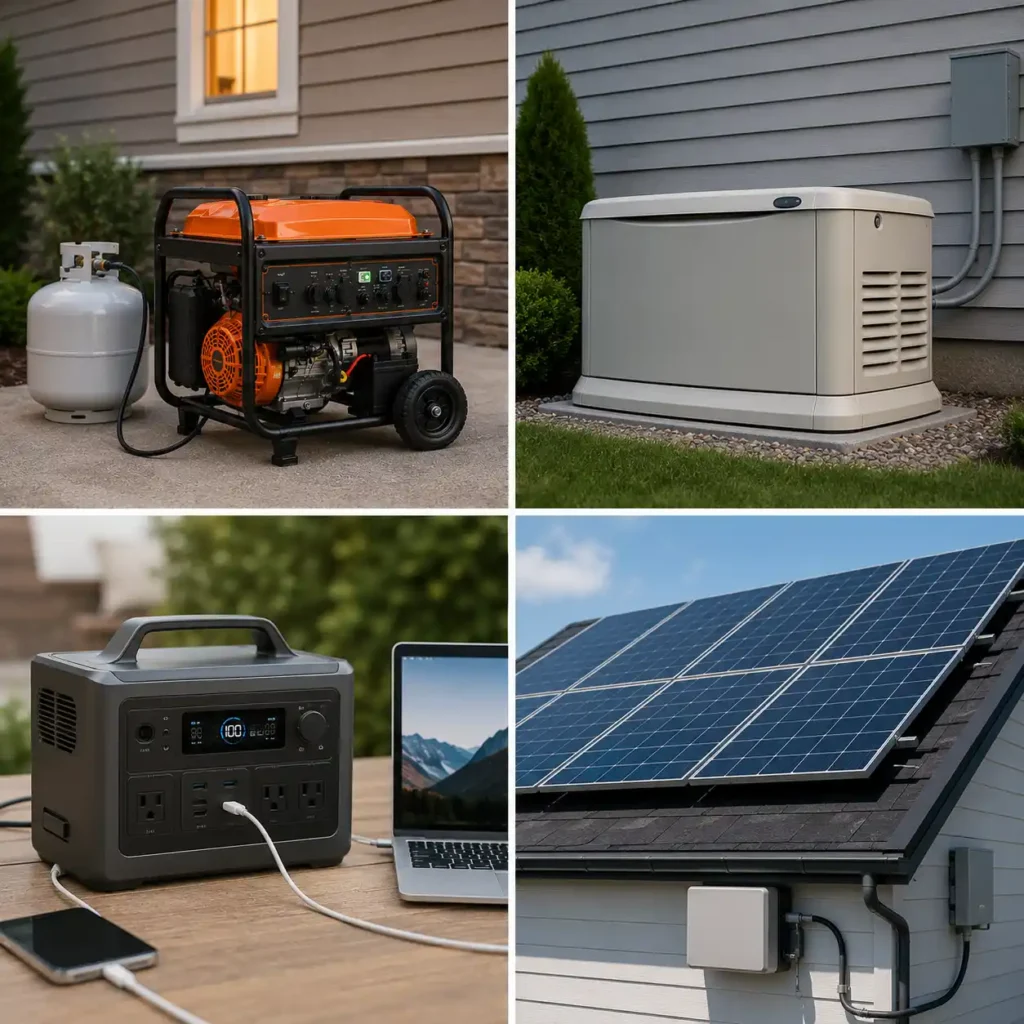
A dual fuel generator is only one way to prepare for power interruptions. Portable power stations, battery backup systems, inverter generators, and permanently installed standby generators can all provide backup electricity, but each technology solves a different problem.
The right choice depends on how much power you need, how long you expect an outage to last, whether fuel storage is acceptable, and how much convenience you want from the system.
Dual Fuel Generator vs. Portable Power Station
Portable power stations store electricity in batteries rather than generating it from fuel.
Their biggest advantage is simplicity. There is no gasoline or propane required during operation, no combustion engine producing exhaust, and no engine noise.
They are particularly convenient for electronics, communications equipment, lighting, camping, and short-duration emergency power.
The limitation is stored energy.
Once the battery is depleted, the power station must be recharged. Solar panels can extend runtime when conditions are favorable, while AC charging can restore the battery when grid power becomes available.
A dual fuel generator takes the opposite approach.
Instead of carrying a fixed amount of stored energy, it can continue generating electricity as long as fuel is available. This makes fuel-powered generators particularly attractive for prolonged outages and higher continuous electrical demand.
The trade-off is that generators require fuel, produce exhaust, create noise, and need regular engine maintenance.
Dual Fuel Generator vs. Inverter Generator
A conventional dual fuel generator and a dual fuel inverter generator can both operate on gasoline and propane, but their design priorities are different.
Conventional generators generally provide higher output and are often preferred for demanding home backup applications.
Inverter generators typically emphasize quieter operation, cleaner electrical output, portability, and fuel efficiency at lighter loads.
If your priority is running several major household loads simultaneously, a high-output conventional generator may be the better choice.
If your priority is camping, RV travel, sensitive electronics, or moderate backup loads, a dual fuel inverter generator may offer a more convenient balance.
Neither design is inherently better.
The right choice depends on whether your primary requirement is maximum capacity or greater operating flexibility and refinement.
Dual Fuel Generator vs. Whole-Home Standby Generator
A permanently installed standby generator provides the highest level of convenience among fuel-powered backup systems.
Once properly installed, it can automatically detect a power outage and start without requiring the homeowner to move and manually connect a portable generator.
Standby systems can also be integrated into a home’s electrical infrastructure and are designed for longer-term stationary use.
Portable dual fuel generators offer a different advantage: flexibility.
They can be stored when not needed, moved between locations, and used for camping, RV travel, home maintenance, or emergency backup.
They also generally require a lower initial commitment than a permanently installed system.
The trade-off is that portable generators require more involvement from the owner.
They need to be positioned correctly outdoors, started manually or remotely depending on the model, connected appropriately, monitored, refueled, and stored safely.
For homeowners who experience occasional outages and want a versatile backup solution, a dual fuel portable generator can be extremely practical.
For those who want automatic whole-home protection with minimal intervention, a permanently installed standby system may be the better fit.
Which Backup Power Option Is Right for You?
The simplest way to compare these technologies is to consider what you value most.
Choose a dual fuel generator if you:
- Need substantial electrical output.
- Want the flexibility of gasoline and propane.
- Expect outages to potentially last for many hours or days.
- Need a portable solution that can serve multiple purposes.
- Are comfortable managing fuel and routine engine maintenance.
Choose a portable power station if you:
- Primarily need silent battery-based backup.
- Power electronics, lights, communication equipment, and smaller appliances.
- Want to avoid gasoline and propane during operation.
- Prefer minimal maintenance.
- Can recharge the battery between extended uses.
Choose a dual fuel inverter generator if you:
- Want cleaner inverter power for electronics.
- Value quieter operation.
- Need portable power for RVs, camping, and moderate home backup.
- Want gasoline and propane flexibility in a smaller package.
Choose a whole-home standby generator if you:
- Want automatic backup during outages.
- Need a permanently installed solution.
- Prefer minimal manual intervention.
- Want a system designed specifically around whole-home backup.
The best backup technology is ultimately the one that matches your expected outage conditions, electrical demand, budget, and willingness to manage the system.
Frequently Asked Questions (FAQ)
Are dual fuel generators worth it?
For many homeowners, yes. The main advantage is fuel flexibility: gasoline typically provides higher output, while propane is easier to store for long periods and gives you another fuel option during an extended outage.
A dual fuel generator can be particularly valuable if you want one portable generator that can serve both short-term emergency needs and longer backup situations. The additional flexibility can be more useful than the small price premium over a comparable gasoline-only model
How long will a dual fuel generator run on propane?
Runtime depends on generator size, electrical load, and propane supply. Many portable dual fuel generators can run roughly 6 to 12 hours on a standard 20-pound propane tank at moderate loads, but the actual figure varies considerably between models and operating conditions.
A larger propane tank can extend runtime substantially. For emergency planning, use the generator’s specified propane consumption rate and your actual expected load rather than relying on a single advertised runtime figure.
How much propane does a dual fuel generator use per hour?
Propane consumption varies significantly with generator size and electrical load. A lightly loaded portable generator may use considerably less fuel per hour than the same generator operating near its rated capacity.
The most reliable way to estimate consumption is to use the manufacturer’s fuel-consumption specification for the particular generator and load condition. Runtime can then be estimated by dividing the usable propane supply by the generator’s hourly consumption rate.
What size propane tank do I need for a dual fuel generator?
A 20-pound propane tank is a common starting point for portable generators, but it is not necessarily the best choice for extended backup.
Larger 40-pound or 100-pound tanks can provide substantially longer operating periods and reduce how often the fuel supply needs to be changed. The appropriate tank size depends on the generator’s propane consumption, expected electrical load, and how long you need the generator to operate.
Always confirm that the tank, regulator, hose, and connection arrangement are compatible with the generator and follow the manufacturer’s instructions.
Does a dual fuel generator produce less power on propane?
Usually, yes. Most portable dual fuel generators produce their highest output on gasoline and somewhat lower peak and running wattage on propane.
The difference varies by model, so generator sizing should be based on the running wattage available on the fuel you expect to use. If you plan to rely primarily on propane during outages, use the propane rating when determining whether the generator can handle your essential loads.
Is propane cheaper than gasoline for running a generator?
Not necessarily. The cost per hour depends on local gasoline and propane prices, the generator’s fuel consumption, and the electrical load.
Propane can become particularly attractive when you already have access to larger propane supplies or use propane as part of your normal household fuel strategy. Gasoline, however, generally provides higher output from the same generator.
For a meaningful comparison, calculate the actual fuel cost per hour at your expected load rather than comparing the price of a gallon of gasoline with the price of a gallon of propane.
Can a dual fuel generator run an air conditioner?
Yes, if the generator has enough running and starting capacity for the specific air-conditioning system.
Air conditioners can have substantial startup requirements, so the generator must be capable of handling both the normal running load and the temporary surge when the compressor starts. A generator that appears large enough based only on running wattage may still struggle with startup demand.
For central air-conditioning systems, check the equipment’s electrical specifications and have the generator sized appropriately before installation.
Can a dual fuel generator power a whole house?
Some high-output portable dual fuel generators can provide enough capacity to support a large selection of household circuits, but whether a particular model can power an entire house depends on the home’s electrical demand and the generator’s continuous output.
A properly installed transfer switch or other approved transfer equipment is also required when integrating a portable generator with household circuits. The generator’s peak wattage should not be used as the sole basis for determining whole-home capability.
Can you switch a dual fuel generator from gasoline to propane while it is running?
It depends on the specific generator.
Some dual fuel models are designed to allow fuel switching without shutting down, while others require the engine to be stopped before changing fuel sources. This is a model-specific feature rather than a universal characteristic of dual fuel generators.
Always follow the manufacturer’s instructions for the particular generator. Never assume that a fuel switch can safely be changed while the engine is operating.
Can a dual fuel generator run continuously for 24 hours?
A portable dual fuel generator can potentially operate for extended periods, but it will normally require refueling and routine shutdown or maintenance intervals according to the manufacturer’s instructions.
Whether it can provide 24 hours of practical backup depends primarily on fuel supply and electrical load. A large external propane supply can provide substantially longer operation than a standard portable gasoline tank or 20-pound propane cylinder.
During a prolonged outage, continuous operation should always follow the generator manufacturer’s maintenance and operating requirements.
What is the biggest disadvantage of a dual fuel generator?
The main trade-offs are higher purchase cost, somewhat greater system complexity, and lower output when operating on propane compared with gasoline.
Dual fuel generators may also be heavier or more complicated than comparable single-fuel models because they require additional fuel-system components. For buyers who always have reliable access to gasoline and have no interest in propane storage, a gasoline-only generator may therefore be simpler.
For emergency preparedness, however, the additional fuel flexibility can outweigh these disadvantages.
Is a dual fuel inverter generator better than a regular dual fuel generator?
It depends on how you plan to use it.
A dual fuel inverter generator is usually the better choice when you prioritize quieter operation, cleaner electrical output, portability, and fuel efficiency at lighter loads. That makes inverter models particularly attractive for RVs, camping, electronics, and moderate home backup.
A conventional dual fuel generator is generally more appropriate when maximum power output is the priority. Larger open-frame models can provide substantially more continuous capacity for demanding household loads.
Is a tri-fuel generator better than a dual fuel generator?
Not automatically. A tri-fuel generator adds natural gas as a third fuel option, while a typical portable dual fuel generator uses gasoline and propane.
Tri-fuel becomes especially attractive if your property already has a suitable natural-gas supply and you want another fuel option during an extended outage. If natural gas is unavailable or impractical, the additional capability may provide little real benefit compared with a well-chosen dual fuel generator.
Final Verdict
Choosing the best dual fuel generator isn’t about finding the model with the largest wattage rating or the longest advertised runtime. It’s about matching generator capacity, fuel flexibility, electrical configuration, and practical usability to the way you expect to use backup power.
Different buyers have very different priorities.
Homeowners facing frequent or prolonged outages may benefit most from a high-output dual fuel generator capable of supporting multiple demanding electrical loads. RV owners and campers may prefer a more compact inverter model that combines gasoline and propane flexibility with quieter operation and cleaner power.
That’s why our five recommendations occupy different positions within the category rather than simply ranking them by wattage.
For buyers seeking the strongest overall balance, the Westinghouse WGen7500DFc remains our Best Overall choice. Its combination of substantial output, dual-fuel capability, 120/240V operation, convenient starting options, and home-backup compatibility makes it a particularly well-rounded solution for demanding emergency use.
If maximum portable capacity is your priority, the DuroMax XP13000EH stands out as our Best High-Power option. Its exceptionally strong running output gives homeowners significantly more headroom when several substantial electrical loads need to operate at the same time.
For buyers looking for a practical balance between high output and overall value, the WEN DF1100X earns our Best Value High-Output award. It provides substantial gasoline and propane capacity together with useful 120/240V connectivity and practical features for home backup.
Those who prioritize inverter technology, quieter operation, and RV-ready versatility should look closely at the WEN DF680iX. Its combination of dual-fuel operation, inverter power, multiple connection options, and moderate output makes it particularly versatile for mobile and essential backup applications.
Finally, the Westinghouse iGen5000DFc EFI is our choice for buyers who want a more compact inverter generator with EFI, dual-fuel capability, and RV-friendly portability. It offers a different approach to backup power, prioritizing manageable size and modern operating features over maximum household capacity.
One of the biggest mistakes buyers can make is choosing a generator before understanding their actual electrical requirements.
Before purchasing, calculate the running wattage of the appliances you expect to operate and identify which devices have significant startup requirements. This gives you a realistic foundation for choosing generator capacity instead of relying on a marketing number printed on the product box.
Fuel planning deserves equal attention.
Gasoline generally provides higher output, while propane offers attractive advantages for long-term storage and emergency preparedness. A dual fuel generator gives you the ability to adapt between the two, but that flexibility becomes most valuable when you have already considered how much fuel you can safely store and how long you may need to operate the generator.
Installation and safety should also be part of the decision from the beginning.
A portable generator is not a substitute for proper electrical installation, and homeowners planning to connect backup power to household circuits should use appropriate transfer equipment and professional installation. Generator placement is equally important: fuel-powered portable generators must remain outdoors and away from openings where exhaust could enter occupied spaces.
The good news is that modern dual fuel generators provide more flexibility than ever.
Whether you need substantial home backup during a prolonged outage, portable electricity for an RV, or a versatile emergency power source that can operate on two different fuels, there is now a wide range of generator designs available for different applications.
Ultimately, the best dual fuel generator is not necessarily the most powerful or the most expensive model. It is the one that provides enough usable running capacity, supports the fuel options you actually need, fits your installation and storage requirements, and can be operated safely and reliably when the power goes out.
Choose according to your real electrical demands rather than the biggest number on the specification sheet, and you’ll be much more likely to have a backup generator that performs exactly as you need it to—when you need it most.
Related Guides
Choosing a dual fuel generator is only one part of building a dependable backup-power strategy. The right generator size, electrical connection, and overall system design all depend on how much power your home or equipment actually requires and how you plan to use backup power.
The product recommendations throughout this guide cover different generator use cases, from high-output home backup to inverter-based RV and portable power. The Related Guide links within each product review provide the most relevant next step for that specific generator and help keep the broader backup-power system organized without duplicating the information covered in this guide.
Before expanding your backup setup, focus on three fundamentals: calculate your electrical demand, choose the appropriate generator type and capacity, and plan the connection method safely.
A well-designed backup system should provide enough power for your real needs without unnecessary equipment, fuel consumption, or complexity.