
Whether you’re preparing for unexpected power outages, building a battery backup system, or simply looking for a reliable way to keep essential household devices running during emergencies, choosing the best power inverter for home backup is one of the most important decisions you’ll make.
The challenge is that the best power inverter isn’t simply the one with the highest wattage or the lowest price. One model may deliver exceptionally clean pure sine wave power for sensitive electronics, another may excel in long-term reliability and efficiency, while a different inverter could offer better value through advanced protection features, easier installation, or greater versatility for off-grid and backup applications.
For this guide, we evaluated today’s leading pure sine wave power inverters based on the factors that matter most for dependable home backup: continuous output power, surge capacity, conversion efficiency, waveform quality, built-in safety protections, build quality, installation flexibility, manufacturer reputation, overall value, and long-term reliability.
Rather than recommending one “perfect” inverter for every situation, we explain the strengths, limitations, and ideal use cases for each model, helping you choose the power inverter that best matches your battery system, backup requirements, budget, and future energy plans.
As an Amazon Associate, we earn from qualifying purchases.
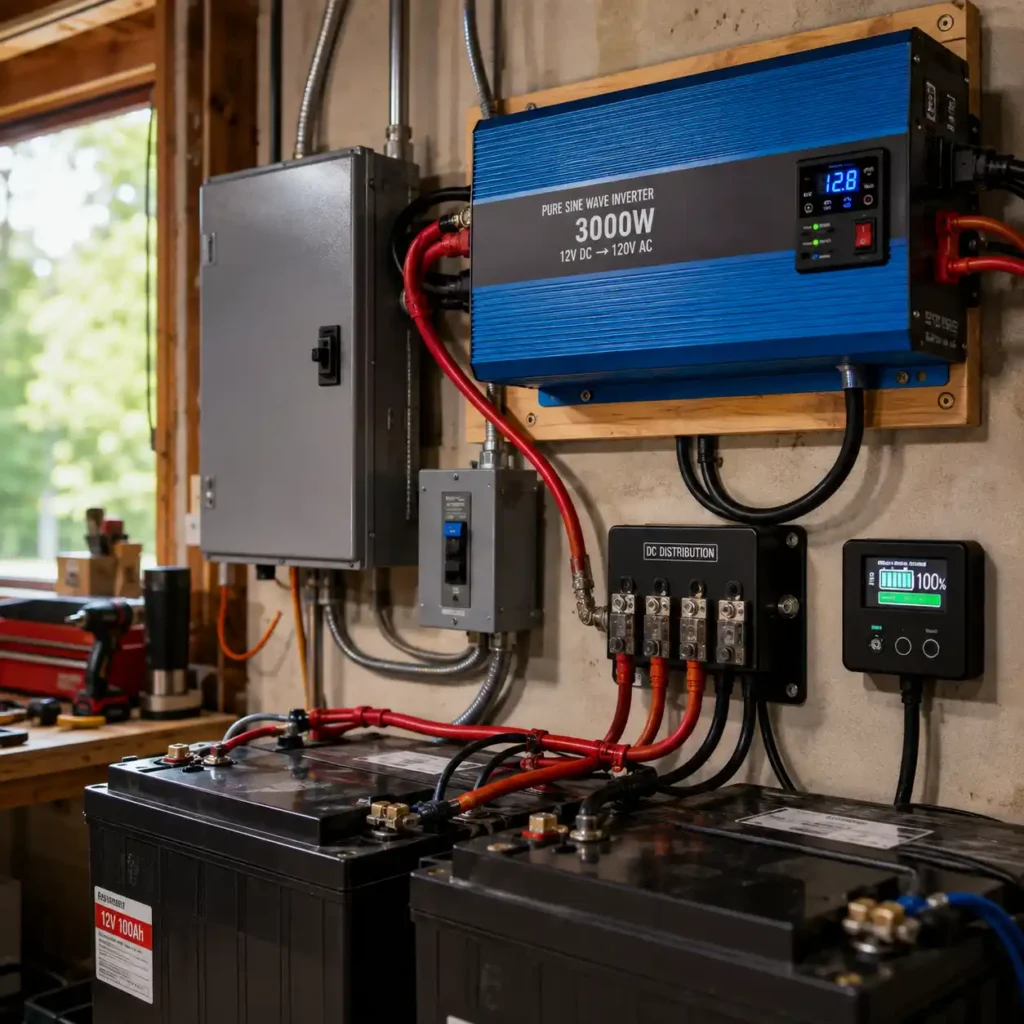
Table of Contents
Quick Answer
Choosing the best power inverter for home backup isn’t simply about buying the most powerful model. The right inverter should provide stable, pure sine wave AC power for your essential household appliances while delivering the reliability, efficiency, and safety features needed for dependable performance during unexpected outages. For many homeowners, long-term durability, build quality, surge capability, and advanced protection systems are just as important as continuous power output.
Unlike inverter chargers or hybrid solar inverters, the products in this guide are dedicated pure sine wave power inverters designed to convert 12V DC battery power into clean 120V AC electricity. They are ideal for home backup battery systems, off-grid cabins, workshops, RVs, and other applications where reliable backup power is essential.
Rather than focusing only on maximum wattage, this guide evaluates each power inverter based on the characteristics that have the greatest impact on real-world performance, including output quality, conversion efficiency, surge capability, cooling performance, built-in safety protections, installation flexibility, manufacturer reputation, and long-term reliability.
After comparing today’s leading models, the Victron Energy 12/3000 Pure Sine Wave Inverter earns our Best Overall recommendation thanks to its outstanding engineering, exceptionally clean power output, high efficiency, advanced monitoring capabilities, and proven reliability across a wide range of home backup applications. Whether you’re building a new battery backup system or upgrading an existing installation, it delivers one of the best combinations of performance, durability, and long-term value available today.
If your priorities are different, there are several excellent alternatives. The Renogy 3000W Pure Sine Wave Inverter offers exceptional value for homeowners seeking dependable everyday backup power, the AIMS 3000W Pure Sine Inverter is an excellent choice for demanding heavy-duty applications, the Samlex NTX-3000-12 stands out for its premium construction and consistently clean AC output, while the Go Power! GP-ISW3000-12 is an outstanding option for homeowners who want a versatile inverter that performs equally well in home backup, RV, marine, and off-grid environments.
Ultimately, the best power inverter for home backup depends on your battery bank, the appliances you want to operate during an outage, your expected runtime, and your future expansion plans. Throughout this guide, we’ll compare each recommended inverter in detail, explain where each model excels, and help you choose the power inverter that best fits your home backup system and long-term energy needs.
Why You Can Trust Power Ready Guide
At Power Ready Guide, we focus exclusively on backup power, portable energy, home battery systems, solar equipment, and emergency preparedness. Every recommendation in this guide is based on extensive product research, official manufacturer specifications, independent testing data, long-term reliability, feature comparisons, and real-world user experiences rather than marketing claims alone.
For this guide, we evaluated every power inverter using the same objective criteria to ensure fair and consistent comparisons. Instead of focusing on a single specification such as continuous wattage, we assessed each inverter as a complete backup power solution designed to deliver clean AC power, dependable performance, and long-term reliability when it matters most.
Our evaluation considered:
- Pure sine wave output quality and compatibility with sensitive electronics.
- Continuous power rating and surge capacity for starting high-demand appliances.
- Conversion efficiency and overall energy performance.
- Cooling system design and thermal management under sustained loads.
- Built-in safety protections, including overload, over-temperature, over-voltage, under-voltage, and short-circuit protection.
- Build quality, internal components, and overall durability.
- Installation flexibility and ease of integration with home backup battery systems.
- Manufacturer reputation, warranty coverage, and long-term reliability.
- Overall value based on performance, features, reliability, and ownership experience.
We don’t recommend the most expensive power inverter—we recommend the one that delivers the best combination of clean power, dependable performance, safety, efficiency, and long-term value for each type of homeowner. Whether you’re preparing for occasional outages or building a permanent battery backup system, our goal is to help you choose a power inverter that will perform reliably whenever you need backup power the most.
How We Evaluated the Best Power Inverters for Home Backup

Every power inverter in this guide was evaluated using the same research framework to ensure fair, consistent, and objective comparisons. Rather than focusing on a single specification such as wattage or peak power, we assessed how each inverter performs as a complete home backup solution, balancing power quality, efficiency, reliability, safety, and long-term ownership value.
The highest power rating doesn’t automatically make an inverter the best choice for every homeowner. In real-world backup applications, factors such as waveform quality, conversion efficiency, surge capability, cooling performance, and overall reliability often have a much greater impact on everyday performance than maximum output alone. Our evaluation reflects the practical considerations homeowners face when choosing a power inverter for a battery backup system.
Each recommendation was assessed using the following criteria:
- Pure sine wave output, ensuring safe operation for sensitive electronics, appliances, and modern household equipment.
- Continuous output power, evaluating how well each inverter supports essential home loads during extended outages.
- Surge capacity, measuring the ability to start refrigerators, freezers, sump pumps, power tools, and other appliances with high startup demands.
- Conversion efficiency, helping maximize available battery capacity and extend runtime during emergencies.
- Safety protections, including overload, over-temperature, over-voltage, under-voltage, low-voltage shutdown, and short-circuit protection.
- Cooling system performance, evaluating thermal management and the inverter’s ability to maintain stable operation under sustained loads.
- Build quality and long-term reliability, based on engineering, internal components, manufacturer reputation, and expected service life.
- Installation flexibility, including terminal design, remote control options, monitoring capabilities, and ease of integration with home backup battery systems.
- Overall value for money, balancing performance, reliability, features, and long-term ownership costs rather than simply recommending the most expensive model.
We also considered different homeowner scenarios because the ideal power inverter depends on how it will be used. Some buyers need dependable emergency backup for a few essential appliances, while others are building a larger battery-based energy system capable of supporting more demanding household loads or future off-grid expansion.
Our objective isn’t to recommend the inverter with the highest specifications on paper. Instead, we identify the models that deliver the best overall ownership experience, helping homeowners invest in reliable backup power equipment that matches both their current needs and their future plans.
Who This Guide Is For
Choosing a power inverter for home backup isn’t simply about selecting the highest wattage or the most feature-rich model. The right inverter depends on your battery system, the appliances you need to power during an outage, how long you expect to run them, and whether you plan to expand your backup power setup in the future.
This guide is designed for homeowners who want to make an informed buying decision based on real-world performance, long-term reliability, and practical backup power requirements rather than marketing specifications alone.
It’s especially helpful for:
- Homeowners building a battery backup system to keep essential appliances, lighting, refrigerators, internet equipment, and home office devices running during power outages.
- Families looking for a reliable pure sine wave inverter that safely powers sensitive electronics and modern household appliances.
- DIY users designing off-grid or emergency backup systems who need a dependable inverter for residential applications.
- Homeowners planning to integrate battery storage with solar charging or expand their backup system over time.
- Buyers comparing leading power inverter brands such as Victron Energy, Renogy, AIMS, Samlex, and Go Power! before making a long-term investment.
Whether your priority is dependable emergency backup, protecting sensitive electronics, maximizing battery efficiency, supporting higher startup loads, or building a flexible backup power system for future expansion, this guide will help you choose the power inverter that best matches your home, your energy requirements, and your long-term backup power goals.
Quick Summary: Our Top Picks
Not every power inverter is designed for the same type of backup power system. Some prioritize premium engineering and maximum reliability, while others focus on delivering excellent value, heavy-duty performance, or greater versatility for off-grid and mobile applications.
The inverters below earned their awards based on our evaluation of power output, surge capability, conversion efficiency, pure sine wave performance, safety features, build quality, ease of installation, long-term reliability, and overall ownership value.
Victron Energy 12/3000 Pure Sine Wave Inverter
Award: Best Overall
Why It Won:
Combines exceptional engineering, ultra-clean pure sine wave output, industry-leading reliability, advanced monitoring capabilities, and outstanding efficiency, making it one of the most dependable power inverters for long-term home backup.
Choose This If:
- You want the best overall power inverter for home backup.
- You value premium build quality and long-term reliability.
- You plan to build or expand a high-quality battery backup system.
Best For:
- Home battery backup
- Sensitive electronics
- Off-grid systems
- Long-term installations
Renogy 3000W 12V Pure Sine Wave Inverter
Award: Best Value
Why It Won:
Delivers an excellent balance of performance, efficiency, safety features, and affordability, making it one of the strongest values for homeowners building a reliable backup power system.
Choose This If:
- You want excellent performance without paying premium prices.
- You’re building your first home backup battery system.
- You need dependable pure sine wave power for everyday emergency use.
Best For:
- Everyday home backup
- DIY battery systems
- Solar installations
- Value-conscious buyers
AIMS 3000W 12V Pure Sine Inverter
Award: Best Heavy-Duty
Why It Won:
Built for demanding applications with excellent surge capability, ETL certification, durable construction, and dependable performance under heavy electrical loads.
Choose This If:
- You need to power appliances with high startup demands.
- You want a rugged inverter for frequent use.
- Long-term durability is a top priority.
Best For:
- Heavy-duty backup power
- Workshops
- High-demand appliances
- Residential emergency power
Samlex NTX-3000-12 Pure Sine Wave Inverter
Award: Best Premium Alternative
Why It Won:
Offers premium engineering, exceptionally clean AC output, excellent efficiency, and reliable long-term performance, making it an outstanding alternative to flagship premium models.
Choose This If:
- You want premium performance from a highly respected manufacturer.
- You prioritize clean, stable power for sensitive equipment.
- You value long-term reliability and build quality.
Best For:
- Premium home backup
- Sensitive electronics
- Professional installations
- Off-grid applications
Go Power! GP-ISW3000-12
Award: Best for RV & Home Backup
Why It Won:
Combines reliable pure sine wave performance with exceptional versatility, making it equally well suited for residential backup systems, RVs, marine applications, and off-grid installations.
Choose This If:
- You want one inverter for multiple applications.
- You own an RV or boat in addition to your home.
- You value installation flexibility and dependable performance.
Best For:
- Home backup
- RV power systems
- Marine applications
- Off-grid living
Still not sure which power inverter is the best fit for your backup power system? The detailed reviews below explain where each model excels, its limitations, and which type of homeowner will benefit most from choosing it.
Best Power Inverters for Home Backup Compared
| Model | Award | Continuous Output | Peak Surge | Best For |
|---|---|---|---|---|
| Victron Energy 12/3000 Pure Sine Wave Inverter | Best Overall | 3000VA | 6000W | Premium home backup systems |
| Renogy 3000W 12V Pure Sine Wave Inverter | Best Value | 3000W | 6000W | Everyday home backup |
| AIMS 3000W 12V Pure Sine Inverter | Best Heavy-Duty | 3000W | 9000W | High-demand household loads |
| Samlex NTX-3000-12 Pure Sine Wave Inverter | Best Premium Alternative | 3000W | 6000W | Premium backup installations |
| Go Power! GP-ISW3000-12 | Best for RV & Home Backup | 3000W | 6000W | Home, RV & Off-Grid Backup |
Note: Victron specifies continuous output in volt-amps (VA), while other manufacturers list continuous output in watts. For most residential backup applications, these ratings are broadly comparable but should always be interpreted according to each manufacturer’s specifications.
Best Power Inverters for Home Backup Reviews
Victron Energy 12/3000 Pure Sine Wave Inverter Review
Best Overall Power Inverter for Home Backup

Quick Verdict
If you’re building a long-term home backup system and want premium performance, the Victron Energy 12/3000 Pure Sine Wave Inverter is the model we’d choose first. It combines exceptional efficiency, intelligent Bluetooth monitoring, and proven long-term reliability in one of the most respected inverter platforms available today.
Rather than simply delivering high output power, the Victron focuses on consistent real-world performance. Its pure sine wave output safely powers sensitive electronics and household appliances, while the advanced cooling design and robust internal components make it well suited for continuous residential backup use, off-grid installations, and battery-based energy systems.
For homeowners who want a premium inverter capable of delivering dependable performance for many years, the Victron Energy 12/3000 Pure Sine Wave Inverter remains one of the strongest choices available today.
Unlike many conventional power inverters that focus primarily on maximum output, the Victron 12/3000 emphasizes overall system performance, efficiency, and long-term dependability. Its intelligent design, high surge capability, and integrated Bluetooth monitoring make it equally suitable for homeowners building a dedicated emergency backup system or expanding an existing battery-based energy setup.
For homeowners seeking the best balance of performance, reliability, monitoring features, and long-term value, the Victron Energy 12/3000 earns our Best Overall Power Inverter for Home Backup award.
Product Snapshot
| Feature | Details |
|---|---|
| Best For | Home Backup • Off-Grid Systems • Sensitive Electronics |
| Continuous Output | 3000VA |
| Input Voltage | 12V DC |
| Output Voltage | 120V AC Pure Sine Wave |
| Monitoring | Bluetooth via VictronConnect App |
| Remote Control | Supported |
| Ideal User | Homeowners seeking a premium pure sine wave inverter with advanced monitoring, exceptional reliability, and long-term performance for residential backup power systems. |
Why We Chose It
The Victron Energy 12/3000 earned our Best Overall Power Inverter for Home Backup award because it offers the most complete combination of engineering quality, power performance, efficiency, and long-term reliability among all the models we evaluated.
What immediately distinguishes the Victron from many competing power inverters is its focus on delivering consistently clean and stable AC power under real-world operating conditions. Its pure sine wave output is suitable for sensitive electronics, modern appliances, communication equipment, and other household devices that require high-quality electrical power during outages.
Performance is equally impressive. With a robust continuous output rating, excellent surge capability, and highly efficient power conversion, the inverter is capable of supporting essential household loads while maximizing available battery capacity. Whether powering refrigerators, lighting circuits, home office equipment, or internet infrastructure, it provides dependable operation during both short interruptions and extended power outages.
Another major advantage is Victron’s mature ecosystem. Built-in Bluetooth connectivity allows homeowners to monitor inverter performance, configure settings, and access diagnostic information directly through the VictronConnect mobile app without requiring additional hardware. This level of visibility simplifies installation, system management, and long-term maintenance.
We also appreciate Victron’s reputation for engineering excellence. The company has spent decades developing professional-grade power conversion equipment used in residential, marine, industrial, and off-grid environments around the world. That experience is reflected in the inverter’s build quality, protective features, and long-term durability.
Although the Victron Energy 12/3000 represents a premium investment, its combination of outstanding reliability, advanced monitoring, excellent efficiency, and proven real-world performance makes it one of the strongest long-term values available for homeowners building a dependable backup power system.
Check the latest price and customer reviews on Amazon.
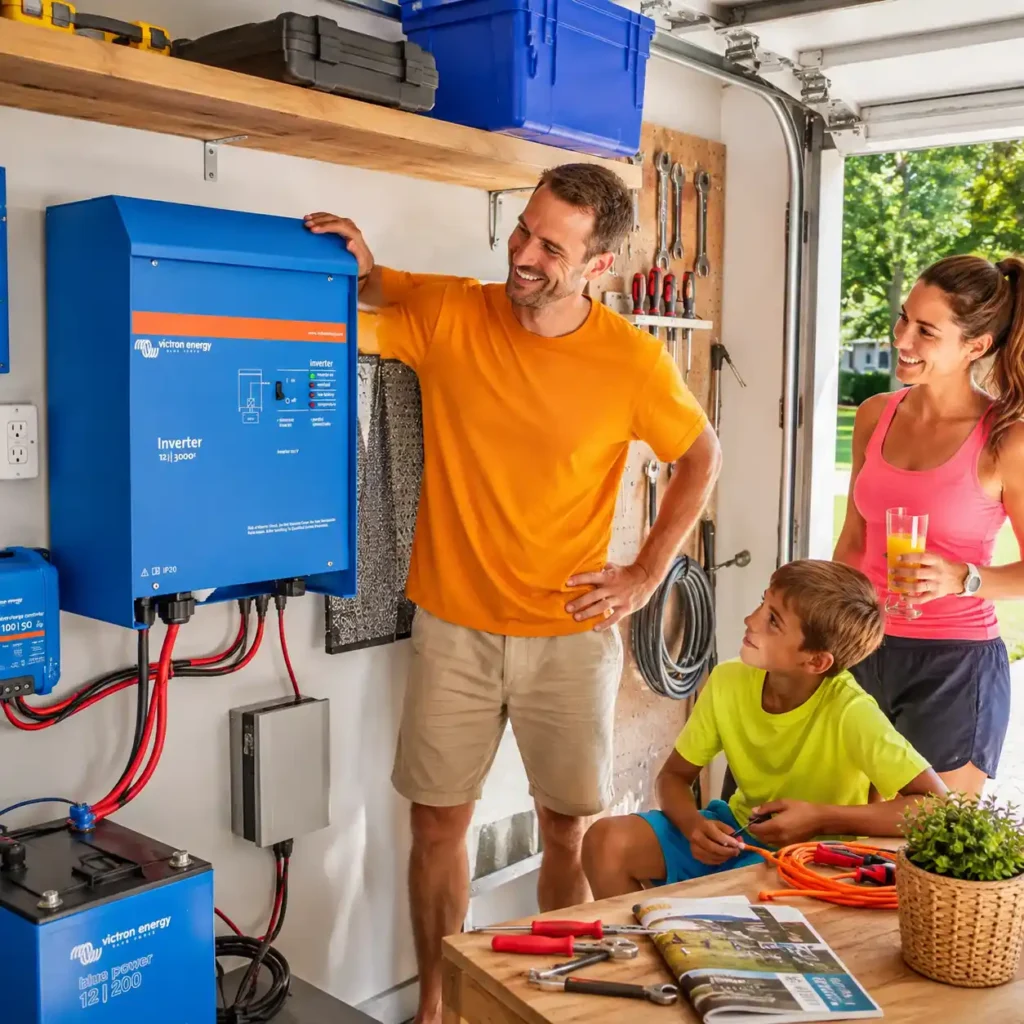
Living With It Every Day
For many homeowners, the greatest advantage of the Victron Energy 12/3000 isn’t simply having backup power during an outage—it’s the confidence that comes from knowing your electrical system is built around equipment designed for long-term reliability. Rather than serving as a basic emergency inverter, it becomes the foundation of a dependable home energy system that performs consistently whenever utility power is unavailable.
Imagine a severe thunderstorm causing an unexpected neighborhood-wide blackout. While nearby homes lose refrigeration, internet access, lighting, and the ability to work from home, your battery backup system automatically supplies clean AC power through the Victron inverter. Refrigerators continue running, networking equipment stays online, lights remain on, and sensitive electronics receive stable pure sine wave power without the risks associated with modified sine wave inverters.
Beyond emergency situations, the Victron 12/3000 fits naturally into everyday off-grid and battery-based energy systems. Homeowners can integrate it with solar charging, expand their battery bank over time, and monitor system performance directly through the VictronConnect app. Instead of checking the inverter manually, operating data, warnings, and configuration settings are available from a smartphone, making day-to-day system management remarkably simple.
What truly sets the Victron apart is its long-term ownership experience. Its premium engineering, excellent efficiency, and proven reliability mean homeowners can invest once and continue building their backup power system as their energy needs evolve. Rather than replacing equipment after a few years, the inverter remains a dependable part of the system for many years of continuous service.
Victron Energy 12/3000 Pure Sine Wave Inverter Evaluation
| Evaluation Category | Editorial Assessment |
|---|---|
| Power Quality | Excellent pure sine wave output that safely powers sensitive electronics and household appliances. |
| Reliability | Outstanding long-term durability backed by Victron's professional-grade engineering. |
| Monitoring Features | Built-in Bluetooth connectivity with VictronConnect for convenient monitoring and configuration. |
| Home Backup Performance | Delivers stable continuous power with excellent surge capability for essential household loads. |
| Overall Value | Premium investment offering exceptional reliability, efficiency, and long-term ownership value. |
| Overall Rating | Our strongest overall recommendation for homeowners seeking a premium power inverter for home backup. |
Who Should Buy This
- Homeowners building a premium home backup battery system.
- Buyers who want exceptionally clean pure sine wave power for sensitive electronics.
- Off-grid users looking for long-term reliability and high-quality engineering.
- Homeowners planning to integrate solar charging and expand their battery system over time.
- Anyone seeking advanced monitoring features together with dependable everyday performance.
Who Should Skip This
- Buyers looking for the lowest possible upfront cost.
- Users who only need occasional backup power for a few small electronic devices.
- Homeowners who require an inverter/charger instead of a standalone power inverter.
- People looking for a lightweight portable power station rather than a permanently installed backup solution.
Final Verdict
The Victron Energy 12/3000 Pure Sine Wave Inverter earns our Best Overall Power Inverter for Home Backup award because it delivers the most complete balance of performance, engineering quality, reliability, and long-term value in this category. Rather than focusing solely on high output power, it combines exceptionally clean pure sine wave electricity, advanced Bluetooth monitoring, premium construction, and dependable operation into a professional-grade backup solution suitable for demanding residential applications.
Its ability to integrate seamlessly into battery-based home backup systems, support sensitive electronics, and provide years of reliable service makes it an excellent investment for homeowners planning beyond occasional outages. Whether you’re building your first emergency backup system or expanding an existing off-grid installation, the Victron 12/3000 offers the confidence and performance expected from one of the industry’s most respected manufacturers.
For homeowners seeking a premium inverter that prioritizes reliability, efficiency, and long-term ownership rather than simply maximum wattage, the Victron Energy 12/3000 stands out as one of the best choices available today.
Check the latest price and customer reviews on Amazon.
Related Guide: If you’re building a complete residential backup system around an inverter and battery storage, our Best Home Battery Backup Systems (2026) guide can help you compare larger battery-based solutions for reliable home energy storage and outage protection.
Renogy 3000W 12V Pure Sine Wave Inverter Review
Best Value Power Inverter for Home Backup

Quick Verdict
For homeowners who want dependable backup power without paying premium prices, the Renogy 3000W 12V Pure Sine Wave Inverter strikes one of the best balances between performance, features, and affordability in this guide. It delivers clean pure sine wave power, solid surge capability, and the everyday reliability needed to keep essential household appliances operating during unexpected outages.
Instead of competing with premium models through advanced connectivity or commercial-grade engineering, Renogy focuses on practical features that matter most to homeowners. Its stable continuous output, straightforward installation, comprehensive protection systems, LCD display, and wired remote control make it especially appealing for first-time battery backup installations as well as existing off-grid systems.
What makes this inverter stand out is its overall value rather than any single specification. It provides the performance most homeowners need, includes the safety features they expect, and does so at a price that remains accessible without compromising reliability.
For buyers looking for a well-rounded pure sine wave inverter that delivers excellent everyday performance at a competitive price, the Renogy 3000W 12V Pure Sine Wave Inverter remains one of the strongest value-focused choices available today.
Product Snapshot
| Feature | Details |
|---|---|
| Best For | Home Backup • Solar Systems • Everyday Emergency Power |
| Continuous Output | 3000W |
| Input Voltage | 12V DC |
| Output Voltage | 120V AC Pure Sine Wave |
| Display | Integrated LCD Display |
| Remote Control | Included Wired Remote |
| Ideal User | Homeowners looking for an affordable pure sine wave inverter with dependable performance, comprehensive safety features, and excellent value for residential backup power systems. |
Why We Chose It
The Renogy 3000W 12V Pure Sine Wave Inverter earned our Best Value Power Inverter for Home Backup award because it successfully combines dependable performance, practical features, and competitive pricing without compromising the qualities that matter most in a residential backup power system.
One of Renogy’s greatest strengths is its ability to deliver clean, stable pure sine wave electricity that safely powers both everyday household appliances and sensitive electronics. Whether supporting refrigerators, freezers, lighting, communication equipment, televisions, or home office devices during an outage, the inverter provides reliable AC power that homeowners can trust.
Performance is equally well balanced. Its 3000-watt continuous output and strong surge capability allow it to handle many of the electrical demands commonly encountered during residential power outages. Combined with high conversion efficiency and an intelligent cooling system, the inverter is well suited for extended backup operation while making efficient use of stored battery energy.
Another reason the Renogy stands out is its focus on user-friendly operation. The integrated LCD display provides clear operating information at a glance, while the included wired remote control allows convenient operation when the inverter is installed in utility rooms, garages, or dedicated battery enclosures. These practical features simplify everyday use without adding unnecessary complexity.
We also appreciate Renogy’s comprehensive safety protections, including overload, over-temperature, over-voltage, under-voltage, and short-circuit protection. Together, these systems help protect both the inverter and connected equipment, providing additional peace of mind during emergency operation.
Although premium models may offer more advanced monitoring capabilities or commercial-grade engineering, the Renogy 3000W Pure Sine Wave Inverter delivers exceptional overall value. Its combination of dependable performance, ease of use, strong safety features, and affordable pricing makes it one of the smartest choices for homeowners seeking reliable backup power without exceeding their budget.
Check the latest price and customer reviews on Amazon.
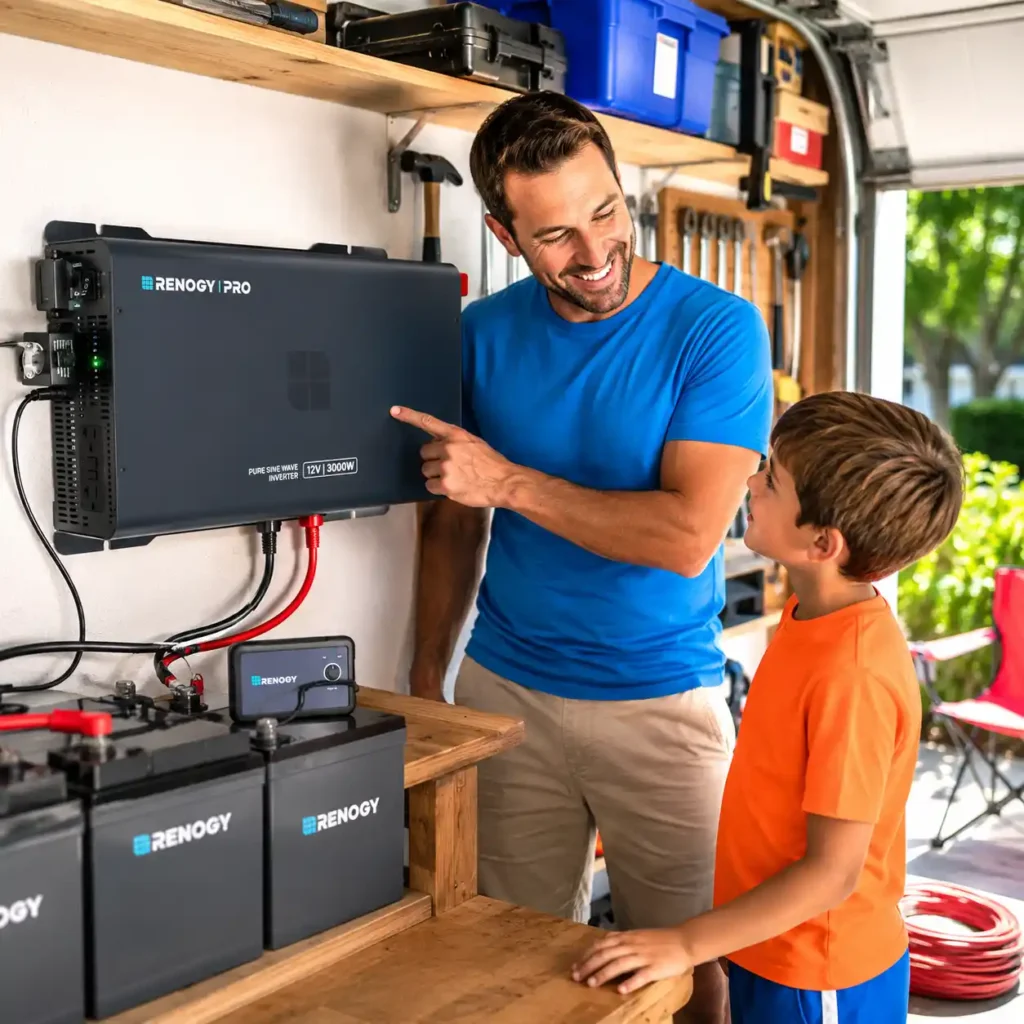
Living With It Every Day
For many homeowners, the biggest advantage of the Renogy 3000W 12V Pure Sine Wave Inverter is how naturally it fits into everyday backup power planning. It isn’t designed only for rare emergencies—it becomes a dependable part of a residential battery system that provides clean, stable AC power whenever the electrical grid becomes unavailable.
Imagine a summer thunderstorm knocking out power across your neighborhood. While nearby homes lose refrigeration, lighting, internet access, and the ability to charge essential devices, your backup battery system continues supplying electricity through the Renogy inverter. Refrigerators stay cold, Wi-Fi remains online, lights continue working, and laptops, televisions, and communication devices operate normally without interruption.
Beyond emergency situations, the inverter works equally well in solar-powered and off-grid battery systems. Homeowners can pair it with solar charging equipment, monitor operating conditions using the integrated LCD display, and conveniently control the inverter using the included wired remote. Whether installed in a garage, utility room, workshop, or dedicated battery enclosure, the system remains simple to operate while providing reliable performance throughout the year.
What makes the Renogy especially attractive for long-term ownership is its balance between capability and affordability. Rather than paying for advanced features that many homeowners may never use, buyers receive dependable pure sine wave performance, comprehensive safety protections, and solid everyday reliability at a price that represents excellent overall value.
Renogy 3000W 12V Pure Sine Wave Inverter Evaluation
| Evaluation Category | Editorial Assessment |
|---|---|
| Power Quality | Clean pure sine wave output suitable for household appliances and sensitive electronics. |
| Ease of Use | Simple operation with an integrated LCD display and included wired remote control. |
| Safety Features | Comprehensive protection against overload, overheating, over-voltage, under-voltage, and short circuits. |
| Home Backup Performance | Reliable continuous power with strong surge capability for essential household appliances. |
| Overall Value | One of the best price-to-performance ratios among pure sine wave inverters for residential backup. |
| Overall Rating | Our top value recommendation for homeowners seeking dependable backup power without a premium price. |
Who Should Buy This
- Homeowners building their first home backup battery system.
- Buyers looking for the best balance of price and performance.
- Solar system owners needing a dependable pure sine wave inverter.
- Families wanting reliable emergency power for essential household appliances.
- Anyone seeking strong safety features and straightforward installation at an affordable price.
Who Should Skip This
- Buyers who want premium Bluetooth monitoring and advanced system configuration.
- Users requiring commercial-grade or marine-specific power equipment.
- Homeowners looking for an inverter/charger instead of a standalone inverter.
- People needing significantly more than 3000 watts of continuous output.
Final Verdict
The Renogy 3000W 12V Pure Sine Wave Inverter earns our Best Value Power Inverter for Home Backup award because it successfully delivers the features that matter most to homeowners without carrying the premium price of higher-end models. It combines clean pure sine wave output, dependable performance, comprehensive safety protections, and user-friendly operation into a package that represents excellent overall value.
Its ability to power essential household appliances, support solar and battery backup systems, and provide reliable operation during power outages makes it an excellent choice for both first-time buyers and experienced homeowners upgrading an existing backup system. While it may not include every advanced feature found in premium models, it excels where it counts—delivering safe, stable, and dependable AC power when your home needs it most.
For homeowners seeking an affordable yet capable inverter that balances performance, reliability, and long-term value, the Renogy 3000W 12V Pure Sine Wave Inverter remains one of the smartest investments available in today’s home backup market.
Check the latest price and customer reviews on Amazon.
Related Guide: If you’re looking for a more portable way to provide emergency electricity without building a dedicated inverter and battery system, our Best Portable Power Stations for Home Backup (2026) guide compares ready-to-use battery power solutions for essential household loads.
AIMS 3000W 12V Pure Sine Inverter Review
Best Heavy-Duty Power Inverter for Home Backup

Quick Verdict
Some homeowners need an inverter that can handle demanding electrical loads day after day—not just occasional emergency use. That’s exactly where the AIMS 3000W 12V Pure Sine Inverter stands out. Built with rugged internal components, ETL certification, and impressive surge capability, it is designed for backup systems that regularly power refrigerators, freezers, pumps, power tools, and other appliances with high startup requirements.
Rather than targeting light-duty residential use, the AIMS 3000W is engineered for heavier workloads. Its durable construction, effective cooling system, and comprehensive protection features make it well suited for home backup systems, off-grid installations, workshops, RVs, and other applications where long-term reliability matters.
Strong surge performance is one of its biggest advantages. The inverter is capable of starting many motor-driven appliances that often challenge lower-capacity models while continuing to deliver stable pure sine wave power for sensitive electronics and essential household equipment.
For homeowners looking for a durable inverter that prioritizes reliability, heavy-load capability, and dependable long-term performance, the AIMS 3000W 12V Pure Sine Inverter remains one of the strongest heavy-duty choices available today.
Product Snapshot
| Feature | Details |
|---|---|
| Best For | Home Backup • High-Demand Appliances • Off-Grid Systems |
| Continuous Output | 3000W |
| Input Voltage | 12V DC |
| Output Voltage | 120V AC Pure Sine Wave |
| Certification | ETL Listed |
| Remote Control | Supported |
| Ideal User | Homeowners seeking a rugged pure sine wave inverter with excellent surge capability and dependable performance for demanding residential backup power applications. |
Why We Chose It
The AIMS 3000W 12V Pure Sine Inverter earned our Best Heavy-Duty Power Inverter for Home Backup award because it consistently delivers the durability, surge performance, and operational reliability required for more demanding backup power applications.
One of its biggest strengths is its ability to support appliances with high startup currents. Equipment such as refrigerators, freezers, sump pumps, compressors, and certain power tools often require significantly more power during startup than during normal operation. The AIMS inverter is designed with this in mind, providing the surge capability needed to start these loads reliably while maintaining stable pure sine wave output.
Performance is backed by durable construction and ETL certification, giving homeowners additional confidence in the inverter’s safety and electrical compliance. Its robust design is intended for long-term use in residential backup systems, off-grid installations, workshops, RVs, and other environments where dependable operation is essential.
We also appreciate AIMS’ emphasis on protection and reliability. The inverter incorporates multiple built-in safety systems, including overload, over-temperature, low-voltage, high-voltage, and short-circuit protection, helping safeguard both the inverter and connected equipment during demanding operating conditions.
Although there are lighter-duty inverters available at lower prices, the AIMS 3000W Pure Sine Inverter stands out for homeowners who prioritize rugged construction, dependable heavy-load performance, and long-term durability. Its combination of strong surge capability, proven reliability, and professional-grade engineering makes it one of the best choices for demanding home backup systems.
Check the latest price and customer reviews on Amazon.
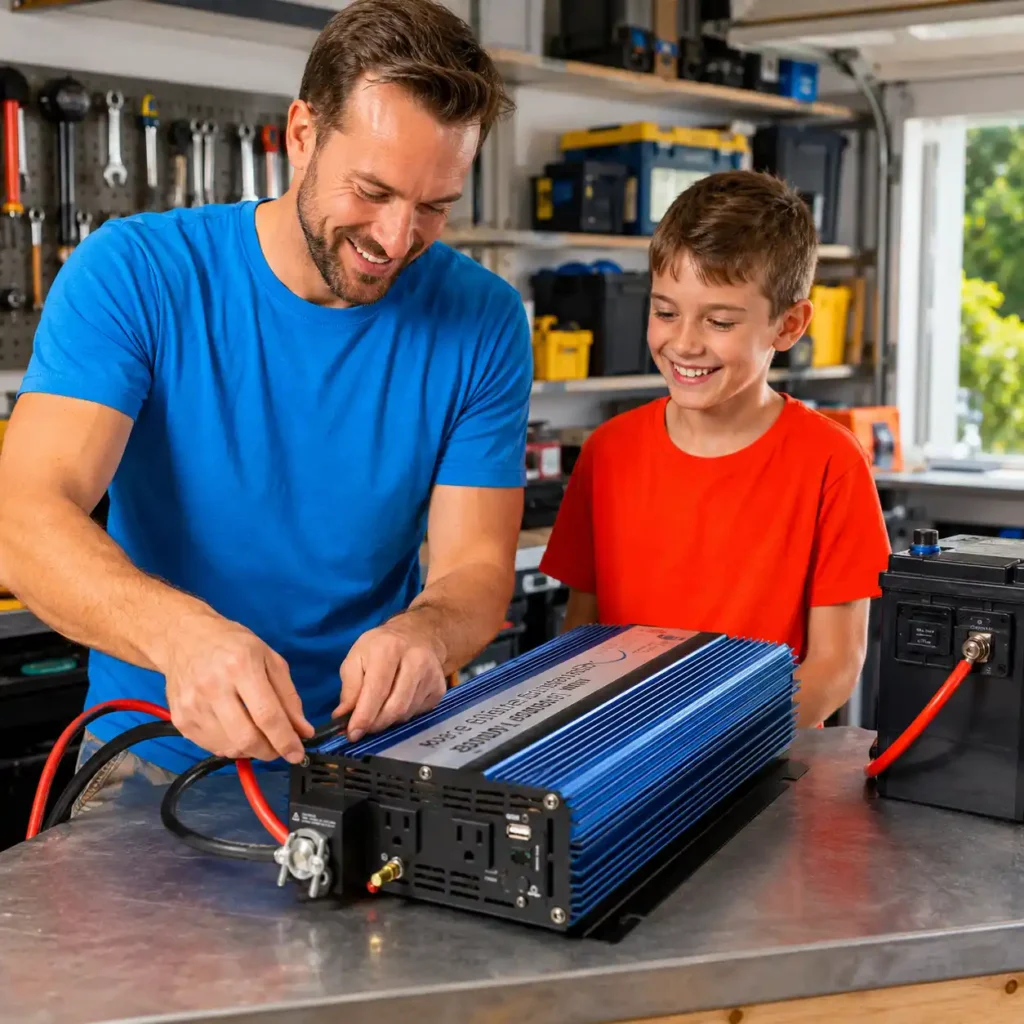
Living With It Every Day
For homeowners who rely on backup power during storms, utility outages, or off-grid living, the AIMS 3000W 12V Pure Sine Inverter offers one of its greatest advantages where it matters most—handling demanding electrical loads with confidence. Rather than worrying whether appliances with high startup currents will overload the inverter, homeowners can depend on its strong surge capability to keep essential equipment operating when the grid goes down.
Imagine a winter power outage lasting several hours. Your refrigerator and freezer continue preserving food, the sump pump activates automatically when needed, lights remain on, and your internet equipment keeps working so you can stay informed and connected. Instead of constantly managing which appliance can be turned on next, the AIMS inverter is designed to support the heavier loads that many residential backup systems must handle.
Beyond emergency use, the inverter integrates well into permanent battery-based energy systems. Whether paired with solar charging equipment or a dedicated battery bank, it provides reliable pure sine wave electricity for workshops, cabins, RVs, and off-grid properties. Its durable construction and straightforward operation make it equally suitable for homeowners who use their backup system regularly rather than only during occasional outages.
What truly distinguishes the AIMS 3000W is its emphasis on long-term durability. Built for demanding environments and repeated operation, it gives homeowners confidence that their backup system will continue performing reliably year after year without sacrificing power quality or safety.
AIMS 3000W 12V Pure Sine Inverter Evaluation
| Evaluation Category | Editorial Assessment |
|---|---|
| Power Quality | Reliable pure sine wave output suitable for household appliances and sensitive electronics. |
| Heavy-Duty Performance | Excellent surge capability for appliances with demanding startup requirements. |
| Build Quality | Durable construction with ETL certification for dependable long-term operation. |
| Home Backup Performance | Handles essential household loads reliably during extended power outages. |
| Overall Value | Outstanding choice for homeowners prioritizing durability and heavy-load capability. |
| Overall Rating | Our top recommendation for demanding home backup applications requiring strong surge performance. |
Who Should Buy This
- Homeowners with refrigerators, freezers, sump pumps, or other appliances that require high startup power.
- Buyers seeking a rugged inverter for long-term residential backup use.
- Off-grid homeowners who depend on reliable daily inverter performance.
- Workshop owners needing dependable pure sine wave power for demanding equipment.
- Anyone prioritizing durability, strong surge capability, and dependable operation over advanced smart features.
Who Should Skip This
- Buyers looking for the lowest-cost inverter available.
- Homeowners who want Bluetooth monitoring or app-based system management.
- Users needing an inverter/charger rather than a standalone inverter.
- People who only require backup power for a few low-power electronic devices.
Final Verdict
The AIMS 3000W 12V Pure Sine Inverter earns our Best Heavy-Duty Power Inverter for Home Backup award because it is engineered to perform reliably under demanding real-world conditions. Its combination of robust construction, excellent surge capability, clean pure sine wave output, and comprehensive protection systems makes it an outstanding solution for homeowners who expect more from their backup power equipment than occasional emergency use.
Whether supporting essential household appliances during prolonged outages, powering an off-grid property, or serving as part of a dedicated battery backup system, the AIMS inverter consistently delivers the stability and durability needed for dependable long-term operation. While some competing models focus on smart features or premium connectivity, AIMS concentrates on providing rugged performance where it matters most.
If your backup system regularly powers appliances with demanding startup requirements, the AIMS 3000W delivers the rugged performance and durability needed for reliable long-term operation.
Check the latest price and customer reviews on Amazon.
Related Guide: If you need backup equipment capable of supporting demanding appliances during an outage, our Best Portable Generators (2026) guide compares higher-output generator options for refrigerators, pumps, appliances, and other essential household loads.
Samlex NTX-3000-12 Pure Sine Wave Inverter Review
Best Premium Alternative Power Inverter for Home Backup

Quick Verdict
For homeowners who place engineering quality above everything else, the Samlex NTX-3000-12 Pure Sine Wave Inverter is an outstanding choice. Designed for continuous operation, it combines highly efficient power conversion, exceptionally clean pure sine wave output, and professional-grade construction in a compact package built for long-term residential backup use.
Rather than chasing the highest output ratings or adding unnecessary smart features, the NTX-3000-12 focuses on dependable everyday performance. Its advanced cooling system, premium internal components, and low idle power consumption make it especially well suited for battery-based home backup systems, off-grid installations, and mobile power applications where efficiency and reliability are equally important.
Samlex has earned a strong reputation across the renewable energy, marine, industrial, and commercial power sectors, and that experience is reflected in the inverter’s stable electrical performance and durable construction. It’s engineered not only to handle unexpected outages but also to deliver consistent performance through years of regular use.
For homeowners seeking premium engineering, excellent efficiency, and dependable long-term reliability, the Samlex NTX-3000-12 Pure Sine Wave Inverter remains one of the strongest premium alternatives in this guide.
Product Snapshot
| Feature | Details |
|---|---|
| Best For | Home Backup • Off-Grid Systems • Sensitive Electronics |
| Continuous Output | 3000W |
| Input Voltage | 12V DC |
| Output Voltage | 120V AC Pure Sine Wave |
| Efficiency | High-Efficiency Power Conversion |
| Remote Control | Optional Remote Available |
| Ideal User | Homeowners seeking a premium pure sine wave inverter with professional-grade engineering, high efficiency, and dependable long-term performance. |
Why We Chose It
The Samlex NTX-3000-12 Pure Sine Wave Inverter earned our Best Premium Alternative Power Inverter for Home Backup award because it combines premium engineering, excellent efficiency, and long-term operational reliability in a package designed for demanding backup power applications.
One of its biggest strengths is the exceptionally clean pure sine wave output it delivers. This allows homeowners to operate sensitive electronics, communication equipment, modern appliances, and home office devices with confidence during power outages, reducing the risk of compatibility issues often associated with lower-quality inverters.
Performance is equally impressive. The inverter provides stable continuous power, efficient energy conversion, and low standby consumption, helping maximize available battery capacity during extended outages. Its intelligent thermal management system supports reliable operation under sustained electrical loads while contributing to the unit’s long service life.
We also appreciate Samlex’s reputation for manufacturing professional-grade power conversion equipment. The company’s products are widely used in residential, marine, commercial, and renewable energy installations where reliability is essential. That experience is evident in the inverter’s solid construction, dependable electrical performance, and overall engineering quality.
Although the Samlex NTX-3000-12 represents a premium investment, it rewards homeowners with exceptional efficiency, durable construction, and dependable long-term operation. For buyers who value engineering quality as much as output power, it stands among the finest pure sine wave inverters available for residential backup systems.
Check the latest price and customer reviews on Amazon.
Living With It Every Day
The Samlex NTX-3000-12 Pure Sine Wave Inverter is the kind of equipment homeowners tend to appreciate more over time. Rather than drawing attention to itself with flashy features or constant notifications, it focuses on doing one job exceptionally well—delivering clean, dependable AC power whenever your backup system needs it.
Imagine a neighborhood power outage that stretches through the evening. Your refrigerator continues cycling normally, your internet equipment keeps you connected, lights remain on, and sensitive electronics operate just as they would with utility power. Instead of worrying about unstable voltage or unexpected shutdowns, the inverter quietly maintains steady performance while your battery bank supplies the energy your household depends on.
This predictable operation becomes even more valuable for homeowners who use their backup system regularly instead of only during emergencies. Whether installed in a dedicated home battery backup system, an off-grid cabin, or a solar-supported energy setup, the NTX-3000-12 is designed for continuous, dependable operation with minimal day-to-day attention. Its efficient power conversion also helps maximize the usable energy stored in your batteries, allowing your backup system to make the most of every charging cycle.
Another advantage is the confidence that comes from professional-grade engineering. When investing in a long-term backup power system, reliability often matters more than extra convenience features. Rather than adding unnecessary complexity, Samlex emphasizes proven electrical performance, durable construction, and stable operation under a wide range of residential and off-grid conditions.
For homeowners who view a backup power system as a long-term investment rather than an occasional emergency tool, the Samlex NTX-3000-12 delivers the kind of consistent, worry-free performance that becomes more valuable every time the power goes out.
Samlex NTX-3000-12 Pure Sine Wave Inverter Evaluation
| Evaluation Category | Editorial Assessment |
|---|---|
| Power Quality | Excellent pure sine wave output for sensitive electronics and essential household appliances. |
| Efficiency | Highly efficient power conversion with low standby consumption for extended battery runtime. |
| Build Quality | Professional-grade engineering designed for dependable long-term residential and off-grid use. |
| Home Backup Performance | Reliable continuous operation with stable AC power for essential household circuits. |
| Overall Value | Outstanding premium alternative for homeowners seeking exceptional efficiency and reliability. |
| Overall Rating | Our top premium alternative recommendation for dependable home backup power. |
Who Should Buy This
- Homeowners looking for premium engineering and long-term reliability.
- Buyers powering sensitive electronics with clean pure sine wave output.
- Off-grid and solar users who value high efficiency and dependable operation.
- Homeowners building a permanent residential battery backup system.
- Anyone seeking a professional-grade inverter designed for years of continuous service.
Who Should Skip This
- Buyers focused primarily on the lowest upfront purchase price.
- Users who only need occasional backup power for a few small electronic devices.
- Homeowners requiring an inverter/charger instead of a standalone inverter.
- Buyers who prioritize advanced wireless monitoring over premium engineering.
Final Verdict
The Samlex NTX-3000-12 Pure Sine Wave Inverter earns our Best Premium Alternative Power Inverter for Home Backup award by delivering the qualities that matter most in a long-term residential backup system: exceptional engineering, highly efficient power conversion, clean pure sine wave output, and dependable reliability. Rather than competing through additional features alone, Samlex focuses on building a professionally engineered inverter capable of providing stable performance year after year.
Its combination of excellent efficiency, durable construction, and consistent power quality makes it particularly well suited for homeowners who expect their backup system to protect sensitive electronics while remaining dependable during extended outages. Whether integrated into an off-grid installation or a dedicated home battery backup system, the NTX-3000-12 provides the confidence that comes from investing in premium power conversion equipment.
Homeowners who value engineering quality, long-term efficiency, and dependable operation over unnecessary extras will find the Samlex NTX-3000-12 to be an investment that continues paying off for years.
Check the latest price and customer reviews on Amazon.
Related Guide: If you plan to recharge your battery bank using renewable energy, our Best Solar Charge Controllers (2026) guide explains how charge controllers manage solar energy and help build a more reliable battery-based backup system.
Go Power! GP-ISW3000-12 Review
Best Power Inverter for RV & Home Backup

Quick Verdict
Not every homeowner needs an inverter designed for a single purpose. The Go Power! GP-ISW3000-12 is built for people who want one dependable power solution that works just as well at home as it does in an RV, off-grid cabin, or mobile installation. Its combination of clean pure sine wave output, rugged construction, and installation flexibility makes it one of the most versatile models in this guide.
Rather than limiting itself to either residential backup or recreational use, the GP-ISW3000-12 performs confidently in both environments. Its hardwire-ready design, efficient power conversion, and robust surge capability allow it to integrate into permanent battery backup systems while remaining equally capable of supporting demanding mobile power applications.
Another practical advantage is its intelligent Power Save Mode, which helps reduce battery consumption during periods of low electrical demand. Combined with comprehensive protection systems and durable construction, it delivers dependable performance whether installed in a residential utility room, an RV electrical compartment, or a remote off-grid cabin.
For homeowners looking for a versatile pure sine wave inverter that adapts to changing power needs without compromising reliability, the Go Power! GP-ISW3000-12 remains one of the most well-rounded choices available today.
Product Snapshot
| Feature | Details |
|---|---|
| Best For | Home Backup • RV • Off-Grid • Marine Applications |
| Continuous Output | 3000W |
| Input Voltage | 12V DC |
| Output Voltage | 110V AC Pure Sine Wave |
| Power Saving Mode | Supported |
| Installation | Hardwire Connection |
| Ideal User | Homeowners and RV owners seeking a versatile pure sine wave inverter for residential backup, mobile power, and off-grid energy systems. |
Why We Chose It
The Go Power! GP-ISW3000-12 earned our Best Power Inverter for RV & Home Backup award because it offers one of the best combinations of residential backup capability and mobile power versatility among the models we evaluated.
One of its greatest advantages is its flexibility. While many inverters are designed primarily for either stationary home installations or recreational vehicles, the GP-ISW3000-12 performs confidently in both environments. Homeowners can integrate it into permanent battery backup systems, while RV owners and off-grid users benefit from the same dependable pure sine wave performance during travel or remote living.
Performance is equally impressive. With a continuous 3000-watt output and strong surge capability, the inverter easily supports many of the appliances homeowners rely on during power outages, including refrigerators, lighting, networking equipment, televisions, and other essential electrical loads. Its pure sine wave output also protects sensitive electronics by delivering clean, stable AC power comparable to utility electricity.
We also appreciate the inverter’s practical design. The hardwire connection simplifies permanent installations, while the integrated Power Save Mode helps reduce unnecessary battery consumption during periods of low electrical demand. Combined with comprehensive protection against overload, overheating, low voltage, high voltage, and short circuits, the system is built for dependable long-term operation.
Although some premium residential inverters offer additional monitoring features, the Go Power! GP-ISW3000-12 stands out for homeowners who value installation flexibility, dependable performance, and the ability to use the same inverter across home, RV, and off-grid applications. Its combination of versatility, durability, and reliable pure sine wave output makes it an excellent choice for buyers who need one inverter capable of serving multiple roles.
Check the latest price and customer reviews on Amazon.

Living With It Every Day
One of the biggest advantages of the Go Power! GP-ISW3000-12 is its ability to adapt to different lifestyles without requiring separate power equipment. Whether you’re protecting your home during unexpected outages, spending weekends in an RV, or maintaining an off-grid cabin, the same inverter delivers reliable pure sine wave electricity wherever dependable AC power is needed.
Imagine a powerful storm interrupting utility service for several hours. Your battery backup system automatically powers the inverter, keeping refrigerators, lighting, internet equipment, televisions, and other essential household devices operating normally. When the outage ends, the system simply returns to standby, ready for the next emergency without requiring fuel, frequent maintenance, or complicated operation.
Outside the home, the GP-ISW3000-12 continues to prove its versatility. RV owners can operate kitchen appliances, entertainment systems, and personal electronics while traveling, while off-grid property owners benefit from the same dependable AC power in remote locations. Its hardwire-ready design supports permanent installations, and the integrated Power Save Mode helps maximize available battery capacity by reducing unnecessary energy consumption when electrical demand is low.
What truly separates the Go Power! inverter from many competing models is its flexibility. Instead of serving only one purpose, it becomes a dependable power solution that moves effortlessly between residential backup, recreational travel, and off-grid living, providing homeowners with greater long-term value from a single investment.
Go Power! GP-ISW3000-12 Evaluation
| Evaluation Category | Editorial Assessment |
|---|---|
| Power Quality | Reliable pure sine wave output for household appliances and sensitive electronic equipment. |
| Versatility | Excellent for residential backup, RV travel, off-grid cabins, and marine applications. |
| Installation | Hardwire-ready design supports secure permanent installations. |
| Home Backup Performance | Dependable continuous power with strong surge capability for essential household loads. |
| Overall Value | Outstanding versatility for buyers needing one inverter across multiple applications. |
| Overall Rating | Our top recommendation for homeowners who want one inverter for both home backup and mobile power. |
Who Should Buy This
- Homeowners who want one inverter for both residential backup and RV use.
- RV owners looking for dependable pure sine wave power while traveling.
- Off-grid property owners needing reliable AC power for everyday use.
- Buyers planning a permanent hardwired battery backup installation.
- Anyone seeking a versatile inverter that performs equally well at home and on the road.
Who Should Skip This
- Buyers focused exclusively on stationary whole-home backup systems.
- Users looking for advanced Bluetooth monitoring and smartphone app control.
- Homeowners requiring an inverter/charger instead of a standalone inverter.
- Buyers with only minimal backup power requirements for small electronic devices.
Final Verdict
The Go Power! GP-ISW3000-12 earns our Best Power Inverter for RV & Home Backup award because it successfully combines dependable residential backup performance with the flexibility required for RV, off-grid, and mobile energy applications. Its clean pure sine wave output, robust construction, hardwire-ready installation, and intelligent Power Save Mode make it a highly practical solution for homeowners who value versatility as much as reliability.
Rather than limiting buyers to a single application, the GP-ISW3000-12 adapts easily to changing energy needs. Whether protecting essential household appliances during an outage, powering an RV while traveling, or supplying electricity to an off-grid cabin, it delivers consistent performance backed by comprehensive safety protections and efficient operation.
Its ability to transition seamlessly between residential backup, RV travel, and off-grid living makes it an excellent choice for buyers who want one inverter capable of serving multiple roles.
Check the latest price and customer reviews on Amazon.
Related Guide: If you’re planning to use your inverter as part of a solar-powered backup setup, our Best Solar Panels for Home Backup (2026) guide can help you choose solar panels capable of supporting battery charging and greater energy independence during outages.
How to Choose the Best Power Inverter for Home Backup
Choosing the best power inverter for home backup isn’t simply about buying the model with the highest wattage or the lowest price. The right inverter depends on your battery system, the appliances you want to power during an outage, your expected runtime, and how you plan to use your backup system over the coming years.
Many homeowners assume that a larger inverter automatically provides better backup performance. In reality, installing an oversized inverter often increases costs without improving everyday reliability. On the other hand, selecting an inverter that’s too small may prevent essential appliances from operating properly or leave you without enough surge capacity to start motor-driven equipment.
The goal is to choose a pure sine wave inverter that matches your home’s actual electrical requirements while providing dependable performance during unexpected outages. Whether you need to keep a refrigerator, internet equipment, lighting, and medical devices running or you’re building a larger battery backup system for multiple household circuits, understanding the key specifications will help you make a smarter long-term investment.
The sections below explain the most important factors to evaluate before purchasing your first—or next—power inverter for home backup. Every recommendation is based on practical residential backup scenarios rather than marketing claims or specification sheets alone.
One principle applies to almost every homeowner: don’t buy the biggest inverter—buy the inverter that fits your home’s real electrical needs. A properly matched inverter delivers better efficiency, greater reliability, and stronger long-term value without paying for unnecessary capacity.
Start With Your Essential Power Needs
The first question isn’t, “Which power inverter has the highest wattage?” It’s “What do I actually need to power during a blackout?”
Every home uses electricity differently, and your inverter should be selected based on the appliances that matter most to your household rather than the largest power rating available.
Imagine a severe storm causes a power outage that lasts several hours.
One homeowner simply wants to keep the refrigerator, internet router, LED lighting, phone chargers, and a few kitchen appliances running until utility power returns. Another expects the backup system to support a home office, freezer, sump pump, microwave, coffee maker, and several additional household circuits throughout an extended outage.
Both homeowners need reliable backup power—but they don’t necessarily need the same inverter.
That’s why creating a list of your essential electrical loads is the most important step before comparing inverter specifications. A properly sized pure sine wave inverter that matches your household’s real energy requirements will usually provide better efficiency, lower overall system cost, and greater long-term reliability than simply purchasing the largest model available.
It’s equally important to consider surge requirements. Appliances with electric motors—including refrigerators, freezers, pumps, and some power tools—briefly require much more power during startup than they do during normal operation. Your inverter must be able to handle these temporary surge loads without shutting down or triggering overload protection.
Before comparing brands, make a list of every appliance you consider essential during a power outage. Add together their normal operating wattage, identify which devices may run simultaneously, and pay attention to startup requirements for motor-driven equipment. That simple planning exercise will make every other buying decision much easier and help you choose a home backup inverter that truly fits your household’s needs.
How Much Power Output Do You Really Need?
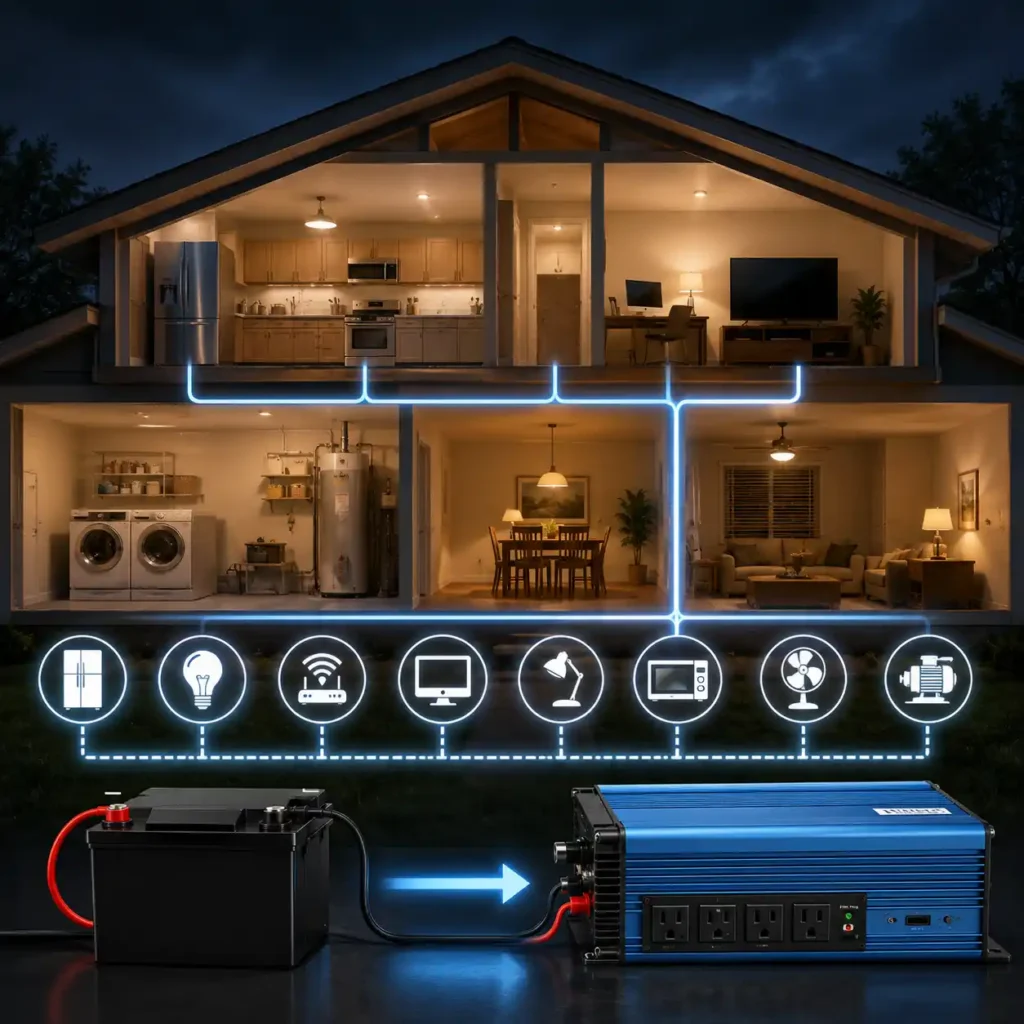
One of the most common mistakes homeowners make when buying a power inverter for home backup is assuming that higher wattage automatically means a better system. While power output is an important specification, choosing the largest inverter available often increases costs without improving your everyday backup experience.
The key is to match the inverter’s continuous output to the appliances you expect to run simultaneously during an outage. Every electrical device has a rated power consumption, usually measured in watts. By estimating how many essential appliances will be operating at the same time, you can determine the inverter capacity your home actually requires.
For example, a refrigerator, Wi-Fi router, LED lighting, laptop charger, and television typically consume far less than 3000 watts when running together. On the other hand, adding appliances such as microwave ovens, coffee makers, space heaters, or power tools can increase total demand quickly. Understanding these real-world usage patterns helps prevent both undersizing and overspending.
It’s also important to leave some reserve capacity. Running an inverter continuously at its maximum rated output generates additional heat and may reduce overall efficiency. Selecting a model with modest headroom allows the system to operate more comfortably while giving you flexibility to connect an additional appliance if needed during an emergency.
For most homeowners building a battery-based backup system, a 3000W pure sine wave inverter provides an excellent balance between capability, efficiency, and cost. It offers enough continuous power to keep many essential household appliances running while remaining practical for residential battery banks and off-grid installations.
Rather than asking, “What’s the biggest inverter I can afford?”, ask “What power output matches the way my household actually uses electricity during an outage?” That approach almost always leads to a more efficient, more reliable, and more cost-effective home backup system.
Understanding Continuous Output vs. Surge Power
When comparing the best power inverters for home backup, you’ll quickly notice two power ratings listed in the specifications: continuous output and surge power. Understanding the difference between these numbers is essential because both play an important role in determining which appliances your inverter can operate reliably.
Continuous output refers to the amount of power the inverter can supply without interruption. This is the rating that should match the combined wattage of the appliances you expect to run at the same time during a power outage. Refrigerators, routers, lighting, televisions, laptops, and many other household devices all draw continuous power while operating.
Surge power is different. Certain appliances require a brief burst of additional electricity when they first start. Refrigerators, freezers, sump pumps, well pumps, air compressors, and other motor-driven equipment often draw two to three times their normal running wattage for a fraction of a second. If the inverter cannot supply this temporary surge, the appliance may fail to start even though its normal operating power is well within the inverter’s continuous rating.
For example, a refrigerator that normally consumes 700 watts may briefly require more than 1,500 watts during compressor startup. Multiply that by several motor-driven appliances starting at different times, and surge capability quickly becomes just as important as continuous output.
This is why we evaluated every inverter in this guide based not only on its advertised continuous wattage but also on its real-world ability to handle demanding startup loads. A well-designed inverter should deliver stable power during normal operation while providing enough surge capacity to start essential household equipment without triggering overload protection.
When choosing a home backup inverter, don’t compare continuous wattage alone. Look for a balanced combination of continuous output, surge capability, and overall build quality. Together, these factors determine how confidently your backup system will perform when your home needs it most.
Choosing the Right Battery Voltage
Selecting the right battery voltage is just as important as choosing the right inverter. Even the best power inverter for home backup will perform poorly if it isn’t matched to the battery bank it was designed to operate with.
Most residential backup systems use 12V, 24V, or 48V battery configurations. Each has its own advantages, but the best choice depends largely on the size of your backup system and the amount of power you expect to deliver during an outage.
A 12V system is the most common option for smaller home backup setups, RVs, cabins, and off-grid installations. It’s relatively simple to build, components are widely available, and installation is straightforward. Many 3000W pure sine wave inverters—including several models featured in this guide—are designed specifically for 12V battery banks, making them an excellent choice for homeowners who need reliable backup power for essential appliances.
As system size increases, however, higher battery voltages become more practical. 24V and 48V systems carry the same amount of power while requiring less current, which reduces cable losses, improves efficiency, and often allows for smaller wiring. These higher-voltage systems are commonly used in larger residential energy storage installations, especially those supporting whole-home backup or extensive solar arrays.
It’s also important to remember that your inverter voltage must always match your battery bank. A 12V inverter cannot be connected to a 24V battery system, and the opposite is equally true. Choosing compatible components from the beginning helps avoid unnecessary expense and ensures safe, reliable operation.
For most homeowners building a battery backup system to power essential household appliances, a 12V pure sine wave inverter paired with a properly sized battery bank offers an excellent balance of simplicity, performance, and affordability. Larger homes with greater energy demands may benefit from higher-voltage systems, but for many residential backup applications, 12V remains a practical and proven solution.
Efficiency Matters More Than You Think
Efficiency is one of the most overlooked specifications when comparing the best power inverters for home backup, yet it has a direct impact on how long your battery system can keep essential appliances running during an outage.
No inverter converts DC battery power into AC electricity with perfect efficiency. A small portion of the stored energy is always lost as heat during the conversion process. The more efficient the inverter, the more of your battery’s stored energy becomes usable household electricity instead of wasted power.
While the difference between two inverters may appear small on paper, it becomes much more noticeable during extended outages. A highly efficient inverter can provide additional runtime without requiring a larger battery bank, allowing homeowners to get more value from the energy they have already stored.
Efficiency is especially important for battery-powered backup systems that operate for several hours or even multiple days. Every percentage point of energy saved helps maximize runtime for critical appliances such as refrigerators, internet equipment, lighting, communication devices, and medical equipment.
Another factor worth considering is idle power consumption. Even when few or no appliances are connected, every inverter consumes a small amount of electricity simply to remain operational. Models with lower standby power requirements place less continuous demand on the battery bank, helping preserve stored energy until it’s actually needed.
Premium manufacturers often invest heavily in improving conversion efficiency, thermal management, and standby performance. While these improvements may increase the initial purchase price, they frequently deliver better long-term value by reducing wasted energy and improving overall system performance.
When evaluating a power inverter for home backup, don’t focus exclusively on wattage. Consider efficiency alongside continuous output, surge capability, safety features, and overall build quality. Together, these characteristics determine how effectively your backup system will perform when reliable power matters most.
Safety Features Worth Having
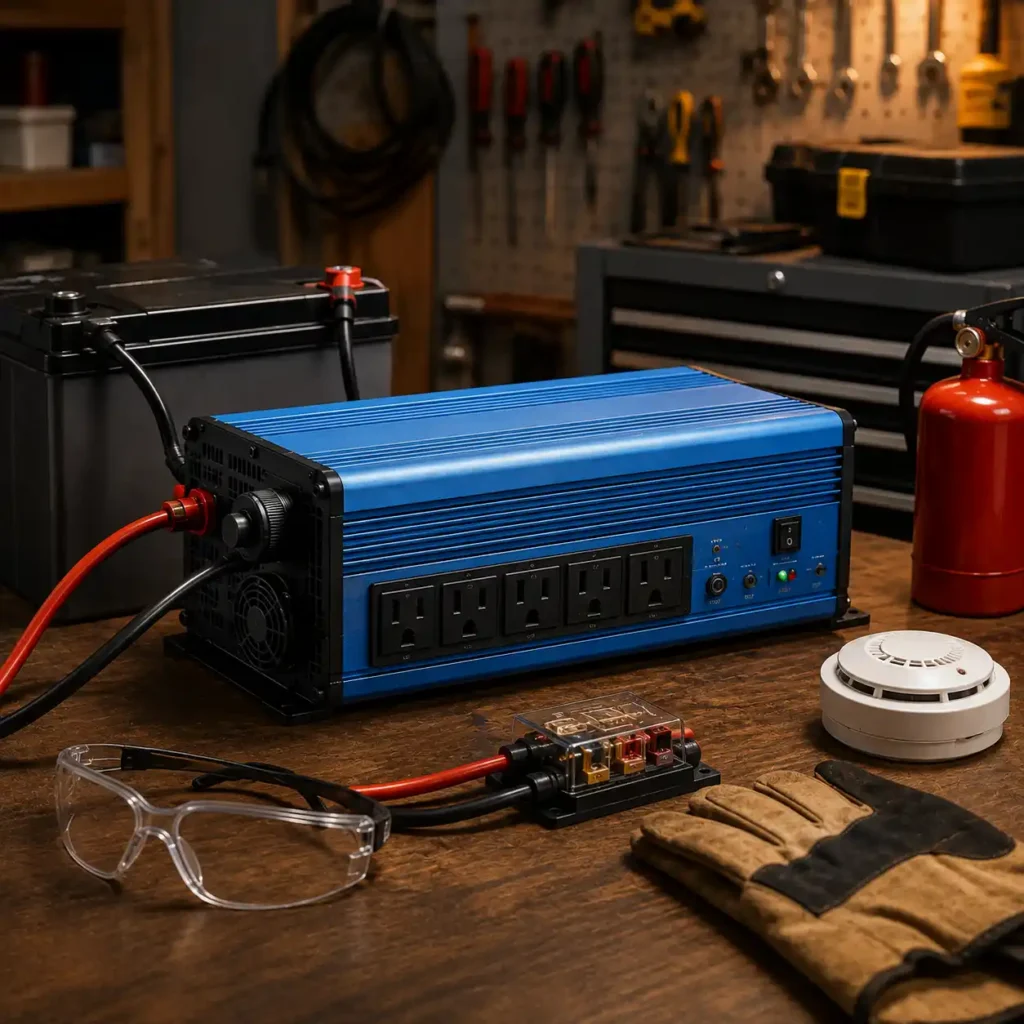
A power inverter for home backup is more than just a device that converts DC battery power into AC electricity. It also serves as a critical layer of protection for both your electrical system and the appliances connected to it. That’s why built-in safety features should never be overlooked when comparing different models.
Modern pure sine wave inverters typically include multiple protection systems designed to monitor operating conditions and automatically respond if something goes wrong. These safeguards help prevent equipment damage while improving the overall reliability of your backup power system.
One of the most important features is overload protection. If connected appliances demand more power than the inverter is designed to deliver, the system automatically shuts down before excessive heat or electrical damage can occur.
Low-voltage protection is equally valuable. Deeply discharging a battery can shorten its lifespan and reduce long-term performance. An inverter with low-voltage shutdown helps protect your battery bank by disconnecting the load before the battery reaches a harmful discharge level.
Homeowners should also look for over-voltage protection, short-circuit protection, and over-temperature protection. These systems continuously monitor electrical conditions and help protect both the inverter and connected appliances from unexpected faults or overheating.
Many premium inverters also include intelligent cooling systems with temperature-controlled fans. Rather than running continuously, these fans operate only when additional cooling is required, reducing noise while maintaining safe operating temperatures during periods of higher electrical demand.
Although safety features may not be the first specifications buyers compare, they become extremely important during real-world emergencies. A well-designed protection system allows the inverter to continue operating safely under changing conditions while reducing the risk of costly equipment damage.
When evaluating the best power inverter for home backup, don’t compare output power alone. A model that combines reliable performance with comprehensive built-in protection will provide greater peace of mind and more dependable service throughout years of residential backup use.
Remote Monitoring and Smart Features
Modern power inverters for home backup offer much more than simple DC-to-AC power conversion. Many newer models include smart monitoring features that allow homeowners to track system performance, monitor battery status, and adjust operating settings without needing to access the inverter directly.
While these features aren’t essential for every backup system, they can make day-to-day operation significantly more convenient—especially for homeowners who rely on their battery backup throughout the year.
Bluetooth and Wi-Fi connectivity are becoming increasingly common on premium inverters. Using a companion mobile app, homeowners can view input voltage, output power, battery status, system efficiency, and fault notifications in real time. Instead of checking indicator lights on the inverter itself, they can monitor the entire system from a smartphone or tablet.
Remote monitoring also simplifies troubleshooting. If the inverter detects an overload, low battery voltage, or another operating issue, the app often provides clear diagnostic information that helps users identify the cause more quickly. This can reduce downtime and make system maintenance much easier.
Some advanced inverters also support remote on/off control, firmware updates, and customizable operating parameters. These features are particularly useful for off-grid cabins, vacation homes, or backup systems installed in garages, utility rooms, or other locations where direct access may not always be convenient.
That said, smart features should never outweigh the fundamentals. Reliable pure sine wave output, sufficient continuous power, strong surge capability, and comprehensive safety protections remain the most important qualities of any home backup inverter. Remote monitoring should be viewed as an added convenience rather than the primary reason for choosing one model over another.
For homeowners who value greater visibility into their backup power system, smart monitoring can provide additional confidence by making it easier to understand exactly how the inverter is performing whenever backup power is needed.
Installation Considerations
Even the best power inverter for home backup can only perform as well as the system it’s installed in. Proper installation plays a major role in safety, efficiency, and long-term reliability, making it an important consideration before purchasing any inverter.
The first step is ensuring compatibility with your existing battery bank. The inverter’s input voltage must match the battery system exactly, whether it’s 12V, 24V, or 48V. Using incompatible components can damage the equipment and create serious safety risks.
Cable sizing is another factor that shouldn’t be overlooked. High-power inverters draw significant current from the battery bank, particularly in 12V systems. Using properly sized cables helps minimize voltage drop, improves efficiency, and reduces heat buildup during operation. Quality battery terminals and secure electrical connections are equally important for dependable long-term performance.
Ventilation also deserves careful attention. During normal operation, inverters generate heat that must be dissipated effectively. Installing the unit in a clean, dry, and well-ventilated location allows the cooling system to operate efficiently while helping extend the lifespan of internal components. Avoid placing an inverter in enclosed spaces with limited airflow or near excessive moisture, dust, or direct heat sources.
Homeowners should also think about future expansion. If you plan to increase battery capacity, add solar charging, or upgrade your backup system over time, selecting an inverter that integrates easily with additional equipment can simplify future improvements and reduce installation costs.
Finally, always follow the manufacturer’s installation guidelines. Proper grounding, correctly rated fuses or circuit breakers, and appropriate overcurrent protection are essential parts of any safe residential backup system. While many experienced DIY homeowners successfully install battery backup equipment, larger or permanently connected systems may benefit from professional installation to ensure compliance with local electrical codes.
A well-installed pure sine wave inverter not only delivers better performance during outages but also provides greater safety, higher efficiency, and years of dependable service as part of your home backup power system
Common Buying Mistakes
Almost everyone shopping for a power inverter for home backup has the same goal: keeping essential appliances running safely and reliably when the electrical grid goes down. Surprisingly, many disappointing purchases aren’t caused by buying a poor-quality inverter—they happen because the inverter doesn’t match the homeowner’s actual backup power requirements.
One of the most common mistakes is choosing far more inverter capacity than the household is ever likely to use. While a larger inverter may seem like better protection, it usually increases system cost and often requires a larger battery bank, heavier cables, and additional installation expenses. Many homeowners eventually discover that most of that extra capacity is never used during a typical outage.
The opposite mistake is selecting an inverter that only meets today’s needs without considering future expansion. A homeowner may later install additional batteries, add rooftop solar panels, purchase new appliances, or expand the number of circuits included in the backup system. Choosing an inverter with no room for growth can limit future upgrades and lead to replacing equipment much sooner than expected.
Another frequent oversight is focusing only on the inverter’s advertised wattage while ignoring surge capability. A refrigerator, freezer, sump pump, or well pump may require significantly more power during startup than during normal operation. An inverter that appears large enough on paper may still struggle to start these essential appliances if its surge performance is insufficient.
Many buyers also compare products using only headline specifications. Continuous output is certainly important, but it’s only one part of the overall ownership experience. Build quality, conversion efficiency, cooling performance, safety protections, warranty coverage, manufacturer reputation, and long-term reliability all play equally important roles in determining how well an inverter performs over years of residential use.
Finally, some homeowners assume that every power inverter for home backup is designed to power an entire house during an outage. In reality, the best solution depends on your expectations. For many households, powering only essential appliances provides the most practical and cost-effective approach, while larger backup systems may require a more comprehensive electrical design.
The best purchasing decisions begin with understanding how your home actually uses electricity during an outage—not by simply choosing the inverter with the biggest numbers on the specification sheet.
Quick Buyer Checklist
Before purchasing a power inverter for home backup, take a few minutes to confirm that it matches your home’s actual backup power requirements—not simply the highest specifications listed on the product page.
A well-chosen pure sine wave inverter should meet most of the following criteria:
- It provides enough continuous output to power the essential appliances you plan to run simultaneously during an outage.
- It offers sufficient surge capacity to start refrigerators, freezers, pumps, and other motor-driven equipment without triggering overload protection.
- It matches your battery bank voltage (12V, 24V, or 48V) to ensure safe and reliable operation.
- It delivers pure sine wave output that is safe for sensitive electronics, modern appliances, and communication equipment.
- It includes comprehensive built-in safety protections, such as overload, over-temperature, low-voltage, over-voltage, and short-circuit protection.
- It operates with high conversion efficiency to maximize battery runtime during extended outages.
- It provides adequate cooling and ventilation for dependable long-term performance under continuous use.
- It supports the type of installation you plan to build, whether it’s a portable battery backup setup, an off-grid system, or a permanently installed residential backup solution.
- It comes from a manufacturer with a strong reputation for reliability, product support, and warranty coverage.
- It leaves enough room for future system expansion if you later decide to increase battery capacity or integrate solar charging.
Choosing a power inverter for home backup isn’t about finding the model with the biggest numbers. It’s about selecting an inverter that fits your home’s electrical demands, works seamlessly with your battery system, and provides dependable power whenever the grid goes down. A few minutes spent evaluating these fundamentals today can help you avoid costly upgrades and ensure your backup system continues serving your household for many years.
The right power inverter for home backup won’t necessarily be the one with the highest wattage or the longest list of features. It will be the inverter that matches your home’s electrical needs, works seamlessly with your battery system, and delivers reliable pure sine wave power when you need it most.
By focusing on continuous output, surge capability, battery compatibility, efficiency, safety features, and long-term reliability, you’ll be far more likely to choose a system that performs well not only during your next power outage but for many years to come.
Now that you understand how to choose the best power inverter for home backup, the next step is comparing today’s leading models side by side. In the following section, you’ll find our top recommendations, each selected for a different type of homeowner, budget, and backup power requirement.
Features You Can Ignore
When shopping for the best power inverter for home backup, it’s easy to become distracted by long specification lists and marketing claims. While some features genuinely improve reliability and everyday usability, others have very little impact on how well an inverter performs during a real power outage.
Manufacturers naturally highlight impressive specifications to help their products stand out. However, experienced homeowners tend to judge an inverter much differently. What matters most is whether it starts essential appliances reliably, delivers stable pure sine wave power, operates efficiently, and continues performing dependably year after year.
For example, some buyers place too much emphasis on the number of AC outlets built into the inverter. In a permanent home backup installation, many systems are hardwired to a transfer switch or dedicated electrical panel, making the number of front-mounted outlets far less important than overall electrical performance.
Similarly, don’t let extremely high peak power ratings become the deciding factor unless your household actually requires that level of surge capacity. Continuous output, inverter efficiency, and overall build quality typically have a much greater influence on everyday performance than the largest surge number printed on the box.
Some models also advertise decorative displays, colorful lighting, or additional convenience features that may look impressive but contribute very little to actual backup capability. While these extras can improve the user experience, they should never take priority over proven reliability, comprehensive safety protection, and high-quality internal components.
The best buying decisions come from focusing on the features you’ll rely on during every outage—not the ones designed primarily to attract attention in product listings. A well-built pure sine wave inverter with dependable performance, strong safety protections, and the right power capacity will almost always provide greater long-term value than a model filled with unnecessary extras but lacking the fundamentals.
When comparing power inverters for home backup, prioritize reliability, compatibility with your battery system, continuous power output, surge capability, efficiency, and safety. Those are the characteristics that will continue delivering value long after the novelty of additional features has worn off.
Real-World Power Inverter Runtime Examples
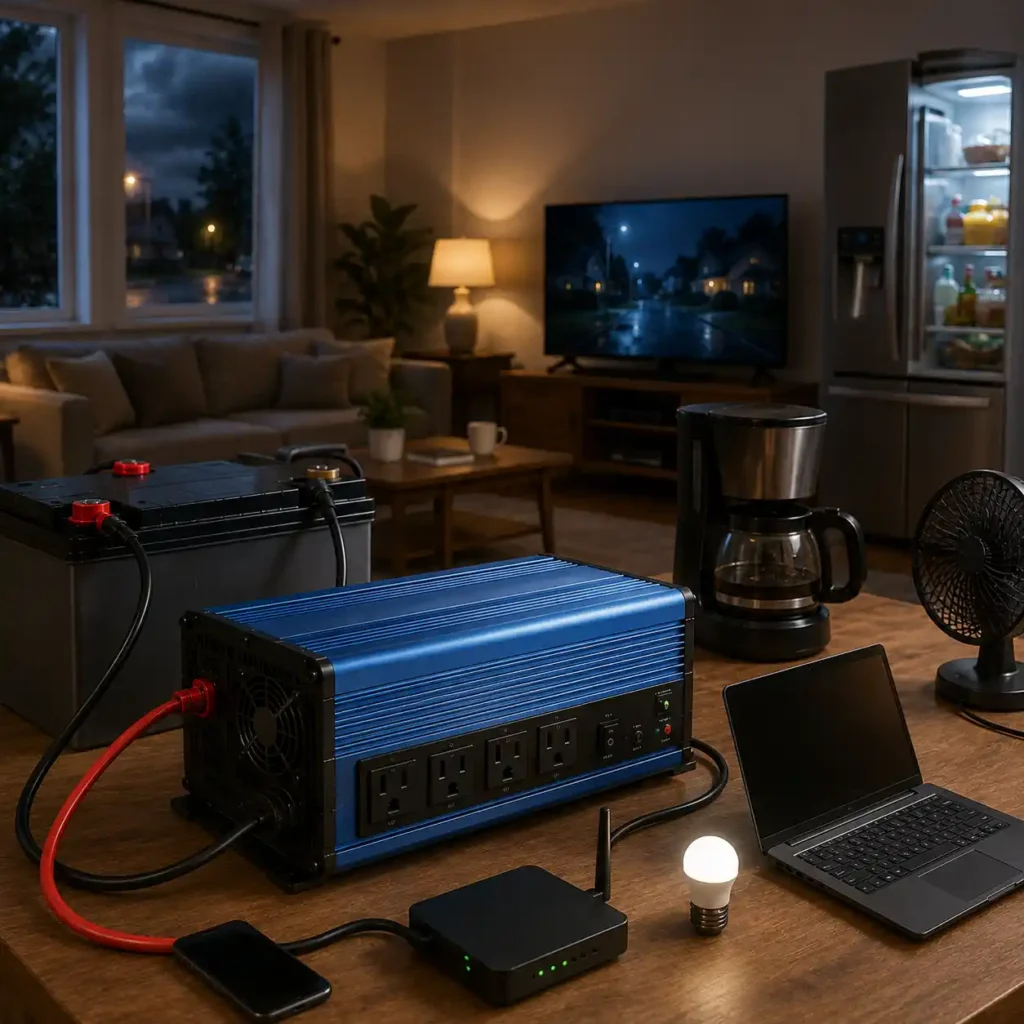
Understanding backup runtime becomes much easier when you look beyond inverter wattage and consider the complete backup system. While a power inverter for home backup converts DC battery power into usable AC electricity, the actual runtime depends primarily on the size of your battery bank and the amount of power your household appliances consume.
The examples below illustrate what you can realistically expect from a 3000W pure sine wave inverter paired with a typical 12V 200Ah LiFePO₄ battery (approximately 2.4kWh of usable energy before inverter losses). Actual runtime will vary depending on battery capacity, inverter efficiency, appliance startup loads, ambient temperature, and the number of devices operating simultaneously. These estimates are intended as practical planning examples rather than exact calculations.
Instead of focusing only on the inverter’s maximum output, think about the combination of appliances you plan to operate during a power outage. Running a refrigerator, Wi-Fi router, LED lighting, and a few small electronics places very different demands on your backup system than using a microwave, coffee maker, or several high-power appliances at the same time.
The runtime estimates below provide realistic planning guidance to help homeowners understand how a properly sized battery bank and a quality 3000W pure sine wave inverter work together in everyday backup scenarios. They offer a practical starting point for estimating the battery capacity you’ll need before investing in a home backup power system.
Runtime Examples
| Household Device | Typical Power Draw | Estimated Runtime* | Why It Matters During an Outage |
|---|---|---|---|
| Refrigerator | 120–200W | 10–15 Hours | Keeps food fresh and prevents spoilage during extended power outages. |
| Wi-Fi Router & Modem | 15–25W | 80–120 Hours | Maintains internet access for communication, work, and emergency updates. |
| LED Lighting | 40–80W | 25–50 Hours | Provides safe, efficient lighting throughout the home during blackouts. |
| CPAP Machine | 30–60W | 30–60 Hours | Supports uninterrupted overnight therapy for users who depend on CPAP treatment. |
| Television | 80–150W | 15–25 Hours | Provides news, weather alerts, and entertainment during extended outages. |
| Microwave Oven | 1000–1500W | 1–2 Hours of Total Use | Useful for preparing meals, though typically operated only for short periods. |
| Coffee Maker | 700–1200W | 40–60 Brewing Cycles | Allows homeowners to prepare hot drinks without relying on grid power. |
| Laptop | 40–70Wh per Charge | 25–40 Full Charges | Keeps remote work, communication, and productivity running during outages. |
*Estimated runtimes are based on a typical 3000W pure sine wave inverter connected to a 12V 200Ah LiFePO₄ battery (approximately 2.4kWh usable capacity before inverter losses). Actual performance varies depending on battery capacity, inverter efficiency, appliance startup loads, operating conditions, and the number of devices running simultaneously.
Quick Runtime Planning Tips
A power inverter for home backup can keep essential household appliances running much longer than many homeowners expect—but only when the available battery capacity is used wisely. Effective energy management often has a greater impact on backup runtime than simply installing a larger inverter.
To get the most from your backup power system during an outage:
- Prioritize essential appliances first. Refrigerators, internet equipment, LED lighting, medical devices, and communication equipment should take priority over comfort appliances with higher power demands.
- Avoid running multiple high-wattage appliances simultaneously. Devices such as microwave ovens, coffee makers, portable heaters, and power tools can quickly increase battery consumption when operated together.
- Choose a battery bank that matches your backup goals. The inverter determines how much power can be delivered at one time, while the battery determines how long that power remains available. Balancing both components is the key to an efficient backup system.
- Recharge your batteries whenever possible. If your system supports solar charging, replenishing stored energy during daylight hours can significantly extend backup time during prolonged outages.
- Monitor battery capacity regularly. Many modern inverters and battery systems provide real-time information through built-in displays or mobile apps, allowing you to adjust energy usage before battery levels become critically low.
- Plan for future expansion. If you expect your household energy needs to grow, selecting an inverter and battery system that can be expanded later may provide better long-term value than replacing your equipment entirely.
In many situations, thoughtful energy management extends backup runtime far more effectively than simply purchasing the largest inverter available. A properly sized pure sine wave inverter paired with an appropriately sized battery bank can keep essential household systems operating comfortably through many common power outages while maximizing efficiency and long-term reliability.
Common Household Devices You Can Power
One of the biggest advantages of installing a power inverter for home backup is the ability to keep essential household appliances running when utility power is unavailable. While the exact number of devices you can operate depends on your inverter’s continuous output and the size of your battery bank, a properly designed backup system can support many of the appliances your family relies on every day.
Understanding the power requirements of common household devices makes it much easier to choose the right inverter and battery combination. Rather than focusing solely on wattage, it’s helpful to consider which appliances are truly essential during an outage and how long you expect them to operate.
The sections below highlight some of the most common household devices homeowners power with a pure sine wave inverter. Each example explains typical power requirements, practical considerations, and why that appliance often becomes a priority during emergency backup situations.
Refrigerators and Freezers
For most homeowners, the refrigerator and freezer are the highest-priority appliances during a power outage. Keeping food refrigerated prevents spoilage, protects frozen items, and eliminates the inconvenience and expense of replacing groceries after an extended blackout.
Although refrigerators operate continuously, the compressor cycles on and off throughout the day, meaning their average energy consumption is usually much lower than their startup demand suggests. This is why both continuous output and surge capacity are important when selecting a home backup inverter. A quality 3000W pure sine wave inverter can easily handle the temporary startup surge of most residential refrigerators while providing stable power during normal operation.
For homeowners building a battery backup system, the refrigerator is often the first appliance used to estimate overall energy requirements. Once refrigeration is covered, it’s much easier to calculate how much additional battery capacity is available for lighting, internet equipment, and other essential household devices.
Medical Devices and CPAP Machines
For households that rely on medical equipment, a dependable backup power system is about much more than convenience—it provides confidence that essential devices will continue operating when the electrical grid fails.
Among the most common medical devices powered by a pure sine wave inverter is a CPAP machine. Because most CPAP units consume relatively little electricity compared with major household appliances, they can often operate for many hours when paired with a properly sized battery bank. This makes a battery-powered backup system an excellent solution for maintaining uninterrupted overnight therapy during unexpected outages.
Other low-power medical equipment, including oxygen concentrators, mobility device chargers, and certain home health monitoring systems, may also be suitable for battery backup depending on their individual power requirements. Before building your system, always verify the manufacturer’s recommended power consumption and ensure that both your inverter and battery bank can provide sufficient capacity.
For families where medical devices are a top priority, backup planning should begin with these essential loads before considering convenience appliances or entertainment electronics. Ensuring reliable operation of critical equipment provides far greater peace of mind than simply maximizing the number of devices connected during an outage.
A properly sized power inverter for home backup allows homeowners to maintain essential medical equipment safely while also reserving enough battery capacity for lighting, refrigeration, internet access, and other critical household needs.
Home Office Equipment and Internet
For many households, maintaining an internet connection during a power outage is almost as important as keeping the lights on. Whether you’re working remotely, attending online classes, managing a business, or simply staying connected with family, a power inverter for home backup can help keep your home office running when grid power is unavailable.
Fortunately, networking equipment is among the easiest household loads to support. Wi-Fi routers, cable modems, fiber terminals, network switches, and laptop chargers consume relatively little electricity, allowing them to operate for many hours on a properly sized battery bank. Even during extended outages, these devices typically require only a small fraction of your backup system’s available capacity.
Remote workers may also choose to power desktop computers, monitors, printers, and other office equipment. While these devices draw more electricity than networking hardware alone, they generally remain well within the capabilities of a 3000W pure sine wave inverter, provided the total load stays within the inverter’s continuous output rating.
Another advantage of a battery-based backup system is clean, stable power. Pure sine wave output helps protect sensitive electronics from voltage fluctuations, making it suitable for computers, networking equipment, external storage devices, and other valuable electronics that benefit from consistent, utility-quality electricity.
As more homeowners work from home, maintaining internet access and a functional home office has become one of the most practical reasons to install a residential backup power system. A properly configured inverter and battery bank can keep essential communication and productivity equipment running smoothly until grid power is restored.
Kitchen Appliances
Kitchen appliances are among the most useful devices to keep running during a power outage, but they also vary significantly in their energy requirements. While some appliances consume relatively little electricity, others require high continuous power and substantial startup capacity, making proper inverter sizing especially important.
Small appliances such as electric kettles, coffee makers, toasters, and blenders typically operate for only a few minutes at a time. Although they often draw between 700W and 1,500W, their short operating cycles mean they have a relatively small impact on overall battery capacity when used occasionally.
Microwave ovens are another common backup priority. Most residential models require between 1,000W and 1,500W of continuous power while heating food, making them well suited for a 3000W pure sine wave inverter. However, because they consume a large amount of power in a short period, it’s best to avoid operating several high-wattage kitchen appliances simultaneously.
Larger appliances such as electric ovens, induction cooktops, and electric water heaters generally require far more power than a typical battery backup system is designed to provide. These appliances are usually better suited to whole-home energy storage systems or standby generators rather than portable battery-based inverter setups.
When planning your backup system, think about how you actually use your kitchen during an outage. For most homeowners, the ability to keep the refrigerator running, heat meals in a microwave, and brew a cup of coffee provides an excellent balance between convenience and efficient energy use without placing unnecessary strain on the battery bank.
Smart Home Devices and Essential Electronics
Modern homes rely on far more than large appliances during a power outage. Smart home devices, communication equipment, security systems, and everyday electronics all play an important role in keeping a household safe, connected, and functional when the electrical grid goes down.
Many of these devices consume surprisingly little electricity. Smart speakers, security cameras, alarm systems, video doorbells, smart thermostats, and charging stations for mobile devices typically require only a small amount of power. As a result, they can often operate for many hours—or even days—when paired with a properly sized battery bank and a pure sine wave inverter.
Televisions, streaming devices, game consoles, and home entertainment systems can also be powered during an outage, provided their combined energy consumption remains within the inverter’s continuous output rating. While these appliances aren’t considered essential in the same way as refrigeration or medical equipment, they can help families stay informed through weather updates and emergency broadcasts while providing a sense of normalcy during extended outages.
Charging smartphones, tablets, rechargeable flashlights, radios, and portable battery packs is another practical use for a home backup system. These devices require relatively little energy but become invaluable for communication, navigation, and emergency preparedness when utility power is unavailable.
One advantage of a 3000W pure sine wave inverter is its ability to deliver clean, stable electricity that’s safe for sensitive electronics. Unlike modified sine wave inverters, pure sine wave models produce utility-quality power that helps protect modern electronic devices while ensuring reliable operation.
As these examples demonstrate, a well-designed backup system is about more than simply powering one or two appliances. The right combination of inverter and battery capacity allows homeowners to keep a wide range of essential household devices operating safely, helping maintain comfort, communication, and peace of mind until normal power is restored.
Power Inverter vs. Portable Power Station

Choosing between a power inverter and a portable power station is one of the most common questions homeowners face when preparing for power outages. Although both devices can supply AC electricity during an emergency, they serve different purposes and are designed for different types of backup power systems.
A power inverter converts DC electricity stored in an external battery bank into standard household AC power. It requires one or more batteries to operate, allowing homeowners to build a customized backup system based on their energy requirements. This approach offers excellent flexibility because battery capacity can often be expanded over time, making it well suited for permanent home backup installations, off-grid systems, and solar energy setups.
A portable power station, by comparison, combines the inverter, battery, battery management system, and charging electronics into a single self-contained unit. These all-in-one systems are simple to use, require minimal installation, and are ideal for homeowners who want backup power without assembling individual components. They’re also popular for camping, RV travel, and portable emergency preparedness.
The right solution depends on your goals. Homeowners building a long-term residential backup system with expandable battery capacity often benefit more from a dedicated pure sine wave inverter and external battery bank. Those looking for a convenient plug-and-play solution for occasional outages may find a portable power station to be the better fit.
The comparison below highlights the practical differences between these two backup power solutions and can help you determine which option best matches your home’s energy needs.
Power Inverter vs. Portable Power Station
| Feature | Power Inverter | Portable Power Station |
|---|---|---|
| Power Source | Requires an external battery bank | Built-in rechargeable battery |
| Installation | Requires battery, wiring, and system setup | Plug-and-play operation |
| Expandability | Battery capacity can often be expanded | Depends on the model; many have fixed capacity |
| Portability | Designed primarily for permanent installation | Easy to transport and use in multiple locations |
| Solar Compatibility | Compatible with external solar charging systems | Many models support direct solar panel charging |
| Maintenance | Depends on the battery type and overall system | Minimal routine maintenance |
| Best For | Permanent home backup, off-grid systems, and custom battery installations | Portable emergency backup, RVs, camping, and simple home backup |
Power Inverter vs. Portable Power Station
For many homeowners, both solutions can provide reliable backup power, but they serve different purposes and excel in different situations.
A power inverter is often the better choice for homeowners building a customized backup system around an existing battery bank or planning to expand their energy storage over time. It offers greater flexibility, integrates easily with solar charging systems, and allows users to choose the battery capacity that best matches their household’s energy requirements. This modular approach makes power inverters particularly attractive for permanent residential backup installations and off-grid applications.
A portable power station, on the other hand, is designed for simplicity. Because the inverter, battery, charging system, and battery management electronics are housed within a single enclosure, setup is quick and straightforward. For homeowners who need occasional emergency power without installing a dedicated battery bank, a portable power station can be an excellent plug-and-play solution.
Ultimately, the best option depends on how you plan to use your backup power system. If your goal is building a scalable home energy solution that can grow alongside your household’s electricity needs, a pure sine wave power inverter paired with a properly sized battery bank is often the more flexible long-term investment. If convenience, portability, and minimal installation are your top priorities, a portable power station may be the better fit.
Rather than asking which technology is universally better, consider which one best matches your home’s backup requirements, budget, and future energy plans. Selecting the right solution today can provide dependable emergency power and greater peace of mind for many years to come.
Frequently Asked Questions (FAQ)
What size power inverter do I need for home backup?
The right inverter size depends on the total continuous wattage of the appliances you plan to run at the same time, not the wattage of a single device. Start by adding the running power requirements of your essential appliances, then include additional capacity for startup surges from refrigerators, freezers, pumps, and other motor-driven equipment. For many homeowners, a 3000W pure sine wave inverter provides an excellent balance of performance, flexibility, and affordability for powering essential household loads during an outage.
Can a 3000W inverter run a refrigerator?
Yes. A quality 3000W pure sine wave inverter can easily run most residential refrigerators and freezers, provided the battery bank is appropriately sized. Because refrigerators require a brief surge of additional power when the compressor starts, choosing an inverter with adequate surge capacity is just as important as its continuous output rating.
How long will a power inverter run during a power outage?
The inverter itself does not determine runtime. Backup duration depends primarily on your battery capacity, the efficiency of the inverter, and the total power consumption of the connected appliances. Larger battery banks provide longer runtime, while reducing unnecessary electrical loads helps maximize available backup power.
Is a pure sine wave inverter better than a modified sine wave inverter?
For home backup applications, yes. Pure sine wave inverters produce electricity that closely matches utility power, making them safe for sensitive electronics, modern appliances, medical equipment, and motor-driven devices. Modified sine wave inverters may work for some basic loads but can reduce efficiency, create electrical noise, or cause compatibility issues with certain equipment.
Can a power inverter damage household electronics?
A high-quality pure sine wave inverter is designed to provide clean, stable AC power that is safe for televisions, computers, networking equipment, kitchen appliances, and other modern electronics. Problems are far more likely to occur with low-quality or modified sine wave inverters, particularly when powering sensitive electronic devices.
Can I connect solar panels directly to a power inverter?
In most cases, no. Standard power inverters convert battery DC power into household AC power but are not designed to regulate electricity coming directly from solar panels. A complete solar backup system typically includes solar panels, a charge controller, a battery bank, and the inverter working together.
Should I choose a 12V, 24V, or 48V inverter?
The correct voltage depends on your battery system and overall power requirements. 12V systems are common for smaller residential backup setups, while 24V and 48V systems are often preferred for larger installations because they improve efficiency and reduce current flow through the wiring. The inverter’s input voltage must always match the battery bank.
Can I install a power inverter myself?
Many homeowners successfully install portable or small battery backup systems themselves, especially when using pre-configured equipment. However, permanently installed home backup systems that connect to household electrical circuits should be installed according to local electrical codes. If you’re unsure about wiring, grounding, or transfer equipment, professional installation is the safest approach.
What's the difference between a power inverter and a portable power station?
A power inverter requires an external battery bank and is typically used as part of a customizable backup power system. A portable power station combines the inverter, battery, charging electronics, and battery management system into a single portable unit. Inverters generally offer greater flexibility for permanent home backup systems, while portable power stations prioritize convenience and mobility.
What should I look for when buying a power inverter for home backup?
Focus on the features that have the greatest impact on real-world performance: pure sine wave output, sufficient continuous power, adequate surge capacity, compatibility with your battery bank, high conversion efficiency, comprehensive safety protections, reliable cooling, and strong manufacturer support. Choosing an inverter that matches your household’s actual backup needs will provide better long-term value than simply buying the highest-wattage model available.
Final Verdict
Choosing the best power inverter for home backup isn’t about buying the highest-wattage model or the one with the longest feature list. It’s about selecting an inverter that delivers the right balance of power output, reliability, efficiency, and compatibility with your battery backup system.
The best inverter is the one that keeps your essential household appliances running safely while giving you confidence that your home will remain functional during unexpected power outages.
Every household has different backup power priorities.
Some homeowners simply want to keep the refrigerator, Wi-Fi router, lighting, and a few electronic devices operating during occasional outages. Others need a more capable system that can support home offices, medical equipment, sump pumps, security systems, or multiple household circuits for extended periods.
That’s exactly why we selected winners for different residential backup needs instead of recommending one inverter for everyone.
If you’re looking for the strongest overall combination of reliability, performance, and intelligent monitoring, the Victron Energy 12/3000 Pure Sine Wave Inverter remains our top recommendation. Its exceptional build quality, highly efficient power conversion, Bluetooth monitoring through the VictronConnect app, and outstanding long-term reliability make it one of the most trusted choices for residential backup power systems.
Homeowners seeking the best balance between price and performance should take a close look at the Renogy 3000W 12V Pure Sine Wave Inverter. It delivers dependable pure sine wave output, solid surge capability, and excellent value, making it an ideal choice for everyday home backup applications.
For demanding residential systems that regularly power motor-driven appliances or higher electrical loads, the AIMS 3000W 12V Pure Sine Inverter offers outstanding surge performance and heavy-duty construction, making it well suited for more challenging backup scenarios.
If premium engineering and long-term durability are your priorities, the Samlex NTX-3000-12 Pure Sine Wave Inverter provides excellent efficiency, clean output, and dependable operation for homeowners who want a professional-grade solution.
For buyers looking for a versatile inverter that performs equally well in residential, RV, and off-grid environments, the Go Power! GP-ISW3000-12 delivers reliable performance with the flexibility to support multiple backup applications.
One of the biggest mistakes we see isn’t choosing the wrong brand—it’s choosing the wrong inverter size. Some homeowners purchase far more capacity than they’ll ever use, while others underestimate startup power requirements and discover that essential appliances won’t operate as expected during an outage.
Taking the time to calculate your household’s essential electrical loads, evaluate surge requirements, and choose the correct battery voltage will almost always result in a better investment than simply buying the most powerful inverter available.
The good news is that today’s pure sine wave inverters are more capable than ever before. Improved conversion efficiency, advanced safety protections, intelligent monitoring, and compatibility with modern LiFePO₄ battery systems have transformed residential backup power into a practical and dependable long-term solution.
Whether your goal is protecting refrigerated food, maintaining internet access, supporting medical equipment, working from home, or simply keeping your family comfortable during severe weather, the right inverter works quietly in the background to provide clean, stable electricity whenever grid power disappears.
At the end of the day, the best power inverter for home backup isn’t the one with the highest specifications on paper. It’s the one that matches your home’s electrical demands, integrates seamlessly with your battery system, and delivers reliable performance every time you need backup power.
Choose an inverter that fits your household—not just your budget—and you’ll enjoy dependable emergency power, greater energy security, and peace of mind for years to come.
We hope this guide has made comparing today’s leading power inverters for home backup easier and has given you the confidence to select the right solution for your needs. Whatever challenges the electrical grid may bring in the future, a well-designed backup power system helps ensure your home stays connected, protected, and prepared.
Our Recommendation
If we could offer just one piece of advice after evaluating every inverter in this guide, it would be this: start by understanding your home’s actual power requirements instead of shopping for the highest wattage available.
Many homeowners assume that a larger inverter automatically provides better protection. In reality, the best investment is usually the inverter that comfortably powers your essential household loads while leaving reasonable headroom for future expansion.
We also strongly recommend choosing a pure sine wave inverter from a manufacturer with a proven reputation for quality, reliable customer support, and long-term product reliability. Features such as high conversion efficiency, comprehensive safety protections, intelligent monitoring, and compatibility with LiFePO₄ battery systems often provide far greater long-term value than simply choosing the model with the highest advertised output.
If you’re still undecided after reading this guide, narrow your shortlist to two or three models that match your battery system, power requirements, and future expansion plans. Compare their efficiency, surge capability, monitoring features, warranty coverage, and overall build quality before making your final decision.
In our experience, that approach almost always leads to a smarter long-term investment than focusing on specifications alone.
Related Guides
Choosing the right power inverter for home backup is only one part of building a dependable residential backup power system. Proper battery sizing, runtime planning, solar integration, and system compatibility all play an important role in creating a reliable emergency power solution.
The guides below will help you build a complete home backup system while avoiding common mistakes and ensuring your equipment is ready whenever the next outage occurs.
- Best Home Battery Backup Systems (2026) — Compare today’s leading residential battery systems for emergency backup, whole-home energy storage, and solar integration.
- Best Portable Power Stations (2026) — Discover the top all-in-one battery power stations for home backup, RVs, camping, and emergency preparedness.
- Best Solar Charge Controllers — Learn how MPPT and PWM charge controllers improve battery charging performance and solar efficiency.
- Best LiFePO₄ Batteries for Home Backup — Compare the most reliable lithium batteries for backup power, off-grid systems, and solar energy storage.
- Power Inverter Runtime Calculator — Estimate how long your battery bank can power refrigerators, lighting, internet equipment, medical devices, and other essential household appliances.
- What Size Power Inverter Do I Need? — Learn how to calculate the correct inverter size based on your home’s actual electrical loads and startup requirements.
- Power Inverter vs. Portable Power Station — Compare both solutions to determine which backup power system best fits your home.
- How to Prepare Your Home for a Power Outage — Discover practical steps to improve emergency readiness before severe weather and unexpected grid failures.