
Choosing the best solar panels for RV air conditioners requires more than comparing wattage ratings. Buyers need modules that can contribute enough energy to a high-demand cooling system while fitting the RV’s available roof space and weight limits. The decision is complicated by differences in panel voltage, current, dimensions, efficiency, shading performance, and installation requirements. Panel output must also be considered in relation to the battery bank, charge controller, and inverter that support the air conditioner.
Power Ready Guide evaluates individual solar panels for RV rooftop arrays, comparing their electrical specifications, physical characteristics, construction, and suitability for different installation needs. This guide helps RV owners identify the trade-offs between panel options and make a more informed choice for an AC-supporting solar system.
As an Amazon Associate, I earn from qualifying purchases.
Table of Contents
Quick Answer
For a conventional RV rooftop solar array designed to support air conditioning, the Renogy 200W N-Type 16BB is our first model to consider. Its standard rigid construction and balanced electrical specifications make it a practical starting point for building a larger array. However, a single 200W panel is only one part of the system and should not be mistaken for enough solar capacity to run an RV air conditioner.
Other models may be a better fit depending on your installation priorities. Consider the Renogy 200W N-Type Bifacial 16BB for a bifacial panel design with a lower operating voltage, the Renogy ShadowFlux 200W where partial shading is a concern, or the BougeRV Arch Pro 200W Flexible when roof weight and curved mounting surfaces matter. The ECO-WORTHY 195W N-Type 18BB two-panel kit is worth considering if you want 390W of combined rated panel capacity from one listing.
The main limitation is that solar panels do not power an RV air conditioner on their own. The array must be sized around actual energy demand, available sunlight, roof space, and the supporting battery, charge controller, and inverter. The right panel choice therefore depends on the complete system design, not wattage alone.
Our Evidence & Evaluation Method
We compare the five selected solar panels using manufacturer-published specifications, official technical documentation, product manuals where available, corresponding Amazon US listings, and published warranty terms. Where available, we link directly to the manufacturer’s product page or datasheet in the relevant product review so readers can verify key specifications, including electrical ratings, module dimensions, weight, construction, and installation requirements. Amazon listings are used to identify the selected US-market products and confirm listing details, while manufacturer documentation takes priority for technical specifications.
Our evaluation focuses on the factors that matter when selecting panels for an RV rooftop solar array designed to support air conditioning.
| Factor | What We Examine | Evidence |
|---|---|---|
| Rated Power & Electrical Output | Wattage, Voc, Vmp, Isc, and Imp | Manufacturer specifications and product listings |
| Module Efficiency | Published module efficiency | Manufacturer specifications |
| Dimensions & Weight | Panel size, thickness, and weight | Product specifications |
| Construction & Installation | Rigid or flexible design and installation suitability | Product documentation |
| Partial-Shading Considerations | Published shading-related technologies | Manufacturer documentation |
| Warranty | Product and power output warranty terms | Official warranty information |
Our Awards reflect specific installation needs rather than an absolute ranking of panel quality. We compare documented product characteristics and consider the practical trade-offs relevant to each buyer scenario.
Testing Transparency
Power Ready Guide did not conduct hands-on testing or independent laboratory measurements of these panels. Our evaluations are based on published product information and technical documentation. We distinguish manufacturer claims from independently verified results and do not present specification-based comparisons as real-world test findings. Manufacturer-stated performance claims, including bifacial gains and partial-shading performance, are identified as published claims rather than independently verified results.
Who This Guide Is For

Who Should Read This
This guide is for RV owners who want to build or expand a rooftop solar array to help support their air conditioning system. It is particularly relevant to:
RV owners planning a new solar installation: Buyers comparing individual solar panels for an AC-supporting rooftop array.
RV owners expanding an existing solar setup: Those looking to add panel capacity while considering roof space, weight, and electrical compatibility.
Buyers comparing rigid and flexible panels: Those who need to match panel construction to their RV roof and installation requirements.
RV owners dealing with partial shading: Those comparing panels with published technologies designed to address shading-related performance challenges.
Who Should Use Another Guide
This article focuses on individual solar panels, not complete power systems or ready-made kits.
If you are comparing preconfigured packages rather than individual modules, see our guide to Best RV Solar Panel Kits (2026), which evaluates complete kit options for different RV power needs.
Readers comparing portable power stations capable of supporting RV air conditioners should see our guide to Best Portable Power Stations for RV Air Conditioners (2026), which evaluates battery-powered alternatives for RV cooling.
Quick Summary: Our Top Picks
The five solar panels in this guide address different priorities when building or expanding an RV rooftop solar array designed to support air conditioning. Rather than treating rated wattage as the only measure of suitability, we selected each model for a specific combination of electrical characteristics, construction, weight, shading considerations, and installation requirements. Each pick also has a clear limitation, because the most suitable panel depends on the RV roof, array configuration, and supporting electrical system.
Renogy 200W N-Type 16BB
Award: Best Standard Rigid Panel for Conventional RV Roof Arrays
Best For: RV owners building or expanding a conventional rooftop solar array who want a standard rigid 200W module with established panel dimensions and electrical specifications.
Key Reason: Its 200W N-Type design, 20.7% published module efficiency, and electrical specifications of 31.03V Vmp and 6.46A Imp make it a practical option for adding capacity to a conventional RV solar array.
Main Limitation: At 23.4 pounds per panel, it adds a meaningful amount of weight to the roof. Buyers must also account for its approximately 49.7 × 30.1-inch footprint when planning the number of modules.
Renogy 200W N-Type Bifacial 16BB
Award: Best Bifacial N-Type Panel for RV Rooftop Arrays
Best For: RV owners building or expanding a rooftop solar array who want a rigid bifacial N-Type panel with a lower operating voltage than conventional high-voltage 200W modules.
Key Reason: Its 200W rated output, 25V Vmp, 8A Imp, and bifacial construction provide a useful combination for RV solar array planning. The panel can also capture reflected light from its rear side when installation conditions provide sufficient clearance and reflectivity.
Main Limitation: Its 19.9% module efficiency and 22.71-pound weight should be considered when roof space and weight are limited. Potential bifacial gains depend on mounting height, rear-side exposure, and surrounding surface reflectivity.
Renogy ShadowFlux 200W
Award: Best Panel for RV Roofs with Partial-Shading Exposure
Best For: RV owners whose roof layouts include potential shading from air conditioners, vents, antennas, or other rooftop obstacles.
Key Reason: Its ShadowFlux anti-shading technology is designed to address partial-shading challenges. With a 200W rating, 31.3V Vmp, and 6.38A Imp, it combines a conventional rigid-panel format with a feature specifically relevant to crowded RV roofs.
Main Limitation: ShadowFlux does not eliminate shading losses or guarantee unchanged output under all shading conditions. Its 23.83-pound weight and approximately 49.69 × 30.08-inch dimensions also need to be considered during roof planning.
BougeRV Arch Pro 200W Flexible
Award: Best Lightweight Flexible Panel for Weight-Sensitive or Curved RV Roofs
Best For: RV owners who need to minimize panel weight or are evaluating flexible modules for suitable curved or weight-sensitive mounting surfaces.
Key Reason: Its 200W rated output and 7.9-pound weight make it substantially lighter than the selected rigid 200W panels. Its flexible N-Type TOPCon construction provides an alternative where a conventional rigid module may not suit the installation.
Main Limitation: Flexible construction requires careful attention to mounting, ventilation, and operating temperature. Its approximately 53 × 31-inch footprint still requires substantial roof area, and flexibility does not make it suitable for every RV surface.
ECO-Worthy 195W N-Type 18BB Bifacial (2-Panel Kit)
Award: Best Two-Panel 390W Set for Building Array Capacity
Best For: RV owners who want to add solar capacity through a two-panel bundle rather than purchasing individual modules separately.
Key Reason: The listing includes two 195W N-Type bifacial panels, providing 390W of combined rated output. Each panel measures approximately 58.86 × 26.18 inches and weighs 20.2 pounds, giving buyers a defined two-panel package for array planning.
Main Limitation: This is a two-panel kit, not a single 195W module. The pair weighs 40.4 pounds before mounting hardware and requires sufficient roof space. Its 20.2V Vmp and 9.65A Imp per panel also need to be considered when designing the array and selecting a compatible charge controller.
Comparison Table
| Model | Rated Power | Vmp / Voc | Weight | Best For |
|---|---|---|---|---|
| Renogy 200W N-Type 16BB Standard Rigid | 200W | Verify manufacturer specs | Verify manufacturer specs | Standard rigid rooftop installations |
| Renogy 200W N-Type Bifacial 16BB | 200W | Verify manufacturer specs | 22.71 lb | Rooftop installations with rear-side light exposure |
| Renogy ShadowFlux 200W | 200W | 31.3V / 36.5V | 23.83 lb | RV roofs with partial-shading exposure |
| BougeRV Arch Pro 200W Flexible | 200W | Verify manufacturer specs | 7.9 lb | Weight-sensitive or compatible curved roofs |
| ECO-WORTHY 195W N-Type 18BB Bifacial (2-Pack) | 195W per panel / 390W combined | 20.2V per panel / 21.2V per panel | 20.2 lb per panel / 40.4 lb total | Two-panel array expansion |
Editorial note: Replace the remaining verification labels with confirmed manufacturer specifications before publication. For ECO-WORTHY, retain per panel beside both voltage values to avoid confusing individual module specifications with the combined two-panel configuration.
How We Evaluated
Selecting solar panels for an RV air-conditioning system requires looking beyond individual panel specifications. We evaluate each model in the context of the installation and the complete electrical system it is intended to support.
1. RV Roof Constraints
We consider how panel dimensions, weight, and construction affect the available roof space and installation options. Rooftop air conditioners, vents, antennas, and other equipment can limit usable space and create shading challenges.
2. Solar Array Configuration
We consider how individual panels can contribute to a larger solar array and why voltage and current characteristics matter when planning series or parallel connections. The selected configuration must remain compatible with the charge controller’s operating limits.
3. Realistic Energy Contribution
Rated panel wattage does not represent the amount of energy an RV solar system produces throughout the day. Actual energy contribution depends on peak sun hours, panel orientation, temperature, shading, and system losses. We distinguish nominal power from estimated daily energy production when assessing an AC-supporting setup.
4. Installation Trade-Offs
Different panel designs address different installation priorities. Rigid modules offer a conventional rooftop format, flexible panels may suit certain weight-sensitive or curved surfaces, and bifacial or shading-related technologies depend on their installation conditions. We consider these trade-offs rather than assuming one design is universally better.
5. Complete System Fit
Finally, we consider each panel’s role within the complete RV electrical system. Supporting air conditioning requires an appropriately sized solar array, compatible charge controller, sufficient battery storage, and an inverter capable of handling the AC unit’s operating demand and startup requirements. A panel’s rated output alone cannot establish whether the complete system will meet those demands.
Product Reviews: Best Solar Panels for RV Air Conditioners
Renogy 200W N-Type 16BB (Standard Rigid)
Best Standard Rigid Panel for Conventional RV Roof Arrays.

Quick Verdict
The Renogy Solar Panels 200 Watt N-Type, 16BB 25% High-Efficiency is a rigid 200W solar panel designed for RVs, Class B vans, boats, trailers, and other space-conscious installations. Its compact design makes it particularly relevant to RV owners who need to add rooftop solar capacity without using more roof area than necessary. With N-Type cells and 16BB technology, it offers a conventional rigid-panel option for building or expanding an RV solar array.
For RV owners planning a solar system to support air conditioning, this panel is best considered as one module within a larger installation rather than a standalone cooling solution. Its role is to contribute solar energy to the system, while the overall setup must also provide adequate battery storage, charge-controller compatibility, and inverter capacity.
Snapshot
| Parameter | Specification | Parameter | Specification |
|---|---|---|---|
| Rated Power | 200W | Electrical Specs (Vmp / Voc) | 31.03V / 37.44V |
| Cell Technology | N-Type, 16BB | Electrical Specs (Imp / Isc) | 6.46A / 6.85A |
| Module Efficiency | 20.7% | Dimensions | 49.7 × 30.1 × 1.2 in |
| Weight | 23.4 lb | Panel Type | Rigid monocrystalline |
Why We Chose It
We selected the Renogy Solar Panels 200 Watt N-Type, 16BB 25% High-Efficiency as Best Standard Rigid Panel for Conventional RV Roof Arrays because it offers a straightforward 200W rigid-panel design for building or expanding a conventional rooftop installation. Compared with the other picks, it provides a balanced standard-panel option without relying on bifacial installation conditions, specialized shading technology, flexible construction, or a bundled two-panel format.
Its distinction becomes most relevant when the priority is a conventional fixed rooftop array with straightforward module-level planning. Unlike the bifacial Renogy, it does not depend on rear-side light exposure; unlike the ShadowFlux, it is not selected for a specialized partial-shading feature; and unlike the BougeRV, it uses a rigid frame rather than a flexible mounting format. Its published 31.03V Vmp and 6.46A Imp also give buyers specific electrical values to use when checking series or parallel configurations against their charge controller. This makes it a practical reference choice for a traditional rigid-panel installation where specialized panel features are not the main priority.
Check the latest price and customer reviews on Amazon.

Practical Considerations
For an RV owner building a fixed solar array, this format offers a straightforward installation approach, provided the roof can accommodate its dimensions and weight. The main practical limitation is layout flexibility: a rigid panel cannot conform to curved roof surfaces, and rooftop obstacles may restrict where it can be mounted. Before choosing it, check the available mounting area and the RV manufacturer’s roof-load guidance.
Evaluation
| Evaluation Factor | This Model | How It Compares | Buyer Implication |
|---|---|---|---|
| Rated Power | 200W at STC | 200W individual rigid panel | Adds 200W of rated capacity to a larger RV solar array. |
| Electrical Output | Voc 37.44V; Vmp 31.03V; Isc 6.85A; Imp 6.46A | Reference specifications for comparison with the other four models | The charge controller must accommodate the panel's voltage and current, including maximum PV input voltage. |
| Module Efficiency | 20.7% | Officially published module efficiency | Use 20.7% for technical comparisons, not the 25% cell-efficiency claim in the product marketing. |
| Dimensions & Weight | 49.7 × 30.1 × 1.2 in; 23.4 lb | Conventional rigid-panel format | Check available roof area, mounting clearance, and permitted roof load before installation. |
Who Should Buy This
- RV owners building or expanding a conventional rooftop solar array with individual 200W rigid panels.
- Buyers whose available roof space can accommodate a panel measuring 49.7 × 30.1 inches.
- RV owners whose roof structure and mounting plan can accommodate a 23.4 lb panel.
- Buyers looking for a standard N-Type module with documented electrical specifications for planning an MPPT-based solar installation.
Who Should Skip This
- RV owners who need a lightweight panel for weight-sensitive installations; the 7.9 lb BougeRV Arch Pro 200W Flexible is a better candidate.
- Buyers whose roof layout has significant partial-shading exposure; consider the Renogy ShadowFlux 200W.
- RV owners who need a panel for a curved mounting surface; a conventional rigid module is not designed to conform to roof curvature.
Final Verdict
The Renogy Solar Panels 200 Watt N-Type, 16BB 25% High-Efficiency is a sensible choice for RV owners who want a conventional rigid 200W module with clearly documented electrical specifications for building a larger rooftop array. Its main advantage is its straightforward integration into a traditional panel layout; its main limitation is the roof space and structural capacity required for a rigid 23.4 lb module. Choose it if your RV can accommodate that installation and you prioritize a standard rigid-panel configuration over specialized shading or lightweight flexible designs.
Check the latest price and customer reviews on Amazon.
Related Guide: If you are comparing rigid solar panels for an RV rooftop installation, see our guide to Best Rigid Solar Panels (2026). It explores rigid panel options and the key factors to consider when selecting panels for your solar array.
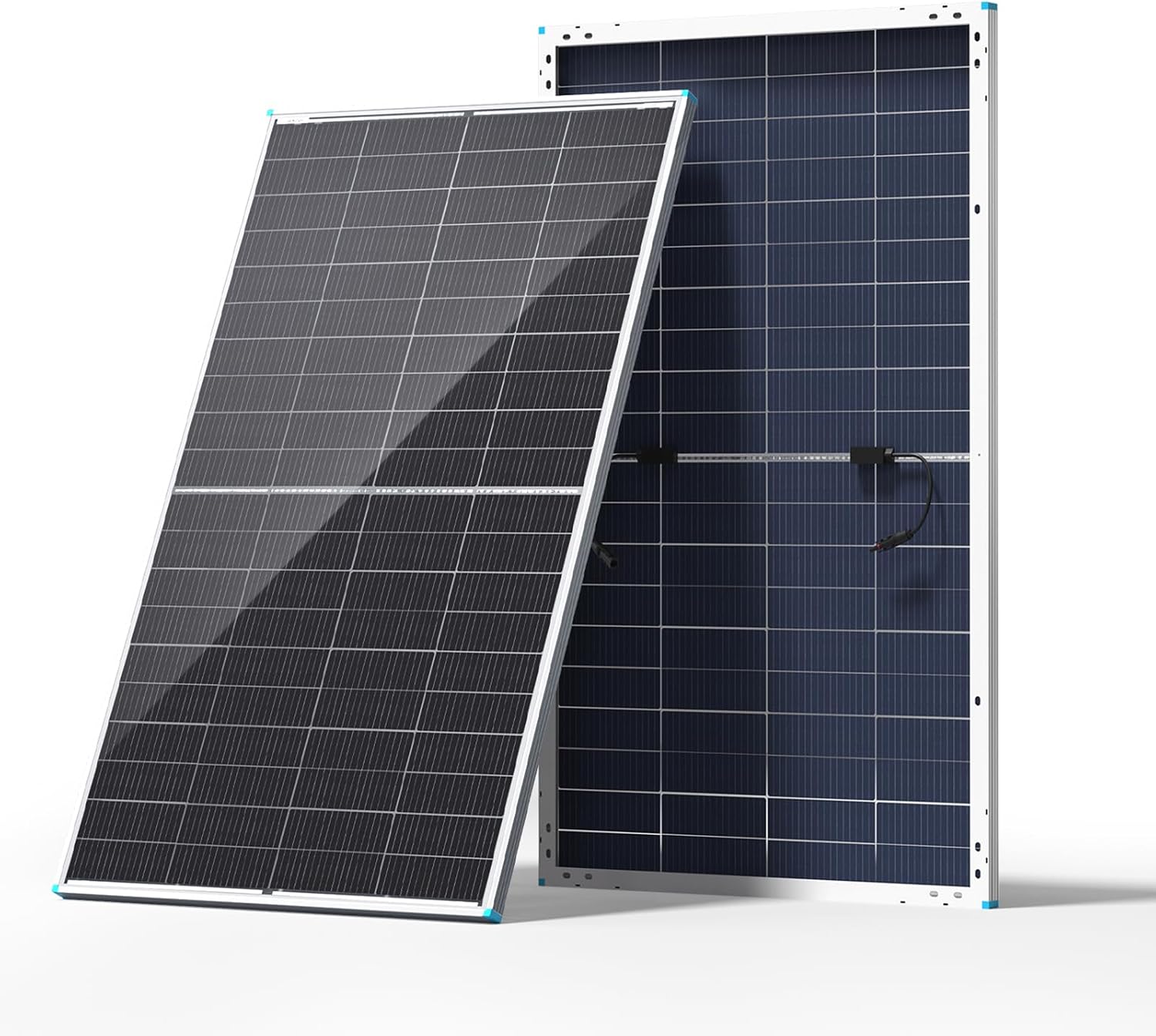
Renogy 200W N-Type Bifacial 16BB
Best Bifacial N-Type Panel for RV Rooftop Arrays.
Quick Verdict
The Renogy Bifacial Solar Panel 200W N-Type, 16BB 25% High-Efficiency is a rigid, dual-sided solar module designed to capture sunlight from both the front and rear surfaces. Unlike a conventional single-sided panel, its bifacial construction allows it to use reflected light reaching the rear side, potentially increasing energy production when the installation provides sufficient rear-side exposure. This makes it particularly relevant to RV owners evaluating rooftop solar layouts where panel clearance and surrounding reflective surfaces can support bifacial operation.
For RV owners building a solar array to support air conditioning, this panel offers an additional design consideration beyond its rated 200W output: how effectively the installation can expose its rear surface to reflected light. Its potential bifacial gain should not be treated as guaranteed production, especially when mounted close to an opaque RV roof. The panel still needs to work as part of a properly sized system with a compatible charge controller, adequate battery storage, and an inverter capable of handling the air conditioner’s running and startup demands.
Snapshot
| Parameter | Specification |
|---|---|
| Rated Power | 200W |
| Panel Type | Rigid Bifacial Monocrystalline |
| Cell Technology | N-Type, 16BB |
| Module Efficiency | 19.9% |
| Electrical Specs | Voc 29.6V; Vmp 25V; Isc 8.7A; Imp 8A |
| Weight | 22.71 lb |
Why We Chose It
We selected the Renogy Bifacial Solar Panel 200W N-Type, 16BB 25% High-Efficiency as Best Bifacial N-Type Panel for RV Rooftop Arrays because its dual-sided construction offers an additional opportunity to capture reflected sunlight. This makes it a distinct choice for RV owners whose roof installation provides sufficient rear-side exposure, allowing them to consider bifacial energy contribution when planning their solar array.
Check the latest price and customer reviews on Amazon.

Practical Considerations
At 51.7 × 30.1 inches and 22.71 lb, this rigid panel requires a suitable section of RV roof and secure mounting. Its rear surface also needs exposure to reflected light, so installation clearance and the surrounding roof surface affect how much additional energy the bifacial design can capture.
Before choosing this model, check whether the planned mounting arrangement leaves enough space behind the panel and whether the roof surface can provide useful reflected light. A close-fitting installation above an opaque surface may leave little opportunity to benefit from the panel’s rear-side design.
Evaluation
| Evaluation Factor | This Model | How It Compares | Buyer Implication |
|---|---|---|---|
| Rated Power | 200W | Same rated output as the other individual 200W panels; ECO-WORTHY provides 390W across two panels. | Adds 200W of rated capacity to a larger RV solar array. |
| Operating Voltage | 25V Vmp; 29.6V Voc | Lower than the other selected 200W panels, which have higher operating voltages. | Check series and parallel configurations against the charge controller's voltage and current limits. |
| Bifacial Design | Front- and rear-side light capture | Unlike the conventional Renogy rigid panel and the BougeRV flexible panel; its rear-side exposure is essential to the potential benefit. | Consider it when the mounting arrangement allows reflected light to reach the rear surface. |
| Roof Installation | 51.7 × 30.1 in; 22.71 lb | Slightly larger than the standard Renogy 200W panel and lighter than the Renogy ShadowFlux; much heavier than the flexible BougeRV. | Check roof space, mounting clearance, and weight limits before installation. |
Who Should Buy This
- RV owners building a fixed rooftop solar array who want bifacial N-Type technology.
- Buyers whose mounting setup provides sufficient clearance and reflected light for rear-side energy capture.
- RV owners looking for an individual 200W rigid panel with a lower operating voltage than the other selected 200W models.
Buyers whose roof can accommodate the panel’s dimensions and mounting requirements.
Who Should Skip This
- RV owners mounting panels close to an opaque roof with little opportunity for rear-side light exposure; a conventional rigid panel may be a more practical choice.
- Buyers who need a lightweight panel for a weight-sensitive roof; consider the BougeRV Arch Pro 200W Flexible.
- RV owners whose roof layout is frequently affected by partial shading and who specifically want a panel designed around shading mitigation; consider the Renogy ShadowFlux 200W.
Final Verdict
The Renogy Bifacial Solar Panel 200W N-Type, 16BB 25% High-Efficiency is a good fit for RV owners who can plan their rooftop installation around rear-side light exposure and want to make use of bifacial technology. Its main advantage is the opportunity to capture additional reflected sunlight; its main limitation is that this benefit depends on mounting conditions. Choose it when your roof layout allows meaningful rear-side exposure; otherwise, a conventional rigid panel may be a more straightforward choice.
Check the latest price and customer reviews on Amazon.
Related Guide: If you are planning a rooftop solar array for your RV, see our guide to Solar Panel Size Calculator: Calculate How Many Solar Panels You Need. It helps estimate the solar capacity required for your energy needs and determine how many panels your system may require.
Renogy ShadowFlux 200W
Best Panel for RV Roofs with Partial-Shading Exposure

Quick Verdict
The Renogy ShadowFlux Solar Panel 200 Watt, N-Type 25% High-Efficiency, is a rigid 200W solar panel designed for RV installations where rooftop equipment, trees, or nearby structures can cast shadows across the array. Its defining feature is Renogy’s ShadowFlux technology, which is designed to reduce power losses when parts of the panel are shaded. This makes it particularly relevant to RV owners whose roof layouts cannot provide consistently unobstructed sunlight.
For RV owners building or expanding a solar array to support air conditioning, the ShadowFlux offers a specialized option for layouts where some shading is difficult to avoid. However, it does not eliminate shading losses or guarantee full rated output under shaded conditions. Actual production still depends on the extent and position of the shade, sunlight exposure, and system configuration. The panel must also be integrated with a properly sized charge controller, battery bank, and inverter capable of handling the air conditioner’s running and startup demands.
Snapshot
| Specification | Details |
|---|---|
| Rated Power | 200W |
| Panel Type | Rigid Monocrystalline Solar Panel |
| Cell Technology | N-Type, 16BB |
| Module Efficiency | 20.7% |
| Operating Voltage (Vmp) | 31.3V |
| Open-Circuit Voltage (Voc) | 36.5V |
| Weight | 23.83 lb |
Why We Chose It
We selected the Renogy ShadowFlux Solar Panel 200 Watt as Best Panel for RV Roofs with Partial-Shading Exposure because it offers a feature specifically intended to address one of the installation challenges common to RV rooftops. The award recognizes its shading-focused design, not a higher rated output, lower weight, or broader installation versatility.
The other models serve different priorities: the standard Renogy provides a conventional rigid-panel option, the bifacial version is designed to capture additional light from its rear surface, the BougeRV prioritizes a flexible and lightweight format, and the ECO-WORTHY kit provides a two-panel configuration. ShadowFlux fills the remaining role in this lineup by giving buyers a dedicated option when rooftop shading is a key factor in panel selection.
Check the latest price and customer reviews on Amazon.

Practical Considerations
The panel’s practical value depends on the RV’s daily parking conditions and rooftop layout. Before installation, consider when shadows from the air conditioner, vents, or antennas are likely to cross the panel and how much unobstructed roof area remains. Buyers should also account for the panel’s weight and mounting requirements when planning the complete array. Its rated 200W output should not be treated as guaranteed production under real-world conditions.
Evaluation
| Evaluation Factor | This Model | How It Compares | Buyer Implication |
|---|---|---|---|
| Partial-Shading Technology | ShadowFlux cell-level technology | The only model in this lineup specifically designed to reduce partial-shading losses | Relevant for RV roofs where shading cannot be fully avoided |
| Electrical Compatibility | Vmp: 31.3V; Voc: 36.5V | Similar voltage range to the standard Renogy and BougeRV panels | Check charge controller limits and array configuration |
| Installation Requirements | Rigid panel; 23.83 lb | Heavier than the flexible BougeRV panel | Requires adequate roof support and secure mounting |
| Rated Output | 200W | Same individual panel rating as three other picks | Contributes to a larger array; does not independently run an RV air conditioner |
Who Should Buy This
- RV owners whose rooftop layout is exposed to unavoidable partial shading from equipment or nearby obstacles.
- Buyers who prioritize reducing shading-related power losses over minimizing panel weight or installation footprint.
- RV owners building a fixed rooftop array with a compatible MPPT charge controller.
- Buyers who can accommodate a conventional rigid panel weighing 23.83 lb.
Who Should Skip This
- RV owners with consistently unobstructed roof exposure who do not need shading-focused technology; the standard Renogy 200W N-Type may be a more straightforward choice.
- Buyers who need a lightweight or flexible panel for weight-sensitive or curved roofs; consider the BougeRV Arch Pro 200W Flexible.
- Buyers whose installation can benefit from rear-side reflected light; consider the Renogy 200W N-Type Bifacial instead.
Final Verdict
The Renogy ShadowFlux 200W is a specialized choice for RV owners whose installation conditions make shading performance an important selection factor. Its main trade-off is the combination of a conventional rigid-panel footprint and a weight of 23.83 lb, which may not suit every roof. If your RV has adequate mounting space and shading is a recurring concern, this model deserves consideration. If your roof receives mostly unobstructed sunlight, the standard Renogy 200W N-Type may be a simpler alternative.
Check the latest price and customer reviews on Amazon.
Related Guide: If you’re adding the ShadowFlux panel to an RV solar array, see our guide to Best Solar Charge Controllers (2026). It compares MPPT and PWM options and explains how to match a controller to your solar array.
BougeRV Arch Pro 200W Flexible
Best Lightweight Flexible Panel for Weight-Sensitive or Curved RV Roofs
Quick Verdict
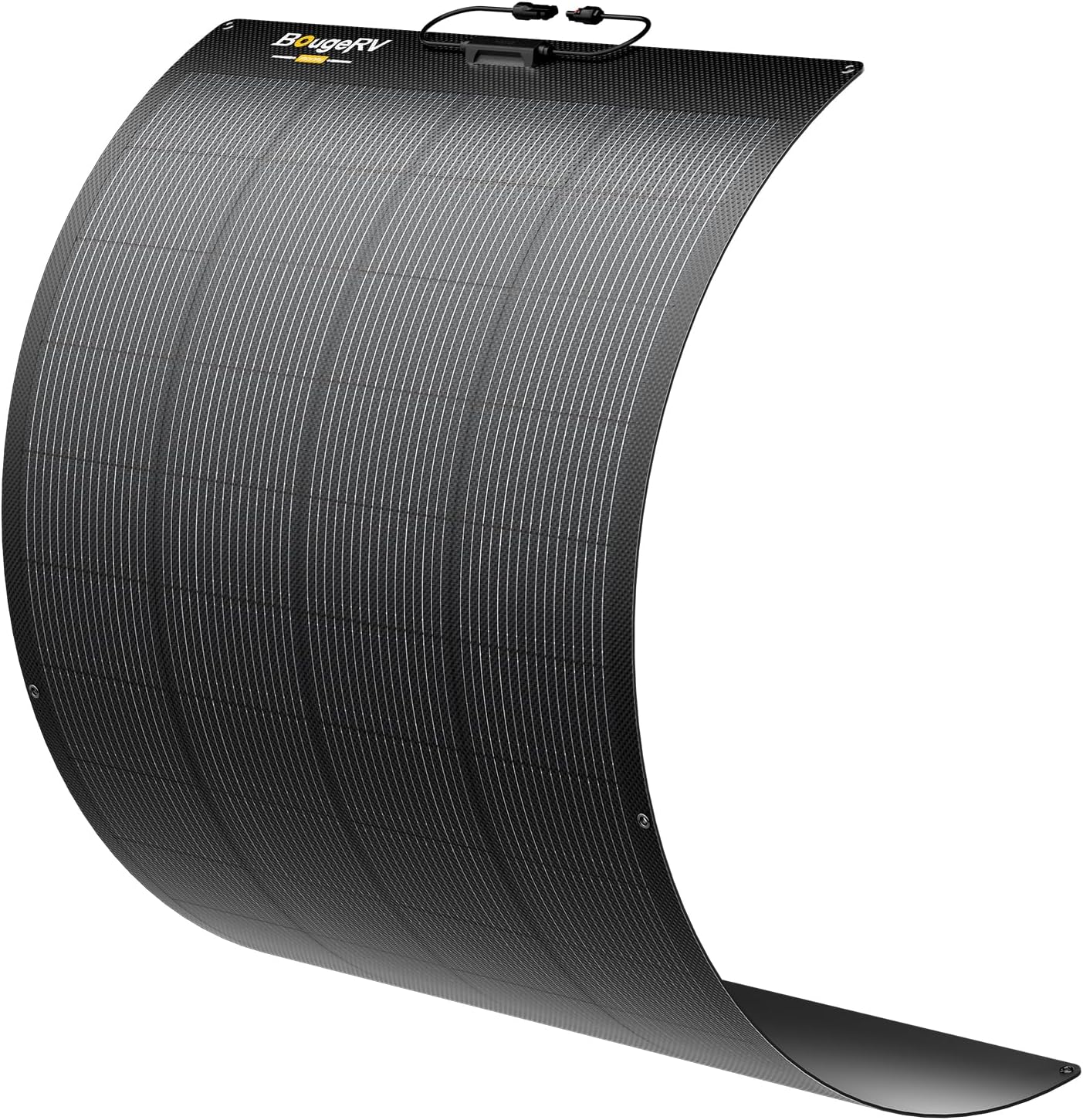
This panel is particularly suitable for RV owners who need to minimize rooftop weight or install solar on a compatible curved surface. At just 7.9 lb, it is substantially lighter than the rigid panels in our comparison. However, its flexible construction requires careful attention to the mounting surface and installation conditions. For an RV air-conditioning system, it should be viewed as one module in a properly sized solar array, supported by adequate battery storage, a compatible charge controller, and an inverter capable of handling the air conditioner’s running and startup demands.
Snapshot
| Specification | Details |
|---|---|
| Rated Power | 200W ±5% |
| Panel Type | Flexible Fiberglass Solar Panel |
| Cell Technology | N-Type TOPCon, 16BB |
| Cell Efficiency | 25% |
| Electrical Output | Vmp: 31.1V; Voc: 36.4V |
| Weight | 7.9 lb |
Why We Chose It
We selected the BougeRV Arch Pro 200W ShadePower N-Type Flexible Solar Panel as Best Lightweight Flexible Panel for Weight-Sensitive or Curved RV Roofs because it addresses an installation constraint that the rigid panels in this comparison cannot accommodate in the same way. Its flexible format provides an alternative for compatible roof surfaces where a conventional framed module may be difficult to position or mount.
This distinction matters when roof curvature, mounting geometry, or weight restrictions limit the use of standard rigid panels. The Renogy and ECO-WORTHY options are designed around rigid rooftop installation, while the BougeRV offers a different mounting approach without reducing the individual panel’s rated output below the 200W level used by the other single-panel picks. Its suitability still depends on the roof material and the manufacturer’s mounting requirements.
Check the latest price and customer reviews on Amazon.

Practical Considerations
For RV owners, this can simplify installation where roof weight or curvature limits panel choices. However, flexible panels require careful surface preparation and mounting; they should not be treated as freely bendable or suitable for every roof material. Buyers should follow BougeRV’s installation guidance and check the permitted mounting conditions before installation.
Evaluation
| Evaluation Factor | This Model | How It Compares | Buyer Implication |
|---|---|---|---|
| Weight & Flexibility | 7.9 lb; flexible fiberglass construction | Significantly lighter than the rigid panels in this lineup | Suitable for weight-sensitive RV roofs and compatible curved surfaces |
| Partial-Shading Design | ShadePower; 28 bypass diodes | Renogy ShadowFlux also features technology designed to reduce shading losses | Compare manufacturer shading claims and installation conditions |
| Electrical Compatibility | Vmp: 31.1V; Voc: 36.4V | Similar voltage range to the standard Renogy and ShadowFlux panels | Verify MPPT controller limits before configuring the array |
Who Should Buy This
- RV owners who need to minimize additional roof weight.
- Owners with compatible curved roof sections where rigid panels are difficult to install.
- Buyers who need a flexible 200W module for a custom rooftop solar array.
- RV owners whose installation may benefit from the panel’s partial-shading design.
Who Should Skip This
- Buyers with flat, unobstructed roofs who prefer conventional rigid panels; consider the standard Renogy 200W N-Type.
- RV owners who prioritize bifacial energy capture; consider the Renogy 200W N-Type Bifacial.
- Buyers who need a rigid module with conventional mounting rather than a flexible installation.
Final Verdict
The BougeRV Arch Pro 200W is the most practical choice in this lineup when roof weight and mounting flexibility are the primary constraints. Its 7.9 lb weight is a substantial advantage, but flexible construction also means installation conditions and surface compatibility require more attention than with a conventional rigid panel. Choose it when a lighter module or compatible curved-roof installation solves a real constraint; otherwise, a rigid panel may offer a more straightforward long-term rooftop solution.
Check the latest price and customer reviews on Amazon.
Related Guide: If you’re considering a lightweight solar installation for your RV, see our guide to Best Flexible Solar Panels (2026). It compares flexible panel options for RVs, camper vans, boats, and curved mounting surfaces, including their installation trade-offs.
ECO-WORTHY 195W N-Type 18BB Bifacial
Best Two-Panel 390W Set for Building Array Capacity

Quick Verdict
The ECO-WORTHY 195W N-Type 18BB Bifacial Solar Panel (2-Pack) is a two-panel rigid solar package designed for RV owners who want to add more rated solar output through a single purchase. Each panel delivers 195W, giving the set a combined rated output of 390W. Its N-Type monocrystalline cells, 18BB design, and bifacial construction make it an option for buyers considering a larger rooftop array with the potential to capture reflected sunlight from the rear side of the modules.
This set is particularly relevant to RV owners who have enough roof space and structural capacity to accommodate two rigid panels and want to expand an existing solar installation or build a larger array from the outset. However, the bifacial contribution depends on rear-side light exposure, which can be limited when panels are mounted close to an opaque RV roof. The combined panel weight is also 40.4 lb, so roof-load limits and mounting requirements should be checked before installation.
Snapshot
| Specification | Details |
|---|---|
| Rated Power | 195W per panel / 390W combined |
| Panel Type | Rigid Bifacial Monocrystalline |
| Cell Technology | N-Type, 18BB |
| Module Efficiency | 19.60% |
| Weight | 20.2 lb per panel / 40.4 lb total |
| Expansion | Two-panel package; 390W combined rated output |
Why We Chose It
We selected the ECO-WORTHY 195W N-Type 18BB Bifacial Solar Panel (2-Pack) as Best Two-Panel 390W Set for Building Array Capacity because it gives buyers a matched two-module package for expanding a fixed RV rooftop array. Rather than choosing two individual panels separately, buyers can start with a single listed package containing both modules. This makes it a relevant option for installations planned around a two-panel configuration.
Compared with the four individual panel options in this guide, the ECO-WORTHY set changes the purchasing and installation decision: buyers need to plan for two rigid modules, their combined roof footprint, total weight, and electrical configuration from the outset. Its advantage is therefore most relevant when the RV has enough usable roof area and load capacity for both panels. For installations with limited space or weight allowances, one of the individual modules may be easier to accommodate.
Check the latest price and customer reviews on Amazon.

Practical Considerations
The two-panel configuration requires more roof space and adds more weight than a single-module installation. Its bifacial design may also provide limited additional benefit when the panels are mounted close to an opaque RV roof, where little reflected light reaches their rear surfaces. Before installation, check the available mounting area, roof load capacity, and clearance around other rooftop equipment.
Evaluation
| Evaluation Factor | This Model | How It Compares | Buyer Implication |
|---|---|---|---|
| Combined Output | 390W (2 × 195W) | Highest combined rated output among the selected configurations | Provides more rated capacity per purchase than any individual panel in this lineup |
| Bifacial Design | N-Type, 18BB | Renogy also offers a bifacial panel | Rear-side gain depends on light exposure |
| Weight | 40.4 lb total | Heavier than any single-panel option | Check RV roof load limits |
| Electrical Output | Vmp: 20.2V; Voc: 21.2V per panel | Lower voltage than the other models | Verify charge controller compatibility |
Who Should Buy This
- RV owners building or expanding a rooftop array with a target output around 390W from two panels.
- Buyers who prefer purchasing two matched panels in one package.
- RV owners with sufficient roof space and load capacity for two rigid modules.
- Buyers whose installation allows some reflected light to reach the panels’ rear surfaces.
Who Should Skip This
- RV owners with limited roof space or strict weight restrictions — consider the BougeRV Arch Pro 200W Flexible.
- Buyers installing panels close to an opaque roof with little rear-side light exposure — consider a conventional rigid panel.
- RV owners who need a panel specifically designed for partial-shading conditions — consider the Renogy ShadowFlux 200W.
Final Verdict
The ECO-WORTHY 2-Pack is the strongest fit for RV owners who want 390W of combined rated output in one purchase rather than a single 200W module. Its main trade-off is the space and 40.4 lb total weight required for two rigid panels, while the practical bifacial benefit depends on rear-side light exposure. Choose it when expanding array output is the priority and your RV can accommodate both panels.
Check the latest price and customer reviews on Amazon.
Related Guide: Planning a larger RV solar array? Use our Solar Panel Size Calculator: Calculate How Many Solar Panels You Need to estimate the required array size and panel count based on energy demand, peak sun hours, and expected system losses. Use it as a starting point for planning your 390W setup; final sizing must account for your RV’s actual loads and installation conditions.
How Much Solar Power Do You Need to Run an RV Air Conditioner?
Before deciding how many solar panels your RV needs, estimate how much energy the air conditioner and other electrical loads consume each day. This is the starting point for sizing a solar array. The required capacity depends on the air conditioner’s running power, how long you use it, how frequently its compressor operates, and how much sunlight your RV receives.
If you are unsure about an appliance’s running and starting requirements, use our Appliance Wattage Calculator to estimate its power demand and energy consumption before sizing the solar system.
A useful starting formula is:
Daily AC Energy Use (Wh) = Running Power (W) × Cooling Time (hours) × Compressor Duty Cycle
The compressor duty cycle represents the percentage of the cooling period during which the compressor is actively running. For example, a 50% duty cycle over six hours means the compressor operates for approximately three hours in total. Actual duty cycle varies with outdoor temperature, RV insulation, thermostat settings, and cooling demand.
Example: Calculating Daily RV Air Conditioner Energy Use
Let’s use an illustrative RV air-conditioning scenario:
| Parameter | Value |
|---|---|
| AC Running Power | 1,400W |
| Cooling Period | 6 hours |
| Compressor Duty Cycle | 50% |
| Other RV Loads | 1,000Wh |
| Solar System Efficiency | 75% |
| Peak Sun Hours | 5 |
First, calculate the air conditioner’s daily energy consumption:
1,400W × 6 hours × 0.50 = 4,200Wh
Next, add the energy required by other RV appliances:
Total Daily Energy Use = Daily AC Energy Use + Other RV Loads
4,200Wh + 1,000Wh = 5,200Wh per day
In this example, the RV’s total daily energy consumption is approximately 5,200Wh, including the air conditioner and other electrical loads. The solar array must generate enough energy to replenish this consumption while accounting for system losses.
Calculating the Required Solar Array Size
To estimate the required rated solar capacity, use:
Solar Array Size (W) = Daily Energy Use (Wh) ÷ (Peak Sun Hours × System Efficiency)
Assuming five peak sun hours and an illustrative 75% system efficiency to account for solar-system losses:
5,200Wh ÷ (5 × 0.75) = approximately 1,387W
Under these assumptions, the RV would need a solar array with approximately 1,400W of combined rated panel capacity to offset the estimated daily energy consumption.
However, available sunlight makes a significant difference. If the same RV receives only three peak sun hours per day, the calculation changes:
5,200Wh ÷ (3 × 0.75) = approximately 2,311W
| Peak Sun Hours | Estimated Solar Array Size |
|---|---|
| 3 hours | 2,311W |
| 5 hours | 1,387W |
The difference shows why solar array sizing cannot rely on panel wattage alone. An installation that may cover the assumed daily demand under five peak sun hours could fall short under three peak sun hours.
What Can Change the Actual Solar Requirement?
These calculations are planning estimates, not guarantees of daily energy production. Actual requirements depend on several factors:
Outdoor temperature: Hotter conditions can increase cooling demand and compressor operating time.
RV insulation: Better insulation can reduce heat entering the living space and lower the compressor duty cycle.
Solar exposure: Cloud cover, shading, panel orientation, and available roof space affect daily generation.
Panel temperature: Solar modules generally produce less power as their operating temperature rises above standard test conditions.
Other electrical loads: Refrigerators, lighting, fans, and other appliances add to daily energy consumption.
The 75% system-efficiency figure is an illustrative planning assumption, not a universal performance rating or a guaranteed system value. Actual energy losses depend on the panels, charge controller, wiring, inverter, battery charging process, and overall system configuration. DC-powered appliances and AC appliances supplied through an inverter may experience different conversion losses, so a detailed system design should account for each load separately.
The key takeaway: Estimate daily energy consumption first, then calculate the solar array capacity needed to replenish that energy. Once you have a target wattage, you can determine how many panels your RV needs and whether the available roof space, battery bank, and charge controller can support the installation.
How Many Solar Panels Do You Need for an RV Air Conditioner?

Based on the illustrative calculation in the previous section, the RV would need approximately 1,400W of combined rated solar panel capacity to offset an estimated daily energy consumption of 5,200Wh under the assumed five peak sun hours and 75% system efficiency. The next step is to determine how many panels are needed to reach or exceed that target.
The number of panels required depends on each module’s rated wattage:
| Panel Rating | Panels Needed for ~1,400W | Actual Array Capacity |
|---|---|---|
| 100W | 14 | 1,400W |
| 175W | 8 | 1,400W |
| 200W | 7 | 1,400W |
| 220W | 7 | 1,540W |
| 400W | 4 | 1,600W |
These figures are based on rated panel wattage, with the number of modules rounded up to reach or exceed 1,400W. They represent nominal array power, not guaranteed daily energy production. Actual output depends on sunlight, panel orientation, temperature, shading, and system losses.
The five products compared in this guide include four individual panels rated at approximately 200W each and the ECO-WORTHY two-panel kit, which provides 390W of combined rated output. On paper, seven 200W panels would provide a combined rated output of 1,400W. However, this is a sizing reference, not a recommendation to install seven identical panels. The actual configuration depends on the selected products, available roof space, electrical compatibility, and installation constraints.
Before choosing a panel count, check three practical constraints:
- Available roof space: Account for the RV air conditioner, vents, antennas, and required mounting clearance.
- Electrical compatibility: Verify panel voltage and current against the charge controller’s limits and the intended series or parallel configuration.
- Installation weight: Calculate the combined weight of all panels and mounting hardware, then check the RV manufacturer’s roof-load guidance.
The key point: matching the array’s rated wattage to a calculated target is only the first step. The final panel configuration must also fit the RV roof and work safely with the charge controller and the rest of the electrical system.
What Size Battery Bank Do You Need for RV Air Conditioning?
Solar panels generate electricity during daylight, but the battery bank stores the energy needed to run an RV air conditioner when solar production is insufficient, including periods of cloud cover and nighttime operation. Its required size depends on the air conditioner’s energy consumption, other RV loads, and how much of the battery’s nominal capacity can safely be used.
Wh vs. Ah: Understanding Battery Capacity
Watt-hours (Wh) measure how much energy a battery stores. Amp-hours (Ah) measure its electrical charge capacity and must be considered together with battery voltage.
For example, a 100Ah battery does not have the same energy capacity at every voltage:
- 12.8V × 100Ah = 1,280Wh
- 25.6V × 100Ah = 2,560Wh
- 51.2V × 100Ah = 5,120Wh
This is why Wh is the more useful measurement when calculating how much energy an RV air conditioner needs.
To estimate the storage capacity required for your own loads and runtime target, use our Battery Capacity Calculator, which helps convert energy requirements into battery capacity in watt-hours and amp-hours.
Ah helps determine the required battery capacity once the system voltage is established.
Calculating the Required Battery Capacity
Let’s use the same illustrative daily energy demand from our solar array calculation. The following calculation provides a simplified baseline estimate of nominal battery capacity before accounting for inverter conversion losses and differences between AC and DC loads.
- Total Daily Energy Use: 5,200Wh;
- Assumed Usable Battery Capacity: 80%;
- Estimated Nominal Battery Capacity: 6,500Wh.
5,200Wh ÷ 0.80 = 6,500Wh
The battery bank needs approximately 6,500Wh of nominal energy capacity to provide 5,200Wh of usable energy under this assumption.
The equivalent amp-hour capacity varies with system voltage:
| Battery Voltage | Approximate Capacity |
|---|---|
| 12.8V | 508Ah |
| 25.6V | 254Ah |
| 51.2V | 127Ah |
These figures represent equivalent nominal energy storage, not three interchangeable battery configurations. The actual battery bank must be designed around compatible components and the electrical requirements of the RV system.
What Else Should You Check?
Nominal capacity alone does not determine whether a battery can run an RV air conditioner. Before choosing a battery bank, check:
- Usable capacity: The manufacturer’s recommended depth of discharge determines how much stored energy is available for regular use. An 80% usable-capacity assumption is an example, not a universal value.
- Continuous discharge current: The battery must deliver enough current to support the inverter and connected AC loads during normal operation.
- Battery Management System (BMS): Confirm that its continuous and peak current limits are compatible with the inverter’s requirements.
- Inverter losses: Energy is lost when DC battery power is converted to AC, so the battery may need to supply more energy than the AC appliances consume.
Important: A 6,500Wh battery bank is a simplified baseline estimate for the 5,200Wh daily energy scenario, not a final system-sizing recommendation. It does not account for inverter conversion losses or differences between AC and DC loads. The actual battery capacity may need to be higher, depending on which appliances run through the inverter, its conversion efficiency, the battery’s usable capacity, and the expected operating conditions. This estimate also does not guarantee a full day of air-conditioning operation or replace adequate solar generation.
Why Your RV Inverter Needs More Than Enough Running Watts
An RV air conditioner requires more than its normal operating power when the compressor starts. This brief increase in electrical demand is called startup surge. An inverter must be able to support both the air conditioner’s continuous running load and its short-duration startup demand.
When choosing an inverter, two ratings matter:
- Continuous power rating: the AC power the inverter can supply during normal operation.
- Surge power rating: the higher power it can deliver temporarily to handle startup loads.
As an illustrative example, an RV air conditioner drawing 1,400W while running requires an inverter capable of supporting that continuous load. However, the inverter must also handle the compressor’s startup demand, which can be substantially higher. Choosing an inverter based only on running watts can therefore lead to startup failures or inverter overload.
Continuous Rating, Surge Rating, and Other Loads
The inverter’s surge rating must be checked together with its specified overload duration. A high surge rating is not enough if the inverter can sustain it for less time than the compressor needs to start. Compare the manufacturer’s surge power and duration with the air conditioner’s startup requirements.
You should also account for appliances that may operate at the same time, such as a refrigerator, microwave, or other AC equipment. Their combined demand adds to the inverter load. The inverter must support the expected continuous load while retaining enough short-term surge capability for the air conditioner’s compressor.
Battery Voltage and Inverter Current
The battery bank voltage also affects how much current an inverter must draw to power an RV air conditioner. Because the inverter converts DC power from the batteries into AC power for the cooling system, the battery-side current can be substantial, especially in a 12V system.
For the same AC load, a lower battery voltage requires more DC current. A higher-voltage battery bank reduces the current needed to deliver the same power, but it does not increase the battery bank’s stored energy or reduce the air conditioner’s actual energy consumption.
For example, consider an RV air conditioner drawing 1,500W while running. Assuming 90% inverter efficiency, the approximate battery-side current would be:
| Battery Bank Voltage | Approximate DC Current |
|---|---|
| 12V | 139A |
| 24V | 69A |
These are illustrative estimates for a steady 1,500W AC load. Actual current depends on inverter efficiency and the battery voltage under load.
This difference matters because higher DC current places greater demands on battery cables, connections, overcurrent protection, and the battery management system (BMS). The battery bank and its BMS must be capable of supplying the required continuous current, while the inverter and DC-side components must also support the system’s operating and startup demands.
When planning an RV air conditioning system, check not only the inverter’s AC output rating but also its DC input voltage and the continuous current capacity of the batteries, BMS, cables, connections, and protection devices.
Do You Need a Soft Starter for Your RV Air Conditioner?
A soft starter can reduce the high initial current required by an AC compressor, making it easier for a suitably sized inverter or generator to handle startup. It does not, however, reduce the air conditioner’s normal running power.
A separate manufacturer example illustrates how a soft starter affects compressor startup requirements. According to Truma’s published specifications, the Aventa eco + SoftStartRV has the following ratings:
| Specification | Published Value |
|---|---|
| Cooling Capacity | 13,500 BTU/h |
| Power Consumption | 1,260W |
| Startup Current with SoftStartRV | 30A RMS / 150ms |
| Startup Current without SoftStartRV | 59A RMS / 150ms |
According to Truma, the integrated SoftStartRV reduces startup current from 59A to 30A RMS over 150 milliseconds. The published running power remains 1,260W.
This distinction matters when designing an RV solar system: a soft starter can make compressor startup easier for the inverter, but the battery bank and inverter must still support the air conditioner’s full operating demand.
Bottom line: Choose an inverter based on the air conditioner’s running power, startup requirements, and other simultaneous loads. Do not select it by continuous watts alone, and do not assume that installing a soft starter makes an undersized inverter suitable.
Can Solar Panels Run an RV Air Conditioner All Day?

Yes, solar power can support RV air conditioning for extended periods, but whether it can run all day depends on the complete electrical system—not just the solar panels. The array must generate enough energy to cover the air conditioner’s consumption and other RV loads, while the battery bank and inverter must handle periods of insufficient sunlight and compressor startup.
The feasibility also depends on when and how long you use the air conditioner. Short cooling periods require less stored energy than extended operation in hot weather. The following scenarios illustrate the differences.
Three RV Air Conditioning Scenarios
| Usage Scenario | What the System Needs | Practical Consideration |
|---|---|---|
| Short Cooling Periods | Adequately sized battery and solar array | Lower total daily energy demand makes solar-supported operation more achievable |
| Daytime Cooling | Sufficient solar generation plus battery support | Solar production varies with sunlight, temperature, shading, and weather |
| Extended Cooling in Hot Weather | Larger solar array, substantial battery storage, and suitable inverter | High energy demand can exceed available roof space and practical battery capacity |
Why Daytime Cooling Is Easier Than Nighttime Operation
During daylight hours, solar panels can supply electricity directly to the system while also recharging the battery bank. When solar production temporarily falls below the air conditioner’s demand, the battery can provide the difference.
At night, solar generation stops. The battery must supply the air conditioner and other electrical loads for the entire cooling period. This increases the amount of stored energy required, particularly if the compressor operates frequently.
A larger battery can extend operating time, but it cannot replace the energy consumed. The solar array must eventually generate enough electricity to replenish the battery and cover ongoing loads.
What Affects Real-World Air Conditioner Runtime?
Several conditions determine how much energy an RV air conditioner actually consumes:
- Outdoor temperature: Higher temperatures can increase cooling demand and compressor operating time.
- RV insulation: Better insulation helps reduce heat entering the living space, potentially lowering the compressor duty cycle.
- Roof temperature and solar exposure: Direct sunlight heats the RV roof and can increase the cooling load.
- Thermostat settings: Lower temperature settings may cause the compressor to operate more frequently.
- Weather and shading: Cloud cover, partial shading, and changing sunlight reduce solar generation, sometimes requiring the battery to supply more energy.
These factors explain why the same solar installation can deliver different operating results from one day to another.
Why a Calculated Solar Array Does Not Guarantee Continuous Cooling
A calculated solar array size provides a planning estimate, not a guarantee of continuous air conditioner operation. The estimate is based on expected daily energy consumption, peak sun hours, and an assumed system efficiency. It represents the amount of energy the system needs to generate over a typical day, but it does not mean that solar production will match the air conditioner’s power demand at every moment.
Solar generation and electricity consumption do not always occur at the same rate. An air conditioner may draw more power than the panels are producing at a particular time, even when the array is expected to generate enough energy over the full day. The battery bank must supply this difference and store enough energy to cover periods when solar generation is insufficient.
For this reason, system sizing must account for both the total daily energy balance and the battery’s ability to support temporary power shortfalls. A system that meets its estimated daily energy target may still struggle to maintain continuous cooling if its battery capacity, inverter output, or available solar generation cannot support the actual operating pattern.
The bottom line: Meeting a calculated daily energy target does not automatically guarantee uninterrupted air conditioning. Reliable operation depends on whether solar generation, battery storage, and inverter capacity work together to meet both the system’s total energy demand and its changing power requirements.
RV Roof Space, Panel Weight, and Installation Constraints
A solar array may meet your calculated wattage requirements on paper but still be impractical to install on an RV roof. Available space, panel dimensions, total weight, rooftop equipment, and mounting limitations all affect how many modules your RV can accommodate.
Check Available Roof Space
Before choosing a panel configuration, measure the usable roof area rather than the total roof dimensions. Several components can restrict panel placement:
- Rooftop air conditioner: Its housing and required clearance can occupy a significant portion of the roof.
- Vents and skylights: These limit the available mounting area and may cast shadows on nearby panels.
- Antennas and other equipment: Satellite dishes, communication equipment, and roof accessories can restrict panel placement.
- Roof edges and access points: Installation must preserve appropriate clearance for mounting, maintenance, and roof access.
The goal is to identify the actual space available for solar modules while accounting for their dimensions and mounting hardware.
Account for Panel Weight
Panel weight becomes increasingly important as the array grows. Seven 200W rigid panels may provide approximately 1,400W of combined rated output, but their total weight can make the installation unsuitable for some RV roofs.
For example, seven panels weighing approximately 23 lb each would add around 161 lb in panel weight alone. Mounting hardware and other installation components add further weight.
Before installation, check the RV manufacturer’s roof-load guidance and any applicable structural limitations. Do not assume that a roof capable of supporting occasional foot traffic can automatically accommodate a permanently mounted solar array.
Rigid vs. Flexible Solar Panels
The choice between rigid and flexible panels involves more than weight. Construction, mounting requirements, roof compatibility, and available installation space all matter.
| Consideration | Rigid Solar Panels | Flexible Solar Panels |
|---|---|---|
| Construction | Framed modules | Thin, flexible modules |
| Weight | Generally heavier | Generally lighter |
| Mounting | Requires suitable mounting hardware | Requires a compatible mounting surface and approved installation method |
| Roof Shape | Best suited to suitable mounting areas | Can fit some compatible curved surfaces |
| Main Consideration | Roof space, weight, and mounting clearance | Surface compatibility and installation conditions |
Rigid panels are generally a practical choice for larger RV rooftop arrays when the roof can support their weight and mounting requirements. Flexible panels may be useful when reducing roof weight or accommodating a compatible curved surface is a priority. However, flexible construction does not mean a panel can be bent freely or installed on every RV roof.
For a closer comparison, see our guides to Best Rigid Solar Panels (2026) and Best Flexible Solar Panels (2026).
Why Seven 200W Panels May Not Fit Your RV
A calculated requirement of approximately 1,400W does not mean seven 200W modules will physically fit on every RV. The panels may occupy more usable roof area than expected once you account for their dimensions, rooftop equipment, mounting clearance, and shading.
Even if the available area is sufficient, the combined panel and mounting weight must remain within the RV manufacturer’s specified limits. Electrical compatibility must also be checked before connecting the modules into a single array.
The bottom line: Determine how much roof space and weight capacity your RV can realistically provide before finalizing the solar array. If the calculated panel count exceeds those limits, the system design needs to be reconsidered rather than forcing additional modules onto the roof.
How to Configure an RV Solar Array: Series vs. Parallel

When connecting multiple solar panels to an RV solar system, the wiring configuration affects the array’s voltage and current. The two most common options are series and parallel connections.
The charge controller also affects how the array operates. For a closer explanation of the two main controller technologies, see MPPT vs. PWM Solar Charge Controllers: Which Is Better for Your System?
Choosing the right configuration is important because the solar charge controller must be able to handle the array’s electrical output safely.
Series vs. Parallel Solar Panel Connections
The main difference is how voltage and current behave when panels are connected.
| Configuration | Voltage | Current | Main Consideration |
|---|---|---|---|
| Series | Adds together | Remains the same as one panel | Higher voltage; check the controller's maximum PV input voltage |
| Parallel | Remains the same | Adds together | Higher current; check the controller's input current limits |
In a series connection, the positive terminal of one panel connects to the negative terminal of the next. The panel voltages add together, while the current remains approximately at the level of the lowest-current panel in the string.
In a parallel connection, positive terminals connect together and negative terminals connect together. Voltage remains approximately the same as one panel, while the currents add together.
Why Voc and Vmp Matter
Two electrical specifications are particularly important when planning an array:
- Open-Circuit Voltage (Voc): The maximum voltage a panel produces when it is not connected to a load. It is essential for checking the charge controller’s maximum PV input voltage.
- Operating Voltage (Vmp): The voltage at which the panel produces its rated maximum power under specified test conditions. It helps determine the array’s operating voltage and compatibility with the controller.
When panels are connected in series, their Voc and Vmp values add together. In parallel, these voltage values remain approximately at the level of one panel.
Temperature also matters. Solar panel Voc increases as cell temperature decreases. In cold conditions, the combined open-circuit voltage of a series array can exceed its expected value under standard test conditions. The array must therefore be designed so its calculated cold-weather Voc remains below the controller’s maximum PV input voltage.
Check Your MPPT Charge Controller Limits
Before connecting panels, verify that the charge controller supports the planned array configuration. Check:
- Maximum PV input voltage, including the cold-weather Voc calculation.
- Maximum PV input current.
- Maximum permitted solar array power.
- Required operating voltage for battery charging.
- Permitted series and parallel configurations.
Exceeding the controller’s electrical limits can damage equipment or create unsafe operating conditions. The controller manufacturer’s specifications should determine the permitted configuration.
Why Panels with the Same Wattage Are Not Automatically Compatible
A panel’s rated wattage does not tell you whether it can be safely or efficiently connected with another model. Two 200W panels can have different operating voltages and currents, even when their nominal power ratings are identical.
For example, the five panels compared in the first part of this guide have different electrical specifications:
| Panel Model | Rated Power | Vmp | Voc |
|---|---|---|---|
| Renogy 200W N-Type 16BB | 200W | 31.03V | 37.44V |
| Renogy 200W N-Type Bifacial 16BB | 200W | 25V | 29.6V |
| Renogy ShadowFlux 200W | 200W | 31.3V | 36.5V |
| BougeRV Arch Pro 200W Flexible | 200W | 31.1V | 36.4V |
| ECO-WORTHY 195W N-Type 18BB | 195W | 20.2V | 21.2V |
These differences matter when designing series or parallel strings. Panels with mismatched electrical characteristics can operate away from their individual maximum power points, reducing array performance. The ECO-WORTHY package also contains two 195W panels, so its electrical configuration must be assessed separately from the individual 200W modules.
Mixing different panel models is not automatically prohibited, but it requires careful electrical design. Where panels have substantially different specifications, separate MPPT inputs or charge controllers may be more appropriate than combining them in the same string.
The bottom line: Choose the wiring configuration based on panel voltage and current, cold-weather Voc, and the charge controller’s limits—not simply the number or wattage of panels. Before connecting modules from different manufacturers or product series, verify their electrical compatibility and follow the controller manufacturer’s installation requirements.
Common Buying Mistakes When Choosing Solar Panels for RV Air Conditioning

Choosing solar panels for an RV air-conditioning system involves more than comparing wattage and prices. These are some of the most common buying mistakes to avoid.
Choosing Panels by Wattage Alone
Two panels with the same rated output can differ in module efficiency, voltage, current, dimensions, and construction. Comparing wattage alone can lead to a purchase that does not fit your installation requirements.
Treating Manufacturer Performance Claims as Guaranteed Output
Claims about bifacial energy gains or improved partial-shading performance depend on installation conditions. A bifacial panel may provide limited additional energy when its rear surface receives little reflected light, while shading-focused technology cannot eliminate all power losses.
Choosing Flexible Panels Without Checking Roof Compatibility
A lightweight flexible panel may seem ideal for an RV, but not every flexible module is suitable for every roof surface. Mounting requirements, surface compatibility, and manufacturer installation instructions should be checked before purchasing.
Ignoring the Total Installation Weight
Comparing the weight of individual panels without calculating the complete array can underestimate the installation load. Mounting hardware and additional components also contribute to the total weight, which must be considered against the RV manufacturer’s roof-load guidance.
Buying Panels Without Considering Future System Expansion
A panel purchase should fit not only the initial installation but also the intended expansion plan. Adding more modules later may require a different controller configuration, additional mounting space, or changes to the electrical layout. Check compatibility and expansion limits before committing to a particular panel combination.
What to Prioritize Before Buying
Choose panels based on their documented electrical specifications, construction, installation requirements, and suitability for your RV roof. Consider manufacturer performance claims in the context of your actual mounting conditions, calculate the total installation weight, and check whether the selected modules can support your planned system configuration. The best panel is not necessarily the one with the highest wattage or the lowest price, but the one that fits the complete RV solar system.
Frequently Asked Questions
Can You Run an RV Air Conditioner Directly from Solar Panels?
Not with a typical rooftop solar setup. Solar panels produce DC electricity, while most RV air conditioners require AC power. A compatible charge controller, battery bank, and inverter are normally needed to regulate, store, and convert the electricity. Specialized direct-solar systems are possible, but they require equipment designed for that purpose.
Can You Use Solar Power and a Generator Together to Run an RV Air Conditioner?
Yes. An RV can use solar panels and a generator as complementary power sources. Depending on the system design, solar can supply available energy while the generator powers the air conditioner or recharges the battery bank when solar production is insufficient. The inverter, charger, and transfer equipment must be configured for the intended power sources.
Does a Soft Starter Reduce the Energy an RV Air Conditioner Uses?
No. A soft starter reduces the compressor’s initial electrical demand during startup, helping an inverter or generator handle the starting load. It does not significantly reduce the air conditioner’s normal running power or the energy required to maintain cooling.
Can You Add More Solar Panels to an Existing RV Solar System?
Yes, provided the existing charge controller, wiring, mounting system, and battery setup can accommodate the additional panels. Check the controller’s maximum PV voltage, input current, and permitted array wattage. New panels must also be electrically compatible with the existing array, particularly when connected in the same series string.
Do RV Solar Panels Produce Less Power in Hot Weather?
Yes. Solar panels generally produce less electrical power as their cell temperature rises above standard test conditions. This means an RV rooftop array may deliver less output on a very hot day, even under strong sunlight. The actual reduction depends on the panel’s temperature coefficient, operating temperature, and installation conditions.
Are Ground-Mounted Portable Solar Panels Useful for RV Air Conditioning?
They can help supplement a rooftop array when roof space is limited. Ground-mounted panels can be positioned in a sunnier location and adjusted as needed, but they require additional setup space, suitable wiring, and a compatible charge controller or input. Their contribution also depends on sunlight, cable length, and the electrical limits of the system.
Final Verdict
The best solar panel for an RV air-conditioning system depends on your roof space, weight limits, shading conditions, and electrical configuration. The Renogy 200W N-Type 16BB is the most straightforward choice for a conventional rooftop array, while the other models address more specific installation needs. Ultimately, choose panels that fit your RV and work with a properly sized battery, charge controller, and inverter. No individual panel can guarantee reliable air-conditioning performance on its own.
Our Recommendation
- If your priority is a straightforward rigid rooftop installation: Choose the Renogy 200W N-Type 16BB.
If you want bifacial technology and your installation allows rear-side light exposure: Choose the Renogy 200W N-Type Bifacial 16BB.
If partial shading is difficult to avoid: Choose the Renogy ShadowFlux 200W.
If low weight and compatibility with a curved roof are essential: Choose the BougeRV Arch Pro 200W Flexible.
If you want 390W of combined rated output from two panels: Choose the ECO-WORTHY 195W N-Type 18BB two-panel set.
Before purchasing, confirm that the selected panels fit your RV roof and are electrically compatible with your charge controller.
Related Guides
Planning an RV solar system involves more than choosing the panels. These guides cover the key components and calculations that help you build a compatible setup.
Solar Panel Size Calculator: Calculate How Many Solar Panels You Need — Estimate the required solar array capacity and panel count based on energy consumption, peak sun hours, and expected system losses.
Best Solar Charge Controllers (2026) — Compare MPPT and PWM controllers and find an option compatible with your solar array and battery system.
Battery Capacity Calculator — Estimate the battery capacity needed to support your RV air conditioner’s energy demand and desired runtime.
Best Flexible Solar Panels (2026) — Explore additional flexible panel options for RVs and other installations where weight or roof curvature limits conventional rigid panels.
Power Ready Guide Commitment
At Power Ready Guide, our goal is to help readers make informed decisions about power solutions through clear explanations, careful product research, and practical guidance.
We prioritize accurate specifications, transparent comparisons, and realistic expectations. We distinguish manufacturer claims from verified information, explain important limitations, and never present estimated performance as guaranteed results.
Our recommendations are based on the needs of real-world applications—not marketing claims alone. We aim to give every reader the information needed to understand the trade-offs, evaluate compatibility, and choose a solution with confidence.
Power Ready Guide — Clear information. Practical guidance. Smarter power decisions.