
Running an RV air conditioner from a portable power station sounds simple until you look at what the air conditioner actually needs. A rooftop A/C does not just consume a certain number of watts while it is running — its compressor can require a much higher burst of power when it starts. The battery capacity also determines how long the system can keep the A/C running once the compressor is operating.
That makes choosing the right power station more complicated than simply buying the model with the highest wattage or the largest battery. You need enough inverter output to handle the A/C’s operating and startup demands, enough usable battery capacity for your expected runtime, and the right connection for your RV. Solar input, recharge speed, and compatibility with 30-amp or 50-amp RV electrical systems can also make a significant difference, especially when you are camping without shore power.
In this guide, we compare five current portable power stations specifically for RV air conditioning and explain how each one handles the demands of a compressor-driven A/C. We focus on the specifications that determine whether a power station can start the air conditioner, sustain its operating load, and provide enough stored energy for the runtime you need.
The goal is not simply to identify the power station with the biggest numbers. It is to help you determine which model best matches your RV air conditioner’s power requirements, startup demand, expected runtime, and electrical connection.
As an Amazon Associate, I earn from qualifying purchases.
Table of Contents
Quick Answer
The best portable power station for an RV air conditioner depends on the A/C’s running wattage, compressor startup demand, desired runtime, and your RV’s electrical connection. A high-output power station can provide the inverter capacity needed to start and run a rooftop A/C, but battery capacity determines how long the air conditioner can actually operate.
For this guide, we selected five current models covering different RV power and runtime needs: Anker SOLIX F3800, EF EcoFlow DELTA Pro 3, BLUETTI Apex 300, Jackery HomePower 3600 Plus, and DJI Power 2000. We selected five current models representing different combinations of inverter output, battery capacity, RV compatibility, and portability.
Among these models, the larger-capacity units are particularly relevant when your priority is running an RV air conditioner for longer periods, while the DJI Power 2000 represents a more compact approach when portability matters more than extended runtime. The Anker SOLIX F3800, EF EcoFlow DELTA Pro 3, BLUETTI Apex 300, and Jackery HomePower 3600 Plus offer substantially more power and battery capacity for demanding RV applications.
Before choosing any of them, however, check your specific air conditioner’s running watts and startup requirements. The same power station can be a practical solution for one RV A/C and a poor fit for another.
In the sections below, we explain how to determine whether a portable power station can start your RV air conditioner, keep it running, and provide enough runtime for your trip. We also compare the five selected models by power output, battery capacity, charging, RV connectivity, and intended use.
Why You Can Trust Power Ready Guide
Choosing a portable power station for an RV air conditioner requires more than comparing battery capacity or maximum output. Compressor-driven appliances have different power requirements at startup and during normal operation, and the practical result depends on how those specifications work together.
At Power Ready Guide, we evaluate portable power stations using manufacturer specifications, product documentation, electrical principles, and the requirements of the equipment they are intended to power. For this guide, we focused specifically on the factors that affect RV air conditioner operation rather than treating these models as general-purpose power stations.
Our evaluation considers continuous AC output, surge capability, battery capacity, charging performance, RV connectivity, expandability where relevant, and the relationship between available battery energy and expected A/C runtime. We also consider practical limitations that can be easy to overlook, such as the difference between starting a compressor and keeping it running for several hours.
We do not claim personal ownership, laboratory testing, or hands-on testing of these five power stations unless explicitly stated. Product recommendations are based on the available technical information and how each model fits specific RV air-conditioning use cases.
This approach matters because there is no single power station that is ideal for every RV. A model that provides enough inverter power to start an A/C may still offer less runtime than you need, while a large battery may be unnecessary if your priority is short periods of cooling rather than extended off-grid operation.
What Makes a Portable Power Station Suitable for an RV Air Conditioner?
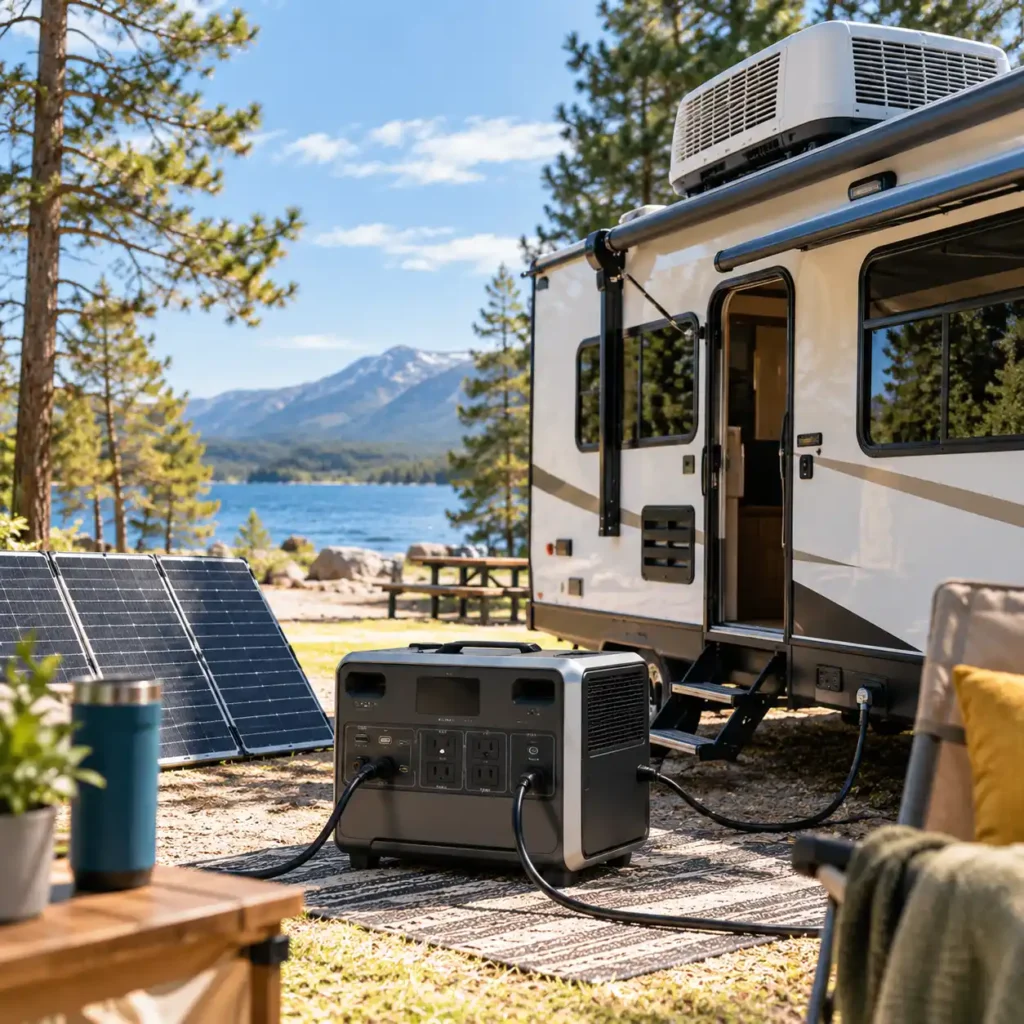
Not every portable power station that can run household appliances is suitable for an RV air conditioner. An A/C compressor creates a more demanding electrical load than many of the devices typically connected to a portable battery, so several specifications need to be considered together.
Continuous AC Output
The first requirement is enough continuous inverter output to handle the air conditioner’s normal operating load. If the A/C requires more power than the inverter can continuously provide, the power station may shut down or refuse to supply the load.
A higher continuous output also gives you more flexibility if other RV appliances are running at the same time. However, buying substantially more inverter capacity than your RV actually needs does not automatically provide longer A/C runtime.
Startup or Surge Capacity
The compressor can require a temporary increase in power when the air conditioner starts. This is why maximum or surge output matters in addition to the continuous rating.
A power station may have enough continuous output for an A/C’s running load but still struggle with compressor startup if its surge capability is insufficient. A soft-start device installed on the RV air conditioner can reduce the compressor’s startup demand, but it does not increase the battery’s stored energy.
Battery Capacity
Battery capacity, measured in watt-hours (Wh), determines how much energy the power station can store.
This is fundamentally different from inverter output. A 4,000-watt inverter does not mean the battery can deliver 4,000 watts for one hour. Runtime depends on the battery’s usable energy and the A/C’s actual average power consumption.
For example, a 2,000 Wh battery connected to an air conditioner averaging 1,400 W would have a theoretical runtime of about 1.4 hours before accounting for inverter losses, reserve capacity, and changes in compressor load. Actual runtime will therefore be shorter.
RV Electrical Compatibility
The power station also needs to work with the RV’s electrical configuration. Depending on the RV and air conditioner, this can involve 30-amp or 50-amp connections, 120-volt or 120/240-volt systems, and different approaches to connecting the portable power station.
A power station having a high wattage rating does not by itself guarantee that it can supply every RV electrical configuration. The connection method and the electrical architecture of the RV need to be checked separately.
Solar Input and Recharge Capability
Solar charging becomes particularly useful when you are camping without shore power and want to extend the amount of time you can use the air conditioner.
The important specifications include maximum solar input, supported voltage and current ranges, and how the station handles charging while other loads are operating. If you are also comparing the solar hardware needed for an off-grid RV setup, see our Best Portable Solar Panels (2026) guide. Solar panels will not necessarily keep an RV air conditioner running continuously, especially during periods of weak sunlight or high A/C demand, but they can help replenish the battery between periods of use.
The Three Questions That Matter Most
When evaluating a portable power station for an RV air conditioner, separate the decision into three questions:
Can it start the A/C?
This depends primarily on the inverter’s continuous and surge capabilities and the compressor’s startup demand.
Can it keep the A/C running?
This depends on whether the station can continuously supply the A/C’s operating load without exceeding its output limits.
How long can it run the A/C?
This depends primarily on usable battery capacity, actual A/C consumption, inverter efficiency, compressor duty cycle, and other loads connected to the power station.
Keeping these three questions separate prevents one of the most common mistakes in RV power planning: assuming that a high wattage rating automatically means long runtime.
Our Evaluation Philosophy
A portable power station for an RV air conditioner should be evaluated differently from a general camping power station. The ability to run a phone, refrigerator, lights, or small appliances does not tell you whether the unit is a practical match for a compressor-driven A/C.
For this guide, we focused on the specifications and characteristics that directly affect RV air-conditioning use.
Inverter Output
We looked at continuous AC output first because the inverter must be able to handle the air conditioner’s normal operating load. Higher output can also provide more headroom when other appliances are operating at the same time.
Surge capability was evaluated separately because compressor startup can temporarily require substantially more power than normal operation.
Battery Capacity and Runtime Potential
Battery capacity is one of the most important factors once the A/C is running. We compared the available watt-hours of each model and considered how that capacity translates into practical runtime rather than treating the advertised Wh figure as guaranteed operating time.
Actual runtime can vary with A/C size, thermostat settings, outdoor temperature, compressor duty cycle, inverter losses, and other loads connected to the power station.
RV Compatibility
We considered how naturally each model fits an RV electrical system, including available AC outlets, higher-power connections, voltage configuration, and RV-oriented features where applicable.
A power station can have impressive electrical specifications and still require additional equipment or a particular connection method for a specific RV setup. That distinction is important when comparing these models.
Charging and Solar Capability
For off-grid RV use, the ability to recharge the battery can be almost as important as its initial capacity. We therefore considered AC charging and solar charging capabilities where they materially affect the usefulness of the system.
Solar charging is especially relevant for extended trips because it can replenish some of the energy consumed by the A/C between periods of operation. However, solar input should be viewed as a way to extend energy availability rather than as a guarantee that an RV air conditioner can run indefinitely from solar power alone.
Portability and Physical Practicality
More battery capacity and inverter power generally mean a larger and heavier power station. We therefore considered portability as part of the overall evaluation rather than treating maximum output as the only measure of usefulness.
This matters particularly for RV owners who need to move the power station between the RV, campsite, storage area, or another location.
Expandability
Where a model supports additional batteries or other expansion options, we considered how that affects longer-term RV use. Expandability can be valuable when the initial battery capacity is sufficient for shorter trips but additional runtime may become important later.
However, expansion should not be treated as an automatic advantage. Additional batteries increase the overall cost, weight, and physical footprint of the system.
Practical Trade-Offs
Finally, we considered what each power station gives up in exchange for its particular strengths.
A larger system may provide substantially more battery capacity and inverter headroom but be harder to move. A more compact model may be easier to handle but provide less runtime for a demanding A/C load. A model with strong RV connectivity may be more convenient for one electrical setup while offering less value to someone with a different configuration.
That is why the five models in this guide are not evaluated simply by comparing their largest numbers. The objective is to identify which combination of inverter output, startup capability, battery capacity, RV electrical compatibility, charging capability, and portability makes sense for a particular RV air-conditioning scenario.
Who This Guide Is For
This guide is for RV owners who want to use a portable power station to run an air conditioner and need help determining which type of system fits their A/C, RV electrical setup, and expected runtime.
It is particularly useful if you are:
- Camping without shore power and want to use your RV air conditioner without relying on a campground electrical hookup.
- Boondocking or dry camping and need battery power specifically for RV air conditioning while managing the additional electrical loads that operate alongside the A/C.
- Traveling in an RV and want to understand whether a portable power station can start and continuously operate your rooftop air conditioner.
- Choosing between different power station sizes and need to understand the difference between inverter output, startup surge, and battery capacity.
- Planning longer off-grid stays and want to use solar charging to replenish some of the energy consumed by the air conditioner.
- Replacing or supplementing a generator for RV air conditioning and want to understand the trade-offs between battery power and generator-based cooling.
- Trying to match a power station to a specific RV A/C and want to check running watts, compressor startup requirements, RV connections, and expected runtime before buying.
If you need a portable power station for broader RV use beyond air conditioning, see our Best Portable Power Stations for RV (2026) guide.
This guide is not intended for RV owners who need to power an entire large RV indefinitely from a portable battery without considering energy consumption, charging, or battery expansion. It is also not a substitute for checking the electrical requirements of your specific air conditioner and RV before connecting a portable power station.
The goal is to help you identify the portable power station that fits your actual RV air-conditioning requirements, electrical configuration, desired runtime, and portability needs rather than simply choosing the model with the highest wattage or largest battery.
Quick Summary: Our Top Picks
If you’re looking for the best portable power station for an RV air conditioner without reading every detailed review, the summary below highlights our top recommendations for different power requirements, battery capacities, RV configurations, and portability needs.
Our selections are based on continuous AC output, surge capacity, battery capacity, RV compatibility, charging capability, solar input, portability, expandability, and practical suitability for running an RV air conditioner. Each model serves a different type of RV owner, making it easier to choose a portable power station that matches your actual A/C requirements.
Anker SOLIX F3800
Award: Best Overall for RV Air Conditioners
Why It Won:
Combines high continuous AC output, substantial battery capacity, strong surge capability, and RV-friendly connectivity. It provides considerable electrical headroom for demanding compressor loads while also offering the battery capacity needed for longer A/C sessions.
Choose This If:
- You want substantial power for a demanding RV air conditioner.
- You need a large battery capacity for longer off-grid use.
- You want a power station that can also handle other high-demand RV loads.
Best For:
- RV air conditioning
- Boondocking
- High-demand RV power
- Extended off-grid use
EF EcoFlow DELTA Pro 3
Award: Best High-Capacity RV Power Station
Why It Won:
Combines a 4,096 Wh battery with 4,000 W of AC output, giving it a strong balance of stored energy and inverter capacity. It is particularly well suited to RV owners who need substantial power reserves for air conditioning and other electrical loads.
Choose This If:
- You want high battery capacity for RV A/C use.
- You need strong continuous AC output.
- You want additional power for other demanding RV appliances.
Best For:
- Extended RV trips
- Air conditioning
- High-demand appliances
- Off-grid RV use
BLUETTI Apex 300
Award: Best RV-Focused Power Station
Why It Won:
Combines high inverter output and substantial battery capacity with RV-oriented connectivity. Its 3,840 W AC output and 2,764.8 Wh battery make it a particularly relevant option for RV owners who want a battery system designed around mobile power needs.
Choose This If:
- RV compatibility is a major priority.
- You need high inverter output for an air conditioner.
- You want dedicated RV-oriented connections and features.
Best For:
- RV air conditioning
- RV electrical systems
- Boondocking
- High-demand mobile power
Jackery HomePower 3600 Plus
Award: Best RV and Home Backup Combination
Why It Won:
Combines 3,600 W of AC output with a 3,584 Wh battery, making it useful beyond the RV. Its capacity and output provide a practical balance for buyers who want one portable power system that can support RV air conditioning and serve as a larger backup power source at home.
Choose This If:
- You want one system for RV and home use.
- You need substantial battery capacity for A/C operation.
- Versatility matters as much as portability.
Best For:
- RV air conditioning
- Home backup
- Extended camping
- Multi-purpose backup power
DJI Power 2000
Award: Best Compact High-Output Option
Why It Won:
Offers 3,000 W of stable AC output in a more compact package with a 2,048 Wh battery. It is a practical option for RV owners who need enough inverter capacity for an appropriate A/C setup but place greater emphasis on portability and a smaller overall system.
Choose This If:
- Portability is important.
- You want high inverter output without moving to a larger power station.
- Your expected A/C use does not require the largest available battery capacity.
Best For:
- Compact RV setups
- Shorter A/C sessions
- Camping
- Portable RV power
Best Portable Power Stations for RV Air Conditioners Compared
The table below compares the five selected portable power stations using the specifications that matter most when your primary goal is running an RV air conditioner.
| Model | Battery Capacity | Continuous AC Output | Surge Output | Best For |
|---|---|---|---|---|
| Anker SOLIX F3800 | 3,840 Wh | 6,000 W | 9,000 W | High-demand RV A/C and extended off-grid use |
| EcoFlow DELTA Pro 3 | 4,096 Wh | 4,000 W | 8,000 W | High-capacity RV power and longer A/C sessions |
| BLUETTI Apex 300 | 2,764.8 Wh | 3,840 W | 7,680 W | RV-focused power and high-output A/C use |
| Jackery HomePower 3600 Plus | 3,584 Wh | 3,600 W | 7,200 W | RV and home backup versatility |
| DJI Power 2000 | 2,048 Wh | 3,000 W | — | Compact RV power and shorter A/C sessions |
The most important distinction is between power output and stored energy. The Anker SOLIX F3800 has the highest continuous output in this group, while the EF EcoFlow DELTA Pro 3 has the largest battery capacity. Those are different advantages: inverter output affects whether the power station can handle the electrical load, while battery capacity affects how long the stored energy can support that load.
The BLUETTI Apex 300 occupies a middle position in battery capacity while offering high inverter output and RV-oriented connectivity. The Jackery HomePower 3600 Plus combines substantial battery capacity with 3,600 W of output and is particularly relevant if the same system will also be used for home backup. The DJI Power 2000 has the smallest battery in this group, but its 3,000 W output makes it a different proposition from a low-output compact power station.
These figures should not be interpreted as a guarantee that any model will start every RV air conditioner. The actual compatibility depends on the A/C’s running load, compressor startup requirement, RV electrical configuration, and connection method.
The Best Portable Power Stations for RV Air Conditioners Reviewed
Anker SOLIX F3800
Best Overall for RV Air Conditioners

Quick Verdict
The Anker SOLIX F3800 stands out in this group because it combines a high 6,000 W continuous AC output with a 3,840 Wh battery and up to 9,000 W of surge capacity. That combination gives it substantial electrical headroom for demanding RV air conditioners while also providing a large energy reserve for longer off-grid use.
For RV owners, the important advantage is the separation between starting power and stored energy. The high inverter output helps address the short, demanding startup event from a compressor, while the 3,840 Wh battery provides the energy needed to continue running the A/C after startup.
It is also a substantial system rather than a lightweight camping battery. That makes the F3800 more appropriate for RV owners who prioritize air-conditioning capability and longer runtime over minimizing the size and weight of the power station.
Snapshot
| Feature | Details |
|---|---|
| Battery Capacity | 3,840 Wh |
| Continuous AC Output | 6,000 W |
| Surge Output | 9,000 W |
| Battery Chemistry | LiFePO4 |
| RV Connectivity | RV port; NEMA 14-50 and L14-30 connections |
| Solar Input | Up to 2,400 W |
| Weight | Approximately 132 lb |
| Best For | High-demand RV A/C and extended off-grid use |
Why We Chose It
The F3800 stands out because its strengths are concentrated in the areas that matter most when a portable power station is being asked to support an RV air conditioner.
The first is inverter capacity. With 6,000 W of continuous AC output, the F3800 has considerably more output capability than many portable power stations designed primarily for smaller recreational loads. That additional capacity can provide useful headroom when the air conditioner is operating alongside other RV appliances.
The second is surge capability. An RV air conditioner’s compressor can create a short startup demand that is significantly higher than its normal operating consumption. The F3800’s 9,000 W surge rating gives the system substantial short-term output capability. However, this should not be interpreted as a guarantee that every RV air conditioner will start successfully. The specific A/C startup requirement still needs to be checked.
The third is battery capacity. The F3800 stores 3,840 Wh, which is important because inverter output and runtime are separate considerations. A high-wattage inverter can handle a large load, but only the battery’s stored energy determines how long that load can be supported.
The F3800 also supports up to 2,400 W of solar input and can be expanded with additional battery capacity. That makes the system more relevant for longer off-grid RV trips, where the objective is not simply to start the A/C but to replenish energy after using it.
Its RV-oriented connections are another practical advantage. Anker specifically positions the F3800 for direct RV power use, making it more naturally suited to this application than a power station designed only around standard household outlets.
Overall, the F3800 is not simply the highest-output option in the group. It is a particularly strong match for the combination of RV air conditioning, high electrical loads, and extended off-grid use.
Check the latest price, availability, and customer reviews on Amazon.

Living With It at Camp
The F3800 makes the most sense when the power station is treated as part of the RV’s overall electrical system rather than as a small portable battery for occasional device charging.
Imagine arriving at a campsite without shore power on a hot afternoon. The air conditioner is likely to be one of the largest electrical loads in the RV, while the refrigerator, lighting, electronics, and other appliances may continue to draw power. A high-output system such as the F3800 gives the RV owner considerably more electrical headroom than a small 1,000- or 2,000-watt-class battery.
The wheels and handles are particularly relevant here because the F3800 is a substantial 132-lb unit. It is portable in the sense that it can be moved around a campsite or positioned for RV use, but it is not designed around effortless hand carrying.
That distinction matters. If you expect to lift your power station into and out of the RV frequently, a smaller model may be easier to live with. If the system will remain in or near the RV for most of the trip, the F3800’s size becomes less of a practical drawback.
Solar charging also changes the ownership equation during longer trips. The F3800 can accept substantial solar input, allowing some of the energy used by the A/C and other loads to be replenished during daylight hours. Solar generation will vary with weather, panel orientation, available panel capacity, and the RV’s location, so it should be considered a way to extend available energy rather than a guarantee of continuous air-conditioning operation.
For RV owners who want one substantial battery system capable of supporting air conditioning and other demanding appliances, this is where the F3800’s larger physical footprint starts to make practical sense.
Evaluation
| Evaluation Area | Anker SOLIX F3800 | RV A/C Relevance | Strength | Trade-Off |
|---|---|---|---|---|
| Continuous AC Output | 6,000 W | Provides substantial headroom for demanding RV air conditioners and other loads running at the same time. | Very high inverter capacity | More capacity than some RV owners may need |
| Startup Capability | Up to 9,000 W surge | Leaves significant headroom for compressor startup and other short-duration power demands. | Strong startup margin | High output contributes to a larger, heavier unit |
| Battery Capacity | 3,840 Wh | Provides a substantial energy reserve for A/C operation, although actual runtime depends on load and operating conditions. | Strong balance of capacity and output | Runtime still depends heavily on A/C load |
| RV Connectivity | RV port, NEMA 14-50, and L14-30 | Offers flexible connection options for RV and other high-power applications. | RV-oriented connectivity | Connection method must match the RV's electrical setup |
| Portability | Approximately 132 lb | Best suited to RV setups where the power station can remain in a relatively fixed location rather than being moved frequently. | Large-capacity system | Heavy for routine manual transport |
Who Should Buy This
- RV owners who want substantial inverter capacity for a demanding air conditioner.
- Boondockers who need significant battery capacity without immediately adding external batteries.
- RV owners who want to support the A/C alongside other high-demand appliances.
- Buyers who value high continuous output and substantial surge capacity.
- Users who want the option to expand battery capacity for longer off-grid use.
- RV owners who can accommodate a large, wheeled 132-lb power station.
Who Should Skip This
- Buyers who primarily need a lightweight power station for short camping trips.
- RV owners whose A/C has relatively modest power requirements and does not justify a 6,000 W-class system.
- Anyone who expects to regularly carry the power station by hand.
- Buyers whose main priority is minimizing purchase cost and physical size.
- RV owners who have not yet checked their specific A/C’s startup and running requirements.
Final Verdict
The Anker SOLIX F3800 earns our Best Overall for RV Air Conditioners position because it provides an unusually large amount of inverter headroom while maintaining a substantial 3,840 Wh battery in a single mobile system.
Its 6,000 W continuous output and 9,000 W surge capacity give it a strong electrical foundation for demanding RV loads, while the 3,840 Wh LFP battery, 2,400 W solar input, RV connectivity, and expandable battery architecture make it particularly relevant to extended off-grid use.
The compromise is physical size. At approximately 132 lb, the F3800 is not the choice for someone who wants a small battery that can be casually carried around a campsite. Its design makes more sense for an RV owner who is willing to accept a larger system in exchange for substantially greater electrical capacity.
Most importantly, the F3800 should not be selected solely from its wattage numbers. Before buying, check the specific RV air conditioner’s running consumption, compressor startup requirement, RV connection, and the amount of runtime you actually need.
For RV owners who prioritize high power, substantial battery capacity, RV compatibility, and extended off-grid capability, the Anker SOLIX F3800 is our Best Overall for RV Air Conditioners.
Check the latest price and customer reviews on Amazon.
Related Guide: If you want to compare other portable battery systems for broader RV applications, see our Best Portable Power Stations for Home Backup (2026) guide for a wider look at RV-oriented power stations.
EF ECOFLOW DELTA Pro 3
Best High-Capacity RV Power Station

Quick Verdict
The EF EcoFlow DELTA Pro 3 is a strong choice for RV owners who want a large energy reserve for air conditioning and other off-grid loads without stepping up to the maximum inverter output of the Anker SOLIX F3800.
Its 4,096 Wh LFP battery is the largest capacity among the five power stations in this guide, while the 4,000 W continuous AC output and 8,000 W surge rating provide substantial power for demanding RV appliances. EcoFlow also supports up to 2,600 W of solar input and expansion with additional batteries, giving the DELTA Pro 3 a clear advantage when the goal is to extend usable energy rather than simply maximize inverter output.
At 113.5 lb, however, this is a substantial piece of equipment rather than a lightweight portable power station. It makes the most sense for RV owners who have the space to accommodate it and who value battery capacity and expandable energy storage over maximum portability.
Snapshot
| Feature | Details |
|---|---|
| Battery Capacity | 4,096 Wh |
| Continuous AC Output | 4,000 W |
| Surge Output | 8,000 W |
| Battery Chemistry | LFP |
| RV / Off-Grid Use | Designed for homes, RVs, and off-grid applications |
| Solar Input | Up to 2,600 W |
| Expandable Capacity | Supports up to two DELTA Pro 3 Smart Extra Batteries |
| Weight | Approximately 113.5 lb |
Why We Chose It
The EF DELTA Pro 3 earns its place in this guide for a different reason than the Anker SOLIX F3800.
The key advantage is its 4,096 Wh battery capacity. That gives it the largest built-in energy reserve among the five models reviewed here. For RV air-conditioning use, battery capacity matters because the power station has to supply energy not only when the compressor starts, but throughout the entire period that the A/C is operating.
The EF DELTA Pro 3 combines that large battery with 4,000 W of continuous AC output and an 8,000 W surge rating. That provides a substantial operating margin for an RV A/C while also leaving room for other electrical loads, assuming the specific air conditioner and RV electrical system are compatible.
Its solar input is another important part of the picture. EcoFlow specifies up to 2,600 W of solar charging input, which can make a meaningful difference during extended off-grid stays where the power station needs to be replenished during the day. The system can also be expanded with additional batteries when the standard 4,096 Wh capacity is not enough for the intended use.
This is why we see the EF DELTA Pro 3 primarily as a high-capacity energy solution rather than simply a high-output power station.
Check the latest price and customer reviews on Amazon.

Living With It
The EF DELTA Pro 3 is best thought of as a substantial onboard energy system rather than something you casually move around a campsite.
At approximately 113.5 lb, the unit is considerably heavier than compact power stations. EcoFlow does provide wheels and an integrated handle design to make movement easier, but its size and weight still matter when deciding where it will live in an RV and how often you expect to move it.
For RV air-conditioning use, that physical size can make sense. The larger battery provides more energy to work with, and the system can be paired with substantial solar input when conditions allow. This makes the EF DELTA Pro 3 particularly interesting for dry camping and longer off-grid stays where the objective is to reduce dependence on shore power.
The important distinction is that 4,096 Wh does not translate directly into a fixed number of hours of A/C runtime. Actual runtime depends on the air conditioner’s running wattage, compressor duty cycle, inverter losses, ambient temperature, and other loads running at the same time.
For example, an air conditioner averaging 1,400 W would theoretically consume 1,400 Wh per hour. A 4,096 Wh battery therefore represents about 2.9 hours of idealized energy at that constant load before accounting for conversion losses and reserve capacity. Real-world runtime would be lower and can vary substantially depending on conditions.
That distinction is important: the EF DELTA Pro 3 gives you a larger energy reserve, but it does not eliminate the need to calculate your actual RV A/C load.
Evaluation
The EF EcoFlow DELTA Pro 3 stands out in this group because it combines a large 4,096 Wh battery with 4,000 W of continuous AC output. That gives it a different balance from the Anker SOLIX F3800, which provides more inverter headroom, but has a slightly smaller 3,840 Wh built-in battery.
For RV air-conditioning use, that distinction matters. The EF DELTA Pro 3 is not the highest-output model in this group, but it offers the largest built-in battery capacity of the five models reviewed here. Its 8,000 W peak output also provides substantial surge capacity, although the actual startup requirements of the specific RV air conditioner still need to be checked.
| Evaluation Area | DELTA Pro 3 | RV A/C Relevance | Where It Stands Out | Trade-Off |
|---|---|---|---|---|
| Battery Capacity | 4,096 Wh | Large energy reserve for extended off-grid use | Largest built-in battery in this group | Higher weight and size |
| Continuous AC Output | 4,000 W | Provides substantial capacity for an RV A/C plus additional loads | Higher continuous output than the Jackery HomePower 3600 Plus and DJI Power 2000 | Less continuous output than the Anker SOLIX F3800 |
| Surge Output | 8,000 W | Provides substantial startup headroom for compressor loads | Strong peak-output capability | Does not guarantee compatibility with every A/C startup load |
| Solar Input | Up to 2,600 W | Useful for replenishing energy during extended dry camping | High solar-input capacity with separate high- and low-voltage PV inputs | Actual solar production depends on panel configuration and conditions |
| Expandability | Supports up to two DELTA Pro 3 Smart Extra Batteries | Allows substantially more stored energy when longer runtime is required | Strong option for extended off-grid energy needs | Additional batteries increase system size and cost |
The EF DELTA Pro 3’s strongest advantage is the balance between battery capacity and output. It does not offer the highest continuous inverter output in this group, but its 4,096 Wh battery, 8,000 W surge capability, strong solar input, and expandable capacity make it particularly well suited to RV owners who prioritize longer off-grid operation over maximum inverter headroom.
Who Should Buy This
- Want a large built-in battery capacity for longer off-grid operation.
- Need enough continuous output for a demanding RV air conditioner plus additional appliances.
- Plan to use solar charging during extended dry-camping or boondocking trips.
- Want the option to expand the system with additional batteries.
- Prefer a large-capacity system over a lighter, easier-to-carry power station.
- Want one power station that can serve both RV and broader backup-power needs.
- It is particularly relevant when energy capacity is the limiting factor rather than inverter output.
Who Should Skip This
The EF DELTA Pro 3 may not be the right choice if:
- You need the highest possible continuous inverter output from a single unit.
- Your RV setup prioritizes minimum weight and maximum portability.
- Your A/C has a startup requirement that exceeds what the station and your specific electrical configuration can support.
- You only need short periods of A/C operation and do not benefit from the larger 4,096 Wh battery.
- You are looking for a compact power station that can be easily moved in and out of an RV.
And as with every model in this guide, the power station should not be selected based on wattage alone. You still need to check the specific RV air conditioner’s running load, startup requirement, electrical connection, and any soft-start equipment before assuming compatibility.
Final Verdict
The EF EcoFlow DELTA Pro 3 earns the Best High-Capacity RV Power Station designation because its strongest argument is straightforward: it gives RV users the largest built-in battery reserve among the five models in this comparison while still providing a substantial 4,000 W continuous output.
That makes it especially compelling for off-grid RV use where the question is not simply whether a power station can start the air conditioner, but how much usable energy is available after the A/C starts and how easily that energy can be replenished.
The Anker SOLIX F3800 remains the more powerful option in terms of continuous inverter output, but the DELTA Pro 3 takes a different approach: more stored energy, strong output, substantial solar input, and expandable capacity.
For RV owners who value longer energy availability and have the space for a large power station, that is a meaningful distinction.
Check the latest price and customer reviews on Amazon.
Related Guide: If you want to compare portable power stations for your RV beyond air-conditioning use, our Best Portable Power Stations for RV (2026) guide looks at battery capacity, AC output, charging performance, solar compatibility, portability, and expandability for different RV travel and off-grid scenarios.
BLUETTI Apex 300
Best RV-Focused Power Station

Quick Verdict
The BLUETTI Apex 300 earns our Best RV-Focused Power Station award because its design is particularly well aligned with the way many RV owners actually use portable power.
Rather than simply maximizing battery capacity or inverter output, the Apex 300 puts a strong emphasis on RV-specific connectivity and electrical flexibility. It provides up to 3,840 watts of continuous AC output, 7,680 watts of peak power, and a 2,764.8 Wh LiFePO₄ battery. More importantly for RV use, the system includes dedicated 30A and 50A RV connections, allowing compatible RV electrical systems to connect directly without relying entirely on household-style outlets or improvised adapter setups.
The Apex 300 also supports 120V/240V output and can accept up to 2,400 watts of standard solar input. That combination makes it especially interesting for RV owners who want a power station that can become part of a more integrated off-grid electrical setup rather than simply acting as a large battery with AC outlets.
Its main limitation is battery capacity. At 2,764.8 Wh, the Apex 300 stores less energy than the EF EcoFlow DELTA Pro 3 and slightly less than the Anker SOLIX F3800. For longer A/C sessions, that difference can matter. The advantage is that BLUETTI designed the Apex 300 as an expandable system, allowing additional battery modules to be added when the base capacity is no longer sufficient.
At approximately 83.78 lb, it is still a substantial piece of equipment, but it is lighter than the largest power stations in this comparison.
For RV owners, therefore, the Apex 300 is less about having the biggest number on the specification sheet and more about having a purpose-built combination of output, RV connectivity, solar charging, and expandable storage.
Snapshot
| Feature | Details |
|---|---|
| Battery Capacity | 2,764.8 Wh |
| Continuous AC Output | 3,840 W |
| Peak Output | 7,680 W |
| Battery Chemistry | LiFePO₄ |
| RV Connectivity | Dedicated 30A and 50A RV connections; 120V/240V output capability |
| Solar Input | Up to 2,400 W standard solar input |
| Expandable Capacity | Supports additional BLUETTI battery modules |
| Weight | Approximately 83.78 lb |
| Best For | RV owners who prioritize direct RV connectivity and an expandable off-grid power system |
Why We Chose It
The BLUETTI Apex 300 stands out because it approaches RV power from the perspective of system compatibility, not just raw battery capacity.
For an RV owner, the difference between having a high-powered portable battery and having a power station that integrates naturally with the RV’s electrical system can be significant. The Apex 300 includes dedicated 30A and 50A connections and supports 120V/240V output, giving it a level of RV-oriented connectivity that is central to its position in this guide.
That matters particularly when the power station is being used to support a rooftop air conditioner. The A/C is only one part of the RV electrical system, and the owner may also want to operate a refrigerator, battery charger, microwave, coffee maker, or other appliances. The Apex 300’s 3,840 W continuous output provides substantial capacity for these combined loads, provided the actual loads remain within the system’s limits.
Its 7,680 W peak capability is also relevant when evaluating compressor-based appliances. However, we would not interpret the peak figure as a guarantee that every RV air conditioner will start successfully. Actual compressor startup demand varies by A/C model, operating conditions, and any soft-start equipment installed in the RV.
The second reason we chose the Apex 300 is its expandable architecture. The base 2,764.8 Wh battery is not the largest in this comparison, but BLUETTI allows additional battery modules to be added. That gives RV owners the option to start with a manageable base system and expand the energy reserve as their off-grid needs become more demanding.
Solar charging further strengthens that approach. The Apex 300 accepts up to 2,400 W through its standard solar inputs, which gives RV owners substantial potential for replenishing the battery during sunny off-grid stays. Actual charging performance, of course, depends on panel configuration, sunlight, shading, temperature, and the rest of the solar setup.
The result is a power station that makes particular sense for someone building an RV-centered off-grid power system, rather than simply looking for the largest battery they can bu
Check the latest price and customer reviews on Amazon.

Living With It
The Apex 300 is substantial enough that it should be treated as part of the RV’s equipment rather than as something you casually carry around the campsite. At approximately 83.78 lb, it requires some planning for storage and transport, but it remains lighter than the Anker SOLIX F3800 and EF EcoFlow DELTA Pro 3.
Where the Apex 300 becomes more interesting is once it is connected to the RV itself.
The dedicated RV connections can make the system feel much more integrated than a conventional portable power station connected through a collection of household adapters. For a compatible RV setup, the ability to connect through 30A or 50A infrastructure gives the owner a more direct way to use the station as a central AC power source.
That is particularly useful during dry camping. Instead of thinking about the power station as something that powers one appliance at a time, the Apex 300 can serve as the central AC source while the RV owner manages total electrical demand across the system.
The 2,764.8 Wh battery does require realistic expectations, however. Running an RV air conditioner is an energy-intensive application, and battery capacity determines how long the system can continue supplying that load after the compressor starts. The Apex 300’s expandable architecture helps address this limitation, but adding batteries also increases the overall size, weight, and cost of the system.
For longer off-grid trips, solar becomes an important part of the equation. With up to 2,400 W of standard solar input, the Apex 300 can be configured around a substantial solar array, although real-world solar production will always depend on conditions rather than the panel’s rated wattage alone.
That combination — RV-specific connectivity, strong inverter output, expandable storage, and substantial solar input — is what makes living with the Apex 300 different from simply carrying a large battery into an RV.
Evaluation
The BLUETTI Apex 300 takes a different approach from the other power stations in this lineup. Its main advantage is not having the largest battery or the highest continuous output. Instead, it combines substantial inverter capacity with an RV-oriented electrical design and a modular expansion path.
For an RV air conditioner, that distinction can be important. The Apex 300 provides 3,840 W of continuous output and 7,680 W of peak power, giving it substantial electrical capacity for compatible A/C systems and other RV loads. Its dedicated RV connections also make it particularly relevant for owners who want the power station to function as part of the RV’s electrical system rather than simply power individual appliances through standard AC outlets.
| Evaluation Area | Apex 300 | RV A/C Relevance | Where It Stands Out | Trade-Off |
|---|---|---|---|---|
| RV Connectivity | 30A and 50A RV connections | Designed to integrate more directly with compatible RV electrical systems | One of the most RV-focused connection layouts in this group | Compatibility still depends on the RV's specific electrical configuration |
| Continuous Output | 3,840 W | Provides substantial capacity for an RV A/C and additional loads | High inverter output without moving into the largest power-station class | Lower continuous output than the Anker SOLIX F3800 and EcoFlow DELTA Pro 3 |
| Peak Output | 7,680 W | Provides substantial headroom for startup loads | Strong peak capability for compressor-based equipment | Peak rating alone cannot guarantee that a specific A/C will start |
| Expandable Storage | Supports additional B300K batteries | Allows the energy reserve to grow when longer A/C runtime is needed | Modular approach can turn the base unit into a larger off-grid system | Additional batteries increase total system size, weight, and cost |
| Solar Capability | Up to 2,400 W standard solar input | Useful for replenishing battery energy during extended off-grid stays | Strong solar input complements its expandable architecture | Actual solar production depends on panel setup and conditions |
The strongest reason to choose the Apex 300 is therefore its RV-centered system design. If direct RV connectivity and future expansion are more important to you than having the largest built-in battery, the Apex 300 offers a distinctive combination.
The trade-off is its 2,764.8 Wh base capacity. That is enough to make the Apex 300 a serious RV power system, but it does not provide the same starting energy reserve as the 4,096 Wh DELTA Pro 3. For extended A/C operation, expansion or solar replenishment may therefore become an important part of the overall setup.
Who Should Buy This
The BLUETTI Apex 300 is a strong fit for:
- RV owners who want a power station designed around RV electrical connectivity.
- Users who want direct 30A or 50A connections for a compatible RV setup.
- Boondockers who want to build an expandable off-grid power system over time.
- RV owners who need substantial inverter output for an air conditioner and other appliances.
- Buyers who expect their energy requirements to grow and want the option of adding battery capacity later.
- Users who plan to combine a power station with a substantial solar array for extended off-grid travel.
- Buyers who prefer an RV-focused system rather than a general-purpose portable battery.
The Apex 300 is particularly interesting if you are thinking beyond one appliance and want to build a more complete RV power system.
Who Should Skip This
The Apex 300 may not be the best fit if:
- Your priority is the largest built-in battery capacity among the models in this guide.
- You need the highest continuous inverter output from a single unit.
- You only need short periods of A/C operation and have no use for RV-specific connectivity or expansion.
- You want the lightest possible power station for frequent manual carrying.
- You do not need 30A or 50A RV connections.
- Your RV air conditioner has a startup requirement that has not been verified against the Apex 300 and the rest of your electrical setup.
It is also worth remembering that adding expansion batteries changes the practical size and weight of the system. The modular design is an advantage only if you actually benefit from the additional stored energy.
Final Verdict
The BLUETTI Apex 300 earns our Best RV-Focused Power Station award because it approaches the RV air-conditioning problem as part of a larger electrical system.
Its 3,840 W continuous output and 7,680 W peak capability give it substantial power for demanding RV loads, while the dedicated RV connections make the system particularly relevant to owners who want a more direct connection to their RV’s electrical infrastructure.
Its 2,764.8 Wh base battery is the main limitation compared with higher-capacity options such as the EF EcoFlow DELTA Pro 3. But the Apex 300’s modular architecture changes the equation: owners who need more energy can expand the system rather than replacing the entire power station.
That makes the Apex 300 particularly compelling for RV owners who value integration and scalability. It is not the model we would choose simply because it has the biggest battery or the highest wattage. Its appeal comes from how those capabilities are combined with RV-specific connectivity and an expandable off-grid architecture.
As always, the final decision should be based on the actual electrical requirements of your RV air conditioner, including running wattage, compressor startup demand, voltage, connector type, and the runtime you need.
Check the latest price and customer reviews on Amazon.
Related Guide: If you want to compare portable power stations for your RV beyond air-conditioning use, our Best Portable Power Stations for RV (2026) guide compares battery capacity, AC output, charging performance, solar compatibility, portability, and expandability for different RV travel and off-grid scenarios.
Jackery HomePower 3600 Plus
Best RV and Home Backup Combination

Quick Verdict
The Jackery HomePower 3600 Plus earns our Best RV and Home Backup Combination award because it occupies a practical middle ground between a dedicated RV power system and a larger home backup solution.
Its 3,584 Wh LiFePO₄ battery and 3,600 W rated AC output give it enough capacity for a wide range of demanding RV loads, including many air-conditioning setups when the specific A/C requirements are within the station’s limits. Jackery also specifies a 7,200 W surge rating, giving the system substantial peak-power capability for startup loads.
What makes the HomePower 3600 Plus different from the other models in this guide is its dual-purpose character. Jackery positions the system for home backup as well as portable use, and the built-in wheels and retractable handle make it easier to move between an RV, a garage, and other locations where backup power may be needed.
For RV owners, the 30A, 3,600 W AC output is particularly relevant because it provides a dedicated higher-current connection for compatible RV setups. At the same time, the unit remains a 120V system, so buyers should verify their RV’s electrical requirements before assuming that every air conditioner or appliance combination will be compatible.
The main trade-off is that the HomePower 3600 Plus does not provide the same inverter headroom or RV-specific 30A/50A architecture as some of the larger systems in this comparison. Its solar input is also limited to 1,000 W.
That makes the Jackery particularly attractive for buyers who want one substantial power station that can travel with the RV but also serve a useful role during household outages.
Snapshot
| Feature | Details |
|---|---|
| Battery Capacity | 3,584 Wh |
| Continuous AC Output | 3,600 W rated |
| Surge Output | 7,200 W |
| Battery Chemistry | LiFePO₄ |
| RV Connectivity | 120V AC output with a dedicated 30A, 3,600 W connection |
| Solar Input | Up to 1,000 W |
| Expandable Capacity | Expandable with compatible Jackery battery systems |
| Weight | Approximately 77.16 lb |
| Best For | RV owners who also want a versatile power station for essential home backup |
Why We Chose It
The Jackery HomePower 3600 Plus stands out because it does not force the buyer to choose between a travel-oriented power station and a useful home backup system.
For RV use, its 3,600 W rated output and dedicated 30A connection give it considerably more capability than compact recreational power stations. That makes it a practical candidate for RV air-conditioning use when the A/C’s voltage, running load, startup requirement, and the rest of the RV’s electrical demand fall within the station’s capabilities.
The 3,584 Wh battery is also large enough to make the system relevant for more than short-duration electronics. Jackery’s own published examples show an estimated runtime of around three hours for a 1,000 W air-conditioning load, although actual runtime will vary with inverter losses, compressor cycling, temperature, and other loads operating at the same time.
That is an important distinction for this article. The HomePower 3600 Plus can provide substantial energy for an RV A/C, but the 3,584 Wh battery should not be interpreted as a guaranteed number of hours of cooling. The actual A/C duty cycle can have a major effect on energy consumption.
Another reason we selected the Jackery is physical practicality. At approximately 77.16 lb, it is still a substantial power station, but its integrated wheels and retractable handle make moving it considerably easier than treating it as a lift-and-carry battery.
That matters because this particular model is not necessarily going to live permanently in the RV. An owner might use it for an RV trip one weekend, keep it available for household backup the next week, and move it to another location when portable power is needed.
Jackery also emphasizes quiet operation, with a published 30 dB figure in Quiet Mode and a higher noise level under full load. For an RV, that distinction matters because a power station can be close to the living area, especially during overnight use.
The HomePower 3600 Plus is therefore best understood as a balanced all-purpose system. It does not dominate this comparison in inverter output, solar input, or RV-specific connectivity. Instead, it combines a substantial battery, useful AC output, manageable mobility, and home-backup functionality into one system.
That balance is what earns it a place in this guide.
Check the latest price and customer reviews on Amazon.

Living With It
The Jackery HomePower 3600 Plus is particularly practical for RV owners who do not want their power station to serve only one purpose.
At approximately 77 lb, it is still a substantial piece of equipment, but the integrated wheels and retractable handle make it easier to move between the RV, garage, driveway, or storage area than a power station that has to be carried entirely by hand. That flexibility fits the product’s broader role as both an RV power source and a home backup system. (jackery.com)
During an RV trip, the 3,600 W rated output gives you useful headroom for running the air conditioner alongside other loads, provided their combined demand remains within the station’s capabilities. The dedicated 30A connection can also make the system more convenient for compatible RV electrical setups than relying solely on standard household-style outlets.
The 3,584 Wh battery is where the HomePower 3600 Plus becomes more useful for longer stays. It gives the system enough stored energy to move beyond short-duration electronics and into meaningful appliance use. However, an RV air conditioner can consume a substantial amount of energy, so actual runtime will depend heavily on the A/C’s average draw and compressor duty cycle.
The Jackery’s 1,000 W solar input also makes it possible to replenish the battery during off-grid trips. This is useful, but it is less aggressive than the solar-input capability of the Anker SOLIX F3800, EF EcoFlow DELTA Pro 3, or BLUETTI Apex 300. For longer periods without shore power, solar conditions and panel capacity therefore become important parts of the overall system design.
The practical advantage of the HomePower 3600 Plus is that you can take the same system home after the RV trip. During a power outage, it can provide backup power for selected household loads rather than becoming equipment that sits unused until the next camping season.
That dual-use capability is the central reason this model has a place in our lineup.
Evaluation
The Jackery HomePower 3600 Plus occupies a balanced position among the five models reviewed here. It does not lead the group in continuous output, battery capacity, solar input, or RV-specific connectivity. Instead, its value comes from combining a substantial 3,584 Wh battery and 3,600 W rated output with a design that can transition easily between RV travel and home backup.
| Evaluation Area | HomePower 3600 Plus | RV A/C Relevance | Where It Stands Out | Trade-Off |
|---|---|---|---|---|
| Battery Capacity | 3,584 Wh | Provides a substantial energy reserve for compatible A/C loads | Large enough for meaningful RV and home backup use | Less capacity than the EcoFlow DELTA Pro 3 |
| Continuous Output | 3,600 W rated | Useful capacity for an RV A/C plus additional loads when within system limits | Strong balance for mixed RV and household applications | Lower output than the Anker SOLIX F3800 and EcoFlow DELTA Pro 3 |
| RV Connectivity | Dedicated 30A, 3,600 W connection | Provides a direct connection option for compatible 30A RV systems | Practical for common 30A RV configurations | Does not offer the same 30A/50A flexibility as the BLUETTI Apex 300 |
| Portability | Approximately 77.16 lb with wheels and handle | More manageable when moving between an RV and home | Well suited to a dual-location backup role | Still too heavy for effortless hand carrying |
| Solar Input | Up to 1,000 W | Can replenish energy during off-grid RV use | Useful for maintaining the battery during longer trips | Lower solar-input ceiling than several models in this comparison |
The HomePower 3600 Plus therefore makes the most sense when versatility is part of the buying decision. If the power station will spend most of its life in an RV and needs to function as a dedicated off-grid electrical system, another model may offer more specialized capabilities. But if the same unit needs to move between RV travel and household backup, Jackery’s balanced design becomes much more compelling.
Who Should Buy This
The Jackery HomePower 3600 Plus is a good fit for:
- RV owners who want one power station that can also serve as home backup.
- Users with compatible 30A RV electrical systems.
- Buyers who need enough output for an RV air conditioner and additional moderate loads.
- Travelers who want a substantial battery without moving into the largest and heaviest power-station class.
- Users who value wheels and an integrated handle for moving the unit between locations.
- Homeowners who want portable backup power that remains useful outside the RV.
- Buyers who prefer a balanced system rather than optimizing exclusively for maximum inverter output or maximum solar input.
Who Should Skip This
The HomePower 3600 Plus may not be the right choice if:
- Your RV requires a 50A electrical connection and you specifically want native 50A support.
- You need the highest continuous inverter output available in this group.
- You want the largest built-in battery for extended A/C runtime.
- You plan to rely heavily on solar during long off-grid stays and need a higher solar-input ceiling.
- You need a compact power station that is easy to lift and carry.
- Your RV air conditioner has startup requirements that have not been verified against the unit’s output and your complete electrical setup.
The key point is that the HomePower 3600 Plus is a balanced solution, not a specialist choice for every RV configuration.
Final Verdict
The Jackery HomePower 3600 Plus earns our Best RV and Home Backup Combination award because it solves a practical ownership problem: the power station can remain useful after the RV trip is over.
Its 3,584 Wh battery, 3,600 W rated output, dedicated 30A connection, wheels, and home-backup orientation create a versatile package for buyers who want one substantial system to cover multiple use cases. It has enough capacity to be meaningful for RV air-conditioning applications when the specific A/C and RV electrical system are compatible, while remaining practical for selected household backup loads.
It does not have the inverter headroom of the Anker SOLIX F3800, the battery capacity of the EcoFlow DELTA Pro 3, or the RV-specific 30A/50A connectivity of the BLUETTI Apex 300. Those are meaningful differences.
But that is not what makes the Jackery compelling.
Its strength is the balance between RV usability and home-backup practicality. For an owner who wants a single power station that can travel on weekends, support an RV during off-grid stays, and remain useful during a household outage, that versatility is the reason to consider it.
Check the latest price and customer reviews on Amazon.
Related Guide: If you want a broader comparison of portable power stations designed specifically for RV travel, our Best Home Battery Backup Systems (2026) guide compares capacity, output, charging options, solar compatibility, portability, and expansion across different RV use cases.
DJI Power 2000
Best Compact High-Output Option

Quick Verdict
The DJI Power 2000 is a compact high-output power station for RV owners who want substantial AC power without moving up to the larger, heavier systems in this category.
With 2,048 Wh of LiFePO4 battery capacity and 3,000 W of continuous AC output, it offers a useful combination of inverter power and portability. That makes it particularly relevant for RV users who need to power an air conditioner along with other essential loads, but do not want a 100-plus-pound power station as their primary option.
Its smaller battery is the main trade-off. The DJI Power 2000 can provide significant output power, but its 2,048 Wh capacity gives it less stored energy for extended air-conditioner runtime than the larger-capacity models in this guide.
For RV air-conditioning, that distinction matters: the Power 2000 is primarily about high output in a more compact package, not maximum runtime.
Snapshot
| Specification | DJI Power 2000 |
|---|---|
| Battery Capacity | 2,048 Wh |
| Continuous AC Output | 3,000 W |
| Battery Chemistry | LiFePO4 |
| RV Compatibility | Suitable for RV power applications and compatible AC loads within its output limits |
| AC Output Capability | High-output inverter suitable for demanding loads within the station's limits |
| Noise Level | Up to approximately 30 dB under specified operating conditions |
| Best For | RV owners prioritizing compact size and high AC output |
Why We Chose It
The DJI Power 2000 earns its place in this guide because it approaches the RV air-conditioning problem from a different direction than the larger power stations.
Many high-output portable power stations achieve their capability by using substantially larger batteries and heavier chassis. The Power 2000 instead combines a relatively compact 2,048 Wh battery with a 3,000 W continuous inverter.
That makes its value proposition straightforward: more inverter capability without requiring the largest power station in the lineup.
For an RV owner, this can be useful when the power station needs to serve multiple purposes. It can provide substantial AC output for demanding appliances while remaining more practical to move than the heaviest systems in this category.
The important limitation is energy storage. A 3,000 W inverter tells you how much power the station can deliver at a given moment; it does not tell you how long the battery can sustain an air conditioner. With 2,048 Wh of storage, the DJI Power 2000 has less energy reserve than the 3,584 Wh Jackery HomePower 3600 Plus, 3,840 Wh Anker SOLIX F3800, and 4,096 Wh EF EcoFlow DELTA Pro 3.
That makes the Power 2000 particularly interesting for shorter-duration cooling, mixed RV loads, and situations where portability matters as much as battery capacity.
Check the latest price and customer reviews on Amazon

Living With It
The practical appeal of the DJI Power 2000 becomes clearer when the priority is not simply maximum battery capacity, but how often the power station needs to be moved, stored, or repositioned around an RV setup.
A smaller power station can be easier to integrate into an RV lifestyle where storage space is limited and the unit may need to serve different locations. Its 3,000 W continuous output also gives it considerably more inverter headroom than the compact-size category might suggest.
For air-conditioning, however, the same rule applies as with every power station in this guide: continuous output, startup requirements, and battery capacity must be considered together.
The DJI Power 2000’s 3,000 W rating provides the available continuous AC power; whether a particular RV air conditioner can start and continue running depends on the air conditioner’s actual electrical requirements, startup characteristics, and any other loads operating at the same time.
Its 2,048 Wh battery also means that users should approach it as a compact high-output solution rather than a maximum-runtime solution. Actual air-conditioner runtime will vary substantially with the A/C’s running wattage, cycling behavior, ambient temperature, RV insulation, and other electrical loads.
Evaluation
The DJI Power 2000 is best understood as a compact high-output option rather than a maximum-runtime power station. Its combination of 3,000 W continuous AC output and a 2,048 Wh battery gives it a different balance from the larger systems in this guide.
| Evaluation Area | DJI Power 2000 | RV A/C Relevance | Where It Stands Out | Trade-Off |
|---|---|---|---|---|
| Continuous AC Output | 3,000 W | Provides substantial inverter capacity for compatible RV air conditioners and additional loads | High output relative to its compact battery class | Lower than the 3,600–6,000 W output available from larger models |
| Battery Capacity | 2,048 Wh | Determines how much stored energy is available for air conditioning and other loads | Smaller battery keeps the overall system more compact | Less energy reserve than the larger-capacity models in this guide |
| Portability | Compact high-output design | Useful when storage space and ease of movement matter in an RV | More practical than the heaviest high-capacity systems for some RV setups | Compact size comes with a smaller energy reserve |
| Air-Conditioner Compatibility | Depends on the A/C's actual electrical requirements | Continuous output and startup requirements must both be within the system's capabilities | 3,000 W continuous output provides meaningful inverter headroom | Power rating alone does not guarantee startup of every RV A/C |
| Runtime Potential | 2,048 Wh battery | Better suited to shorter cooling periods or moderate loads than extended continuous A/C use | Balances useful output with a smaller physical footprint | Runtime can be significantly shorter than with 3,500–4,000+ Wh systems |
The key takeaway is that the DJI Power 2000 does not try to compete primarily on battery size. Its appeal is the combination of 3,000 W continuous output and a more compact energy-storage platform. For an RV owner who values that balance, it can make more sense than choosing a much larger power station simply to gain additional battery capacity.
Who Should Buy This
The DJI Power 2000 is a good fit for RV owners who:
- Want a relatively compact power station with substantial AC output
- Need to support demanding RV appliances within a 3,000 W continuous-output limit
- Expect shorter or intermittent air-conditioning sessions rather than maximum-duration cooling
- Have limited RV storage space and do not want one of the largest power stations in this category
- Want one portable power station that can handle a range of higher-power AC loads
Who Should Skip This
The DJI Power 2000 may not be the right choice if you:
- Need the longest possible air-conditioner runtime from a single battery
- Regularly expect to run an RV A/C for extended periods without recharging
- Need substantially more than 3,000 W of continuous AC output
- Want the largest built-in battery capacity available in this comparison
- Need the broader RV-specific connectivity offered by systems with dedicated 30A and 50A RV connections
- Plan to operate multiple high-demand appliances simultaneously and need more inverter headroom
Final Verdict
The DJI Power 2000 earns its place as the Best Compact High-Output Option because it takes a different approach to RV air-conditioning.
Instead of maximizing battery capacity or adding the largest possible inverter, it combines 3,000 W of continuous AC output with a 2,048 Wh LiFePO4 battery in a more compact format. That makes it relevant for RV owners who need meaningful high-power capability but do not want to carry one of the largest systems in the category.
Its limitation is equally clear: 2,048 Wh is a modest energy reserve for sustained air-conditioning use. If long A/C runtime is the primary goal, a larger-capacity model is likely to be more appropriate. If portability, storage practicality, and high AC output are the priorities, the DJI Power 2000 offers a different and useful balance.
As with any power station used for RV air conditioning, confirm the air conditioner’s running wattage and startup requirements before relying on the system for compressor startup.
Check the latest price and customer reviews on Amazon.
Related Guide: If you want to compare portable power stations for broader RV use, our Best Portable Power Stations for RV (2026) guide covers battery capacity, AC output, charging performance, solar compatibility, portability, and expandability across different RV power needs.
How to Choose a Portable Power Station for an RV Air Conditioner
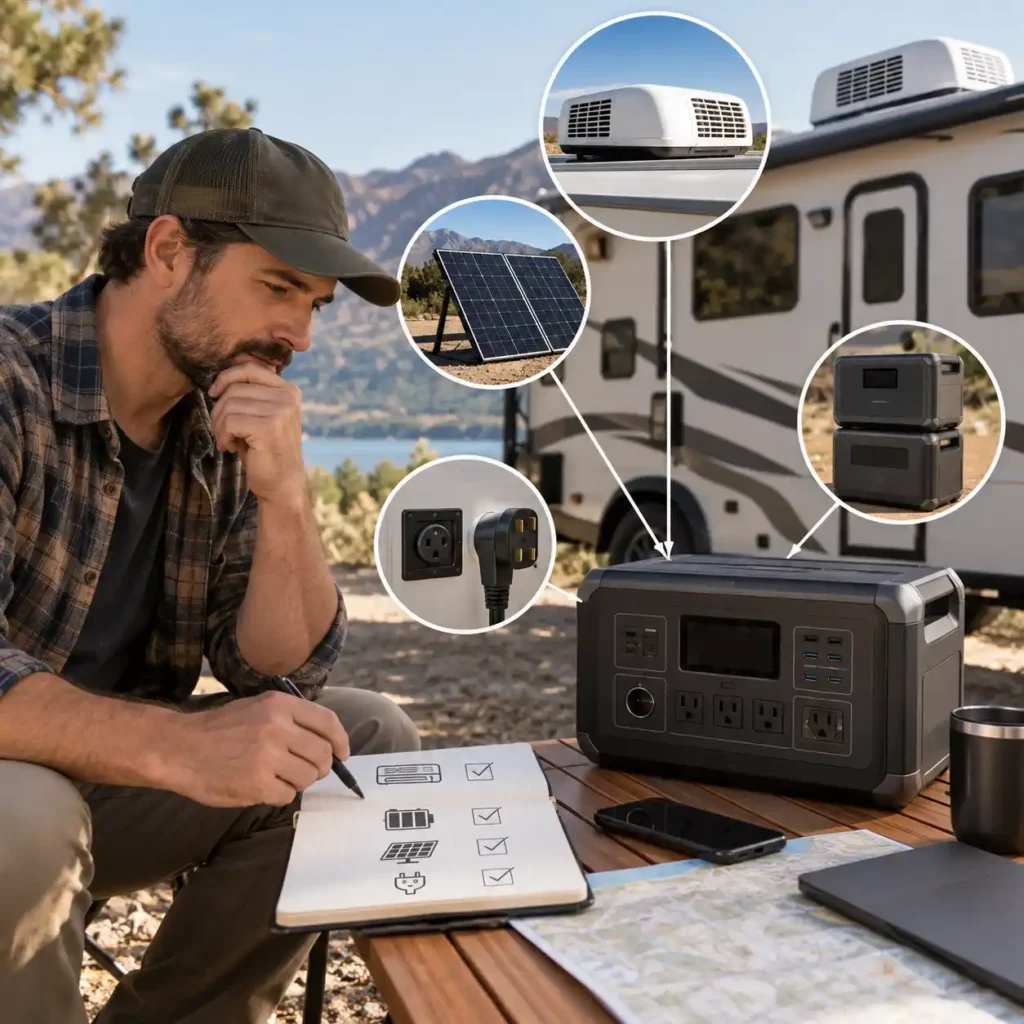
Choosing a portable power station for an RV air conditioner requires more than comparing battery capacity or looking at the highest wattage on the product label. The power station needs to match the air conditioner’s electrical requirements, including its normal running load and the additional power required when the compressor starts.
For RV air-conditioning, four specifications deserve particular attention: continuous AC output, startup or surge capability, battery capacity, and RV electrical compatibility. Solar input, charging speed, and expandability can also become important if you plan to use the system for extended off-grid travel.
The goal is not simply to choose the most powerful power station available. It is to find a system that can handle the air conditioner’s electrical demands while providing enough stored energy for the amount of cooling time you actually need.
Start With Your RV Air Conditioner's Power Requirements
Before choosing a power station, identify the actual electrical requirements of your RV air conditioner.
Look for the air conditioner’s rated or running wattage and, if available, its startup or locked-rotor requirements. The compressor can require substantially more power when it starts than it uses once it is running normally.
This distinction is especially important with battery power stations. A model may have enough continuous output to operate an air conditioner after startup but still lack sufficient short-term power to start the compressor.
Also consider what else will be running at the same time. If the refrigerator, microwave, fans, lights, battery charger, or other appliances are drawing power simultaneously, those loads reduce the amount of available capacity for the air conditioner. Our Appliance Wattage Calculator can help estimate the running power of individual appliances when you are calculating the combined RV load.
The first question is therefore not “How many watts does the power station have?” but “How much power does my RV air conditioner actually require, and what other loads will operate at the same time?”
For a broader explanation of calculating simultaneous electrical demand and energy consumption, see our How to Calculate Power Consumption guide.
Typical RV Air Conditioner Power Requirements
Most RV rooftop air conditioners fall into a relatively high-power range, with 13,500 BTU and 15,000 BTU units being common sizes. As a general sizing reference, a 13,500 BTU unit may draw roughly 1,200–1,700 watts while running, while a 15,000 BTU unit may be around 1,400–1,800 watts. Startup demand can be considerably higher, depending on the compressor and the specific A/C design.
| RV A/C Size | Typical Running Demand | Startup Demand | What to Check |
|---|---|---|---|
| 13,500 BTU | ~1,200–1,700 W | Often significantly higher | Manufacturer's running watts and LRA/startup current |
| 15,000 BTU | ~1,400–1,800 W | Often significantly higher | Manufacturer's running watts and LRA/startup current |
These figures are sizing references, not specifications for every RV air conditioner. The data plate or manufacturer documentation for the specific A/C should take priority. A soft-start device can also substantially reduce compressor startup demand, but it does not reduce the energy required to keep the air conditioner running.
Check Continuous AC Output
Continuous AC output determines how much electrical power the power station can deliver while appliances are operating normally.
For RV air conditioning, the power station’s continuous output needs to cover the air conditioner’s running demand as well as any other appliances you expect to operate simultaneously.
A higher continuous-output rating provides more operating headroom. This can be useful when the air conditioner is running while other RV loads are also drawing power.
However, a large inverter rating does not automatically mean longer air-conditioner runtime. Continuous output describes power delivery, while battery capacity determines how much stored energy is available.
That distinction is important when comparing models such as the five power stations reviewed in this guide. A power station with a very large inverter can handle substantial loads, but its actual cooling runtime still depends on its available watt-hours and the air conditioner’s real-world consumption.
Account for Startup Surge
Startup surge is one of the most important considerations when using a portable power station with an RV air conditioner.
The compressor can draw substantially more power for a short period when it starts. The power station therefore needs enough short-term output capability to accommodate that demand without shutting down or triggering overload protection.
A power station’s advertised surge rating can provide useful information about this capability, but it should not be treated as a guarantee that every RV air conditioner will start successfully.
The actual startup requirement varies by air-conditioner model, compressor design, operating conditions, and other electrical loads connected to the power station.
If your RV air conditioner has a particularly high startup requirement, a compatible soft-start device may reduce the compressor’s initial electrical demand. A soft-start can make startup easier for a power station with sufficient continuous output, but it does not increase the battery’s stored energy or automatically provide longer runtime.
Compare Battery Capacity for Runtime
Battery capacity is measured in watt-hours (Wh) and determines how much electrical energy the power station stores.
This is separate from the inverter’s wattage rating. A 3,000 W inverter can potentially deliver more instantaneous power than a 2,000 W inverter, but the battery may still run down quickly if the connected load is high.
For RV air conditioning, larger battery capacity generally provides more potential runtime between charging sessions.
For example, a 2,048 Wh power station and a 4,096 Wh power station may both have sufficient inverter output for a particular air conditioner, but the larger battery has approximately twice the stored energy before accounting for conversion losses and differences in actual operating conditions.
Actual runtime will always be lower than a simple theoretical calculation based on the full battery capacity because power stations have inverter losses and reserve some energy for system operation. Air-conditioner cycling also changes the average load over time.
For that reason, compare battery capacity and expected average A/C consumption together, rather than choosing a power station based on Wh alone.
Match the Power Station to Your RV Electrical Connection
RV electrical compatibility is another important part of the decision.
Many RVs use 30-amp or 50-amp electrical connections, but the exact electrical configuration varies between RVs. The power station needs to provide a compatible way to deliver power to the RV or to the specific appliance you intend to operate.
A 30-amp RV connection and a 50-amp RV connection should not be treated as interchangeable simply because both are described as “RV-ready.”
Before purchasing, check your RV’s shore-power connection, voltage requirements, and the way you intend to connect the portable power station.
This is also where the models in this guide differ meaningfully. Some prioritize dedicated RV connectivity, while others are better suited to users who will connect individual appliances or use a particular AC outlet configuration.
The safest approach is to match the power station to the actual electrical configuration of your RV, rather than relying only on a product description that says it is suitable for RV use.
How Long Can a Portable Power Station Run an RV Air Conditioner?
The runtime of a portable power station depends primarily on battery capacity and the air conditioner’s actual average power consumption. A larger battery can store more energy, but the amount of time it can run an RV air conditioner still depends on how much electricity the A/C uses while operating.
Battery capacity is measured in watt-hours (Wh), while the air conditioner’s electrical demand is measured in watts. In simple terms, dividing available battery capacity by the average load provides a theoretical runtime estimate.
In real-world use, however, the result will be lower because the power station’s inverter is not 100% efficient and the system may reserve some battery capacity for its own operation.
Air conditioners also do not necessarily draw the same amount of power continuously. The compressor may cycle on and off, and the average load can change with outdoor temperature, RV insulation, thermostat settings, and other conditions.
For this reason, runtime figures should be treated as estimates rather than guarantees.
Battery Capacity Matters More Than Inverter Wattage for Runtime
When comparing portable power stations for RV air conditioning, it is important to separate power output from stored energy.
Continuous AC output tells you how much power the inverter can deliver at a given moment. Battery capacity tells you how much energy is stored and therefore how long that energy can potentially support a load.
For example, a power station with a 3,000 W inverter is not necessarily going to run an air conditioner longer than a model with a 2,000 W inverter. If the second model has a significantly larger battery, it may provide more total runtime despite having a lower maximum output.
This is why the five models in this guide differ in more than just their wattage ratings. The DJI Power 2000, for example, combines 3,000 W of continuous output with a 2,048 Wh battery, while the EF EcoFlow DELTA Pro 3 provides 4,000 W of continuous output and a 4,096 Wh battery.
The higher-output inverter helps with demanding loads, but the larger battery is what provides the additional energy reserve for extended operation.
How to Estimate RV Air Conditioner Runtime
A simple theoretical calculation can provide a useful starting point:
Theoretical runtime = Battery capacity (Wh) ÷ Average A/C load (W)
For example, if a power station has 2,048 Wh of battery capacity and an RV air conditioner averages 1,400 W while operating:
2,048 Wh ÷ 1,400 W = approximately 1.46 hours
This is a theoretical result based on the full rated battery capacity and does not account for inverter losses or other system consumption. Actual runtime will therefore be shorter.
The same calculation can be used to compare different battery sizes. A 4,096 Wh battery has approximately twice the stored energy of a 2,048 Wh battery, assuming comparable usable capacity and operating conditions.
The calculation becomes more complicated when the air conditioner cycles rather than drawing a constant load. If the compressor runs for part of each hour and then cycles off, the average power consumption may be substantially lower than the A/C’s maximum running wattage.
What Affects RV Air Conditioner Runtime?
Several factors can significantly change how long a portable power station can operate an RV air conditioner.
Air Conditioner Power Consumption
The most important variable is the A/C’s actual electrical demand. Two RV air conditioners with similar cooling capacity can have different power requirements, so the manufacturer’s electrical specifications should be checked before estimating runtime.
Compressor Cycling
An air conditioner may not operate at its maximum electrical load continuously. Once the desired temperature is reached, the compressor can cycle on and off. This can reduce average power consumption compared with assuming the A/C runs continuously at its rated load.
Outdoor Temperature
Hotter weather can increase the amount of work required to maintain the desired interior temperature. On very hot days, the compressor may operate for longer periods, increasing average electricity consumption.
RV Insulation and Heat Gain
The RV’s insulation, windows, roof construction, shade, and overall heat gain affect how frequently the air conditioner needs to run. An RV exposed to direct sunlight can require more cooling than the same RV parked in shade.
Other Electrical Loads
If the power station is also running a refrigerator, fans, lights, electronics, or other appliances, those loads reduce the amount of energy available for air conditioning.
This is particularly important when using a smaller battery such as a 2,048 Wh system. Even relatively modest additional loads can reduce available A/C runtime.
Power Station Efficiency
The battery does not deliver every watt-hour directly to the air conditioner. Energy is lost during the DC-to-AC conversion process and through the power station’s own electronics.
Actual usable energy therefore varies by model, load, temperature, battery condition, and operating mode.
Why Advertised Runtime Can Be Different From Real-World Runtime
Portable power station specifications generally describe battery capacity under defined testing conditions. They do not necessarily represent the exact amount of usable energy that an RV air conditioner will receive during normal operation.
An air conditioner is also a particularly variable load. Its compressor may start, run at a high load, cycle off, and restart repeatedly. Ambient temperature and thermostat settings can change this pattern throughout the day.
For this reason, it is better to think in terms of runtime range and operating conditions rather than expecting one precise number.
If you are planning for overnight cooling or extended off-grid stays, compare battery capacity, expected A/C consumption, solar charging capability, and the possibility of recharging the power station during the day.
If longer cooling periods are important, solar charging can also change the calculation. A power station receiving meaningful solar input during the day may replenish some of the energy consumed by the air conditioner, extending the practical operating window. Our Solar Charging Time Calculator can help estimate how long it may take to replenish the battery under a given solar input.
The most useful question is not simply “How many hours will this power station run?” but “How many hours can it realistically support my RV air conditioner under the conditions in which I plan to use it?”
Portable Power Station Runtime Examples
Understanding the difference between battery capacity and actual air-conditioner consumption makes it easier to estimate how long a portable power station can support an RV air conditioner.
The examples below use a range of common average A/C loads to illustrate how theoretical runtime changes with battery capacity. These calculations are intended as planning examples rather than guaranteed real-world runtime.
Actual runtime will be lower than the theoretical result because of inverter losses, usable battery capacity, compressor cycling, ambient temperature, RV insulation, and other electrical loads operating at the same time.
Example Runtime at Different A/C Loads
The same portable power station can provide very different runtime depending on how much electricity the RV air conditioner actually consumes.
For a simple comparison, the theoretical runtime can be estimated by dividing battery capacity by the average electrical load:
Theoretical runtime = Battery capacity (Wh) ÷ Average A/C load (W)
The following examples use the five power stations evaluated in this guide. They assume a constant A/C load and 100% theoretical battery availability, so they should not be interpreted as expected real-world runtime.
If you want to translate your actual RV loads and required runtime into a practical power-station size, use our Power Station Size Calculator.
| Power Station | Battery Capacity | 1,000 W A/C Load | 1,400 W A/C Load | 1,800 W A/C Load |
|---|---|---|---|---|
| DJI Power 2000 | 2,048 Wh | ~2.05 hours | ~1.46 hours | ~1.14 hours |
| BLUETTI Apex 300 | 2,764.8 Wh | ~2.76 hours | ~1.97 hours | ~1.54 hours |
| Jackery HomePower 3600 Plus | 3,584 Wh | ~3.58 hours | ~2.56 hours | ~1.99 hours |
| Anker SOLIX F3800 | 3,840 Wh | ~3.84 hours | ~2.74 hours | ~2.13 hours |
| EcoFlow DELTA Pro 3 | 4,096 Wh | ~4.10 hours | ~2.93 hours | ~2.28 hours |
These numbers demonstrate why battery capacity matters so much for RV air conditioning. At a constant 1,400 W load, for example, the theoretical runtime ranges from approximately 1.46 hours with a 2,048 Wh battery to approximately 2.93 hours with a 4,096 Wh battery.
In actual RV use, the result can be different. An air conditioner may cycle rather than drawing its full running load continuously, which can reduce its average consumption. On the other hand, inverter losses and other RV appliances consume part of the available battery energy.
The table is therefore most useful for understanding the relationship between battery capacity and electrical load, not for predicting an exact number of hours.
How Runtime Changes Under Different Loads
Runtime changes directly as the average electrical load changes.
For example, a 2,048 Wh power station has a theoretical runtime of approximately 2.05 hours at a constant 1,000 W load. At 1,400 W, the same battery provides approximately 1.46 hours, while an 1,800 W load reduces the theoretical result to approximately 1.14 hours.
This illustrates an important point for RV owners: the air conditioner’s rated maximum or running wattage is not necessarily the same as its average consumption over an entire cooling period.
If the compressor cycles off after the RV reaches the desired temperature, the average load may fall below the A/C’s running wattage. This can extend actual runtime compared with a calculation that assumes the compressor runs continuously.
The opposite can happen in very hot conditions. If the compressor operates for longer periods because the RV is exposed to strong sunlight or has significant heat gain, average consumption can remain relatively high and shorten runtime.
Other appliances also matter. Running a refrigerator, fans, lights, electronics, or a microwave from the same power station adds to the total electrical load.
For example, if an air conditioner averages 1,200 W and other RV appliances consume another 200 W, the power station is effectively supporting an average load of approximately 1,400 W. The runtime calculation should therefore use the combined load rather than the A/C’s consumption alone.
What You Can Realistically Expect in an RV
The theoretical calculations above provide a useful starting point, but actual RV air-conditioner runtime depends on how the system behaves in real conditions.
Three factors are particularly important.
First, compressor cycling can reduce average consumption. An air conditioner does not necessarily draw its rated running wattage continuously. Once the interior temperature approaches the thermostat setting, the compressor may cycle off and later restart.
Second, inverter efficiency reduces usable energy. The battery’s rated Wh capacity represents stored energy, but some energy is consumed during the conversion from battery power to AC electricity and by the power station’s internal electronics.
Third, other RV loads reduce available runtime. Even relatively small loads become meaningful when the air conditioner is already consuming a substantial amount of power.
For this reason, the examples in this section should be used as planning benchmarks rather than runtime guarantees.
A useful way to plan is to start with the air conditioner’s expected average load, add the appliances you expect to run simultaneously, and then compare the combined load with the power station’s battery capacity.
If longer cooling periods are important, solar charging can also change the calculation. A power station receiving meaningful solar input during the day may replenish some of the energy consumed by the air conditioner, extending the practical operating window. Our Solar Charging Time Calculator can help estimate how long it may take to replenish the battery under a given solar input.
The most important takeaway is simple: inverter output determines whether the power station can handle the load, while battery capacity and average consumption determine how long it can keep doing so.
That distinction is essential when comparing portable power stations for RV air conditioners and explains why a model with a higher wattage rating is not automatically the model with the longest cooling runtime.
Common Mistakes When Choosing a Portable Power Station for an RV Air Conditioner
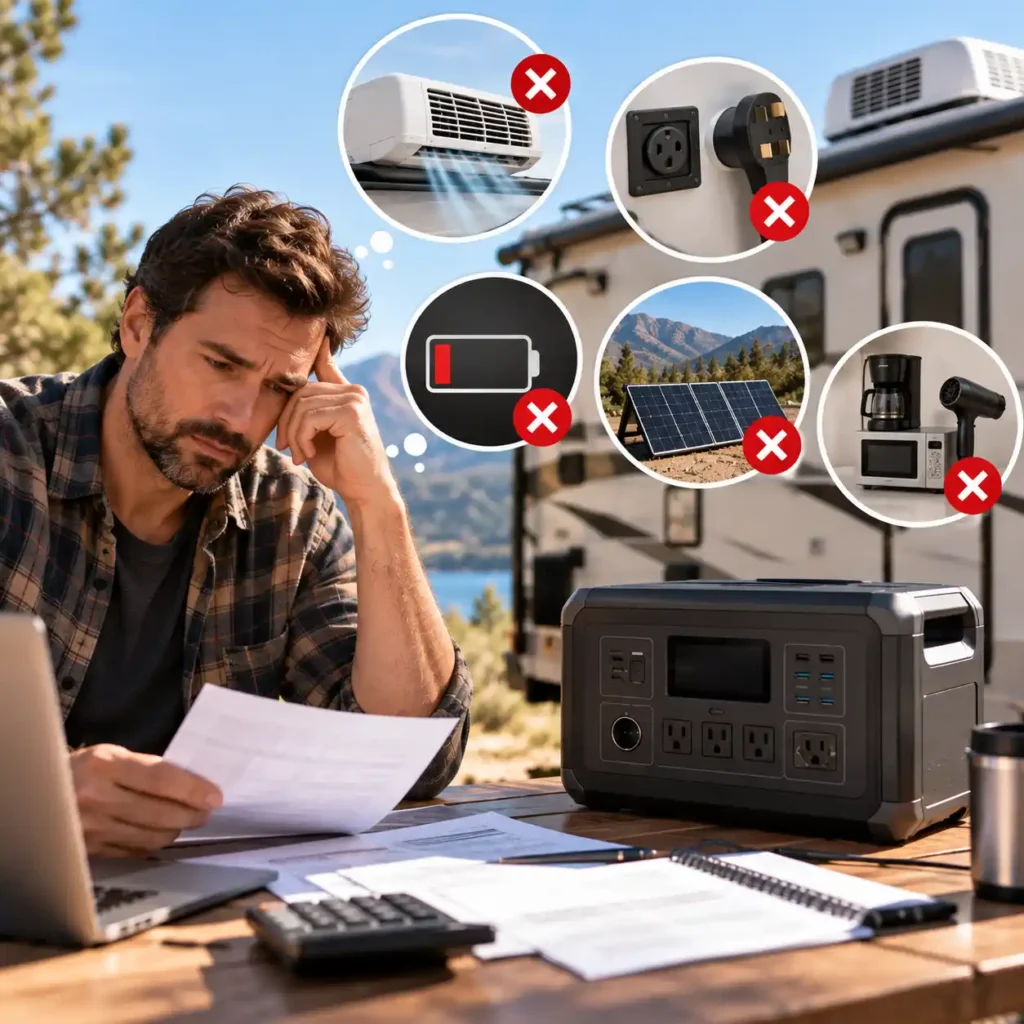
Choosing a portable power station for an RV air conditioner is not simply a matter of finding the highest wattage number. Several common mistakes can lead to a system that appears powerful enough on paper but does not provide the expected cooling performance or runtime in actual RV use.
Choosing Based Only on Peak Wattage
Peak or surge wattage is important because an air-conditioner compressor can require additional power during startup. However, peak output is available only for a limited period and should not be confused with continuous AC output.
A power station advertised with a high peak rating may still have a lower continuous output that limits which appliances can operate simultaneously.
For RV air conditioning, look at both specifications: continuous output for normal operation and surge capability for short startup demands.
Confusing Inverter Power With Battery Runtime
A larger inverter does not automatically mean longer air-conditioner runtime.
The inverter determines how much power the power station can deliver, while the battery capacity determines how much stored energy is available.
A 3,000 W power station with a 2,048 Wh battery can potentially deliver more instantaneous power than a lower-output model, but a larger 4,000 Wh battery can provide substantially more energy for extended operation.
Always compare watts and watt-hours separately.
Ignoring the Air Conditioner’s Startup Requirements
An RV air conditioner can require significantly more power when its compressor starts than it consumes while running.
If the power station does not have enough available surge capacity, the A/C may fail to start even when its normal running wattage appears to be within the power station’s continuous rating.
Check the specific air conditioner’s electrical specifications rather than assuming that a particular wattage class of power station will automatically start it.
Forgetting Other RV Loads
The air conditioner is rarely the only appliance using electricity.
A refrigerator, microwave, battery charger, television, fans, lights, and other equipment can all draw power at the same time. These additional loads reduce the available inverter capacity and consume battery energy that could otherwise be used for cooling.
If the A/C is close to the power station’s continuous limit, operating another high-demand appliance simultaneously may trigger an overload.
Buying Too Little Battery Capacity for the Intended Runtime
A power station can have enough inverter output to operate an RV air conditioner but still provide less runtime than expected.
This happens when the battery capacity is too small for the intended cooling period.
If your goal is several hours of air conditioning, compare the power station’s usable battery capacity with the A/C’s expected average consumption. Do not rely on the inverter’s wattage rating as an indication of runtime.
Assuming a Soft-Start Solves Every Power Problem
A soft-start system can reduce the initial electrical demand of an air-conditioner compressor and may make startup easier for a compatible power station.
However, it does not increase the battery’s capacity and does not make a power station capable of delivering more continuous power than its specifications allow.
A soft-start can address part of the startup problem, but you still need sufficient continuous output and enough battery capacity for the desired runtime.
Ignoring RV Electrical Compatibility
Not every power station connects to an RV in the same way.
Before purchasing, check whether your RV uses a 30-amp or 50-amp connection, the required voltage, and how the power station is designed to deliver power to the RV.
A power station may be powerful enough electrically but still require a different connection method or appropriate adapter for your particular RV setup.
Assuming the Advertised Runtime Applies to Air Conditioning
Manufacturer runtime figures are usually based on specified test conditions and loads. They should not be interpreted as guaranteed air-conditioner runtime.
An RV air conditioner can have a highly variable load because the compressor cycles according to temperature and thermostat settings. Outdoor heat, RV insulation, sunlight, and other electrical loads can also change actual consumption.
Use published runtime information as a reference point, then estimate your own expected runtime based on the specific A/C and operating conditions.
Choosing the Largest Power Station Without Considering Portability
More battery capacity and inverter output usually mean a larger and heavier system.
For RV owners, this can create a practical problem. A power station that is difficult to move or store may be less convenient even if it provides excellent electrical performance.
Consider where the unit will be stored, how it will be transported, and whether you need to move it between the RV, campsite, home, or another location.
The right balance is the one that provides enough electrical capacity for your A/C without creating more weight and bulk than your RV setup can reasonably accommodate
What Else Can You Run Alongside an RV Air Conditioner?
An RV air conditioner is often the largest electrical load connected to a portable power station, but it is rarely the only one. Refrigerators, lights, electronics, fans, chargers, and kitchen appliances can all draw power at the same time.
When you are using a portable power station for RV air conditioning, these additional loads matter because they compete with the A/C for both inverter capacity and stored battery energy. A power station may be able to run the air conditioner by itself but have less available capacity once several other appliances are operating.
Refrigerator and Freezer
An RV refrigerator is usually a relatively modest continuous load compared with the air conditioner, but it can operate for many hours and therefore contribute meaningfully to total energy consumption.
If the refrigerator cycles while the A/C is running, its power draw reduces the energy available for cooling. The effect is usually more important for runtime than for startup, unless the refrigerator has a significant compressor startup demand.
Lights, Phones, and Small Electronics
LED lights and ventilation fans generally use much less power than an RV air conditioner. They are therefore unlikely to be the main factor determining whether the power station can start the A/C.
However, their combined consumption still reduces available battery energy. During longer off-grid stays, even relatively small loads can add up when they operate for many hours.
Wi-Fi Router, Modem, and Computer
A portable power station can provide backup power for internet equipment, laptops, monitors, and other home-office devices while you are traveling.
Routers and modems typically consume relatively little electricity, while desktop computers and larger monitors can require considerably more.
If you need to maintain a working setup inside the RV, calculate the combined demand of the computer, monitor, networking equipment, and peripherals rather than evaluating each device separately.
Coffee Maker and Small Kitchen Appliances
Coffee makers, microwaves, electric kettles, toasters, and other kitchen appliances can consume substantially more power than phones, lights, or laptops.
A sufficiently powerful portable power station may be able to operate these appliances, but the additional load can become important when the RV air conditioner is already running.
For example, using a microwave or coffee maker while the A/C compressor is operating can push the combined demand closer to the power station’s continuous output limit.
When necessary, operate high-wattage kitchen appliances separately rather than assuming the power station can support every appliance simultaneously.
RV Air Conditioner
The RV air conditioner is usually the most demanding appliance in this setup and should be evaluated separately from lower-power devices.
The compressor can require significantly more power during startup than it uses during normal operation. The power station therefore needs sufficient continuous output for normal operation as well as adequate surge capability for startup.
Whether a particular portable power station can operate a specific RV air conditioner depends on the A/C’s actual running and startup requirements.
The air conditioner should therefore be the starting point for sizing the power station, with the refrigerator, electronics, kitchen appliances, and other loads added afterward.
Fans and Ventilation Equipment
Fans, roof ventilation systems, and other smaller motor-driven appliances generally require much less power than an RV air conditioner.
They can often operate alongside the A/C without creating a major additional load, but their consumption still contributes to the total demand and therefore affects battery runtime.
If you are trying to maximize cooling time from a limited battery capacity, prioritize the loads you actually need rather than running every appliance continuously.
Power Tools and Other Motor-Driven Equipment
Drills, circular saws, shop vacuums, pumps, and other motor-driven equipment can create substantial startup demands.
These loads can be particularly challenging when the power station is already supporting an air conditioner. Even if the tool’s normal operating wattage appears manageable, its startup demand may temporarily increase the total load beyond the power station’s available surge capability.
If you plan to use power tools from your RV power station, check both their running and startup requirements and avoid operating several high-demand devices simultaneously.
Electric Heaters and High-Wattage Appliances
Electric space heaters, electric kettles, induction cooktops, hair dryers, and similar resistive appliances can consume large amounts of electricity continuously.
Unlike many motor-driven appliances, they may not create a large startup surge, but their sustained power demand can quickly use a substantial portion of the power station’s available output.
This is especially important when an RV air conditioner is already running. A power station that comfortably handles the A/C alone may not have enough continuous capacity for the A/C plus another high-wattage heating or cooking appliance.
The practical rule is simple: size the power station for the highest-demand combination of appliances you expect to operate alongside the RV air conditioner, not for each appliance individually.
Portable Power Station vs. Inverter Generator for RV Air Conditioning
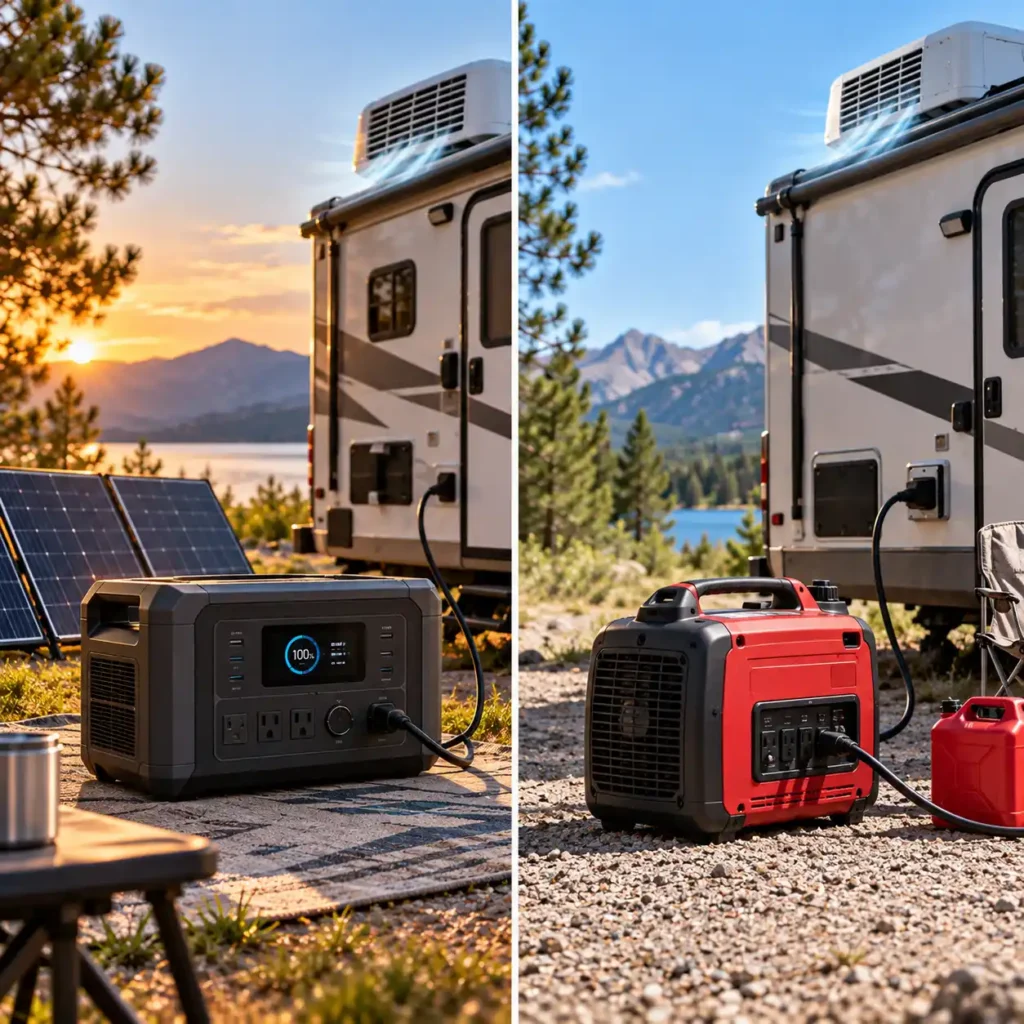
For a broader comparison of battery-based power stations and fuel generators beyond RV air conditioning, see our Portable Power Station vs. Generator guide.
Portable power stations and inverter generators can both provide electricity for an RV away from shore power, but they work in fundamentally different ways.
A portable power station stores electricity in a battery and delivers it through AC and DC outputs. An inverter generator produces electricity continuously while its engine is running and requires a fuel supply.
For RV air conditioning, this difference affects runtime, noise, emissions, refueling, maintenance, and how easily the system can be used around a campsite.
Neither technology is automatically suitable for every RV setup. The right choice depends on how long you need the air conditioner to operate, how much power it requires, and which practical limitations matter most to you.
When a Portable Power Station Makes More Sense
A portable power station can make sense when quiet operation, simple setup, and zero direct emissions during use are important.
There is no combustion engine, gasoline storage, or exhaust during operation. This can make a battery-based system more convenient around an RV campsite, particularly when engine noise would be disruptive.
Portable power stations are also straightforward to use. Once the battery is charged, you can connect compatible loads without starting an engine or managing fuel.
For shorter periods of RV air-conditioning, this can be particularly convenient. A sufficiently powerful power station can provide the required AC output while also supporting lower-power loads such as lights, electronics, refrigeration, and fans.
The main limitation is stored energy. Once the battery is depleted, the power station needs to be recharged. Solar panels can help replenish the battery during the day, but the amount of energy recovered depends on solar input, weather, panel configuration, and the power station’s charging limits.
For RV owners who prioritize quiet operation and simple battery-powered cooling, these characteristics can make a portable power station a practical alternative to a fuel-powered generator.
When an Inverter Generator Makes More Sense
An inverter generator can be more practical when you need sustained power for long periods and the ability to refuel and continue operating.
As long as sufficient fuel is available, the generator can continue producing electricity without waiting for a battery to recharge. This can be useful during extended off-grid stays or situations where the RV air conditioner needs to operate for many hours.
Fuel-powered generators can also provide substantial continuous output. Depending on the model, an inverter generator may be capable of supporting an RV air conditioner together with other higher-demand appliances.
If you are considering an inverter generator specifically, see our Best Inverter Generators (2026) guide for a broader look at inverter-generator options for RVs, camping, and home backup.
However, generators introduce considerations that do not apply to battery power stations. They require fuel, produce exhaust, generate engine noise, and must be operated outdoors with appropriate ventilation and clearance from the RV.
For that reason, a generator’s electrical capability is only one part of the decision. The operating environment and practical requirements of the RV also need to be considered.
Which Option Fits Your RV Air-Conditioning Needs?
The key difference is that a portable power station is an energy-storage system, while an inverter generator is an energy-production system.
A portable power station is particularly relevant when you value:
- Quiet operation
- No direct exhaust emissions during use
- Simple startup and operation
- Shorter-duration air-conditioning
- Battery-based operation
- Solar recharging capability
- Convenient power for electronics and other lower-power RV loads
An inverter generator may be more relevant when you prioritize:
- Extended operation with the ability to refuel
- Higher sustained electrical demand
- Longer off-grid stays
- Multiple high-demand appliances
- Fuel flexibility on compatible dual-fuel models
There is also no requirement to treat the two technologies as mutually exclusive. Some RV owners may use a portable power station for quiet, lower-power loads while keeping a generator available when longer-duration or higher-output power is required.
For an RV air conditioner specifically, the most important starting point remains the same regardless of technology: check the A/C’s running wattage, startup requirement, and the total load you expect to operate at the same time.
Once those requirements are clear, the choice between stored battery power and fuel-powered generation becomes much easier to evaluate.
Frequently Asked Questions
What size portable power station do I need to run an RV air conditioner?
The required power station size depends on the RV air conditioner’s running wattage, startup requirement, and the other appliances you plan to operate at the same time.
Start by checking the A/C’s rated running power and startup requirements. The power station should have enough continuous AC output for normal operation and sufficient surge capability for compressor startup.
Battery capacity then determines how long the air conditioner can potentially run. If longer cooling periods are important, prioritize a larger Wh capacity rather than looking only at inverter wattage.
Can a portable power station run a 13,500 BTU RV air conditioner?
Yes, some portable power stations can run a 13,500 BTU RV air conditioner, but BTU rating alone does not determine compatibility.
A typical 13,500 BTU RV A/C may require roughly 1,300–1,600 W while running, with a substantially higher startup demand depending on the compressor and model. The specific air conditioner’s electrical specifications should always be compared with the power station’s continuous and surge output.
How many watts does an RV air conditioner use?
The actual power requirement varies by air-conditioner model, cooling capacity, operating conditions, and compressor design.
For example, current manufacturer guidance for a typical 13,500 BTU RV A/C puts continuous consumption around 1,300–1,600 W, while startup can require considerably more power for a short period.
The best approach is to use the electrical specifications for your specific A/C rather than relying on a general wattage estimate.
Can a 2,000-watt portable power station run an RV air conditioner?
It depends on the specific air conditioner and its startup requirements.
A 2,000 W power station may have enough continuous output for some RV air conditioners but still fail to start the compressor if the startup demand exceeds its surge capability.
If the A/C’s running load is close to the power station’s maximum output, there will also be little capacity left for other RV appliances.
Do I need a soft start for an RV air conditioner with a portable power station?
Not every RV air conditioner requires a soft-start device, but it can be useful when compressor startup demand is too high for the available power source.
A soft-start reduces the initial electrical surge required by a compatible compressor. It does not increase the power station’s battery capacity or continuous output, and it does not reduce the A/C’s normal running demand substantially.
If a power station has enough continuous output but struggles with compressor startup, checking whether a compatible soft-start system is appropriate can be worthwhile.
Can a portable power station run a 30-amp RV air conditioner?
It can, provided the power station and connection method can supply the required voltage and current and the A/C’s electrical demands remain within the available output.
A typical 30-amp RV electrical service provides up to approximately 3,600 W at 120 V. However, the air conditioner is only one part of the RV’s total electrical load, so other appliances operating at the same time also need to be considered.
Can a portable power station run a 50-amp RV air conditioner?
It depends on the RV’s electrical configuration and how the portable power station supplies power.
A 50-amp RV has substantially more available electrical capacity than a 30-amp RV, but that does not mean every portable power station can reproduce the RV’s full 50-amp service.
Check the power station’s output configuration, the RV’s connection, and the specific A/C and other loads you intend to operate.
How long will a portable power station run an RV air conditioner?
Runtime depends primarily on battery capacity and the air conditioner’s average power consumption.
As a simple theoretical example, a 2,048 Wh battery supporting a constant 1,400 W load would provide:
2,048 Wh ÷ 1,400 W = approximately 1.46 hours
Actual runtime will be lower because of inverter losses and other system consumption. Compressor cycling can also reduce the A/C’s average load and change the real-world result.
Can I run an RV air conditioner and other appliances from the same power station?
Yes, if the combined load remains within the power station’s continuous output and the startup demands of motor-driven appliances remain within its surge capability.
An RV refrigerator, lights, fans, electronics, and other low-power loads may be practical alongside the A/C. High-demand appliances such as microwaves, electric kettles, or induction cooktops can consume a substantial portion of the remaining capacity.
Portable power station manufacturers specifically advise checking both rated and startup power and considering combined loads when operating high-surge appliances.
Can solar panels extend the runtime of an RV air conditioner?
Yes. Solar panels can replenish a compatible portable power station while it is being used, potentially extending the amount of time available for off-grid cooling.
The amount of additional runtime depends on the power station’s maximum solar input, the size and configuration of the solar array, sunlight conditions, and the A/C’s current consumption.
Solar charging should therefore be viewed as a way to replenish battery energy, not as a guarantee that the solar panels will continuously provide enough power to operate the air conditioner.
Final Verdict
The best portable power station for an RV air conditioner is not necessarily the model with the largest battery or the highest inverter output. The right choice depends on your RV air conditioner’s running and startup requirements, the amount of cooling time you need, your RV’s electrical connection, and how much portability matters.
For RV owners who want substantial inverter headroom for demanding air-conditioning loads, the Anker SOLIX F3800 stands out as our Best Overall for RV Air Conditioners. Its 6,000 W continuous output and 9,000 W surge rating provide considerable electrical headroom, while its 3,840 Wh battery gives it a strong foundation for extended off-grid use. It is a large and heavy system, however, so its capabilities come with a significant portability trade-off.
The EF EcoFlow DELTA Pro 3 is our Best High-Capacity RV Power Station for buyers who place greater emphasis on stored energy and extended off-grid operation. Its 4,096 Wh battery is the largest built-in capacity among the five models in this guide, and its expandable architecture allows the system to store substantially more energy when additional batteries are added. Its 4,000 W continuous output also provides substantial capacity for compatible RV air conditioners and other loads.
The BLUETTI Apex 300 is our Best RV-Focused Power Station. Its combination of dedicated 30A and 50A RV connections, 3,840 W continuous output, 7,680 W peak output, and expandable battery architecture makes it particularly relevant to RV owners who want a system designed around RV electrical requirements rather than a general-purpose portable battery alone.
The Jackery HomePower 3600 Plus is our Best RV and Home Backup Combination. With a 3,584 Wh battery, 3,600 W rated output, dedicated 30A connectivity, and a lighter overall design than the largest systems in this guide, it offers a practical balance for buyers who want one power station that can serve both RV trips and selected home-backup needs.
The DJI Power 2000 is our Best Compact High-Output Option. Its 3,000 W continuous output gives it substantial inverter capacity for its relatively compact 2,048 Wh battery class. The trade-off is straightforward: its smaller battery provides less stored energy for prolonged air-conditioning use than the larger systems in this guide.
The most important point is that inverter output and battery capacity solve different problems. Continuous and surge output determine whether the power station can support the air conditioner’s electrical demand, while battery capacity determines how much energy is available once the system is running. A high-wattage inverter does not automatically provide long runtime, and a large battery does not compensate for an inverter that cannot handle the air conditioner’s startup requirements.
Your RV air conditioner’s exact specifications therefore matter more than its BTU rating alone. Before choosing a power station, check the A/C’s rated running watts or amps, startup requirement, voltage, and recommended electrical connection. A soft-start system can reduce compressor startup demand on compatible conventional A/C units, but it does not increase the battery’s stored energy or make a small battery last longer.
Runtime is the other major limitation. Even a large portable power station can provide only a limited amount of continuous compressor operation when an RV rooftop air conditioner is drawing roughly 1,300–1,700 W. Actual runtime will also vary with compressor cycling, outside temperature, insulation, solar input, inverter losses, and other RV loads.
Ultimately, choosing a portable power station for an RV air conditioner means matching electrical capability and stored energy to your actual cooling requirements. The five models in this guide represent different approaches to RV air conditioning: maximum inverter headroom, maximum built-in battery capacity, RV-focused connectivity, combined RV and home-backup versatility, and compact high-output portability.
Our Recommendation
The right portable power station for an RV air conditioner depends on more than battery size or inverter output. The key is matching the power station’s electrical capability, usable energy, RV compatibility, recharge options, and portability to the way you actually plan to use the air conditioner.
For RV owners who place the greatest emphasis on high inverter headroom for demanding air-conditioning loads, the Anker SOLIX F3800 is the most appropriate fit within this group. Its high continuous output and substantial surge capacity provide considerable electrical headroom for demanding RV A/C applications.
If longer off-grid operation and stored energy are the primary priorities, the EF EcoFlow DELTA Pro 3 is the stronger fit. Its larger base battery and high solar-input capability make it particularly relevant for extended periods away from shore power, where recharge opportunities matter as much as initial battery capacity.
For buyers who place a high value on direct RV electrical integration and system expandability, the BLUETTI Apex 300 deserves particular attention. Its RV-oriented connections and expandable architecture make it well suited to owners building a more capable off-grid power system rather than looking only for a standalone battery.
The Jackery HomePower 3600 Plus is a practical choice for RV owners who want a system that can also serve selected home-backup needs. Its combination of output capability, battery capacity, dedicated 30A connection, and relatively manageable weight gives it a useful middle ground between RV functionality and general backup use.
The DJI Power 2000 is better suited to buyers who place greater emphasis on compact size and high AC output than on maximum battery capacity. Its smaller energy storage means it is not the same type of extended-runtime solution as the larger systems in this guide, but its power-to-size balance can make it attractive for RV owners who value portability.
Whichever model you choose, size the system around the actual electrical requirements of your RV air conditioner and the other loads you expect to run at the same time. The air conditioner’s running power, startup demand, duty cycle, and your desired runtime all affect the required system size. Leaving reasonable electrical headroom is generally more practical than sizing the power station around the A/C alone.
For occasional daytime cooling, solar charging can help extend the practical operating window. For prolonged air-conditioning use in hot weather, however, battery capacity, solar input, recharge speed, and A/C duty cycle become increasingly important. A power station that can start the compressor is not necessarily a power station that can run it for as long as you need.
Ultimately, the best choice depends on which trade-off matters most to you: maximum A/C headroom, longer runtime, RV integration, portability, or a combination of these factors.
Related Guides
If you need help with the broader RV power setup beyond air conditioning, the following guides cover the related decisions that can help you plan your system.
- Best Portable Power Stations for RV (2026) — Compare portable power stations for broader RV use, including battery capacity, AC output, solar charging, portability, electrical compatibility, and expandability.
- How Much Power Do You Really Need? — Learn how to estimate your total electrical demand before choosing a power station or other backup-power system.
- Power Station Size Calculator — Estimate the battery capacity and power output you may need based on the appliances and electrical loads you plan to run.
- Appliance Wattage Calculator — Estimate the running power requirements of individual appliances when planning your total RV electrical load.
- Solar Charging Time Calculator — Estimate how long a portable power station may take to recharge from solar based on battery capacity, solar input, and available panel wattage.
- Best Portable Solar Panels (2026) — Compare portable solar panels for recharging compatible power stations during RV travel and other off-grid applications.
Power Ready Guide Commitment
Power Ready Guide is committed to independent, accurate, and transparent product guidance. Our recommendations are based on published specifications, practical use considerations, and clearly stated trade-offs—not on affiliate commissions or manufacturer influence.
We do not claim testing or hands-on experience we have not performed, and we distinguish manufacturer specifications from our own editorial analysis. Product specifications, availability, and technology can change, so we review and update our guides as new information becomes available.
Our goal is simple: to give readers clear, useful information that helps them make informed decisions based on their own needs, priorities, and budget.