
Knowing how much power an appliance requires is essential when planning backup power, checking electrical loads, or estimating how long a battery-powered system can operate a device.
Our Appliance Wattage Calculator helps you estimate the running wattage, starting demand, and energy consumption of one or more appliances. You can use these results to understand the total load before choosing or evaluating a battery, inverter, portable power station, or other backup power system.
For the most accurate calculation, use the actual wattage listed on the appliance nameplate, owner’s manual, or manufacturer specifications whenever possible. Generic wattage estimates can be useful for preliminary planning, but the actual power requirements of similar appliances can vary considerably.

Table of Contents
Quick Answer: How Do You Calculate Appliance Wattage?
If you know an appliance’s voltage and current, you can estimate its electrical power using:
Watts = Volts × Amps
If the appliance’s wattage is already known, you can calculate its energy consumption over time with:
Watt-hours = Watts × Hours of Operation
For example, a 500W appliance operating for 4 hours would use:
500 × 4 = 2,000 Wh
or:
2 kWh
When calculating the running load of multiple appliances, multiply the running wattage of each appliance by its quantity and add the results:
Total Running Load = Σ (Running Watts × Quantity)
For example, two 100W fans and one 200W television would have a combined running load of:
(100W × 2) + (200W × 1) = 400W
For a broader explanation of how power and energy are calculated, see our How to Calculate Power Consumption.
For appliances with motors or compressors, however, running wattage is not the only value that matters. The appliance may require a temporary increase in power when it starts.
This is known as starting watts, startup watts, or surge demand.
For backup-power planning, you therefore need to consider both the appliance’s normal running load and any additional startup demand that may occur.
Appliance Wattage Calculator
Use the calculator below to estimate the electrical load and energy consumption of your appliances.
Enter the running wattage, starting wattage when applicable, quantity, and expected operating time. The calculator can then estimate the total running load and energy used over the selected period.
The result is a planning estimate rather than a measurement of actual electricity consumption. Appliances may cycle on and off, change their power draw during operation, or consume less than their rated power under normal conditions.
For appliances with a compressor, motor, heating element, or variable-speed electronics, actual consumption can differ substantially from a simple calculation based on the maximum rated wattage.
Appliance Wattage Calculator
Estimate the running load, starting demand, and energy consumption of one or more appliances. Add each appliance below, enter its power requirements and expected operating time, then calculate the total load.
| Appliance | Running Watts | Starting Watts | Quantity | Hours/Day | |
|---|---|---|---|---|---|
Your Estimated Appliance Load
How to Use the Appliance Wattage Calculator
The calculator is designed to separate the main factors that determine appliance power and energy requirements.
Step 1: Enter Running Watts
Running watts represent the approximate power an appliance requires while operating normally.
For example, an appliance rated at 1,000W may draw approximately 1,000 watts while operating at its rated load.
Whenever possible, use the appliance’s actual rated wattage rather than an estimate from a generic appliance chart.
Look for the power rating on:
- the appliance nameplate;
- the manufacturer’s specifications;
- the owner’s manual;
- technical documentation.
If the appliance lists volts and amps instead of watts, you can use the basic relationship:
Watts = Volts × Amps
For some AC equipment, particularly motors and electronic loads, the relationship between voltage, current, and real power can be more complicated because of power factor. In those cases, the manufacturer’s stated wattage is preferable.
Step 2: Enter Starting Watts When Applicable
Starting watts represent the temporary power demand that can occur when an appliance starts.
This is particularly important for appliances containing motors or compressors, including some:
- refrigerators;
- freezers;
- air conditioners;
- pumps;
- compressors;
- power tools.
For example, an appliance might require:
700W running power
but:
1,500W starting power
during startup.
If the manufacturer provides an actual starting-watt or surge rating, use that value.
Do not assume that every motor-driven appliance requires the same multiplier above its running wattage. Startup demand varies according to the motor, compressor, control electronics, appliance design, and operating conditions.
Step 3: Enter the Quantity
If you are calculating several appliances, account for the number of units.
For example, if three identical appliances each require 200W:
200W × 3 = 600W
The combined running load is therefore approximately 600W.
Quantity also matters when considering startup demand. If several motor-driven appliances can start at the same time, their temporary demands may overlap.
For backup systems, this simultaneous load can be more important than the wattage of any individual appliance.
Step 4: Enter Operating Time
Wattage describes power demand at a given moment. Operating time determines how much energy the appliance consumes.
The basic calculation is:
Energy (Wh) = Power (W) × Operating Time (hours)
For example:
800W × 3 hours = 2,400 Wh
That is equivalent to:
2.4 kWh
If an appliance does not operate continuously, its actual energy consumption may be lower than the result obtained by multiplying its rated running wattage by the entire time period.
If you are using these figures to estimate how much battery storage you need, you can then use our Battery Capacity Calculator to estimate the required battery size in Ah and Wh.
Running Watts vs. Starting Watts
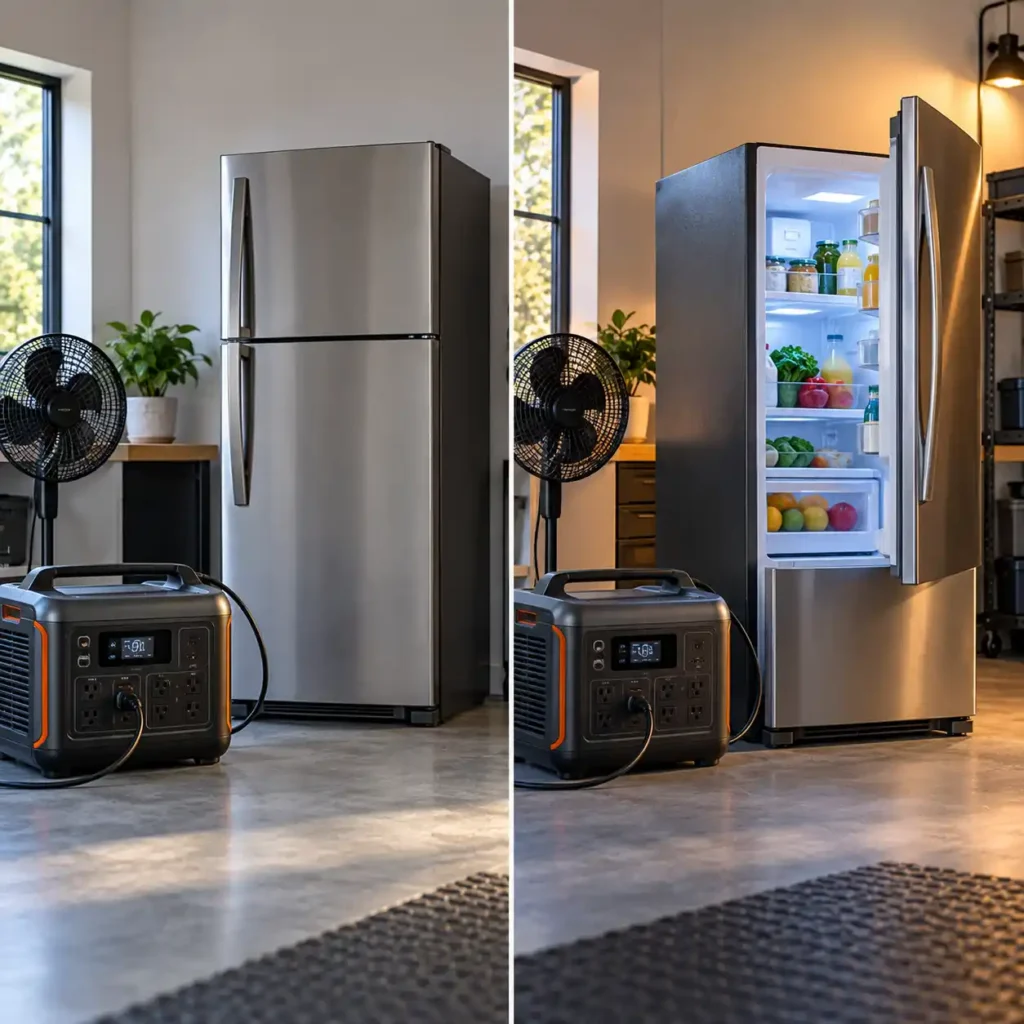
Running watts and starting watts describe different aspects of an appliance’s power demand.
Understanding the difference is particularly important when the appliance will be powered by an inverter, portable power station, battery system, or generator. If you are selecting an inverter for loads with higher startup demand, see our guide to Best Power Inverters for Home Backup.
What Are Running Watts?
Running watts are the power an appliance requires during normal operation.
They may also be described as:
- operating watts;
- continuous watts;
- rated operating power.
A simple resistive load, such as an electric heater, may draw relatively consistent power while switched on.
Other appliances can have much more variable consumption.
For example, a refrigerator may draw power when its compressor is running and much less when the compressor is off. As a result, its actual energy consumption over a full day cannot always be determined accurately by multiplying one rated wattage figure by 24 hours.
What Are Starting Watts?
Starting watts are the temporary power demand that can occur when an appliance begins operating.
They are also commonly called:
- startup watts;
- surge watts;
- starting power;
- peak startup demand.
This distinction is especially important for motor-driven appliances and compressors.
An appliance can therefore have a relatively modest running wattage while requiring a substantially higher amount of power for a short period during startup.
Why Starting Watts Matter for Backup Power
Consider a simplified example:
- Refrigerator: 700W running, 1,500W starting
- Television: 120W
- LED lighting: 80W
The normal running load would be:
700 + 120 + 80 = 900W
If the refrigerator starts while the television and lights are already operating, the instantaneous load could reach approximately 1,700W.
1,500 + 120 + 80 = 1,700W
This illustrates why a backup system should not be evaluated using running watts alone.
The inverter or power source must be able to supply the required continuous load and accommodate the relevant startup demand when applicable.
For an actual installation, use the appliance and inverter manufacturer’s specifications rather than relying solely on estimated surge values.
Power and energy are related, but they are not interchangeable.
Watts (W) measure power.
Watt-hours (Wh) measure energy used over time.
Kilowatt-hours (kWh) are commonly used for larger quantities of electrical energy.
The basic formula is:
Energy (Wh) = Power (W) × Time (hours)
To convert watt-hours to kilowatt-hours:
Energy (kWh) = Energy (Wh) ÷ 1,000
How to Calculate Appliance Energy Consumption
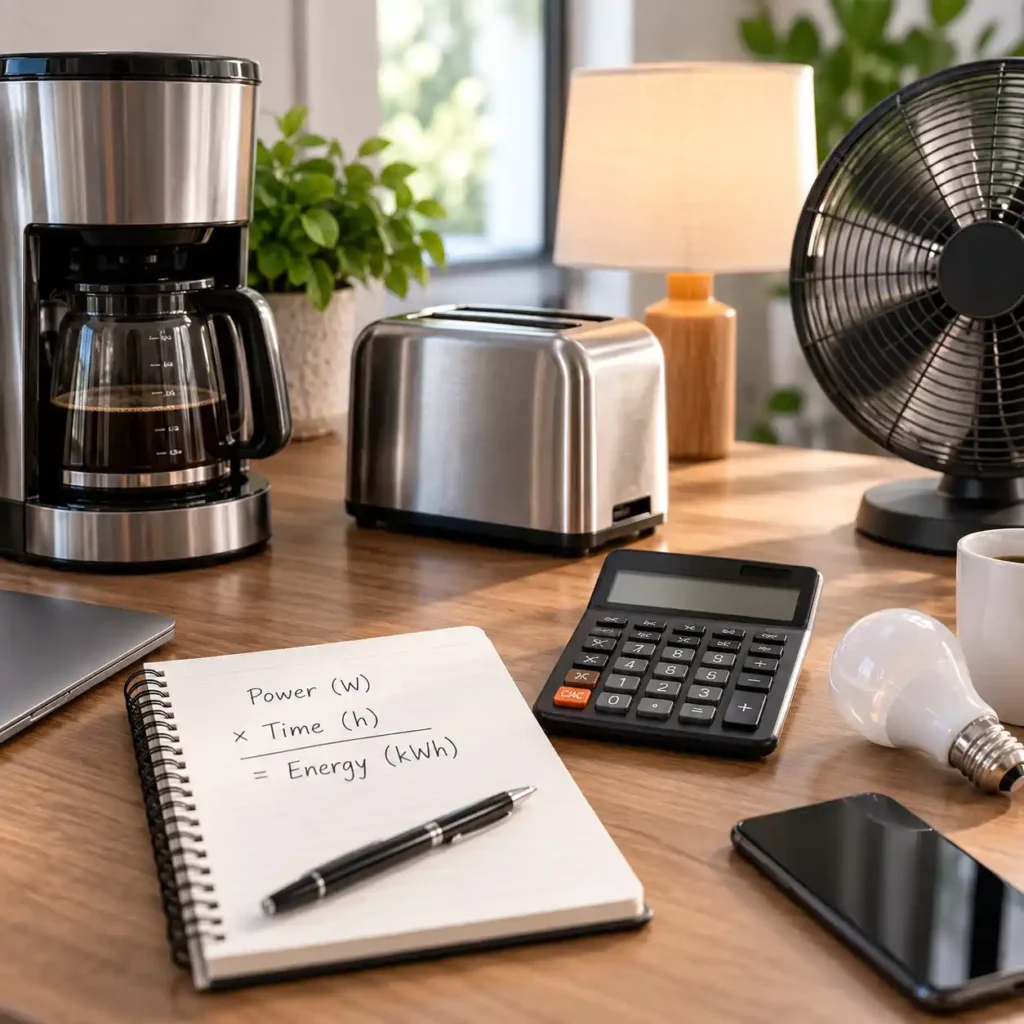
Example: A 1,000W Appliance
Suppose an appliance uses 1,000W and operates continuously for 2 hours.
1,000W × 2 hours = 2,000 Wh
Convert this to kilowatt-hours:
2,000 ÷ 1,000 = 2 kWh
The appliance therefore uses approximately 2 kWh during those two hours under these assumptions.
Example: A 500W Appliance
A 500W appliance operating for 4 hours uses:
500W × 4 hours = 2,000 Wh
or:
2 kWh
Although the two appliances have different wattage ratings, they consume the same amount of energy in these examples because their power and operating times produce the same watt-hour total.
This distinction becomes particularly important when estimating battery runtime.
A battery stores energy, usually expressed in Wh or kWh, while an appliance consumes power, expressed in W.
For additional information on household electricity consumption and appliance energy use, see the U.S. Department of Energy's energy consumption resources.
How Appliance Wattage Affects Battery Runtime
Appliance wattage is one of the most important factors determining how quickly a battery’s stored energy is consumed.
A higher-power appliance generally depletes a battery faster than a lower-power appliance when both operate for the same amount of time.
A simplified runtime calculation is:
Battery Runtime (hours) = Usable Battery Energy (Wh) ÷ Appliance Power (W)
For example, suppose a battery provides 2,000Wh of usable energy and an appliance continuously draws 500W.
2,000 ÷ 500 = 4 hours
The theoretical runtime is approximately 4 hours.
However, this is not necessarily the runtime you will experience in a real backup system.
If you are using a portable power station for these loads, our guide to Best Portable Power Stations for Home Backup can help you compare suitable backup systems.
Accounting for System Efficiency
Battery-powered systems have losses.
Energy can be lost through:
- inverter conversion;
- wiring;
- battery discharge;
- power-management electronics;
- the battery’s operating conditions.
A simplified planning estimate can account for these losses by applying an overall system-efficiency factor:
Estimated Runtime = Usable Battery Energy × System Efficiency ÷ Load Power
For example, using:
- usable battery energy = 2,000Wh;
- appliance load = 500W;
- assumed system efficiency = 90%;
the calculation becomes:
2,000 × 0.90 ÷ 500 = 3.6 hours
The estimated runtime is therefore approximately 3.6 hours.
This is a planning estimate. Actual runtime can vary depending on the battery’s usable capacity, inverter efficiency, temperature, battery condition, minimum state-of-charge limits, and whether the appliance maintains a constant power draw.
Why Appliance Cycling Changes Runtime
Not every appliance consumes its rated wattage continuously.
A refrigerator is a useful example. Its compressor may operate for part of the day and switch off at other times.
If a refrigerator is rated at 700W while the compressor is running, that does not necessarily mean it consumes:
700W × 24 hours = 16.8 kWh/day
Actual daily energy consumption may be substantially lower because the compressor cycles on and off.
For appliances with variable or intermittent loads, measured energy consumption over time can provide a better estimate than multiplying the maximum rated wattage by the entire operating period.
How to Find an Appliance's Actual Wattage

The most reliable way to determine an appliance’s power requirement is to use information provided for the specific appliance rather than relying on a generic wattage estimate.
Check the Appliance Nameplate
Many appliances have a rating label that lists electrical information such as:
- voltage;
- amperage;
- wattage;
- frequency;
- model information.
If wattage is provided directly, use that value in the Appliance Wattage Calculator.
If only voltage and current are listed, a basic estimate can be calculated using:
Watts = Volts × Amps
However, this relationship is a simplification for AC equipment. Motors, compressors, and some electronic devices can have power-factor characteristics that make actual real power different from a simple volts-times-amps calculation.
For that reason, manufacturer-provided wattage is preferable when available.
Check the Manufacturer's Specifications
The owner’s manual, technical specification sheet, or manufacturer documentation may provide more useful information than the appliance label alone.
This is particularly important when an appliance has:
- a motor;
- a compressor;
- variable-speed operation;
- multiple operating modes;
- heating and cooling cycles;
- a separate startup or surge rating.
If both running and starting power are documented, enter the appropriate values separately.
Measure Power With a Watt Meter
For compatible plug-in appliances, a plug-in power meter can provide a practical way to measure actual electricity use.
This can be useful when an appliance’s consumption varies during operation.
For example, a refrigerator may draw considerably more power while its compressor is running than when it is idle. Measuring the appliance over a longer period can therefore provide a more realistic picture of its energy consumption than observing its instantaneous wattage alone.
For permanently wired appliances or higher-power equipment, use an appropriate measurement method performed by a qualified professional rather than using a consumer plug-in meter.
Typical Appliance Wattage Examples
Appliance wattage can vary substantially by model, size, age, operating mode, and manufacturer.
The values below are general planning ranges, not guaranteed specifications for a particular appliance. For backup-power planning, use the actual rating from the appliance or manufacturer whenever possible.
| Appliance | Typical Running Watts | Starting Demand | Typical Use |
|---|---|---|---|
| Refrigerator | 100–400W | Often higher | Intermittent |
| Television | 50–200W | Usually low | Several hours |
| Microwave | 800–1,500W | Usually near running demand | Short periods |
| Coffee Maker | 600–1,500W | Usually low | Short periods |
| Portable Fan | 20–100W | Usually low | Several hours |
| Space Heater | 750–1,500W | Usually near running demand | Variable |
| Electric Kettle | 1,000–3,000W | Usually low | Short periods |
| Air Conditioner | 500–2,500W+ | Can be substantially higher | Variable |
These figures should not be treated as universal appliance ratings. A refrigerator or air conditioner, for example, may cycle on and off rather than draw its rated running power continuously.
Heating appliances such as electric kettles and space heaters can have relatively high running loads, even when they operate for only short periods. By contrast, lower-wattage appliances such as fans or televisions may consume less power at any given moment but can contribute meaningful energy use when operated for several hours.
Use these figures for initial planning only. Before selecting a battery, inverter, generator, or other backup-power equipment, verify the actual appliance specifications whenever possible.
How to Calculate the Wattage of Multiple Appliances

When several appliances will operate at the same time, calculate the load for each appliance and then combine the results.
The basic running-load formula is:
Total Running Watts = Running Watts × Quantity for each appliance, then add the results
For example, suppose a backup system needs to power:
- refrigerator: 150W;
- television: 120W;
- five LED lights: 10W each;
- Wi-Fi router: 15W.
The combined running load is:
150 + 120 + (5 × 10) + 15 = 335W
The system therefore needs to support approximately 335W of continuous running load before accounting for any startup demand.
Consider Appliances That Start at the Same Time
Starting demand becomes more important when multiple motor-driven appliances can start simultaneously.
Suppose the refrigerator has:
- 150W running;
- 800W starting.
If the other appliances require 135W combined, the temporary load could reach approximately:
800 + 135 = 935W
This does not mean the system will continuously consume 935W.
It means the power source and inverter may need to tolerate a temporary demand of approximately that magnitude if the appliances start under those conditions.
For real equipment selection, use the actual surge specifications of the inverter and appliances rather than assuming that all startup loads will always occur simultaneously.
Appliance Wattage vs. Energy Consumption
A common mistake is to treat wattage as if it were the amount of electricity an appliance consumes over an entire day.
Wattage measures power at a given point in time.
Energy consumption depends on both power and operating time.
The basic relationship is:
Energy (Wh) = Power (W) × Time (hours)
This means a 1,500W appliance used for 20 minutes does not necessarily consume more daily energy than a 200W appliance running for several hours.
For example:
1,500W × 0.33 hours ≈ 495Wh
while:
200W × 3 hours = 600Wh
The lower-wattage appliance actually uses more energy in this example because it operates for much longer.
This distinction is especially important when estimating battery runtime because battery capacity is expressed in units of energy such as Wh or kWh, not simply watts.
Using the Appliance Wattage Calculator for Backup Power
For backup-power planning, start by identifying the appliances that genuinely need to operate during an outage.
You do not necessarily need to power every appliance in the home.
A practical backup load might include:
- refrigerator;
- freezer;
- lighting;
- Wi-Fi equipment;
- phone chargers;
- medical equipment where applicable;
- television or computer;
- selected kitchen appliances.
High-power discretionary loads such as electric heaters, electric ranges, dryers, and other resistance-heating appliances can consume stored energy rapidly.
Once the required appliances are identified, enter their running watts, starting watts, quantities, and expected operating time into the calculator.
The resulting values can then help answer three separate questions:
How much continuous power is required?
Use the total running load.
How much temporary power may be required?
Consider the potential starting load of appliances with motors or compressors.
How much energy may be consumed?
Use the estimated watt-hours or kilowatt-hours based on operating time.
If solar generation is part of the backup system, use our Solar Panel Size Calculator to estimate the PV array required to offset the expected energy demand.
These are different requirements and should not be combined into a single wattage number.
If the calculated load will be used to size a generator, continue with our Generator Size Calculator.
Common Appliance Wattage Calculation Mistakes
Using Generic Wattage Instead of the Actual Rating
Generic appliance charts are useful for estimates, but they should not replace the manufacturer’s specifications when accurate system sizing matters.
Two appliances with the same function can have very different power requirements.
Ignoring Starting Watts
A refrigerator, pump, air conditioner, or other motor-driven appliance may require more power during startup than during normal operation.
Looking only at running watts can therefore underestimate the instantaneous load.
Assuming Rated Watts Are Used Continuously
An appliance may cycle on and off or change its power draw during operation.
Multiplying its maximum rated wattage by 24 hours can significantly overestimate daily energy use for some appliances.
Confusing Watts With Watt-Hours
Watts describe power.
Watt-hours describe energy used over time.
For example:
500W × 4 hours = 2,000Wh
The two values answer different questions.
Forgetting the Number of Appliances
If five identical devices each consume 100W, the combined running load is:
5 × 100W = 500W
Do not calculate the load from a single appliance when several units will operate simultaneously.
Ignoring Simultaneous Operation
Knowing the wattage of every appliance is not enough.
You also need to consider which appliances may be running or starting at the same time.
A backup system designed around a low average load can still experience a high temporary demand when multiple appliances start together.
Treating the Calculator Result as a Final Electrical Design
An appliance wattage calculation is a planning tool.
It does not automatically determine:
- the correct inverter size;
- circuit protection;
- wiring requirements;
- transfer-switch requirements;
- electrical-code compliance;
- generator sizing;
- battery installation requirements.
Those decisions depend on the specific equipment and installation and may require a qualified electrician or other appropriate professional.
How Accurate Is an Appliance Wattage Calculator?
An Appliance Wattage Calculator can provide a useful estimate when the input data is accurate.
Its accuracy depends primarily on the quality of the wattage and operating-time information entered by the user.
The calculation becomes less representative when:
- generic wattage estimates are used;
- appliance power changes significantly during operation;
- compressors cycle on and off;
- variable-speed motors change their output;
- multiple appliances do not operate simultaneously;
- startup demand is unknown;
- actual operating time differs from the assumed schedule.
For this reason, the calculator should be treated as a planning estimate rather than a substitute for measured electrical consumption or manufacturer specifications.
If precise energy consumption matters, measuring the appliance over a representative operating period can provide better data.
Frequently Asked Questions
What is an appliance wattage calculator?
An appliance wattage calculator estimates the electrical load and energy use of one or more appliances based on their wattage, quantity, and operating time. It can also help identify starting or surge demand when an appliance uses a motor or compressor.
How do I calculate the wattage of an appliance?
If the appliance rating is not given directly in watts, a basic calculation is Watts = Volts × Amps. For the most accurate result, use the wattage shown on the appliance nameplate, specification sheet, or manufacturer’s documentation.
What is the difference between running watts and starting watts?
Running watts are the power an appliance normally uses while operating. Starting watts, also called surge watts, are the temporary increase in power that some motors and compressors require when they start.
Do all appliances have starting watts?
No. Many heating elements, lights, and electronic devices have little or no significant startup surge. Motors and compressors, such as those in refrigerators, pumps, and air conditioners, are much more likely to require additional starting power.
How do I calculate the wattage of multiple appliances?
Multiply the running watts of each appliance by its quantity, then add the loads that may operate at the same time:
Total Running Watts = Running Watts × Quantity
For backup-power planning, also consider the starting demand of appliances with motors or compressors.
How do I calculate appliance energy consumption in kWh?
Use:
Energy (kWh) = Watts × Hours ÷ 1,000
For example, a 1,000W appliance operating continuously for 2 hours would use approximately 2 kWh. Actual consumption can be lower when an appliance cycles on and off.
How many watts does a refrigerator use?
A refrigerator’s power requirement varies by model, size, efficiency, and operating conditions. It may have relatively modest running wattage but a considerably higher starting demand because of its compressor. For accurate planning, use the refrigerator’s actual specifications whenever available.
How many watts does an air conditioner use?
Air-conditioner power consumption varies significantly by type, capacity, efficiency, and operating conditions. Compressor-based units can also require substantially more power when starting. Always check the unit’s nameplate or manufacturer’s specifications before sizing backup equipment.
How many watts does a microwave use?
A typical household microwave may draw roughly 800–1,500 watts, depending on the model and its electrical input rating. Because microwaves usually operate for relatively short periods, their energy consumption depends on both wattage and operating time.
Should I use the wattage on the appliance label or an estimated wattage?
Use the actual appliance rating whenever possible. Generic wattage values are useful for initial planning, but power requirements vary by model, size, age, efficiency, and operating mode. The appliance nameplate or manufacturer documentation should take priority over a generic estimate.
Can an appliance use less power than its rated wattage?
Yes. Rated wattage does not necessarily mean that an appliance draws that amount continuously. Refrigerators and air conditioners may cycle their compressors on and off, while variable-speed equipment can change its power draw during operation. Therefore, rated watts and actual energy consumption are not always the same.
Can I use an appliance wattage calculator to size backup power?
Yes, as a planning tool. The calculated appliance load can help estimate the required capacity of a generator, portable power station, inverter, or battery system. However, final sizing should also account for starting demand, usable battery capacity, inverter efficiency, equipment limits, and the specific appliances you intend to operate simultaneously
Final Takeaway
An Appliance Wattage Calculator is most useful when you understand what its numbers represent.
Start with the actual running wattage whenever possible. Then account for the number of appliances, expected operating time, and any relevant starting demand.
Remember the three key calculations:
Running Load = Running Watts × Quantity
Energy Use = Watts × Hours
Battery Runtime ≈ Usable Battery Energy × System Efficiency ÷ Load Power
For backup power, these calculations should be considered together rather than independently. Running watts determine the continuous electrical load, starting watts can determine the required surge capability, and watt-hours or kilowatt-hours determine how much stored energy the appliances consume over time.
The calculator provides a practical starting point for planning, but actual appliance specifications and measured consumption should take priority when making final equipment decisions.