
A refrigerator is one of the first appliances many households want to keep running during a power outage, but choosing the right portable power station is more complicated than comparing battery capacity. A refrigerator’s compressor can require a higher startup load than its normal running demand, while actual energy consumption varies as the compressor cycles on and off.
The right power station therefore needs sufficient inverter capability to handle the refrigerator’s electrical demands, enough usable battery capacity for the expected outage, and practical recharge options if the outage lasts longer than the initial battery reserve. For a refrigerator-specific runtime estimate, see our Refrigerator Runtime Calculator. UPS functionality can also matter when automatic backup is important.
This guide compares five portable power stations specifically for refrigerator backup, focusing on capacity, inverter and surge capability, estimated runtime, charging options, UPS functionality, expandability, and portability. Unlike guides based on hands-on testing claims, we clearly distinguish manufacturer specifications, calculated estimates, and documented evidence.
As an Amazon Associate, I earn from qualifying purchases.
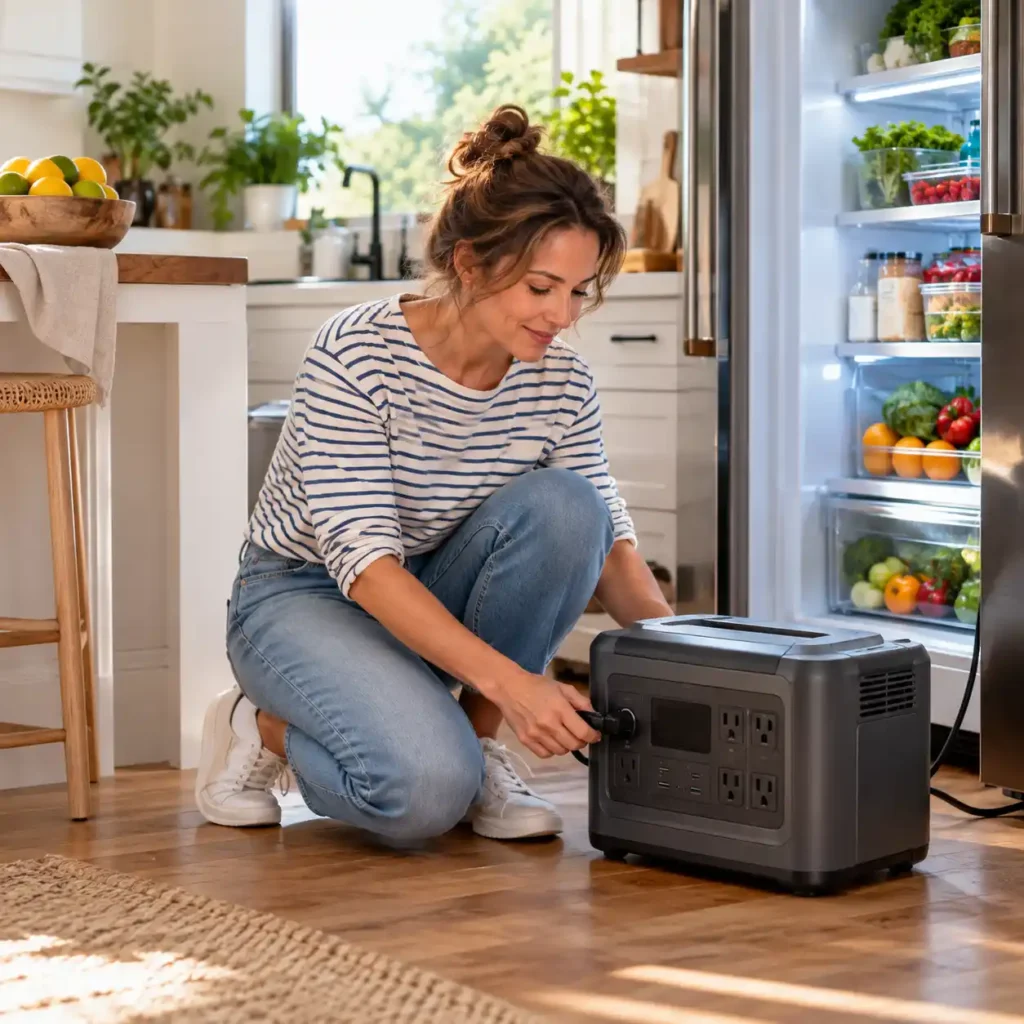
Table of Contents
Quick Answer
The right portable power station for refrigerator backup depends primarily on how long you need the refrigerator to operate, how much energy it actually consumes, and whether you need to power anything else during the outage. For many households, a 2,000Wh-class station provides a more substantial energy reserve for extended outages, while a 1,000Wh-class model can be more practical for shorter interruptions and lower energy requirements.
Among the five models in this guide, the EF EcoFlow DELTA 3 Max Plus is the strongest fit for users who want high inverter capacity and a substantial battery reserve for the refrigerator plus additional essential loads. The Anker SOLIX C2000 Gen 2 offers a similar 2,000Wh-class capacity with a different balance of size and capability. The Jackery Explorer 2000 v2 is a lighter 2,000Wh-class alternative, while the BLUETTI AC200PL provides the largest battery capacity in this group for users prioritizing longer-duration backup and expansion. The Anker SOLIX C1000 Gen 2 is the smaller-capacity option for shorter outages and situations where portability and lower capacity are more important than maximum runtime.
The important distinction is that refrigerator backup cannot be determined from battery capacity alone. Compressor startup requirements, actual refrigerator energy consumption, usable battery energy, conversion losses, charging options, and outage duration all affect the result. The comparisons below therefore focus on how each specific model fits these refrigerator-backup conditions rather than treating the highest wattage or largest battery as automatically the right choice.
Our Evidence & Evaluation Method
Power Ready Guide does not operate a laboratory, and we have not physically tested these five power stations with a refrigerator. We therefore do not present our estimates as laboratory measurements, and we do not claim that a refrigerator will perform exactly as a manufacturer specification or calculated estimate suggests in every real-world situation.
Instead, this guide combines manufacturer specifications and documentation with technical analysis, published independent information where available, and refrigerator-backup calculations based on stated assumptions. Where we discuss runtime, charging performance, compressor startup, or other real-world behavior, we distinguish between documented specifications, calculated estimates, and practical considerations.
| Factor | What We Examine | Evidence |
|---|---|---|
| Capacity | Battery capacity and usable energy | Manufacturer specifications + technical analysis |
| Output | Continuous AC output and surge capability | Manufacturer specifications + available independent data |
| Charging | AC, solar, and other relevant charging options | Manufacturer documentation |
| Runtime | Estimated refrigerator runtime under stated assumptions | Calculated estimates + refrigerator energy-use principles |
| Portability | Weight, size, and practical handling | Product specifications |
| Backup Function | UPS behavior and automatic transfer capability | Manufacturer documentation |
| Expandability | Additional battery capacity and long-outage flexibility | Manufacturer specifications |
| Reliability & Warranty | Battery technology, warranty, and documented support | Manufacturer documentation + relevant independent sources |
This distinction matters because refrigerator backup is highly dependent on the actual appliance. Compressor cycling, refrigerator efficiency, ambient temperature, door openings, food load, battery conversion losses, and other conditions can change real-world energy consumption.
Our recommendations therefore focus on fit and evidence, not on claims of personal testing. When the available evidence cannot establish a specific real-world result with confidence, we identify the limitation rather than presenting an assumption as a fact.
Who This Guide Is For
Who Should Read This
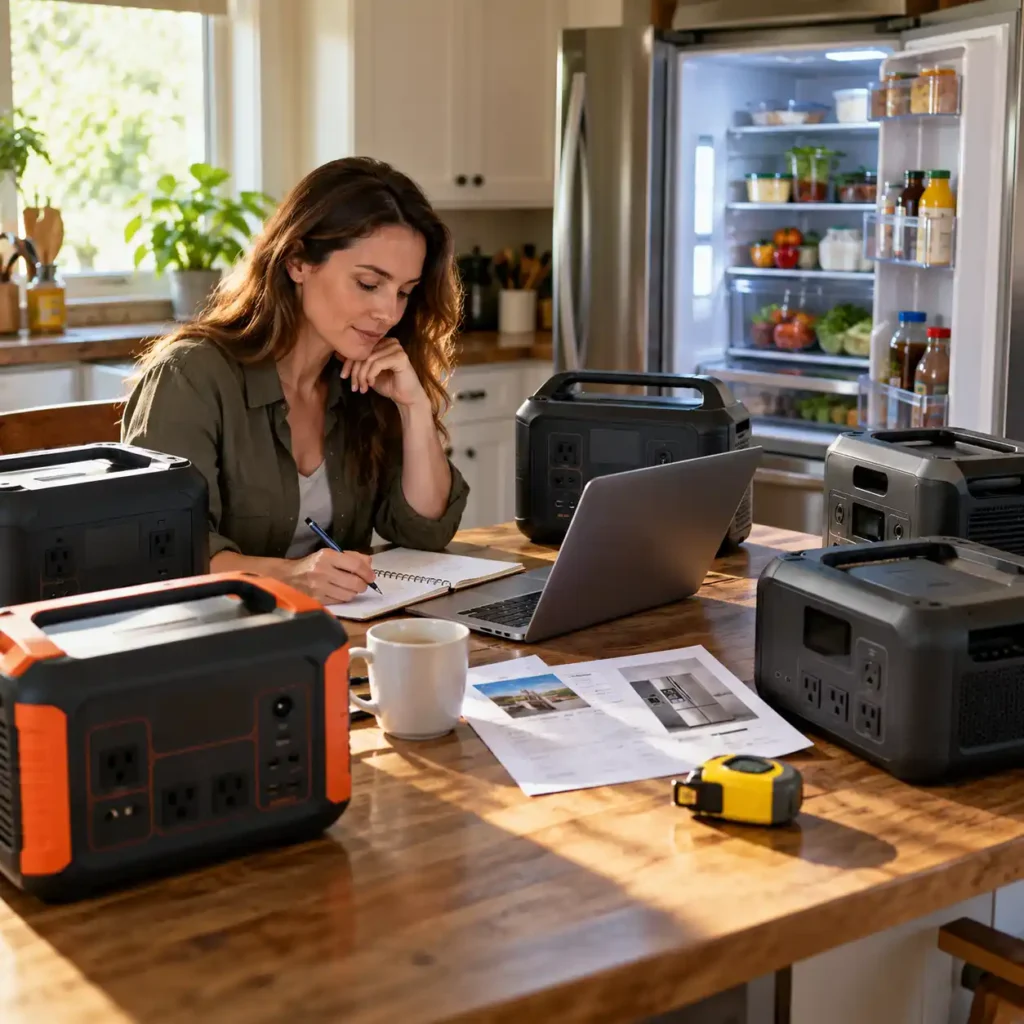
This guide is for U.S. homeowners and renters looking for a portable power station specifically to keep a refrigerator running during a power outage. It is most useful when comparing roughly 1,000Wh to 2,000Wh-class portable power stations and deciding between runtime, inverter capability, recharge options, portability, and expansion.
Who Should Use Another Guide
If you need backup power for an entire home or multiple major appliances, see our Best Portable Power Stations for Home Backup (2026) guide. If you need to determine the right battery size from your refrigerator’s actual energy consumption, use the Refrigerator Runtime Calculator. For sizing a power station around several different appliances, use our Power Station Size Calculator and general power-station sizing guide.
This article focuses specifically on the decision: which portable power station is a practical fit for refrigerator backup?
Quick Summary: Our Top Picks
The five power stations in this guide cover different refrigerator-backup priorities. Instead of treating battery capacity as the only deciding factor, we selected each model for a specific combination of energy capacity, inverter capability, recharge options, portability, and long-outage practicality. Each pick also has a clear limitation, because no single power station is the right fit for every refrigerator-backup situation.
EF EcoFlow DELTA 3 Max Plus
Award: Best Overall for Refrigerator Backup
Why It Stands Out: The DELTA 3 Max Plus combines a 2,048Wh battery with 3,000W of AC output, giving it a substantial energy reserve and high inverter capacity for refrigerator backup. That combination also leaves more room for additional essential loads when the refrigerator is not the only appliance you need to keep running.
Choose This If: You want one versatile power station for longer refrigerator outages and may need to support other essential household loads at the same time.
Best For: Extended refrigerator backup, refrigerator plus essential loads, and users who prioritize inverter capacity and battery reserve.
Main Limitation: Its larger capacity and higher output make it less compact and portable than a smaller 1,000Wh-class power station.
Anker SOLIX C2000 Gen 2
Award: Best Balance of Capacity and Portability
Why It Stands Out: The C2000 Gen 2 combines a 2,048Wh battery with 2,400W of rated AC output, placing it in a useful middle ground between smaller refrigerator-backup stations and larger, heavier systems.
Choose This If: You want substantial battery capacity for refrigerator backup without moving to a significantly larger power station.
Best For: General refrigerator backup, longer outages, and households that want a strong balance between energy reserve, output, and portability.
Main Limitation: Its 2,000Wh-class capacity may be more than necessary for refrigerator-only backup during short outages.
Jackery Explorer 2000 v2
Award: Best Lightweight 2kWh Option
Why It Stands Out: The Explorer 2000 v2 provides 2,042Wh of battery capacity and 2,200W of continuous AC output while weighing about 39.5 pounds. That makes it a comparatively manageable option for users who want substantial refrigerator-backup capacity without choosing one of the heavier 2kWh-class systems.
Choose This If: You want around 2,000Wh of battery capacity but portability and easier handling are important.
Best For: Refrigerator backup where a substantial energy reserve is needed but the power station may still need to be moved or stored regularly.
Main Limitation: Its 2,200W continuous output is lower than the 2,400W and 3,000W offered by several other models in this comparison.
Anker SOLIX C1000 Gen 2
Award: Best for Shorter Refrigerator Outages
Why It Stands Out: The C1000 Gen 2 combines a 1,024Wh battery with 2,000W of AC output, providing a more compact alternative to the 2kWh-class models while retaining substantial inverter capacity.
Choose This If: Your primary goal is refrigerator-only backup during shorter outages and you do not need the larger energy reserve of a 2,000Wh-class station.
Best For: Shorter outages, refrigerator-only backup, smaller households, and users who prioritize a more compact power station.
Main Limitation: Its 1,024Wh battery provides less energy reserve for extended outages and leaves less capacity available when additional appliances are connected.
BLUETTI AC200PL
Award: Best for Long-Duration and Expandable Backup
Why It Stands Out: The AC200PL has a 2,304Wh battery and 2,400W of AC output, giving it the largest built-in battery capacity among the five models in this guide. Its expandable architecture also provides additional flexibility when an outage lasts longer or the system needs to support more than the refrigerator alone.
Choose This If: You want a substantial energy reserve and the option to expand your backup capacity for longer outages.
Best For: Extended outages, refrigerator plus additional essential loads, and users who value expandable battery capacity.
Main Limitation: Its larger battery system makes it considerably heavier and less portable than the lighter options in this comparison.
Comparison Table
| Model | Capacity | AC Output | Weight | Best For |
|---|---|---|---|---|
| EcoFlow DELTA 3 Max Plus | 2,048Wh | 3,000W | 48.7 lb | Longer refrigerator outages + additional essential loads |
| Anker SOLIX C2000 Gen 2 | 2,048Wh | 2,400W | 41.7 lb | Balanced capacity, output, and portability |
| Jackery Explorer 2000 v2 | 2,042Wh | 2,200W | 39.5 lb | Lightweight 2kWh-class refrigerator backup |
| BLUETTI AC200PL | 2,304Wh | 2,400W | 72 lb | Long-duration and expandable backup |
| Anker SOLIX C1000 Gen 2 | 1,024Wh | 2,000W | 24.9 lb | Shorter outages with portability as a priority |
How We Evaluated
A refrigerator-backup power station cannot be evaluated by battery capacity or maximum wattage alone. We assessed each of the five models using the criteria below, with particular attention to the way each factor affects refrigerator operation during a U.S. power outage.
Because Power Ready Guide does not operate a testing laboratory and we have not physically tested these five stations with a refrigerator, our evaluation is based on manufacturer documentation, published product specifications, available independent information, technical analysis, and calculated use-case estimates. Where real-world performance can vary, we identify the limitation rather than presenting an estimate as a measured result.
Energy Capacity
We look at the station’s rated battery capacity in watt-hours and consider what that capacity means for refrigerator backup. A larger battery generally provides more stored energy, but capacity alone does not tell us exactly how long a refrigerator will run.
Usable Energy
Rated battery capacity is not the same as the energy available to the refrigerator. Conversion losses, inverter efficiency, operating limits, and other system losses affect how much of the stored energy can actually reach the appliance. This is why our runtime analysis uses estimates rather than treating the advertised Wh figure as directly available AC energy.
Inverter Capability
The inverter must support the refrigerator’s normal AC load and provide appropriate headroom for compressor startup. We therefore consider continuous AC output and documented surge capability rather than comparing battery capacity alone.
Charging Speed
A long outage changes the decision. Once the initial battery reserve is depleted, the ability to recharge the station becomes part of the backup system. We consider AC charging and other documented charging methods, including how useful they are for restoring battery capacity during an extended outage.
Portability
A larger battery can provide more runtime, but it also tends to increase the size and weight of the power station. We consider weight and physical practicality because a refrigerator backup system may need to be stored, moved into position, or connected to the appliance when an outage occurs.
Solar Compatibility
Solar charging can extend the useful duration of a backup system when grid power remains unavailable. We consider documented solar-input capability and how each station fits into a longer-duration backup strategy. We do not assume that a station’s maximum solar-input rating represents the amount of solar energy it will actually receive in real-world conditions.
Expandability
For longer outages, the built-in battery may not be enough. We therefore consider whether additional battery capacity is supported and whether expansion materially changes the station’s usefulness for extended refrigerator backup.
Warranty and Ecosystem
A backup power station is an electrical product intended to remain useful beyond a single outage. We consider the manufacturer’s warranty, battery technology, available accessories, expansion options, and broader product ecosystem where these factors affect long-term ownership and backup planning.
Value
Value is not simply the lowest price or the largest battery for the money. We consider what the buyer receives in usable capacity, inverter capability, charging flexibility, portability, expandability, and practical refrigerator-backup capability relative to the alternatives in this comparison.
Use-Case Fit
This is the final and most important layer of the evaluation. A power station that works well for a short refrigerator-only outage may not be the right choice for a multi-day outage or for a household that also needs to power lights, internet equipment, medical devices, or other essential loads.
We therefore evaluate each model according to the refrigerator-backup situation it is actually suited to rather than treating one specification as a universal measure of performance.
Product Reviews
EF EcoFlow DELTA 3 Max Plus
Award: Best Overall for Refrigerator Backup

Quick Verdict
The EF EcoFlow DELTA 3 Max Plus is the most capable all-around option in this comparison for households that want refrigerator backup with enough inverter headroom and battery capacity to handle additional essential loads. Its 2,048Wh battery and 3,000W AC output give it a substantial operating envelope without moving into a much larger whole-home battery system.
Snapshot
| Specification | EF ECOFLOW DELTA 3 Max Plus |
|---|---|
| Battery Capacity | 2,048Wh |
| AC Output | 3,000W |
| Surge Output | 6,000W |
| Battery Chemistry | LiFePO₄ |
| Solar Input | Up to 1,000W |
| UPS | <10 ms |
| Weight | 48.7 lb |
| Expandable Capacity | Up to 10kWh |
Specifications are based on EcoFlow’s U.S. product documentation. Actual refrigerator runtime depends on the appliance, operating conditions, conversion losses, and other connected loads.
Why We Chose It
The EF EcoFlow DELTA 3 Max Plus stands out because its refrigerator-backup value is not limited to its 2,048Wh battery. The 3,000W AC inverter and 6,000W surge rating provide substantial electrical headroom, while the U.S. model supports 1,000W of solar input and can be expanded from its built-in 2,048Wh capacity to as much as 10kWh with compatible batteries.
That combination matters during a longer outage. A refrigerator may be the first appliance you protect, but the practical backup requirement can quickly expand to include a modem/router, lighting, a few small appliances, or other essential loads. The EF EcoFlow DELTA 3 Max Plus has enough output capacity that adding those loads does not immediately put the system into the same narrow operating envelope as a smaller power station.
Its <10 ms UPS function is another reason it belongs in this comparison. EcoFlow specifies automatic UPS switching below 10 ms, which makes the station relevant for refrigerator backup where automatic transfer during an unexpected outage is important. This is a documented specification, not a claim that we independently measured its transfer performance.
The trade-off is physical. At approximately 48.7 pounds, this is not a lightweight power station, so its value is primarily in backup capability and reserve capacity, rather than easy carrying.
Check the latest price and customer reviews on Amazon.

Living With It
At approximately 48.7 pounds, the EF EcoFlow DELTA 3 Max Plus is better treated as a stationary or semi-stationary home backup unit than something you routinely move around. For refrigerator backup, that is less of a concern because the power station can be positioned near the appliance and left ready for an outage. Its 2,048Wh capacity also gives it a meaningful reserve before recharging becomes necessary, although actual refrigerator runtime must be calculated from the refrigerator’s energy consumption rather than the battery’s nameplate capacity alone.
Evaluation
| Evaluation Factor | This Model | How It Compares | Buyer Implication |
|---|---|---|---|
| Inverter headroom | 3,000W continuous / 6,000W surge | Highest continuous output in the five-model set | More headroom for refrigerator startup and additional essential loads |
| Battery reserve | 2,048Wh | Similar to the other 2kWh-class models; below the 2,304Wh BLUETTI | Provides substantial reserve without moving into the largest built-in capacity class |
| UPS capability | <10 ms | Among the faster UPS switching times in this five-model set | Useful when automatic backup transfer is important for the refrigerator |
| Expansion | Up to 10kWh | Greater expansion potential than the other models in this set | Gives refrigerator backup a path toward a broader home-backup system |
| Portability | 48.7 lb | Heavier than Jackery and both Anker models; lighter than BLUETTI | Better suited to a mostly stationary or semi-stationary backup setup |
Who Should Buy This
- U.S. households that want one portable power station for a refrigerator plus several additional essential loads.
- Buyers who want substantial inverter headroom rather than choosing a station close to the refrigerator’s expected operating demand.
- Users who may eventually want to expand battery capacity for longer outages.
- Households that value fast AC charging, solar charging, and automatic UPS functionality in the same system.
Who Should Skip This
- Buyers who only need refrigerator backup for relatively short outages and have no need for additional capacity.
- Anyone who places a high priority on keeping the power station easy to carry.
- Users looking for the smallest practical solution rather than a higher-capacity emergency backup system.
Final Verdict
The EF EcoFlow DELTA 3 Max Plus earns its place as our Best Overall for Refrigerator Backup because it combines a 2,048Wh battery with unusually high 3,000W inverter output, strong recharge options, UPS functionality, and a clear path to additional battery capacity. Its main compromise is weight, so its advantages make the most sense when refrigerator backup is part of a broader emergency-power plan rather than a short, refrigerator-only use case.
Check the latest price and customer reviews on Amazon.
Related Guide: If you need broader backup power for multiple essential appliances during an outage, see our Best Portable Power Stations for Home Backup (2026) for models evaluated around wider household backup needs.
Anker SOLIX C2000 Gen 2
Award: Best Balance of Capacity and Portability
Quick Verdict
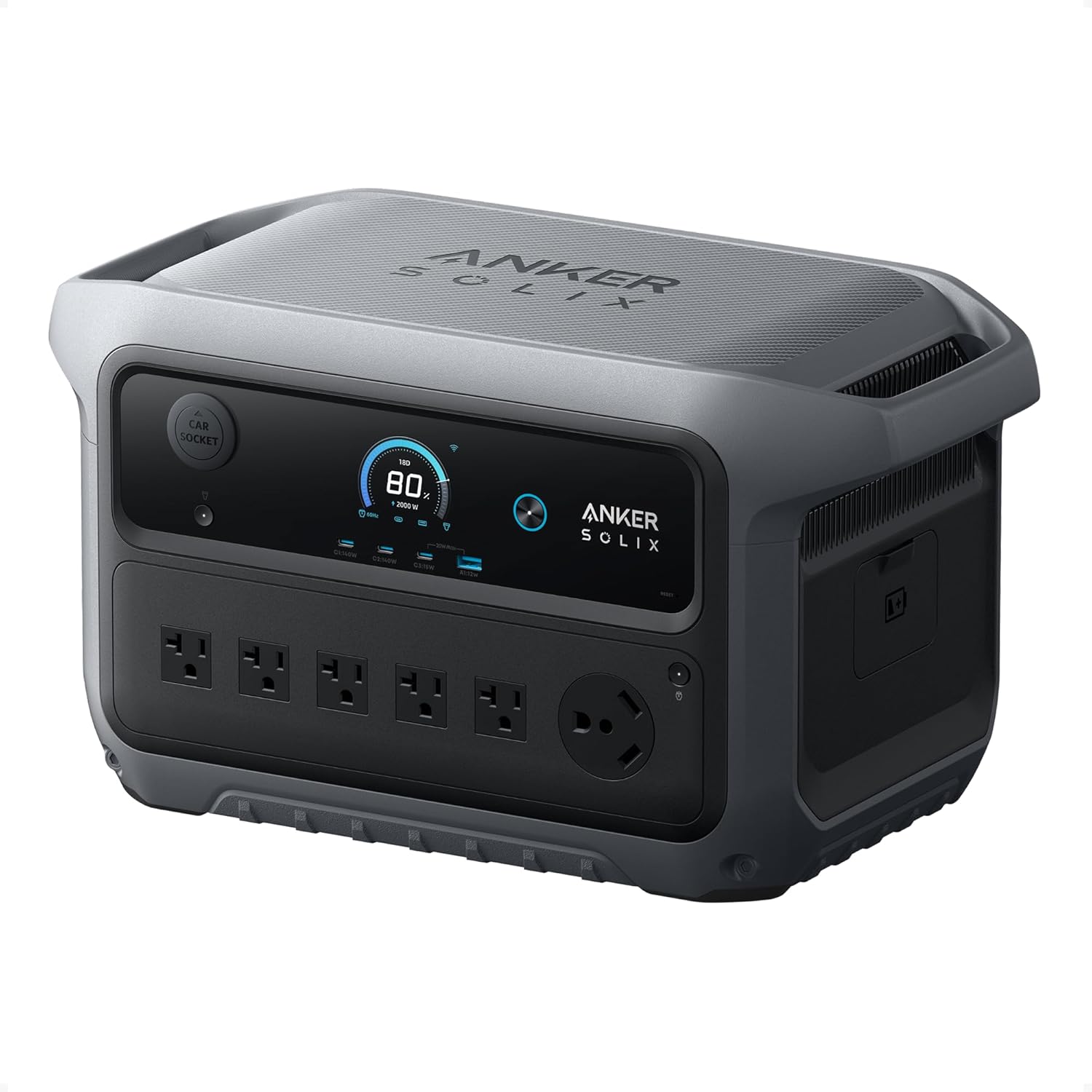
The Anker SOLIX C2000 Gen 2 offers a substantial 2,048Wh battery with 2,400W of AC output, making it a strong middle-ground choice for refrigerator backup when you want more energy reserve than a 1,000Wh-class station without moving to a substantially larger system.
For refrigerator backup, its main advantage is balance. The capacity provides a meaningful reserve for longer outages, while the 2,400W inverter provides ample headroom for a refrigerator’s normal operation and compressor startup requirements. The trade-off is that a 2,000Wh-class power station can be more capacity than necessary for a short refrigerator-only outage.
Snapshot
| Specification | Anker SOLIX C2000 Gen 2 |
|---|---|
| Battery Capacity | 2,048Wh |
| AC Output | 2,400W |
| Peak Output | 4,000W |
| Battery Chemistry | LiFePO₄ |
| Solar Input | Up to 800W |
| UPS | 10 ms |
| Weight | 41.7 lb |
| Expandable Capacity | Up to 4,096Wh |
Why We Chose It
The Anker SOLIX C2000 Gen 2 earns its place in this guide because it occupies a useful middle ground between compact refrigerator backup and larger, heavier systems designed for maximum energy storage.
Its 2,048Wh battery gives the refrigerator a substantially larger energy reserve than a 1,000Wh-class station. That matters when an outage lasts longer than expected or when the refrigerator is not the only appliance that needs power. At the same time, the 2,400W AC output provides considerable inverter headroom for compressor-based loads without requiring a move to the highest-output model in this group.
This balance also makes the Anker SOLIX C2000 Gen 2 easier to justify when portability still matters. At approximately 41.7 lb, it is not a lightweight power station, but it remains considerably more practical to handle than the heaviest high-capacity options in this comparison.
For refrigerator backup, that combination is more important than simply having the largest battery. A household that needs substantial reserve capacity but does not want to prioritize maximum expansion or maximum inverter output may find this configuration a more appropriate fit.
Check the latest price and customer reviews on Amazon.
Living With It
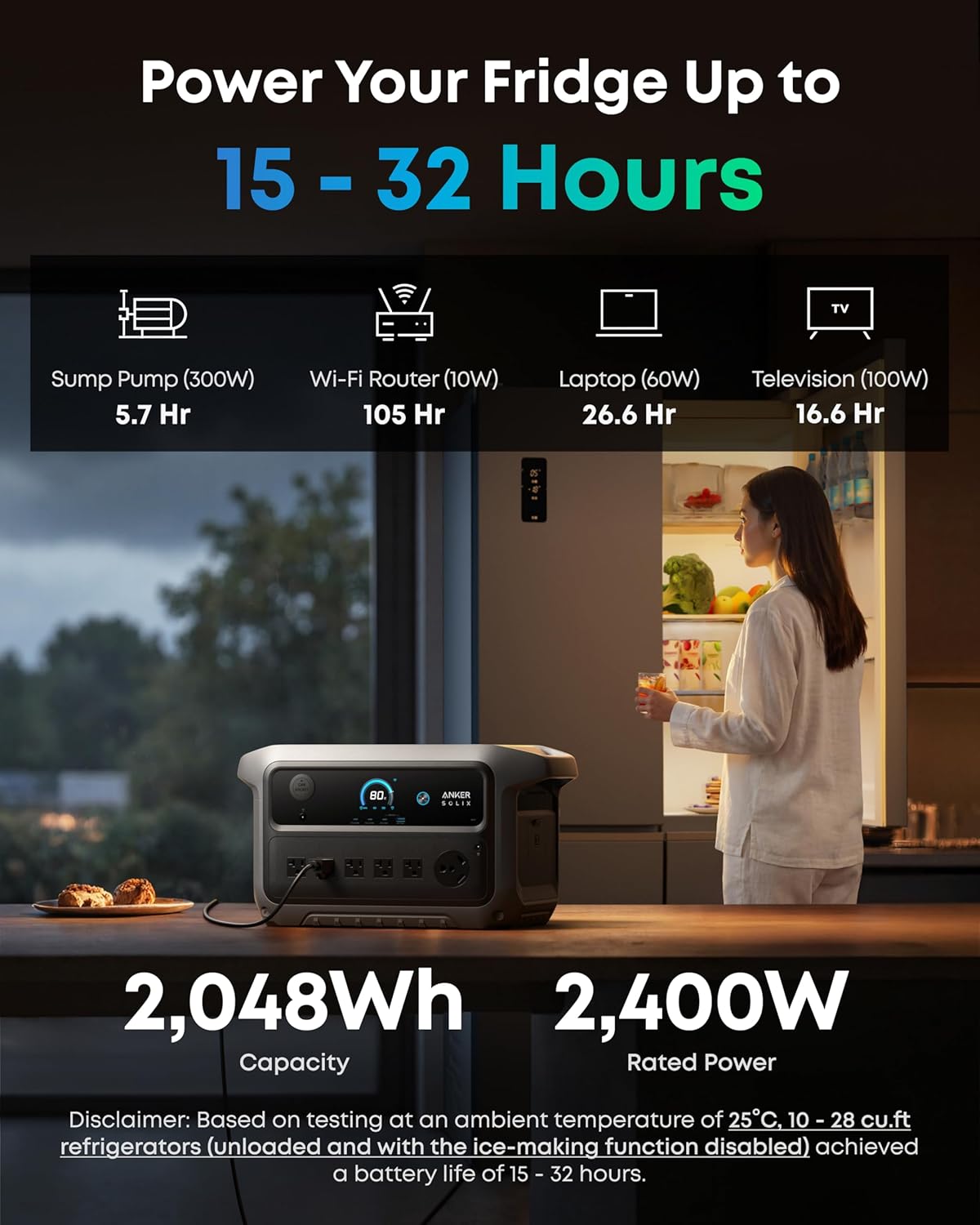
The Anker SOLIX C2000 Gen 2 makes the most sense when the power station will normally stay in a practical storage location and be moved only when necessary.
Its approximately 41,7 lb weight means this is not a unit most users will want to carry around frequently. For home refrigerator backup, however, portability usually means being able to position the station near the refrigerator, store it when it is not needed, and move it when circumstances require—not carrying it long distances.
The larger battery reserve becomes more useful as an outage extends. A refrigerator does not draw its maximum power continuously because the compressor cycles on and off, but the actual energy requirement depends on the refrigerator, ambient temperature, door openings, and other conditions. The 2,048Wh rating therefore should not be interpreted as a guaranteed number of hours of refrigerator operation.
If the refrigerator is the only load, a smaller station may provide enough energy for a shorter interruption. The Anker SOLIX C2000 Gen 2 becomes more compelling when the expected outage is longer or when the available battery reserve may also need to cover other essential devices.
Evaluation
| Evaluation Factor | This Model | How It Compares | Buyer Implication |
|---|---|---|---|
| Battery capacity | 2,048Wh | Essentially matches the 2kWh-class EcoFlow and Jackery | Provides substantial reserve for extended refrigerator backup |
| AC output | 2,400W | Higher than Jackery and C1000; below EcoFlow | Provides substantial inverter headroom for a refrigerator and additional essential loads |
| Weight | 41.7 lb | Heavier than Jackery and C1000; lighter than EcoFlow and BLUETTI | A relatively manageable option for a 2kWh-class system |
| Expansion | Up to 4,096Wh | More limited than EcoFlow and BLUETTI | Useful if some future expansion is desired, but not designed around maximum system growth |
| Overall balance | Capacity + output + moderate weight | Combines 2kWh-class capacity with 2,400W output at a moderate weight | A strong fit when you want substantial refrigerator reserve without choosing the heaviest system |
Who Should Buy This
- Buyers who want approximately 2,000Wh of battery capacity for refrigerator backup.
- Households preparing for outages that may last beyond a few hours.
- Users who want to run a refrigerator alongside selected additional essential loads.
- Buyers looking for a balance between substantial battery capacity and manageable size for a 2,000Wh-class power station.
- Users who value inverter headroom without choosing the highest-output model in this group.
Who Should Skip This
- Buyers who only need backup for short power interruptions and have no additional loads.
- Users who prioritize the lightest possible refrigerator-backup solution.
- Buyers who need the maximum battery capacity available in this five-model comparison.
- Users whose refrigerator’s actual energy requirements can be comfortably covered by a smaller-capacity power station.
Final Verdict
The Anker SOLIX C2000 Gen 2 is a strong choice when refrigerator backup calls for substantial energy reserve without making maximum capacity, maximum output, or minimum weight the only priority.
Its 2,048Wh battery and 2,400W AC output create a well-balanced combination for longer refrigerator outages and additional essential loads. The main compromise is straightforward: at approximately 41.7 lb, it is better suited to planned home backup than frequent carrying.
For buyers who want a balanced 2,000Wh-class power station for refrigerator backup, the Anker SOLIX C2000 Gen 2 offers a practical combination of capacity, inverter capability, and portability.
Check the latest price and customer reviews on Amazon.
Related Guide: If you want to determine how much battery capacity your refrigerator actually needs for a specific outage duration, see our Refrigerator Runtime Calculator for a calculation based on your refrigerator’s energy use.
Jackery Explorer 2000 v2
Award: Best Lightweight 2kWh Option

Quick Verdict
The Jackery Explorer 2000 v2 combines a 2,042Wh battery with 2,200W of AC output in a package that weighs approximately 39.5 pounds. For refrigerator backup, its main advantage is getting close to 2kWh of battery capacity without moving into the heavier end of this comparison.
That makes it particularly useful when you want substantial energy reserve for a longer outage but still expect to move, store, or reposition the power station when necessary. Its limitation is that the 2,200W inverter provides less output headroom than the higher-output models in this group.
Snapshot
| Feature | Details |
|---|---|
| Best For | Lightweight 2kWh-class refrigerator backup |
| Battery Capacity | 2,042Wh |
| AC Output | 2,200W |
| Battery Chemistry | LiFePO₄ |
| Weight | 39.5 lb |
| Charging | AC, solar, and vehicle charging supported |
Why We Chose It
The Jackery Explorer 2000 v2 earns its place in this guide for a very specific reason: it delivers substantial battery capacity without making the power station unnecessarily heavy for its class.
At 2,042Wh, its battery reserve is almost the same size as the 2,048Wh capacity offered by the Anker SOLIX C2000 Gen 2, but the Explorer 2000 v2 weighs approximately 39.5 pounds. That difference matters when the power station needs to be moved into position, stored between outages, or repositioned around the home.
For refrigerator backup, the larger battery reserve can provide more flexibility during longer outages than a 1,000Wh-class station. It can also leave some capacity available for selected essential loads, although actual runtime will depend on the refrigerator’s energy consumption and the other devices connected to the station.
The 2,200W AC output is another important part of the equation. It provides substantial capacity for refrigerator operation and other household loads, while remaining below the 2,400W and 3,000W output levels offered by some alternatives in this comparison.
The resulting trade-off is straightforward: the Explorer 2000 v2 emphasizes battery capacity and physical manageability rather than maximum inverter output or the largest expansion potential.
Check the latest price and customer reviews on Amazon.

Living With It
The Jackery Explorer 2000 v2 is most useful when portability still matters even though the required battery capacity has moved into the 2kWh range.
At approximately 39.5 pounds, it is not a lightweight device in absolute terms. But compared with many power stations offering around 2,000Wh of storage, that weight makes it comparatively easier to handle.
For refrigerator backup, this can matter before and after an outage as much as during one. The station may need to be stored when not in use, moved into position when severe weather is expected, or relocated closer to the refrigerator when the power goes out.
Its 2,042Wh battery also provides more reserve than a 1,000Wh-class station, but capacity should not be translated directly into a guaranteed runtime. Refrigerator energy consumption varies with compressor cycling, ambient temperature, door openings, refrigerator efficiency, and other operating conditions. Conversion losses also reduce the energy actually available to an AC appliance.
The practical advantage of the Explorer 2000 v2 is therefore more reserve without making physical handling unnecessarily difficult for a 2kWh-class station.
Evaluation
| Evaluation Factor | This Model | How It Compares | Buyer Implication |
|---|---|---|---|
| Weight | 39.5 lb | Lightest among the 2kWh-class models in this group | Easier to move and store when portability matters |
| Battery capacity | 2,042Wh | Very close to the 2,048Wh EcoFlow and Anker C2000 | Provides nearly the same nominal battery reserve without a meaningful capacity penalty |
| AC output | 2,200W | Lower than EcoFlow, C2000, and BLUETTI; higher than C1000 | Provides useful inverter headroom for a refrigerator, with less capacity for additional high-demand loads |
| Portability-to-capacity balance | 2kWh-class capacity at 39.5 lb | Lighter than the other 2kWh-class choices | Particularly relevant for users who expect to move the station frequently |
| Trade-off | Lower output for lower weight | Gives up some inverter headroom compared with the higher-output models | Better suited to refrigerator-focused backup than heavier multi-load use |
Who Should Buy This
- Buyers who want approximately 2,000Wh of battery capacity for refrigerator backup.
- Households preparing for outages that may last beyond a short interruption.
- Users who still need to move or store the power station relatively easily.
- Buyers who want substantial battery reserve without choosing one of the heavier models in this comparison.
- Users who need enough AC output for a refrigerator and selected additional essential loads.
Who Should Skip This
- Buyers who only need refrigerator backup for short outages and would benefit from a smaller station.
- Users who prioritize maximum inverter output over weight.
- Buyers who need the largest battery capacity or greatest expansion potential in this comparison.
- Households that expect to run several high-draw appliances simultaneously.
- Users for whom approximately 39.5 pounds is still too heavy for their intended setup.
Final Verdict
The Jackery Explorer 2000 v2 takes a deliberately different approach to refrigerator backup. Its key advantage is not having the highest inverter output or the largest battery in the group. It is the combination of 2,042Wh of storage and approximately 39.5 pounds of weight.
That makes it a practical option for buyers who want the reserve of a 2kWh-class power station but do not want to move immediately into a heavier system.
The 2,200W AC output provides useful headroom for refrigerator backup and selected additional loads, while the relatively manageable weight makes storage and repositioning easier than with some larger alternatives.
If you want substantial refrigerator-backup capacity while keeping the physical size and weight of the system under better control, the Jackery Explorer 2000 v2 is our Best Lightweight 2kWh Option.
Check the latest price and customer reviews on Amazon.
Related Guide: If you are comparing battery capacity, power output, portability, and charging options before choosing a model, see our How to Choose a Portable Power Station guide for a broader buying framework.
Anker SOLIX C1000 Gen 2
Award: Best for Shorter Refrigerator Outages

Quick Verdict
The Anker SOLIX C1000 Gen 2 takes a different approach to refrigerator backup from the larger stations in this guide. Its 1,024Wh battery is designed for situations where you need a practical reserve for a shorter outage rather than maximum battery capacity for an extended emergency.
Its 2,000W AC output is substantial for a power station of this capacity class, giving it useful inverter headroom for a refrigerator and selected additional loads. The main limitation is energy reserve: if the outage continues for a long time or several appliances need to run alongside the refrigerator, the smaller battery can become the limiting factor.
Snapshot
| Feature | Details |
|---|---|
| Best For | Shorter refrigerator outages |
| Battery Capacity | 1,024Wh |
| AC Output | 2,000W |
| Peak Output | 3,000W |
| Battery Chemistry | LiFePO₄ |
| Weight | 24.9 lb |
| Best Use | Refrigerator backup and limited essential loads during shorter outages |
Why We Chose It
The Anker SOLIX C1000 Gen 2 is included because refrigerator backup does not automatically require a 2,000Wh-class power station.
If the main objective is to keep one refrigerator operating through a shorter interruption, carrying twice the battery capacity may provide little practical benefit while adding considerable weight and size. The C1000 Gen 2 instead focuses on providing a 1,024Wh energy reserve in a more compact package.
Its 2,000W AC output is particularly relevant here. Battery capacity determines how much stored energy is available, while inverter output determines how much AC power the station can supply at a given moment. Those are different requirements, and a 1,024Wh station can still have substantial inverter capability.
That distinction matters for refrigerators because compressor startup can temporarily increase the electrical demand compared with the refrigerator’s normal running consumption. The C1000 Gen 2’s 2,000W AC output provides useful headroom, while its smaller battery keeps the overall system more manageable.
The trade-off is equally important. A 1,024Wh station simply provides less stored energy than the 2,000Wh-class alternatives in this guide. If the outage lasts much longer than expected, or if the power station must also support several other appliances, the additional capacity of a larger model becomes more valuable.
Check the latest price and customer reviews on Amazon.

Living With It
At approximately , the Anker SOLIX C1000 Gen 24.9 lb changes what portability means in a home refrigerator-backup setup.
It is substantially easier to move into position, store between outages, and relocate when necessary than the heavier 2,000Wh-class models in this comparison. That can be useful for households that do not want a large power station permanently occupying storage space.
The smaller battery also makes the station easier to match to a specific emergency scenario. If your priority is keeping the refrigerator operating through a relatively short outage, a 1,024Wh reserve may be more practical than buying capacity you rarely need.
But this is where realistic expectations matter. A refrigerator does not consume its maximum rated power continuously; the compressor cycles on and off, and actual energy use varies with the appliance, room temperature, door openings, and other conditions. At the same time, the power station loses some energy through the conversion from battery DC power to household AC power.
The C1000 Gen 2 should therefore be viewed as a shorter-outage refrigerator backup solution, not as a substitute for a larger energy reserve when multi-day backup is the objective.
Evaluation
| Evaluation Factor | This Model | How It Compares | Buyer Implication |
|---|---|---|---|
| Battery capacity | 1,024Wh | Roughly half the capacity of the 2kWh-class models | More appropriate when the expected outage is shorter or the refrigerator is the primary load |
| AC output | 2,000W | Lower than the four larger models, but still substantial for its battery class | Provides meaningful inverter capability despite the smaller battery |
| Weight | 24.9 lb | Lightest model in the five-model set | Much easier to store, move, and deploy during an outage |
| UPS capability | 10 ms | Comparable to the other 10 ms UPS-equipped models | Useful when automatic transfer matters more than maximum battery reserve |
| Capacity trade-off | Smaller reserve in a compact package | Gives up runtime potential in exchange for portability | Provides less runtime potential in exchange for a much lighter, easier-to-deploy system |
Who Should Buy This
- Households primarily concerned with shorter refrigerator outages.
- Buyers who want a more compact alternative to a 2,000Wh-class power station.
- Users who value lower weight and easier storage.
- Buyers who expect the refrigerator to be the primary emergency load.
- Households that do not need to run several major appliances simultaneously during an outage.
- Users who want substantial AC inverter capacity without carrying a much larger battery.
Who Should Skip This
- Buyers preparing for extended or multi-day power outages.
- Households that expect to run a refrigerator together with several other substantial AC loads.
- Users who want the largest possible battery reserve without adding another charging cycle.
- Buyers who expect significant future expansion of their emergency power system.
- Anyone whose refrigerator has unusually high energy consumption and whose expected outage duration requires more than a 1,024Wh-class reserve.
Final Verdict
The Anker SOLIX C1000 Gen 2 is the compact-capacity option in this comparison, but that does not make it a lesser refrigerator-backup solution by definition.
Its 1,024Wh battery and 2,000W AC output address a specific scenario: keeping a refrigerator operating during shorter outages while maintaining a power station that is easier to store and move.
The key question is therefore not whether 1,024Wh is enough in the abstract. It is whether that amount of stored energy matches your refrigerator’s actual consumption and the duration of the outages you are preparing for.
If your priority is practical refrigerator backup for shorter outages rather than maximum runtime, the Anker SOLIX C1000 Gen 2 provides a more compact alternative to the larger power stations in this guide.
Check the latest price and customer reviews on Amazon.
Related Guide: If you are deciding between a smaller and larger power station based on your expected appliance load, see our What Size Power Station Do I Need? guide for a broader look at capacity and power requirements.
BLUETTI AC200PL
Award: Best for Long-Duration and Expandable Backup

Quick Verdict
The BLUETTI AC200PL is the high-capacity option in this comparison, with a 2,304Wh battery, 2,400W AC output, and substantial expansion potential. For refrigerator backup, its main advantage is the amount of stored energy available when an outage may last well beyond a short interruption.
That makes it particularly relevant when the refrigerator is only one part of the emergency-power plan. The larger battery can provide additional reserve for selected essential loads, while expansion gives the system a path toward substantially greater capacity if longer outages become a recurring concern.
The trade-off is physical: at approximately 72 lb, the AC200PL is the heaviest model in this five-station comparison and is better suited to a planned backup position than frequent movement.
Snapshot
| Feature | Details |
|---|---|
| Best For | Long-duration refrigerator backup and expandable capacity |
| Battery Capacity | 2,304Wh |
| AC Output | 2,400W |
| Solar Input | Up to 1,200W |
| Battery Chemistry | LiFePO₄ |
| Weight | 72 lb |
| Expansion | Expandable up to 8,448Wh |
Why We Chose It
The BLUETTI AC200PL is here because some refrigerator-backup situations are not really about getting through the next few hours. They are about having enough stored energy to remain useful when the outage lasts much longer than expected.
Its 2,304Wh battery is the largest built-in battery among the five models in this guide. That additional reserve can be valuable when the refrigerator needs to continue operating while the power station also supports other essential loads.
The 2,400W AC output provides substantial inverter capacity, while the ability to accept up to 1,200W of solar input gives the system a meaningful option for replenishment during an extended outage when an appropriate solar setup is available.
The other defining feature is expansion. The AC200PL can be expanded substantially, making it different from a power station chosen simply as a self-contained refrigerator battery. For households preparing for recurring or potentially prolonged outages, that creates a path toward a larger energy reserve without replacing the core unit.
But capacity comes with a physical cost. At 72 lb, the AC200PL is not the station to choose primarily for easy carrying. Its strengths make more sense when it can be positioned near the equipment it is intended to support and remain there during an outage.
Check the latest price and customer reviews on Amazon.

Living With It
The BLUETTI AC200PL is best treated as a substantial emergency-power system rather than a power station that you expect to move casually.
For refrigerator backup, that can actually be an advantage. Once positioned in a suitable location, the station can serve as a central source of AC power during an outage instead of being repeatedly moved between appliances.
Its 2,304Wh capacity provides more stored energy than the other four models in this comparison. However, that does not translate into a fixed number of refrigerator hours. Actual runtime depends on the refrigerator’s energy consumption, compressor cycling, ambient conditions, conversion losses, and whether other loads are connected.
The larger reserve becomes particularly useful when the refrigerator is not the only priority. A household may also need to keep communications equipment, lighting, networking equipment, or other essential electronics operating. In those circumstances, starting with more battery capacity can provide greater flexibility.
The AC200PL also becomes more interesting when an outage is expected to last long enough that recharging matters. Its solar-input capability can support a larger solar replenishment strategy, although actual solar production will depend on the panels, sunlight, orientation, weather, and other system constraints.
The central compromise remains weight. At approximately 72 lb, this is a model to position deliberately rather than carry repeatedly.
Evaluation
| Evaluation Factor | This Model | How It Compares | Buyer Implication |
|---|---|---|---|
| Battery capacity | 2,304Wh | Highest built-in capacity in the five-model set | Provides the largest initial battery reserve for longer outages |
| Expansion | Up to 8,448Wh | Higher than most models in this set; below EcoFlow's maximum | Gives refrigerator backup a path toward a larger emergency-power system |
| Solar input | Up to 1,200W | Highest solar-input figure among these five models | More recharge potential can be useful when grid power remains unavailable |
| AC output | 2,400W | Higher than Jackery and C1000; below EcoFlow | Strong enough for refrigerator backup plus additional essential loads |
| Portability | 72 lb | Heaviest model in the five-model set | Best treated as a stationary or semi-permanent backup system rather than a frequently moved power station |
Who Should Buy This
- Households preparing for longer refrigerator outages.
- Buyers who want the largest built-in battery capacity among the five models in this guide.
- Users who expect the power station to support a refrigerator plus additional essential loads.
- Buyers interested in expanding battery capacity as their backup needs grow.
- Households with enough space for a dedicated power-station location.
- Users who want substantial solar-input capability for extended backup scenarios.
Who Should Skip This
- Buyers preparing only for short refrigerator outages.
- Users who prioritize easy portability and frequent movement.
- Households whose refrigerator is the only meaningful emergency load.
- Buyers who have no need for additional battery expansion.
- Users for whom a 2,000Wh-class battery already provides sufficient reserve.
Final Verdict
The BLUETTI AC200PL occupies the high-capacity end of this refrigerator-backup comparison for a clear reason: it is designed around having more energy available when the outage does not end quickly.
Its 2,304Wh battery, 2,400W AC output, 1,200W solar input, and expansion capability give it the flexibility to move beyond refrigerator-only backup toward a broader emergency-power system.
The price of that capacity is physical practicality. At approximately 72 lb, the AC200PL is considerably less convenient to move than the lighter models in this guide.
If your priority is a substantial built-in energy reserve for longer refrigerator outages, with the option to expand your backup capacity over time, the BLUETTI AC200PL is the most capacity-focused choice in this comparison.
Check the latest price and customer reviews on Amazon.
Related Guide: If you want to understand how long a portable power station can actually run before choosing a model for an extended outage, see our How Long Does a Power Station Last? guide for the factors that determine real-world runtime.
How to Choose a Portable Power Station for Refrigerator Backup
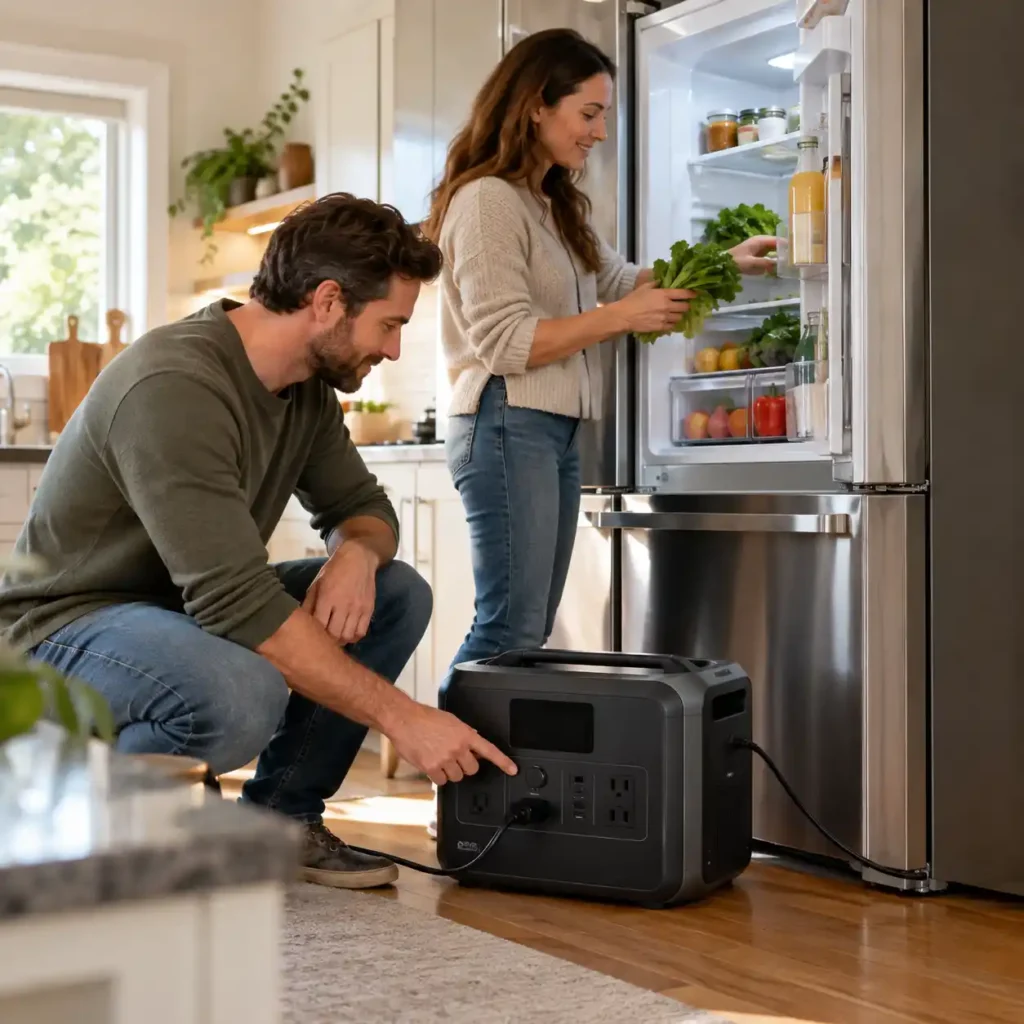
Choosing a portable power station for refrigerator backup is not simply a matter of buying the largest battery or the highest inverter rating. The better approach is to match the station to your refrigerator, expected outage conditions, charging options, and any additional loads you want to keep running.
If you already know your refrigerator’s energy consumption and the approximate backup duration you need, use those figures as the starting point. For the broader process of calculating required capacity, see our What Size Power Station Do I Need? guide. For refrigerator-specific runtime estimates, use our Refrigerator Runtime Calculator.
Start With the Outage You Need to Cover
The first decision is how you expect to use the power station during an outage.
A short interruption may require only enough stored energy to keep the refrigerator operating until utility power returns. A longer outage changes the priorities: you may want additional reserve, faster recharging, solar input, or the ability to expand the battery later.
This distinction matters when comparing 1,000Wh-class and 2,000Wh-class stations. A smaller station can be practical when the refrigerator is the primary load and outages are usually brief. A larger station provides more reserve when outages may last longer or when the refrigerator is only one part of your emergency-power plan.
The goal is not to maximize battery capacity. It is to have enough usable reserve for the outage scenario you actually need to cover.
Match Inverter Capability to the Refrigerator
Battery capacity determines how much energy the station stores. The inverter determines whether the station can supply the refrigerator’s AC load in the first place.
Refrigerators are different from simple resistive loads because the compressor can require a higher starting demand than its normal running power. For that reason, compare both the station’s continuous AC output and surge capability with the refrigerator’s electrical requirements.
A higher inverter rating does not automatically mean longer refrigerator runtime. It provides more output headroom, which can be useful when the compressor starts or when you want to run another appliance at the same time.
For refrigerator-only backup, there is usually little reason to choose a model solely because it has the highest possible inverter rating. What matters is having sufficient headroom for the refrigerator and the other loads you realistically expect to use.
Consider How Much Else You Need to Power
A refrigerator may be the primary reason for buying a power station, but it is rarely the only appliance people want available during an outage.
You may also want to power a modem or router, a few lights, phones, medical equipment, a fan, or other essential electronics. Once additional loads are included, both battery reserve and inverter capacity become more important.
This is where two power stations with similar refrigerator-backup capability can serve very different purposes. A compact station may be entirely adequate for the refrigerator alone, while a larger model may be more appropriate if the same battery must also support several essential household loads.
Choose according to the complete emergency load you expect to use, rather than sizing the system around the refrigerator in isolation.
Look at Recharge Options for Longer Outages
Battery capacity only describes the energy available at the beginning of an outage. During a prolonged outage, the ability to put energy back into the battery becomes equally important.
When comparing models, look at the available charging methods and their practical charging rates. AC charging can restore the battery when utility power or another generator is available. Solar charging can provide an independent source of energy during a grid outage, while vehicle charging can be useful in some emergency situations.
Maximum solar input should also be interpreted carefully. A high input rating tells you what the power station can accept under suitable conditions; it does not guarantee that a solar array will actually deliver that much energy.
For a refrigerator backup system, the useful question is therefore not simply “How fast can this power station charge?” but “How can I replenish the battery if the outage lasts longer than the initial reserve?”
Decide Whether UPS Functionality Matters
If you want the power station to take over automatically when utility power fails, UPS functionality can be an important part of the decision.
A UPS-capable power station can keep connected equipment powered during a grid interruption without requiring you to manually move the refrigerator’s plug. This can be particularly useful when the refrigerator is connected to the station continuously and automatic backup is part of your emergency-power strategy.
However, UPS specifications should be compared according to the manufacturer’s documented operating behavior and transfer time. A UPS feature does not eliminate the need to verify that the refrigerator and the power station are compatible with the intended setup.
If automatic backup is not important, this feature may carry less weight in your decision than battery capacity, recharge options, or portability.
Balance Capacity Against Portability
A larger power station can provide more energy reserve, but it also generally means more weight and a larger physical footprint.
For a station that will remain in one location during an outage, weight may be a relatively minor concern. If you expect to move it between rooms, store it when not in use, or use it for both home backup and other activities, portability becomes more important.
This creates a practical difference between the models in this guide. A 2,000Wh-class station can provide substantial reserve, but a roughly 1,000Wh-class model may be easier to store and move when the refrigerator is the main load and the expected outage is shorter.
Do not pay for capacity that creates a handling or storage problem if you are unlikely to use the additional reserve.
Consider Expansion if Long Outages Are a Recurring Concern
Expandable power stations can make sense when refrigerator backup is part of a broader emergency-power strategy.
If you expect occasional short outages, built-in capacity may be all you need. If your goal is to prepare for extended outages and eventually support additional essential appliances, an expandable system can provide a way to increase stored energy without replacing the main power station.
Expansion is therefore most relevant when you are planning for future backup needs, not simply trying to maximize the specification of your current refrigerator setup.
Choose the Model Around Your Backup Scenario
Once the basic requirements are understood, the final decision should come down to the type of refrigerator backup you actually want.
Refrigerator only + shorter outages: prioritize adequate capacity, sufficient inverter headroom, and portability rather than maximum battery size.
Refrigerator + several essential loads: look for a larger battery reserve and stronger AC output so the station can support the broader emergency load.
Longer or unpredictable outages: give more weight to battery capacity, recharge speed, solar input, and expansion capability.
Automatic backup: prioritize a model with documented UPS functionality and an appropriate transfer time.
Frequent movement or limited storage: favor a lighter, more manageable station if its capacity and output still meet your requirements.
The key is to evaluate these characteristics together. Battery capacity tells you how much energy is stored, inverter capability determines what the station can power, and charging capability determines how practical that stored energy remains during a prolonged outage.
That is the decision framework used in the five models compared below.
How Much Battery Capacity Is Practical for Refrigerator Backup?
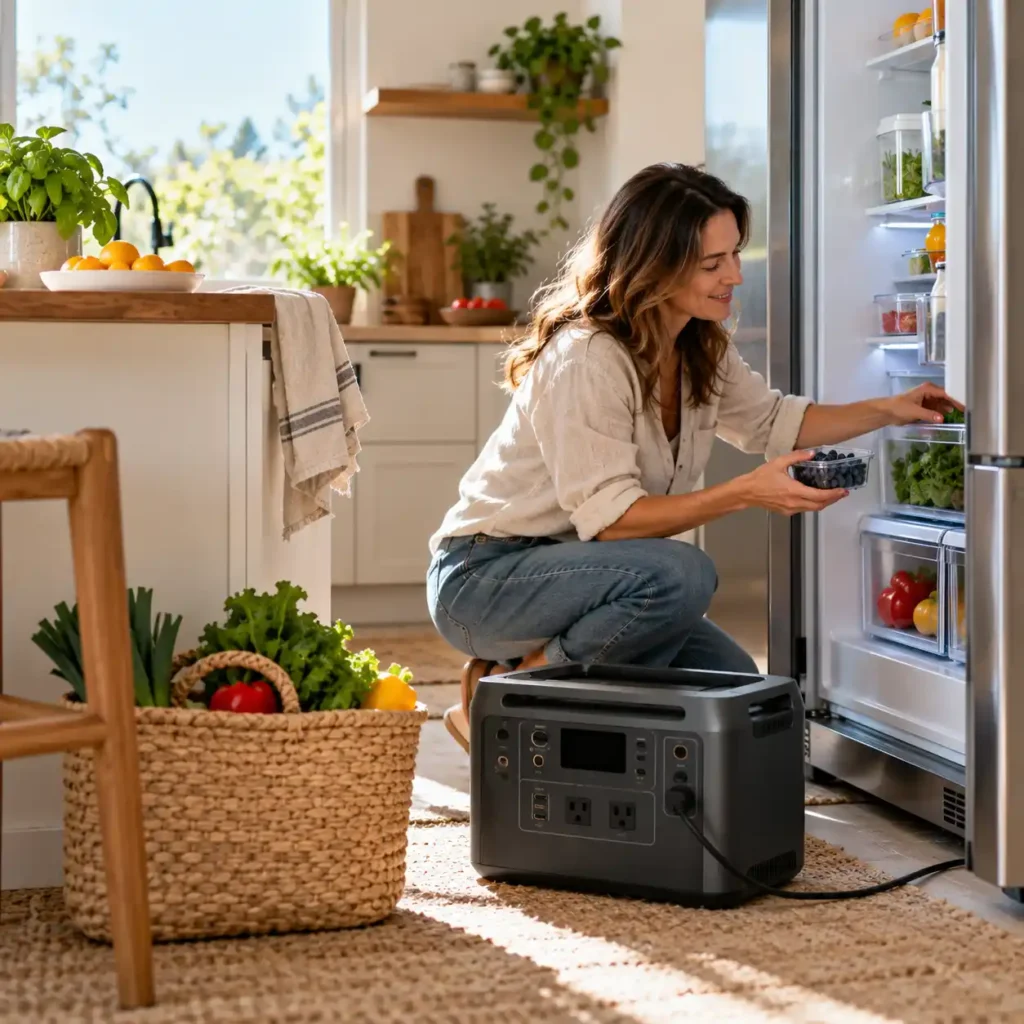
Battery capacity is one of the most important specifications when choosing a portable power station for refrigerator backup, but more capacity is not automatically better. The practical choice depends primarily on the type of outage, whether the refrigerator is the only load, and how much backup reserve you want to carry.
For refrigerator backup, the most useful comparison is often between 1,000Wh-class and 2,000Wh-class power stations. Larger expandable systems can make sense when refrigerator backup is part of a broader plan for extended outages.
1,000Wh-Class Power Stations
A 1,000Wh-class power station can make sense when the refrigerator is the primary load and the expected outage is relatively short. If you are specifically comparing models in this capacity class, see our Best 1000Wh Portable Power Stations (2026) guide.
The main advantage is practicality. A smaller battery is generally easier to store and move, and it can provide a useful emergency reserve without the additional size and weight of a 2,000Wh-class system.
The trade-off is flexibility. If the outage lasts longer than expected or you add other essential loads, the smaller battery provides less reserve. For that reason, a 1,000Wh-class model is most appropriate when portability and refrigerator-only backup are more important than maximum runtime.
2,000Wh-Class Power Stations
A 2,000Wh-class power station provides substantially more stored energy and gives you greater flexibility during an extended outage.
The additional reserve becomes particularly useful when the refrigerator is only one part of the emergency-power plan.
The trade-off is weight and physical size. If the station will remain in one location during an outage, that may be relatively unimportant. If you need to move and store it frequently, the additional capacity may be less valuable.
For many refrigerator-backup scenarios, the 2,000Wh class provides a practical balance between substantial reserve and a still-portable system.
When More Than 2,000Wh Makes Sense
A larger battery becomes more relevant when refrigerator backup is part of a broader emergency-power strategy, especially when you expect to support several essential loads or plan to expand the system over time.
Capacity Is Only One Part of the Decision
The practical decision is simple: choose the capacity class that matches your outage scenario, then compare inverter capability, recharge options, portability, and expansion before selecting the model.
How Long Can a Portable Power Station Run a Refrigerator?

There is no single runtime figure that applies to every refrigerator and every portable power station. A refrigerator does not normally draw its maximum rated power continuously: the compressor cycles on and off, and its energy consumption changes with temperature, settings, ventilation, and usage.
For that reason, battery capacity provides the starting point for a runtime estimate, but it does not determine the actual operating time by itself.
Refrigerator Energy Use Matters More Than Rated Wattage Alone
A refrigerator’s rated wattage describes its electrical demand under particular operating conditions, but it does not necessarily represent how much energy the appliance consumes over an entire day.
A compressor refrigerator typically cycles rather than running continuously. During periods when the compressor is off, the refrigerator still uses some energy for controls, lighting, and other functions, while compressor operation increases the instantaneous demand.
This means two refrigerators with similar rated wattage can consume different amounts of energy over the same period.
For refrigerator backup, the more useful measurement is therefore actual energy consumption over time, rather than simply the highest wattage shown on the appliance label.
Startup Demand and Runtime Are Different Questions
Compressor startup is important when determining whether a power station can run a refrigerator, but it should not be confused with battery runtime.
The inverter must be capable of supplying the refrigerator when the compressor starts, including any higher temporary demand. Once the refrigerator is operating normally, the amount of stored battery energy determines how long the station can continue supplying the load.
In practical terms:
Inverter capability determines whether the refrigerator can start and operate; battery capacity determines how much energy is available for continued operation.
This is why a power station with a very high inverter rating does not necessarily provide longer refrigerator runtime than a model with a lower-rated inverter and similar battery capacity.
Usable Battery Energy Is Lower Than the Rated Capacity
The capacity printed on a power station is the battery’s rated energy capacity, not necessarily the amount of AC energy that will reach the refrigerator.
When the refrigerator is powered through the station’s AC inverter, some energy is lost during conversion. The usable energy can also be affected by the station’s operating limits and other system characteristics.
As a result, runtime estimates based simply on dividing battery capacity by refrigerator wattage can overstate actual operating time.
For this reason, our runtime comparisons should be treated as estimates rather than guaranteed operating times. Power Ready Guide has not laboratory-tested these five power stations with a refrigerator.
Real-World Conditions Can Change Runtime
Even the same refrigerator can consume different amounts of energy from one situation to another.
Factors that can affect runtime include:
Ambient temperature
Refrigerator temperature setting
Frequency of door openings
Amount and temperature of food placed inside
Refrigerator efficiency and age
Compressor cycling behavior
Other devices connected to the power station
AC conversion losses
A refrigerator operating in a hot environment may require more energy than the same appliance operating in cooler conditions. Similarly, opening the door frequently can increase compressor activity.
This is why a calculated runtime should be treated as a planning estimate rather than a promise of how many hours the refrigerator will operate.
Additional Loads Reduce Refrigerator Runtime
The refrigerator does not have to be the only device connected to the power station.
If you also run a router, lights, phones, fans, or other essential equipment, those loads consume part of the same battery reserve. The more additional energy the household uses, the less energy remains available for the refrigerator.
This creates an important distinction between refrigerator-only backup and refrigerator-plus-essential-load backup.
A 2,000Wh-class station may therefore be particularly useful not simply because it can run a refrigerator for longer, but because it provides more reserve when several essential loads must share the battery.
How Long Can Food Stay Safe During a Power Outage?
Keeping a refrigerator powered is not only about extending runtime—it can also help protect perishable food. According to the USDA, an unopened refrigerator will generally keep food at a safe temperature for up to 4 hours during a power outage, while a full freezer can maintain safe temperatures for about 48 hours (or 24 hours if half full). Keep the doors closed as much as possible, and use an appliance thermometer to monitor temperatures.
If the outage lasts longer than four hours, USDA recommends moving perishable food to a cooler with ice or frozen gel packs, or discarding it if it has not been kept at a safe temperature.
Treat Runtime as a Range, Not a Fixed Number
For refrigerator backup, a useful runtime estimate should be based on the refrigerator’s actual or estimated energy consumption, the power station’s usable AC energy, and the conditions under which the refrigerator will operate.
If you know your refrigerator’s energy consumption and want to estimate how long a specific power station can support it, use our Refrigerator Runtime Calculator.
The important takeaway is that battery capacity, refrigerator energy consumption, inverter efficiency, compressor cycling, and operating conditions all contribute to actual runtime. No single specification on the power station’s product page can predict the exact number of hours a refrigerator will run during a real outage.
Estimated Refrigerator Runtime Examples
Runtime estimates are useful for comparing portable power stations, but they should be treated as planning figures rather than guaranteed refrigerator operating times. A refrigerator’s compressor cycles on and off, and actual energy consumption varies with appliance efficiency, ambient temperature, temperature settings, door openings, and other operating conditions.
The table below uses three capacity classes represented in this guide and assumes approximately 85% of rated battery capacity is available as usable AC energy after typical conversion and system losses. The load figures represent an average AC load, not the refrigerator’s compressor startup demand.
The 85% factor is a planning assumption used to make the capacity classes comparable; it is not a measured efficiency figure for any specific model.
| Average Refrigerator Load | 1,024Wh Class | 2,048Wh Class | 2,304Wh Class |
|---|---|---|---|
| 50W average | ~17.4 hours | ~34.8 hours | ~39.2 hours |
| 75W average | ~11.6 hours | ~23.2 hours | ~26.1 hours |
| 100W average | ~8.7 hours | ~17.4 hours | ~19.6 hours |
These figures are calculated estimates, not measured refrigerator runtimes. They assume approximately 85% usable AC energy and do not account for the refrigerator’s specific duty cycle beyond the stated average load. Actual runtime can vary with inverter efficiency, compressor cycling, ambient temperature, refrigerator efficiency, door-opening frequency, temperature settings, and any additional loads connected to the power station.
How to Interpret the Estimates
The 50W, 75W, and 100W figures should not be interpreted as fixed refrigerator wattages. They represent different average-load scenarios to illustrate how the same battery capacity can produce substantially different runtimes.
For context, the U.S. Department of Energy has cited approximately 1.5–2.0 kWh of electricity per day for a representative household refrigerator. That corresponds to an average load of roughly 63–83W if consumption were distributed evenly over 24 hours, although a real refrigerator does not operate at a constant load.
This is why measuring or obtaining the refrigerator’s actual energy consumption is more useful than relying on a single wattage number printed on the appliance.
What the Capacity Difference Means
The table illustrates an important distinction between the capacity classes in this guide.
A 1,024Wh-class station can provide useful refrigerator backup when the expected outage is relatively short, but its smaller energy reserve leaves less room for extended operation or additional household loads.
A 2,048Wh-class station provides roughly twice the rated battery capacity of a 1,024Wh-class model, creating substantially more reserve for longer outages or refrigerator-plus-essential-load scenarios.
The 2,304Wh-class BLUETTI AC200PL adds some additional built-in capacity beyond the 2,000Wh class, which can provide extra reserve when the outage is longer or additional loads share the battery.
However, battery capacity is only one part of the calculation. A refrigerator with higher actual energy consumption can reduce these runtimes substantially, while a more efficient refrigerator may operate longer under the same conditions.
For a refrigerator-specific estimate based on your appliance’s actual energy consumption and the expected outage duration, use our Refrigerator Runtime Calculator rather than relying on a generalized wattage assumption.
Important: These examples are intended to compare capacity classes, not to predict the exact runtime of any specific refrigerator. Power Ready Guide has not laboratory-tested these five power stations with a refrigerator.
Common Buying Mistakes When Choosing a Power Station for Refrigerator Backup
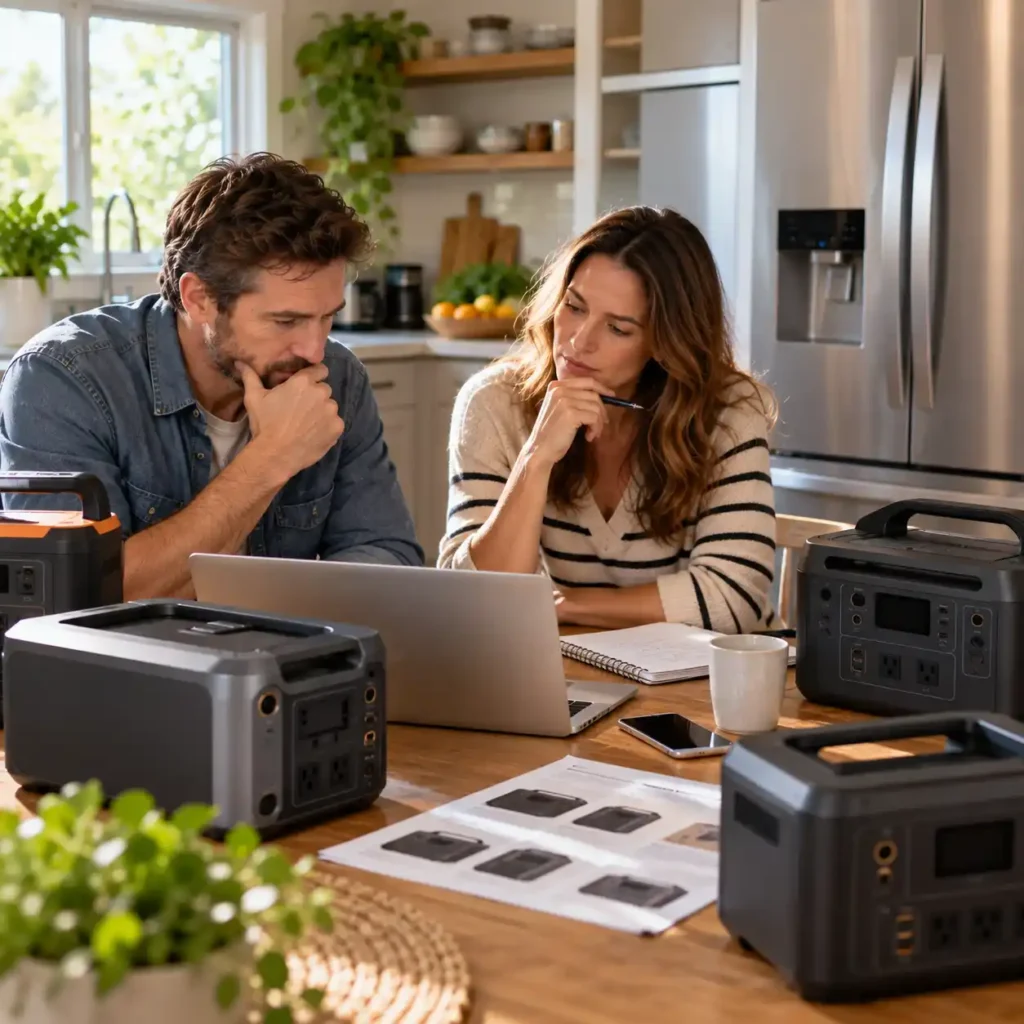
Choosing a power station for refrigerator backup involves more than comparing battery capacity or maximum output. The most common mistakes come from choosing a model that does not match the actual backup scenario.
Choosing a Capacity Class Without Considering the Outage Scenario
A larger battery is not automatically the better choice. A 2,000Wh-class power station may provide useful additional reserve during a prolonged outage, but it also adds weight, size, and cost.
For a short outage where the refrigerator is the primary load, a 1,000Wh-class model may be sufficient. For longer outages or broader emergency backup, a larger capacity class may be more practical.
Buying More Capacity Than the Backup Scenario Requires
It is easy to assume that more battery capacity provides better protection against outages. In practice, the additional capacity only adds value if you are likely to use it.
If the power station will be used primarily for short refrigerator outages, paying for a substantially larger and heavier system may provide little practical benefit. The better approach is to match capacity to the expected use rather than simply choosing the largest battery available.
Not Checking the Refrigerator’s Actual Electrical Requirements
A power station should be selected based on the refrigerator it needs to support, not on generic refrigerator wattage figures.
Before buying, check the refrigerator’s available specifications or measured electrical requirements and confirm that the selected power station provides appropriate continuous AC output and sufficient startup capability. For a broader buying framework, see our How to Choose a Portable Power Station guide. This is particularly important for refrigerators with higher compressor demands.
Forgetting That the Refrigerator Is a Priority Load
A refrigerator is different from many other emergency loads because it needs to remain available around the clock. Adding lights, fans, internet equipment, or other appliances draws from the same battery reserve and can reduce the amount of energy available for the refrigerator.
If refrigerator preservation is the primary goal, make sure the power station has enough reserve for the refrigerator before adding secondary loads.
Choosing a Power Station Without a Realistic Recharge Plan
Battery capacity matters most when you cannot easily replenish it. For outages that may last beyond the initial battery reserve, consider how you will recharge the power station through available AC, solar, or vehicle-charging options.
A model with a large battery but limited practical recharge options may be less useful during a prolonged outage than a system that can be replenished while the refrigerator continues operating.
Frequently Asked Questions
Can a Portable Power Station Run a Refrigerator During a Power Outage?
Yes. A portable power station can run a refrigerator during a power outage if its inverter can handle the refrigerator’s operating and startup requirements and its battery provides enough usable energy for the expected outage. Actual runtime depends on the refrigerator’s energy consumption, compressor cycling, battery capacity, conversion losses, and any other loads connected to the power station.
Can a Portable Power Station Run a Refrigerator While Charging?
Some portable power stations can power a refrigerator while they are being recharged, but the behavior depends on the model’s charging and pass-through capabilities. For a prolonged outage, check the manufacturer’s documentation to confirm that the station supports simultaneous AC output and charging and understand any limitations that apply.
Does a Portable Power Station Need Pure Sine Wave Output for a Refrigerator?
A pure sine wave inverter is the preferred choice for refrigerator backup because refrigerators use compressor motors and sensitive electronic controls. Most modern high-quality portable power stations use pure sine wave AC output, but you should verify the specific model’s specifications before buying.
Can I Run a Refrigerator and Freezer From the Same Power Station?
Yes, provided the power station has sufficient continuous AC output, startup capability, and battery capacity for both appliances. Because the refrigerator and freezer can cycle their compressors at different times, the combined load should be evaluated rather than sizing the power station around either appliance individually.
Do I Need a UPS Function for Refrigerator Backup?
Not necessarily. UPS functionality is most useful when you want the refrigerator to switch to battery backup automatically when utility power fails, without requiring you to manually reconnect it. For a broader explanation of UPS systems and automatic backup behavior, see our Best UPS Battery Backup Systems (2026) guide. If you are comfortable connecting the refrigerator to the power station after an outage begins, UPS functionality may be less important.
Will Running a Refrigerator From a Portable Power Station Damage It?
A compatible portable power station should not damage a refrigerator when used within the manufacturer’s specified operating limits. Choose a station with appropriate AC output and a pure sine wave inverter, use the correct connection method, and follow the operating guidance for both devices. Avoid using a power station that cannot adequately handle the refrigerator’s electrical requirements.
Final Verdict
The best portable power station for refrigerator backup depends on the outage scenario, not simply on battery capacity or maximum output. A 1,000Wh-class model can make sense for shorter, refrigerator-focused outages, while a 2,000Wh-class or larger station provides more reserve for extended outages and additional essential loads.
Among the five models reviewed, the key differences are capacity, inverter capability, portability, recharge options, UPS functionality, and expandability. The right choice is therefore the model that matches your refrigerator’s requirements, expected outage conditions, and broader backup needs.
Our Recommendation
If your priority is maximum inverter capacity and a strong balance of battery reserve and additional-load capability, choose the EcoFlow DELTA 3 Max Plus.
If your priority is a balanced 2,000Wh-class system with strong output and portability, choose the Anker SOLIX C2000 Gen 2.
If your priority is a lighter 2,000Wh-class power station that is easier to move and store, choose the Jackery Explorer 2000 v2.
If your priority is the largest built-in battery capacity and expansion potential for longer outages, choose the BLUETTI AC200PL.
If your priority is a more compact and portable solution for shorter refrigerator outages, choose the Anker SOLIX C1000 Gen 2.
Related Guides
If you are comparing portable power stations for refrigerator backup, these guides can help with the next step:
- Refrigerator Runtime Calculator — estimate how long a specific power station may run your refrigerator based on its energy requirements.
- What Size Power Station Do I Need? — understand the broader process of matching power station capacity and output to your appliances.
- How to Choose a Portable Power Station — compare the main factors to consider before selecting a model.
- How Long Does a Power Station Last? — understand the factors that affect battery runtime and long-term power station use.
- Best Portable Power Stations for Home Backup (2026) — compare portable power stations for broader household backup needs beyond refrigerator-only use.
Power Ready Guide Commitment
At Power Ready Guide, we focus on practical power decisions rather than specifications in isolation. We distinguish manufacturer specifications, calculated estimates, and real-world considerations so you can understand what a power station can realistically do before you buy.
We do not claim hands-on testing where we have not performed it. Our goal is straightforward: provide clear, evidence-based guidance that helps you choose backup power with confidence.