
If you’re looking for the best portable power stations under $1,000, the challenge is not simply finding a model with the largest battery. At this price point, power stations can differ significantly in output, charging speed, portability, UPS performance, and overall value. A higher capacity does not automatically make one model a better choice, and spending the full $1,000 may not be necessary for your needs.
This guide evaluates the best portable power stations under $1,000 based on capacity, continuous power output, charging performance, portability, useful features, and overall value. Instead of treating every model as interchangeable, we compare what each one delivers at its price level and where its trade-offs matter. The goal is to help you identify the strongest option for your budget without paying for capabilities you do not need.
As an Amazon Associate, I earn from qualifying purchases.

Table of Contents
Quick Answer
If you want the strongest all-around option under $1,000, the EF ECOFLOW DELTA 3 Max is the model to consider first. It combines 2,048Wh of capacity, 2,400W of continuous AC output, fast charging, and a sub-10ms UPS response in a package that works well for buyers who want substantial capacity without moving into a larger, more specialized system. Its main limitation is that it is still a roughly 45-pound power station, so it is not the easiest option to move frequently.
For buyers with different priorities, the BLUETTI Elite 200 V2 stands out when higher continuous output matters most, while the Anker SOLIX S2000 is particularly attractive if you want a 2kWh-class battery without the weight typically associated with this capacity. If portability matters more than maximum capacity, the Jackery Explorer 2000 v2 offers a strong balance of 2,042Wh, 2,200W output, and a 39.5-pound weight. Its main trade-off is that it gives up some output and charging flexibility compared with the strongest high-output options.
If you need a more compact station rather than a full 2kWh model, the Anker SOLIX C1000 Gen 2 is worth considering. Its 1,024Wh capacity, 2,000W continuous output, 10ms UPS, and 24.9-pound weight make it a different kind of value proposition. The key limitation is that the Gen 2 does not support battery expansion. Overall, there is no single best choice for every buyer under $1,000—the right pick depends on whether your priority is capacity, output, portability, or a more compact design.
Our Evidence & Evaluation Method
We evaluate each power station using the specifications and performance factors that matter most when comparing models within a $1,000 budget. Capacity, continuous output, charging capability, portability, expected runtime, and long-term ownership factors are considered together rather than relying on a single headline specification.
Our evaluation is based primarily on manufacturer specifications, technical documentation, warranty information, and product data for the U.S. versions of the models reviewed. Where independent measurements or third-party testing are available, they can provide additional context, but manufacturer claims are identified as such rather than presented as independent test results. Runtime figures are calculated estimates based on stated capacity and typical power consumption, so actual results can vary with load, efficiency, temperature, and operating conditions.
| Factor | What We Examine | Evidence |
|---|---|---|
| Capacity | Wh / available energy | Manufacturer specifications and technical documentation |
| Output | Continuous / surge power | Manufacturer specifications and documentation; independent measurements where available |
| Charging | AC / solar / car charging | Technical documentation and manufacturer specifications |
| Portability | Weight / dimensions | Product specifications |
| Runtime | Common loads | Calculated estimates based on stated capacity and typical power consumption |
| Reliability | Battery technology / warranty | Manufacturer documentation, warranty terms, and independent reports where available |
Our portability and ownership assessments are based on published dimensions, weight, specifications, and feature documentation rather than proprietary hands-on testing.
Who This Guide Is For

Who Should Read This
This guide is for U.S. buyers who want a portable power station and have a budget of up to $1,000. It is especially useful if you are comparing several models at different capacity and output levels and want to understand which features are worth prioritizing within that budget.
Who Should Use Another Guide
Use a different guide if you already know the capacity you need, are choosing a power station specifically for home backup, camping, RV use, refrigerator backup, or UPS applications, or need help calculating your required battery size. Those decisions require a more specialized comparison than a budget-focused guide can provide.
Quick Summary: Our Top Picks
The five power stations in this guide cover different priorities within a $1,000 budget. Rather than treating battery capacity or AC output as the only measures of value, we selected each model for a specific combination of capacity, output, charging performance, portability, UPS capability, and overall practicality. Each pick also has a clear limitation, because the strongest option for one buyer may not be the best fit for another.
EF EcoFlow DELTA 3 Max
Award: Best Overall 2kWh-Class Option
Best For: Buyers who want a well-rounded 2kWh-class power station with strong output, fast charging, and UPS capability.
Key Reason: Its 2,048Wh LFP battery, 2,400W continuous AC output, 500W solar input, and sub-10ms UPS response give it one of the most complete feature combinations in this price range.
Main Limitation: At about 44.8 pounds, it is not the most portable option in the group.
BLUETTI Elite 200 V2
Award: Best High-Output Value
Best For: Buyers who prioritize higher continuous AC output while still wanting roughly 2kWh of battery capacity.
Key Reason: Its 2,073.6Wh LFP battery and 2,600W continuous AC output give it the highest continuous power rating among the five models in this guide.
Main Limitation: At 53.35 pounds, it is the heaviest model in this group and is less convenient to move frequently.
Anker SOLIX S2000
Award: Best Lightweight 2kWh Option
Best For: Buyers who want around 2kWh of capacity but place greater importance on weight and portability.
Key Reason: Its 2,010Wh battery and 35.7-pound weight make it the lightest 2kWh-class option in this group, while its 1,500W continuous output and 10ms UPS provide useful everyday capability.
Main Limitation: Its 1,500W continuous AC output is considerably lower than the 2,000W-plus output offered by several other models here.
Anker SOLIX C1000 Gen 2
Award: Best Compact 1,000Wh-Class Option
Best For: Buyers who want a lighter, more compact power station with high AC output rather than maximum battery capacity.
Key Reason: Its 1,024Wh capacity, 2,000W continuous output, 10ms UPS, 600W solar input, and 24.9-pound weight create a strong balance for buyers who do not need a 2kWh battery.
Main Limitation: The Gen 2 does not support battery expansion, so its 1,024Wh capacity cannot be increased with an expansion battery.
Jackery Explorer 2000 v2
Award: Best Portable 2kWh Option
Best For: Buyers who want substantial 2kWh-class capacity while keeping weight and overall portability under control.
Key Reason: Its 2,042Wh battery, 2,200W continuous output, and 39.5-pound weight provide a practical balance between energy reserve, power delivery, and portability.
Main Limitation: Its 400W maximum solar input and <20ms UPS response are less competitive than the strongest charging and UPS specifications in this group.
Comparison Table
| Model | Capacity | AC Output | Weight | Best For |
|---|---|---|---|---|
| EF EcoFlow DELTA 3 Max | 2,048Wh | 2,400W | 44.8 lb | Best overall balance |
| BLUETTI Elite 200 V2 | 2,073.6Wh | 2,600W | 53.35 lb | High-power loads |
| Anker SOLIX S2000 | 2,010Wh | 1,500W | 35.7 lb | Lightweight 2kWh capacity |
| Anker SOLIX C1000 Gen 2 | 1,024Wh | 2,000W | 24.9 lb | Compact high-output power |
| Jackery Explorer 2000 v2 | 2,042Wh | 2,200W | 39.5 lb | Portable 2kWh capacity |
How We Evaluated
A power station can look impressive on a specification sheet and still be the wrong choice for a particular buyer. We therefore evaluate these models across ten factors, looking at how their specifications work together rather than ranking them by battery capacity or inverter output alone.
Energy Capacity
We compare the stated battery capacity in watt-hours (Wh) to understand how much stored energy each model provides. Capacity is an important starting point, but a larger battery is not automatically better if it comes with unnecessary weight, cost, or reduced portability.
Usable Energy
Nominal battery capacity does not equal the energy available to connected AC devices. Conversion losses and operating conditions affect real-world runtime, so we use capacity as the basis for calculated runtime estimates rather than presenting the rated Wh figure as guaranteed usable energy.
Inverter Capability
We examine continuous AC output and surge capability, with particular attention to whether a station can realistically support higher-demand appliances and equipment. Continuous output is treated as the more important figure for sustained loads; peak or surge output is not presented as equivalent to continuous power.
Charging Speed
We compare AC charging, solar input, and other supported charging methods to determine how quickly each station can be replenished and how flexible it is when grid power is unavailable.
Portability
Weight and physical dimensions matter when a power station needs to be moved between rooms, loaded into a vehicle, or carried to an outdoor location. We consider portability relative to capacity and output rather than treating the lightest model as automatically superior.
Solar Compatibility
We look at maximum solar input and the charging flexibility supported by each model. A higher solar-input rating can matter when faster off-grid recharging is a priority, but it is only useful if the buyer’s solar setup can take advantage of it.
Expandability
Where applicable, we consider whether additional batteries can increase total energy storage. Expandability can make a smaller base unit more flexible over time, while a non-expandable model may still be the better choice for buyers who value simplicity, lower weight, or a fixed-size system.
Warranty and Ecosystem
We consider warranty coverage alongside practical ecosystem features such as app control, monitoring, charging management, and manufacturer support. These factors can affect the ownership experience long after the initial purchase.
Value
Value is not simply the lowest price or the largest battery for the money. We consider what combination of capacity, output, charging performance, portability, features, and ownership support each model provides within the $1,000 budget.
Use-Case Fit
Finally, we ask who each model actually makes sense for. A 2kWh station with high output may be excessive for someone who primarily needs to keep smaller electronics running, while a compact 1,000Wh-class model may not provide enough energy reserve for a buyer with heavier or longer-duration loads.
The result is a comparison based on trade-offs and buyer priorities, not a single specification. That is why this guide gives each model a specific award and clearly identifies its main limitation.
Our Top Portable Power Station Picks Under $1,000
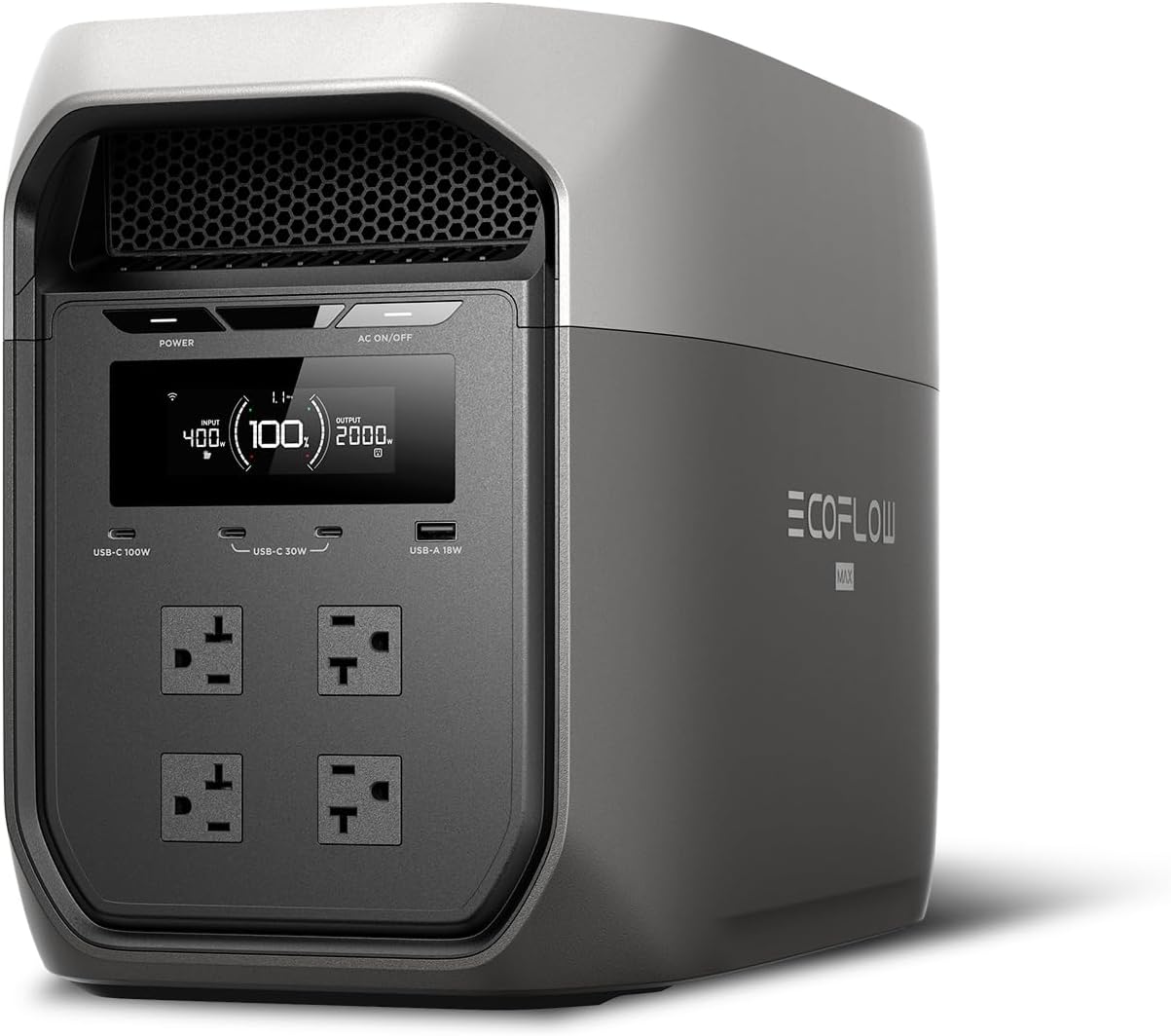
EF EcoFlow DELTA 3 Max
Best Overall 2kWh-Class Option
Quick Verdict
The EF EcoFlow DELTA 3 Max is a 2,048Wh LiFePO4 portable power station designed for buyers who want substantial energy storage without giving up strong AC output or fast recharging. With 2,400W of continuous AC power, it can handle a wider range of higher-demand equipment than compact 1,000Wh-class stations, while its 2kWh-class battery provides a meaningful energy reserve for longer outages and off-grid use.
This model is best suited to buyers who want one versatile power station rather than a highly specialized solution. It offers a strong combination of battery capacity, inverter power, charging performance, portability, and UPS capability, making it the broadest fit in this five-model comparison. The trade-off is physical size and weight: at about 44.8 lb, it is portable, but it is not the model to choose if frequent carrying is the primary concern.
Snapshot
| Specification | EF EcoFlow DELTA 3 Max |
|---|---|
| Battery Capacity | 2,048Wh |
| Battery Chemistry | LiFePO4 |
| Continuous AC Output | 2,400W |
| Peak / Surge Output | 4,800W |
| Solar Input | Up to 500W |
| UPS Transfer Time | <10ms |
| Weight | 44.8 lb |
Why We Chose It
The EF EcoFlow DELTA 3 Max earned our Best Overall 2kWh-Class Option award because it delivers the strongest overall balance of the factors that matter in this five-model comparison. Its 2,048Wh battery, 2,400W continuous AC output, 4,800W surge capability, UPS functionality, solar input, and 44.8-pound weight create a particularly well-rounded combination for buyers who want substantial capacity and strong power output without choosing the heaviest model in the group.
The other four models each have a more specific advantage. The BLUETTI Elite 200 V2 delivers the highest continuous output at 2,600W, the Anker SOLIX S2000 is lighter at 35.7 pounds, the Anker SOLIX C1000 Gen 2 prioritizes a compact 1,000Wh-class format with 2,000W output, and the Jackery Explorer 2000 v2 balances 2,042Wh and 2,200W at 39.5 pounds. The DELTA 3 Max does not win every individual category; its advantage is that capacity, output, surge capability, UPS, solar input, and weight come together in the most balanced overall package of the five.
Check the latest price and customer reviews on Amazon.
Living With It

At 20.3 kg (44.8 lb) and measuring approximately 20.4 × 9.8 × 12.4 inches, the EF EcoFlow DELTA 3 Max is substantial but still manageable for a portable 2kWh-class power station. Its footprint is better suited to a floor, sturdy table, garage shelf, or the cargo area of an SUV than to a small desk or crowded countertop. The built-in handle makes short-distance repositioning practical, but this is not a station most people will want to carry far by hand.
In everyday use, its size makes more sense when the power station has a defined location and is moved only when needed. For example, it can sit in a garage or home office during an outage, then be moved to a vehicle or outdoor setup when portable power is needed elsewhere. The main limitation in daily handling is the weight: at nearly 45 pounds, frequent carrying up stairs or over longer distances becomes noticeably less convenient than with lighter options such as the Anker SOLIX S2000 or Anker SOLIX C1000 Gen 2.
Evaluation
| Evaluation Factor | This Model | How It Compares | Buyer Implication |
|---|---|---|---|
| Overall Power Balance | 2,048Wh / 2,400W continuous / 4,800W surge | Stronger continuous output than the Anker SOLIX S2000 and Anker SOLIX C1000 Gen 2, while remaining lighter than the BLUETTI Elite 200 V2 | A strong fit for buyers who want substantial capacity without moving to the heaviest option |
| Solar Recharging | Up to 500W solar input | Higher than the 400W maximum of the Anker SOLIX S2000 and Jackery Explorer 2000 v2 | Better suited to buyers who expect to make regular use of solar recharging |
| UPS Capability | <10ms transfer | Among the fastest stated UPS specifications in this five-model group | Useful when connected electronics need fast automatic transition during an outage |
| Portability vs. Capacity | 44.8 lb for 2,048Wh | Heavier than the Anker SOLIX S2000 and Jackery Explorer 2000 v2, but lighter than the BLUETTI Elite 200 V2 | A reasonable compromise for buyers who prioritize capacity and output over frequent carrying |
Who Should Buy This
The EF ECOFLOW DELTA 3 Max is a strong fit for a U.S. buyer who:
- wants around 2kWh of battery capacity for longer-duration backup rather than a compact power source;
- needs 2,400W of continuous AC output for a broader range of household appliances and electronics;
- wants one power station that can serve both home backup and portable/off-grid use;
- expects to use solar charging and can benefit from up to 500W of solar input;
- wants UPS functionality with a stated <10ms transfer time for connected electronics;
- is comfortable with a 44.8-pound unit and does not need to carry it frequently over long distances;
- prefers a balanced combination of capacity, output, charging options, and portability rather than optimizing for just one specification.
Who Should Skip This
- You need to carry the power station frequently or over longer distances — at 44.8 lb, the EF ECOFLOW DELTA 3 Max is noticeably heavier than the Anker SOLIX S2000, Jackery Explorer 2000 v2, and Anker SOLIX C1000 Gen 2.
You want the highest continuous AC output in this group — the BLUETTI Elite 200 V2 provides 2,600W continuous output compared with 2,400W from the EF ECOFLOW DELTA 3 Max.
You need a compact 1,000Wh-class power station — the Anker SOLIX C1000 Gen 2 is a better fit if lower weight and a smaller footprint matter more than having around 2kWh of battery capacity.
You prioritize the lightest 2kWh-class option — the Anker SOLIX S2000 provides 2,010Wh at 35.7 lb, making it easier to move while retaining 2kWh-class capacity.
You do not need around 2kWh of storage or 2,400W of output — a smaller, lighter model may provide better value if your actual power needs are more modest.
Final Verdict
The EF ECOFLOW DELTA 3 Max is the strongest choice for buyers who want one well-rounded power station rather than maximizing a single specification. Its main advantage is the combination of 2,048Wh capacity, 2,400W continuous output, 4,800W surge capability, fast charging, 500W solar input, and <10ms UPS performance in one system.
Its main limitation is weight. At 44.8 pounds, it is portable but not especially convenient for frequent carrying. If you prioritize mobility, the Anker SOLIX S2000 or Jackery Explorer 2000 v2 may be better fits, while buyers focused on maximum continuous output should consider the BLUETTI Elite 200 V2.
Bottom line: choose the EF ECOFLOW DELTA 3 Max if you want the Best Overall 2kWh-Class Option balance of capacity, power, charging, UPS capability, and portability under $1,000 and can accept its heavier build.
Check the latest price and customer reviews on Amazon.
Related Guide: If you are planning to use a power station for household outages, see our guide to Best Portable Power Stations for Home Backup. It explores backup options for essential appliances and longer power interruptions.
BLUETTI Elite 200 V2
Best High-Output Value
Quick Verdict

The BLUETTI Elite 200 V2 is a 2,073.6Wh LiFePO4 portable power station designed for buyers who need substantial battery capacity together with unusually high continuous AC output. Its 2,600W continuous rating is the highest among the five models in this comparison, giving it a clear advantage for running higher-demand appliances and equipment.
This model is best suited to buyers who prioritize sustained power over portability. It combines a 2,073.6Wh battery with 2,600W continuous AC output, making it particularly compelling when output capacity is more important than keeping the unit light and easy to carry. The trade-off is its 53.35-pound weight, which makes the BLUETTI Elite 200 V2 the heaviest model in this comparison.
Snapshot
| Specification | BLUETTI Elite 200 V2 |
|---|---|
| Battery Capacity | 2,073.6Wh |
| Battery Chemistry | LiFePO4 |
| Continuous AC Output | 2,600W |
| Peak / Surge Output | Not separately specified |
| Solar Input | Up to 1,000W |
| UPS Transfer Time | ≤15ms |
| Weight | 53.35 lb (53.4 lbs / 24.2 kg) |
| Expandable Capacity | No |
Why We Chose It
The BLUETTI Elite 200 V2 earned our Best High-Output Value award because it delivers the highest continuous AC output in this five-model comparison while maintaining a 2,073.6Wh battery capacity. Its 2,600W continuous rating gives it a meaningful advantage for buyers who need to run higher-demand equipment for sustained periods, rather than simply having a large battery reserve.
The other four models each emphasize a different strength. The EF ECOFLOW DELTA 3 Max offers the strongest overall balance, the Anker SOLIX S2000 prioritizes lower weight in the 2kWh class, the Anker SOLIX C1000 Gen 2 focuses on compact size and high output from a 1,000Wh-class battery, and the Jackery Explorer 2000 v2 combines 2,042Wh of capacity with a lighter 39.5-pound design. The BLUETTI Elite 200 V2 stands apart by putting 2,600W of sustained power at the center of its value proposition.
Check the latest price and customer reviews on Amazon.

Living With It
At approximately 13.78 × 9.84 × 12.74 inches and 53.35 pounds, the BLUETTI Elite 200 V2 is a substantial power station that needs a deliberate storage and operating location. Its footprint works well on a sturdy floor, garage shelf, utility area, or other stable surface where there is enough room to access the ports and controls. This is a station that makes more sense when positioned before use rather than moved repeatedly throughout the day.
For a typical use scenario, the Elite 200 V2 can stay in a garage or utility area and be brought into position when higher-power equipment is needed during an outage or at an off-grid location. Its high continuous output makes the weight easier to justify when the priority is running demanding equipment rather than minimizing the effort required to move the station.
The main limitation in everyday use is portability. At more than 53 pounds, the BLUETTI Elite 200 V2 is the heaviest model in this comparison. It is manageable for occasional repositioning, but buyers who regularly carry their power station between rooms, load it into a vehicle, or move it outdoors will find lighter alternatives more convenient.
Evaluation
| Evaluation Factor | This Model | How It Compares | Buyer Implication |
|---|---|---|---|
| Continuous AC Output | 2,600W | Highest continuous output among the five models | Strong choice for buyers who regularly need to run higher-demand equipment |
| Solar Recharging | Up to 1,000W | Highest maximum solar input among the five models | Better suited to buyers who expect to rely more heavily on solar recharging |
| Power vs. Portability | 2,600W / 53.35 lb | Highest output, but also the heaviest model in the group | Better suited to stationary use or occasional transport than frequent carrying |
| UPS Capability | ≤15ms | Among the fastest UPS specifications in this comparison | Useful for buyers who want automatic backup for connected electronics |
Who Should Buy This
- You regularly need high continuous AC output — the 2,600W continuous rating makes the BLUETTI Elite 200 V2 a strong fit for buyers who need to run higher-demand equipment for sustained periods.
You want around 2kWh of battery capacity without giving up output power — the 2,073.6Wh battery provides a substantial energy reserve while supporting the highest continuous AC output in this comparison.
You expect to use solar charging as part of your setup — up to 1,000W of solar input makes it well suited to buyers who want faster solar replenishment when conditions allow.
You value high output more than easy portability — the 53.35-pound weight is easier to accept if the power station will usually stay in one location or only be moved occasionally.
You want a power station for demanding backup or off-grid use — its combination of 2,600W continuous output and 2,073.6Wh capacity fits situations where both sustained power and meaningful energy storage matter.
Who Should Skip This
- You need to carry your power station frequently — at 53.35 lb, the BLUETTI Elite 200 V2 is the heaviest model in this comparison, so the Anker SOLIX S2000, Jackery Explorer 2000 v2, or Anker SOLIX C1000 Gen 2 may be more practical.
You prioritize the best overall balance rather than maximum continuous output — the EF ECOFLOW DELTA 3 Max offers a more balanced combination of capacity, output, charging, UPS capability, solar input, and weight.
You want a lightweight 2kWh-class power station — the Anker SOLIX S2000 provides 2,010Wh at 35.7 lb, making it substantially easier to move.
You need a compact 1,000Wh-class station — the Anker SOLIX C1000 Gen 2 is a better fit if lower weight and a smaller footprint matter more than having around 2kWh of battery capacity.
You rarely need more than about 2,000W of continuous AC output — if your typical loads are well below 2,600W, paying the portability penalty for the Elite 200 V2’s higher output may not make sense.
Final Verdict
The BLUETTI Elite 200 V2 makes the most sense for buyers whose priority is sustained AC power. Its 2,600W continuous output is the clearest reason to choose it over the other models here, especially when you regularly need to operate higher-demand equipment while still having roughly 2kWh of stored energy available.
The main limitation is portability. At 53.35 pounds, it gives up considerable ease of handling to deliver that higher output. If the power station will usually remain in one location, that trade-off is relatively easy to justify; if you expect to move it frequently, a lighter model is likely the better choice.
Bottom line: choose the BLUETTI Elite 200 V2 when high continuous output is the deciding factor and you are comfortable sacrificing portability to get it.
Check the latest price and customer reviews on Amazon.
Related Guide: If you want to compare other high-capacity power stations in the same class, see our guide to Best 2000Wh Portable Power Stations (2026). It compares 2kWh-class models for buyers who need substantial battery capacity and sustained power.
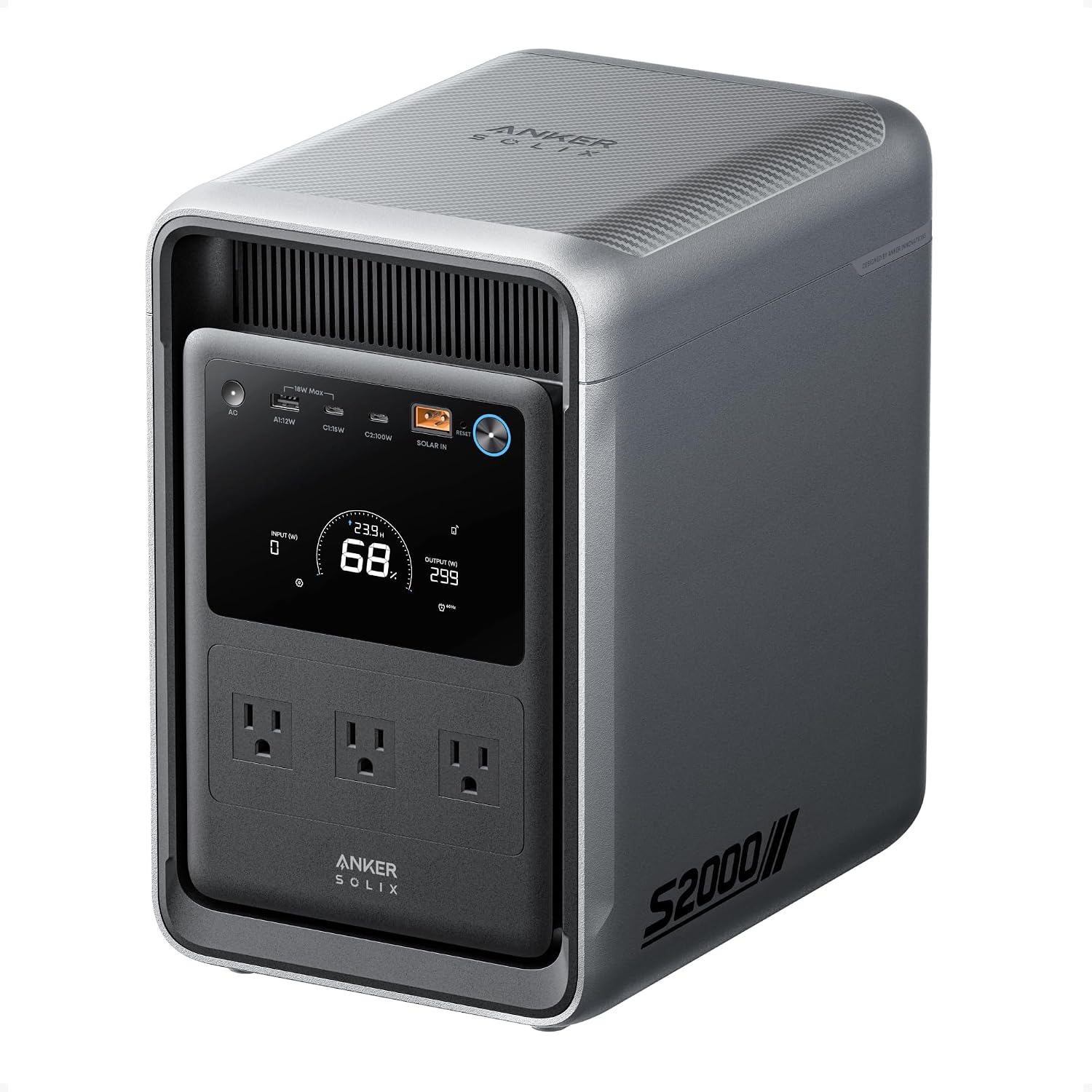
Anker SOLIX S2000
Best Lightweight 2kWh Option
Quick Verdict
The Anker SOLIX S2000 is a 2,010Wh LiFePO4 portable power station for buyers who want substantial battery capacity without moving to the heavier end of the 2kWh class. At 35.7 pounds, it is significantly easier to handle than the BLUETTI Elite 200 V2 and lighter than the EF ECOFLOW DELTA 3 Max, while still providing enough stored energy for extended use away from a wall outlet.
This model is best suited to buyers who expect to move their power station regularly but still want around 2kWh of capacity. Its 1,500W continuous AC output is the main compromise: it is well suited to many everyday devices and moderate loads, but buyers who need to run higher-demand equipment continuously should look toward models with 2,000W or more of continuous output.
Snapshot
| Specification | Anker SOLIX S2000 |
|---|---|
| Battery Capacity | 2,010Wh |
| Battery Chemistry | LiFePO4 |
| Continuous AC Output | 1,500W |
| Peak / Surge Output | 3,000W |
| Solar Input | Up to 400W |
| UPS Transfer Time | ≤10ms |
| Weight | 35.7 lb |
| Expandable Capacity | Not verified |
Why We Chose It
The Anker SOLIX S2000 earned our Best Lightweight 2kWh Option award because it delivers 2,010Wh of battery capacity at just 35.7 pounds. Among the 2kWh-class models in this comparison, that gives it a particularly strong capacity-to-weight combination for buyers who need substantial stored energy but expect to move the power station regularly.
The other models prioritize different characteristics. The EF ECOFLOW DELTA 3 Max offers a stronger overall balance with 2,400W continuous output, the BLUETTI Elite 200 V2 reaches 2,600W continuous output, the Anker SOLIX C1000 Gen 2 is considerably smaller but has roughly half the battery capacity, and the Jackery Explorer 2000 v2 provides similar 2kWh-class capacity at 39.5 pounds. The Anker SOLIX S2000 therefore stands out specifically for making 2kWh-class capacity easier to carry, while accepting its lower 1,500W continuous output as the trade-off.
Check the latest price and customer reviews on Amazon.

Living With It
At approximately 8.2 × 11.1 × 12.7 inches, the Anker SOLIX S2000 has a relatively compact footprint for a 2kWh-class power station. Its size makes it practical to keep on a sturdy floor, shelf, work surface, or in the cargo area of a vehicle without taking up the space of a much larger high-capacity unit.
At 35.7 pounds, portability is one of its strongest practical advantages. It is easier to lift, load into a vehicle, and reposition between rooms or outdoor locations than the heavier EF ECOFLOW DELTA 3 Max and BLUETTI Elite 200 V2. That makes it a practical choice for situations where the same power station may be used at home one day and taken outdoors or on a trip the next.
The main limitation in everyday use is its 1,500W continuous AC output. While that is sufficient for many electronics and moderate loads, buyers who regularly need to power higher-demand equipment should choose a model with 2,000W or more of continuous output instead.
Evaluation
| Evaluation Factor | This Model | How It Compares | Buyer Implication |
|---|---|---|---|
| Capacity-to-Weight Ratio | 2,010Wh / 35.7 lb | Lighter than the EF ECOFLOW DELTA 3 Max, BLUETTI Elite 200 V2, and Jackery Explorer 2000 v2 while remaining in the 2kWh class | Strong fit for buyers who want substantial capacity without a heavy unit |
| Continuous AC Output | 1,500W | Lower than the 2,000W-plus output of the EF ECOFLOW DELTA 3 Max, BLUETTI Elite 200 V2, and Jackery Explorer 2000 v2 | Better suited to moderate loads than consistently high-demand equipment |
| Solar Recharging | Up to 400W | Lower than the 500W of the EF ECOFLOW DELTA 3 Max and 1,000W of the BLUETTI Elite 200 V2 | Adequate for solar top-ups, but less suited to buyers prioritizing faster solar replenishment |
| UPS Capability | ≤10ms | Among the fastest stated UPS specifications in this comparison | Useful for connected electronics that benefit from a fast automatic transfer |
Who Should Buy This
- You want around 2kWh of battery capacity without a heavy power station — 2,010Wh at 35.7 lb makes the Anker SOLIX S2000 a strong fit when capacity and manageable weight are both priorities.
You expect to move the power station regularly — its lower weight makes it easier to load into a vehicle, reposition at home, or take between indoor and outdoor locations.
Your typical loads stay below 1,500W continuously — the continuous AC output is well suited to everyday electronics and moderate-power equipment without requiring a heavier high-output model.
You want a 2kWh-class station for both home and portable use — the combination of substantial capacity and relatively low weight works well when the same unit needs to serve different locations.
You value fast automatic backup for connected electronics — the ≤10ms UPS specification makes it a suitable option when fast transfer is important.
You prioritize portability over maximum output — if carrying convenience matters more to you than having 2,000W-plus continuous AC power, the Anker SOLIX S2000 fits that trade-off particularly well.
Who Should Skip This
- You regularly need more than 1,500W of continuous AC output — the EF ECOFLOW DELTA 3 Max, BLUETTI Elite 200 V2, and Jackery Explorer 2000 v2 offer higher continuous output for more demanding loads.
You want the highest output possible in a 2kWh-class station — the BLUETTI Elite 200 V2 reaches 2,600W continuous, making it a better fit when sustained power matters more than weight.
You want the strongest overall balance of capacity, output, charging, and UPS capability — the EF ECOFLOW DELTA 3 Max is a better choice if portability is not your primary concern.
You prioritize faster solar replenishment — the BLUETTI Elite 200 V2 accepts up to 1,000W of solar input, while the EF ECOFLOW DELTA 3 Max supports up to 500W.
You need a smaller, lighter 1,000Wh-class station — the Anker SOLIX C1000 Gen 2 weighs just 24.9 pounds and is a better fit when compact size matters more than having around 2kWh of stored energy.
You rarely need around 2kWh of battery capacity — choosing a smaller-capacity model may make more sense if your actual energy requirements are modest and you do not need the S2000’s larger battery reserve.
Final Verdict
The Anker SOLIX S2000 is the right choice when you want 2kWh-class capacity without the weight normally associated with it. At 35.7 pounds, it offers a practical middle ground for buyers who need a substantial energy reserve but expect to move the power station between home, a vehicle, and outdoor locations.
The main limitation is its 1,500W continuous AC output. That makes it less suitable for buyers who regularly run higher-demand equipment, even though its 2,010Wh battery provides plenty of stored energy. In those situations, a heavier model with 2,000W or more of continuous output is the better fit.
Bottom line: choose the Anker SOLIX S2000 when carrying convenience is a priority and your continuous power requirements stay within 1,500W.
Check the latest price and customer reviews on Amazon.
Related Guide: If you are looking for a portable power station for outdoor trips and camping, see our guide to Best Portable Power Stations for Camping (2026). It compares portable options for powering electronics and essential equipment away from home.
Anker SOLIX C1000 Gen 2
Best Compact 1,000Wh-Class Option

Quick Verdict
The Anker SOLIX C1000 Gen 2 is a 1,024Wh LiFePO4 portable power station designed for buyers who want strong AC output in a smaller, lighter package. With 2,000W of continuous power and a weight of just 24.9 pounds, it offers an unusually high output-to-size combination for a 1,000Wh-class station.
This model is best suited to buyers who do not need a 2kWh battery but still want enough capacity for everyday backup, portable power, and higher-demand equipment. Its compact design makes it easier to store and carry than the larger models in this comparison, while its main trade-off is the smaller energy reserve: buyers who need longer runtimes or substantially more stored energy should move up to a 2kWh-class option.
Snapshot
| Specification | Anker SOLIX C1000 Gen 2 |
|---|---|
| Battery Capacity | 1,024Wh |
| Battery Chemistry | LiFePO4 |
| Continuous AC Output | 2,000W |
| Peak / Surge Output | 3,000W |
| Solar Input | Up to 600W |
| UPS Transfer Time | 10ms |
| Weight | 24.9 lb |
Why We Chose It
The Anker SOLIX C1000 Gen 2 earned our Best Compact 1,000Wh-Class Option award because it combines a 1,024Wh battery with 2,000W of continuous AC output in a 24.9-pound design. That gives it a distinct position in this comparison: it delivers substantial output without requiring the larger physical size and weight associated with the 2kWh-class models.
The other four models are designed around different priorities. The EF ECOFLOW DELTA 3 Max, BLUETTI Elite 200 V2, Anker SOLIX S2000, and Jackery Explorer 2000 v2 all provide roughly twice the battery capacity, making them better suited to buyers who need longer energy reserves. The C1000 Gen 2 instead makes a deliberate trade-off: less stored energy in exchange for a smaller, lighter format while retaining 2,000W continuous output. That makes its compact 1,000Wh-class design the reason to choose it, rather than simply a smaller version of the other four options.
Check the latest price and customer reviews on Amazon.

Living With It
At approximately 15.12 × 8.19 × 9.61 inches, the Anker SOLIX C1000 Gen 2 has a compact footprint that is easy to accommodate on a shelf, sturdy table, floor, or in a vehicle. Its smaller dimensions make it less demanding to store than the larger 2kWh-class stations in this comparison, particularly when space is limited.
At 24.9 pounds, it is also the easiest model in this five-station group to move. That makes it practical for carrying between rooms, loading into a car, or taking to an outdoor setup when you need portable power without handling a much heavier unit. For example, it can stay stored indoors for occasional outages and then be moved outside when you need power for electronics or equipment away from an outlet.
The main limitation in everyday use is the 1,024Wh battery capacity. Although the 2,000W continuous output is substantial for its size, the smaller energy reserve means it will generally provide shorter runtimes than the 2kWh-class models when powering the same loads.
Evaluation
| Evaluation Factor | This Model | How It Compares | Buyer Implication |
|---|---|---|---|
| Compact Power | 1,024Wh / 2,000W / 24.9 lb | Much lighter than the 2kWh-class models while maintaining 2,000W continuous output | Strong fit when you want substantial AC power in a compact package |
| Battery Capacity | 1,024Wh | Roughly half the capacity of the four 2kWh-class alternatives | Better suited to shorter backup periods than extended power needs |
| Portability | 24.9 lb | Lightest model in this comparison | Easier to carry, store, and move between locations |
| UPS Capability | 10ms | Among the fastest stated UPS specifications in this group | Useful when fast automatic backup for connected electronics matters |
Who Should Buy This
- You need strong AC output without a 2kWh-class power station — 2,000W continuous output makes it suitable when your equipment needs substantial power but your energy requirements do not justify a larger battery.
You want a genuinely compact power station for everyday use — the 24.9-pound format works well when storage space, vehicle space, or easy handling matters.
You need a portable station for shorter backup periods — 1,024Wh is a good fit when you need essential power for a limited period rather than extended outage coverage.
You regularly move your power station between locations — its lower weight makes it practical for moving between rooms, loading into a vehicle, or taking to an outdoor setup.
You want fast automatic backup for sensitive electronics — the 10ms UPS specification makes it a good fit when quick transfer is an important requirement.
You prefer portability and compactness over maximum battery capacity — this is the right trade-off if a smaller, lighter station is more valuable to you than the longer runtimes offered by the 2kWh-class models.
Who Should Skip This
- You need around 2kWh of stored energy — the EF ECOFLOW DELTA 3 Max, BLUETTI Elite 200 V2, Anker SOLIX S2000, and Jackery Explorer 2000 v2 provide roughly twice the battery capacity for longer runtimes.
You expect extended power outages — the smaller 1,024Wh battery may require more frequent recharging than the 2kWh-class alternatives when the station is used continuously.
You regularly need more than 2,000W of continuous AC output — the BLUETTI Elite 200 V2 provides 2,600W, while the EF ECOFLOW DELTA 3 Max and Jackery Explorer 2000 v2 also offer higher continuous output.
You want the strongest capacity-to-weight combination in the 2kWh class — the Anker SOLIX S2000 gives you 2,010Wh at 35.7 lb, making it the better choice when you want substantially more stored energy without moving to the heaviest models.
You want maximum battery capacity rather than a compact format — the smaller footprint of the C1000 Gen 2 is an advantage only if you are willing to trade away the longer runtimes of a 2kWh-class station.
Final Verdict
The Anker SOLIX C1000 Gen 2 makes the most sense for buyers who want 2,000W of continuous AC output in a compact, easy-to-handle package without stepping up to a 2kWh-class power station. Its smaller format is particularly useful when storage space and portability are practical priorities.
The main limitation is energy capacity. At 1,024Wh, it cannot provide the same runtime as the 2kWh-class alternatives when the same equipment is running for extended periods. That makes the capacity trade-off important: if your priority is compact portable power for shorter-duration use, the C1000 Gen 2 is a strong fit; if you need longer backup runtime, a larger-capacity model is the better choice.
Bottom line: choose the Anker SOLIX C1000 Gen 2 when compact size and portability matter more than maximum stored energy.
Check the latest price and customer reviews on Amazon.
Related Guide: If you are not sure whether a 1,000Wh-class power station is enough for your needs, see our guide to What Size Power Station Do I Need? How to Calculate the Right Size. It explains how to match battery capacity and power output to the devices you need to run.
Jackery Explorer 2000 v2
Best Portable 2kWh Option

Quick Verdict
The Jackery Explorer 2000 v2 is a 2,042Wh LiFePO4 portable power station designed for buyers who want substantial battery capacity and strong AC output without moving to the heavier end of the 2kWh class. At 39.5 pounds, it sits between the lighter Anker SOLIX S2000 and the heavier EF ECOFLOW DELTA 3 Max and BLUETTI Elite 200 V2.
This model is best suited to buyers who want around 2kWh of stored energy while keeping the station reasonably manageable to transport. Its 2,200W continuous output gives it more power headroom than the Anker SOLIX S2000, while its weight remains below 40 pounds. The trade-off is that it does not match the strongest solar input or fastest UPS specification in this comparison.
Snapshot
| Specification | Jackery Explorer 2000 v2 |
|---|---|
| Battery Capacity | 2,042Wh |
| Battery Chemistry | LiFePO4 |
| Continuous AC Output | 2,200W |
| Peak / Surge Output | 4,400W |
| Solar Input | Up to 400W |
| UPS Transfer Time | 20ms |
| Weight | 39.5 lb |
Why We Chose It
The Jackery Explorer 2000 v2 earned our Best Portable 2kWh Option award because it combines 2,042Wh of battery capacity with 2,200W of continuous AC output at 39.5 pounds. That gives it a practical position between the lighter Anker SOLIX S2000 and the more powerful but heavier BLUETTI Elite 200 V2, making it a strong fit for buyers who want substantial capacity without moving into the heaviest end of the category.
The other models each have a more specific advantage. The EF ECOFLOW DELTA 3 Max offers the strongest overall balance, the BLUETTI Elite 200 V2 prioritizes maximum continuous output, and the Anker SOLIX S2000 is lighter while remaining in the 2kWh class. The Anker SOLIX C1000 Gen 2 is substantially lighter still, but with roughly half the battery capacity. The Jackery Explorer 2000 v2 therefore earns its place by offering a middle-ground combination of 2kWh-class capacity, useful continuous output, and manageable weight rather than maximizing any single specification.

Living With It
At approximately 13.2 × 10.4 × 11.5 inches, the Jackery Explorer 2000 v2 has a manageable footprint for a 2kWh-class power station. It can be kept on a stable floor, work surface, garage shelf, or in a vehicle cargo area without requiring the space of a substantially larger unit.
At 39.5 pounds, it remains practical to move when needed, while being noticeably heavier than the Anker SOLIX S2000. This makes it suitable for buyers who may move the station between home, a vehicle, and outdoor locations but do not need to carry it constantly. For example, it can be stored at home for backup use and loaded into a vehicle when portable power is needed elsewhere.
The main limitation in everyday use is that 39.5 pounds is still substantial for frequent carrying. Buyers who expect to move their power station regularly or over longer distances may find the lighter Anker SOLIX S2000 more convenient, while those who need maximum continuous output may prefer a higher-output model.
Evaluation
| Evaluation Factor | This Model | How It Compares | Buyer Implication |
|---|---|---|---|
| 2kWh-Class Portability | 2,042Wh / 39.5 lb | Heavier than the Anker SOLIX S2000 but lighter than the EF ECOFLOW DELTA 3 Max and BLUETTI Elite 200 V2 | A practical choice when you want substantial capacity without the heaviest 2kWh-class design |
| Continuous AC Output | 2,200W | Higher than the Anker SOLIX S2000, but below the EF ECOFLOW DELTA 3 Max and BLUETTI Elite 200 V2 | Provides useful power headroom for demanding loads without prioritizing maximum output |
| Solar Recharging | Up to 400W | Lower than the EF ECOFLOW DELTA 3 Max, BLUETTI Elite 200 V2, and Anker SOLIX C1000 Gen 2 | Adequate for solar top-ups, but less compelling if rapid solar replenishment is a priority |
| UPS Capability | 20ms | Slower than the ≤10ms Anker SOLIX S2000 and 10ms Anker SOLIX C1000 Gen 2 | Better suited to general backup use than situations where the fastest transfer is a priority |
Who Should Buy This
- You want around 2kWh of battery capacity without choosing the heaviest model — 2,042Wh at 39.5 lb offers a practical compromise between stored energy and portability.
You need more than 1,500W of continuous output but do not need the maximum available — its 2,200W continuous rating provides more power headroom than the Anker SOLIX S2000.
You expect to use the station in more than one location — its manageable size and weight make it suitable for moving between home, a vehicle, and outdoor setups when needed.
You want substantial stored energy for portable or backup use — the 2,042Wh battery provides considerably more energy reserve than the 1,024Wh Anker SOLIX C1000 Gen 2.
You prefer a middle-ground 2kWh option rather than optimizing for one specification — this model makes sense when you want a combination of capacity, useful AC output, and manageable weight without specifically prioritizing maximum output or minimum weight.
Who Should Skip This
- You want the lightest 2kWh-class power station — the Anker SOLIX S2000 weighs 35.7 lb, making it easier to carry while retaining 2,010Wh of capacity.
You need the highest continuous AC output in this comparison — the BLUETTI Elite 200 V2 reaches 2,600W continuously, making it the better fit for consistently higher-demand loads.
You prioritize the strongest overall balance of capacity, output, charging, and UPS capability — the EF ECOFLOW DELTA 3 Max offers a broader combination of these characteristics.
You need the fastest UPS transfer among these options — the Anker SOLIX S2000 and Anker SOLIX C1000 Gen 2 have stated transfer times of 10ms or less, compared with 20ms for the Jackery Explorer 2000 v2.
You want faster solar replenishment — the BLUETTI Elite 200 V2 and EF ECOFLOW DELTA 3 Max accept more solar input, making them better suited to buyers who place greater emphasis on solar charging speed.
Final Verdict
The Jackery Explorer 2000 v2 is a strong choice for buyers who want 2kWh-class capacity with useful 2,200W continuous output while keeping the station below 40 pounds. Its advantage is the way those three priorities come together without pushing the unit into the heavier range of the category.
The main limitation is that it does not lead the comparison in either portability, continuous output, solar input, or UPS speed. That matters if one of those factors is your primary requirement: the Anker SOLIX S2000 is lighter, the BLUETTI Elite 200 V2 delivers more continuous power, and the EF ECOFLOW DELTA 3 Max offers a stronger overall balance.
Bottom line: choose the Jackery Explorer 2000 v2 when you want a practical 2kWh-class middle ground and do not need the lightest design or the highest-performing option in any single category.
Check the latest price and customer reviews on Amazon.
Related Guide: If you are planning to use a portable power station in an RV, see our guide to Best Portable Power Stations for RV (2026). It compares power stations suited to mobile setups where battery capacity, output, and portability all matter.
What Can You Get at Different Price Points?
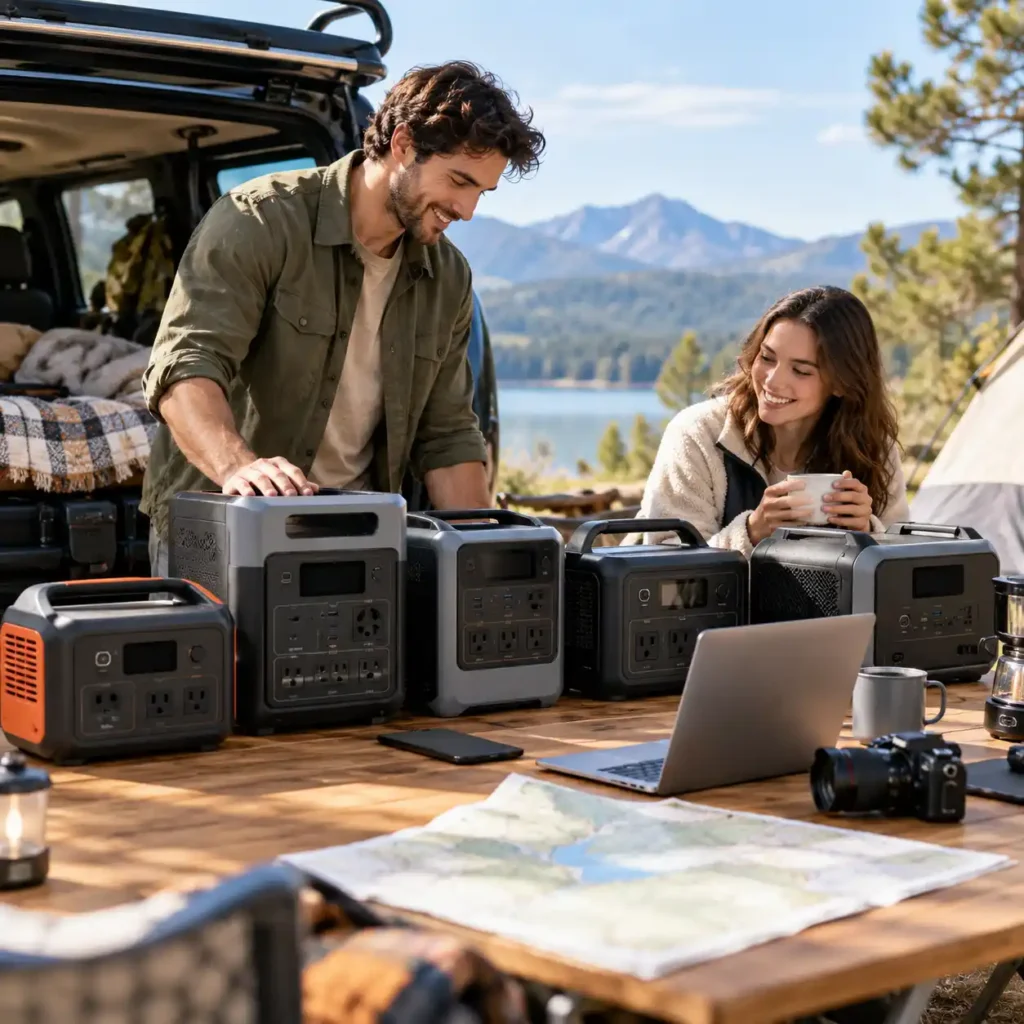
A $1,000 budget gives you access to a wide range of portable power stations, but spending more does not automatically mean getting a better option. The main difference between lower- and higher-priced models is usually how much battery capacity, continuous output, charging capability, and convenience you can combine in one system.
Around $500: Focus on the Essentials
At roughly the $500 level, the priority is usually getting the core capabilities you actually need without paying for a larger battery or more advanced features than necessary.
This price range can make sense if you need a portable power station for electronics, smaller appliances, short-duration backup, camping, or everyday power needs. A 1,000Wh-class model can already provide substantial energy storage while remaining considerably easier to carry than larger 2,000Wh units.
At this level, expect a 1,000Wh-class power station to be the more common target, with enough output for everyday electronics and moderate loads but less energy reserve for extended backup.
The trade-off is that you generally have less stored energy and less flexibility for extended outages or multiple high-demand devices. If your typical loads are modest and you do not need long runtime, spending more may provide little practical benefit.
If your needs are more modest, our guide to Best Portable Power Stations Under $500 (2026) compares lower-cost options for buyers who do not need to use the full $1,000 budget.
Around $700: A More Capable Middle Ground
Moving toward the $700 range can provide a more substantial combination of battery capacity and output without necessarily reaching the largest or heaviest models in the category.
In practical terms, this is where buyers can start looking for a stronger balance of roughly 1,000Wh to 2,000Wh-class capacity, higher continuous output, and better charging capability rather than simply a larger battery.
This is where the decision becomes less about basic functionality and more about flexibility. A larger battery can extend runtime, while higher continuous output gives you more freedom to run demanding devices. Faster charging and stronger solar input can also become more valuable if you expect to use the power station frequently or recharge it away from the grid.
For many buyers, this is the point where paying more than an entry-level model starts to deliver a meaningful improvement rather than simply adding features.
Around $900–$1,000: 2kWh-Class Power and Higher Output
Near the top of the budget, you can move into substantially more capable power stations, including several 2kWh-class models in this guide.
This is the price range where buyers can find 2,000Wh-class capacity, 2,000W-plus continuous output, and a broader set of charging or backup features in the same system.
The advantage is not simply having a larger battery. Models in this range can combine roughly 2,000Wh of stored energy with continuous output well above 2,000W, faster charging, stronger solar input, UPS functionality, or other features that make the system more versatile.
That additional capability is useful when you want longer runtime, need to support higher-demand equipment, or want one power station that can cover a broader range of situations.
The downside is that larger batteries and higher output can also mean more weight and a higher purchase price. A $1,000 power station is therefore not automatically a better choice than a $500–$700 model if you do not need the additional capacity or output.
Should You Spend the Full $1,000?
Not necessarily.
The best value depends on which limitation you are trying to remove. If a smaller power station already provides enough capacity and continuous output for your typical devices, spending another few hundred dollars may not materially improve your experience.
On the other hand, if your priority is longer runtime, higher continuous power, faster charging, or a more capable 2kWh-class system, moving toward the upper end of the budget can make sense.
A useful way to think about the budget is:
Around $500: prioritize essential capacity and portability.
Around $700: look for a stronger balance of capacity, output, charging, and features.
Around $900–$1,000: consider 2kWh-class capacity and higher output when you have a specific need for them.
The key is not to spend up to your maximum budget simply because you can. Spend more when the additional capability solves a problem you actually have.
How Much Power Do You Need?
The right portable power station is not necessarily the one with the largest battery or highest wattage. Before spending $1,000, it is more useful to determine how much power your typical loads actually require.
Two numbers matter most: battery capacity, measured in watt-hours (Wh), and continuous AC output, measured in watts (W). Capacity affects how long a power station can provide energy, while continuous output determines how much power you can draw from it at one time.
Start With Your Power Demand
Think about the devices you expect to run simultaneously rather than simply adding up everything you own.
For example, a laptop, phone chargers, lights, and a small fan may require relatively little continuous power. A refrigerator, microwave, coffee maker, space heater, or other high-demand appliance can require considerably more.
The important question is therefore not just, “How many watts does my appliance use?” but “What is the highest combined load I am likely to run at the same time?”
That figure should stay below the power station’s rated continuous output. Short startup surges from some appliances are a separate consideration, which is why surge or peak output should not be treated as the same thing as continuous power.
Then Consider How Long You Need It to Run
Once you understand your expected load, battery capacity becomes the next consideration.
A larger Wh rating generally means more stored energy and potentially longer runtime, assuming the same load. This is why a 2,000Wh-class power station can be useful when you need extended backup or want to run several devices over a longer period.
But more capacity also tends to mean a larger and heavier unit. If you only need to charge electronics, power lights, or cover relatively short interruptions, carrying a much larger battery may not be worth the additional cost and weight.
Match the Power Station to the Job
For this under-$1,000 category, a useful way to think about the options is:
Around 1,000Wh: suitable when portability, storage space, and shorter-duration power are more important than maximum runtime.
Around 2,000Wh: a better fit when you want substantially more stored energy for longer backup periods or multiple devices.
2,000W+ continuous output: worth prioritizing when you expect to operate more demanding appliances or several higher-draw devices at the same time.
Higher capacity and output together: useful when you need both longer runtime and the ability to handle demanding loads, but expect a larger and heavier power station.
You do not need the highest number in every category. A compact 1,000Wh-class model can be the better choice for a buyer whose loads are modest, while a 2kWh-class station becomes more valuable when runtime and higher power demand are the priority.
For a more detailed calculation of the capacity and output you need, see our guide to What Size Power Station Do I Need? How to Calculate the Right Size.
Capacity vs. Output: Which Matters More for Your Budget?
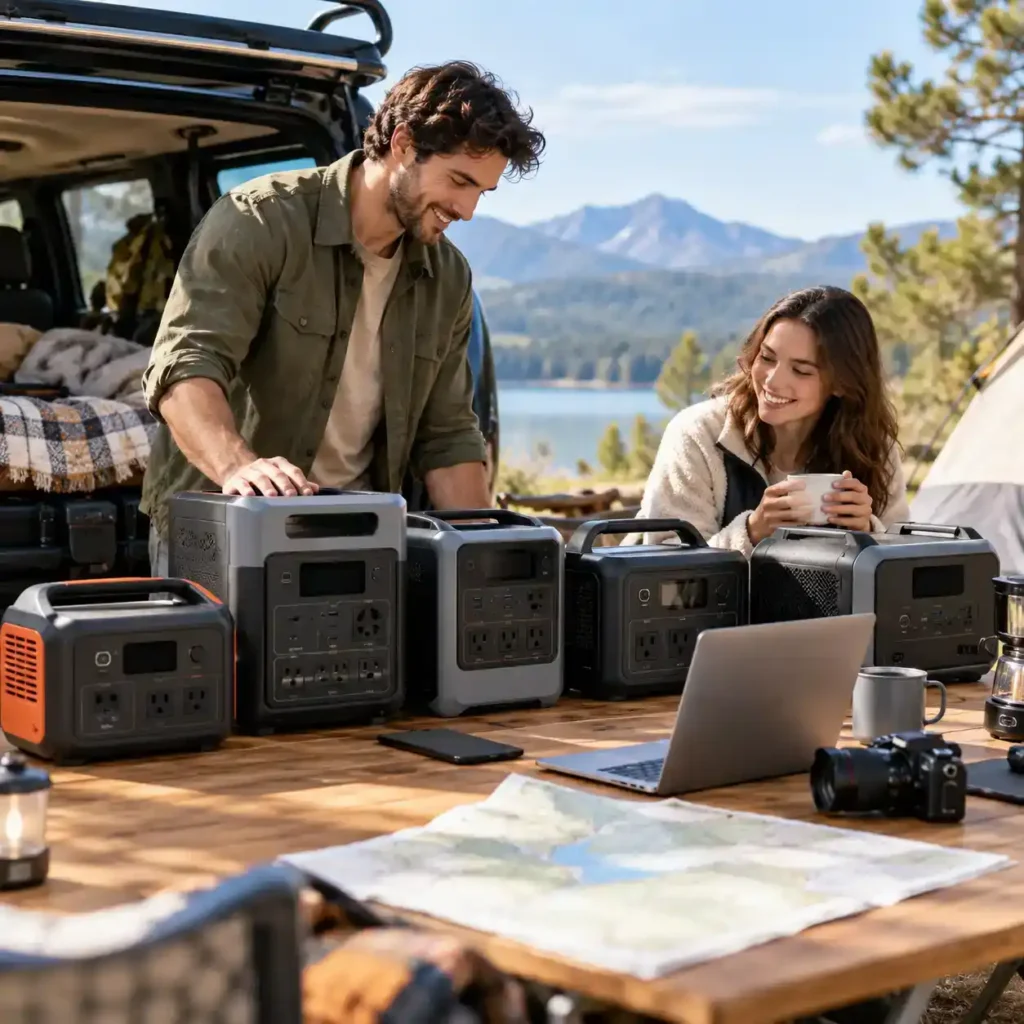
When comparing portable power stations under $1,000, it is easy to focus on the biggest battery capacity. But watt-hours and watts solve different problems, and the more expensive power station is not necessarily the better choice if it emphasizes the specification you do not need.
Capacity Determines How Much Energy You Have
Battery capacity, measured in watt-hours (Wh), tells you how much energy the power station can store.
A higher Wh rating generally gives you more energy to work with and can extend runtime when powering the same load. That makes capacity particularly important when your priority is longer backup, such as keeping several lower-power devices running for an extended period.
This is where a 2,000Wh-class power station can justify its higher price over a 1,000Wh-class model: you are primarily paying for a larger energy reserve.
If you already know that roughly 2,000Wh is the capacity you want, see our Best 2000Wh Portable Power Stations (2026) guide for a deeper comparison of that class.
Output Determines What You Can Run
Continuous AC output, measured in watts (W), answers a different question: how much power can the station deliver at one time?
A power station with a large battery can still be a poor choice for a high-demand appliance if its continuous output is too low. Conversely, a model with high output but a smaller battery may be able to run a demanding device while providing less overall runtime.
This is why continuous output should be considered separately from battery capacity. Peak or surge ratings can help with short startup demands, but they should not be used as a substitute for the station’s continuous rating.
Which Should Matter More?
The answer depends on what limits your particular setup.
Prioritize capacity when:
you need longer runtime;
most of your devices have relatively modest power demands;
you want more stored energy for an outage or off-grid use;
you expect to power several smaller devices over time.
Prioritize continuous output when:
you need to operate higher-draw appliances;
several devices may run simultaneously;
your existing power station shuts down because a load exceeds its output rating;
the ability to start and continuously operate demanding equipment matters more than maximum runtime.
If you need both, a 2kWh-class station with more than 2,000W of continuous output provides a broader operating range—but it can also cost more and weigh considerably more than a smaller unit.
The Best Value Is the Right Combination
For a budget of up to $1,000, the goal is not to maximize either number in isolation. It is to find the best combination of capacity and output for your actual loads.
That is why the models in this guide occupy different positions. A 1,000Wh-class power station can be the better value when portability and moderate loads are the priority, while a 2,000Wh-class model can be worth the additional cost when longer runtime or higher power demand is important.
In other words, buy enough capacity for the runtime you need and enough continuous output for the devices you need to run. Paying for substantially more of either specification only makes sense when it solves a real limitation.
What Can You Actually Run?
The practical value of a portable power station comes down to what you can actually run from it. A model with enough battery capacity for your needs can still be the wrong choice if its continuous AC output is too low for the devices you want to use.
For the power stations in this guide, the main difference is the range of loads they can handle comfortably.
Lower-Power Electronics and Everyday Devices
Most portable power stations can easily handle relatively modest loads such as:
smartphones and tablets;
laptops and monitors;
Wi-Fi routers and networking equipment;
LED lights;
cameras and other small electronics;
small fans and similar low-draw devices.
These devices generally place less demand on the inverter, so battery capacity becomes more important than maximum output. If this is the type of equipment you expect to power, a 1,000Wh-class station may already provide the capability you need.
Refrigerators and Other Moderate Loads
A larger power station becomes more useful when you move beyond electronics to appliances that need substantially more power.
A refrigerator is a good example because its compressor can create a higher startup demand before settling into a lower operating load. If your primary goal is keeping household essentials running during outages, see our Best Portable Power Stations for Home Backup (2026) guide for a use-case-specific comparison. Other moderate loads can include small kitchen appliances and selected tools.
For these devices, you need to consider both the station’s continuous output and its ability to handle short startup demands. Battery capacity then determines how long you can continue using the appliance before recharging.
Estimated Runtime Examples
Runtime depends on the station’s usable energy, the device’s actual power draw, and conversion losses. The examples below are calculated estimates, not measured runtimes, and actual results can vary with the specific device, load, temperature, and operating conditions.
| Example Load | Typical Use |
|---|---|
| Wi-Fi router | Long-duration backup for connectivity during an outage |
| LED lights | Extended lighting with relatively low power demand |
| Refrigerator | Intermittent operation; compressor startup can require additional power |
| CPAP machine | Overnight or extended backup, depending on the device and settings |
These examples illustrate how runtime can differ dramatically by load. A low-power device such as a router can run far longer than a high-demand appliance, even from the same power station.
Higher-Demand Appliances
Devices such as microwaves, coffee makers, air fryers, and some power tools can draw considerably more power than everyday electronics.
This is where a higher continuous output rating becomes important. A power station with a 2,000W-class inverter provides considerably more flexibility than a smaller unit when you need to operate higher-draw equipment.
However, not every high-demand appliance should be treated as automatically compatible. The appliance’s actual running and startup requirements still need to stay within the power station’s capabilities.
Running Multiple Devices at Once
You also need to consider whether you will use several devices simultaneously.
For example, a power station may be capable of running a single moderate appliance but have less available output for additional loads at the same time. Adding a laptop, lights, refrigerator, or other equipment increases the combined demand.
This is one reason higher continuous output can be valuable even when your individual appliances do not appear particularly demanding.
What This Means for the Models in This Guide
The models we selected cover noticeably different use ranges.
A 1,000Wh-class power station such as the Anker SOLIX C1000 Gen 2 can make sense when you want a compact unit for electronics, smaller appliances, and shorter-duration backup while still having 2,000W of continuous output available for higher-demand loads.
The 2kWh-class models provide a larger energy reserve for longer use and can be a better fit when you expect to combine multiple devices or need more flexibility during an outage or off-grid trip. Within that group, continuous output still varies significantly, so capacity alone should not determine your choice.
The practical takeaway is simple: choose a power station that can handle the highest-demand device you expect to run and has enough battery capacity to keep your essential loads operating for as long as you need.
Choose a power station based on the devices you need to run, their combined power requirements, and how long you need them to operate—not simply on the battery capacity listed on the box.
When Should You Spend More?
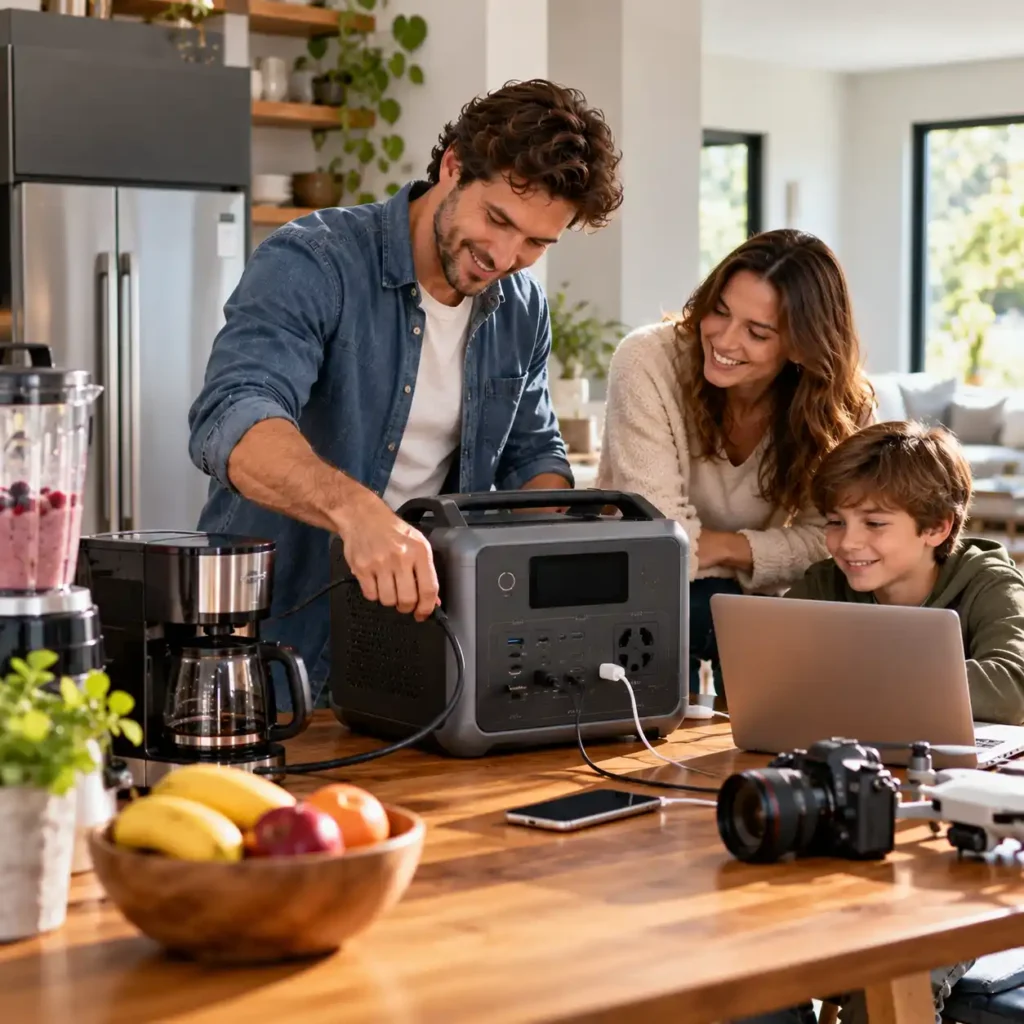
Spending more on a portable power station is worthwhile when the additional capability solves a limitation you would otherwise encounter. A higher price alone does not make a power station a better value.
Spend More When You Need Longer Runtime
If your main concern is keeping essential devices running for longer, additional battery capacity can justify a higher price.
Moving from a 1,000Wh-class station to a roughly 2,000Wh model gives you a substantially larger energy reserve. That can be valuable for longer outages, extended off-grid use, or situations where several lower-power devices need to remain available for hours at a time.
If you mainly charge electronics or need short-duration backup, however, paying for twice the battery capacity may not provide enough practical benefit to justify the added cost and weight.
Spend More When Your Loads Require More Output
A higher budget can also make sense when you need to run more demanding appliances or several devices at once.
If your current option already handles your highest-demand device comfortably, additional continuous output may not change your experience. But if your expected loads approach the limits of a lower-output model, moving to a more capable inverter can give you significantly more flexibility.
This is particularly relevant when you want one power station to handle both everyday electronics and higher-demand appliances rather than maintaining separate equipment for different uses.
Spend More When Charging Speed Matters
Charging capability can become a meaningful reason to move toward the upper end of the budget when you expect to use the power station frequently.
Faster AC charging can reduce downtime between uses, while stronger solar input can make a difference when you need to replenish the battery away from the grid. These features are more valuable for frequent or demanding use than for a power station that spends most of its time stored for occasional emergencies.
Spend More When You Want One More Versatile System
Sometimes the advantage of a more expensive power station is the combination of capabilities rather than one specification.
A higher-priced model can give you more battery capacity, higher output, stronger charging, and useful backup features in one system. If you want one power station that can cover a wider range of situations, paying more can be easier to justify than buying a smaller model that meets only your minimum requirements.
The trade-off is that greater capability can also mean more weight, a larger footprint, and a higher purchase price.
When Spending More Is Not Worth It
You probably do not need to use your entire $1,000 budget if a less expensive model already covers your requirements.
Spending more is harder to justify when:
your normal loads are comfortably below the cheaper model’s continuous output;
you do not need extended runtime;
you rarely use the power station away from a wall outlet;
portability is more important than maximum capacity;
the additional charging or convenience features would rarely be used.
The best value is therefore not the most capable power station you can afford. It is the model that gives you enough capacity, output, charging performance, and useful features without paying for capability you are unlikely to use.
For this reason, the $900–$1,000 range makes the most sense for buyers who have a clear need for the additional capacity, higher output, or broader capability available at the top of this category. If you do not, keeping part of your budget in reserve can be the smarter choice.
Portability vs. Capacity: What Are You Giving Up?
More battery capacity can give you longer runtime, but it usually comes with a practical cost: more weight and a larger physical footprint. For a portable power station, that trade-off matters because a battery that is difficult to move may be less useful than a smaller one you can easily position where you need it.
More Capacity Usually Means More to Carry
The difference becomes noticeable when moving from a 1,000Wh-class power station to a 2,000Wh-class model.
In this guide, the Anker SOLIX C1000 Gen 2 represents the more compact end of the range at 24.9 pounds, while the 2kWh-class models range from 35.7 pounds for the Anker SOLIX S2000 to 53.35 pounds for the BLUETTI Elite 200 V2.
That is a substantial difference in what you have to lift, carry, load into a vehicle, or move around the house.
The benefit of the heavier models is a much larger energy reserve. The question is whether you will actually use that additional capacity often enough to justify carrying it.
When the Extra Capacity Is Worth the Weight
A heavier 2kWh-class power station can make sense when you expect to:
need longer runtime between charges;
power several devices over an extended period;
keep a larger energy reserve available during outages;
use the power station primarily in one location, such as a garage or home office;
transport it occasionally rather than carrying it frequently.
In these situations, the additional battery capacity can be more valuable than minimizing weight.
When Portability Matters More
A smaller power station can be the better choice when you expect to move it regularly.
If you carry the unit between rooms, load it into a vehicle, take it on short trips, or simply do not have a permanent location for it, every additional pound becomes part of the ownership experience. If frequent outdoor use is the main reason portability matters to you, our Best Portable Power Stations for Camping (2026) guide focuses specifically on that use case.
For these buyers, giving up some battery capacity can be a sensible trade if it results in a power station that is easier to handle and store.
The Right Balance Depends on How You Use It
There is no universal point at which a power station becomes “too heavy.” The right balance depends on whether capacity or mobility is the bigger constraint in your situation.
A 1,000Wh-class model may be the smarter choice when compactness and frequent movement are priorities. A 2kWh-class model becomes more compelling when longer runtime matters more than carrying convenience.
The important thing is to consider how often you will physically move the power station, not just whether you technically can.
If the unit will spend most of its time in one place, additional capacity may be worth the weight. If you expect to carry it regularly, a lighter model with enough capacity for your actual needs can provide better overall value.
For that reason, do not treat portability as a secondary specification. The best power station is one whose capacity you will use and whose weight you are comfortable handling.
Common Buying Mistakes When Shopping Under $1,000
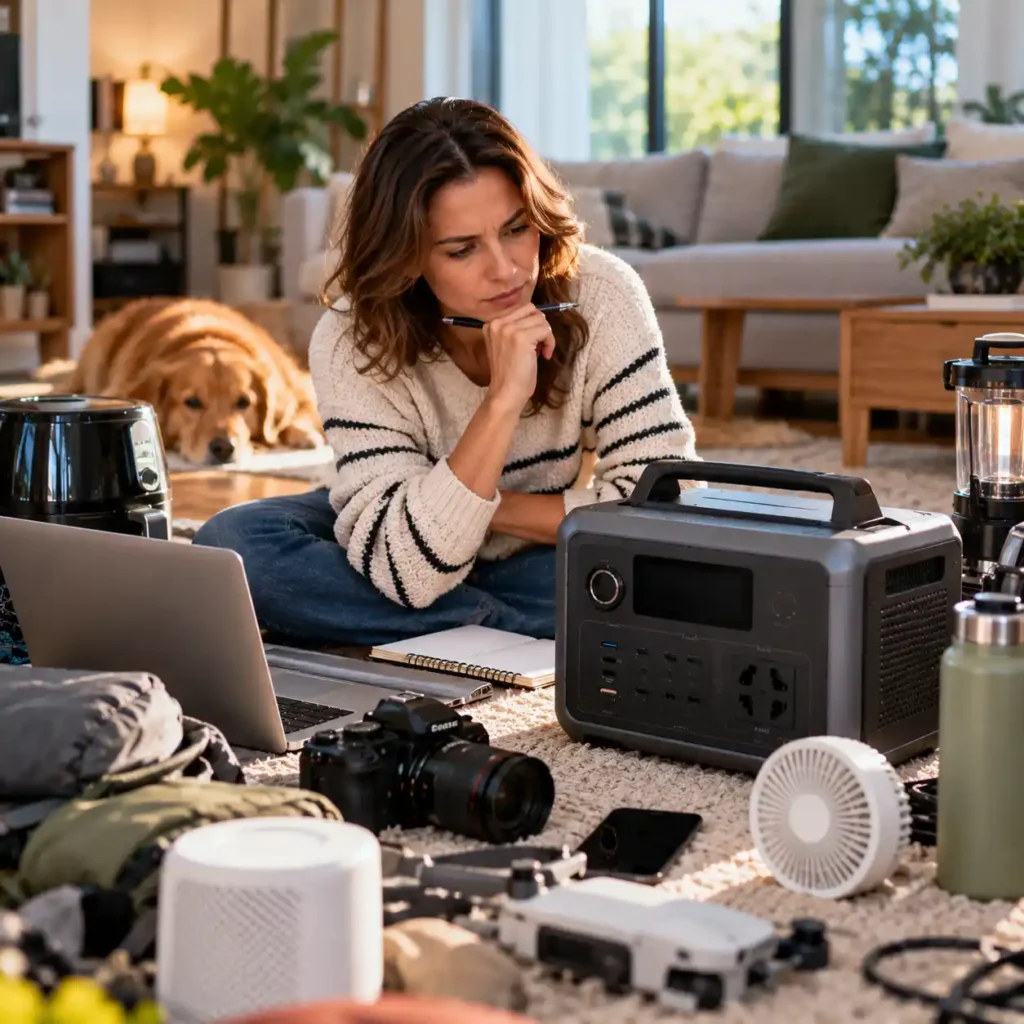
A budget of $1,000 gives you many capable options, but it can also make it easier to overbuy. The most expensive model is not automatically the best choice if its additional capacity, output, or features do not solve a real need.
Buying the Biggest Battery Just Because the Budget Allows It
A larger battery can provide longer runtime, but it also usually adds weight, size, and cost. If your typical loads are modest or your backup periods are short, a 2kWh-class power station may provide more capacity than you will actually use.
Looking at Wh Without Checking Continuous Output
Battery capacity tells you how much energy is stored, not how much power the inverter can deliver at once. A power station can have plenty of Wh but still be unsuitable for a demanding appliance if its continuous AC output is too low.
Confusing Peak Output With Continuous Output
Peak or surge output is designed to handle short-term startup demands from certain devices. It should not be treated as the amount of power the station can continuously deliver. When comparing models, use the continuous rating to determine whether the station can support your expected load.
Paying for More Capacity Than You Actually Need
It is easy to assume that more Wh always means better value. But if a smaller battery already provides enough runtime for your devices, the additional capacity may simply increase the purchase price and weight without improving your actual use.
Underestimating Weight and Portability
A power station may look portable on paper but feel very different once you have to lift it into a vehicle or move it around your home. If you expect to carry the unit regularly, consider whether the additional battery capacity is worth the extra weight.
Paying More for Features You Will Rarely Use
Higher-priced models can offer faster charging, stronger solar input, app controls, UPS functionality, and other conveniences. If UPS performance is the deciding factor rather than the overall budget, see our Best Portable Power Stations for UPS Backup (2026) guide for a dedicated comparison. These can be valuable, but only when they match your usage. Paying for capabilities you rarely use can reduce the actual value of a more expensive power station.
Assuming the $900–$1,000 Model Is Automatically the Best Value
The upper end of the budget often provides more capacity and output, but that does not make it the right choice for every buyer. A less expensive model can offer better value when it already meets your required load, runtime, and portability needs.
Choosing by Price Instead of the Capability You Actually Need
A $500 power station is not necessarily a bargain if it cannot handle your intended loads, just as a $1,000 model is not necessarily a better purchase if you will never use its additional capabilities.
The better approach is to identify the specific limitation you need to solve—whether that is runtime, continuous output, portability, charging, or another useful feature—and choose the least expensive model that solves it comfortably.
Frequently Asked Questions
Should I buy one large power station or two smaller ones?
One larger power station can provide more capacity and output in a single unit and may offer better value per watt-hour. Two smaller units can provide greater portability and redundancy, but they can also cost more for the same total capacity. For a fixed $1,000 budget, the better approach depends on whether simplicity and maximum capacity or flexibility and easier handling matter more to you.
.
Do I need solar panels with a portable power station under $1,000?
No. A portable power station can be recharged from a wall outlet without solar panels. Solar becomes more valuable when you expect to use the station away from the grid or want another way to replenish the battery during an extended outage. If you rarely need off-grid charging, putting the budget toward the power station itself may make more sense.
Is LiFePO4 important when choosing a power station under $1,000?
LiFePO4 is a useful specification to look for in this price range because it is associated with long cycle life and is now common among current-generation models. However, battery chemistry should not be the only deciding factor. Capacity, continuous output, weight, charging performance, and the features you will actually use still determine whether a particular power station is the better fit. Current 2026 competitors also treat LiFePO4 as a major baseline feature in this category.
Does the $1,000 budget need to cover solar panels and accessories?
For this guide, the under-$1,000 comparison is focused on the portable power station itself. Optional solar panels, expansion batteries, carrying accessories, and other equipment can add substantially to the total system cost. If you are building a complete solar-powered setup rather than buying the power station alone, account for those additional costs separately.
Should I buy at the regular price or wait for a sale?
A sale can significantly change the value equation in this category because several portable power stations are frequently discounted below their listed prices. The important point is to evaluate the model against your actual needs rather than buying a model simply because its discount looks large. Check the current price and specifications before purchasing because street prices and availability can change
Is the most expensive power station under $1,000 always the best choice?
No. A higher-priced model can provide more capacity, output, charging capability, or other features, but those advantages only matter if they solve a real need. A less expensive power station can be the better value when it already provides enough capacity and output for your devices and is easier to carry or store. This is why our recommendations are divided by buyer priorities rather than simply ranked by price.
Final Verdict
The best portable power station under $1,000 is not necessarily the most expensive or highest-capacity model. The right choice depends on how much capacity, output, and portability you actually need.
For most buyers, the EF ECOFLOW DELTA 3 Max offers the strongest overall balance of capacity, power, charging, and useful features. But buyers who prioritize higher output, lower weight, or a more compact design may get better value from one of the other picks in this guide.
The goal is not to spend the full $1,000. It is to buy the most capable power station that meets your needs without paying for capacity or features you will not use.
Our Recommendation
Choose the EF ECOFLOW DELTA 3 Max if you want the strongest all-around combination of battery capacity, continuous output, charging capability, and versatility under $1,000.
Choose the BLUETTI Elite 200 V2 if your priority is higher continuous output and you are willing to accept a heavier power station in exchange for more sustained power.
Choose the Anker SOLIX S2000 if your priority is a lighter 2kWh-class power station that is easier to move without giving up substantial battery capacity.
Choose the Anker SOLIX C1000 Gen 2 if you want a compact, lightweight option with 2,000W of continuous output and do not need the longer runtime of a 2kWh-class battery.
Choose the Jackery Explorer 2000 v2 if you want a practical middle ground in the 2kWh class, balancing substantial capacity, useful output, and a weight below 40 pounds.
If you are still unsure, start with the capability you need most—runtime, continuous output, portability, or compact size—rather than starting with the price.
Related Guides
If you want to narrow your choice further, these guides cover the next step in the buying decision:
Best Portable Power Stations Under $500 (2026) — if you want to spend less and determine whether a lower budget is enough for your needs.
Best 2000Wh Portable Power Stations (2026) — if you have decided that a 2kWh-class battery is the right capacity and want to compare that category in greater depth.
What Size Power Station Do I Need? How to Calculate the Right Size — if you still need to determine the capacity and output required for your specific devices.
Best Portable Power Stations for Home Backup (2026) — if your main goal is keeping essential household devices running during power outages.
Best Portable Power Stations for Camping (2026) — if portability and outdoor use are more important than maximizing home backup capability.
Power Ready Guide Commitment
At Power Ready Guide, our goal is not to tell you to spend the most. It is to help you understand what you are actually getting for your money.
We compare portable power stations based on the capabilities that matter to real buying decisions—capacity, output, charging, portability, useful features, and overall value. We also make the trade-offs clear, so you can see not only what a power station does well, but where another option may make more sense.
Our commitment is simple: help you spend your budget with confidence, not simply spend the entire budget.