
Choosing a portable power station with around 2,000Wh of battery capacity involves more than comparing stored energy. Models in this class can differ significantly in continuous AC output, usable energy, charging speed, weight, solar input, and expansion options. These differences matter depending on whether you need to keep essential home appliances running during an outage, power multiple devices, or carry a reliable source of electricity on an off-grid trip.
This guide compares five portable power stations in the approximately 2,000Wh class, focusing on the specifications that shape their real-world usefulness. We examine manufacturer specifications, official documentation, available independent testing, and relevant technical considerations to explain how each model balances output, runtime potential, portability, and charging flexibility. By comparing their capabilities and limitations side by side, you can assess which station is suited to your equipment, estimate how long it may power your essential devices, and understand where each model may fall short. The goal is to help you choose based on your actual power needs rather than battery capacity alone.
As an Amazon Associate, I earn from qualifying purchases.
Table of Contents
Quick Answer
For high-output home backup, the DJI Power 2000 stands out with its 3,000W continuous AC output. If you expect your backup needs to grow over time, the EF EcoFlow DELTA 2 Max offers expandable capacity. The BLUETTI AC200PL provides the largest built-in energy reserve in this group, while the Anker SOLIX S2000 is designed for essential loads that do not require high inverter output.
For buyers who value portability alongside useful backup power, the Jackery Explorer 2000 v2 offers a comparatively lightweight design with 2,200W of continuous output. Each model serves a different priority, so the right choice depends on your appliances, expected runtime, available space, and whether you need to move or expand the system.
Compare the five models below to see how their output, capacity, UPS performance, and practical limitations align with your needs.
Our Evidence & Evaluation Method
We compare the selected portable power stations using manufacturer specifications, official product documentation, relevant independent test results, and transparent technical calculations. Power Ready Guide does not conduct laboratory or hands-on product testing. We distinguish published specifications from independently measured results and identify limitations when evidence is incomplete or not directly comparable.
| Factor | What We Examine | Evidence |
|---|---|---|
| Battery Capacity and Usable Energy | Rated capacity in Wh and estimated usable AC energy, including the assumptions used for runtime planning | Manufacturer specifications, independent measurements where available, and stated conversion assumptions |
| AC Output | Continuous inverter rating, surge capability, and suitability for common appliance loads | Official specifications and independent output measurements where available under sufficiently documented test conditions |
| Charging Flexibility | AC, solar, and vehicle charging options, input limits, supported charging configurations, and published recharge times | Manufacturer documentation, technical specifications, and compatible accessory information |
| Portability | Published weight, dimensions, handle design, and practical transport considerations | Product specifications and documented design characteristics |
| Practical Runtime | Estimated operating time for representative household and off-grid loads | Calculations based on stated usable-energy assumptions and the power requirements of representative devices |
| Battery and Ownership | Battery chemistry, published cycle-life claims, warranty coverage, expansion options, and compatible additional batteries | Official product documentation and relevant independent reports, where available |
How We Interpret the Evidence
Manufacturer specifications provide the baseline for comparison. Independent test results add measured evidence only when the model and test conditions are sufficiently documented. Runtime estimates are planning tools rather than guaranteed operating times, and published cycle-life figures and warranty terms are treated as ownership information, not proof of independently verified long-term durability. When data is missing or specifications are not directly comparable, we identify those limitations rather than filling gaps with unsupported assumptions.
Who This Guide Is For
Who Should Read This
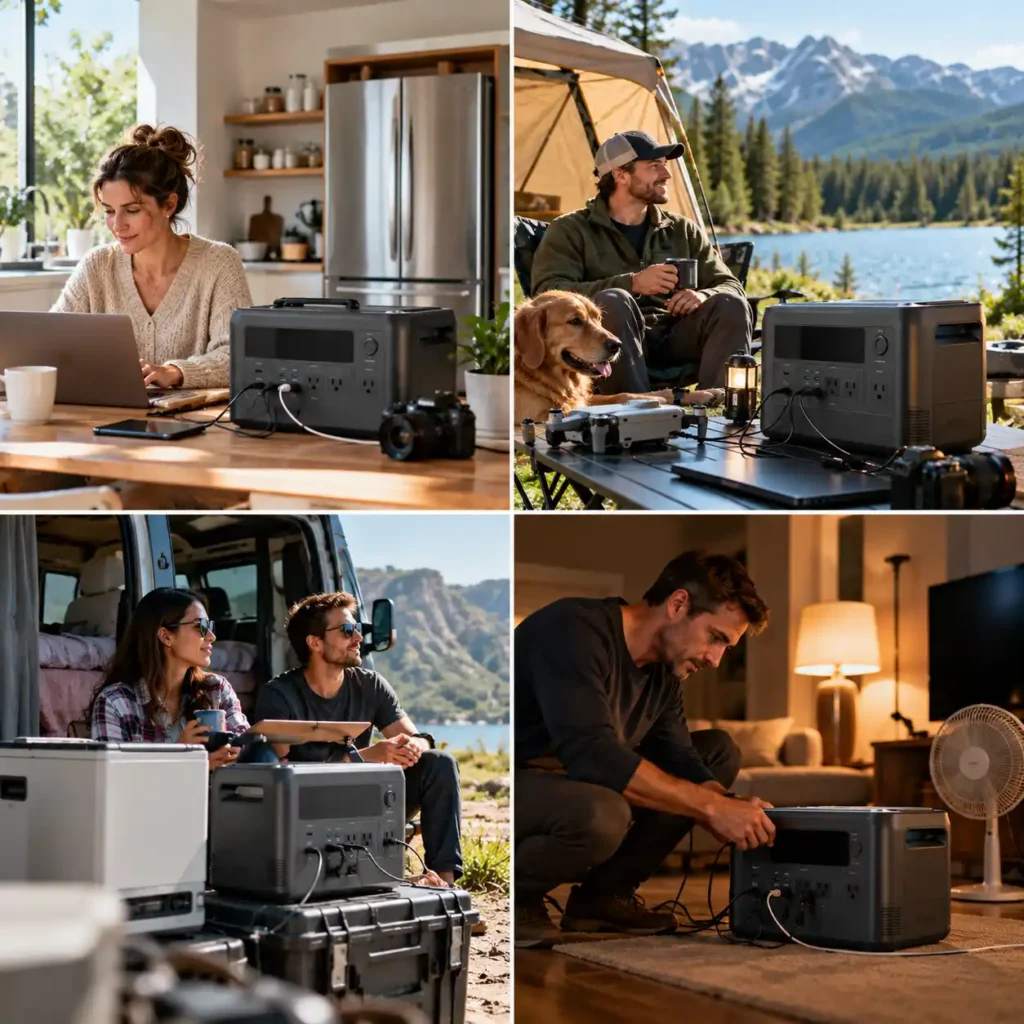
This guide is for buyers comparing portable power stations in the approximately 2,000Wh class for home backup, camping, and off-grid use. It focuses on the practical differences in usable energy, AC output, charging flexibility, portability, and expansion options.
If your primary goal is powering equipment at a campsite rather than preparing for household outages, explore our Best Portable Power Stations for Camping guide for options tailored to outdoor use.
Who Should Use Another Guide
If your needs are more specific than a general 2,000Wh comparison, a dedicated guide may be more useful:
- Refrigerator backup: If keeping your refrigerator running during an outage is your main priority, see our Best Portable Power Stations for Refrigerator Backup guide for a more focused comparison of suitable models and runtime considerations.
UPS backup: For transfer time and sensitive-device compatibility, see our dedicated UPS guide.
Camping: For lightweight setups and trip-specific power needs, explore our camping and tent camping guides.
Larger home backup systems: For critical-load planning, transfer switches, and expandable systems, see our home backup guide.
Quick Summary: Our Top Picks
These five portable power stations offer different combinations of battery capacity, AC output, expansion options, and portability. Each is included for a specific use case, with a key advantage and a limitation to consider before buying.
DJI Power 2000
Award: Best for High-Output Home Backup
Best For: Running multiple household devices that require substantial AC output.
Key Reason: Its 2,048Wh battery and 3,000W AC output provide substantial power headroom for demanding backup loads.
Main Limitation: Its size and weight make it less convenient for frequent transport or occasional camping.
EF EcoFlow DELTA 2 Max
Award: Best Expandable Home Backup System
Best For: Households that may need to increase their backup capacity over time.
Key Reason: Its 2,048Wh battery, 2,400W AC output, and additional-battery support offer flexibility as energy requirements grow.
Main Limitation: Expansion adds cost and requires additional storage space.
Anker SOLIX S2000
Award: Best for Essential-Load Backup
Best For: Powering selected essential electronics and moderate-power appliances during an outage.
Key Reason: Its approximately 2,010Wh battery provides a substantial energy reserve for lower-demand backup loads.
Main Limitation: Its 1,500W continuous output restricts the range of appliances it can run simultaneously.
BLUETTI AC200PL
Award: Best for a Larger Built-In Energy Reserve
Best For: Buyers who want more than 2,000Wh of built-in capacity and the option to expand.
Key Reason: Its 2,304Wh battery offers the largest built-in energy reserve among the five selected models.
Main Limitation: Its heavier, bulkier design is less convenient for frequent relocation.
Jackery Explorer 2000 v2
Award: Best Balance of Portability and Output
Best For: Home users and campers who want substantial capacity in a comparatively manageable unit.
Key Reason: Its 2,042Wh battery and 2,200W AC output combine useful energy storage with relatively low weight for this capacity class.
Main Limitation: Its capacity is not expandable, which may limit its suitability for longer outages or growing backup requirements.
Comparison Table
| Model | Capacity | AC Output | Weight | Best For |
|---|---|---|---|---|
| DJI Power 2000 | 2,048 Wh | 3,000 W | 48.5 lb | High-output home backup |
| EcoFlow DELTA 2 Max | 2,048 Wh | 2,400 W | 50 lb | Expandable home backup |
| Anker SOLIX S2000 | 2,010 Wh | 1,500 W | 35.7 lb | Essential-load backup |
| BLUETTI AC200PL | 2,304 Wh | 2,400 W | 62.4 lb | Larger built-in energy reserve |
| Jackery Explorer 2000 v2 | 2,042 Wh | 2,200 W | 39.5 lb | Portability and output balance |
| Model | Expandable Capacity | Expansion Details |
|---|---|---|
| DJI Power 2000 | Yes | Supports compatible expansion batteries |
| EcoFlow DELTA 2 Max | Yes | Supports compatible extra batteries |
| Anker SOLIX S2000 | Verify | Confirm compatibility for the exact U.S. model |
| BLUETTI AC200PL | Yes | Supports compatible expansion batteries |
| Jackery Explorer 2000 v2 | No | Fixed built-in capacity |
Rated battery capacity indicates how much energy a power station stores, not how much electricity its AC outlets can deliver to connected devices. Inverter losses and power-station operating requirements reduce usable AC energy, so actual runtime will be lower than a simple calculation based on rated capacity alone. Runtime estimates should account for these losses and the power draw of the connected equipment.
How We Evaluated
A power station’s battery capacity is only one part of its overall performance. Models in the approximately 2,000Wh class differ in AC output, charging flexibility, portability, and expansion options. We evaluated five selected models across ten criteria, focusing on the practical advantages and trade-offs that matter for home backup, camping, and off-grid use.
Energy Capacity
We compared rated battery capacity in watt-hours (Wh) to establish the energy reserve built into each model. Although all five stations fall within the approximately 2,000Wh class, differences in capacity can affect how long they support connected devices before recharging is needed.
A larger battery reserve may be useful for extended outages or higher daily energy demand, but capacity alone does not determine which model is the best fit.
Usable Energy
We considered usable AC energy alongside rated battery capacity to compare the energy available to connected devices. For consistent runtime estimates, we applied the 85% usable-energy planning assumption described in our evaluation methodology. This helps illustrate practical differences between models without presenting calculated runtime as measured performance.
Inverter Capability
We compared continuous AC output and published surge ratings to determine which loads each station may support.
Higher continuous output offers more flexibility for running demanding appliances or several devices at once. Surge capability is relevant for equipment with brief startup demands, but compatibility still depends on the appliance’s actual power requirements and the station’s operating limits.
Charging Speed
We examined supported AC input and manufacturer-stated recharge times to understand how quickly each station can be prepared for its next use.
Faster AC charging can be especially useful during short breaks in an outage or between trips. The practical advantage depends on the available power source and the station’s supported input settings.
Portability
We compared weight, dimensions, and carrying design in relation to each model’s capacity and output.
The difference between a 35.7 lb station and a 62.4 lb unit can substantially affect how easily it can be moved, loaded into a vehicle, or stored between uses. Lighter models may be more convenient for frequent transport, while heavier units may suit buyers who prioritize built-in capacity and higher power over mobility.
Solar Compatibility
We compared maximum supported solar input and documented electrical limits to assess each station’s solar charging flexibility.
Higher solar input can allow a compatible panel setup to deliver more charging power when conditions permit. For buyers planning extended camping trips or longer outages, panel compatibility and input limits help determine whether solar charging can meaningfully support their energy needs.
Expandability
We assessed whether each model supports compatible additional batteries and how expansion changes its potential role in a backup setup.
Expandable systems can accommodate longer backup requirements or changing energy needs without replacing the main power station. However, additional batteries increase total cost, storage space, and system weight. For buyers whose built-in capacity is already sufficient, expansion may offer little practical benefit.
Warranty and Ecosystem
We considered published warranty coverage, battery-life information, compatible accessories, and expansion options where documented.
These factors can influence long-term ownership and the flexibility of a complete setup. We treated warranty terms and published battery-life claims as reference information rather than proof of independently verified durability, and considered ecosystem advantages only where they offered a relevant practical benefit.
Value
We assessed value in terms of the capabilities each model offers for its intended use, including capacity, AC output, charging options, portability, and expansion support.
Because prices, promotions, and bundles change, value depends on the specific listing and configuration available when purchasing. Without a consistent, verified price comparison, we focus on capability and use-case fit rather than declaring one model the best financial value.
Use-Case Fit
Finally, we considered how each station’s combined capabilities align with common use cases.
For home backup, usable energy, inverter output, and expansion options can be particularly important. Camping and frequent transport place greater emphasis on weight, dimensions, and charging flexibility. Buyers who need one station for both settings must balance these priorities against their equipment requirements and expected runtime.
This final criterion brings the other nine together, helping explain why a model suited to demanding household loads may not be the most convenient option for frequent travel, and why a lighter station may be sufficient for essential devices without meeting higher-power needs.
Product Reviews
DJI Power 2000
Best for High-Output Home Backup

Quick Verdict
The DJI Power 2000 is a 2,048Wh portable power station designed for users who need substantial battery capacity and high AC output in one system. Its 3,000W continuous output provides more room for running demanding household appliances or combining multiple loads than the lower-output models in this comparison.
It is particularly relevant for home backup because its capacity can be expanded with compatible batteries. Starting with the base unit and adding storage later gives buyers flexibility as their backup needs change. However, expansion requires additional investment and space, so the system is most useful for households that expect to need more than the built-in battery can provide.
Snapshot
| Specification | DJI Power 2000 |
|---|---|
| Battery Capacity | 2,048Wh |
| Continuous AC Output | 3,000W |
| Peak/Surge Output | Not specified |
| AC Voltage | 100–120V |
| Weight | Approx. 48.5 lb |
| Battery Chemistry | LiFePO4 (LFP) |
| Expandability | Up to 22,528Wh |
| AC Outlets | 4 |
| Dimensions | 17.6 × 8.9 × 12.8 in |
Why We Chose It
The DJI Power 2000 stands out primarily for its 3,000W continuous AC output, the highest rating among the five selected models. Compared with the EF EcoFlow DELTA 2 Max and BLUETTI AC200PL at 2,400W, the Jackery Explorer 2000 v2 at 2,200W, and the Anker SOLIX S2000 at 1,500W, it offers more headroom for combining household loads.
That additional output is useful when an outage plan includes appliances with relatively high running power or equipment with demanding startup requirements. It does not increase the battery’s stored energy, however, and it cannot guarantee that every combination of appliances will work. Total running load and startup power must remain within the unit’s limits.
The other distinguishing feature is its expansion potential. The system can reach a stated total capacity of up to 22,528Wh with compatible expansion batteries. This makes the DJI a candidate for buyers who want to begin with a portable power station and build toward a larger backup setup over time.
Check the latest price and customer reviews on Amazon.
Living With It
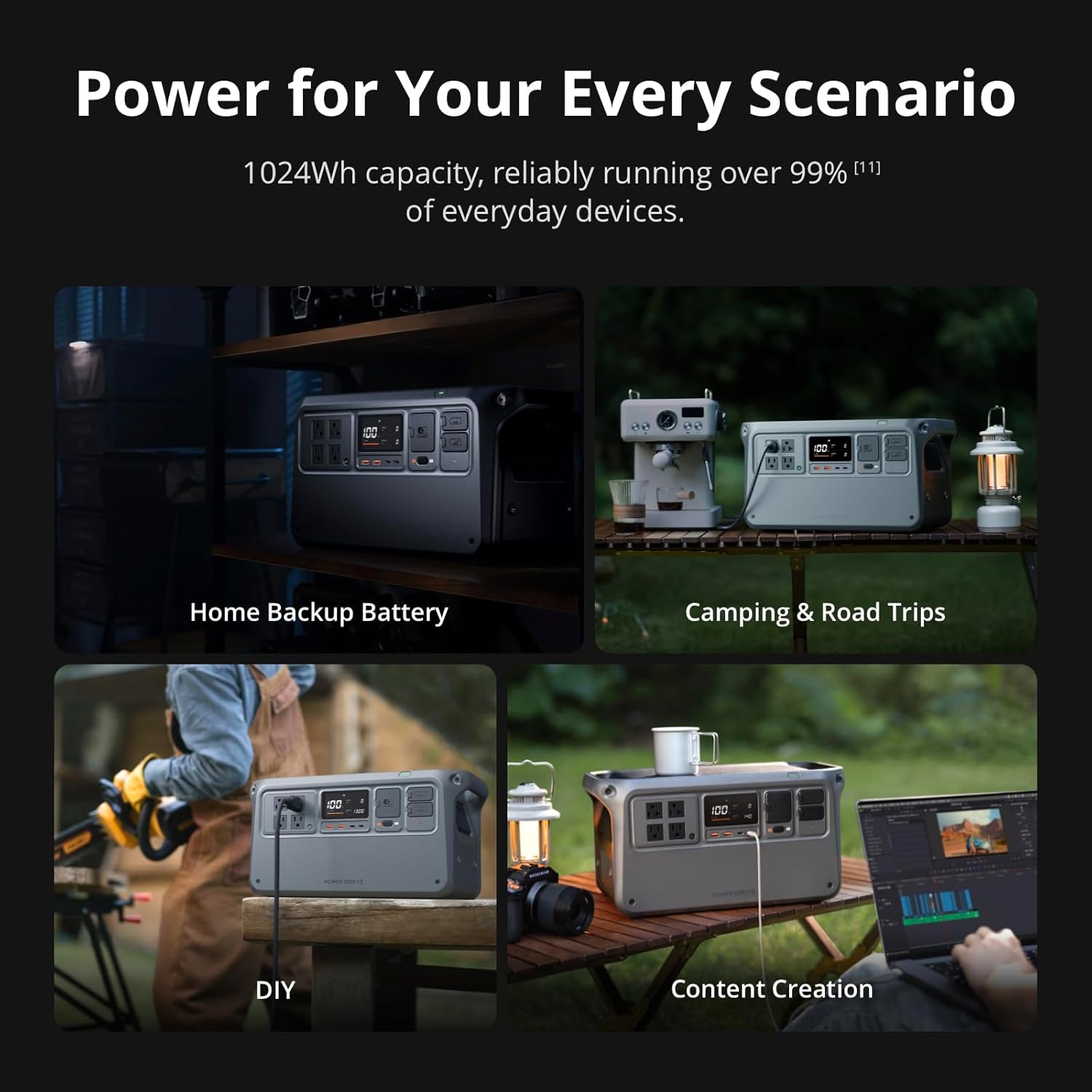
The DJI Power 2000 measures approximately 17.6 × 8.9 × 12.8 inches and has a body volume of about 32.6 liters. Its display, controls, and connection ports are accessible from the front, making it practical to position in a garage, utility area, or another accessible location at home.
At approximately 48.5 pounds, it is manageable to reposition occasionally, but its weight makes frequent carrying less convenient. For a home backup setup, this is less of a concern if the unit can remain in a designated location until needed. For camping or trips that involve repeated loading and unloading, a lighter model may be easier to handle.
Expansion changes the practical setup considerably. Additional batteries increase available energy but also add weight, cost, and the space required for storage. Buyers considering the full system should plan for the expanded configuration rather than evaluating only the dimensions and weight of the base unit.
Evaluation
| Evaluation Factor | This Model | How It Compares | Buyer Implication |
|---|---|---|---|
| Continuous Output | 3,000W | Highest rated continuous output among the five selected models | More headroom for demanding appliances and combined loads, within the unit’s limits |
| Battery Capacity | 2,048Wh | Close to the capacity of most models in this comparison | A substantial starting reserve, but runtime still depends on power draw and conversion losses |
| Expandability | Up to 22,528Wh | Highest stated maximum system capacity in this comparison, subject to verification against other models’ current specifications | Allows a larger backup setup, but requires compatible batteries, extra space, and additional spending |
| Portability | Approx. 48.5 lb | Lighter than the BLUETTI AC200PL, but heavier than the Anker SOLIX S2000 and Jackery Explorer 2000 v2 | More practical for a mostly stationary backup location than for frequent transport |
The DJI’s main strength is its combination of high output and expansion flexibility. These characteristics address two different parts of a backup plan: the amount of power appliances can draw at once and the amount of energy available over time. Buyers should evaluate both separately. A higher output rating does not provide longer runtime, while a larger battery reserve does not automatically support appliances with high power requirements.
Who Should Buy This
- Households that need substantial continuous AC output for several appliances or more demanding household loads.
- Buyers who want to start with a 2,048Wh power station and potentially expand their backup capacity later.
- Users who expect the unit to remain in one place most of the time and prioritize output flexibility over frequent portability.
Who Should Skip This
- Buyers who only need to power lights, phones, laptops, routers, and other modest loads, and do not need 3,000W of continuous output.
- Campers or travelers who frequently carry their power station and place a higher priority on lower weight.
- Households that want a larger built-in battery reserve without purchasing, storing, and connecting expansion batteries.
- Buyers whose primary requirement is uninterrupted power for sensitive electronics and who need to compare dedicated UPS transfer behavior and compatibility.
Final Verdict
The DJI Power 2000 is a strong fit for home backup plans that place a premium on high continuous output and the option to expand storage later. Its 3,000W rating gives it the greatest output headroom in this comparison, while its expansion system offers a path to a much larger energy reserve.
The trade-off is practical rather than technical: the base unit is not especially light, and a larger system requires additional batteries, investment, and storage space. For buyers with modest loads or a strong preference for portability, much of the DJI’s extra capability may go unused.
Check the latest price and customer reviews on Amazon.
Related Guide: If you are planning to use a power station during household outages, see our guide to Best Portable Power Stations for Home Backup. It explores backup options for essential appliances and longer power interruptions.
EF EcoFlow DELTA 2 Max
Best for Expandable Home Backup

Quick Verdict
The EF EcoFlow DELTA 2 Max combines a 2,048Wh LFP battery with 2,400W of continuous AC output, making it a versatile option for home backup, camping, and other situations where a balance of capacity and output matters. Its six AC outlets in the U.S. configuration also provide flexibility for connecting multiple devices, as long as their combined power requirements stay within the station’s limits.
Its main advantage is expandability. The DELTA 2 Max supports compatible extra batteries, allowing the system to grow from 2,048Wh to as much as 6,144Wh. This makes it a practical choice for households that want more backup runtime without moving immediately to a substantially larger system. The trade-off is the additional cost, weight, and storage space required as capacity grows.
Snapshot
| Specification | EcoFlow DELTA 2 Max |
|---|---|
| Battery Capacity | 2,048Wh |
| Continuous AC Output | 2,400W |
| Peak/Surge Output | 4,800W |
| AC Voltage | 100–120V |
| Weight | Approx. 50 lb |
| Battery Chemistry | LiFePO4 (LFP) |
| Expandability | Up to 6,144Wh |
| AC Outlets | 6 |
| Dimensions | 19.6 × 9.5 × 12 in |
| Solar Input | Up to 1,000W |
| Cycle Life | 3,000 cycles to 80%+ capacity (manufacturer-rated) |
Why We Chose It
The EF EcoFlow DELTA 2 Max earns its place in this comparison because it offers a clear expansion path while retaining a useful level of AC output. Its 2,400W continuous rating matches the BLUETTI AC200PL and exceeds the Jackery Explorer 2000 v2 and Anker SOLIX S2000 in this group. Although it provides less continuous output than the DJI Power 2000, its expansion system offers a more moderate route to increasing capacity.
With one compatible 2,048Wh extra battery, total capacity reaches 4,096Wh. Adding a second brings the system to 6,144Wh. This can be useful for households that want to extend the runtime of essential appliances during longer outages without immediately committing to a much larger backup system.
The DELTA 2 Max also supports up to 1,000W of solar input. That gives buyers another way to replenish the battery when suitable panels and sunlight are available. Actual solar charging time depends on panel output, weather, orientation, and other system conditions.
Check the latest price and customer reviews on Amazon.

Living With It
The DELTA 2 Max measures approximately 19.6 × 9.5 × 12 inches and weighs about 50 pounds. Its footprint is substantial but manageable for a designated home backup location, such as a garage, storage area, or utility space with adequate ventilation and access to outlets.
At this weight, it is possible to move the unit when necessary, but frequent carrying is less convenient than transporting a lighter power station. For camping, it is better suited to trips where the station can be loaded into a vehicle and kept in one place rather than carried over long distances.
The expansion system affects everyday practicality. Each extra battery adds considerable weight and requires additional storage space. Buyers planning to expand should account for the dimensions and weight of the complete setup, not just the base station. The benefit is a larger energy reserve without replacing the original unit.
Evaluation
| Evaluation Factor | This Model | How It Compares | Buyer Implication |
|---|---|---|---|
| Continuous Output | 2,400W | Matches the BLUETTI AC200PL; below the DJI Power 2000 | Supports many household appliances and combined loads, but offers less headroom than the DJI |
| Battery Capacity | 2,048Wh | Similar to the DJI Power 2000 and Jackery Explorer 2000 v2 | Provides a substantial starting reserve, with runtime determined by the connected loads and conversion losses |
| Expandability | Up to 6,144Wh | Supports a larger system than its built-in capacity, though below the DJI’s stated maximum expansion capacity | Allows buyers to increase runtime gradually without replacing the base station |
| Portability | Approx. 50 lb | Close in weight to the DJI Power 2000; heavier than the Anker SOLIX S2000 and Jackery Explorer 2000 v2 | More suitable for a mostly stationary backup setup or vehicle-based trips than frequent carrying |
The DELTA 2 Max balances output and storage flexibility rather than maximizing either one. Its 2,400W continuous output is sufficient for many common backup loads, while the extra-battery system provides a way to increase runtime. Buyers should keep these two capabilities separate: expansion adds stored energy, not a higher continuous AC output rating.
Who Should Buy This
- Households that want to extend backup runtime gradually by adding compatible batteries.
- Buyers who need 2,400W of continuous AC output for essential household appliances and multiple devices.
- Users who want both home backup capability and the option to take the base unit on vehicle-based camping trips.
- Buyers who can benefit from solar charging and want up to 1,000W of solar input capacity.
Who Should Skip This
- Buyers who need the highest continuous output in this comparison and would benefit from the DJI Power 2000’s 3,000W rating.
- Households that need a much larger backup reserve from the start and prefer not to purchase or store additional batteries.
- Campers who prioritize a lightweight station for frequent carrying.
- Buyers who only need to power small electronics and do not expect to use the DELTA 2 Max’s capacity, output, or expansion options.
Final Verdict
The EF EcoFlow DELTA 2 Max is a suitable choice for buyers who want a 2kWh-class power station that can grow into a larger home backup system. Its combination of 2,400W continuous output, 1,000W solar input, and expansion to 6,144Wh gives it flexibility across different backup requirements.
Its main compromise is that expansion increases the system’s cost, weight, and space requirements without increasing the inverter’s continuous output. For buyers who value a gradual increase in backup capacity more than maximum output or lightweight portability, that trade-off may make sense.
Check the latest price and customer reviews on Amazon.
Related Guide: If you want to estimate how much battery storage your setup requires, use our Battery Capacity Calculator to calculate the capacity needed for your expected energy consumption.
Anker SOLIX S2000
Best for Lower-Output 2kWh Backup
Quick Verdict
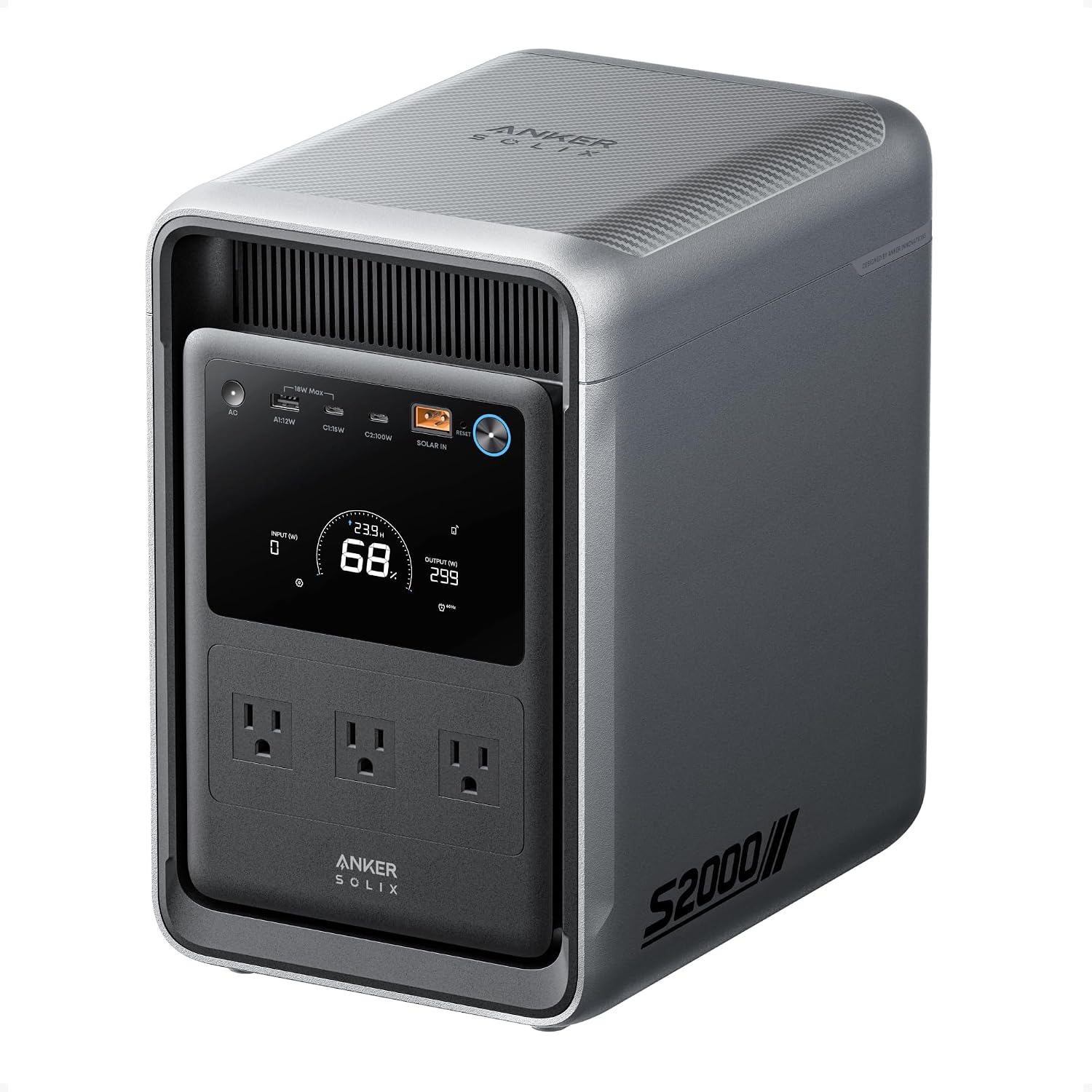
The Anker SOLIX S2000 is a compact 2kWh-class power station for buyers who want a substantial energy reserve without moving up to a heavier, higher-output unit. Its 2,010Wh LFP battery, 1,500W continuous AC output, and 35.7 lb weight make it a practical option for essential home backup, camping, and powering moderate loads. Its relatively low active idle draw is also relevant when the station needs to remain on for extended periods.
The main trade-off is its limited inverter output. At 1,500W, the S2000 is better suited to refrigerators, networking equipment, lights, laptops, and other moderate loads than to high-demand appliances or several power-hungry devices running simultaneously. Its 400W maximum solar input also limits how quickly it can replenish its battery from solar panels compared with models that accept substantially more solar power.
Snapshot
| Specification | Anker SOLIX S2000 |
|---|---|
| Battery Capacity | 2,010Wh |
| Battery Chemistry | LiFePO4 |
| AC Output | 1,500W continuous |
| Bypass Mode | Up to 1,800W maximum; 12A continuous for extended operation |
| Solar Input | 400W maximum |
| UPS Switchover | ≤10 ms |
| AC Charging | 1,150W standard; up to 1,600W with UltraFast charging |
| Weight | 35.7 lb |
| Expandability | Not expandable through a dedicated expansion battery system |
Why We Chose It
The Anker SOLIX S2000 stands out for buyers who want a meaningful battery reserve without prioritizing high inverter output. Its 2,010Wh capacity can support a selected group of essential devices, while its 1,500W continuous output is better matched to moderate loads than to demanding appliances.
Portability is another part of its appeal. At 35.7 lb, the S2000 is relatively manageable for a power station in this capacity class. Its compact footprint makes it easier to store between outages, move around the home, or bring along for car camping.
Anker also specifies a 6W active idle power draw and a UPS switchover time of 10 ms or less. These features can be useful when the station is connected to compatible electronics or networking equipment. However, buyers should confirm that the transfer behavior meets the requirements of their specific devices.
The S2000 is not expandable, and its 400W maximum solar input is a limitation for buyers who need to replenish a 2kWh battery quickly from solar panels. Its strongest case is therefore a balance of capacity, manageable weight, and moderate-load backup—not maximum output or system expansion.
Check the latest price and customer reviews on Amazon.

Living With It
The S2000 is most practical when you decide in advance which devices need backup. A refrigerator, Wi-Fi router, lights, and selected electronics may fit within its output limit, but the combination depends on each appliance’s running and startup power. A refrigerator’s compressor can draw more power when starting than it uses during normal operation, so check its requirements before relying on the station.
Battery capacity also needs to be separated from usable AC energy. The rated 2,010Wh describes stored energy, not the amount delivered to connected AC devices. For planning, allowing for conversion losses provides a more realistic runtime estimate. Actual performance will vary with the connected load, inverter operation, appliance cycling, and environmental conditions.
For camping, the S2000 can power lighting, electronics, and moderate appliances at a stationary or vehicle-based campsite. Its 35.7 lb weight is still substantial for frequent carrying, so it is not designed for backpacking or situations where the station must be moved over long distances.
Solar charging is possible with compatible panels, but the 400W input limit places a ceiling on how quickly the battery can be replenished. Real-world charging depends on sunlight, panel orientation, temperature, and other conditions. Buyers who expect to rely heavily on solar during multi-day outages should compare this limit with their daily energy needs.
Evaluation
| Evaluation Factor | This Model | How It Compares | Buyer Implication |
|---|---|---|---|
| Energy Capacity | 2,010Wh | Within the typical 2kWh-class capacity range | Provides a substantial energy reserve for essential devices, although actual AC runtime is lower than rated battery capacity. |
| Continuous Output | 1,500W | Below higher-output models in the 2kWh class | Supports many everyday appliances and essential backup loads, but limits the use of high-wattage appliances and multiple demanding devices. |
| Portability | 35.7 lb | Relatively manageable for a 2kWh-class unit | Suitable for car camping and occasional relocation, though less convenient for frequent carrying. |
| Solar & Backup | 400W solar input; ≤10 ms UPS; 1,800W maximum bypass | Solar input is more limited than on some competing models; UPS transfer time is in the fast-switching range | Supports solar replenishment and backup for compatible electronics, but the solar input limits recharge potential, and UPS suitability depends on the connected equipment. |
| Expandability | Not expandable | Lacks the dedicated expansion-battery capability available on some competing models | The built-in capacity sets the storage limit, making the station less flexible for buyers who may need substantially longer backup runtime. |
Who Should Buy This
The Anker SOLIX S2000 is worth considering if you:
- Want a 2kWh-class battery for essential home backup and moderate loads.
- Prefer a relatively manageable weight and compact footprint for this capacity class.
- Primarily need to power devices such as a refrigerator, router, lights, laptops, and small electronics.
- Value a UPS function for compatible equipment and do not need a dedicated UPS system.
Who Should Skip This
Consider another model if you:
Need more than 1,500W of continuous AC output for demanding appliances or several high-power devices.
Want to expand battery capacity later, since the S2000 does not support a dedicated expansion battery system.
Depend heavily on solar charging and need more than 400W of maximum solar input.
Need a lighter station for frequent carrying or a dedicated UPS with specific compatibility requirements.
Final Verdict
The Anker SOLIX S2000 is a practical option for buyers who want a substantial battery reserve but do not need the higher inverter output or expansion capability of some competing power stations. Its 1,500W continuous output defines the type of equipment it can support, while its 35.7 lb weight makes it easier to handle than many larger-capacity alternatives.
Its appeal comes from the balance of capacity, portability, and backup features. For essential devices and moderate loads, that combination may be sufficient. Buyers who need broader appliance coverage, faster solar replenishment, or longer runtime through additional batteries should look at models with higher output, greater solar input, or expandable capacity.
Check the latest price and customer reviews on Amazon.
Related Guide: If you need backup power for electronics during an outage, see our guide to Best Portable Power Stations for UPS Backup. It compares portable power stations with UPS functionality and explains the practical differences in transfer behavior.
BLUETTI AC200PL
Best for a Larger Built-In Energy Reserve

Quick Verdict
The BLUETTI AC200PL has a 2,304Wh LiFePO4 battery, giving it the largest built-in energy reserve among the five power stations in this guide. Its 2,400W continuous AC output supports a range of household appliances, RV equipment, and off-grid loads. For buyers who want more stored energy without immediately purchasing expansion batteries, its larger starting capacity is the main advantage.
The AC200PL also supports compatible BLUETTI expansion batteries, allowing buyers to increase total storage capacity for longer backup periods. The available capacity depends on the expansion battery configuration. Its main trade-off is portability: at 62.4 pounds, it is the heaviest model in this comparison. It is better suited to a home backup location, an RV setup, or a semi-stationary off-grid system than frequent transport.
Snapshot
| Specification | BLUETTI AC200PL |
|---|---|
| UPS Transfer | ≤20ms |
| Battery Capacity | 2,304Wh |
| Continuous AC Output | 2,400W |
| Peak/Surge Output | 3,600W Power Lifting mode; not a conventional surge rating |
| AC Voltage | 120V (U.S. version) |
| Weight | 62.4 lb |
| Battery Chemistry | LiFePO4 (LFP) |
| Expandability | Up to approximately 8,448Wh with compatible batteries |
| AC Outlets | 4 AC outlets, plus an RV outlet |
| Dimensions | 16.5 × 11 × 14.4 in |
Why We Chose It
The BLUETTI AC200PL stands out for buyers who want more stored energy before investing in expansion batteries. Its 2,304Wh starting capacity exceeds the built-in battery capacity of the DJI Power 2000 and EF EcoFlow DELTA 2 Max at 2,048Wh, the Jackery Explorer 2000 v2 at 2,042Wh, and the Anker SOLIX S2000 at 2,010Wh.
That extra reserve can help extend runtime when powering essential devices, depending on their energy consumption. The AC200PL also offers an expansion path for buyers whose backup requirements may grow over time. Its distinction is the combination of the largest starting battery in this group and the option to add compatible storage—not the highest output or easiest portability.
Check the latest price and customer reviews on Amazon.

Living With It
The AC200PL measures approximately 16.5 × 11 × 14.4 inches, giving it a substantial footprint that can work in a garage, utility area, or RV storage space with sufficient clearance for ventilation and access to its ports. Its 2,304Wh built-in battery provides a relatively large energy reserve without requiring external batteries from the start.
At 62.4 pounds, however, moving the unit between locations takes more effort than handling the lighter models in this comparison. It is most practical when placed near the appliances or equipment it is intended to support. For RV and off-grid use, its capacity can be useful for longer periods away from grid power, but regular transport and frequent lifting are less convenient.
Actual runtime depends on the combined wattage of connected devices, inverter losses, and operating conditions. The rated battery capacity should not be treated as the amount of AC energy available to appliances. Buyers planning to run a refrigerator or other motor-driven equipment should also account for startup power and test their intended setup before relying on it during an outage.
Evaluation
| Evaluation Factor | This Model | How It Compares | Buyer Implication |
|---|---|---|---|
| Built-In Capacity | 2,304Wh | Largest among the five selected models | More stored energy before external expansion |
| Continuous Output | 2,400W | Matches the EcoFlow and exceeds the Jackery and Anker, but is below DJI | Suitable for many household loads, with less headroom than DJI |
| Expandability | Up to approximately 8,448Wh | Supports additional batteries, although total capacity depends on configuration | Useful for longer backup scenarios |
| Portability | 62.4 lb | Heaviest model in this comparison | Better for stationary or occasional relocation |
| UPS Transfer | ≤20ms | A documented backup feature; transfer behavior depends on connected equipment | Relevant for selected electronics that need backup during an outage |
Who Should Buy This
- Buyers who want the largest built-in battery reserve among the five models in this guide.
- Households that need substantial stored energy for essential appliances and longer backup periods.
- RV and off-grid users who value battery capacity and the option to add compatible expansion batteries more than easy transport.
- Buyers who prefer to start with a larger built-in battery rather than immediately purchasing additional storage.
Who Should Skip This
- Buyers who prioritize frequent carrying, lightweight design, or easy relocation.
- Users who need the highest continuous AC output in this comparison.
- Households with modest backup requirements that would not benefit from the additional built-in capacity.
- Buyers who need a dedicated UPS solution with specific transfer-time or compatibility requirements.
Final Verdict
The BLUETTI AC200PL earns its place as Best for a Larger Built-In Energy Reserve because its 2,304Wh battery provides the most built-in energy among the five models in this comparison. Its compatible expansion options add flexibility for buyers whose backup needs may increase over time.
The trade-off is its 62.4-pound weight, which makes it less practical for frequent transport. Its 2,400W continuous output also falls short of the DJI Power 2000. For buyers who value a larger starting battery and future expansion more than portability or maximum output, the AC200PL offers a clear use-case fit.
Check the latest price and customer reviews on Amazon.
Related Guide: If you are considering the AC200PL for vehicle-based travel, see our guide to Best Portable Power Stations for RV. It explores the capacity, output, and practical features that matter when powering equipment on the road.
Jackery Explorer 2000 v2
Best Balance of Portability and Output

Quick Verdict
The Jackery Explorer 2000 v2 combines a 2,042Wh LiFePO4 battery with 2,200W of continuous AC output in a 39.5-pound design. This balance makes it suitable for essential home backup, occasional transport, and car camping. It offers enough capacity for many everyday backup needs without the added weight of some larger or expandable alternatives.
Its built-in UPS function switches to battery power within 20 ms, which can help keep compatible electronics running during a power interruption. However, it is not designed for equipment that requires zero-transfer power. The other important limitation is its fixed battery capacity: unlike expandable models, the Explorer 2000 v2 cannot accept additional batteries to extend its energy reserve.
Snapshot
| Specification | Jackery Explorer 2000 v2 |
|---|---|
| UPS Transfer | ≤20 ms |
| Battery Capacity | 2,042Wh |
| Continuous AC Output | 2,200W |
| Peak/Surge Output | 4,400W |
| AC Voltage | 120V |
| Weight | 39.5 lb |
| Battery Chemistry | LiFePO₄ |
| Expandability | Not expandable |
| AC Outlets | 3 |
| Dimensions | 13.2 × 10.4 × 11.5 in |
| Cycle Life | 4,000 cycles to 70% capacity |
Why We Chose It
The Jackery Explorer 2000 v2 is a portability-focused option for buyers who still need substantial battery capacity and practical AC output. Its 2,200W continuous rating can support many essential household loads, while its 39.5-pound weight makes it easier to relocate than the heavier BLUETTI AC200PL and EF EcoFlow DELTA 2 Max.
Its appeal comes from combining these characteristics in a self-contained design. The 2,042Wh battery provides a useful starting reserve for home backup and travel without requiring an expansion system. That simplicity is convenient for buyers whose energy needs are relatively predictable.
The trade-off is limited flexibility. Its battery capacity cannot be expanded, and its output is lower than the DJI Power 2000 and the 2,400W BLUETTI and EcoFlow models. It is therefore better suited to balanced, moderate backup needs than to setups that may require more power or additional storage later.
Check the latest price and customer reviews on Amazon.

Living With It
At 13.2 × 10.4 × 11.5 inches, the Explorer 2000 v2 has a relatively compact footprint for a power station in the 2kWh class. Its 39.5-pound weight makes it more manageable than heavier alternatives, although it is still substantial equipment that is better suited to occasional relocation than frequent carrying over long distances.
At home, the unit can be positioned near essential devices that need backup power during an outage. For car camping and occasional travel, its combination of capacity and weight makes transport more practical than with some larger power stations. The 2,200W output also gives it flexibility for a range of household and recreational equipment, provided the combined load stays within its operating limits.
The main planning consideration is its fixed 2,042Wh capacity. Users preparing for longer outages cannot add expansion batteries, so runtime depends on selecting essential loads and managing consumption. Actual AC energy available to appliances will be lower than the rated battery capacity because of inverter losses and operating conditions.
The UPS function is another useful feature, but its ≤20ms transfer time does not guarantee uninterrupted operation for every device. Equipment that cannot tolerate a brief power interruption may require a dedicated zero-transfer UPS. Check compatibility before relying on the power station to protect sensitive electronics.
Evaluation
| Evaluation Factor | This Model | How It Compares | Buyer Implication |
|---|---|---|---|
| UPS Transfer | ≤20 ms | In the same general transfer-time class as several portable power stations in this comparison. | Suitable for many household devices, but not for equipment that requires zero-transfer protection. |
| Built-In Capacity | 2,042Wh | Close to the 2,000Wh-class capacity of most models in this group, but below the BLUETTI AC200PL’s 2,304Wh. | Provides a substantial energy reserve without matching the largest built-in capacity in the group. |
| Continuous Output | 2,200W | Below the DJI Power 2000’s 3,000W rating and the 2,400W ratings of the EcoFlow DELTA 2 Max and BLUETTI AC200PL. | Can support many essential loads, but offers less headroom for multiple high-wattage appliances. |
| Portability | 39.5 lb | Lighter than the other larger, heavier options in this comparison. | Easier to reposition at home or transport for occasional trips. |
| Expandability | Not expandable | Unlike expandable systems such as the EcoFlow DELTA 2 Max, its capacity remains fixed. | Best suited to buyers whose expected backup needs fit within the built-in battery capacity. |
Who Should Buy This
- Buyers who want a 2kWh-class power station that is comparatively easy to move.
- Households that need backup for essential devices rather than every appliance in the home.
- Campers and travelers who also want a capable home backup option.
- Users who prefer a self-contained system and do not expect to expand their energy storage.
- Buyers who value a balance of battery capacity, AC output, and manageable weight.
Who Should Skip This
- Buyers who need higher continuous output for demanding household appliances.
- Households planning to expand their energy reserve for longer outages.
- Users who require zero-transfer UPS protection for sensitive electronics, servers, or workstations.
- Anyone expecting to power several high-wattage devices simultaneously.
- Buyers who need a larger built-in battery reserve than approximately 2kWh.
Final Verdict
The Jackery Explorer 2000 v2 combines a 2,042Wh battery and 2,200W continuous output with a relatively low weight for its capacity class. This makes it a flexible option for buyers who want one power station for essential-load home backup and occasional transport.
Its main compromise is the fixed battery capacity. Buyers who anticipate longer outages or growing energy needs may prefer an expandable system, while those who regularly use high-wattage appliances may need more output headroom. Its ≤20ms UPS function adds useful backup capability for compatible devices, but it is not a substitute for a zero-transfer UPS where even a brief interruption is unacceptable.
For buyers whose priorities are practical output, substantial capacity, and easier relocation, the Explorer 2000 v2 offers a clear balance without the additional weight of some larger alternatives.
Check the latest price and customer reviews on Amazon.
Related Guide: If you plan to use a power station away from home, see our guide to Best Portable Power Stations for Camping. It compares options for powering essential devices and equipment at a campsite.
How Much Power Do You Need?
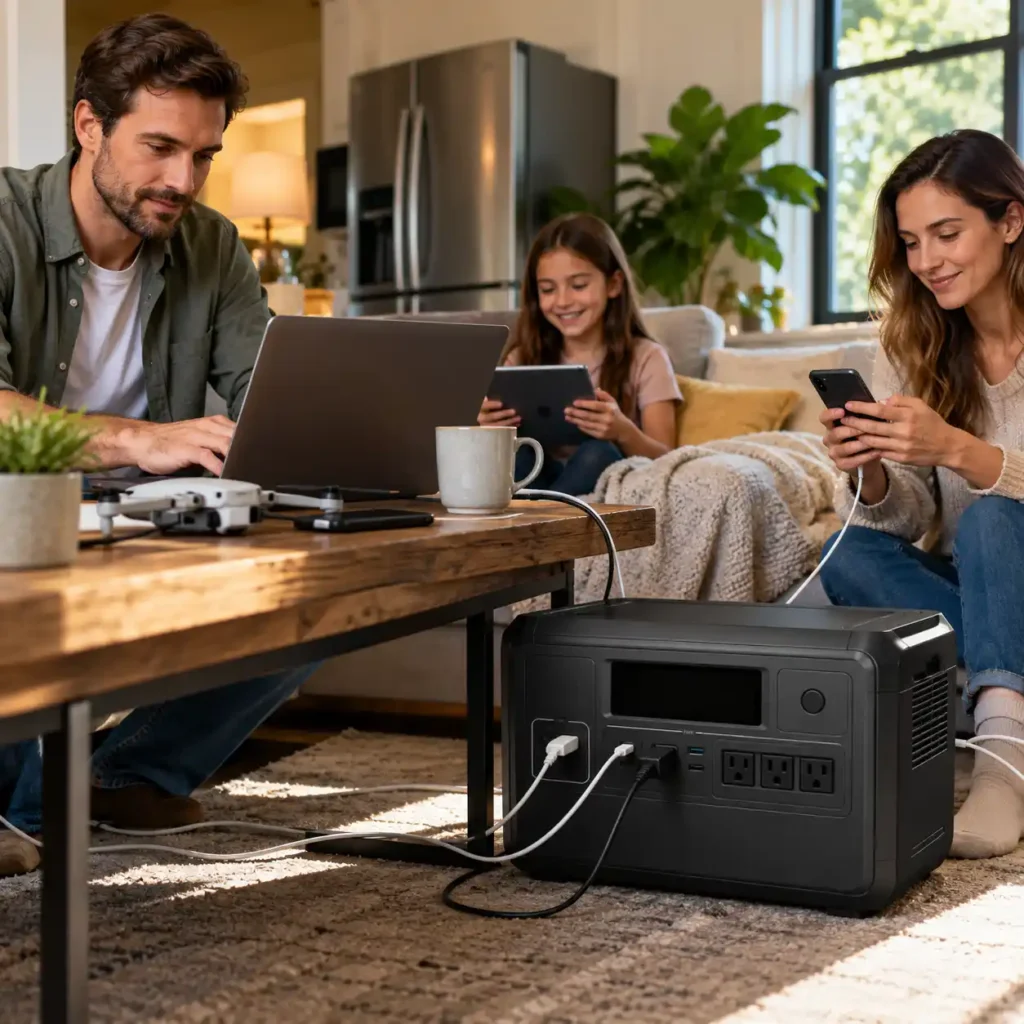
When choosing a portable power station in the approximately 2,000Wh class, battery capacity is only part of the decision. Two models can store nearly the same amount of energy yet handle very different combinations of appliances. The key is to distinguish power output, measured in watts (W), from battery capacity, measured in watt-hours (Wh).
If you are unsure which combination of battery capacity and inverter output fits your appliances, use our Power Station Size Calculator to estimate the power station specifications required for your setup.
Power output determines which appliances a station can run at the same time. Battery capacity determines how long it can supply that load before the battery is depleted. Both matter during an outage, but they solve different problems.
Start With the Appliances You Need to Run
Make a list of the devices you would actually use during a power outage. Focus first on essential loads, such as:
A refrigerator or freezer
A modem and Wi-Fi router
Phones, laptops, and other small electronics
LED lights
Medical or other essential equipment, where applicable
A fan or other small household appliance
Next, estimate the wattage of each device and identify which appliances may operate simultaneously. Add the running wattages of those devices to estimate the continuous load your power station must support.
For example, a refrigerator, router, several lights, and a laptop may have a relatively modest combined running load. Adding a microwave, kettle, space heater, or other high-wattage appliance can increase the demand substantially. The important question is not simply how many devices you want to connect, but which ones need to operate at the same time.
Check Both Continuous Output and Startup Requirements
A power station’s continuous AC output is the amount of power its inverter can supply under the specified operating conditions. If the combined load exceeds that limit, the station may overload or shut down its AC output.
Some appliances also require a brief surge of power when their motors or compressors start. Refrigerators, freezers, pumps, and certain power tools can have startup demands above their normal running wattage. A station’s advertised surge rating may help accommodate these short peaks, but surge capability is not a substitute for sufficient continuous output. Its duration and operating conditions also matter.
This distinction is particularly relevant to the five models in this comparison:
DJI Power 2000: its 3,000W continuous output provides more headroom for higher-demand combinations of appliances.
EF ECOFLOW DELTA 2 Max and BLUETTI AC200PL: their 2,400W continuous outputs suit a range of essential and moderate household loads, subject to each appliance’s running and startup requirements.
Jackery Explorer 2000 v2: its 2,200W output sits between the higher-output models and the Anker.
Anker SOLIX S2000: its 1,500W output makes load planning especially important if you intend to run several appliances together or use equipment with high startup demand.
These output ratings describe different levels of inverter capability, not differences in how long the stations will run. A higher-output model can support a larger load, but it may also drain its battery faster when operating that load.
Understand What Approximately 2,000Wh Can Provide
Battery capacity is the energy stored in the station, not the amount of AC energy that will necessarily reach connected appliances. Inverter losses and the station’s own operating requirements reduce the energy available at the outlets.
For planning purposes, this guide uses an 85% usable-AC-energy assumption. At that planning rate, a station with a rated capacity of approximately 2,000Wh would provide roughly 1,700Wh of usable AC energy. This is an estimate for comparing and planning, not a guaranteed result for every model, load, or operating condition.
A simple runtime estimate is:
Estimated runtime (hours) = usable AC energy (Wh) ÷ total running load (W)
For example, a 200W combined load would use approximately 200Wh per hour. With 1,700Wh of estimated usable AC energy, the calculated runtime would be about 8.5 hours. Actual runtime may be shorter because appliance consumption changes, some devices cycle on and off, and power stations have different conversion and standby losses.
This is why a station’s rated capacity alone cannot tell you whether it will cover an entire evening, overnight use, or a longer outage. The result depends on the appliances, their actual consumption, and how often they operate.
Match the Station to Your Backup Priorities
For essential electronics, lighting, networking equipment, and a carefully managed refrigerator load, a 1,500W model may provide sufficient output. If your backup plan includes several appliances running together, equipment with higher startup demands, or occasional higher-wattage use, additional inverter headroom can make operation more flexible.
The trade-off is portability and system design. A higher-output station may be heavier or less convenient to move, while a lighter model with lower output may be easier to store and reposition. If your priority is longer backup duration rather than running more appliances at once, usable energy and expansion options deserve more attention than inverter wattage alone.
Before choosing, check three things:
Combined running load: Will the appliances you need to use together remain within the station’s continuous output rating?
Startup demand: Do any motors, compressors, or other equipment require a brief surge that the station can support?
Required runtime: How many hours must the station supply that load, and does its estimated usable energy cover that period?
A power station in the 2,000Wh class can support many essential-load backup plans, but it is not automatically suitable for whole-home backup or for running every household appliance. The right model depends on the loads you need to support, how long you need them to run, and whether portability or expandability matters more than additional output.
What Can a 2,000Wh Power Station Run?
A power station in the approximately 2,000Wh class can support a wide range of essential household devices, but its practical capabilities depend on more than battery capacity. The inverter’s continuous output, appliance startup requirements, and combined load determine which devices can run together.
The five models in this comparison have different output limits, ranging from 1,500W to 3,000W of continuous AC power. These differences can affect which appliances you can operate simultaneously, even though their battery capacities are relatively close.
Common Household Devices and Their Requirements
| Device or Appliance | What to Check | Practical Consideration |
|---|---|---|
| Refrigerators and freezers | Running wattage and compressor startup demand | Check continuous output and surge capability. Average energy consumption also affects backup duration. |
| Wi-Fi routers and modems | Combined power draw and required backup duration | Usually modest loads that can fit within the output limits of all five models. |
| Laptops, monitors, and small electronics | Combined wattage of connected equipment | Generally manageable loads, although multiple devices increase total demand. |
| LED lighting | Total wattage of lights used simultaneously | Several LED lights can often be supported without placing a large demand on the inverter. |
| Microwaves | Actual electrical input wattage | Cooking wattage may be lower than the power drawn from the outlet. |
| Coffee makers and electric kettles | Rated power and simultaneous appliance use | Heating appliances can consume a substantial share of available inverter output. |
| Space heaters | Rated wattage and intended operating duration | High continuous demand can use a large share of the available battery energy. |
| Power tools | Running wattage and motor startup demand | Requirements vary widely, so check the specific tool rather than relying on its category. |
This table describes compatibility considerations rather than fixed wattage limits. Appliances within the same category can have very different electrical requirements. Always check the appliance’s rating label or manufacturer documentation before connecting it.
How the Five Models Differ in Practical Use
DJI Power 2000 — More Headroom for Higher-Demand Loads
The DJI Power 2000 provides 3,000W of continuous AC output, giving it the highest standard inverter rating among the five models. This can be useful when your backup plan includes several appliances operating together or equipment with relatively high running requirements.
However, higher output does not increase the station’s stored energy. Running a demanding appliance will still reduce available runtime, and startup requirements must remain within the unit’s documented surge capability.
EF ECOFLOW DELTA 2 Max — Flexible Output for Moderate Household Loads
The EF EcoFlow DELTA 2 Max provides 2,400W of continuous AC output, with a published surge rating of 4,800W. This gives it useful output headroom for a range of essential and moderate household loads.
EcoFlow’s X-Boost feature also allows compatible devices with rated power up to a higher advertised threshold, but this is not equivalent to supplying that wattage as standard continuous AC output. Buyers should check the feature’s operating limitations and the requirements of the appliance they intend to use.
Anker SOLIX S2000 — Essential Loads With More Careful Load Planning
The Anker SOLIX S2000 provides 1,500W of standard AC output, the lowest continuous inverter rating in this comparison. This makes combined-load planning particularly important if you intend to use several appliances simultaneously.
It can be suitable for essential electronics, lighting, and other lower-demand devices, provided their combined requirements remain within its output limits. The S2000 provides 1,500W of continuous AC output when operating from its battery. Its bypass mode supports up to 1,800W under the specified operating conditions, but this is a separate rating and does not increase the inverter’s battery-powered output.
BLUETTI AC200PL — Additional Output Through a Separate Power Lifting Mode
The BLUETTI AC200PL provides 2,400W of standard continuous AC output and advertises up to 3,600W of Power Lifting. The distinction matters: Power Lifting is a special operating mode intended for compatible resistive loads, not a general increase in the inverter’s continuous output for every appliance.
For normal load planning, use the 2,400W rating. Consider the additional mode only when the appliance is compatible and the manufacturer’s operating requirements are met.
Jackery Explorer 2000 v2 — A Mid-Range Output Option
The Jackery Explorer 2000 v2 provides 2,200W of rated continuous AC output and a published surge peak of 4,400W. Its standard output can support many common essential-load scenarios, but buyers should pay closer attention to total demand when combining higher-wattage appliances.
The surge rating describes a short peak rather than the power available continuously. It should not be used as the basis for planning a sustained appliance load.
Can a 2,000Wh Power Station Run Major Household Appliances?
Some appliances commonly included in home-backup plans require additional attention:
- Refrigerators: Often practical backup loads when the station can handle compressor startup and the expected energy demand. Check the refrigerator’s actual consumption and the power station’s surge specifications.
- Microwaves: Compatibility depends on their electrical input requirements. A microwave’s advertised cooking wattage is not necessarily the power it draws from the outlet.
- Electric kettles and space heaters: These can place a substantial continuous load on the inverter. Running them alongside other appliances may exceed the output limit of lower-output models.
- Air conditioners: Requirements vary considerably by system type, capacity, and startup behavior. Do not assume that a 2,000Wh-class station can run an air conditioner simply because its battery capacity appears sufficient.
- Washing machines and other motor-driven appliances: Suitability depends on power demand, operating cycles, startup characteristics, and any additional electrical requirements.
A station’s ability to run an appliance is separate from its ability to run it for a useful length of time. A unit may have sufficient inverter output for a high-wattage device but provide limited runtime at that load.
The Practical Rule: Check the Combined Load
Before connecting multiple appliances, add their expected running wattages and compare the total with the station’s continuous AC output. Then check whether any appliance requires additional startup power.
For example, a backup plan that combines a refrigerator, networking equipment, lights, and a laptop may fit within the output limits of several models in this comparison. Adding a high-wattage heating appliance or another demanding device can change that assessment considerably.
The key distinction is that inverter output determines what you can run together, while available battery energy determines how long you can run it. For buyers comparing stations with similar battery capacities, this difference is often more useful than small variations in rated watt-hours.
To check the combined power demand of your appliances before connecting them, use our Appliance Wattage Calculator to estimate running watts, starting watts, and energy use.
If your backup plan depends on several high-demand appliances operating simultaneously, prioritize sufficient continuous output and verify startup requirements. If you mainly need essential electronics and a few household devices, a lower-output model may meet your needs without requiring additional inverter capacity.
How Much Battery Capacity Do You Actually Need?
A power station with approximately 2,000Wh of rated capacity can provide a useful energy reserve for essential household backup, but whether that is enough depends on your average power consumption and how long you need to operate your appliances.
The goal is not necessarily to buy the largest battery available. It is to choose enough usable energy for your expected backup scenario without paying for capacity you are unlikely to need or overlooking the value of an expandable system.
When Approximately 2,000Wh Is Enough
A power station in this capacity class may be sufficient when your backup priorities include:
Keeping phones, laptops, routers, and essential lighting powered during an outage.
Running a refrigerator alongside a few lower-demand devices, with a carefully managed load.
Supporting a home-office setup for several hours.
Maintaining essential household functions during shorter outages without powering the entire home.
These scenarios vary significantly in energy demand. A station that comfortably supports a modest electronics setup may provide much less backup time when a refrigerator or other continuously operating appliance is added.
The relevant question is how much energy your specific appliances consume over the period you need to cover—not simply how many devices you plan to connect.
For a more detailed estimate of the energy storage your setup may require, use our Battery Capacity Calculator to convert your power needs into battery capacity.
When You May Need More Capacity
A larger energy reserve becomes more valuable when:
Outages last longer: Several hours of backup can require substantially more energy than a short interruption.
Multiple appliances operate for extended periods: Refrigeration, networking, lighting, and other essential loads add up over time.
Your average load is relatively high: Even a station with sufficient inverter output can run out of stored energy quickly under sustained demand.
You have limited opportunities to recharge: If grid power is unavailable for an extended period and solar recharging is limited by weather, available panels, or charging conditions, additional stored energy can provide a useful reserve.
A higher-capacity system does not automatically solve every backup problem. The inverter still needs to support the connected load, and a larger battery may add weight, cost, and storage requirements.
Fixed Capacity vs. an Expandable System
One important difference between power stations is whether their battery capacity can be increased with compatible expansion batteries.
A fixed-capacity system has a defined energy reserve. Its simplicity may suit buyers whose backup needs are relatively predictable and who prefer a single unit.
An expandable system can offer a different approach. You can start with the base station and add compatible battery capacity if your backup needs grow or if you later decide that longer runtime is worth the additional investment.
However, expansion is not automatically the better choice. Additional batteries increase the system’s total weight and cost, and compatibility, supported configurations, and charging behavior depend on the specific model. Expansion also increases stored energy; it does not necessarily increase the station’s standard AC inverter output.
For the models in this comparison, check the compatible expansion options and maximum supported capacity in each product card before treating expandability as a deciding factor.
Compare Energy Reserve With Your Actual Backup Needs
The five stations have rated capacities ranging from approximately 2,010Wh to 2,304Wh. These differences are relatively modest compared with the potential effect of changing the connected load or adding compatible expansion batteries.
For many buyers, the more useful comparison is therefore not which base model has the largest number of watt-hours, but which system offers the right combination of usable energy, inverter capability, portability, and future flexibility.
If you expect to power only essential electronics and a few household devices, a base unit may be sufficient. If you anticipate longer outages, sustained refrigeration, or a broader backup setup, consider whether a larger or expandable system better fits your requirements.
Choose capacity around the outage scenario you need to cover—not around the largest number in the specification sheet.
Practical Runtime Examples
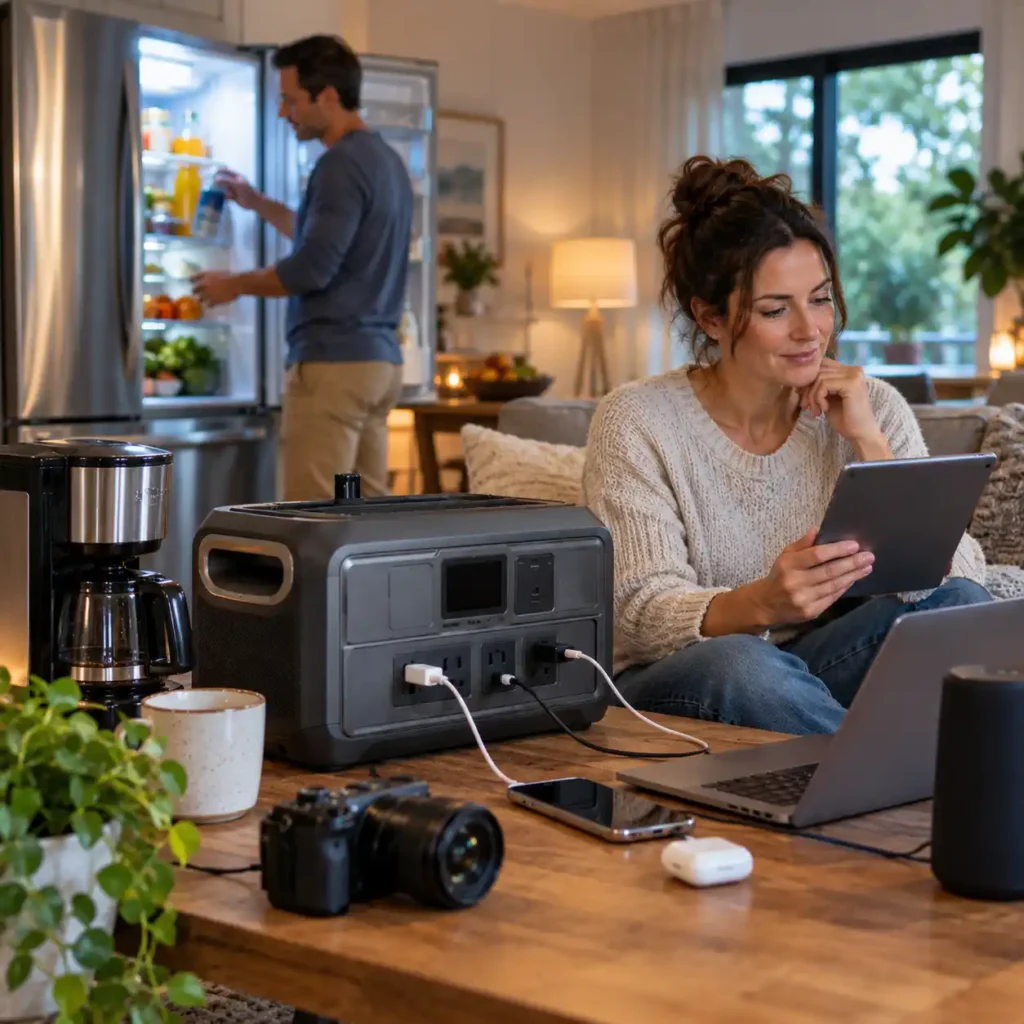
Runtime estimates help translate battery capacity into a more practical question: how long can a power station keep your essential devices running? The examples below use the five approximately 2,000Wh models in this comparison and the same 85% usable-AC-energy planning assumption established earlier.
The estimates are calculated from each model’s rated battery capacity and the specified average load. They are illustrative planning figures, not measured runtime results.
Estimated Runtime by Load
| Power Station (Capacity) | Phone (10W) | Laptop (60W) | CPAP (50W) | Refrigerator (75W) |
|---|---|---|---|---|
| DJI Power 2000 (2,048Wh) | 174h | 29.0h | 34.8h | 23.2h |
| EcoFlow DELTA 2 Max (2,048Wh) | 174h | 29.0h | 34.8h | 23.2h |
| Anker SOLIX S2000 (2,010Wh) | 171h | 28.5h | 34.2h | 22.8h |
| BLUETTI AC200PL (2,304Wh) | 196h | 32.6h | 39.2h | 26.1h |
| Jackery Explorer 2000 v2 (2,042Wh) | 173h | 28.9h | 34.7h | 23.1h |
| Power Station | Coffee Maker (1,000W) |
|---|---|
| DJI Power 2000 | 1.7h |
| EcoFlow DELTA 2 Max | 1.7h |
| Anker SOLIX S2000 | 1.7h |
| BLUETTI AC200PL | 2.0h |
| Jackery Explorer 2000 v2 | 1.7h |
These figures represent calculated equivalent runtime at a constant load. They are not a promise that a device will operate for that many hours under real-world conditions.
How to Interpret These Estimates
- Phone charging: The 10W example represents a simplified continuous load. Actual phone charging is intermittent, and charging power changes as the battery fills. The table is therefore useful for comparing energy demand, not predicting the exact number of phone charges.
- Laptop use: A 60W average load provides a straightforward reference for a laptop setup. Actual consumption varies with the laptop, workload, screen brightness, and whether other equipment is connected.
- CPAP: The 50W example is illustrative. A CPAP’s actual power demand can differ substantially depending on the device, pressure settings, humidifier, heated tubing, and operating conditions. If you rely on CPAP therapy, check your specific equipment’s power requirements and plan for an adequate reserve rather than relying on this estimate alone.
- Refrigerator backup: The 75W figure represents an assumed average load, not the refrigerator’s continuous running wattage. Compressors cycle on and off, and energy use varies by model, ambient temperature, door openings, and contents. Startup demand also matters when checking inverter compatibility.
Because refrigerator energy use varies with compressor cycling, temperature, and usage patterns, our Refrigerator Runtime Calculator can help you estimate backup time using your refrigerator’s actual power requirements.
- Coffee maker: The 1,000W example illustrates a high-power heating appliance. The calculated runtime is the equivalent time at a continuous 1,000W draw. Since coffee makers usually operate for short periods, actual use may consume much less energy than running one continuously for the full estimated time. Confirm that the appliance’s electrical input is within the power station’s output limits.
What the Comparison Actually Shows
The five models have relatively similar base capacities, so their estimated runtimes at the same load are also close. The BLUETTI AC200PL has the largest rated battery capacity in this comparison and therefore produces the longest calculated runtime under the same assumptions. However, the difference is not large enough to replace a realistic assessment of your appliances and outage duration.
For most buyers, the practical decision is less about a few additional hours in a theoretical calculation and more about whether the station can support the required appliances, whether it is portable enough for the intended use, and whether its capacity can be expanded if backup needs change.
Important: Estimates assume approximately 85% usable AC energy and vary with inverter efficiency, standby consumption, duty cycle, battery condition, temperature, and device behavior. Actual runtime may be shorter or longer. For critical equipment, use the manufacturer’s power specifications and allow an additional energy reserve.
Charging Options and Recharge Time
A power station’s charging capability matters most when you need to restore its energy reserve between outages or keep it available for repeated use. In the approximately 2,000Wh class, charging speed and flexibility can differ as much as inverter output and portability.
The five models support different combinations of AC, solar, and vehicle-based charging. Their maximum input ratings provide a useful comparison, but actual recharge time depends on the power source, charging conditions, battery level, and the station’s charging behavior.
AC Charging: The Fastest Way to Restore Capacity
For most buyers, charging from a household outlet is the most straightforward way to recharge a power station when grid power is available.
The models in this comparison offer different AC charging capabilities:
- DJI Power 2000: Supports AC charging, with additional fast-charging configurations available through compatible DJI accessories.
EF EcoFlow DELTA 2 Max: The U.S. version supports up to 1,800W of AC input through EcoFlow’s X-Stream fast-charging technology. EcoFlow states that the unit can recharge fully in approximately 80 minutes under suitable conditions. Actual charging time varies depending on the starting battery level, charging settings, temperature, and available power.
- Anker SOLIX S2000: Check the exact AC input rating and manufacturer’s stated recharge time for the specific version before comparing it with the other models.
- BLUETTI AC200PL: Supports AC charging with a maximum input of up to 2,400W in Turbo Charging mode. BLUETTI advertises approximately 1.5 hours for a full recharge under its specified conditions.
- Jackery Explorer 2000 v2: Supports up to 1,800W AC input, with a manufacturer-stated recharge time of around two hours.
A high maximum input rating can shorten recharge time, but it does not mean the station will draw that amount of power continuously from a standard outlet. Charging may slow as the battery approaches full capacity, and the available wall power or charging mode can impose additional limits.
Solar Charging: Useful When Grid Power Is Unavailable
Solar charging can help restore battery capacity during an extended outage, particularly when the station is used for repeated daily backup rather than a single short interruption.
The maximum solar input ratings differ across the models:
| Model | Maximum Solar Input | Practical Consideration |
|---|---|---|
| DJI Power 2000 | Up to 1,800W with the DJI Power 1.8kW Solar/Car Super Fast Charger; up to 400W with the DJI Power Solar Panel Adapter Module (MPPT) | The 1,800W configuration requires compatible, separately purchased accessories. The MPPT adapter supports a lower-input solar setup. |
| EcoFlow DELTA 2 Max | Up to 1,000W total (up to 500W per solar input port) | Uses two independent solar input ports. Actual charging speed depends on sunlight, panel output, and charging conditions. |
| Anker SOLIX S2000 | Up to 400W | Its lower solar input limit can result in longer recharge times than higher-input models when sufficient sunlight is available. |
| BLUETTI AC200PL | Up to 1,200W | Supports higher solar input, but actual charging time depends on sunlight, panel configuration, and operating conditions. |
| Jackery Explorer 2000 v2 | Up to 400W | Its solar input limit is lower than those of the EcoFlow and BLUETTI models, which may mean slower solar recharging in suitable conditions. |
Maximum solar input is a technical ceiling, not a prediction of everyday energy production. Actual output depends on sunlight intensity, panel orientation, shading, temperature, and the solar array’s electrical configuration.
Before purchasing panels, check the power station’s permitted input voltage and current, connector requirements, and any restrictions on connecting panels in series or parallel. A panel setup that exceeds the station’s supported input limits may not work as expected and can risk equipment damage.
If you still need to choose compatible portable panels for your setup, see our Best Portable Solar Panels guide for a comparison of solar charging options.
Vehicle Charging and Other Options
Vehicle charging can be useful when traveling or when grid power is unavailable but a suitable vehicle-based charging source is accessible.
However, charging from a standard 12V vehicle outlet is generally much slower than high-power AC charging. Some systems support faster alternator-based charging through dedicated equipment, but these configurations may require additional accessories, installation, and compatibility checks.
DJI Power 2000 supports vehicle-based charging through compatible DJI chargers. EF EcoFlow DELTA 2 Max supports 12V and 24V vehicle charging. BLUETTI AC200PL also supports vehicle charging. Check the exact supported charging method and expected input power for the Anker and Jackery versions before relying on them for a specific backup plan.
A vehicle-based charging setup should be treated as a separate system decision. Consider the required accessories, installation requirements, vehicle electrical limits, and whether the engine must be running during charging.
What Charging Speed Means During an Outage
Fast charging is especially valuable when outages are intermittent. If grid power returns for only a limited period, a station with higher AC input capability may be able to recover more of its battery reserve before the next interruption.
Solar input becomes more important when outages last longer and grid power is unavailable for extended periods. In that situation, the amount of energy your panels can actually produce each day matters more than the station’s maximum solar input rating alone.
Consider these practical questions:
- How much time do you have to recharge? Short periods of available grid power make AC charging speed more important.
- Will you have reliable sunlight? Solar input can help extend backup use, but weather and available panel space affect the energy you can recover.
- Do you need to recharge away from home? Vehicle charging may add flexibility, but its speed and accessory requirements vary.
- Will you use the station while charging? Check the manufacturer’s guidance on simultaneous charging and discharging, including any output or operating limitations.
For a one-time outage, the station’s stored energy and your appliance load may matter more than recharge speed. For repeated outages or off-grid use, charging capability becomes a more important part of the overall system.
The practical takeaway: Compare charging methods, supported input power, accessory requirements, and realistic recharge conditions—not just the fastest advertised charging time. A power station is only as useful for repeated backup as your ability to restore its energy reserve.
Safety and Practical Limitations
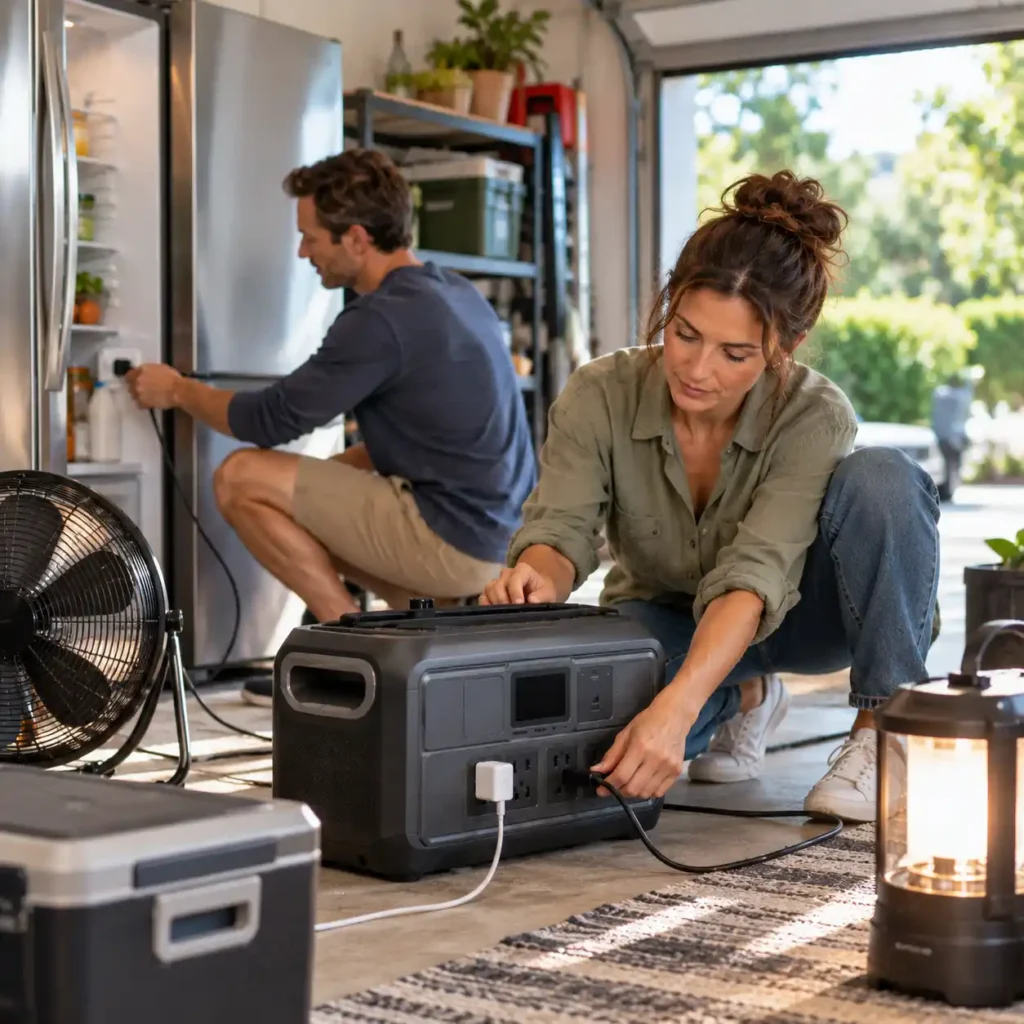
A portable power station can provide useful backup power during an outage, but safe operation depends on more than its battery capacity and output rating. Appliance compatibility, operating conditions, electrical connections, and the environment in which the unit is used all affect how reliably it can perform.
Understanding these limitations before an outage helps prevent overloads, equipment damage, and unsafe operating conditions.
Avoid Overloading the Power Station
Every power station has a specified continuous AC output limit. Connecting appliances with a combined demand above that limit can trigger overload protection or interrupt power delivery.
Pay particular attention to appliances with heating elements, motors, or compressors. Electric kettles, space heaters, microwaves, refrigerators, and power tools can place substantial demands on the inverter, either during normal operation or at startup.
A few practical precautions can help:
Check the rated electrical input of each appliance before connecting it.
Add the running wattages of appliances that will operate simultaneously.
Account for motor and compressor startup requirements.
Do not treat a surge rating or a special operating mode as a general continuous-output rating.
Avoid relying on an overloaded setup simply because the station has operated it briefly in the past.
If an overload warning appears or the AC output shuts down, reduce the connected load and follow the manufacturer’s troubleshooting instructions.
Consider Temperature and Ventilation
Power stations contain batteries and power electronics that generate heat during operation and charging. Their operating temperature limits and ventilation requirements vary by model.
Use the unit in a dry, well-ventilated location, away from direct heat sources and conditions outside the manufacturer’s specified temperature range. Do not cover ventilation openings or place the station where airflow is restricted.
Extreme temperatures can also affect charging performance and available battery capacity. In particular, charging a lithium battery below its permitted temperature range may be restricted by the battery management system or create a safety risk if the system does not provide adequate protection.
Always check the operating and charging temperature limits in the manual for the specific model. Do not assume that all five stations have identical temperature tolerances.
Keep the Station Dry and Protect Its Connections
Portable power stations are not automatically waterproof or suitable for outdoor exposure. Rain, condensation, moisture, and dust can create electrical hazards or damage connectors and internal components.
For outdoor or emergency use:
Keep the unit protected from rain, splashes, and standing water.
Place it on a stable, dry surface.
Keep cables and connectors in good condition.
Avoid using damaged plugs, adapters, or charging cables.
Follow the manufacturer’s instructions for outdoor operation and storage.
If the unit or its electrical connections become wet, disconnect it only when it is safe to do so and follow the manufacturer’s guidance. Do not continue operating equipment that may have suffered water damage.
Understand the Limits of Home Backup Connections
A portable power station with AC outlets can power compatible appliances directly. Supplying power to a home’s fixed electrical circuits is a different matter.
Do not connect a power station to a household wall outlet using a male-to-male cable or another improvised backfeeding method. This can create a serious electrocution and fire hazard and may energize utility lines unexpectedly.
If you want to power selected home circuits, use an appropriately designed transfer switch or another approved connection method installed in accordance with local electrical requirements. Confirm that the power station supports the intended arrangement and that its output characteristics are suitable for the connected circuits.
A power station’s advertised output capacity does not, by itself, establish that it can serve as a whole-home backup system.
Plan Carefully for Medical Equipment
Some buyers rely on portable power stations to operate essential medical equipment, such as CPAP devices. In these cases, a general runtime estimate is not enough to establish that the setup is suitable.
Actual power consumption can depend on device settings, accessories, and operating conditions. Some equipment may also have specific requirements for power quality, grounding, or uninterrupted operation.
Before relying on a power station for medical use:
Check the equipment manufacturer’s electrical requirements.
Confirm compatibility with the power station’s output.
Estimate runtime using the actual device configuration.
Allow a reserve for unexpected demand or a longer outage.
Follow the medical equipment manufacturer’s recommendations and consult the relevant healthcare provider when needed.
For equipment that must operate continuously, do not treat a calculated runtime as a guarantee of uninterrupted service.
Account for Battery Aging and Long-Term Storage
Battery capacity can decline over time. The energy available from a station after several years of use may be lower than its original rated capacity, and actual performance can also be affected by temperature, charging habits, and storage conditions.
If you keep a power station for emergency use, inspect it periodically and follow the manufacturer’s recommendations for storage charge level, maintenance, and recharging. Check that the unit powers on and that its cables and accessories remain in good condition.
A station that has been stored for a long period without maintenance may not be ready to provide the backup runtime you originally calculated.
Know When a Portable Power Station Is Not Enough
A 2,000Wh-class power station can support many essential-load scenarios, but it is not a substitute for every type of backup system.
Its limitations become more important when:
Several high-demand appliances need to run simultaneously.
An outage lasts longer than the available energy reserve can support.
Solar or grid charging is unavailable or insufficient to restore the battery.
A home circuit requires an electrical connection the station is not designed to provide.
Critical equipment needs a guaranteed level of uninterrupted power that the station’s specifications do not establish.
In these situations, a larger or expandable battery system, a properly configured home backup solution, or a dedicated uninterruptible power supply may be more appropriate, depending on the requirement.
The practical takeaway: Choose a power station not only for the appliances it can run, but also for the conditions and connection methods under which it can operate safely. Follow the specific model’s manual, respect its electrical and environmental limits, and use an appropriately designed backup setup for critical equipment.
Common Buying Mistakes When Choosing a 2,000Wh Power Station
Power stations in the approximately 2,000Wh class can look similar on paper, but choosing one based on a single specification can lead to an unsuitable backup setup. The following mistakes are worth avoiding before making a purchase.
Choosing Based on Battery Capacity Alone
A larger watt-hour rating does not automatically make a power station the right choice. Battery capacity affects how long a station can supply energy, but it does not determine which appliances the inverter can support.
For example, the BLUETTI AC200PL has a higher rated capacity than the other models in this comparison, but that advantage may matter less to someone who prioritizes portability or needs a different combination of output and charging features.
Compare capacity alongside continuous AC output, weight, charging options, and any expansion capability relevant to your backup plan.
Confusing Surge Output With Continuous Power
A station may advertise a high surge rating, but that figure describes a brief peak rather than the power it can supply continuously.
This distinction matters when comparing appliances with high startup demand or devices that draw substantial power for extended periods. Use the continuous AC output rating for normal load planning, then check surge capability separately when necessary.
Also pay attention to special operating modes. Features such as EcoFlow X-Boost, BLUETTI Power Lifting, or Anker bypass-mode output have specific limitations and should not be treated as equivalent to standard battery-powered inverter output.
Underestimating the Power Requirements of Household Appliances
Appliance categories are not precise electrical specifications. Two refrigerators, coffee makers, or power tools can have very different power requirements.
A refrigerator may have a modest average energy consumption but require a higher startup surge. A microwave’s advertised cooking power may not match its electrical input. A kettle or space heater can draw a high continuous load that leaves little inverter capacity for other devices.
Check the appliance label or manufacturer documentation rather than relying on generic wattage assumptions.
Assuming Advertised Runtime Is Guaranteed
Runtime calculations are useful for planning, but actual performance depends on the connected load, inverter efficiency, standby consumption, duty cycle, temperature, and battery condition.
A refrigerator does not draw the same amount of power continuously, while a laptop’s demand can change substantially depending on workload. A calculated runtime should therefore be treated as an estimate, not a guaranteed operating time.
For a broader explanation of runtime estimates, battery aging, and long-term battery life, read our guide on How Long Does a Power Station Last?
For essential backup equipment, allow an additional reserve rather than planning to use every watt-hour available.
Ignoring Weight and Portability
Power stations in this capacity class vary considerably in weight. A heavier model may offer more output or additional battery capacity, but it can be less convenient to move, store, or use in different locations.
Consider where the unit will be stored, whether you may need to relocate it during an outage, and whether its weight and dimensions suit your intended use.
Portability is not just a convenience feature. It can affect whether the station is practical for your actual backup routine.
Overlooking Charging Limits and Accessory Costs
Maximum AC or solar input ratings do not tell the whole story. Charging speed depends on the available power source, supported charging configuration, environmental conditions, and the station’s charging behavior.
Solar charging may also require compatible panels, adapters, or other accessories. A system with a high solar input rating is not automatically the most practical choice if the required panel setup is expensive, difficult to install, or unsuitable for the available space.
Before buying, confirm which accessories are included and which must be purchased separately.
Assuming Expandability Is Always Worth Paying For
An expandable power station can provide a path to longer runtime, but expansion batteries add cost, weight, and storage requirements. Compatibility and maximum supported capacity also vary by model.
If your backup needs are predictable and limited to shorter outages, a fixed-capacity unit may be sufficient. If you expect longer outages or anticipate increasing your backup requirements, expansion may be worth considering.
Remember that adding battery capacity generally increases stored energy, not the station’s standard inverter output.
Buying Without Considering Your Actual Outage Scenario
A station designed around occasional phone charging and lighting has different requirements from one intended to support refrigeration, a home office, or essential medical equipment.
Before choosing a model, define the appliances you need to power, which ones may operate simultaneously, and how long the backup period should last. Then compare the five models against those requirements rather than choosing by brand reputation or a single headline specification.
The practical takeaway: The most common buying mistakes come from comparing specifications without connecting them to real use. A suitable power station is the one whose output, usable energy, charging options, portability, and limitations match your specific backup scenario.
Frequently Asked Questions
Can a 2,000Wh Power Station Run a Refrigerator?
Yes. Most household refrigerators can be powered by a compatible 2,000Wh-class power station, provided the inverter can handle the refrigerator’s running demand and compressor startup surge. Actual runtime depends on the refrigerator’s average energy consumption, not just its rated running wattage. Check the appliance’s specifications or daily energy use before relying on a particular runtime estimate.
How Long Will a 2,000Wh Power Station Run a Refrigerator?
As a rough planning estimate, a 2,000Wh power station may run a refrigerator averaging 50–100W for approximately 17–34 hours, assuming 85% usable AC energy. A refrigerator averaging 150W may run for closer to 11 hours. These are refrigerator-only estimates; additional appliances, inverter overhead, temperature, and compressor cycling can change actual runtime.
Is a 2,000Wh Power Station Enough for a 24-Hour Power Outage?
It can be enough for essential loads during a 24-hour outage, but it depends on what you need to power. An efficient refrigerator, a router, LED lights, and occasional phone charging may fit within the available energy reserve if usage is managed. Running several high-demand appliances or adding a large continuous load can exhaust the battery much sooner. Estimate the total energy required for your specific devices before deciding.
Can a 2,000Wh Power Station Run Multiple Appliances at the Same Time?
Yes, as long as their combined power demand stays within the station’s continuous AC output limit and any startup surges are supported. Battery capacity determines how long the appliances can run, while inverter output determines which combinations the station can power simultaneously. This distinction is particularly important when combining a refrigerator with a microwave, kettle, space heater, or power tool.
Will a 2,000Wh Power Station Keep My Refrigerator Running During an Extended Outage?
It can provide useful backup, but a single full battery may not last through a multi-day outage. The result depends on the refrigerator’s daily energy consumption and whether you can recharge the station using grid power, solar panels, or a compatible vehicle-based setup. For longer outages, consider an expandable system or a charging plan that can replenish enough energy to cover daily use.
Is a 2,000Wh Power Station a Replacement for a UPS?
Not necessarily. A portable power station may offer an uninterruptible power supply or pass-through feature, but that does not automatically make it equivalent to a dedicated UPS. Transfer time, supported operating modes, and compatibility with sensitive equipment vary by model. If uninterrupted power for a computer, network equipment, or other critical device is essential, check the manufacturer’s transfer-time specifications and test the exact setup before relying on it.
Final Verdict
The best 2,000Wh-class power station depends on more than battery capacity. Across these five models, differences in continuous output, charging flexibility, portability, and expandability have a greater practical impact than their relatively small capacity differences.
The right choice is the one that matches your essential loads, expected outage duration, and backup priorities—not simply the model with the highest specifications.
Our Recommendation
Choose the power station that best matches your backup priorities:
If you need higher continuous output for demanding household loads: Choose the DJI Power 2000. Its 3,000W continuous AC output provides the most inverter headroom among these five models.
If you want an expandable home backup system: Choose the EF EcoFlow DELTA 2 Max. Its expansion capability makes it a flexible option if you expect your energy storage needs to grow.
If portability is your main priority for essential-load backup: Consider the Anker SOLIX S2000. At approximately 35.7 lb, it is the lightest model in this comparison, although its 1,500W standard AC output requires more careful load planning.
If you want the largest built-in battery capacity: Choose the BLUETTI AC200PL. Its 2,304Wh capacity provides the largest rated energy reserve among the five models, which can offer additional runtime under comparable loads.
If you want a balance of portability and standard AC output: Consider the Jackery Explorer 2000 v2. Its 39.5 lb weight and 2,200W continuous output offer a combination suited to buyers who value manageable weight without choosing the lowest-output model.
Before making your final choice, verify the exact model specifications, included accessories, expansion compatibility, and current U.S. pricing. Your appliance requirements and expected outage duration should remain the deciding factors.
Related Guides
Choosing a 2,000Wh power station is easier when you match the model to your actual backup needs. These guides explore specific use cases and related power solutions:
Best Portable Power Stations for Refrigerator Backup — Compare power stations for keeping a refrigerator running during an outage, including runtime planning and practical capacity considerations.
Best Portable Power Stations for Home Backup — Explore larger backup options for powering multiple household essentials and preparing for longer outages.
Best Portable Power Stations with UPS Functionality — Understand how portable power stations with UPS features can support selected electronics and equipment during short power interruptions.
What Size Power Station Do I Need? How to Calculate the Right Size — Learn how to estimate the capacity and output needed for your appliances, devices, and expected backup duration.
Power Ready Guide Commitment
At Power Ready Guide, we believe choosing backup power should be about more than comparing numbers on a spec sheet.
A power station is only as useful as the demands it can realistically meet. That is why we look beyond headline capacity and wattage to explain what specifications mean in everyday situations, where limitations matter, and how different models fit different backup needs.
We aim to make technical information clear, practical, and transparent—so you can weigh the trade-offs, understand the assumptions behind runtime estimates, and choose equipment with realistic expectations.
Our commitment is to give you the clarity to make a confident, informed decision—before the power goes out.