
Choosing a portable power station for tent camping is different from choosing one for home backup, RV travel, or car camping. For a broader comparison of outdoor power setups, see our Best Portable Power Stations for Camping (2026) guide. For tent camping specifically, the challenge is not simply finding a battery with enough watt-hours. You also have to consider how far you will carry it, how much power you need overnight, how much space it takes up, how quietly it operates, and how you will recharge it during the trip.
The best portable power stations for tent camping are therefore not necessarily the largest or most powerful models. A compact 300Wh-class station may be sufficient for phones, lights, cameras, and other small devices on a short trip, while a 500Wh-class or larger station may make more sense when several people share one power source, a laptop or fan is used regularly, or a CPAP machine needs to run overnight.
The choice also depends on how the station will be used at the campsite. A model with a higher AC output may be useful for certain devices, while a station with strong USB-C and DC connectivity can be more practical when most of your equipment is designed to run directly from those outputs. Solar charging can further change the capacity calculation by allowing you to replace some of the energy used during the day rather than carrying all of it from the start.
In this guide, we compare five portable power stations selected for the U.S. tent-camping market and examine them through a specifically camping-focused lens: portability, usable battery capacity, output capability, overnight power needs, noise, charging options, and campsite practicality. The goal is to help you match the power station to the way you actually camp rather than simply choosing the largest battery available.
As an Amazon Associate, I earn from qualifying purchases.
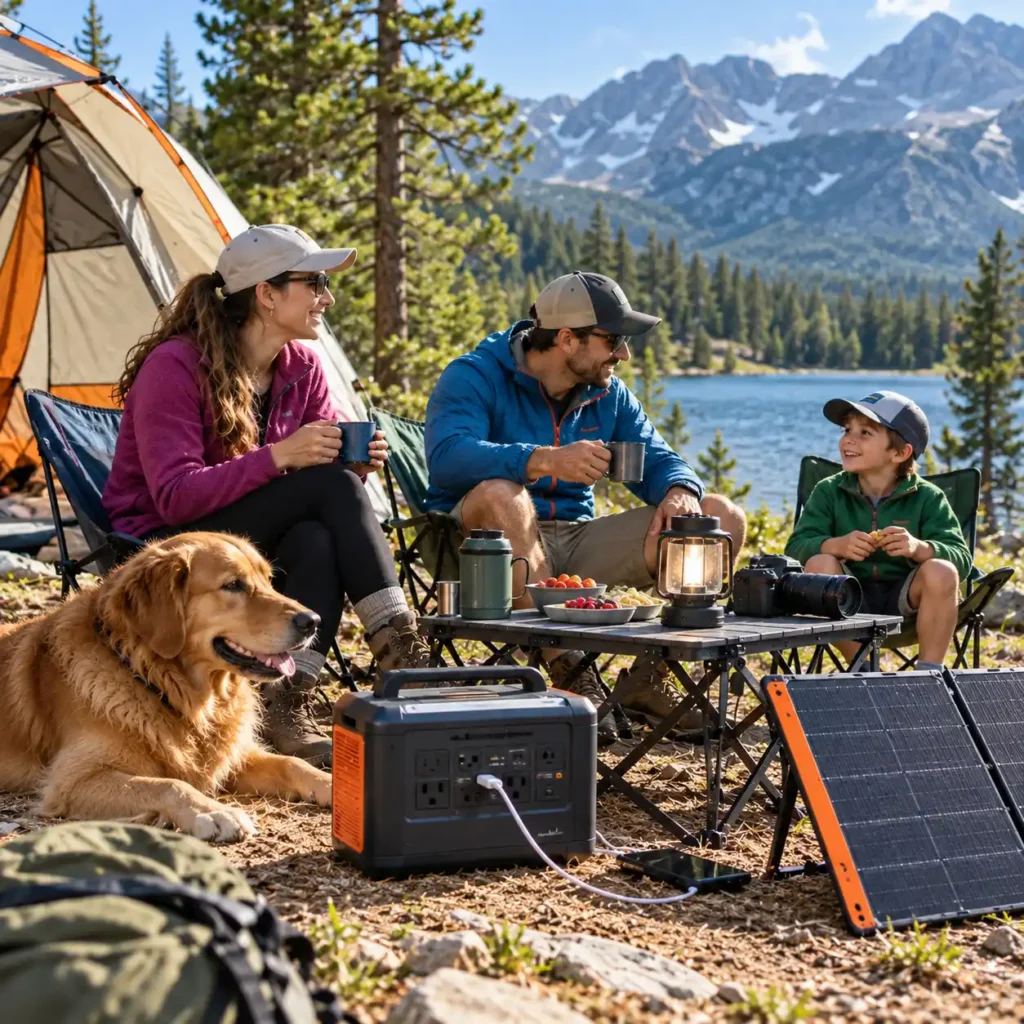
Table of Contents
Quick Answer
For most tent campers, the right portable power station depends on how much energy you need between charging opportunities and how far you need to carry it. A compact 288Wh-class model can be sufficient for phones, lights, cameras, and other small devices on a short trip. A 500–600Wh model makes more sense when you need more overnight reserve, are camping with several people, or regularly use a laptop, fan, or CPAP machine.
For this guide, we selected five models for different tent-camping needs: the Anker SOLIX C300 for an all-around compact setup, the BLUETTI Elite 30 V2 for higher AC output in a compact format, the EF ECOFLOW Portable Power Station River 3 Max for higher-capacity camping, the Jackery Explorer 500 v2 for 500Wh-class weekend use, and the Anker SOLIX C300 DC for lightweight setups built primarily around USB and other DC devices.
The key is to match capacity, output, weight, connectivity, and charging options to your actual camping setup rather than simply choosing the largest battery.Before deciding, use our Power Station Size Calculator to estimate the capacity and output your specific camping setup may require.
Our Evidence & Evaluation Method
Our evaluations are based on a transparent evidence model rather than claims of hands-on or laboratory testing. We use manufacturer specifications, official product documentation, the specific Amazon.com listing for each selected model, and calculated estimates where appropriate. Where independent testing is available and actually used, it is identified separately rather than presented as our own testing.
| Factor | What We Examine | Evidence | Best Use | Watch-Out |
|---|---|---|---|---|
| Capacity | Battery capacity and stated watt-hours | Manufacturer specifications and official product documentation | Evaluating total stored energy for trips | Stated capacity differs from usable output due to conversion efficiency |
| Usable Energy | How much of the stated capacity may be available for practical loads | Manufacturer information where available and calculated estimates; actual usable capacity can vary with inverter efficiency, load, and operating conditions | Planning realistic runtimes for campsite devices | Inverter losses and low-temp conditions reduce actual available energy |
| Output | Continuous AC output, surge capability, and relevant USB/DC output | Manufacturer specifications and official product documentation | Matching appliance wattage requirements to station limits | Exceeding continuous output will trigger overload protection |
| Charging | AC, solar, and vehicle charging options and stated charging capabilities | Manufacturer specifications and technical documentation | Planning off-grid and on-the-road replenishment | Real-world solar and vehicle charging speeds depend heavily on external factors |
| Portability | Weight, dimensions, and how practical the unit is to carry to a tent campsite | Product specifications and the specific Amazon.com listing | Vehicle-accessible tent camping and short hand-carries | Heavier units require more effort to transport from vehicle to site |
| Runtime | Estimated operating time for representative camping loads | Calculated estimates based on stated capacity and estimated device consumption; these are not measured test results | Estimating hours of use for phones, lights, and small gear | Actual runtimes vary based on device efficiency and environmental conditions |
| Reliability | Battery chemistry, warranty coverage, and documented product support | Manufacturer warranty and product documentation; independent reports are used only when specifically sourced | Ensuring long-term lifespan and manufacturer backing | Check specific regional warranty terms and support availability |
This approach allows us to separate documented product specifications from calculated camping estimates. It also prevents manufacturer claims, estimated runtimes, and third-party test results from being presented as though they were all measured in the same way.
For tent camping, we give particular weight to the tradeoff between stored energy, portability, output capability, and practical overnight use. A higher watt-hour rating is not automatically more useful if the added weight makes the power station difficult to transport or unnecessary for the devices being powered.
How We Evaluated
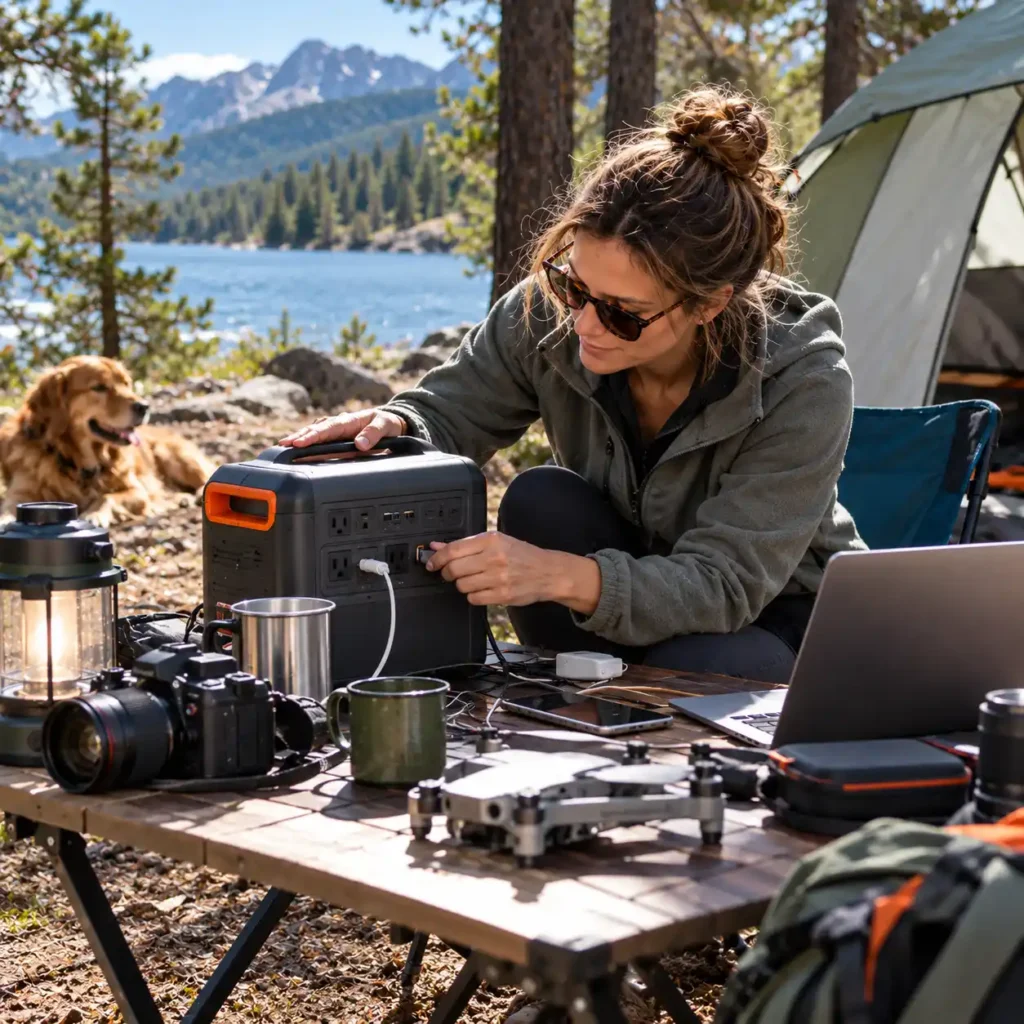
A portable power station for tent camping has to solve a different problem from a home-backup or RV power system. It has to be practical to carry, provide enough energy for the devices that matter, remain suitable around a sleeping area, and offer a realistic way to recharge when a trip lasts more than one night.
We therefore evaluate the models in this guide using a tent-camping framework rather than ranking them by battery capacity or maximum output alone. The following factors are considered together because no single specification determines how useful a power station will be at a campsite.
Energy Capacity
We consider the stated watt-hour capacity and how it fits common tent-camping scenarios. In particular, we look at the difference between compact 288Wh-class stations and models in the roughly 500–600Wh range, and when the additional energy reserve may be useful.
Usable Energy
Rated capacity does not translate directly into device runtime. We therefore consider how much of the stored energy may be practically available for typical camping loads, taking into account factors such as inverter efficiency, device consumption, and operating time.
Inverter Capability
We examine continuous AC output, relevant surge or enhanced-output capabilities, and whether the available power is appropriate for the types of devices a camper may need to run. This is particularly important for AC-powered equipment rather than lower-power USB or DC electronics.
Charging Speed
We consider how quickly each station can be replenished through supported charging methods, where the manufacturer provides the relevant specifications. For multi-day camping, recharge capability can be as important as the amount of energy carried into camp.
Portability
Weight and physical practicality matter when a power station has to be carried from a vehicle or parking area to a tent. We consider the relationship between carrying weight and available battery capacity rather than treating a heavier station as automatically more capable.
Solar Compatibility
We examine whether a model supports solar charging and consider its stated solar-input capability in the context of multi-day tent camping. Solar charging can reduce the amount of stored energy a camper needs to carry when suitable conditions and panel placement are available.
Expandability and Charging Ecosystem
Where applicable, we consider features that can extend or complement the power station’s use, such as additional battery support, compatible charging accessories, or multiple charging methods. These features are treated as practical considerations rather than automatic advantages.
Warranty and Support
Warranty coverage and documented product support are considered as part of the overall ownership picture. We use the available manufacturer and product documentation rather than making assumptions about long-term reliability beyond the evidence available.
Value
Value is considered in relation to the specific tent-camping use case. A lower-priced or higher-capacity model is not automatically better value if its weight, output, connectivity, or other characteristics do not match the camper’s actual requirements.
Tent-Camping Use-Case Fit
Finally, we consider how the complete combination of capacity, usable energy, output, charging options, portability, and practical features fits different camping situations.
This includes lightweight personal setups, weekend trips, multi-day camping, shared power for several people, and higher overnight loads such as a fan, laptop, or CPAP machine. The result is a use-case comparison rather than a specification contest: each model is evaluated according to the camping requirements it is best suited to meet and the tradeoffs that come with that fit.
Who This Guide Is For
Who Should Read This
This guide is for campers who:
use a portable power station at a tent campsite, including vehicle-accessible campsites;
need power for a one- or two-night trip or a weekend camping trip;
are planning a multi-day tent-camping trip and need more stored energy between charging opportunities;
need to power devices such as phones, lights, cameras, laptops, fans, or CPAP machines;
primarily use USB-C/DC devices or need AC power for specific camping equipment;
want to balance battery capacity, portability, output, and charging options rather than simply choosing the largest power station.
Who Should Use Another Guide
This guide is not designed specifically for:
RV camping — see our dedicated RV power station guide.
Van life or other vehicle-based setups — see the relevant vehicle-camping guide.
Home backup power — see our home backup power station guides.
Exact battery sizing — use our Power Station Size Calculator for a device-by-device capacity estimate.
Quick Summary: Our Top Picks
Anker SOLIX C300
Award: Best All-Around Compact Tent-Camping Power Station
Best For: Weekend tent camping and mixed AC, USB-C, and DC loads
Key Reason: 288Wh capacity, versatile connectivity, and manageable weight make it a balanced option for a wide range of tent-camping setups.
Main Limitation: The 288Wh battery provides less energy reserve for high-demand devices, heavier overnight loads, or longer trips without recharging.
BLUETTI Elite 30 V2
Award: Best Compact High-Output Power Station for Tent Camping
Best For: Campers who need higher AC output without moving to a larger battery class
Key Reason: Its 600W continuous AC output gives a compact 288Wh power station more flexibility for higher-demand AC devices.
Main Limitation: Its 288Wh capacity still limits how long higher-power devices can run between charging opportunities.
EF ECOFLOW Portable Power Station River 3 Max
Award: Best Higher-Capacity Power Station for Tent Camping
Best For: Longer trips, multiple campers, and higher overnight energy demands
Key Reason: The 572Wh battery provides substantially more stored energy than the compact 288Wh models while retaining a 600W continuous AC output.
Main Limitation: At approximately 18.5 lb, it is considerably heavier than the compact options and is less convenient when the campsite requires a longer carry.
Jackery Explorer 500 v2
Award: Best 500Wh-Class Power Station for Weekend Tent Camping
Best For: Vehicle-accessible weekend camping where additional battery capacity is more important than minimum weight
Key Reason: Its 512Wh capacity provides a useful middle ground between compact 288Wh stations and substantially larger power stations.
Main Limitation: It is heavier than the compact models, making it less suitable when portability over distance is a primary concern.
Anker SOLIX C300 DC
Award: Best DC-Only Power Station for Lightweight Tent Camping
Best For: Lightweight setups built primarily around USB-C, USB, and other DC devices
Key Reason: Its approximately 6.2 lb weight makes it the most portable option in this group, while its DC-focused design avoids carrying an AC inverter that a DC-only setup may not need.
Main Limitation: It has no AC inverter, so it is not suitable for campers who need to power conventional AC appliances or other AC-only equipment.
Comparison Table
The table below focuses on the specifications that matter most when choosing a power station for tent camping: stored energy, AC output, carrying weight, and the type of camping setup each model best suits.
| Model | Capacity / Wh per lb | AC Output | Weight | Best For |
|---|---|---|---|---|
| Anker SOLIX C300 | 288Wh / 31.6 Wh/lb | 300W | ~9.1 lb | All-around tent camping |
| BLUETTI Elite 30 V2 | 288Wh / 30.4 Wh/lb | 600W | ~9.5 lb | Compact high-output use |
| EF ECOFLOW Portable Power Station River 3 Max | 572Wh / 30.9 Wh/lb | 600W | ~18.5 lb | Longer trips and higher energy needs |
| Jackery Explorer 500 v2 | 512Wh / 40.6 Wh/lb | 500W | ~12.6 lb | Weekend tent camping |
| Anker SOLIX C300 DC | 288Wh / 46.7 Wh/lb | N/A — DC-only | ~6.2 lb | Lightweight USB-C/DC setups |
The Best Portable Power Stations for Tent Camping Reviewed
Anker SOLIX C300
Best All-Around Compact Tent-Camping Power Station

Quick Verdict
The Anker SOLIX C300 is a compact 288Wh power station designed for campers who want a single portable battery for a mixture of AC, USB-C, and DC devices. Its 300W continuous AC output, 140W two-way USB-C charging, and 12V car output give it more flexibility than a conventional power bank while keeping the unit at about 9.1 lb.
For tent camping, its main strength is the balance between capacity, connectivity, and carrying weight. It is large enough for a meaningful camping electronics load but remains substantially lighter than the 500–600Wh models in this guide.
Snapshot
| Specification | Anker SOLIX C300 |
|---|---|
| Battery Capacity | 288Wh |
| Continuous AC Output | 300W |
| Surge Output | Up to 600W |
| Battery Chemistry | LiFePO4 |
| USB-C | Up to 140W bidirectional |
| Solar Input | Up to 100W |
| Weight | About 9.1 lb |
| Best Camping Role | Compact all-around tent camping |
Why We Chose It
The C300 earns its place in this guide because it offers a useful middle ground for campers who need more than USB charging but do not want to carry a substantially larger power station.
Its 288Wh battery and 300W AC inverter are appropriate for moderate camping loads, while the 140W USB-C capability is particularly useful for compatible laptops and other USB-C equipment. The 100W solar input and vehicle charging option also give campers more than one way to replenish the battery when they are away from a wall outlet.
The limitation is equally straightforward: 288Wh is still a compact battery capacity. The C300 is better suited to managing a defined camping energy budget than to supporting substantial continuous loads for several days without recharging.
Check the latest price and customer reviews on Amazon.

Living With It
At about 9.1 lb, the C300 is realistic to move from a vehicle to a tent campsite without making the power station itself a major part of the carrying load. Its compact format also makes it easier to position near the campsite while keeping cables organized around the equipment being charged.
For a typical tent-camping setup, the most practical approach is to use the station according to the device’s native connection: USB-C for compatible laptops and electronics, DC for suitable 12V equipment, and AC when a conventional outlet is actually required. This can help avoid using the inverter unnecessarily.
The 288Wh capacity is the main constraint. Phones, cameras, lights, and other lower-power electronics can fit comfortably within a compact energy budget, while repeated laptop use, fans, CPAP equipment, or other higher-demand loads require more careful planning. If the trip extends beyond a night or two, the C300’s 100W maximum solar input and vehicle-charging capability can become more important because they provide additional ways to replace consumed energy.
Who Should Buy This
- Tent campers who want one compact station for AC, USB-C, and DC devices.
- Weekend campers whose expected energy use fits within a 288Wh-class battery.
- Campers who need to power compatible laptops or other higher-power USB-C devices.
- Vehicle-accessible campers who want a reasonable balance between battery capacity and carrying weight.
- Campers who may use solar or vehicle charging to extend time away from an outlet
Who Should Skip This
- Campers who need substantially more stored energy for multi-day trips without recharging.
- Users running high-power AC equipment for extended periods.
- Backpackers for whom even approximately 9 lb is too much to carry.
- Campers whose equipment is almost entirely DC/USB-based and who do not need an AC inverter; the Anker SOLIX C300 DC is specifically designed for that type of setup.
- Anyone choosing a power station primarily for maximum battery capacity rather than compact versatility.
Final Verdict
The Anker SOLIX C300 is a balanced compact option for tent campers who need more than a simple power bank but do not want to carry a 500Wh-class station. Its 288Wh battery, 300W continuous AC output, strong USB-C capability, solar input, and approximately 9.1-lb weight give it a practical combination of portability and versatility.
Its defining limitation is capacity rather than output: 300W of AC output does not make the 288Wh battery a high-capacity system. For moderate weekend electronics and mixed charging needs, that compact balance is useful; for heavier overnight or multi-day loads, a larger battery becomes more appropriate.
The Anker SOLIX C300 is our Best All-Around Compact Tent-Camping Power Station for 2026.
Check the latest price and customer reviews on Amazon.
Related Guide: If you want to determine whether 288Wh is enough for your camping equipment, see our guide to how much power you really need.
BLUETTI Elite 30 V2
Award: Best Compact High-Output Power Station for Tent Camping

Quick Verdict
The BLUETTI Elite 30 V2 takes a different approach to compact tent-camping power. It keeps the battery capacity at 288Wh but provides 600W of continuous AC output, giving campers substantially more output capability than many stations in the same capacity class.
That makes it relevant when a camping setup includes an AC-powered device that needs more than a typical compact inverter can provide. At approximately 9.48 lb, it remains practical to carry from a vehicle to a tent campsite, while its 140W and 100W USB-C ports also support modern electronics without requiring every device to run through the AC inverter.
The important limitation is straightforward: higher output does not mean higher battery capacity. The Elite 30 V2 can deliver more power at one time, but its 288Wh battery still places a relatively tight limit on how long higher-demand devices can run.
Snapshot
| Specification | BLUETTI Elite 30 V2 |
|---|---|
| Battery Capacity | 288Wh |
| Continuous AC Output | 600W |
| Power Lifting | Up to 1,500W for supported pure-resistive loads |
| Battery Chemistry | LiFePO₄ |
| USB-C | 140W + 100W |
| Solar Input | Up to 200W |
| Weight | 9.48 lb |
| Noise | 30 dB |
| Warranty | 5 years |
| Best Camping Role | Compact high-output tent camping |
Why We Chose It
The Elite 30 V2 earns its place because it separates output capability from stored energy particularly clearly. Its 288Wh capacity puts it in the same compact class as the Anker SOLIX C300, but its 600W continuous AC output gives campers more headroom for compatible AC-powered equipment.
Its connectivity is also well suited to a mixed campsite. BLUETTI provides one 140W USB-C port, one 100W USB-C port, two USB-A ports, a 12V car outlet, and two 12V DC5521 ports, giving campers several ways to power different types of equipment directly.
Recharge capability further supports the compact format. The station accepts up to 200W of solar input and up to 380W of AC charging input; BLUETTI specifies approximately 45 minutes to reach 80% under its stated TurboBoost conditions and about 70 minutes for a full AC recharge.
Check the latest price and customer reviews on Amazon.

Living With It at a Tent Campsite
At approximately 9.48 lb, the Elite 30 V2 is still manageable for vehicle-accessible tent camping, but it is not an ultralight backpacking power source. Its carrying weight is similar to other compact AC power stations, so the reason to choose it is the additional output capability rather than a lower transport burden.
The 600W inverter is most useful when a specific device actually needs that additional headroom. Lower-power electronics can use the USB-C or DC outputs directly, while AC power can be reserved for equipment that requires a conventional outlet. This approach also makes the distinction between 600W of available output and 288Wh of stored energy easier to manage.
For overnight use, the battery capacity remains the main constraint. BLUETTI’s own examples include a 10W fan for 16.4 hours and a 10W camping light for 24.6 hours, but actual runtime depends on load, conversion losses, operating conditions, and how the outputs are used.
The station is also specified at 30 dB, with BLUETTI describing its cooling system as adjusting fan speed according to operating conditions. That makes noise a relevant consideration for a tent campsite, although the published figure should be treated as a manufacturer specification rather than an independent measurement by Power Ready Guide.
Who Should Buy This
- Tent campers who need more AC output without moving into a larger battery class.
- Campers using compatible AC-powered equipment that exceeds the output capability of a typical 300W-class station.
- Users who want strong USB-C capability alongside AC and 12V/DC outputs.
- Vehicle-accessible campers for whom approximately 9.5 lb is a reasonable carrying weight.
- Multi-day campers who can make practical use of the station’s 200W solar input or fast AC recharge capability.
Who Should Skip This
- Campers who primarily need more stored energy rather than more output power.
- Anyone expecting 288Wh to support substantial loads for several days without recharging.
- Backpackers who need to minimize every pound of equipment.
- Users who specifically need battery expansion; the Elite 30 V2 does not support battery expansion.
- Anyone expecting the 1,500W Power Lifting specification to provide 1,500W of continuous AC power; the normal continuous output remains 600W.
Final Verdict
The BLUETTI Elite 30 V2 is defined by its 600W continuous inverter rather than by its battery size. The 288Wh LiFePO₄ battery keeps it compact, while the higher output, dual USB-C capability, 200W solar input, and fast AC charging give it considerable flexibility for a small campsite power system.
Its limitation is equally important: 600W of output does not turn 288Wh into a high-capacity battery. If the camping problem is running a particular higher-output device, this compact format can make sense. If the problem is simply needing more energy for longer between charging opportunities, moving to a 500–600Wh class station is the more relevant change.
The BLUETTI Elite 30 V2 is our Best Compact High-Output Power Station for Tent Camping for 2026.
Check the latest price and customer reviews on Amazon.
Related Guide: If you need help comparing capacity, output, ports, and charging options, see our portable power station buying guide.
EF ECOFLOW Portable Power Station River 3 Max
Award: Best Higher-Capacity Power Station for Tent Camping

Quick Verdict
The EF ECOFLOW Portable Power Station River 3 Max is the step up in this guide for tent campers who need substantially more stored energy than a compact 288Wh station provides. Its 572Wh LiFePO₄ battery gives campers roughly twice the nominal capacity of the smaller stations, while the 600W continuous AC output supports a broader range of campsite equipment.
That additional capacity is most relevant for longer trips, shared campsite power, and higher overnight energy use. The tradeoff is portability: at approximately 18.5 lb, the River 3 Max is considerably heavier than the compact options, so its larger battery makes more sense when the campsite is accessible by vehicle or the additional energy reserve is worth carrying.
Snapshot
| Specification | EF ECOFLOW River 3 Max |
|---|---|
| Battery Capacity | 572Wh |
| Continuous AC Output | 600W |
| Surge / X-Boost | Up to 1,200W |
| Battery Chemistry | LiFePO₄ |
| USB-C | Up to 100W |
| Solar Input | Up to 220W |
| Weight | About 18.5 lb |
| Noise | <30 dB |
| Battery Life | 3,000 cycles to 80% capacity |
| Best Camping Role | Higher-capacity tent camping |
Why We Chose It
The River 3 Max earns its place because it addresses a different limitation from the 288Wh models. Instead of increasing output while keeping the same compact battery class, it provides 572Wh of stored energy, giving campers substantially more energy to manage between charging opportunities. EcoFlow specifies 600W of total AC output, up to 1,200W surge/X-Boost, and a 100W USB-C output.
Its charging options also fit a longer camping trip. The station supports up to 220W of solar input, as well as AC and vehicle charging, giving campers several ways to replenish the battery when suitable charging opportunities are available. EcoFlow specifies 220W vehicle input and 220W solar input on its RIVER 3 Max specifications.
The defining tradeoff is weight. At 8.4 kg, the River 3 Max is roughly twice the carrying weight of the compact 288Wh models in this guide. That makes the extra capacity much easier to justify for vehicle-accessible tent camping than for a campsite requiring a long carry.
Check the latest price and customer reviews on Amazon.

Living With It
The River 3 Max changes the practical energy budget of a campsite. With 572Wh available at the battery level, campers have considerably more room for multiple phones, cameras, lights, laptops, and other moderate loads before needing to recharge. That does not make high-wattage appliances inexpensive in energy terms, but it reduces the need to ration smaller loads throughout a weekend.
The 220W solar input is particularly relevant on multi-day trips. When conditions are suitable, solar charging can replace part of the energy consumed during the day instead of requiring the entire energy budget to be carried into camp. Actual solar charging time will depend on sunlight, panel configuration, temperature, and other operating conditions.
At approximately 18.5 lb, however, this is not a lightweight power station. It is better suited to a campsite with a short carry from the vehicle than to a setup where the power station must be transported over a significant distance. EcoFlow specifies noise below 30 dB and a LiFePO₄ battery rated for 3,000 cycles to 80% capacity, but those are manufacturer specifications rather than measurements by Power Ready Guide.
Who Should Buy This
- Tent campers who need more stored energy than a 288Wh-class station provides.
- Couples or small groups sharing one power station between several devices.
- Campers taking longer weekend or multi-day trips with higher energy requirements.
- Campers who need more overnight energy reserve for devices such as laptops, fans, cameras, or other moderate loads.
- Vehicle-accessible campers who can accommodate an approximately 18.5-lb power station.
- Campers who can make practical use of solar, AC, or vehicle charging during a longer trip.
Who Should Skip This
- Backpackers or campers who need to carry their power station over long distances.
- Solo campers whose needs are limited to phones, lights, cameras, and other low-power electronics.
- Short trips where a 288Wh-class station already provides enough energy.
- Campers who prioritize minimum carrying weight over additional battery capacity.
- Anyone expecting 572Wh to provide unlimited runtime for high-wattage appliances.
- Campers who do not have a practical way to recharge when the stored energy is depleted.
Final Verdict
The EF ECOFLOW Portable Power Station River 3 Max is the point in this guide where the main decision shifts from minimizing battery weight to deciding whether additional stored energy is worth carrying.
Its 572Wh capacity provides substantially more energy than the compact 288Wh models, while the 600W AC output, 100W USB-C, and up to 220W solar input make the larger battery practical for a broader range of camping setups.
The tradeoff is clear: about 18.5 lb versus roughly 9–12.6 lb for the smaller stations in this guide. For vehicle-accessible tent camping, that additional weight may be reasonable when longer trips, shared loads, or fewer charging opportunities make the extra capacity useful.
The EF ECOFLOW Portable Power Station River 3 Max is our Best Higher-Capacity Power Station for Tent Camping for 2026.
Check the latest price and customer reviews on Amazon.
Related Guide: If you plan to use solar charging to extend your time away from an electrical outlet, see our guide to the best portable solar panels for camping.
Jackery Explorer 500 v2
Award: Best 500Wh-Class Power Station for Weekend Tent Camping

Quick Verdict
The Jackery Explorer 500 v2 is the middle-ground option in this guide for campers who need more stored energy than a compact 288Wh station provides but do not want to carry a much larger power station.
Its 512Wh LiFePO₄ battery and 500W continuous AC output provide substantially more energy reserve than the compact models while keeping the unit at about 12.6 lb. That combination makes it particularly relevant for weekend tent camping where several people may share one power station or where laptops, lights, cameras, fans, and other moderate loads need to be supported.
The tradeoff is portability. At roughly 12.6 lb, it is still practical for a vehicle-accessible campsite, but it is noticeably heavier than the 288Wh options. For campers who mainly need phones, lights, and other small electronics, the additional battery capacity may not justify the extra weight.
Snapshot
| Specification | Jackery Explorer 500 v2 |
|---|---|
| Battery Capacity | 512Wh |
| Continuous AC Output | 500W |
| Maximum Instantaneous Output | 1000W |
| Battery Chemistry | LiFePO₄ |
| USB-C | Up to 100W + 30W |
| Solar Input | Up to 200W |
| Weight | About 12.6 lb |
| Best Camping Role | Weekend tent camping and shared campsite power |
Why We Chose It
The Explorer 500 v2 earns its place because 500Wh is a useful step up from the compact 288Wh class without moving into the much heavier 700–1000Wh range.
The additional capacity gives campers more flexibility when several devices share one station. Phones, cameras, camping lights, laptops, and other moderate loads can be managed within a larger energy budget, while the 500W AC output provides enough headroom for compatible AC equipment within the station’s limits.
Its charging options also fit the weekend-camping use case. The Explorer 500 v2 supports AC, solar, and vehicle charging, with up to 200W of solar input. Jackery also specifies AC charging in about 1.3 hours under its stated conditions, making it practical to replenish the station before a trip or between camping days when an electrical outlet is available.
The important distinction is that the Explorer 500 v2 provides more stored energy, not unlimited runtime. A 500W appliance can draw a large portion of the 512Wh battery relatively quickly, so the advantage of this model is its larger energy reserve for moderate mixed loads rather than continuous operation of high-wattage equipment.
Check the latest price and customer reviews on Amazon.

Living With It
At approximately 12.6 lb, the Explorer 500 v2 sits between the compact stations and the heavier 572Wh River 3 Max in this guide. That makes it a practical size for a campsite where the power station only needs to be carried a relatively short distance from the vehicle.
Its 512Wh battery is particularly useful when one station serves multiple people. Instead of relying on several small power banks, campers can use the Explorer 500 v2 as a shared charging point for phones, cameras, lights, laptops, and compatible 12V equipment. The combination of two AC outlets, two USB-C outputs rated at up to 100W and 30W, a USB-A output, and a 12V car port gives it enough connectivity for a mixed campsite setup.
For longer trips, the 200W solar input can help replace energy consumed during the day when conditions are suitable. Jackery also specifies quiet operation, with its documentation listing up to 30 dB for the fan in the relevant operating conditions. These are manufacturer specifications rather than independent measurements by Power Ready Guide.
Who Should Buy This
- Weekend tent campers who need more energy reserve than a 288Wh-class station provides.
- Couples or small groups sharing one power station between several devices.
- Campers who regularly use laptops, cameras, lights, fans, or other moderate loads.
- Vehicle-accessible campers who consider approximately 12.6 lb a reasonable carrying weight.
- Campers who want the option of AC, solar, and vehicle charging.
- Users looking for a middle ground between compact 288Wh stations and substantially larger power stations.
Who Should Skip This
- Campers whose needs are limited to phones, lights, cameras, and other low-power electronics.
- Backpackers who need to minimize carrying weight.
- Campers who already know that a 288Wh station provides enough energy for their trip.
- Users who need substantially more stored energy for multi-day trips without reliable opportunities to recharge.
- Anyone expecting the 500W AC output to provide long runtime for high-wattage appliances.
- Campers who specifically want the lightest possible power station rather than a larger energy reserve.
Final Verdict
The Jackery Explorer 500 v2 occupies the middle ground between the compact 288Wh stations and larger high-capacity models. Its 512Wh LiFePO₄ battery provides substantially more stored energy than the smaller options, while the 500W AC output, multiple USB-C ports, 200W solar input, and approximately 12.6-lb weight keep it practical for vehicle-accessible tent camping.
Its main tradeoff is portability. It is not the lightest option in this guide, but it also does not carry the approximately 18.5-lb burden of the River 3 Max. For a weekend campsite where several people share one power station, that balance between capacity and carrying weight is the central reason to consider it.
The Jackery Explorer 500 v2 is our Best 500Wh-Class Power Station for Weekend Tent Camping for 2026.
Check the latest price and customer reviews on Amazon.
Related Guide: If you want to understand how load, usable capacity, and conversion losses affect actual runtime, see our guide to how long a power station lasts.
Anker SOLIX C300 DC
Award: Best DC-Only Power Station for Lightweight Tent Camping

Quick Verdict
The Anker SOLIX C300 DC takes a fundamentally different approach to portable power. Instead of adding an AC inverter for maximum versatility, it is designed specifically for campers whose equipment can run directly from USB-C, USB, and 12V DC connections.
That makes it the lightest option in this guide at approximately 6 lb, while still providing a relatively substantial 288Wh battery. Its two 140W bidirectional USB-C ports, additional USB outputs, 120W car socket, and up to 100W solar input make it particularly well suited to modern camping setups built around phones, cameras, tablets, laptops, lights, and other DC-powered equipment.
The defining limitation is also its defining feature: there is no AC inverter. If your camping equipment requires a conventional 120V outlet, the C300 DC cannot replace an AC-capable power station. But if you do not need AC power, carrying an inverter you will never use simply adds weight and conversion overhead to the system.
Snapshot
| Specification | Anker SOLIX C300 DC |
|---|---|
| Battery Capacity | 288Wh |
| AC Output | None — DC-only |
| USB-C | 2 × up to 140W bidirectional |
| Additional USB-C | Up to 100W + 15W |
| USB-A | 2 × up to 12W |
| Car Socket | Up to 120W |
| Solar Input | Up to 100W |
| Weight | About 6 lb |
| Battery Chemistry | LiFePO₄ |
| Best Camping Role | Lightweight DC/USB-C tent camping |
Why We Chose It
The C300 DC earns its place because removing the AC inverter changes the portability equation. The result is a 288Wh power station that weighs about 6 lb, substantially less than the approximately 9–12.6 lb AC-capable models in this guide. Anker specifically lists the C300 DC as a DC-only version of the C300.
For campers whose equipment is already designed around USB-C or 12V DC, that architecture can be more practical than carrying an AC inverter simply to power devices that could be charged directly. The two 140W USB-C ports are particularly useful for compatible high-power USB-C equipment, while the additional USB ports and 120W car socket cover lower-power electronics and suitable 12V devices.
The C300 DC also supports up to 100W solar input, as well as vehicle charging and USB-C charging. Anker specifies that the two 140W USB-C ports can provide up to 280W of combined charging input when used for full-speed recharging.
Check the latest price and customer reviews on Amazon.

Living With It
At approximately 6 lb, the C300 DC changes how realistic it is to carry a power station beyond the immediate area around a vehicle. It is still not a backpacking battery in the ultralight sense, but compared with a 9–12.6-lb AC-capable station, the difference can be meaningful when every pound matters.
The most important question is not how much power the C300 DC can deliver, but whether your equipment actually needs AC power. A campsite built around USB-C phones, cameras, tablets, laptops, rechargeable lights, and suitable 12V equipment can connect directly to the station without first converting the battery’s DC energy into AC and then converting it back again inside a device’s power adapter.
That makes the C300 DC particularly logical for a modern electronics-focused campsite. The 288Wh capacity is still the same compact battery class as the standard C300, so heavier overnight loads will require careful energy planning. But for a DC-first setup, the lower carrying weight and direct-output architecture can be more relevant than having a conventional AC outlet.
For multi-day trips, the 100W solar input and vehicle charging capability provide additional ways to replenish the battery. Anker specifies solar charging through compatible 11–28V panels and recommends its 100W or 60W panels; actual charging time will depend on conditions and available solar input.
Who Should Buy This
- Tent campers whose equipment is primarily USB-C, USB, or 12V DC powered.
- Campers who want to minimize the weight of their power system.
- Backpack-style or walk-in campers who can benefit from a power station of approximately 6 lb rather than a 9–19-lb AC-capable model.
- Photographers and other campers carrying multiple USB-C rechargeable devices.
- Campers who do not need conventional 120V AC outlets.
- Multi-day campers who can use solar or vehicle charging to replenish the battery.
Who Should Skip This
- Campers who need to power AC-only equipment.
- Anyone who regularly uses conventional 120V appliances at the campsite.
- Users who need an AC inverter for devices such as standard wall-plug chargers or other AC equipment.
- Campers whose primary requirement is maximum battery capacity rather than minimum carrying weight.
- Anyone who wants one power station to cover both DC and conventional AC loads.
Final Verdict
The Anker SOLIX C300 DC is not simply a lighter version of the standard C300. Its main advantage comes from a different system design: it removes the AC inverter for campers who do not need one.
That leaves a 288Wh LiFePO₄ battery in a package weighing approximately 6 lb, with strong USB-C capability, additional USB outputs, a 120W car socket, and up to 100W solar input.
The tradeoff is absolute rather than minor: there is no AC output. For a DC-first campsite, that can be exactly the point. For a campsite with even one important AC-only device, the standard Anker SOLIX C300 or another AC-capable model is a more appropriate architecture.
The Anker SOLIX C300 DC is our Best DC-Only Power Station for Lightweight Tent Camping for 2026.
Check the latest price and customer reviews on Amazon.
Related Guide: If you are deciding between a DC-only power station and an AC-capable model, see our guide on how to choose a portable power station.
How to Choose a Portable Power Station for Tent Camping
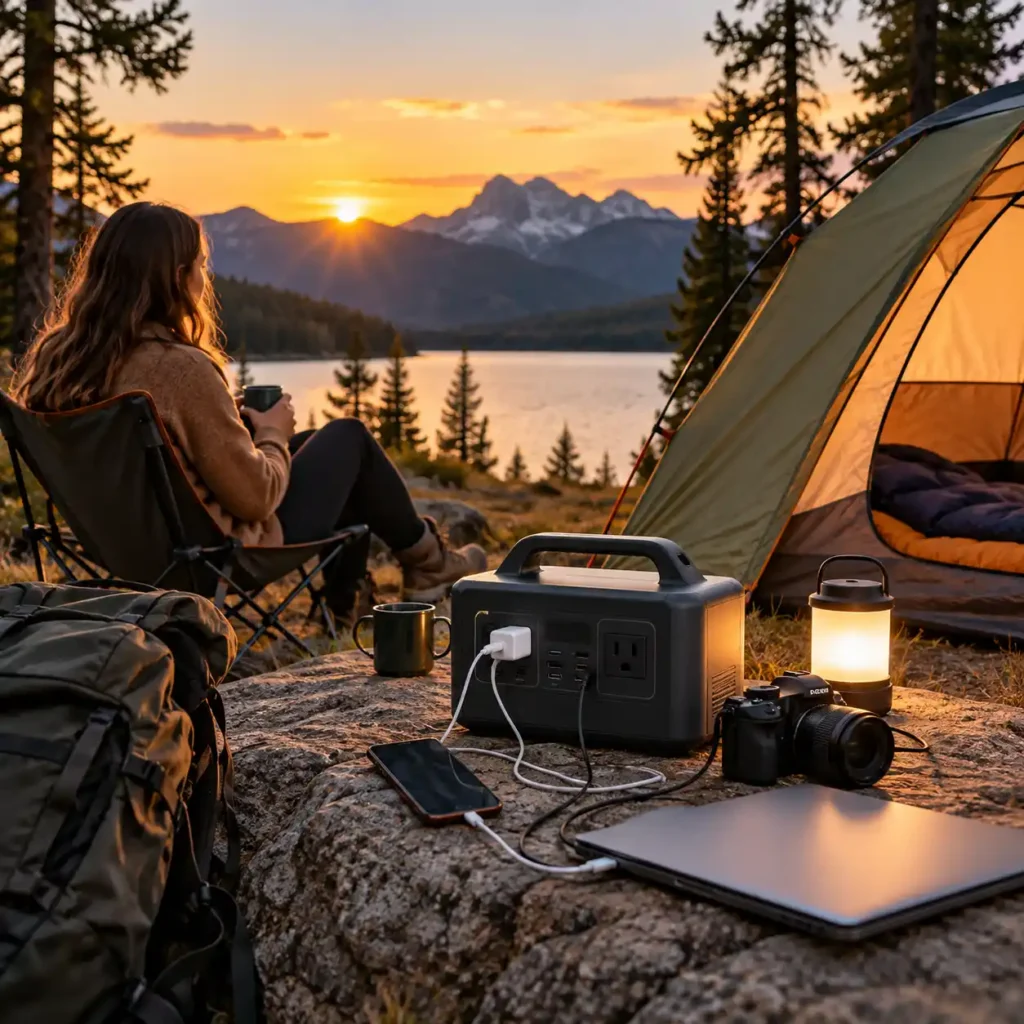
For tent camping, don’t choose a power station by watt-hours alone. The better decision comes from five practical questions: how far you need to carry it, what you need to run overnight, how many people will share it, how long you will camp, and when you can recharge.
Start With Your Camping Pattern
Your camping pattern determines the capacity class that makes sense.
- One-night, one-person trips: a compact 288–300Wh-class station can be appropriate for phones, lights, cameras, and other small electronics.
- Weekend trips for two: a 500Wh-class station provides more reserve for shared electronics, laptops, fans, and longer overnight use.
- Longer trips or higher daily loads: a 500–600Wh-class station provides more stored energy between charging opportunities.
- DC-first lightweight setups: if your equipment is primarily USB-C, USB, and 12V DC, a DC-only station can reduce carrying weight by eliminating the AC inverter you do not need.
- CPAP or other continuous overnight loads: treat the device as a primary part of your energy budget rather than an occasional load.
Once you know which devices you plan to bring, use our Power Station Size Calculator to estimate the required output and battery capacity.
Match Output to Your Actual Devices
Capacity determines how long a station can support your equipment; output determines whether it can support it at all.
For tent camping, first separate your equipment into:
- USB-C/USB/DC devices such as phones, cameras, lights, tablets, and compatible laptops.
- AC devices that require a conventional 120V outlet.
If most of your equipment is DC-based, direct DC or USB-C charging can make a compact station more practical. If you need AC power, check the station’s continuous output against the device’s requirements, including any higher startup demand.
Let Carrying Distance Influence Capacity
A 500–600Wh station may be practical when the vehicle is parked close to the campsite. The same station can become inconvenient if you need to carry it a significant distance along with your tent, sleeping gear, and other equipment.
Think about capacity and carrying weight together:
short carry → more capacity may be practical
long carry → compact 288–300Wh class may make more sense
The goal is not to carry the largest battery you can afford. It is to carry enough energy without turning the power station into a burden.
Plan Around Overnight Use
Daytime charging can make a power station appear more than adequate, while overnight loads can change the calculation completely.
A phone or camera may use relatively little energy during intermittent daytime charging. A fan, CPAP machine, or other device running for several hours overnight can consume considerably more.
Before choosing a capacity class, ask:
What will still be running after everyone goes to sleep?
That overnight load should be part of your capacity decision, particularly for CPAP users and campers who rely on a fan throughout the night.
Consider How You Will Recharge
If you leave home with a fully charged station and cannot recharge at the campsite, the battery has to cover the entire period between departure and your next reliable charging opportunity.
If you can recharge during the trip, the calculation changes.
- AC charging: the most predictable option when an outlet is available.
- Solar charging: useful for multi-day trips when conditions and panel placement allow meaningful daytime recharge.
- Vehicle charging: a practical secondary option for vehicle-accessible campsites.
For short trips with modest loads, starting with a full battery may be all you need. For longer trips, recharge capability can reduce how much stored energy you need to carry from the beginning.
Bottom line: choose the power station around the combination of carry distance → overnight load → number of people → trip length → recharge opportunities.
How Much Power Do You Need for Tent Camping?
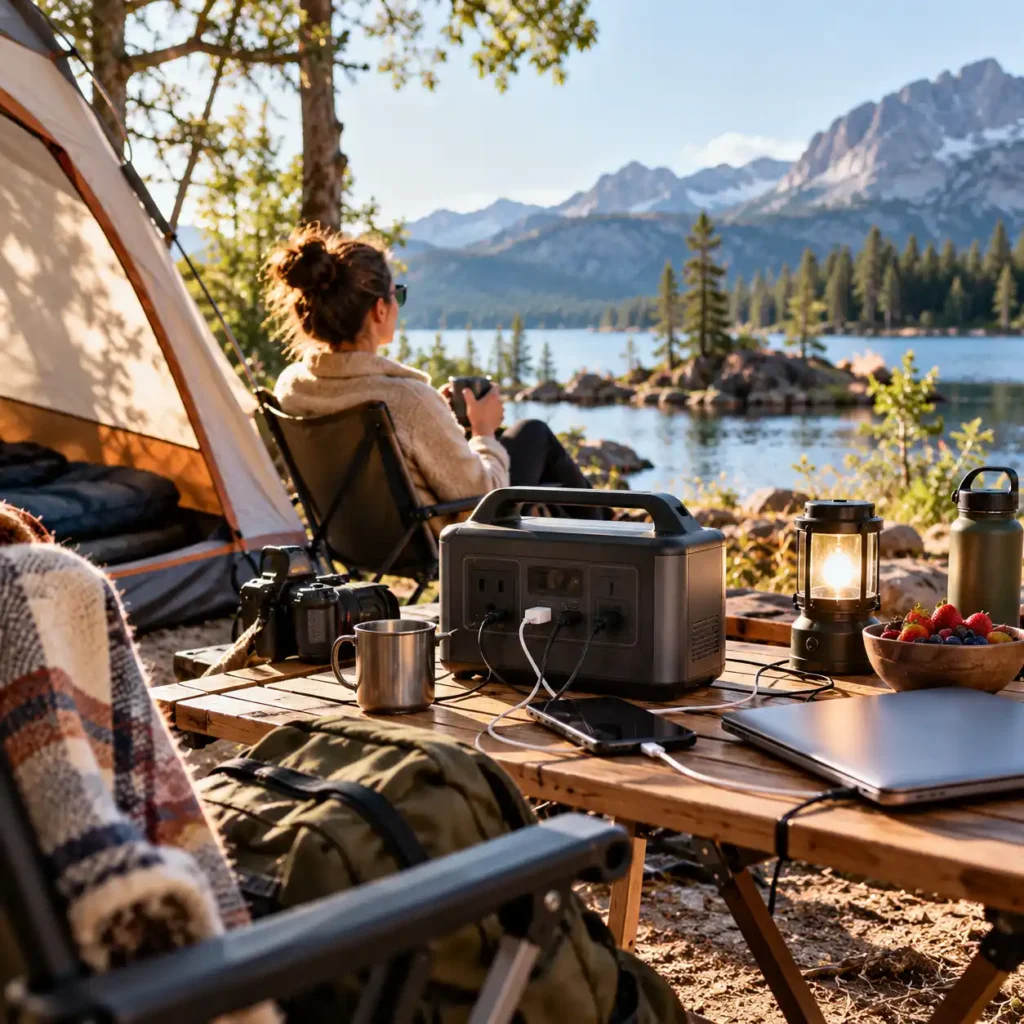
The right power station capacity for tent camping depends on what you use overnight, how many people share the battery, how long you stay, and when you can recharge.
For tent camping, these capacity classes provide useful starting points:
- 288–300Wh: minimalist one-night trips with phones, cameras, lights, and other small loads.
- 500Wh class: weekend camping for one or two people, especially when laptops, fans, or additional shared devices are included.
- 500–600Wh: multi-day camping, higher daily loads, or several people sharing one power station.
- CPAP: calculate the CPAP’s overnight requirement first, then size the rest of the camping setup around it.
These are category-specific starting points, not universal capacity requirements. Actual energy use depends on the devices, operating time, connection method, and available recharge opportunities.
One-Night Tent Camping
For a minimalist one-night trip, a 288–300Wh-class power station can be a practical starting point when the load is limited to phones, cameras, campsite lighting, and other small electronics.
The main advantage is portability. There is little reason to carry a substantially larger battery when the campsite’s actual energy requirements are modest and there is no need to support continuous high-power loads.
The calculation changes when overnight equipment is added. A fan running for several hours or a CPAP machine operating throughout the night can become a significant part of the energy budget. In those cases, calculate the overnight load first rather than assuming that a compact station will be sufficient.
A Weekend for One or Two People
For a one- or two-person weekend, a 500Wh-class power station can provide a useful middle ground between compact capacity and a larger battery.
This capacity class becomes more relevant when the station is shared between several devices: phones, cameras, lights, a laptop, a fan, or other moderate camping loads. It provides more energy reserve than a 288–300Wh station without moving directly into the weight of larger-capacity models.
The actual requirement still depends on how the battery is used. Two campers charging phones and cameras may use considerably less energy than two campers adding regular laptop use, a fan, and other overnight loads.
Multi-Day Tent Camping
For multi-day tent camping, a 500–600Wh-class power station can provide a useful increase in stored energy when several people share the battery or daily consumption is higher.
The important distinction is that a larger battery does not remove the need for a recharge plan. If the station must provide all of the energy for several days with no opportunity to recharge, even 500–600Wh can eventually be depleted.
Solar or vehicle charging can change the calculation by replacing part of the energy consumed during the trip. In that situation, the practical energy budget becomes a combination of initial battery reserve plus available daily recharge.
For longer trips, therefore, consider the four factors together: daily consumption, battery capacity, recharge opportunities, and carrying weight.
If you want to translate a required load and runtime into a battery-energy requirement, our Battery Capacity Calculator provides a more detailed calculation.
When CPAP Changes the Calculation
CPAP can change the sizing decision because it is a primary overnight load, not an occasional device charge.
Start with the specific CPAP manufacturer’s power requirements and the way you intend to power the machine. An AC power supply and a compatible DC setup can have different energy requirements, so the complete connection method matters.
Calculate the expected CPAP energy requirement first, then add essential camping loads such as phones, lighting, cameras, and other overnight equipment. This gives you a more realistic picture of how much capacity needs to remain available while you sleep.
For a single night, a fully charged power station may be sufficient if the total requirement fits within its usable capacity. For a multi-day trip, however, reliable daytime recharging becomes much more important.
For detailed overnight planning, use our CPAP Runtime Calculator to estimate battery runtime based on your specific CPAP setup.
For tent camping, choose capacity around the load that matters most: the overnight requirement and the time until you can recharge.
Estimated Runtime Examples for Tent Camping
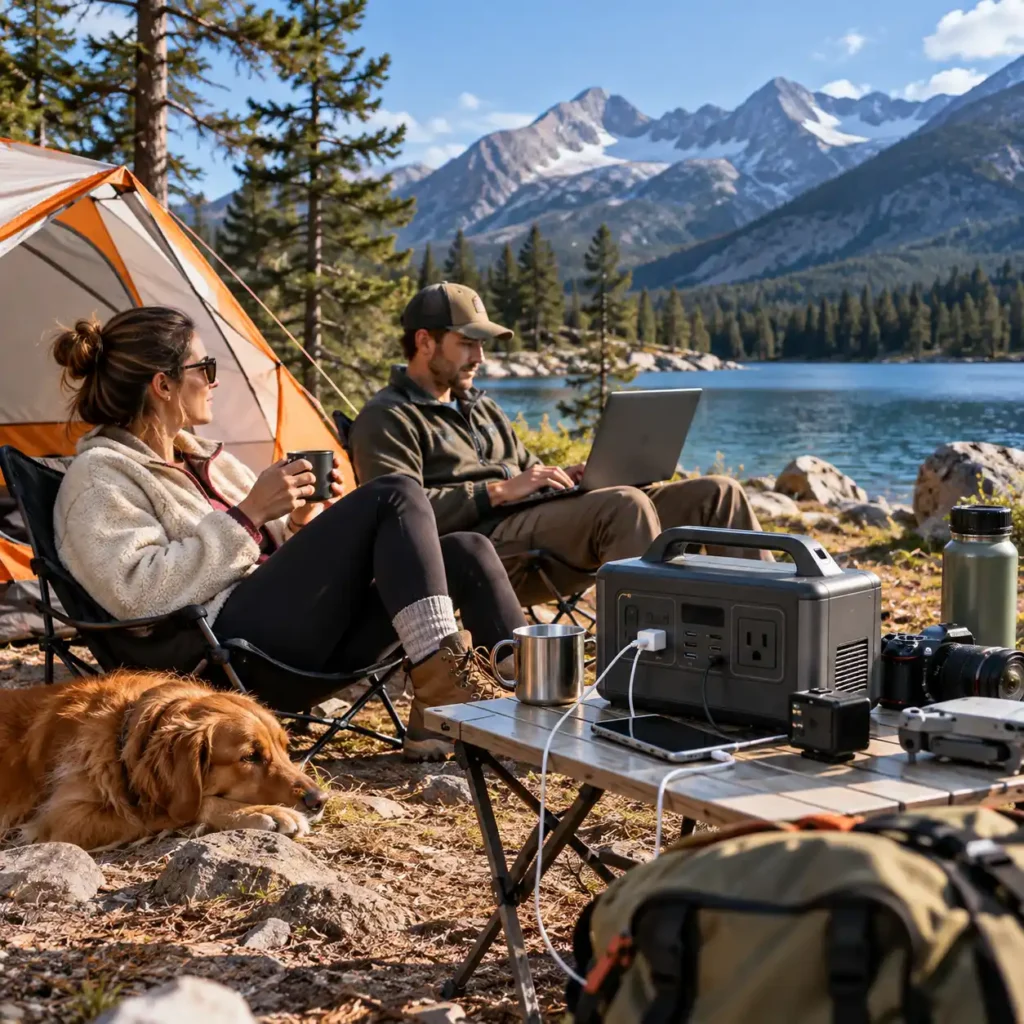
Runtime estimates are planning examples, not guaranteed results. Actual energy use varies with device power draw, operating time, inverter efficiency, battery reserve, temperature, and whether the device uses AC, USB-C, or DC power.
For a broader explanation of power station runtime, battery efficiency, and usable energy, see our guide to how long a power station lasts.
For planning purposes, we use an 85% usable-energy assumption for typical loads; this is a modeling assumption, not a measured efficiency figure.
This is not a measured efficiency figure for any specific power station. Actual usable energy varies by model, load, temperature, and connection method.
| Camping Scenario | Approx. Energy Use | Suitable Capacity Class | Why | Watch-Out |
|---|---|---|---|---|
| Minimalist overnight | ~100–150Wh | 288–300Wh | Phones, camera, lights, and other light loads | Keep device charging efficient to preserve reserve power |
| Weekend for two | ~200–300Wh/day | 500Wh class | Shared electronics, lighting, cameras, laptop, or intermittent fan use | Carefully balance concurrent high-draw device usage |
| CPAP overnight | Device-specific | Depends on CPAP and settings | Overnight CPAP consumption can dominate the battery budget | Heated tubing and humidification significantly increase energy draw |
| Multi-day + solar | ~200–300Wh/day | 500–600Wh class | Stored energy plus daytime solar recharge | Actual solar recovery depends entirely on weather and panel alignment |
| Higher-demand overnight | ~300–450Wh/night | 500–600Wh class or larger | CPAP, fan, phones, lighting, and other overnight loads | Verify that daily watt-hour consumption does not exceed available usable capacity |
Minimalist One-Night Setup
A light one-night setup with phones, a camera, and campsite lighting can often fit comfortably within a 288–300Wh-class power station. The advantage is keeping the battery compact when there is no need for a large overnight energy reserve.
Adding a fan, laptop, or other continuous load can change the calculation quickly, so estimate those devices separately.
Weekend Setup for Two
For two campers sharing one station, 200–300Wh per day is a useful planning range for moderate electronics use. A 500Wh-class station provides substantially more reserve than a 288Wh model while remaining practical for vehicle-accessible tent camping.
Actual consumption depends on how often devices are charged and how much equipment is used between recharge opportunities.
CPAP Overnight
CPAP should be calculated separately because its energy requirement varies considerably by machine, settings, humidification, heated tubing, and connection method.
For a CPAP setup, calculate the overnight CPAP requirement first, then add phones, lighting, fans, and other loads. Do not use a generic CPAP wattage as a substitute for the manufacturer’s power information.
Multi-Day Camping With Solar
For a setup using approximately 200–300Wh per day, a 500–600Wh-class station can provide a useful balance between stored energy and portability when solar charging is available during the day.
The important calculation is not simply battery capacity but the energy cycle: starting reserve → daily consumption → solar recharge → next day’s reserve.
Solar output varies with weather, shade, panel orientation, and the power station’s charging capability, so the battery should retain enough reserve for periods of lower solar production.
What These Examples Mean
For tent camping, the practical starting points are:
- 288–300Wh: light one-night setups
- 500Wh: weekend use for one or two people
- 500–600Wh: higher daily consumption or multi-day camping with recharge
- CPAP: calculate the specific overnight requirement first
Common Devices and Their Impact on Tent-Camping Power Use
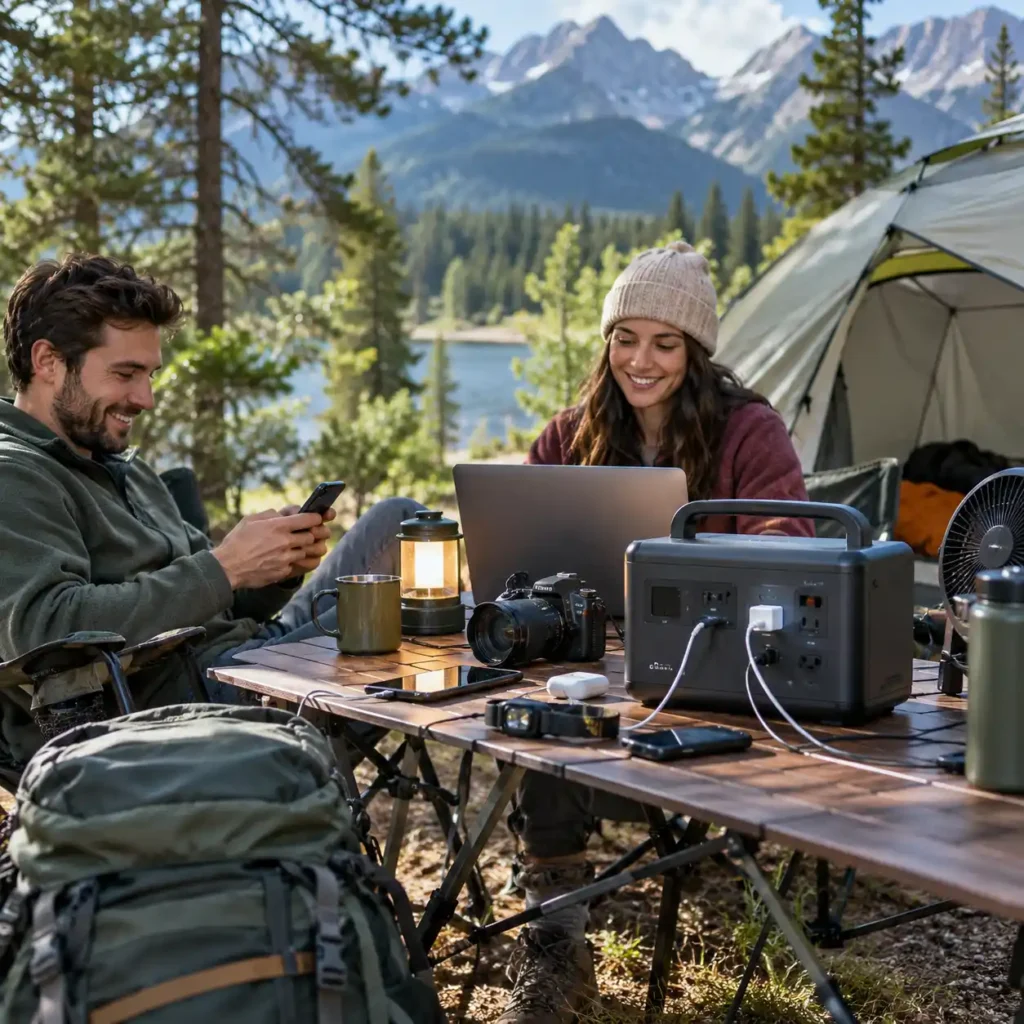
Different camping devices place very different demands on a portable power station. For tent camping, the most important distinction is between short charging sessions and devices that consume power continuously for hours. The key question is not simply how powerful a device is, but how long it will run and whether it needs to operate overnight.
Phones, Cameras, and Small USB Devices
Phones, cameras, GPS devices, and similar electronics are generally relatively light loads. Their main impact comes from the number of devices and charging cycles, especially when two or more campers share one power station.
Whenever possible, use USB-C or USB/DC outputs directly rather than running a small electronic device through the AC inverter. This is particularly practical for modern phones, cameras, and other USB-powered equipment.
For most short tent-camping trips, these devices are unlikely to determine the required battery size by themselves.
Laptops
Laptops can become a meaningful part of the energy budget when they are used for several hours rather than occasional charging.
If a laptop supports USB-C charging, direct USB-C output can be preferable to using AC. Laptops that require a conventional AC adapter will instead use the power station’s inverter.
The important variable is hours of actual use: occasional charging has a very different impact from several hours of computer use each evening.
Fans
Fans are different from phones and cameras because they may run continuously for several hours, particularly overnight. Even a relatively modest wattage can therefore become a significant energy load over time.
A USB/DC fan can be powered directly from the appropriate output, while an AC fan requires the inverter. Include the fan’s expected operating hours in your camping energy estimate.
CPAP Machines
CPAP can be one of the most significant overnight loads because the machine may operate continuously while you sleep.
There is no reliable universal wattage for every CPAP setup. Consumption varies with the specific machine, settings, humidification, heated tubing, and connection method. Check the manufacturer’s power information for the exact setup before planning your battery capacity.
Where the equipment supports it, compare appropriate DC operation with AC operation, because the connection method can affect energy use.
For a more precise estimate, use our CPAP Runtime Calculator.
Charging a Portable Power Station While Tent Camping
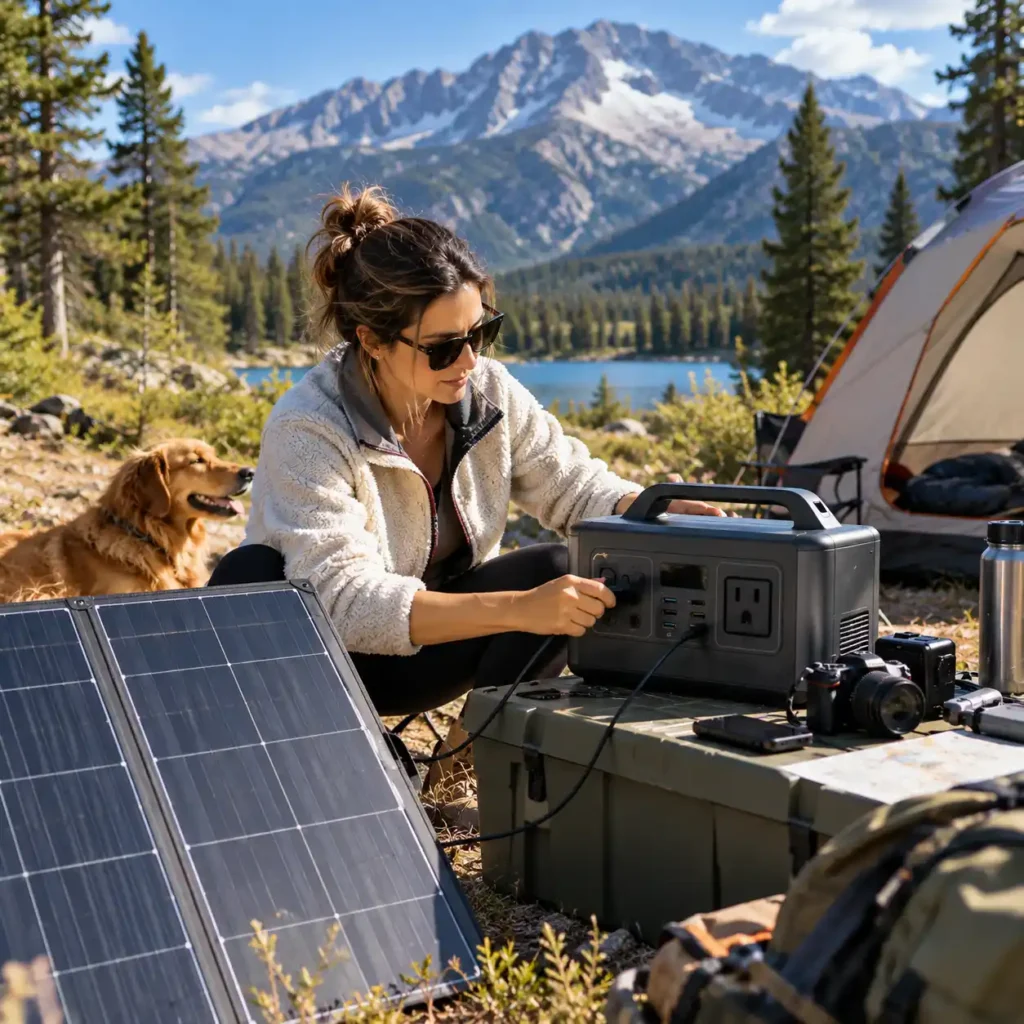
How you recharge a portable power station matters most when a camping trip lasts longer than the battery reserve you bring with you. For short trips, the simplest strategy is usually to start with a full battery; for longer trips, solar or vehicle charging can help restore the energy you use.
Charge Fully Before Leaving Home
For most tent-camping trips, start with the power station fully charged. This gives you the maximum available energy for the first night and avoids making your initial battery reserve dependent on campsite charging conditions.
For a one-night or weekend trip, this may be all the charging you need. Before leaving, check the battery level and pack the appropriate charging cables and accessories.
Recharge With Portable Solar During the Day
For multi-day camping, portable solar can replenish part of the energy used during the previous day or night.
Place the panel where it has a clear view of the sun and follow the power station manufacturer’s requirements for solar input. Treat solar as daily replenishment rather than a guaranteed replacement for all energy consumed.
Actual charging performance varies with sunlight, shade, panel orientation, weather, temperature, and the power station’s solar-input limit. The panel’s maximum rated wattage therefore does not represent a guaranteed charging rate throughout the day.
Our Solar Charging Time Calculator can help estimate charging requirements under different conditions.
For multi-day trips, the useful question is how much energy the panel can realistically return to the battery during the day compared with how much you consumed overnight and during the day.
Vehicle Charging as a Secondary Option
Vehicle charging can provide another way to restore battery capacity when a campsite is accessible by car, particularly when solar production is limited.
It works best as a secondary charging method rather than the main plan. Check the power station’s specifications for its supported vehicle-charging method and use the appropriate cable and connection.
Vehicle charging is particularly useful as a backup after several days of camping or during periods of poor solar conditions. However, if the vehicle is parked far from the tent, repeatedly moving the power station between the campsite and vehicle can make this option less convenient.
For tent camping, the practical charging strategy is simple: start with a full battery, use solar for daytime replenishment on longer trips, and keep vehicle charging as a backup when practical.
Using a Power Station Safely Around a Tent
Tent camping exposes a power station to conditions that are different from indoor use, including rain, dew, dirt, temperature changes, and uneven ground. A few simple precautions can make the setup safer and easier to manage.
Keep the Power Station Dry
Keep the power station protected from rain, splashes, and persistent moisture unless the manufacturer specifically states that the model is designed for those conditions. Overnight dew can also be a concern at an exposed campsite.
Place the unit on a stable, dry surface rather than directly on wet ground. Keep charging ports, plugs, and cable connections protected from moisture, and avoid handling electrical connections with wet hands.
Maintain Adequate Ventilation
Leave sufficient open space around the power station’s ventilation openings while it is operating or charging. Do not place it inside a closed bag, storage box, or other confined space, and do not cover its ventilation openings with clothing or camping gear.
A stable, shaded location beside the tent can be practical, provided the unit remains protected from the elements and has the airflow recommended by the manufacturer.
Keep Cables Clear at Night
Cable management becomes particularly important after dark. Route cables away from tent entrances, walkways, and areas where people may step, and avoid unnecessary cable runs through the sleeping area.
Before going to sleep, check that connections are secure, cables are not under tension, and connected devices cannot easily be pulled or knocked over.
For cables, adapters, and other equipment that can make a portable setup easier to manage, see our Essential Portable Power Station Accessories (2026) guide.
Position Solar Panels Away From the Sleeping Area When Practical
When using portable solar, place the panel where it has a clear view of the sun and where it will not interfere with the tent or campsite traffic. The panel does not need to be directly beside the tent.
Route the charging cable safely back to the power station, keeping it away from walkways and protecting the connection from moisture and accidental damage.
Separating the solar equipment from the sleeping area can make the campsite easier to organize, particularly when the power station is being recharged during the day.
Common Mistakes When Choosing a Power Station for Tent Camping
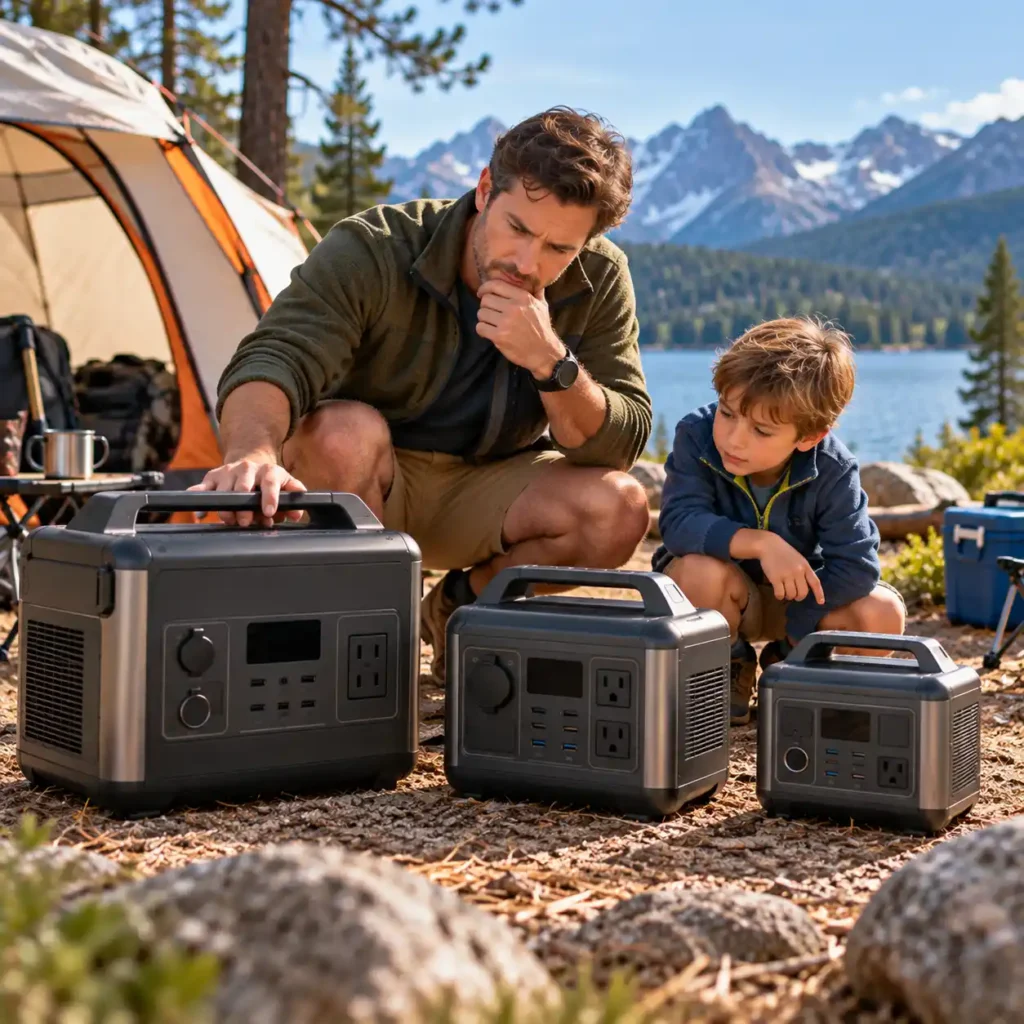
Choosing a power station for tent camping involves more than comparing battery capacity and output. A model that looks impressive on paper can still be a poor fit if its weight, output, or charging requirements do not match the way you actually camp.
Buying More Capacity Than You Can Comfortably Carry
A larger battery is not automatically a better camping battery. Extra watt-hours also mean additional weight, which matters when you have to carry the station from a vehicle or parking area to the tent.
For a short trip with phones, lights, cameras, and other small loads, a compact 288–300Wh-class station may be more practical than a much larger model. Choose enough capacity for your expected loads and a reasonable reserve, rather than carrying capacity you are unlikely to use.
Choosing by Watt-Hours Alone
Watt-hours tell you how much energy the battery stores, but not whether the station can power every device you plan to bring.
Two stations with similar capacity can have different AC output, USB-C/DC options, and charging capabilities. A higher-output station also does not automatically provide longer runtime if its battery capacity is similar.
For tent camping, consider capacity and output together: capacity affects how long the battery can support your loads, while output determines which devices it can actually run.
Ignoring AC Output and Device Requirements
A station can have enough battery capacity but still be unsuitable for a particular device if its available output is too low.
Check the continuous AC output and relevant peak capability against equipment that requires AC power. For USB-C and DC devices, check whether the station provides an appropriate direct output instead of assuming every device needs an AC outlet.
The right station needs both enough stored energy and enough usable output for the equipment you plan to bring.
Forgetting About Overnight Loads
It is easy to plan for daytime electronics and overlook what will still be drawing power after you go to sleep. A fan may run for several hours, phones may charge overnight, and a CPAP machine can operate throughout the night.
For tent camping, calculate the essential overnight loads first, then add daytime consumption and maintain a reasonable reserve. This is particularly important on multi-night trips, when the remaining battery capacity must cover the next night’s essential equipment.
Assuming Solar Will Always Replace Your Daily Energy Use
Solar can extend a power station’s useful runtime, but it should be treated as a recharging opportunity rather than a guaranteed daily energy source.
Actual production depends on sunlight, shade, panel orientation, weather, temperature, and the power station’s solar-input limit. For multi-day camping, maintain enough battery reserve to cover essential loads if solar production is lower than expected.
Treating a Tent Campsite Like an RV or Home Backup Setup
Tent camping has different requirements from an RV or home backup system. A tent camper generally needs a station that is practical to carry and suitable for relatively small loads such as phones, cameras, lights, laptops, fans, and sometimes CPAP equipment.
Larger batteries and higher output can make sense for longer trips, multiple campers, or limited charging opportunities. The mistake is choosing that larger format without considering the distance you need to carry it and the equipment you actually need to power.
Frequently Asked Questions
Is 300Wh Enough for Tent Camping?
A 300Wh-class power station can be enough for a simple overnight or short weekend tent-camping trip when the main loads are phones, cameras, lights, and other small electronics. It becomes less suitable when you add continuous overnight loads such as a fan, laptop, or CPAP machine.
The key is to calculate your actual energy use rather than choosing capacity based on the trip length alone. A 300Wh station can be a practical choice when portability is a priority and your campsite loads are relatively light.
Is 500Wh Enough for a Weekend Camping Trip?
A 500Wh-class power station can provide a useful middle ground for a weekend tent-camping trip. It offers more reserve than a compact 300Wh station while remaining substantially easier to carry than many larger models.
Whether it is enough depends on what you run. Phones, lights, cameras, and occasional laptop use may fit comfortably, while a fan running for hours overnight, CPAP equipment, or several high-demand devices can use the available energy much more quickly.
Can a Portable Power Station Run a CPAP All Night in a Tent?
Yes, a properly sized portable power station can run a CPAP overnight. The required capacity depends on the specific machine, settings, humidifier and heated tubing, and whether the CPAP is powered through AC or an appropriate DC connection.
For a CPAP setup, use the manufacturer’s power information and calculate the expected overnight energy requirement rather than relying on a generic runtime estimate. Some manufacturers and camping guides recommend DC power when compatible because it can avoid inverter losses.
Can You Use a Portable Power Station Inside a Tent?
A battery power station does not produce combustion exhaust or carbon monoxide like a fuel-powered generator. However, the manufacturer’s instructions should always take priority, and the unit should remain dry, stable, and unobstructed while operating.
For practical tent camping, placing the power station in a protected location beside the tent can make cable management and ventilation easier. Keep it away from moisture, heat sources, sleeping bags, and anything that could block its ventilation openings.
How Do You Recharge a Portable Power Station While Tent Camping?
The most reliable approach for a short trip is to fully charge the station before leaving home. For longer trips, portable solar panels can replenish some of the energy during daylight, while vehicle charging can provide a secondary option when the campsite is accessible by car.
Solar production varies with sunlight, shade, weather, panel orientation, and the station’s solar-input limits, so it should be treated as a recharge opportunity rather than a guaranteed replacement for all daily consumption.
How Long Will a Portable Power Station Last While Camping?
Runtime depends on the station’s usable battery capacity and the combined power consumption of the devices connected to it. A phone and a few lights may use relatively little energy, while a laptop, fan, CPAP, or other continuous load can reduce the battery reserve much faster.
A useful planning method is to estimate each device’s wattage and operating time, add the resulting energy requirements together, and allow a practical reserve rather than planning to drain the battery completely.
What Can You Run From a Portable Power Station While Tent Camping?
Common tent-camping loads include phones, cameras, lights, laptops, small fans, speakers, USB devices, and CPAP equipment. A station’s continuous AC output and available ports determine which devices it can actually operate.
USB-C and DC-powered devices can often be connected directly when the station provides compatible outputs, while AC-powered equipment requires an appropriate AC inverter output. Always compare the device’s requirements with the station’s specifications before relying on it at camp.
Are Portable Power Stations Quiet Enough to Use at Night?
Many battery power stations are substantially quieter than fuel-powered generators, which makes them better suited to quiet camping environments. The actual noise level varies by model and operating condition, particularly when the cooling system or inverter is working harder.
If nighttime noise matters, check the manufacturer’s stated noise level and consider the station’s expected load. A compact station operating light loads may behave differently from a larger unit under sustained high output.
Should You Use AC or USB-C/DC Power When Camping?
Use the connection that matches the device and the power station. Phones, compatible laptops, cameras, and other USB-C devices can often be charged directly through USB-C, while other equipment requires AC power.
Direct USB-C or DC charging can be useful because it avoids using the station’s AC inverter for devices that do not require it. For overnight equipment such as a compatible CPAP, the manufacturer’s recommended DC setup may also reduce conversion losses.
Do You Need a 1,000Wh Power Station for Tent Camping?
Not necessarily. A 1,000Wh-class power station can be useful for longer trips, multiple campers, substantial overnight loads, or limited opportunities to recharge, but it can be unnecessary for a lightweight tent-camping setup built around phones, lights, cameras, and other small electronics.
The deciding factors are your actual energy requirements, number of nights, recharge opportunities, and how far you need to carry the station. For many tent campers, a smaller 300–600Wh-class model can provide a more practical balance between usable energy and portability.
Final Verdict
Choosing a portable power station for tent camping comes down to balancing capacity, output, portability, overnight needs, and recharge options. The right model is the one that fits the way you actually camp without adding unnecessary weight or capacity.
Our Recommendation
Choose based on your primary camping priority:
- If portability is the priority → Anker SOLIX C300 or Anker SOLIX C300 DC. Choose the C300 for mixed AC, USB-C, and DC use; choose the C300 DC when your equipment is primarily USB-C, USB, and 12V DC and you do not need AC output.
- If higher AC output is the priority → BLUETTI Elite 30 V2. Its 600W continuous AC output provides more AC capability while remaining in the compact 288Wh class.
- If additional stored energy is the priority → EF ECOFLOW Portable Power Station River 3 Max. Its 572Wh battery provides substantially more stored energy for longer trips and higher daily loads, with the tradeoff of considerably greater carrying weight.
- If you want a 500Wh-class weekend middle ground → Jackery Explorer 500 v2. Its 512Wh capacity sits between the compact 288Wh models and larger-capacity stations, making it a practical option for weekend camping and shared loads.
Related Guides
Power Ready Guide Commitment
At Power Ready Guide, our goal is to make portable power decisions easier to understand, not simply to promote the products we cover.
We aim to keep product information accurate, transparent, and relevant to the way people actually use portable power equipment. When specifications, models, availability, or product capabilities change, we review our content and update it where necessary.
Our recommendations are based on the requirements of the specific use case described in each guide. We do not assume that the largest, newest, or most expensive option is automatically the right choice.
We will continue to refine this guide as the portable power station market changes, while keeping the reader’s needs, practical usefulness, and clear decision-making at the center of the editorial process.