
A portable power station can keep a refrigerator running during a power outage or at an off-grid campsite, but whether it can run continuously for 24 hours or longer depends on more than battery capacity alone. Refrigerators cycle on and off as the compressor responds to cooling demand, so the wattage listed on the appliance does not tell you how much energy it consumes over an entire day.
To determine whether a portable power station can run a refrigerator 24/7, you need to consider three things: the refrigerator’s actual daily energy consumption, the battery energy available for use, and whether the station can be recharged enough to replace the energy the refrigerator consumes. The inverter must also handle the refrigerator’s normal operating load and compressor startup surge.
In this guide, you’ll learn how to estimate your refrigerator’s daily energy use, calculate the battery capacity needed for your intended runtime, and identify the power station specifications that matter for reliable, continuous operation.
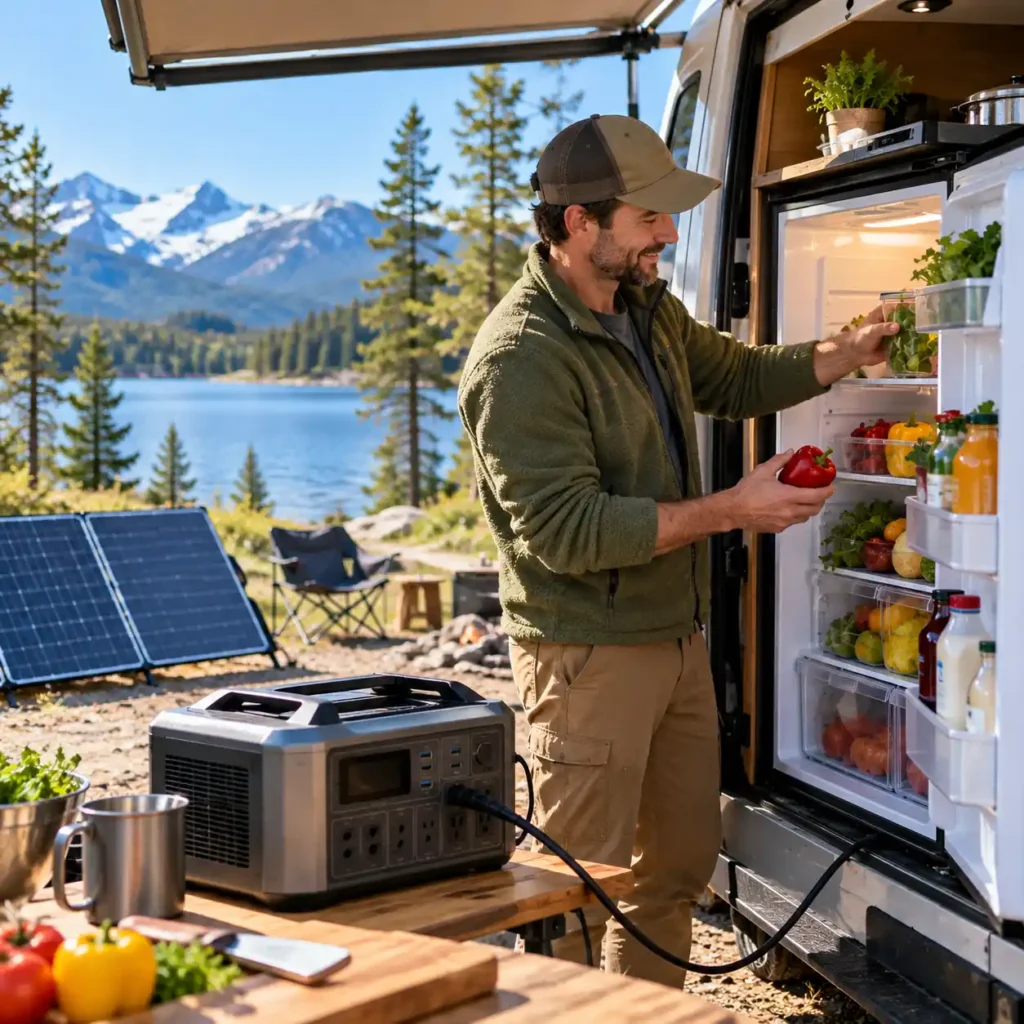
Table of Contents
Quick Answer: Can a Portable Power Station Run a Refrigerator 24/7?
Yes, a portable power station can run a refrigerator 24/7 if its battery capacity, inverter output, and available recharging meet the refrigerator’s energy needs.
Three conditions determine whether it will work:
- Enough usable battery energy: The station must supply the refrigerator’s electricity consumption for the required period, accounting for energy lost during power conversion.
- Sufficient inverter power: The inverter must handle the refrigerator’s running load and the higher startup surge when the compressor switches on.
- Reliable energy replenishment: For continuous operation over multiple days, the station must receive enough energy from recharging to replace what the refrigerator consumes.
There is an important difference between running a refrigerator for 24 hours on a single charge and keeping it running 24/7 for several days. The first depends primarily on usable battery energy and the refrigerator’s daily consumption. The second also requires a sustainable way to recharge the battery, such as grid power or a suitably sized solar setup.
A power station that meets these requirements can provide continuous refrigerator backup, but actual runtime depends on the refrigerator, operating conditions, and the station’s specifications.
Quick Calculation: Will a Power Station Run Your Refrigerator for 24 Hours?
Suppose your refrigerator uses 1,200 Wh of electricity per day. If an estimated 85% of the power station’s rated battery capacity is available to run the refrigerator, the calculation is:
Required battery capacity = 1,200 Wh/day ÷ 0.85 ≈ 1,412 Wh
Adding a separate 20% planning reserve gives a target of approximately 1,694 Wh.
This is an illustrative estimate, not a guarantee of 24-hour runtime. You must also confirm that the power station can handle the refrigerator’s running wattage and compressor startup surge. For operation beyond one battery charge, the charging system must replenish the energy the refrigerator consumes.
What Determines Whether a Power Station Can Run a Refrigerator 24/7?
Three technical checks determine whether a power station is suitable: inverter capability, usable battery energy, and recharge performance. The following sections explain how to evaluate each factor before calculating runtime.
Running Watts vs. Starting Watts
A refrigerator does not draw the same amount of power at every moment. Its compressor switches on and off as the appliance maintains the set temperature, and starting the compressor can briefly require more power than running it normally.
Running watts describe the power the refrigerator needs while operating. Starting watts refer to the higher, short-duration demand that may occur when the compressor starts.
A power station must support both loads. Its continuous AC output rating needs to accommodate the refrigerator’s operating demand, while its surge capability must be sufficient for compressor startup. The actual starting requirement varies by refrigerator and compressor design, and the station’s ability to handle a surge depends on its specifications and operating conditions.
If the inverter cannot supply the required startup power, the refrigerator may fail to start or the station may shut down, even when the battery is fully charged.
Battery Capacity vs. Inverter Output
Battery capacity and inverter output measure two different things, and both matter when powering a refrigerator.
Watts (W) measure power — the rate at which electricity is supplied to an appliance.
Watt-hours (Wh) measure energy — the amount of electricity stored in the battery and available for use.
In simple terms, watts help determine whether the power station can operate the refrigerator, while watt-hours help determine how long it can run before the battery needs recharging.
A station with a large battery may store enough energy for many hours of refrigerator use but still have an inverter that cannot handle the compressor’s startup surge. Conversely, a station with a powerful inverter may start and run the refrigerator successfully but have insufficient battery capacity to sustain it for 24 hours.
Before choosing a station, verify both its usable battery energy (Wh) and its continuous and surge AC output ratings (W).
What Continuous Operation Actually Means
The phrase running a refrigerator 24/7 can describe three different operating arrangements. Distinguishing between them is important because each has different energy requirements.
1. Running from the battery without recharging
The refrigerator draws energy from the power station until the battery is depleted. To cover a full 24-hour period, the station must have enough usable energy to meet the refrigerator’s consumption during those hours. Once the battery runs out, the refrigerator stops unless another power source is available.
2. Running with periodic recharging
The refrigerator operates from the station while the battery is recharged at intervals. Recharging might take place during the day using solar panels or from another compatible power source. For operation over several days, the energy added must be sufficient to replace the energy consumed, or the battery will gradually run down.
3. Running while connected to a supported AC power source
Some power stations support operating an appliance while the station itself is connected to grid power. Depending on the model, the refrigerator may receive power through an AC bypass or another supported operating mode, while the battery remains charged or recharges.
However, this behavior is not universal. Charging while powering an appliance does not automatically guarantee uninterrupted backup if grid power fails. The station’s documentation must confirm its supported operating mode and whether it can transfer to battery power without interrupting the refrigerator.
These three arrangements establish the starting point for the next step: determining how much electricity your refrigerator actually consumes each day and how much usable battery energy is needed to cover that demand.
How Much Electricity Does a Refrigerator Use Per Day?
The best approach is to measure your refrigerator’s actual electricity use over a representative period. If you cannot measure it directly, the appliance’s EnergyGuide label provides a useful starting point.
Why Refrigerator Wattage Does Not Equal Daily Energy Use
A refrigerator’s rated wattage describes its power demand at a particular moment or under specified operating conditions. It does not tell you how much electricity the appliance consumes over an entire day.
Most refrigerators use a compressor that switches on when cooling is needed and switches off once the desired temperature is reached. During a compressor cycle, the refrigerator draws power; between cycles, its energy consumption may be much lower, although other components can still use electricity.
As a result, a refrigerator rated at a particular number of watts does not necessarily draw that amount continuously for 24 hours. Its daily energy consumption depends on how often and how long the compressor operates, along with the energy used by other components.
This distinction matters because watts (W) measure power, while watt-hours (Wh) measure energy consumed over time. For estimating daily electricity use, Wh per day is the more useful figure.
What Affects Daily Refrigerator Energy Consumption?
Several factors influence how much electricity a refrigerator uses over 24 hours:
- Size and design: Larger refrigerators generally have more internal space to cool, although actual consumption depends on the appliance’s design and efficiency.
- Energy efficiency: Insulation, compressor technology, and the appliance’s overall design affect how much energy is required to maintain the target temperature.
- Room temperature: A refrigerator operating in a hot garage, camper, or outdoor environment may need to remove more heat than one in a cooler indoor space.
- Door openings: Opening the door allows warm air to enter, increasing the cooling demand. Frequent or prolonged openings can raise energy consumption.
- Temperature settings: Colder settings can increase compressor activity and electricity use.
- Door seals: Worn or damaged gaskets allow cold air to escape and warm air to enter, potentially increasing the energy required to maintain the set temperature.
These variables explain why two refrigerators with similar rated wattage can have different daily energy consumption. Even the same appliance may use different amounts of electricity depending on its surroundings and how it is used.
There is no single daily Wh figure that accurately represents every refrigerator. For a dependable estimate, use the energy data for your specific appliance or measure its consumption directly.
How to Measure Your Refrigerator’s Actual Energy Use
The most reliable practical method is to use a plug-in energy monitor that measures cumulative electricity consumption in kWh. It should be suitable for the refrigerator’s electrical load and compatible with the outlet and electrical system you use.
Follow these steps:
Plug the energy monitor into the appropriate outlet and connect the refrigerator according to the monitor’s instructions.
Record cumulative energy consumption over at least 24 hours. A longer measurement period can provide a more representative result because compressor cycles and cooling demand vary.
Keep your normal refrigerator settings and usage habits during the measurement period.
Divide the measured energy by the number of days monitored to calculate average daily consumption.
Use this formula to calculate average daily energy consumption:
Daily energy consumption (Wh/day) = Total measured energy (Wh) ÷ Number of days measured
Here, total measured energy is the electricity recorded by the energy monitor over the measurement period, expressed in watt-hours (Wh).
For example, if the monitor records 3,600 Wh over three days:
Daily energy consumption = 3,600 ÷ 3 = 1,200 Wh/day
This is an illustrative calculation, not a typical consumption figure for all refrigerators.
Estimating Daily Energy Use From the EnergyGuide Label
If direct measurement is not available, use the annual electricity consumption printed on the refrigerator’s EnergyGuide label as a preliminary estimate. The label reports estimated annual energy use in kilowatt-hours (kWh/year).
The U.S. Department of Energy explains how to read appliance energy labels and interpret estimated annual electricity use. See its Energy Savers guide for background on EnergyGuide figures and their limitations.
Convert the annual figure to average daily watt-hours using:
Daily energy consumption (Wh/day) = Annual energy consumption (kWh/year) × 1,000 ÷ 365
For example, an EnergyGuide estimate of 500 kWh per year gives:
Daily energy consumption = 500 × 1,000 ÷ 365 ≈ 1,370 Wh/day
You can also convert this daily estimate into average power over 24 hours:
Average power (W) = Daily energy consumption (Wh/day) ÷ 24
For this example:
Average power = 1,370 ÷ 24 ≈ 57 W
This 57 W figure represents average power across the full day, not the inverter capacity required to run the refrigerator. A refrigerator’s compressor cycles on and off, so its instantaneous power demand can be substantially higher than its daily average, particularly during startup. Check the refrigerator’s running wattage and startup surge separately when evaluating a power station’s inverter.
EnergyGuide figures are estimates, not precise predictions of real-world consumption. Actual use may differ depending on room temperature, door openings, temperature settings, and other operating conditions. Whenever possible, use measured daily energy consumption in Wh/day for the calculations in the following sections. If you only have the EnergyGuide figure, treat the converted daily value as a preliminary estimate.
Once you have your refrigerator’s daily energy consumption, use the Refrigerator Runtime Calculator to estimate how long a battery can power it under your expected operating conditions.
What Size Power Station Do You Need for 24 Hours?

Once you know your refrigerator’s daily energy consumption, you can estimate the battery capacity needed to run it for 24 hours. The key is to distinguish the energy stored in the battery from the energy that actually reaches the refrigerator. Conversion losses and limits on usable battery capacity mean that not all the rated watt-hours will be available to power the appliance.
Rated Capacity vs. Usable Energy
A power station’s rated battery capacity, expressed in watt-hours (Wh), indicates how much energy its battery is designed to store. However, the energy available to a refrigerator through an AC outlet is lower because the inverter consumes energy during DC-to-AC conversion. The station may also have battery-use limits that affect how much stored energy can be discharged.
For example, a station rated at 1,000 Wh will not necessarily deliver 1,000 Wh of usable AC energy to the refrigerator. The actual amount depends on inverter efficiency, the station’s operating mode, and its battery management settings.
To estimate the required capacity, use a usable-energy factor that accounts for these effects. This factor is a planning assumption, not a universal specification: actual efficiency and usable capacity vary by power station and operating conditions.
How to Calculate the Required Battery Capacity
Use this formula:
Required nominal battery capacity (Wh) = Daily energy consumption (Wh/day) ÷ Usable-energy factor
Where:
Required nominal battery capacity is the estimated rated battery capacity needed, measured in Wh.
Daily energy consumption is the refrigerator’s average electricity use per day, measured in Wh/day.
Usable-energy factor is the assumed fraction of the battery’s rated capacity available to power the refrigerator after accounting for conversion losses and applicable battery-use limits.
For example, assume your refrigerator consumes 1,200 Wh per day based on your own measurements, and the usable-energy factor is 0.85 (85%).
Required nominal battery capacity = 1,200 ÷ 0.85 ≈ 1,412 Wh
Under this assumption, a nominal battery capacity of approximately 1,412 Wh is needed to cover the estimated daily energy consumption before adding an extra reserve. This is an illustrative calculation, not a guarantee of the usable energy a particular power station will deliver.
How Much Reserve Should You Allow?
A refrigerator’s daily consumption can fluctuate with room temperature, door openings, thermostat settings, and compressor activity. A reserve helps accommodate this uncertainty and reduces the risk of running out of energy before the 24-hour period ends.
Keep the reserve separate from the usable-energy factor. The factor accounts for assumed conversion losses and battery-use limits; the reserve provides additional capacity for uncertainty in actual consumption. Applying the same adjustment twice would overestimate the requirement.
For this example, add a 20% planning reserve to the calculated nominal capacity:
Required capacity with reserve = 1,412 × 1.20 ≈ 1,694 Wh
Therefore, for a refrigerator consuming 1,200 Wh per day, the illustrative calculation gives a nominal battery capacity requirement of approximately 1,694 Wh, using an 85% usable-energy factor and a separate 20% reserve.
Portable Power Station Capacity Needed for 24 Hours
Use your refrigerator’s daily energy consumption to estimate the nominal battery capacity needed for a 24-hour period. The table below applies an illustrative usable-energy factor of 85%. The reserve column adds a further 20% to the calculated capacity.
| Refrigerator Energy Use | Nominal Capacity for 24 Hours | Capacity With a 20% Reserve |
|---|---|---|
| 600 Wh/day | 706 Wh | 847 Wh |
| 1,000 Wh/day | 1,176 Wh | 1,412 Wh |
| 1,200 Wh/day | 1,412 Wh | 1,694 Wh |
| 1,500 Wh/day | 1,765 Wh | 2,118 Wh |
| 2,000 Wh/day | 2,353 Wh | 2,824 Wh |
Use this table to estimate the battery capacity needed for your refrigerator’s daily energy consumption. If your measured usage is 1,200 Wh/day, for example, the calculation gives approximately 1,412 Wh of nominal capacity before a reserve, or 1,694 Wh with a 20% reserve.
To calculate the requirements for your own setup, use the Power Station Size Calculator to estimate the battery capacity and output power needed for your appliances.
These figures address battery capacity, but capacity alone does not determine whether a power station can run your refrigerator. You must also check that its inverter supports the refrigerator’s running wattage and compressor startup surge. The next step is to compare estimated runtime across different battery sizes while accounting for these power requirements.
How Long Will Different Power Station Sizes Run a Refrigerator?
A power station’s estimated runtime depends on how much usable energy its battery can deliver and how much electricity the refrigerator consumes each day. A larger battery generally provides longer runtime, but the same station can run for very different lengths of time depending on the refrigerator’s actual energy use.
The following comparison estimates battery-only runtime without recharging from solar panels or another source. It uses the same methodology as the previous section, assuming that 85% of nominal battery capacity is available to power the refrigerator after accounting for conversion losses and applicable battery-use limits. This is an illustrative planning assumption, not a universal efficiency rating for all power stations.
These estimates are based on daily energy consumption and assume the power station can handle the refrigerator’s running wattage and compressor startup surge. Actual runtime may vary with operating conditions, usable battery energy, and the refrigerator’s measured consumption.
Estimated Refrigerator Runtime by Power Station Capacity
The table below compares three nominal battery capacities across five illustrative daily consumption levels. Estimated runtime is calculated from usable battery energy and average daily consumption.
| Nominal capacity | Assumed usable energy (85%) | Refrigerator use per day | Estimated runtime | Enough for 24 hours? |
|---|---|---|---|---|
| 1,024 Wh | 870 Wh | 600 Wh | 34.8 hours | Yes |
| 1,024 Wh | 870 Wh | 1,000 Wh | 20.9 hours | No |
| 1,024 Wh | 870 Wh | 1,200 Wh | 17.4 hours | No |
| 1,024 Wh | 870 Wh | 1,500 Wh | 13.9 hours | No |
| 1,024 Wh | 870 Wh | 2,000 Wh | 10.4 hours | No |
| 1,500 Wh | 1,275 Wh | 600 Wh | 51.0 hours | Yes |
| 1,500 Wh | 1,275 Wh | 1,000 Wh | 30.6 hours | Yes |
| 1,500 Wh | 1,275 Wh | 1,200 Wh | 25.5 hours | Yes |
| 1,500 Wh | 1,275 Wh | 1,500 Wh | 20.4 hours | No |
| 1,500 Wh | 1,275 Wh | 2,000 Wh | 15.3 hours | No |
| 2,048 Wh | 1,741 Wh | 600 Wh | 69.6 hours | Yes |
| 2,048 Wh | 1,741 Wh | 1,000 Wh | 41.8 hours | Yes |
| 2,048 Wh | 1,741 Wh | 1,200 Wh | 34.8 hours | Yes |
| 2,048 Wh | 1,741 Wh | 1,500 Wh | 27.9 hours | Yes |
| 2,048 Wh | 1,741 Wh | 2,000 Wh | 20.9 hours | No |
Calculation method: Estimated runtime (hours) = Usable battery energy (Wh) ÷ Daily energy consumption (Wh/day) × 24
Values are rounded to one decimal place; usable-energy figures are rounded to the nearest whole Wh in the table.
How to Interpret These Results
The table illustrates why battery capacity should be evaluated against your refrigerator’s measured daily consumption rather than its rated wattage alone.
- A 1,024 Wh station is sufficient for 24 hours in the 600 Wh/day scenario, but not in the higher-consumption scenarios shown.
- A 1,500 Wh station provides an estimated 25.5 hours at 1,200 Wh/day, leaving only a modest margin for changes in consumption.
- A 2,048 Wh station provides an estimated 27.9 hours at 1,500 Wh/day under the same assumptions.
These figures are calculated scenarios, not guaranteed real-world runtimes. They assume the refrigerator’s daily consumption remains consistent and that 85% of nominal battery capacity is available for its use. Actual runtime can differ with operating conditions and the power station’s efficiency.
Important: All estimates assume that the power station’s inverter is compatible with the refrigerator’s running load and compressor startup surge. A station with enough battery energy may still fail to operate the refrigerator if its inverter cannot handle those loads.
For planning a full 24 hours of backup, avoid treating a result just above 24 hours as a guarantee. A separate reserve for uncertain consumption, as discussed in the previous section, can help you choose a more robust capacity.
Can Solar Panels Keep a Refrigerator Running 24/7?
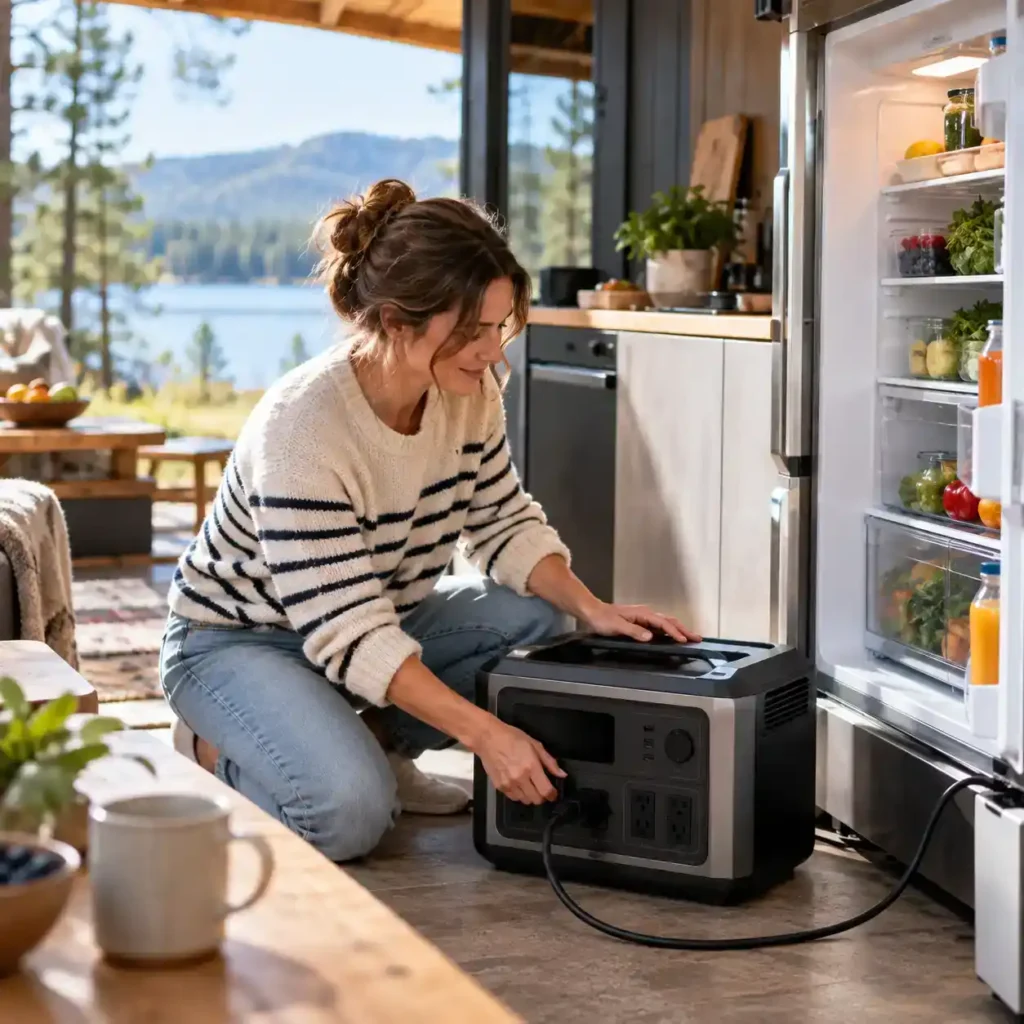
The key is to maintain a sustainable daily energy balance. The refrigerator consumes electricity throughout the day and night, while solar panels generate energy only when sunlight is available. The battery bridges this gap by storing energy for nighttime use and periods of reduced solar production.
To evaluate whether a solar setup can support continuous refrigerator operation, start with the refrigerator’s measured daily energy consumption, account for losses during charging, and estimate how much energy actually reaches the battery under your local conditions.
How Much Energy Must Solar Panels Generate Each Day?
Start with the refrigerator’s daily electricity consumption, expressed in Wh/day. This is the energy your solar setup must ultimately replace to sustain operation over multiple days.
However, the amount of energy the solar panels need to produce is higher than the refrigerator’s consumption at the AC outlet because energy is lost both when the battery powers the refrigerator and when solar energy is converted and stored.
For a practical estimate, distinguish between two quantities:
- Energy delivered by the solar panels: The electricity generated by the panels under actual sunlight conditions.
- Energy stored in the battery: The portion of that electricity that remains available after charging-path losses.
If you know how much energy reaches the battery, you can compare it directly with the energy the battery needs to supply the refrigerator. If you estimate panel production instead, you must account for charging losses and the station’s power-conversion efficiency.
For example, suppose your refrigerator consumes 1,200 Wh/day.
For illustration, assume the refrigerator requires approximately 1,412 Wh of battery-side energy per day to cover its 1,200 Wh daily AC consumption, accounting for an assumed 85% inverter efficiency. Separately, assume that 85% of the energy generated by the solar panels reaches the battery after charging losses. These are illustrative assumptions; actual efficiencies depend on the equipment and operating conditions.
The estimated solar energy required at the panel output would be:
Required solar energy = 1,412 Wh ÷ 0.85 ≈ 1,661 Wh/day
These are illustrative assumptions, not universal efficiency figures. Use your power station’s specifications and measured consumption wherever possible.
Why Rated Solar Watts Do Not Guarantee Daily Energy Production
Solar panels are rated in watts (W), which describe power under specified test conditions. Daily energy production, measured in Wh, depends on how much sunlight the panels receive and how effectively the system converts that sunlight into stored energy.
Several factors can cause actual production to differ from the rated output:
- Sunlight conditions: Cloud cover, haze, and changing weather reduce the energy available to the panels.
- Season and daylight hours: Shorter winter days can limit daily production compared with long summer days.
- Panel orientation and angle: Panels that are poorly positioned relative to the sun generally collect less energy.
- Shading: Trees, buildings, vehicle roofs, or even partial shading can reduce output.
- Temperature: Panel output varies with temperature and the characteristics of the panel.
Power station input limits: The station may limit solar charging based on its maximum input wattage, permitted voltage range, current limits, or other charging specifications.
Actual solar production depends on system design and installation conditions, not just the panels’ rated wattage. The U.S. Department of Energy’s Solar Photovoltaic System Design Basics explains key factors that affect solar system performance.
For these reasons, you should not multiply a panel’s rated wattage by an assumed number of daylight hours and treat the result as guaranteed daily energy. Real-world production varies, and the power station must also be compatible with the panels being used.
For a more detailed estimate of panel requirements under different conditions, use the Solar Panel Size Calculator.
Battery Capacity, Overnight Use, and Cloudy Days
Solar panels cannot generate electricity at night, so the battery must supply the refrigerator after daylight ends. It also provides a buffer when clouds, poor weather, or seasonal conditions reduce solar production.
Battery capacity and daily solar production therefore serve different purposes. The battery stores energy to cover periods when generation is unavailable, while the panels replenish that energy when sunlight returns.
Consider a simplified daily energy balance:
Daily energy balance = Energy added to the battery − Energy drawn from the battery
Suppose the refrigerator’s operation requires the battery to supply 1,412 Wh per day, and the solar system stores 1,500 Wh in the battery during a particular day.
Daily energy balance = 1,500 − 1,412 = +88 Wh/day
Under these illustrative conditions, the battery gains a small amount of energy over the day. The setup could theoretically sustain the refrigerator’s daily demand while maintaining a slight surplus, assuming other losses and loads have already been accounted for consistently.
Now suppose cloudy weather reduces the energy stored in the battery to 1,000 Wh:
Daily energy balance = 1,000 − 1,412 = −412 Wh/day
The battery loses approximately 412 Wh of stored energy that day. If this deficit continues, the battery will gradually discharge, even though solar panels remain connected.
The important distinction is that a positive daily energy balance under favorable conditions does not guarantee continuous operation during extended cloudy periods. The battery needs enough reserve to bridge temporary shortfalls, and the solar system must replenish the energy consumed over time.
For reliable 24/7 refrigerator operation, evaluate both the energy the panels can realistically deliver and the battery’s ability to cover nights and periods of insufficient sunlight.
You can then use the Solar Charging Time Calculator to estimate how long solar charging may take, based on your battery capacity, panel output, and expected system efficiency.
Can You Run a Refrigerator While the Power Station Is Charging?
Pass-Through Charging, AC Bypass, and UPS/EPS Modes
These terms describe related functions, but they are not interchangeable guarantees of uninterrupted refrigerator power.
- Pass-through charging: A station can support powering connected appliances while receiving energy from an external source. The way power is routed and whether the battery charges at the same time depend on the model.
- AC bypass: In a supported bypass mode, incoming AC power can supply connected loads without necessarily passing through the battery inverter in the usual way. The station’s design determines how it handles the load and what happens if the incoming supply is lost.
- UPS/EPS mode: Some stations offer an uninterruptible power supply (UPS) or emergency power supply (EPS) function that switches a connected load to battery power when grid power fails. The transfer behavior and supported loads vary by model.
Do not assume that a station supports all three functions simply because it can charge and power an appliance simultaneously.
Before choosing a model, review our guide on how to choose a portable power station to understand which specifications and operating features to compare.
Consult the manufacturer’s documentation for the specific model and confirm the permitted operating mode, AC output limits, and any restrictions on simultaneous charging and output.
What Happens If Grid Power Fails?
If your refrigerator must keep running when grid power disappears, the transition from external AC power to battery power becomes important.
Some stations can switch to battery output automatically, but the transition may involve a brief interruption. Check the documented transfer time for the exact operating mode rather than assuming the station provides zero-interruption power.
A refrigerator’s compressor may stop when power is interrupted. Whether it resumes normally depends on the refrigerator’s controls, compressor protection features, and the duration of the interruption. A station’s transfer specification alone does not guarantee that every refrigerator will continue operating without disruption.
Before relying on the arrangement during an outage:
- Confirm that the manufacturer explicitly supports the intended charging and output mode.
- Verify that the station can handle the refrigerator’s normal operating load and compressor startup demand.
- Check the documented transfer behavior if automatic backup is required.
- Test the complete setup under safe, controlled conditions before relying on it during a power outage.
The practical takeaway: Running a refrigerator while a power station charges can support continuous operation, but only when the station’s operating mode, load limits, and backup behavior match your requirements. If uninterrupted refrigeration is essential, verify the exact model’s documentation and test the refrigerator with the complete setup.
Why a Power Station May Not Run a Refrigerator for 24 Hours
If your refrigerator stops running before the expected time, the problem may be different from what your initial calculations suggest. Actual energy consumption, additional connected appliances, solar charging performance, and the power station’s operating limits can all affect the result.
Use the following troubleshooting guide to identify the likely cause and determine what to check.
Refrigerator Backup Troubleshooting Guide
| Symptom | Possible cause | What to check |
|---|---|---|
| The battery runs out earlier than expected. | The refrigerator consumes more energy than estimated, the usable battery energy is lower than assumed, or other appliances are drawing power. | Check the station’s recorded energy use, review the refrigerator’s actual consumption, and disconnect nonessential loads to see whether runtime improves. |
| The compressor does not start. | The inverter may not support the compressor’s startup demand, or the station may have an output limitation or protection setting that prevents startup. | Check the station’s continuous and surge output ratings, review any displayed warnings, and compare them with the refrigerator’s requirements. |
| Solar charging does not keep up with consumption. | Actual solar production may be lower than expected because of cloud cover, shading, panel positioning, or charging-input limitations. | Check the station’s real-time solar input, inspect panel placement and shading, and confirm that the panels operate within the station’s permitted solar input range. |
| Runtime drops when other appliances are connected. | Additional loads are consuming energy that would otherwise be available to the refrigerator. | Check which appliances are connected, review their energy use, and disconnect unnecessary devices to isolate the refrigerator’s demand. |
| The station shuts off or displays an error. | The station may be responding to an overload, temperature condition, low battery, charging restriction, or another protection event. | Read the exact error message, consult the manufacturer’s troubleshooting instructions, and check the station’s load, temperature, battery, and input conditions. |
How to Narrow Down the Problem
Start with the symptom rather than changing several settings at once.
- Check the station’s display. Look for battery level, output power, solar input, warning icons, or error codes.
- Disconnect other loads if safe to do so. This helps establish whether the refrigerator alone can operate as expected.
- Observe a compressor startup. If the refrigerator cannot start, check the inverter specifications and the station’s protection messages rather than repeatedly attempting to restart it.
If you need to check the refrigerator’s running load and startup demand more systematically, use the Appliance Wattage Calculator to help assess the wattage requirements.
- Compare solar input with actual consumption. If the battery level falls throughout the day, the incoming energy may not be sufficient to replace what the refrigerator uses.
- Follow the manufacturer’s instructions for errors. If the station repeatedly shuts down, smells unusual, becomes excessively hot, or shows signs of electrical damage, stop using it until the issue has been assessed safely.
Do not bypass overload protection, exceed the station’s specified input limits, or open the unit to investigate an internal fault.
The key diagnostic principle: Identify whether the problem is premature battery depletion, insufficient startup capability, inadequate recharging, additional loads, or a station protection event. Once the cause is isolated, you can decide whether the setup needs a different operating arrangement, fewer connected appliances, more effective recharging, or a power station better suited to the refrigerator.
Common Mistakes When Using a Power Station for 24/7 Refrigerator Backup
1. Choosing a Power Station Based on Battery Capacity Alone
A large battery does not guarantee that the inverter can handle the refrigerator’s running load and compressor startup surge.
What to do: Check the refrigerator’s running watts and startup requirements against the power station’s continuous and surge output ratings.
2. Assuming Rated Battery Capacity Equals Usable Energy
Some of the rated battery capacity is unavailable to the appliance because of conversion losses and the power station’s operating limits.
What to do: Use the manufacturer’s usable-energy specifications when estimating runtime, rather than relying on rated capacity alone.
3. Assuming Solar Panels Will Always Replenish the Battery
Actual solar production varies with sunlight, shading, weather, season, and system limitations.
What to do: Estimate daily solar energy production under realistic conditions and compare it with the refrigerator’s daily energy consumption.
4. Ignoring Charging and Output Compatibility
A power station may not support simultaneous charging and AC output in the way your setup requires.
What to do: Confirm the manufacturer’s pass-through charging or backup-power specifications and test the complete setup before relying on it.
5. Relying on Estimated Runtime Without Testing the Setup
Calculated runtime is an estimate; actual consumption and operating conditions can differ.
What to do: Test the refrigerator with the power station under representative conditions and monitor battery depletion over time.
Safety Checks Before Relying on a Power Station 24/7
Before relying on a portable power station to keep a refrigerator running continuously, verify that the complete setup can operate safely for the intended period. A station that has sufficient battery capacity may still be unsuitable if its inverter cannot handle compressor startup, its operating limits are exceeded, or its installation environment is inappropriate.
Use the checklist below before a planned outage or off-grid stay.
| Safety check | What to verify | Why it matters |
|---|---|---|
| Running and starting power | Confirm that the station’s continuous AC output supports the refrigerator’s running load and that its surge capability can handle compressor startup. | A refrigerator may fail to start even when its normal running wattage is within the station’s rating. |
| Load and operating mode | Check the station’s total load limit, permitted operating modes, and any restrictions on simultaneous charging and AC output. | Exceeding operating limits can trigger overload protection or shut down the output. |
| Ventilation and placement | Place the station in a dry, stable, well-ventilated location. Follow the manufacturer’s temperature limits and required clearances. Keep it away from water, excessive heat, and blocked air vents. | Poor ventilation, moisture, and unsuitable temperatures can affect safe operation and performance. |
| Cables and connections | Inspect cables, plugs, and connectors for damage, looseness, discoloration, or unusual heating. Use compatible cables and follow the manufacturer’s connection instructions. | Damaged or incompatible connections can create electrical and overheating hazards. |
| Solar input limits | If using solar panels, verify the array’s open-circuit voltage, operating current, and total input remain within the station’s specified limits. Account for the potential increase in panel voltage in cold weather. | Exceeding the permitted solar input voltage can damage the station. |
| Full-system test | Test the refrigerator, power station, cables, charging setup, and intended operating mode together before an outage. Check startup, normal operation, charging behavior, and estimated battery depletion. | A complete test can reveal compatibility or runtime problems before dependable power is needed. |
| Food safety during an outage | Keep refrigerator doors closed as much as possible and monitor food temperature during extended outages. Follow official food-safety guidance if refrigeration is interrupted. | Restoring power does not guarantee that perishable food remained at a safe temperature. |
Test the setup before you need it
A practical test should establish whether the refrigerator starts reliably, how much energy it actually consumes, and whether the battery and charging arrangement can support the intended duration. If you plan to use solar panels, test the charging setup under realistic conditions rather than assuming the panels will consistently deliver their rated output.
Do not assume that pass-through charging, UPS, or EPS functionality guarantees uninterrupted refrigerator operation. Confirm the specific model’s behavior and test it under the conditions you expect to encounter.
Important: Do not connect a portable power station directly to household wiring or a breaker panel using improvised cables or adapters. Supplying household circuits requires suitable transfer equipment and, where applicable, installation by a qualified electrician. Follow the power station manufacturer’s instructions.
For food safety, a closed refrigerator generally keeps food cold for approximately four hours during a power outage. For longer interruptions, monitor the actual temperature and consult the official FoodSafety.gov power outage guidance.
The key principle is simple: verify compatibility, test the complete system, and confirm that both the power supply and food-storage conditions remain safe before relying on 24/7 refrigerator backup.
Frequently Asked Questions
Can a 1,000Wh power station run a refrigerator for 24 hours?
It depends on the refrigerator’s daily energy consumption and the station’s usable battery capacity. A 1,000Wh station may run an efficient refrigerator for 24 hours, but it will not necessarily provide a full day of operation. Inverter losses and startup power requirements also matter.
How many watt-hours does a refrigerator use in 24 hours?
Many household refrigerators use roughly 1,000–2,000Wh per day, but actual consumption varies considerably by model, size, efficiency, and operating conditions. Check the appliance’s energy label or measure its consumption with a suitable energy monitor for a more reliable estimate.
Can a portable power station run a refrigerator overnight?
Yes, if the station has enough usable energy to cover the refrigerator’s consumption throughout the night and can handle compressor startup. A fully charged station may be sufficient for an overnight period, but runtime depends on the refrigerator and battery capacity.
Can solar panels keep a refrigerator running continuously?
Yes, a properly sized solar-and-battery system can support continuous operation when it generates enough usable energy to replace what the refrigerator consumes. Actual performance depends on sunlight, weather, seasonal conditions, charging losses, and battery capacity for nighttime or low-sun periods.
Can a power station run a refrigerator while charging?
Some power stations support simultaneous charging and AC output, but this depends on the model and operating mode. Check the manufacturer’s specifications to confirm that the station can power the refrigerator while charging and understand whether a brief power interruption can occur when the input supply changes.
Is it safe to leave a refrigerator connected to a power station all the time?
It can be safe when the station is designed for the intended operating mode, the refrigerator’s power requirements are within limits, and the equipment is used according to the manufacturer’s instructions. Ensure adequate ventilation, keep the station dry, inspect connections, and follow any restrictions on continuous operation or charging.
Final Verdict: What Makes 24/7 Refrigerator Backup Reliable?
Reliable 24/7 refrigerator backup starts with understanding how much energy your refrigerator actually uses—not simply choosing a power station with a large battery. The right setup must match the refrigerator’s daily energy needs, handle its operating and startup power requirements, and support recharging if you need to keep it running for multiple days.
Before choosing or relying on a system, follow these steps:
- Measure or estimate daily energy consumption. Use a suitable energy monitor for a more accurate estimate, or calculate an approximate daily figure from the refrigerator’s annual energy rating.
- Calculate the required battery capacity. Account for usable energy rather than assuming the station’s entire rated capacity is available to power the refrigerator.
- Verify the power output. Check that the station can support both the refrigerator’s running load and compressor startup, and confirm that its operating limits suit your intended setup.
- Determine whether recharging is necessary. For operation beyond a single battery charge, assess whether AC or solar charging can replenish enough energy to meet the refrigerator’s ongoing consumption.
- Test the complete setup. Confirm that the refrigerator starts reliably, the station operates as expected, and the estimated runtime is sufficient before an outage occurs.
The final decision comes down to matching energy consumption, usable battery capacity, power output, and recharge capability to your actual requirements. A system that meets these conditions is a much more dependable choice for keeping a refrigerator running continuously than one selected on battery capacity alone.
If you’re ready to compare specific models against these requirements, explore our guide to the best portable power stations for refrigerator backup.