
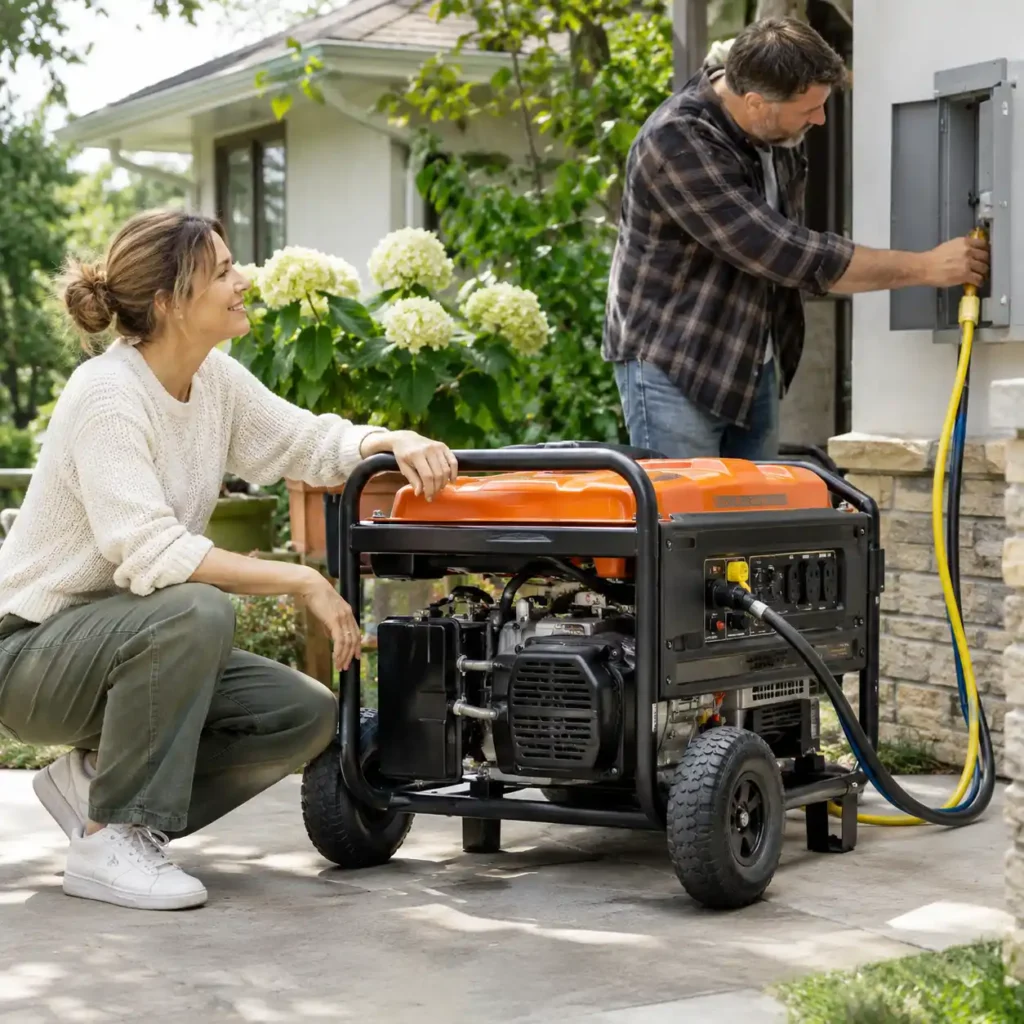
Choosing the best tri-fuel generators for home backup involves more than comparing advertised wattage. A generator can deliver substantially different running and starting power on gasoline, propane, and natural gas, so the fuel you plan to use most often directly affects how much capacity is available. Natural gas adds another consideration: the generator’s output must be evaluated alongside the supply pressure and BTU requirements of the home’s gas line.
This guide evaluates five tri-fuel generators across all three fuel types, with attention to running watts, starting capacity, home-backup connections, fuel requirements, safety features, and practical trade-offs. Unlike general generator roundups, our comparison focuses on fuel-specific output and the requirements for connecting a generator to a home, helping buyers choose a model that matches their primary fuel and backup-power needs.
As an Amazon Associate, I earn from qualifying purchases.
Table of Contents
Quick Answer
This guide compares five selected conventional open-frame portable tri-fuel generators for residential backup: the WEN TF1450X, DuroMax XP13000HXT, Champion 201438, Westinghouse WGen9500TFc, and Generac GP9500E TF 50ST. Each model can operate on gasoline, propane, or natural gas, but its available running and starting power varies by fuel.
Rather than treating advertised peak wattage as the deciding factor, we compare the running and starting watts each generator delivers on all three fuels, along with its 120V/240V output, natural gas connection requirements, included accessories, safety features, portability, and practical home-connection considerations. This helps identify which model is better suited to essential-circuit, partial-home, or more demanding residential backup.
This is a focused comparison of five selected conventional portable tri-fuel models, not an exhaustive ranking of every tri-fuel generator available. Buyers who prioritize quieter operation, cleaner inverter-generated power, or better efficiency at variable loads may also want to consider an inverter tri-fuel generator. Those models belong to a different product segment and are not included in this comparison.
Our Evidence & Evaluation Method
We evaluate five selected conventional open-frame portable tri-fuel generators for residential backup by examining how each model performs on gasoline, propane, and natural gas according to its published specifications. Because a generator’s available output can change significantly depending on the fuel used, we compare fuel-specific running and starting watts rather than relying on a single advertised wattage figure. This is a focused comparison of the selected models, not an exhaustive ranking of every tri-fuel generator available.
Our evaluation also considers the practical requirements of connecting and operating a generator during a power outage. We review manufacturer specifications, official product documentation, and owner’s manuals, and use clearly identified calculations where appropriate. We do not present manufacturer ratings or calculated estimates as independent test results.
| Evaluation Factor | What We Examine | Evidence |
|---|---|---|
| Fuel-Specific Output | Running and starting watts on gasoline, propane, and natural gas | Manufacturer specifications and official manuals |
| Home Backup Compatibility | 120/240V output, outlets, transfer-switch compatibility, and connection requirements | Manufacturer documentation and manuals |
| Natural Gas and Fuel Requirements | Gas pressure, BTU capacity, supported fuels, included hoses, regulators, and adapters | Manufacturer specifications and manuals |
| Runtime | Published runtime at specified loads and fuel conditions; clearly identified calculations | Manufacturer data and calculations |
| Safety Features | CO detection and shutdown, low-oil protection, GFCI, and other documented safeguards | Manufacturer documentation |
| Portability, Warranty and Value | Weight, dimensions, noise, included equipment, warranty coverage, and practical purchase considerations | Product specifications and warranty terms |
Conventional vs. Inverter Tri-Fuel Generators
The five generators reviewed in this guide are conventional open-frame models. This category may suit homeowners who prioritize substantial backup power and are comfortable with the operating characteristics of conventional generators.
An inverter tri-fuel generator may be a better option for buyers who place greater importance on quieter operation, cleaner and more stable electrical output for sensitive electronics, or improved fuel efficiency under lighter and changing loads. Inverter technology allows engine speed to adjust to electrical demand, although actual noise levels, power quality, efficiency, and available output vary by model.
Inverter tri-fuel generators are outside the scope of this comparison. Buyers specifically interested in inverter technology should evaluate that category separately rather than assume that the conventional models reviewed here represent the entire tri-fuel market.
Who This Guide Is For

This guide is for homeowners comparing portable tri-fuel generators for backup power and deciding whether gasoline, propane, or natural gas best fits their needs. It focuses on fuel-specific power output, natural gas supply requirements, home connection options, and the practical differences between five selected models.
Who Should Read This
Homeowners who want one generator that can operate on gasoline, propane, and natural gas.
Buyers comparing running watts across all three fuel types before choosing a generator.
Households considering natural gas operation and needing to understand gas pressure and BTU requirements.
Buyers looking for a portable generator with 120/240V output and compatibility with a properly installed home transfer switch or interlock system.
Who Should Use Another Guide
For calculating generator size for your home or selected appliances, use our Generator Size Calculator or Whole House Load Calculator.
For gasoline-and-propane generators without natural gas capability, see our Best Dual Fuel Generators guide.
For permanently installed automatic backup systems, read our Best Standby Generators for Home Backup guide.
For help choosing a transfer switch or interlock, consult our Best Transfer Switches for Generators guide.
Quick Summary: Our Top Tri-Fuel Generator Picks
WEN TF1450X
Award: Best for Maximum Gasoline and Propane Output
Best For: Homeowners who prioritize high running output on gasoline or propane for residential backup power.
Key Reason: Its 14,500 starting watts and 11,500 running watts on gasoline, along with 10,300 running watts on propane, make it the highest-output option on these two fuels among the five selected models.
Main Limitation: The natural gas hose is sold separately.
DuroMax XP13000HXT
Award: Best for Homes with a High-Capacity Natural Gas Supply
Best For: Homeowners whose natural gas supply can meet the generator’s substantial full-load fuel requirements.
Key Reason: Its 9,000 running watts on natural gas give it the highest published natural gas output among the five selected generators.
Main Limitation: Requires 225,000 BTU at full load and is not CARB-certified or 50-state compliant.
Champion 201438
Award: Best for a Ready-to-Connect Natural Gas Setup
Best For: Buyers who want a tri-fuel generator supplied with a natural gas hose kit for a more straightforward connection setup.
Key Reason: Its included 25-foot natural gas hose kit and LPG hose reduce the need to purchase basic fuel connections separately.
Main Limitation: Its 14-50R outlet is rated for 42A, not 50A.
Westinghouse WGen9500TFc
Award: Best for Remote-Start Convenience During Home Backup
Best For: Homeowners who value remote starting and convenient operation during a power outage.
Key Reason: Remote key-fob starting, a VFT display, and 120/240V output make it a practical option for users who want convenient controls and home-backup connectivity.
Main Limitation: Its total harmonic distortion (THD) is rated at up to 23%, and natural gas hose inclusion is not confirmed for the current package.
Generac GP9500E TF 50ST (Model 8061)
Award: Best 50-State Option with EFI and CO Monitoring
Best For: Buyers prioritizing a 50-state-compliant configuration, electronic fuel injection, and carbon monoxide monitoring.
Key Reason: Its 500 cc engine with EFI, COsense protection, and compatibility with the Generac HomeLink manual transfer switch provide a distinctive combination of features. It delivers 9,500 running watts on gasoline, 8,550 watts on propane, and 7,000 watts on natural gas.
Main Limitation: Its natural gas output is the lowest among the five selected models at 7,000 running watts. Buyers planning to use natural gas as their primary fuel should compare this capacity with their intended household loads.
Best Tri-Fuel Generators for Home Backup: Comparison Table
| Model | Gasoline Running Watts | Propane Running Watts | Natural Gas Running Watts | Weight |
|---|---|---|---|---|
| WEN TF1450X | 11,500 W | 10,300 W | 8,750 W | 224.9 lb |
| DuroMax XP13000HXT | 10,500 W | 10,000 W | 9,000 W | 240 lb |
| Champion 201438 | 10,000 W | 9,000 W | 8,000 W | 231 lb |
| Westinghouse WGen9500TFc | 9,500 W | 8,500 W | 7,500 W | 215 lb |
| Generac GP9500E TF 50ST (8061) | 9,500 W | 8,550 W | 7,000 W | 227 lb |
How We Evaluated the Best Tri-Fuel Generators
We evaluated the five tri-fuel generators using six consistent criteria focused on their suitability for residential backup power. Rather than ranking models by advertised peak wattage or assigning arbitrary numerical scores, we compared their published specifications, fuel requirements, electrical compatibility, and practical ownership considerations.
Our evaluation focuses on one central question: how well does each generator meet a homeowner’s backup-power needs when operating on gasoline, propane, or natural gas?
1. Fuel-Specific Output
We compared published running and starting watts on all three fuels. Running watts determine the continuous power available, while starting watts indicate the additional short-term capacity available for starting motor-driven appliances.
We also calculated the percentage reduction in running output when switching from gasoline to propane or natural gas. This helps identify which models retain more of their rated capacity on alternative fuels and which provide the strongest output for a particular fuel choice.
2. Home Electrical Compatibility
We examined 120V and 240V output, available receptacles, outlet amperage, and documented compatibility with residential transfer switches or interlock systems.
This criterion helps establish whether a generator can support the type of household connection being considered. We distinguish between supplying selected essential circuits, supporting a broader group of household loads, and providing enough capacity for a more extensive home-backup arrangement.
3. Fuel Infrastructure Requirements
We reviewed each model’s natural gas pressure and flow requirements, supported fuel types, and included connection equipment. Where published, we compared pressure specifications in inches of water column (in. WC) and fuel demand in BTU per hour.
We also checked whether propane hoses, natural gas hoses, regulators, and adapters are included or require separate purchase. These details matter because an available household gas connection does not automatically guarantee sufficient capacity for generator operation.
4. Runtime and Fuel Readiness
We compared manufacturer-published runtime figures at their specified loads and fuel conditions. We considered gasoline tank capacity, propane cylinder requirements, and whether natural gas runtime information is available.
Because runtime figures depend on load and fuel conditions, we do not treat results measured at different loads or with different tank sizes as directly equivalent. Where manufacturers do not publish a runtime figure for a particular fuel, we identify that limitation rather than estimating one.
5. Portability and Operating Practicality
We assessed published weight, dimensions, wheel and handle configurations, and noise ratings. These factors help determine how practical each generator is to store, reposition, and accommodate in a suitable outdoor operating location.
A generator may offer substantial output but still require considerable space and planning because of its weight and physical dimensions. We therefore consider portability as a practical ownership factor, not simply a specification to compare in isolation.
6. Ownership Considerations
We reviewed warranty coverage, included accessories, additional equipment requirements, and documented compliance information. This includes components that may need to be purchased separately, such as fuel hoses, connection fittings, and home-backup equipment.
We also consider whether a model’s regional emissions certification and configuration suit the buyer’s location. These details can affect the total cost and practicality of preparing a generator for home backup.
How These Criteria Shape Our Assessment
Each generator is evaluated against the same six criteria, but the importance of individual features depends on the intended use. A homeowner relying primarily on natural gas may place greater importance on natural gas output and supply requirements, while someone prioritizing gasoline or propane may value a different combination of capacity, runtime, and fuel readiness.
Our recommendations therefore reflect each model’s documented strengths and limitations rather than a universal numerical score. We do not claim independent performance testing: output figures, runtime specifications, and equipment details are based on manufacturer documentation, while clearly identified percentage comparisons are calculated from published ratings.
What to Look for in a Tri-Fuel Generator for Home Backup
Choosing a tri-fuel generator for home backup requires checking more than its advertised wattage. The fuel you plan to use, your home’s electrical setup, and the available gas supply all affect whether a particular model will meet your backup-power needs. Before comparing individual generators, pay attention to these seven factors.
Running Watts on Your Primary Fuel
Start with the generator’s running watts on the fuel you expect to use most often. Tri-fuel models do not deliver the same continuous output on gasoline, propane, and natural gas, so a generator’s highest advertised rating may not reflect its actual capacity on your preferred fuel.
Compare the published running watts for that specific fuel with the combined operating requirements of the appliances and circuits you intend to power. If natural gas will be your primary fuel, use the natural gas rating rather than the gasoline figure when assessing capacity.
120V/240V Output and Transfer-Switch Compatibility
Check whether the generator provides 120/240V output and the receptacles required for your intended home-backup connection. Many residential backup applications use a 120/240V connection, but the presence of a suitable outlet alone does not establish compatibility with every transfer switch or interlock.
Confirm the generator’s outlet type and amperage, the transfer equipment’s specifications, and the electrical requirements of your home. A properly installed transfer switch or approved interlock is necessary to connect a portable generator to household circuits safely. Never connect a generator directly to a household wall outlet.
Natural Gas Connection Requirements
Natural gas operation depends on more than whether a generator has a natural gas inlet. Check the manufacturer’s specified supply pressure, measured in inches of water column (in. WC), and the required gas flow capacity, usually expressed in BTU per hour.
Your home’s gas line must be capable of supplying the required pressure and volume under the intended operating conditions. Other gas appliances sharing the line can affect available capacity. If the supply requirements are uncertain, have a qualified professional assess the gas system before purchasing or connecting the generator.
Included Hoses, Regulators and Accessories
Do not assume that every tri-fuel generator includes all the equipment needed to connect all three fuel sources. Package contents vary by model.
Check whether the generator includes:
A propane hose and regulator.
A natural gas hose or quick-connect adapter.
Required fittings and connection adapters.
Battery, wheel kit, and other setup components where applicable.
Pay particular attention to natural gas hoses. A generator may support natural gas operation while requiring the buyer to purchase the hose separately. Confirm the contents of the exact retail package rather than relying only on general product descriptions or accessories listed in a manual.
Total Cost of Ownership and Fuel Readiness
The purchase price of a tri-fuel generator does not necessarily represent the total cost of preparing it for home backup. Depending on the model and the home’s existing electrical and gas infrastructure, additional equipment, installation work, and fuel storage arrangements may be required before the generator is ready to use.
Before comparing prices, account for the following potential expenses:
Fuel hoses and adapters: Some generators include propane and natural gas connection equipment, while others require separately purchased hoses, regulators, quick-connect fittings, or adapters.
Transfer switch or interlock: Connecting a portable generator to selected household circuits requires compatible transfer equipment. The equipment needed depends on the home’s electrical panel and planned backup configuration.
Generator inlet box and power cord: A suitable outdoor generator inlet and correctly rated power cord may be necessary for a permanent household connection setup.
Professional installation: Electrical work, transfer equipment installation, and any required permits can add to the initial cost.
Natural gas line preparation: An existing gas connection may require professional assessment, piping modifications, or capacity upgrades to meet the generator’s pressure and fuel-flow requirements.
Fuel storage and maintenance: Gasoline requires suitable storage containers and periodic fuel rotation. Propane requires appropriate cylinders or tank capacity. Both fuel options involve planning for availability, storage, and maintenance.
Fuel Independence: What Does Tri-Fuel Capability Actually Provide?
One of the main advantages of a tri-fuel generator is the ability to choose between gasoline, propane, and natural gas. This flexibility can reduce dependence on a single fuel source, but it does not automatically make a household independent of fuel availability or infrastructure.
Gasoline and propane require homeowners to maintain an adequate stored supply or arrange refueling during an extended outage. Natural gas can reduce the need for on-site fuel storage and manual refueling when utility service remains available. However, it depends on the continued availability of the gas supply and a household connection capable of meeting the generator’s requirements.
The practical value of three-fuel capability therefore depends on which fuels are accessible, how much backup fuel can be stored, and whether the home can support natural gas operation. Buyers should evaluate these factors before paying extra for fuel flexibility they may not realistically use.
A more useful comparison considers not just the generator’s purchase price, but the complete setup required for the intended fuel and home connection. The least expensive generator may not be the least expensive solution once additional equipment and installation requirements are included.
CO Protection and Other Safety Features
Look for a documented carbon monoxide (CO) detection and shutdown system, which can help reduce the risk of continued operation when dangerous CO levels are detected. Also check for low-oil shutdown, GFCI-protected outlets, and other safety features listed by the manufacturer.
These systems provide additional protection, but they do not replace safe generator placement and operation. Portable generators must always run outdoors, away from windows, doors, and other openings, following the manufacturer’s clearance instructions. Never operate one inside a home, garage, or other enclosed or partially enclosed space.
Our Top Tri-Fuel Generator Reviews
WEN TF1450X Tri-Fuel Generator
Best for Maximum Gasoline and Propane Output

Quick Verdict
The WEN TF1450X is a high-output tri-fuel portable generator designed for homeowners who want substantial backup power with the flexibility to operate on gasoline, propane, or natural gas. It delivers 11,500 running watts on gasoline and 10,300 watts on propane, making it the highest-output option among our five selected models on these two fuels.
This model is particularly suitable for households that plan to rely primarily on gasoline or propane and need a generator capable of supporting multiple household circuits during an outage. Its 120/240V output and transfer-switch-ready configuration also make it relevant for residential backup setups, while natural gas operation provides an additional fuel option when the required connection equipment is available.
Snapshot
| Specification | WEN TF1450X |
|---|---|
| Gasoline Running Output | 11,500 W |
| Propane Running Output | 10,300 W |
| Natural Gas Running Output | 8,750 W |
| Starting Output (Gasoline) | 14,500 W |
| Engine | 500 cc, 4-stroke OHV |
| Fuel Types | Gasoline, propane, natural gas |
| Voltage | 120/240V |
| Fuel Tank Capacity | 8.2 gallons |
| Weight | 224.9 lb (with wheel kit) |
Why We Chose It
The WEN TF1450X earns the Best for Maximum Gasoline and Propane Output award because it delivers 11,500 running watts on gasoline and 10,300 watts on propane. Both figures are higher than the corresponding published ratings of the other four generators in our shortlist, making it the strongest option for buyers prioritizing output on either of these two fuels.
The distinction matters when gasoline or propane is expected to serve as the primary backup fuel. Although the DuroMax XP13000HXT delivers higher natural gas output, the WEN provides more continuous power on gasoline and propane. This makes its award specific to those two fuel priorities rather than an overall ranking across all three fuel types.
Check the latest price and customer reviews on Amazon.

Practical Considerations
The WEN TF1450X is a substantial portable generator, weighing 224.9 lb with its wheel kit. Its wheels and handles make it easier to reposition across a driveway or other relatively level surface, but its weight and overall size mean it needs a dedicated outdoor storage and operating area. Before purchasing, consider where it will be stored and how it will be moved into position during an outage.
For homeowners with a suitable outdoor location, the TF1450X can serve as a central backup source for selected household circuits through a properly installed transfer switch. Its three-fuel capability provides flexibility when gasoline or propane is the preferred backup option. However, natural gas operation requires a separately purchased hose, so switching to that fuel involves an additional equipment purchase rather than an immediately ready connection.
Evaluation
| Evaluation Factor | This Model | How It Compares | Buyer Implication |
|---|---|---|---|
| Fuel-Specific Output | 11,500 W gasoline / 10,300 W propane / 8,750 W natural gas | Highest gasoline and propane running output among the five selected models | Provides greater continuous capacity when gasoline or propane is the primary fuel |
| Natural Gas Requirements | 8,750 W running output; NG hose sold separately | Lower natural gas output than the DuroMax XP13000HXT (9,000 W) | Suitable for natural gas backup, but buyers must source the required hose separately |
| Home Backup Connections | 120/240V; L14-30R and 14-50R outlets | Offers connections used in residential backup setups | Supports connection to compatible transfer equipment, subject to electrical ratings and installation requirements |
| Portability and Runtime | 224.9 lb with wheel kit; up to 12 hours at 50% load on gasoline | Heavier than the Westinghouse WGen9500TFc (215 lb), but lighter than the DuroMax XP13000HXT (240 lb) | Wheels help with repositioning, but moving and storing it still requires planning |
Who Should Buy This
Homeowners who need high running output and plan to use gasoline as their primary backup fuel.
Buyers who prefer propane but still want the option to run on gasoline or natural gas.
Households with selected circuits requiring substantial 120/240V backup capacity and compatible transfer equipment.
Buyers with adequate outdoor storage space who can accommodate a heavy generator weighing 224.9 lb.
Who Should Skip This
- Buyers who need the highest available natural gas output should consider the DuroMax XP13000HXT, which delivers 9,000 running watts on natural gas.
Homeowners who want a natural gas hose included should consider the Champion 201438, which comes with a 25-foot NG hose kit.
Buyers who need a lighter generator for easier handling may prefer the Westinghouse WGen9500TFc, which weighs 215 lb.
Final Verdict
The WEN TF1450X is a strong choice for homeowners who prioritize high continuous output on gasoline or propane and want the flexibility of a third fuel option. Its main advantage is the highest running output on both gasoline and propane among the five selected generators. The trade-off is its substantial weight and the need to purchase a natural gas hose separately. Choose it if gasoline or propane output is your priority; consider another model if natural gas readiness or easier handling matters more.
Check the latest price and customer reviews on Amazon.
Related Guide: Planning to connect your generator to your home’s electrical system? See our guide to Best Transfer Switches for Generators (2026)
DuroMax XP13000HXT Tri-Fuel Generator
Best for Homes with a High-Capacity Natural Gas Supply

Quick Verdict
The DuroMax XP13000HXT is a high-output tri-fuel portable generator designed for homeowners who want substantial backup power and the flexibility to operate on gasoline, propane, or natural gas. It delivers 10,500 running watts on gasoline, 10,000 watts on propane, and 9,000 watts on natural gas, giving it the highest published natural gas running output among the five generators in our comparison.
This model is particularly relevant for households planning to use an existing natural gas connection during extended outages. Its 120/240V output, remote start, and included 15-foot natural gas hose make it suitable for certain residential backup setups. However, its substantial natural gas demand and lack of 50-state compliance are important considerations before purchasing.
Snapshot
| Specification | DuroMax XP13000HXT |
|---|---|
| Gasoline Running Output | 10,500 W |
| Propane Running Output | 10,000 W |
| Natural Gas Running Output | 9,000 W |
| Starting Output (Gasoline) | 13,000 W |
| Engine | 500 cc OHV |
| Voltage | 120/240V |
| Weight | 240 lb (dry) |
Why We Chose It
The DuroMax XP13000HXT earns the Best for Homes with a High-Capacity Natural Gas Supply award because its 9,000 running watts on natural gas exceed the published natural gas output of every other generator in our five-model shortlist. This makes it particularly relevant to homeowners who want to rely on natural gas without giving up as much continuous output as they would with lower-rated alternatives.
Its advantage comes with a specific infrastructure requirement: the manufacturer specifies 6–9 inches of water column pressure and 225,000 BTU at full load. The Champion 201438, for example, requires a lower published minimum gas flow of 130,000 BTU/hr, although it also delivers less natural gas output. The DuroMax is therefore the more suitable choice when higher natural gas capacity is the priority and the home’s gas supply can support its requirements.
Check the latest price and customer reviews on Amazon.

Practical Considerations
The DuroMax XP13000HXT is a large generator measuring approximately 30 × 29 × 26 inches and weighing 240 lb dry. Its wheel and handle kit helps with repositioning, but this is not a unit most homeowners will want to move frequently or handle alone. Plan for a dedicated outdoor operating area with adequate clearance and a suitable storage location. Its published noise rating of 74 dB is also worth considering when choosing where to position it.
For extended home-backup use, the 8.3-gallon gasoline tank provides up to 17 hours of runtime at 25% load or 8.5 hours at 50% load. On propane, the published figures are up to 13 hours at 25% load and 6.5 hours at 50% load. Natural gas runtime is not published. The main practical consideration is the gas supply: operating at full load requires 225,000 BTU and 6–9 inches of water column pressure. A household connection that cannot meet these requirements may prevent the generator from delivering its rated natural gas output.
Evaluation
| Evaluation Factor | This Model | How It Compares | Buyer Implication |
|---|---|---|---|
| Fuel-Specific Output | 10,500 W gasoline / 10,000 W propane / 9,000 W natural gas | Highest published natural gas running output among the five selected models | Offers the strongest natural gas output in this comparison, provided the gas supply is sufficient |
| Natural Gas Requirements | 6–9 in. WC; 225,000 BTU at full load | Higher published full-load BTU requirement than the Champion 201438, which specifies 130,000 BTU/hr minimum | Requires careful verification of household gas-line capacity before purchase |
| Runtime | Up to 17 hours at 25% load on gasoline; up to 13 hours at 25% load on propane | Published runtime varies by fuel and load; natural gas runtime is not published | Provides useful published runtime information for gasoline and propane planning, but not for estimating NG runtime |
| Portability and Operating Conditions | 240 lb dry; 74 dB; wheel and handle kit | Heaviest of the five selected generators | Better suited to a planned, relatively permanent outdoor position than frequent relocation |
Who Should Buy This
Homeowners with a natural gas supply capable of meeting the generator’s 225,000 BTU full-load requirement and 6–9 in. WC pressure specification.
Buyers who want the highest published natural gas running output among these five models.
Households that need substantial 120/240V backup capacity and have compatible, professionally installed transfer equipment.
Buyers who can accommodate a 240 lb generator in a dedicated outdoor operating and storage area.
Who Should Skip This
Buyers whose natural gas supply cannot meet the required pressure and BTU capacity should consider a model with lower natural gas requirements, such as the Champion 201438.
California buyers and others requiring a CARB-certified, 50-state-compliant generator should choose a compliant alternative; this DuroMax model is not 50-state compliant.
Homeowners who need a lighter generator for frequent repositioning may prefer the Westinghouse WGen9500TFc.
Final Verdict
The DuroMax XP13000HXT makes the most sense for homeowners who have verified that their natural gas infrastructure can support its high fuel demand and want to retain substantial output during an outage. Its natural gas rating is a meaningful advantage, but it should not be treated as an automatic benefit for every home: the gas supply must be capable of delivering the specified pressure and flow. If that requirement is met and the generator’s regional compliance status is suitable, it is a strong candidate for high-capacity residential backup.
Check the latest price and customer reviews on Amazon.
Related Guide: Planning your home’s backup-power capacity? Use our Generator Size Calculator to estimate the generator output needed for your essential appliances and household loads.
Champion 201438 Tri-Fuel Generator
Best for a Ready-to-Connect Natural Gas Setup

Quick Verdict
The Champion 201438 is a 10,000-watt tri-fuel portable generator designed for homeowners who want the flexibility to run on gasoline, propane, or natural gas. It delivers 10,000 running watts on gasoline, 9,000 watts on propane, and 8,000 watts on natural gas, providing substantial output for residential backup applications.
Its main appeal is the included fuel-connection equipment, particularly the 25-foot natural gas hose kit and LPG hose. This makes it a practical option for homeowners who intend to use an existing natural gas connection and want fewer accessories to source separately before setting up their backup generator.
Snapshot
| Specification | Champion 201438 |
|---|---|
| Gasoline Running Output | 10,000 W |
| Propane Running Output | 9,000 W |
| Natural Gas Running Output | 8,000 W |
| Starting Output (Gasoline) | 12,500 W |
| Engine | 500 cc, 4-stroke |
| Voltage | 120/240V |
| Weight | 231 lb |
Why We Chose It
The Champion 201438 earns the Best for a Ready-to-Connect Natural Gas Setup award because it includes a 25-foot natural gas hose kit with adapter fittings, as well as a 6.5-foot LPG hose with regulator. Among the five selected generators, this package makes it particularly convenient for buyers who want the basic fuel-connection equipment supplied with the generator rather than having to source a natural gas hose separately.
Its natural gas requirements also distinguish it from the DuroMax XP13000HXT. Champion specifies 5–7 inches of water column pressure and a minimum flow rate of 130,000 BTU/hr, compared with the DuroMax’s 225,000 BTU requirement at full load. The DuroMax delivers higher natural gas output, but the Champion may be a more practical fit for homes with a natural gas supply that cannot support the DuroMax’s higher demand.
Check the latest price and customer reviews on Amazon.

Practical Considerations
The Champion 201438 weighs 231 lb and measures approximately 29 × 28.5 × 25.8 inches. Its wheel kit helps with repositioning, but its size and weight still require a planned outdoor storage and operating location. With a published noise rating of 74 dB(A), placement also matters when considering proximity to living areas and neighboring properties.
For household backup, its 7.7-gallon gasoline tank provides up to 8 hours of runtime at 50% load. On propane, the published runtime is up to 3 hours at 50% load using a 20 lb tank. Natural gas runtime is not published. Although the included 25-foot hose simplifies the connection setup, the home’s gas supply must still meet the generator’s specified pressure and flow requirements. One additional electrical detail to check is the 14-50R receptacle: it is rated for 42A, not 50A.
Evaluation
| Evaluation Factor | This Model | How It Compares | Buyer Implication |
|---|---|---|---|
| Fuel-Specific Output | 10,000 W gasoline / 9,000 W propane / 8,000 W natural gas | Lower output than the WEN TF1450X and DuroMax XP13000HXT on all three fuels | Provides substantial backup capacity but is not the highest-output option in this group |
| Natural Gas Requirements | 5–7 in. WC; 130,000 BTU/hr minimum | Lower published full-load gas requirement than the DuroMax XP13000HXT, which specifies 225,000 BTU | May suit homes with a more limited natural gas supply, provided the required pressure and flow are available |
| Included Fuel Accessories | 25-ft natural gas hose kit with adapters; 6.5-ft LPG hose with regulator | More complete documented natural gas connection package than the WEN TF1450X, which requires a separately purchased NG hose | Reduces the need to source basic fuel-connection equipment separately |
| Home Backup Connections | 120/240V; L14-30R and 14-50R rated at 42A | Provides residential connection options, but the 14-50R is not rated for a full 50A | Buyers must match the outlet rating and generator capacity to their transfer equipment |
Who Should Buy This
Homeowners who want a tri-fuel generator with a natural gas hose kit and LPG hose included.
Buyers whose natural gas supply can meet the specified 5–7 in. WC pressure and 130,000 BTU/hr minimum flow requirement.
Households that need 120/240V output for a compatible residential transfer-switch setup.
Buyers who prefer to have basic fuel-connection accessories supplied with the generator rather than purchased separately.
Who Should Skip This
Buyers who need the highest gasoline or propane output should consider the WEN TF1450X.
Homeowners with a natural gas supply capable of supporting 225,000 BTU at full load may prefer the higher natural gas output of the DuroMax XP13000HXT.
Buyers whose transfer equipment requires a genuine 50A connection should not assume this model’s 14-50R receptacle provides 50A; its rating is 42A.
Final Verdict
The Champion 201438 is a sensible choice for homeowners who value a more complete fuel-connection package and whose natural gas supply meets its published requirements. Its strongest buying advantage is the included 25-foot natural gas hose kit, which reduces accessory sourcing before installation. The trade-off is that its output is lower than the leading alternatives on all three fuels, and its 14-50R outlet is rated at 42A. Choose it for connection convenience rather than maximum generator capacity.
Check the latest price and customer reviews on Amazon.
Related Guide: Considering a generator that runs on fewer fuel types? See our guide to Best Dual Fuel Generators (2026) to compare gasoline-and-propane models for home backup, RVs, and camping.
Westinghouse WGen9500TFc Tri-Fuel Generator
Best for Remote-Start Convenience During Home Backup

Quick Verdict
The Westinghouse WGen9500TFc is a conventional open-frame tri-fuel generator for homeowners who need substantial backup power and want the flexibility to use gasoline, propane, or natural gas. Its running output ranges from 9,500 watts on gasoline to 7,500 watts on natural gas, so buyers should account for the lower output when planning to run it on their preferred backup fuel.
Its standout convenience feature is remote starting with an included key fob. Combined with electric and recoil starting, this gives owners several ways to start the generator during an outage. The WGen9500TFc is best suited to households that value remote-start convenience and need 120/240V output for compatible residential backup connections.
Snapshot
| Key Specification | Details |
|---|---|
| Running Watts (Gasoline / Propane / NG) | 9,500 / 8,500 / 7,500 W |
| Starting Watts (Gasoline / Propane / NG) | 12,500 / 11,200 / 9,500 W |
| Engine | 457 cc, 4-stroke OHV |
| Voltage | 120/240V |
| Weight (Dry) | 215 lb |
| Starting System | Remote key fob, electric, recoil |
Why We Chose It
We chose the Westinghouse WGen9500TFc for its remote-start capability, which distinguishes it from several other generators in this comparison. The included key fob allows the owner to start the unit from a distance, provided the generator is positioned in its designated outdoor operating area. This can make startup more convenient when the generator is set up away from the house.
The WGen9500TFc does not lead this group in fuel-specific power output: its 9,500-watt gasoline rating and 7,500-watt natural gas rating are below those of several competing models. Instead, its appeal lies in combining three-fuel operation with remote, electric, and recoil starting. The VFT display adds useful operating information, including voltage, frequency, and accumulated hours, giving owners a convenient way to monitor the generator.
Check the latest price and customer reviews on Amazon.

Practical Considerations
At 215 lb dry, the Westinghouse WGen9500TFc is the lightest of the five generators in our comparison, although it is still too heavy for frequent manual moving. Its wheel kit and handle help with repositioning on suitable surfaces. Measuring approximately 27.2 × 26.1 × 26.5 inches, it has a published noise rating of 74 dBA. Buyers should plan a suitable outdoor location with adequate clearance and ventilation.
The 6.6-gallon gasoline tank provides up to 12 hours of runtime at 25% load or 8 hours at 50% load. On propane, runtime is up to 7 hours at 50% load with a 20-lb tank; natural gas runtime is not published. The generator’s THD is up to 23%, so buyers should not expect inverter-level power quality. Finally, the product page and owner’s manual differ on whether a natural gas hose is included. Confirm the exact package contents before purchasing.
Evaluation
| Evaluation Factor | This Model | How It Compares | Buyer Implication |
|---|---|---|---|
| Remote-Start Convenience | Key-fob remote start, electric start, and recoil backup | Offers remote-start convenience not listed among the key features of the other selected models | Allows homeowners to start the generator without approaching the unit |
| Fuel-Specific Output | 9,500 W gasoline / 8,500 W propane / 7,500 W natural gas | Lower output than WEN, DuroMax, and Champion on all three fuels; matches Generac on gasoline | Suitable for substantial backup loads, but compare fuel-specific output with your required capacity |
| Home Backup Connections | 120/240V; L14-30R and 14-50R outlets; Smart Switch outlet for Westinghouse ST Switch | Provides multiple connection options, including compatibility with the separately sold Westinghouse ST Switch | Supports suitable residential backup configurations when matched with compatible transfer equipment |
| Runtime and Power Quality | Up to 8 hours at 50% load on gasoline; up to 7 hours at 50% load on a 20-lb propane tank; THD up to 23% | Published gasoline runtime is competitive, but THD is higher than buyers may expect from an inverter generator | Check runtime against your expected load and consider power-quality requirements for sensitive electronics |
Who Should Buy This
- Homeowners who value key-fob remote starting when the generator is positioned in its designated outdoor operating area.
- Buyers who want gasoline, propane, and natural gas flexibility without prioritizing the highest available output.
- Households that need 120/240V output for compatible transfer-switch or interlock installations.
- Buyers who prefer a relatively lighter option among these five models and can accommodate a 215-lb generator.
Who Should Skip This
- Homeowners who need the highest gasoline or propane output should consider the WEN TF1450X or DuroMax XP13000HXT.
- Buyers who need the highest natural gas output should consider the DuroMax XP13000HXT, provided their gas supply meets its requirements.
- Households that specifically need an inverter generator or lower-THD power for sensitive equipment should compare inverter models instead.
Final Verdict
The Westinghouse WGen9500TFc is best suited to homeowners who place a high value on remote-start convenience and want the flexibility of three fuel options for household backup. Its 215-lb dry weight is the lowest in this comparison, although it remains a heavy generator that requires a planned operating location. The main trade-off is its lower output relative to the leading models on all three fuels, along with THD of up to 23%. Choose it when remote starting is a meaningful practical advantage—not when maximum capacity or inverter-level power quality is the priority.
Check the latest price and customer reviews on Amazon.
Related Guide: Looking for a more permanent home-backup solution? See our guide to Best Standby Generators for Home Backup (2026) to compare whole-home systems designed for automatic backup during power outages.
Generac GP9500E TF 50ST (Model 8061)
Best 50-State Option with EFI and CO Monitoring

Quick Verdict
The Generac GP9500E TF 50ST (Model 8061) is a conventional open-frame tri-fuel generator for homeowners who need gasoline, propane, and natural gas flexibility in a 50-state-compliant configuration. Its 500 cc OHV engine uses electronic fuel injection (EFI), distinguishing it from the carbureted models in this comparison.
This model is particularly relevant to buyers who prioritize EFI, built-in COsense carbon monoxide protection, and compatibility with Generac HomeLink manual transfer switches. Its running output ranges from 9,500 watts on gasoline to 7,000 watts on natural gas, so buyers should match its fuel-specific capacity to their essential household loads.
Snapshot
| Key Specification | Details |
|---|---|
| Running Watts (Gasoline / Propane / NG) | 9,500 / 8,550 / 7,000 W |
| Starting Watts (Gasoline / Propane / NG) | 12,500 / 11,250 / 9,000 W |
| Engine | 500 cc OHV with EFI |
| Voltage | 120/240V |
| Weight | 227 lb |
| Starting System | Electric start / recoil |
Why We Chose It
We selected the Generac GP9500E TF 50ST for its combination of electronic fuel injection (EFI), COsense carbon monoxide protection, and a 50-state-compliant configuration. Together, these features distinguish it from the other four generators in this comparison and make it particularly relevant to homeowners who prioritize fuel-system technology, built-in CO monitoring, and broad state-level availability.
The model does not lead this group in fuel-specific output, particularly on natural gas. Its appeal is instead its feature combination and compatibility with Generac HomeLink manual transfer switches, provided the selected switch and household electrical configuration meet the installation requirements.
Check the latest price and customer reviews on Amazon.

Practical Considerations
At 227 lb, the Generac GP9500E TF 50ST is not easy to move frequently, although its included wheel and handle kit helps with repositioning. Its 7.5-gallon gasoline tank provides up to 10.5 hours of runtime at 50% load, while a 20-lb propane tank provides up to 5 hours under the same conditions. Generac does not publish a natural gas runtime figure.
Natural gas operation requires an adequate fuel supply and a properly sized connection. The owner’s manual specifies 3.5–7.0 inches of water column inlet pressure, with fuel consumption of 75 cubic feet per hour at 50% load and 101 cubic feet per hour at full load. The standard package includes a 4-ft LP hose, not a natural gas hose. Buyers should arrange the appropriate gas line, shutoff valve, and fittings before relying on natural gas backup.
The generator is compatible with Generac HomeLink manual transfer switches, but this does not guarantee compatibility with every home’s electrical system. Because the unit has a bonded neutral, the selected transfer switch must also switch the neutral. A qualified electrician should verify the switch, wiring, and installation requirements before connection.
Evaluation
| Evaluation Factor | This Model | How It Compares | Buyer Implication |
|---|---|---|---|
| Fuel-Specific Output | 9,500 W gasoline / 8,550 W propane / 7,000 W natural gas | Lowest natural gas running output among the five models | Buyers should calculate essential loads using the 7,000 W natural gas rating if NG is their primary fuel |
| Engine and Fuel System | 500 cc OHV with EFI | Uses electronic fuel injection rather than a conventional carburetor | A distinguishing feature for buyers who prioritize EFI |
| Safety and Compliance | COsense protection; 50-state configuration | Combines CO monitoring and 50-state compliance | Relevant to buyers who need this combination of features |
| Home Backup Compatibility | 120/240V output; compatible with Generac HomeLink manual transfer switches | Designed to work with compatible HomeLink equipment | The transfer switch, neutral switching, wiring, and installation must still match the home's electrical system |
Who Should Buy This
Homeowners who need a tri-fuel generator in a 50-state-compliant configuration.
Buyers who prioritize electronic fuel injection (EFI) and built-in COsense protection.
Households planning a professionally configured backup system with a compatible Generac HomeLink manual transfer switch.
Buyers whose essential loads can be supported by the generator’s fuel-specific running and starting wattage.
Who Should Skip This
- Homeowners who need higher natural gas output should consider the DuroMax XP13000HXT.
- Buyers prioritizing maximum gasoline and propane output should consider the WEN TF1450X.
- Those who need longer runtime on a 20-lb propane tank should compare models with higher published propane runtime.
Final Verdict
The Generac GP9500E TF 50ST is a strong option for homeowners who prioritize 50-state compliance, EFI, and COsense protection in one tri-fuel generator. Its main trade-off is lower natural gas output than the other models in this comparison, along with the additional preparation required for a suitable natural gas connection. Buyers whose essential loads fit its fuel-specific ratings and who can provide a compatible, properly installed home connection may find it a compelling choice. Those who prioritize maximum output should consider the WEN TF1450X or DuroMax XP13000HXT instead.
Check the latest price and customer reviews on Amazon.
Related Guide: Comparing portable generators for home backup? See our guide to Best Portable Generators (2026) to explore other options for keeping essential household appliances running during a power outage.
Gasoline vs. Propane vs. Natural Gas: What Changes?
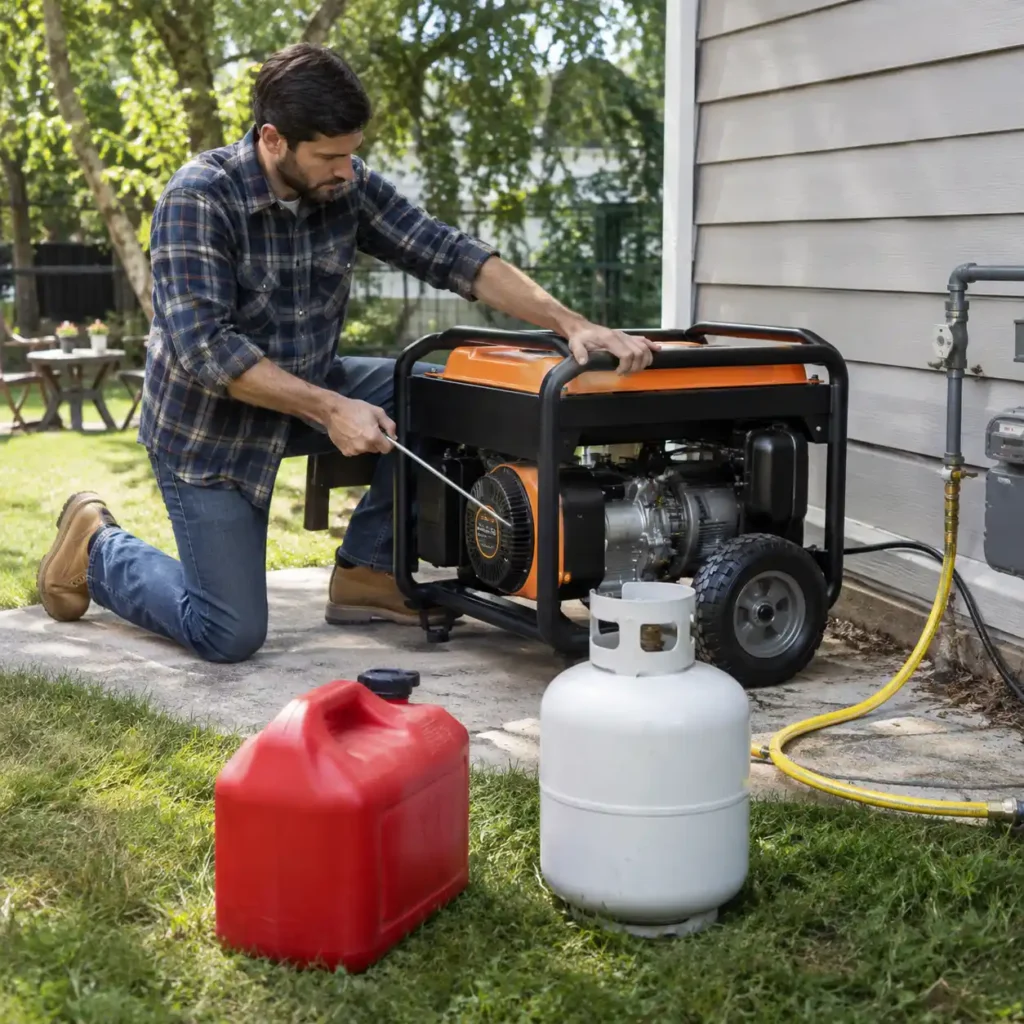
A tri-fuel generator gives homeowners three fuel options, but each comes with different storage, availability, and operating considerations. Gasoline offers familiar refueling and portable storage, propane can be kept on-site for extended periods, and natural gas can provide a convenient fuel supply through an existing utility connection. The right choice depends not only on fuel availability but also on how long an outage may last and how the generator will be used.
Gasoline: Power Output and Fuel Storage
Gasoline is widely available and easy to purchase from local fuel stations, making it a practical option when a generator needs to be refueled during an outage. Homeowners can keep an additional supply in approved gasoline containers, allowing them to operate a generator without depending entirely on fuel deliveries during an emergency.
The main limitation is storage. Unlike propane, gasoline deteriorates over time, particularly when stored improperly or left unused in a generator’s fuel system. Fuel stabilizers can help extend its usable storage period, but they do not eliminate the need for proper storage and maintenance. For occasional backup use, homeowners should rotate stored gasoline and follow the generator manufacturer’s storage instructions.
Propane: Storage and Long-Term Readiness
Propane is particularly useful for emergency backup because it can be stored in properly maintained cylinders or tanks without the fuel degradation concerns associated with gasoline. This makes it a practical option for homeowners who want to keep backup fuel available between outages rather than regularly replacing stored gasoline.
However, the available supply depends on tank capacity and the number of cylinders on hand. A common 20-pound propane cylinder may be convenient for smaller or shorter backup applications, but longer outages or higher generator loads can require larger tanks or additional cylinders. Buyers should also check the generator’s propane consumption and connection requirements before deciding how much fuel to keep available.
Natural Gas: Continuous Fuel Supply and Installation Requirements
Natural gas offers a different approach to fuel readiness. Instead of storing gasoline or propane on the property, homeowners can connect a compatible tri-fuel generator to an existing natural gas supply. When utility service remains available, this can provide a continuing fuel source without requiring manual refueling or monitoring the remaining tank level.
The main consideration is whether the home’s gas system can supply the generator’s required pressure and flow rate. The meter, regulator, service line, and piping must be capable of meeting the generator’s fuel demand, including the requirements of other gas appliances operating at the same time. A natural gas connection should therefore be evaluated before purchase, rather than assuming that an existing household gas line will automatically support a generator.
Why Generator Output Changes Between Fuels
A tri-fuel generator does not necessarily produce the same power on all three fuels. Gasoline, propane, and natural gas have different energy characteristics, and the engine’s fuel delivery system must supply the appropriate air-fuel mixture for each one. The available fuel pressure and flow also affect whether the engine can maintain the conditions required for its rated output.
For this reason, manufacturers publish separate running and starting wattage ratings for each supported fuel. Buyers should use the rating for the fuel they expect to rely on most often, rather than assuming that the generator’s highest advertised wattage applies to every fuel option. The actual model-by-model differences are examined in the next section.
How Much Power Does a Tri-Fuel Generator Deliver on Each Fuel?
A tri-fuel generator does not deliver the same amount of power on gasoline, propane, and natural gas. Both running watts and starting watts vary depending on the fuel used, which affects the loads the generator can support during a power outage.
Comparing all three fuel ratings is essential when choosing a generator for home backup. The table below shows the published running and starting watts for each model, along with the percentage reduction in running output when switching from gasoline to propane or natural gas.
Three-Fuel Output Reality Check
| Generator Model | Gasoline (Running / Starting) | Propane (Running / Starting) | Natural Gas (Running / Starting) | Running Output Reduction: Propane / Natural Gas |
|---|---|---|---|---|
| WEN TF1450X | 11,500 / 14,500 W | 10,300 / 12,500 W | 8,750 / 10,500 W | 10.4% / 23.9% |
| DuroMax XP13000HXT | 10,500 / 13,000 W | 10,000 / 12,500 W | 9,000 / 11,250 W | 4.8% / 14.3% |
| Champion 201438 | 10,000 / 12,500 W | 9,000 / 11,250 W | 8,000 / 10,000 W | 10.0% / 20.0% |
| Westinghouse WGen9500TFc | 9,500 / 12,500 W | 8,500 / 11,200 W | 7,500 / 9,500 W | 10.5% / 21.1% |
| Generac GP9500E TF 50ST (Model 8061) | 9,500 / 12,500 W | 8,550 / 11,250 W | 7,000 / 9,000 W | 10.0% / 26.3% |
Each fuel column shows running watts first and starting watts second. Output reduction is calculated using published running-watt ratings, with gasoline as the baseline. Percentages are comparative calculations, not independent test results.
The WEN TF1450X delivers the highest running output on gasoline and propane, at 11,500 W and 10,300 W, respectively. The DuroMax XP13000HXT leads on natural gas with 9,000 W and has the smallest calculated output reduction when switching from gasoline to either alternative fuel.
The Generac GP9500E TF 50ST has the largest natural gas output reduction in this comparison, at 26.3%, and the lowest natural gas running output at 7,000 W. Its appeal therefore lies more in its 50-state configuration, EFI, and COsense protection than in maximum natural gas capacity. The Champion and Westinghouse offer intermediate output levels, with their own practical advantages in connection accessories and remote-start convenience.
These differences show why a generator should not be selected by its gasoline rating alone. A model with a higher advertised gasoline output may deliver considerably less power when operating on natural gas. Buyers should compare the ratings for the fuel they actually intend to use.
What Can a Tri-Fuel Generator Power at Home?
A tri-fuel generator can support different levels of home backup depending on its available running watts, starting capacity, fuel source, and the electrical setup. For practical planning, residential backup needs can be divided into three categories: essential-circuit backup, partial-home backup, and whole-home backup.
To understand the total electrical demand behind these backup scenarios, use our Whole House Load Calculator to estimate running loads, starting demand, and the power required by the household equipment you want to operate.
Essential-Circuit Backup
Essential-circuit backup focuses on keeping the most important household equipment operating during an outage. This may include a refrigerator, selected lights, internet equipment, phone chargers, and other essential appliances or outlets.
This setup generally requires less generator capacity than backing up multiple household systems. A properly configured transfer switch can supply selected circuits, allowing homeowners to prioritize essential loads without attempting to power the entire electrical panel.
Partial-Home Backup
Partial-home backup provides power to a broader selection of household circuits. Depending on the generator’s available capacity, this may include essential appliances, additional lighting and outlets, and selected larger loads such as a well pump or certain heating and cooling equipment.
The main limitation is simultaneous demand. Larger appliances can require substantial starting power, and operating several high-demand loads together may exceed the generator’s available output. Homeowners may need to manage which appliances run at the same time.
Whole-Home Backup
Whole-home backup aims to supply nearly all household circuits, including larger appliances and major electrical systems. However, this requires sufficient generator capacity, compatible electrical equipment, and a properly designed installation.
A portable tri-fuel generator should not automatically be considered a whole-house backup solution.
Homeowners who want permanently installed equipment with automatic operation may want to compare standby generators for whole-home backup, which are designed for a different level of residential integration.
Even a model advertised with 13,000 or 14,500 starting watts may not have enough continuous output on the selected fuel to support all household loads simultaneously. A natural gas rating may be substantially lower than the gasoline rating, further limiting available capacity.
Why Generator Wattage Alone Does Not Determine Backup Coverage
The level of backup a generator can provide depends on the combined running wattage of the loads operating at the same time and the starting requirements of appliances that cycle on. Buyers must also check whether the generator supports the required 120V and 240V circuits and whether its outlets and transfer equipment are compatible with the planned installation.
If you are unsure how much power individual appliances require, our Appliance Wattage Calculator can help estimate their running watts, starting demand, and energy use before you combine them into a household load calculation.
For this reason, choosing between essential-circuit, partial-home, and whole-home backup requires more than comparing a generator’s advertised peak wattage. Start with the appliances and circuits you want to operate, calculate their running and starting requirements, and compare the results with the generator’s ratings on your intended primary fuel.
For a more detailed estimate, use our Generator Size Calculator to compare the combined running load and starting demand with the generator capacity required for your planned backup setup.
Why You Should Size for Your Primary Fuel
When choosing a tri-fuel generator for home backup, use the running-watt rating for the fuel you expect to rely on most often. For example, the WEN TF1450X delivers 11,500 W on gasoline but 8,750 W on natural gas. If natural gas is your primary fuel, the lower rating should determine whether the generator can support your intended household loads.
Starting watts must also be considered when planning which appliances can operate together. Running watts determine the continuous power available, while starting watts provide additional short-term capacity for motor-driven appliances such as refrigerators and sump pumps. The generator must have sufficient capacity for both the combined running load and the starting demand of equipment that may switch on.
Ultimately, the right tri-fuel generator is the one that provides sufficient running and starting capacity on your primary fuel for the household loads you intend to support. Its highest advertised wattage alone does not establish whether it is suitable for your home.
Can You Connect a Tri-Fuel Generator to Your Home?
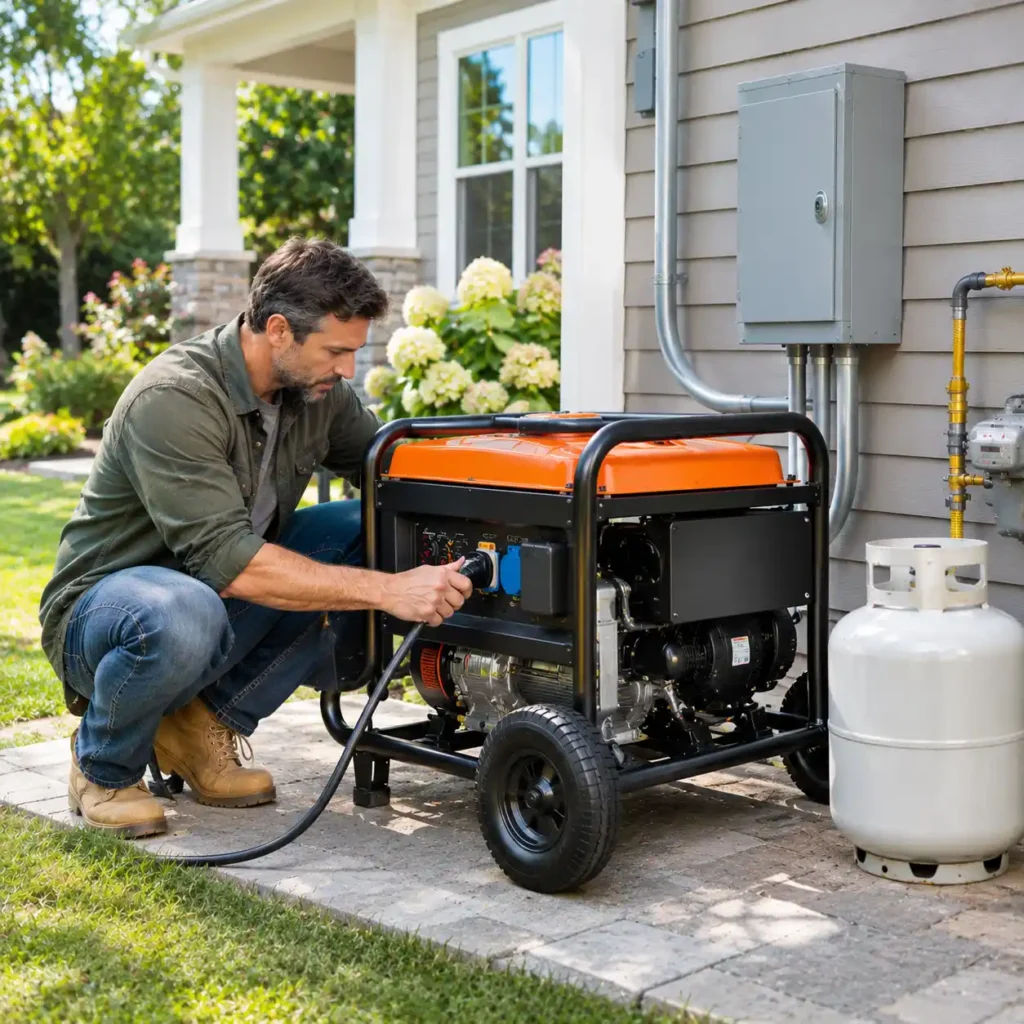
A tri-fuel generator can supply power to selected household circuits, but connecting it to a home’s electrical system requires more than a compatible outlet. The generator must provide the correct voltage and sufficient running watts on the fuel you plan to use, while the transfer equipment and natural gas supply must meet the requirements of your home’s installation.
Before buying, check three things: whether the generator supports the voltage and connections your backed-up circuits require, whether your electrical panel can accommodate a suitable transfer switch or interlock, and whether your natural gas line can deliver the required pressure and fuel volume.
120V/240V and Essential Household Circuits
In a typical U.S. residential electrical system, 120V circuits supply many everyday loads, including lighting, refrigerators, electronics, and standard household outlets. Some larger appliances and equipment use 240V, including certain well pumps, central air-conditioning systems, electric ranges, and clothes dryers.
A generator with 120/240V output can supply both types of circuits when connected through compatible equipment. However, the presence of a 120/240V outlet does not mean the generator can run every household appliance. Its available running watts on the selected fuel, outlet and breaker ratings, and the transfer equipment’s configuration all limit what can operate at the same time.
Check the voltage, starting requirements, and running wattage of the circuits you intend to back up. A 240V appliance may also have a substantial startup demand, so voltage compatibility alone is not enough to establish that the generator can support it.
Transfer Switch vs. Interlock
A manual transfer switch directs selected household circuits between utility power and generator power. It is typically installed alongside the main electrical panel and allows the homeowner to switch designated circuits to generator supply during an outage. The selected circuits and their combined loads must stay within the generator’s available capacity.
An interlock kit is a mechanical device fitted to a compatible electrical panel. It prevents the utility main breaker and the generator breaker from being switched on at the same time. Instead of assigning circuits to a separate transfer-switch panel, it allows the generator to supply circuits through the existing panel, with the homeowner choosing which breakers to operate.
The main difference is how circuits are selected and managed. A transfer switch provides a defined group of backed-up circuits, while an interlock can offer more flexibility across a compatible panel. However, an interlock does not increase generator capacity: the homeowner must still manage loads to avoid overloading the unit. Interlock kits are also not accepted in every jurisdiction or for every panel.
Both options must be correctly matched to the generator, panel, inlet, wiring, and applicable electrical requirements. Have a qualified electrician confirm the equipment and installation. Never connect a portable generator directly to household wiring through a standard wall outlet or an improvised connection; improper backfeeding can endanger utility workers and damage equipment.
Natural Gas Line and Installation Considerations
A natural gas connection must supply the generator with the pressure and fuel volume specified by its manufacturer. Two important requirements are inlet pressure, commonly stated in inches of water column (in. WC), and fuel demand, expressed in BTU per hour. Both must be satisfied when the generator is operating under load.
The five models in this guide do not have identical natural gas requirements. For example, the DuroMax XP13000HXT specifies 6–9 in. WC and a full-load demand of 225,000 BTU. The Champion 201438 specifies 5–7 in. WC and a minimum natural gas flow rate of 130,000 BTU/hr. These figures are model-specific, not universal requirements for tri-fuel generators.
An existing household gas line may not have enough capacity for an additional generator. The meter, regulator, pipe diameter, total pipe length, fittings, and other connected gas appliances all affect the amount of gas available at the generator. A line that supplies a furnace, water heater, and stove may not be able to support the generator at full load without an upgrade.
Before connecting a generator to natural gas, have a qualified gas professional verify the meter capacity, line sizing, operating pressure, and total demand under simultaneous appliance use. Follow the generator manufacturer’s installation instructions and applicable local fuel-gas codes. Do not assume that a nearby gas connection is suitable simply because it fits the hose.
What to Confirm Before Buying
Use this checklist to verify that the generator can be connected to your home’s electrical and natural gas systems:
Running watts on your primary fuel: Confirm that the generator can support the household loads you intend to operate on gasoline, propane, or natural gas.
Voltage and connections: Check whether your essential circuits require 120V, 240V, or both, and verify that the generator has compatible outlets and sufficient output.
Transfer switch or interlock: Confirm compatibility with your electrical panel, generator inlet, breaker ratings, and the circuits you plan to back up. Ask an electrician to verify local code requirements.
Natural gas pressure and BTU capacity: Compare the generator’s specified inlet pressure and full-load fuel demand with the capacity of your meter, regulator, and gas piping.
Included hoses and fittings: Check whether the package includes the required natural gas hose, propane hose, regulator, and connection adapters. Included accessories vary by model.
Additional equipment and installation: Account for any separately purchased gas hose, generator power cord, inlet box, transfer switch or approved interlock kit, and professional electrical or gas-line work.
A generator may be advertised as transfer-switch-ready or tri-fuel, but those descriptions do not confirm that it is ready to connect to every home. Verify the complete electrical and fuel setup before choosing a model.
Safety Considerations for Home Backup
A portable tri-fuel generator can provide essential power during an outage, but safe operation depends on more than choosing the correct fuel and connecting the unit properly. Carbon monoxide exposure, electrical backfeeding, fire, and fuel leaks are serious hazards that require attention before and during operation.
Follow the generator manufacturer’s instructions and local safety requirements. The precautions below apply regardless of whether the generator runs on gasoline, propane, or natural gas.
Carbon Monoxide Protection
Portable generators produce carbon monoxide (CO), a colorless, odorless gas that can cause serious illness or death. Because CO cannot be detected by smell or sight, exposure may become dangerous before anyone recognizes the symptoms.
Some generators include a built-in CO sensor with an automatic shutdown feature. Systems such as CO Watchdog, CO Alert, CO Shield, and COsense are designed to stop the engine when the sensor detects specified CO conditions around the generator. This is an important additional safety feature, but it does not prevent every possible exposure scenario or replace safe outdoor placement.
Install working CO alarms inside the home, particularly near sleeping areas, and follow the alarm manufacturer’s placement and maintenance instructions. Use alarms with battery backup so they continue operating during a power outage. Never rely on the generator’s CO shutdown system as a substitute for household CO alarms.
Outdoor Placement and Ventilation
Always operate a portable generator outdoors in a well-ventilated location. Place it at least 20 feet from the home and away from doors, windows, and vents through which exhaust could enter. Position the exhaust so it points away from the house and other occupied buildings.
Never operate a generator inside a home, basement, shed, or garage—even if the garage door or windows are open. Opening doors, using fans, or providing partial ventilation does not make an enclosed or partially enclosed space safe. Avoid porches and carports as well, because they can allow exhaust to collect or enter the home.
Choose a stable, dry operating surface and follow the manufacturer’s instructions for protection from rain and other weather conditions. Any cover or generator enclosure must be specifically suitable for the unit and must not restrict ventilation or exhaust flow.
Electrical Connection Safety
Connecting a generator directly to a household wall outlet is dangerous. This practice, known as backfeeding, can send electricity into utility lines and expose utility workers or others to potentially fatal electric shock. It can also bypass intended electrical protection.
To supply household circuits, use a properly rated transfer switch or a compatible, correctly installed panel interlock system. These devices prevent the generator and utility supply from energizing the same circuits simultaneously. The equipment must match the electrical panel, generator output, inlet, and applicable electrical requirements.
If you are still comparing connection equipment, see our guide to transfer switches for portable generators, which explains the options available for connecting a generator to selected household circuits.
Have a qualified electrician select and install the appropriate connection equipment. Never use a male-to-male power cord or improvise a connection to household wiring. If you are powering individual appliances directly, use heavy-duty outdoor-rated extension cords with sufficient capacity for the connected loads, intact insulation, and properly grounded plugs.
Fuel Storage and Handling
Gasoline and propane require different storage and handling precautions. Keep both fuels away from open flames, sparks, hot surfaces, and other ignition sources, and follow the generator and fuel-container manufacturers’ instructions.
Gasoline: Store gasoline in approved, properly labeled fuel containers with secure caps. Keep containers in a cool, well-ventilated location outside living areas and away from ignition sources. Never store gasoline in a home, basement, or near fuel-burning appliances. Before refueling, switch off the generator and allow the engine to cool; spilled gasoline can ignite on hot engine components.
Propane: Keep propane cylinders outdoors, upright, and secured against tipping or physical damage. Store them away from excessive heat and ignition sources, and follow applicable local storage requirements. Keep cylinders away from the generator’s hot exhaust and use only compatible hoses, regulators, and fittings specified for the generator.
Hoses and connections: Inspect fuel hoses, regulators, fittings, and connections for damage, wear, or deterioration before use. Make sure connections are properly secured and compatible with the selected fuel. If you smell propane or suspect a leak, shut off the fuel supply if it is safe to do so. Do not start the generator or operate electrical switches nearby. Never use a flame to check for leaks; follow the manufacturer’s approved leak-checking procedure and have damaged components inspected or replaced before operating the generator.
Safe fuel handling also means following the correct shutdown and storage procedures whenever the generator is not in use. A damaged hose, incorrect regulator, or poorly secured cylinder can turn an otherwise suitable backup setup into a fire or leak hazard.
Common Buying Mistakes When Choosing a Tri-Fuel Generator
A tri-fuel generator may look like a flexible backup solution, but choosing the wrong model can create unexpected limitations after purchase. The most common mistakes are not necessarily about the generator itself; they involve assumptions about how it will fit your household, fuel supply, electrical setup, and local requirements.
Choosing a Generator Based on Its Highest Advertised Wattage
The largest number in a product title can make a generator appear more capable than it will be for your intended setup. Buyers who focus on the headline rating rather than their actual backup requirements may pay for capacity they cannot use effectively or choose a model that does not suit their household. Compare models against your intended loads and primary operating conditions, rather than ranking them by the highest advertised figure.
Treating Starting Watts as Available Continuous Capacity
A high starting-watt rating can make a model appear suitable for a larger household than it can support during normal operation. Buyers who overlook this distinction may discover that the generator cannot sustain all their planned loads simultaneously. Make sure the model’s continuous capacity matches your intended use instead of relying on its peak starting figure.
Assuming an Existing Natural Gas Connection Is Ready for a Generator
Seeing a natural gas meter or an outdoor connection near the house can create a false sense that installation will be straightforward. In reality, the existing setup may require professional assessment or modifications before it can support the additional appliance. Factor this possibility into your purchase decision rather than treating natural gas availability as proof that the generator can be connected immediately.
Buying for Three-Fuel Flexibility Without a Realistic Primary-Fuel Plan
Having gasoline, propane, and natural gas options sounds convenient, but not every household has equally practical access to all three. Buyers may pay extra attention to the number of supported fuels without deciding which one they will actually rely on during an outage. Choose a model around a realistic primary-fuel plan, and treat the other fuel options as useful alternatives rather than assuming all three will be equally convenient.
Assuming All Connection Accessories Are Included
A tri-fuel label describes the generator’s fuel capability, not necessarily the contents of its retail package. Missing hoses, regulators, or adapters can mean additional purchases and delays before the unit is ready for the intended fuel connection. Check the exact listing and package contents for the specific model and version you plan to order.
Buying Without Confirming Compatibility With Your Home Setup
A generator can have the right general voltage rating and still be unsuitable for the connection equipment already installed at your home. Overlooking this before purchase can lead to extra equipment costs or the need to reconsider the installation plan. Confirm compatibility with your electrician before committing to a model, especially if you intend to use an existing transfer switch or interlock arrangement.
Overlooking CARB Certification and State-Specific Compliance
A model available through a major retailer may not be approved for sale in every state. Buyers who check only the product name or general EPA certification can overlook differences between 50-state and 49-state versions. Verify the exact model number and emissions certification for your state before ordering. This is particularly important for California buyers.
Before You Make Your Final Choice
Prioritize the generator’s suitability for your actual backup needs, decide which fuel you expect to use most, and account for any additional connection or installation costs. Confirm the exact package, home-system compatibility, and state compliance before ordering. A good tri-fuel purchase is not simply a generator with three fuel options; it is a model that fits your household’s practical requirements without unexpected limitations.
Frequently Asked Questions
Is a tri-fuel generator worth it if my home already has natural gas?
A tri-fuel generator can be a worthwhile investment if you want to use your home’s natural gas supply while keeping gasoline and propane as backup options. Natural gas can reduce the need to store fuel or refuel during an extended outage.
However, if you do not have access to a suitable natural gas connection, a dual-fuel generator running on gasoline and propane may offer better value because you would not be paying for a fuel option you cannot use.
Will a natural gas generator keep running during a power outage?
A portable tri-fuel generator can continue operating on natural gas during a power outage as long as the utility gas service remains available and the supply meets the generator’s requirements. A loss of electricity does not automatically mean that natural gas service will stop. However, severe weather, infrastructure damage, or a utility interruption can affect gas availability, so gasoline and propane remain useful alternatives.
Can you switch between gasoline, propane, and natural gas while the generator is running?
Fuel-switching procedures vary by generator model. Some manufacturers allow switching between certain fuel sources while the engine is running, while others require the generator to be stopped and electrical loads disconnected first. Never assume that one model’s procedure applies to another. Follow the exact switching instructions in the owner’s manual to avoid engine damage or fuel-related hazards.
Does a factory-built tri-fuel generator need a conversion kit?
No. A factory-built tri-fuel generator is designed to operate on gasoline, propane, and natural gas without requiring an aftermarket fuel conversion kit. It uses the manufacturer’s specified fuel-selection system and compatible fuel connections. However, the required hoses, regulators, and adapters may not all be included in the retail package, so check the exact model’s accessories before purchasing.
Can a tri-fuel generator run continuously for several days?
Some tri-fuel generators can operate for extended periods when connected to a continuous natural gas supply, but this does not mean they can run indefinitely without maintenance. Operating limits, oil-check intervals, service requirements, and recommended shutdown procedures vary by model. Follow the owner’s manual for the specific generator, monitor operating conditions, and complete required maintenance during prolonged outages.
Can a tri-fuel generator use a standard 20-pound propane tank?
Some models support a standard 20-pound propane cylinder, but compatibility and expected runtime depend on the generator. Other models may recommend or require a larger tank, particularly at higher loads. Check the manufacturer’s specified tank size, regulator, hose connection, and runtime information before relying on a standard grill-size cylinder for home backup.
What happens if the natural gas supply is interrupted during an outage?
If natural gas service becomes unavailable, you may be able to use gasoline or propane instead, provided the generator supports those fuels and you have the necessary connections and fuel available. The changeover procedure depends on the model: some generators require the engine to be stopped and electrical loads disconnected before switching. Keep an alternative fuel supply available and follow the manufacturer’s instructions for changing fuel sources.
Final Verdict
The best tri-fuel generator for home backup depends on your primary fuel, available power, and home connection requirements. WEN leads in gasoline and propane output, DuroMax delivers the highest natural gas output, and Generac offers a 50-state-compliant option with EFI and COsense. Choose the model that matches your home’s actual backup needs rather than its highest advertised wattage.
Our Recommendation
Choose the generator that best matches your main backup-power priority:
If you prioritize maximum gasoline and propane output: choose the WEN TF1450X.
If you plan to run primarily on natural gas and have sufficient gas supply capacity: choose the DuroMax XP13000HXT.
If you want a more complete natural gas connection package included: choose the Champion 201438.
If remote-start convenience is your priority: choose the Westinghouse WGen9500TFc.
If you need a 50-state-compliant model with EFI and CO monitoring: choose the Generac GP9500E TF 50ST (Model 8061).
Related Guides
Choosing a tri-fuel generator is one part of preparing your home for a power outage. The following guides can help you calculate your power requirements, compare alternative generator types, and plan the equipment needed for a reliable backup setup.
Generator sizing: Use our Generator Size Calculator to estimate the generator capacity needed for your backup requirements.
Household loads: Use our Whole House Load Calculator to estimate the combined electrical demand of your home.
Appliance requirements: Our Appliance Wattage Calculator helps identify the power requirements of individual household appliances.
Fuel comparison: Explore Best Dual Fuel Generators (2026) if gasoline and propane are sufficient for your backup needs.
Broader generator selection: Compare other portable options in Best Portable Generators (2026).
Home electrical connection: See Best Transfer Switches for Generators (2026) when planning to connect a portable generator to selected household circuits.
Permanent home backup: If you prefer an automatically installed backup system, explore Best Standby Generators for Home Backup (2026).
Power Ready Guide Commitment
Power Ready Guide is committed to helping readers make informed equipment decisions through clear comparisons, transparent limitations, and accurate product information. We review recommendations as products, specifications, and availability change, updating our guidance when significant changes affect a product’s suitability or value.
Our goal is not to present every product as the right choice, but to explain what each option can—and cannot—do so readers can choose equipment that fits their needs