
Choosing an alternator charger for a portable power station is harder than comparing advertised wattage. A charger rated at 800W may not deliver 800W to every power station, and compatibility can depend on the station’s input limits, your vehicle’s electrical system, connectors, and installation requirements.
This guide compares the best alternator chargers for portable power stations based on charging power, compatibility, charging flexibility, installation, battery protection, and overall value.
For a broader overview of useful add-ons, see our guide to Essential Portable Power Station Accessories (2026), which covers the wider accessory category beyond vehicle charging.
We look beyond headline specifications to explain how each charger fits into a complete vehicle-to-power-station charging setup.
What makes this comparison different is its focus on system compatibility rather than wattage alone. The right alternator charger is the one that matches your power station, vehicle, and charging needs—not necessarily the one with the highest advertised output.
As an Amazon Associate, I earn from qualifying purchases.
Table of Contents
Quick Answer
If you want the best alternator charger for a portable power station, start with compatibility rather than wattage. The BLUETTI Charger 2 is the strongest option to consider if you want flexible alternator charging with the added ability to combine alternator and solar input. It supports up to 800W from the alternator and up to 1,200W when alternator and solar charging are combined. Its main limitation is that you still need to confirm your power station, vehicle, and connector setup are compatible.
For Anker SOLIX owners, the Anker SOLIX Alternator Charger is the most logical fit because it is designed around the Anker SOLIX ecosystem and supports up to 800W charging. EcoFlow 800W Alternator Charger is the better match for compatible EcoFlow DELTA systems, while its charging, battery-maintenance, and jump-start functions add flexibility beyond basic alternator charging. Both are ecosystem-focused, so compatibility should be checked before purchase.
If you use an OUPES Mega or Guardian system, the OUPES 800W Alternator Charger is the relevant choice, while the AFERIY DC060 is aimed at compatible AFERIY systems and provides up to 580W of output. Neither should be treated as a universal alternator charger. Overall, the right choice depends on your power station’s input requirements, your vehicle’s electrical system, and whether you need ecosystem-specific features or broader charging flexibility.
Our Evidence & Evaluation Method
Our evaluation is based primarily on manufacturer specifications, technical documentation, product manuals, warranty information, and U.S. product listings. We use these sources to assess each charger’s documented capabilities, compatibility requirements, installation considerations, and limitations.
Where independent measurements or third-party testing are available, they can provide additional context. Charging-time figures and other calculated estimates are identified as estimates rather than presented as measured results.
We do not claim proprietary hands-on vehicle testing. Our compatibility and installation assessments rely on published technical information, and model-specific vehicle or power-station restrictions are treated as part of the buying decision rather than overlooked in favor of headline charging power.
Who This Guide Is For

Who Should Read This
This guide is for U.S. buyers who already own, or are choosing, a compatible portable power station and want a faster way to recharge it from a vehicle. It is especially useful if you are comparing alternator chargers and need to understand charging power, compatibility, vehicle requirements, installation, and battery protection before buying.
Who Should Use Another Guide
Use another guide if you are still choosing the portable power station itself, need to calculate the battery capacity or power output you require, or are primarily looking for solar panels or another charging method.
If you have not chosen a unit yet, start with How to Choose a Portable Power Station: A Complete Buying Guide before comparing alternator chargers.
Those decisions are covered in more specialized Power Ready Guide resources.
Quick Summary: Our Top Picks
The five alternator chargers in this guide serve different priorities, from combined alternator and solar charging to ecosystem integration and additional vehicle-support functions. Rather than ranking them by advertised wattage alone, we selected each model for its charging capabilities, compatibility, functionality, and practical value. The right choice depends on your power station, vehicle, and charging needs.
BLUETTI Charger 2
Award: Best for Combined Alternator + Solar Charging
Best For: Buyers who want to combine vehicle charging with solar input in the same charging setup.
Key Reason: It supports up to 800W of alternator input and up to 600W of solar input, with up to 1,200W of combined charging when both sources are used.
Main Limitation: The combined charging capability does not make it universally compatible; your power station, vehicle electrical system, and connector configuration still need to meet the required specifications.
Anker SOLIX Alternator Charger
Award: Best for Ecosystem-Integrated Vehicle Charging
Best For: Anker SOLIX owners who want a high-power vehicle charging solution that integrates with their existing system.
Key Reason: It provides up to 800W of charging while adding bidirectional charging and starter-battery monitoring within the Anker SOLIX ecosystem.
Main Limitation: Its ecosystem-focused design makes it less flexible for buyers who use a power station outside the Anker SOLIX system.
EF ECOFLOW 800W Alternator Charger
Award: Best for All-in-One Vehicle Power Support
Best For: Buyers who want an alternator charger that can also support vehicle-battery maintenance and emergency starting.
Key Reason: It combines up to 800W of alternator charging with reverse charging, battery maintenance, and jump-start functionality in one device.
Main Limitation: Compatibility and cable requirements vary between EF ECOFLOW DELTA models, so some setups require specific cables or adapters.
OUPES 800W Alternator Charger
Award: Best for Battery Maintenance and App Control
Best For: Compatible OUPES owners who want more than basic alternator charging and value battery-maintenance and app-based control.
Key Reason: It combines up to 800W of charging with reverse charging, a 100W battery-maintenance mode, Bluetooth, and app control.
Main Limitation: It is designed specifically for OUPES Mega and Guardian systems, so compatibility is much narrower than the charging wattage alone might suggest.
AFERIY DC060
Award: Best for 12V/24V Vehicle Charging at 580W
Best For: Buyers with a compatible AFERIY power station who need a dedicated 12V/24V vehicle charging solution.
Key Reason: It supports 12V/24V vehicle systems and provides up to 580W of output, with automatic engine detection, starter-battery protection, active cooling, and a 16.4-foot cable.
Main Limitation: Its 580W maximum output is below the 800W models, while compatibility also depends on the power station accepting the required 47–49V input and may require additional checks for smart-alternator, start-stop, and BMS-equipped vehicles.
Comparison Table
| Model | Alternator Charging | Key Compatibility | Best For |
|---|---|---|---|
| BLUETTI Charger 2 | Up to 800W | BLUETTI and selected third-party stations, subject to input and connection requirements | Combined alternator + solar charging |
| Anker SOLIX Alternator Charger | Up to 800W | Compatible Anker SOLIX systems; verify exact model and connection requirements | Ecosystem-integrated vehicle charging |
| EF ECOFLOW 800W Alternator Charger | Up to 800W | Compatible EcoFlow DELTA systems | All-in-one vehicle power support |
| OUPES 800W Alternator Charger | Up to 800W | OUPES Mega & Guardian systems | Battery maintenance and app control |
| AFERIY DC060 | Up to 580W | Compatible AFERIY systems with required 47–49V input | 12V/24V vehicle charging at 580W |
Selection Criteria
We compare each model across ten criteria covering system compatibility, charging performance, safety, installation, functionality, and value.
Alternator Charging Capability
We examine the charger’s maximum alternator charging power and how that figure fits into the charging class of the products we compare. We distinguish between alternator input and combined charging capability so that solar-assisted figures are not mistaken for alternator-only output.
Power Station Compatibility
A charger is only useful if its output matches the power station’s input requirements. We consider supported voltage, maximum input power, connectors, required adapters, and any model-specific compatibility restrictions.
Vehicle Compatibility
We examine whether the charger is designed for 12V or 24V vehicle systems and whether published documentation identifies limitations involving smart alternators, start-stop systems, battery-management systems, or other vehicle configurations.
Actual Charging Capability
Advertised wattage does not always equal the power a specific power station can accept. We therefore consider the charger’s rated capability together with the power station’s input limits and other system constraints that can affect usable charging power.
Charging Flexibility
Some chargers do more than draw power from an alternator. We consider support for solar integration, combined alternator and solar charging, reverse charging, and other charging modes that can make the system more useful in different situations.
Vehicle and Starter-Battery Protection
Because an alternator charger is connected directly to a vehicle’s electrical system, protection features are an important part of the evaluation. We look for starter-battery monitoring, low-voltage protection, engine detection, automatic shutdown, and other published safeguards.
Installation Requirements
We evaluate the practical requirements for installing each charger, including wiring, fuse requirements, cable specifications, connection methods, and any additional components or adapters needed for a compatible setup.
Additional Functionality
We consider features that add meaningful functionality beyond basic alternator charging, such as battery-maintenance modes, jump-start capability, Bluetooth or app control, and bidirectional charging.
Value and Ownership
Value is not based on purchase price alone. We consider charging capability, compatibility, protection features, additional functionality, warranty, ecosystem restrictions, and the installation requirements that affect the total ownership experience.
Use-Case Fit
Finally, we consider who each charger actually makes sense for. A model designed around one power-station ecosystem may be an excellent choice for that system but a poor choice for another buyer. Our recommendations therefore reflect the complete use case rather than treating one specification as universally better.
Our Evaluation Principle
Compatibility comes first. A charger is only a practical choice when it can connect to the intended power station and vehicle through a manufacturer-supported setup.
Our decision hierarchy is:
Compatibility → Vehicle electrical system → Power-station input → Usable charging power → Safety and installation → Features → Value.
A higher advertised wattage does not automatically make a charger the better choice. The recommendation must reflect the requirements of the complete charging system.
Product Reviews
BLUETTI Charger 2
Best for Combined Alternator + Solar Charging

Quick Verdict
The BLUETTI Charger 2 is a high-power DC-DC charger designed to recharge compatible portable power stations from a vehicle alternator while also accepting solar input. It supports up to 800W of alternator input and up to 600W of solar input, with combined charging power reaching up to 1,200W when both sources are used together. This makes it particularly useful for buyers who want to combine charging while driving with available solar generation rather than relying on alternator charging alone.
This model is best suited to buyers who want more flexible vehicle charging than a standard 12V cigarette-lighter connection can provide, especially those building an RV, van, overlanding, or off-grid charging setup. It is designed to work with BLUETTI power stations and may support compatible third-party models through suitable solar-charging connections. Actual compatibility depends on the power station’s supported input voltage, maximum accepted charging power, connector configuration, and manufacturer guidance.
The charger’s 800W alternator rating and 1,200W combined charging rating describe different operating configurations. Neither figure guarantees that every connected power station can accept the full rated power. Its battery-voltage monitoring and D+ signal are designed to help reduce unnecessary starter-battery drain when the engine is off, but correct installation and configuration remain important.
Snapshot
| Snapshot Specification | BLUETTI Charger 2 |
|---|---|
| Alternator Input | Up to 800W |
| Solar Input | Up to 600W |
| Combined Charging | Up to 1,200W |
| Vehicle Voltage | 12V / 24V |
| Fuse Rating | 75A |
| Weight | Approximately 3.5 lb |
Why We Chose It
The BLUETTI Charger 2 earned our Best for Combined Alternator + Solar Charging award because it supports charging from two sources within one system. With up to 800W of alternator input and up to 600W of solar input, it can combine vehicle charging with available solar generation, subject to operating conditions and the connected power station’s input limits.
The other models serve different priorities. The Anker SOLIX Alternator Charger and EF ECOFLOW 800W Alternator Charger are designed around their respective power-station ecosystems, while the OUPES 800W Alternator Charger offers additional functions for compatible OUPES systems. The AFERIY DC060 provides an alternative for compatible AFERIY power stations, with a rated charging capability of up to 580W. The BLUETTI Charger 2 stands out for its combined alternator and solar charging capability rather than for a claim of universal compatibility.
To explore the wider product ecosystem, see our BLUETTI: Portable Power, Solar & Home Backup guide.
Check the latest price and customer reviews on Amazon.

Practical Considerations
At approximately 3.5 pounds, the BLUETTI Charger 2 is relatively compact for a high-power vehicle charging system. In an RV, van, or overlanding vehicle, it may be best suited to a permanent or semi-permanent installation, with the charger wired into the vehicle and connected to a compatible power station.
The main practical consideration is installation rather than portability. The setup requires appropriate wiring, fuse protection, suitable cable connections, and a mounting location that follows the manufacturer’s instructions. This makes it less convenient for frequent vehicle-to-vehicle transfers than a simple plug-in charger. Before installation, confirm the requirements for the vehicle, the power station, and any necessary cables or adapters.
Evaluation
| Evaluation Factor | This Model | How It Compares | Buyer Implication |
|---|---|---|---|
| Alternator Charging | Up to 800W | Shares the 800W alternator-input rating with the Anker SOLIX and EF ECOFLOW models in this guide. | A high-power option for buyers who need more than a standard 12V vehicle outlet can provide. |
| Combined Charging | Up to 1,200W from alternator and solar | Offers a distinct advantage for combining two charging sources; the actual power accepted depends on system limits. | Particularly useful when driving time is limited but solar generation is also available. |
| Compatibility | BLUETTI systems and potentially compatible third-party stations | Compatibility depends on supported input specifications, connectors, and manufacturer guidance; broad cross-brand support should not be assumed. | Verify the exact power-station model and connection requirements before purchasing. |
| Vehicle Protection | Battery-voltage monitoring and D+ signal | Includes features designed to help manage charging in relation to vehicle operating conditions. | Correct wiring, configuration, and adherence to manufacturer instructions remain essential. |
| Installation & Setup | Dedicated wiring, fuse protection, and suitable connections | Requires a more involved setup than a standard vehicle outlet; similar considerations apply to other high-power alternator chargers. | Best suited to buyers prepared for a dedicated vehicle charging installation. |
Who Should Buy This
Buyers who want to combine alternator and solar charging in one setup.
Owners of BLUETTI power stations or verified-compatible third-party models.
RV, van, overlanding, and off-grid users who need higher-power vehicle charging.
Buyers comfortable with dedicated wiring and vehicle electrical integration.
Who Should Skip This
Buyers looking for simple plug-and-play charging through a vehicle outlet.
Owners of power stations that do not meet the charger’s input and connection requirements.
Buyers who do not need combined alternator and solar charging.
People who frequently switch the charging system between vehicles and want to avoid repeated installation work.
Final Verdict
The BLUETTI Charger 2 is a compelling choice when combined alternator and solar charging is an important part of your power strategy. Its key advantage is the ability to use both sources within one charging system, with combined charging power of up to 1,200W under supported conditions.
The main trade-off is the need for proper vehicle integration and careful compatibility checks. Confirm that your power station can accept the charger’s output through a supported connection, and follow the manufacturer’s installation requirements. If you need dual-source charging and are prepared for a dedicated installation, the BLUETTI Charger 2 deserves serious consideration. If you need a simpler setup or already use another power-station ecosystem, a different model may be a better fit.
Check the latest price and customer reviews on Amazon.
Related Guide: If you are building a vehicle-based off-grid setup, see our guide to Best Portable Power Stations for Van Life (2026): Top Picks for Off-Grid Living. It covers power stations suited to extended van-based use, where vehicle charging, solar input, portability, and off-grid energy needs must work together.
Anker SOLIX Alternator Charger
Best for Ecosystem-Integrated Vehicle Charging

Quick Verdict
The Anker SOLIX Alternator Charger is a high-power DC-DC charger that draws energy from a vehicle’s alternator to recharge compatible Anker SOLIX portable power stations. It supports 12V and 24V vehicle systems and delivers up to 800W, providing substantially more charging power than a standard vehicle outlet. It is not compatible with electric vehicles (EVs).
It is primarily suited to Anker SOLIX owners who want vehicle charging integrated with the same power ecosystem. Beyond charging the power station, it supports bidirectional operation, allowing compatible setups to send power back to a supported vehicle starter battery. The system also monitors starter-battery voltage and alternator output during operation.
Snapshot
| Key Specification | Anker SOLIX Alternator Charger |
|---|---|
| Alternator Charging | Up to 800W |
| Vehicle System | 12V / 24V |
| Supported Starter-Battery Types | Compatible LFP and lead-acid batteries |
| Bidirectional Charging | Yes |
| Weight | 2.9 lb |
Why We Chose It
The Anker SOLIX Alternator Charger earned our Best for Ecosystem-Integrated Vehicle Charging award because its strongest advantage is how directly it fits into the Anker SOLIX ecosystem. It combines up to 800W of alternator charging with bidirectional operation and starter-battery monitoring, giving Anker SOLIX owners a more integrated vehicle-charging solution rather than simply adding a high-power DC-DC charger.
The other models have different strengths: BLUETTI Charger 2 stands out for combining alternator and solar charging, EF ECOFLOW 800W Alternator Charger adds vehicle-support functions such as battery maintenance and jump-start capability, OUPES 800W Alternator Charger emphasizes battery maintenance and app control, and AFERIY DC060 focuses on dedicated 580W charging for compatible systems. The Anker SOLIX Alternator Charger therefore earns its award specifically for ecosystem integration, not because it has the highest charging output.
Check the latest price and customer reviews on Amazon.

Practical Considerations
At about 2.9 pounds, the Anker SOLIX Alternator Charger is relatively easy to handle compared with the portable power stations it is designed to recharge. Its compact charger format makes it suitable for installation within a vehicle electrical system rather than being carried around as a standalone charging accessory. For an RV, van, or other vehicle-based setup, the practical approach is to position it where the wiring can remain connected while the output reaches the compatible Anker SOLIX power station.
In everyday use, this makes the most sense as a dedicated vehicle charging system: start the vehicle, let the charger draw power from the alternator, and recharge the power station while driving. Bidirectional operation also gives compatible setups additional flexibility for supporting the vehicle’s starter battery. The main limitation is that the charger is not a simple portable accessory; installation and compatibility with the vehicle and Anker SOLIX system need to be considered before treating it as an everyday charging solution.
Evaluation
| Evaluation Factor | This Model | How It Compares | Buyer Implication |
|---|---|---|---|
| Alternator Charging | Up to 800W | Matches the highest charging class in this group; BLUETTI Charger 2, EF ECOFLOW 800W Alternator Charger, and OUPES 800W Alternator Charger also reach 800W. | Strong option for high-power vehicle charging while driving. |
| Ecosystem Integration | Designed for Anker SOLIX power stations | More ecosystem-focused than the broader compatibility approach of BLUETTI Charger 2 and the more specialized OUPES and AFERIY options. | Best fit if your power station is already part of the Anker SOLIX ecosystem. |
| Bidirectional Charging | Yes | Adds reverse power capability beyond basic alternator-to-power-station charging; similar functionality is available on several competing models. | Useful if you want the charging system to support both the power station and the vehicle battery. |
| Starter-Battery Support | Monitoring; supports compatible LFP and lead-acid starter batteries | Provides monitoring and bidirectional charging for supported configurations. | Useful for buyers who want additional flexibility when integrating the charger with a compatible vehicle electrical system. |
Who Should Buy This
- Anker SOLIX owners who want a dedicated high-power charging solution integrated with their existing power ecosystem.
- Buyers who need up to 800W of vehicle-based charging while driving.
- Users with a compatible 12V or 24V vehicle who value bidirectional charging and starter-battery monitoring.
RV, van, or off-grid users with a compatible 12V or 24V vehicle who are comfortable with a dedicated installation. This charger is not compatible with electric vehicles.
Who Should Skip This
- Buyers who use a non-Anker power station and want broader cross-brand compatibility.
- Users who only need occasional, lower-power vehicle charging and do not need an 800W alternator charger.
- Buyers looking for the simplest possible setup or a charger with features better suited to another power-station ecosystem.
Final Verdict
The Anker SOLIX Alternator Charger is the strongest choice for buyers who want high-power vehicle charging that fits naturally into an existing Anker SOLIX setup, with the added flexibility of bidirectional operation and starter-battery monitoring. Its main trade-off is the ecosystem focus: buyers using another power-station brand may get more flexibility from a different model. Choose it when Anker SOLIX integration is a priority; otherwise, a more broadly compatible charger may make more sense.
Check the latest price and customer reviews on Amazon.
Related Guide: If you want to explore the broader Anker SOLIX ecosystem, see our guide to Anker SOLIX: Portable Power, Solar & Home Backup. It covers the brand’s portable power, solar, and home backup products and helps put the alternator charger into the context of the wider ecosystem.
EF ECOFLOW 800W Alternator Charger
Best for All-in-One Vehicle Power Support

Quick Verdict
The EF ECOFLOW 800W Alternator Charger is a high-power DC-DC charger that uses a vehicle’s alternator to recharge compatible portable power stations while driving. It delivers up to 800W and is designed as a 3-in-1 system that combines power-station charging with vehicle-battery maintenance and jump-start functionality.
It is best suited to buyers who want more than a dedicated alternator-to-power-station connection, particularly for RV, van, and overlanding setups. The charger also works with the EcoFlow app for monitoring charging status. However, compatibility and connection requirements vary by model. EcoFlow specifies additional connection requirements for the DELTA 3 Max Plus, DELTA 3 Ultra Plus, DELTA Pro, and DELTA Pro 3. Reverse charging and battery-maintenance functions also have cable requirements, so buyers should confirm the correct cable or adapter for their exact power station before purchasing.
Before purchasing, verify the required connection method and adapter for your exact DELTA model. Compatibility with one DELTA power station should not be assumed to extend to every model in the range, and the charger’s 800W rating does not override the station’s own charging-input limits.
Snapshot
| Key Specification | EF ECOFLOW 800W Alternator Charger |
|---|---|
| Alternator Charging | Up to 800W |
| Vehicle System | 12V / 24V |
| Functions | Charger, battery maintainer, jump starter |
| Weight | 5.1 lb |
Why We Chose It
The EF ECOFLOW 800W Alternator Charger earned our Best for All-in-One Vehicle Power Support award because it goes beyond alternator-to-power-station charging by combining three vehicle-power functions in one unit: charging, battery maintenance, and jump-start capability. That makes it particularly useful for buyers who want their vehicle charging equipment to provide additional support rather than serving only as a way to recharge a power station while driving.
Unlike chargers selected primarily for ecosystem integration or combined alternator and solar charging, the EF ECOFLOW 800W Alternator Charger combines charging, battery maintenance, and jump-start functionality. Its advantage is the range of vehicle-support functions in one system, provided the connected equipment and required cables are compatible.
Check the latest price and customer reviews on Amazon.

Practical Considerations
At 5.1 pounds, the EF ECOFLOW 800W Alternator Charger is intended to be part of a vehicle-based charging setup rather than a frequently moved accessory. In an RV, van, or overlanding vehicle, placement depends on the available space, wiring route, and access to the required connections.
Its all-in-one design combines power-station charging, battery maintenance, and jump-start functionality, but the available functions depend on the connection used. EcoFlow specifies model-dependent cable or adapter requirements, including additional connection requirements for the DELTA 3 Max Plus, DELTA 3 Ultra Plus, DELTA Pro, and DELTA Pro 3. Confirm the exact setup in the current manufacturer documentation before installation.
Evaluation
| Evaluation Factor | This Model | How It Compares | Buyer Implication |
|---|---|---|---|
| Alternator Charging | Up to 800W | Matches the highest charging class in this group; BLUETTI Charger 2, Anker SOLIX Alternator Charger, and OUPES 800W Alternator Charger also reach 800W. | Strong option for high-power vehicle charging while driving. |
| All-in-One Functionality | Charger, battery maintainer, and jump starter | Offers the broadest combination of vehicle-support functions among the five models. | Useful if you want one device to handle charging plus additional vehicle-battery support. |
| Ecosystem Compatibility | Designed for compatible EcoFlow DELTA power stations. | Supported connections and accessory requirements vary by model. | Verify the exact DELTA model and required cable or adapter before purchase. |
| Installation & Compatibility | Dedicated vehicle connection; cable/adapter requirements vary by DELTA model | More setup-specific than a simple plug-in charger, with model-dependent connection requirements. | Check your exact DELTA model and required cables or adapters before purchase. |
Who Should Buy This
EcoFlow DELTA owners who want a dedicated vehicle-charging solution with additional battery-support functions and are prepared to verify model-specific connection requirements.
- Buyers who need up to 800W of alternator charging while driving.
- RV, van, or overlanding users who value having battery maintenance and jump-start capability in the same system.
- Buyers who are comfortable checking model-specific cable or adapter requirements before installation.
Who Should Skip This
- Buyers who use a non-EcoFlow power station or want broader cross-brand compatibility.
- Users who only need straightforward alternator charging and have no use for battery maintenance or jump-start functions.
Buyers who want a universal setup without checking model-specific cable, adapter, or connection requirements.
Final Verdict
The EF ECOFLOW 800W Alternator Charger is a strong choice for buyers who want alternator charging, battery maintenance, and jump-start capability in one system. Its main trade-off is model-specific compatibility and connection requirements. Before purchasing, confirm that your DELTA power station supports the intended setup and identify any required cables or adapters. It makes the most sense for buyers who will benefit from its additional vehicle-support functions and are prepared to verify the installation requirements.
Check the latest price and customer reviews on Amazon.
Related Guide: If you are building a vehicle-based power setup for RV travel, see our guide to Best Portable Power Stations for RV (2026). It covers power station options for RV use, including the practical requirements of charging and running equipment on the road.
OUPES 800W Alternator Charger
Best for Battery Maintenance and App Control

Quick Verdict
The OUPES 800W Alternator Charger is a 3-in-1 vehicle charging system designed to recharge compatible OUPES portable power stations from a vehicle’s alternator. It supports 12V and 24V vehicle systems and provides up to 800W in charging mode, while also offering reverse charging and a dedicated battery-maintenance mode.
It is best suited to owners of compatible OUPES Mega and Guardian power stations who want more control than basic alternator charging provides. Bluetooth connectivity and the Cleanergy app allow users to monitor operating status and manage charging settings, while the dedicated battery-maintenance mode provides up to 100W of output for supported vehicle-battery configurations. OUPES states that the charger is not compatible with its Exodus Series or power stations from other brands, so buyers should verify compatibility before purchasing. The charger is also not compatible with fully electric vehicles (EVs), although certain hybrid vehicles with a conventional alternator and starter battery may be supported.
Snapshot
| Key Specification | OUPES 800W Alternator Charger |
|---|---|
| Alternator Charging | Up to 800W |
| Vehicle System | 12V / 24V |
| Additional Functions | Reverse charging and battery maintenance |
| Weight | 2.45 lb |
Why We Chose It
The OUPES 800W Alternator Charger earned our Best for Battery Maintenance and App Control award because it combines high-power alternator charging with functions that give the user more control over the vehicle charging system. Its battery-maintenance capability and app-based monitoring make it more than a basic alternator-to-power-station charger.
Its distinguishing advantage is the combination of battery-maintenance functionality and app-based control. BLUETTI Charger 2 is more notable for combined alternator and solar charging, Anker SOLIX for ecosystem integration, and EF ECOFLOW for its combination of charging, battery maintenance, and jump-start functionality. The OUPES charger is therefore best suited to buyers who specifically value its maintenance mode and app control within a compatible OUPES setup.
Check the latest price and customer reviews on Amazon.

Practical Considerations
At 2.45 pounds, the OUPES 800W Alternator Charger is relatively light for a dedicated vehicle charging unit. In an RV, van, or other vehicle-based setup, it is best treated as part of an installed charging system, with suitable wiring and connections in place between trips.
The Cleanergy app allows users to monitor operating status and manage charging settings, while the maintenance mode adds a separate battery-support function. However, the charger is not a universal accessory for different power-station brands. Before installation, verify that your power station belongs to a supported series and follow OUPES’s instructions for wiring, fuse protection, and vehicle compatibility.
Evaluation
| Evaluation Factor | This Model | How It Compares | Buyer Implication |
|---|---|---|---|
| Alternator Charging | Up to 800W | Matches the highest charging class in this group; BLUETTI Charger 2, Anker SOLIX Alternator Charger, and EF ECOFLOW 800W Alternator Charger also reach 800W. | Strong option for high-power vehicle charging while driving. |
| Battery Maintenance | Dedicated battery-maintenance mode | A more explicit battery-support focus than the other models, although EF ECOFLOW 800W Alternator Charger also provides battery maintenance. | Useful if maintaining the vehicle battery is an important part of your charging setup. |
| App Control | Bluetooth and app connectivity | Adds app-based monitoring and control that is not the primary focus of most competing models. | Better fit if you want to monitor and manage the charging system from a phone. |
| System Compatibility | Designed for OUPES Mega and Guardian power stations | More restrictive than BLUETTI Charger 2's compatible third-party approach and the broader ecosystem options in this group. | Choose this charger only after verifying your exact power-station model and vehicle setup. |
Who Should Buy This
Owners of compatible OUPES Mega or Guardian power stations who want a dedicated alternator-charging system.
- Buyers who value battery-maintenance functionality alongside vehicle charging.
- Users who want app-based monitoring and control of their vehicle charging setup.
- RV, van, or off-grid users who are comfortable with a dedicated vehicle installation.
Who Should Skip This
Buyers who use a non-OUPES power station, an unsupported OUPES model, or a fully electric vehicle.
- Users who do not need battery-maintenance or app-control features and prefer a simpler alternator charger.
Buyers who want a charger that can be easily moved between different vehicle or power-station setups.
Final Verdict
The OUPES 800W Alternator Charger is a strong option for owners of compatible OUPES Mega and Guardian power stations who value battery-maintenance functionality and app-based control alongside high-power vehicle charging. Its main limitation is the restricted compatibility range: it is not designed for the Exodus Series or power stations from other brands, and it is not compatible with fully electric vehicles. Confirm your exact power-station model and vehicle configuration before purchasing.
Check the latest price and customer reviews on Amazon.
Related Guide: If you are building a portable power setup for off-grid camping, see our guide to Best Portable Power Stations for Tent Camping (2026). It compares portable power stations for camping by capacity, portability, charging, runtime, and practical overnight use.
AFERIY DC060
Best for 12V/24V Vehicle Charging at 580W

Quick Verdict
The AFERIY DC060 is a DC-DC alternator charger designed to recharge compatible portable power stations directly from a vehicle’s electrical system. It accepts 12V or 24V vehicle input and converts it to the higher-voltage DC output required by compatible power stations, providing up to 580W of charging power.
The AFERIY DC060 is aimed at buyers who need a dedicated vehicle-charging solution for a compatible power station and want substantially more charging power than a conventional 12V vehicle outlet can provide. Its automatic engine detection and intelligent power adjustment are designed to stop charging when the engine is off and reduce the charging load when vehicle voltage is low.
Before buying, confirm that your power station accepts the charger’s 47–49V DC output and that the connector and cable arrangement are suitable for your exact model. AFERIY lists compatibility with its P310, P280, P210, P110, and P010 power stations. The manufacturer also warns that smart alternators, start-stop systems, battery-management systems, and other advanced vehicle electrical systems may require additional compatibility checks or settings. Do not assume that a nominally compatible 12V or 24V vehicle system is sufficient.
Snapshot
| Key Specification | AFERIY DC060 |
|---|---|
| Alternator Charging | Up to 580W |
| Vehicle System | 12V / 24V |
| Power-Station Input | 47–49V DC |
| Weight | 2.1 lb (0.95 kg) |
Why We Chose It
The AFERIY DC060 earned our Best for 12V/24V Vehicle Charging at 580W award because it occupies a distinct position among the five chargers: it provides dedicated vehicle charging across both 12V and 24V systems at a defined 580W output. That makes it a strong choice for buyers who want substantially more charging capability than a conventional vehicle outlet without necessarily needing an 800W-class charger.
The AFERIY DC060 earns its award for its focused 580W charging capability and support for 12V and 24V vehicle systems. Unlike the 800W models in this comparison, it prioritizes a lower rated charging output and a specific DC-input requirement rather than combined alternator and solar charging or a broader set of vehicle-support functions. Its suitability depends on whether 580W meets your needs and your power station accepts the required input.
Check the latest price and customer reviews on Amazon.

Practical Considerations
At approximately 2.1 pounds, the AFERIY DC060 is relatively compact for a dedicated vehicle-charging unit. The included 16.4-foot DC input cable provides flexibility when positioning the charger and routing connections within a vehicle-based setup. AFERIY lists this cable among the package contents.
The charger is designed to stop operating when the engine is turned off and to adjust power when vehicle voltage is low. However, these features do not make installation universally compatible. The power station must accept the required 47–49V DC input, and vehicles with smart alternators, start-stop systems, or other battery-management features may require additional checks. Verify the vehicle and power-station requirements before installation.
Evaluation
| Evaluation Factor | This Model | How It Compares | Buyer Implication |
|---|---|---|---|
| Vehicle Charging Output | Up to 580W | Lower than the 800W output offered by BLUETTI, Anker SOLIX, EF ECOFLOW, and OUPES. | A good fit if 580W is sufficient; choose an 800W model for maximum charging speed. |
| Vehicle System Compatibility | 12V / 24V | Supports both nominal vehicle voltage classes, but AFERIY warns that some vehicle electrical systems may have compatibility limitations. | Confirm compatibility with the specific vehicle, especially if it uses a smart alternator, start-stop system, or battery-management system. |
| Power-Station Input | Requires 47–49V DC input | More specific than the compatibility requirements of some competing models. | Confirm the power station accepts the required voltage before buying. |
| Vehicle-Side Protection | Engine detection, voltage protection, and front-end fuse | Provides dedicated protection features, while modern vehicle systems may still require additional compatibility checks. | A practical choice when the vehicle's alternator and battery-management system are confirmed compatible. |
Who Should Buy This
- Owners of a compatible power station that accepts 47–49V DC input and want a dedicated vehicle-charging solution.
- Drivers with 12V or 24V vehicle systems who need more charging power than a standard 12V vehicle outlet can provide.
- RV, road-trip, and overlanding users who want automatic engine detection and vehicle-side protection as part of the charging setup.
- Buyers comfortable verifying vehicle compatibility before installation, particularly if the vehicle uses a smart alternator, start-stop system, or battery-management system.
Who Should Skip This
- Buyers whose power station does not accept 47–49V DC input or whose compatibility cannot be confirmed.
- Users who need 800W-class alternator charging and want the highest charging output available among these models.
- Owners of vehicles with smart alternators, start-stop systems, or battery-management systems when compatibility or required settings have not been confirmed.
Final Verdict
The AFERIY DC060 is a practical option for buyers who need a compact, dedicated vehicle-charging solution for a compatible 12V or 24V vehicle system, with charging power of up to 580W. Its main trade-off is the specific 47–49V DC input requirement and the need to verify vehicle compatibility. Choose it when your power station accepts the required input and 580W meets your needs; otherwise, consider an alternative with a suitable supported connection and charging capacity.
Check the latest price and customer reviews on Amazon.
Related Guide: If you are building a vehicle-based power setup for extended off-grid travel, see our guide to Best Portable Power Stations for Overlanding (2026). It focuses on the power, charging, portability, and practical off-grid requirements that matter when your power station is part of an overlanding setup.
How to Choose an Alternator Charger
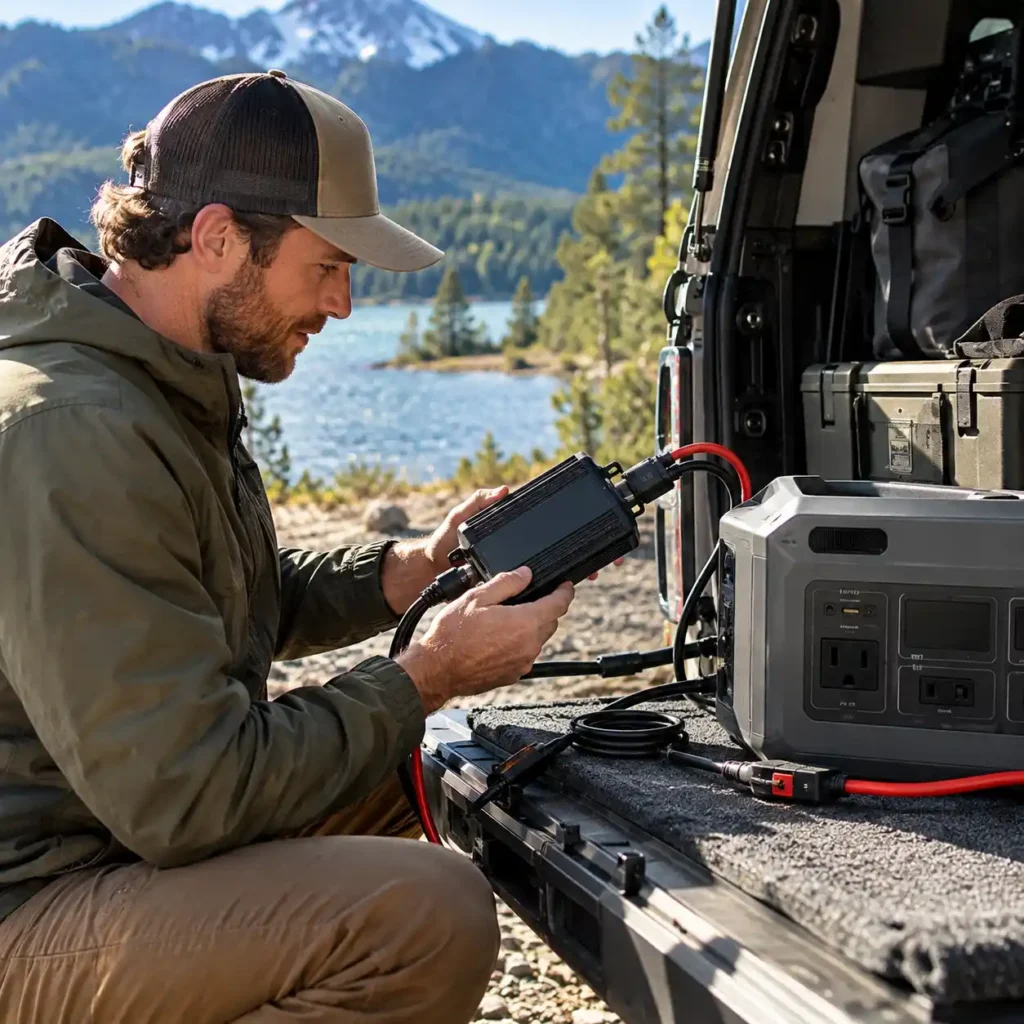
Choosing an alternator charger is not simply a matter of comparing advertised wattage. The charger has to fit into two systems at the same time: the electrical system of your vehicle and the charging system of your portable power station. A charger that can deliver 800W on paper may provide much less in practice if the power station accepts less, the vehicle cannot support the required load, or the installation and connection requirements are not met.
An alternator charger uses electrical power generated by a vehicle’s alternator while the engine is running to recharge a compatible portable power station. The charger regulates and converts that power into a form the power station can accept through its DC charging input. The actual charging power depends on the vehicle’s electrical system, the charger’s capabilities, and the power station’s input limits, so the charger’s advertised wattage does not guarantee the same charging rate in every setup.
The safest way to compare the best alternator chargers for portable power stations is therefore to work through compatibility first, then charging capability, installation requirements, features, and value. This approach helps you avoid paying for charging power or features that your particular setup cannot actually use.
Check Your Power Station’s Input Requirements
Start with the portable power station, not the charger. Check how the station accepts external DC charging, including its required input voltage, maximum accepted charging power, connector type, and any manufacturer-specific cable or adapter requirements.
This is where seemingly similar alternator chargers can differ substantially. Some are designed primarily for a specific power-station ecosystem, while others can work with a broader range of compatible DC inputs. The important question is not whether a charger is rated for 580W or 800W, but whether your power station can safely accept the charger’s output and connection method.
Check Whether Your Vehicle Uses a 12V or 24V System
Next, confirm the voltage of your vehicle’s electrical system. Alternator chargers in this category commonly support 12V, 24V, or both, but that does not mean every charger is appropriate for every vehicle.
The vehicle’s electrical architecture also matters beyond the nominal voltage. Smart alternators, start-stop systems, and battery-management systems can affect how the charger should be connected and how it behaves while the vehicle is running. If the manufacturer’s compatibility guidance excludes or requires additional checks for your type of vehicle, treat that as a buying requirement rather than assuming the charger will work normally.
Match Charger Output to Your Power Station
A charger’s advertised maximum output is only one part of the charging equation. An 800W alternator charger does not automatically deliver 800W to every portable power station. The station’s own maximum charging input can become the limiting factor.
Think of the charging path as:
Charger output → Power station input limit → Actual charging power
For example, if a charger can provide up to 800W but the power station accepts only 500W through its relevant charging input, the station cannot use the charger’s full 800W capacity. Vehicle-side limitations, wiring, and operating conditions can further affect the power actually delivered.
If you are still deciding how much battery capacity you need for your setup, use our Power Station Size Calculator to estimate the power station capacity that fits your needs.
Check Connectors, Cables and Adapters
Physical and electrical compatibility also depends on how the charger connects to the power station. Before buying, verify the required connector, cable configuration, and whether an additional adapter is needed for your exact power-station model.
This is particularly important with ecosystem-specific solutions. A charger may be an excellent match for one manufacturer’s power stations while being unsuitable for another brand, even when both stations have similar battery capacities and charging specifications. Compatibility should therefore be confirmed at the model level, not assumed from the brand name or advertised wattage alone.
Check Your Alternator and Vehicle Electrical System
Finally, consider whether your vehicle can support the additional electrical load. The relevant question is not simply whether the vehicle has a 12V or 24V system, but whether its alternator and electrical architecture are suitable for the intended charging setup alongside the vehicle’s normal loads.
Pay particular attention to vehicles with smart alternators, start-stop systems, or battery-management systems. These systems can change charging behavior or require specific installation methods. When manufacturer documentation identifies limitations for a particular vehicle architecture, that information should take priority over general assumptions about alternator capacity.
Check Fuse and Installation Requirements
An alternator charger is part of the vehicle’s electrical system, so wiring and protection are part of compatibility—not just installation details. Check the required fuse, cable requirements, connection points, and installation instructions before choosing a model.
The more demanding the charger, the more important it is that the wiring and protection are appropriate for the intended current. If the installation requirements are beyond your experience or the vehicle has a complex electrical architecture, professional installation can be the more appropriate choice.
How Much Faster Is Alternator Charging?
Alternator charging can provide much more charging power than a standard 12V vehicle outlet, but the actual charging time depends on the complete charging path. A charger’s maximum rating alone is not enough to predict how quickly a portable power station will recharge.
Understanding Charging Time
A simple planning formula is:
Charging Time ≈ Energy Needed ÷ Actual Charging Power
For example, if a power station needs approximately 1,000Wh of energy and receives about 500W of actual charging power, the basic calculation gives approximately 2 hours.
If you need help understanding battery energy ratings before estimating charging time, use our Battery Capacity Calculator: How to Calculate Battery Size in Ah and Wh.
This is a planning estimate, not a guaranteed charging time. It becomes more useful when you base the calculation on the actual charging power available to the power station, rather than the charger’s headline maximum.
Why Advertised Wattage Is Not the Same as Real Charging Speed
An 800W alternator charger does not automatically mean 800W of charging power into every portable power station. Several parts of the charging system can limit the actual rate:
- Power station input limit — the station may accept less power than the charger can provide.
- Conversion losses — some energy is lost as the charger converts and regulates power.
- Charging curve — charging power can change as the battery approaches a higher state of charge.
- Battery state of charge — a deeply discharged battery may behave differently from one that is already near full.
- Vehicle limitations — the alternator and vehicle electrical system may not always support the charger’s maximum rated output.
For this reason, comparing alternator chargers solely by their advertised wattage can lead to the wrong buying decision. The relevant figure is the charging power your complete system can actually deliver to the power station.
What Affects Real-World Charging Time?
Actual charging time depends on the interaction between the charger, vehicle, and power station. The power station may reduce its charging rate as the battery approaches full capacity, while conversion losses mean that the simple energy-to-power calculation does not represent every watt drawn from the vehicle.
The vehicle can also affect the result. Existing electrical loads, alternator behavior, and the specific installation can limit how much power the charger can continuously provide.
That is why charging-time estimates are best used for planning rather than as guaranteed performance figures. A charger rated at 800W may be capable of high-speed charging, but the actual result depends on what the vehicle can provide and what the power station can accept.
Alternator Charging vs. Other Charging Methods

An alternator charger is not automatically the best way to recharge a portable power station in every situation. The right charging method depends on where you are, how quickly you need to replenish the battery, and which charging inputs your power station supports.
For vehicle-based use, however, alternator charging has one important advantage: it turns driving time into a predictable opportunity to replenish the power station without depending on grid access or sunlight.
Alternator Charger vs. 12V Car Outlet
A standard 12V car outlet and a dedicated alternator charger use fundamentally different charging approaches. A car outlet is designed primarily for lower-power vehicle accessories, while an alternator charger is installed as a dedicated DC charging system that can draw substantially more power from the vehicle’s electrical system.
That difference matters when you are trying to recharge a large portable power station while driving. A 12V outlet may be convenient for occasional charging or smaller loads, but it can become a limiting factor when faster replenishment is important. A dedicated alternator charger is better suited to buyers who want vehicle charging to be a meaningful part of their power-station charging strategy.
When charging through a standard 12V car outlet, the usable charging power is limited by the vehicle outlet’s rated capacity, the connected charging device, and the power station’s input requirements. A dedicated alternator charger uses a separate electrical connection with appropriately specified wiring and circuit protection, allowing higher-power charging when the vehicle, charger, and power station support it. However, neither method guarantees a particular charging rate: the actual result depends on the limits of the complete charging system.
The trade-off is installation. A car outlet is already available and requires little setup, while an alternator charger requires appropriate wiring, protection, connections, and vehicle compatibility.
Alternator Charger vs. Solar Charging
Solar charging is valuable when you are parked and have sufficient sunlight, making it particularly useful for extended off-grid stays.
If solar is likely to be your main charging source while parked, compare the options in our guide to Best Portable Solar Panels (2026).
It can replenish a power station without running the vehicle and without access to grid power.
Alternator charging has a different advantage: it works while you drive and does not depend on solar conditions. For road trips, RV travel, van life, and overlanding, this can make vehicle charging a useful way to replenish energy between destinations.
The two methods therefore solve different parts of the charging problem. Solar is especially useful when you have time and sunlight available; alternator charging is useful when driving provides the most predictable charging opportunity. For many off-grid setups, the most practical solution is to use both when the power station and charging equipment support that configuration.
Alternator Charger vs. AC Charging
AC charging remains the simplest option when you have reliable access to grid power. At home, a campground with hookups, or another suitable AC source, plugging the power station into an appropriate wall outlet can provide straightforward and often fast recharging without relying on the vehicle.
Alternator charging becomes more valuable when grid access is unavailable or when you want to replenish the power station during travel. Instead of waiting until you reach an outlet, you can use driving time to restore part of the battery.
For buyers who regularly move between locations, this makes alternator charging less of a replacement for AC charging and more of a second charging path that adds flexibility to the overall system.
Alternator + Solar Charging
Combining alternator and solar charging can make sense when a power station supports both inputs and the charging equipment is designed to use them together. The advantage is that the two sources can complement each other: the alternator provides charging while driving, while solar can continue replenishing the battery when the vehicle is parked.
This approach is particularly useful for extended vehicle-based travel where charging opportunities vary from day to day. Instead of depending entirely on either driving or sunlight, the system can use both available energy sources.
The BLUETTI Charger 2 is a notable example in this comparison because it supports up to 800W of alternator input and 600W of solar input, with up to 1,200W of combined charging. The important point, however, is not simply the higher combined number: the power station and the rest of the system must also support the required charging configuration.
Is an Alternator Charger Safe for Your Vehicle?
A properly selected and installed alternator charger can be a practical way to recharge a portable power station while driving, but safety depends on the compatibility of the charger, vehicle, wiring, and power station. There is no universal alternator-charger setup that should be assumed safe for every vehicle.
What Makes an Installation Safe?
The installation should match the charger’s electrical requirements and the vehicle’s system. Before installation, confirm the correct vehicle voltage, appropriate wiring, required fuse protection, and secure electrical connections.
The charger should also be installed according to the manufacturer’s instructions. High-power DC charging places greater demands on wiring and circuit protection than a standard accessory connection, so the installation should not be treated as simply connecting another device to the vehicle battery.
Fuse and Cable Requirements
The fuse and cable are part of the charger’s electrical protection system. The wiring needs to be appropriate for the current the charger is designed to draw, while the fuse provides protection for the circuit if an electrical fault occurs.
Do not select a fuse or cable size based only on what appears convenient. Follow the charger’s specified installation requirements and use the appropriate connection method for the vehicle and charger. If those requirements are unclear or the installation involves a complex vehicle electrical system, professional installation is the safer approach.
Protecting the Starter Battery
An alternator charger should not leave the vehicle’s starter battery unnecessarily exposed to discharge. Depending on the model, protection can include starter-battery monitoring, low-voltage protection, automatic shutdown, or battery-maintenance functions.
These features differ between chargers, so they should be considered when comparing models rather than assuming that every alternator charger provides the same level of starter-battery protection. The goal is to ensure that charging the portable power station does not compromise the vehicle’s ability to start.
Smart Alternators and Start-Stop Vehicles
Modern vehicles may use smart alternators and start-stop systems that change charging behavior depending on battery state, engine operation, and vehicle conditions. Battery-management systems can add another layer of control to the vehicle’s electrical architecture.
Because of these differences, compatibility should be confirmed for the specific vehicle and charger combination. A charger that works correctly with one 12V vehicle should not automatically be assumed to work the same way in another 12V vehicle with a different charging architecture.
When Professional Installation Makes Sense
Professional installation is worth considering when the charger requires high-current wiring, the vehicle has a smart alternator or complex battery-management system, or you are not experienced with automotive DC electrical work.
It is also appropriate when the manufacturer’s installation requirements are difficult to verify for your vehicle. The objective is not simply to make the charger operate, but to ensure that the vehicle, alternator charger, wiring, starter battery, and power station form a compatible charging system.
Common Alternator Charger Buying Mistakes

The most common alternator charger mistakes are not simply technical errors. They happen when buyers evaluate one specification in isolation instead of considering how the charger fits into the complete vehicle → charger → power station system.
Choosing the Highest Wattage Instead of the Best-Matched Charger
A higher wattage rating can look like the obvious advantage, but it does not necessarily translate into faster or more useful charging for a particular setup. If your power station cannot accept the charger’s full output, the additional capacity may provide little practical benefit.
The better question is not “Which charger has the most watts?” but “Which charger can my system actually use?”
Treating Similar 800W Chargers as Equivalent
Two chargers with the same advertised output can have very different compatibility boundaries, connection requirements, ecosystem restrictions, and vehicle-side requirements.
This matters particularly when comparing the models in this guide. Their 800W ratings do not make them interchangeable: each one is designed around a different combination of power-station compatibility, vehicle integration, and additional functionality.
Choosing the Charger Before Confirming the Power Station
It is easy to start with the charger because its specifications are presented clearly on the product page. But the power station ultimately determines whether that charging path can be used and how much of the charger’s capability is available.
For that reason, the exact power-station model should be identified before comparing charger features or prices.
Assuming a More Feature-Rich Charger Is Automatically Better
Reverse charging, battery maintenance, app control, jump-start capability, or combined solar charging can be useful, but only when they solve a real need in your setup.
Additional functions can increase the value of a charger for one buyer while adding little for another. A simpler charger can therefore be the better purchase if straightforward alternator charging is all the system requires.
Ignoring the Vehicle’s Actual Use Pattern
A charger that makes sense for long daily drives may not be the best choice for a vehicle that spends most of its time parked. Likewise, buyers who regularly travel off-grid may value charging while driving differently from someone who normally has access to AC or solar charging.
The right choice depends not only on what the charger can do, but on when and how often you will realistically use alternator charging.
Comparing Purchase Price Without Considering the Complete Setup
The lowest-priced charger is not necessarily the lowest-cost solution. Required cables, adapters, installation, wiring, protection, or ecosystem-specific accessories can affect the practical cost of getting the system working.
Compare the charger as part of the complete installation rather than judging value from the device price alone.
Assuming Compatibility From the Brand or Vehicle Voltage Alone
A shared brand name or a compatible 12V/24V rating does not guarantee that the complete system will work together. Compatibility can depend on the exact power-station model, charging input, connector configuration, vehicle electrical architecture, and manufacturer requirements.
When in doubt, verify the specific charger + power station + vehicle combination before buying.
What These Mistakes Mean for Your Buying Decision
The safest buying priority is therefore:
Compatibility → Vehicle electrical system → Power-station input → Actual charging capability → Safety and installation → Ecosystem and features → Value.
Once those conditions are satisfied, wattage and price become useful comparison points. Before that, they can be misleading.
Frequently Asked Questions
Can I use an alternator charger with any portable power station?
No. Compatibility depends on the power station’s charging input, voltage requirements, connector or cable configuration, maximum accepted charging power, and sometimes the manufacturer’s ecosystem. Some chargers support a wider range of third-party stations, while others are designed primarily for specific systems. Always check the exact power-station model rather than relying on the charger’s wattage or brand alone.
Can I use an alternator charger with a smart alternator?
Sometimes, but compatibility depends on the specific charger and vehicle. Smart alternators can change their output according to vehicle conditions, so a charger designed for conventional alternator behavior may require different installation or operating conditions. Check the charger’s manufacturer guidance for your vehicle before installation rather than assuming that a 12V match is sufficient.
Can an alternator charger drain the vehicle's starter battery?
A properly designed system can include starter-battery monitoring, low-voltage protection, or automatic shutdown to help prevent excessive discharge. However, these protections vary by charger, so they should be treated as an important selection criterion rather than an assumption. Some models also offer reverse charging or battery-maintenance functions, but those are additional features rather than standard behavior across the category.
Can an alternator charger be used while the vehicle is driving?
Yes. Driving is the primary use case for an alternator charger: the system draws power from the vehicle’s charging system and uses it to recharge the compatible portable power station. Actual charging output can still vary with the vehicle, operating conditions, and power station’s input capability.
Does using an alternator charger increase fuel consumption?
It can add some load to the vehicle’s electrical system, which means the alternator may need to produce additional power. The practical effect on fuel consumption depends on the vehicle, charging load, and operating conditions, so it should not be treated as literally “free” energy. For buyers comparing charging methods, the important consideration is whether the additional fuel and electrical load are worthwhile for the convenience of charging while driving.
Can I use an alternator charger with an RV house battery?
Some models support connection to an RV house battery as well as a vehicle starter battery, but this is model-specific and should not be assumed for every charger. For example, EcoFlow’s documentation explicitly supports certain configurations involving an RV house battery. If your goal is to charge a portable power station from an RV electrical system, verify the exact charger and battery configuration before installation
Can I use the same alternator charger with different portable power stations?
Sometimes, but switching between stations is not necessarily plug-and-play. Different power stations may require different output voltages, connectors, adapters, or charger settings, and some chargers are more ecosystem-specific than others. A charger that supports multiple stations can still require configuration changes between models.
Final Verdict
The best alternator charger is not necessarily the one with the highest wattage. The right choice depends on compatibility with your power station and vehicle, usable charging power, installation requirements, and the features you actually need.
For most buyers, BLUETTI Charger 2 offers the strongest combination of alternator and solar charging. But buyers who prioritize ecosystem integration, all-in-one vehicle support, battery maintenance, or a simpler 580W solution may find another model better suited to their setup.
The goal is not to choose the most powerful charger. It is to choose the charger your vehicle and power station can actually use.
Our Recommendation
If your priority is combined alternator + solar charging → choose the BLUETTI Charger 2.
If your priority is Anker SOLIX ecosystem integration → choose the Anker SOLIX Alternator Charger.
If your priority is all-in-one vehicle power support → choose the EF ECOFLOW 800W Alternator Charger.
If your priority is battery maintenance and app control → choose the OUPES 800W Alternator Charger.
If your priority is 12V/24V vehicle charging at 580W → choose the AFERIY DC060.
Related Guides
If you want to continue your research, these guides cover the next decision in the power setup:
- Need to choose the right power station for vehicle-based use? → Best Portable Power Stations for Van Life (2026): Top Picks for Off-Grid Living
- Already using Anker SOLIX and want to explore the broader ecosystem? → Anker SOLIX: Portable Power, Solar & Home Backup
- Building an RV power system? → Best Portable Power Stations for RV (2026)
- Looking for a portable setup for camping? → Best Portable Power Stations for Tent Camping (2026)
- Planning extended vehicle-based off-grid travel? → Best Portable Power Stations for Overlanding (2026)
Power Ready Guide Commitment
At Power Ready Guide, our goal is not to recommend the most powerful accessory simply because it has the highest specification.
We compare charging equipment based on the factors that matter to real buying decisions—compatibility, usable charging power, vehicle requirements, installation, useful features, and overall value.
Our commitment is simple: help you choose the charging solution your system can actually use, not simply the one with the biggest number.