
Choosing a portable power station for CPAP backup involves more than finding a battery that can keep a machine running overnight. During an extended power outage, you may also need enough stored energy and output capacity to support other essential household devices. The challenge is finding a station that matches your CPAP requirements while providing sufficient backup capacity for your broader needs.
This guide compares five higher-capacity portable power stations for home CPAP backup, extended outages, and situations where additional devices must share the available power. We evaluate battery capacity, AC output, expansion options, charging capabilities, practical operating considerations, and manufacturer guidance relevant to CPAP use.
As an Amazon Associate, I earn from qualifying purchases.
Table of Contents
Quick Answer
The Anker SOLIX C1000 Gen 2 is a strong option for buyers who want a compact power station with substantial AC output. It stands out as the Best 2,000W Output in a Lightweight 1,000Wh Class, combining 1,024Wh of capacity with 2,000W of continuous output at approximately 24.9 lb. The BLUETTI Elite 100 V2 is worth considering if CPAP-specific manufacturer guidance is a priority: BLUETTI provides example runtime calculations for 30W and 60W CPAP loads. Its main limitation is that neither manufacturer’s guidance guarantees runtime with every CPAP configuration.
For buyers prioritizing longer backup potential, the BLUETTI Elite 300 offers the largest built-in battery capacity in this comparison, while the EcoFlow DELTA 2 Max is the expandable option for a home backup setup. The BLUETTI Elite 200 V2 offers higher continuous AC output than the other selected models in its approximately 2,000Wh capacity class, which may matter when powering additional household devices alongside a CPAP machine. These advantages address different needs; greater capacity, output, or expandability does not automatically mean better CPAP compatibility.
Before choosing, check your CPAP manufacturer’s power requirements and guidance, including whether the device can run from a standard AC outlet or requires an approved DC connection. Confirm any restrictions on using a portable power station, and consider whether you use a humidifier or heated tubing. Actual runtime depends on the CPAP model, settings, power draw, battery energy available, and conversion losses. A portable power station should not be treated as a medically approved or guaranteed life-support backup.
Our Evidence & Evaluation Method
We compare the five power stations using manufacturer specifications, official U.S. product documentation, user manuals, warranty information, and Amazon listings. For CPAP-related considerations, we also examine manufacturer guidance and restrictions concerning medical equipment.
Published specifications are distinguished from calculated runtime estimates. We do not present manufacturer examples as independent test results or imply that a power station is medically certified for CPAP use.
| Factor | What We Examine | Evidence |
|---|---|---|
| Capacity | Rated capacity (Wh) | Manufacturer specifications |
| Output | Continuous and peak AC output | Product documentation and user manuals |
| Charging | AC, solar, and vehicle charging | Technical documentation |
| Portability | Weight and dimensions | U.S. product specifications |
| CPAP Runtime | Estimated operating time under stated load assumptions | Calculations |
| CPAP Guidance | Manufacturer recommendations and restrictions | Official documentation |
| Reliability | Battery chemistry, cycle life, and warranty | Manufacturer documentation |
Who This Guide Is For
This guide is for U.S. buyers comparing higher-capacity portable power stations for home CPAP backup and extended power outages. It focuses on five selected models that offer different combinations of stored energy, continuous AC output, expansion options, and manufacturer guidance relevant to CPAP use. These stations may also support additional essential household devices, provided the combined power requirements remain within the manufacturer’s limits.
Who Should Read This
- CPAP users preparing for overnight or extended home power outages.
- Buyers who want to power a CPAP machine alongside other essential household devices.
- Households comparing battery capacity, continuous AC output, and expansion options for backup power.
- Buyers who want a portable power station that can serve as a flexible home backup source.
Who Should Use Another Guide
If you need to calculate how long a specific power station will run your CPAP setup, use our CPAP Runtime Calculator.
If you are choosing a power station for broader household backup rather than CPAP use, see our Best Portable Power Stations for Home Backup guide.
If you need a general explanation of battery capacity and how to size a power station for different appliances, start with What Size Power Station Do I Need?
Quick Summary: The 5 Best Portable Power Stations for CPAP
These five portable power stations offer different combinations of battery capacity, AC output, expansion options, and CPAP-related manufacturer guidance. Each is included for a specific buyer priority, with a distinct advantage and a limitation to consider before choosing.
Anker SOLIX C1000 Gen 2
Award: Best 2,000W Output in a Lightweight 1,000Wh Class
Best For: Buyers who want substantial AC output in a relatively lightweight power station.
Key Reason: Its 1,024Wh battery and 2,000W continuous AC output provide considerable power capacity without moving into a much heavier unit.
Main Limitation: Its battery capacity cannot be expanded.
BLUETTI Elite 300
Award: Best for Maximum Built-In Battery Capacity
Best For: Buyers who prioritize the largest built-in battery capacity among the five selected models.
Key Reason: Its 3,014.4Wh LiFePO₄ battery provides the highest built-in energy capacity in this comparison.
Main Limitation: Its approximately 58 lb weight makes frequent transportation less convenient.
EcoFlow DELTA 2 Max
Award: Best for Expandable Home CPAP Backup
Best For: Households that want the option to increase battery capacity for home backup.
Key Reason: Its 2,048Wh battery supports expansion with compatible extra batteries, and EcoFlow provides specific guidance concerning home CPAP use.
Main Limitation: EcoFlow does not recommend it for hospital-grade CPAP equipment or medical emergency equipment requiring continuous professional monitoring.
BLUETTI Elite 200 V2
Award: Best for Higher Continuous AC Output in the 2,000Wh Class
Best For: Buyers who may need to power additional household devices alongside a CPAP machine.
Key Reason: Its 2,073.6Wh battery and 2,600W continuous AC output provide higher continuous power output than the other selected model in this capacity class.
Main Limitation: Its default ECO settings can shut off output at low loads, so the settings may need adjustment for low-wattage CPAP equipment.
BLUETTI Elite 100 V2
Award: Best for CPAP-Specific Manufacturer Guidance in a 1,000Wh Class
Best For: Buyers who want manufacturer-published CPAP usage and runtime examples.
Key Reason: BLUETTI provides example runtime calculations for 30W CPAP use without a humidifier and 60W with a humidifier.
Main Limitation: Actual runtime depends on the CPAP model, operating settings, humidifier use, and available battery energy.
Comparison Table: Best Portable Power Stations for CPAP
| Model | Capacity | AC Output | Weight | CPAP Guidance & Best For |
|---|---|---|---|---|
| Anker SOLIX C1000 Gen 2 | 1,024Wh | 2,000W | 24.9 lb | 40W CPAP example; lightweight, high-output backup |
| BLUETTI Elite 300 | 3,014.4Wh | 2,400W | 57.98 lb | No specific CPAP guidance; maximum built-in capacity |
| EcoFlow DELTA 2 Max | 2,048Wh | 2,400W | Approx. 50 lb | Conditional home CPAP use; expandable backup |
| BLUETTI Elite 200 V2 | 2,073.6Wh | 2,600W | 53.35 lb | No specific CPAP guidance; higher continuous output |
| BLUETTI Elite 100 V2 | 1,024Wh | 1,800W | Approx. 25.3 lb | 30W/60W CPAP examples; portable backup |
How to Read CPAP Manufacturer Guidance
These labels describe the level of CPAP-specific information found in the reviewed manufacturer documentation. They do not represent medical certification or guarantee compatibility with a particular CPAP machine.
Explicit CPAP guidance: The manufacturer specifically references CPAP use or provides CPAP-related operating or runtime examples.
Conditional home CPAP use: The manufacturer permits certain home CPAP applications subject to stated conditions and restrictions.
No specific CPAP guidance found: General electrical specifications are available, but we did not find explicit CPAP-use guidance in the reviewed documentation.
Manufacturer restrictions: The manufacturer identifies equipment or operating scenarios for which the power station is not recommended or permitted.
How We Evaluated
We evaluated the five portable power stations by looking beyond their advertised capacity and output ratings. For CPAP backup, a useful power station must provide sufficient energy, maintain reliable output under a relatively low load, and fit the conditions in which the user plans to operate it. We considered the following thirteen factors when comparing the selected models.
Energy Capacity
We compared the rated battery capacity of each model to understand how much stored energy it offers. Capacity matters for overnight backup, but a higher Wh rating does not automatically make a station the better choice. Usable energy, operating conditions, and the additional power demands of connected household devices also affect its practical value.
Usable Energy
Rated capacity is not the same as energy available to a connected CPAP machine. When evaluating usable energy, we considered conversion losses, power station self-consumption, and the additional demand created by humidifiers and heated tubing. These factors can reduce actual operating time compared with estimates based on battery capacity alone.
Inverter Capability
We examined each station’s continuous AC output, surge capability, and documented inverter performance. For CPAP users, the ability to maintain AC output under a relatively low load can be more important than a high maximum wattage. We also considered low-load behavior and UPS functionality where documented, since automatic output shutoff or transfer interruptions may affect overnight backup operation.
CPAP Power Connection & Inverter
We reviewed the documented AC waveform of each power station, including whether its manufacturer specifies pure sine wave output. We also examined available DC output options and whether a manufacturer-approved connection method for CPAP equipment could be verified.
A pure sine wave inverter is an important specification when evaluating AC power, but it does not independently establish compatibility with a particular CPAP machine. Compatibility depends on the CPAP manufacturer’s electrical input requirements and the approved power supply or adapter.
We distinguish between verified inverter specifications, available output connections, and manufacturer-confirmed CPAP connection guidance. We do not assume that a standard AC outlet, a DC port, or a pure sine wave inverter guarantees compatibility with every CPAP model.
Charging Speed
We compared AC charging capabilities and available recharging options. Faster AC charging can help restore backup capacity between outages, while compatible solar and vehicle charging options may provide additional ways to replenish stored energy during extended grid interruptions.
Portability
Weight and physical dimensions matter when a power station needs to be moved between rooms, positioned near a CPAP setup, or stored in a designated home backup area. We considered portability in relation to battery capacity and practical home placement rather than treating the lightest model as automatically the most suitable choice. Larger units may be less convenient to relocate, but their additional stored energy can be valuable during extended outages.
Solar Compatibility
We considered supported solar input and charging capabilities for buyers who may need to replenish battery capacity during an extended grid outage. Solar charging can provide additional flexibility when household electricity is unavailable, provided compatible panels, sufficient sunlight, and suitable installation space are available.
Expandability
We checked whether each model supports compatible additional batteries and how expansion affects its potential role as a home backup system. Expandability can be valuable for households that want to increase stored energy over time, although additional batteries also increase cost and storage requirements.
Warranty and Ecosystem
We considered warranty coverage, compatible expansion batteries, charging accessories, and manufacturer support. For CPAP users, access to the correct power accessories and clear operating guidance is particularly important. A standard DC output should never be assumed compatible with a CPAP machine without verifying its voltage, connector, and power requirements.
Value
We assessed value in relation to capacity, continuous AC output, portability, expansion options, and CPAP-specific guidance. The highest-capacity or highest-output model is not necessarily the best purchase for someone who only needs a practical overnight backup solution.
Use-Case Fit
Finally, we considered how well each station fits different CPAP backup scenarios, including overnight home backup, multi-night outages, and situations where the same power station must support additional essential household devices. We also accounted for practical limitations such as low-load automatic shutoff, manufacturer restrictions, available battery capacity, and the need to verify whether a particular CPAP setup can operate from the station.
These criteria help distinguish between a power station with impressive specifications and one that makes practical sense for a particular CPAP backup requirement.
Bedroom Practicality
We considered how practical each power station is to keep in or near a bedroom during overnight CPAP backup. This includes physical dimensions, weight, cooling fan noise, display brightness, indicator lights, and documented operating conditions.
Where manufacturers publish noise measurements, display controls, or relevant operating information, we use those details to assess bedroom suitability. We do not estimate decibel levels or describe a station as quiet without supporting evidence. When comparable information is unavailable, we identify the specification as not published or not verified rather than assuming that the unit operates silently.
We also considered whether the station’s size, ventilation requirements, and access to its outlets and controls make it practical to position near a CPAP setup.
CPAP Manufacturer Guidance
We reviewed manufacturer documentation for explicit CPAP references, published runtime examples, permitted home CPAP use, and restrictions concerning medical equipment. We distinguish specific manufacturer guidance from general electrical specifications and do not treat the absence of a stated restriction as confirmation of compatibility.
This assessment reflects the guidance available in the reviewed documentation. It does not establish medical certification, confirm compatibility with every CPAP model, or guarantee uninterrupted operation during a power outage.
Portable Power Station Reviews for CPAP Backup
Anker SOLIX C1000 Gen 2
Best 2,000W Output in a Lightweight 1,000Wh Class

Quick Verdict
The Anker SOLIX C1000 Gen 2 is a 1,024Wh portable power station with 2,000W of continuous AC output, designed for buyers who want substantial power in a relatively compact unit. For CPAP users, one particularly relevant detail is that Anker itself uses a 40W CPAP machine as an example on the U.S. product page. The unit also includes a UPS function with a stated transfer time of 10 ms, making it worth considering for home backup where a brief interruption during a power outage is a concern.
This model is a good candidate for CPAP users who want a portable home backup option without moving to a much heavier, higher-capacity station. However, Anker’s 40W example should not be treated as a runtime guarantee: actual consumption depends on the CPAP model, pressure settings, humidifier and heated-tubing use. The UPS specification also does not establish uninterrupted operation with every CPAP device. Buyers should check their CPAP manufacturer’s power requirements and confirm that the intended backup arrangement is suitable for their equipment.
CPAP Compatibility & Manufacturer Guidance
Manufacturer guidance: Explicit CPAP example provided.
Anker’s U.S. product documentation uses a 40W CPAP machine as an example load. This provides a specific reference for evaluating the C1000 Gen 2 as a potential CPAP backup power source.
However, the example does not establish compatibility with every CPAP model or guarantee a particular runtime. Actual suitability depends on the CPAP manufacturer’s electrical requirements, the intended AC or approved DC connection, and the use of accessories such as a humidifier or heated tubing.
What to verify: Confirm that your CPAP manufacturer’s requirements match the station’s available output and that your intended connection method is supported.
Snapshot
| Specification | Details |
|---|---|
| Capacity | 1,024Wh |
| Battery Chemistry | LiFePO₄ |
| Continuous AC Output | 2,000W |
| Peak / Surge Output | 3,000W |
| Weight | 24.9 lb |
| Expansion | Not expandable |
Why We Chose It
The Anker SOLIX C1000 Gen 2 earns its award by delivering 2,000W of continuous AC output in a power station weighing just 24.9 lb. Among the two selected models in the approximately 1,000Wh class, it offers higher continuous output than the BLUETTI Elite 100 V2 while remaining nearly the same weight. The larger-capacity alternatives provide more stored energy or higher output, but they are substantially heavier. This makes the Anker a distinctive choice for buyers who want strong AC output without stepping up to a 50–58 lb unit.
Its relevance to CPAP users is supported by Anker’s own product guidance, which includes a 40W CPAP machine as an example load and identifies the unit’s 10 ms UPS function as a backup feature for equipment such as CPAP machines. These details make it particularly worth considering for home backup, although they do not guarantee a specific runtime or uninterrupted operation with every CPAP model.
Check the latest price and customer reviews on Amazon.

Living With It
Measuring 15.12 × 8.19 × 9.61 inches and weighing 24.9 lb, the C1000 Gen 2 has a relatively compact footprint for a 1,024Wh power station. Its size makes it easier to store in a bedroom, closet, or nearby utility area than the heavier 2,000Wh and 3,000Wh-class alternatives. For a CPAP user, this can make it more practical to keep backup power accessible without dedicating a large amount of floor space to it.
At this weight, the unit can be moved between rooms or loaded into a vehicle when needed, although it is not something most users would want to reposition repeatedly throughout the night. Its fixed 1,024Wh capacity is the main trade-off: there is no compatible expansion battery to increase the energy reserve later. Buyers who expect to run a CPAP alongside other household loads for extended periods may prefer a larger expandable system.
Evaluation
| Evaluation Factor | This Model | How It Compares | Buyer Implication |
|---|---|---|---|
| Battery Capacity | 1,024Wh | Less capacity than the three selected 2,000Wh-class and 3,014.4Wh models; matches the Elite 100 V2 | Suitable for buyers prioritizing portability over a larger energy reserve. |
| Continuous AC Output | 2,000W; 3,000W surge | Higher continuous output than the Elite 100 V2, but below the Elite 200 V2, Elite 300, and DELTA 2 Max | Provides substantial AC output for a compact 1,000Wh-class unit; output capacity does not determine CPAP runtime. |
| CPAP Backup Features | Anker provides a 40W CPAP example; 10 ms UPS function | More explicit CPAP-related product guidance than some alternatives; UPS specifications differ across models | Relevant for home backup, but users should verify CPAP compatibility and actual runtime with their equipment. |
Who Should Buy This
CPAP users who need a home backup station with 2,000W of continuous AC output but do not need a multi-night battery reserve.
Buyers who want a relatively lightweight 1,024Wh unit that is easier to store and move than the larger 2,000Wh-class alternatives.
Users who value Anker’s published 40W CPAP example and want a station with a specified 10 ms UPS function for home backup.
Households that need a portable power source for a CPAP machine and occasional additional devices, while keeping total energy demand within the station’s capacity.
Who Should Skip This
Users who need extended overnight backup or several nights of operation without recharging; a larger-capacity model such as the BLUETTI Elite 300 or EcoFlow DELTA 2 Max may be more appropriate.
Buyers who expect to expand battery capacity later; the C1000 Gen 2 does not support additional battery expansion.
CPAP users whose equipment requires a medically approved or professionally monitored backup system; this power station is not a substitute for one.
Final Verdict
The Anker SOLIX C1000 Gen 2 is the strongest fit for buyers who prioritize high AC output, manageable weight, and practical home backup in a 1,000Wh-class unit. Its 2,000W output and CPAP-related guidance make it a credible candidate for a single CPAP setup, but its fixed 1,024Wh capacity limits the available energy reserve. Choose it when portability and output matter more than extended runtime or future expansion; choose a larger expandable station if longer backup is the priority.
Check the latest price and customer reviews on Amazon.
Related Guide: If you want to use a portable power station for CPAP backup during household outages, see our guide to Best Portable Power Stations for Home Backup. It compares backup options for essential household devices and helps you choose a station based on capacity, output, and outage needs.
BLUETTI Elite 300
Best for Maximum Built-In Battery Capacity

Quick Verdict
The BLUETTI Elite 300 stands out for its 3,014.4Wh LiFePO₄ battery, the largest built-in capacity among the five power stations in this guide. Its 2,400W continuous AC output and 10 ms UPS switching specification make it a substantial home backup option for CPAP users who want a larger energy reserve and may also need to power other essential household devices during an outage. Unlike a smaller 1,000Wh-class station, it offers considerably more stored energy without requiring a separate expansion battery.
For CPAP use, the main advantage is its battery capacity rather than a specific CPAP feature or manufacturer runtime example. BLUETTI’s published specifications establish the unit’s electrical capabilities, but they do not provide a CPAP runtime guarantee. Actual operating time will depend on the machine, pressure settings, humidifier and heated-tubing use, and whether the CPAP is connected through AC or a compatible DC arrangement. Buyers should confirm their device’s requirements before relying on the Elite 300 as overnight backup.
CPAP Compatibility & Manufacturer Guidance
Manufacturer guidance: No specific CPAP guidance found in the reviewed documentation.
BLUETTI’s published specifications establish the Elite 300’s battery capacity and AC output, but the reviewed documentation does not provide a specific CPAP runtime example or explicit CPAP-use recommendation.
This does not establish that the station is incompatible with CPAP equipment. It means that buyers should not interpret its electrical specifications alone as confirmation of CPAP suitability.
What to verify: Check your CPAP manufacturer’s input requirements, approved connection options, and any restrictions on using portable power stations. Also review the Elite 300’s operating instructions before relying on it for overnight backup.
Snapshot
| Specification | Details |
|---|---|
| Capacity | 3,014.4Wh |
| Battery Chemistry | LiFePO₄ |
| Continuous AC Output | 2,400W |
| Peak / Surge Output | 4,800W |
| Weight | 57.98 lb |
| Expansion | Not expandable |
Why We Chose It
The BLUETTI Elite 300 earns its award with a 3,014.4Wh built-in battery — the largest capacity among the five models in this guide. It provides a substantially larger energy reserve than the other four options without requiring a separate expansion battery, making it the strongest choice for buyers who prioritize maximum built-in storage.
For CPAP users, this capacity can be useful during extended outages or when the station also needs to power other essential household devices. Its 2,400W continuous AC output adds flexibility, but the award is based on battery capacity, not a guaranteed CPAP runtime. Actual operating time depends on the CPAP and its settings.
Check the latest price and customer reviews on Amazon.

Living With It
Measuring 14.41 × 12.01 × 11.71 inches and weighing 57.98 lb, the Elite 300 is better suited to a dedicated home backup location than frequent relocation. Buyers should plan where to keep it and how to move it before installation.
During a household outage, it can provide a substantial energy reserve for overnight CPAP use and selected additional devices. The trade-off is limited flexibility: the battery cannot be expanded, and its weight makes it less practical for regular travel or moving between rooms.
Evaluation
| Evaluation Factor | This Model | How It Compares | Buyer Implication |
|---|---|---|---|
| Battery Capacity | 3,014.4Wh | Highest built-in capacity among the five selected models | Offers the largest starting energy reserve for extended CPAP backup and additional household loads. |
| Continuous AC Output | 2,400W | Matches the EcoFlow DELTA 2 Max; below the Elite 200 V2 at 2,600W | Provides substantial AC output for CPAP and other devices, but maximum output does not determine runtime. |
| Portability | 57.98 lb; 14.41 × 12.01 × 11.71 in | Heaviest of the five selected models | Better suited to a fixed home backup location than frequent transport. |
| Expandability | No battery expansion | Unlike the EcoFlow DELTA 2 Max, it cannot accept compatible extra batteries | Its full capacity is available from the start, but buyers cannot increase the energy reserve later. |
Who Should Buy This
CPAP users who want a large built-in energy reserve for longer household outages.
Households that need to power a CPAP machine alongside other essential devices during a power interruption.
Buyers who prefer a single high-capacity power station rather than a system requiring separate expansion batteries.
Users who plan to keep the station in a dedicated home backup location rather than move it frequently.
Who Should Skip This
Buyers who need a lightweight power station for camping, travel, or frequent relocation.
Users who want to expand battery capacity later; the Elite 300 does not support additional batteries.
CPAP users who require a medically approved or professionally monitored backup system.
Final Verdict
The BLUETTI Elite 300 is best suited to buyers who prioritize maximum built-in capacity for home CPAP backup and additional essential devices. Its 3,014.4Wh battery provides the largest energy reserve in this comparison, but its 57.98 lb weight and lack of expansion limit flexibility. Choose it when substantial built-in capacity matters more than portability or the ability to expand the system later.
Check the latest price and customer reviews on Amazon.
Related Guide: If you need a larger built-in energy reserve for extended household backup, see our guide to Best 3000Wh Portable Power Stations (2026): Top Picks for High-Capacity Backup Power. It compares high-capacity models for buyers who need more stored energy to support essential devices during longer power outages.
EF ECOFLOW DELTA 2 Max
Best for Expandable Home CPAP Backup

Quick Verdict
The EF ECOFLOW DELTA 2 Max is a 2,048Wh portable power station designed for buyers who want substantial home backup capacity with the option to expand it later. Its defining advantage is compatibility with up to two additional EcoFlow Smart Extra Batteries, allowing the system to grow from 2kWh to as much as 6kWh. For CPAP users, this makes it particularly relevant when a standard battery reserve may not be enough for longer outages or when the same system must support other essential household devices.
An important distinction is EcoFlow’s guidance on medical equipment: the manufacturer does not recommend this station for medical emergency equipment requiring continuous professional monitoring, including hospital-grade CPAP. However, its manual states that it can power a home CPAP that does not require continuous professional monitoring, subject to medical advice and the CPAP manufacturer’s restrictions. This makes the DELTA 2 Max a relevant home backup candidate for some CPAP users, but not a medically approved replacement for a dedicated life-support backup system.
CPAP Compatibility & Manufacturer Guidance
Manufacturer guidance: Conditional home CPAP use; manufacturer restrictions apply.
EcoFlow’s manual states that the DELTA 2 Max can power a home CPAP machine that does not require continuous professional monitoring, subject to medical advice and the CPAP manufacturer’s restrictions.
However, EcoFlow does not recommend this power station for medical emergency equipment requiring continuous professional monitoring, including hospital-grade CPAP equipment.
This is more specific CPAP-related guidance than general electrical specifications alone, but it does not constitute medical certification or guarantee uninterrupted therapy.
What to verify: Confirm that your CPAP equipment falls within EcoFlow’s stated conditions and that your healthcare provider and CPAP manufacturer consider the proposed backup arrangement appropriate.
Snapshot
| Specification | Details |
|---|---|
| Capacity | 2,048Wh |
| Battery Chemistry | LiFePO₄ (LFP) |
| Continuous AC Output | 2,400W |
| Peak / Surge Output | 4,800W |
| Weight | 50 lb |
| Expansion | Supports up to two compatible EcoFlow Smart Extra Batteries |
Why We Chose It
The EcoFlow DELTA 2 Max earns its award because it is the only model in our five-product selection that can expand its capacity with up to two compatible Smart Extra Batteries. This gives it an advantage over the BLUETTI Elite 300, which has a larger built-in battery but cannot be expanded, and the other three models, which also lack this expansion option. Buyers can start with the base unit and increase their energy reserve as their backup needs grow.
For CPAP users, this flexibility is particularly relevant when planning for longer outages or powering additional household devices alongside a CPAP machine. EcoFlow also explicitly addresses home CPAP use in its guidance, while distinguishing it from hospital-grade equipment requiring continuous professional monitoring. That makes the DELTA 2 Max a well-supported option for certain home backup scenarios, subject to the manufacturer’s restrictions and the CPAP provider’s advice.
Check the latest price and customer reviews on Amazon.

Living With It
Measuring approximately 19.6 × 9.5 × 12 inches and weighing around 50 lb, the DELTA 2 Max requires a planned storage location. It is manageable to reposition occasionally, but its size and weight make it less convenient for frequent room-to-room movement or regular travel. Buyers should also allow space for any extra batteries they may add.
At home, the system can serve as a central backup unit for a CPAP machine and selected household devices, with the option to increase capacity later. The trade-off is that expansion requires purchasing compatible extra batteries and allocating additional storage space. Buyers who need a ready-made larger reserve without adding components may prefer the Elite 300.
Evaluation
| Evaluation Factor | This Model | How It Compares | Buyer Implication |
|---|---|---|---|
| Battery Capacity | 2,048Wh | More than the two 1,024Wh models, but less than the Elite 300 | Provides a substantial starting reserve with the option to increase capacity later. |
| Continuous AC Output | 2,400W | Matches the Elite 300; below the Elite 200 V2 at 2,600W | Suitable for a CPAP machine and additional household loads within its output limits. |
| Expandability | Supports up to two compatible Smart Extra Batteries | The only expandable model among the five selected products | Allows buyers to increase backup capacity without replacing the original power station. |
| CPAP Manufacturer Guidance | Home CPAP use permitted under stated conditions; hospital-grade CPAP requiring continuous professional monitoring is excluded | More explicit CPAP-use guidance than the other selected models | Relevant for home CPAP backup, but users must follow EcoFlow's restrictions and consult their CPAP provider. |
Who Should Buy This
CPAP users who want a home backup system with the option to increase battery capacity as their needs change.
Households planning to power a CPAP machine alongside other essential devices during longer outages.
Buyers who prefer starting with a 2,048Wh unit rather than purchasing a larger system upfront.
Home CPAP users whose equipment does not require continuous professional monitoring and falls within EcoFlow’s stated guidance.
Who Should Skip This
Buyers who want the largest built-in battery capacity without purchasing extra batteries; the BLUETTI Elite 300 offers more out of the box.
Users who need a lighter, easier-to-move station for frequent travel or camping.
Users whose CPAP equipment requires continuous professional monitoring or falls under EcoFlow’s medical-equipment restrictions.
Final Verdict
The EcoFlow DELTA 2 Max is the most flexible choice in this comparison for home CPAP backup because its capacity can grow as household needs change. Its main drawback is that expansion requires additional compatible batteries, increasing both cost and storage requirements. Choose it if you want a system you can build over time; if you need maximum capacity immediately, the BLUETTI Elite 300 is the more direct option.
Check the latest price and customer reviews on Amazon.
Related Guide: If you want to expand your DELTA 2 Max system for longer backup periods, see our guide to Best Expansion Batteries for Portable Power Stations (2026): Top Picks for Capacity and Runtime. It compares additional battery options and explains how expansion can increase available energy storage.
BLUETTI Elite 200 V2
Best for Higher Continuous AC Output in the 2,000Wh Class

Quick Verdict
The BLUETTI Elite 200 V2 is a 2,073.6Wh portable power station with 2,600W of continuous AC output. Its main distinction is the higher inverter capacity within the approximately 2,000Wh group, making it relevant to households that may need to run a CPAP machine alongside other appliances during an outage. For buyers who want more output headroom rather than expandable battery storage, it offers a different proposition from the EcoFlow DELTA 2 Max.
There is one CPAP-specific detail buyers should understand before choosing it: the Elite 200 V2 has an ECO mode that can automatically switch off the AC output when the connected load is too low. BLUETTI advises disabling ECO mode for small devices below 60W or critical appliances. Since CPAP machines can operate at relatively low power levels, users should check this setting and verify stable operation with their particular machine before relying on the station overnight. The high inverter rating is useful for additional appliances, but it does not by itself make the unit a better CPAP backup solution.
CPAP Compatibility & Manufacturer Guidance
Manufacturer guidance: No specific CPAP guidance found in the reviewed documentation.
BLUETTI’s published specifications describe the Elite 200 V2’s electrical capabilities, but the reviewed documentation does not provide a specific CPAP runtime example or explicit CPAP-use recommendation.
One important operating consideration is its ECO mode, which can switch off AC output when the connected load is too low. BLUETTI advises disabling ECO mode for small devices below 60W or critical appliances.
This behavior deserves particular attention when evaluating the station for CPAP backup, but it does not by itself establish incompatibility.
What to verify: Check your CPAP’s electrical requirements, confirm the approved connection method, and test stable operation with ECO mode configured according to BLUETTI’s instructions.
Snapshot
| Specification | Details |
|---|---|
| Capacity | 2,073.6Wh |
| Battery Chemistry | LiFePO₄ |
| Continuous AC Output | 2,600W |
| Peak / Surge Output | 3,900W (Power Lifting) |
| Weight | 53.35 lb |
Why We Chose It
The BLUETTI Elite 200 V2 earns its award with 2,600W of continuous AC output — the highest rating among the five selected models. It exceeds the 2,400W output of the BLUETTI Elite 300 and EcoFlow DELTA 2 Max, while the two 1,000Wh-class models offer less output. This makes the Elite 200 V2 particularly relevant to households that want to run a CPAP machine alongside other appliances with higher power demands.
For CPAP users, however, higher inverter output is not the main benefit on its own. The more important consideration is how the station handles a relatively low-power device. Its ECO mode can switch off the AC output when the connected load is too low, so buyers need to understand this setting before choosing the model for overnight CPAP use. BLUETTI advises disabling ECO mode for small loads below 60W or critical appliances.
Check the latest price and customer reviews on Amazon.

Living With It
Measuring 13.78 × 9.84 × 12.74 inches and weighing 53.35 lb, the Elite 200 V2 is a substantial unit that is better suited to a planned home backup location than frequent relocation. Its footprint is relatively compact for its capacity, but the weight makes moving it between rooms or loading it into a vehicle less convenient.
At home, it can supply a CPAP machine alongside other household devices during an outage, provided the combined load stays within its limits. The important practical step is to check the ECO setting and verify that the AC output remains active with the actual CPAP setup. Its fixed battery capacity is another limitation: buyers who expect their backup needs to grow cannot add compatible expansion batteries.
Evaluation
| Evaluation Factor | This Model | How It Compares | Buyer Implication |
|---|---|---|---|
| Battery Capacity | 2,073.6Wh | Slightly more than the DELTA 2 Max; less than the Elite 300 | Provides a substantial built-in energy reserve. |
| Continuous AC Output | 2,600W | Highest among the five selected models | Offers more output headroom for CPAP and additional household appliances. |
| Low-Load Operation | ECO mode may switch off AC output at low loads | Requires attention to settings for low-power devices | Disable ECO mode and verify stable CPAP operation. |
| Expandability | Not expandable | No additional battery support | Capacity remains fixed. |
Who Should Buy This
CPAP users who also need to power additional household appliances during an outage.
Buyers who prioritize higher continuous AC output in a roughly 2,000Wh-class power station.
Households that can keep the station in a fixed backup location and configure ECO mode appropriately for low-power devices.
Who Should Skip This
Buyers who need expandable battery capacity for longer backup periods.
Users who want a straightforward low-load setup without having to manage ECO settings.
Buyers who prioritize lighter equipment for frequent transport or camping.
Final Verdict
The BLUETTI Elite 200 V2 is best suited to households that need more AC output headroom for a CPAP machine and additional appliances from one power station. Its 2,600W continuous output is the strongest advantage, but the low-load ECO behavior requires attention before relying on it overnight. Choose it if higher output is your priority and you are comfortable configuring the station; if simple low-load operation or future capacity expansion matters more, consider another model in this comparison.
Check the latest price and customer reviews on Amazon.
Related Guide: If you want to understand why a power station may switch off when running a low-power device, see our guide to Why Your Portable Power Station Shuts Off Under Load. It explains common causes of unexpected shutdowns and what to check when configuring a power station for connected equipment.
BLUETTI Elite 100 V2
Best for CPAP-Specific Manufacturer Guidance in a 1,000Wh Class

Quick Verdict
The BLUETTI Elite 100 V2 is a 1,024Wh portable power station with 1,800W of continuous AC output, designed for buyers who want a relatively compact backup option for home use, travel, or camping. What distinguishes it in this guide is BLUETTI’s specific CPAP guidance: the manufacturer provides illustrative runtime calculations for a 30W CPAP setup without a humidifier and a 60W setup with a humidifier. This gives buyers a more relevant starting point for evaluating CPAP use than a general appliance wattage example.
The manufacturer’s estimates are not guaranteed runtimes. Actual energy consumption varies with the CPAP model, pressure settings, humidifier and heated-tubing settings, and power source. The Elite 100 V2 also has an ECO mode that can switch off AC output under low loads; BLUETTI advises disabling it for small devices below 60W or critical appliances. CPAP users should check this setting and verify stable operation with their own equipment before relying on the station overnight.
CPAP Compatibility & Manufacturer Guidance
Manufacturer guidance: Explicit CPAP runtime examples provided.
BLUETTI provides illustrative runtime calculations for the Elite 100 V2 using a 30W CPAP load without a humidifier and a 60W load with a humidifier. These examples make its manufacturer guidance particularly relevant to buyers comparing different CPAP configurations.
However, the examples are estimates based on stated assumptions, not guaranteed operating times or confirmation of compatibility with every CPAP model. Actual consumption depends on the machine, pressure settings, humidifier and heated-tubing use, and connection method.
The Elite 100 V2 also has ECO mode, which BLUETTI advises disabling for small devices below 60W or critical appliances.
What to verify: Compare your CPAP’s actual power requirements with BLUETTI’s stated assumptions, check the manufacturer’s connection requirements, and verify stable operation with ECO mode configured appropriately.
Snapshot
| Specification | Details |
|---|---|
| Capacity | 1,024Wh |
| Battery Chemistry | LiFePO₄ |
| Continuous AC Output | 1,800W |
| Peak / Surge Output | 3,600W |
| Weight | 25.3 lb |
| Expansion | Supports B80 expansion battery in Power Bank Mode |
Why We Chose It
The BLUETTI Elite 100 V2 earns its award because BLUETTI provides specific CPAP runtime examples for both a 30W setup without a humidifier and a 60W setup with one. Among the five selected models, this is the clearest manufacturer-provided guidance addressing two common CPAP configurations. The Anker SOLIX C1000 Gen 2 also references CPAP use, but its published example uses a single 40W load rather than separate humidifier scenarios.
This makes the Elite 100 V2 particularly useful for buyers who want a starting point for assessing their CPAP setup before purchase. The estimates remain illustrative, not guaranteed: actual runtime depends on the machine, settings, accessories, and energy losses. Its advantage is the relevance of the manufacturer’s guidance, not a larger battery or higher output than the competing models.
Check the latest price and customer reviews on Amazon.

Living With It
Measuring 12.6 × 8.5 × 9.8 inches and weighing approximately 25.3 lb, the Elite 100 V2 is relatively easy to accommodate in a bedroom, closet, or vehicle. Its manageable size makes it more practical to move between home and travel setups than the heavier Elite 200 V2, Elite 300, or EcoFlow DELTA 2 Max.
For overnight CPAP use, the important practical consideration is ECO mode. BLUETTI advises disabling it for small devices below 60W or critical appliances because low loads may cause the AC output to switch off. The station also does not offer conventional battery expansion; B80 support is limited to Power Bank Mode. Buyers should therefore verify their CPAP’s operation with the intended settings and understand the fixed-capacity limitation before relying on it for backup.
Evaluation
| Evaluation Factor | This Model | How It Compares | Buyer Implication |
|---|---|---|---|
| Battery Capacity | 1,024Wh | Same as Anker C1000 Gen 2; below the other three | Suited to buyers who do not need a large energy reserve. |
| AC Output | 1,800W | Lowest among the five models | Best for CPAP and lower-power devices rather than multiple demanding appliances. |
| CPAP Guidance | 30W without humidifier; 60W with humidifier | Most specific CPAP examples among the five | Helps estimate suitability for different CPAP setups. |
| Expansion | B80 support in Power Bank Mode | No conventional battery expansion | Do not count on B80 as a standard capacity upgrade. |
Who Should Buy This
CPAP users who want manufacturer runtime guidance for setups with and without a humidifier.
Buyers looking for a relatively lightweight power station for overnight CPAP backup at home or while traveling.
Users whose CPAP power requirements fit within a 1,024Wh battery and 1,800W AC output.
Buyers who prioritize CPAP-specific information and portability over expandable capacity or higher output.
Who Should Skip This
Buyers who need a larger built-in energy reserve for extended outages.
Households that plan to run several demanding appliances alongside a CPAP machine.
Users who want conventional battery expansion to increase capacity later.
Final Verdict
The BLUETTI Elite 100 V2 is a practical choice for CPAP users who value specific manufacturer guidance and a relatively portable backup unit. Its main limitation is the fixed 1,024Wh capacity, which leaves less room for extended outages or additional household loads. Choose it when CPAP-focused guidance and portability matter more than maximum runtime or higher AC output.
Check the latest price and customer reviews on Amazon.
Related Guide: If you want to estimate how long the Elite 100 V2 can power your specific CPAP setup, see our CPAP Runtime Calculator: Calculate How Long a Battery Can Run Your CPAP. It helps estimate battery requirements and expected runtime based on your CPAP’s power consumption.
Practical CPAP Backup Considerations
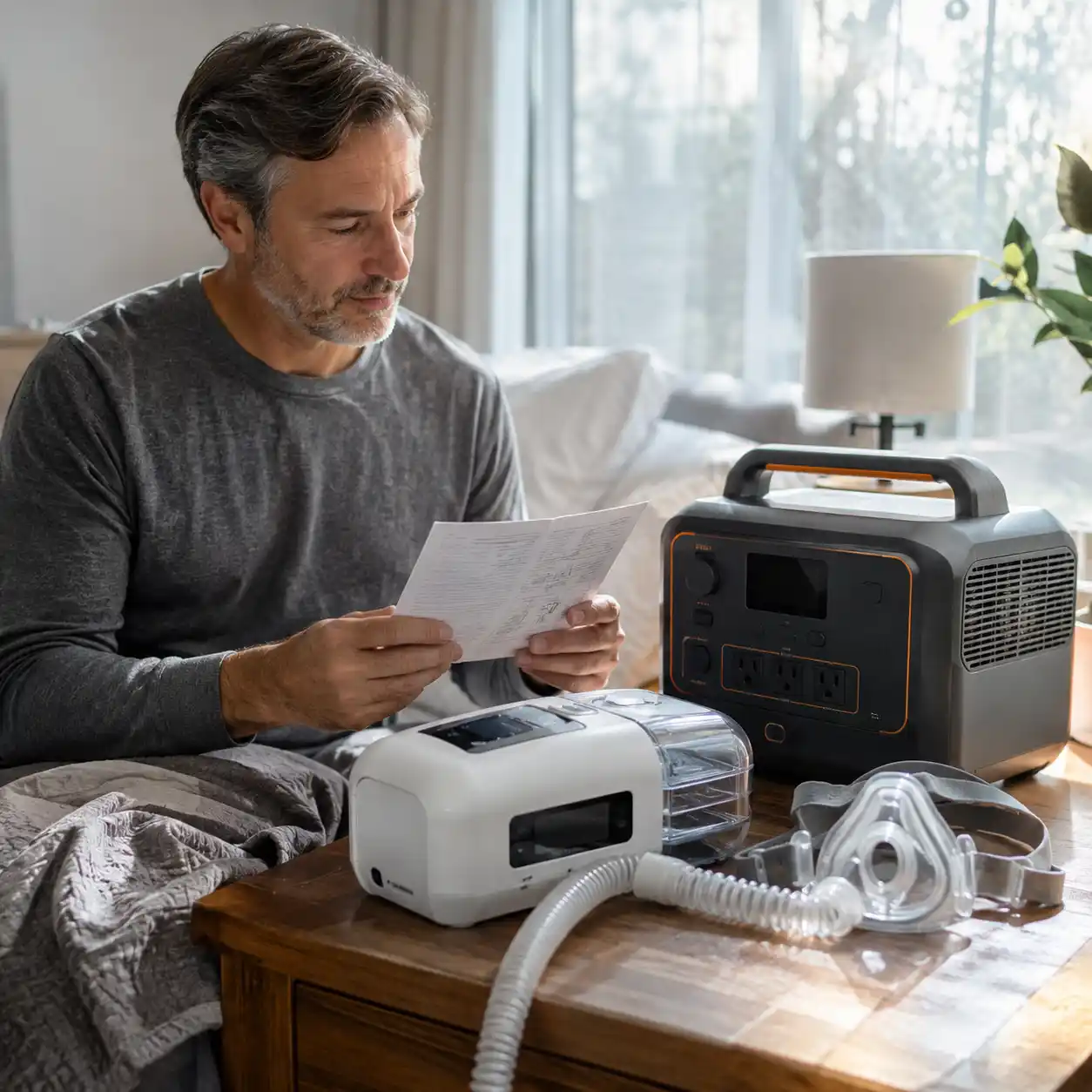
Choosing a power station with sufficient battery capacity is only part of preparing for a CPAP-related power outage. The station must also provide a compatible power output, support the intended connection method, and remain operational with the relatively low electrical load of a CPAP machine. Features such as a humidifier or heated tubing can further affect how much energy the setup uses.
Before relying on a portable power station for overnight backup, check the requirements of your specific CPAP model, review both manufacturers’ instructions, and test the complete setup. The following points can help identify compatibility issues before an outage occurs.
Check Your CPAP Manufacturer’s Power Requirements
Start with the documentation for your exact CPAP model. Do not assume that the requirements of one machine apply to another, even if both are designed for the same type of therapy.
Check the following information in the CPAP manual or manufacturer’s official support documentation:
Input voltage and frequency: Confirm the electrical input requirements and whether the machine is designed for the power supply available from the station.
Power adapter specifications: Check the output voltage, current, and wattage printed on the original adapter. These details help establish the electrical requirements of the equipment.
AC and DC power options: Determine whether the manufacturer supports direct AC operation, a dedicated DC power supply, or an approved battery connection.
Accessories and additional equipment: Check whether the stated requirements include the humidifier, heated tubing, heated humidifier chamber, or other connected accessories.
Manufacturer restrictions: Look for guidance concerning battery operation, third-party power sources, and backup arrangements.
A power station’s rated capacity and AC output do not, by themselves, establish compatibility with every CPAP machine. The CPAP manufacturer’s instructions should be the starting point for evaluating a potential backup setup.
Confirm AC or DC Connection Compatibility
Portable power stations generally offer AC outlets and may also provide DC outputs, but the availability of a particular connection does not mean that it is suitable for your CPAP machine.
AC connection: If your CPAP manufacturer permits operation from a standard AC supply, check that the power station provides the required voltage and frequency. A pure sine wave inverter is an important specification to review when evaluating AC power, but it should not be treated as universal proof of compatibility. Follow the requirements of the CPAP manufacturer.
DC connection: Some CPAP models support operation from a dedicated DC power source. This may require a manufacturer-approved adapter or a compatible DC cable. Before using one, verify the required voltage, connector type, polarity, and current rating. A cable that physically fits the machine is not necessarily electrically compatible.
Also check the power station manufacturer’s instructions for the relevant output port and any restrictions on connected equipment. Avoid improvised adapters or unverified cables, particularly when the CPAP manufacturer specifies an approved power supply.
The practical rule is straightforward: use only a connection method and accessories that meet the requirements of your particular CPAP model.
Understand Humidifier and Heated Tubing Impact
A CPAP setup without a humidifier can have substantially different power requirements from one operating with a heated humidifier and heated tubing. These accessories use additional electricity, so a station that appears suitable for the basic machine may provide less backup time when all normal comfort settings are enabled.
Before choosing a power station, establish how you normally use your CPAP:
Do you use the humidifier every night?
Is the heated humidifier enabled, and at what setting?
Do you use heated tubing?
Are these features essential to your normal therapy setup?
Do not base your purchase decision solely on a manufacturer’s runtime example for a CPAP machine operating without a humidifier if you normally use heated accessories. Equally, do not assume that switching these features off is an appropriate solution for your therapy. Follow your healthcare provider’s advice and the CPAP manufacturer’s instructions.
For an individual runtime estimate, use our CPAP Runtime Calculator. This guide focuses on selecting and evaluating the power station; the calculator addresses the separate question of how long a particular setup may run.
Test Your Backup Setup Before an Outage
A power station should be tested with the actual CPAP machine and accessories before you depend on it during a power outage. A successful connection does not necessarily confirm that the complete setup will remain operational throughout the night.
Use the following checks as part of your preparation:
Test the intended connection. Connect the CPAP using the approved AC or DC method and verify that the machine starts and operates normally.
Use your normal configuration. Include the humidifier and heated tubing if they are part of your usual therapy. Testing only the basic machine may not reflect your real overnight setup.
Check the power station’s ECO settings. Some stations automatically switch off their AC or DC outputs when the connected load is low.
This behavior is often related to Eco Mode, low-load detection, or automatic output settings. For a more detailed explanation of why a portable power station shuts off under load, including how to identify low-load shutdown and distinguish it from an overload or protection fault, see our troubleshooting guide.
Since CPAP machines may draw relatively little power under certain operating conditions, check whether ECO mode can be disabled and follow the station manufacturer’s instructions.
Observe the station during extended operation. Confirm that the output remains active and look for unexpected shutdowns, warning indicators, or other abnormal behavior. A brief test is not enough to establish reliable overnight performance.
Review the backup procedure. Make sure you know how to connect the CPAP to the station and how to restore normal operation if the grid supply fails.
Some power stations include a UPS function with a published transfer time. However, this specification alone does not guarantee that a particular CPAP machine will continue operating without interruption when grid power is lost. The result depends on the compatibility of the complete setup, and uninterrupted therapy should not be assumed without confirmation from the relevant manufacturers.
Finally, check the power station manufacturer’s restrictions concerning medical equipment. Some manufacturers distinguish between ordinary home CPAP use and medical devices requiring continuous professional monitoring. A portable power station should not be treated as a medically approved life-support backup system unless the relevant equipment manufacturers and healthcare professionals explicitly confirm that it is appropriate.
The key takeaway: verify compatibility, use an approved connection, test your normal CPAP configuration, and understand the power station’s low-load behavior before relying on it during an outage.
Using a Power Station for Overnight CPAP Backup
A portable power station may provide a practical backup option for CPAP users, but its suitability for overnight use depends on more than battery capacity and electrical compatibility. Its size, weight, cooling system, display, and operating behavior can all affect how convenient it is to keep the unit in or near a bedroom.
Before choosing a model, consider where the station will be placed, whether its cooling fans may disturb sleep, and how the CPAP will remain connected if household power fails during the night. These practical details can make a meaningful difference when selecting a station for regular or occasional overnight backup.
Bedside Placement and Portability
The physical dimensions and weight of a power station matter when deciding where to keep it during overnight CPAP use. A compact model may fit beside a bed or on a suitable floor space, while a larger unit may require a dedicated location nearby.
Before placing a station in your bedroom, consider:
Available space: Check the unit’s dimensions and allow enough room around it for ventilation and access to its controls and outlets.
Weight and repositioning: Consider whether you can comfortably move the station between a bedroom, storage area, or another room when needed.
Cable reach: Make sure the power cable can connect the station to the CPAP without stretching across walkways or creating a tripping hazard.
Access to controls: The AC or DC output buttons and battery display should remain accessible, particularly if you need to check the station during the night.
Ventilation: Keep the cooling vents unobstructed and follow the manufacturer’s placement and clearance instructions. Do not enclose an operating power station in a cabinet or place it where bedding, curtains, or other objects can block airflow.
A heavier station does not necessarily need to be moved every night. For home backup, it may be more practical to keep it in a suitable, well-ventilated location near the bedroom. For travel or camping, however, weight and dimensions become more important because the unit must be transported and positioned at each destination.
Fan Noise, Display Brightness, and Operating Conditions
Portable power stations do not have combustion engines, but their cooling fans and internal electronics can still produce audible noise. Fan activity may change depending on the connected load, charging rate, internal temperature, and operating conditions. A unit that is quiet while supplying a small load may become more noticeable when fast-charging or powering several devices.
If you plan to keep a power station near your bed, check the following:
Cooling fan behavior: Look for manufacturer information about fan operation under different loads and charging modes. If no sound-level specification is published, do not assume the unit is silent.
Published noise measurements: Compare decibel figures only when the manufacturer identifies the operating mode and test conditions. A measurement taken during silent charging, for example, does not establish how loud the station will be while supplying AC power overnight.
Display and indicator lights: Check whether the screen dims, switches off automatically, or offers brightness adjustments. A bright display or persistent indicator light may be distracting in a dark bedroom.
Operating temperature: Follow the manufacturer’s specified temperature range and ventilation requirements. Avoid placing the station next to heating equipment, inside enclosed furniture, or under bedding.
Charging during sleep: If possible, recharge the station before bedtime rather than assuming that its fan behavior during charging will be the same as during battery-powered operation.
Manufacturer documentation does not always provide comparable noise measurements for every model. Where this information is unavailable, buyers should treat bedroom noise as an aspect to verify rather than rely on an unsupported claim that a particular station is quiet.
Keeping the CPAP and Power Station Connected During an Outage
A power station can be prepared for overnight backup by connecting the CPAP through a manufacturer-approved AC or DC power arrangement before an outage occurs. The important point is to understand how the complete setup behaves when the household supply is interrupted.
For a planned backup arrangement, check these details:
Output readiness: Confirm that the required AC or DC output is enabled and that the station has sufficient charge before bedtime.
Automatic shutdown settings: Review ECO mode, low-load shutdown, and AC timeout settings. Some stations can switch off an output after detecting a low or absent load. Make sure the selected configuration is appropriate for your CPAP and permitted by the power station manufacturer.
UPS or pass-through operation: If you intend to leave the station connected to household power, check whether the manufacturer supports the intended charging and output arrangement. A published UPS transfer time does not guarantee uninterrupted operation with every CPAP machine.
Battery monitoring: Know how to check the remaining charge and recognize low-battery or temperature warnings. Do not rely exclusively on an estimated runtime display.
Backup procedure: Understand how to connect the CPAP to the station if the grid supply fails and how to restore the normal setup afterward.
If the power station is intended to remain connected to household power overnight, verify the manufacturer’s instructions for that operating mode. Do not assume that every model supports continuous pass-through operation or that every UPS feature is suitable for medical equipment.
Most importantly, test the complete arrangement before relying on it. A successful daytime connection does not establish that the station will maintain the required output throughout an entire night or switch over without interrupting a particular CPAP machine.
A portable power station can make overnight backup more convenient, but it should not be treated as a medically approved life-support system. Follow the CPAP manufacturer’s guidance and consult your healthcare provider about an appropriate backup plan for your therapy.
Choosing the Right Capacity for CPAP Backup
Choosing the right battery capacity for CPAP backup starts with understanding how you intend to use the power station. A compact 1,000Wh-class model may be a practical option for some overnight setups, while a 2,000Wh or larger station can provide a greater energy reserve for extended outages or additional household devices.
However, battery capacity should not be considered in isolation.
Rated battery capacity does not represent the exact amount of energy available to your CPAP. Conversion losses, inverter consumption, and internal battery limits can reduce the energy delivered to connected equipment. Our guide to portable power station usable capacity explains how to distinguish rated capacity from usable battery energy and actual delivered output.
Your CPAP model, humidifier and heated-tubing settings, preferred connection method, and access to recharging all influence which capacity class makes sense. The goal is not to buy the largest power station available, but to choose one that provides an appropriate reserve for your expected backup needs.
Illustrative CPAP Runtime Estimates
The table below compares the five power stations using the same CPAP load assumptions and an eight-hour overnight session. These estimates are intended to illustrate relative battery capacity, not to predict the exact runtime of a specific CPAP machine.
For a consistent comparison, all estimates assume an AC connection through the CPAP manufacturer’s standard power supply. The calculation uses 85% of each station’s rated battery capacity as estimated usable AC energy. This is a planning assumption that accounts for conversion losses and a remaining battery reserve; it is not a manufacturer-rated usable-capacity figure.
Two illustrative power-draw scenarios are used:
30W average load: a lower-power scenario without active humidification.
60W average load: a higher-power scenario representing a CPAP setup with humidification.
Each scenario assumes eight hours of continuous operation per night, with no other devices connected and no recharging during use.
| Power Station | Rated Capacity | Usable Energy (85%) | 30W Load (8h/night) | 60W Load (8h/night) |
|---|---|---|---|---|
| Anker SOLIX C1000 Gen 2 | 1,024Wh | 870Wh | 3.6 nights | 1.8 nights |
| BLUETTI Elite 300 | 3,014.4Wh | 2,562Wh | 10.7 nights | 5.3 nights |
| EcoFlow DELTA 2 Max | 2,048Wh | 1,741Wh | 7.3 nights | 3.6 nights |
| BLUETTI Elite 200 V2 | 2,073.6Wh | 1,763Wh | 7.3 nights | 3.7 nights |
| BLUETTI Elite 100 V2 | 1,024Wh | 870Wh | 3.6 nights | 1.8 nights |
How to interpret these estimates: The figures are calculated by dividing estimated usable AC energy by the assumed energy consumption per eight-hour night. For example, a 60W CPAP load operating for eight hours uses approximately 480Wh per night.
These are calculated estimates, not measured CPAP runtime results or guaranteed operating times. Actual consumption varies by CPAP model, pressure settings, humidifier and heated-tubing use, ambient conditions, power-supply efficiency, and the power station’s operating behavior. Some CPAP machines draw considerably more power during certain operating conditions.
For a more accurate estimate, check the power consumption specifications for your exact CPAP model and measure its actual energy use over a typical night. Do not assume that a manufacturer’s maximum power rating represents its average overnight consumption.
Is a 1,000Wh Power Station Enough for CPAP Backup?
A 1,000Wh-class power station can be a reasonable starting point for CPAP users who need a relatively compact backup option and do not expect to power several additional appliances. Models in this category, such as the Anker SOLIX C1000 Gen 2 and BLUETTI Elite 100 V2, offer approximately 1,024Wh of rated battery capacity.
This capacity class may suit buyers who:
Need backup primarily for a CPAP machine rather than multiple household appliances.
Expect to use the station for occasional or limited overnight outages.
Prefer a lighter, more manageable unit that can be moved or stored easily.
Have access to a reliable way to recharge the station between outages.
The main limitation is the available energy reserve. Actual usable energy is lower than the rated battery capacity because power conversion and the station’s own operation consume energy. CPAP configurations that use a heated humidifier or heated tubing may also require substantially more energy than a basic setup.
Therefore, a 1,000Wh rating should not automatically be interpreted as enough for a full night or a particular number of nights. Check your CPAP requirements and use the CPAP Runtime Calculator to estimate how a specific setup may perform before choosing this capacity class.
When Does a 2,000Wh or Larger Station Make Sense?
A 2,000Wh-class or larger power station becomes more attractive when you want a greater energy reserve, need to prepare for longer outages, or plan to power devices in addition to your CPAP machine.
For example, the EcoFlow DELTA 2 Max and BLUETTI Elite 200 V2 provide approximately 2,000Wh of built-in capacity, while the BLUETTI Elite 300 offers more than 3,000Wh. These models are better suited to buyers who prioritize a larger stored-energy reserve over minimum weight and portability.
If you want to compare other models in this capacity range beyond the CPAP-focused options reviewed here, see our guide to 2,000Wh portable power stations. It compares additional models based on battery capacity, AC output, portability, and home backup applications.
Consider this capacity class if you:
Want more backup flexibility during outages that may last beyond one night.
Normally use a CPAP humidifier or heated tubing and want a larger energy reserve.
Need to power selected essential household devices alongside your CPAP.
Prefer to reduce the need for frequent recharging during an extended outage.
Want a larger starting capacity or, in the case of an expandable model, the option to increase storage later.
A larger battery does not automatically make a power station more suitable for CPAP use. Buyers still need to check AC or DC compatibility, low-load behavior, manufacturer restrictions, and the station’s practical operating characteristics. Capacity is only one part of the selection decision.
One-Night vs. Multi-Night Backup
The difference between one-night and multi-night backup is not simply the size of the battery. It also depends on how long an outage may last and whether you can recharge the station between periods of use.
For occasional overnight outages, a 1,000Wh-class station may be sufficient for some CPAP configurations, provided its usable energy and operating characteristics match the user’s requirements. Buyers should also consider whether they need backup for only the CPAP or for other devices overnight.
For multiple consecutive nights, a larger capacity can provide a more substantial reserve and reduce dependence on immediate recharging. This becomes particularly relevant when the CPAP operates with heated accessories or when the station also supports other essential equipment.
For extended outages, consider both stored capacity and the ability to replenish it. A larger station can provide more energy initially, but it will eventually need recharging. Access to compatible solar panels, vehicle charging, or another available power source may therefore become just as important as the original battery size.
If you are comparing expected operating time or the number of nights a particular station may support, use the CPAP Runtime Calculator. This article focuses on choosing the appropriate capacity class rather than repeating individual runtime calculations.
CPAP Only vs. CPAP Plus Other Essential Devices
Another important buying decision is whether the power station will serve only your CPAP machine or act as a broader household backup during an outage.
CPAP-only backup generally allows you to focus on a smaller, more portable power station, provided its usable capacity, output, and connection compatibility meet your equipment’s requirements. Buyers who prioritize portability may find a 1,000Wh-class model more practical for this purpose.
CPAP plus other essential devices changes the selection criteria. If you also intend to power a phone, router, lighting, or other necessary equipment, those loads draw from the same battery reserve. A larger capacity may therefore make more sense, particularly when the outage could last longer than one night.
For this type of use, consider both battery capacity and continuous AC output. A station may have enough stored energy for several devices but still be unsuitable if their combined power demand exceeds its output limits. Also check whether the additional devices will need to operate simultaneously with the CPAP.
The practical distinction is simple: choose a station for the complete backup setup you actually intend to use, not just for the CPAP machine considered on its own.
The key takeaway: a 1,000Wh-class station can be a practical choice for a focused CPAP backup setup, while a 2,000Wh or larger model offers more flexibility for longer outages and additional devices. The right choice depends on your equipment, normal therapy settings, backup duration, and recharging options—not capacity alone.
Recharging During Extended Power Outages
A portable power station provides a limited amount of stored energy, so its usefulness during an extended power outage depends not only on battery capacity but also on how effectively it can be recharged. A station that can support your CPAP setup overnight may still need to be replenished before the next night, particularly if you also use other essential devices.
For CPAP users preparing for longer outages, it is worth considering the available charging methods before choosing a power station. AC wall charging, solar input, and vehicle charging offer different levels of convenience and depend on the station’s supported inputs, available equipment, and environmental conditions.
AC Wall Charging Before an Outage
The simplest way to prepare a portable power station for a power outage is to keep its battery charged while household electricity is available. Before severe weather or another event that could interrupt the grid, check the battery level and recharge the unit according to the manufacturer’s instructions.
When evaluating a power station, consider:
AC charging speed: Check how quickly the station can recharge from a household outlet and whether the manufacturer provides different charging modes.
Charging settings: Some models allow users to adjust the AC charging rate. A slower setting may be useful in situations where reducing input power is important.
Battery readiness: Avoid assuming that a station will remain fully charged indefinitely. Check its charge level periodically and follow the manufacturer’s storage and maintenance recommendations.
Charging accessories: Confirm whether the required AC charging cable is included and whether any additional equipment is needed.
For CPAP users, the practical objective is to begin an outage with a sufficiently charged battery rather than depend on access to household electricity after the grid has failed.
Solar Recharging During a Grid Outage
Solar panels can provide an alternative way to replenish a portable power station when household electricity is unavailable. This can be particularly useful during multi-day outages, provided the station supports solar charging and compatible panels are available.
However, solar charging performance depends on several factors:
Solar input limits: Check the maximum solar charging wattage and supported voltage and current ranges specified by the power station manufacturer.
Panel compatibility: Make sure the panel’s electrical specifications fall within the station’s permitted input range. Connector compatibility alone does not establish electrical compatibility.
Available sunlight: Cloud cover, season, panel orientation, shading, and installation conditions can significantly affect actual energy production.
Charging equipment: Some setups require a compatible adapter or additional connection cable. Verify the manufacturer’s requirements before purchasing panels.
Available daylight: Solar charging is limited by the amount of usable sunlight, so a station may not receive enough energy to restore its battery fully during a short or cloudy day.
For extended outages, solar charging is best viewed as a way to supplement stored energy rather than a guaranteed replacement for grid electricity. Buyers should also consider whether they have enough panel capacity and suitable outdoor space to make the arrangement practical.
Vehicle Charging as an Additional Option
Some portable power stations support charging from a vehicle’s 12V outlet or through a dedicated alternator charging system. This can provide another way to replenish the battery when household electricity is unavailable and solar conditions are unfavorable.
Before relying on vehicle charging, check:
Supported vehicle input: Confirm whether the power station accepts standard 12V car charging or requires a dedicated charging accessory.
Input power: Vehicle charging through a standard 12V outlet may be relatively slow compared with AC charging or a compatible alternator charger.
Vehicle compatibility: Check the power station manufacturer’s requirements and any restrictions associated with the vehicle’s electrical system.
Charging conditions: Follow the vehicle and charging-system manufacturers’ instructions. Do not assume that every vehicle outlet can support continuous charging at the power station’s maximum input.
Driving requirements: If charging requires the engine to be running, consider fuel availability, vehicle operating time, and local safety requirements.
Vehicle charging is most useful as an additional option rather than the only planned recharge method. Its practical value depends on the vehicle, supported charging equipment, and the amount of energy that needs to be restored.
Recharge Speed and Backup Readiness
Recharge speed can make a meaningful difference when a power station is expected to support CPAP use over several consecutive nights. A model with a large battery may provide a substantial initial reserve, but buyers should also understand how long it takes to restore that reserve using the charging methods available to them.
When comparing models, look beyond the maximum charging wattage and consider the complete charging arrangement:
AC recharge time: Review the manufacturer’s published charging time and the conditions under which it was measured.
Solar recharge capability: Compare the maximum supported solar input with the output of the panels you intend to use.
Vehicle charging: Check the supported input power and whether a standard car cable or dedicated alternator charger is required.
Simultaneous charging and output: Verify whether the manufacturer permits the station to charge while powering connected equipment and whether any operating restrictions apply.
Charging flexibility: Consider whether the station supports more than one practical charging method, giving you alternatives if one source becomes unavailable.
Published recharge times are usually based on specified starting battery levels, input power, and test conditions. Actual charging may take longer because of changing solar conditions, input limitations, temperature, and charging behavior near full capacity.
For CPAP users, backup readiness means more than having a large battery. It means starting with sufficient stored energy, understanding how to replenish it, and having a realistic alternative when the preferred charging source is unavailable.
The key takeaway: for multi-day outages, compare both battery capacity and recharge options. AC charging prepares the station before an outage, while solar and vehicle charging may help restore energy when the grid is unavailable. The most practical setup is the one that matches your expected outage conditions and the charging resources you can realistically access.
Choosing a Station for Home CPAP Backup
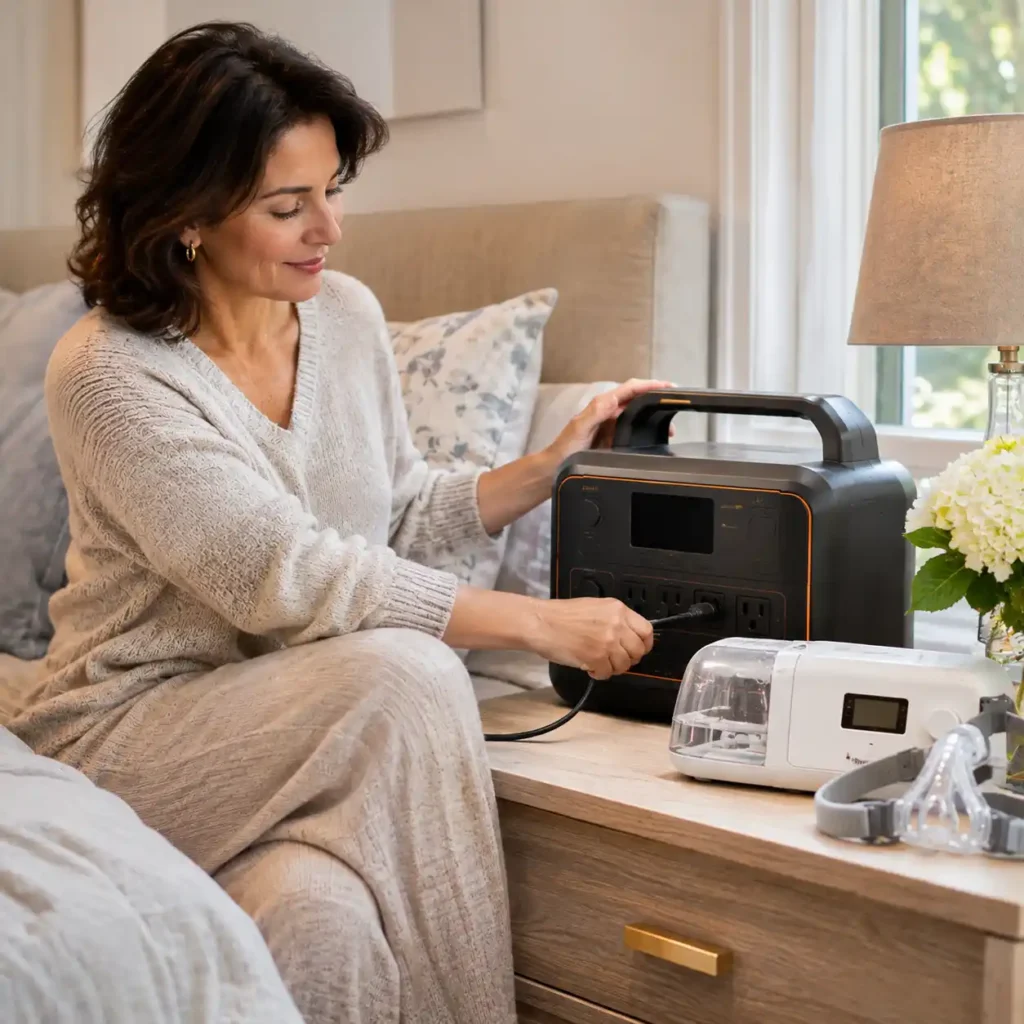
For home use, a portable power station can serve as a dedicated backup source for a CPAP machine during unexpected grid outages. For households preparing for longer interruptions, the same unit may also support additional essential devices, provided their combined power demand remains within the station’s continuous output rating and available battery capacity. Because the station does not need to be transported regularly, buyers can prioritize stored energy, charging flexibility, expansion options, and practical placement.
When evaluating a station for home CPAP backup, consider:
Battery capacity: A larger built-in battery can provide more stored energy for extended outages or additional household loads.
Expandable capacity: Some models support compatible expansion batteries, allowing users to increase storage as their backup requirements change.
AC output and compatibility: Confirm that the station meets the electrical requirements of your CPAP and any other equipment you intend to connect.
Charging flexibility: AC charging before an outage and compatible solar or vehicle charging options can help maintain backup readiness.
Placement: Check the station’s dimensions, ventilation requirements, fan behavior, and access to outlets before selecting a permanent location.
A heavier power station may be perfectly practical for a dedicated home backup setup if it can remain in a suitable location near the bedroom. Buyers who want to power additional household devices may also benefit from a larger unit, provided its output and capacity match the combined requirements.
For this scenario, the EcoFlow DELTA 2 Max and BLUETTI Elite 300 represent two different approaches: the EcoFlow offers expandable battery capacity, while the Elite 300 provides a larger built-in energy reserve without requiring additional batteries.
Common CPAP Power Station Buying Mistakes
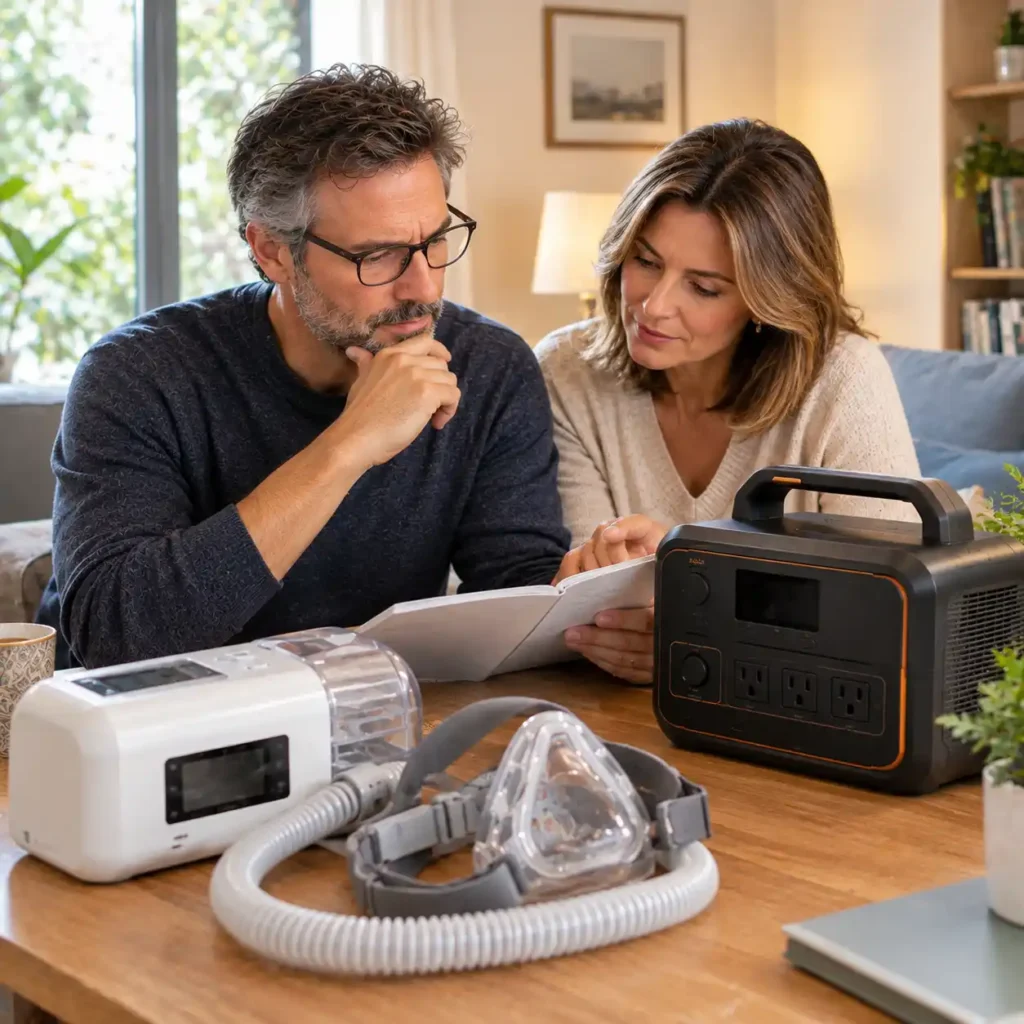
Choosing a portable power station for CPAP backup is not simply a matter of selecting the largest battery or the highest-rated inverter. Buyers can easily spend more than necessary, choose a model that is inconvenient for their intended use, or pay for features that do not meaningfully improve their backup setup.
The following mistakes highlight the trade-offs worth considering before committing to a purchase.
Choosing the Largest Capacity Without a Clear Backup Plan
A larger battery provides a greater energy reserve, but that does not automatically make it the best purchase for every CPAP user. Buyers who primarily need occasional overnight backup may end up paying for capacity they rarely use.
On the other hand, choosing a smaller station solely to save money can leave too little flexibility for longer outages or additional essential devices.
The better approach is to establish the intended backup scenario first. Consider how long outages in your area may last, whether the station will power only your CPAP, and how frequently you can recharge it. Choose capacity around those requirements rather than assuming that more Wh always represents better value.
Confusing Rated Capacity with Practical Backup Value
Two power stations with similar advertised capacity can offer different overall value depending on their usable energy, operating characteristics, and intended application.
A lower purchase price or an attractive Wh rating does not necessarily mean that a station will provide the most practical backup for your needs. Buyers should consider the complete specification and the limitations that affect real-world use, rather than comparing battery capacity in isolation.
The important distinction is between the amount of energy advertised and how useful the complete system will be for your particular CPAP setup.
Paying for Output You May Never Need
High continuous AC output can be valuable when a power station must support several household appliances, but it may offer limited additional value to someone buying a station primarily for one CPAP machine.
A model with a higher inverter rating may also be heavier or more expensive than a smaller alternative with sufficient output for the intended equipment.
Consider what you actually plan to power. If the station is dedicated to CPAP backup, prioritize an appropriate combination of battery capacity, electrical compatibility, and practical operation. If it will also support other household devices, higher output may justify the additional cost.
Assuming Expandability Automatically Makes a Better Investment
Expandable power stations offer the option to increase battery capacity later, but this flexibility comes at a cost. Compatible expansion batteries require additional spending and may also increase the space and weight of the complete system.
Buyers should consider whether they are likely to need additional capacity and whether purchasing an expandable system makes more financial sense than choosing a larger built-in battery from the beginning.
For example, a station with a smaller initial battery may appear more affordable, but the total cost can increase substantially once expansion batteries are included. Compare the cost of the complete system rather than evaluating the base unit alone.
Buying Based on Charging Features Without a Realistic Recharge Plan
Solar input, vehicle charging, and fast AC charging can make a power station more flexible during extended outages. However, paying extra for these features does not guarantee that you will be able to restore the battery when needed.
A solar-compatible station offers limited practical benefit if you do not have suitable panels, sufficient sunlight, or an appropriate place to use them. Similarly, vehicle charging may be inconvenient if you cannot regularly access your vehicle or the supported charging equipment.
Before paying for additional charging capabilities, consider which energy sources will actually be available during an outage and whether you are prepared to use them.
Choosing a Power Station Based on Portability Instead of Backup Needs
A lighter power station may be easier to move, but portability should not outweigh the energy capacity and output required for your intended backup scenario. Buyers preparing for extended home outages may need a larger battery reserve or an expandable system, particularly if the station must support a CPAP machine and additional household devices.
The better approach is to start with the expected outage duration and the combined power requirements of the equipment you plan to connect. Then consider weight, dimensions, and placement to determine whether the selected model is practical for your home.
A station that is easy to relocate but cannot provide enough usable energy for the intended backup period may be a poor fit. Conversely, a heavier model can make sense when it will remain in a suitable home backup location.
What to Prioritize Before Buying
These mistakes point to a more useful way to compare CPAP power stations:
Start with your backup scenario: Decide whether you need occasional overnight support, several nights of backup, or a broader household power reserve.
Evaluate the complete system: Consider usable energy, output, compatibility, and operating behavior rather than relying on headline specifications.
Pay for relevant features: Higher output, expansion batteries, and advanced charging options should solve an actual need.
Consider the total investment: Include compatible accessories, expansion batteries, and charging equipment when comparing prices.
Prioritize your backup requirements: Estimate how long you may need backup power, identify the devices that must remain operational, and compare the station’s usable energy and continuous output with their combined requirements.
The best purchase is not necessarily the largest or most feature-rich power station. It is the model that meets your CPAP requirements, supports your intended backup scenario, and provides the right balance of capacity, practicality, and total cost.
Frequently Asked Questions
Can I Take a Portable Power Station on a Plane with My CPAP?
The five power stations reviewed here cannot be carried on passenger aircraft because each battery exceeds the FAA’s 160Wh limit. Under FAA rules, rechargeable lithium-ion batteries up to 100Wh are generally permitted in carry-on baggage, while batteries from 101Wh to 160Wh require airline approval. Batteries exceeding 160Wh are not permitted on passenger aircraft. A CPAP machine may be subject to separate medical-device provisions, but those do not override the battery restrictions. For air travel, consider a dedicated CPAP battery within the applicable limit and confirm the requirements with your airline before departure.
Can One Portable Power Station Run Two CPAP Machines?
Yes, a suitable power station may support two CPAP machines simultaneously, provided its continuous output and available battery capacity meet the combined requirements of both setups. Remember to account for each machine’s humidifier and heated tubing, as well as any additional devices sharing the battery. Do not assume that a station capable of powering one CPAP will automatically provide sufficient overnight backup for two.
Can I Use a Portable Power Station with a BiPAP or APAP Machine?
A portable power station may be suitable for a BiPAP or APAP device, but compatibility must be confirmed for the specific machine. Check its input voltage, power adapter requirements, and approved AC or DC connection method. Also review any restrictions published by the device and power station manufacturers. Do not assume that compatibility with one CPAP model establishes compatibility with every PAP device.
Is a Dedicated CPAP Battery Better Than a Portable Power Station?
A dedicated CPAP battery may be more convenient for travel because it is designed around specific therapy equipment and is often smaller and lighter. However, it may support fewer devices and offer less flexibility than a portable power station. A larger power station can also serve as household backup for other essential equipment. The better choice depends on portability, required backup capacity, device compatibility, and whether you need power for anything beyond your CPAP machine.
Can I Use a Portable Power Station While It Is Charging and Running My CPAP?
Some portable power stations support simultaneous charging and output, often described as pass-through charging. However, availability and operating restrictions vary by model. Check the manufacturer’s documentation to confirm whether the station permits this arrangement and whether the relevant AC or DC output can remain active. Do not assume that pass-through operation guarantees uninterrupted CPAP power or that every charging configuration is suitable for overnight use.
What Should I Do If My Power Station Runs Out of Battery During the Night?
If the station’s battery is depleted, it can no longer provide backup power to the CPAP. This is why buyers should plan for an appropriate energy reserve and understand the station’s remaining-charge indicators before an outage. If your backup needs extend beyond the available battery capacity, consider an alternative power source and discuss an appropriate contingency plan with your healthcare provider. Do not rely on an untested charging arrangement or assume that a depleted station will maintain therapy.
Final Verdict
The best portable power station for CPAP backup depends on your machine’s electrical requirements, expected outage duration, and whether you need to power additional household devices. The five models reviewed here offer different advantages, from relatively lightweight 1,000Wh-class options to larger built-in battery reserves and expandable home backup capacity.
For buyers preparing for extended power outages, battery capacity, usable energy, continuous AC output, and recharging options deserve particular attention. However, a larger battery or higher output rating does not automatically establish CPAP compatibility. Before purchasing, verify your CPAP manufacturer’s requirements, review any power station restrictions, and estimate runtime using your actual equipment and settings.
Our Recommendation
Choose the power station that best matches your CPAP backup priorities:
For higher AC output in a relatively lightweight 1,000Wh-class unit: Choose the Anker SOLIX C1000 Gen 2 — 2,000W continuous output at 24.9 lb.
For the largest built-in capacity: Choose the BLUETTI Elite 300 — 3,014.4Wh without expansion batteries.
For expandable home backup: Choose the EcoFlow DELTA 2 Max — supports up to two additional Smart Extra Batteries.
For higher continuous AC output: Choose the BLUETTI Elite 200 V2 — 2,600W for CPAP and additional household devices.
For CPAP-specific manufacturer guidance: Choose the BLUETTI Elite 100 V2 — published runtime examples for setups with and without a humidifier.
Before purchasing, verify CPAP compatibility and manufacturer restrictions. If you plan to power additional household devices, calculate their combined energy requirements and confirm that the station has sufficient usable capacity and continuous output. Actual runtime depends on your equipment, settings, and operating conditions.
Related Guides
Continue exploring Power Ready Guide resources to compare backup options, estimate your CPAP runtime, and choose the right power station for your needs.
CPAP Runtime Calculator: Calculate How Long a Battery Can Run Your CPAP — Estimate how long a portable power station can power your specific CPAP setup and how many nights of backup it may provide.
Best 1000Wh Portable Power Stations (2026) — Compare power stations in the 1,000Wh class if you need a smaller home backup unit for essential devices and shorter power interruptions.
Best Portable Power Stations for Home Backup (2026) — Explore broader home backup options if you need to power your CPAP alongside other essential household devices.
Best Expansion Batteries for Portable Power Stations (2026): Top Picks for Capacity and Runtime — Compare compatible expansion batteries if you want to increase the storage capacity of an expandable power station.
Power Ready Guide Commitment
At Power Ready Guide, we believe choosing backup power equipment should be based on verified specifications, practical requirements, and a clear understanding of product limitations.
We review manufacturer documentation, compare real-world use cases, and distinguish published specifications from estimates. We do not treat advertised capacity, output ratings, or product features as guarantees of performance.
Our goal is to help you make an informed decision with clear comparisons, transparent evaluations, and recommendations grounded in your actual power needs.
Power Ready Guide — Practical guidance. Verified specifications. Smarter backup power decisions.