
Van life changes the way you think about portable power.
When your power station is part of your everyday living setup, it is no longer just a convenient source of electricity for a weekend outdoors. It may need to keep a 12V refrigerator running, charge laptops and phones, power lights and ventilation, support remote work or Starlink, and handle occasional high-draw appliances — all while fitting into a limited amount of storage space.
That makes choosing the best portable power stations for van life less straightforward than simply buying the largest battery or the highest-wattage model.
For some van travelers, a compact 1,000Wh-class power station may be enough for a weekend trip with modest DC loads. Others may need around 2,000Wh or more to comfortably cover a full day of refrigeration, electronics, cooking, and remote work. The right capacity also depends on how easily you can replenish that energy through solar panels, charging while driving, campground power, or a combination of methods.
Charging flexibility is particularly important in a van. A power station that can accept substantial solar input or recharge from an alternator while you drive can be much more practical than one that looks impressive on paper but is difficult to replenish between stops. Likewise, 12V/DC capability matters because many everyday van loads can be powered without converting battery energy to AC first.
In this guide, we compare five current portable power stations that can serve different van-life setups, from compact weekend vans to higher-energy full-time mobile living. We look beyond battery capacity and headline wattage to evaluate daily energy needs, AC and DC output, solar charging, charging while driving, portability, storage requirements, expandability, and long-term practicality.
The goal is not to identify one power station that is perfect for every van. Instead, we will show you which strengths and trade-offs matter for different ways of living on the road — so you can choose a system that matches your actual energy budget, charging opportunities, and available space.
As an Amazon Associate, I earn from qualifying purchases.
Table of Contents
Quick Answer
The best portable power station for van life depends on how much energy you use each day, how you recharge while traveling, and how much space and weight your van can accommodate.
For most van-life setups, these five models stand out for different reasons:
- Anker SOLIX C2000 Gen 2 — Best Overall for Van Life: A strong all-around option with 2,048Wh of capacity, 2,400W of rated output, 800W solar input, and up to 800W alternator charging. It is especially well suited to van travelers who want substantial daily capacity without moving into a much larger system.
- EF ECOFLOW DELTA 3 Plus — Best for Compact Vans: With 1,024Wh of capacity and a relatively lightweight design, the DELTA 3 Plus is a practical choice when storage space and portability matter more than having a large battery reserve.
- Jackery Explorer 2000 v2 — Best Lightweight 2kWh Option: With about 2,000Wh of capacity and a weight of roughly 39.5 pounds, the Explorer 2000 v2 offers a useful balance for van travelers who want substantial energy storage without choosing one of the heaviest 2kWh-class units.
- BLUETTI AC200PL — Best for Full-Time, High-Energy Van Life: Its 2,304Wh battery, 2,400W output, 1,200W solar input, and substantial expansion capability make it better suited to demanding setups that regularly use more electricity. The trade-off is its much higher weight.
- EF ECOFLOW DELTA 2 Max — Best for Solar-Heavy Van Life: With 2,048Wh of capacity, 2,400W of output, and up to 1,000W of solar input, the DELTA 2 Max is a strong option for van travelers who expect solar to play a major role in replenishing their battery.
The Bottom Line
If you want one versatile power station for a broad range of van-life needs, the Anker SOLIX C2000 Gen 2 offers a particularly well-balanced combination of capacity, output, solar charging, alternator charging, and portability.
But a smaller van, a lower daily energy budget, frequent driving, or heavy reliance on solar can change which model makes the most sense. That is why the rest of this guide evaluates these power stations specifically around daily van-life energy use, not simply battery size or maximum wattage.
Why You Can Trust Power Ready Guide
Choosing a portable power station for van life requires more than comparing battery capacity and maximum output. A system that looks powerful on paper may not be the most practical choice once you consider daily energy use, charging opportunities, DC loads, storage space, and life on the road.
At Power Ready Guide, we evaluate portable power stations by looking at how their published specifications translate into practical use. For this guide, we compared the selected models across the factors that matter most in a van: usable battery capacity, AC output, 12V/DC capability, solar input, charging while driving, portability, storage requirements, expandability, and overall flexibility.
We also consider different patterns of van living rather than assuming that every traveler has the same energy needs. A weekend van with a refrigerator and basic electronics has very different requirements from a full-time setup with remote work, Starlink, cooking appliances, and regular daily cycling.
Our recommendations are based on published manufacturer specifications, product information, and use-case analysis. We do not present simulated calculations or specifications as hands-on test results, and we distinguish between documented product capabilities and our assessment of how those capabilities fit particular van-life scenarios.
What Makes This Guide Different
What makes this guide different is its focus on the complete energy cycle of van life. Instead of treating battery capacity, output, or solar input as standalone numbers, we look at how daily energy use, 12V and AC loads, charging while driving, solar replenishment, available space, and portability work together in a real van-life setup.
Our Evaluation Philosophy
We do not assume that the largest battery or highest output automatically makes a power station the best choice. We evaluate each model by how its capacity, charging options, DC and AC capability, portability, and expansion potential work together for a specific van-life scenario.
The result is a comparison designed to help you understand not only which portable power stations have strong specifications, but which combination of specifications makes sense for the way you actually live and travel in a van.
How We Evaluated the Best Portable Power Stations for Van Life
We evaluated these portable power stations around one central question: how well can each model support everyday electrical needs in a van while remaining practical to recharge, store, and use on the road?
Rather than ranking the largest batteries or highest output numbers automatically, we looked at the combination of capacity, charging flexibility, DC capability, portability, and practical van-life usability.
Daily Energy Capacity
Battery capacity determines how much energy you have available between charging opportunities. We considered whether each model provides enough capacity for common van-life loads such as refrigeration, lighting, electronics, ventilation, and occasional AC appliances.
A 2,000Wh-class power station is not automatically the right choice for every van. The appropriate capacity depends on daily consumption and how frequently the battery can be replenished.
Charging Flexibility
Van life often means charging from several sources rather than relying on one. We looked at AC charging, solar input, and vehicle-based charging, with particular attention to how useful each method can be during normal travel.
A power station that can recover meaningful battery capacity while driving can be especially valuable when solar conditions are limited.
12V and DC Capability
Many everyday van loads are naturally DC-powered. Refrigerators, lights, fans, USB devices, and other electronics may not require AC power at all.
We therefore considered the available 12V/DC outputs and overall DC usability rather than evaluating each model only by its AC inverter rating.
AC Appliance Capability
AC output still matters when van life includes laptops, monitors, kitchen appliances, coffee makers, induction cooking, or other higher-draw equipment.
We compared continuous output and surge capability to determine which models can comfortably support different types of AC loads.
Solar Recharge Potential
Solar can reduce dependence on shore power and vehicle charging, but the amount of energy a power station can accept from solar is just as important as the size of the battery.
We considered maximum solar input alongside battery capacity to assess how effectively each model can be replenished during daylight.
Charging While Driving
For mobile living, the ability to recharge while the vehicle is moving can fundamentally change how much usable energy is available each day.
We looked at the vehicle-charging options specified for each model, including higher-power alternator charging where supported, rather than treating all forms of car charging as equivalent.
Portability and Storage
Space is limited in most vans, and every additional kilogram competes with other equipment and living essentials.
We considered each power station’s weight, physical footprint, and practicality of storing or moving it within a van. A larger battery only makes sense if its size and weight fit the vehicle and the way you use it.
Expandability
Some van travelers may eventually need more capacity as their electrical needs grow. We therefore considered whether each power station supports additional battery capacity and how that could affect longer-term flexibility.
Long-Term Practicality
Finally, we considered how the combination of capacity, charging options, outputs, portability, and expandability translates into everyday van-life use.
The goal is not to identify the specification sheet with the biggest numbers. It is to identify the power station whose overall system of capabilities best matches a particular van-life energy strategy.
Who This Guide Is For
This guide is for van travelers who want a portable power station to function as a practical part of their everyday electrical setup — not simply as an emergency battery for occasional outdoor use.
It is particularly useful if you are:
- A weekend van traveler who needs enough power for a refrigerator, lights, phones, cameras, and other basic equipment without installing a permanent electrical system.
- A full-time van-lifer who depends on reliable electricity every day and needs more capacity, flexible charging, and the ability to support a wider range of appliances.
- A remote worker living from a van who needs dependable power for a laptop, monitor, networking equipment, or other work essentials.
- A traveler who relies heavily on 12V/DC appliances and wants to minimize unnecessary energy losses from converting battery power to AC.
- Someone who expects to recharge while driving, making vehicle-based charging an important part of the daily energy strategy.
- A solar-focused van traveler who wants to replenish the battery during daylight and make better use of available roof or portable solar panels.
- A van owner with limited storage space who needs to balance battery capacity against weight, dimensions, and the practical realities of storing equipment inside the vehicle.
- Someone deciding between a portable power station and a built-in electrical system and wants to understand where a portable setup makes sense.
This guide is less relevant if you are looking specifically for a permanent RV electrical installation, shore-power integration, 30A or 50A RV systems, or a dedicated whole-vehicle electrical architecture. Those requirements involve a different set of considerations than a portable power station designed for flexible van living.
Quick Summary: Our Top Picks
The five power stations in this guide cover different van-life priorities. Instead of treating battery capacity as the only deciding factor, we selected each model for a specific combination of energy capacity, charging flexibility, output, portability, and everyday practicality.
Anker SOLIX C2000 Gen 2
Award: Best Overall for Van Life
Why It Stands Out: The C2000 Gen 2 combines a 2,048Wh battery with 2,400W of rated output, 800W of solar input, and up to 800W of alternator charging. That combination gives it the flexibility to support both everyday van loads and higher-demand appliances while providing multiple ways to replenish the battery.
Choose This If: You want one versatile power station that can handle a broad range of van-life scenarios without moving to an especially heavy system.
Best For: General van life, mixed AC/DC loads, frequent driving, and travelers who want strong charging flexibility.
EF ECOFLOW DELTA 3 Plus
Award: Best for Compact Vans
Why It Stands Out: The DELTA 3 Plus provides 1,024Wh of capacity and 1,800W of output in a comparatively compact package. Its combination of capacity, output, and charging flexibility makes it attractive when storage space and weight are important constraints.
Choose This If: Your daily energy requirements are moderate and you would rather have a lighter, easier-to-store power station than a larger 2,000Wh-class unit.
Best For: Weekend van trips, compact vans, lighter electrical setups, and moderate daily energy consumption.
Jackery Explorer 2000 v2
Award: Best Lightweight 2kWh Option
Why It Stands Out: The Explorer 2000 v2 offers roughly 2,000Wh of energy storage and 2,200W of output while weighing about 39.5 pounds. It provides substantial battery capacity without reaching the weight of some larger high-capacity alternatives.
Choose This If: You want around 2kWh of storage but want to keep the weight of your portable power system under control.
Best For: Travelers who need substantial daily capacity but still expect to move or reposition the power station regularly.
BLUETTI AC200PL
Award: Best for Full-Time, High-Energy Van Life
Why It Stands Out: With a 2,304Wh battery, 2,400W of output, up to 1,200W of solar input, and significant expansion capability, the AC200PL is designed around higher-energy use. Its 30A TT-30 output can also be useful in van setups that make use of compatible RV-style connections.
Choose This If: Your van is your primary living space and your electrical needs extend well beyond basic refrigeration, lighting, and device charging.
Best For: Full-time van life, higher daily energy consumption, substantial solar input, and setups where weight is a secondary concern.
EF ECOFLOW DELTA 2 Max
Award: Best for Solar-Heavy Van Life
Why It Stands Out: The DELTA 2 Max combines 2,048Wh of capacity and 2,400W of output with up to 1,000W of solar input. Its strong solar-input capability makes it particularly relevant for travelers who expect daylight charging to be a major part of their energy strategy.
Choose This If: You have access to sufficient solar generation and want to replenish a 2,000Wh-class battery efficiently during the day.
Best For: Solar-focused van life, longer stays off-grid, and travelers who want substantial battery capacity with strong solar charging potential.
At a Glance
These five models illustrate why there is no single battery size that defines the best portable power stations for van life. A compact van with modest daily consumption may benefit more from lower weight and easier storage, while a full-time setup may prioritize capacity, solar input, and expansion.
The right choice ultimately depends on how much electricity you use each day, how you plan to recharge it, and how much space and weight your van can accommodate.
Best Portable Power Stations for Van Life Compared
The table below highlights the specifications that matter most when choosing a portable power station for van life. Battery capacity and AC output are important, but charging options, weight, and solar input can have an equally significant impact on everyday use.
| Power Station | Battery Capacity | AC Output | Solar Input | Weight |
|---|---|---|---|---|
| Anker SOLIX C2000 Gen 2 | 2,048Wh | 2,400W | 800W | ~41.7 lb |
| EF ECOFLOW DELTA 3 Plus | 1,024Wh | 1,800W | 1,000W | ~27.6 lb |
| Jackery Explorer 2000 v2 | 2,042Wh | 2,200W | — | ~39.5 lb |
| BLUETTI AC200PL | 2,304Wh | 2,400W | 1,200W | ~72 lb |
| EF ECOFLOW DELTA 2 Max | 2,048Wh | 2,400W | 1,000W | ~50 lb |
What the Numbers Mean for Van Life
The differences become more meaningful when viewed through a van-life lens.
The 1,024Wh DELTA 3 Plus prioritizes lower weight and easier storage, making it more appropriate for moderate daily consumption. The three roughly 2,000Wh-class models — the Anker SOLIX C2000 Gen 2, Jackery Explorer 2000 v2, and EF ECOFLOW DELTA 2 Max — provide substantially more energy reserve for travelers who need to cover a full day of mixed loads.
The BLUETTI AC200PL offers the largest battery and highest solar-input capacity in this group, but its approximately 72-pound weight makes it a very different proposition inside a van. Its strengths become more relevant when energy demand and solar replenishment matter more than portability.
For van life, therefore, the comparison should not stop at the largest battery. The more useful question is how each power station balances energy capacity, charging speed, solar potential, output, and physical practicality for your particular setup.
The Best Portable Power Stations for Van Life Reviewed
Anker SOLIX C2000 Gen 2
Best Overall Portable Power Station for Van Life

Quick Verdict
The Anker SOLIX C2000 Gen 2 earns our Best Overall for Van Life award because it strikes an unusually useful balance between substantial battery capacity, high output, solar charging, and vehicle-based recharging.
Its 2,048Wh battery gives van travelers considerably more energy reserve than a 1,000Wh-class unit, while the 2,400W rated output leaves enough headroom for demanding AC appliances that may occasionally become part of everyday van life. More importantly, this is not a power station designed around only one charging method: it supports up to 800W of solar input and up to 800W of alternator charging, giving travelers multiple ways to replenish the battery during a mobile trip.
That combination changes how the C2000 Gen 2 fits into a van. You can use battery capacity for overnight refrigeration, electronics, lighting, and other daily loads, then recover a meaningful amount of energy while driving or through solar during the day. It is therefore less about having the biggest possible battery and more about creating a workable daily energy cycle.
The trade-off is straightforward: at approximately 41.7 pounds, it is not a lightweight power station. But for travelers who want a single portable system capable of supporting a broad range of van-life needs, the combination of capacity, output, and charging flexibility makes the C2000 Gen 2 a particularly complete package.
Snapshot
| Feature | Details |
|---|---|
| Best For | General van life and mixed AC/DC daily use |
| Battery Capacity | 2,048Wh |
| AC Output | 2,400W rated / 4,000W peak |
| Solar Input | Up to 800W |
| Alternator Charging | Up to 800W |
| Weight | Approximately 41.7 lb |
| Expansion | Expandable to 4kWh |
Why We Chose It
The defining advantage of the Anker SOLIX C2000 Gen 2 is not any single specification, but how its capabilities work together for mobile living.
Van life requires a different approach to energy: you start with a certain battery reserve, consume energy throughout the day, and need practical ways to replenish it. The C2000 Gen 2 fits this cycle particularly well, combining a 2,048Wh battery with substantial solar input and high-power alternator charging.
Solar can replenish the battery while the van is parked, while alternator charging turns driving time into another opportunity to recover energy. Conventional AC charging provides an additional option when needed.
The 2,400W inverter also makes the C2000 Gen 2 suitable for a broad range of van setups, from everyday electronics to higher-draw appliances. Expansion provides additional flexibility if energy needs increase over time.
For this guide, that combination makes the C2000 Gen 2 a general-purpose mobile energy system that can adapt to different styles of van life without requiring travelers to build their routine around the limitations of the power station.
Check the latest price and customer reviews on Amazon

Living With It
The C2000 Gen 2 makes the most sense when you think of it as part of the van’s daily energy rhythm rather than a battery you occasionally switch on.
Imagine arriving at a remote campsite with the battery partially depleted after refrigeration, laptop use, lighting, and other loads. Once parked, solar can begin replenishing the battery while you continue using electricity. The following morning, the refrigerator is still running, your devices can be charged, and the power station remains ready for the next part of the journey.
Then you drive.
Instead of treating driving time as a period when the electrical system is simply idle, the C2000 Gen 2 can use that time for alternator charging. For travelers who move locations regularly, this can become an important part of the daily energy strategy.
That combination of parked-time solar and driving-time charging gives the C2000 Gen 2 flexibility that a system relying primarily on one charging source may not offer.
Its size and weight are the other side of the equation. At roughly 41.7 pounds, it is better suited to a van where the power station has a practical storage location and can remain there during normal use rather than being moved constantly.
Evaluation
| Evaluation Category | Editorial Assessment |
|---|---|
| Daily Energy Capacity | 2,048Wh provides a substantial reserve for mixed van-life loads and longer periods between charging opportunities. |
| Charging Flexibility | Strong combination of up to 800W solar input and up to 800W alternator charging. |
| AC Performance | 2,400W rated output provides substantial headroom for higher-draw appliances. |
| Van-Life Practicality | Good fit for a permanent storage position, but its approximately 41.7-lb weight favors stationary use inside the van. |
| Overall Assessment | A highly versatile combination of capacity, output, solar charging, and vehicle charging for everyday van life. |
Who Should Buy This
- Van travelers who want one power station capable of covering a wide range of daily electrical needs.
- Full-time or frequent travelers who benefit from having around 2kWh of battery capacity available.
- Van owners who expect to use alternator charging as an important part of their energy strategy.
- Travelers combining solar charging with regular driving.
- Users who need enough AC output for both everyday electronics and higher-draw appliances.
- Buyers who prefer a system with room for future capacity expansion.
Who Should Skip This
- Van travelers whose daily electricity use is low enough that a 1,000Wh-class power station provides sufficient reserve.
- Buyers who need the lightest possible 2kWh-class system.
- Users who expect to carry the power station in and out of the van frequently.
- Travelers whose setup relies almost entirely on small 12V/DC loads and rarely needs substantial AC output.
Final Verdict
The Anker SOLIX C2000 Gen 2 stands out because it addresses one of the central challenges of van life: not simply storing energy, but having practical ways to replace it.
Its 2,048Wh capacity gives you meaningful daily reserve, while 800W solar input and up to 800W alternator charging create two useful paths for replenishment. Add a 2,400W inverter and expansion capability, and the result is a power station that can accommodate everything from basic mobile living to a more demanding electrical setup.
Its weight prevents it from being an obvious choice for every van. But when the unit can remain securely stored in the vehicle, that compromise becomes much easier to accept.
For van travelers who want a versatile, high-capacity portable power system with strong solar and alternator charging, the Anker SOLIX C2000 Gen 2 is our Best Overall choice.
Check the latest price and customer reviews on Amazon.
Related Guide: If you are building a broader emergency power setup for your home, see our Best Portable Power Stations for Home Backup (2026) for models evaluated around home power needs rather than mobile living.
EF ECOFLOW DELTA 3 Plus
Best for Compact Vans

Quick Verdict
The EF ECOFLOW DELTA 3 Plus earns our Best for Compact Vans award because it focuses on a different kind of van-life problem: having enough electricity for everyday needs without filling a small vehicle with heavy power equipment.
With a 1,024Wh battery and 1,800W AC output, the DELTA 3 Plus sits below the 2,000Wh-class models in this guide, but that is not necessarily a disadvantage. For a compact van, weekend setup, or traveler with a relatively moderate daily energy budget, carrying another 20 or 30 pounds of battery capacity may provide little practical benefit.
At approximately 27.6 pounds, the DELTA 3 Plus is substantially easier to position, store, and move than the larger models in this comparison. It also supports strong charging options, including up to 1,000W of solar input and up to 800W of car charging, giving compact-van travelers more than one way to replenish the battery during a trip.
The key is understanding its role. This is not the model we would choose simply because more battery is always better. It makes sense when your van-life routine can realistically fit within a 1,024Wh energy budget and you value lower weight, easier storage, and fast energy replenishment over maximum overnight reserve.
Snapshot
| Feature | Details |
|---|---|
| Best For | Compact vans and moderate daily energy use |
| Battery Capacity | 1,024Wh |
| AC Output | 1,800W / 3,600W surge |
| Solar Input | Up to 1,000W |
| Car Charging | Up to 800W |
| Weight | Approximately 27.6 lb |
| Expansion | Supported |
Why We Chose It
The most important thing about the DELTA 3 Plus is that it challenges the assumption that van life automatically requires a 2,000Wh-class power station.
In a compact van, storage space is limited and heavy equipment can quickly become inconvenient. At roughly 27.6 pounds, the DELTA 3 Plus is much easier to accommodate than the larger models in this guide, making it particularly well suited to compact vans, minimalist conversions, and travelers who move frequently.
Its 1,024Wh capacity can support a practical range of everyday loads, but its real strength is the charging strategy. Up to 1,000W of solar input provides substantial daytime replenishment potential, while up to 800W of car charging can turn driving time into another opportunity to restore energy.
That combination makes a smaller battery more practical. A traveler who uses the battery through the evening and overnight may not need several days of stored energy if the van moves regularly and solar conditions are favorable. In that situation, efficient replenishment can be more valuable than carrying another 1,000Wh everywhere.
This is why we see the DELTA 3 Plus as a compact-van power strategy, rather than simply a lower-capacity alternative to the larger models.
Check the latest price and customer reviews on Amazon.

Living With It
The DELTA 3 Plus makes the most sense in a van where electricity is important but does not dominate the entire setup.
Imagine a compact camper with a 12V refrigerator, LED lighting, phones, a laptop, camera equipment, and occasional AC use. During the day, the van is either moving to a new location or parked where solar panels can generate power. In the evening, the battery handles essential loads without requiring a large permanent electrical installation.
Because the power station is relatively light, it is also easier to use as flexible equipment. It can stay in one storage position during normal use but be moved when you need access to another part of the van, want to use it outside, or need to reorganize limited storage space.
That lower weight can matter more in a compact van than the specification sheet suggests. A 40- or 50-pound power station may work well in a dedicated compartment, but smaller vehicles often require equipment to be moved simply to make room for everyday living.
The DELTA 3 Plus also suits travelers who regularly drive between destinations, since vehicle charging allows driving time to become part of the recharge cycle.
The trade-off is important: 1,024Wh is still 1,024Wh. If you regularly run several high-consumption appliances, rely heavily on AC power, or spend multiple days parked without reliable charging, the smaller battery reserve can become restrictive.
Evaluation
| Evaluation Category | Editorial Assessment |
|---|---|
| Portability | One of the easier models in this group to move and accommodate inside a compact van. |
| Daily Energy Capacity | Well suited to moderate energy consumption, but less forgiving of several consecutive high-use days without recharging. |
| Charging Flexibility | Strong solar and vehicle-charging capability gives a smaller battery more opportunities to recover energy. |
| AC Performance | 1,800W of continuous output provides useful headroom for common van appliances and electronics. |
| Overall Assessment | A particularly practical choice when low weight, limited storage, and efficient daily recharging matter more than maximum battery reserve. |
Who Should Buy This
- Travelers with compact vans or minimalist camper conversions.
- Weekend and short-trip van travelers with moderate daily electricity consumption.
- Users who prioritize lower weight and easier storage.
- Van travelers who drive frequently and can use vehicle charging as part of their daily energy routine.
- Travelers with good access to solar charging who do not need several days of battery reserve.
- Users who want substantial AC output without moving to a much heavier 2,000Wh-class power station.
Who Should Skip This
- Full-time van-lifers with consistently high daily electricity consumption.
- Travelers who regularly spend several days parked without reliable solar, vehicle, or AC charging.
- Users running multiple high-draw appliances for extended periods.
- Anyone who specifically needs around 2,000Wh or more of stored energy available overnight.
- Buyers who expect to expand into a high-energy electrical setup immediately.
Final Verdict
The EF ECOFLOW DELTA 3 Plus is a reminder that the best portable power station for van life is not necessarily the one with the largest battery.
Its 1,024Wh capacity is deliberately more modest than the 2,000Wh-class models in this guide, but the lower weight, 1,800W AC output, up to 1,000W solar input, and up to 800W car charging create a compelling combination for compact and efficient van setups.
The central trade-off is simple: you give up battery reserve in exchange for a power station that is easier to live with physically. For travelers who can regularly replenish their energy through driving or solar, that can be a very sensible exchange.
If your van is compact, your daily energy consumption is moderate, and you value portability as much as battery capacity, the DELTA 3 Plus is one of the most practical choices in this group.
Check the latest price and customer reviews on Amazon.
Related Guide: If solar charging is going to be a major part of your van’s energy strategy, see our Best Portable Solar Panels (2026) guide for a closer look at portable solar options and how they can complement a power station.
Jackery Explorer 2000 v2
Best Lightweight 2kWh Option

Quick Verdict
The Jackery Explorer 2000 v2 earns our Best Lightweight 2kWh Option award for travelers who want substantial energy storage without stepping up to the heaviest power stations in this category.
Its 2,042Wh battery puts it firmly in the class of power stations designed for more than occasional phone charging. That amount of stored energy can support a broader collection of van-life loads, including refrigeration, electronics, lighting, and selected AC appliances, while giving you more overnight reserve than a 1,000Wh-class unit.
The important distinction is its weight. At approximately 39.5 pounds, the Explorer 2000 v2 remains substantial, but it avoids some of the physical burden associated with larger high-capacity systems. That makes it interesting for van travelers who need around 2kWh of storage but still expect to move the power station occasionally.
The Explorer 2000 v2 therefore occupies a useful middle ground. It is not the smallest option here, and it is not built around the highest solar-input specification in our comparison. Instead, its appeal comes from having a large battery in a package that remains relatively manageable for its capacity class.
Snapshot
| Feature | Details |
|---|---|
| Best For | Travelers who want around 2kWh without choosing a heavier system |
| Battery Capacity | 2,042Wh |
| AC Output | 2,200W |
| Battery Chemistry | LiFePO₄ |
| Weight | Approximately 39.5 lb |
| Charging | AC, solar, and vehicle charging supported |
| Best Use | Higher-energy van setups where portability still matters |
Why We Chose It
The Jackery Explorer 2000 v2 is built around a practical compromise: getting into the 2kWh class without automatically accepting the weight and bulk of the largest units.
For van life, that distinction matters. A power station may spend most of its time in one storage compartment, but it can still need to be moved to access equipment, reorganize the living area, or use it outside the van. At approximately 39.5 pounds, the Explorer 2000 v2 remains substantial, but its weight is comparatively reasonable for a battery around the 2,000Wh mark.
With 2,042Wh of capacity, it provides considerably more energy reserve than a 1,000Wh-class station. That can be useful when refrigeration and electronics run continuously and immediate charging is not always available.
Its 2,200W AC output also allows it to support a range of higher-demand appliances without moving into a larger 3,000W-class platform.
The result is a good fit for travelers who have moved beyond a minimalist electrical setup but still want their power system to remain genuinely portable.
The trade-off is replenishment. A 2kWh battery provides substantial reserve, but it also requires more energy to refill. Travelers spending extended periods off-grid should therefore consider their available solar and vehicle-charging opportunities alongside the battery capacity.
Check the latest price and customer reviews on Amazon.

Living With It
The Explorer 2000 v2 makes sense for the traveler who wants to stop thinking about battery percentage quite so often.
Consider a typical day in a van: the refrigerator runs continuously, phones and cameras need charging, a laptop is used for several hours, and lighting comes on after sunset. A 1,000Wh-class station can handle this type of setup depending on actual consumption and recharge opportunities, but there is less room for unexpected use.
A roughly 2,000Wh battery gives you more breathing room.
That does not mean 2,042Wh automatically equals two days of off-grid electricity. Actual runtime depends on your loads, conversion losses, operating conditions, and how much energy is replenished during the day. What the larger battery provides is more flexibility in when you need to recharge.
That can be particularly useful when weather is poor, the van is parked in shade, or the next driving day is shorter than expected.
At the same time, the Explorer 2000 v2 remains manageable enough to move when necessary, which matters in a van where the power station is not permanently integrated into a fixed electrical compartment.
The result is a setup suited to travelers with meaningful daily electricity needs who still want the flexibility of a portable system.
Evaluation
| Evaluation Category | Editorial Assessment |
|---|---|
| Battery Capacity | 2,042Wh provides a substantial energy reserve for mixed daily van-life loads. |
| Portability | Approximately 39.5 lb is comparatively manageable for a power station in the 2kWh class. |
| AC Performance | 2,200W of output provides useful capability for everyday electronics and a range of higher-draw appliances. |
| Daily Van-Life Use | A strong fit for travelers who want more energy reserve without moving to a substantially heavier platform. |
| Overall Assessment | A balanced 2kWh-class option where energy capacity and manageable weight are equally important. |
Who Should Buy This
- Van travelers who specifically want around 2kWh of battery capacity.
- Users who want a substantial energy reserve without choosing one of the heaviest models in this guide.
- Travelers running refrigeration, electronics, lighting, and other mixed daily loads.
- People who occasionally need to move their power station rather than keeping it permanently installed.
- Van owners who want meaningful AC capability alongside a large battery reserve.
Who Should Skip This
- Travelers with very low daily electricity consumption who would benefit more from a smaller and lighter power station.
- Buyers whose primary priority is maximum solar-input capacity.
- Full-time high-energy users who expect to build a substantially expandable electrical system.
- Travelers who need the lightest possible setup for a compact van.
Final Verdict
The Jackery Explorer 2000 v2 takes a different approach from the other models in this guide. Its strongest argument is not maximum charging speed or the smallest footprint. It is the combination of roughly 2kWh of storage and a comparatively manageable weight.
That makes it particularly useful for van travelers who have outgrown smaller power stations but do not want their electrical system to become too heavy or cumbersome.
The 2,042Wh battery provides meaningful reserve for everyday mobile living, while the 2,200W output gives the system enough AC capability for a broader range of equipment. At approximately 39.5 pounds, it remains a substantial load, but one that is still realistic to move when necessary.
If your van-life setup needs around 2kWh of energy but you still care about keeping the power station reasonably portable, the Jackery Explorer 2000 v2 is a compelling middle-ground option.
Check the latest price and customer reviews on Amazon.
Related Guide: If you are still determining what capacity and output your van actually requires, see our How to Choose a Portable Power Station guide for a broader framework covering battery size, power requirements, charging, and other buying considerations.
BLUETTI AC200PL
Best for Full-Time, High-Energy Van Life

Quick Verdict
The BLUETTI AC200PL earns our Best for Full-Time, High-Energy Van Life award because it is built around a different priority from the lighter models in this guide: having substantial stored energy and enough charging capacity to support a more demanding mobile lifestyle.
Its 2,304Wh battery is the largest in this comparison, while its 2,400W output provides plenty of AC capacity for a broader range of appliances. The AC200PL also accepts up to 1,200W of solar input, giving a solar-heavy setup significant replenishment potential when adequate generation is available.
The system can also be expanded substantially, with the Amazon listing specifying expansion up to 8,448Wh. That makes it particularly interesting for travelers whose electrical requirements may grow over time rather than remain limited to refrigeration, lighting, and basic electronics.
There is, however, one very important trade-off: the AC200PL weighs approximately 72 pounds. That changes the meaning of “portable.” This is not a power station you will want to carry around casually or move repeatedly throughout the day.
Instead, it makes the most sense when it can occupy a dedicated position inside a larger van and function as the core of a higher-energy portable electrical setup.
Snapshot
| Feature | Details |
|---|---|
| Best For | Full-time van life and higher daily energy consumption |
| Battery Capacity | 2,304Wh |
| AC Output | 2,400W |
| Solar Input | Up to 1,200W |
| Weight | Approximately 72 lb |
| Expansion | Expandable up to 8,448Wh |
| RV-Style Output | TT-30 30A output |
Why We Chose It
The BLUETTI AC200PL makes the most sense when a van is not simply a place to sleep between destinations, but where you spend a significant part of everyday life.
A full-time traveler may run a refrigerator continuously, work from a laptop, power networking equipment, charge multiple devices, and occasionally use kitchen appliances. Together, these loads can create a substantially higher daily energy requirement than a minimalist weekend setup.
The AC200PL addresses that scenario with 2,304Wh of battery capacity and 2,400W of AC output. Its particularly strong point is the 1,200W maximum solar input, which gives travelers with sufficient solar generation greater potential to replenish energy during the day rather than relying entirely on stored capacity.
Its expansion capability also allows the system to grow as energy needs increase, whether through longer off-grid stays or additional electrical equipment.
The major trade-off is physical size and weight. At approximately 72 pounds, the AC200PL is by far the heaviest model in this comparison. That may be manageable in a larger van with a dedicated storage position, but it can become a significant inconvenience in a compact setup where equipment needs to be moved.
That is why our recommendation is specifically full-time, high-energy van life, rather than general van life.
Check the latest price and customer reviews on Amazon.

Living With It
The AC200PL is best understood as equipment you position deliberately rather than something you casually carry around.
In a full-time van, that can be an advantage. Once the power station has a dedicated location, its 2,304Wh battery can serve as the central reserve for the day’s electrical routine, with solar contributing energy during daylight and the battery carrying the van through periods without solar production.
This approach is particularly useful for travelers who spend long periods parked. Instead of designing the entire routine around minimizing every AC appliance, you can build a more substantial energy budget around the equipment you actually use: a laptop workspace, networking equipment, refrigerator, lighting, fans, and selected kitchen appliances.
The 1,200W solar input capability is especially relevant here. Actual energy recovery will depend on the solar array, sunlight, orientation, weather, and other system limitations, but the AC200PL can accept substantial solar input when the rest of the setup can provide it.
Its TT-30 30A output can also be useful for compatible van and RV-style electrical configurations. However, the appropriate setup depends on how the vehicle is wired and how the power station is intended to be integrated.
The biggest everyday consideration remains the weight. At around 72 pounds, this is a unit you want to place once and leave in position. If your van requires frequent lifting or moving the power station, that weight can become a significant practical burden.
Evaluation
| Evaluation Category | Editorial Assessment |
|---|---|
| Energy Capacity | 2,304Wh provides the largest battery reserve among the five models in this guide. |
| Solar Potential | Up to 1,200W of solar input makes it particularly suitable for a substantial solar-based energy strategy. |
| AC Performance | 2,400W of output provides strong capability for mixed everyday loads and higher-draw appliances. |
| Expansion | Expansion up to 8,448Wh provides considerable room for a growing high-energy setup. |
| Overall Assessment | A high-capacity platform for full-time van life, with exceptional expansion potential balanced by very high weight. |
Who Should Buy This
- Full-time van travelers who use electricity extensively every day.
- Travelers who need a substantial battery reserve between charging opportunities.
- Van owners with enough physical space for a dedicated power station location.
- Users planning a substantial solar setup and wanting high solar-input capacity.
- Travelers who may eventually need significantly more than 2kWh of stored energy.
- Users who prioritize energy capacity and expansion potential over easy portability.
Who Should Skip This
- Compact-van owners with limited storage space.
- Weekend travelers with relatively modest daily energy consumption.
- Anyone who expects to move the power station frequently.
- Travelers who prioritize low weight and easy portability.
- Users whose electrical needs are primarily limited to refrigeration, phones, lighting, and small electronics.
Final Verdict
The BLUETTI AC200PL is the power station in this guide for travelers who have reached the point where energy capacity is a central part of their van-life system.
Its 2,304Wh battery, 2,400W output, 1,200W solar input, and expansion capability up to 8,448Wh give it considerable room for a demanding mobile lifestyle.
But the AC200PL comes with a very clear condition: you need to be comfortable with its size and approximately 72-pound weight.
That makes it a fundamentally different proposition from a lightweight portable power station. For the right van, that may be perfectly reasonable. For a compact vehicle where every piece of equipment needs to be moved regularly, it can be excessive.
If you live in your van full-time, use substantial amounts of electricity, and can dedicate a permanent storage position to a high-capacity power system, the BLUETTI AC200PL offers the capacity and expansion potential to support a much more demanding setup.
Check the latest price and customer reviews on Amazon.
Related Guide: If you are trying to determine whether your daily electricity consumption actually justifies a 2,000Wh-class or expandable power station, see our How Much Power Do You Really Need? A Guide to Sizing Your Power Station guide before choosing your battery capacity.
EF ECOFLOW DELTA 2 Max
Best for Solar-Heavy Van Life

Quick Verdict
The EF ECOFLOW DELTA 2 Max earns our Best for Solar-Heavy Van Life award because it is particularly well suited to travelers who want solar generation to play a major role in their everyday energy strategy.
Its 2,048Wh battery provides a substantial energy reserve, while the 2,400W AC output gives the system enough capacity for a broad range of everyday van appliances and electronics. The defining specification, however, is its ability to accept up to 1,000W of solar input.
That matters because a large battery is only as useful as your ability to replenish it. In a van that spends long periods away from hookups, solar can become the primary source of recovered energy during the day. A power station capable of accepting substantial solar input gives a well-sized solar array more opportunity to put energy back into the battery while the van is parked.
The DELTA 2 Max also offers 12V/24V vehicle charging and expansion capability up to 6,144Wh, giving the system additional flexibility when solar conditions are poor or when energy requirements increase over time.
At approximately 50 pounds, it is heavier than the Jackery Explorer 2000 v2 and considerably heavier than the DELTA 3 Plus. But its appeal is not based on being easy to carry. It is about creating a van-life power system where battery storage and solar replenishment work together.
Snapshot
| Feature | Details |
|---|---|
| Best For | Van travelers who rely heavily on solar replenishment |
| Battery Capacity | 2,048Wh |
| AC Output | 2,400W |
| Solar Input | Up to 1,000W |
| Vehicle Charging | 12V/24V car charging supported |
| Weight | Approximately 50 lb |
| Expansion | Expandable up to 6,144Wh |
Why We Chose It
The DELTA 2 Max stands out because it treats solar charging as a central part of the system rather than simply another specification.
For van life, that distinction matters. When the vehicle is parked, the battery acts as a buffer between energy consumption and solar production: stored energy covers loads throughout the day and overnight, while solar replenishes the battery whenever conditions allow.
The DELTA 2 Max’s up to 1,000W solar input gives a suitably sized solar setup substantial charging potential. Actual production will depend on the panels, available space, sunlight, orientation, temperature, and shading, but the power station has enough solar-input headroom not to become an obvious bottleneck for a substantial van-mounted or portable array.
Its 2,048Wh battery complements this strategy by providing meaningful energy reserve. Refrigeration, laptops, networking equipment, lighting, and other devices can continue running from stored energy as solar production changes throughout the day.
Vehicle charging adds another layer of flexibility. The ability to use 12V/24V car charging means solar does not have to carry the entire responsibility for replenishment.
Expansion up to 6,144Wh also gives travelers room to grow as energy needs increase, although a larger battery naturally requires more energy to refill.
The central idea is simple: the DELTA 2 Max makes the most sense when your van is built around a deliberate solar-and-storage strategy rather than simply carrying a large battery.
Check the latest price and customer reviews on Amazon.

Living With It
The DELTA 2 Max becomes particularly interesting during the longer stretches of a van trip when you are parked rather than driving.
Imagine spending several days at a scenic location with no campground hookup. The refrigerator continues running, a laptop and networking equipment are used during the day, and phones, cameras, lighting, and ventilation add to the daily load. The battery handles those demands when solar production is unavailable, while the solar array replaces part of the energy consumed during daylight.
That creates a different daily rhythm from a power station that is primarily recharged from a wall outlet or vehicle. You are not asking only, “How much battery capacity do I have?” but also, “How much energy can my setup realistically put back into the battery today?”
Evaluation
| Evaluation Category | Editorial Assessment |
|---|---|
| Solar Charging | Up to 1,000W of solar input makes it particularly suitable for a substantial solar-based van setup. |
| Battery Capacity | 2,048Wh provides a strong energy buffer between periods of solar production. |
| AC Performance | 2,400W of output supports a broad range of everyday van appliances and electronics. |
| Charging Resilience | 12V/24V vehicle charging provides an alternative replenishment path when solar conditions are unfavorable. |
| Overall Assessment | A strong fit for van travelers building their energy strategy around substantial solar replenishment and meaningful battery storage. |
Who Should Buy This
- Van travelers who expect solar to be a major source of daily energy replenishment.
- Travelers who spend several days parked away from electrical hookups.
- Users who want around 2kWh of battery storage alongside substantial solar-input capability.
- Van owners with enough available panel area to take advantage of higher solar input.
- Travelers who want vehicle charging as a backup to solar.
- Users who may eventually need more battery capacity and want expansion capability.
Who Should Skip This
- Travelers who rarely use solar and primarily recharge from AC power.
- Compact-van owners who need the lightest possible power station.
- Weekend travelers with very low daily electricity consumption.
- Users without enough practical solar generation to make higher solar-input capability useful.
- Buyers who want a highly portable power station that will frequently be carried outside the van.
Final Verdict
The EF ECOFLOW DELTA 2 Max is a particularly compelling option when solar is not simply an accessory to your van-life setup but a major part of how you intend to produce energy.
Its combination of a 2,048Wh battery, 2,400W AC output, and up to 1,000W of solar input gives you a substantial storage-and-replenishment platform. The additional 12V/24V vehicle charging capability means you have another way to recover energy when sunlight is insufficient.
That does not make it immune to the realities of solar power. Your actual daily energy production will always depend on the size and placement of the solar array, weather, shading, and available sunlight. But the DELTA 2 Max provides enough solar-input capacity to make a serious solar-based strategy possible.
Its approximately 50-pound weight is the clearest trade-off. This is a better fit for a van where the power station can stay in a dedicated location than for a setup where portability is the overriding priority.
If your goal is to build a van-life energy system around substantial solar replenishment, meaningful battery reserve, and the flexibility to use vehicle charging when needed, the EF ECOFLOW DELTA 2 Max is our Best for Solar-Heavy Van Life choice.
Check the latest price and customer reviews on Amazon.
Related Guide: If you are considering solar panels for a van roof where weight, available space, and installation flexibility matter, see our Best Flexible Solar Panels (2026) guide for a closer look at flexible panel options.
How Much Power Do You Need for Van Life?

There is no single battery size that works for every van. A weekend traveler who mainly runs a refrigerator, lights, and a few devices has very different energy needs from someone living in a van full-time, working remotely, cooking electrically, and relying on solar and vehicle charging to replenish the battery.
The most useful way to size a portable power station for van life is to look at how you actually use electricity throughout a typical day. Your battery needs are shaped not only by how much power your appliances draw, but also by how often you can recharge while driving, how much solar energy you can collect, and how much reserve you want between charging opportunities.
Van Life Daily Power Needs
A typical van-life electrical load is built around several relatively small DC devices rather than one large appliance. A 12V refrigerator, ventilation fan, LED lights, water pump, phones, cameras, and other electronics may run throughout the day, while larger AC loads such as a laptop, induction cooktop, coffee maker, or microwave are used for shorter periods.
This makes daily watt-hours (Wh) more useful than simply adding up the wattage printed on each device.
For a broader explanation of how appliance wattage translates into actual energy use, see our Power Consumption Formula Explained guide.
For example, a van that primarily uses 12V equipment may consume considerably less energy over a day than a setup that regularly relies on AC appliances. Two vans can therefore use the same 2,000Wh-class power station very differently: one may have several days of practical reserve, while the other may need to recharge every day.
Your real-world energy budget should account for:
- 12V refrigerator and other DC loads
- Ventilation fans and lighting
- Phones, tablets, cameras, and other electronics
- Laptop and monitor use
- Starlink or other internet equipment
- Coffee makers and induction cooking
- Microwave or other short-duration high-power appliances
- Energy lost through inverter conversion when using AC power
The goal is not to choose the largest battery available. It is to have enough usable capacity for your normal day without making the system unnecessarily heavy or difficult to store inside the van.
Weekend Van vs. Full-Time Van
The right capacity can change substantially depending on how you use the van.
For a weekend or occasional van, the power station may only need to cover the essentials between short charging opportunities. If most trips involve driving every day, the vehicle itself can become an important part of the charging strategy. A smaller, lighter unit can therefore make more sense than a large battery designed to carry several days of reserve.
A full-time van presents a different situation. When the van is your living space, electricity may be used continuously for refrigeration, ventilation, communication, work, entertainment, cooking, and other daily routines. You may also spend several days in one location without driving, making battery capacity and solar replenishment much more important.
This is why battery capacity should be considered together with charging availability. For a more general explanation of how to determine the right battery size, see our Battery Capacity Calculator. A 1,000Wh-class station with reliable daily solar or driving-based charging can serve a very different purpose from a 2,000Wh-class station that must carry you through several days of limited charging.
For full-time use, it is also worth considering whether you want the portable power station to function as your primary electrical system or simply as one part of a larger van setup. That distinction becomes especially important when deciding how much capacity, output, and expandability you actually need.
Remote Work and Starlink Power Needs
Remote work can change a van’s daily electricity profile quickly.
A laptop may not consume much compared with an induction cooktop or microwave, but using a computer for many hours every day adds a predictable load. Monitors, phone charging, networking equipment, cameras, and other work devices can add to it. Starlink can have an even more noticeable effect because connectivity may require continuous power while it is operating.
For a remote worker, the important question is not simply “Can this power station run my laptop?” Most modern 1,000Wh-class and larger units can handle that type of load. The more useful question is:
How much of my daily battery budget will work and connectivity consume before I account for the rest of van life?
If work and internet access are essential, you may want additional battery reserve so that a cloudy day or a day without driving does not immediately become a power-management problem. At the same time, a larger battery is only useful if you have a practical way to replenish it.
That is why remote-work van life should be evaluated as a complete energy cycle: daily consumption → battery reserve → solar or vehicle charging → next day’s available energy.
How to Choose a Portable Power Station for Van Life

Choosing a portable power station for van life is less about finding the biggest battery or the highest wattage and more about matching the power station to the way your van is actually used.
A good setup needs to balance five things: daily energy consumption, charging opportunities, appliance requirements, DC usage, and the physical limitations of the van itself. A power station that looks impressive on paper can still be inconvenient if it is too heavy to move, difficult to recharge, or poorly matched to the way you use electricity.
Start With Your Daily Watt-Hour Budget
Before comparing models, estimate how much energy your van typically uses in one day.
Start with the devices that operate regularly, such as a refrigerator, ventilation fan, lights, phones, and networking equipment. Then add occasional AC loads such as a laptop, coffee maker, induction cooktop, or microwave.
The important figure is the total energy consumed over the day, measured in watt-hours (Wh), rather than the wattage of the largest appliance.
Leave some practical reserve as well. Van life does not always provide ideal charging conditions: you may have a cloudy day, drive less than expected, or spend more time working or cooking than planned. A power station that covers your normal consumption with no reserve can become restrictive very quickly.
Choose Battery Capacity
Once you have a realistic daily energy budget, choose a battery capacity that fits both your consumption and your charging pattern.
A 1,000Wh-class power station can make sense for a compact van with relatively modest daily loads and frequent opportunities to recharge. A 2,000Wh-class model provides considerably more breathing room for full days off-grid, higher energy consumption, or periods when solar and driving cannot fully replenish the battery.
However, bigger is not automatically better in a van. Additional capacity also means more weight and more storage space. If you rarely use the extra energy, carrying a substantially larger battery may simply reduce the practicality of the setup.
Think of capacity as usable reserve between charging opportunities, not as a number to maximize.
Match AC Output to Your Appliances
Battery capacity tells you how long a power station can potentially supply energy. AC output tells you whether it can run the appliances you want to use in the first place.
This distinction matters in a van because some everyday appliances have relatively high starting or operating demands. Induction cooktops, coffee makers, microwaves, hair dryers, and similar AC loads can require substantially more power than a laptop or phone charger.
If you want to check the actual running and starting demands of individual appliances, our Appliance Wattage Calculator can help.
Check both the station’s continuous AC output and its surge capability when an appliance has a higher startup demand.
For many van-life setups, you do not need enough inverter output to run every appliance simultaneously. What matters is whether the power station can comfortably handle the appliances you actually use and whether your normal routine involves running more than one significant AC load at the same time.
Check 12V and DC Outputs
DC capability deserves particular attention in a van because many essential loads are naturally designed to run from 12V power.
A refrigerator, fan, lights, water pump, and other van equipment may be better suited to DC operation than to running through an AC inverter. Using the appropriate DC output can avoid unnecessary conversion and can make the overall electrical setup more efficient.
Look beyond the presence of a simple car-style outlet. Check the available DC outputs, their voltage, current limits, and how they fit the devices you plan to connect.
For a van where most everyday loads are 12V, strong DC functionality can be more relevant than having an exceptionally high AC output that you rarely use.
Plan Solar Charging
Solar can turn a portable power station from a finite battery into part of a daily energy system.
When evaluating a model for van life, look at its maximum solar input as well as its battery capacity. A large battery is useful only if you have a practical way to replenish it.
Your available solar energy will depend on panel size, installation area, weather, season, orientation, shading, and the amount of time the van spends in suitable sunlight. Roof space can be particularly limiting, which means the theoretical maximum solar input of a power station may be higher than what your van can realistically provide.
The key question is therefore not simply “How many watts of solar can this power station accept?” It is whether the combination of your panels and the station can replace a meaningful portion of your daily energy use.
If you need to work out how much panel capacity your setup may require, see our Solar Panel Size Calculator.
Consider Charging While Driving
For van life, charging from the vehicle can be just as important as solar.
If you regularly drive between locations, charging while the engine is running can replenish the battery while you travel rather than requiring a separate charging stop. This can be particularly useful for travelers who spend several days away from strong sunlight or who use more energy than their solar setup can replace.
Different power stations support very different vehicle-charging capabilities. Some provide relatively modest charging through a 12V vehicle outlet, while others support substantially higher charging rates through dedicated alternator-charging equipment.
The important consideration is how much energy you can realistically recover during your normal driving routine. For the broader principles of selecting a portable power station, see our How to Choose a Portable Power Station guide.
A high-capacity battery paired with slow vehicle charging may behave very differently from a smaller battery that can be replenished quickly during a few hours on the road.
Check Physical Size and Storage
Inside a van, physical space is part of the power system.
A power station needs a secure, accessible location where it can be operated, charged, and connected to your equipment without obstructing living space or creating a trip hazard. Weight matters too, especially if you expect to move the unit between the van and an outdoor setup.
This is one reason a lighter 1,000Wh-class station can sometimes be more practical than a much larger model, even when the larger unit offers more capacity.
Before buying, consider not only the published dimensions but also where the power station will actually live in the van and how often you will need to move it.
Decide Whether You Need Expansion
Expandable battery systems can be valuable for full-time van living because your energy needs may change over time.
You might start with a single portable power station for basic travel and later add capacity as remote work, refrigeration, cooking, or longer stays off-grid become part of your routine.
But expansion is not necessary for everyone. If your van is used mainly for short trips and your daily consumption is modest, paying for an expandable ecosystem may add complexity without solving a real problem.
Consider expansion when you expect your electrical needs to grow or when you want additional reserve for longer periods without driving or reliable solar conditions.
How to Charge a Portable Power Station While Driving
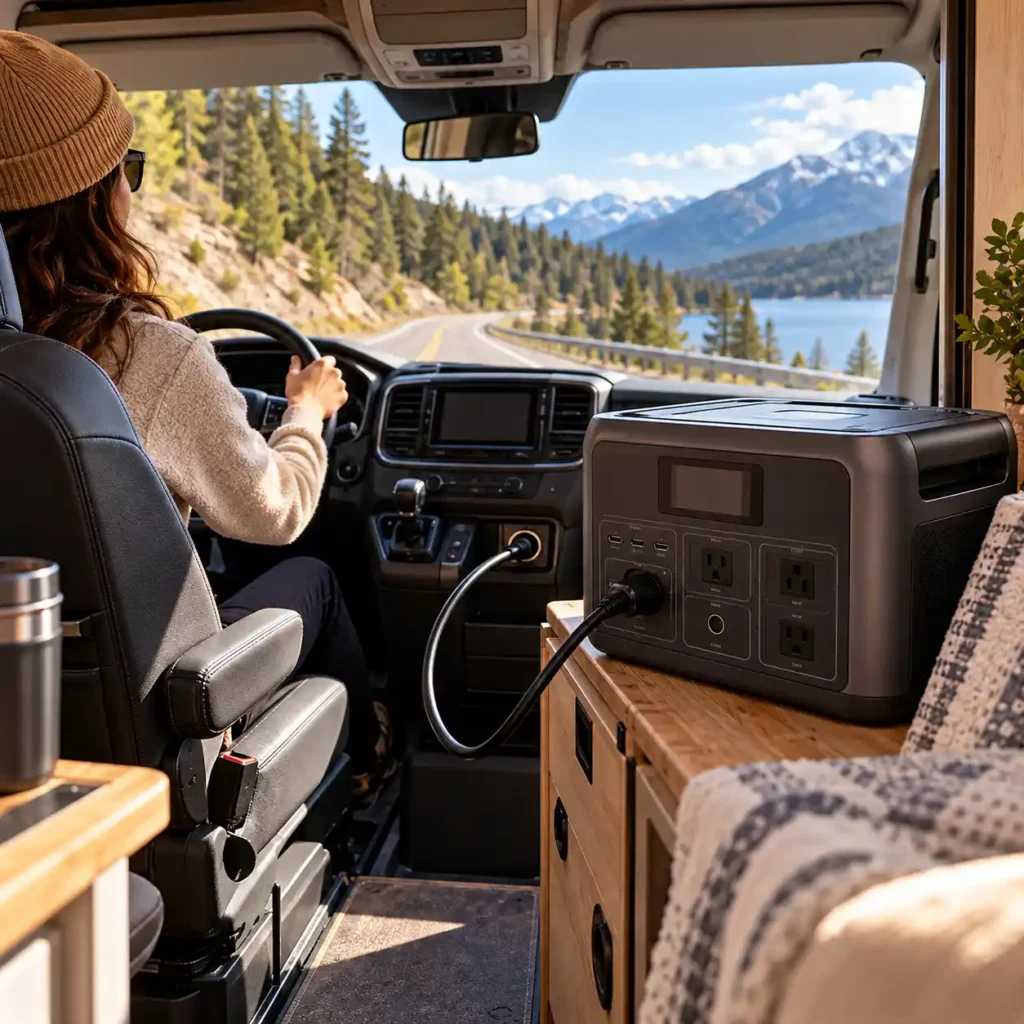
For van life, driving is more than transportation—it can also be an opportunity to replenish your battery.
If you move between locations regularly, vehicle charging can reduce your dependence on solar conditions and give you another way to recover energy during the day. The charging method you choose, however, makes a significant difference in how useful that energy source will be.
12V Car Outlet Charging
The simplest option is charging a portable power station from the vehicle’s 12V outlet.
This approach requires little additional equipment and can work well for smaller power stations or vans with relatively modest daily energy needs. It is also convenient when you want a straightforward charging method that does not require changes to the vehicle’s electrical system.
The limitation is charging speed. A standard 12V outlet may provide substantially less charging power than a dedicated alternator-charging system, so replacing a large amount of energy can take several hours.
For occasional travel, that may be perfectly acceptable. For full-time van life, especially with a higher daily energy budget, it is worth checking whether the available charging rate matches how much energy you typically use between drives.
Alternator Charging
Alternator charging can provide a much faster way to replenish a portable power station while the van is running.
Some newer power stations support high-power vehicle or alternator charging through dedicated charging equipment. This can make a meaningful difference for van lifers who drive regularly and want to recover a substantial amount of battery capacity during a normal journey.
The attraction is straightforward: instead of waiting for several hours of solar production, you can use driving time to put energy back into the battery.
However, higher-power charging should not be treated as simply connecting a large power station directly to any vehicle connection. The charging equipment, vehicle electrical system, alternator capacity, wiring, and installation method all need to be appropriate for the application.
For this reason, check the power station manufacturer’s requirements carefully before planning an alternator-charging setup.
If you are comparing portable power systems for different vehicle setups, our Best Portable Power Stations for RV (2026) guide covers the separate RV use case.
AC Charging Through an Inverter
Another possibility is to power the portable power station’s AC charger from an inverter connected to the vehicle.
This can work in some setups, but it introduces another conversion stage: the vehicle’s electrical system supplies the inverter, the inverter produces AC power, and the power station then converts that energy back into battery power.
That additional conversion can result in losses and may make the arrangement less efficient than a charging method designed specifically for vehicle use.
It can still be useful when the equipment you already have makes this approach practical, but it should not automatically be considered the most efficient way to charge a large battery while driving.
What to Check Before Connecting to a Vehicle
Before choosing a vehicle-charging method, look at the complete system rather than only the power station’s advertised charging wattage.
Check:
- Charging input: What type of vehicle charging does the power station support?
- Charging rate: How many watts can it actually accept from the vehicle?
- Vehicle compatibility: Is the charging method appropriate for your van and its electrical system?
- Installation requirements: Does it require dedicated wiring, protective components, or professional installation?
- Driving pattern: How much energy can you realistically recover during your normal journeys?
- Battery strategy: Are you using driving as your primary charging source or as a supplement to solar?
For many van-life setups, the most useful approach is not to rely on one charging method alone. Solar can replenish the battery while parked, while vehicle charging provides another opportunity to recover energy when you are on the road. Together, they can make a portable power station much more practical for continuous mobile living.
How Much Solar Do You Need for Van Life?

Solar can be one of the most useful ways to replenish a portable power station while the van is parked, but the right amount depends on how much energy you use and how much usable solar exposure your van actually gets.
The goal is not to install the maximum possible solar capacity. It is to create a charging setup that can realistically replace a meaningful portion of your daily energy consumption.
Solar Input vs. Battery Capacity
Battery capacity and solar input solve two different parts of the same problem.
A larger battery gives you more stored energy. Higher solar input gives you more potential to replenish that energy during the day. Increasing one without considering the other can create an unbalanced system.
For example, a 2,000Wh-class power station may provide plenty of overnight reserve, but if your solar setup can replace only a small amount of what you consume each day, the battery will gradually run down during extended stays.
When comparing power stations, therefore, look at battery capacity and maximum solar input together. A station with strong solar input can be particularly useful for van life because it can recover more energy during the limited daylight hours available for charging.
Roof Space and Panel Limitations
A van places practical limits on how much solar you can collect.
Available roof area, vents, skylights, roof racks, shading, and the way the van is parked can all reduce the amount of solar energy reaching the panels. A power station may technically accept a large solar input, while the van itself may not have enough usable panel area to take advantage of that maximum.
Portable panels can provide additional flexibility when you are parked, but they also require setup space and may need to be repositioned as conditions change. If you are comparing portable panel options specifically, see our Best Portable Solar Panels (2026) guide.
This is why the power station’s maximum solar-input specification should be treated as a system capability, not a guaranteed daily energy yield.
Daily Solar Replenishment
For van life, the most useful question is how much of your daily consumption solar can realistically replace.
If your van uses relatively little electricity, a modest solar setup may cover a substantial part of your daily needs. A higher-consumption setup—with refrigeration, remote work, networking equipment, cooking, and other AC loads—will require more solar energy or another charging source to maintain the battery over several days.
Weather and season also matter. Solar production can vary significantly between bright summer days and periods of cloud, shade, or shorter daylight hours.
For that reason, solar works best as part of a multi-source charging strategy. You can use solar while parked and vehicle charging while driving, with the battery providing the buffer between energy production and daily consumption. That approach is often more practical for van life than trying to make solar alone carry the entire electrical load.
What Can a Portable Power Station Run in a Van?

A portable power station can cover a surprisingly wide range of everyday van-life needs, but the practical question is not simply whether an appliance can be powered. It is how that appliance fits into your daily energy budget.
Lower-power DC devices can often run for long periods, while high-wattage AC appliances may use a significant portion of the battery in a short time. Understanding that difference helps you decide which loads should be part of your normal routine and which are better used occasionally.
12V Refrigerator
A 12V refrigerator is one of the most common continuous loads in a van.
Unlike a high-wattage AC appliance, a compressor refrigerator cycles on and off rather than drawing its maximum rated power continuously. Its actual energy consumption therefore depends on factors such as ambient temperature, temperature settings, ventilation, and how often the refrigerator is opened. For a more specific way to estimate refrigerator energy use and runtime, see our Refrigerator Runtime Calculator.
For van life, a power station with a suitable DC output can be particularly useful because the refrigerator can operate directly from DC rather than requiring AC conversion.
Because the refrigerator runs throughout the day and night, it should be included in your daily energy budget, even though its instantaneous power demand may be relatively modest.
Laptop and Remote Work
A laptop is usually a manageable load for a modern portable power station, but remote work changes the calculation because the device may operate for many hours every day.
Add a monitor, phone charging, camera equipment, or other work accessories and the total becomes more significant.
For someone working from the van regularly, battery capacity matters less as an isolated specification than the combination of daily work consumption and available recharge opportunities. Solar and charging while driving can help replenish the energy used during the working day.
Starlink and Networking
Reliable internet can become one of the more demanding parts of a remote-work setup, particularly when connectivity equipment operates continuously for extended periods.
Starlink and other networking equipment should therefore be treated as a recurring daily load rather than an occasional electronic device.
If internet access is essential for work, leave enough battery reserve to cover periods when solar production is poor or the van is stationary for several days. The power station should be sized around the complete work setup rather than the laptop alone.
Lights and Vent Fans
LED lighting and ventilation fans are generally among the easier van-life loads to support.
They may operate for several hours without consuming anything close to the energy required by high-power cooking appliances. Many ventilation and lighting systems are also naturally suited to DC power.
For this reason, these devices are unlikely to determine the required AC output of your power station. They matter more as part of the cumulative daily energy consumption.
Induction Cooking
Induction cooking is a very different type of load.
An induction cooktop can draw substantial AC power while operating, which means it places greater demands on both the inverter and the battery than a refrigerator or laptop.
That does not make induction cooking impractical in a van. It simply means you should consider both the cooktop’s operating power and how frequently you use it.
If cooking is a regular part of your routine, make sure the power station has sufficient AC output and enough battery capacity to accommodate cooking without consuming most of your available reserve.
Coffee Maker and Microwave
Coffee makers and microwaves are typically short-duration but relatively high-power loads.
A portable power station may be able to run them comfortably if its inverter has sufficient continuous output and the appliance’s startup requirements are within the system’s capabilities. The larger issue is how much energy these appliances consume relative to your overall daily budget.
Using a coffee maker for a few minutes is very different from relying on an electric cooking appliance for most meals. In a van, high-power appliances are therefore best evaluated by looking at both watts and usage time.
The key takeaway is simple: a power station does not need to run every appliance simultaneously to be useful. A well-matched van-life setup prioritizes the loads you use every day, provides enough AC output for the appliances you actually rely on, and has enough charging capacity to replenish the energy you consume.
Common Mistakes When Choosing a Van Life Power Station

Choosing a power station for van life is easier when you avoid a few common mismatches between the equipment and the way you actually travel.
Choosing Capacity Without Considering Charging
A large battery gives you more stored energy, but it does not solve the problem of replacing that energy.
If you spend several days parked, your solar setup and other charging sources need to provide enough energy to keep the battery from steadily running down. Consider capacity and recharge opportunities together rather than choosing the largest battery available.
Focusing Only on AC Output
A high inverter rating can look impressive, but many everyday van loads are relatively small DC devices.
If your setup relies heavily on a 12V refrigerator, fans, lights, or other DC equipment, pay attention to the station’s DC outputs as well as its AC capability.
Ignoring Vehicle Charging
For travelers who drive regularly, the vehicle can be an important charging source.
A power station that supports only slow 12V charging may behave very differently from one designed for substantially faster vehicle or alternator charging. Check the actual charging method and rate before assuming that driving will quickly replenish the battery.
Buying More Weight Than You Need
Extra battery capacity comes with extra weight and storage requirements.
A larger power station may provide useful reserve for full-time van life, but carrying a heavy unit that rarely gets used to its full potential can make everyday life less convenient. Consider where the station will be stored and how often you will need to move it.
Choosing a Station That Does Not Match Your Cooking Habits
High-power appliances can change the requirements of an otherwise modest van setup.
If you regularly use an induction cooktop, microwave, or coffee maker, make sure the station’s AC output can handle those appliances. If these loads are only occasional, you may not need to size the entire system around them.
Treating the Power Station as the Entire Electrical System
A portable power station can cover a substantial part of van life, but it is not automatically the right architecture for every vehicle.
If you have extensive permanently installed loads or want the electrical system fully integrated into the van, a built-in system may be more appropriate. Decide first how you want the van’s electrical system to function, then choose the portable power station around that role.
Runtime Examples
Runtime in a van depends on the actual energy used by your appliances, how often they run, and how quickly you can recharge the battery. For a broader explanation of runtime, battery life, and the factors that affect how long a power station can operate, see our How Long Does a Power Station Last? guide. The examples below are therefore illustrative scenarios, not guaranteed runtimes.
Basic Weekend Van
A lighter weekend setup might include a 12V refrigerator, LED lights, ventilation, phones, cameras, and occasional laptop use.
For this type of van life, a 1,000Wh-class power station may provide a practical amount of stored energy, particularly when the van is driven regularly or receives some solar charging during the trip.
The emphasis is less on carrying several days of reserve and more on having enough capacity to cover normal use between charging opportunities.
Full-Time Van Life
Full-time living usually adds more continuous and recurring loads: refrigeration, ventilation, electronics, lighting, cooking, and longer periods spent without driving.
A 2,000Wh-class power station can provide substantially more breathing room for this type of use, especially when combined with solar or vehicle charging.
However, even a larger battery should not be viewed as a substitute for a reliable replenishment strategy. Several days of high consumption without meaningful charging can eventually deplete any portable battery.
Remote Work + Starlink
A remote worker may use a laptop, monitor, networking equipment, phones, and Starlink for several hours each day in addition to normal van loads.
In this scenario, battery capacity becomes more important because work and connectivity are recurring daily requirements rather than occasional loads. A 2,000Wh-class station can provide more reserve between charging opportunities, while solar and driving can help replace the energy consumed during the day.
Higher-Energy Van Life
A higher-consumption setup may combine refrigeration and electronics with frequent induction cooking, coffee making, microwave use, or other AC appliances.
Here, both battery capacity and inverter output become important. A larger power station can provide more reserve, but regular high-power use also increases the amount of energy that needs to be replenished.
For these setups, the practical question is not simply how long the battery will last. It is whether your combination of battery capacity, solar input, and vehicle charging can keep up with your typical daily consumption.
Portable Power Station vs. Built-In Van Electrical System
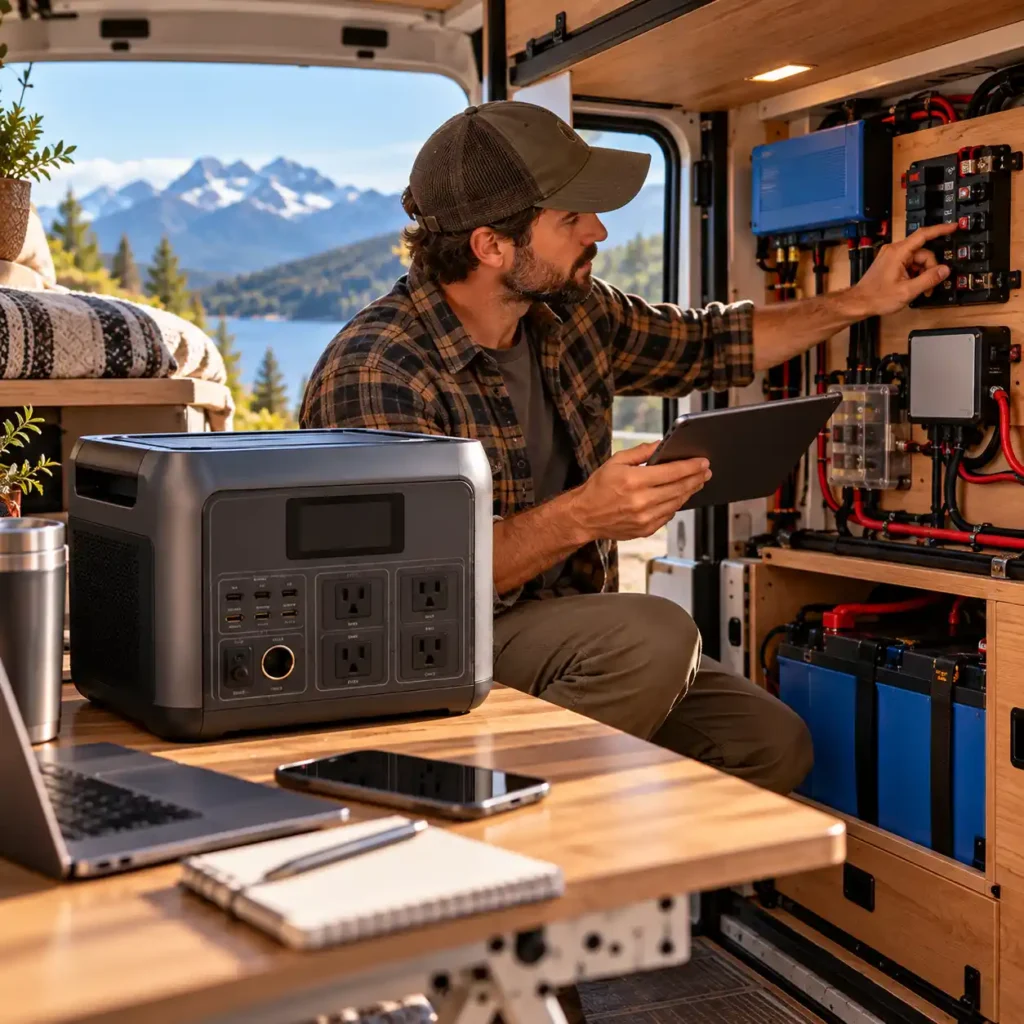
A portable power station is not the only way to power a van. For some travelers, its simplicity and flexibility are exactly what they need; for others, a permanently installed electrical system makes more sense.
The main difference is how closely you want your power system integrated with the vehicle.
A portable power station is a strong fit when you want a self-contained system that can be installed without extensive vehicle modifications and moved when necessary. It can also make sense for rented vans, frequently changing setups, or travelers who want to use the same battery outside the vehicle.
A built-in system is designed around the van itself. The battery, charging equipment, wiring, and electrical distribution become part of the vehicle rather than a separate piece of equipment. This can be useful for full-time van living where fixed electrical loads and permanent installation are priorities.
When a Portable Power Station Makes Sense
A portable system can be particularly practical when:
- You want to avoid a complex permanent installation.
- You use the van for both short trips and longer adventures.
- You want to take your power source outside the van.
- Your vehicle or van conversion may change in the future.
- You prefer a self-contained system that can be upgraded or replaced independently.
Its biggest advantage is flexibility. You can start with the capacity you need now and, depending on the model, add expansion batteries later rather than designing the entire vehicle around a fixed electrical system from the beginning.
When a Built-In System Makes More Sense
A permanent electrical system becomes more relevant when the van is your long-term living space and you want the power infrastructure integrated into the vehicle.
It can be better suited to setups with multiple permanently installed loads and a charging system designed specifically around the vehicle. The trade-off is greater planning, installation complexity, and less flexibility if your needs or vehicle change.
For full-time van life, the decision therefore comes down to how much of your electrical system you want to be part of the van itself. If you are specifically comparing portable power with a more permanent RV-oriented setup, see our Best Portable Power Stations for RV (2026) guide.
The Practical Middle Ground
The choice does not always have to be completely one or the other.
A portable power station can serve as the primary battery for a relatively simple van setup, while a more developed van can use portable power as an additional source alongside its built-in electrical system.
For travelers who value flexibility, a portable power station can therefore provide a useful middle ground: enough capacity and output for everyday van life without requiring the entire vehicle to be designed around a permanent battery installation.
Frequently Asked Questions
What Size Portable Power Station Do I Need for Van Life?
The right size depends on your daily energy use and how often you can recharge. A 1,000Wh-class station can suit lighter weekend setups, while a 2,000Wh-class model provides more reserve for full-time van life, remote work, and higher daily consumption. Charging opportunities from solar and driving are just as important as battery capacity.
Can I Charge a Portable Power Station While Driving?
Yes. Many portable power stations can charge from a vehicle’s 12V outlet, while some models support substantially faster charging through dedicated alternator-charging equipment. The charging rate varies considerably, so check the station’s supported vehicle input before relying on driving as a major charging source.
Can a Portable Power Station Replace a Leisure Battery in a Van?
For some setups, yes. A portable power station can serve as the primary battery for a simpler van configuration, particularly for weekend travel or moderate electrical loads. Full-time users with extensive permanently installed equipment may prefer a built-in electrical system or a combination of both.
Can a Portable Power Station Run a 12V Refrigerator?
Yes. A compatible portable power station can run a 12V refrigerator, and using a suitable DC output can avoid unnecessary AC conversion. Actual runtime depends on the refrigerator, ambient temperature, settings, and how often it cycles.
Can a Portable Power Station Run Starlink in a Van?
Yes. A suitable power station can run Starlink and other networking equipment, provided its output and available energy match the setup. Because Starlink can operate for extended periods, it should be included as a regular daily load when planning power for remote work.
How Long Will a 2,000Wh Power Station Last in a Van?
There is no single runtime because van loads vary significantly. A setup using mainly a refrigerator, lights, and electronics can consume much less energy than one that also uses induction cooking or other high-power AC appliances. Solar and vehicle charging can also extend practical operating time between full battery charges.
Is 1,000Wh Enough for Van Life?
It can be enough for lighter van-life setups, especially for weekend travel with modest electrical loads and regular opportunities to recharge. It becomes less suitable when you work remotely, use Starlink extensively, cook electrically, or spend several days without reliable charging.
How Much Solar Do I Need for a Van Life Power Station?
The amount depends on your daily consumption, available roof or portable-panel space, weather, and the power station’s maximum solar input. Rather than matching solar to battery capacity alone, aim for a setup that can realistically replace a meaningful portion of the energy you use each day.
Are Portable Power Stations Safe to Use Inside a Van?
They can be used in a van when operated according to the manufacturer’s instructions. Keep the unit stable, allow appropriate airflow, protect it from excessive heat and direct sun, and follow the manufacturer’s requirements for charging and storage. Unlike fuel-burning generators, portable battery stations do not produce exhaust fumes.
Is a Portable Power Station Better Than a Built-In Van Electrical System?
Neither approach is universally better. A portable power station offers simplicity, flexibility, and portability, while a built-in system can make more sense when the electrical infrastructure is intended to be permanently integrated into a full-time van. The right choice depends on how the van is used and how much electrical infrastructure you need.
Final Verdict
The best portable power station for van life is not necessarily the one with the largest battery or the highest output. It is the one that fits your daily energy needs, charging routine, available space, and way of living on the road.
For most van lifers, a 2,000Wh-class station offers a useful balance of reserve and capability, while a lighter 1,000Wh-class model can make more sense for compact vans, shorter trips, and lower daily consumption. If you work remotely, rely heavily on Starlink, cook with electricity, or spend several days away from reliable charging, additional capacity and stronger replenishment options become more important.
Among the models in this guide, the Anker SOLIX C2000 Gen 2 stands out as our Best Overall choice because it combines substantial capacity with strong AC output, solar charging, alternator charging, and expansion potential without moving into the extreme weight of some larger systems.
The EF ECOFLOW DELTA 3 Plus is particularly well suited to compact vans where weight and storage matter, while the Jackery Explorer 2000 v2 offers a practical 2kWh-class option for travelers who want substantial reserve without choosing one of the heaviest models.
For full-time, higher-energy van living, the BLUETTI AC200PL provides greater capacity and expansion potential, although its weight makes the trade-off significant. The EF ECOFLOW DELTA 2 Max is especially relevant for travelers who expect solar to play a major role in their charging strategy.
Ultimately, the most important decision is not simply how much battery you can carry. It is whether your power station, solar setup, vehicle charging, and daily consumption work together as a sustainable energy cycle.
Choose the model that fits that cycle, and your portable power station can become a dependable part of everyday van life rather than simply another piece of equipment to carry.
Power Ready Guide Commitment
At Power Ready Guide, we believe choosing backup power should start with how you actually use electricity, not with the biggest numbers on a product page.
For van life, that means looking beyond battery capacity and considering the complete energy cycle: daily consumption, 12V and AC loads, solar availability, charging while driving, available storage space, and how the system fits into your travel routine.
Our recommendations are based on published product specifications, practical use-case analysis, and the trade-offs that matter in real-world van living. We do not treat a higher capacity, higher output, or larger solar input as automatically better.
Our goal is simple: help you choose a portable power station that fits your van, your energy needs, and the way you actually live on the road.