
Choosing between a portable power station and a generator is not simply a matter of deciding which product produces more electricity.
Both can provide backup power when the grid is unavailable, but they solve the problem in fundamentally different ways. A portable power station stores electrical energy in a rechargeable battery. A fuel generator produces electricity while its engine is running.
That difference affects almost everything that matters during an outage or off-grid trip: how long you can run your equipment, how much power you can draw at once, where you can operate the system, how much noise it makes, how much maintenance it requires, and what happens when the stored energy or fuel runs out.
For a short outage, camping trip, apartment, RV, home office, or essential electronics, a battery-based power station can be highly practical. A generator becomes more relevant when you need sustained high-power output, extended operation, or the ability to restore power simply by adding more fuel.
The right choice depends on your load, required runtime, operating location, recharge or refueling options, and tolerance for noise and maintenance.
This guide compares a portable power station vs generator across the factors that actually affect real-world performance, so you can determine which type of backup power fits your situation.
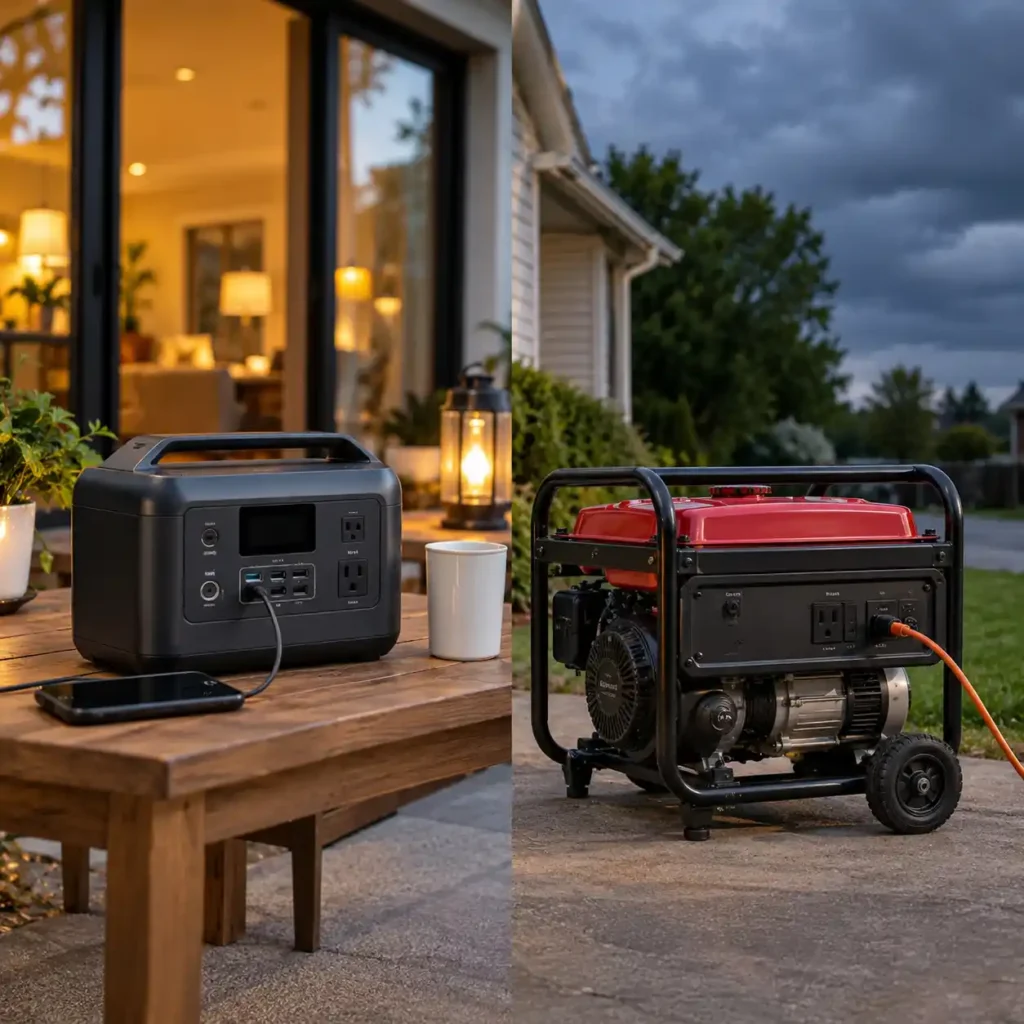
Table of Contents
Quick Answer
The simplest way to understand a portable power station vs generator is this:
A portable power station stores electricity. A generator produces electricity.
A portable power station uses a rechargeable battery and an inverter to supply electricity to connected devices. Depending on the model, it can be recharged from an AC outlet, solar panels, a vehicle, or other supported sources.
A fuel-powered generator uses an internal combustion engine and alternator to generate electricity while it is operating. As long as the generator has an appropriate fuel supply and is operated within its specifications, it can continue producing electricity after its initial tank is depleted.
This creates a fundamental trade-off:
| Factor | Portable Power Station | Fuel Generator |
|---|---|---|
| Energy source | Stored battery energy | Fuel converted to electricity |
| Runtime | Limited by usable battery capacity | Extended by adding fuel |
| Noise | Very low; cooling fans may be audible | Engine noise varies by model and load |
| Exhaust emissions | None during battery operation | Produces combustion exhaust and carbon monoxide |
| Indoor operation | No combustion exhaust; follow manufacturer instructions | Never operate indoors |
| Refueling / recharging | AC, solar, vehicle, or supported sources | Gasoline, propane, diesel, or other specified fuel |
| Maintenance | Generally low | Engine and fuel-system maintenance required |
| High continuous loads | Limited by inverter and battery system | Often better suited to sustained high loads |
| Portability | Often easy to move, but larger units can be heavy | Portable models can be heavy and require fuel handling |
Neither technology is universally suitable for every situation.
A power station may be the more practical solution when quiet operation, low maintenance, indoor use, portability, and short-to-moderate backup periods matter most.
A generator may be more appropriate when high continuous power, long-duration operation, and rapid refueling are more important.
The key is to evaluate the actual job before choosing the equipment.
Portable Power Station vs Generator: What Is the Difference?
The biggest mistake in this comparison is treating a portable power station and a generator as if they were simply two versions of the same machine.
They are not.
The distinction begins with where the electrical energy comes from.
A portable power station starts with energy stored in a battery. When you connect an appliance, the battery supplies DC energy to an inverter, which converts it into AC electricity when required.
A generator starts with chemical energy stored in fuel. Its engine converts that fuel into mechanical energy, which drives an alternator and produces electricity.
In simplified terms:
Portable power station:
Battery → Inverter → Appliance
Fuel generator:
Fuel → Engine → Alternator → Appliance
This fundamental difference affects how the two systems handle runtime, recharging, noise, emissions, maintenance, and extended use.
A battery has a finite amount of stored energy. Once that energy is depleted, the power station must be recharged.
A generator can continue producing electricity as long as it has an appropriate fuel supply and remains within its operating limits.
This is why comparing only the advertised wattage can produce a misleading result.
Two systems can have similar output ratings but behave very differently during extended use.
How a Portable Power Station Works
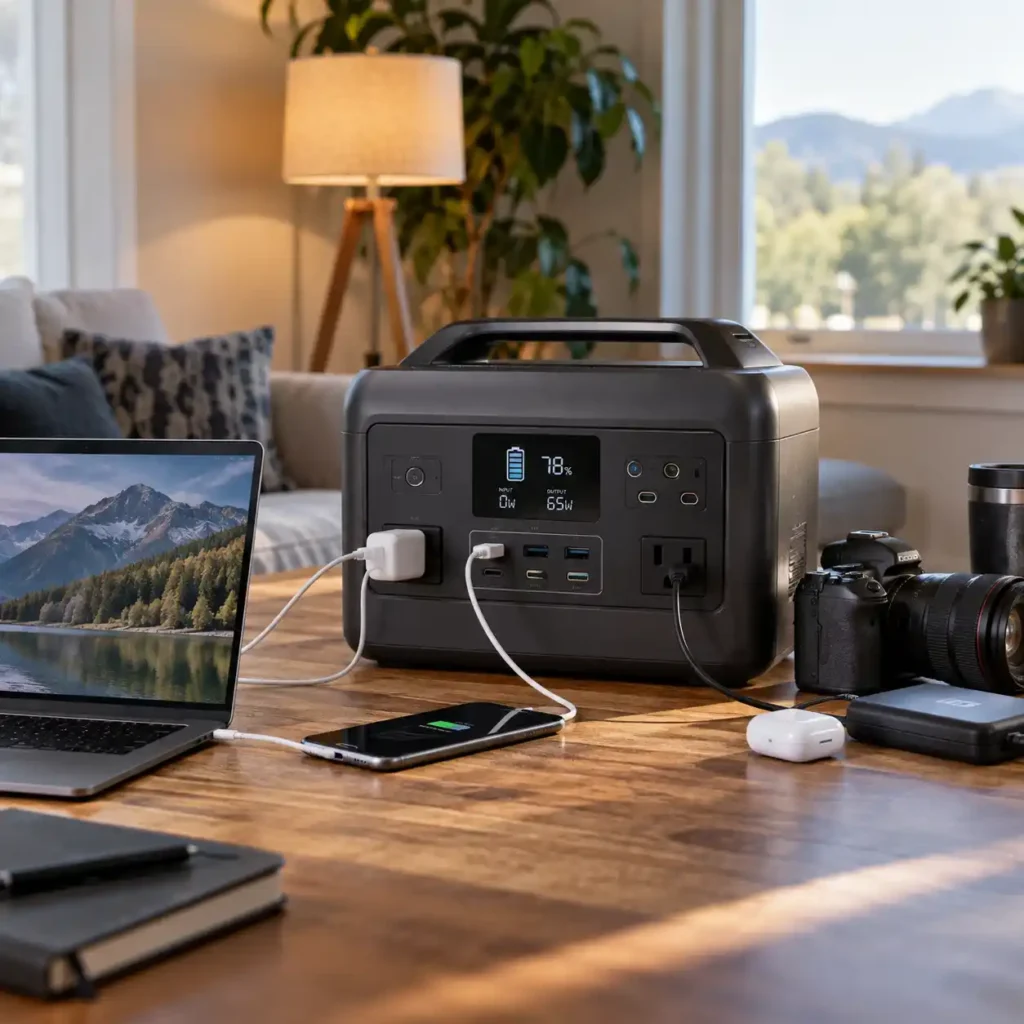
A portable power station is essentially a rechargeable battery system combined with power electronics and multiple output options.
A typical unit may contain:
- A lithium battery pack
- Battery management electronics
- An inverter for AC output
- AC outlets
- USB ports
- DC outputs
- A charging system
- Protection circuitry
- A display or app for monitoring
- Solar input on many models
The battery stores energy in watt-hours (Wh).
The inverter determines how much electrical power the system can provide at a given moment, expressed in watts (W).
For example, a power station might have:
- 2,000Wh battery capacity
- 1,800W continuous AC output
- 2,700W surge output
Those numbers describe three different things.
The 2,000Wh figure describes stored energy.
The 1,800W figure describes the approximate maximum continuous AC load the inverter is designed to support.
The 2,700W figure describes its temporary surge capability under the manufacturer’s specified conditions.
A 2,000Wh battery therefore does not mean that the power station can automatically run a 2,000W appliance.
This distinction is central to understanding a portable power station vs generator comparison.
How a Portable Power Station Is Recharged
Unlike a fuel generator, a battery power station does not create new energy while operating.
It must be recharged.
Depending on the model, charging may come from:
- A household AC outlet
- Solar panels
- A vehicle’s 12V system
- USB-C or other supported inputs
- Combined charging methods
Solar charging can be particularly useful during an extended outage because it provides another way to restore stored energy without relying entirely on the electrical grid.
However, solar charging is dependent on available sunlight, panel configuration, the power station’s solar-input limits, and charging conditions.
That means solar panels can extend the practical usefulness of a power station, but they do not turn a finite battery into an unlimited source of electricity.
How a Generator Works
A portable fuel generator uses an engine to produce electricity.
The engine burns fuel, turns an alternator, and generates electrical power that is delivered through the generator’s outlets.
Portable generators may use:
- Gasoline
- Propane
- Diesel
- Dual-fuel configurations
The exact fuel options depend on the model.
The critical difference is that the generator produces electricity while it is running.
If the generator is operating within its rated capacity and has an adequate fuel supply, it can continue producing electricity after the original tank is empty by safely refueling it according to the manufacturer’s instructions.
This gives generators an important advantage during prolonged outages.
A battery power station might have 2,000Wh of stored energy. A generator does not have an equivalent fixed Wh capacity in the same sense. Its potential operating duration is determined by factors such as fuel capacity, fuel consumption, load, and the availability of additional fuel.
That makes the two technologies fundamentally different when an outage lasts for several days.
Inverter Generators Are Still Fuel Generators
An important distinction is sometimes missed in online comparisons.
An inverter generator is still a fuel-burning generator.
Its electrical architecture differs from a conventional generator, and inverter generators are often designed to provide cleaner, more stable AC output and can be quieter or more efficient at lighter loads depending on the model.
But they still use an engine and fuel.
Therefore, an inverter generator does not eliminate the fundamental generator considerations of:
- Fuel supply
- Engine maintenance
- Exhaust
- Carbon monoxide
- Outdoor operation
- Refueling
The term inverter generator should not be confused with a battery power station.
If you are considering this type of fuel-powered system, our guide to the best inverter generators covers the category in more detail.
Portable Power Station vs Generator: Side-by-Side Comparison
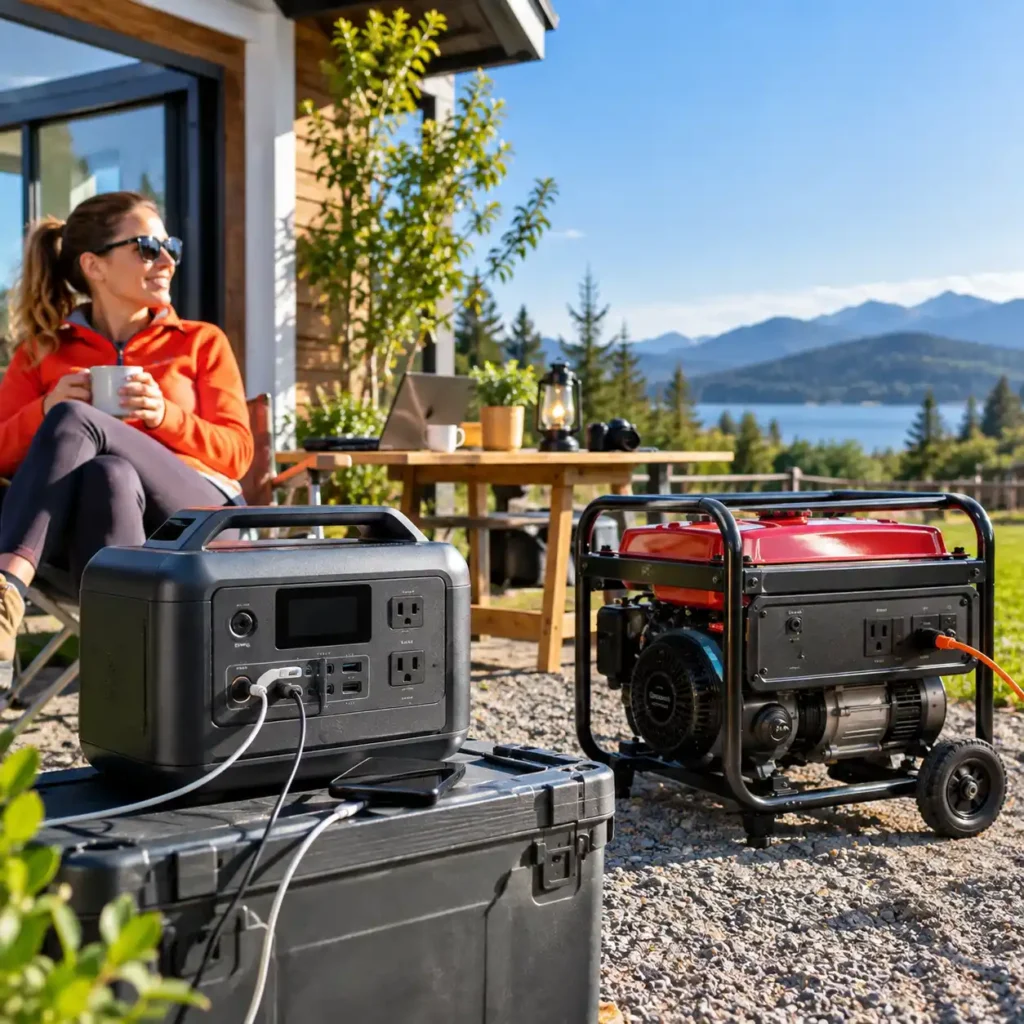
A portable power station vs generator comparison becomes much easier when you look beyond the basic power rating. The two technologies produce usable electricity in fundamentally different ways, which affects runtime, noise, emissions, maintenance, portability, and how each system can be used during an outage.
The table below highlights the most important practical differences.
| Factor | Portable Power Station | Fuel Generator |
|---|---|---|
| Energy source | Stores electricity in a rechargeable battery. | Generates electricity from fuel while the engine is running. |
| Runtime | Limited by usable battery capacity unless the unit can be recharged. | Can operate for extended periods when an adequate fuel supply is available. |
| Noise | Very quiet during normal operation; cooling fans may be audible under load. | Produces engine and exhaust noise while running. |
| Emissions | No combustion exhaust during battery operation. | Produces combustion exhaust and carbon monoxide while operating. |
| Operating location | Can be used in occupied spaces when permitted by the manufacturer's instructions. | Requires safe outdoor operation and appropriate separation from buildings. |
| Energy replenishment | Recharged from AC power, solar, vehicle power, or other supported sources. | Refueled with the appropriate fuel. |
| Maintenance | Generally low mechanical maintenance; battery care and manufacturer-specific maintenance still apply. | Requires engine, fuel-system, and scheduled maintenance. |
| High-demand loads | Limited by inverter output, surge capability, and battery capacity. | Can support higher continuous and starting loads when properly sized. |
| Portability | Ranges from lightweight units to large battery systems with wheels or handles. | Ranges from compact inverter generators to heavier portable models. |
The biggest difference is the energy model.
A portable power station stores energy first and delivers it later. A generator converts fuel into electricity while it is operating.
That difference explains many of the other trade-offs.
A battery power station can provide quiet backup without combustion exhaust, making it practical for selected loads such as electronics, lighting, communication equipment, and other compatible devices.
A generator can continue producing electricity as long as it has an appropriate fuel supply and is operated according to the manufacturer’s requirements. This can make it useful when higher power or longer-duration operation is required.
Neither technology is automatically suitable for every situation. The correct comparison depends on the loads you need to run, the required runtime, the available recharge or fuel supply, and where the system can operate safely.
Watts vs. Watt-Hours: Why the Difference Matters
This is one of the most important concepts in the entire portable power station vs generator comparison.
Watts (W) measure power.
Watt-hours (Wh) measure energy.
They answer different questions.
Watts answer:
“How much power do I need right now?”
For example, if your refrigerator, router, lights, and laptop draw a combined 300W while operating, your backup system needs to support that load.
Watt-hours answer:
“How much energy do I need over time?”
If the same 300W load were continuous for four hours, a simplified calculation would be:
300W × 4 hours = 1,200Wh
Real-world battery runtime will be lower than a simple nameplate calculation because of conversion losses, inverter efficiency, operating conditions, appliance cycling, and the usable portion of the battery.
This is why a power station needs to be evaluated using both output power and stored energy.
Why generators are different
Generators are generally specified primarily by output power, such as rated and maximum watts.
Their total operating duration depends on fuel consumption rather than a fixed battery capacity.
For example, two systems could both provide around 2,000W of output, but their behavior over a 24-hour outage could be completely different:
Battery system:
2,000Wh stored → energy is gradually depleted → recharge required
Fuel generator:
2,000W output → fuel is consumed → refuel → continued operation
The watt rating tells you what the system can potentially run.
It does not tell you how long it will run.
Runtime: Battery Capacity vs. Fuel Supply
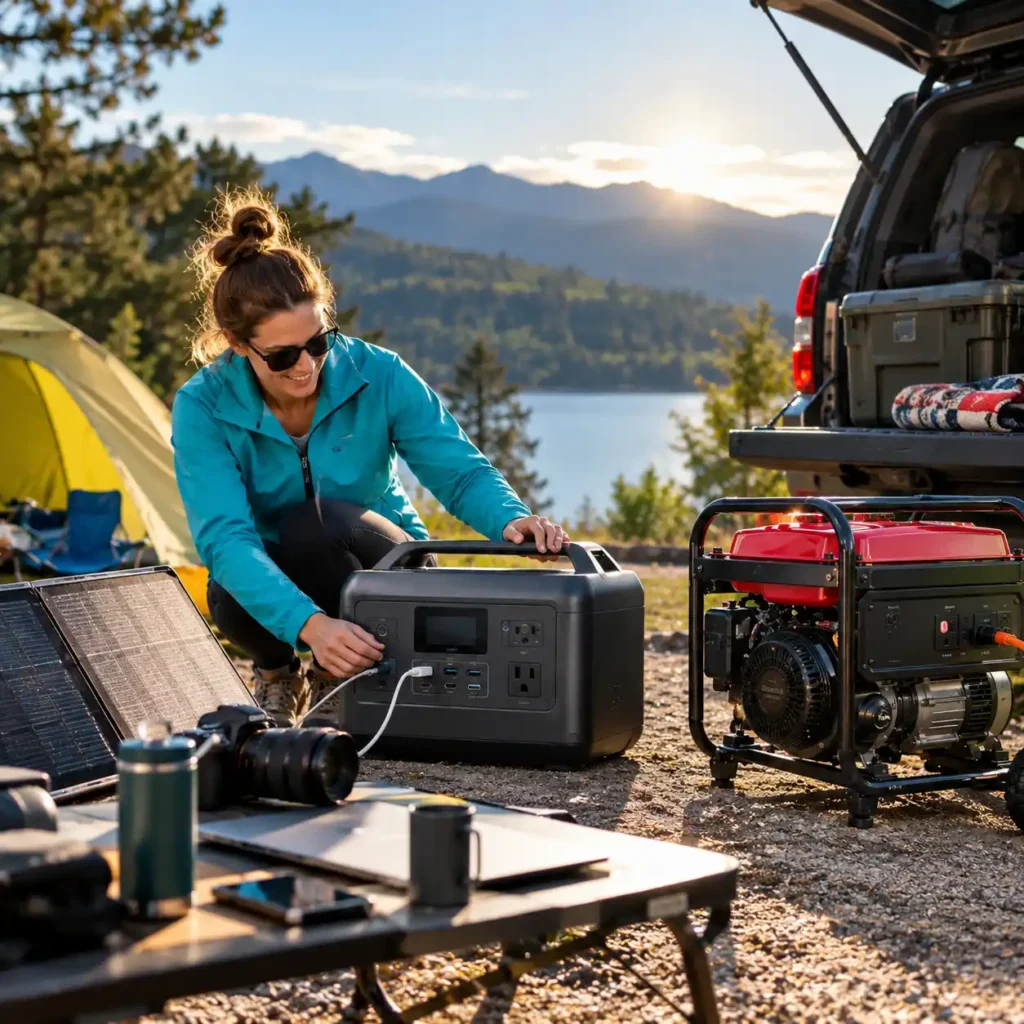
Runtime is where the difference between the two technologies becomes especially important.
Portable power station runtime
For a battery power station, a simplified estimate is:
Runtime ≈ Usable Battery Energy ÷ Load
For example, suppose a power station has 2,000Wh of rated capacity and the connected load averages 200W.
The theoretical calculation is:
2,000Wh ÷ 200W = 10 hours
But that does not mean the appliance will necessarily run for exactly 10 hours.
Actual AC runtime depends on inverter efficiency, load characteristics, battery temperature, battery condition, system settings, and other losses.
Appliances that cycle on and off, such as refrigerators, also make simple calculations less precise.
For critical backup applications, measured consumption or conservative estimates are preferable to relying only on the battery’s headline capacity.
Generator runtime
A generator’s runtime depends primarily on:
- Fuel tank capacity
- Fuel type
- Engine efficiency
- Electrical load
- Operating mode
- Generator design
A generator that consumes fuel at a relatively low rate under a light load may operate much longer than the same generator running near its rated output.
The important difference is what happens when the initial energy supply is exhausted.
With a power station, you need an appropriate charging source and enough time to recharge.
With a fuel generator, you need an appropriate fuel supply and a safe opportunity to refuel.
That distinction becomes increasingly important as an outage gets longer.
Power Output and Starting Loads
Runtime is only half of the equation.
The system also needs to be capable of starting and running the equipment you connect to it.
Some appliances have motors or compressors that can require a higher instantaneous startup demand than their normal running wattage.
Common examples include:
- Refrigerators
- Freezers
- Sump pumps
- Well pumps
- Air compressors
- Fans
- Some power tools
- Certain air-conditioning equipment
If you are unsure about the running and starting wattage of a specific appliance, use our Appliance Wattage Calculator before comparing backup systems.
This creates two separate requirements:
Continuous output:
How much power the system can supply while the equipment is operating.
Surge or starting capability:
How much additional power the system can temporarily provide when a compatible load starts.
Why this matters for a power station
A portable power station may have enough battery capacity to run a refrigerator for several hours but still fail to start it if its inverter cannot handle the compressor’s startup demand.
This is why Wh alone is not enough.
You need to compare:
Battery capacity + continuous inverter output + surge capability
Why generators can be useful for high-demand loads
Generators are often available in higher-output configurations and can be well suited to equipment that requires substantial continuous power or significant starting power.
However, the same rule applies:
The generator must still be correctly sized for the load.
A generator is not automatically capable of running every appliance simply because it uses fuel.
Large HVAC systems, well pumps, electric water heaters, dryers, ranges, and combinations of major household loads can require substantially more power than a small portable generator can provide.
This is where proper load calculation matters.
For detailed load sizing, use the site’s dedicated How to Calculate Power Consumption guide and Generator Size Calculator rather than duplicating that methodology here.
Noise, Emissions, and Where You Can Use Each System
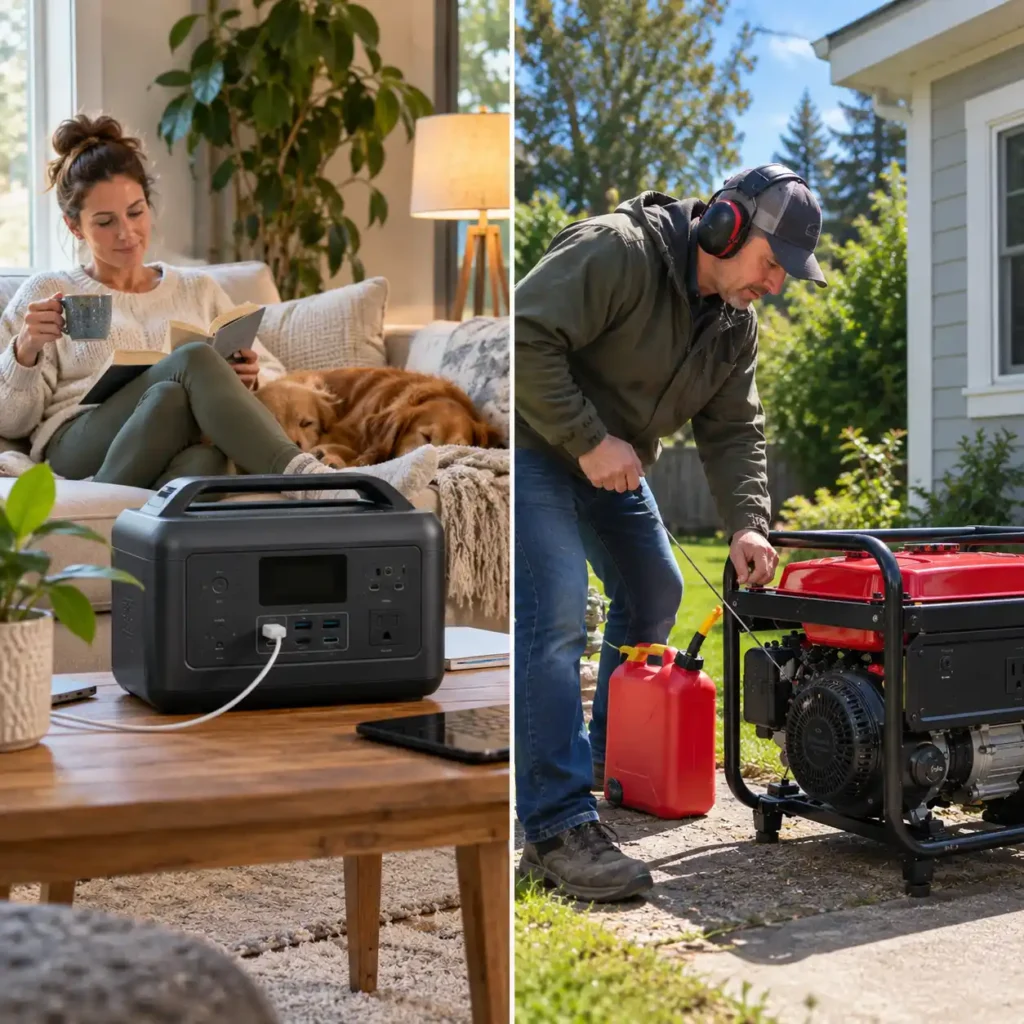
Noise and emissions are among the most visible differences between a portable power station and a generator.
A battery power station has no combustion engine. During battery operation, it produces no combustion exhaust. The main audible source may be cooling fans, particularly when the system is charging or supplying a substantial load.
A fuel generator, by contrast, has a running engine and produces combustion exhaust.
This distinction affects where the equipment can be operated.
Portable power station
A battery power station does not produce carbon monoxide through battery discharge because there is no combustion process.
That makes it fundamentally different from a fuel generator.
However, “no exhaust” does not mean “ignore the manual.” Charging, temperature, moisture, electrical loading, ventilation requirements, and other manufacturer-specific instructions still apply.
Fuel generator
A portable fuel generator must be operated outdoors.
The CDC and CPSC advise keeping portable generators at least 20 feet from homes and buildings, away from doors, windows, and vents, with exhaust directed away from the structure. For official guidance, see the portable generator safety guidelines from the U.S. Consumer Product Safety Commission (CPSC).
A generator should never be operated inside a home, garage, basement, shed, or other enclosed space, even if doors or windows are open.
This is not simply a comfort issue.
Carbon monoxide is colorless and odorless and can accumulate to dangerous levels without an obvious warning.
For generator use, appropriate carbon-monoxide detection inside the home is an important additional safety measure.
Why location can decide the purchase
Consider two otherwise similar situations.
Apartment:
There may be no safe location to place a portable fuel generator at the required distance from the building.
A battery power station can therefore solve a problem that a portable generator cannot safely solve in that environment.
Detached house with outdoor space:
A properly positioned generator may be practical, particularly when the household needs higher output or extended operation.
The technology itself does not determine the answer.
The environment in which you need the power can be just as important as the amount of power you need.
Charging vs. Refueling
One of the biggest practical differences between a portable power station and a generator is what you do when the available energy is running out.
A portable power station needs to be recharged.
A fuel generator needs to be refueled.
Neither option has unlimited energy on its own, but the logistics are very different.
Recharging a portable power station
Depending on the model, a portable power station may support:
- AC wall charging
- Solar charging
- Vehicle charging
- USB-C or other supported charging inputs
- Combined charging methods
AC charging is usually the most predictable option when grid electricity is available.
Solar charging can become particularly valuable during an extended outage because it provides an independent way to replenish the battery.
If solar is part of your recharge strategy, our guide to the best portable solar panels compares portable options for battery charging.
However, solar charging depends on conditions such as:
- Available sunlight
- Panel orientation
- Shade
- Weather
- Solar input limits
- Panel configuration
- Charging efficiency
This means a power station with solar input can have a much longer practical operating window than its battery capacity alone suggests, but it still requires enough sunlight and a compatible charging setup.
Refueling a generator
A fuel generator has a different advantage.
When the fuel tank is depleted, the energy supply can be restored by adding the appropriate fuel, provided the generator has been shut down, cooled as required, and refueled according to the manufacturer’s instructions.
This can make a generator particularly useful during long outages.
But fuel availability is part of the backup plan.
You need to consider:
- What fuel the generator uses
- How much fuel you can safely store
- How quickly the generator consumes fuel
- Whether additional fuel will be available during a widespread outage
- How fuel should be stored according to local requirements and the manufacturer’s instructions
The generator’s ability to continue operating is therefore not truly unlimited. It depends on having a safe, reliable fuel supply.
The practical difference
Think of the two systems this way:
Power station:
You need a way to put electricity back into the battery.
Generator:
You need a way to put fuel back into the generator.
For a short outage, that distinction may barely matter.
For a multi-day outage, it can become one of the most important factors in the entire decision.
Maintenance and Long-Term Ownership
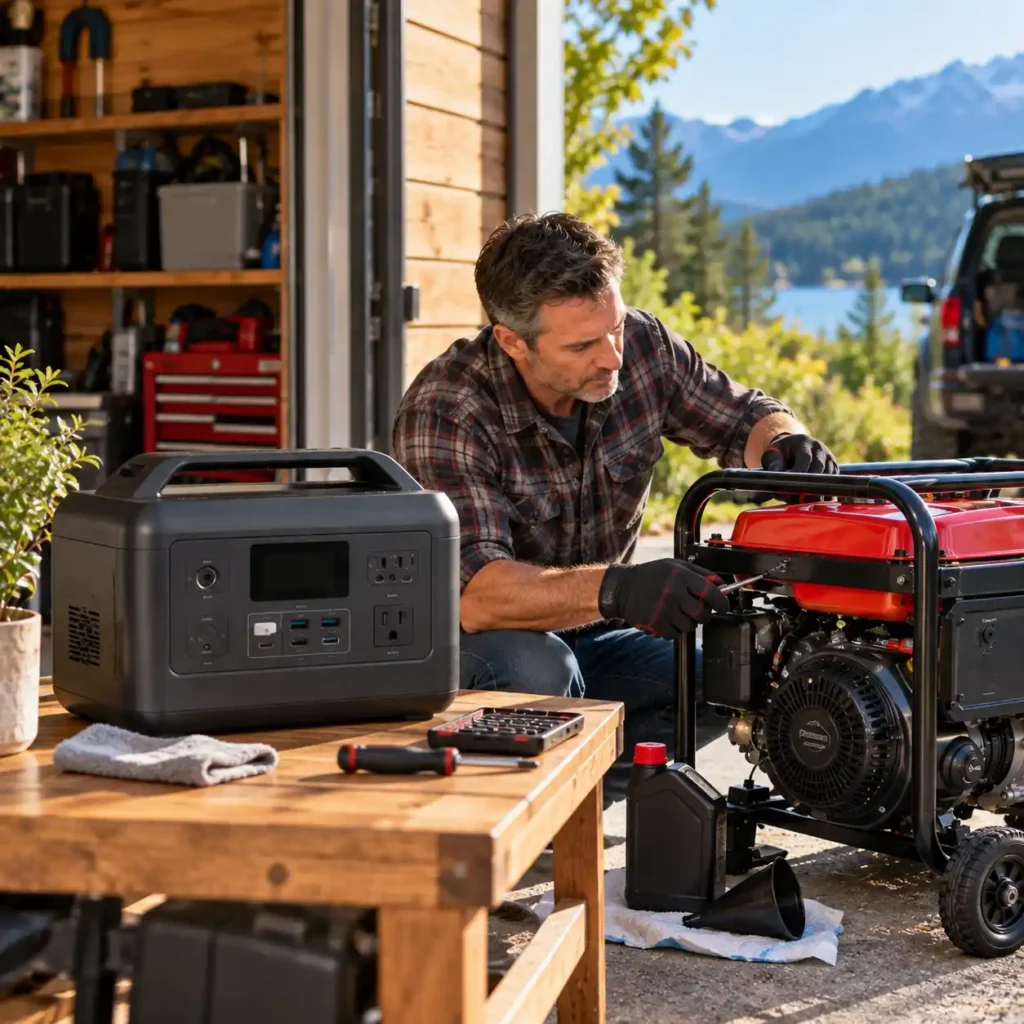
Maintenance is another area where the two technologies differ substantially.
A portable power station has no combustion engine, oil system, spark plug, or fuel system.
That means routine ownership is generally simpler.
You still need to follow the manufacturer’s recommendations for:
- Storage
- Charging
- Battery temperature
- Periodic inspection
- Firmware updates, where applicable
- Long-term battery care
A fuel generator has an engine and therefore has more mechanical maintenance requirements.
Depending on the generator, these may include:
- Engine oil
- Air filter
- Spark plug
- Fuel system
- Fuel storage
- Battery maintenance on electric-start models
- Scheduled servicing
Fuel can also create a long-term storage issue.
A generator that sits unused for long periods still needs to be maintained so that it is ready when an emergency occurs.
Why this matters during an emergency
A backup system is only useful if it is ready when the power goes out.
A battery power station can generally be kept charged and stored until needed.
A fuel generator requires a more active maintenance and fuel-management routine.
This does not make one technology universally better.
It means the two products impose different responsibilities on the owner.
If you want a backup system that can remain relatively simple and ready for occasional outages, maintenance requirements may be an important part of your decision.
If you already maintain outdoor equipment and are comfortable with engine maintenance and fuel management, the additional work may be less significant.
Portability and Practical Setup
Both products are described as portable, but portability means something different in each category.
A small battery power station may be easy to carry from a bedroom to a home office, take to a campsite, or load into a vehicle.
As battery capacity increases, however, weight can increase substantially.
Large power stations may have wheels or handles because moving several kilowatt-hours of battery storage is no longer a one-handed task.
Generators also vary considerably in size.
A small inverter generator may be relatively easy to transport, while a larger portable generator can require two people, wheels, or a dedicated transport solution.
There is another practical difference:
A generator needs an appropriate outdoor operating location.
That affects how portable it really is in an emergency.
A battery power station can often be positioned close to the equipment it needs to supply, subject to the manufacturer’s instructions and environmental limitations.
A generator may need to remain outside at a safe distance from buildings while extension cords or appropriate electrical connections bring power to the required loads.
This distinction becomes particularly important for:
- Apartments
- Condos
- Townhouses
- Campgrounds with generator restrictions
- Small properties
- Homes without suitable outdoor generator placement
Before buying a generator, determine whether you actually have a compliant location where it can operate.
Portable Power Station vs Generator for Different Use Cases
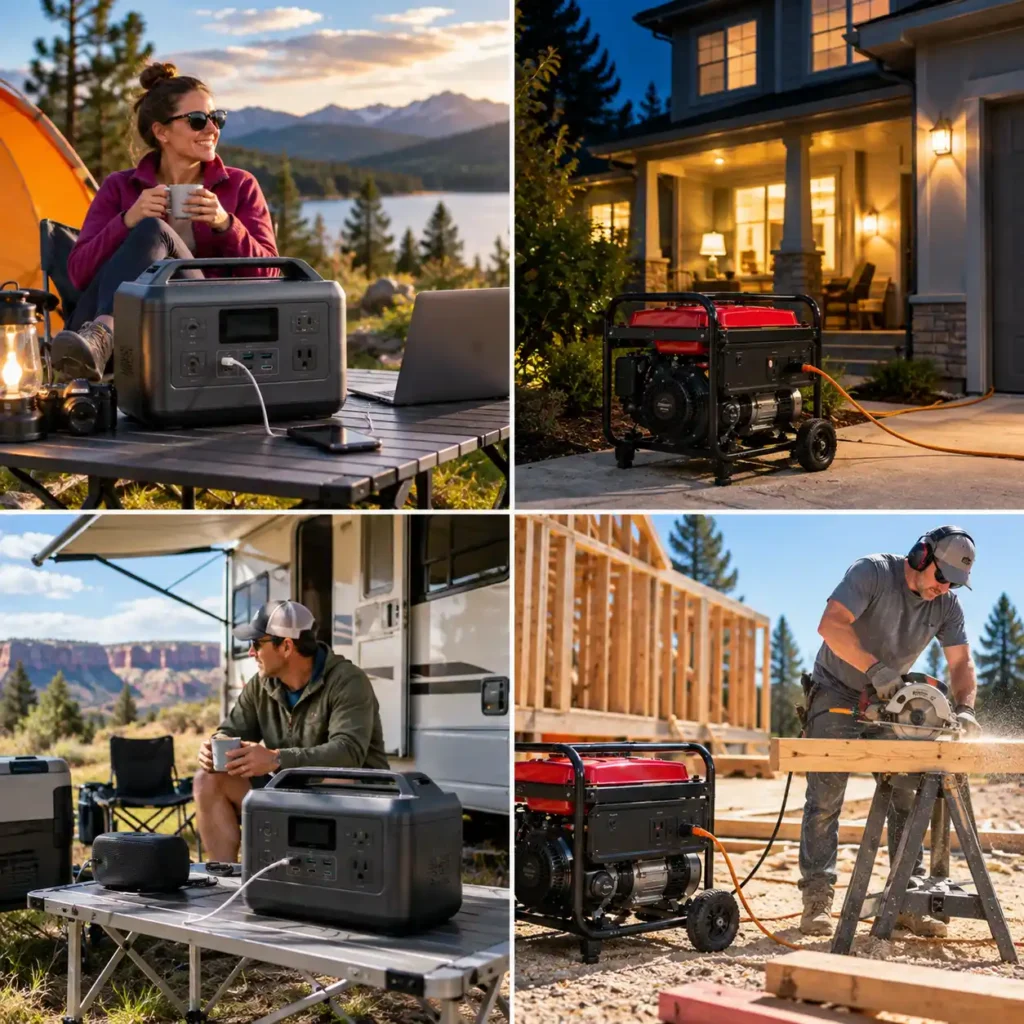
The best way to compare the two technologies is to stop thinking about the products and start thinking about the job.
The same power station that is excellent for a laptop and router may be inadequate for a central air conditioner.
The same generator that is useful for a home outage may be unnecessary for a weekend camping trip.
For Short Power Outages
A portable power station can be particularly convenient when the primary goal is to keep essential electronics and selected appliances operating for several hours.
Typical loads may include:
- Phones
- Laptops
- Wi-Fi router
- Modem
- LED lighting
- Television
- Small appliances
- CPAP equipment
- Refrigerators, when appropriately sized
The advantages are quiet operation, low maintenance, and no need to start an engine or handle fuel.
For a broader look at battery-based backup for essential household loads, see our guide to the best portable power stations for home backup.
The main limitation is the amount of stored energy.
For Long Power Outages
As the outage gets longer, the balance changes.
A power station needs a reliable recharge strategy.
That might be:
- Grid power when available
- Solar panels
- A vehicle
- Additional battery modules
- Another compatible charging source
A generator needs an adequate supply of fuel.
If fuel can be safely stored and replenished, a generator can continue operating for much longer than a single battery cycle.
This is one of the clearest situations where the duration of the outage matters more than the headline wattage of either system.
For Camping
A portable power station can be highly convenient for camping because it can provide electricity without the continuous engine noise associated with a fuel generator.
It can power:
- Phones
- Cameras
- Laptops
- Lights
- Small coolers
- Portable refrigerators
- Communication equipment
Solar charging can also reduce dependence on vehicle or grid charging.
However, capacity matters.
A large home-backup power station may provide much more energy than a weekend camping trip requires while adding considerable weight.
For camping, the ideal system is often determined by the balance between capacity, weight, charging options, and the devices you actually use.
If a battery-based system fits your camping needs, see our guide to the best portable power stations for camping.
For RVs and Vans
Both technologies can be useful for RV and van applications, but they serve different purposes.
A battery power station can provide quiet power for electronics and selected appliances without running an engine.
A generator can provide longer-duration high-power output when fuel is available.
Before choosing either option, consider:
- Battery or fuel storage space
- Required operating time
- Appliance wattage
- Air-conditioning requirements
- Solar availability
- Noise restrictions
- Ventilation and generator placement
- Vehicle charging capability
The correct choice depends heavily on the RV’s electrical system and the loads you need to support.
If you decide on a battery-based solution for RV travel, our guide to the best portable power stations for RV covers the key requirements for use on the road.
For Refrigerators and Freezers
Refrigerators are a good example of why neither wattage nor battery capacity should be considered alone.
A refrigerator’s compressor cycles rather than drawing its full running wattage continuously.
At the same time, the compressor may require higher startup power.
For a more practical estimate of battery runtime, use our Refrigerator Runtime Calculator rather than relying only on the refrigerator’s nameplate wattage.
For a power station, check:
- Continuous inverter output
- Surge capability
- Usable battery capacity
- Actual refrigerator consumption
- Required runtime
For a generator, check:
- Rated output
- Starting capability
- Fuel consumption
- Required runtime
A refrigerator can therefore be an excellent application for either technology when the system is correctly sized.
For CPAP Equipment
A power station can be convenient for CPAP backup because it can operate quietly through the night.
However, the required energy can vary significantly depending on:
- CPAP model
- Pressure settings
- Humidifier use
- Heated tubing
- Other accessories
Do not estimate overnight runtime from the CPAP’s basic wattage alone if you need dependable medical-device backup.
Check the equipment specifications and use measured consumption when possible.
If you need to estimate overnight battery runtime, our CPAP Runtime Calculator can help calculate how long a compatible battery system may operate.
For Power Tools
Power tools create a different challenge.
Many tools have motors that can create substantial starting or transient loads.
A battery power station can run some tools successfully if its inverter is appropriately rated.
A generator may be more practical when several high-power tools need to operate for extended periods.
For either system, check the actual running and starting requirements before assuming compatibility.
For Central Air Conditioning and Other Major Loads
Large HVAC systems are where many portable power stations reach their practical limits.
Central air conditioning, large well pumps, electric water heaters, dryers, ranges, and other high-demand household equipment can require substantial continuous and starting power.
A small portable battery station or portable generator should not be assumed to support these loads.
For whole-home or high-demand applications, the correct solution may instead involve:
- A larger battery backup system
- A standby generator
- A properly designed generator system
- A hybrid backup architecture
The important point is that portable does not mean whole-house capable.
For homes that require automated backup for larger household loads, see our guide to the best standby generators for home backup.
When a Portable Power Station Makes More Sense

A portable power station may be the better fit when your priorities include:
- Quiet operation
- No combustion exhaust during battery operation
- Low routine maintenance
- Indoor battery backup, subject to manufacturer instructions
- Portable selected-load backup
- Solar recharge capability
- Electronics and communication equipment
- Camping or RV use
- Shorter outages
- Easy startup
- No gasoline or propane handling
It can be especially practical when you need to keep a small number of essential devices running rather than trying to power the entire house.
If you decide that a portable power station fits your needs, our how to choose a portable power station guide explains how to evaluate capacity, output, runtime, charging, and other specifications.
A power station also makes sense when noise is a major concern.
Running a router, CPAP machine, laptop, lights, or refrigerator overnight is a very different experience when there is no engine running outside.
When a Generator Makes More Sense
A fuel generator may make more sense when your requirements include:
- Higher continuous power
- Large starting loads
- Extended operation
- Rapid refueling
- Limited access to grid electricity
- High-demand outdoor equipment
- Heavy-duty tools
- Larger household loads
The generator’s main advantage is the ability to keep producing electricity as long as the fuel supply can be safely maintained.
That becomes increasingly valuable when the outage is measured in days rather than hours.
However, this advantage comes with additional responsibilities:
- Safe outdoor placement
- Carbon-monoxide precautions
- Fuel management
- Engine maintenance
- Noise management
- Correct electrical connections
The generator therefore trades some convenience for sustained power capability.
Can You Use a Portable Power Station and Generator Together?
A battery power station could handle:
- Phones
- Internet equipment
- Lighting
- Laptop
- CPAP
- Overnight essentials
A properly sized outdoor generator could handle:
- Higher-power appliances
- Pumps
- Tools
- Larger household loads
- Battery recharging, where the equipment and connection method support it
This creates two layers of backup.
The battery handles the loads where quiet operation and convenience matter most.
The generator provides additional energy when the battery needs to be recharged or when the required load exceeds the practical capability of the power station.
However, the two systems should not be connected together arbitrarily.
Never connect a generator to a home’s electrical wiring through an improvised connection or attempt to make two power sources feed the same circuit without properly designed equipment.
If a generator is intended to supply household circuits, the connection should use an appropriate transfer mechanism installed according to applicable electrical requirements and by a qualified professional where required.
A hybrid strategy should be designed around the electrical system, not improvised during an outage.
Portable Power Station vs Generator: Cost and Long-Term Value
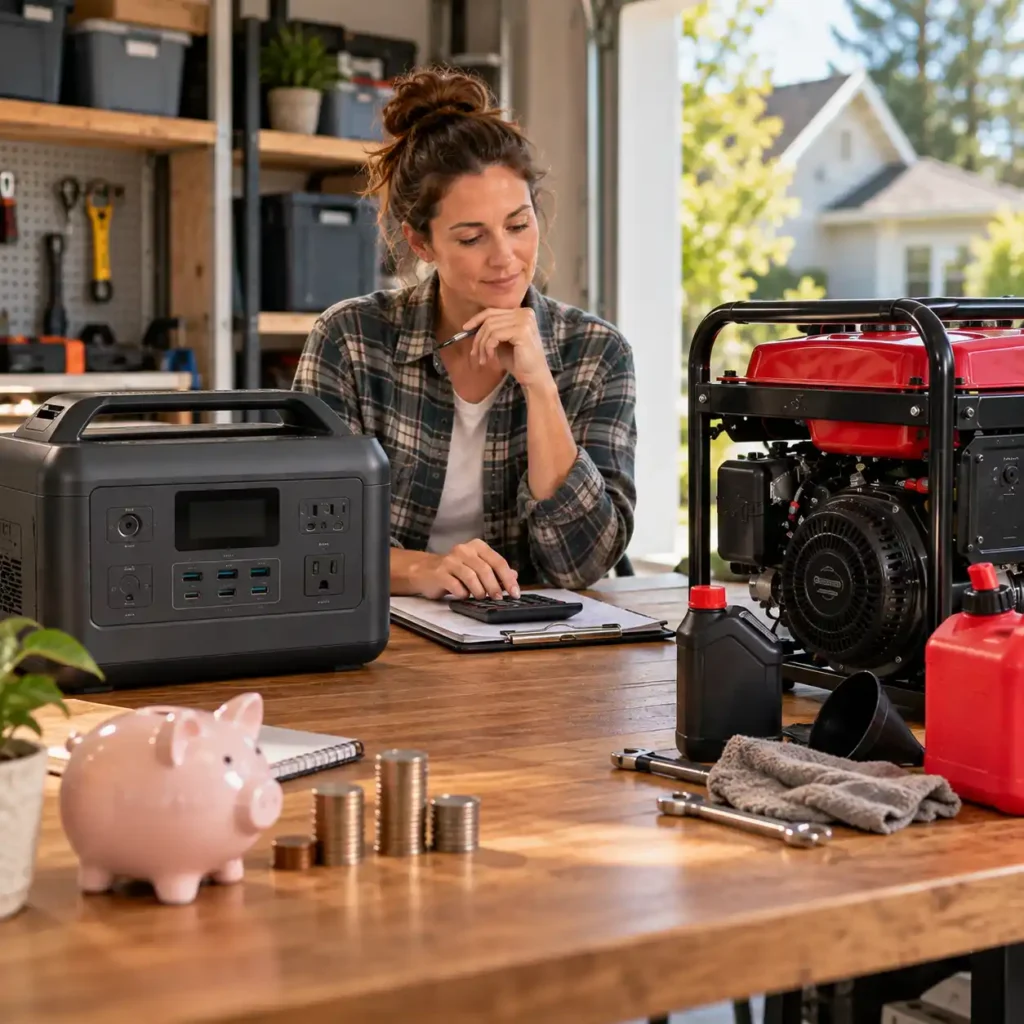
Purchase price is only one part of the comparison.
A generator may have a lower initial purchase price for a given power output, particularly when comparing high-wattage equipment.
But operating costs continue after the purchase.
A generator can require:
- Fuel
- Engine oil
- Filters
- Spark plugs
- Maintenance
- Fuel storage
- Replacement parts
A power station has a different cost structure.
Its major expense is the battery system itself, while electricity or solar energy used for charging may be less costly to operate than repeatedly purchasing fuel.
Battery degradation also matters.
The useful life of a power station depends on factors such as:
- Battery chemistry
- Number and depth of cycles
- Operating temperature
- Charging practices
- Storage conditions
- Manufacturer design
This means purchase price alone cannot determine which system costs less to own.
Compare Total Cost, Not Just the Box Price
When evaluating a portable power station vs generator, look beyond the initial purchase price and consider the full cost of ownership:
Total ownership cost = purchase price + energy or fuel costs + maintenance + required accessories and storage − any remaining value or useful service life
In practical terms, consider:
- Initial purchase — the upfront cost of the system and any essential equipment.
- Charging or fuel costs — electricity or solar charging for a power station versus ongoing fuel purchases for a generator.
- Maintenance — battery care and manufacturer-specific maintenance for a power station versus engine oil, filters, spark plugs, and other service requirements for a generator.
- Accessories and storage — items such as charging equipment, solar panels, fuel storage, or other equipment required for your intended setup.
- Expected service life — how long the system can reasonably remain useful under its operating and storage conditions.
- Replacement or expansion costs — future battery replacement or expansion for a power station, or replacement parts and repairs for a generator.
The actual cost advantage depends on how often you use the system, how much energy you need, how long you keep it, and what ongoing costs your setup requires.
This is why purchase price alone cannot determine which system costs less to own.
Common Mistakes When Choosing Between a Portable Power Station and Generator
Comparing Only Wattage
Two systems with similar watt ratings can have completely different runtime characteristics.
Ignoring the Duration of the Outage
A system designed for a six-hour outage may not be appropriate for a three-day outage.
Assuming a Larger Battery Solves Every Problem
More Wh does not automatically mean more inverter output.
Ignoring Starting Power
A refrigerator, pump, or motor may require more power during startup than its normal running wattage suggests.
Buying a Generator Without Planning Where It Will Operate
Safe generator placement is a fundamental requirement, not an accessory consideration.
Forgetting the Recharge Plan
A power station without a realistic recharge strategy can become useless after the battery is depleted.
Forgetting the Fuel Plan
A generator without an adequate and safely managed fuel supply cannot provide indefinite backup.
Comparing a Battery Station With a Generator Without Considering the Actual Loads
The right comparison is not: “Which machine is more powerful?” It is: “Which system can safely provide the power and runtime my specific loads require?”
Assuming “Portable” Means “Whole-House”
Portable equipment is generally designed for selected loads unless the specific system is engineered for broader home integration.
Ignoring the Possibility of a Hybrid System
For some households, the most practical solution is not choosing one technology exclusively.
A battery system and generator can serve different roles.
The Simple Decision Framework
If you are still deciding between a portable power station vs generator, work through these questions in order.
What Do You Need to Power?
List the actual devices and appliances.
Do not start with a product.
Start with the load.
How Much Power Do They Require?
Determine the approximate running wattage of the equipment you expect to use simultaneously.
Then identify loads with significant startup requirements.
For a battery-based system, our Power Station Size Calculator can help translate your load requirements into the watts and watt-hours you need.
How Long Must They Run?
A four-hour outage and a three-day outage create very different requirements.
Estimate the required energy rather than relying only on the power rating.
Where Will the System Operate?
If you need power inside an apartment, bedroom, office, RV, or other occupied space, a fuel-burning generator is not an indoor option.
If you have a house with a suitable outdoor location, a generator may be practical.
How Will You Restore the Energy Supply?
For a power station:
How will I recharge it?
For a generator:
How will I safely obtain and store fuel?
How Much Noise Can You Tolerate?
If the equipment will operate overnight near sleeping areas, noise may become a major consideration.
How Much Maintenance Are You Willing to Manage?
A battery system generally involves less mechanical maintenance.
A fuel generator requires ongoing engine and fuel-system care.
Do You Need High Continuous Power?
If you need major HVAC equipment, pumps, electric heating appliances, or several high-demand loads simultaneously, carefully evaluate whether a portable power station has sufficient inverter output.
Would a Hybrid System Solve the Problem Better?
If you want quiet overnight backup but also need a way to handle extended outages or larger loads, combining technologies may be worth considering.
Compare the Complete System
Finally, compare:
- Purchase cost
- Runtime
- Energy source
- Recharge/refueling
- Noise
- Emissions
- Maintenance
- Portability
- Safety
- Required output
- Long-term ownership
That is a much more reliable way to evaluate a portable power station vs generator than choosing based on a single specification.
FAQ
Which Is Better for a Power Outage: a Portable Power Station or a Generator?
Neither option is universally better. A portable power station is designed for quiet, low-maintenance backup of selected loads, while a generator can provide sustained power as long as it has an appropriate fuel supply.
For shorter outages and essential devices such as a refrigerator, router, lights, phones, laptops, or CPAP equipment, a power station may provide a simpler solution. For longer outages or higher-demand loads, a properly sized generator may be more practical.
The right choice depends on what you need to power, how long the outage may last, and where the equipment can operate safely.
Can a Portable Power Station Replace a Generator?
A portable power station can replace a generator for some applications, but not all.
It can be a practical replacement when your loads are within the power station’s continuous and surge output, the battery has enough usable capacity, and you have a realistic way to recharge it.
A generator remains useful for applications that require sustained high power or extended operation where refueling is easier than recharging a battery.
Which Lasts Longer During a Power Outage: a Power Station or Generator?
A generator can generally continue producing electricity longer because it generates power from fuel while it is running. As long as the generator is designed for the operating schedule, maintained correctly, and has an adequate fuel supply, its runtime can be extended by refueling.
A portable power station has a finite amount of stored energy. Once the battery is depleted, it needs to be recharged before it can continue supplying power.
However, a power station can extend its operating time through solar, grid, vehicle, or other compatible charging methods.
Can a Generator Charge a Portable Power Station?
Yes, a generator can potentially charge a compatible portable power station through its AC output.
However, the generator’s output, the power station’s charging requirements, and the manufacturer’s instructions should all be checked before using this setup.
For a hybrid backup system, the generator can provide electricity for higher-demand loads while also recharging the battery when the equipment and connection method are designed to support it.
Can You Use a Portable Power Station Indoors?
A battery-powered portable power station does not produce combustion exhaust while operating from its battery, but indoor operation should still follow the manufacturer’s instructions for charging, temperature, ventilation, moisture, and other operating conditions.
A fuel-burning generator must never be operated inside a home, garage, basement, shed, or other enclosed or partially enclosed space because of carbon-monoxide risk.
This difference in operating environment is one of the most important distinctions between a portable power station and a fuel generator.
Can a Portable Power Station Run a Refrigerator During a Power Outage?
Yes, provided the power station has sufficient continuous output, surge capability, usable battery capacity, and runtime for the refrigerator.
The refrigerator’s compressor can require additional power when starting, while its energy consumption varies as the compressor cycles on and off.
Before relying on a power station for refrigerator backup, check the refrigerator’s actual power requirements and compare them with the power station’s output and usable capacity.
Final Takeaway
The portable power station vs generator decision is ultimately a decision about how you want your backup system to obtain and deliver energy.
A portable power station stores electricity in a battery. It can provide quiet, low-maintenance backup for selected loads and can often be recharged from AC power, solar panels, or other supported sources.
A fuel generator produces electricity while its engine is running. It can provide sustained power and extend its operating time through additional fuel, but it requires outdoor operation, fuel management, and engine maintenance.
The right choice depends on your actual situation.
Choose based on:
What you need to power → how much power it requires → how long it must run → where the system will operate → how you will recharge or refuel it → how much noise and maintenance you can accept.
For some households, a portable power station is enough.
For others, a generator is the more appropriate tool.
And for situations that combine quiet essential-load backup with prolonged or high-demand power requirements, using both technologies as part of a properly designed backup strategy can make more sense than treating them as mutually exclusive options.
The important thing is not to choose the technology first.
Define the power problem first, then choose the system that can safely solve it.